THESES, SIS/LIBRARY R.G. MENZIES BUILDING N0.2 Australian Natiooal University Canberra ACT 0200 Australia
USE OF THESES
This copy is supplied for purposes
of private study and research only.
Passages from the thesis may not.be
copied or closely paraphrased without the
written consent of the author.
A.
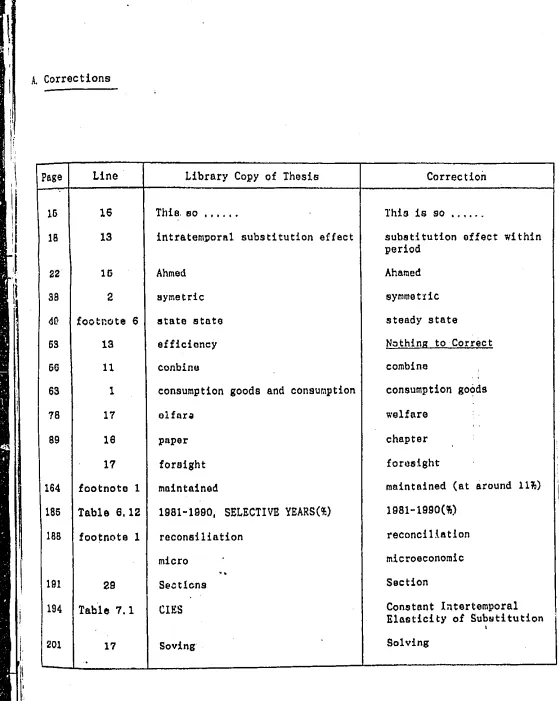
Corrections
Page
Line
Library Copy of Thesis
16 16
Thie. so , , , . , .
18
13
intratemporR1 substitution effect
22
lu
Ahmed
38
2
symetric
4fl
footnote 6
state state
53
13
efficiency
66
11
conbine
63
lconsumption goods and consumption
78 17
olfnrw
89
16
pnper
17
foraight
164
footnote 1
maintained
186
Table
6, 12
1981-1990, SELECTIVE YEARS(%)
188
footnote 1
reconsi1iation
micro
..
191
29
Sect lens
194
Table 7. 1
CIES
201 17
Sovins
.
Correction
This is so •...
substitution affect within
period
Ahamed
symmettic
steady state
N~thing
to Correct
combine
consumption goods
welfare
chapter
forllsight
maintained (at around
11~)1981-1990(%)
reconci ll.a
tlon
microeconomic
Section
[image:2.628.21.580.45.746.2]I
I,
:!'
·'
I I •Page
11 13 4644
45 5466
79 52 80 56 14 102 164 170Line
1010 - 11
16
6 -
110
17
2
1
B
8 - 9
16
6
eq(27)
4 - 5
16
19
16
195
Table7.2
209
Note
1.211 6
229 6
12 - 13
Library Copy of Thesis
Rybczynski matrix
a tariff reduction
both imports
feature
thoro
is(see
Appendix
7,2)a constant ratio
from
(A4)and
(AS)and this with(A1), and with(A3)
provides:
( a - m - b )
to yiold
•
•
Un/Un
net gains in output
increases
has be•:n an average
..
not rnuch
lowor case
z
perventage
are distinguishable
- c-t"In tho stead;v state, , . , ...
1 1 1 1 • values. "Correction
Rybczynski vector
The elements of the vector
Rpk
a proportional tariff
reduction
imports
features
there are
(see
Appendix
3.2)a ratio
fr~m
(A3) and (A4)
and this wi th(Al) provides:
( a - h - b )
to yield
(nssuming that
all goods
are normal)
•
•
Um/Um
gains in output of some
goods
increase
'
has been kept at an average
not
upper case Zs
percentage
distinguishable·
~ I t • : ' ~ • ' ~ ' ~ • r o . • - - - - _}:_ _ _ _ _ _ ~ , , '"• • • • ·, . • • I
.
'-
.... -~ ..
I
.I
~I
~
i··: '
Comment
(ii)
"Two-good
model
I I I I I 0 I I I I I. . confused. "
(3)
Data
(i)
data source,
etc.
Replr
o Chapters
3and
4deal with a respective two-good
model. But in Chapter
3there are importnbles and
nontradeables whereas Chapter 4 contains
import-nbles and exportablos.
Had we have one more good in both models
ofChapter
3and Chapter
4,the anelysos would have
~enerated
more ambiguous results, and probably
some would have analytically been impossible to
examino our issues.
Thnt
'swhy we il\troduccd the simulation chapter
which incorporates m(o3t elements of the
theoretic-al models.
These reasonings appear in
P.
188of
'
the thesis.
I
o
Tho sources of data and estimates are sufficiently
presented in pp,202-207, and the definition of
parameters is contained in pp.248-261,
(ii) "Are capital
o Capital stocks are gross stocks and do not includo
stock.,,,,.~·.
land and inventory stocks.
(Hi)
"deprecia-
o I think that
itmay be worth while conductlnj
tion rate •. "
sensitivity analysis
byemploying depreciation
re. ta 6, 6!1%,
!
r
I
')I;
,,
J
I
I
•
'
I ,
6
10
Comment
(iv) "Does the
Bank of ...
Reply
. o No, the BOK' s I-0 Tables do not report capital
stock estimates.
And note that the calculation
procedure to obtain capital stock estimates is
explained in
~203.
It seems that this examiner
did not read the calibration procedure carefully,
"introducing
o I would say that if I introduce an explicit
utility maximizing
utility maximizing role(intertemporal) !or the
role for the gover
-nment ... "
(iii)
"The
dis-cussion on
why •..
export
sector."
government, the analytic solution in Chapter 3
would be much more complicated and we may losa
tn ""m"' extent our .allin focus.
o All I try to say·here is that non-credible
liberalization could be just one possible causo
for nn increase in consumption goods imports in
Korea in 1990-91.
This is consistent with the
data given in Tablo G,S(consumer goods 6,6%-+7,0%)
{,
-Page
Line
Library Copy of Thesis
Correction
186
14
during the liberalization
during the early
Ubernli-zation
166 1-2
when the value of exports was
when an increaGo in tho value
only
U, S.5,6 billion dollars
ofexportJ was only
u.s.
2.7(3% annual increase), the val'.:•;
billion dollars, an increase
o! imports was
U.S,33,
2bill1on
in the value
o~imports was
doll ... re,
u.s.
8.4 billion dollars,
1102 11
the importable
the profit of the importable
167 2
wage to rise
factor costs tc rise
ISSUES IN TRADE LIBERALIZATION: TIMING,
SEQUENCING, SPEED AND CREDIBILITY -THEORY AND
PRACTICE IN KOREA
Cha Dong KIM
A thesis submitted for the degree of
Doctor of Philosophy
at the
Austr~lianNational University
April 1992
I
I
Declaration
Except where otherwise indicated, this thesis is my own original work.
Cha Dong KIM
ii
' ';
iii
Acknowledgements
Throughout the course of this dissertation, I have incurred a number of scholarly debts
which I gladly acknowledge. First and foremost in my g;atitude is my chair supervisor,
Dr Rodney Falvey. His time-sharing for reading and commenting on all parts of the
thesis, support, and interest have been beyond the call of duty. I am also grateful to my
sup~risory members, Professor Peter Drysdale and Dr George Fane, for their comments
on many chapters, advice, and continued encouragement.
I would also like to thank Professor Ngo Van Long, Dr Neil Vousden, and Dr Albert
Schweinberger, for their comments and suggestions on specific theoretical points in
several parts of the thesis. My special thanks go to Professor Robert Gregory who has
provided a s~imulating environment at Ph. D workshops. I also deeply appreciate the
valuable comments of Professor Richard Snape and Dr Sisira Jayasuriya at the Ph.d
Conference in Economics and Business in Perth.
Fellow colleagues in a Ph. D workshop group have been helpful in many ways,
especially, Hom Pant and Dr Changmo Ahn. Our conversations have been most useful,
and I sincerely th:;.nk them. My thanks also go to Michael Malakellis, Mike Kenderes, and
Peter Rossiter for useful discussion on a simulation work. S.:veral colleagues in Korea
were very helpful in collecting data during (and even after) my field work in Korea.
Among them, Suhyun Choi in the Ministry of Finance, Dosung Nah in the Ministry of
Trade and Industry, and Kyungku Lee in the Economic Planning Board deserve mention.
I thank all of them.
The Australian National University has provided a Ph.D scholarship, for which I am
very grateful. Finally, my wife, Eunhee, deserves special thanks since her constant
assistence and patience have been absolutely fundamental. Also, thanks to my daughters,
iv
Abstracts
The thesis discusses the dynamic effects of trade liberalization on welfare, current
~.ccc;unt
and other macroeconomic variables.
Ithighlights on 1:1e potential intert.:mporal
costs of temporary reform during the transition, and h•!:lCe focuses on the examination of
the main issues raised by these costs: timing (duration), sequencing, speed and credibility
ofreform. We examine
th~::cdynamic issues using intertem;Joral optimizing frameworks.
We first show that both the long-run and the transitional effects of trade reform depend
largely upon different assumptions on its timing and duration. We demonstrate that
temporary reform can not only bring about a current account deficit but generate welfare
costs, and is thus suboptimal to consumers. We also show that the resource rr'\llocation
objective of trade reform is to be dampened if the reform ends prematurely. Second, we
discuss how the effects of trad:· :eform under capital controls differ from the effects under
a free capital mobility regime, and show that if trade reform is temporary (or incredible)
maintaining capital controls may alleviate the intertemporal costs arisen from the
temporariness. This provides some arguments for the conventional view that trade
account should
beliberalized before the capital account.
Third, the credibility issue in trade reform is examined. We argue that if the reform is
perceived to be incredible to the public, free trade would no longer be optimal since
incredibility can act to create an intertemporal distortion. In line with this .:t.:dibility issue,
optimal speed of trade reform is also discussed. We demonstrate that grndualism may be
preferred and be optimal when there is a credibility problem in the cunent reform.
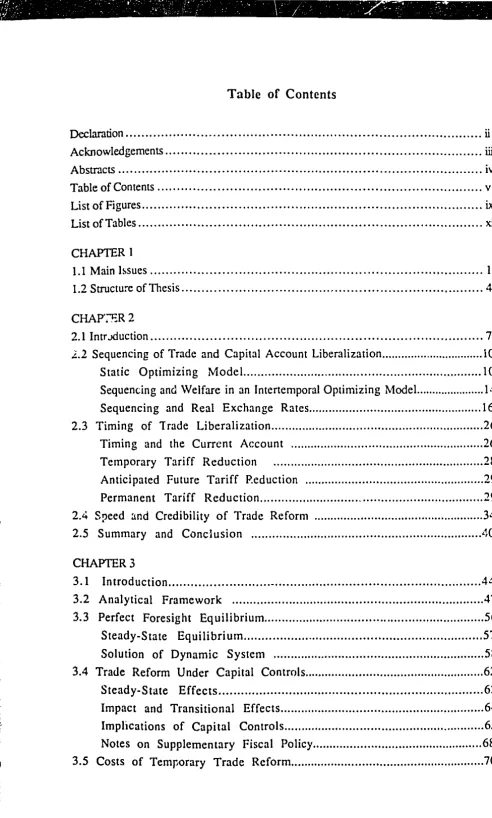
Declaration ... ii
Acknowledgements ... iii
Abstracts ... · ... iv
Table of Contents ... v
List of Figures ... ix
List of Tables ... xi
CHAPTER I 1.1 Main hsues ... I 1.2 Structure of Thesis ... 4
CHAP"~R2 2.1 lntr Jduction ... 7
.i..2
Sequencing of Trade and Capital Account Liberalization ...IO
Static Optimizing Model.. ...IO
Sequencing and Welfare in an lntertemporal Optimizing Model... ... l4 Sequencing and Real Exchange Rates ... l6 2.3 Timing of Trade Liberalization ... 26Timing and the Current Account ... 26
Temporary Tariff Reduction ... 28
Anticipated Future Tariff Reduction ... 29
Permanent Tariff Reduction ... 29
2.4 S:Jeed and Credibility of Trade Reform ... 34
2.5 Summary and Conclusion ... .'10
CHAPTER3 3.1 lntroduction ... .44
3.2 Analytical Framework ... .47
3.3 Perfect Foresight Equilibrium ... 56
Steady-State Equilibrium ... 57
Solution of Dynamic System ... 58
3.4 Trade Reform Under Capital Contrnls ... 62
Steady-State Effects ... 62
Impact and Transitional Effects ... 64
Implications of Capital Controls ... 65
Notes on Supplementary Fiscal Policy ... 68
[image:11.633.113.605.0.818.2]vi
Intertemporal Consumption Distortion ... 70
Wealth Effects ... 72
Current Account ... 76
3.6 Conclusion ... 77
APPENDIX TO CHAPTER 3 ... 79
CHAPTER4 4.1 Introduction ... !-:6
4.2 The Mode1.. ... 89
Firms ... 90
Consumers ... 94
Government ... 96
) 4.3 Dyn;•mics of the System ... 97
Steady-State Equilibrium ... 99
4.4 Steady-State Effects of Trade Liberalization ... IOI 4.5 Timing of Trade Reform and Transitional Dynamics ... J03 Permanent Trade Liberalization ... I04 Temporary Trade Liberalization ... 108
Policy Temporariness and the Current Account. ... ll2 Resource Allocation and Policy Temporariness ... ll6 Pre-Announced Tariff Cut ... ll7 4.6 Conclusion ... l20 APPENDIX TO CHAPTER 4 ... 122
C!-IAPTER
5
'.I Introduction ... l26 5.2 Suboptimality of Incredible Trade Reform ... l29 Optimal Speed of Tariff Liberalization ... l32 5.3 A More General Framework ... l34 5.4 Incredible Trade Reform, Real Wages and Welfare ... l39 Future Tariffs and Real Wages ... l41 Future Tariffs and the Current Account ... l42 Suboptimality of Jncredibile Free Trade l'·,licy ... 1455.5 Optimal Speed of Traiff Reform ... !47
5.6 Capital Account Liberalization with Future Tarif!~ ... 150
5.7 Conclusion ... l52 APPENDIX TO CHAPTER 5 ... 154
6 1 The Korean Economy: Recent Trends ... 162
':··, .. 6.2 Korea's Trade Policy: A BackgrouJJd Review ... 166
6.3 Tradr. Liberalization ... 168
Recent Trade Liberalization: 1984-1988 and 1989-1993 ... 169
Import L, ':'<:-_\ization Index ... l73 Other Mea~.: .. -. of Protection ... 173
6.4 Changing Industrial Patterns with Reform ... l74 Sectoral Production Structure ... 175
Imports and Exports... 176
Real Exchange Rates ... , ... 178
Real Wages ... ! 80
Investments by
S
.ctor ... 180Tariff Revenues ... J8J 6.5 Capital Account Libera!ization ... l82 Liberalization in CajJital Inflows ... .- ... 182
Liberalization in Capital Outflows ... l83 Full Scale Capital Account Liberalization The Next Task? ... 184
6.6 Implications on Timing, Sequencing, and Credibility ... l85 APPENDIX TO CHAPTER 6 ... 187
CHAPTER? 7 .I Introduction ... 188
. '!.' 7.2 A Simulation Model ... 192
Overview ... 192
Households ... l93 Producers ... l94 Government ... 197
Exports ... 198
Welfare ... l98 7.3 Solving the Model ... 199
Atemporal and Intertemporal Equilibrium ... 199
Numerical Solution ... 200
7.4 Data and Parameters: Calibration ... 202
Baseline Data ... 202
Parameters ... 205
7.5 Simulation Results ... 207
Timing of Tariff Reduction: Permanent vs Temporary ... 207
Degree of Temporariness ... 212
•· ·-1_
II·. _;;•
C'~
i
'
'-
. .· ·/'.
'
'
l
~:·'
'
I
i·
f
I .,.
I
.
i
I
I
-: --. ~. . : . ·~,. . . =·· - .. ·... ·~J. . =-· .
viii
Gradual vs One-sh\•l Rcfcrm: Speed ... 215
Tariff Reduction Wi~.h and Without L.•pital Controls: Sequencing ... 217
Other Experiments ... 222
7.6
Predictions of Korea·: Trade Reform: 1989-1993 ... 222If Credible or If t-i'ot Credible ... 223
S
. . .
E
.
2~47.7
ens111v11y xerctses ... .t. 7.8 Cor.clusions ... 226APPENDIX TO CHAPTER 7 ... 229
CHAPTERS 8.1 Main Issues Again ... 252
8.2 Principal Findings ... 253
8.3 Agenda for Further Study ... 255
RERFERENCES Major References ... 257
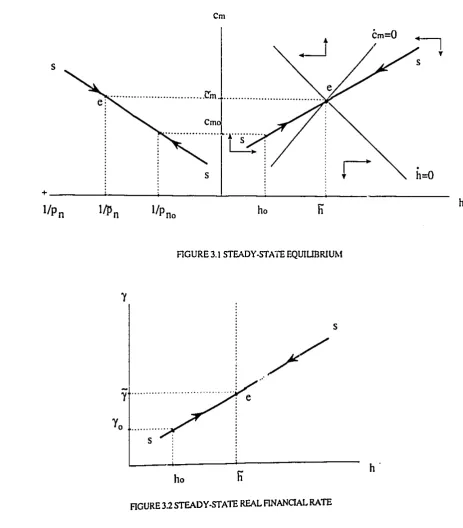
Figure 3.1 Steady-State Equilibrium ... 60
Figure 3.2 Steady-State Real Financial Rate ... 60
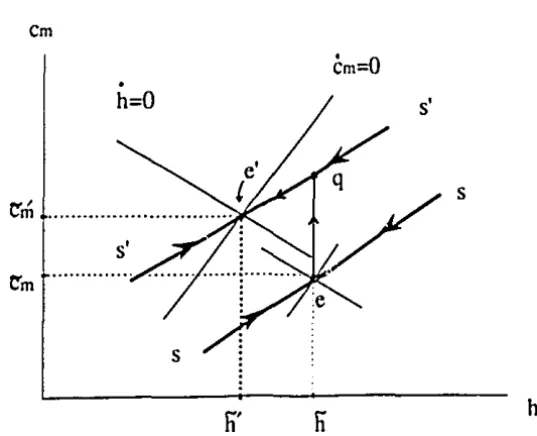
Figure 3.3 Dynamics of Trade Reform ... 64
Figure 3.4 Tract:: Reform and Real Financial Rate ... 66
Figure 3.5 Real Financial Rate Overshooting or Undershooting ... 67
Figure 3.6 Trade Reform, C:urrent Account, and Capital Control.. ... 69
Figure 4.1 Dynamics of •.he S ystem ... l 00 Figure 4.2 Permanent Tariff Cut Investment in the Exponable Sector and Its Panial Effects on the Current Account ... .! 05
Figure 4.3 Permanent vs Temporary Tariff Cut Investment in the Imponable Sector and Its Panial Effects on the Current Account ... I09 Figure 4.4 Permanent vs Temp0ra;y Tariff Cut Investment in the ExporTable Sector and Its Panial Effec(s on thr; Current Account. ... "' ... 112
Figure 4.5 Degree of Temporariness: Exportables ... ll3 Figure 4.6 Degree of Temporariness: Importables ... ll4 Figure 4.7 Pre-Announced Trade Reform: Exportables ... ll8 Figure 5.1 H.•!al Wages in Intertemporal Equilibrium ... l40 Figure 5.2 Incredible Trade Reform and Real Wages ... 141
Figure 5.3 Effects of Future Tariffs in the Case of dwt
> dwz ...
143Figure 5.4 Effects of Future Tariffs in the Case of dwt
<
dw2 ••••••••••••••••.••••••••.•. 144 Figure 5.5 Higher Wage and Decling Exports Due to Incredibility of Reform ... 146Fig•tre 5.6 Digrammatic Derivation of E(p, w, u) ... 155
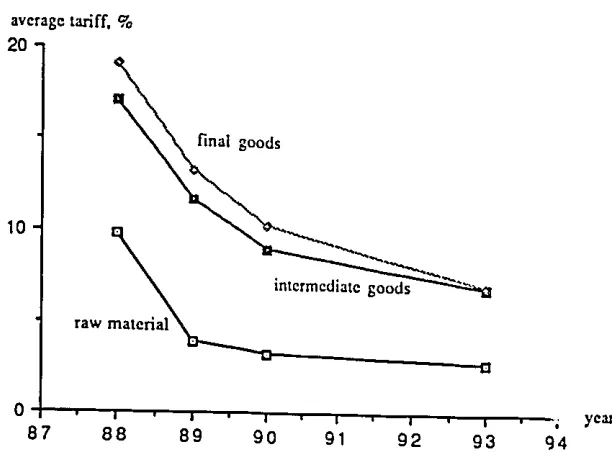
Figure 6.1 Tariff Rate by Use: Korea, 1988-1993 ... 173
Figure 6.2 Exchangl! Rate~ in Manufacturing: Korea, 1980-1990 ... 179
Figure 6.3 Rising Trend in Wages: Korea, 1980-1990 ... 180
Figure 6.4 Ratio of Tariff Revenues in Total Revenues: Korea, 1980-1990 ... 182
X
Figure 7.2 Altered Timing Announcement and Dyanmic Paths ... 216
Figure 7.3 Speed of Reform and Trade Balance ... 219
List of Tables
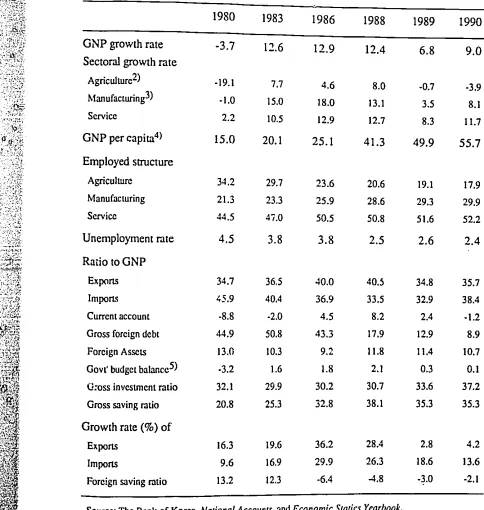
Table 6.1 Structural Economic Pattern: Korea, 1980-1990, Selective Years ... 163
. o.··.
Table 6.2 Impon Liberalization Ratio (ILR) by Industry: Korea, 1980-1991, Selective Years ... 170Table 6.3 Average tariff Rate by Industry: Korea 1982-1993, Selective Year~ ... l71 Table 6.4 International Comparison of Tariff Rates, 1988 ... 171
Table 6.5 Impon Liberalization Index: Korea 1979-1993, Selective Years ... !74
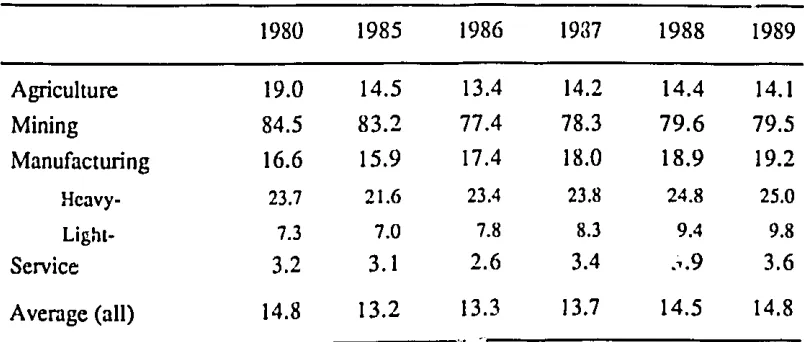
Table 6.6 Changes in Sectoral Production Structl!l'e: Korea 1980-1989, Selective Years ... 176
Table 6.7 Impon Penetration Ratio: Korea 1980-1989, Selective Years ... 176
Table 6.8 Trend in lmpons by Use: Korea 1984-1990, Selective Years ... 177
Table 6.9 Composition of Expons: Korea 1980-1989, Selective Years ... !i8
Table 6.10 Sectoral Expon-Output Ratio: Korra, 1980-1989, Selective Years ... l79 Table 6.11 Rate of Increases in Sectoral Investment Ratio: Korea, 1984-1988 ... 181
Table 6.12 Real Cost of Foreign Capital: Korea, 1980-1989, Selective Years ... 185
'~- . Table 7.1 Household Consumption Structure ... 194
Table 7.2 Industry Production Structure ... 195
Table 7.3 Industry Classification ... 203
Table 7.4 Industry Characteristics ... 203
Table 7.5 Basecase Values for Industry Behaviour ... 204
Table 7.6 Basecase Wealth ... 205
Table 7.7 Basic Parameters and Elasticities ... 206
Table 7.8 Permanent vs Temporary Tariff Reduction ... 209
Table 7.9 One-Shot vs Gradual Tariff Reduction ... 218
Table 7.10 Tariff Reform With and Without Capital Control.. ... : ... 221
Table 7.11 Tariff Reduction Schedule Korea, 1988-1993 ... 223
Table 7.12 Predictions of Korea's Tariff Reform, 1989-1993 . . ,. (Two Scenarios Credible and Incredible Cases) ... 224
d '
:o·.
'.
.-. ;; . _.,.
-·.w
;'\< :.;
... ,·-;
CHAPTER 1
INTRODUCTION
1.1 Main
Issues
This thesis deals with important issues in trade liberalization: timing, duration,
sequencing, speed and credibility. To do this, the thesis examines the dynamics of trade
liberalization under different assumptions on timing, duration, sequencing, and
credibility: pennanent versus temporary trade reform, trade reform with and without
capital controls, gradual versus one-shot trade reform, and credible versus non-credible
trade reform. Macroeconomic, welfare, and industry effects of trade liberalization are
considered. A simulation analysis of the Korea's trade reform is also conducted.
Throughout the thesis, the term
trade liberalization
refers mainly to a reduction oftariffs only. This is mainly because quant:tative import restrictions virtually no longer
exist in Korea except for some agricultural products, and accordingly, tariffs have now
become an increasingly important trade policy instrument. Also, our analyses apply
mostly for a small country.
The traditional theoretical background on tariff liberalization policy is firmly based on
fundamental and well-known principles: gains from trade and comparative advantage. For
a small country, world prices represent shadow prices and free trade is the optimal trade
policy. That is, proportional tariff cuts lower the domestic price of importables and thus
expands the feasible set of consumption possibilities, and thereby act to improve
resident's welfare. On the otl:er hand, lower import prices (for both inputs and outputs)
boost the export production while they discourage the importable industry. Hence, in the
f)
',,
,. ~., '
l
i
i
!
liberalization policy is thus in general compatible with the outward-oriented trade regime.
Trade balance would not in general be a problem in the long-run.
Several issues should be confronted, however, before leaping to policy conclusions
from this simple logic. An essential argument is that the standard principles are based on
the static analyses of the relationship between tariffs, welfare, and the trade balance,
ignoring issues involved in intertemporal resource allocation. First, the timing and the
duration of reform must be considered. For example, a temporary tariff reduction tends to
lower the price of current imports relative to future imports, which will, ceteris paribus,
increase the consumption-based real interest rate, inducing a shift of import expenditure
towards the current period. Consequently, a larger deficit in the present period's current
account would be generated than in the absence of these intert<.:mporal effects. The size of
the deficits in the current period would in part depend on the duration of a temporary
reform.
Second, there is sequencing issue between the trade and capital account. The effects of
trade reform with capital (or foreign exchange) ::ontrols are different from the effects with
no capital controls. Therefor~. if there ure restrictions on both current and capital account
transactions, the relevant question is whether the two accounts should be liberalized
simultaneously or whether there is any preferred order of liberalization. Two interrelated
aspects can be discussed: the effects on allocative efficiency and on the macroeconomic
variables. The currP.nt :w\:ount, in particular, is affected sensitively by the ordering
assumptions.
'i'hird, there remains the question of the appropriate speed of liberalization. Once
sequencing issues have been resolved, the gov~mment faces certain choices with respect to the speed of trade reform. Should the reform be implemented step by step or abruptly?
The speed of reform is important for the economy's adjustment costs. The usual
argument i~ that a full scale liberalization would speed up the beneficial effects of reform,
but would entail economic costs such as unemployment.
Finally, and more importantly, the issues of timing, sequencing, and speed are all by
..•.
,3
functionally equivalent to incredible reform [Calvo, 1988]. Also, too gradual or reluctant
a reform, i.e., trade reform which is not composed of major and intensive measures,
would likely lack credibility. The upshot of credibility considerations in trade reform is
that if the refo'111 is not fully credible, and hence if the private agents anticipate future
reversal of libenllization then reform wi!l act to create an intenemporal distonion in the
economy. If the degree of noncredibility is large, i.e., an intertemporal distortion is large,
the beneficial effects of reform would be more than offset. As Rodrik [ 1989] argues,
incredible reform in this case could be worse than no reform at all .
Despite the crucial importance of these issues, existing trade liberalization literatu~e
seemed to haw; neglected to incorporate these into theoretical as well as empirical
applications. Some analytical studies focus on each issue s·~parately. Very few studies,
however, are based on solid micro foundations. Therefore, the objective of this study is
to identify analytically various effects of alternative timing (and duration), sequencing,
speed and credibility assumptions, using intertemporal optimization frameworks. Further,
considering the limitations of theoretical studies, an intertemporal computable general
equilibrium model for the Korean economy is developed as it enables us to reexamine
these issues in a more consolidated way. It can also yield some definitive results from
which some policy suggestions can be drawn out. The specific issues and questions we
raise in this thesis are as follows.
(1) What are the effects of temporary and permanent trade reform, and how are they different in terms of their effects on welfare, saving and investment, and the current
account?
(2) Are there any economic costs of temporary trade reform? If so, what are they, and
through what cha'lnels do they occur? Are there any relations between these costs and the
degree of temporariness of reform? Under what conditions, if any, are these costs greater
as the duration of reform becomes shorter?
(3) What are the different effects of trade reform with and without capital controls?
Should capital controls be maintained until trade has been liberalized'! If so, what are the
·:~:
,,
.:.:;..
4
(4) What is the role of credibility in trade reform? And why is incredible trade reform
suboptimal?
(5) What were the basic contents of Korea's trade liberalization programs in the
1980s? Were there any changing patterns in the Korean industry during the reform
period? What were the characteristics of those reform programs in terms of timing,
sequencing, speed and credibility?
(6) Are the theoretical results in general consistent with the results obtained from a
consolidated large simulatio11 model of thi! Korean economy? What are the short- and
long-run predictions of Kort"a's pre-announced trade reform which was announced in
1988 for the period of 1989-19\13? How would these effects be different if the announced
plan is halted?
1.2 Structure
of Thesis
We organize the thesis in the following way. Chapter 2 reviews the literature related to
the issues of timing, sequencing, speed and credibility of trade liberalization. The review
organizes the arguments between the proponents and opponents with regard to the
question of sequencing.
It
also disc~sses theoretical results regarding the effects ofdifferent assumptions on the time horizon of trade reform (or exogenous external
shocks). The focus is mainly on the effects on the current accot>~.t and welfare. The
importance of the credibility of trade reform is also highlighted.
Chapter 3 establishes an intertemporal optimizing model of the balanre of payments
where the economy's current and capital accounts transactions are in tne government's
control. Trade distortion in the form of tariffs and capital account di~tordon in the form of
a dua! exchange rate regime are specified in the model. The model essentially highlights
the consumption-saving dynamics. We analyze the dynamic effects of a tariff reduction
on individual's welfare and the current account both in the steady-state and during the
transition. The relationships between trade policy temporariness and the critical variables
-·
.,,
·• ·:: _·
, . . ' .
'\-'
. , • • • • ' j · ' •• • • • . . . ,. . . . '!' • • " •• , • • ·~.;
5
welfare. We show that trade reform with capital controls may generate a smaller deficit in
the current account during the transitional adjustment, and this favours the conventional
view of "current account first" order of liberalization.
In Chapter 4, we also set up an intertemporal optimizing framework, but now focus
on the firm's investment dynamics. Adjustment costs are considered in modelling. We
examine the effects of different timing of trade reform on sectoral investment, capital
accumulation, and the current account. Timing and duration of trade reform are
demonstrated to be a key in determining the economy's dynamic adjustment. It is shown
that the dynamics in transition are qualitatively different between the exportable and the
importable industry. We also show that as the temporariness of tariff reform is higher, the
resource movement from the importable into the exportable industry is weakened, which
is likely to lead the economy to a failure of reform.
Chapter
5
highlights the role of the lack of credibility of trade reform by making use ofduality functions. Moving from a simple to a more general intertemlJc>ral framework, we
show that noncredible trade reform is suboptimal as it creates an intt>rtemporal distortion.
Free trade policy is Pareto optimal if and only if it is credible to the public. In the case that
reform Jacks credibility, we show that there exists an optimal positive tariff in the current
period, favouring gradualism. As long as the gradual implementation is innocuous to the
government's credibility level, a slower speed of rdorm is optimal.
The welfare effects of the relaxation of capital controls are also examined in this
chapter, and it is demonstrated that if the public questions the viability of the current trade
reform, then a welfare-deteriorating effect of incredible trade reform may offset the
beneficial effect of the capital account liberalization. Hence, if there is a credibility
problem of trade reform, maintaining capital controls may have the effect of equalizing
consumption across periods, which in turn supports the "trade account first" view of
reform.
Korea's trade liberalization policy is illustrated in Chapter 6. We explain the recent
trends of the Korean economy, the background of trade policy, the scope and depth of the
refonn period. Our objective here is to provide the essential background of the structure
and the size of the economy during the major refonn period in the 1980s. However, this
illustration is useful in interpreting and understanding the model and the results of the
simulation of the Korean economy in the next chapter.
In Chapter 7, we try to integrate the theoreti:al analyses into a single consolidated
model to reexamine our i:;sues in the context of the Korean economy. The simulation
model is essentially a mu!ti·sector intertemporal computable general equilibrium model of
the Korean economy, and is capable of examining not only macroeconomic effects of
timing, sequencing, speed and credibility of trade refonn, but its inter-sectoral effects as
well. The simulation results are generally consistent with the results obtained separately
from each theoretiCal framework. We also predict how the Korean economy will adjust in
response to i~s rrade refonn which was announced in 1988 for the period of 1989-1993.
Our observaticn is that the refonn program would substantially enhance the nation's
welfare if it is implemented according t~ the announcement. If, however, the plan is
interrupted into, intertemporal welfare costs will be observed.
Finally, in Chapter 8, we restate the main issues of this thesis, summarize main
findings, and draw conclusions. Also, limitations as well as possihle future extensions of
CHAPTER 2
TRADE AND CAPITAL ACCOUNT LIBERALIZATION:
SEQUENCING,TIMING, AND SPEED AND
CREDIBILITY-A SELECTIVE REVIEW OF LITERCREDIBILITY-ATURE
2.1 Introduction
7
There are some fundamental and well-known doctrines justifying the optim1lity of free
trade and the benefits of policies that move the economy towards it. Very briefly, trade
liberalization expands the feasible set of consumption possibilities; the increased exposure
of domestic industries to international competition improves efficiency; and opponunities
to exploit economies scale are increased. In a similar vein, liberalizing international capital
flows can provide residents with
high~rreturns from their choice of ponfolio
diversification, and increase the availability of foreign funds. To the extent that these
foreign funds are utilized to augment the domestic capital stock, the economy will grow
over time. The freer movements of capital internationally can also stimulate competition
and improve efficiency in the domestic financial system. Most economists agree that a
fully liberalized economy is Pareto superior to a controlled economy. Also, the
accumulated empirical evidence in fact indicate that more liberalized and outward-oriented
economies have achieved a higher level of national income, efficiency and (!{jUity. t
Despite the widespread acceptance of the long-run benefits of opening up, a number of
liberalization programs in developing countries have been stopped at different stages
before they have been completed. Also, a majority of developing countries begrudge
embarking on external liberalization programs. Khan and Zahler
[1983)and Edwards
I see Lillie Scitovsky and Scr.tt (1970}, La! [t979l. Krueger [1978, 1983), Balassa [1982, 1985), Balassa and[1984] point out some effective barriers to the success of reform: sectoral conflicts,
shan-run adjustment costs, and mismanagement of the transition - all being related to
dynamics. Hence, tl.e explicit treatment of these problems requires dynamic analysis.
Little is known, however, both theoretically and empirically about the principal attributes
of successful transiti(!nal paths following reform. See also Krueger [1986]. The main
problems which are involved in determining the transitional paths are: the order of
liberalization of the current and capital account, the timing of trade liberalization, and the
speed and credibility of the reform. If an instantaneous and simultaneous liberalization is
not a feasible option, should trade reform precede the capital account liberalization, or
vice versa? What are the different effects of different timing and durations of trade
liberalization? And finally, what is the optimal speed of liberalization, and in what sense
does the credibility of reform affect the outcome of reform?
In this chapter, we survey literature on these issues. First, regarding the order of
liberalization, the central question is which account of the balance of payments should be
opened first when distonions in both accounts are present. As Edwards [ 1984] notes, this
sequencing question involves more than second-best problems. That is, in addition to the
evaluation of the welfare effects of alternative strategies for external liberalization, the
alternative orders of liberalization determine alternative paths of crucial variables such as
the relative prices, aggregate output and the current account. We highlight the arguments
for the 'current account first' order of liberalization and the critiques against this order.
Second, in examining the effects of the timing and duration of trade liberalization, we
mainly consider how these generate different effects on the current account. This is
because the current account response during the transition can be one of the most crucial
elements for determining the survival of trade liberalization, and thus understanding the
nature of these time horizons of reform and their likely outcomes is of utmost imponance.
The effects of permanent vs temporJry, and anticipated vs immediate trade reform are
compared.
Third, in relation to the speed and credibility of reform, the question is: should the
9
involved in this question is the adjustment costs incurred by the reform. The magnitude of
costs during the adjustment could depend on how intensively or fast the reform proceeds.
TI1is question of the optimal speed of liberalization is as imponant as other issues since
this may panly determine the credibility of the government's reform policy. One may
argue that if the reform is implemented too slowly and hence does not bring about a
required structural change in the economy, then the private agents would not believe that
the true intention of the government is to liberalize, expecting the reform to be reversed.
The expectation of the reversal itself creates an additional distonion in the economy, and
therefore the reform becomes suboptimal due to the lack of credibility. Most economists
generally agree on the co~ts of this imperfect credibility of liberr:lization. We can also
relate this credibility issue to the time horizon of the policy temporariness.2
Note that, in terms of the order of liberalization, our survey and discussion are
confined only !I' the order of liberalization in the current and capital account of the balance of payments. Other sequencing questions, such as whether macro stabilization or
liberalization should be conducted first, and whether there are any preferred order
between quantitative restrictions, tariffs, and expon subsidies, are not our main concern.
See, however, Wolf [ 1986], Edwards [ 1989c], Falvey and Kim [1992], for these
sequencing issues. We simply assume that the initial timing of trade reform is such that
the quantitative restrictions have been dismantled before tariff reform has embarked, and
also macro stabilization has been achieved before liberalization has begun.3
The paper is organized in the following form. In Section
2
th: arguments between theproponents and opponents regarding the sequencing question, 'which account should be
liberalized first?' are provided. Section 3 surveys the timing and duration of trade reform
to discuss different effects of a temporary vs permanent reform, and an anticipated vs
immediate reform. Then, the credibility of reform in parallel with the speed of policy
implementation is reviewed in Section 4. Finally, we summarize the survey in Section 5.
2sce Calvo (1986a, 1987a. 19881.
..
2.2 Sequencing of Trade and Capital Account Liberalization
Static Optimizing Model
In an ideal, frictionless world without externalities, distortions, or other economic and
political constraints, the sequencing issue is trivial and can simply be answered; all
markets and sectors are best liberalized simultaneously. But in the less than perfect real
world, simultc.neous liberalization of all sectors is often infeasible, so that the question
naturally arises as to which form of liberalization should first be pursued. Thi\
seque:dng problem has been regarded as one of the most controversial issues in the
theory of economic policy. It embraces both micro and macroeconomic im!Jiications. At a
micro level, typical second-best problems are present; if there is more than cne distortion
in !he economy, a remo·:1l of one distortion in the presence of other distortions does not
necessarily bring about a welfare gain, whereas at a macro level different sequences of
reform will generate different transitional adjustmer.t paths for !he critical macroeconomic
variables such as the relative prices, output, and the current account. Moreover, in some
circumstances, the micro and macro outcomes following sequential measures may turn
out to be incompatible with each other. In this section we concentrate on the examination
of the welfare implications of reducing one distortion while other distortions are kept in
place. To do this, it may be useful to begin with a simple static real model.
Consider a small open economy with multiple goods and factors. The domestic price
(p) of those goods which are subject to tariffs (t) is such that p = p*
+
t, where p* is theworid prices of imports (fixed). The economy is endowed with an internationally traded
factor, referred to as capital, K. The initial equilibrium may be given by
(I) E(p, u) = R(p, K)
+
t(Ep- Rp)which is the familiar income-expenditure identity. E is the expenditure function, R is the
revenue function, the subscript denotes the partial derivative of !he corresponding variable
and thus Ep is the compen~ated demand function for importables, RP is the supply
II
revenue from tariffs (redistributed). For the application of these expenditure and revenue
functions in trade theory see Dixit and Norman [ 1980) and Woodland [ 1982). Totally
differentiate equation (1) to yield
(2)
where Epu
=aEptau, EpuiEu is the pure income effect of a
~hangein expenditure on
importables and
~JEu E(0, 1) if all good; ::ce norma[ in demand.
~p (=acptap)and
RPP
(=aRptap) are the ustral consumption and production changes associated with
changes in tariffs, respective!;.·, RK is the value marginal product at domestic prices which
is assumed to be equal to
r~·ntalsaccruing to capital, and RpK
(=aRptaK) is the
Rybczynski matrix whose sign
l~eterminescapital intensity.
~Kwill be positive if the
importable goods are capital intensive on average.
The first term in the RHS of equation
{'2)states the well-known result that a tariff
reduction must raise welfare.4 The second term in the RHS of equation (2) demonstrates
thlt the capital account liberalization in the form of a capital-goods transfer in the presence
of tariffs, has the possibility of immiserising if RK
<
tRpK· That is, we have the
possibility of the shadow price of capital,
A.(=RK - tRpK), being negative.s This
immiserizing result occurs since when capital is accumulated, production of the capital
intensive sector will increase by the Rybczynski effect, and the effect of pre-existing
distortion will be reinforced. Hence, a capital transfer to domestic residents may reduce
welfare by driving the economy further away from its free trade production equilibrium.
Several authors have proposed that a capital account liberalization in the presence of trade
distortions may lead to welfare losses, and hence suggested that the capital account
should be opened only after trade has been liberalized [McKinnon (1973, 1982), Frenkel
4If there arc many goods which arc subject
!D
tariffs: thc_n the interprct~tion is t.hat a proportional ta~iffreduction unambiguot::,!y improves welfare, wh1ch also 1mpla.:s that non-umform tanff reducucns may bnng
about • deterioration,,(
welfare. SecVousden
[1990[.·''·
,,
(1982, 1983),
Krueger
(1986)].The welfare-theoretic underpinning of this sequencing
recommendations is the above result of an immiserising capital transfer.6
Note, however, that in equation (2) we are not able to distinguish the welfare effect of
trade liberalization in the presence of capital controls from the effect in the absence of
capital control. To distinguish these, we introduce the concept of foreign ownership of
capital in
(1).Following Neary and Ruane [
198~.pp. 572-575], equation
(I)becomes
(3)
E(p, u)
=R(p, K)
+
t(Ep- Rpl- ril.*
where K*
=K- K. K
i~capital in use in the domestic economy, K is capital owned by
domestic residents, K * is the foreign capital, and hence rK* is the net outflow of factor
income since we assume that capital in use exceeds capital owned by residents in the
economy.? Totally differentiate (3), we obtain
(4)
Eu(l- tEpJEu) du
=
[::(Epp- RPP)- K*RKpl dt
- [tRpK
+
K*RKKl dK
+
r dK
w!>~:re
dr
=
RKptl
t+
RKKdK and pRpr.
=
RK
=
rare used.
Now we can compare expressions (2) and (4) for the effects of a removal of one
distonion in the presence of the other distonion. Comparison between the coefficients of
dt in (2) and (4) focuses attention on how foreign ownership alters the effects of the tariff
reduction. In the presence of foreign ownership of capital, tariff reform generates an
additional welfare gain in addition to the usual consumption cum production gain. This is
so because tariff liberalization lowers the return to capital which is owned by foreigners.
However, hy assumption, foreign capital does not flow out of the country following the
reduction in the domestic rental induced by the tariff reductions on the capital-intensive
imponablt:
.~c>Ods.6see Samuelson [1952 !9541, Mundell [19601. and Johnson 119671 for the immiserizing capital
accumulation, for the wctr:Ue-rcducing foreign in~Jcsuncnt sec Uuwa [1969]. 11tc subsequent contributions in II>;; subject were made by Kemp (19621, Halla ll977a, t977bl, Bertrand and Flauers (1971[, Caves (1971[. Jon:s (1975[, Brecher and Di"'"·Aiezandro (!9771, Srinivasan and Bhagwa<i (1978[, Orecher and Findlay (1983[, Helpman and Razin (!983[, Edwards and van Wijnbergen (1986[, Smith 11987[, and Neary (1989[, among others. Falvey ( t 988[ examines a pcacemcal policy reform.
13
With foreign ownership of capital, we a~sume that r
>
r*, and hence a capital accountliberalization will bring about an increase in foreign capital. Total capital in use will also
be expanded. Then, <lie second and term in the RHS of (4) indicates that given
R,
atransfer of capital in use (dK = dK*
>
0) in the presence of tariffs is less likely to beimmiserizing when some capital is foreign-owned, because there is an additional welfare
gain generated by the reduction in rentals paid to ;fie o.,.,ners of existing foreign .:a pi tal,
K*RKK· This result is in contrast with the one obtained by Edwards and van Wijnbergen
[1986] since they consider only the payment of interest on foreign fund~. but do not
consider the ownership of foreign capital. Note that if rental is fixed at the world rate,
capital flows adjust to equate the domestic and world rental rates. To see this, equation
(4) can be modified as
(5) E0(1 - 'tEpufEu) du
=
T[(Epp-~p)+
~KRKp/RKKl dt- [K*
+
tRpKIRKKl dr*+
r* dKwhere we have usee dK = 1/RKK[dr*-RKpldt. In this case, tariff liberalization can bring about the endogenous flows of capital. Then, a tariff reduction unambiguously improves
welfare (negativt: dt term in (5)), regardless of the capital intensity, since capital flows
out if rentals fall following tariff liberalization. See also Falvey and Kim [ 1992], for the
factor market implications of trade refomt.
Therefore, although there exists a possibility of immiserizing capital transfer in the
above sbpk model, the preceding results do not provide a clear-cut suggestion that the
capital acwunt should not be liberalized when there are trade restrictions. On the other
hand, trade liberalization brings about a welfare gain, and the welfare gain will be
reinforced if there is foreign ownership of capital. The degree of capital mobility does not
qualititively alter the effect of trade reform on welfare.8 If capital is fixed, a tariff
reduction will reduce r to foreign capital, and
hen~e
foreign owners of capital will losetheir income.
If
capital is mobile, then a fall in the rental to foreign capital will force K* toflow uut and hence, as reflected by the term RpKRKp/RKK• a larger supply response
..
~·'(production gain) will take place from liberalization. This is why trade liberalization in
this case unambiguously improves welfare regardless of capital motility.
Sequencing and Welfare in an lnrertemporal Optimizing Model
One can notice that the above static framework is inadequate to fully examine the
effects of trade liberalization with and without capital controls. Also, it is not clear what
the restrictions on the capital account transactions are. For analyzing the effects of
external liberalization on relative prices and welfare in a meaningful way, the explicit
specification of the intertemporal budget constraint will be necessary. One may ideally
want a fully specified intertemporal general equilibrium framework incorporating both the
real and monetary sectors in the economy. Whether this kind of model is tractable or not
deserves further research. For the moment, we will use a popular simple intertemporal
model which focuses the real side of the economy.
Consider the extension of equation (I) to incorporate the agent's two-period
intertemporal optimizing behaviour. The model becomes
(6)
E(Pl(l, Pm1), 8P2(1, Pmz),u)
= R1(1, Pml• v) + 8R2(1, Pm2• v)+
t1(Em1 - R~)+
8(R2 - P2E2)where we assume that the individual's utility function is weakly time separable, with
preferences in each period being homothetic to allow :he use of within-period price index,
as in Svensscn and Razin [1933]. The nominal exchange rate is fixed at unity and the
prices of exportable goods are taken as the numeraire. Rt is the revenue function in period
t, v is the economy's fixed endowment of factors, pt is the exact price index in period t,
t
1 is the tariff rate in period I, Emt
=
ilE/aPmt is the compensated demand for the importable goods, R~ = aRtfaPmt is the supply of importable goods, all in period t. Andfinally,
o
(=1/(1+
r)) ando•
(= 1/(1+ r•)) are the consumer's domestic discount rate and
the world discount rate, respectively. Consequently, 8 =o•- o
> 0, denotes the present
value of tax on foreign borrowing, and foreign borrowing is represented as the trade
15
restrictions ir, period 2 so that Pmz
=P;z. In sum, equation (6) represents the economy's
intenemporal budget constraint with the revenues being redistributed to consumers in a
lump-sum manner.
To see the effects of trade liberalization in the presence of capital controls, we
differentiate (6) with respect to t 1 to obtain
(7)
where
Q=
Eu(l- ttEmtufEu
+
9P2E~)>
0 with Emtu
=ilEm1fclu and Ea
=
il~/ilu,Emtmt
=
ilEmtlilpml
=EzP:h
+
EzzP~P1
<
0 with
P~ ~
()plf()pml
>
0 and Pi2
=ilP1filPmt
<
0,
R:lz
=C.lR~/Clpml
>
0, and
~ml
=ilEz/dPmt
=E21 P1
>
0 with E21
=ilE2/ilPI
>
0. In the
absence of capital controls equation (7) reduces to du/dt1
=l/O[t1(Emtml- R:lz>], which
is the usual result where a tariff reduction increases welfare in proportion to the net
increase in imports at initial tariff level.
Equation (7) reveals that in the presence of capital controls, there is an additional
channel through which the tariff reduction affects welfare, which is captured by the
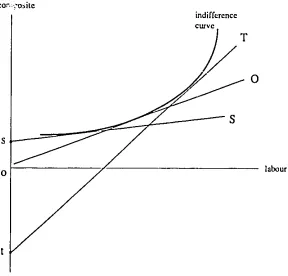
second term in the RHS of (7). This is an intertemporal substitution effect which acts to
improve welfare. This so because a fall in the relative price of imponables in period I
lowers the cost of current consumption in terms of future consumption by raising the
consumption-based discount rate, 8P2JP
1•As a rr.sult, consumers will substitute
consumption intertemporally, consuming more in the present period. However,
consumption in period
1is already below its optimal level (free trade level), Therefore,
the tariff reduction alleviates the initial distonion, which results in an additional welfare
gain through the interactions of the the tariff reform with the existing capital control. The
effects of a capital account liber.ilization on welfare can similarly be obtained:
(8)
welfare. The second term in the RHS of (8) captures the usual income effect A reduction
of the tax in foreign borrowing, i.e., an increase in 8 towards its world level, reduces the
distortion in the capital account transactions, generating the improvement of welfare. This
income effect basically depends on the initial level of distortion as well as on the
propensity to consume, E10• In addition, the capital account liberalization has an
intertemporal substitution <:iit:r.t which is revealed in the ftrst term in the RHS of (8). The
reduction of the tax on foreign borrowing makes future consumption relatively more
expensive, induces consumers to substitute intertemporally, generating more
consumption in period I. However, tariffs in period I has already made the period-!
consumption to be sub-optimal, and therefore an intertemporal substitution acts to
improve welfare. As a consequence, welfare unambiguously improves.
This intertemporal analysis reveals that the welfare gain from trade liberalization in the
presence of capital control is reinforced to generate a greater gain in welfare than the case
of trade liberalization after the c:1~;t:;1 account has been liberalized. In a similar way, the
welfare improvement from the capital account li bera!ization in the presence of trade
restrictions is greater than the gain in the absence of tariffs.9 Consequently, both
sequencings of liberalization in this simple case bring about welfare gain, and hence no
sequencing recommendation will be necessary. Note also that in this model, tax on
foreign borrowing is an exogenous policy variable. The alternative approach is to take 8
as an endogenous variable by imposing quantitative rationing in foreign borrowing. See
Edw:rrds and van Wijnbergen [1986] and Rodrik [1989a].
Sequencing and Real Exchange Rates
The undesirable effect of opening of the capital account, in that it will result in large
destabilizing capital inflows and hence real appreciation in the short-run, has been
indicated and analyzed by a number of authors, including McKinnon [ 1973, 1982],
Frenkel [1982, 1983]. Rodriguez [ 1981], Arriazu [ 1983], Obstfeld [ 1985], and
Dornbusch [1982, 1983a], among others. They argue that if the fiscal deficit has been
9Th · e 1mmlscnzmg ou co · · · 1 me of cap"1tal account liberalization docs not occur in this intcrtcmporal fr;:unework · . ,
17
wntrolled and the domestic financial market liberalized (and hence the domestic interest
rate: has bee!l raised), the opening of the capital account may induce substantial net
inflows of capital, triggered by the interest rate differentials. As long as the income
elasticity of demand for non tradeable goods is positive, that is, if a fraction of these flows
is spent on nontradeable goods, this generates excess demand for nontraded goods at
given prices. Hence, the domestic abscrption of these capital inflows will cause a rise in
the relative price of these goods, and will result in a real appreciation of the exchange
rates.l0 Dornbusch [1983b], Edwards [1987b, 1989a, 1989b], Ostry [1988), Edwards
and Ostry [I 'l89), and van Wijnbergen [ 1989] examine issues involv<d in tariffs and the
terms of trade disturbances, capital control, and the equilibrium real exchange behaviour.
To discuss the real exchange rate effects of liberalization, we add non traded goods to
equation (5), and the two equations for their market clearing condition in each period. For
simplicity, we assume that the importable goods are not produced (only consumed)
>:
the exportable goods are not consumed (only produced) domestically:
(9)
(10)
(11)
E(P 1(Pnt• Pmt), OP2(Pn2• Pm2), u)
=
R1(1, Pnt• v)+
llR2(1, Pn2• v)+
t1Em1+
9(R2- P2E2)EntCPnl• Pml• u) =
R~l(l•
Pnl• v)where the exponable good is still taken as the numeraire so that Pnt is the relative price of
nontraded goods in terms of the exportable goods in period t, Ent = ilE/ilpnt is the
compensated d,~mand function for nontr~ded goods in period t while
R,\
1 = ilR 1/ilPnt is the
supply function of non traded goods in period t. Equation (9) is the intertemporal
income-expenditure identity and equations (10) and (11) are market clearing conditions for
non traded goods in the respective period~. We define 1/Pnt as r!;c: real exchange rate in period t. The distortions in this model are the same as before; tariffs in period I and
capital controls.l1 Total differentiation of (9) provides the expression for the effect of a
trade liberalization on welfare:
(12)
where Emlnl
=
E1Pl2+
P1EllP\>
0 if the importables and nontradables are gross~t.bstitutes (Pf2
>
0) and if this effect dominates over any intertemporal reallocation awayfrom overall consumption in period I. E2"1 = E21P\
>
0, E2"2 = E22Pr<
0, and Emtnl =liE12PIPi
>
0, i.e., intertemporal cross effects are assumed to be positive.Equation (12) shows that in the presence of tariffs in period 1 and capital control~.
there are two additional channels through which the tariff reductions affect welfare. The
ftrst bracket term in th.:: RHS of (12) operates as in (7) to improve welfare. Consider the
second term, (t!Emtnl- 9P2E2nt> dPntldtt. It will be either positive or negative,
depending ftrst on the relative strength between intratemporal substitution effect and
intenemporal substitution effect, and second on the real exchange rate behaviour. If there
is a real depreciation, namely, dpntfdt 1
>
0 and if t 1Emlnl<
9P2E2n1 is satisfied, thenthe tariff reduction in period I in the presence of capital controls acts to improve welf>re
additionally through the real depreciation effect. This occurs because a decrease in the
price of non traded good in period I reduces the consumption rate of real interest which
induces substitution of overall spending from the future towards today. Since the present
consumption is too low due to the tariffs and capital controls, the movement of the real
exchange rate in period I further reduces the distortions, acting as a further improvement
of welfare.
The third bracket term in (12), (t1Emtn2- 8P2E2n2> dpnidtt, reveals the channel
through which future expected changes in the real exchange rate caused by the current
tariff reform affect welfare. Since we assume that all cross intertemporal effects are
11 Note that if there arc tariffs in period 2, equation (12) becomes more ambiguous to sign. That is, with
pcrios·2 tariffs, StlEmlml• St2Emlnl and St2Em2n2 enter the rust, •econd and third brackets respectively,
19
positive, t1Em1n2- OP2E2n2
>
0. Thus, if there is an anticipation of a real appreciation inthe future, dpn2/dt1
<
0, it favors the improvement of welfare whereas a real depreciationin period
2
will act to reduce welfare. Similar explanations can also be provided: a real appreciation in the future raises the consumption-based discount factor, inducingconsumers to substitute their consumption towards period 1, and thereby funher
alleviating the distonions created by the capital controls and tariffs. Edwards [1987a],
using a similar model, derives a formula for the real exchange rates response following
changes in tariffs, and concludes that tariff reform can bring ab:>ut either a real
depreciation or a real appreciation. He also indicates the possibility of 'overshooting' of
the real exchange rate, i.e., the real exchange rate in period I could rise more than the
future real exchange rate undercenain circumstances.12
Note that equation (9) can also be used 10 examine the effect of a relaxation of capital
controls on welfare when there are real exchange rate effects. The obtained expression is
similar to that of (12). That is,
(13)
Similarly, the effect of the capital account liberalization on welfare in the presence of
tariffs depends largely on the movements of the real exchange rates.13 Note that this kind
of framework can be used for examining the effect of a variety of disturbances. For
example, by adding tariffs in period 2, we may consider the effect of an anticipation of a
future tariff liberalization en welfare in the presence and absence of capital contrOls. The
effects of an anticipation of a future policy change will be discussed later.
We have seen that in the Svensson and Razin-type intenemporal framework without
nontraded goods, any sequential liberalization program will result in a gain in welfare.
However, once a nontraded good is introduced in the model, it is not possible to
12Equations (9)-(11) contain three endogenous variables, the prices of a nontradcd good in each period and welfare, so that we can solve for those variables.
s ...
determine whether or not a removal of one distortion in the presence of the other will
improve welfare. This is because the responses of the real exchange rates are ambiguous.
If a real appreciation takes place following the capital account liberalization before tariffs
have been liberalized, it can be shown that welfare will be funher improved. This implies
that as far as the individual's welfare is concerned, the real appreciation on its own does
not constitute a problem [see La!, 1987], and hence the argument for the conventional
sequencing recommendation of 'current account first' may be weakened in terms of the
welfare effects of sequential reform.
However, the fundamental argument against the opening of the capital account before
(or simultaneously with) trade reform is not in the real appreciation itself, but r..tther in the
real appreciation when the economy requires a real depreciation through the trade reform.
Initial real appreciation will lead to resource movements opposite to those required during
the process of trude Iiberalization.t4 Hence, it is argued that the opening of the capital
account before the trade liberalization is completed will lead to unnecessary shifts in
national resources, in effect away from traded ro nontraded goods industries. In addition,
if the opening of the capital account inhibits the real exchange rate from depreciating
sufficiently, it would become more difficult to manage the transition in the tradable sector
from an illiberal to a new freer structure. As a result, a reai appreciation can cause
;;ggregate imports to increase above aggregate exports, leading to a squeeze on
profitability in the tradable goods sector [Corden, I 982 and I 985]. The experience of
Argentina in the late 1980s was an example that trade reform may be collapsed by this real
appreciation effects of the capital account liberalization. See Michaely, Papageorgiou,
and Choksi [1991].
McKinnon [1973, p. 161) further emphasizes that securing the full liberalization of
foreign trade is inherently contrary to the use of foreign capital since capital inflows
themselves may inhibit the complete removal of import restrir.tions during the
liberalization and its afternmth. The so-called McKinnon Paradox of capital inflow is