The Integration of Six Sigma and Balanced Scorecard in Internal
Auditing
Samah Hafez
Accounting Department, Faculty of commerce, Mansoura University, Egypt Abstract
Purpose – This study examines the integration of six sigma and balanced scorecard in internal auditing (IA).It aims to utilize the integration between six sigma and BSC in internal auditing to be more effective and efficient in risk management.
Design/methodology – This study based on a structured questionnaire, was distributed to a group of a sample of internal auditors, members of audit committee and senior managers of insurance companies in Egypt that have established internal audit function and risk management, The research sample consists of Misr insurance company, as a public company and represent 70% of this sector, Delta insurance company and Suez canal insurance company as private one. In total130 responses were collected and analyzed.
Findings –The integration between six sigma and balanced scorecard will have a significant positive impact on the internal auditing effectiveness and efficiency.
Practical implications – Financial organizations like banks and insurance companies could gain an understanding of the integration between six sigma and balanced score card in internal auditing to be more effective and efficient in its organizations.
Value – This study indicated an empirical evidence to support the need to rethink the internal auditing role in risk management to be added value in the organizations.
Limitation -This study focuses on the Egyptian insurance companies that have risk management but they do not use six sigma or balanced scorecard in internal auditing. This study chooses three companies in insurance companies which represent the major percentage of the Egyptian insurance companies.
Keywords: Egypt, Balanced scorecard, Six Sigma, the integration, risk management internal auditing, efficiency, effectiveness.
Introduction:
This study proposed the integration of six sigma and balanced scorecard in internal auditing (IA). In recent years internal audit leaders were confused about the fundamental role of IA to be added value. Beginning with the IIA Standards 2009 that defined added value as improving opportunities to achieve organizational objectives, identifying operational improvement, reducing risk exposure through both assurance and consulting services (IIARF, 2009, p. 40). After that, the IIA Standards in 2011 (IIARF, 2011e, 47) lead to the change of the “added value” concept. It is argued that if the internal audit activity provides objective and significant assurance, contributes to the effectiveness and efficiency of governance, enhances risk management and control processes, it will added value to the organization and its stakeholders.( Lenz and Sarens,2012).
The IA definition doesn't include how to achieve internal auditing efficiency of risk management as a need for the added value, However, the effectiveness of internal audit function measurement achieve increasingly significant valences in risk management ; so, Facing the internal audit function a big challenge in discovering an approach that can increase its efficiency and effectiveness.
The importance of internal auditing increases in recent years particularly in insurance companies after issuing Solvency II standard for insurance companies in April 2009, where the European Parliament accepted the Solvency II framework instruction and become effective in January 2013.
The Solvency II is a criterion, which requires insurers to focus on managing risks which faces their organizations. Solvency II is not only for insurance companies in the EU, but it's a world -leading. it is being implemented as a result of the previous great market disturbance, which arise awareness over the need to improve risk management techniques and issuing Solvency II standards related to insurance companies like Basel II standards of banking, So applying Solvency II standards rises awareness of the internal auditing role in risk management, to be become more active in assessing risk management in insurance companies.
While Egyptian Financial Supervisory Authority (EFSA) is concentrates on risk management and how to be more effective(EFSIA,2014), The current study aims to focus on the role of internal auditing in risk management in Egyptian insurance companies, in the light of issuing Solvency II standard.
Furthermore, accounting literature lately realized the need to rethink the internal audit strategy, and may be even rethinking a new paradigm of internal auditing. (Deloitte, 2010; Price Waterhouse Coopers, 2010; Pop &Boţa-Avram, 2009)
Many companies have increasingly used Six Sigma tools after issuing Sarbanes -Oxley Act (SOX, 2002) in USA. Using six sigma tools can assist organizations to meet the COSO - ERM requirement to consider
acceptance levels for all the possible consequences and the improvement of its risk management and control systems (Ramamoorti,et al,2008).
Six Sigma is a controlling set of tools that enables organizations to make more accurate and quantitative approach to identify and correct basis that cause problems. It helps the internal audit group to make more useful audit recommendations (the Six Sigma effect) and to reduce the costs associated with compliance called the “Lean” effect by avoiding costs that don’t add value to the organization. It also helps internal auditors to assess risks facing all systems and processes at operational stage (Ibd, 2008).
Otherwise, using balanced scorecard (BSC) enables internal audit to align its objectives as a strategic role of the organization, it can be used in implementing risk management by using the integration of balanced scorecard and COSO- ERM frameworks to align risk management with strategy. In COSO -ERM, where internal auditors monitor risk levels and control effectiveness and verify that the strategy risk linkage is working effectively and efficiently at an organizational level and the role of the other risk functions ( Beasley etal.2006) .
This study aims to utilize the integration between six sigma and BSC in internal auditing to be more effective and efficient in risk management, through answering the following question: Does the use of the integration between six sigma and balanced scorecard in risk management improves the internal auditing efficiency and effectiveness?
1- Six sigma, COSO's ERM, Balanced scorecard and risk management: 1/1 Six sigma and COSO's ERM:
Recently, Enterprise risk management (ERM) has turn out to be a vital part of the organization life, ( Soin and collier ,2013) due to the financial crisis that happened since 2008. It can be defined as a systematic and comprehensive approach and it has been heavily recommended to be applied by companies (Gates et al .2012)
According to the definition provided by the committee of Sponsoring organizations of the tread way Commission ERM is a process, affected by the board of directors, management and other personnel, applied on strategy setting and across the enterprise, considered to identify probable events that may affect the entity, and manage risk to be within its risk appetite, to provide practical assurance regarding the attainment of entity objectives (COSO, 2004).
The processes and methods of ERM enable the organizations to manage risks and seize the opportunities in achieving the objectives. ERM deals with various stakeholders, who want to achieve a wide range of risks confronting the organization, to ensure that the organization is properly managed (Rasid etal.,2012).
The structure of Six Sigma and its statistical methods can enable and promote the application and effectiveness of ERM in three main areas: implementation tools, skilled employees, and value creation. It can be used in internal auditing, depending on DMAIC pattern. Many of process improvement models are based on the steps in the Plan – Do – Check –Act cycle. As well as, DMAIC methodology (Define, Measure , Analyze, Improve and Control) comprise the major phases of process improvement project of Six Sigma (Alhawari et al., 2008; De Feo and Barnard, 2005; Paul E, etal.2007).
Therefore, using six sigma in internal auditing requires management’s support to be applied, quality culture through the organization to be succeed, and using six sigma to assess risk management in internal auditing, where risk assessment remains at the heart of internal audit, choosing a comprehensive risk assessment will lead to better results which depends on achieving greater efficiencies and cover the important aspects that add or preserve value in the organization (Hirth, 2008).
Six sigma tools can be used in the eight components specified in COSO’s ERM framework internal environment, objective setting, event identification, risk assessment, risk response, control activities, information communication and monitoring as the following:
- The data collection schemes, statistical sampling analyses to ensure of the validity of the data and its importance.
- Tools that identify the cause of the problems to prevent future anomalies.
- Provide monitoring and decision support by using Statistical process control (SPC). - Provide transparency to processes by using visual techniques, such as flowcharts.
- Fishbone Diagram produces visual depiction of root cause analysis to identify root causes. - Pareto Principle: 80% of effects are produced by 20% of causes
- FMEA (Failure Modes and Effects Analysis) quantitatively assesses risks based on severity, likelyhood, detect ability.
- Application of FMEA, together with Pareto analysis can force effective audit practices, focused on the “critical few” risks (Zu et al., 2008).
Using six sigma tools in internal auditing, requires qualified people to use them depending on a structure known as belt system (Park, 2003), Antony& Ban˜uelas (2002) and Brady& Allen (2006) argued that using belt system in internal auditing can be as the following: The Sponsor (internal auditing manager ) who is a
manager for a practical land or a process owner, Master Black Belt who improve black belts, determine the needs of training on Six Sigma and provide the sophisticated technical expertise, a technical leader of a six sigma projects called Black Belt and he a full-time engaged in it . Green Belt who support the Black Belt in gathering and analyses data, working a part-time to a Six Sigma project and finally team members.
Six sigma's tools and people in internal auditing can be used in applying its DMAIC approach in internal auditing, as follows (Barnes and Walker, 2010, P.26):
Define: establish the focus ,including forming a team based on black - belt as mentioned above, identify and describe the gap in risk management
Measure: check the recent status, see the details of risk management, and build up strategies about risk management.
Analyze: Using six sigma's tools like brainstorming and prioritize root causes in analyzing the root causes. Improve: act on the causes of brainstorm probable performance, select actions to take and develop action plans. Control: develop a process management plan to standardize successful actions after executing actions on a large
scale, then determine benefits, difficulties and lessons learned and take them into future plans.
As we mentioned above, six sigma applications depend on skilled employees, implementation tools, and value creation. There are seven process related to SOX compliance (Juras, etal 2007).
- Top management commitment which depends on a clear communication contains the reason of using Six Sigma and the business objectives.
- Determine proper process to satisfy the internal or external customer.
- Create teams with a cross functional set of employees who have significant contacts with the identification process.
- Provide the right tools and measures appropriate to the cultural environment of the organization, and teach team members how to use them.
- Action plan should be developed with clear goals to define the project’s range, reason, and expected benefit, then plot each process to define outputs, inputs, and needed process resources.
- Measure and communicate results to identify the core cause of the problems by using suitable analytical tools, and then propose new processes or changes to existing processes to get rid of the source causes. - Reduce the variance of resource demands by choosing and implementing process changes; then measures
will be accomplished to be ensured that problems don’t come back again.
When you apply the methodology of Six Sigma it focused on the possibility of improving the efficiency and effectiveness of the internal auditing by improving the quality of processes (Aghili,2009), however, in view of the definition of internal auditing from a strategic view for the company, there is a need to use the balanced scorecard in the development of the risk management in internal auditing.
1/2 Balanced – scorecard and internal auditing:
Academic researches confirm that the internal auditor should play a greater strategic role within the organization. The use of the balanced scorecard framework can assist in achieving this strategic influence and maximize the efficiency and effectiveness of the organizations, as it is a tool for communicating and delivering the company’s strategy throughout the organization. The traditional balanced score card identifies the company’s strategy in four key areas as Customer; Internal; Innovation and learning; and Financial. ( Frigo,2002).
- Balanced scorecard and COSO’s ERM:
Combining the BSC with ERM can strengthen management and internal auditors’ performance. In the Balanced score card, when objectives are known for each perspective, ERM starts with an understanding of objectives to set metrics (KPIs) for selected and broaden targets for each BSC perspectives.
ERM adds value to the BSC through the detection of risks that could stand in the way of achieving the targets in each of the four perspectives. By monitoring the KPIs, management can measure how effectively their risk improvement efforts are working.
The development of an integrated BSC-COSO ERM models, would cover the four COSO’s ERM management objectives (event identification- risk assessment, risk response and control activities) and the eight risk management components, COSO ERM - integrated BSC calls for implementing strategy in such a way that limits risk to the range in which the risk can be controlled ( Nagumo ,2005). Their integration provide prospective advantages, where they enable risk issues to be managed due to the strategic objectives of organization, then managers can prioritize the targets they have been set (Woods, 2008), The main benefit of using the COSO ERM model in concert with the BSC is that it helps ensure that all the strategically important objectives of BSC four categories are be included, while keeping the organization strategy focused.
Creating an inclusive strategic road map helps internal audit functions to create a well-associated strategy by following these four steps:
- Build up internal audit’s strategic vision, by knowing the function’s roles and responsibilities, the needs of its key stakeholders, what the internal audit function should achieved over a long term period.
- Recognize key strategic priorities, in the light of strategic vision, and prioritize them like main business risks, main operational and financial risks. Where internal auditing can have the industry and functional visions it needs by updating the processes, methodologies, tools. It also using flexible staffing models to expect changes and concentrate on rising risks or subjects.
- Propose the suitable main performance indicators (KPIs), and identify the internal audit measures in the light of its stakeholder expectations.
- Develop an operating strategy to provide internal audit with detailed activities, to achieve its strategic priorities.
The ERM-BSC process passes through four stages as the following:
BSC: Formulating Strategies: this stage contains determining risk desire, setting objectives (strategic, operations, reporting, and compliance).
BSC: implementing Strategies: as risk detection, risk response and risk management. BSC: Evaluating Performance: as risk monitoring.
BSC: Risk reporting and communication as the last stage called Feedback and learning. 2- Literature review and hypotheses development:
Studies showed great concern to the recent movement within the internal audit work confirm that there is a need to be more efficiently and effectively (IIARF 2007: 216–233; E&Y 2008: 59; PwC 2008:31-35; IIARF 2009: 9). They agreed that internal auditing has to use more updated internal audit tools and methods.
According to The IIA's International Standards for the Professional Practice of Internal Auditing (Standard 1120 ),Practice Advisory 2100-3: Internal Auditing Role in the Risk Management Process and Practice Advisory 2100-4: Internal Auditing Role in Organizations without a Risk Management Process, Internal audit perceived its role in risk management to increase awareness of the formal risk management processes (Woods,2008). as threefold. First, supporting in the detection of risks; second, recommending the resolution of suitable controls, and finally, testing the usefulness of the risk control system by using risk based audits (s).
Additionally, most of participants execute risk based scheduling for their annual internal audit plan, apparently that controls are mostly scanned as a means of reducing risks ( Castanheira et al., 2010: 95). Other risk justifying performance or risk responses, such as sharing the risk, avoiding the risk or risk acceptance (COSO, 2004: 55–66), are not mentioned, but could be more positive or cost effective (Griffiths, 2006:42; Pelletier, 2008: 73–76; Reding et al., 2009: 13–28). An organization can use six sigma methodology to improve the efficiency and effectiveness of its business processes (Gupta, 2004; Basu and Wright, 1997; Hrgarek and Bowers, 2009 ).
The study of Aghili,2009 and Ramamoorti,et al,2008 refer to use Lean Six Sigma in internal audit projects to improve internal control, where internal auditors can coordinate between the individuals and the tools they are used to circulate ERM more effectively, it helps in evaluating whether ERM processes are getting better gradually with the passage of time or there is a necessity for changes, Therefore, the following hypothesises will be:
H1 : Six sigma methodology will have a significantly positive impact on the internal auditing effectiveness. In order for the internal audit to be efficient it must actively participate in risk management process, which must be based on joint risk management framework and evaluate this framework operational efficiency in the company, provide recommendations on its improvement
H2: The six sigma methodology will have a significantly positive impact on efficiency.
Prior studies confirms that the internal auditor should play a greater strategic role within the organization, using balanced scorecard to enhance the strategic role of the internal auditing function, and maximize the efficiency and effectiveness of the organization (Frigo,2002:49-55).
Beasley et al. (2006) has submitted that BSC can be an infrastructure for ERM adoption. Therefore, it is easier for organizations to implement an effective ERM framework they can overcome challenges such as board of directors’ resistance and a demand of a top-down approach. Meantime, organizations as Mitsubishi and Tesco PLC have linked their ERM framework with BSC. Bank of Tokyo-(Nagumo, 2005; Woods, 2008). Mobil, Chrysler, and the US Army have linked their scorecards to risk management (Olson & Wu, 2007). On the other hand there is a lack of literature to consider the integration between ERM and BSC as Calandro & Lane (2006); Beasley et al, 2006, So the third and fourth hypothesis are:
H3: The balanced scorecard will have a significantly positive impact on the internal auditing effectiveness. H4:The balanced scorecard will have a significantly positive impact on the internal auditing efficiency.
As mentioned in the study of (Gupta, 2004) an integration of information excluded from the strategic, operational, and execution fields of the business. a business can only do the preferable goals, through aggressive goal setting, effective data collection, analysis, reporting, communication, and improvement efforts . It reflects the effectiveness of all operations at the action level, rather than the strategic level. So the fifth& sixth hypotheses are:
H5: The integration between six sigma and balanced scorecard will have a significantly positive impact on the internal auditing effectiveness.
H6: The integration between six sigma and balanced scorecard will have a significantly positive impact on the internal auditing efficiency.
Figure 1, Research framework 3- Research Methodology:
3/1 Sample selection and data collection:
To test the proposed hypothesis, Empirical research, based on a structured questionnaire, was distributed to a group of a sample of internal auditors, members of audit committee and senior managers of insurance companies in Egypt that have established internal audit function and risk management, The research sample consists of Misr insurance company, as a public company and represent 70% of this sector, Delta insurance company and Suez canal insurance company as private one. The questionnaire consisted of 30 statements for internal auditors, members of audit committee and senior managers.
The survey was realized on a sample of a total of 130 subjects in the period from January 2015 to February 2015, 80 participants are internal auditors representing 61.5% of the total sample, and the remaining 38.5% is applicable to audit committee member or senior management. The respondents were 121subject , asked to select the response that best indicates their level of agreement with each statement , using a likert - type five point scale where 1= strongly disagree, 2= disagree , 3=neutral ,4 = agree ,5 = strongly agree . This scale is very popular in this type of social research.
3/2 Definition of variables and model specification: 3/2/1 Dependent variables:
3/2/1/1 Internal auditing effectiveness:
The International Standard for the Professional Practice of Internal Auditing- internal audit activity 1300– “Quality Assurance and Improvement” Program is measuring the effectiveness and efficiency of the internal auditing, Where the chief audit executive is responsible for developing and maintaining a quality assurance and improvement program which covers all aspects of the internal audit activity, it also assesses the efficiency and effectiveness of the internal audit activity and identifies opportunities for improvement .
A general description of effectiveness and efficiency is “the degree (including quality) to which established objectives are achieved.” The same description can be used for internal audit effectiveness and efficiency (IPPF,2010).
Effectiveness refer to the capacity of obtaining results in harmony with the goals , Dittenhofer (2001) refer to it as ," when internal auditing accomplish the task described by the internal auditing objective ,it achieved its process, where (Lenz,2013) defines IA effectiveness as a" risk based goal – attainment concept that helps the organization to achieve its objectives, and it argues for a consolidation, Sarnes, (2009) explored that the parameter about effective internal audit function should be whether the internal auditing function has a positive influence on the quality of corporate governance. In academic research, IA effectiveness has been largely unaddressed, many studies refer to the growing need for measuring IA effectiveness using generally scale (such as: Dittenhofer,2001; KPMG, 2008; Mihret &Yismaw, 2007; Ridley & D’Silva, 2008),
identify the most relevant methods for evaluating the internal auditing department effectiveness; they led to different benchmarking information about different issues of internal auditing. The study of Ziegenfuss (2000) referred to five top performance measures as the results of including Chief Audit Executive (CAEs) as participants in the GAIN project:
- The experience of an internal auditing staff. - The view of the audit committee of auditing. - Management expectations of internal auditing;
- The ratio of audit recommendations that have been implemented. - The education levels of auditors.
The effectiveness of internal auditing is determined by: (Arena &Azzone (2009): - The internal audit team characteristics.
- The audit operations and its activities. - The organizational links.
Dittenhofer (2001), refer that the evaluation of the effectiveness of internal auditing operation would be positive when the internal auditors do the following: audits the goals that have been done without any problem, or recommends solutions when they found problems, they also consider all the elements on which audit activities have an impact.
Whereas; Marika and Giovanni, 2009 stated that IA effectiveness determined by: the percentage of internal auditors to the organizations employees, the Chief Audit Executive followed the instruction of the Institute of Internal Auditors (IIA), control risk self-assessment techniques are used, and there is a strong relation between audit committee and internal auditors .
3/2/1/2 Internal auditing efficiency:
There are no legal acts or other obligatory documents determining how internal audit must be organized and how its efficiency must be assured. Analysis of the Standards on Internal Auditing issued by the Institute of Internal Auditors(IIA,1200-IIA,1300,IIA,2000,IIA,2100, IIA,2100,IIA2300,IIA2400) allows specifying the four main areas for internal audit implementation and efficiency assurance, i.e. subordination, qualification, internal audit strategy and efficiency estimation (Savčuk Olga, 2007).
There is a lack of studies about internal auditing efficiency, as Kenneth, 2013 refer to the metric of internal auditing efficiency as:
• Number of audits scheduled, • Number of audit completed,
• Timeliness of performance feedback, Staff utilization – direct vs. indirect time, • Completed audits per auditor, Actual hours vs. budgeted hours,
• Audit report cycle time,
• Number of internal audit reports issued vs. planned internal audits.
3/2/2 Independent variables:
3/2/2/1 The variables of six sigma methodology in risk management contain the factor:
- Top management commitment to provide clear communication compatible with the purpose of using quality program.
- Formed a team composed of a group of employees, where each related to identified processes and has the ability to use analytical tools to determine the root causes of the problems and propose new processes to eliminate these causes, it should be provided with regular training.
- There must be a clear vision of the Organization’s cultural environment to define the project’s scope, purpose, and expected benefit, including any project milestones.
- Setting a process map to clearly define outputs, inputs, and needed process resources and the statistical measures used in it.
3/2/2/2 Balanced scorecard methodology of internal auditing in risk management: 1- Set Overall strategic vision of the internal auditing.
2- Break down the vision and themes into more actionable elements. 3- Support the overall vision and provide areas of emphasis for the risk. 4- Management to focus its activities (critical success factors).
5- Monitor the achievement of the strategic objectives (key performance indicators). 6- Initiatives Actions taken to improve current performance.
7- Execute Strategies: as risk identification, risk response, risk control. 8- Strategic Feedback.
So, the current research depends on how to use the integration between Six sigma and balanced scorecard in internal auditing? Is this integration affects internal auditing effectiveness and efficiency? Are Egyptian insurance companies ready to apply this approach?
4- Findings:
This study relies on the study of Hair et al. (2006) depends on using structural equation modelling (SEM) which consists of a two-step methodology. it begins by providing a descriptive statistical analysis of the respondents, demographic profile. Then it tests the effect of the mentioned methods on the effectiveness and efficiency of internal auditing. According to this procedure, the structural equation model can be analyzed, after the model has been modified to create the best measurement model.
4/1 Sample characteristics:
Respondents, Characteristics were more male with percentage 70% than 30% female, reflecting Egyptian workforce, more than two -thirds of respondents were between 30-50years old, and more than ninety six percent hold a university degree, the majority of respondents worked for more five years.
4/2 Questionnaire Reliability: Measurement model:
This study used two-step approach(Anderson and Gerbing, 1988) that included in the first step using confirmatory factor (CFA) ) for providing evidence of convergent and discriminant validity and in the second step used structural equation modeling (SEM) for assessing the hypothesized relationships .
The overall fit of the measurement and structural models were examined using χ2/df (< 3), nonnormed fit index (NFI > 0.9), comparative fit index (CFI > 0.9), Incremental Fit Index (IFI> 0.9),)root mean square error of approximation (RMSEA < 0.08), and standardized root mean square residual (SRMR a value less than .08 is generally considered a good fit.
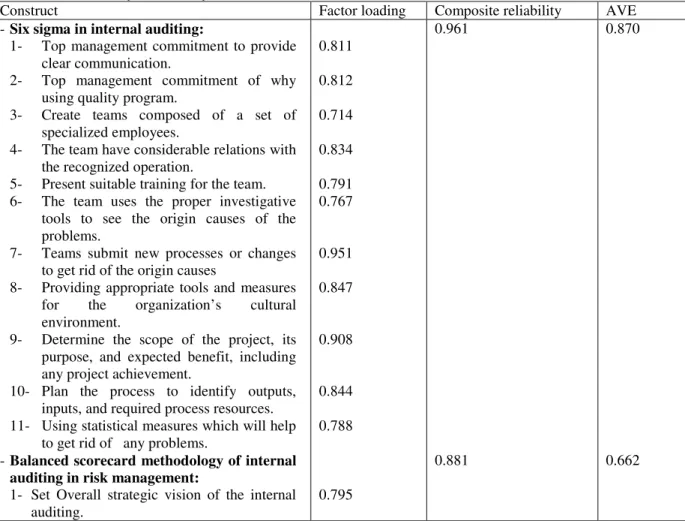
Table 1 Shows results of the first step which consisted of, the evaluation of convergent for each of the measurement scales, that depending on using three measures: factor loading, composite construct reliability and average variance extracted, the results in Table 1 shown that all standardized factor loadings ranged from 0.724 to 0. 951, which are significantly at (p<0.01), the construct reliabilities( CR )were within the commonly accepted range, greater than 0.70,and the average variances extracted(AVE) were all the above recommended level 0.50 , so all constructs had convergent validity as recommended( Hair et all,2006: Fornell & Larcker, 1981). The results revealed that the proposed four-factor measurement model fit the data acceptably; x2/df 1.55; (CFI) 0.91; (IFI) 0.91; RMSEA 0.071; and SRMR 0.070)..
Table1: Confirmatory factor analysis results
Construct Factor loading Composite reliability AVE
-Six sigma in internal auditing:
1- Top management commitment to provide clear communication.
2- Top management commitment of why using quality program.
3- Create teams composed of a set of specialized employees.
4- The team have considerable relations with the recognized operation.
5- Present suitable training for the team. 6- The team uses the proper investigative
tools to see the origin causes of the problems.
7- Teams submit new processes or changes to get rid of the origin causes
8- Providing appropriate tools and measures for the organization’s cultural environment.
9- Determine the scope of the project, its purpose, and expected benefit, including any project achievement.
10- Plan the process to identify outputs, inputs, and required process resources. 11- Using statistical measures which will help
to get rid of any problems.
-Balanced scorecard methodology of internal auditing in risk management:
1- Set Overall strategic vision of the internal auditing. 0.811 0.812 0.714 0.834 0.791 0.767 0.951 0.847 0.908 0.844 0.788 0.795 0.961 0.881 0.870 0.662
2- Break down the vision and themes into more actionable elements.
3- Support the overall vision and provide areas of emphasis for the risk.
4- Management to focus its activities (critical success factors).
5- Monitor the achievement of the strategic objectives (key performance indicators). 6- Initiatives Actions taken to improve current
performance.
7- Execute Strategies: as risk identification, risk response, risk control.
8- Strategic Feedback.
-Internal auditing effectiveness:
1- Providing advices about the risk identification, evaluation and ranking. 2- Giving proposals on the possibilities of
improving the risk management process. 3- Providing assurance to management about
the adequacy of the overall risk management process.
4- Examining management relationship to key risks.
5- Reporting to the audit committee.
6- The audit was conducted in a professional and courteous manner.
7- The audit report was accurate and findings clearly communicated.
8- The audit report fairly reflected your team’s comments and corrective action.
9- The overall audit provided value to your area.
-Internal auditing efficiency:
1- It depends on statistics to measure and monitor performance stages.
2- It depends on qualified people using statistics models.
3- There is a periodically training program. 4- It decreases the gap between Actual hours
vs. budgeted hours.
5- Decreasing the Number of internal audit reports issued vs. planned internal audits. 6- It commit with an Audit report cycle time. 7- There are a Number of audits scheduled
of each risk.
8- There is a timeliness of performance feedback. 0.923 0.920 0.852 0.923 0.871 0.863 0.801 0.751 0.931 0.724 0.901 0.925 0.871 0.865 0.864 0.850 0.783 0.821 0.971 0.735 0.911 0.827 0.777 0.941 0.871 0.884 0.661 0.651 - Descriptive Analyses:
The Range of the descriptive analyses means, standard deviations and correlations have been calculated which is related with, Balanced scorecard methodology, Six sigma in internal auditing, Internal auditing effectiveness, and Internal auditing efficiency. As can be seen in Table 2
Table 2: Descriptive analysis and correlation of the study variables
Construct Mean SD Six sigma BSC Effictiv Efficiency Integr
Six sigma 3.57 .88 1 BSC 3.59 .73 .68** 1 Effictiv 3.67 .89 .78** .63** 1 Efficiency 3.58 .77 .88** .64** .61** 1 Integr 3.88 . 90 .810** .71** .64** .668** 1 **p<0.01)
Structural Equation Model
After the correlation analysis and measurement model, the study applied a structural equation model to verify hypotheses for the causal relationships between variables in accordance with literature. The SEM estimates for the hypothesized model. The results of the structural model arex²/df: 2.09; RMSEA: 0.060; GFI: 0.89; IFI: 0.98; CFI: 0.98; NFI: 0.97; NNFI: 0.98. These results indicate that structural model has been acceptable and in accordance with the study’s theoretical framework.
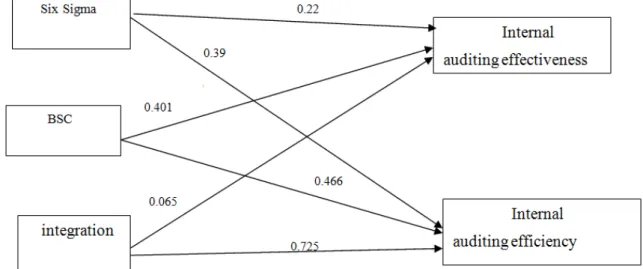
In addition, the SEM path results, standardized regression weight standardized path coefficients(r) and t-values of all relationships hypothesized in the model are shown in Figure 2. H1 posited that using six sigma would have a significant impact on the effectiveness of internal auditing, The results of SEM analysis support this hypothesis (r = 0.394,p < 0.001), H3 proposed that using BSC would positively influence the internal auditing effectiveness. The coefficient for the path from BSC to internal auditing effectiveness is positive and significant (r = 0.401, p = 0.001), which supports H3. Finally, H5 proposed that the integration would positively impact on the internal auditing effectiveness, the coefficient for the path from the integration to internal auditing effectiveness is significant (r= 0. 653, p = 0.001), which support H5.
The SEM path results for the relation among the three methods ( six sigma – BSC- the integration ) and internal auditing efficiency, standardized path coefficients and t-values of all relationships hypothesized in the model are shown in Figure 3. H2 posited that using six sigma would have a significant impact on the effectiveness of internal auditing, The results of SEM analysis backing this hypothesis (r= 0.394,p < 0.001), H4 suggested that using BSC would positively influence the internal auditing effectiveness The coefficient for the path from BSC to internal auditing effectiveness is positive and significant (r= 0.466, p = 0.001), which supports H4. At last, H6 proposed that the integration would positively influence the internal auditing efficiency, the coefficient for the path from the integration to internal auditing efficiency is significant (r= 0.725, p = 0.001), which support H6.
Figure 2 Path analysis results for effectiveness and efficiency of internal auditing 5- Discussion:
It is obvious that in the current business environment internal audit plays a very important role in risk management , and it also become a strategic partner of the organization and add value to its activities improving governance processes and ensuring their effectiveness and efficiency
The research results backing the proposed hypothesis (H1) that six sigma methodology will have a significantly positive impact on the internal auditing effectiveness and (H2) the six sigma methodology will have a significantly positive impact on efficiency. This result supports the outcomes of previous researches as Undertaking a six sigma initiative can help an organization to optimize the efficiency and effectiveness of its business processes (Gupta, 2004; Basu and Wright, 1997; Hrgarek andBowers, 2009 ). It also agree with The
study of Aghili,2009 and Ramamoorti etal,2008 which refer that using Lean Six Sigma in internal audit projects circulates ERM more effectively . Ramaley,2013) also refer that audit organizations should embrace Six Sigma tools to improve their process efficiency and effectiveness.
In addition, balanced scorecard can act as a basic tool to improve ERM. As a result, challenges such as board of directors’ resistance and the need of a top down approach can be solved and organizations would find it easier to implement an effective ERM framework (Beasley et al., 2006). Meanwhile, using balanced scorecard can enhance the strategic role of the internal auditing function, and it will maximize the efficiency and effectiveness of the organization (Frigo,2002:49-55). Valmohammadi and Servati, (2011) also mentioned that performance measurement can be seen as a tool to analyze the efficiency and effectiveness of processes. The results support the hypothesis (H3): The balanced scorecard will have a significantly positive impact on the internal auditing effectiveness, H4: The balanced scorecard will have a significantly positive impact on the internal auditing efficiency.
These results support the main question of this research which refers to the use of six sigma and balanced scorecard in internal auditing to be more effective and efficient in Egyptian insurance sector, where the need for risk management increase, and the role of internal auditing in risk management also increase recently. The results support the hypothesis H5: The integration between six sigma and balanced scorecard will have a significantly positive impact on the internal auditing effectiveness,H6: The integration between six sigma and balanced scorecard will have a significantly positive impact on the internal auditing efficiency. These results agree with the study of (Gupta, 2004), where the Six Sigma Balanced Scorecard has an integration of information excluded from the strategic, operational, and execution fields of the business.
6- Conclusion and future studies:
A review of the previous studies illustrated that there is a shortage of research related to the role of internal auditing in risk management in insurance sector conducted in developing countries. This study examines the integration between six sigma and balanced scorecard implementation in internal auditing in insurance companies in Egypt. The model was tested and validated by using empirical data from Egyptian companies. It was found that using the integration between six sigma and balanced scorecard have a positive relationship with effectiveness and efficiency of internal auditing.
This study contribute to academic area of research by providing empirical verification to hold up the role of internal auditing as a value added. The research confirms that six sigma and balanced scorecard are positively related with the effectiveness and efficiency of internal auditing. Moreover, these results are significant if taken the research environment into account. It adds to the increasing range of the knowledge on performance of internal auditing application tools in Egyptian insurance companies. This study has substantial managerial effects. First, Egyptian insurance companies and managers might expand their perspective of the risk management complexities and the role of internal auditing in it. Second, the results of this study are also useful to all the parties of companies.
There are various ways to explore and extend this study in the future. Further studies would be conducted in Egypt. Moreover, this study focuses on using the integration between six sigma and balanced scorecard in internal auditing. Future research could examine other tools which can be used in internal auditing. There is also a need for studies about solvency ǁ statement and how to apply it in Egyptian insurance companies. Reference:
Aghili, S. (2009), “A Six Sigma approach to internal audits”, Strategic Finance, Vol. 90 No. 8, pp. 38-43.
Alhawari, S., Thabtah, F., Karadsheh, L. and Hadi, W.M. (2008), “A risk management model for project execution”, Proceedings of the 9th International Business Information Management Association Conference (IBIMA), Conference on Information Management in Modern Organizations: Trends & Challenges, Marrakech, Morocco, January 4-6, pp. 887-893.
Anderson, J.C., Gerbing, D.W., 1988. Structural equation modeling in practice: A review and recommended two-step approach. Psychological Bulletin 103 (3), 411-423.
Antony, J. and Ban˜uelas, R. (2002), “Key ingredients for the effective implementation of six sigma program”, Measuring Business Excellence,vol.6,No,4,pp20-27.
Antony, J. and Ban˜uelas, R. (2002), Key ingredients for the effective implementation of six sigma program”, Measuring Business Excellence,vol.6,No,4 ,pp20-27.
Arena, M.& Azzone, G. (2009), ‘Identifying organizational drivers for internal audit effectiveness’, International Journal of Auditing, (13): 43-69.
Barnes, C. & Walker, R. (2010). Improving corporate communications: Lean Six Sigma science has broad reach. International Journal of Business Strategy. 31(1): 23-36. DOI: 10.1108/02756661011012750,pp26. Basue,P and wright,A(1997),” An Exploratory Study of Control Environment Risk Factors: Client Contingency
Considerations and Audit Testing Strategy”, International Journal of auditing, vol.1,Issu.2,pp77-96. Beasley, M., Chen, A., Nunez, K., & Wright, L. (2006). Working Hand in Hand: Balanced Scorecards and
Enterprise Risk Management-Taking a total look at all the potential risks to a company, or enterprise risk management, is becoming the minimum standard. Strategic Finance, 87(9), 49-55.
Brady JE, Allen TT. (2006) “Six Sigma literature: A review and agenda for future research”, Quality and Reliability Engineering International; vol. 22(,No.3), pp335—367.
Calandro, J., and L. Lane. 2006. Insights from the Balanced Scorecard: An Introduction to the Enterprise Risk Scorecard. Measuring Business Excellence, pp. 31–40.
Castanheira Nuno ,Lu´ cia Lima, and Russell Craig,(2010).,” Factors associated with the adoption of risk-based internal auditing”, Managerial Auditing Journal, Vol. 25 Iss: 1, pp.79 – 98.
COSO. (2004). Enterprise Risk Management- Integrated Framework., Executive Summary,Sep.,2004.
De Feo, J.A. and Barnard, W.W. (2005), Juran Institute’s Six Sigma Breakthrough and Beyond: Quality Performance Breakthrough Methods, Tata McGraw-Hill, Noida.
Delloite, (2010), ‘The changing role of internal audit’, March, accesibil on-linehttp://www.deloitte.com/view/en_BE/be/services/aers/internalaudit/efeb39896dea7210VgnVCM10 0000ba42f00aRCRD.htm.
Dittenhofer, M. (2001), “Internal auditing effectiveness: an expansion of present methods”, Managerial Auditing Journal, Vol. 16 No. 8, pp. 443-50.
E&Y (Ernst & Young). 2008. Escalating the Role of Internal Audit: Global Internal AuditSurvey. [Online] Available from:http://www.ey.com /Global/ assets.nsf /Australia-/ AABS_GIAS_-2008/$file/GIAS-08.pdf. Accessed: 27 March 2009.
Egyptian Financial Supervisory Authority, FSInewsletter, 2014, June, issue.1.
European confederation of institute of internal auditing , The role of Internal Audit under Solvency”, IIECIIA task force / Solvency II / position paper / Internal audit,2014
Fornell, C., & Larcker, D. F. (1981). Evaluating structural equation models with unobservable variables and measurement error. Journal of Marketing Research, 18(1), 39-50. http://dx.doi.org 10.2307/3151312. Frigo, M.L., & Krumwiede, K.R., (2002), ‘A Balance Scorecard Framework for Internal Auditing Departments’
(Paperback)’, The Institute of Internal Auditors Research Foundation, Altamonte Springs ,Florida. Gates, s., Nicolas, J.L., & Walker P.L.(2012),” Enterprise risk management :A process for enhanced management
and improved performance .Management accounting quarterly,vol.13, No. 3,pp28-38.
Griffiths, D. (2006b), ‘Risk-based internal auditing: three views on implementation’, 15/03/2006, Version 1.0.1. Available at:http://www.internalaudit.biz/supporting-pages/resources.htm (accessed 20 February 2008). Gupta, P., (2004), “Creating a comprehensive corporate performance measurement system : Six Sigma business
scorecard”, (New York: McGraw-Hill)
Hair,J.F.,Black,W.C.,Babin,B.J.,Andreson,R.E. and Tatham,R.L.(2006), Multivariate Data Analysis,6th ed.,Pearson Prentice –Hall,Upper Saddle River,NJ.
Hirth Jr,R,(2008),”Better internal audit leads to better control”, www .financialexecutivemage.
Hrgarek. N and Bowers,K,A,(2009),” Integrating Six Sigma into a Quality management System in the Medical Device Industry”, JIOS, vol.. 33, No. 1 (2009).
IIA (2001), Practice Advisory 2100-4: Internal Auditing Role in Organization without a Risk Management Process, Institute of Internal Auditors, Altamonte Springs, FL, available at: www.iia.org.au/content /Practice% 20Advisories %20in%20full%20June%202006.pdf
IIA (2009), IIA Position Paper: The Role of IA in ERM, Institute of Internal Auditors, Altamonte Springs, FL, available at: www.theiia.org/ download. cfm?file¼62465.
IIA (Institute of Internal Auditors) (UK and Ireland). 2003. Position statement: Risk based internal auditing. [Online] Available from: http://www.iia.org.uk. Accessed: 14 March 2007.
IIA(2100), Practice Advisory 2100-3:The internal auditor’s role in risk management process, Institute of Internal Auditors, Altamonte Springs, FL, available at: www.iia.org.au/content /Practice% 20Advisories %20in% 20full%20June%202006.pdf
IIARF (2007), A Global Summary of the Common Body of Knowledge Study 2006, IIA Research Foundation, Altamonte Springs, FL.
IIARF (2011e), International Professional Practice Framework (IPPF), IIA Research Foundation, Altamonte Springs, FL.
IIARF, IIA(2009), Research Foundation, Global Audit Information Network, A world in economic crisis: Key themes for refocusing internal audit strategy,.
IPPF(2010), Measuring Internal audit effectiveness and efficiency, Practice guide, IIA,PP1-16.
Juras, P.H., Martin, D.R. and Aldhizer, G.R. (2007), “Adapting six sigma to help tame the SOX 404 compliance beast”, Strategic Finance, pp. 36-41.
Kenneth J Ramaley,(2013), IIA Chicago Chapter 53rdAnnual Seminar April , Donald E. Stephens Convention Center @IIAChicago #IIACHI Applying Six Sigma to Internal Audit.
Lenz, R. and Sarens, G. (2012), “Reflections on the internal auditing profession: what might have gone wrong?”, Managerial Auditing Journal, 27(6), 532-49.
Lenz, Rainer ,(2013),” Insights into the effectiveness of internal audit: a multi-method and multi-perspective study”, Doctoral Thesis, Louvain School of Management, Universite Catholique de Louvain.
Marika Arena and Giovanni Azzone, Identifying Organizational Drivers of Internal Audit Effectiveness, International Journal of Auditing, Int. J. Audit. 13: 43–60 (2009).
Mihret, D.G. & Yismaw, A.W. (2007), “Internal audit effectiveness: an Ethiopian public sector case study”, Managerial Auditing Journal, Vol. 22, No. 5, pp. 470-484.
Nagumo, T. (2005). Aligning enterprise risk management with strategy through the BSC: the Bank of Tokyo-Mitsubishi approach. Balanced Scorecard Report (September-October), 3-6.
Olson, D., Wu Dash, D. (2007) Enterprise Risk Management, Chapter 1 in Financial Engineering and Risk Management, Chicago.
Pararit, Thanyagamon and Ussahawanitchakit, Phapruke. "Roles of audit committee effectiveness in financial information usefulness of Thai- Listed Firms", Journal of International Finance & Economics, 2012,pp85-.
Park, s.h.(2003),"Six sigma for quality and productivity promotion, productivity series 32, Asian productivity organization,Tokyo .
Paul ,E. Juras ,Dale R. Martin and George R. Aldhizer, (2007), “Adapting Six Sigma to Help Tame the SOX 404 Compliance Beast, Strategic Finance; Mar2007, Vol. 88 Issue 9, p36.
Pelletier, J. (2008),‘Adding risk back into the audit process’, Internal Auditor, Vol. 65, No. 4, pp. 73–76.
Pop, A. & Boţa-Avram, C. (2009), ‘Criza economică globală: activitatea de audit intern ar fi putut preveni această criză?’, Revista de Audit Financiar Nr.7/2009, pp.14-22.
PricewaterhouseCoopers (2008), Internal audit 2012: a study examining the future of internal auditing and the potential decline of a controls-centric approach. Available at: http:// www.pwc.com/images /gx/eng/about/svcs /grms/PwC_IAS_2012.pdf (accessed 3 May 2008).
PricewaterhouseCoopers, (2010), State of internal audit profession, accesibil on-line la http://www.pwc.com/us/ en/internal-audit/ publications/2010-study-internal-auditprofession.jhtml
Ramaley ,Kenneth J,(2013),”Applying Six Sigma to Internal Audit-A practical approach , IIA Chicago Chapter 53rdAnnual Seminar.
Ramamoorti Sridhar, Weidermier Marcia, watsonet Markzabel," Engineering value in the enterprise risk management ,October 2008,pp53-59.
Rasid,S.Z.A.,Gloshan,N,M.,Ismail,W.K.W.,& Ahmad,F.S.(2012), "Risk management ,performance measurement and organizational performance : a concept framework .In3rd International Conference on Business and Economic Research proceeding ,Indonesia ,pp 1702-1715.
Reding, K. F., Sobel, P. J., Anderson, U. L., Head, M. J., Ramamoorti, S., - - Salamasick, M. &Riddel, C. (2009), Internal Auditing: Assurance and Consulting Services, 2ndedn, Altamonte Springs, FL: Institute of Internal Auditors pp13-28.
Ridley, J. & D’Silva, K. (2008), “Explorations into “Cutting Edge” Internal Auditing since 1941”, Paper presented at the First Global Academic Conference on Internal Auditing and Corporate Governance, 20-22 April 2008, Rotterdam.
Sarens, G. (2009), “Internal auditing research: Where are we going? Editorial”, International Journal of Auditing, 13, 1-7.
Savčuk Olga,(2007),Internal audit efficiency evaluation principles, Journal of Business Economics and Management, Vol VIII, No 4, 275–284.
Soin,K.,& Collier. P. (2013), Risk and risk management in management accounting and control .Management Accounting Research, vol.24, No.2, pp 82-87.
Valmohammadi, C., &Servati,A., (2011), Performance measurement system implementation using Balanced scorecsrd and statistical methods .International Journal of productivity and performance Management ,vol.60,No.5,pp493-511.
Woods, Margaret, (2008)," Linking risk management to strategic controls: a case study of Tesco plc", International Journal of. Risk Assessment and Management, Vol. 7, No. 8, pp.1074–1088.
Ziegenfuss, D.E. (2000), ‘Measuring performance’, Internal Auditor, February,accessibleon-lineat http://findarticles.com/p/articles/mi_m4153/is_1_57/ai_62599893/?tag=content;co
Zu X, Fredendall L D, Douglas T J (2008),” The evolving theory of quality management: the role of six sigma”. Journal of Operational Management, vol. 26,pp. 630-650.