University of Huddersfield Repository
Bland, Marian and Ousey, Karen
The effectiveness of simulation in preparing student nurses to competently measure blood pressure
in the real-world environment
Original Citation
Bland, Marian and Ousey, Karen (2010) The effectiveness of simulation in preparing student nurses
to competently measure blood pressure in the real-world environment. Project Report. University of
Huddersfield & UCOL, New Zealand.
This version is available at http://eprints.hud.ac.uk/7560/
The University Repository is a digital collection of the research output of the
University, available on Open Access. Copyright and Moral Rights for the items
on this site are retained by the individual author and/or other copyright owners.
Users may access full items free of charge; copies of full text items generally
can be reproduced, displayed or performed and given to third parties in any
format or medium for personal research or study, educational or not-for-profit
purposes without prior permission or charge, provided:
•
The authors, title and full bibliographic details is credited in any copy;
•
A hyperlink and/or URL is included for the original metadata page; and
•
The content is not changed in any way.
For more information, including our policy and submission procedure, please
contact the Repository Team at: [email protected].
The effectiveness of simulation in preparing student nurses to
competently measure blood pressure in the real-world
environment: A comparison between New Zealand and the
United Kingdom (pilot study).
Report to:
Ako Aotearoa, The National Centre for Tertiary Teaching
Excellence, New Zealand
and
Yorkshire and Humber Strategic Health Authority, England
Report prepared by:
Marian Bland, RN, PhD
School of Nursing
UCOL
NEW ZEALAND
Karen Ousey, RGN, PhD
Department of Adult and Health
Studies
University of Huddersfield
ENGLAND
March 2010
Support for this work was provided by Ako Aotearoa through its Regional Hub Project Funding scheme
Executive summary
This research report outlines the key findings of a collaborative pilot study between the School of Nursing, UCOL, New Zealand, and the Department of Nursing and Health Studies, University of Huddersfield, [UH] England, which sought to evaluate the effectiveness of simulation in the teaching of clinical skills to Year One nursing students. The clinical skill of blood pressure measurement was selected as the focus for the research project.
Comparisons were made between the teaching and learning approaches utilised by the two institutions in teaching blood pressure measurement; students were surveyed as to the effectiveness of the simulation sessions before and after their first clinical placement; and the clinical preceptors/mentors working with those students on that placement were surveyed about their evaluation of student preparation and performance.
The findings highlight the complexities of teaching blood pressure measurement. Both institutions used remarkably similar teaching approaches and resources, including the number of hours students spend in the clinical skills laboratory. The key difference was related to the timing of summative assessment of clinical skills competency – with UCOL
conducting assessments prior to the student’s first clinical placement, compared with UH, who conducted their summative assessment after the student’s first clinical placement.
Students in both institutions reported feeling some degree of confidence and competence in blood pressure measurement following the simulation sessions, although confidence levels were slightly higher at UCOL. UCOL students reported practicing blood pressure measurement more often than their UH counterparts, although this may be due in part to the timing of the summative assessments. By the conclusion of their clinical placement, 99% of UCOL students and 100% of those at UH rated themselves as having a good understanding of the relationship between the theory and practice of blood pressure measurement, and felt confident in applying that theory to practice.
The nurses who worked alongside the students on their first clinical practice as mentors/preceptors considered that the majority of students (80% UCOL, 70% UH) were competent in blood pressure measurement. Surprisingly, considering the number of students they rated as being not yet competent, 75% of the UCOL and 96% of the UH mentors/preceptors considered the simulation sessions prepared the students effectively. This research has demonstrated that simulation plays an important role in preparing students to competently measure blood pressure in real-world environments. It does raise questions however as to what should be expected of first year student nurses in relation to this skill, what degree of competency is realistic and achievable. It also raises questions about the timing of summative clinical skills assessment, and whether this should be conducted before or after students have completed their first clinical placement.
The use of simulation is becoming more widespread in undergraduate nursing education. It is important to not only answer the questions raised by this research, but also consider the implications of including simulated practice hours in the total of accumulated clinical hours each student must accumulate prior to the completion of their programme. Further consideration should also be given to identifying teaching and learning strategies that could be adopted to help overcome the anxiety students experience in relation to performing blood pressure measurement.
Contents
Page
Introduction 4
The research question and aims 5
Simulation and blood pressure measurement 5
Nursing education – an overview 6
Research design 8
Part One: Teaching and learning strategies 8
Part Two: Student perspectives 10
Part Three: Clinician perspectives 14
Implications for educational practice and further research 15
Acknowledgements 17
References 18
Appendices:
Appendix A: Information sheet and teaching inventory form for staff Appendix B: Student information sheet
Appendix C: Student questionnaire #1 Appendix D: Student questionnaire #2
Appendix E: Information sheet for clinical teachers and clinical mentors Appendix F: Clinical teachers/mentors questionnaire
20
This work is published under the Creative Commons 3.0 New Zealand Attribution Non-commercial Share Alike Licence (BY-NC-SA). Under this licence you are free to copy, distribute, display and perform the work as well as to remix, tweak, and build upon this work noncommercially, as long as you credit the author/s and license your new creations under the identical terms.
The effectiveness of simulation in preparing student nurses to competently measure blood pressure in the real-world environment: A comparison between
New Zealand and the United Kingdom. Introduction
Simulation has become an integral part of health professional training and development, within both academic and health care settings.
Simulation has been described as an
educational technique that allows interactive and, at times, immersive activity by recreating
all or part of a clinical experience without exposing patients to the associated risks;
simulation imitates, but does not duplicate reality, allowing for experiential learning in a
risk-free setting (Maran & Glavin, 2003).
Simulation sessions are designed to support practice application and consolidate the theory covered in the modules and courses. These sessions offer the opportunity to practice key skills and knowledge required of a healthcare practitioner in a safe learning environment. Simulation training is about practicing the skill; the doing.
The School of Nursing, Universal College of Learning (UCOL), Palmerston North, New Zealand (NZ) and the Department of Nursing and Health Studies, the University of Huddersfield (UH), United Kingdom (UK) endorse the use of simulation as a teaching and learning strategy to enable the linking of theory to practice, offering the student a realistic experience of a variety of educational experiences. However, although simulation training is now commonplace, the two institutions considered it timely to review the effectiveness of the simulation training they were currently using, as well as comparing and contrasting the respective approaches taken to teaching clinical skills. One clinical skill, blood pressure [BP] measurement1, was selected for the purposes of
this review.
Two research teams worked on this project, one based at UCOL and the other at UH. The members of the project teams were:
UCOL: Marian Bland (Research co-leader), Geraldine Clear, Faye Davenport, Susie le Page.
UH: Karen Ousey (Research co-leader), Angela Hope.
The study was conducted with Year One students enrolled in the UCOL Bachelor of Nursing [BN] programme, Palmerston North campus, and with students enrolled in the Diploma or Degree in Nursing Studies at the Department of Nursing and Health Studies, UH. Data for the study was collected over the period February - September 2009.
This report outlines a summary of the key findings of the research.
1 Blood pressure. The force that blood exerts against the walls of the blood vessels. It is usually measured by indirect methods, using an inflatable cuff to temporarily occlude arterial blood flow through one of the limbs. Blood pressure may be measured either manually or electronically.
The research question and aims
The question that this evaluation sought to answer was:
How effective is simulation in preparing student nurses to competently measure blood pressure in the real-world environment?
The aims were to:
A. Compare and contrast the teaching and learning strategies used by the two Departments/Schools in the teaching of blood pressure measurement [BPM]; B. Identify students’ experiences of teaching and learning in relation to BPM prior
to, and then immediately after their first clinical placement;
C. Identify clinical mentors and nurse teachers’ perceptions of whether students on
their first clinical placement were able to competently measure blood pressure; D. To explore the implications of the research findings for other clinical simulation
teaching.
To answer the question, and meet the aims, a triangulated approach was taken, involving five discrete but inter-related components:
1. A review of the literature to identify best practice for taking and recording blood pressure;
2. A comparison of current teaching practices in each Department/School in relation to taking and recording blood pressures;
3. An evaluation of whether the procedure taught in each School is consistent with best practice recommendations for BPM;
4. An evaluation of students’ perspectives of the effectiveness of the simulation taught prior to their first clinical placement, and their confidence/competence when performing this skill on their first clinical placement;
5. An evaluation of clinical mentors and nurse teachers’ perspectives as to whether
the students were able to confidently and competently perform BPM on their first clinical placement.
Simulation and BPM
BPM is considered a generic skill required in nursing, and a skill required by a range of health professionals, including nurses, for effective health assessment. Measuring BP using a manual method is a highly developed skill requiring considerable practice in order to achieve competence. The Australian Heart Foundation Guidelines for measuring BP (2008) were selected as the standard for evaluating the appropriateness of what is taught to students on this topic.
Deviations from the range of normal in BP readings can be indicators of such chronic conditions as coronary heart disease, diabetes and chronic kidney disease (Thornett, 2007), and acute conditions such as hypovolemic shock. This clearly identifies the importance of students possessing effective practical skills in the recording of BPs and an in-depth understanding of the underpinning knowledge base to be able to effectively interpret the recordings.
Simulated practice encompasses classroom learning followed by a hands-on learning opportunity based within the safe environment of a laboratory designed specifically to simulate a hospital ward or relevant health care setting. Binstadt et al. (2007) maintain that simulation permits learners to evaluate and treat high risk conditions without risking injury to a patient. Although Murray et al. (2008) and Lammers (2007) credit simulation
with ‘animating the curriculum’ they recognise this approach has the potential to be resource intensive.
The use of simulated practice as a teaching and learning strategy within the education of health care professionals has been acknowledged by the Nursing and Midwifery Council in the UK as complementary to placement learning (NMC, 2007). Alinier et al. (2004), in their study of simulation in an undergraduate nursing curriculum, highlighted that it was essential to evaluate how effective the use of realistic simulation was as a teaching and learning strategy. They identified that although there had been no perceived difference in the level of confidence or perception of stress between the two groups of students studied, the limited period of exposure to simulation had a significant effect on the performance of the students. It had enabled students from the experimental group to improve their Objective Structured Clinical Examination [OSCE]2 performance by an
additional 6.67% over the students from the control group.
Simulation as a teaching and learning strategy encompassing critical thinking is recognised within the nursing context as an essential component in developing nurse thinking in the present day (Distler, 2007). Indeed Nunn (2004) acknowledges that simulation offers tuition that is constructive, realistic and highly participatory whilst representing believable working environments. Nunn also notes the value of simulation has been acknowledged in non-health related professions, such as aviation and car manufacturing. Furthermore Roberts (2000) and Wong and Chung (2002) associate the use of simulation with higher order thinking, inclusive of concepts such as problem solving, decision making and diagnostic reasoning; whilst Haigh (2007) discusses the value of simulation to the students as being associated with the ‘knowing why’ and the
inclusion of peers in the process for discussion purposes.
Simulation may be used as a learning and teaching strategy for a variety of clinical skills including the measurement and recording of blood pressure. Simulation is not a new phenomenon in clinical learning but it has gradually established a role in health care education, although Bradley (2006) claimed that there was limited research of sufficient quality to provide a robust evidence base. Baillie and Curzio (2009) explored first year student nurses’ experiences of learning BPM, identifying human error as the main contributor to inaccurate recordings, with the emphasis placed upon the lack of training undertaken.
Nursing education – an overview
In NZ, a three-year fulltime BN programme leads to nursing registration, with graduates determining their practice specialty post-registration. Entry to the register is by degree only. In the UK students select a branch focus (adult, children, mental health, or learning disabilities) prior to the commencement of their three year programme. After completing a common first year, students then move into their chosen branch training for the remainder of their programme. Entry to the UK register is by degree or diploma.
2OSCE: A graded assessment where the student is required to demonstrate selected clinical
The UK Nursing and Midwifery Council [NMC] and Nursing Council of New Zealand [NCNZ] stipulate that students must complete a minimum number of hours prior to registration. The NMC (2004) require 2,300 hours to be in theory and 2,300 to be in clinical practice. The NCNZ (2007a) does not specify the number of theory hours that are to be completed but students must complete a minimum of 1100 hours of clinical practice, and a Bachelor of Nursing degree. The NMC (2007a) permit up to 300 hours of simulated practice learning to be included in the students’ total practice hours, but in NZ simulated practice hours cannot be included in the clinical practice hours total.
The Code of Conduct for Registered Nurses (NMC, 2008), and the Competencies for Registered Nurses (NCNZ, 2007b), seek to protect the health and safety of members of the public by providing mechanisms to ensure that health practitioners are competent and fit to practice their professions. As part of their clinical placements, nursing students are also working towards demonstrating the required competencies.
Registered nurses working in those clinical placement3 settings (‘mentors’ in the UK,
‘preceptors’4 in NZ) play a major role in teaching the students, as well as assessing their
clinical competence. Within the UK mentors are expected to spend 40% of their time
working with students and to assess a range of competencies during the students’
clinical placement. In 2007, it became a mandatory requirement that UK pre-registration students, undertaking an approved education programme, were assigned a mentor who works with them for the duration of each of their clinical placements (NMC, 2004). The NMC (2008) maintain that mentors should support students for several reasons:
Provide support and guidance to the student when learning new skills or applying new knowledge;
Act as a resource to the student to facilitate learning and professional growth;
Directly manage the student’s learning in practice to ensure public protection;
Directly observe the student’s practice, or use indirect observation where
appropriate, (NMC, 2008, 3.2.4).
UCOL students undertaking their clinical placements are assigned a clinical preceptor, who is a registered nurse working in that agency. The student works under the direct supervision of the preceptor throughout their placement although the NCNZ has not mandated the percentage of time that must be spent working with the student. In addition, the student is also supported by a clinical lecturer from the School of Nursing. Year One nursing students at UCOL receive 30 hours direct support from the clinical lecturer during their six week placement, including tutorials and formative assessments. Although it is the clinical lecturer who ultimately accepts responsibility for signing off the
student’s competence, s/he will work closely with the preceptor to complete the
summative assessment.
Support of students then, is a collaborative venture between the academic and practice areas ensuring that students develop the skills necessary to meet the required competencies and standards. The role of the mentor/preceptor in the clinical areas is
vital to the students’ development, enriching the learning experience; maintaining an
3Clinical placement: Student learning experience that occurs in an environment where health care is delivered.
4 Clinical mentor/preceptor: A nurse employed by the health service provider who has completed training as a preceptor/mentor and who supervises the nursing practice of the student.
effective learning environment and allowing an understanding of the nature of nursing and the rationales underpinning their interventions (Ousey, 2009).
Research Design
Permission to conduct the study was obtained from the UCOL Research Committee, and the School’s Research and Ethics Panel (SREP) at UH, and from the relevant agencies where students went on clinical placement. Details of the sampling, recruitment and informed consent processes are included in the outline of the research components that follows. All data for the various research components was collected in 2009.
Raw data obtained from the study components was stored in a locked cupboard in the Schools of Nursing at either UH or UCOL. All electronic data was stored on the relevant project leads computer, and the project leads were responsible for the safekeeping of all data. Only the project leads had access to all raw data during the study. Associate researchers had access to the raw data for those components of the study for which they had accepted responsibility and/or were actively involved. The raw data will be destroyed once the formal report has been accepted. All participants will be offered a summary of the findings.
The quantitative data from each component of the research was read by an optical reader, and qualitative data extracted manually by a research assistant. A comparison was made of the similarities and differences between the two Schools of Nursing, as well as a comparison of the BPM techniques taught to students with best practice.
The components that make up this over-arching proposal have elements in common, but have been detailed separately below to ensure the design component of each is explicit.
Part One: Teaching and learning strategies.
In this component of the research, attention was focused on specific aspects of the teaching and learning strategy related to the teaching of BPM.
An information sheet and survey form was distributed during March and April by the project leads to all nursing staff at UCOL (n=3) and UH (n=11) involved in the teaching5
of BPM to Year One nursing students. Potential participants were asked to complete this survey, and return it in the internal mail system to the respective project leads, with a response rate of 100% at both institutions. Completion of the survey form was considered to indicate consent to participate in the study.
All the lecturers who participated in this research were registered nurses, with a nursing degree (most with Masters degrees). In addition, all but one held a formal teaching qualification. Experience of teaching students ranged from six to twenty three years.
5 Lecturer/teacher/tutor: Registered nurse engaged in classroom and/or clinical skills laboratory
teaching who is responsible for teaching students clinical skills and assessing their competency at those skills
The key teaching and assessment focus in relation to BPM at both UCOL and UH were: Identification of need for BPM
Checking the equipment prior to use
Preparation of patient, including explanation
Identifying the correct limb for conducting the measurement Identifying the appropriate size cuff for the measurement Position of the limb
Auscultation/palpation
Identifying the Phase 1 - Phase 5 Korotkoff sounds
Recording the BP and identifying whether further action should be taken.
The complexity of the teaching and learning approaches used in relation to BPM was such that an indepth analysis and comparison between the two institutions was not possible, and requires further, more focused research. The findings from this component of the research are therefore more general in nature, and limited to several key areas. There were a number of common elements across the two programmes in the teaching of BPM. At both UCOL and UH, students are taught the underpinning anatomy/ physiology, and the process of BPM prior to beginning to practice the skill in the clinical skills laboratory (3.5 hours of theory at UCOL, 4 hours of theory at UH). Two hours of clinical skills laboratory time is scheduled at both UCOL and UH for the students to work in small groups with a lecturer practicing BPM. In addition, eight hours of scheduled practice time, with a lecturer present, are available to UCOL students to practice a range of clinical skills. During those sessions, students practice on each other. UH has high fidelity mannequins6 available, but these are not used in BPM simulation, while UCOL
does not currently have this equipment.
Students can continue to practice the skill through booking unsupervised sessions as many times as they wish prior to their practice placement/OSCE. During these additional sessions the students practice on each other; with staff members being available should they require some assistance. At UH, students are advised to restrict their total number of attempts at BPM on each other to limit the potential of arterial damage although the basis for this advice was unclear. UCOL students are encouraged to ‘swop limbs’ when
they practice BPM, but no restrictions are placed on the total number of attempts available to them.
The student’s clinical competency in BPM is summatively assessed through the OSCE, which is conducted in the skills laboratories. At UCOL, the OSCE occurs at the conclusion of the clinical skills paper, and students must pass this assessment to be able to go out onto clinical placement. UH students undertake the OSCE after their first clinical placement, and must pass in order to progress into their branch programme.
Throughout the theory and practical teaching of BPM, a variety of learning and teaching resources are used. In both UCOL and UH a virtual learning environment contains relevant information for the students to access (Moodle for UCOL, Blackboard for UH); indicative reading includes anatomy and physiology text books; nursing care text book; journal articles; videos demonstrating the application of the skill; interactive web based anatomy and physiology learning packages; sessions in the skills lab, including lecturer
6High fidelity mannequin: Full body mannequin, which can be programmed to simulate
physiological conditions of various medical scenarios and responses to intervention(Hammond, 2004, Maran & Glavin, 2003).
demonstrations; observation of the student undertaking the skill by the lecturer and the use of a double headed stethoscope7 to support the student when measuring BPs. While
UCOL staff all reported that the staff:student ratio in the clinical skills lab was 1:10, staff at UH reported a ratio range of between 1:7 – 1:10.
The nursing lecturers at both institutions were mostly able to describe in some detail how the nursing component of BPM was taught (the resources used, the number of hours in the skills lab etc). However, their knowledge of what was taught in the anatomy/physiology sessions was generally limited or lacking. This is of concern because of the potential for overlapping/conflicting or incomplete information being given to students.
Part Two: Student perspectives
In this component of the project, an evaluation was undertaken of student’s perspectives
of the effectiveness of the BPM simulation prior to undertaking their first clinical placement, and then immediately after that placement.
All Year One nursing students at UCOL (Semester One intake, Palmerston North campus) and at UH (January intake) in class on a specific date(s) were surveyed. The first questionnaires were distributed between February and April, at the end of the scheduled teaching of the skills paper, but before students went on their first clinical placement. The second questionnaires were distributed to students immediately on their return to class following that placement (April - September).
An independent person, not directly associated with either School/Department of Nursing, met with students during scheduled classroom time to distribute the questionnaires. Potential participants were given written and verbal information about the study, and their questions answered to ensure they understood:
the nature of the project any likely benefits or burdens
how much and what was asked of them that they did not have to participate
that they could withdraw from the project at any time without penalty how their privacy and confidentiality would be protected
that they could receive feedback on the results of the project if they chose. The survey questions were based on questionnaires adapted from the NMC/West Yorkshire Nursing Simulated Practice Pilot WYNSPP (NMC, 2007b) previously used at the UH, and were piloted with UCOL Year Two student nurses not eligible to participate in the research. No changes were made to the questionnaires following the pilot. Those who choose to participate in the study were asked to fill out the questionnaires at a time and place convenient to them, and then place the completed questionnaires in a specially marked box at a central location on each of the two campuses. Completed questionnaires were stored in a locked cupboard within the project leads office on their campus.
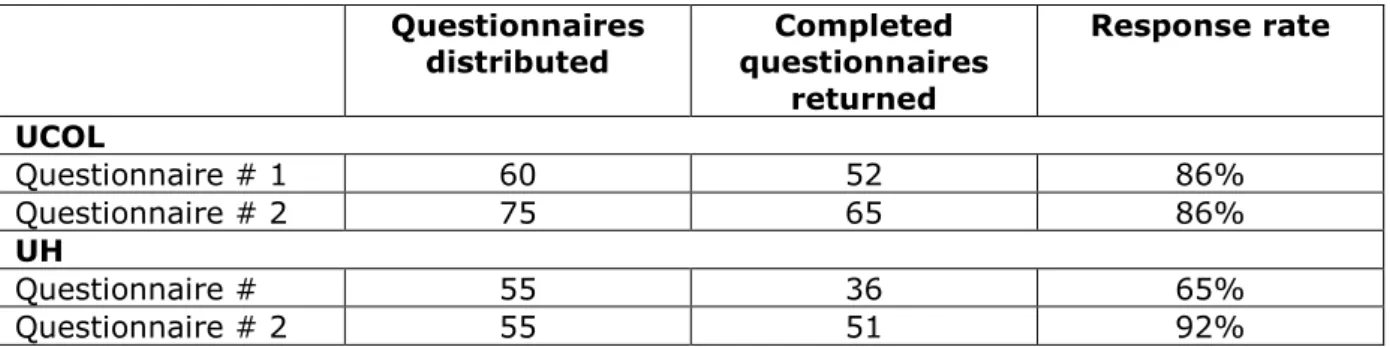
The response rates for these two questionnaires indicated a high level of student interest in this research, with a combined response rate of 76.5% to the first questionnaire, and 89.2% for the second.
7Double-headed stethoscope: A stethoscope that makes it possible for two people to listen to the blood pressure sounds at the same time.
Table One: Response rates, student questionnaires Questionnaires
distributed questionnaires Completed returned Response rate UCOL Questionnaire # 1 60 52 86% Questionnaire # 2 75 65 86% UH Questionnaire # 55 36 65% Questionnaire # 2 55 51 92%
No attempt was made to match each student’s first and second questionnaires. In
addition, different numbers of responses were received at each institution for the first and second questionnaires. Therefore general comparisons only can be made when comparing responses between the questionnaires on each campus.
The majority of students had no previous experience of BPM. Just over a half of UH students (56%), and 29% of UCOL students had been employed in health related work before commencing their nursing training. Of those, 62% at UH and 11% at UCOL had previously undertaken BPM.
Prior to attending the simulation sessions 55% of UCOL and 69% of UH students rated themselves as having a poor level of understanding of theory underpinning the skill of BPM; with only 14% of UCOL and 4% of UH students rating themselves as being confident in their understanding (Figures 1 & 2).
Figures 1 & 2 – Students’ self assessment of level of understanding of theory
In relation to the level of understanding students had of the practical skills associated with BPM prior to the simulation session, 50% of UCOL and 53% of UH students rated their level of understanding as being poor.
55% 31%
14%
Before simulation, how would you rate your level of understanding of
theory - UCOL
Poor Good Confident
69%
27% 4%
Before the simulation sessions: level of understanding of theory -UH
Poor level of understanding Good level of understanding.. Confident in my understanding
Following the simulation sessions 88% of UCOL students and 63% of UH students reported feeling well prepared to undertake BPM, meaning 10% of UCOL and 37% of UH students did not feel well prepared. Unfortunately the questionnaire format did not offer students the opportunity to qualify their responses. By the conclusion of their first clinical placement however, 99% of UCOL and 100% of UH students stated that they now believed they had a good understanding of the relationship between theory and practice, and felt confident in the application of theory to practice.
During the simulation sessions students had the opportunity to practice the skills of measuring BPs both manually and electronically. Interestingly students at UCOL reported practicing taking manual blood pressures more often than their UH counterparts (73% of UCOL students reported practicing 6+ times, whereas the majority of UH students, 92%, practiced manual BPM between 1-5 times).
Figures 3 & 4 – Practicing manual BPM
UCOL students were scheduled to undertake their OSCE assessment immediately after the completion of teaching for this paper, which may be one factor that contributed to the differences in practice rates. Fewer students (just 25% of UCOL and 51% of UH students) had practiced electronic BPM (Figures 5 & 6).
Figures 5 & 6 – Practicing electronic BPM.
17%
39% 25%
19%
How many times did you practice taking a manual blood pressure?
UCOL Not at all 1 to 5 6 to 10 11 to 15 Over 15 5% 92% 3%
How many times did you practice taking a manual blood pressure?
UH
Not at all 1 to 5 6 to 10
75% 25%
How many times did you practice taking an electronic blood pressure
-UCOL
Not at all 1 to 5
49% 35%
2%8% 6%
How many times did you practice taking an electronic blood pressure
UH
Not at all 1 to 5 6 to 10 11 to 15 Over 15
During their first clinical placement 21% of UH students did not have the opportunity to measure BPs manually whereas 100% of UCOL students undertook manual BPM. In comparison 100% of UH but only 66% of UCOL students measured BPs electronically during their placement. This may be attributed to the type of clinical placement area the students were allocated to; UH students went to either an acute hospital or primary care placement whereas the majority of UCOL students went to residential aged care where electronic BPM would not be routinely undertaken. However when the students practiced BPM in the skills laboratories there was little evidence that the type of BPM selected (manual or electronic) was congruent with the type of measurement most commonly undertaken in their subsequent clinical practice. This is exemplified by the fact that UH students had very little experience of undertaking and practicing electronic BPM despite the fact they would be attending an acute placement area where this skill would be used. It was interesting to note that five UCOL students commented they would have liked to be able to practice BPM on a range of patients of different ages, including older people, as they believed this would have better prepared them for BPM during their clinical placement. Thirty students (5 at UCOL, 25 at UH) identified that they would like to have more blood pressure measurement simulation sessions prior to attending the clinical practice areas to further develop their confidence and competence.
Despite the complexities associated with learning to do BPM, especially manual BPM, students felt empowered when they developed competency in this skill. One student commented that ‘Learning to perform the blood pressure on a patient was fascinating
and an empowering experience in the early steps of being a student nurse. I can’t wait to use my new skill in the practicum’.
Part Three: Clinician perspectives
This last component of the project sought to establish the perspectives of clinical mentors and nurse teachers about the readiness of students to confidently and competently perform BPM on their first clinical placement. Upon completion of the first clinical placement for students, a survey form and information sheet was distributed by the researchers to the clinical mentors and nurse teachers/clinical lecturers who worked with the students. The project leads distributed these directly to the nurse teachers/clinical lecturers, and asked them to them to distribute surveys to the relevant clinical mentors/preceptors. Potential participants were asked to complete the anonymous survey, and return it in the pre-paid envelope provided. The completion of the survey form was considered to indicate consent to participate in the study.
The roles of clinical lecturer (UCOL) and nurse teacher (UH) are very different in relation to their direct involvement in the student clinical experience, and as comparisons are unable to be made of their responses, their data has not been included in the report. Instead, attention is focused here on the responses of the clinical mentors/preceptors. The response rate from clinical mentors/preceptors was disappointing, and may be due to the demands of the clinical area being such that completion of a survey form was not considered a priority. Of the 75 preceptor questionnaires distributed by UCOL, the response rate was 22 (29.3%) with a 30% response rate at UH (21 of the 70 mentor questionnaires distributed).
The experience of the respondents in relation to preceptoring nursing students was similar.
Figures 7 & 8 – Years of experience of preceptoring/mentoring
Although there were some very experienced preceptors/mentors among the respondents (18% for UCOL with 6+ years of experience, and 23% for UH), many of the preceptors had relatively limited experience in this role. For instance, 41% of the UCOL preceptors and 30% of the UH preceptors had less than 2 years experience.
Most preceptors/mentors (100% UCOL, 85% UH) considered that the students were able to prepare for, measure and record blood pressure. The students were also considered to have a good understanding of the relationship between theory and practice (86% agreement UCOL, 81% UH). As the following figures demonstrate, students’ competence in performing BPM was also rated highly.
Figures 9 & 10 – Student competence in BPM
Almost 80% of the UCOL preceptors and 70% of UH mentors agreed or strongly agreed that the student was competent in BPM, with 20% and 30% of students respectively not considered competent. Most preceptors/mentors also agreed or strongly agreed that students understood the results of the BPM (87% UCOL, 78% at UH). Although preceptors/mentors identified that some students were unable to demonstrate competence in BPM, 75% of UCOL preceptors and 96% of UH mentors considered the simulation sessions prepared the students effectively. The rating from UH is surprising when they deemed 30% of the students as not being competent in BPM, and raises
41% 41%
9% 4% 5%
Experience in years of
preceptorship of nursing
degree students - UCOL
<2yrs 2-5yrs 6-10yrs 11-20yrs 20+yrs
30% 44% 4% 11% 11%
Experience in years of
preceptorship of nursing
degree students - UH
<2yrs 2-5yrs 6-10yrs 11-20yrs 20+yrs
5%
81% 14%
The student was competent
in performing blood
pressure monitoring - UCOL
Strongly disagree DisagreeAgree Strongly agree
30% 33% 37%
The student was competent
in performing blood pressure
monitoring - UH
Strongly disagree Disagree Agree Strongly agreequestions about the criteria mentors/preceptors use to determine competence, and the extent of additional teaching that occurs during the clinical placement.
In the second student questionnaire, 100% of UCOL students, and 84% of UH students reported they were always supervised by a registered nurse when undertaking BPM. Surprisingly then, when the preceptors/mentors were asked if the student was always supervised by a registered nurse, 68% at UCOL, and 46% at UH reported they were not. The students who were not supervised every time, were reportedly supervised ‘most
times’ (40% UCOL, 59% UH). One possible explanation for this finding may be that once
the preceptor/mentor had confirmed the student was competent in BPM, they no longer felt it necessary to supervise the student on every single occasion they were performing this skill.
Implications for educational practice
The original aims of the research project have been used to frame the discussion of the findings and the implications for educational practice and further research.
A. Compare and contrast the teaching and learning strategies used by the two Departments/Schools in the teaching of BPM
Following data analysis it was apparent that the learning and teaching strategies, and associated resources, were similar between UCOL and UH in relation to teaching BPM. However, the complexity of teaching this skill was not fully captured in this pilot study, and further research is required to enable a detailed comparison and analysis.
Theory underpinning the skill of BPM was taught prior to practice in the skills laboratory. All students were supervised by a lecturer, generally on a 1:10 staff/student ratio while practicing the skill during simulation sessions, and all students were offered additional practice opportunities. Interestingly some of the lecturers were not fully conversant with the theory taught in the anatomy/physiology sessions which led to the potential for repetition, and/or conflicting or incomplete information being given to students. Arguably there is a need to develop clear guidance for lecturers as to the content of anatomy/physiology sessions that allows them to ensure skills session reinforce, rather than repeat, information previously given to students.
One major difference between the two institutions was that UH allowed for 300 hours of simulated practice to be included in the total clinical hours each student accumulated NMC (2006) whereas New Zealand has no allowance for simulated practice in accumulated clinical hours. The pressure educational institutes in both NZ and the UK are experiencing in accessing sufficient clinical placements for nursing students is such that further consideration of the role of simulated clinical hours in undergraduate nursing education is now urgent.
B. Identify students’ experiences of teaching and learning in relation to BPM prior to,
and then immediately after their first clinical placement;
From the data, students identified that they enjoyed and benefited from the simulation sessions and felt confident that they could link theory to practice. They highlighted that they would have liked the opportunity to practice for longer, and to practice on people of different ages, to further prepare them for the patients they would meet in the clinical areas. A large percentage of UH students stated that they did not feel prepared to undertake BPM on clinical placement. It would be beneficial to interview students either individually or as a group to understand their anxieties associated with undertaking BPM
in the clinical areas and to adapt the teaching and learning strategies, if necessary, to overcome these anxieties.
C. Identify clinical mentors and nurse teachers’ perceptions of whether students on their first clinical placement were able to competently measure blood pressure.
The majority of preceptors/mentors were satisfied with the ability of the student to effectively undertake BPMl during their first clinical placement area. Student support in the clinical areas from their preceptors/mentors varied, with some students stating that their preceptors/mentors supervised them at all times doing BPM, in comparison with other students who stated that they were largely unsupervised when undertaking this skill.
It is important that preceptors/mentors are well prepared, and then receive regular updates to further their understanding of the collaborative nature of nurse education. Whilst it is mandatory in the UK for mentors to attend an update every year, it is not currently mandatory in NZ. There needs to be close partnership working between academia and clinical areas to ensure preceptors/mentors receive continued support from lecturers to develop the clinical skills of students in line with NCNZ and NMC competencies.
D. To explore the implications of the research findings for other clinical simulation teaching.
The teaching of clinical skills is far more complex than was first anticipated and more focussed research is required into the teaching and learning strategies used to develop the clinical skills of nurses.
The effectiveness of simulation in preparing the student nurse for their occupational role requires further exploration as does the extent to which mentors/preceptors value their role in preparing and supporting student nurses to undertake clinical skills. The replacement of some clinical hours with simulated hours in nurse education curricula, which would also reduce the demands on clinical areas, is currently the subject of intense international nursing discussion.
The key question that has arisen from this research, and which has implications for other clinical simulation teaching, relates to the anticipated outcomes of such teaching. Further consideration is required of the appropriate expectations of first year nursing students, and what degree of confidence/competence is achievable in the range of clinical skills they are taught. In addition, further exploration is required into the most appropriate timing of the OSCE following the teaching of clinical skills.
Conclusion
This pilot study has confirmed that the teaching and learning strategies, including simulation, used to educate Year One nursing skills in BPM are, in the mainly, generally effective in preparing students for the real-world environment. A number of areas for further research have also been identified.
Acknowledgements
The research team would like to acknowledge the generous support provided by Ako Aotearoa, National Centre for Tertiary Teaching Excellence, New Zealand, and the Yorkshire and Humber Strategic Health Authority, England. In addition, thanks are extended to the numerous students, mentors/preceptors and clinical teachers who participated in this research, and to Veronica Wilbourn for her contribution to data analysis.
Contact details
Marian Bland, RN, PhD
Associate Professor (Nursing), UCOL Karen Ousey, RGN, PhD Principal Lecturer/ Divisional Head Acute and Critical Care (UH)
School of Nursing UCOL Private Bag 11022 Palmerston North, NZ Phone : +64 6 9527001 ext 70423 Email : [email protected]
Department of Nursing and Health Studies Harold Wilson Building
University of Huddersfield, Queensgate, Huddersfield West Yorkshire, England HD1 3DH Phone: 0044 (0) 1484 473462 E-Mail: [email protected]
References
Alinier G., Hunt, W.B., & Gordon, R. (2004). Determining the value of simulation in nurse education: Study design and initial results. Nurse Education in Practice, 4, 200–207. Baillie, L., & Curizo, J. (2009).A survey of first year student nurses’ experiences of learning
blood pressure measurement. Nurse Education in Practice, 9(1), 61-71.
Binstadt, E.S., Walls, R.M., White, B.A., Nadel, E.S., Takayesu, T.D., Barker, T.D., Nelson, S.J., & Pozner, C.N. (2007) A comprehensive medical simulation education curriculum for emergency medicine residents. Annals of Emergency Medicine, 49(4), 495-504.
Bradley, P. (2006). The history of simulation in medical education and possible future directions. Medical Education, 40, 254–262.
Distler, J.W. (2007). Critical thinking and clinical competence: Results of the implementation of student-centred teaching strategies in an advanced practice nurse curriculum. Nurse Education Today, 7, 53-59.
Haigh, J. (2007). Expansive learning in the university setting: The case for simulated clinical experience. Nurse Education in Practice, 7(2), 95-102.
Hammond, J. (2004). Simulation in critical care and trauma education and training. Current Opinion In Critical Care, 10(5), 325-329.
Heart Foundation (Australia). (2008). Heart Foundation guide to management of hypertension: Measuring blood pressure. Retrieved 7 February 2010 from http://www.heartfoundation.org.au/Professional_Information/Clinical_Practice/Hypertens ion/Pages/default.aspx?gclid=CIT-iOKz3J8CFRciagodgBe0Hw.
Lammers, R.L. (2007) Simulation: The new teaching tool. Annals of Emergency Medicine, 49(4), 505-507.
Maran, N.J., & Glavin, N.J., & Glavin, R. (2003). Low-to-high-fidelity simulation: A continuum of medical education? Medical Education,37(Supp 1), 22-28
McCallum J. (2007). The debate in favour of using simulation education in pre-registration adult nursing. Nurse Education Today, 27(8), 825–831.
Murray C., Grant, M.J., Howarth, M.L., & Leigh, J. (2008). The use of simulation as a teaching and learning approach to support practice learning. Nurse Education in Practice, 8(1), 5-8.
Nunn, A. (2004). Almost the real thing. Nursing Management, 11(7), 7 14-18.
Nursing and Midwifery Council. (2004). Consultation on a standard to support learning and assessment in practice. London: Author.
Nursing and Midwifery Council (2006). NMC simulation and practice learning project. London: Author.
Nursing and Midwifery Council. (2007a). Essential skills clusters (ESCs) for pre-registration nursing programmes: Annexe 2 to NMC Circular 07/2007. London: Author.
Nursing and Midwifery Council (2007b). Simulation and practice learning project: Outcome of a pilot study to test the principles of auditing simulated practice and learning
environments in the pre-registration nursing programme. London: Author. Nursing and Midwifery Council. (2008). Standards to support learning and assessment in
practice: NMC standards for mentors, practice lecturers and lecturers. NMC, London
Nursing Council of New Zealand. (2007a). Handbook for nursing departments offering programmes leading to registration as a registered nurse. Wellington: Author.
Nursing Council of New Zealand. (2007b). Competencies for registered nurses. Wellington: Author.
Ousey, K. (2009). Socialization of student nurses: The role of the mentor. Learning in Health and Social Care, 8(3), 175-184.
Roberts, J.D. (2000). Problem solving skills of senior student nurses: An exploratory study using simulation. International Journal of Nursing Studies, 37, 135-143.
Thornett, A. (2007) New skills for HCA’s: Taking a blood pressure. British Journal of Healthcare Assistants, 10(3), 133- 135.
Wong, T.K.S, & Chung, J.W.Y. (2002) Diagnostic reasoning processes using patient simulation in different learning environments. Journal of Clinical Nursing, 11(1), 65-72.