Bonn Econ Discussion Papers
Discussion Paper 16/2001
Factor Models for Portofolio Credit Risk
by
Philipp J. Sch¨
onbucher
December 2000
Bonn Graduate School of Economics Department of Economics
University of Bonn Adenauerallee 24 - 42
PHILIPP J. SCH ¨ONBUCHER Department of Statistics, Bonn University
December 2000
ABSTRACT. This paper gives a simple introduction to portfolio credit risk models of the factor model type. In factor models, the dependence between the individual defaults is driven by a small number of systematic factors. When conditioning on the realisation of these factors the defaults become independent. This allows to combine a large degree of analytical tractability in the model with a realistic dependency structure.
1. INTRODUCTION
In this paper we give an introduction to an important class of portfolio credit risk mod-els: the factor models (also known as conditionally independent credit risk models). These models are among the few models that can replicate a realistic correlated default behaviour while still retaining a certain degree of analytical tractability. Many models that are used in practice are based upon this approach.
Default correlation is an important issue that arises in a large number of practical appli-cations. Default correlation with respect to two obligors arises in the context of letter of credit backed debt, credit guarantees, counterparty risk (particularly in credit deriva-tives). Here the determination of the joint default probability of the two obligors is of particular interest. We will see below that this quantity depends very strongly on the default correlation between these obligors.
Default correlation with respect to multiple counterparties is highly relevant for the pricing and risk management of collateralised debt obligations, and for portfolio man-agement of loan or bond portfolios and bank-wide risk manman-agement: Diversification of credit risk can only be successful if an adequate portfolio credit risk model is in place that can quantify the risks in the portfolio.
Dependence between the defaults of different obligors can be caused by several different fundamental factors. There may be direct links between the obligors (e.g. one obligor is a large creditor of the other, or one is the other’s largest customer).
JEL Classification. G 13.
Key words and phrases. Default Risk, Portfolio Models. Comments and suggestions are welcome, all errors are my own.
Alternatively the links are more indirect but still strong. Industrial firms may use the same input factors (and be exposed to the same price shocks here) or sell on the same markets (and thus depend on the demand there). The general state of an industry or the economic cycle in a region/country also strongly influence the credit quality of other-wise unrelated debtors.
Historically, defaults tend to cluster as the following examples from the USA show:
• Oil industry 22 companies defaulted 1982–1986
• Railroad Conglomerates: One default each year 1970–1977
• Airlines: 3 defaults 1970–1971, 5 defaults 1989–1990
• Thrifts: (Savings and Loan Crisis) 19 defaults 1989-1990
• Casinos / Hotel Chains: 10 defaults 1990
• Retailers: >20 defaults 1990–1992
• Construction / Real Estate: 4 defaults 1992. The structure of the rest of the paper is as follows:
• First, we cover some basic modelling issues and notation.
• Then the distribution of default losses under independence is briefly analysed.
• In the next section we cover the case when defaults are driven by one common factor,
• and then the case when defaults are driven by several common factors.
2. DEFAULT CORRELATIONBASICS
2.1. Terminology. Although it has become common to talk about default correlation, the term correlation is misleading. The classical linear correlation coefficient that we know from the analysis of share prices, exchange rates and interest rates, is a very inadequate measure of d dependence between defaults in a portfolio. This is implicitly recognized by many portfolio managers and risk managers who use different concepts to measure the total credit risk in a portfolio of credit exposures. The conclusive measure of the risk of the portfolio is the full distribution of its returns which is also the quantity that we are mostly concerned with. Many risk-relevant features of this distribution can be summarised in a few key numbers like the expected loss and VaR numbers at various levels.
In this paper default correlation will be used as a generic term for interdependent de-faults. Otherwise the specific term linear correlation will be used.
2.2. Linear default correlation, conditional default probabilities, joint default
prob-abilities. As it is difficult to gain an intuitive feeling for the size and effect of the linear
default correlation coefficient we set it into context with two more accessible quantities: the conditional default probability and the joint default probability.
We consider two obligorsA andB and a fixed time horizonT. The probability of a default ofAbeforeT is denoted bypA, the default probability ofB bypB. We assume
that these probabilities are exogenously given.
Knowledge of these quantities is not yet sufficient to determine either
• the probability, thatAandB default beforeT: the joint default probabilitypAB
• i.e. the probability that Adefaults beforeT, given thatB has defaulted before T, or the probability thatB defaults given thatAhas defaulted:
the conditional default probabilitiespA|BandpB|A
• the linear correlation coefficient%AB between the default events1{A}and1{B}.
(The default indicator function equals one1{A} = 1ifAdefaults beforeT, and
1{A} = 0ifAdoes not default.)
We need at least one of the quantities above to calculate the others. The connection is given by Bayes’ rule:
(1) pA|B = pAB pB , pB|A= pAB pA
and by the definition of the lineare correlation coefficient
(2) %AB =
pAB −pApB
p
pA(1−pA)pB(1−pB)
.
2.3. Why Correlations? Default correlations are very important because default prob-abilities are very small. %AB can have a much larger effect on the than usual (e.g. for
equities etc).
The joint default probability is given by pAB =pApB+%AB
p
pA(1−pA)pB(1−pB)
(3)
and the conditional default probabilities are: pA|B =pA+%AB r pA pB (1−pA)(1−pB) (4)
To illustrate the significance of the size of the default correlation let us assume the following orders of magnitude:%AB =%=O(1)is not very small andpA=pB =p
1small, e.g.%AB = 10%andp= 1%.
pAB = 0.01∗0.01 + 0.1∗0.01∗0.99 = 0.00109≈p2+%p≈%p
(5)
pA|B = 0.01 + 0.1∗0.99 = 0.109 ≈%.
(6)
In equations (5) and (6) the correlation coefficient dominates the joint default probabil-ities and the conditional default probabilprobabil-ities.
2.4. The need for theoretical models of default correlations. In this subsection it will be shown that for several reasons, structural theoretical models are indispensable for the successful assessment of the risk of default correlation. These models must be able to explain and predict default correlations from more fundamental variables. The first of these reasons lies in the data upon which the assessment of default correla-tion is based. There are several possible data sources, none of which is perfect:
• Actual rating and default events:
The obvious source of information on default correlation is the historical inci-dence of joint defaults of similar firms in a similar time frame. This data is objective and directly addresses the modelling problem. Unfortunately, because joint defaults are rare events, historical data on joint defaults is very sparse. To gain a statistically useful number of observations, long time ranges (several decades) have to be considered and the data must be aggregated across industries and countries. In many cases direct data will therefore not be available.
• Credit Spreads
Credit spreads contain much information about the default risk of traded bonds, and changes in credit spreads reflect changes in the markets’ assessment of the riskiness of these investments. If the credit spreads of two obligors are strongly correlated it is likely that the defaults of these obligors are also correlated. Credit spreads have the further advantage that they reflect market information (there-fore they already contain risk premia) and that they can be observed far more frequently than defaults. Disadvantages are problems with data availability, data quality (liquidity), and the fact that there is no theoretical justification for the size and strength of the link between credit spread correlation and default corre-lation1.
• Equity Correlations
Equity price data is much more readily available and typically of better quality than credit spread data. The connection between equity prices and credit risk is not obvious, this link can only be established by using a theoretical model. Consequently a lot of pre-processing of the data is necessary until a statement about default correlations can be made.
Therefore the only viable data sources require theoretical models which predict default behaviour.
The second, and most important reason for the usage of default models is the fact that the specification of full joint default probabilities is simply too complex: While there are only four joint default events for two obligors (none defaults,Adefaults,Bdefaults and both default), there are2N joint default events forN obligors. For a realistic number of
obligors it is impossible to enumerate these probabilities.
1Theoretically, two obligors could exhibit independent credit spread dynamics up to default, but still have
This situation is different from normally distributed random variables where theN(N−
1)/2elements of the correlation matrix are sufficient to describe the dependency struc-ture.
3. INDEPENDENCE
Assume the following (very simplified) situation:
Assumption 1 (Homogeneous Portfolio, Independent Defaults).
(i) We consider default and survival of a portfolio until a fixed time-horizon of T. Interest-rates are set to zero2.
(ii) We have a portfolio ofN exposures toN different obligors.
(iii) The exposures are of identical sizeL, and have identical recovery rates ofc. (iv) The defaults of the obligors happen independently of each other. Each obligor
defaults with a probability ofpbefore the time-horizonT. The assumptions in assumption 1 will be relaxed in coming sections.
We callXthe number of defaults that actually occurred until timeT. The loss in default is then
(7) X(1−c)L,
the number of defaults multiplied with exposure size and one minus the recovery rate. Therefore, to assess the distribution of the default losses it is sufficient to know the distribution of the numberXof defaults.
In this situation the distribution of defaults is given by the well-known Binomial Distri-bution. The probability of exactlyX =n, (withn≤N) defaults until timeT is
(8) P[X =n ] = N n pn(1−p)N−n = N! n!(N −n)!p n(1−p)N−n=:b(n; N, p),
and the probability of up toN defaults is the sum over all potential numbers of defaults up ton (9) P[X ≤n] = n X m=0 N m pm(1−p)N−m =:B(n; N, p).
Equations (8) and (9) define the Binomial Density functionb(n; N, p)and the Binomial Distribution functionB(n; N, p).
3.1. Properties of the Binomial Distribution Function. An example for a typical Bi-nomial density function is given in figure 1. The density has an extremely thin tail, the 99% VaR lies at 11 defaults, the 99.9% VaR at 13 and the 99.99% VaR at 15 defaults. As table 1 shows, these VaR numbers are not significantly changed when different individ-ual default probabilities are used. When the number of obligors approaches infinity, the 2This assumption is not critical, we could also just consider the forward values of the exposures untilT.
0% 2% 4% 6% 8% 10% 12% 14% 16% 18% 20% 0 10 20 30 n p ro b
FIGURE 1. Default loss density function under independence.
Parame-ters: Number of obligorsN = 100, individual default probabilityp = 5%
Default Probability 99.9% VaR Level
1% 5 2% 7 3% 9 4% 11 5% 13 6% 14 7% 16 8% 17 9% 19 10% 20
TABLE 1. VaR levels as a function of the individual default probability
under independence of defaults.
central limit theorem ensures the convergence of the distribution function to a normal distribution function, hence the bell-shaped form of the default loss density function in figure 1.
3.2. The other extreme: Perfectly dependent defaults. The extreme case of default correlation is given when the defaults are perfectly dependent. In the situation of as-sumption 1 this means, that
◦ either all obligors default (with 5% probability)
◦ or none of the obligors defaults (this happens with 95% probability).
Note that this situation is still compatible with the previously made assumption that each obligor defaults with a probability of 5%. It is impossible to recover any information about the likelihood of joint defaults from the individual default probabilities in this situation.
When the individual default probabilities are not identical across the obligors it is possi-ble to extract some information about the likelihood of joint defaults from the individual default probabilities, but not much. For example, the joint default probability of a certain set of obligors must be less than or equal to the smallest individual default probability of these obligors3.
4. ONE- FACTOR DEPENDENCE
We need a model to represent correlated defaults. Here we use a very simplified form of the so-called firm’s value models which is reportedly4due to Vasicek (1997). This approach is also used in Finger (1999) and in Belkin et al. (1998).
4.1. A simplified firm’s value model.
Assumption 2 (Simplified Firm’s Value Model). The default of each obligor is triggered
by the change of the value of the assets of its firm. The value of the assets of then’th obligor at timetis denoted byVn(t).
We assume that Vn(T) is normally distributed. Without loss of generality we set the
initial asset values to zero Vn(0) = 0 and standardise their development such that
Vn(T)∼Φ(0,1).
Obligorndefaults if its firm’s value falls below a pre-specified barrierVn(T)≤Kn.
The asset values of different obligors are correlated with each other. The variance-covariance matrix5of theV1, . . . , VN is denoted byΣ.
This model is very similar in nature to the JPMorgan Credit Metrics model.
Note that in this setup we can still calibrate the model to reflect different individual default probabilities pn over the time horizon by setting the barrier level to that level
3These bounds are a version of the so-called Frechet bounds.
4Although it is frequently cited, this working paper cannot be obtained from KMV or any of the usual
working paper archives.
p2 Asset Corr. p12 p2|1 p2|1/p2 Default Corr.
0.02 48 0.006 0.45 23 3.54 0.02 65 0.012 0.90 45 7.24 0.26 48 0.052 3.91 15 8.32 0.26 65 0.087 6.54 25 14.32
TABLE 2. Joint default probabilities p12, conditional default
probabil-ities p2|1 and default correlations in a practical firm’s value model.
Source: Dt. Bank, Units: %
which replicates the given individual default probability. This level is (10) Kn = Φ−1(pn).
The other calibration parameters are the 12N(N −1)elements of the covariance matrix
Σ. These elements do not affect the individual default probabilities but only the joint default behaviour of the portfolio.
4.2. Example Firm’s Value Model. Table 4.2 shows a practical numerical example with two Japanese banks as obligors. The indidvidual default probability of the first bank isp1 = 1,33%, the default probability of the second bank is eitherp2 = 0.02%or
p2 = 0.2%. The presence of asset value correlation has a significant effect on the joint
and conditional default probabilities. This effect is larger for the high quality situation p2 = 0.02%than for the low credit quality situation.
It should also be noted that the (linear) asset correlation coefficient is not equal to the (linear) default correlation coefficient. Typically, the default correlation coefficient is much smaller than the asset correlation.
4.3. A one-factor version of the firm’s value model.
Assumption 3 (One-Factor Model). The values of the assets of the obligors are driven
by a common, standard normally distributed factorY component and an idiosyncratic standard normal noise componentn
(11) Vn(T) =
√
% Y +p1−% n ∀n≤N,
whereY andn, n≤N are i.i.d. standard normallyΦ(0,1)-distributed.
Using this approach the values of the assets of two obligorsnandm 6=nare correlated with linear correlation coefficient%. The important point is that conditional on the real-isation of the systematic factorY, the firm’s values and the defaults are independent. 4.4. The distribution of the defaults. In the following we assume that all obligors have the same default barrierKn=Kand the same exposureLn = 1.
By the law of iterated expectations, the probability of having exactlyn defaults is the average of the conditional probabilities ofn defaults, averaged over the possible reali-sations ofY and weighted with the probability density functionφ(y):
P[X =n] =
Z ∞
−∞
P[X =n|Y =y]φ(y)dy. (12)
Conditional onY =y, the probability of havingndefaults is (13) P[X =n |Y =y ] = N n (p(y))n(1−p(y))N−n, where we used the conditional independence of the defaults in the portfolio.
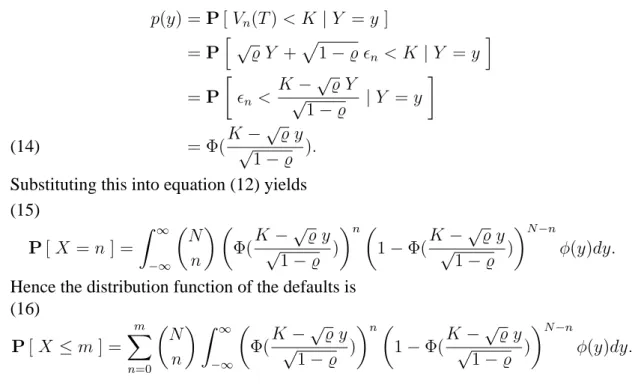
The individual conditional default probabilityp(y)is the probability that the firm’s value Vn(T)is below the barrierK, given that the systematic factorY takes the valuey:
p(y) =P[Vn(T)< K|Y =y] =Ph√% Y +p1−% n< K |Y =y i =P n < K−√% Y √ 1−% |Y =y = Φ(K− √ % y √ 1−% ). (14)
Substituting this into equation (12) yields
P[X =n ] = Z ∞ −∞ N n Φ( K−√% y √ 1−% ) n 1−Φ(K − √ % y √ 1−% ) N−n φ(y)dy. (15)
Hence the distribution function of the defaults is
P[X ≤m] = m X n=0 N n Z ∞ −∞ Φ(K− √ % y √ 1−% ) n 1−Φ(K − √ % y √ 1−% ) N−n φ(y)dy. (16)
Figure 2 shows the distribution of the default losses for the previous portfolio (100 obligors, 5% individual default probability) under different asset correlations. Increas-ing asset correlation (and thus default correlation) leads to a shift of the probability weight to the left (’good’ events) and to the tail on the right. Very good events (no or very few defaults) become equally more likely as very bad events (many defaults). It should be noted that the deviation of the loss distribution function from the distribution under independence is already significant for very low values for the asset correlation (e.g. 10%).
The most significant effect for risk management is the increased mass of the loss dis-tribution in its tails. Figure 3 uses a logarithmic scale for the probabilities to show this effect more clearly. While the probabilities decrease very quickly for independence and very low correlations, the probability of a joint default of 30 obligors is still above 10 bp for asset correlations of 30% or 50%.
0,00% 2,00% 4,00% 6,00% 8,00% 10,00% 12,00% 14,00% 16,00% 18,00% 20,00% 0 5 10 15 20 25 30 rho=0 rho=1 rho=10 rho=30 rho=50
FIGURE 2. Default losses under correlation (one-factor model). Pa-rameters: Number of obligorsN = 100, individual default probability p= 5%, asset correlation rho in percentage points: 0, 1, 10, 30, 50
Asset Correlation 99.9% VaR Level 99% VaR Level
0% 13 11 1% 14 12 10% 27 19 20% 41 27 30% 55 35 40% 68 44 50% 80 53
TABLE 3. 99.9% and 99% VaR levels as a function of the asset corre-lation in the one-factor model. Parameters: 100 obligors, 5% individual default probability
The 99.9% and 99% VaR levels shown in table 3 show the dramatically increased tail probabilities when correlation in the asset values is taken into account. The 99.9% VaR at a moderate asset correlation of 10% and an individual default probability of 5% is 27, which is worse than the 99.9% VaR of a portfolio of independent credits with a much higher individual default probability of 10% (the VaR is 20 in the latter case).
0,01% 0,10% 1,00% 10,00% 100,00% 0 5 10 15 20 25 30 rho=0 rho=1 rho=10 rho=30 rho=50
FIGURE 3. Default losses under correlation (one-factor model). Log-arithmic scale. Parameters: Number of obligors N = 100, individual default probabilityp= 5%, asset correlation rho in percentage points: 0, 1, 10, 30, 50
4.5. The large portfolio approximation. Even more tractability than in equations (15) and (16) can be reached if the number of obligorsN tends to infinity.
Assumption 4 (Large Uniform Portfolio). The portfolio consists of a very largeN → ∞ number of credits of uniform size. LetX now denote the fraction of the defaulted securities in the portfolio.
Individual defaults are still triggered by the simple firm’s value model. Thus the indi-vidual default probability (conditional on the realisationyof the systematic factorY) is given by equation (14) p(y) = Φ(K− √ % y √ 1−% ).
Conditional on the realisationyofY the individual defaults happen independently from each other. Therefore, in a very large portfolio, the law of large numbers ensures that the fraction of obligors that actually defaults is (almost surely) exactly equal to the individual default probability:
(17) P[X =p(y)|Y =y] = 1.
Now we do not know the realisation ofY yet, but we can invoke iterated expectations to reach P[X ≤x] =E[P[X ≤x|Y ] ] (18) = Z ∞ −∞ P[X ≤x|Y =y]φ(y)dy (19) using equation (17) = Z ∞ −∞ P[X =p(y)≤x|Y =y ]φ(y)dy (20) = Z ∞ −∞ 1{p(y)≤x}φ(y)dy= Z ∞ −y∗ φ(y)dy= Φ(y∗) (21)
Herey∗ is chosen such thatp(−y∗) = x, andp(y) ≤ xfory > −y∗. (Remember that the individual default probabilityp(y)decreases iny.) Thusy∗ is
(22) y∗ = √1
% p
1−%Φ−1(x)−K.
and combining the results yields the distribution function of the loss fractionX: (23) F(x) :=P[X ≤x] = Φ 1 √ % p 1−%Φ−1(x)−Φ−1(p) .
Taking the derivative of the distribution function with respect toxyields the correspond-ing probability density functionf(x):
f(x) = r 1−% % exp 1 2(Φ −1 (x))− 1 2% Φ−1(p)−p1−%Φ−1(x) 2 . (24)
Obviously, infinitely large portfolios do not occur in practice, but the quality of the ap-proximation is remarkable. In the present example (100 obligors, 5% individual default probability, 30% asset value correlation) the relative error in the tail of the distribution is around 0.1 – 0.2, i.e. the large-portfolio value of the default distribution deviates by a factor of up to±0.2from the exact value. Given the uncertainty about the correct input for the asset correlation this error is negligible in many cases.
Figures 4 and 5 show the limit distribution of the default losses. For very low num-bers of defaulted obligors (one or zero defaults) the approximation is incorrect because these events are discrete in reality, but must be represented as continuous events in the infinitely large portfolio. The approximation also has problems with very low (less than 1%) asset correlation coefficients, again here the discreteness of the real-world becomes noticeable: As the asset correlation coefficient tends to zero, the discrete distribution tends towards a Binomialb(n; N, p)distribution, while the distribution of the infinitely large portfolio tends to a default fraction of exactlyp. Apart from this, the quality of the approximation is remarkable.
0,00% 2,00% 4,00% 6,00% 8,00% 10,00% 12,00% 14,00% 16,00% 18,00% 20,00% 0% 5% 10% 15% 20% 25% 30% Loss Fraction P ro b a b il it y 1% 10% 30% 50%
FIGURE 4. The limiting distribution of default losses for different asset
value correlations. 0,01% 0,10% 1,00% 10,00% 100,00% 0% 5% 10% 15% 20% 25% 30% Loss Fraction P ro b a b il it y 1% 10% 30% 50%
FIGURE 5. The limiting distribution of default losses for different asset value correlations, logarithmic scale.
5. GENERALISATIONS
The results of section 4 will now be generalised to show the influence of some, seem-ingly innocent assumptions, about the nature of the default process.
5.1. Volatility-Uncertainty. We replace the dynamics (11) with (25) Vn= 1 t( √ % Y +p1−% n) ∀n ≤N,
wheretisχ2-distributed withνdegrees of freedom and independent ofY and then.
This setup changes the distribution of the firms’ valuesVnfrom a multivariate normal
distribution to a multivariatet-distribution. Thet-distribution arises whenever the vari-ance of a normally distributed random variable must be estimated, it can be considered to represent stochastic volatility in the firms’ values.
The expression for the conditional default risk (equation (14)) must be conditioned ont andY, it takes the following form
p(y) = P n/t < K−√% Y √ 1−% |Y =y =H(K− √ % y √ 1−% ). (26)
The large-portfolio approximation now yields the generalisation of equation (23), a gen-eral loss distribution
(27) F(x) :=P[X ≤x] = 1−G K √ % − r 1−% % H −1(x) .
5.2. General Distribution Functions. The careful reader will have observed that in the derivation of the results for the loss distributions in sections 4 we never explicitly used the functional form of the Normal Distribution. We therefore replace assumption 3 with 5.
Assumption 5 (Generalised One-Factor Model). The values of the assets of the obligors
are driven by a common factorY which has distribution functionG(y), and an idiosyn-cratic noise component n which is distributed according to the distribution function
H()
(28) Vn(T) =
√
% Y +p1−% n ∀n≤N,
whereY ∼G, and then, n≤N are i.i.d. H()-distributed.
If the respective moments ofY andn exist we assume w.l.o.g. that these random
vari-ables are centered and standardised.
Changing the distribution functions of the systematic factor and the noise term will not affect the linear correlation between the values Vn and Vm of two firms (provided the
second moments exist), but it may have a large impact on the default risk of a portfolio of obligors.
The expression for the conditional default risk (equation (14)) now becomes p(y) =P n< K−√% Y √ 1−% |Y =y =H(K− √ % y √ 1−% ). (29)
The large-portfolio approximation now yields the generalisation of equation (23), a gen-eral loss distribution
(30) F(x) :=P[X ≤x] = 1−G K √ % − r 1−% % H −1(x) .
6. MULTI-FACTOR DEPENDENCE
6.1. Multifactor conditional models without rating transitions. The results of the previous section can be extended to include more than one driving systematic factor for the development of the obligors’ asset values. The model presented here is similar to Lucas et al. (1999).
Assumption 6 (Multifactor Firm’s Value Model). The asset values of the firms are
driven by a vector Y of J driving factors. Each factor influences the value of the n -th firm’s assets wi-th a weight of βj
n. The weight vector of the n-th firm is called βn.
Thus (31) Vn= J X j=1 βnjYj +n
wherenis the idiosyncratic noise of firmn.
Firmndefaults if its firm’s value is below the barrier for this firm: Vn ≤Kn.
The factors and errors are normally distributed
• Y ∼Φ(0,ΩY): the driving factors in firm’s values
• n ∼N(0, ωn2): idiosyncratic errors,
and(Y, 1, . . . , N)are independent.
Note that the assumption of uniform default probability across the portfolio has been given up.
Like in the one-factor case we need to derive the conditional default probabilitiespn(y)
of the different obligors to derive the distribution of the numberX of defaults. Given a realisationyof the factor vectorY, the default probability of obligornis
pn(y) = P[Vn ≤Kn|Y =y] =P " n≤Kn− J X j=1 βnjyj # = Φ Kn− PJ j=1βnjyj ωn ! . (32)
In general, the conditional default probabilities will be different for obligors with dif-ferent factor loadings, even if they have the same default barrier K. For this reason assuming different unconditional default probabilities (and thus default barriers) does not complicate the model any further.
Using the conditional default probabilities from equation (32) we can now derive the conditional probability of havingmdefaults in the whole portfolio:
P[X =m |Y =y ] = X |M|=m Y n∈M pn(y) Y n06∈M (1−pn0(y)) ! , (33)
where the sum is over all subsetsM ⊂ {1, . . . , N}with exactlymelements:|M|=m. The unconditional probability of havingmdefaults is now
P[X =m] = Z IRJ X |M|=m Y n∈M pn(y) Y n06∈M (1−pn0(y)) ! φ(y|ΩY)dy = X |M|=m Z IRJ Y n∈M pn(y) Y n06∈M (1−pn0(y)) ! φ(y|ΩY)dy (34)
Equations (33) and (34) are in closed-form but its numerical implementation is often impossible because of the large number of summation elements in the formula6 For-tunately, in many practically relevant cases the number of summands can be reduced significantly.
6.2. Portfolios of two asset classes. As a simple example we consider the case where the portfolio of obligors can be decomposed into two classes of homogeneous obligor types.
Assumption 7 (Homogeneous Classes). Assume that the portfolio consists of two classes
of obligors: C1 andC2. There areN1 obligors of classC1 andN2 obligors of classC2.
Obligors of the same class have the same default barriersK1 (orK2) and factor
load-ings: Vn1 =Y1β 1 1 +Y2β12+n1 forn1 inC1 (35) Vn2 =Y1β 1 2 +Y2β22+n2 forn2 inC2. (36)
The two factorsY1 andY2 and the noisesn1 andn2 are i.i.d.Φ(0,1)distributed.
In many practical credit risk modelling problems the information about the obligors is given in this form: The obligors are classified into different risk classes by criteria like industry, country, rating, but within the individual risk class no distinction is made between the obligors. Similar classifications are also made by the well-known Credit Metrics (JPMorgan & Co. Inc. (1997)) and Credit Risk+ (Credit Suisse First Boston (1997)) models.
The obligors’ assets within one class are correlated with a correlation coefficient of%1
and%2 respectively, and the conditional survival probability in class 1 is given by
p1(y) =P[Vn1 ≤K1 |Y =y] =Pn1 ≤K1−y1β 1 1 −y2β12 = Φ K1−y1β11−y2β12 . (37)
6For 10 defaults out of 100 obligors there are 100 10
The survival probabilityp2(y) for class 2 is determined analogously. Then the
condi-tional probability of havingm1defaults in classC1is given by the Binomial probability
b(m1; N1, p1(y)). Thus the total conditional probability of observingmdefaults in the
whole portfolio is (38) P[X =m|Y =y] = m X m1=0 b(m1; N1, p1(y))b(m−m1; N2, p2(y))
because, ifm1 defaults occur in the first class, we needm−m1 defaults in the second
class to reach a total of m defaults7. The unconditional probability of m defaults is reached by integrating over all possible realisations of the factors:
(39) P[X =m] = m X m1=0 Z IR2 b(m1; N1, p1(y))b(m−m1; N2, p2(y))φ(y)dy.
It is straightforward to generalise this approach to more than two classes of obligors.
6.3. Rating Classes and Normal Approximation. Another generalisation of the model is the introduction of rating classes, which enables us to model changes in the market values of the assets in the portfolio before a default occurs.
Assumption 8 (Rating Transitions). Similar to the credit-metrics approach we
intro-duce rating transitions which are driven by changes in the asset values Vn when the
firm’s values exceed certain barriers
ckl.
Herecklis the barrier for a transition from rating classkto rating classl. The barriers
are calibrated to exogenous rating transition probabilities.
If obligorn’s rating changes from classkto classlthere is an associated loss in value πklLn.
Here, closed-form solutions can also be written down, but their implementation gener-ates even more problems than the implementation of equations (33) and (34). Therefore another way has to be found to reach the distribution of the default losses.
Again, we start from the conditional distribution of the values of the obligors’ assets. The probability that the assets of obligornare below the barrierckl, given thatY =yis
pkln(y) =P[Vn ≤ckl |Y =y ] =P " n≤ckl− J X j=1 βnjyj # = Φ ckl− PJ j=1β j nyj ωn ! . (40)
7Here we also need to check thatN
From the conditional rating transition probabilities and the associated price changesπkl
we can derive the conditional mean and variance of the value of then-th asset: µn(y) := X l Lnπklpkln(y) (41) σ2n(y) :=X l (Lnπkl−µn(y))2pkln(y). (42)
The normal approximation now approximates the conditional distribution of the change in the value of the portfolio with a normal distribution with the same conditional mean and variance as the conditional mean and variance of the portfolio:
µ(y) := N X n=1 µn(y) (43) σ2(y) := N X n=1 σn2(y). (44)
If the number of assets in the portfolio is large (and the individual default probabili-ties are not too small), this is a good approximation. In Lucas et al. (1999) there is a detailed numerical analysis of the quality of this approximation. Using this approxima-tion the condiapproxima-tional distribuapproxima-tion of the portfolio’s change in value is the standard normal distribution (45) P[X ≤x|Y =y] = Φ x−µ(y) σ(y) .
The unconditional distribution of the value changes of the portfolio is reached by inte-grating over the possible realisations ofY
(46) P[X ≤x] = Z IRJ Φ x−µ(y) σ(y) φ(y|ΩY)dy.
7. SOMEREMARKS ONIMPLEMENTATION
A few remarks on the implementation of conditionally independent credit risk models:
7.1. Estimation with Probit Regression. It is not a coincidence that the setup of the model in equation (31) looks very much like a linear regression model. The only differ-ence to classical linear regression is the fact that the firm’s valueVncannot be observed,
but only the default / survival event. This situation is known as a hidden variables regression problem in the econometric literature, and the best-known methods for prob-lems of this kind are LOGIT and PROBIT regression. In the case of normally distributed residualsn we are dealing with a PROBIT regression model. There is already a large
literature on these models which can be directly used here.
The models crucially depend on the independence assumption for the n. If these are
still correlated, we cannot use the Binomial distribution and we have missed a portion of the correlation in the model. Usually this will result in an underestimation of the tail probabilities. Therefore, independence of the regression residuals is not just a esoteric exercise of statisticians but an important model requirement.
7.2. Calibration to historical default experiences. As an alternative to the Probit es-timation of the fundamental asset value processes, one can calibrate the large portfolio distribution function (23) directly. Besides the average default ratep there is only one unknown parameter % in equation (23). Given a historically observed distribution of default rates for a given industry / country / rating class one can imply these two pa-rameters by fitting the distribution (23) to the historical observations. These papa-rameters can then be used as asset value correlations and default probabilities in the models with fewer obligors.
This approach has the advantage of ensuring a realistic, historically confirmed shape for the distribution of default rates. Even if this approach is not taken, it should be used as a benchmark to check the results of the Probit regression.
8. CONCLUSION
The effect of default correlation can be very large, sometimes as large as the default probabilities themselves. Default correlations are especially important for worst cases and VaR. Therefore these effects must not be ignored in the management of portfolios of credit sensitive instruments. The structure of the modelling problem and the lack of available data makes structural models of default correlation indispensable.
In this paper a particularly simple and tractable class of default risk models is presented: the conditionally independent models. These models were built up from the most simple case of a homogeneous portfolio to the fully complex case of a multi-factor portfolio with different exposure sizes and possible value changes due to rating transitions. Furthermore, the influence of the different parameters on key risk management numbers (VaR) was shown, and the quality of the various approximations was discussed.
REFERENCES
Belkin, Barry, Stephan Suchover, and Lawrence Forest (1998). “A one-parameter repre-sentation of credit risk and transition matrices.” Credit Metrics Monitor, 1(3), 46–56. Credit Suisse First Boston (1997). “Credit Risk+.” Technical document. URL:
www.csfb.com/creditrisk.
Finger, Christopher C. (1999). “Conditional approaches for credit metrics portfolio distributions.” Credit Metrics Monitor, 2(1), 14–33.
JPMorgan & Co. Inc. (1997). “Credit Metrics.” Technical document. URL: www.creditmetrics.com.
Lucas, Andre, Pieter Klaassen, Peter Spreij, and Stefan Staetmans (1999). “An ana-lytic approach to credit risk of large corporate bond and loan portfolios.” Research Memorandum 1999-18, Vrije Universiteit Amsterdam.
Vasicek, Oldrich (1997). “The loan loss distribution.” Working paper, KMV Corpora-tion.
Author’s address: Philipp J. Sch¨onbucher
Department of Statistics, Faculty of Economics, Bonn University Adenauerallee 24–42, 53113 Bonn, Germany,
Tel: +49 - 228 - 73 92 64, Fax: +49 - 228 - 73 50 50
E-mail address: [email protected]