A Survey: Content Based Image Retrieval
Javeria Amin
Department of Computer Science, COMSATS University, Wah Campus- Pakistan
Email: [email protected]
Annam Zafar
Department of Computer Science, COMSATS University, Wah Campus- Pakistan
Email: [email protected]
---ABSTRACT---The field of image processing is addressed significantly by the role of CBIR. Peculiar query is the main
feature on which the image retrieval of content based problems is dependent. Relevant information is
required for the submission of sketches or drawing and similar type of features. Many algorithms are
used for the extraction of features which are related to similar nature. The process can be optimized by
the use of feedback from the retrieval step. Analysis of colour and shape can be done by the visual
contents of image. Here neural network, Relevance feedback techniques based on image retrieval are
discussed.
Keywords-
Colour, Database, Image, Query, Shape.
____________________________________________________________________________________
1. INTRODUCTION
BIR is a term known as the process of
Retrieving image from features such as shape
information, texture or colour.[1]The researches
carried on database and processing of images
involves CBIR system and these vary from issues of
storage that are user friendly[2] PNPA operation is
applied
successfully
which
eliminates
the
discontinuity of edges that formed by the image
capturing from a distance[3]In radiology practices
the CBIR system is becoming important due to the
substantial advantage in medicine and feature
analysis[4-5].It also plays significant role in CT scan
images MRI scan images and x-rays [6-10].The
geometrical structural change of the body is
possibility examined and processed by medical
image [11].In case of breast cancer the diagnosis is
possible by using digital mammography technique
which is being widely applicable but in order to safe
human body from the bad effects, some safe
procedures are preferred which include MRI,
Infrared and Biopsy [12].In medical image sequence
proposed lossless fast method gives the best
sequences of CE and MRI images which ultimately
improves the compression rate[13].Modalities in the
medical images such as US bladder ,US phantom,
CT and MR images are segmented which is using
different
algorithms
e.g.
KNN,
GAL,ISNN.
Segmentation can be used by applying feature
extraction method that is (2D-CWT), MGH and a
joined version of both 2D-CWT, MGH called hybrid
features. Analysis outcome show that KNN did better
Volume: 5 Issue: 06 Pages: 2076-2083 (2014)
ISSN: 0975-0290
photo book, visual SEEK, video Q are handled to
image video clips and audio clips.[31]Desired
features of image in microscopic level are possible to
be extracted by the using of technique known as
microscopic feature extraction that is useful in the
area of medical sciences for tracing the infected parts
in the body these may be bone crackes or holes and
tainted cell[32] The fast and faster results are
possible to achieve in calculations where initial step
of Hull quick formulation is applied [33]
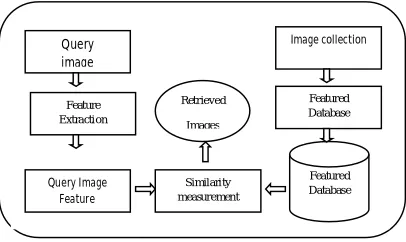
Figure 1. General Flow of content based Image
Retrieval System
the maximum margin criterion (MMC) may be used
to solve the problems such as small sample size
(SSS).This may be stated as the form of LDA which
is modified and convex hull[34] Many researchers
have paid attention in retrieval of feature of textures
colour and shape which is given in [35].Such
combination of colours and texture along with shape
have been optimized in[36]some examples of such
features can be found in[37]system defined
in[38]deals with the quires of audio visual[39]which
also combines CBIR systems[40].Next level to the
image retrieval for better image and performance
were followed by the researchers. The proposed
methods for retrieving the colour, texture and shapes
are being used now days. Some methods can be
discussed.
2.
SEMANTIC
G
APAlgorithms from the evolutionary stage may be
called as Evolutionary programming (EP).In such
type of programming’s the high level feature of
keyword is used to be retrieved for the images and
then accordingly the use of relevant images and
query keywords the retrieval by database is
accomplished [41].Dealing with databases of images,
semantic analysis giving us the idea that how to
make retrieval of similar images [42]. It is mainly
divided into two steps. firstly the explanation of the
images with their complete description of meanings,
are taken from an ontology(study and thought of
natural existence).and secondly by calculating the
comparison of two similar images based on (HSBD),
and also based on natural thoughts these two steps
helps us to solve the problem of semantic gap[43].
3.
IMAGE
DATABASE:
It is necessary to have collection of images with
distinct feature where there exist a large number of
images this will be easy to separately identify them
[44], decision regarding the selection of image has to
be taken. Not to choose the similar images with in
group. Sometimes first image [45] is selected but
nothing is said to process about the selecting an image
as it is selected randomly or by the hand.About three
million images are handled by the retrieval system of
images on large scale. Collateral text and the visual
features are the basics of system retrieval of images.
Such process that consists of keyword of initial or
image based query and results of visual appearance on
the feedback .This is possible to set on large scale data
[46].
4.
WEB
BASE DATABASE:
Efforts are required to make the image processing to
web retrieval imaging. An image searching engine is
proposed to retrieve the web image in improved form
[47] .Heterogeneous and inter-active types of data deals
with several trends of multi-model image retrieving
systems. This is in search still to find the resemblance
and combine different models. Iterative model for
similarity propagation proposed such approaches are
used to learn the semantic similarities of images in the
way to leverage the relationship existing between the
textual annotations and their images [48].
5.
CBIR
BYC
OLOUROne of the important features in image retrieval is the
colour feature [49] Proper selection of colour space is
basic issue in local Fourier transform. Different result
will be gained by using different colour spaces. [50]
Professional and the other users can have good access
to changing technologies of internet and colour
imaging. Now a day’s many sources are used for
imaging such as digital cameras, scanner, internet and
digital video and all these are increasing challenges for
computer systems. This is a challenge to store and
index such huge data in efficient manner which could
be easily accessible. This corner has been investigated
for more than 30 years and successful achievement
gained to tackle with image compression colour
scheme of human vision which requires translating
such RGB colours into some other [51-52]. The
recognition of objects and images describe colour
histogram [53].
Query image
Feature Extraction
Query Image Feature
Similarity measurement
Featured Database Image collection
Featured Database Retrieved
6.
CBIR
BYS
HAPEIn the image the natural feature of shapes of objects is
used for image retrieval and image storage [54]. The
extensively powerful feature is the shape but these run
into two problems. Firstly that image is to be
partitioned from region for which descriptors of shape
can be extracted secondly the shape for natural objects
is to be researched till present[55] Two types of
shapes contour-based and region based are usually
represented in contour based methods there is a need
to extract boundary information which may not be
available sometimes. Shape of boundary does not rely
on the region based methods. Therefore both kinds of
representations may be necessarily made. Four
important types of descriptors such as ZMD, GD, FD
and CSSD are used in which CSSD and FD are based
on contour whereas GD and ZMD based on region
[56-57].
7.
C
ONTENTB
ASED IMAGER
ETRIEVAL USINGN
EURALN
ETWORKSeveral techniques which based on neural networks
are used to image retrievals. The adaptive fascinating
factor to be used for neural networks in CBIR is the
learning capability. Significant performance can be
gained
by
use
of
difficult
techniques
and
understanding of contents. Different ideas and
comments are given in papers on CBIR given in
[61-62].Better performance on healthcare imaging and
other medical imaging applications can be done by
the help of neural networks in such applications as
per described in [63-64]. To handle with database
containing large image the use of artificial neural
network is efficiently proven and is successfully being
used in the application of this area [65]
Table1.Image retrieval techniques of different features of image S.
No Application Advantages Limitation Results
1 Backup on retrieval of features of images their colour &shape, by region matching. [58]
How the system is performing & how much it is effective can be calculated by standard recall vs. precision graph.
In the initial phase limitation of scheme is applied by the segmentation process in order to obtain homogeneous colour region.
On the basis of querying retrieval of images & their effectiveness increases in non-cascaded region.
2 The pats of image backup or retrieval solution is provided by considering both global and local content of images.[59]
Representation of global features by Zernike moment’s effectiveness can be measured by Bray cutis, classification can be done by Euclidean distance.
- Result shows that the proposed
descriptors and methods of image retrieval &their distance are measured outperform by bray-cutis.
3 Selection of respective images by SFA using visual feature.[60]
Selection of representation images by SFA using visual features in series from the images to previous visual features from highly ranked.
- Outperformance of conventional
Volume: 5 Issue: 06 Pages: 2076-2083 (2014)
ISSN: 0975-0290
Table 2
.Neural network technique based on image retrieval
S.
No. Application Advantages Results
1
Deep neural network.[ 66] Image recognition is improved by its robustness. Higher levels of multimodal representations are generated and sound spectrums.
2 FRAR model with BA[67] New approach is useful for retrieving images in efficient and effective manner useful for engineering research& medicine.
Better result are expected from EHD and MTs in their improved from compared to HTD MPEG-7s EHD.
3 Pulse coupled neural networks.[68]
Aerial images which cause noise can be removed by employed PCNN.
The detection rate was approximately 70%
4 fuzzy clustering (FCM) and MANFIS neural network[69]
Compression ratio improved by the compression algorithm.
F-MANFIS in better form of its compression ratio than related to other algorithms.
5 morphological neural network (DMNN)[ 70]
Errors can be reduced very effectively. Real problems are solved by the use of training algorithms as experimentally validated.
6
CMR[71] Optimal speed & accuracy is possible to achieve by the selection of CMR Which is flexible in selecting the search space.
Favourable in the sense of retrieval schemes as compared to other texture.
7 NNS(neural network classifier)72]
Advertisements of unseen classification can be classified using this technique.
Result generated are outperforms by random by 100-300%.
8.
R
ELEVANCE FEEDBACK SYSTEM FORCBIR
Some images such as content based images are
retrieved by using relevance feedback scheme
[73-74].To find about the relevancy of images a list will
be needed containing candidate image 75].This idea is
used behind the feedback also reflex the parameter by
which modification, semantic space and space
features can be found [76].According to [77] many
approaches have adopted to weight positive and
negative examples and for the features of online
selection. Power technique in retrieval of information
system is based on traditional process. The process of
adjusting the query using feedback of information is
better to approximate for need of user information the
vector equation for optimization of problem has
been used as feedback [78] the better understanding
using RF model is as it combines the NE and PE in
framework of probabilistic manner [79].
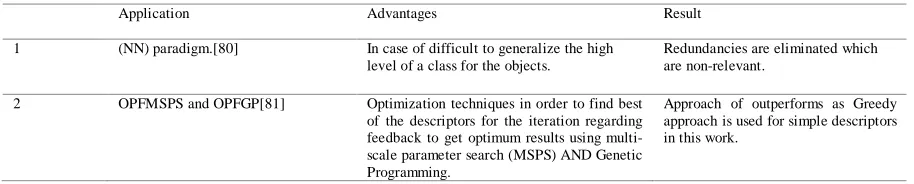
Table 3
.Relevance feedback technique base on image retrieval
Application Advantages Result
1 (NN) paradigm.[80] In case of difficult to generalize the high level of a class for the objects.
Redundancies are eliminated which are non-relevant.
2 OPFMSPS and OPFGP[81] Optimization techniques in order to find best of the descriptors for the iteration regarding feedback to get optimum results using multi-scale parameter search (MSPS) AND Genetic Programming.
9. CONCLUSION
Now days internet is being used frequently which
ultimately
demands
to
increase
multimedia
application along with image retrieval system. In
order to share the information now days the mean
of digital images is playing very important role.
This is much effective in the terms of expression.
Visual contents of the image seldom contain the
particulars of the situation against which it is meant
for. This kind of work is easily handled in the
situation where limited numbers of images are
stored but the situation becomes worse when the
imaged exceed one hundred and one million. In
such situations the need of an intelligent searcher
raises to find the specific image out of million
images in a very short time. In this study luminous
work done by the researchers has been illustrated to
acknowledge the concept
.
Analysis of colour and
shape can be done by the visual contents of image.
Here we have discussed the techniques which are
mostly used in CBIR and to improve the retrieval
system of images along with their performance.
References:
[1] Mussarat Yasmin, Muhammad Sharif, Sajjad Mohsin, Use of Low Level Features for Content Based Image Retrieval: Survey, World Applied Sciences Survey, 2(11), 2013, 65-75.
[2] A. W. M. Smeulders, M. Worring, S. Santini, A. Gupta, and R. Jain, Content-Based Image Retrieval at the End of the Years, IEEE Transactions on Pattern Analysis and Machine Intelligence, 22(12)
,2000, 1349–1380.
[3] Waqas Haider, Muhammad Sharif Malik, Mudassar Raza, Abdul Wahab, Izhar Ahmed Khan, Umar Zia, Jawad Tanveer, Hadia Bashir, A Hybrid Method for Edge Continuity Based on Pixel Neighbors Pattern Analysis (PNPA) for Remote Sensing Satellite Images, Int. J. Communications Network and System Sciences, (5),2012, 624-6 .[4] Akgül, C. B, Rubin, D. L, Napel, S, Beaulieu, C.
F, Greenspan, H, &Acar, B, Content-based image retrieval in radiology current status and future directions, Journal of Digital Imaging ,24(2),2011,208-222.
[5] Ramamurthy, B, and K. R. Chandran, Content based Image Retrieval for Medical Images using Canny Edge Detection Algorithm, International Journal of Computer Applications, 17(6), 2011, 1-37.
[6] Masood, Saleha, Muhammad Sharif, Mussarat Yasmin, Mudassar Raza, and Sajjad Mohsin, Brain Image Compression: A Brief Survey, Research Journal of Applied Sciences, (5), 2013, 49-59.
[7] Yasmin, Mussarat, Sajjad Mohsin, Muhammad Sharif, Mudassar Raza, and Saleha Masood, Brain Image Analysis: A Survey, World Applied Sciences Journal, 19(10), 2012, 1484-1494.
[8] Yasmin, Mussarat, Muhammad Sharif, Saleha Masood, Mudassar Raza, and Sajjad Mohsin, Brain image enhancement: A survey,World Applied Sciences Journal, 17 (9),2012,1192-1204. [9] Yasmin, Mussarat, Muhammad Sharif, Saleha
Masood, Mudassar Raza, and Sajjad Mohsin, Brain image reconstruction: A short survey, World Applied Sciences Journal, 19(1), 2012, 52-62. [10] Raza, Mudassar, Muhammad Sharif, Mussarat
Yasmin, Saleha Masood, and Sajjad Mohsin, Brain Image Representation and Rendering: A Survey,
Research Journal of Applied Sciences, (4), 2012.
[11] Irum, Isma, Mudassar Raza, and Muhammad Sharif, Morphological techniques for medical image,
Research Journal of Applied Sciences, Engineering and Technology, 4(17), 2012,2948-2962.
[12] Yasmin, Mussarat, Muhammad Sharif, and Sajjad Mohsin, Survey Paper on Diagnosis of Breast Cancer Using Image Processing Techniques,
Research Journal of Recent Sciences, 2(10),2013, 88-98.
[13] Mudassar Raza, Ahmed Adnan, Muhammad Sharif, Syed Waqas Haider, Lossless Compression Method for Medical Image Sequences Using Super-Spatial Structure Prediction and Inter-frame Coding,
Journal of Applied Research and Technology, (10),2012.
3 Imbalance problem in image retrieval tasks by generating synthetic patterns according to Nearest-Neighbour information[82]
The computation overhead of the proposed technique is small
Results show that the proposed technique allows improving the performances.
4 Track-based relevance feedback [83] Automatic tracking method and person tracing improvement for speed up are used here.
Relevance setting of people is improved by considering the feedback which is track based.
5 Enhancing the relevancy of queries during a passage retrieval in log files[84]
This approach is useful for both log files and for the documents containing general domains.
Relevant passages of protocol enables to show the query expansion and the experiments are conducted on real data.
6. SVM relevance feedback CBIR algorithm[85]
In which the covariance matrix based kernel empirical orthogonal complement component analysis is utilized
Volume: 5 Issue: 06 Pages: 2076-2083 (2014)
ISSN: 0975-0290
[14] Maria Hameed, Muhammad Sharif, Mudassar Raza, Syed Waqas Haider, Muhammad Iqbal, Framework for the Comparison of Classifiers for Medical Image Segmentation with Transform and Moment based features, Research Journal of Recent Sciences ,2(6),2013, 1-10.
[15] Amir Shahzad,Muhammad Sharif, Mudassar Raza, Khalid Hussain, Enhanced Watershed Image Processing Segmentation, journal of Information & Communication Technology ,2( 1),2008 , 01-09. [16] Mehwish Rehman, Muhammad Sharif and
Mudassar Raza, Image Compression: A Survey,
Research Journal of Applied Sciences, Engineering and Technology, 7(4), 2014,656-672. [17] Rana Muhammad Nazim, Muhammad sharif, Mudassar Raza, Aman ullah khan, Layered compression technique base on entropy or dictionary Methods, Research Journal of Applied Sciences, (5), 2013.
[18] R. Datta, D. Joshi, J. Li and J. Z. Wang, Image retrieval: Ideas, influences, and trends of the new age, ACM Computing, 40 (2), 2008 ,1-60. [19] Mussarat Yasmin, Muhammad Sharif, Isma Irum,
Sajjad Mohsin, Powerful Descriptor for Image Retrieval Based on Angle Edge and Histograms, Journal of Applied Research and Technology, (11), 2013.
[20] Liu, Ying, Dengsheng Zhang, Guojun Lu, and Wei-Ying Ma, A survey of content-based image retrieval with high-level semantics, Pattern Recognition, 40(1), 2007, 262-282.
[21] Schaefer, Gerald, Content-based image retrieval: some basics, in (First Ed), Man-Machine Interactions 2, (Springer Berlin Heidel berg, 2011) 21-29.
[22] Jain, M, & Singh, S. K , A Survey On: Content Based Image Retrieval Systems Using Clustering Techniques for Large Data sets, International Journal of Managing Information Technology, 3(4), 2011.
[23] Collins, R.T, Yanxi, L, Leordeanu, and M, Online selection of discriminative tracking features, IEEE Trans. Pattern Anal. Mach. Intell, 27(10), 2005, 1631–1643.
[24] Wei, J, Guihua, E, Qionghai, D, Jinwei, G, Similarity-based online feature selection in content-based image retrieval, IEEE Trans. Image Process, 15(3), 2006, 702–712.
[25] Akakin, HaticeCinar, and Metin N. Gurcan, Content-based microscopic image retrieval system for multi-image queries, Information Technology in Biomedicine, IEEE Transactions, 16, (4), 2012, 758-769.
[26] K. Mikolajczyk and C. Schmid, A Performance Evaluation of Local Descriptors, IEEE Transactions on Pattern Analysis and Machine Intelligence, 27(10), 2005, 1615-1630.
[27] Velmurugan, K., and Lt Dr S. Santhosh Baboo ,Content-based image retrieval using SURF and colour moments, Global Journal of Computer Science and Technology, 11(10), 2011,1-5. [28] S. Kiranyaz, K. Caglar, O. Guldogan, and E.
Karaoglu, MUVIS: A multimedia browsing, indexing and retrieval framework, In Proc. Third Int. Workshop on Content Based Multimedia Indexing, 2003,22–24.
[29] Kiranyaz, Serkan, Kerem Caglar, Esin Guldogan, Olcay, Guldogan, and Moncef Gabbouj. MUVIS: a content-based multimedia indexing and retrieval framework, Proceedings. IEEE Seventh International Symposium. In Signal Processing and Its Applications,(1), 2003,1-8.
[30] Kiranyaz, Serkan, and Moncef Gabbouj, Hierarchical cellular tree: an efficient indexing scheme for content-based retrieval on multimedia databases, IEEE Transactions, 9(1), 2007, 102-119.
[31] TianYumin and Mei Lixia, Image Retrieval based on Multiple Features using Wavelet, Proc. Fifth International Conference on Computational Intelligence and Multimedia Applications, 2003, 137-142.
[32] Muhammad Sharif, Mudassar Raza, Sajjad Mohsin, Jamal Hussain Shah, Microscopic Feature Extraction Method, Int. J. Advanced Networking and Applications, 4 (5), 2013, 1700-1703. [33] Sharif, Muhammad,Syeda Zilley Zahra Naqvi,
Mudassar Raza, Waqas Haider, A new approach to compute convex hull Innovative Systems, Design and Engineering ,2(3),2011,186-192.
[34] Murtaza, Marryam, Muhammad Sharif, Mudassar Raza, and J. Shah, Face Recognition using Adaptive Margin Fisher’s Criterion and Linear Discriminant Analysis, International Arab Journal of Information Technology, 11(2),2014,1-11. [35] Priya, R, and VasanthaKalyani David, Optimized
Content based Image Retrieval System based on Multiple Feature Fusion Algorithm, International Journal of Computer Applications,31(8), 2011. [36] Qianni Zhang and EbroulIzquierdo, Histology
Image Retrieval in Optimized Multi feature Spaces,
IEEE Journal of Biomedical and Health Informatics,17(1), 2013 ,240-249.
[37] Roland Kwitt, Peter Meerwald and Andreas Uhl, Efficient Texture Image Retrieval Using Copulas in a Bayesian Framework,IEEE transactions on image processing, 2011,1- 20.
[38] Naphade, Milind R, and Thomas S. Huang, Extracting semantics from audio-visual content: the final frontier in multimedia retrieval Neural Networks, IEEE Transactions on, 13 (4),2002,793-810.
[39] Yixin Chen Member, IEEE, James Z. Wang, Member, IEEE and Robert Krovetz, CLUE, Cluster-Based Retrieval of Image by Unsupervised Learning, IEEE transactions on image Processing, 2005,1-14.
[40] Singh, Sanjay T, and Trimbak Ramchandra Sontakke, Neutralizing the Semantic Gap in the Content Based Image Retrieval (CBIR) System,
European Journal of Scientific Research, 75 (4), 2012, 536-549.
[41] Kurtz, Camille, Christopher F. Beaulieu, Sandy Napel, and Daniel L. Rubin, A hierarchical knowledge-based approach for retrieving similar medical images described with semantic annotations, Journal of biomedical informatics, 2014, 1-18.
[42] Rehman, Mehwish, Muhammad Iqbal, Muhammad Sharif, and Mudassar Raza, Content Based Image Retrieval: Survey, World Applied Sciences Journal, 19 (3),2012, 404-412.
[43] Li, Zhixin, Zhongzhi Shi, Weizhong Zhao, Zhiqing Li, and Zhenjun Tang, Learning semantic concepts from image database with hybrid generative/discriminative approach, Engineering Applications of Artificial Intelligence, 26(9), 2013, 2143-2152.
[45] Shyu, Mei-Ling, Shu-Ching Chen, Min Chen, and Chengcui Zhang, A unified framework for image database clustering and content-based retrieval,
Proceedings. 2nd ACM international workshop. on Multimedia databases, 2004, 19-27.
[46] Quack, Till, Ullrich Mönich, Lars Thiele, and B. S. Manjunath, Cortina: a system for large-scale,
content-based web image
retrieval, Proceedings.12th annual ACM international .conference on Multimedia, 2004 ,508-511.
[47] Lin, Wei-Hao, Rong Jin, and Alexander Hauptmann, Web image retrieval re-ranking with relevance model , Proceedings. IEEE/WIC International Conference .on Web Intelligence,
2003,242-248.
[48] Wang, Xin-Jing, et al,Multi-model similarity propagation and its application for web image retrieval, Proceedings .12th annual ACM international conference. On Multimedia, 2004,944-951.
[49] Schaefer, Gerald, and Michal Stich, UCID: an uncompressed color image database, Proc. SPIE 5307 .on Storage and Retrieval Methods and Applications for Multimedia, 2004, 472-480. [50] Yu, Hui, Mingjing Li, Hong-Jiang Zhang, and
JufuFeng, Color texture moments for content-based image retrieval In Image Processing, Proceedings. International Conference on IEEE, (3), 2002,929-932.
[51] Kekre, H. B, and Sudeep D. Thepade, Boosting Block Truncation Coding with Kekre's LUV Color Space for Image Retrieval, International Journal of Electrical, Computer & Systems Engineering,2(3),2008.
[52] Gagaudakis, George, and Paul L. Rosin, Incorporating shape into histograms for CBIR,Pattern Recognition, 35 (1),2002,81-91. [53] Zhang, Dengsheng, and GuojunLu, Content-Based
Shape Retrieval Using Different Shape Descriptors: A Comparative Study, ICME, 2001, 1-4. [54] Mussarat Yasmin, Muhammad Sharif, Sajjad
Mohsin, Image Retrieval Techniques Using Shapes of Object: A Survey, Sci.Int (Lahore), 25(4), 2013, 723-729.
[55] Yasmin, Mussarat, Sajjad Mohsin, Isma Irum, and Muhammad Sharif, Content based image retrieval by shape, color and relevance feedback, Life Science Journal 10 (4s), 2013, 593-598. [56] Prasad, B. G., K. K. Biswas, and S. K.
Gupta,Region-based image retrieval using integrated color, shape, and location index,
Computer vision and image understanding ,94
(1),2004,193-233.
[57] Singh, Chandan, Improving image retrieval using combined features of Hough transform and Zernike moments, Optics and Lasers in Engineering ,49(12),2011,1384-1396.
[58] Cheng, Heng-Da, X. H. Jiang, Ying Sun, and Jingli Wang, Color image segmentation advances and prospects, Pattern recognition, 34 (12), 2001,2259-2281.
[59] Qin, Chanchan, Guoping Zhang, Yicong Zhou, Wenbing Tao, and Zhiguo Cao, Integration of the saliency-based seed extraction and random walks for image segmentation, Neurocomputing, (129), 2013, 378–391.
[60] Zhang, Jun, and Lei Ye, Series feature aggregation for content-based image retrieval, Computers & electrical engineering ,36(4), 2010, 691-701. [61] Seetharaman, K, and S. Sathiamoorthy,Color image
retrieval using statistical model and radial basis
function neural network, Egyptian Informatics Journal ,15 (1),2014,59-68.
[62] Sánchez-Cruz, Hermilo, and Ernesto Bribiesca, Polygonal approximation of contour shapes using corner detectors, Journal of applied research and technology, 7(3), 2009,275-290.
[63] Tao, Dacheng, Xiaoou Tang, Xuelong Li, and Yong Rui, Direct kernel biased discriminant analysis: a new content-based image retrieval relevance feedback algorithm, Multimedia IEEE Transactions ,8 (4) ,2006,716-727.
[64] Yasmin, Mussarat, Muhammad Sharif, and Sajjad Mohsin, Neural Networks in Medical Imaging Applications: A Survey, World Applied Sciences Journal, 22 (1) ,2013.
[65] Noda, Kuniaki, Hiroaki Arie, Yuki Suga, and Tetsuya Ogata, Multimodal integration learning of robot behavior using deep neural networks,
Robotics and Autonomous Systems ,62 (6), 2014.721-736.
[66] Kurtz, Camille, Christopher F. Beaulieu, Sandy Napel, and Daniel L. Rubin, A hierarchical knowledge-based approach for retrieving similar medical images described with semantic annotations, Journal of biomedical informatics,2014,1-18.
[67] Gao, Chao, Dongguo Zhou, and YongcaiGuo, Automatic iterative algorithm for image segmentation using a modified pulse-coupled neural network, Neurocomputing,(119),2013,332-338. [68] Son, Le Hoang, Nguyen Duy Linh, and Hoang
Viet Long, A lossless DEM compression for fast retrieval method using fuzzy clustering and MANFIS neural network, Engineering Applications of Artificial Intelligence, 2013,33-42.
[69] Humberto Sossn, ElizabethGuevara, Efficient training for dendrite morphological neural networks, Neurocomputing, 2013, 132-142. [70] Sudipta.Mukhopadhyay, A new content-based
image retrieval technique using fuzzy class membership,NeuroComputing, 34(6), 2013,646– 654.
[71] Abrahams, Alan S. Eloise Coupey, Eva X. Zhong, Reza Barkhi, and Pete S. Manasantivongs, Audience targeting by B-to-B advertisement classification: A neural network approach, Expert Systems with Applications, 40 ,(8),2013,2777-2791.
[72] Milanova, Mariofanna, Roumen Kountchev, Stuart Rubin, Vladimir Todorov, and Roumiana Kountcheva,Content Based Image Retrieval Using Adaptive Inverse Pyramid Representation, ,In (First Ed) ,Human Interface and the Management of Information and Interaction ,(Springer Berlin Heidelberg, 2009)304-314.
[73] Yasmin, Mussarat, Sajjad Mohsin, and Muhammad Sharif, Intelligent Image Retrieval Techniques A Survey, Journal of Applied Research and Technology,12 (1),2013,87-103.
[74] Seo, Kwang-Kyu , An application of one-class support vector machines in content-based image retrieval, Expert Systems with Applications, 33 (2), 2007,491-498.
[75] Su, Zhong, Hongjiang Zhang, Stan Li, and Shaoping Ma, Relevance feedback in content-based image retrieval Bayesian framework, feature subspaces and progressive learning, Image Processing IEEE Transactions, 12 ( 8),2003,924-937.
Volume: 5 Issue: 06 Pages: 2076-2083 (2014)
ISSN: 0975-0290
challenges, ACM Transactions on Multimedia Computing, Communications, and Applications (TOMCCAP), 2 (1), 2006,1-19.
[77] Rahimi, M, M.H. Alizadeh, R. Rajabi and N. Mehrshad, The Comparison of Innovative Image Processing and Goniometer Methods in Q Angle Measurement ,World Applied Sciences Journal,18(2),2001,226-232.
[78] Rui, Yong. Relevance feedback a power tool for interactive content-based image retrieval, Circuits and Systems for Video Technology, IEEE Transactions, 1998, 644-655.
[79] MacArthur, S. D, Brodley, C. E, Kak, A. C, & Broderick, L. S, Interactive content-based image retrieval using relevance feedback, Computer Vision and Image Understanding,88(2), 2002,55-75 ,2002.
[80] Arevalillo-Herráez, Miguel, and Francesc J.Ferri, An improved distance-based relevance feedback strategy for image retrieval, Image and Vision Computing,31(10),2013,704-713.
[81] da Silva, André Tavares, Jefersson Alex dos Santos, Alexandre Xavier Falcao, Ricardo da S. Torres, and Léo Pini Magalhães, Incorporating multiple distance spaces in optimum-path forest classification to improve feedback-based learning,
Computer Vision and Image Understanding ,116
(4),2012,510-523.
[82] Piras, Luca, and Giorgio Giacinto, Synthetic pattern generation for imbalanced learning in image retrieval, Pattern Recognition Letters ,33(16),2012,2198-2205.
[83] Metternich, Michael J, and Marcel Worring, Track based relevance feedback for tracing persons in surveillance videos, Computer Vision and Image Understanding ,117 (3),2013,229-237.
[84] Saneifar, Hassan, Stéphane Bonniol, Pascal Poncelet, and Mathieu Roche, Enhancing passage retrieval in log files by query expansion based on explicit and pseudo relevance feedback, Computers in Industry,2014,1-15.
[85] Wang, Xiang-Yang, Yong-Wei Li, Hong-Ying Yang, and Jing-Wei Chen, An image retrieval scheme with relevance feedback using feature
reconstruction and SVM