www.cloudwatchhub.eu
D4.1 – Cloud certification guidelines
and recommendations
Revised Version
www.cloudwatchhub.eu|[email protected]|@CloudWatchHub
Security and privacy certifications and attestations have been identified as one of most effective and efficient means to increase the level of trust in cloud service and stimulate their adoption. Based on this on assumption a number of efforts have been started in Europe at policy level mainly leaded by the European Commission (EC), ENISA and ETSI. CloudWATCH itself is part of this effort.
Building on the ETSI and on the EC SIG Certification works, CloudWATCH wants to provide through this report a guidance to cloud service customers, cloud service providers and policy makers in their evaluation of suitable security and privacy certification schemes for cloud services.
www.cloudwatchhub.eu
CloudWATCH Mission
The CloudWATCH mission is to accelerate the adoption of cloud computing across European private and public organisations. CloudWATCH offers independent, practical tips on why, when and how to move to the cloud, showcasing success stories that demonstrate real world benefits of cloud computing. CloudWATCH fosters interoperable services and solutions to broaden choice for consumers. CloudWATCH provides tips on legal and contractual issues. CloudWATCH offers insights on real issues like security, trust and data protection. CloudWATCH is driving focused work on common standards profiles with practical guidance on relevant standards and certification Schemes for trusted cloud services across the European Union.
The CloudWATCH partnership brings together experts on cloud computing; certification schemes; security; interoperability; standards implementation and roadmapping as well as legal professionals. The partners have a collective network spanning 24 European member states and 4 associate countries. This network includes: 80 corporate members representing 10,000 companies that employ 2 million citizens and generate 1 trillion in revenue; 100s of partnerships with SMEs and 60 global chapters pushing for standardisation, and a scientific user base of over 22,000.
Disclaimer
CloudWATCH (A European Cloud Observatory supporting cloud policies, standard profiles and services) is funded by the European Commission’s Unit on Software and Services, Cloud Computing within DG Connect under the 7th Framework Programme.
The information, views and tips set out in this publication are those of the CloudWATCH Consortium and its pool of international experts and cannot be considered to reflect the views of the European Commission.
www.cloudwatchhub.eu
Document information Summary
Document title: Cloud certification guidelines and recommendations Main Author(s): Daniele Catteddu, Cloud Security Alliance
Contributing author(s): Marina Bregu, Cloud Security Alliance Jesus Luna, Cloud Security Alliance
Konstantinos Mantzoukas, Cloud Security Alliance Alain Pennetrat, Cloud Security Alliance
Reviewer(s): Michel Drescher, EGI.eu
Editor(s): Stephanie Parker, Trust-IT Services
Target audiences: Policy makers, ranging from European Commission to member state levels.
Public procurers in European, National and Regional/local institutions and agencies.
Procurers of cloud services both in SMEs (small and medium enterprises) and large corporations.
Compliance managers of cloud service customers. Compliance managers of cloud service providers.
Keywords: Certification, Recommendation, Trust Transparency, Assurance, Flexibility, Compliance Cost efficiency, European Commission
Deliverable nature: Report
Dissemination level: (Confidentiality)
Public
Contractual delivery date: 1 December 2013 Actual delivery date: 31 December 2013 Revised version following Year
1 review
30 January 2015
Reference to related publications
www.cloudwatchhub.eu
Executive Summary
Security and privacy certifications and attestations have been identified as one of most effective and efficient means to increase the level of trust in cloud services and stimulate their adoption. Based on this on assumption a number of efforts have begun in Europe at policy level mainly led by the European Commission (EC), in collaboration with ENISA and the Clouds Standards Coordination CSC ETSI effort. These efforts have aroused much interest in European solutions for cloud standards and software industry development beyond the European Union.
Trust and confidence in cloud computing
The ETSI Cloud Standard Coordination report (December 2013)1, where several CloudWATCH partners have played an active role, concludes:
“One of the main challenges, when it comes to cloud computing, consists of building trust and confidence in cloud computing services. The variety of existing standards, with a varying degree of maturity, as well as the lack of clarity around the suitability of currently available certification schemes, are not really helpful in these trust building efforts. Concerns are being voiced about compliance issues as well as the effectiveness and efficiency of traditional security governance and protection mechanisms applied to the cloud computing” and “.Our analysis has shown that cloud computing governance and assurance standards specifically developed for and aimed at the cloud already exist (e.g., cloud controls framework, security cloud architectures, continuous monitoring of cloud service provider’s) and some of them are considered as sufficiently mature to be adopted.”
How CloudWATCH is making a contribution
CloudWATCH is making an active contribution to European efforts through its focus on standards and certification, driving interoperability as key to ensuring broader choice and fairer competition. Building on the ETSI and on the EC SIG Certification works, this CloudWATCH report is aimed at providing guidance for cloud service customers, especially public administrations and small and medium companies, cloud service providers and policy makers in their evaluation of possible options for “certifying” the level of security and privacy of cloud services.
The findings of this interim report will be further elaborated in a final report on Certification and Recommendation Guidelines, which will be published in June 2014.
1 http://www.etsi.org/images/files/Events/2013/2013_CSC_Delivery_WS/CSC-Final_report-013-CSC_Final_report_v1_0_PDF_format-.PDF.
www.cloudwatchhub.eu
Main findings of the CloudWATCH analysis Transparency
A suitable certification scheme should support transparency to the highest degree. Providing visibility into the security and privacy capabilities of a cloud services gives opportunities to all the actors in the cloud computing market to:
Make more informed and risk based decisions when selecting/assessing a service Transform security and privacy capabilities in market differentiator
Avoid unnecessary regulatory intervention Increase the level of trust in the cloud market
Scalability, Flexibility and Cost Efficiency
Moreover certification schemes should be scalable, flexible and cost efficient in order to be able to accommodate the needs of:
Organizations of different sizes (SMEs, large corporations etc.), operating at the various layers of the cloud stack (SaaS, PaaS, IaaS, XaaS) and in different sectors (e.g. healthcare, finance, public administration, not or less regulated business sectors) Organizations with varying assurance requirements.
Our analysis shows that most of the certification schemes considered have some promising transparency features. However, in most cases the level of visibility and information available about the certification process, and audit results are not yet sufficient, and more should be done.
We also noted that most of the certification schemes considered appear to provide the necessary level of scalability, some seem to be cost efficient, but only a few clearly provide the necessary level of flexibility. This lack of flexibility could represent a potential problem since it might prevent, in some cases, the technical frameworks underlying the schemes from being able to evolve at same pace of the cloud market, therefore failing to satisfy changing requirements. Moreover only a few certification schemes are able to address the needs of organizations with varying level of assurance (e.g. very few schemes are based on a maturity /capability model, and very few include a self-certification option).
CloudWATCH Recommendations
Based on these findings and our associated conclusions, CloudWATCH makes the following recommendations.
Supporting Transparency
We recommend cloud customers, especially public administrations, to adopt a cloud selection process that favours certifications/attestations that clearly support transparency. It is of particular importance for a procurement officer to have a clear visibility on the details of technical standard(s) on which the certification assessment is based. Knowing which
www.cloudwatchhub.eu
technical controls are included in a standard is the only way to understand if that technical framework, and the certification scheme it is based on, is suitable to satisfy the technical requirements and compliance needs of a certain organization. Furthermore, importance should be given to the quality of the assessment/audit. This recommendation is mainly addressed to public sector procurement offices, since they have the necessary negotiation power to demand specific features and services.
Appropriate level of detail on information security approaches
We also recommend that Cloud Providers introduce more transparency in their information security approaches. While we do not suggest an approach based on full disclosure, as we do appreciate that in some cases this is not possible given the confidentiality of some information included in the assessment report, Cloud Providers should nevertheless be willing to provide as much details as possible about the results of their certification assessment reports.
Soft law supporting transparency
Further, we recommend that policy makers work on soft-law to foster transparency by supporting certification schemes that enable transparency. Transparency is a fundamental attribute of accountability and essential trust-enabling component, and the adoption of soft-law supporting transparency could prevent the need of binding regulatory intervention that might not be the most appropriate measure in a market, which is still underdevelopment and in continuous transformation.
Assurance
Certification schemes should provide scalability, flexibility & cost efficiency. We recommend policy makers to endorse/demand for certification schemes that are able to provide scalability, flexibility and cost efficiency and to match the different assurance levels requested by regulatory authorities and customers of any kind (pubic administration, micro, small medium companies and enterprise). There is a clear trade-off between the levels of rigour and the cost of certification (obviously self-certification is less expensive than a certification based on third party assessment). To make market more efficient each actor should be given the possibility to select the most cost effective solution to satisfy its assurance needs.Address how the FP7 funded projects: A4Cloud, CIRRUS, CUMULUS, SPECS & The STAR certification Training could in the future, or have already addressed some of these recommendations.
www.cloudwatchhub.eu
1. Context and Scope ... 9
1.1 Overview ... 9
1.2 Structure of the report ... 10
1.3 Acronyms ... 10
1.4 Target Audiences ... 12
1.5 Scope ... 12
1.6 Objectives ... 13
1.7 Methodology & Approach ... 14
2. Drivers for the definition and selection of certification schemes ... 16
2.1 European Policy background ... 16
2.2 Foundational objectives from the European Commission ... 17
2.3 Prioritizing the EC foundational objectives ... 17
2.4 Principles and requirements identified by the EC SIG ... 19
2.5 Prioritizing EC SIG principles and requirements ... 21
2.6 Other relevant elements to consider ... 22
3. Relevant certification schemes for security and privacy ... 25
3.1 ISO/IEC 27001:2013 ... 25
3.2 SSAE16 – SOC 1-2-3 ... 26
3.3 Cloud Security Alliance Open Certification Framework ... 30
3.4 EuroPrise: The European Privacy Seal ... 34
3.5 EuroCloud – STAR Audit... 35
3.6 USA: Federal Risk and Authorization Management Program (FedRAMP) ... 36
3.7 Singapore: Multi-Tier Cloud Security (MTCS) ... 39
3.8 China ... 41
3.9 Hong Kong ... 42
3.10 Australia ... 43
3.11 New Zealand ... 44
3.12 Other certifications schemes ... 45
3.13 Mapping schemes with objectives and features ... 47
4. Recommendations and Conclusions ... 50
4.1 Conclusion 1 – Transparency ... 50
www.cloudwatchhub.eu
4.3 Conclusion 2 – Scalability, Flexibility, Cost efficiency ... 51
4.4 Recommendation 2 – Assurance ... 52
5. Next steps ... 52
This current version of the report will be updated during period from M4 to M18... 52
The objective of the revision of this initial version will be to: ... 52
Annex 1 – SIG Certification Survey ... 54
Annex 2 - Report on the CloudWATCH Workshop at EGI TF ... 58
Annex 3 – Second survey – D4.1. final version ... 63
Annex 4 - References ... 71
Annex 5 - Document Log ... 71
Tables
Table 1 - ISO/IEC 27001:2013 ... 25Table 2 - Overview of SOC Reports ... 29
Table 3 - CSA STAR ... 30
Table 4 - EuroPrise ... 34
Table 5 - EuroCloud STAR Audit ... 35
Table 6 - FedRAMP ... 36
Table 7 - Singapore ... 39
Table 8 - China ... 41
Table 9 - Hong Kong ... 42
Table 10 - Australia ... 43
Table 11 - New Zealand ... 44
Table 12 - Mapping schemes: objectives ... 48
Table 13 - Mapping schemes: features ... 49
Figures
Figure 1 - Implementing the European Cloud ... 16www.cloudwatchhub.eu
Figure 2 – SIG Certification Survey: high-level objectives ... 18 Figure 3 – Details of the answer to the questionnaire on the prioritization of objectives ... 19 Figure 4 – SIG Certification Survey: relevant features ... 21
1.
Context and Scope
1.1
Overview
One of the main objectives of the CloudWATCH project is to accelerate and increase the adoption of cloud computing across the public and private sectors in Europe and strengthen collaborative, international dialogue on key aspects of cloud computing such as interoperability, portability, security and privacy. One of actions associated with this high level objective is to “raise awareness of and promote education about Certification Schemes for cloud services certification”, by e.g. providing guidance on how to apply the certification principles (as defined by the SIG Certification) in practice.
This revised version of D4.1 responds to Year one review recommendations to make it fully clear which criteria have been used to pull together the list of those standards considered relevant, this should be made explicit in the report. Also the reason why only the
operational standards have been taken into account for the mapping exercise, needs to be addressed.
These are addressed in section 1.5 while section 5 looks at next steps for D4.1 including a revised version of the deliverable to be released in early 2015.
CloudWATCH is looking into the topics of standards and certification in order to understand if and how certification can increase the level of trust in the cloud computing business model. Specifically, CloudWATCH is leading activities on certification and testing standard compliance with the aim of providing sound recommendations based on real-life cases and clear explanations on protection from risks.
In Europe, a relevant effort is being taken by the EC includes in the “European Cloud Strategy”2, which explicitly acknowledges the need of adopting voluntary certification schemes. Such schemes can be used as a measure to increase the level of trust in cloud services.
A similar approach has been taken by other policy makers outside Europe, for instance in the USA, Singapore, Japan, Thailand, Hong Kong and China.
The debate around cloud certification has been based on the following key aspects:
2
www.cloudwatchhub.eu
Suitability of existing security certification schemes (e.g. ISO 27001 or SSAE16/SOC1-2-3) for the cloud market vs. the needs to introduce new schemes
Mandatory vs. voluntary industry driven approaches Global vs. Regional/National schemes
Cost
Transparency
Assurance and maturity/capability models
In this report we describe in detail the most relevant aspects of this on-going debate. Furthermore, we provide a set of recommendations, the relevance of which is going to be monitored and assessed over the next 12 months of CloudWATCH. The final version of this report (“Cloud certification guidelines and recommendations”) will be published in February 2015 and will include a more elaborate and validated set of the initial recommendations.
1.2
Structure of the report
This deliverable is organized in the following manner:
This Chapter 1 includes target audience, scope, objectives, methodology and approach that was taken to create this deliverable. This chapter also presents our relevant information sources.
Chapter 2 presents the principles, objectives and requirements that are the basis for selecting the appropriate cloud certification schemes.
Chapter 3 discusses and summarizes relevant cloud certification schemes, applying the methodology proposed in Chapter 1. It also provides an easy to digest mapping of certification schemes to the defined objectives and principles.
Chapter 4 presents our main conclusions and overall recommendations respectively.
1.3
Acronyms
The table below provides a list of the main acronyms used in this report.
Acronym Meaning
AICPA American Institute of Certified Public Accountants (CPAs),
ANAB ANSI-ASQ National Accreditation Board
ATO Authority to Operate
BCP/DR Business Continuity Planning/Disaster Recovery
BSI British Standards Institution
www.cloudwatchhub.eu
CCM Cloud Global Matrix
CGMA Chartered Global Management Accountant
CIRRUS Certification, Internationalisation and Standardization in Cloud Security
CPA Certified Public Accountant
CRM Certified Public Accountant Customer relation management systems
CSA Cloud Security Alliance
CSP Cloud Service Provider
CTP Cloud Trust Protocol
DHS Department of Homeland Security
DOD U.S. Department of Defense
ECP European Cloud Partnership
ECSA EuroCloud Star Audit
EDA European Defense Agency
EEA European Economic Area
ENISA European Network and Information Security Agency
ETSI European Telecommunications Standards Institute
FedRAMP Federal Risk and Authorization Management Program
FISMA Federal Information Security Management Act
GAPP Generally Accepted Privacy Principles
GRC Governance, Risk and Compliance
GSA U.S. General Service Administration
HIPAA Health Insurance Portability and Accountability Act
IaaS Infrastructure as a Service
www.cloudwatchhub.eu
IDA Infocomm Development Authority of Singapore
1.4
Target Audiences
This report addresses the following groups of stakeholders:
Policy makers, ranging from European Commission to member state levels.
Public procurers in European, National and Regional/local institutions and agencies. Procurers of cloud services both in SMEs (small and medium enterprises) and large corporations.
Compliance managers of cloud service customers. Compliance managers of cloud service providers.
Although this report is written from a European perspective, the issues and challenges in the field of security and privacy certification for cloud computing services are not confined to Europe. This report can therefore also be relevant for countries outside the European Economic Area (EEA). Further, CloudWATCH offers a comprehensive vision, and aims to pave the way for globalized approaches to cloud computing certification.
1.5
Scope
This report focuses on security governance certification schemes and privacy certification schemes for cloud services. More specifically this report covers:
Security governance and privacy certification schemes for cloud computing in the EEA.
Security governance certification schemes for cloud computing outside the EEA. Standards used as base for security governance certification schemes.
It should be noted that the analysis of the available certification schemes is by no means exhaustive or complete. Our approach considers only those schemes that are the most relevant in this area. Beside the relevant certification for the EU market we also wanted to include in the analysis information related to the approaches taken in Countries outside the European Union.
1.5.1 Criteria for determining relevant schemes for analysis
The criteria we have used to determine the relevance of a scheme in the context of our analysis were the following:
1. The scheme and/or the underlying technical standard are included in the ETSI’s document: Cloud Standard Coordination Final Report3
3
http://www.etsi.org/images/files/Events/2013/2013_CSC_Delivery_WS/CSC-Final_report-013-CSC_Final_report_v1_0_PDF_format-.PDF
www.cloudwatchhub.eu
2. The scheme is included in the ENISA Cloud Certification Scheme List (update October 2013)4 or it is used as National accreditation scheme for cloud services in a Country or is widely accepted as security accreditation scheme
3. The scheme is operational and has to have a minimum level of market consideration 4. The scheme is cloud specific or at least cloud relevant certification scheme
We have defined an initial pool of certification scheme candidates to be considered in the analysis and assigned them a score based on the above-mentioned criteria.
The pool of schemes was based on the ENISA Cloud Certification Scheme List (CCSL), updated at October 2013 (which included the following schemes: 1) Certified Cloud Service - TÜV Rheinland, 2) CSA Star Program – Open Certification Framework, 3) EuroCloud Star Audit, 4) ISO27001, 5) Security Rating Guide – Leet Security. To this list we added: SOC1-2-3 since they are widely accepted in Industry; Fedramp and Multi-Tier Cloud Security (MTCS) as they are mandatory schemes for certain categories of service in USA and Singapore; and EuroPrise as it is considered as one of the few widely accepted schemes for privacy requirement certification.
Each scheme was given 1 point for each requirement that it met. The schemes that scored at least 3 points were considered in the study. Schemes scoring 2 points were considered as candidates for inclusion in the final version of the report. Schemes scoring less than 2 points were considered as irrelevant to the context of this study.
The cloud certification schemes selected wereanalysed and used as input to elaborate the recommendations presented at the end of this document.
For the sake of clarity, input from the following groups and research informed the decision on what is most relevant and what is outside the scope of this report:
The EC Selected Industry Group. 5
Relevant institutions outside EEA (e.g. NIST, GSA, AICPA, EDA, etc.). Standards Development Organizations (SDO).
Publicly available market research.
1.6
Objectives
The four main objectives of this report are to:
I. Identify principles and requirements for certification schemes suitable for satisfying the EEA’s security and privacy requirements.
II. Provide guidance to cloud customers (both in the private and public sectors) with the aim of accelerating the adoption of cloud computing services (especially for SMEs and Public Sector) by clarifying the value and meaning of a cloud certification with 4 https://resilience.enisa.europa.eu/cloud-computing-certification 5 http://ec.europa.eu/digital-agenda/en/news/cloud-select-industry-group-research-priorities-competitive-cloud-computing-industry-europe.
www.cloudwatchhub.eu
respect to the capabilities required to address and satisfy security and privacy compliance requirements.
III. Provide guidance to Cloud Service Provider (CSP) on how to select the most appropriate cloud certification for their business needs.
IV. Provide recommendations to CSPs, customers and policy makers with regards to the selection of cloud certifications based on the principles and requirements identified by CloudWATCH (see § 2.5. and 2.6)
1.7
Methodology & Approach
The following approach was followed to produce this report:
Identifying principles, objectives and requirements for security and privacy certification schemes suitable for the cloud market.
Stocktaking of the existing certification schemes.
Analysis of the collected schemes based on the previously identified principles, objectives and requirements (stage 1 above).
Drawing conclusions and recommendations based on the analysis.
This report has been created based on the input collected from various sources, consolidated and analysed by subject matter experts in the CloudWATCH consortium. Specifically, input for this deliverable has been were collected from the following sources:
EC Selected Industry Group survey on cloud certifications: this survey was prepared by Cloud Security Alliance and ENISA in the context of the work of the SIG Certification and distributed to the members of this group (the complete results of the survey can be found in Annex 2)
Certification & testing standard compliance Workshop, EGI Technical Forum, 17 September 2013, Madrid6.
NIST7 (National Institute of Standards and Technology) and FedRAMP8 web sites. Cloud Security Alliance9 web site
Cloud Security Alliance International Standardization Council10 AICPA11 web site
EuroSeal12 web site EuroCloud13 web site 6https://indico.egi.eu/indico/sessionDisplay.py?sessionId=48&confId=1417#20130918. 7 http://www.nist.gov/index.html. 8 http://www.fedramp.com/. 9https://cloudsecurityalliance.org/. 10 https://cloudsecurityalliance.org/isc/. 11 http://www.aicpa.org/Pages/default.aspx. 12https://www.european-privacy-seal.eu/. 13 http://www.eurocloud.org/.
www.cloudwatchhub.eu
Interviews and contributions from: FedRAMP/GSA, NIST, AICPA, EDA14, British Standards Institution15, Cloud Security Alliance, EuroCloud.
14http://www.eda.europa.eu. 15
www.cloudwatchhub.eu
2.
Drivers for the definition and selection of certification
schemes
In this chapter we describe the set of principles, objectives and requirements that should drive the definition and selection of cloud security and privacy certification schemes.
2.1
European Policy background
In September 2012, the European Commission (EC) published a policy document that defines the short-term cloud computing strategy for the EEA: “European strategy for Cloud computing – unleashing the power of cloud computing in Europe” [2].
This document has two main goals:
Making Europe cloud-friendly and cloud-active. Connecting digital agenda initiatives.
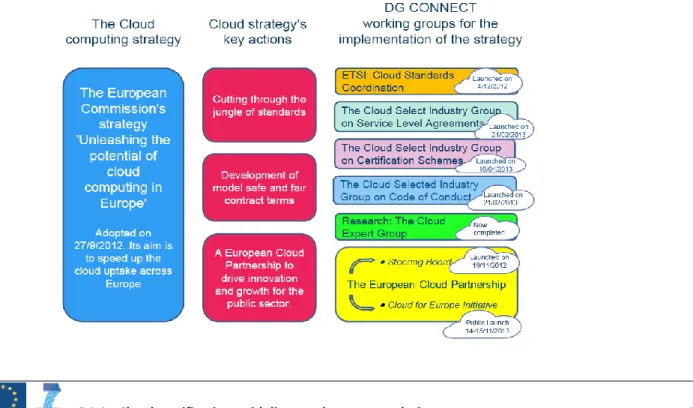
The planned strategy [2] contains three key actions that EC policy makers have identified to support the uptake of cloud computing in Europe:
I. “Cutting through the jungle of standards”. II. Safe and fair contract terms.
III. A European Cloud Partnership.
The figure below provides a summary of the activities related to the implementation of the European Cloud.
www.cloudwatchhub.eu
For the implementation of key actions 1 and 2, the EC has created the so-called Select Industry Group (SIG) with the goal of bringing together subject matter experts from Industry and not-for-profit organizations to work on Service Level Agreements; Certification Schemes; Code of Conduct for Privacy.
2.2
Foundational objectives from the European Commission
The EC cloud computing strategy states “there is a need for a chain of confidence-building steps to create trust in cloud solutions. This chain starts with the identification of an appropriate set of standards that can be certified in order to allow public and private procurers to be confident that they have met their compliance obligations and that they are getting an appropriate solution to meet their needs when adopting cloud services. These standards and certificates in turn can be referenced in terms and conditions so that providers and users feel confident that the contract is fair”.
“In addition, take-up amongst public procurers of trusted cloud solutions could encourage SMEs to adopt as well”.
In April 2013, the EC launched the SIG Certification with the aim of supporting the identification of certification(s) schemes(s) “appropriate” for the EEA market:
Identify objectives, principle and requirements for security and privacy certification schemes.
List available schemes.
The first step undertaken by the SIG Certification was the preparation and launch of a survey between the members of group. The questionnaire, created by ENISA and Cloud Security Alliance, derived from the EC’s cloud strategy the following six mains objectives [1]:
I. Improve customer trust in cloud services. II. Improve security of cloud services.
III. Increase the efficiency of cloud service procurement.
IV. Make it easier for cloud providers and customers to achieve compliance. V. Provide greater transparency to customers about provider security practices. VI. Achieve all the above objectives as cost-effectively as possible.
It should be noted that, the objectives, principles and requirements defined by the EC SIG Certification [1] can be also found in other policy documents in other countries and in general can be regarded as common sense goal to increase the level of adoption of cloud computing in Europe.
2.3
Prioritizing the EC foundational objectives
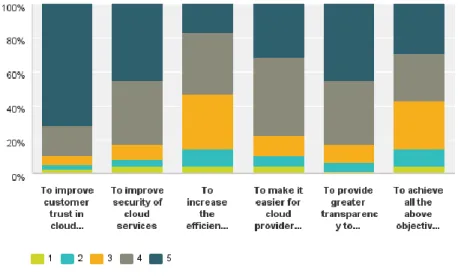
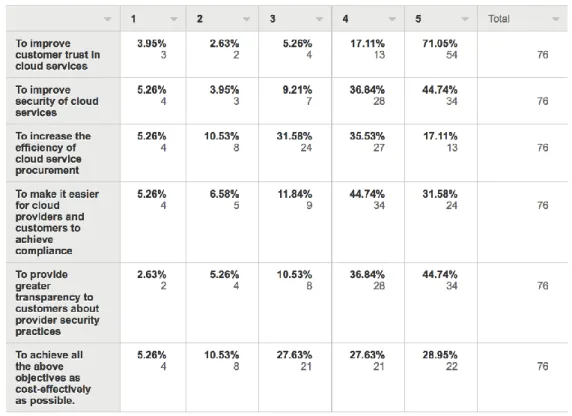
The results of the SIG Certification survey highlighted that the members of the SIG consider that the top three objectives are:
www.cloudwatchhub.eu
To improve customer trust in cloud services: giving emphasis on trust as a necessary condition for a large scale adoption of cloud services and, indirectly confirming that the lack of trust has been so far the highest barrier to cloud uptake.
To improve the security of cloud services: giving emphasis on the fact security certifications should be a vehicle to provide a competitive advantage to those CSP. To provide greater transparency to customers about CSP’s security practices: placing emphasis on the fact that cloud certifications should provide enough details on what is effectively certified, based on which security measures, how and by whom.
The figure below shows responses on the most important high-level objectives. Figure 2 – SIG Certification Survey: high-level objectives
www.cloudwatchhub.eu
Figure 3 – Details of the answer to the questionnaire on the prioritization of objectives
2.4
Principles and requirements identified by the EC SIG
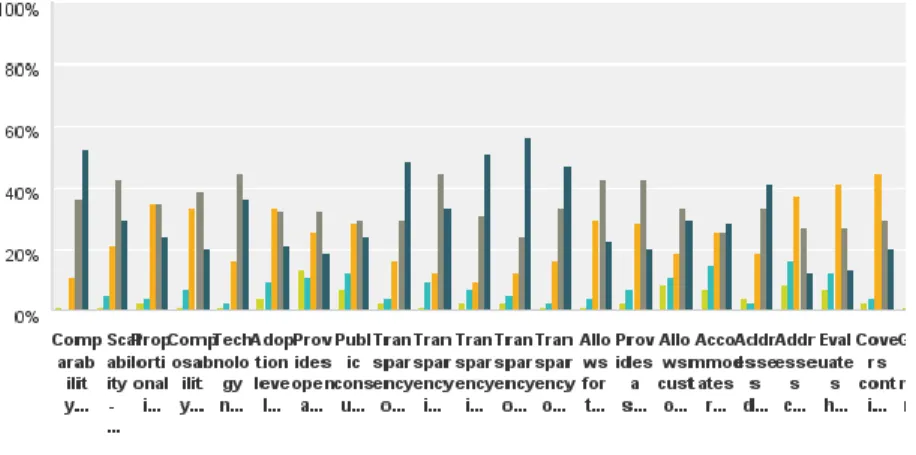
In the context of the same survey, the EC SIG Certification group has identified the following set of twenty-five features for a sound security certification scheme. It must be considered that this set of 25 features is a mix of both principles and requirements:
1. Comparability: results should be repeatable, quantifiable and comparable across different certification targets.
2. Scalability: the scheme can be applied to large and small organizations.
3. Proportionality: evaluation takes into account risk of occurrence of threats for which controls are implemented.
4. Composability/modularity: addresses the issue of composition of cloud services including dependencies and inheritance/reusability of certifications.
5. Technology neutrality: allows innovative or alternative security measures 6. Adoption level (number of providers adopting the certification).
7. Provides open access to detailed security measures.
8. Public consultation on drafts of certification scheme during development. 9. Transparency of the overall auditing process.
www.cloudwatchhub.eu
10.Transparency in reporting of audit results including what is not reported (as far as possible within confidentiality constraints).
11.Transparency in the auditor/assessor accreditation process.
12.Transparency of scope: to allow consumer to verify which services, processes or systems are in scope of certification and which controls have been audited.
13.Transparency of validity or timing (how long is the certification valid for, when did the certification take place).
14.Allows for transparency on good practice against customer requirements. 15.Provides a scale of maturity in security measures.
16.Allows customers and providers to select the trust model that best suits their requirements, e.g. self- assessment, third party assessment, internal audit etc. 17.Accommodates requirements of specific business sectors (e.g. banking and Finance,
eHealth, Public Administration, etc.).
18.Addresses data protection compliance including data transfers across border. 19.Addresses capacity management and elasticity controls.
20.Evaluates historical performance against SLA commitments.
21.Covers continuous monitoring: it goes beyond point-in-time assessment by taking into account historical performance and monitoring controls in place.
22.Global/international reach/recognition.
23.Recognition of the certification scheme or standard by accreditation bodies (regional/ national/ sector).
24.Accountable and ethical governance of the certification scheme e.g. fair representation in governance board.
www.cloudwatchhub.eu
2.5
Prioritizing EC SIG principles and requirements
The figure below present the results to Question 5 of the SIG Certification survey.
Figure 4 – SIG Certification Survey: relevant features
The results of the survey, reported above, can be summarised by the following principles and requirements:
Transparency: the certification schemes should offer full visibility on (1) the way it is structured; (2) the underlying standard(s) on which it is based, (3) how the assessment/audit is conducted, (4) how the auditors are qualified and accredited, (5) the scope of the certification and finally, (6) on the controls against which the assessment is conducted.
Scalability: the certification scheme should be able to scale depending on the needs/size of the CSP (ranging from a big enterprises to small businesses) and, any kind of service model (IaaS, PaaS, SaaS).
Flexibility: the certification schemes should provide a sufficient degree of flexibility in order to:
Address sector specific requirements.
Provide alternative means to satisfy a certain requirement and reach a control objective. In other words, the security framework on which the
www.cloudwatchhub.eu
certification is based should foresee the concept of compensating controls and avoid being unnecessarily prescriptive.
Satisfy varying assurance requirements. In other words, means that certification schemes should foresee different types of assessments/audits including self-assessment, third party assessment, and other more sophisticate types of assessments and audits (e.g., based on continuous collection of evidences, continuous monitoring or trusted computing based certification).
Privacy-relevant: the certification schemes should contain controls able to satisfy data protection compliance requirements
Comparability: results should be repeatable, quantifiable and comparable across different certification targets.
2.6
Other relevant elements to consider
Other relevant aspects to be considered in the on-going debate on security certifications schemes for cloud computing such as:
Voluntary vs. Mandatory approach: a majority of cloud stakeholders seem to converge around the idea that a voluntary certification approach should be preferred instead of a mandatory one. The voluntary approach is also preferred by EC. Take for example the European Cloud Strategy, which indicates the need of “development of EU-wide voluntary certification schemes in the area of cloud computing […]”. A similar statement can be found in the Art 29 WP “Opinion 05/2012 on Cloud Computing”16.
Generic vs. Cloud specific schemes: the most widely recognised information security certification is ISO 2700117. There are over 17,500 organizations certified globally in over 120 countries. It is a management systems standard, outlining the processes and procedures an organization must have in place to manage Information Security issues in core areas of business. The British Standard Institution (BSI), market leader in the ISO27001 certification, considers it as the gold standard for information security, but argues that ISO 27001 is a general purpose certification that has some limitations when it comes to the certification of cloud computing services. During the CloudWATCH “Certification & testing standard compliance” workshop, at the EGI Technical Forum (17 September 2013, Madrid), Tom Nicholls (Global Commercial Manager Systems Certification at the British Standard Institution) identified the following gaps and limitation in the ISO 27001:
16 http://ec.europa.eu/justice/data-protection/article-29/documentation/opinion-recommendation/files/2012/wp196_en.pdf. 17 http://www.iso27001security.com/html/27001.html.
www.cloudwatchhub.eu
Out of date: the recommended list of security control objectives in ISO 27001 (Annex A) is updated every 8 years, which means that the controls soon become obsolete.
It is a “one-size-fits-all” that does not cover some industry specific concerns. Control objectives and controls listed in Annex A of ISO27001 are not exhaustive. Furthermore, specified controls are not fit for the purpose for cloud computing services.
Lack of transparency: ISO27001 does not encourage transparency, since in most of the cases organizations that obtain a certification are not publishing information about the scope of it (which service, department, areas of the organisation are ISO certified?) and neither about the statement of applicability (which controls the company has been audited against?).
These limitations, identified by BSI (and previously by Cloud Security Alliance), are also the reasons why ISO/IEC SC27 is working on new standards to better satisfy the needs of the cloud computing market. In particular ISO is working on the following new international standards:
ISO 27009 Information technology – Security techniques – The use and application of ISO/IEC 27001 for sector/service specific third party accredited certifications.
ISO 27017_ Information technology – Security techniques – Code of practice for information security controls for cloud computing services based on ISO/IEC 27002. ISO 27018_ Information technology – Security techniques – Code of practice for data
protection controls for public cloud computing services.
Based on (1) the previously mentioned input; (2) the input provided by the members of the SIC Certification group and (3) on the fact that a number of countries have already developed (e.g., USA, Singapore) or are developing cloud security certifications (e.g., Hong Kong, Australia, Germany, etc.), we can conclude that new certification schemes should satisfy the cloud market’s needs of trust.
Global vs. National: in recent months there’s been an intense debate in Europe around the need of having National vs. European vs. Global certification schemes. There is no common view across the various actors in the market and different stakeholders. For example, some policy makers are in favour of national schemes, while others would prefer a more global approach. Most cloud providers are in favour of global schemes to avoid duplication of efforts and costs, etc.
A recent panel discussion took place during the launch of the Cloud for Europe18 project on 14 November 2013 and is also on the agenda of the European Cloud Partnership Steering Board (ECP-SB). The recommendations of ECP-SP (see report of the meeting of the 4th of
18
www.cloudwatchhub.eu
July19, where it points to a convergent agreement on the need to facilitate interoperability and cooperation. Hence a global approach to certification should be preferred.
19
http://ec.europa.eu/digital-agenda/en/european-cloud-partnership. The Board highlighted the importance of technical solutions (including encryption) to support security: the goal is ensuring security, not keeping data within the borders of states (as currently valid laws require). President Ilves noted that Estonia and Finland intend to work together to build mutually interoperable e-service systems. This might eventually allow both countries to move backups of data to data centres established outside of their borders to support redundancy – but to achieve that, we will need to deal with the legal aspects of data storage abroad.
www.cloudwatchhub.eu
3.
Relevant certification schemes for security and privacy
3.1
ISO/IEC 27001:2013
Name of the programme: ISO/IEC 27001:201320 - Information technology – Security techniques – Information security management systems - Requirements
Governing of the standard: ISO – ISO/IEC – JTC 121
Accreditation Body/Bodies: Numerous, including UKAS22, ANAB23, JAS-ANZ24 Table 1 - ISO/IEC 27001:2013
Scope: Information Security
Cloud-relevance: ISO 27001 covers all areas of information security and is applicable to cloud services.
Type of certifiable organisation: Any - SaaS, PaaS, IaaS
Type of trust models applicable: self-attestation/third-party/benchmark-test: Third party assessment with accreditation programs in place for certifying bodies.
Is the certification proprietary or open: Open
Programme, status (operational, in development): Operational
ISO/IEC 27001 is the international standard for information security management. It outlines how to put in place an independently assessed and certified information security management system. This allows you to more effectively secure all financial and confidential data, so minimizing the likelihood of it being accessed illegally or without permission.
With ISO/IEC 27001 you can demonstrate commitment and compliance to global best practice, proving to customers, suppliers and stakeholders that security is paramount to the way you operate.
The main body of the standard outlines the requirements of a system to manage information security. There is also an Annex A, which contains and extensive list of controls. These 20 http://www.iso.org/iso/home/standards/management-standards/iso27001.htm. 21http://www.iso.org/iso/home/standards_development/list_of_iso_technical_committees/jtc1_hom e.htm. 22 http://www.ukas.com. 23http://www.anab.org/. 24 http://www.jas-anz.com.au.
www.cloudwatchhub.eu
controls, along with others as required, are selected by assessing the risks facing the organisation and the applicability of the controls to manage those risks. The combination of the controls and the management system to maintain these controls makes ISO 27001 a highly effective information security standard.
The standard follows the approach common in International management systems standards, making it easy to integrate with other systems and organisation might already have in place. The 7 core elements of the new version of the standard published in 2013 are:
I. Context of the Organization II. Leadership
III. Planning IV. Support
V. Operation
VI. Performance Evaluation VII. Improvement
3.2
SSAE16 – SOC 1-2-3
Name of the programme: Service Organization Control (SOC)25
Governing of the standard: AICPA Attestation Standards
Accreditation Body/Bodies: State licensing bodies
Scope:
SOC 1: Controls relevant to user entities’ internal control over financial reporting SOC2 2: AT Section 101, Attest Engagements (AICPA, Professional Standards)
SOC3: Controls relevant to security, availability, confidentiality, and processing integrity
Cloud-relevance: Not cloud specific. Cloud relevance is provided through the use of Cloud Security Alliance Cloud Control Matrix (See STAR Attestation and the following reference)26.
Type of certifiable organisation: SaaS, PaaS, IaaS
Type of trust models applicable: Independent 3rd party assurance.
Is the certification proprietary or open: Report is restricted to use of management of the
25
www.aicpa.org/SOC.
26 http://www.aicpa.org/interestareas/frc/assuranceadvisoryservices/downloadabledocuments/csa-position-paper-on-aicpa-service-organization-control-reports.pdf.
www.cloudwatchhub.eu
service organization and other specified parties. If prospective user entities are intended users of the report, the prospective user entities should have sufficient knowledge and understanding of the nature of services provided by the service organization; how the service organization’s system interacts with user entities, subservice organizations, and other parties; internal control and its limitations; complementary user-entity controls and how they interact with related controls at the service organization and subservice organization to meet the applicable trust services criteria; the applicable trust services criteria; and the risks that may threaten the achievement of the applicable trust services criteria and how controls address those risks.
Programme, status (operational, in development): Operational
For over 20 years, Certified Public Accountants have performed specialized audits of information technology (IT) internal controls at service organizations. During this time, a report by a CPA firm has become the standard for reporting on internal controls at a service organization as required by the U.S. Government, Security and Exchange Commission (SEC), the financial services industry, and standard contract terms with countless service organization users. One of the main reasons for this wide adoption has been that the professional standards that underpin these CPA reports provide customers with a basis for relying on the reports’ conclusions. The objective of these service organization reports (SOC) has been to provide the customers of service organizations, and the auditors of those customers, assurance over the effective operation of IT controls designed to address IT risk to information processing. To provide the framework for CPAs to examine controls and to help management understand the related risks, the American Institute of Certified Public Accountants (AICPA) established three Service Organization Control (SOC) reporting options (SOC 1, SOC 2 and SOC 3 reports).
SOC 1
SOC 1 engagements are performed in accordance with Statement on Standards for Attestation Engagements (SSAE) 16, Reporting on Controls at a Service Organization. SOC 1 reports focus solely on controls at a service organization that are likely to be relevant to an audit of a user entity’s financial statements. Use of a SOC 1 report is restricted to existing user entities (not potential customers). There are two types of SOC 1 reports:
Type 1 – A report on management’s description of the service organization’s system and the suitability of the design of the controls to achieve the related control objectives included in the description as of a specified date.
Type 2 – A report on management’s description of the service organization’s system and the suitability of the design and operating effectiveness of the controls to achieve the related control objectives included in the description throughout a specified period.
www.cloudwatchhub.eu
SOC 2
Recognizing customers’ need for assurance extended beyond financial objectives, the AICPA in collaboration with Canadian Institute of Chartered Accountants (CPA Canada) first formulated the Trust Services Principles and Criteria (TSPC) in 2002 to assist in brokering a trust-relationship between the vastly increasing IT service- and data processing industry and its customers. The TSPC provides a framework for a CPA to report on the design and operating effectiveness of Security, Confidentiality, Availability, Privacy and Processing Integrity controls.
SOC 2 engagements use the predefined criteria in the TSPC, as well as the requirements and guidance in AT Section 101, Attest Engagements, of SSAEs (AICPA, Professional Standards, vol. 1). A SOC 2 report is similar to a SOC 1 report. Either a type 1 or type 2 report may be issued. The report provides a description of the service organization’s system. For a type 2 report, it also includes a description of the tests performed by the service auditor and the results of those tests. SOC 2 reports specifically address one or more of the following five key system attributes:
Security - The system is protected against unauthorized access (both physical and logical).
Availability - The system is available for operation and use as committed or agreed. Processing integrity - System processing is complete, accurate, timely and
authorized.
Confidentiality - Information designated as confidential is protected as committed or agreed.
Privacy - Personal information is collected, used, retained, disclosed and disposed of in conformity with the commitments in the entity’s privacy notice, and with criteria set forth in Generally Accepted Privacy Principles (GAPP) issued by the AICPA and Canadian Institute of Chartered Accountants.
Additionally, the scope of the SOC 2 report can address other criteria related to HIPAA, e-Prescribing, FISMA and other IT (security) requirements.
Today, with the rise of cloud computing, the demand for reporting by CPA firms on controls related to security, confidentiality, and availability has seen a resurgence and large cloud service providers (CSP) have, or are in the process of, providing their customers with SOC 2 reports to address this demand.
In a position paper released February 2013, the CSA stated that “for most cloud providers, a type 2 SOC 2 attestation examination conducted in accordance with AT section 101 of the AICPA attestation standards is likely to meet the assurance and reporting needs of the majority of users of cloud services, when the criteria for the engagement are supplemented
www.cloudwatchhub.eu
by the criteria in the CSA Cloud Controls Matrix,” [3] a framework CSA provides for assessing the overall security risk of a cloud provider.
“The cloud can create great efficiencies for businesses, but it also introduces challenges and complexities for those businesses and their stakeholders who rely on the information’s integrity, security, and privacy,” said Susan Coffey, CPA, CGMA, the AICPA’s senior vice president–Public Practice & Global Alliances, in a news release. “We’re delighted that the Cloud Security Alliance has given its stamp of approval to Service Organization Control Reports as a mechanism to meet this reporting challenge.”
SOC 3
SOC 3 engagements also use the predefined criteria in the TSPC that are used in SOC 2 engagements. The key difference between a SOC 2 report and a SOC 3 report is that a SOC 2 report, which is generally a restricted-use report, contains a detailed description of the service auditor’s tests of controls and results of those tests as well as the service auditor’s opinion on the description of the service organization’s system. A SOC 3 report is a general-use report that provides only the auditor’s report on whether the system achieved the trust services criteria (no description of tests and results or opinion on the description of the system). It also permits the service organization to use the SOC 3 seal on its website.
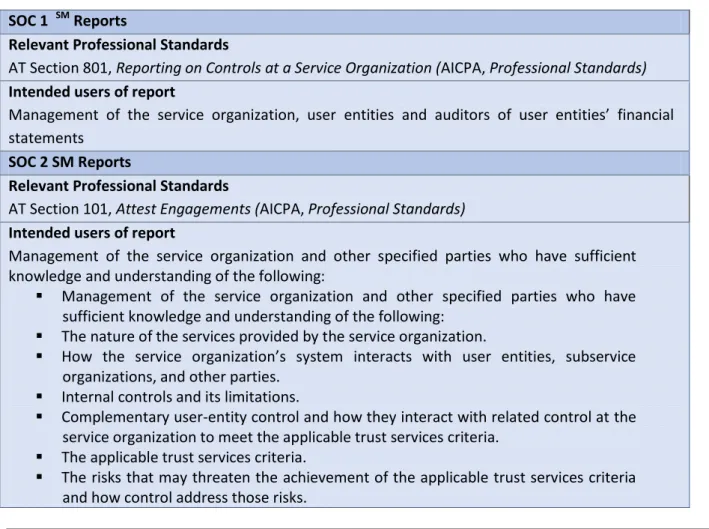
Table 2 - Overview of SOC Reports
SOC 1 SM Reports
Relevant Professional Standards
AT Section 801, Reporting on Controls at a Service Organization (AICPA, Professional Standards)
Intended users of report
Management of the service organization, user entities and auditors of user entities’ financial statements
SOC 2 SM Reports
Relevant Professional Standards
AT Section 101, Attest Engagements (AICPA, Professional Standards)
Intended users of report
Management of the service organization and other specified parties who have sufficient knowledge and understanding of the following:
Management of the service organization and other specified parties who have sufficient knowledge and understanding of the following:
The nature of the services provided by the service organization.
How the service organization’s system interacts with user entities, subservice organizations, and other parties.
Internal controls and its limitations.
Complementary user-entity control and how they interact with related control at the service organization to meet the applicable trust services criteria.
The applicable trust services criteria.
The risks that may threaten the achievement of the applicable trust services criteria and how control address those risks.
www.cloudwatchhub.eu
3.3
Cloud Security Alliance Open Certification Framework
Name of the programme: Open Certification Framework – STARGoverning of the standard: Cloud Security Alliance
Accreditation Body/Bodies: Cloud Security Alliance, British Standard Institution (for STAR Certification), AICPA (for STAR Attestation)
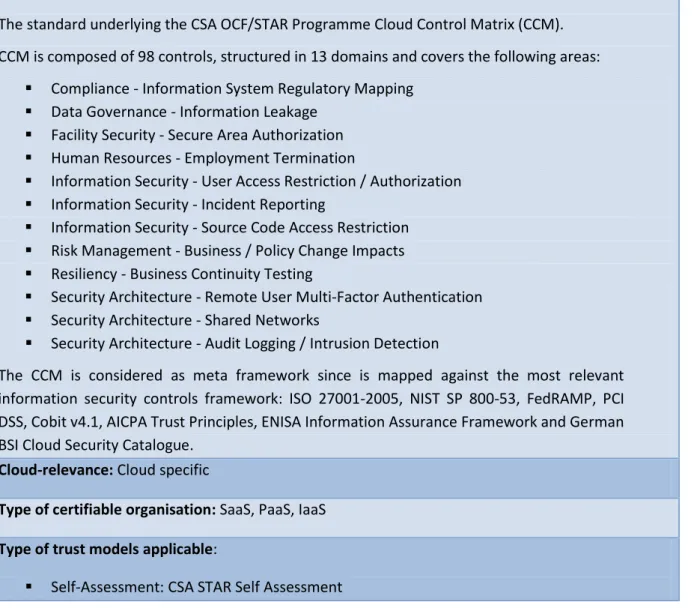
Table 3 - CSA STAR
Scope: Security and Privacy
The standard underlying the CSA OCF/STAR Programme Cloud Control Matrix (CCM). CCM is composed of 98 controls, structured in 13 domains and covers the following areas:
Compliance - Information System Regulatory Mapping Data Governance - Information Leakage
Facility Security - Secure Area Authorization Human Resources - Employment Termination
Information Security - User Access Restriction / Authorization Information Security - Incident Reporting
Information Security - Source Code Access Restriction Risk Management - Business / Policy Change Impacts Resiliency - Business Continuity Testing
Security Architecture - Remote User Multi-Factor Authentication Security Architecture - Shared Networks
Security Architecture - Audit Logging / Intrusion Detection
The CCM is considered as meta framework since is mapped against the most relevant information security controls framework: ISO 27001-2005, NIST SP 800-53, FedRAMP, PCI DSS, Cobit v4.1, AICPA Trust Principles, ENISA Information Assurance Framework and German BSI Cloud Security Catalogue.
Cloud-relevance: Cloud specific
Type of certifiable organisation: SaaS, PaaS, IaaS
Type of trust models applicable:
Self-Assessment: CSA STAR Self Assessment
SOC 3 SM Reports
Relevant Professional Standards: AT Section 101, Attest Engagements (AICPA, Professional Standards)
www.cloudwatchhub.eu
Third party independent audit: CSA STAR Certification and CSA STAR Attestation Continuous monitoring based certification: CSA STAR Continuous (not operational
yet)
Is the certification proprietary or open: Open
Programme, status (operational, in development): Operational
The following text is based on information received from Cloud Security Alliance:
The CSA Open Certification Framework can be described as an industry initiative to allow global, accredited, trusted certification of cloud providers.
The CSA Open Certification Framework is a program for flexible, incremental and multi-layered cloud provider certification according to the Cloud Security Alliance’s security guidance and control objectives:
Consensus Assessments Initiative Questionnaire (CAIQ). Cloud Controls Matrix (CCM).
The program integrates with popular third-party assessment (ISO27001) and attestation statements (SOC2) developed within the public accounting community to avoid duplication of effort and cost.
The CSA Open Certification Framework is based upon the control objectives and continuous monitoring structure as defined within the CSA GRC (Governance, Risk and Compliance) Stack research projects.
The CSA Open Certification Framework is structured in three tiers in order to address varying assurance requirements and maturity levels of providers and consumers. These range from the CSA STAR Self-assessment to high-assurance specifications that are continuously monitored.
The three levels of the OCF Programme are: Level 1 – CSA STAR Self-Assessment
Level 2 – CSA STAR Certification/Level 2 – CSA STAR Attestation Level 3 – CSA STAR Continuous
www.cloudwatchhub.eu
3.3.1 STAR Self-Assessment
CSA STAR Self Assessment is a self-assessment due diligence process based on CSA best practice Consensus Assessments Initiative Questionnaire (CAIQ)27 and Cloud Controls Matrix (CCM).
The results of the self-assessment are voluntarily published by the CSP on the CSA STAR web site that is freely available and open to all cloud providers.
Cloud providers can submit two different types of reports to indicate their compliance with CSA best practices:
The Consensus Assessments Initiative Questionnaire (CAIQ), which provides industry-accepted ways to document what security controls exist in IaaS, PaaS, and SaaS offerings. The questionnaire (CAIQ) provides a set of over 140 questions a cloud consumer and cloud auditor may wish to ask of a cloud provider. Providers may opt to submit a completed Consensus Assessments Initiative Questionnaire.
The Cloud Controls Matrix (CCM), which provides a controls framework that gives detailed understanding of security concepts and principles that are aligned to the Cloud Security Alliance guidance in 13 domains. As a framework, the CSA CCM provides organizations with the needed structure, detail and clarity relating to information security tailored to the cloud industry. Providers may choose to submit a report documenting compliance with Cloud Controls Matrix.
3.3.2 STAR Certification
The CSA STAR Certification28 is a third party independent assessment of the security of a cloud service provider. A technology-neutral certification that leverages the requirements of the ISO/IEC 27001:2005 management system standard together with the CSA Cloud Control Matrix.
The independent assessment is conducted by certification body (such as the British Standard Institution) accredited CSA. The assessment assigns a ‘Management Capability’ score to each of the CCM security domains. Each domain is scored on a specific maturity and will be measured against 5 management principles.
The internal report shows organizations how mature their processes are and what areas they need to consider improving on to reach an optimum level of maturity. These levels will be designated as either “No”, “Bronze”, “Silver” or “Gold” awards. Certified organization will be listed on the CSA STAR Registry as “STAR Certified”.
27https://cloudsecurityalliance.org/research/cai/. 28
www.cloudwatchhub.eu
CSA STAR CERTIFICATION evaluates the efficiency of an organization’s ISMS and ensures the scope, processes and objectives are “Fit for Purpose”, and helps organizations prioritize areas for improvement and lead them towards business excellence.
It also enables effective comparison across other organizations in the applicable sector and it is focused on the strategic & operational business benefits as well as effective partnership relationships.
CSA STAR Certification enables the auditor to assess a company’s performance, on long-term sustainability and risks, in addition to ensuring they are SLA driven, allowing senior management to quantify and measure improvement year on year.
The STAR certification scheme is designed to comply with:
ISO/IEC 17021:2011, Conformity assessment – Requirements for bodies providing audit and certification of management systems.
ISO/IEC 27006:2011, Information technology – Security techniques – Requirements for bodies providing audit and certification of information security management systems.
ISO 19011, Guidelines for auditing management systems. 3.3.3 STAR Attestation
The STAR Attestation29 is positioned as STAR Certification at Level 2 of the Open Certification Framework and is likewise STAR Certification a third party independent assessment of the security of a cloud service provider.
Star Attestation is based on type 2 SOC attestations supplemented by the criteria in the Cloud Controls Matrix (CCM). This assessment:
Builds on the key strengths of SOC 2 (AT 101).
Provides for robust reporting on the service provider’s description of its system, and on the service provider’s controls, including a description of the service auditor’s tests of controls in a format very similar to the now obsolete SAS 70 reporting format, and current SSAE 16 (SOC 1) reporting, thereby facilitating market acceptance.
Evaluation over a period of time rather than a point in time. Recognition with an AICPA Logo.
3.3.4 STAR Continuous
CSA STAR Continuous30 will be based on a continuous auditing/assessment of relevant security properties.
29
www.cloudwatchhub.eu
It will built on the following CSA best practices/standards: Cloud Control Matrix (CCM).
Cloud Trust Protocol (CTP). CloudAudit (A6).
CSA STAR Continuous is currently under development and the target date of delivery is 2015.
3.4
EuroPrise: The European Privacy Seal
Name of the programme: Europrise31Governing of the standard: EuroPrise GMBH, with a board of stakeholders including the German Data Protection of Schleswig-Holstein.
Accreditation Body/Bodies: EuroPrise GMBH accredits independent third party auditors based on an evaluation. Third party independent auditors are accredited by the Europrise Certification Authority. Third party auditors evaluate the product or service and produce an evaluation report. The seal is awarded after report has been validated by the Europrise Certification Authority.
Table 4 - EuroPrise
Scope:
Data protection
Cloud-relevance: Not cloud specific (just like ISO 27001) but could be applied to a cloud service, and has already been awarded to a search engine and a behavioural advertising network.
Type of certifiable organisation: Certifies IT products and services. Does not apply to organizations.
Type of trust models applicable: Evaluation by accredited independent third party auditors.
Is the certification proprietary or open: Proprietary
Programme, status (operational, in development): Operational
30https://cloudsecurityalliance.org/star/continuous/.
31
www.cloudwatchhub.eu
EuroPrise is a European certification scheme that certifies compliance of IT products and services with a catalogue of criteria that are based on the European Data Protection directives (95/46/EC and 2002/58/EC) and opinions of Article 29 working party.
The EuroPrise trustmark is awarded after (1) an evaluation by an independent accredited auditor and (2) the validation of the produced evaluation report by the Europrise certification body.
EuroPrise is currently governed by the data protection authority of Schleswig-Holstein (ULD) in Germany. However, starting on January 1st 2014, governance will be handed over to an independent private entity, EuroPrise GMBH, in order to account for the expansion of this trustmark.
3.5
EuroCloud – STAR Audit
Name of the programme: EuroCloud Star Audit (ECSA)32. The international platform based on Promis with multiple languages available in Q2/2014
Governing of the standard: EuroCloud
Accreditation Body/Bodies: In preparation
Table 5 - EuroCloud STAR Audit
Scope: Transparency about the Cloud Service Delivery chain and involved subcontractors. Legal compliance according to individual regulations per EU country. Data Security and Data privacy. DC resilience. Business Operations. Reversibility and Interoperability
Cloud-relevance: ECSA is cloud specific quality insurance and certification programme
Type of certifiable organisation: Any SaaS, PaaS, IaaS
Type of trust models applicable: Self-assessment (no certificate, only benchmark) Third party assessment with certification
Is the certification proprietary or open: Open (not yet fully disclosed, planned for Q1/2014)
Programme, status (operational, in development): Operational
32
http://www.saas-audit.de/en/. For a sample of dissemination in German, see https://www.promis.eu/de/eurocloud-star-audit/.