P R I M A R Y R E S E A R C H P A P E R
The importance of environmental variables for submerged
macrophyte community assemblage and coverage in shallow
lakes: differences between northern and southern Europe
Torben L. Lauridsen•Erik Jeppesen• Steven A. J. Declerck•Luc De Meester• Jose M. Conde-Porcuna• Wouter Rommens•
Sandra Brucet
Received: 23 January 2014 / Revised: 8 September 2014 / Accepted: 22 September 2014 / Published online: 1 October 2014 ÓSpringer International Publishing Switzerland 2014
Abstract Much information is available on commu-nity composition and abundance of submerged macro-phytes in North temperate lakes, including their response to variation in environmental variables. Less is known about macrophytes in other climate regions. We studied 98 shallow lakes distributed in three different European latitudinal regions. The lakes were selected along mutually independent gradients of macrophyte coverage and total phosphorus and were sampled monthly from May to October for water chemistry and physical variables. We tested for changes in the impact of selected environmental variables on the macrophyte assemblage, coverage and richness in the three regions. Coverage was measured along transects
during July/August and June in the northern/central and southern European lakes, respectively. Correspondence Discriminant Analysis was used to detect for differ-ences in macrophyte composition among different regions, and univariate regression trees were used to detect relationships between environmental variables and macrophyte coverage and richness. In the northern lakes, the coverage was mainly related to chlorophyll a followed by pH, and richness was related to Secchi depth and chlorophylla. In the southern lakes, pH was the key environmental variable for both coverage and richness. North–south differences may be of relevance for determining management strategies related to global climate change.
Handling editor: Zhengwen Liu
T. L. Lauridsen (&)E. JeppesenS. Brucet
Department of Bioscience, Aarhus University, Vejlsøvej 25, 8600 Silkeborg, Denmark
e-mail: [email protected]
T. L. LauridsenE. JeppesenS. Brucet
Arctic Research Centre, C.F. Møllers Alle´ 8, Bldg. 1110, 8000 Aarhus C, Denmark
T. L. LauridsenE. Jeppesen
Sino-Danish Centre for Education and Research (SDC), Beijing, People’s Republic of China
S. A. J. Declerck
Department of Aquatic Ecology, Netherlands Institute of Ecology (NIOO-KNAW), Postbus 50,
6700 AB Wageningen, The Netherlands
S. A. J. DeclerckL. De MeesterW. Rommens Laboratory of Aquatic Ecology, Evolution and
Conservation, KU Leuven, University of Leuven, Leuven, Belgium
J. M. Conde-Porcuna
Institute of Water Research, University of Granada, Ramo´n y Cajal 4, 18071 Granada, Spain
S. Brucet
Department of Environmental Sciences, University of Vic, Vic, Spain
S. Brucet
Institute for Environment and Sustainability, European Commission Joint Research Centre, Ispra, Italy DOI 10.1007/s10750-014-2055-6
Keywords Aquatic plantsRichnessFreshwater RestorationClimate
Introduction
Macrophytes play an important role in shallow lakes. They provide habitat complexity, serve as spawning areas for fish, as shelter for pelagic zooplankton and as habitats for littoral zooplankton and macroinverte-brates (Diehl & Kornijo´w,1998; Jeppesen et al.,1998; Burks et al.,2002; Declerck et al.,2007,2011). It is generally accepted that nutrient enrichment causes a decline in vegetation coverage (Van den Berg et al.,
1999; Sand-Jensen et al.,2000; Kolada,2010) due to shading by phytoplankton, periphyton and suspended detritus and inorganic matter. Traditionally, phospho-rus has been considered to be of key importance for changes in macrophyte abundance, but recent studies have provided evidence that nitrogen may also be important (James et al., 2005; Sagrario et al., 2005; Jeppesen et al.,2010). Besides nutrients, also alkalin-ity is important; for instance, isoetids dominate in low alkaline lakes, elodeids in alkaline lakes and chara-ceans in high alkaline waters (Vestergaard & Sand-Jensen, 2000a; Søndergaard et al., 2010; Kanninen et al., 2013). Above a certain nutrient level, species richness is negatively correlated with phosphorus, nitrogen and chlorophyll a, both at regional/national scale (Søndergaard et al.,2010; Alahuhta et al.,2012) and at northern European scale (Penning et al.,2008), basically reflecting that few nutrient-tolerant species are effective competitors to other species at high nutrient levels and that macrophytes are adversely affected by algae growth in such environments (Sand-Jensen & Borum,1991). However, species richness is also alkalinity dependent, with relatively few species in the low alkaline lakes and a potential for more species in the high alkaline lakes (Søndergaard et al.,
2010; Kanninen et al., 2013). Species richness furthermore differs along a latitude gradient in north-ern European lakes with low richness in the most northern, cold lakes and increasing richness with decreasing latitude; not only just on a national scale (Heino & Toivonen,2008) but to some extent also on a larger scale with a maximum of freshwater macro-phytes in cool temperate regions (Crow,1993; Hille-brand, 2004). However, freshwater macrophyte
communities apparently exhibit weaker latitude gra-dients in richness compared to those observed in marine and terrestrial studies (Hillebrand, 2004), perhaps because of dispersal limitation and geograph-ical barriers (Rørslett,1991; Hillebrand,2004). Other factors limiting species richness and abundance can be herbivory by waterfowl (Lauridsen et al.,2003) and by fish or crayfish (Rodrı´guez et al.,2005).
It is generally accepted that there is a strong positive feedback relationship between water clarity and mac-rophyte abundance in temperate lakes (Moss, 1990; Scheffer et al., 1993; Jeppesen et al., 1998), where phytoplankton-feeding invertebrates/zooplankton is using macrophytes as a refuge. This relationship is less strong in warm lakes (Bachmann et al.,2002; Jeppesen et al.,2007; Kosten et al.,2011) due to differences in trophic dynamics between warm and cold lakes (Jeppesen et al., 2007), e.g. higher aggregation of small-sized fish within the macrophyte beds in sub-tropical and Mediterranean lakes (Meerhoff et al.,2007; Teixeira-de Mello et al., 2009; Brucet et al., 2010), reducing the refuge effect of macrophytes for zoo-plankton and thereby the grazing on phytozoo-plankton in warm lakes too. However, continuity of the growing season where plants stretch their leaves towards the surface for light in combination with reduced water level in warm lakes during summer, leading to an improved light environment for the plants, may some-how counteract the fish effect (Bachmann et al.,2002; Beklioglu et al.,2006; Bucak et al.,2012).
Conductivity may also affect macrophyte compo-sition. Not only in brackish lakes, a decline in macrophyte richness is observed with an increase in salinity/conductivity (Bostro¨m et al.,2014), but also in freshwater systems, Hrivna´k et al. (2013) observed conductivity effects on macrophyte communities, although it turned out to be of minor importance. In Mediterranean lakes, irregular precipitation and runoff events, plus prolonged droughts and high evaporation may cause seasonally fluctuating conductivity (Quin-tana et al., 2006; Beklioglu et al., 2006). However, whether this affects macrophyte communities is still unknown for such systems.
Climate warming may thus, both directly and indirectly, affect the species composition and abun-dance of submerged macrophytes. As part of a com-prehensive study of biodiversity in shallow lakes in different latitudinal regions (Declerck et al.,2005; De Meester et al., 2006), we measured macrophyte
composition and abundance in 98 shallow lakes (Table1) situated in northern, northern/central and southern Europe and selected along mutually indepen-dent gradients of macrophyte coverage, lake size and total phosphorus that in each region exhibited various degrees of eutrophication from mesotrophy to hyper-eutrophy (for more details see Declerck et al. (2005)). This study design enabled us to elucidate the impact of various key environmental factors on submerged macrophytes independently of nutrient levels. We hypothesised that the importance of clarity, largely dependent on the chlorophyllalevel, would be higher in the northern European lakes than in the southern lakes in which other abiotic and especially chemical variables were expected to be of key importance. We further expected to find major changes in community structure along the north–south climate gradient.
Materials and methods Study sites
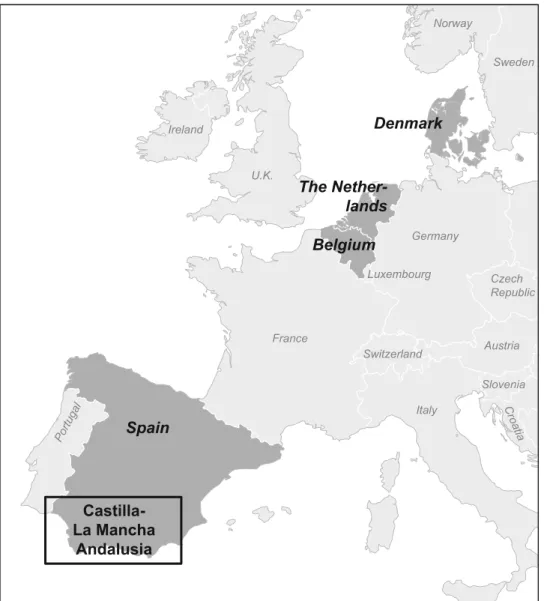
The study included 98 lakes, almost equally divided between Denmark (DK, 32), Belgium/The Nether-lands (BNL, 34) and Spain (SP, 32). The Spanish lakes were all situated in the southern part, mainly in Andalusia (Fig.1). Mean depth was\3 m (except for 7 m in one Spanish lake), and maximum depth was
\6 m (except 13 m in the same Spanish lake), and lake area varied from 0.2 to 124 ha (Table1). The lakes were not only selected randomly but also along mutually independent gradients of the potentially important environmental driving variables: turbidity
(overall, the turbid and non-turbid lakes had a macrophyte cover\and[20%, respectively), total phosphorus (\and[100 lg l-1, respectively), lake size (\and[5 ha, respectively) and connectedness (for details see Declerck et al.,2005: ESA’s Electronic Data Archive: Ecological Archives E086-101-A1). This was to prevent interference from multicolinear-ity. The climate in the three different regions differed markedly with average day temperatures for the 6-month study period ranging from 17°C in Denmark over 19°C in Belgium/The Netherlands to 24°C in southern Spain (Table1), and the corresponding total precipitation ranging from 412 mm in Belgium/The Netherlands to 159 mm in southern Spain, with Denmark placed in between (Table 1). Due to high evaporation in combination with low precipitation, six of the Spanish lakes dried out during the study period and four lakes lost a considerable part of their water volume (J. M. Conde-Porcuna, pers. observations). Sampling and analyses
All lakes were shallow and fully mixed. Depth-integrated samples for water chemistry, chlorophyll and physical parameters were collected monthly at the deepest station in the lakes during a 6-month period from May to October. Physical variables (temperature, conductivity and Secchi depth) were measured in the field, and pH was measured in the field or in the lab. pH was included since it is closely related to the logarithm of bicarbonate concentration in waters at approximate carbon dioxide equilibrium with the atmosphere over the pH range 5.5–8.8 (Stumm & Morgan,1981) and is as such considered a surrogate
Table 1 Morphometric data of the 32 study lakes from Denmark (DK), Belgium/The Netherlands (BNL) and Spain (SP). Average
(Avg), median (Med), minimum (Min) and maximum (Max) values are given
Avg Med Min Max Air temp. Precip., mm Prec. days
Area (ha) DK 18.7 6.0 0.6 124 17 297 53 BNL 11.7 4.6 0.2 76 19 412 62 SP 17.9 10.3 0.8 98 24 159 24 Mean depth (m) DK 1.3 1.0 0.5 3.0 BNL 1.1 0.9 0.5 3.6 SP 1.8 1.0 0.3 7
The three right columns show averages of air temperature (Air temp), total precipitation (Precip) and total number of precipitation days (Prec. Days) during the 6-month study period and during the period 1961–1990
for alkalinity (alkalinity itself was not measured). pH is also a possible controlling factor for macrophyte distribution via its strong direct influence on the membrane function in cells and ion solubility (Larcher,1995).
Chlorophyllawas measured spectrophotometrically after ethanol extraction (Jespersen & Christoffersen,
1987), total phosphorus (TP) as orthophosphate using the ascorbic acid molybdenum method (Murphy & Riley,1972) following persulphate digestion (Koroleff,
1970), total nitrogen (TN) by the Kjeldahl method and nitrite and nitrate as nitrite using a flow injection analyser. Suspended organic and inorganic matter was
determined using pre-ignited GF/C filters. Samples were dried out at 105°C (12 h), weight was determined and the dried sample was subsequently ignited at 550°C (4 h) to determine weight loss on ignition.
Depending on lake area, aquatic macrophytes were observed at 30–200 equidistant observation points situated along transects covering the entire lake area. At each observation point, percentage macrophyte coverage, using a 0–5 range scale: 0%, 1:[= 0–5%, 2:[= 5–25%, 3:[= 25–50%, 4:[= 50–75% and 5:
[= 75%, was registered, and we recorded the dominant plant species (the species covering most of the macro-phyte covered area) plus registered less abundant
Germany France Portugal Italy Austria Slovenia Croatia Ireland Luxembourg Czech Republic Switzerland Sweden Norway U.K.
Denmark
Belgium
Spain
Castilla-La Mancha
Andalusia
The
Nether-lands
Fig. 1 The study included 98 comparable shallow lakes: 32 lakes in Denmark (DK), 34 lakes in Belgium/The Netherlands (BNL) and
species in the lake to elaborate a total species list for the lake. Total macrophyte coverage for the lake was calculated based on the total number of equidistant observations using mid-values for the five ranges (2.5, 15, 38, 63 and 87%) in the calculation. Observations were performed once between June and mid-August depending on latitude, early observations being con-ducted in the south.
Correspondence Discriminant Analysis (CDA) was performed on presence-absence data to determine whether significant differences existed in macrophyte composition between the different countries. CDA is a pattern-recognition method that helps to separate two or more pre-defined groups from data provided for several variables (Legendre & Legendre,1998), in our case the occurrence of macrophyte species. It is particularly useful for describing how groups differ in terms of variables (Chessel & Thioulouse,1996; Perriere et al.,
1996). The pre-defined grouping variable of the CDA was the three different regions. If the test supports the hypothesis of significant differences among groups, the analysis proceeds to find the linear combinations (discriminant functions) of the predictor variables that best discriminate among groups. Standardised canon-ical coefficients are used to compare the relative importance of each variable (macrophyte species). The percentage of cases correctly classified reflects the degree to which the samples yield consistent informa-tion (Legendre & Legendre, 1998) and is based on cross-validation. To test if TP and turbidity play a role in the occurrence of macrophyte species, a discriminant analysis using TP and turbidity categories as classifi-cation criteria was performed according to Declerck et al. (2005). First, the analysis was undertaken including all regions, and next, using regions, with TP and turbidity categories as grouping variables.
Univariate regression trees were produced to trace the relationship between the environmental variables (predictor variables) in each region and the percentage of macrophyte coverage and richness (response vari-ables) and to identify thresholds of the predictor variables best discriminating the resulting macrophyte coverage and richness. Regression trees are a binary partitioning approach whereby a dataset is progressively split into subsets that most significantly reduce the variability of the response variable. This type of regression gives a clear picture of the structure of the data and provides a highly intuitive insight into the kinds of interactions between variables (Crawley, 2002).
Regression trees are insensitive to outliers and multi-collinearity (Breiman et al.,1984; De’ath,2007). The surrogates that best agree (i.e. classify the same subjects in the same way) with the original splitting variable (Breiman et al., 1984) are selected by the statistical algorithm according to their performance in the per-centage of agreement in the allocation of cases to the two groups. To avoid overfitting, we ‘pruned’ the tree by selecting the model with the minimum cross-validated relative error according to De’ath & Fabricius (2000). The explanatory variables included in the model were: lake area, mean depth, conductivity, Secchi depth, pH, TP, orthophosphate, TN, nitrite, nitrate, chlorophylla, suspended matter, suspended inorganic and suspended organic matter. It was decided to include TP and orthophosphate as explanatory variables in order to confirm macrophyte independency of TP as expected from the way we selected the study lakes. Suspended matter, inorganic and organic matter were all three included as explanatory variables since inorganic and organic matter may act independently or partly inde-pendently with inorganic matter, being dependent on resuspension or inorganic loading, whereas organic matter is more dependent on primary production and resuspension. Secchi depth was included as an indicator of transparency. As default, the explanatory variables used in the regression tree analysis were monthly averaged data for the 6-month investigation period, covering the growth season of the macrophytes. However, in the SP lakes macrophytes were quantified in May, June or July before senescence started or the lakes dried out. Therefore, in the regression tree analysis of the SP lakes, both 3- and 6-month averages of environmental variables were used.
All explanatory variables were log-transformed except conductivity, which was X0.25-transformed, and pH which was not transformed. Macrophyte coverage was X0.25-transformed. The X0.25-transformation was chosen in accordance with Declerck et al. (2005).
Results
Abiotic variables
Phosphorus and nitrogen concentrations were in the same range in the three regions, but the highest nitrogen concentrations were found in SP with a median value of 1.8 mg l-1, and the highest
phosphorus concentrations in BNL with a median value of 117lg l-1 (Fig.2). The 75-percentiles for TN and TP in SP and BNL, respectively, were 2–3 times higher than in Denmark. Secchi depth was quite similar in the three regions; however, variability was larger in the SP lakes than in the DK and BNL lakes that exhibited similar variability (Fig.2).
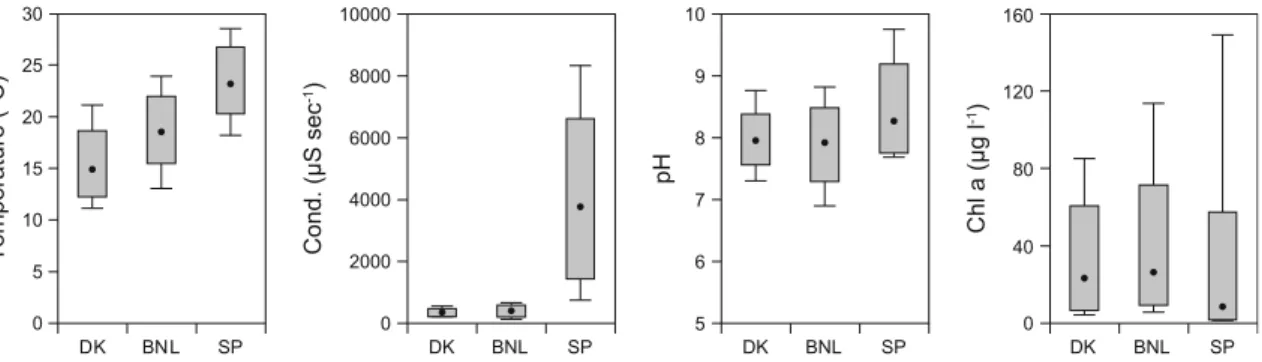
Summer median water temperature ranged from 14.8°C in DK to 18.6°C in BNL and 24.3°C in SP, and the 90-percentile temperatures ranged from 21.1°C in DK and 23.9°C in BNL to 28.5°C in SP (Fig.3). Conductivity was generally low in the DK and BNL lakes with median values of 335 and 395lS, respec-tively, and with low variability between lakes. In contrast, the SP lakes had a median conductivity of 3761lS and a 90 percentile of 8330lS (Fig.3). None of the lakes were connected to the sea. pH was similar in the DK and BNL lakes with median values around 8. However, in the SP lakes median pH was slightly higher (8.3), and the 75-percentile and maximum pH were one unit higher (maximum: 9.7) (Fig.3).
Biotic variables
Median values of chlorophyll a in the DK and BNL lakes were 23 and 26lg l-1, respectively, and vari-ability was similar in the two regions. In the SP lakes, median chlorophyllawas 8lg l-1, but variability was high with a 90 percentile of 149 lg l-1(Fig.3).
In DK, BNL and SP, a total of 25, 21 and 11 macrophyte species were identified, respectively. In all three regions, the submerged plant community was dominated by elodeids, e.g. Potamogetonand Calli-triche species (Table2). DK and BNL shared seven species, BNL and SP only three, and DK and SP two species (Table2). Only two isoetid species (rosette formed plants), Isoetes lacustris L. and Littorella unifloraL., were found, and only in the Danish lakes. In Denmark,Elodea canadensis Rich. was the most frequently occurring macrophyte species and was observed in almost 50% of the lakes with macro-phytes, followed byPotamogeton obtusifoliusMert. & Koch, filamentous algae andPotamogeton crispusL.
DK BNL SP DK BNL SP DK BNL SP TN (mg l -1) SD (cm) TP (μg l -1) 0 1 2 3 4 5 6 0 50 100 150 200 250 300 350 0 200 400 600 800 1000 1200
Fig. 2 Total nitrogen (TN), total phosphorus (TP) and Secchi depth (SD). Thebox plotsshow 10, 25, median, 75 and 90% percentiles
in the 32 Danish (DK), 34 Belgium/Dutch (BNL) and 32 Spanish (SP) lakes
Temperature (°C) Cond. (μS sec
-1) pH Chl a (μg l -1) 0 2000 4000 6000 8000 10000 0 40 80 120 160 0 5 10 15 20 25 30 6 5 8 7 10 9 DK BNL SP DK BNL SP DK BNL SP DK BNL SP
Fig. 3 Temperature, conductivity, pH and chlorophylla(Chla) measured during the study period. For further explanation see the text
In the BNL lakes two species,Potamogeton pectinatus L. andCeratophyllum demersumL., were particularly frequent and detected in 35% of the macrophyte-containing lakes. In the SP lakes,P. pectinatusL. was the most frequent species and occurred in 70% of the lakes with macrophytes, followed byChara connivens Salzm. andNajas marinaL. (Table 2; Fig.4).
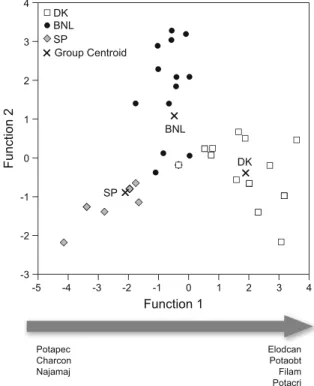
The CDA analysis ordered the three countries in one single significant dimension CDA (P\0.0001) that explained 78.5% of the variance (Fig.4), 57.1% of the samples being correctly classified by cross-validation analysis. The most notable differences in macrophyte composition appeared between Spain and Denmark, while Belgium/The Netherlands shared species with both countries. When using the pre-defined TP and turbidity categories according to Declerck et al. (2005) as grouping variables in the CDA analysis, no significant results were obtained, indicating that the geographical differences were more important than productivity and turbidity in differen-tiating lake macrophyte composition. Regarding max-imum species richness, 15 species were registered in one DK lake, whereas maxima of 7 and 4 species were registered in the BNL and SP lakes, respectively (Table 2); in the SP lakes, there was no difference in species richness, irrespective of whether the lakes were permanent or dried out.
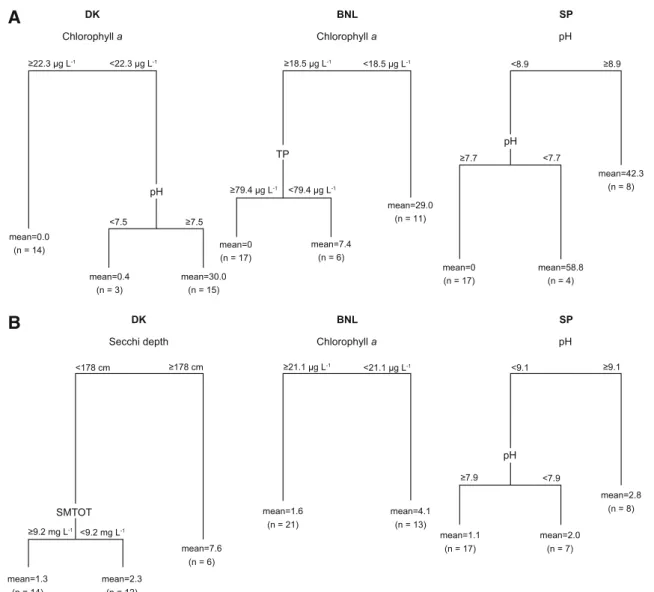
The regression tree analysis for Denmark using macrophyte coverage as a response variable produced a three-leaf tree that explained 69% of the variance. The primary split (57% of the explained variance) was defined by chlorophyllaand it separated 14 lakes having high chlorophyllaconcentrations (C22.3lg l-1to the left) and no macrophytes (Fig.5A). For the primary split, surrogate variables (i.e. variables that classify the same subjects in the same way as the original splitting variable) for chlorophyll a were suspended matter
Table 2 Macrophyte occurrence in the different regions and
number of lakes in which species occur in the Danish (DK), Belgian/Dutch (BNL) and Spanish lakes (SP)
Name DK lakes BNL lakes SP lakes Batrachiumsp. 5 Callitriche hamulataKiitz. 1 Callitriche hermaphroditicaL. 4 Callitriche platycarpaKiitz. 1 Callitriche truncatavarocciden. 4 Ceratophyllum demersumL. 4 7 Chara asperaDeth. 2 Chara connivensSalzm. 4 Chara contrariaKiitz. 2 Chara galioidesC. Agardh 1 Chara globularisvar.globularisThuill. 3
Chara hispidaL. 1
Charaspp. 6
Chara vulgarisvar.longibracteataL. 3 Drepanocladus fluitansHedw. 1 Drepanocladussp. 1 Eleocharis acicularisL. 1 1 Elodea canadensisRich. 10 Elodea nuttalliiSt. John 4 Isoetes lacustrisL. 1 Juncus bulbosusL. 1 Lemna gibbaL. 1 Lemna trisulcaL. 1 1 Littorella unifloraL. 1 Myriophyllum alterniflorumDc. 3 Myriophyllum spicatumL. 3 2 2 Najas marinaL. 1 2 Nitellasp. 1
Nitella translucensAg. 2 Potamogeton berchtoldiiFieber 4 1 Potamogeton crispusL. 5 2 Potamogeton gramineusL. 1 Potamogeton obtusifoliusMert & Koch 6 2 Potamogeton pectinatusL. 3 8 11 Potamogeton perfoliatusL. 3
Potamogeton praelongusWulf. 1 Potamogeton pusillusL. 1 4 Radiola linoidesRoth. 2 Ranuncullus circinatusSibth. 2 Ricciocarpus natansL. 1 Ruppia drepanensisTineo 1 Ruppia maritimaL. 1 Table 2 continued Name DK lakes BNL lakes SP lakes Sparganium erectumL. 1 Utricularia vulgarisL. 2 Zannichellia palustrisvar.
pedic. L.
3
Zannichellia obtusifoliaL. 1 Average species number per lake 3.5 3.3 1.9 Max. species number per lake 15 7 4
(C8.9 mg l-1; Fig.5A, left), Secchi depth (\0.79 m) and suspended inorganic matter (C3.2 mg l-1). The secondary split separated three lakes with pH lower than 7.5 and predicted values of macrophyte coverage of 0.4% and 15 lakes with pH higher or equal to 7.5 and predicted values of macrophyte coverage of 30%. The regression tree analysis using species richness (Fig.5B) as a response variable explained 64% of the variance, and the lakes were divided according to Secchi depth (explaining 54% of the variance), with suspended matter as a surrogate. The highest richness was found in lakes with a Secchi depth higher than 1.78 m. A second split divided the lakes below and above the threshold of 9.2 mg l-1suspended matter content (Fig.5B).
A three-leaf tree was produced for Belgium using macrophyte coverage as a response variable which explained 63% of the variance. The primary split was defined by chlorophylla (47% of explained variance)
and separated 11 lakes with chlorophyllalevels lower than 18.5lg l-1 (Fig.5A, middle) and a predicted macrophyte coverage of 29%. Surrogate variables for the primary split were given by Secchi depth (\100 cm), TP (\31.6lg l-1) and TN (\0.32 mg l-1). Lakes with chlorophyll a levels higher or equal to 18.5lg l-1 were split again based on TP. The secondary split separated lakes with TP levels lower than 79.4lg l-1 with a predicted macrophyte mean coverage of 7.4% and lakes with TP levels higher or equal to 79.4lg l-1 with no macrophytes. The regression tree analysis for species richness (Fig. 5B) explained 37% of the variance. Lakes were divided according to chlorophyll awith area as a surrogate, and the highest richness was found in lakes with chlorophyllaconcentrations lower than 21.1lg l-1.
No variable was selected when running the regres-sion tree analysis for Spain using macrophyte cover-age as a response variable and the environmental data from the 6-month period. However, when the 3-month period from May–July was used, the regression tree analysis produced a three-leaf tree explaining 73% of the variance. The primary split (explaining 37% of the variance) separated eight lakes with pH higher or equal to 8.9 and a predicted macrophyte coverage of 42.3%. The rest of the lakes were split again according to pH, separating 17 lakes with pH higher or equal to 7.7 and no macrophytes. Regression trees for species richness using the 6-month data period produced a similar three-leaf tree with pH as a primary (explain-ing 36% of the variance) and secondary split, and the highest species richness occurred at pH higher or equal to 9.1, explaining 52% of the total variance (Fig.5B). No variable was selected when running the regression trees for richness using the 3-month period.
Discussion
The CDA demonstrated a clear difference in macro-phyte communities among the countries. Differences were largest between DK and SP, but even between DK and BNL communities differed despite a similar number of species. This indicates that geographic differences, historical contingencies related to post-glacial colonisation and/or climatic differences are important in differentiating macrophyte composition. We also found a marked difference in species richness from north to south. In DK and BNL, a total of 25 and Function 1 Potapec Charcon Najamaj Elodcan Potaobt Filam Potacri 4 2 3 0 1 -2 -1 -4 -5 -3 Function 2 3 4 2 1 0 -1 -2 -3 SP DK BNL Group Centroid SP DK BNL
Fig. 4 Correspondence discriminant analysis (CDA) of
regis-tered macrophyte species in the Danish (DK), Belgian/Dutch (BNL) and Spanish (SP) lakes with macrophytes. For the significant function (function 1), macrophyte species driving the distribution of the countries are shown; Potapec= Potamog-eton pectinatus, Charcon=Chara contraria, Najama=Najas marina, Elodcan=Elodea canadensis, Potaobt=P. obtusifo-lius, Filam=Filamentous algae, Potacri=P. crispus. Lakes without macrophytes are not included
21 submerged macrophyte species were registered, respectively, compared to only 11 species in the SP lakes. Only seven species were shared between DK and BNL and three species between the SP and BNL lakes. The only two macrophyte species registered in all three regions, P. pectinatus and Myriophyllum spicatum, are cosmopolitan. In particularP. pectinatus is tolerant to high nutrient levels, low light and high conductivity (Scheffer et al., 1992; Wollheim & Lovvorn, 1996; Søndergaard et al., 2010). Also
regionally, the dominant macrophyte species could most frequently be characterised as tolerant, for instance E. canadensis together withP. crispus and P. obtusifoliusin the DK lakes,P. pectinatusandC. demersum and Elodea nutallii St. John in the BNL lakes andP. pectinatusin the SP lakes (Van den Berg et al.,1999; Bakker et al.,2010; Søndergaard et al.,
2010; Alahuhta et al.,2012). Eutrophication-sensitive plant species such asEleocharis acicularisL.,Chara spp. orCallitrichespp. (Søndergaard et al.,2010) were SMTOT <178 cm ≥178 cm ≥9.2 mg L-1 <9.2 mg L-1 ≥21.1 μg L-1 <21.1 μg L-1 mean=7.6 (n = 6) mean=1.3 (n = 14) mean=2.3 (n = 12) mean=4.1 (n = 13) mean=1.6 (n = 21) mean=2.8 (n = 8) mean=1.1 (n = 17) mean=2.0 (n = 7) pH <9.1 ≥9.1 SP L N B K D ≥7.9 <7.9 pH <8.9 ≥8.9 ≥7.7 <7.7 mean=30.0 (n = 15) pH <7.5 ≥7.5 mean=42.3 (n = 8) mean=0.0 (n = 14) mean=0 (n = 17) mean=58.8 (n = 4) mean=0.4 (n = 3) mean=29.0 (n = 11) mean=0 (n = 17) mean=7.4 (n = 6) TP ≥79.4 μg L-1 <79.4 μg L-1 pH Chlorophyll a Chlorophyll a pH Chlorophyll a Secchi depth SP L N B K D ≥22.3 μg L-1 <22.3 μg L-1 ≥18.5 μg L-1 <18.5 μg L-1
B
A
Fig. 5 Regression trees based on the percentage of (A)
macro-phyte coverage and (B) species richness for DK, BNL and SP lakes. In general, the analyses are based on 6-month periods; however, for macrophyte coverage in the SP lakes, the analysis is based on a 3-month period (see text). The higher a variable is positioned in the tree, the most important it is for differentiating
the response variable. Each node of the tree is described by the splitting variable. The longer the line, the higher the variance explained by the splitting variable. Each leaf is labelled with the mean rating (macrophyte coverage or species richness) and the number of observations (n) in the group (in parentheses)
found in only a few lakes, reflecting the overall high nutrient levels of the lakes included in our survey. The low species richness in the SP lakes and dominance of P. pectinatus(occurring in 11 lakes) may be due to the overall high conductivity asP. pectinatusis known to be a salt-tolerant species (Wollheim & Lovvorn,1996; Casagrande et al., 2005; Steinhardt & Selig, 2007), and species richness of submerged macrophytes generally declines at high conductivity/salinity (Capers et al.,2009; Bostro¨m et al., 2014) as is also the case for emergent macrophytes (Garcı´a et al.,
1993).
The low species overlap between the regions illustrates the differences in region-specific species pools. To´th et al. (2008) and Hrivna´k et al. (2013) described how macrophyte distribution patterns reflected their source region, regional climate and/or biogeography factors to a larger extent than lake type and morphometry. We found lower species richness in warm lakes. This contrasts with the findings in previous studies of macrophyte richness along a temperature gradient in Finnish lakes (Heino & Toivonen,2008), but the difference likely reflects that submerged macrophyte species richness peaks in moderately cold temperate climates, being lower in the most northern latitudes (too cold an environment and too short a growing season) and in the warmer climate regions of southern Europe (likely caused by high turbidity and conductivity). An earlier compar-ison between temperate and tropical freshwaters also showed higher macrophyte richness in the temperate zone (Crow, 1993). However, a recent review of latitudinal patterns in species richness in shallow lakes showed contrasting results with no obvious latitudinal pattern for macrophyte richness (Meerhoff et al.,
2012). A variable response is in line with Hillebrand (2004) who, in a meta-analysis, found latitudinal gradients to be less clear in freshwaters than in terrestrial environments. Despite the fact that dispersal limitation mechanisms may differ between fish and macrophytes, parallels can be drawn to freshwater fish communities, which also show substantial regional differences due to, for instance, biogeographic barriers such as mountains, lack of streams or drought (Griffith, 2006; Lenoir et al., 2010; Brucet et al.,
2013). In addition, in our study also climate-induced changes, for example the overall much higher con-ductivity due to high evaporation and periodic droughts in Spain, may have contributed to the low
species diversity of macrophytes in the warm climate region.
The regression tree analysis revealed that macro-phyte coverage in the northern and central European lakes (DK and BNL) was mainly related to chlorophyll a, Secchi depth and pH; the latter we consider a proxy for alkalinity (Stumm & Morgan, 1981), which was unfortunately not measured. The thresholds of the primary split in the DK and BNL lakes were very similar: 22.3 and 18.5 lg Chl a l-1, respectively. This threshold is in agreement with the chlorophyll levels associated with major changes in coverage in a much larger set of Danish lakes (Søndergaard et al.,2010), although higher threshold values have been found in shallow lakes further south in South-Eastern France (Robin et al.,2014). Macrophyte richness in the north/ central European lakes was mainly related to Secchi depth (DK lakes) and chlorophyll a (BNL lakes), which is in accordance with Søndergaard et al. (2010). Secchi Depth and chlorophyll aare somehow corre-lated and important predictors for macrophyte rich-ness in both DK and BNL lakes, but our analyses showed regional differences in which of the two that became the strongest predictor.
For both macrophyte coverage and richness, the regression tree analysis selected pH as the main predictor for the SP lakes. For coverage, pH was selected based on the early summer period (May–July) and for richness on the entire summer period (6-months), indicating differences in the sensitivity of the two variables. In Southern Europe the growing season starts and peaks earlier than in northern Europe (Moss et al., 2004; Beklioglu & Tan, 2008), which may explain the relationship with early season pH for coverage, while richness (species presence) was apparently affected also by pH (alkalinity) later in the season. The relationship with pH revealed in our study may indirectly reflect differences in either alkalinity or productivity. Vestergaard & Sand-Jensen
(2000b) and Sass et al. (2010) showed that pH and
alkalinity are usually positively correlated and of key importance in determining macrophyte community composition. We cannot fully exclude the possibility that the relationship with pH may be influenced by productivity, but the monthly data do not indicate an increase in pH during the period with high macrophyte coverage or a higher pH in lakes with high coverage or chlorophyll a (unpubl. data), suggesting alkalinity-rather than productivity-driven variation in pH.
We conclude that local environmental variables have different impacts on macrophyte community richness and abundance in northern and southern Europe. Chlorophyllawas important for coverage and richness in the northern temperate region, with almost the same chlorophyll a threshold in Denmark and Belgium/The Netherlands. In the southern, warmer region pH (likely reflecting alkalinity) appeared as the most important variable determining both coverage and species richness. Such differences in importance of environmental variables along climate gradients may be of importance when forecasting impacts of future climate change in temperate regions, where focus in monitoring often is on chlorophyll and Secchi depth and not necessarily on other abiotic/environ-mental variables such as pH or alkalinity. These results are of particular importance in relation to the conservation and management strategies and scenario analyses of future climate effects on European lakes as they underline the importance of considering climate-induced changes in abiotic conditions, such as evap-oration and water level, which may have consequences for submerged macrophyte communities, species richness and whole-lake ecosystem functioning.
Acknowledgments We thank Jon Svendsen, Kim Pedersen,
Lissa Skov Hansen, Karina Jensen, Jane Stougaard-Pedersen, Birte Laustsen, Stig Bech Nielsen, Jochen Vanderkerkhove, J. M. Medina-Sanchez, F. Bullejos, P. Sanches-Castillo and J. A. Delgado for field and laboratory assistance. We thank Anne Mette Poulsen and Tinna Christensen for valuable editorial assistance and lake owners and local authorities for lake access. The survey was carried out within the framework of the EU project BIOMAN (Biodiversity and Human Impact in European Shallow Lakes, EVK2-CT-1999-00046). TLL, EJ and SB were supported by the EU project REFRESH (Adaptive strategies to mitigate the impacts of climate change on European freshwater ecosystems, Env. 2009.2.1.2.1), TLL and EJ also by CLEAR (a Villum Kann Rasmussen Foundation, Centre of Excellence project), EJ by CIRCE and CRES, and SB by the Marie Curie Intra European Fellowship no. 330249 (CLIMBING).
References
Alahuhta, J., A. Kanninen & K.-M. Vuori, 2012. Response of macrophyte communities and status metrics to natural gradients and land use in boreal lakes. Aquatic Botany 103: 106–114.
Bachmann, R. W., C. A. Horsburgh, M. V. Hoyer, L. K. Mataraza & D. E. Canfield, 2002. Relations between trophic state indicators and plant biomass in Florida lakes. Hydrobiologia 470: 219–234.
Bakker, E. S., E. Van Donk, S. A. J. Declerck, N. R. Helmsing, B. Hidding & B. A. Nolet, 2010. Effect of macrophyte community composition and nutrient enrichment on plant biomass and algal blooms. Basic and Applied Ecology 11: 432–439.
Beklioglu, M. & C. O. Tan, 2008. Restoration of a shallow Mediterranean lake by biomanipulation complicated by drought. Archiv fu¨r Hydrobiologie 171: 105–118. Beklioglu, M., G. Altinayar & C. O. Tan, 2006. Water level
control over submerged macrophyte development in five shallow lakes of Mediterranean Turkey. Archiv fu¨r Hy-drobiologie 166: 535–556.
Bostro¨m, C., S. Baden, A.-C. Boeckelmann, K. Dromph, S. Frederiksen, C. Gustavsson, D. Krause-Jensen, T. Mo¨ller, S. L. Nielsen, B. Olesen, J. Olsen, L. Pihl & E. Rinde, 2014. Distribution, structure and function of Nordic eelgrass (Zostera marina) ecosystems: implications for coastal management and conservation. Aquatic Conservation: Marine and Freshwater Ecosystems 24: 410–434. Breiman, L., J. H. Friedman, R. A. Ohlsen & C. J. Stone, 1984.
Classification and Regression Trees. Wadsworth Interna-tional Group, Belmont.
Brucet, S., D. Boix, X. D. Quintana, E. Jensen, L. W. Nathansen, C. Trochine, M. Meerhoff, S. Gascon & E. Jeppesen, 2010. Factors influencing zooplankton size structure at contrast-ing temperatures in shallow lakes: implications for effects of climate change. Limnology and Oceanography 55: 1697–1711.
Brucet, S., S. Pedron, T. Mehner, T. L. Lauridsen, C. Argillier, I. J. Winfield, P. Volta, M. Emmrich, T. Hesthaugen, K. Holmgren, L. Benejam, F. Kelly, T. Krause, A. Palm, M. Rask & E. Jeppesen, 2013. Fish diversity in European lakes: geographical factors dominate over anthropogenic pressures. Freshwater Biology 58: 1779–1793.
Bucak, T., E. Saraoglu, E. E. Levi, U¨ . N. Tavs¸anoglu, A. I˙. C¸ akıroglu, E. Jeppesen & M. Beklioglu, 2012. The role of water level for macrophyte growth and trophic interactions in eutrophic Mediterranean shallow lakes: a mesocosm experiment with and without fish. Freshwater Biology 57: 1631–1642.
Burks, R. L., D. M. Lodge, E. Jeppesen & T. L. Lauridsen, 2002. Diel horizontal migration of zooplankton costs and benefits of inhabiting the littoral. Freshwater Biology 47: 343–365. Capers, R. S., R. Selsky, G. J. Bugbee & J. C. White, 2009. Species richness of both native and invasive aquatic plants influenced by environmental conditions and human activ-ity. Botany 87: 306–314.
Casagrande, C., C. F. Boudouresque & P. Francour, 2005. Abundance, population structure and production of Hy-drobia ventrosa(Gastropoda: Prosobranchia) in a Medi-terranean brackish lagoon, Lake Ichkeul, Tunisia. Archiv fu¨r Hydrobiologie 164: 411–428.
Chessel, D. & J. Thioulouse, 1996. L’analysc discriminante des correspondances. Documentation Themalique ADE-4, Vol. 5, Section 6. Universite Claude Bernard - Lyon 1, Lyon.
Crawley, M. J., 2002. Statistical computing. An introduction to data analysis using S-Plus. Wiley, Chichester.
Crow, G. E., 1993. Species-diversity in aquatic angiosperms – latitudinal patterns. Aquatic Botany 44: 229–258.
De Meester, L., S. Declerck, J. Janse, P. J. T. M. Van Puijenb-roek, R. Portielje, E. Lammens, E. Jeppesen, T. Lauridsen, K. Schwenk, K. Muylaert, K. Van der Gucht, W. Vyver-man, G. Zwart, E. Van Hannen, J. M. Conde-Porcuna, J. Vandekerkhove & L. Brendonck, 2006. Chapter 8: Biodi-versity in European Shallow Lakes: A Multilevel – Mul-tifactorial Field Study. Ecological Studies. Springer Verlag, New York: 149–167.
De’ath, G., 2007. Boosted trees for ecological modeling and prediction. Ecology 88: 243–251.
De’ath, G. & K. E. Fabricius, 2000. Classification and regression trees: a powerful yet simple technique for ecological data analysis. Ecology 81: 3178–3192.
Declerck, S., J. Vandekerkhove, L. Johansson, K. Muylaert, J. M. Conde-Porcuna, K. Van Der Gucht, C. Perez-Martı´nez, T. L. Lauridsen, K. Schwenk, G. Zwart, W. Rommens, J. Lo´pez-Ramos, E. Jeppesen, W. Vyverman, L. Brendonck & L. De Meester, 2005. Multigroup biodiversity in shallow lakes along gradients of phosphorus and water plant cover. Ecology 86: 1905–1915.
Declerck, S., M. Vanderstukken, A. Pals, K. Muylaert & L. de Meester, 2007. Plankton biodiversity along a gradient of productivity and its mediation by macrophytes. Ecology 88: 2199–2210.
Declerck, S. A. J., E. S. Bakker, B. van Lith, A. Kersbergen & E. van Donk, 2011. Effects of nutrient additions and macro-phyte composition on invertebrate community assembly and diversity in experimental ponds. Basic and Applied Ecology 12: 466–475.
Diehl, S. & R. Kornijo´w, 1998. Influence of submerged mac-rophytes on trophic interactions among fish and macroin-vertebrates. In Jeppesen, E., Ma. Søndergaard, Mo. Søndergaard & K. Christoffersen. The Structuring Role of Submerged Macrophytes in Lakes. Ecological Studies 131. Springer Verlag, New York: 24–46.
Garcı´a, L. V., T. Marano´n, A. Moreno & L. Clemente, 1993. Above ground biomass and species richness in a Mediter-ranean salt marsh. Journal of Vegetation Science 4: 417–424.
Griffith, D., 2006. Pattern and process in the ecological bioge-ography of European freshwater fish. Journal of Animal Ecology 75: 734–751.
Heino, J. & H. Toivonen, 2008. Aquatic plant diversity at high latitudes: patterns of richness and rarity in Finnish fresh-water macrophytes. Boreal Environment Research 13: 1–14. Hillebrand, H., 2004. On the generality of the latitudinal diversity gradient. The American Naturalist 163: 192–211. Hrivna´k, R., H. Ot’ahel’ova´, J. Kochjarova´ & P. Pal’ove-Ba-lang, 2013. Effect of environmental conditions on species composition of macrophytes – study from two distinct biogeographical regions of Central Europe. Knowledge and Management of Aquatic Ecosystems 411: 09. James, C., J. Fisher, V. Russell, S. Collings & B. Moss, 2005.
Nitrate availability and hydrophyte species richness in shallow lakes. Freshwater Biology 50: 1049–1063. Jeppesen, E., T. L. Lauridsen, T. Kairesalo & M. R. Perrow,
1998. Impact of submerged macrophytes on fish-zoo-plankton interactions in lakes. In Jeppesen, E., Ma. Søndergaard, Mo. Søndergaard & K. Christoffersen. The Structuring Role of Submerged Macrophytes in Lakes.
Ecological Studies 131. Springer Verlag, New York: 91–114.
Jeppesen, E., M. Søndergaard, M. Meerhoff, T. L. Lauridsen & J. P. Jensen, 2007. Shallow lake restoration by nutrient loading reduction – some recent findings and challenges ahead. Hydrobiologia 584: 239–252.
Jeppesen, E., M. Meerhoff, K. Holmgren, I. Gonza´lez-Ber-gonzoni, F. Teixeira-de Mello, S. A. J. Declerck, L. De Meester, M. Søndergaard, T. L. Lauridsen, R. Bjerring, J. M. Conde-Porcuna, N. Mazzeo, C. Iglesias, M. Reizen-stein, H. J. Malmquist, Z. W. Liu, D. Balayla & X. Lazzaro, 2010. Impacts of climate warming on lake fish community structure and potential ecosystem effects. Hydrobiologia 646: 73–90.
Jespersen, A.-M. & K. Christoffersen, 1987. Measurements of chlorophyll a from phytoplankton using ethanol as extraction solvent. Archiv fu¨r Hydrobiologie 109: 445–454.
Kanninen, A., S. Hellsten & H. Ha¨ma¨la¨inen, 2013. Comparing stressor-specific indices and general measures of taxo-nomic composition for assessing the status of boreal lacustrine macrophyte communities. Ecological Indicators 27: 29–43.
Kolada, A., 2010. The use of aquatic vegetation in the lake assessment: testing the sensitivity of macrophyte metrics to anthropogenic pressures and water quality. Hydrobiologia 656: 133–147.
Koroleff, F., 1970. Determination of total phosphorus in natural waters by mean of persulphate oxidation. Interlab Report no. 3 Cons. int. Explor. Mer.
Kosten, S., E. Jeppesen, V. L. Huszar, N. Mazzeo, E. H. Van Nes, E. T. Peeters & M. Scheffer, 2011. Ambiguous cli-mate impacts on competition between submerged macro-phytes and phytoplankton in shallow lakes. Freshwater Biology 56: 1540–1553.
Larcher, W., 1995. Physiological Plant Ecology. Springer, Berlin.
Lauridsen, T. L., P. Hald-Møller & H. Sandsten, 2003. The restoration of a shallow lake by introducingPotamogeton spp.: the impact of waterfowl grazing. Lakes & Reservoirs: Research and Management 8: 177–187.
Legendre, P. & L. Legendre, 1998. Numerical Ecology. Else-vier, Amsterdam.
Lenoir, J., J.-C. Ge´gout, A. Guisan, P. Vittoz, T. Wohlgemuth, N. E. Zimmermann, S. Dullinger, H. Pauli, W. Willner, J. A. Grytnes, R. Virtanen & J.-C. Svenning, 2010. Cross scale analysis of the region effect on vascular plant species diversity in southern and northern European mountain ranges. PLoS ONE 5: e15734.
Meerhoff, M., J. M. Clemente, F. Teixeira-de Mello, C. Iglesias, A. R. Pedersen & E. Jeppesen, 2007. Can warm climate-related structure of littoral predator assemblies weaken the clear water state in shallow lakes? Global Change Biology 13: 1888–1897.
Meerhoff, M., F. Teixeira-de Mello, C. Kruk, C. Alonso, I. Gonza´lez-Bergonzoni, J. Pablo Pacheco, G. Lacerot, M. Arim, M. Bekliog˘lu, S. Brucet, G. Goyenola, C. Iglesias, N. Mazzeo, S. Kosten & E. Jeppesen, 2012. Environmental warming in shallow lakes: a review of potential changes in community structure as evidenced from space-for-time
substitution approaches. Advances in Ecological Research 46: 259–350.
Moss, B., 1990. Engineering and biological approaches to the restoration from eutrophication of shallow lakes in which aquatic plant communities are important components. Hydrobiologia 200(201): 367–377.
Moss, B., D. Stephen, D. M. Balayla, E. Becares, S. E. Collings, C. Fernandez-Alaez, M. Fernandez-Alaez, C. Ferriol, P. Garcia, J. Goma, M. Gyllstro¨m, L. A. Hansson, J. Hietala, T. Kairesalo, M. R. Miracle, S. Romo, J. Rueda, V. Russell, A. Stahl-Delbanco, M. Svensson, K. Vakkilainen, M. Valentin, W. J. Van de Bund, E. Van Donk, E. Vicente & E. G. Villena, 2004. Continental-scale patterns of nutrient and fish effects on shallow lakes: synthesis of a pan-European mesocosm experiment. Freshwater Biology 49: 1633–1649.
Murphy, J. & J. R. Riley, 1972. A modified single solution method for the determination of phosphate in natural waters. Analytical Chemistry Acta 27: 21–26.
Penning, W. E., M. Mjelde, B. Dudley, S. Hellsten, J. Hanganu, A. Kolada, M. Van den Berg, S. Poikane, G. Phillips, N. Willby & F. Ecke, 2008. Classifying aquatic macrophytes as indicators of eutrophication in European lakes. Aquatic Ecology 42: 237–251.
Perriere, G., J. R. Lobry & J. Thioulouse, 1996. Correspondence discriminant analysis: a multivariate method for comparing classes of protein and nucleic acid sequences. CABIOS 12: 519–524.
Quintana, X. D., D. Boix, A. Badosa, S. Brucet, J. Compte, S. Gasco´n, R. Lo´pez-Flores, J. Sala & R. Moreno-Amich, 2006. Community structure in temporary and permanent shallow lentic ecosystems: size-based vs. taxon-based approaches. Limnetica 25: 303–320.
Robin, J., A. Wezel, G. Bornette, F. Arthaud, S. Ange´libert, V. Rosset & B. Oertli, 2014. Biodiversity in eutrophicated shallow lakes: determination of tipping points and tools for monitoring. Hydrobiologia 723: 63–75.
Rodrı´guez, C. F., E. Be´cares, M. Ferna´ndez-Ala´ez & C. Fern-a´ndez-Ala´ez, 2005. Loss of diversity and degradation of wetlands as a result of introducing exotic crayfish. Bio-logical Invasions 7: 75–85.
Rørslett, B., 1991. Principal determinants of aquatic macrophyte richness in northern European lakes. Aquatic Botany 39: 173–193.
Sagrario, M. A. G., E. Jeppesen, J. Goma, M. Søndergaard, J. P. Jensen, T. L. Lauridsen & F. Landkildehus, 2005. Does high nitrogen loading prevent clear-water conditions in shallow lakes at moderately high phosphorus concentra-tions? Freshwater Biology 50: 27–41.
Sand-Jensen, K. & J. Borum, 1991. Interactions among phyto-plankton, periphyton and macrophytes in freshwaters and estuaries. Aquatic Botany 41: 137–175.
Sand-Jensen, K., T. Riis, O. Vestergaard & S. E. Larsen, 2000. Macrophyte decline in Danish lakes and streams over past 100 years. Journal of Ecology 88: 1030–1040.
Sass, L. L., M. A. Bozek, J. A. Hauxwell, K. Wagner & S. Wright, 2010. Response of aquatic macrophytes to human land use pertubations in the watersheds of Wisconsin lakes, USA. Aquatic Botany 93: 1–8.
Scheffer, M., M. R. Redelijkheid & F. Noppert, 1992. Distri-bution and dynamics of submerged vegetation in a chain of shallow lakes. Aquatic Botany 42: 199–216.
Scheffer, M., S. H. Hosper, M. L. Meijer, B. Moss & E. Je-ppesen, 1993. Alternative equilibria in shallow lakes. Trends in Ecology & Evolution 8: 275–279.
Søndergaard, M., L. S. Johansson, T. L. Lauridsen, T. B. Jørgensen, L. Liboriussen & E. Jeppesen, 2010. Sub-merged macrophytes as indicators of ecological quality of lakes. Freshwater Biology 55: 893–908.
Steinhardt, T. & U. Selig, 2007. Spatial distribution patterns and relationship between recent vegetation and diaspore bank of a brackish coastal lagoon on the southern Baltic Sea. Estuarine, Coastal and Shelf Science 74: 205–214. Stumm, W. & J. J. Morgan, 1981. Aquatic Chemistry – An
Introduction Emphasizing Chemical Equilibria in Natural Waters. Wiley, New York: 171–227.
Teixeira-de Mello, F., M. Meerhoff, Z. Pekcan-Hekim & E. Je-ppesen, 2009. Substantial differences in littoral fish com-munity structure and dynamics in subtropical and temperate shallow lakes. Freshwater Biology 54: 1202–1215. To´th, L. G., S. Poikane, W. E. Penning, G. Free, H. Ma¨emets, A.
Kolada & J. Hanganu, 2008. First step in the Central. Baltic intercalibration exercise on lake macrophytes: where do we start? Aquatic Ecology 42: 265–275.
Van den Berg, M., M. Scheffer, E. Van Nes & H. Coops, 1999. Dynamics and stability of Chara sp. and Potamogeton pectinatus in a shallow lake changing in eutrophication level. Hydrobiologia 408(409): 335–342.
Vestergaard, O. & K. Sand-Jensen, 2000a. Aquatic macrophyte richness in Danish lakes in relation to alkalinity, trans-parency and lake area. Canadian Journal of Fisheries and Aquatic Sciences 57: 2022–2031.
Vestergaard, O. & K. Sand-Jensen, 2000b. Alkalinity and tro-phic state regulate aquatic plant distribution in Danish lakes. Aquatic Botany 67: 85–107.
Wollheim, W. M. & J. R. Lovvorn, 1996. Effects of macrophyte growth forms on invertebrate communities in saline lakes of the Wyoming High Plains. Hydrobiologia 323: 83–96.