Virtual Resource Orchestration Constraints in
Cloud Infrastructure as a Service
Khalid Bijon
Institute for Cyber Security Univ of Texas at San Antonio[email protected]
Ram Krishnan
Institute for Cyber Security Univ of Texas at San Antonio[email protected]
Ravi Sandhu
Institute for Cyber Security Univ of Texas at San Antonio[email protected]
ABSTRACT
In an infrastructure as a service (IaaS) cloud, virtualized IT resources such as compute, storage and network are offered on demand by a cloud service provider (CSP) to its tenants (customers). A major problem for enterprise-scale tenants that typically obtain significant amount of resources from a CSP concerns orchestrating those resources in a secure manner. For instance, unlike configuring physical hardware, virtual resources inIaaSare configured using software, and hence prone to misconfigurations that can lead to critical security violations. Examples of such resource orchestration operations include creating virtual machines with appropri-ate operating system and software images depending on their purpose, creating networks, connecting virtual machines to networks, attaching a storage volume to a particular virtual machine, etc. In this paper, we propose attribute-based con-straints specification and enforcement as a means to mitigate this issue. High-level constraints specified using attributes of virtual resources prevent resource orchestration operations that can lead to critical misconfigurations. Our model al-lows tenants to customize the attributes of their resources and specify fine-grained constraints. We further propose a constraint mining approach to automatically generate con-straints once the tenants specify the attributes for virtual re-sources. We present our model, enforcement challenges, and its demonstration in OpenStack, the de facto open-source cloudIaaSsoftware.
Categories and Subject Descriptors
K.6.5 [Management of Computing and Information
Systems]: Security and Protection
General Terms
Security
Permission to make digital or hard copies of all or part of this work for personal or classroom use is granted without fee provided that copies are not made or distributed for profit or commercial advantage and that copies bear this notice and the full cita-tion on the first page. Copyrights for components of this work owned by others than ACM must be honored. Abstracting with credit is permitted. To copy otherwise, or re-publish, to post on servers or to redistribute to lists, requires prior specific permission and/or a fee. Request permissions from [email protected].
CODASPY’15,March 2–4, 2015, San Antonio, Texas, USA. Copyrightc 2015 ACM 978-1-4503-3191-3/15/03 ...$15.00. http://dx.doi.org/10.1145/2699026.2699112 .
Keywords
Cloud IaaS, Virtual-Resource Orchestration, Constraints, Configuration Policy, Security Policy Mining
1.
INTRODUCTION
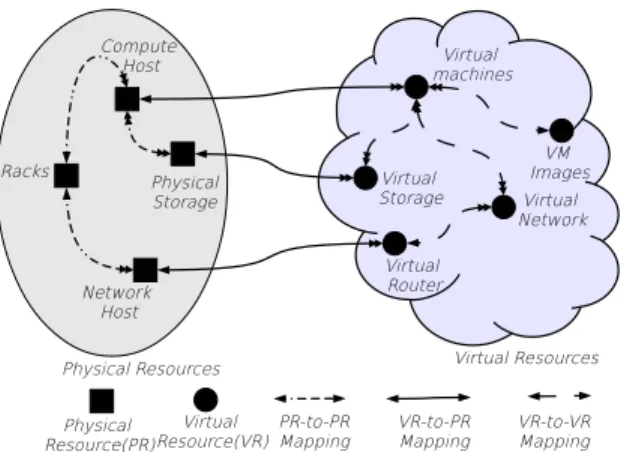
Enterprises are increasingly driven by economics and flexi-bility to use computing resources provided by cloudIaaS[23]. In cloudIaaS the physical resources in a datacenter are log-ically arranged by the cloud service provider (CSP), while computing resources are virtualized and hosted on those log-ical collections of physlog-ical resources. This is illustrated in figure 1 where, for example, a rack is a collection of a specific set of physical servers and network hosts. Other resources such as physical storages may be associated with those com-pute hosts in the rack. This is shown as physical resource to physical resource mapping (PR-to-PR) in the figure. The single and double-headed arrows indicate the usual “one-to” and “many-to” mappings respectively. In cloud IaaS, en-terprises or tenants obtain a number of separate pieces of virtual computing resources (or simply virtual resources or resources), e.g. virtual machines (VMs), virtual networks (NETs), etc., from the CSP, where a physical resource is shared by multiple virtual resources for maximizing utiliza-tion and reducing cost. IaaSproviders allow multi-tenancy which multiplexes virtual resources of multiple enterprises upon same hardware. This includes co-location ofVMs from different tenants on a single (physical) host, sharing of VM images in a repository, etc. This is illustrated as virtual re-source to physical rere-source mapping in figure 1. This raises many security and performance considerations for a tenant’s workload in the cloud. For instance, a tenant’sVMs can be attacked by co-located malicious VMs of an adversary ten-ant. Such issues that arise due to multi-tenancy of virtual resources on physical resources have been extensively inves-tigated in the past (see for example [19, 22, 28, 29, 32, 33]). Another major issue arises from the fact that, for a given tenant with large-scale, heterogeneous virtual resources in IaaS, orchestrating those resources in a secure manner is cumbersome. Virtual to virtual resource mapping relations are also shown in figure 1. Here, orchestration refers to re-source management issues such as creating networks, design-ing network layouts, applydesign-ing appropriate images to VMs, etc. Since, in IaaS resource orchestration operations are performed in software (unlike in the case of physical re-sources where, for instance, servers are physically connected via Ethernet cables), they are highly prone to misconfigura-tions that can lead to security issues or increased exposure. For instance, a web-facingVMcan be accidentally connected
Figure 1: Cloud Resources Mapping Relation
to a sensitive internal network or a low-assurance image may be applied to aVMthat is expected to be security-hardened. In this paper, we present the design, implementation, and evaluation of attribute-based CVRM (constraint-driven vir-tual resource management) as an approach to mitigate such concerns in cloudIaaS. Constraints in access control theory are effective ways of risk mitigation. A classic example is separation of duty in RBAC [24] where certain roles such as accounts manager and purchase manager conflict with each other and hence should never be assigned to the same user. Our developed CVRM enables tenants to express several es-sential properties of cloud resources as their attributes and specify constraints on resource mappings (VR-to-VR in fig-ure 1) based on those attributes. We expect such constraints to be specified by a tenant administrative user or theCSP administrator. We provide a number of examples illustrating the utility of this technique in practical situations, such as configuring a Hadoop Cluster and a 3-tier business applica-tion in cloudIaaS. TheCSPcan then algorithmically enforce such constraints specified by all of its tenants when a virtual resource is mapped with another. We have implemented a prototype of CVRM in the widely-deployedOpenStack, the
de facto open-sourceIaaScloud software. We also propose an algorithm for mining the constraints in CVRM where the tenants specify the necessary attributes according to their business specifications and the algorithm automatically con-structs the required constraints.
2.
MOTIVATION
Migrating line-of-business applications toIaaScan be dis-astrous rather than beneficial for the tenants if their virtual resources are not properly configured. A misconfigured sys-tem not only hinders expected performance but also poses several security threats to a tenant. These threats include (i) malicious image insertion and inadvertent leakage of sen-sitive information through snapshot, (ii) sensen-sitive informa-tion passing from a virtual machine to malicious virtual networks, and (iii) flow of information from a highly sen-sitive virtual network to a malicious or less sensen-sitive one. However, present commercial cloud IaaS providers, includ-ing Amazon and Rackspace, offer at best rudimentary ca-pabilities for such configuration management. For instance, AWS-IAM [1] offers a tenant to specify policies that can re-strict resource-level permissions for certain users where the
Figure 2: Constraints on Virtual Resources Arrangement Configurations
permissions include snapshot aVM, create a virtual storage with specific capacity, etc. On the other hand, Rackspace provides a fixed mechanism for isolation management where cloud resources and administrative users of a tenant, also re-ferred as admin-users, can be grouped into different projects where admin-users can only configure the resources in their assigned projects. These fixed approaches lack the gener-ality to capture diverse enterprise-specific requirements for configuring virtual resources. Moreover, in these user-driven configuration management setups, completely relying on the admin-users increases the risk of possible misconfiguration since admin-users may inadvertently create incorrect config-urations. It also elevates potential for insider threats.
Motivated by this scenario, we aim to develop CVRM that offers a tenant to specify various constraints for con-figuring the required arrangements of virtual resources. We address the fact that security concerns due to misconfigu-ration will vary across line-of-business applications of the tenants. For instance, 3-tier business application will be concerned about protecting unauthorized disclosure of data, while hadoop cluster configurations will seek to ensure in-tegrity and availability of the resources. CVRM is designed to address tenant-specific constraints where the constraints are enforced on user-operations that affect the configurations of virtual resources. Constraints specified by a tenant can be enforced on operations performed by the tenant’s admin-users during regular operations or by CSP’s admin-users in case of exceptions and troubleshooting. We believe that, in addition to any access control mechanism implemented in this system, CVRM provides resource management capabil-ity that prevents misconfiguration caused by admin-users.
Figure 2 shows conceptual view of constraint driven vir-tual resource management. Constraints can be specified for a specific mapping relation (or simply relation) between two virtual resources. We describe these mapping relations and possible misconfiguration issues. We also provide ex-amples for 3-tier application and hadoop cluster configu-rations. Note that, 3-tier aims to isolate computational requirements of an organization by three different tiers— presentation (PS), application (APP), and database (DB), for better security and scalability. Hadoop is a master-slave architecture for faster analysis of big-data where security issues include integrity and availability of the resources.
• IMG-VM Compatibility Relations: As shown in
figure 2, a virtual machine image, also referred asIMG, can be used by multipleVMs and also from aVM
mul-tiple snapshots can be imaged. This process provides quick replication of aVMinto large numbers of VMs, and also quick migration of a VM to another server. However, incorrect usage of IMG can critically affect the security and performance in the system. For in-stance, in 3-tier,VMs running the application of each tier require separateIMGs since VMs in different tiers perform different operations. Thus, anIMGcreated for DB-tier is not to be used forVMs of tier, since PS-tierVMs are web-facing and theIMGmay expose crit-ical information about DB-tier. Similarly, in hadoop, each type of VMs such as nameNode and taskTracker have different functionalities, whereby improper use of IMGcan hamper performance and availability.
• NET-VMConnectivity Relations: A group ofVMs,
connect to a network NET, so as to internally com-municate. However, a wrong VMconnected to aNET may hamper communication inNETand availability of information. For instance, in 3-tier application, APP-tierVMs can be connected to each other for faster com-munications, however, accidental assignment of VMs from other tiers can hamper the flow. Similarly, the taskTrackerVMs performing reduce jobs should be con-nected with each other and no otherVMs should con-nect to this network.
• RT-NET Connection Relations: Using a virtual
router (RT), VMs of two selected NETs can commu-nicate. In 3-tier application,VMs of APP-tier and PS-tier should communicate, however, PS-PS-tier should not directly communicate with DB-tier. Also, connection to the external internet is only authorized for tier-1 VMs. Similarly, in hadoop, aNETfor nameNodeVMs should only connect to theNETof jobTrackerVMs.
• STR-VM Attachment Relations: A persistent
vir-tual storage (STR), is like a hard-disk drive which can be attached and detached to multiple VMs, but one at a time, until it is destroyed. Note that, aSTR at-tached to aVMstores data from theVM. Later, if the STRis detached and re-attached to anotherVM with-out deleting its data, the new VM will get access to the data of the previousVM.
3.
DESIGN OF CVRM
Intuitively, an attribute captures a property of an entity in the system, expressed as a name:value pair. For instance, clearance can be a user attribute and values of clearance could be ‘top-secret’, ‘secret’, etc. In the context of cloud IaaS, various useful properties of the virtual resources, such asVMs andNETs, can be captured by associating attributes to them. For instance, attributes can represent aVM’s dif-ferent properties including owner tenant, operational pur-pose, workloads sophistication, and connected networks. In CVRM, given that the properties of the virtual resources are represented by their attributes, a constraint is enforced while mapping (i.e., connecting) two virtual resources by comparing the specific attributes of the virtual resources.
In this section, we formally define CVRM that includes representation of the basic elements, relations among virtual resources and the constraint specification language. Then, we instantiate CVRM for 3-tier architecture in cloudIaaS.
3.1
Formal Specification
The basic elements of CVRM include representation of existing tenants and virtual resources in a cloudIaaSsystem where each virtual resource belongs to a particular tenant. A virtual resource is also mapped to a particular class of virtual resource such asVM,NET,IMG,RT, andSTR. Formally, we have the following.
• VRis the set of all existing virtual resources inCSP.
• CLS is the set of all classes of virtual resources that are supported by theCSP.
• rCls:VR→CLS, is a function that maps each virtual resource to its class.
• TENANTSis the finite set of existing tenants inCSP.
• tenant : VR → TENANTS, is a function that maps each virtual resource to the tenant that owns it.
• VRtntis the set of virtual resources that are owned by
the tenanttnt. Formally, VRtnt={v∈VR|tenant(v)=tnt}.
Here,VRtntcontains the virtual resources of a tenanttnt
and these virtual resources are partitioned into different sets based on their class. We define such sets of the virtual re-sources of each tenant as follows,
• VRtnt,cis the set of virtual resources of classcthat are
owned by the tenanttnt. Formally, VRtnt,c={v∈VRtnt|rCls(v)=c}.
In a tenant, a particular class of virtual resources can have specific type of mapping relations to virtual resources of another class. For instance, virtual resources of classVM can have connection-mapping and attachment-mapping re-lations with virtual resources of classNETandSTR respec-tively. We can define the relations between elements of every two classes of virtual resources in a tenant as follows,
• Rtnt,ci,cj is the relation between virtual resources of
classci andcjin a tenanttnt. Formally, Rtnt,ci,cj ⊆VRtnt,ci×VRtnt,cj.
However, CVRM restricts the following type of relations, 1. Relations between virtual resources of same class
can-not be specified (i.e.,Rtnt,ci,ci cannot be specified).
2. For two classesci6=cjwe can defineRtnt,ci,cj orRtnt,cj,ci
but not both.
CVRM provides two operations calledAdd and RM re-spectively to add and remove tuples to a relation, where each operation is a function that takes as inputs the relation and two virtual resources of appropriate classes. Each operation also evaluates a specific constraint with respect to these two virtual resources as discussed below. Formally they are de-fined as follows (the notation for defining these operations is similar to the notation of schema used in NIST RBAC [25]),
Add(Rtnt,ci,cj,vr1,vr2)C vr1∈VRtnt,ci ∧vr2∈VRtnt,cj ∧consEval(δ Add tnt,ci,cj,vr1,vr2) Rtnt,ci,cj 0 =Rtnt,ci,cj ∪ {<vr1,vr2>}B
RM(Rtnt,ci,cj,vr1,vr2)C vr1∈VRtnt,ci ∧vr2∈VRtnt,cj ∧consEval(δ RM tnt,ci,cj,vr1,vr2) Rtnt,ci,cj 0 =Rtnt,ci,cj − {<vr1,vr2>}B
Here, δtnt,Addci,cj and δ
RM
tnt,ci,cj are constraints that are
re-spectively specified for adding and removing a tuple to the relationRtnt,ci,cj. A successful execution of an operation is
allowed if the constraint is satisfied for the particular virtual resources vr1and vr2. BothAddandRMcall the constraint
evaluation functionconsEval with vr1, vr2 as inputs along
with the relevant constraint. Evaluation of the constraint is a simple evaluation of a logical formula to true or false.
Basically, a constraint compares different properties as-signed to the virtual resources vr1 and vr2 which are
evalu-ated byconsEval to make a decision. In CVRM, there are attributes of each class of virtual resource that character-ize different properties of the resources and are modeled as functions. For each attribute function, there is a set of finite constant values that represents the possible values of that attribute. We assume values of attributes to be atomic,1 therefore, for a particular element of that resource, the name of the attribute function maps to one value from the set. For convenience attribute functions are simply referred to as at-tributes. Formally, we have the following.
• ATTRci
tnt is the set of attribute functions of a virtual
resource class ci in tenant tnt. Here, for a function
att∈ATTRci
tnt, the domain of the function is the
vir-tual resources VRtnt,ci and the codomain is the values
of att written as SCOPEatt which is a set of atomic
values. Formally, att : VRtnt,ci→ SCOPEatt where
att∈ATTRci tnt.
Now, for eachRtnt,ci,cj, at most two constraints can be
spec-ified for the operations Add and RM respectively. Each constraint is used to verify if assigned values of specific at-tributes of two virtual resources vr1 and vr2 of classciand
cj respectively satisfy certain conditions. CVRM uses the
grammar below to specify constraints,
<Quantifier>:=∀(vr1,vr2)∈ R<Cls>,<Cls>. <Stmt>
<Stmt>:=<Stmt> <connector><Stmt>|(<rule>) <rule>:=<Token>→<Token>
<Token>:= (<Token> <connector> <Token>)|(<Term>) <Term>:=<Attribute>(<resource>)<comperator> <Scope> <Attribute>::=<letter>|<digit>|<Attribute>
<Scope>::=<letter>|<digit> <Scope> <connector>::=∧ | ∨ <comparator>::= =| 6= <Cls>::=c1|c2|. . .|cn <resoruce>::= vr1|vr2 <digit>::= 0|1|2|. . .|8|9 <letter>::= a|b|. . .|y|z|A|B|. . .|Y|Z
The constraint specification grammar syntax is given in Backus Normal Form (BNF). Each constraint statement con-tains single or multiple small expressions in the form of im-plication, A→B, joined by logical connectors. The small expression is also referred to as constraint-rule or justrule.
1
As given in section 2, in 3-tier application, an example of such constraints is to restrict communication betweenVMs of APP-tier and DB-tier. Here, if the attribute is calledtier
and the possible values are presentation, application and database, avmcan only get one of the three values. However, there might be constraints that require set-valued attributes where the virtual resources get multiple values. CVRM is not currently designed to express such constraints, however, can be easily extended to set-valued attributes.
Both A and B in aruleA→B contain one or more predicates connected by logical connectors, where a predicate contains an attribute function of a specific class of virtual resource and the function returns the assigned value to the attribute of a specific instance of that class and, then, the predicate compares the value with a particular value of the attribute. Basically, arule, A→B, verifies that if assigned attribute val-ues of a virtual resource vr1 meets the conditions specified in A then assigned attribute values of vr2 should satisfy the condition in B in order to insert vr1 and vr2 into a relation. Note that, the grammar is also weakly typed since in each predicate <Attribute>and<Scope>are replaced by arbi-trary names. To this end, we develop a simple static type-checking system that ensures valid constraint expression. For each predicate of a constraint, it checks if the value, specified after the<comparator>sign of the predicate, be-longs to the scope of the attribute name specified before the
<comparator>. It is formally defined as follows.
Predicate format:
attribute(<Resource>)<comparator>attribute-value
Type-Checking Rule:
If attribute-value∈SCOPEattribute T hen
returntrue Else
returnerror
3.2
Instantiation
In this section, we instantiate CVRM for an example of 3-tier business application setup. Another example of hadoop cluster setup is given in the appendix. We focus on the tenant called 3-tier. The classes of virtual resources sup-ported by theCSPareVM,NET,RT,STRandIMGand 3-tiersupports relations fromVM-to-NET,NET-to-RT, VM-to-IMGandVM-to-STRwhich are written asR3-tier,VM,NET,
R3-tier,NET,RT,R3-tier,VM,STRandR3-tier,VM,IMGrespectively.
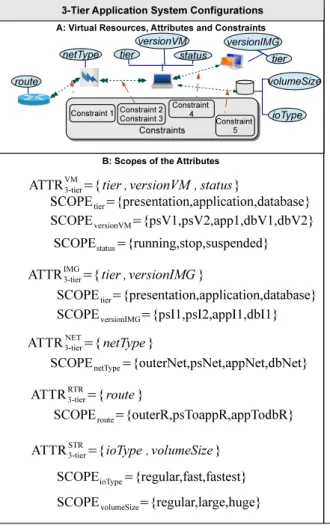
Attributes are defined for the instances of each class of virtual resources that characterize different properties nec-essary to capture the requirements to run3-tier applica-tion in cloud. Figure 3-A identifies the attributes of the virtual resources of tenant 3-tier. It also shows the map-ping relation among virtual resources (represented by arrow-headed lines). Figure 3-B gives the scopes of these at-tributes. For instance, in A, a VMattributetier represent the tier-operations a VM performs and B shows the scope of tier which is presentation, application, database. For each vm, tier assigns a value from the scope to the vm. An example attribute assignment for a vm that performs as a database server is: tier(VM)= database. Other two attributes of VM calledversionV M and status represent the version of aVM in specific tier and the activity status respectively. Similarly, IMG also has attributes calledtier
andversionIM Gthat represnts the tier and version respec-tively for which anIMGis created. For3-tier, we also cre-ate a NETattribute callednetT ype that specifies the layer for which a NETis created for the communication. For in-stance, aNETwithnetT ype value psNet should only carry presentation layer data. Figure 3-A and 3-B also defines attributes and their scopes forRTandSTRrespectively.
Generally, in CVRM, tenants can specify attributes for their virtual resources to capture specific organizational
re-Figure 3: Constraints Specification for 3-Tier Application System
quirements. Also, resources can have certain general proper-ties irrespective of organizational diversiproper-ties of the tenants. CVRM categorizes attributes in two types: one that cap-tures the general properties across all the tenants (referred as inter-tenant attributes) and the other that captures tenant-specific properties (referred to as intra-tenant attributes).
For a 3-tier application, the tenant specifiesVMattribute called tier, as shown in figure 3-A, for their operational purpose. Here, tier is intra-tenant attribute since this at-tribute does not capture anything in other applications such as hadoop. However, volumeSize attribute of STR repre-sents the size of the volume and this attribute is required by virtual storage regardless of operational objectives of differ-ent tenants, and is thereby an inter-tenant attribute
In this setup, proper administration of the attributes is necessary where administration process should include cre-ation and deletion of the attributes and their scopes as well as assigning correct attribute values to the virtual resources. Creation and deletion of inter-tenant attributes and their scopes should be managed by theCSP’s admin-users, while, the attribute value assignment to virtual resources are per-formed byCSP’s or tenant’s admin-users or by the IaaS sys-tem as appropriate. Attribute administration is beyond the scope of this paper. However, there is literature on attribute administration [18] that might apply in this context.
Followed by attribute specification of the resources, the tenant3-tier specifies at most two constraints for the re-lations of every two classes. Some example constraints with high level descriptions are shown in figure 3-C. For instance, constraintδAdd
3-tier,VM,NETapplies to theAddoperation where
it checks if a vm is connecting to an appropriate virtual network by comparing their attributes. Another constraint calledδRM
3-tier,VM,NET applies to RM operation of same
rela-tion where it checks if the a vm is in stop state to disconnect it from a virtual network. Figure 3-C also shows example constraints for other relations.
4.
CVRM ENFORCEMENT
We describe a CVRM enforcement in OpenStack cloud platform. Then, we analyze some security issues of CVRM.
4.1
Enforcement in OpenStack
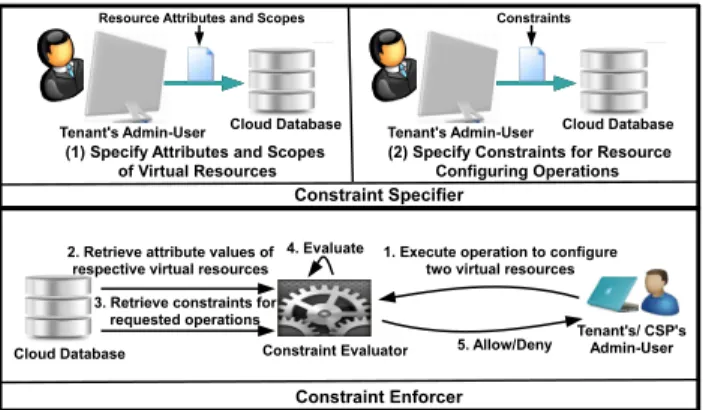
Figure 4 shows conceptual picture of CVRM enforcement process inIaaS. This process includes a constraint specifier and constraint enforcer components. Constraint specifier specifies necessary attributes and their scopes for the vir-tual resources inIaaS. It also specifies the constraints for the operations that add/remove configuration-relations between two virtual resources. When users execute the operations, respective constraints are enforced. As shown in the figure, after getting each request from users, the constraint
evalua-Figure 4: Components of CVRM Enforcement Process in a Service of OpenStack
tor retrieves the attributes of the virtual resources and the respective constraints from cloud database and evaluate the constraints to make decision.
4.1.1
OpenStack Overview
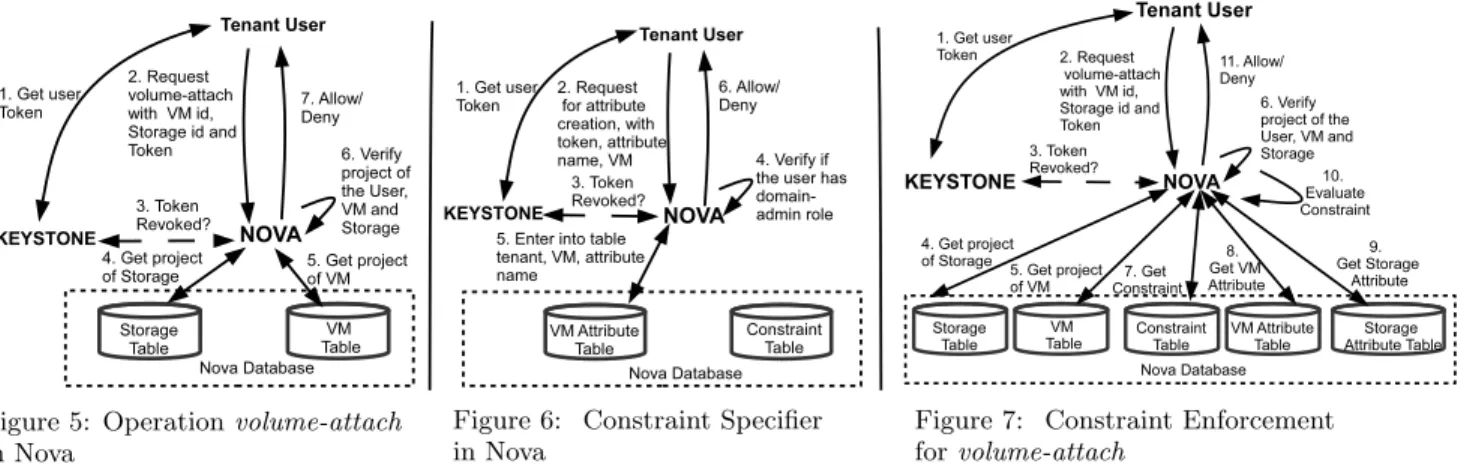
OpenStackcomprises various service components that pro-vide functionalities for managing different virtual resources. For instance, it has compute service callednovathat offers operations for the management ofVMs where the operations include create, delete, start and stop virtual machines.nova also has operations for arranging other virtual resources to VMs, e.g., connect VMs with NETs, attachSTRs to VMs, etc. InOpenStack, each resource is a member of a specific project. A user is authorized to exercise a service opera-tion to virtual resources of a project if she is a member of the project and has the role calledproject-admin. There is also a notion in OpenStackcalled domain where a domain consists multiple projects. A user who is a member of a domain and assigned to the role calleddomain-adminis re-sponsible to create/delete projects in that domain as well as add/remove users to specific projects. We can consider such users of a domain and its projects as the super and regular admin-users of a tenant respectively. There is also a fixed domain called admin whose members are theCSP’s admin-users. Members of the admin domain are responsi-ble to create other domains and also add/remove users to them. Generally, inOpenStack, if a user requests a virtual resource configuration-operation, the authorization service which is calledkeystoneprovides a token that contains user authorization information including the projects where the user is a member. The operation is allowed if the project of respective virtual-resources are same as the requesting user. Figure 5 shows execution steps of an user-operation ( volume-attach) in OpenStackthat attaches a STRto a VM. When a user in a project tries to execute the operation, the Open-Stack client program retrieves the token for the user from keystone. Then, it forwards the token along with respective VM and STR names to nova since nova manages volume-attach. nova verifies validity of the token and collects the tenant information of VM and STR from database and it approves if the given user,VMandSTRare in same tenant.
4.1.2
Constraint Specifier
Our designed constraint specifier component can be in-cluded in each service inOpenStack. The specifier extends
respective service operations by adding functionalities for the creation and management of the attributes and their scopes for respective virtual resources. In a tenant (domain), managing such functionalities are only authorized for the users having domain-admin role in the domain. Specifier also provides operations for constraint specification. Each constraint is mapped to an operation-name to which it ap-plies. Operations that specify constraints are also authorized only to users havingdomain-admin role. Attributes, their scopes and constraints are stored in database-tables of re-spective service. Entries in a database-table across tenants (domains) are isolated by specific domain ids and admin-users of a domain cannot access other domains’ information. Figure 6 shows anovaoperation of the constraint-specifier component that specifiesVMattributes. Database of nova contains tables for storing attributes and constraints. When a user tries to create an attribute, the token of the user is verified to check if the user hasdomain-admin role in order to make a decision. The component also contains similar operations that specify constraints.
4.1.3
Constraint Enforcer
Similar to constraint specifier, an enforcer component is included in every service in OpenStack. When a user exe-cutes a service operation that affects a relation between two virtual resources, enforcer verifies the respective constraint which is already specified by constraint specifier. This pro-cess retrieves attributes of the virtual resources and the con-straint expression from service database. It implements an evaluator to evaluate the constraint for making a decision. Note that, in OpenStack, these operations are authorized only for project admin-users.
Figure 7 shows extended view of figure 5 for the execution of volume-attach. Besides, comparing the project informa-tion of the VM, storage and user, the enforcer component now retrieves the attributes forVMandSTRand constraint forvolume-attach and evaluates the constraints by consid-ering theVMandSTRattributes.
4.2
Security Analysis
We present different security issues for enforcing CVRM in practice.
4.2.1
Constraint Specifications Process
• Constraints, Attribute and Scope: CVRM aims
to restrict privileges of admin-users in order to mitigate misconfiguration issues of a tenant. Therefore, con-straints specification and modification process should be restricted to the majority of admin-users and only selected admin-users of a tenant should be authorized to specify constraints, attributes of the virtual resources and their scope. InOpenStack, there are three types of admin-users: CSP-admin, domain-admin and project-admin. In our developed constraint enforcement in OpenStackwe only authorize domain-admins to man-age the constraints, attributes and their scopes where the specified constraints are applied to all three type of admin-users. A more formal isolation management scheme is given in [8] that can also be applied here.
• Attribute Value Assignments:An admin-user who
can create virtual-resources should also assign values to their attributes. In CVRM, the project-admin users
Figure 5: Operationvolume-attach
in Nova
Figure 6: Constraint Specifier in Nova
Figure 7: Constraint Enforcement forvolume-attach
can assign values to the attributes. However, one needs to make sure that the admin-users can only assign ap-propriate values. For instance, a project-admin can create VMs and assign only her project-id to those VMs (not ids of other projects). In this paper we do not focus on such access control system, however, ex-isting mechanisms such as [8] might be useful.
• Generalized Enforcement Engine with Data
Iso-lation: For scalability, one generalized enforcement
engine should be designed for the evaluations of the constraints of all the tenants. In our developed en-forcement engine inOpenStack, constraints are stored in the database separated according to the domain-id of a tenant and only respective admin-users can have access to their constraints.
4.2.2
Issues on Constraint Structure
• Contradictory Constraint: The sub-expressions of
a constraint can be of two types. One restricts the re-lation of virtual resources of two different classes when values of their attributes are mutual exclusive. An-other one forces relation when the values of the at-tributes are congruent. A constraint containing both type of sub-expressions for same combination of values of the attributes generates contradictory decisions for a relation. We call these constraints as contradictory constraints and they need to be avoided.
• Deadlock Constraints: In a constraint, a value, let’s
say, valx of an attributeattp of the virtual resources
of specific class ci can have mutual exclusion relation
with all the values of an attributeattqof the virtual
re-sources of classcj. Then, the virtual resources of class
ci with assigned value valx cannot be arranged with
any resources of cj. These constraints are deadlock
constraints and tenants need to handle them properly.
• Redundant CVRM Expressions: In CVRM, an
expression is redundant if it specified multiple times. Redundant expression unnecessarily increases the run-time complexity since it requires evaluation of the same expression more than once. One such example of a re-dundant expression is the multiple occurrences of same sub-expression in a constraint expression.
4.3
Prototype Implementation
We describe the implemented prototype of CVRM en-forcement process. We leverage the DevStack cloud frame-work [2], a quick and stand-alone installation of OpenStack, for the implementation and analysis. We choose DevStack as it provides all components of the open source cloud platform OpenStack. We installed DevStack in a physical server that has 4 cores and 3GB RAM. We implemented the CVRM components for nova. The implemented component can specify attributes and their scopes forVMs andNETs which are stored in the database. It also has a process to spec-ify and evaluate constraints for VM-NETconnection. Our python-based implementation of constraint specifier, that includes API design to enable users to declare attributes and constraints which require tables creation into DevStack database (MySQL), has 190 lines of sqlalchemy code. The constraint enforcer that includes the constraint parser has 257 lines. The parser returns true or false value based on a constraint expression by considering assigned attribute val-ues for aVMandNETwhich need to be connected.
5.
CONSTRAINT MINING IN CVRM
In this section, we consider approaches for mining CVRM constraints from already specified relations among the in-stances of two classes of virtual resources. Basically, this process generates a collection of restricted rules, also refer-eed asmin rule, where amin ruleis an implication, a→b, in which both a and b are single predicates. Note that, the ac-tualrulein the form of A→B as defined in section 3.1 allows both A and B to be collections of predicates connected by∧
and/or∨. Now for a givenRtnt,ci,cj,δ
Add
Rtnt,ci ,cj andδ
RM Rtnt,ci ,cj,
amin rulecan be generated by following grammar,
<Quantifier>:=∀(vr1,vr2)∈ R<Cls>,<Cls>. <Stmt>
<Stmt>:=<Stmt> <connector><Stmt>|(<min rule>) <min rule>:=<Token>→<Token>
<Token>:=<Attribute>(<resource>)<comperator><Scope> <Attribute>::=<letter>|<digit>|<Attribute>
<Scope>::=<letter>|<digit> <Scope> <connector>::=∧ | ∨ <comperator>::= =| 6= <Cls>::=c1|c2|. . .|cn <resoruce>::= vr1|vr2 <digit>::= 0|1|2|. . .|8|9 <letter>::= a|b|. . .|y|z|A|B|. . .|Y|Z
Each min rule is restricted to specify a comparison be-tween only two attributes of virtual resource classesci and
cj. Now let us say Rtnt,ci,cj is a given set of tuples that
ci andcj. Themin rulemining problem is to construct all
possible min rules. For given Rtnt,ci,cj, ATTR ci tnt, ATTR
cj tnt,
attp∈ATTRctnti, attq∈ATTR
cj
tnt,SCOPEattpandSCOPEattq,
min rules can be of four following formats, where each val has to belong to the appropriate attributeSCOPEatt.
• a→b where a≡(attp(vr1)=valx)∧b≡(attq(vr2)=valy). • a→b where a≡(attp(vr1)=valx)∧b≡(attq(vr2)6=valy). • a→b where a≡(attp(vr1)6=valx)∧b≡(attq(vr2)=valy). • a→b where a≡(attp(vr1)6=valx)∧b≡(attq(vr2)6=valy).
For simplicity, we provide a mining algorithm for the for-mat a→b which is also referred as mutual exclusivemin rule. Similar algorithms can be generated for other formats. We choose mutual exclusivemin ruleformat because we develop mining algorithm on top of a constraint mining algorithm for role based access control [20] where they also mine mutual exclusive roles, so it is feasible to compare mutual exclusive min ruleto mutual exclusive roles.
5.1
Overview: Mining Constraints in RBAC
Mining association rules has become a fundamental prob-lem in data mining, and it has been studied extensively. Many algorithms such as FP-growth, Apriori, and Eclat [4] have been developed to solve this problem in databases con-taining transactions. Recently, a constraint mining algo-rithm, called anti-Apriori, is proposed for role-based access control (RBAC) [20] which is developed on top of the Apri-ori algApri-orithm [4]. InRBAC,Uand R contains set of users and roles in the system. A functionuser roles maps each user to a set of roles that are assigned to the user. Now the mutual exclusive constraint forRBACis defined as follows.
A mutual exclusiveRBACconstraint between roles∈Ris an implication of the form R1→R2 where R1⊂Rand R2⊂
Rand R1∩R2=∅anduser roles(u)⊆R1→user roles(u)
∩R2 = ∅for each user u∈ U. Let D be a set of user-role assignments, the constraint R1→R2 has confidence c if c% of users inUthat are assigned a role in R1 do not have any role from R2, and it has support s if s% users are assigned a role in R1. The constraint R1→R2 holds forD if it has certain user-specified minimum support and confidence.
5.2
Mining min rule in CVRM
In this section, we discuss the mining approaches for mu-tual exclusivemin rule. We first utilize the anti-Apriori al-gorithm [20] for miningmin rules. Then, we customize the anti-Apriori algorithm, which we call CVRM-Apriori, for min rulemining in order to get better performance.
5.2.1
Reduction to
RBACconstraint mining
In this approach, we identify inputs of a mutual exclusive min rulemining algorithm and reduce them to the inputs of anti-Apriori. Then, we collect the outputs from anti-Apriori algorithm and constructmin rules.
Inputs of amin rulemining algorithm: In CVRM, each
mutual exclusivemin rule is restricted to specify a mutual exclusive relation between one value of an attribute of vir-tual resources of a particular class with another value of an attribute of virtual resources of another class. For given
Rtnt,ci,cj,VRtnt,ci,VRtnt,cj, and for eachattp∈ATTR ci tntand
for each attq ∈ ATTR
cj
tnt, the inputs for a mutual exclusive
min rulealgorithm areVRtnt,ci,VRtnt,cj,Rtnt,ci,cj,attp,attq,
SCOPEattpandSCOPEattq.
Inputs of anti-Apriori: The inputs of the anti-Apriori
algorithm are U,R, the user-role assignment matrix M (M is a u×r dimension boolean matrix where u and r is the size of UandRand for each ui ∈Uand rj ∈ R, M[ui][rj]=1 if
rj ∈user roles(ui) and 0 otherwise), matrix O where O=
M, minconf (minimum confidence) and minsup (minimum support). The inputs of the min rulemining algorithm are reduced to the anti-Apriori algorithm as follows.
1. U =VRtnt,ci×VRtnt,cj and R =SCOPEattp∪SCOPEattq.
Without loss of generality, we assume the values in SCOPEattp andSCOPEattq are disjoint.
2. M is a |U| × |R| dimensional boolean matrix where, for each u∈U and for each r ∈ R, M[u][r]=1 where (vr1,vr2)=u and attp(vr1)=r or attq(vr2)=r. Also,
O=M.
3. minconf and minsup are the values specified by the users.
Now, anti-Apriori generates constraints in following steps, 1. Scan M to find all combinations of Ri⊆R in a set F
where the support of Riis greater than minsup.
2. Scan O to find all combinations of Ri⊆R in a set F
where the support is greater than minsup.
3. For each Ri∈F and for each Rj∈F, generate mutual
exclusive rules in the format of Ri→Rjif its confidence
is greater than minconf and store Ri→RjinRules.
min rule Creation from Output of anti-Apriori
algo-rithm: Output of anti-Apriori is a set of mutual exclusive
rules from which the min rules are constructed as follows, for each Ri→Rj∈Rules, each valx∈Riand valy∈Rj
con-struct amin ruleattp(v1)=valx→attq(v2)6=valywhere valx ∈SCOPEattp and valy ∈SCOPEattq.
Although, this approach constructsmin rules, it lacks scal-ability for the following reasons.
(1) Size of the input parameter U is multiplicative with re-spective to the virtual resources of two different class since it is created by the cross product of each pair of virtual re-sources. It thereby makes the size of matrix M and O very large, increasing the run-time complexity.
(2) Algorithm anti-Apriori is designed to identify relations among all possible subset of roles, therefore, it needs mul-tiple scans to database which is very costly. However, for mining themin rules should require much simpler approach since it only needs to identify relations between every two values of two different attributes of the virtual resources.
5.2.2
Anti-Apriori for
min rulemining (CVRM-Apriori)
We customize the anti-Apriori algorithm for mining mu-tual exclusive min rules. For a given VRtnt,ci, VRtnt,cj, foreach attp ∈ ATTRctnti and for each attq ∈ ATTR
cj
tnt, a
mu-tual exclusivemin rulebetween each valx ∈SCOPEattp and
valy ∈SCOPEattq holds for an already specifiedRtnt,ci,cj if
it satisfies certain user-specified minsup and minconf. The support and confidence of amin ruleis calculated as follows,
• We define a function calledinsideRattp
tnt,ci,cj that returns
a set of elements inRtnt,ci,cj that has a value valx of
an attributeattp∈ATTRctnti. Formally,
insideRattp
tnt,ci,cj(valx)={(vr1,vr2)|(vr1,vr2)∈ Rtnt,ci,cj
∧attp(vr1)=valx}.
• Another function called outsideRattq
tnt,ci,cj returns the
set of elements inRtnt,ci,cj that does not have a value
valyof an attributeattq ∈ATTR
cj
tnt. Formally,
outsideRattq
tnt,ci,cj(valy)={(vr1,vr2)|(vr1,vr2)∈ Rtnt,ci,cj
∧attq(vr2)6=valy}.
• Now, a function called supportattp
tnt,ci,cj calculates
sup-port of a value valx of an attribute attp ∈ ATTRctnti.
Formally, supportattp tnt,ci,cj(valx) = |insideRatttntp,c i ,cj(valx)| |Rtnt,ci ,cj| ,
that calculates the ratio of the number of tuples in
Rtnt,ci,cj that contain valxof the attributeattp∈ATTR ci tnt
with all tuples inRtnt,ci,cj.
• Similarly,supportattq
tnt,ci,cj(valy) =
|outsideRatttntq,c
i ,cj(valy)|
|Rtnt,ci ,cj| ,
is another function that calculates the ratio of the num-ber of tuples inRtnt,ci,cjthat do not contain valyof the
attributeattq ∈ATTR
cj
tnt with all tuples inRtnt,ci,cj.
• Finally, a function calledconf idenceattp,attq
tnt,ci,cj calculates
the confidence which is the ratio of the number of el-ements in Rtnt,ci,cj that have a value valx of an
at-tribute attp ∈ ATTRctnti, but, simultaneously, do not
have a value valy of an attributeattq ∈ATTR
cj tnt with
the total number of elements inRtnt,ci,cj that have a
value valx of an attributeattp∈ATTRctnti. Formally,
conf idenceattp,attq
tnt,ci,cj (valx,valy) = |insideRatttntp,c i ,cj(valx)∩outsideR attq tnt,ci ,cj(valy)| |insideRatttntp,c i ,cj(valx)|
Now, for a givenRtnt,ci,cj, for each attp ∈ ATTR ci tnt and
for eachattq∈ATTR
cj
tnt, user specifiedmin sup
attp,attq
tnt,ci,cj and
min confattp,attq
tnt,ci,cj , algorithm 1 constructs the min rules. In
algorithm 1, procedure Identify Frequency identifies each attribute value valx ∈ SCOPEattp and each attribute value
valy ∈ SCOPEattq whose supports satisfy min sup
attp,attq
tnt,ci,cj
and returns them in sets F and F respectively. Now, the Genmin ruleprocedure takes the sets F and F and for each valx∈F and for each valy∈F constructs themin rules that
satisfy the value ofmin confattp,attq
tnt,ci,cj . This algorithm
over-comes the scalability issues of anti-Apriori algorithm since it only identifies relations between two values instead of two subset of values of attributes, and F and F are specified separately from the scopes of two different attributes.
5.3
Implementation and Analysis
We compare the performance of anit-Apriori and CVRM-Apriori algorithms. We implemented and evaluated both the mining algorithms, which are defined in 5.2, to construct min rules for the add operation for VM-NET connectivity relations. We define three attributes for VM and two at-tributes forNET. The value of each attribute of the virtual
Algorithm 1Apriori Algorithm formin ruleMining
1: procedureIdentify Frequency(SCOPEattp,SCOPEattq,
min supattp,attq
tnt,ci,cj )
2: F ={}, F={}
3: for allval∈SCOPEattp do
4: if supportattp
tnt,ci,cj(val)≥ min sup
attp,attq
tnt,ci,cj then
5: Insert val into F
6: end if
7: end for
8: for allval∈SCOPEattq do
9: if supportattq
tnt,ci,cj(val)≥ min sup
attp,attq
tnt,ci,cj then
10: Insert val intoF
11: end if
12: end for
13: Return F andF
14: end procedure
15: procedure Gen min rule(F,F, min confattp,attq
tnt,ci,cj )
16: for allvalx ∈ F and valy ∈ Fdo
17: if conf idenceattp,attq
tnt,ci,cj (valx, valy)≥
18: min confattp,attq
tnt,ci,cj then
19: Createmin rule(min rulei, valx, valy)
20: end if
21: end for
22: end procedure
resources is specified in their ‘meta’ information. We ran-domly connect 10NETs toVMs where eachVMis assigned to at-least 3 NETs. Then, we collect logs of VM-NET con-nection from the nova database of DevStack and evaluate both algorithms.
Our first experiment verifies scalability of the algorithms when number ofVMs increases. We gradually increaseVMs from 50 to 500 with a fixed size of scope of each attribute to 10 from which we randomly assign a value for each attribute of VMs and NETs. Then, for each VM attribute andNET attribute pair we separately execute both algorithms and record time. We repeated this process 10 times for each algorithm. Figure 8 shows the average execution time of both algorithms where time of anti-Apriori is very high while CVRM-apriori gives much better performance. For instance, for 50VMs the average time of anti-Apriori is 1.3s where it is 14.2s for 500VMs. On the other hand, in CVRM-Apriori, it is 0.23s and 1.2s. The reason is that the size of U of anti-Apriori is multiplicative with increasing number ofVMs where in CVRM-Apriori it is only additive.
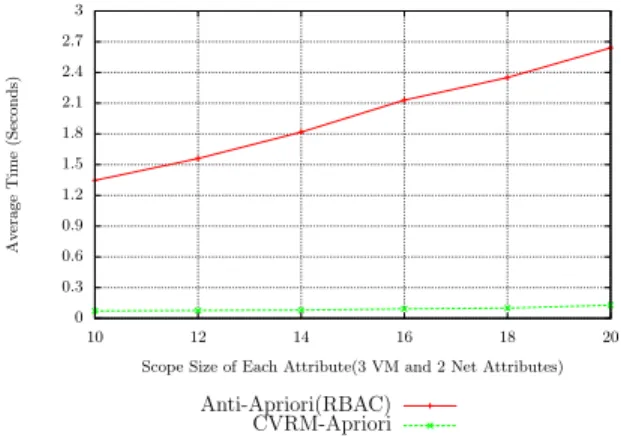
In second experiment, we fixed theVMs to 100, however, increase the scope of eachVMattribute from 10 to 20 and executed both algorithms. We also executed each of them 10 times and recorded the time. Figure 9 shows the evaluation results. Note that, like experiment one, anti-Apriori gives very poor performance with compare to CVRM-Aprior. For instance, from 10 to 20 values in scope the required time of anti-Apriori increases 1.3s where, in CVRM-Apriori, it remains almost constant. The reason behind this is that anti-Apriori calculates mutual exclusive relations for all the combination of the values of two attributes which unnec-essarily increases time sincemin ruleonly needs to capture separate relations between each two values of attributes.
In general, CVRM-Apriori behaves similar to the 2-frequent Apriori algorithm which requires exactly 2 scans over the database, hence, the required run-time complexity of
CVRM-0 2 4 6 8 10 12 14 50 100 150 200 250 300 350 400 450 500 A v era g e T im e (S ec o n d s) No. of VMS Anti-Apriori(RBAC) CVRM-Apriori
Figure 8: Mining Time with Increasing No. of VMs
Apriori is as good as FP-growth algorithm, which is an ef-ficient Apriori algorithm with FP-tree data structure. Also, the accuracy of CVRM-Apriori is exactly same of the gen-eral Apriori algorithm since it does not discard any items from database for calculating the support and confidence.
6.
RELATED WORK
Providing functionality to clients for resource-level per-mission management has started to receive more attention recently from cloud IaaS providers. However, this is pri-marily for managing user or group privileges to access their virtual resources. AWS Identity and Access Management (IAM) policies [1] now can construct fine-grained policies to control users’ access to Subnets, VPCs, Security Groups and also type of virtual machines they can create. Also, the open source cloud platform OpenStack [3] has devel-oped service called Keystone to manage users privilege to access cloud resources using some type of role-based access control. However, both platforms lack suitable mechanism so that clients can systematically specify policy to manage their virtual resources towards building a desired computing environment that addresses security, scale, hpc, etc. This increases various security threats for the running workloads from different tenants in cloud IaaS system. For instance, Shieh at al [26] shows that arbitrary sharing of network, in cloud, may cause denial of service attack and performance interferences. Wei et al [30] shows that uncontrolled snap-shots and uses of images cause security risk for both creator and user of images. Sivathanu et al [27] presents an experi-mental analysis on I/O performance bottleneck when virtual storages are placed arbitrarily in physical storage and shared by randomvms. Hence, different performance and security issues exist in cloud IaaS for unorganized multiplexing of resources and lack of controls, several of which are sum-marized in [14, 16, 17]. Hashizume et al [16] discuss and enumerates the security threats in cloud IaaS arising due to sharing physical machine, using images from public reposi-tory, sharing networks and storage, and also lack of proper resource control mechanism. Recently, for improving these scenarios, several efforts have been conducted by different groups of researchers. For instance, several improvements on shared network performance management have been pro-posed [5, 6, 26]. CloudNaas [6] provides better management of application-specific address spaces, middlebox traversal, bandwidth reservation, etc. Shieh at al [26] gives a
band-0 0.3 0.6 0.9 1.2 1.5 1.8 2.1 2.4 2.7 3 10 12 14 16 18 20 A v era g e T im e (S ec o n d s)
Scope Size of Each Attribute(3 VM and 2 Net Attributes)
Anti-Apriori(RBAC) CVRM-Apriori
Figure 9: Mining Time with Increasing Scopes
width allocation scheme that allows infrastructure providers to define bandwidth sharing in cloud network with multiple tenants. Sivathanu et al [27] identifies four different factors that affects storage I/O performance and provides guidelines and their experimental analysis to minimize I/O overhead. Developing proper virtual machine placement algorithm also recently drew attention from research community [10, 11, 13, 15, 21, 31] for improving different aspects, e.g. high perfor-mance and load balancing. Present literature also contains several processes on users authorization and access control models for cloud IaaS that includes different RBAC models for cloud IaaS [9, 12].
Our contribution, in this paper, is unique and different than above described efforts. We aim to provide flexible mechanism to capture different requirements of the tenants to manage their virtual resources. Trusted virtual data cen-ter (TVDc) [7] is closely related to our work, where they assign virtual resources and users different colors where re-sources with similar colors can be combined to build a com-puting environment. Note that, color can be represented by an attribute, hence, CVRM is a generalization of TVDc in which resources are managed by multiple attributes.
7.
CONCLUSIONS
We presented CVRM, the very first constraint specifica-tion process that enables tenants to specify several virtual resource management policies needed for production enter-prise applications to run in IaaS clouds. CVRM can be specified as part of a cloud deployment, and are installed in the every cloud service provided by the IaaS providers.
We also identified that virtual-resource management poli-cies can be discovered and constructed from log-file where it is similar to the well-known frequent-itemsets mining prob-lem in database system. We demonstrated a constraint mining algorithm for CVRM where the algorithm leverages standard Apriori algorithm from the data mining literature. However, in this paper, we consider that the log-file is static and noise-free. Also, we do not analyze whether the mined constraints preserve semantic meaning with respective to the configuration requirements of the tenant. An obvious future work would be to identify various factors inIaaSthat helps mining the rule with semantic meaning. Also, it will be interesting to determine noise in this system and develop a more dynamic mining algorithm that can eliminate such noises from the mining data.
8.
ACKNOWLEDGEMENT
This research is partially supported by NSF Grants (CNS-1111925 and CNS-1423481). The authors thank Farhan Patwa and the anonymous reviewers for their helpful sug-gestions.
9.
REFERENCES
[1] AWS identity and access management.
https://aws.amazon.com/iam/.
[2] Devstack.https://wiki.openstack.org/wiki/DevStack. [3] Openstack.http://docs.openstack.org/.
[4] R. Agrawal, T. Imieli´nski, and A. Swami. Mining association rules between sets of items in large databases. InProceedings of International Conference on Management of Data, pages 207–216. ACM, 1993. [5] H. Ballani, P. Costa, T. Karagiannis, and A. I.
Rowstron. Towards predictable datacenter networks. InProcedings of The ACM Special Interest Group on Data Communication, pages 242–253, 2011.
[6] T. Benson et al. Cloudnaas: a cloud networking platform for enterprise applications. InProceedings of the 2nd Symposium on Cloud Computing. ACM, 2011. [7] S. Berger et al. Security for the cloud infrastructure:
Trusted virtual data center implementation.IBM Journal of Research and Development, 53(4):6–1, 2009. [8] K. Bijon, R. Krishnan, and R. Sandhu. A formal
model for isolation management in cloud
infrastructure-as-a-service. InProceedings of the 8th International Conference on Network and System Security (NSS). 2014.
[9] S. Bleikertz et al. Secure cloud maintenance -protecting workloads against insider attacks. In
Proceedings of the ACM Symposium on Information, Computer and Communications Security, 2012. [10] N. Bobroff et al. Dynamic placement of virtual
machines for managing SLA violations. InProceedings of the International Symposium on Integrated Network Management. IEEE, 2007.
[11] N. M. Calcavecchia, O. Biran, E. Hadad, and Y. Moatti. Vm placement strategies for cloud scenarios. InProcedings of The International Conference on Cloud Computing. IEEE, 2012. [12] J. M. A. Calero et al. Toward a multi-tenancy
authorization system for cloud services.IEEE Security & Privacy, 8(6):48–55, 2010.
[13] L. Cherkasova et al. Comparison of the three cpu schedulers in xen.SIGMETRICS Performance Evaluation Review, 35(2):42–51, 2007.
[14] W. Dawoud, I. Takouna, and C. Meinel. Infrastructure as a service security: Challenges and solutions. In
Procedings of International Conference on Informatics and Systems, pages 1–8, 2010.
[15] A. Gupta et al. Hpc-aware vm placement in infrastructure clouds. InIEEE Intl. Conf. on Cloud Engineering, volume 13, 2013.
[16] K. Hashizume et al. An analysis of security issues for cloud computing.Journal of Internet Services and Applications, 4(1):1–13, 2013.
[17] A. Jasti, P. Shah, R. Nagaraj, and R. Pendse. Security in multi-tenancy cloud. InProceedings of the
International Carnahan Conference on Security Technology (ICCST), pages 35–41. IEEE, 2010. [18] X. Jin, R. Krishnan, and R. Sandhu. A role-based
administration model for attributes. InProceedings of the International Workshop on Secure and Resilient Architectures and Systems. ACM, 2012.
[19] E. Keller, J. Szefer, J. Rexford, and R. B. Lee. Nohype: virtualized cloud infrastructure without the virtualization. InACM SIGARCH Computer Architecture News, volume 38, pages 350–361, 2010. [20] X. Ma, R. Li, Z. Lu, and W. Wang. Mining
constraints in role-based access control.Mathematical and Computer Modelling, 55(1):87–96, 2012.
[21] K. Mills, J. Filliben, and C. Dabrowski. Comparing vm-placement algorithms for on-demand clouds. In
Procedings of The International Conference on Cloud Computing Technology and Science. IEEE, 2011. [22] T. Ristenpart et al. Hey, you, get off of my cloud:
exploring information leakage in third-party compute clouds. InProceedings of The ACM Conference on Computer and Communications Security, 2009. [23] J. Rivera. Gartner identifies the top 10 strategic
technology trends for 2014.http://www.gartner.com/ newsroom/id/2603623, 2013.
[24] R. Sandhu, E. Coyne, H. Feinstein, and C. Youman. Role-based access control models.IEEE Computer, 29(2):38–47, 1996.
[25] R. Sandhu, D. Ferraiolo, and R. Kuhn. The NIST model for role-based access control: towards a unified standard. InACM workshop on Role-based access control, volume 2000, 2000.
[26] A. Shieh et al. Sharing the data center network. In
Proceedings of the 8th USENIX conference on Networked systems design and implementation, 2011. [27] S. Sivathanu, L. Liu, M. Yiduo, and X. Pu. Storage
management in virtualized cloud environment. In
Procedings of The International Conference on Cloud Computing, pages 204–211. IEEE, 2010.
[28] J. Szefer et al. Eliminating the hypervisor attack surface for a more secure cloud. InProceedings of The ACM Conference on Computer and Communications Security, pages 401–412. ACM, 2011.
[29] V. Varadarajan et al. Resource-freeing attacks: improve your cloud performance (at your neighbor’s expense). InProceedings of The ACM Conference on Computer and Communications Security, pages 281–292, 2012.
[30] J. Wei et al. Managing security of virtual machine images in a cloud environment. InProcedings of the ACM workshop on Cloud computing security, 2009. [31] C.-T. Yang et al. A dynamic resource allocation model
for virtual machine management on cloud. InGrid and Distributed Computing. Springer, 2011.
[32] F. Zhang et al. Cloudvisor: Retrofitting protection of virtual machines in multi-tenant cloud with nested virtualization. InProceedings of the ACM Symposium on Operating Systems Principles, pages 203–216, 2011. [33] Y. Zhang et al. Cross-vm side channels and their use
to extract private keys. Inproceedings of the 19th ACM Conference on Computer and Communications Security, 2012.
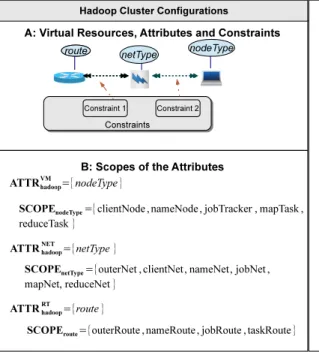
Figure 10: Constraints Specification for Hadoop Cluster
Appendix: CVRM for Hadoop Cluster Setup
We discuss the CVRM instantiation for a simple hadoop cluster setup. The setTENANTScontains the tenanthadoop. The classes of the virtual resources supported by CSP are VM,NET, andRTand specified relations are between VM-to-NET and NET-to-RT. The relations are represented as
Rhadoop,VM,NET andRhadoop,NET,RT.
In this simple hadoop setup, we only define one attribute for each virtual resources (shown in figure 10-A). Here, a VM attribute nodeT ype represent the type of operations a vm performs in hadoop cluster and figure 10-B shows the scope ofnodeT ypethat is clientNode, nameNode,
job-Tracker, mapTask, reduceTask. Similarly, two attributes
netT ypeandrouteare defined forNETandRTrespectively. Note that, other attributes can also defined for more com-plex hadoop configuration management.
Followed by attribute specification of the resources, we show two constraints for adding elements in each of the re-lations (shown in figure 10-C). Here, for instance, constraint
δAdd
hadoop,NET,RTapplies to theAddoperation where it restricts
all theNETs except outerNet and clientNet to connect aRT which has value outerRoute in routeattribute. This con-straint only allows clientNet to connect to outer internet.