Towards The User Experience - Integration Of The Measurable And Non–Measurable Conditions Of Indoor Environment
Suvi Nenonen 1, Hannu Koskela2, Risto Kosonen3
Built Environment Services – research group, School of Engineering, Aalto University P.O. Box 13300
FIN-00076 Aalto Finland 1 [email protected]
Finnish Institute of Occupational Health Lemminkäisenkatu 14-18 B, FIN-20520 Turku, Finland
3[email protected] Halton Oy, Myynti
Esterinportti 2, FIN-00240 Helsinki, Finland Abstract
The indoor environment quality is not only about managing the technical conditions such as indoor air, thermal conditions, acoustic environment, lighting and functional space arrangements. The quality includes also the elements of subjective individual experience and response to individual needs, a response to social collaboration and communication among the community as well as a response to cultural habits and values.
The daily practice has proven that the target values of indoor environment can be achieved but it does not necessarily lead to satisfaction in user experiences. The individual user experience is a more complex system. So far, there is a lack of ability to combine subjective, often qualitatively described user experience with objectively defined needs and requirements, when developing the user-centric indoor environment solutions.
The aim of this paper is to identify the different ways to measure user experiences of indoor environment and to provide the holistic overview of different methods with their focuses and strengths. The question asked is how to understand and integrate the different methods to measure user experience of indoor environment?
The results provide a map, which can be used as a tool for capturing the holistic and integrative approach to user-experience. That can be used for more focused experience centric design principles and design processes of indoor environment solutions.
Keywords – indoor environment; methods; measurements, user experience
The indoor environment is where people spend 90 % of their time [1]. Indoor environment is viewed as having eight main elements: the physical building incl. architecture, indoor air quality, thermal conditions, acoustics, lighting, maintenance, and hygiene of indoor air and potable water.
The tangible measured indoor environment with tangible products and solutions are the basis of indoor environment quality system. The conditionsa are designed either to steady-state conditions or to dynamic conditions. It has been found out thet users appreciate the possibilities to control and it is increasing the user-satisfaction. However the indoor environment quality is not only about managing the technical conditions. The quality includes also the elements of subjective individual experience and response to individual needs, a response to social collaboration and communication among the community as well as a response to cultural habits and values. Research on human thermal comfort, lighting criteria, acoustic environment and air quality is active but not integrated. [2]
So far, there is a lack of ability to combine subjective, often qualitatively described user experience integrated with objectively defined needs and requirements, when developing the user-centric indoor air solutions. However, the need to create a holistic view of different methods from technical solutions, comfort, and perceptions to the user experiences in order redefines the indoor environment quality.
The user experience is based on individual perceptions of indoor air quality. The comfort factor is an important determinant, but the experience cannot be objectively measured. However there are varieties of ways to capture the knowledge of user-experience and create descriptions of the non-measurable, intangible conditions. The need to widen and complement the indoor air quality definitions with experience-based descriptions can support the more focused user centric design principles and design processes for indoor environment solutions as well as produce high quality outcomes.
The aim of this paper is to identify the different ways to measure user experiences of indoor environment and to provide the holistic overview of different methods with their focuses and strengths. The question asked is how to understand and integrate the different methods to measure user experience of indoor environment?
The methods used for finding answers for the question are literature review with the intention to identify the variety of research approaches connected to the indoor environment. Based on the analysis the holistic mapping of approaches is presented.
2. Different approaches to indoor environment
2.1. Measureable conditions of indoor environment – methods used
One can identify at least two perspectives for measureable conditions of indoor environment. One of them is connected to the products, solutions and systems controlling the indoor environment. The products for ventilation, heating and cooling, lightning, acoustics and maintenance have their own disciplines behind the research and development towards more functional products and solutions. Indoor Environment Laboratories are equipped with test facilities for doing research within ventilation and air conditioning as well as acoustics and even interior design. The labs can be full scale or small scale test rooms and also equipped with a 3D simulation tools that can be used for studies of ventilation problems and indoor conditions [3,4]. The labs can be thermal chambres with completely controlled conditions or field environment chambers, which provide an environment more closely resembling ambient conditions than the environment found in thermal chambers.
Real estate and construction sector has focused mostly to improving the product. There are several international standards and guidelines that give recommendations for achieving good indoor environment. Those standards specify measurable physical units for different IEQ elements e.g. the draught rating (DR) value – i.e., the percentage of people dissatisfied because of local air movement [5] as well as the requested outdoor air flow rates for the selected indoor classes [6].
As an example The International Council for Research and Innovation in Building and Construction (CIB) published "Performance criteria of buildings for health and comfort" in 2004 [7]. It is intended to be used in the design and construction of healthier and more comfortable buildings and their mechanical systems. It also provides guidance for manufacturers of air-handling equipment and building materials who
wish to produce better building products. It presents target and design values for indoor climate support the work of building owners, designers, equipment manufacturers, contractors and maintenance personnel. They can be referred to when writing specifications of construction and mechanical systems.
The focus on the building states e.g. “A building must accommodate the activities it is built for and provide floorspace, room volume, shelter, light and amenities for working, living, learning, curing, processing etc. Furthermore, the building must supply a healthy and comfortable indoor climate to the people using it. In meeting these basic requirements, the building should not cause harm to its occupants or the environment and must, for example, be structurally stable and fire safe. Sustainable development requires that the building does not cause unnecessary load or risk to the environment, for example in the form of energy use.” [7] Additionally The REHVA Guidebooks are tools that disseminate the latest knowledge and technologies to improve health, comfort and energy efficiency in all buildings and communities. The guidebooks are made to encourage the development and application of both energy conservation and renewable energy sources. [8]
A large effort has been made during the last 40 years in order to better understand and predict the perception of human beings of their environment. More recently, a huge effort has been made in order to demonstrate the influence of the indoor environment on performance and on behavior of occupants. [2]
The focus is on the understanding of the physiological and psychological basis of perceived indoor environmental quality (IEQ) and development of methods to understand and recognize user-organizations requirements on IEQ. The effectiveness target is to create genuine extra-value for owners and users with excellent indoor environment by developing new indoor environment solutions. [2].
The value of good indoor climate is in decreased number of illnesses and sick building syndrome symptoms and in improvements of comfort and productivity. Recognition needs to be given to the fact that a building adds value to the organizations core business; Williams believes that this is by far the most significant component of the financial aspect of building performance. [9] The difficulty, which remains, is that of producing sufficient credible evidence for the client. What needs to be
recognized in the building design process is that there are three key attributes, which interact. The type of building, the facilities provided for environment and utilities, and the use of the building are three inter-related facets. In practice these issues are often considered separately but their interaction is ignored. In other words form, function and human needs are the foundation for deriving architecture, which not only contributes to the well-being of the individuals occupying the building but also makes a significant impact on the business organization.
The other aspect is connected with the comfort and human health. It is commonly stated that indoor environment affects one’s health, satisfaction and productivity. E.g. Clements-Croome and Li have carried out environmental surveys in several office buildings which have shown that crowded work spaces, job dissatisfaction and the physical environment are the main factors affecting productivity [10]. The data was produced and analyzed using an occupational stress indicator in conjunction with the analytical hierarchical process [11]. Williams work has shown that job satisfaction contributes up to 16% of output for administrative and professional staff. Further work has sought to see how premises affected job satisfaction. [9]
Ilgen classified the methods of performance measurement into three categories: (1) Physiological (2) Objective and (3) Subjective [12]. The rational for using physiological methods is based on the reasoning that physiological measures of activation or arousal are associated with increased activity in the nervous system which is equated with an increase in stress on the operator. However, physiological measures of work load have received wide criticism regarding their validity, as well as the sensitivity of measures to contamination and the intrusive nature of the measures themselves. Objective measures [13] are frequently measures of workload comprises subjective measures [14]. Subjective measures of workload are applied to gain access to the subjects' perceptions of the level of load they are facing in task performance. Rating scales, questionnaires, and interviews are used to collect opinion about the workload. While these methods may not have the empirical or quantitative appeal of physiological or objective measures, it is often argued that subjective measures are more appropriate and realistic since individuals are likely to work in accordance with their feeling regardless of what physiological or behavioural performance measures suggest.
2.3. Non-measureable conditions of indoor environment – methods used
The recently raised issues of user centricity have led to the need to understand the experiences of user. Even though numerical physical measures define accurately different factors of the indoor environment, only the perceived quality determines the total performance of the building from user’s point of view. The daily practice has proven that the target values of indoor environment can be achieved but it does not necessarily lead to satisfaction in user experiences. The individual user experience is a more complex system.
Historically, building occupants and user-organizations have been underutilized as a source of information on building performance. Knowledge of occupants’ overall perception on the IEQ and user-organizations requirements for indoor environment should understood better to make possible to develop novel solutions that really create value for users and facility owners through excellent built environment. A holistic approach for IEQ management process is required to improve the perception of indoor climate conditions However the approach to user experience demands not only the interest to the solutions, but the interest to the effects of the solutions on business processes. The research outcome is not only the feedback to the product development industry but to feed forward to the development of processes and strategies within the user organization. [15]
In the 1990s, design solutions in healthcare, based on published research, were defined as “evidence-based design” (EBD). Evidence-based design has become the theoretical concept for what are called healing environments. Based on the definitions of several academic researchers [16,17], a healing environment can be defined as a place where the interaction between patient and staff produces positive health outcomes within the physical environment. The movement towards EBD in healthcare started with Ulrich [18], who compared the positive effect of views of natural scenery on the recovery of patients from surgery to patients in similar conditions who were exposed to a view of a brick wall. Ulrich showed that in comparison with the wall-view group, the patients with the tree view had shorter postoperative hospital stays, had
fewer negative evaluative comments from nurses, took fewer moderately strong and strong medication, and had slightly lower scores for minor postsurgical complications. Since then, the impact of the physical environment of the hospital on the well-being and health of the patient has received extensive academic attention. An increasing body of knowledge on evidence-based healthcare design has become available, and the amount of information has grown rapidly in recent years.
Interesting study from sociology is conducted by Hauge [19] investigates phenomenon that may be measurable in terms of wind force, temperature, humidity, air change per hour in a room. This research is an attempt to come closer to an understanding of the non-measurable aspects of air: By looking at what people do with the fresh air from outside, how they think about fresh air, the study investigates the sociality of air. Relevant insights on human behaviour regarding air and air activities and management may be gained from qualitative research, providing both manufacturers and researchers in the field with highly detailed, descriptive information.
International Council for Building Research and Documentation (CIB) working group on usability of workplace (W111) has been exploring concepts, methods and tools, developed in the evaluation of all kinds of consumer products, applied to the built environment [20,21,22]. They sought to identify and evaluate the ways in which users (and other stakeholders) in projects were involved in decision-making about building use and the methods and tools they used to understand, as well as to design and manage, the relationship between activities and space.
A starting point was the definition of usability in ISO 9241–11 as “the extent to which a product can be used by specified users to achieve specified goals with effectiveness, efficiency and satisfaction in a specified context of use” (ISO, 1998). Usability in the built environment is context dependent, a product of user experience related to the social relations amongst users and to the interaction between users and facilities [23]. Usability has been found to be strongly related not only to relationships between people and physical settings, but also to clear strategies for the organization of work and the use of facilities. In summary, the group sees usability as “a cultural phenomenon that can only be improved through a better understanding user experience, considered as situated action in a specific context” [23].
When capturing the user experience, it has been found out, that there is no single method to investigate the issue. The multi method approach has been conducted in many of the international case studies. The background of the methods is more in behavioral and organizational disciplines. The latest research investigating the user experience has developed its framework and methods including the methods of service design [24].
User experience is a holistic and all-encompassing concept that includes the user, the product and the context of use [25]. It is a multidisciplinary phenomena including design, business, philosophy, anthropology, cognitive science, and social science.Co-experience relates to user experience in social context. Co-experience takes places as experiences are created together, or shared with others. ([26]
Based on the qualitative interviews the experience of place consists on six dimensions.
1. Dimension of narrative of the place, which means the constancy and coherency of the story of the place. Features such as identity, brand, and purpose of the place relate to this dimension. 2. Dimension of the atmosphere of the space includes the elements that are affecting the holistic sense-experience of the place: smell, taste, sight, feel, and hearing. Also different cognitive symbols (such as signs) relates to this dimension.
3. Dimension of familiarity of the refers to easiness of the use of the place and e.g. effortless adoption to the use of the place. 4. Dimension of the functionality of the space indicates how the
place supports the performance that is done there.
5. Dimension of the frequency of the place is connected to the sense of time in the place including e.g. the sense of history or the sense of short or long period of use of the place.
6. Dimension of the meaning of the space expresses the
significance of the place to its users. It relates to tangible and intangible values as part of the place experience.
Experience is the constant stream of self-talk that takes place when we are conscious. An experience is something that could be articulated or named. This type of experience can be characterized by a number of
interactions and emotions, but is schematized with a particular character in one’s memory and a sense of completion. An experience has a beginning and an end, and it often inspires emotional and behavioural changes The user experience is approached through the emotions and meanings the users associate with them. Emotion is at the heart of any human experience and an essential component of user experience [26].
2.3. Summary of the different methods in indoor environment research
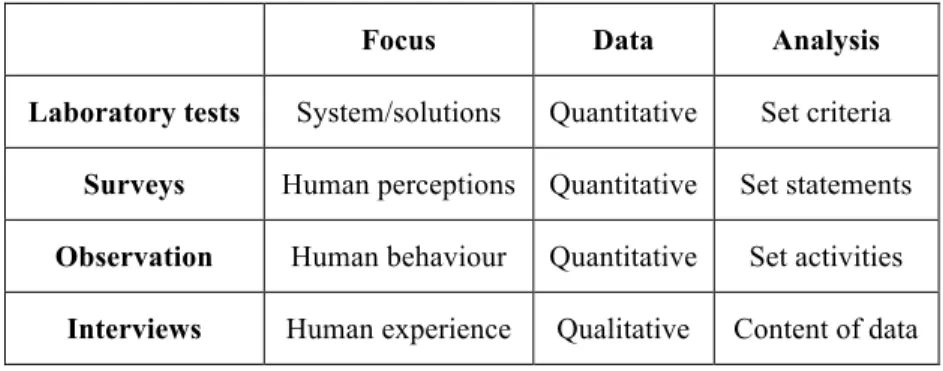
To summarise the methods used for investigating the measureable and non-measureable conditions of indoor environemt the following elements are presented in Table 1:
Table 1 The summary of methods
Focus Data Analysis
Laboratory tests System/solutions Quantitative Set criteria
Surveys Human perceptions Quantitative Set statements
Observation Human behaviour Quantitative Set activities
Interviews Human experience Qualitative Content of data
Table 1 indicates that the intention to investigate the indoor-environment differs from the orientation to solutions to orientation to human experience. Additionally one can identify the axis from laboratory studies to field studies. The data is either quantitative or qualitative. The following chapter includes the framework, which is combining these persepctives.
3. Framework for mapping the methods and elements of place experience
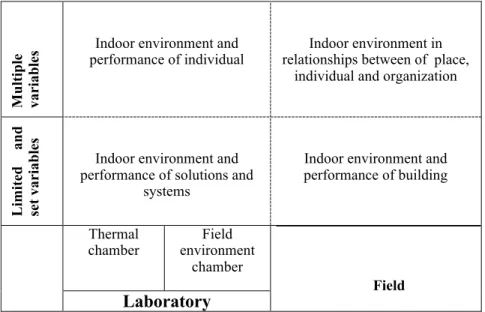
Based on the overview of measureable and non-measureable conditions the map of indoor-environment performance has been made. The intention is to provide a map for capturing the holistic and integrative approach to user-experience of indoor environment. The map is presented in the Table 2.
Table 2 Indoor environment performance map
Mu lti p le var iab le
s performance of individual Indoor environment and relationships between of place, Indoor environment in
individual and organization
Li m it ed an d se t va ri ab le s
Indoor environment and performance of solutions and
systems
Indoor environment and performance of building
Thermal
chamber environment Field chamber
Field Laboratory
The indoor environment performance map positions the for major performances:
1. Solution / System performance: the functionality of the systems 2. Building performance: the functionality of the building
3. Individual performance: the effects of indoor environment
4. Individual and organizational performance: the interaction between people, processes and places.
The indoor environment performance map indicates what is the starting point for approaching the phenomena. It can be either technical
or behavioral. If it is technical it is scalable from solution to building. If it is behavioral it is scalable from individual activities to organizational activities.
The goal of the map is to indicate the values of each performances as well as it helps to identify, how the methods and their use should be seen in the holistic context.
4. Conclusions
The importance of indoorenvironment can be apporoached from the technical and behavioural persepctives. The map is also veryfying that there is no need to differ the measureable and non-measureable conditions. Human behaviour can be measured too. The negation is not not needed when developing the indoor environment to the user-centric direction.
The performance map need to be validated but in this phase the intention is to contribute to the discussion about user-centric approach to the indoorenvironment.
5. References
[1] Anonymous 2002 Economic Census. Census Bureau, U.S. Department of Commerce. www.census.gov/econ/census02/advance/TABLE2.HTM
[2] Vischer, J.C. The effects of the physical environment on job performance: towards a theoretical model of workspace stress." Stress and Health 23 (2007) : 175–184.
[3] Haapakangas A, Hongisto V, Kokko J, Oliva D, Keränen J, Hakala J, Hyönä J, Room acoustics and work performance - experimental study in a full-scale open-plan office laboratory, 10th International Congress on Noise as a Public Health Problem (ICBEN) 2011, London, UK.
[4] Koskela H, Häggblom H, Kosonen R, Ruponen M, Flow Pattern and Thermal Comfort in Office Environment with Active Chilled Beams, HVAC&R research 18(4) (2012) 723-736.
[5] ISO 7730:2005.Ergonomics of the thermal environment - Analytical determination and interpretation of thermal comfort using calculation of the PMV and PPD indices and local thermal comfort criteria, Geneva, Switzerland.
[6] EN 15251 2007, Indoor Environmental Input Parameters for Design and Assessment of Energy Performance of Buildings Addressing Indoor Air Quality, Thermal Environment, Lighting and Acoustics, European Committee for Standardization, B-1050 Brussels.
[7] Säteri, J. ed. Performance criteria of buildings for health and comfort. ISIAQ-CIB task group tg 42. 2004. www.isiaq.org/publications/TG42-report.pdf .
[8] REHVA guidebooks on http://www.rehva.eu/en/guidebooks.
[9] Williams, B., 2002, An Introduction to Benchmarking Facilities, (Building Economics Bureau Limited ISBN 0904237257).
[10] Clements-Croome, D.J. and Li, B., 2000, International Conference on Healthy Buildings 2000, August 6-10, Helsinki.
[12] Ilgen, D.R., Schneider, J., 1991, International Review of Industrial and Organizational Psychology, Vol.6, Chapter 3, 71-108, Edited by Cooper and Robertson, John Wiley & Sons Ltd..
[13] O'Donell, R.D., Eggemeier, F.T., 1986 Handbook of Perception and Human Performance: Cognitive Processes and Human Performance, edited by Boff, K.R., et al. New York: Wiley.
[13] Cyfracki, L., 1990, Indoor Air'90, 5th International Conference Indoor Air Quality and Climate, 5, 135-1141 (Aurora, ON: Inglewood Printing Plus).
[15] Huovala, R. and Alexander, K. Demonstrating the Added Business Value Appraisal of Tools and Methods The 16th CIB World Building Congress 2004.
[16] Jonas WB, Chez RA. Toward optimal healing environments in health care.J Altern Complement Med 2004;10
[17] Devlin AS, Arneill AB. Health care environments and patient outcomes. a review of literature. Environ Behav 2003;35(5)
[18] Ulrich RS. View through a window may influence recovery from surgery. Science 1984;224(4647) [19] Hauge, B. Analysis of the significance of fresh air from the outside and into the home – a qualitative, comparative study in the following countries: Denmark, France, England and Scotland.
[20] Alexander, 2005 Alexander, K. (2006). Usability of Workplaces: report on case studies CIB Report 906, Rotterdam: CIB.
[21] Alexander, 2008, Alexander, K, (2008), Usability: philosophy and concepts. in Usability of Workplaces - Phase 2. Report 316. Rotterdam: CIB.
[22] Alexander, 2010 Alexander, K, (2010). The usability of learning environments, in Usability of Workplaces—Phase 3. Report 330. Rotterdam: CIB.
[23] Fenker, M. (2008). Towards a theoretical framework for usability of buildings. In Usability of Workplaces: Phase 2 CIB Research Report 316. Rotterdam: CIB.
[24] Kojo, I. & Nenonen, S. 2012. Workplaces for social ecosystems: User ecperiences in coworking places, Proceedings of EFMC2012, 23rd - 25th of May, 2012 Copenhagen, Denmark.
[25] Battarbee, K. (2008), Co-experience: Understanding User Experiences in Social Interaction, PhD thesis, University of Art and Design Helsinki, Helsinki.
[26] Forlizzi, J. & Battarbee, K. (2004), “Understanding Experience in Interactive Systems”, paper published proceeding Designing Interactive Systems DIS2004, 1st-4th August, Cambridge, Massachusetts, ACM Press, New York, pp. 261-268.