A Key-recovery Attack on 855-round Trivium
Ximing Fu1, and Xiaoyun Wang2,3,4?, and Xiaoyang Dong2, and Willi Meier5 1
Department of Computer Science and Technology, Tsinghua University, Beijing 100084, China
2
Institute for Advanced Study, Tsinghua University, Beijing 100084, China
3 School of Mathematics, Shandong University, Jinan 250100, China 4
Key Laboratory of Cryptologic Technology and Information Security, Ministry of Education, Shandong University, Jinan 250100, China,
5
FHNW, Windisch, Switzerland
Abstract. In this paper, we propose a key-recovery attack on Trivium
reduced to 855 rounds. As the output is a complex Boolean polynomial over secret key and IV bits and it is hard to find the solution of the secret keys, we propose a novel nullification technique of the Boolean polynomial to reduce the output Boolean polynomial of 855-round Trivium. Then we determine the degree upper bound of the reduced nonlinear boolean polynomial and detect the right keys. These techniques can be applicable to most stream ciphers based on nonlinear feedback shift registers (NFSR). Our attack on 855-round Trivium costs time complexity 277. As far as we know, this is the best key-recovery attack on round-reduced Trivium. To verify our attack, we also give some experimental data on 721-round reduced Trivium.
Keywords: Trivium, Nullification Technique, Polynomial Reduction, IV Representation, Key-recovery Attack
1
Introduction
Most symmetric cryptographic primitives can be described by boolean functions over secret variables and public variables. The secret variables are often key bits, the public variables are often plaintext bits for block ciphers and IV bits for stream ciphers. The ANF (algebraic normal form) representation of the output is usually very complex by repeatedly executing a simple iterative function, where the iterative function is a round function for block ciphers or a feedback function for stream ciphers based on nonlinear feedback shift registers. For stream ciphers, obtaining the exact output boolean functions is usually impossible. But if its degree is low, the cipher can not resist on many known attacks, such as higher order differential attacks [15,13], cube attacks [1,4], and integral attacks [14]. Hence, it is important to reduce the degree of polynomials for cryptanalysis of stream ciphers.
?
Trivium, based on a nonlinear feedback shift register (NFSR), is one of the finalists by eSTREAM project and has been accepted as ISO standard [2,10]. Trivium has a simple structure, with only bit operations, so that it can be applicable to source restricted applications such as RFID. By iteratively using NFSR, the degree increases rapidly and the output is a complex boolean function over key and IV bits.
There have been lots of cryptanalysis of Trivium since its submission. The early results include the chosen IV statistical attack [6,7], which was applied to key-recovery attack on Trivium reduced to 672 rounds. Inspired by the message modification technique [21,20], Knellwolf et al. invented the conditional differential tool [11], which was applicable to distinguishing stream ciphers based on NFSR. In [12], Knellwolf et al. proposed a distinguishing attack on 961-round Trivium with practical complexity for weak keys.
Cube attacks are the major methods for recent cryptanalysis results of reduced round Trivium. In [4], Dinur and Shamir proposed a practical full key recovery on Trivium reduced to 767 rounds, using cube attacks. Afterwards, Aumasson et al. [1] provided the distinguishers of 790-round Trivium with complexity 230. Then Fouque and Vannet [8] provided a practical full key
recovery for 784/799 rounds Trivium. Todo et al. [19] proposed a key-recovery attack on 832-round Trivium, where one equivalent bit can be recovered with complexity of around 277, combined with division property [18]. All of these
attacks exploited low degree properties of the ANF of the output bit over IV bits. As though the degree is not low, i.e., the degree is equal to the number of variables, there is a possibility to construct distinguishers if there are missing (IV) terms. In [5,3], Dinur and Shamir exploited the density of IV terms, combined with nullification technique, and broke the full-round Grain128. Based on nullification technique [5,3], degree evaluation and IV representation techniques were proposed and the missing IV terms can be obtained with probability 1 [9]. The degree upper bounds of Trivium-like ciphers were obtained [16] using the degree evaluation techniques. Then a key-recovery attack on 835-round Trivium was proposed in [17] using correlation cube attack with a complexity of 275. Though the cube attack and cube tester tools
can be applied to obtain the low-degree information, it is restricted by the computing ability. It is hard to execute cube tester programs of dimension more than 50 on a small cluster of cores.
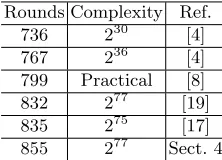
In this paper, we focus on the cryptanalysis on round-reduced Trivium. We first propose a novel observation of the Boolean polynomial and invent a new nullification technique for reducing the output Boolean polynomial. After nullification, we determine the degree upper bound of the reduced polynomial, which can serve as the distinguishers. In this process, large quantities of state terms arise to be processed. We present a series of techniques to help discard monomials, including degree evaluation and degree reduction techniques. Based on these reduction techniques for boolean polynomials, we propose the first key-recovery attack on 855-round Trivium with time complexity 277. We summarize
Table 1.Some related key-recovery results for reduced round Trivium.
Rounds Complexity Ref. 736 230 [4] 767 236 [4] 799 Practical [8] 832 277 [19] 835 275 [17] 855 277 Sect. 4
The rest of the paper is organised as follows. In Section 2, some basic related preliminaries will be shown. The basic techniques used in this paper and the attack framework will be introduced in Section 3. Based on the Boolean polynomial reduction techniques and IV representation, a key recovery attack on 855-round Trivium is proposed in Section 4, combined with a new nullification technique. Finally, Section 5 summarizes the paper.
2
Preliminaries
In this section, some basic notations used in this paper are introduced in the following subsections.
2.1 Notations
ANF the Algebraic Normal Form
IV bit public variables of Trivium
IV term product of certain IV bits
state bit internal state bit in the initialization of Trivium stream cipher
state term product of certain state bits, IV bits or key bits
2.2 Brief Description of Trivium
Trivium can be described by a 288-bit nonlinear feedback shift registersi (1≤
i≤288). During the initialization stage,s1 to s80 are set to 80 key bits,s94 to
s173are set with 80 IV bits,s286,s287,s288are set to 1s and the other state bits
are set to zeros, i.e.,
(s1, s2, . . . , s93)←(K0, . . . , K79,0, . . . ,0)
(s94, s95, . . . , s177)←(IV0, . . . , IV79,0, . . . ,0)
(s178, s179, . . . , s288)←(0, . . . ,0,1,1,1).
Then the NFSR is updated for 1152 rounds with the following updating function, i.e.,
fori←1 : 4·288do
t1←s66+s91·s92+s93+s171
t2←s162+s175·s176+s177+s264
(s1, s2, . . . , s93)←(t3, s1, . . . , s92)
(s94, s95, . . . , s177)←(t1, s94, . . . , s176)
(s178, s179, . . . , s288)←(t2, s178, . . . , s287) end for
After the initialization, the output bitsoi can be generated by the following
functions.
fori←1 :N do
t1←s66+s91·s92+s93+s171
t2←s162+s175·s176+s177+s264
t3←s243+s286·s287+s288+s69
oi←s66+s93+s162+s177+s243+s288
(s1, s2, . . . , s93)←(t3, s1, . . . , s92)
(s94, s95, . . . , s177)←(t1, s94, . . . , s176)
(s178, s179, . . . , s288)←(t2, s178, . . . , s287) end for
Then the message can be encrypted by exclusive-or with oi. To outline our
technique more conveniently, we describe Trivium using the following iterative expression. We usesr
w(0≤w≤2) shown in Equ. 1 to illustrater-round (1≤r≤
1152)s1,s94 ands178separately. Letzr denote the output bit afterrrounds of
initialization. Then the initialization process can be illustrated by the following formula
sr0=sr2−66+sr2−109s2r−110+sr2−111+sr0−69, sr
1=s
r−66
0 +s
r−91
0 s
r−92
0 +s
r−93
0 +s
r−78
1 ,
sr2=sr1−69+sr1−82s1r−83+sr1−84+sr2−87.
(1)
The sr
w (0 ≤ w ≤ 2) is denoted as internal state bit in this paper. The
multiplication of state bits Y
i∈I,j∈J
sji is denoted as a state term. The output
can be described using the state terms aszr=sr0−65+s
r−92
0 +s
r−68
1 +s
r−83
1 +
sr2−65+sr2−110.
2.3 Representation of Boolean Functions for Stream Ciphers
Supposing that there are m IV bits, i.e., v0, v1, . . . , vm−1 and n key bits, i.e.,
k0, k1, . . . , kn−1, the Algebraic Normal Form (ANF) of the internal state bit or
output bitscould be written as the following style:
s=X
I,J
Y
i∈I
vi
Y
j∈J
kj, (2)
where the sum operation is over field F2. TheQi∈IviQj∈Jkj is also denoted
as a state term of s and Q
i∈Ivi is denoted as its corresponding IV term. Let
IV termtI =Qi∈Ivi be the multiplication ofviwhose indices are withinI, the
ANF ofscan be rewritten as
s=X
I
wheregI(k) is the sum of the corresponding coefficient function of terms whose
corresponding IV term is tI. The |I| is denoted as the degree of IV term tI,
deg(tI). The degree ofsis deg(s) =maxI{deg (tI)}.
2.4 Cube Attack and Cube Tester
Cube attack [4] is introduced by Dinur and Shamir at EUROCRYPT 2009. This method is also known as high-order differential attack introduced by Lai [15] in 1994. It assumes the output bit of a cipher is a d-degree polynomial
f(k0..., kn−1, v0..., vm−1) over GF(2). The polynomial can be written as a sum
of two polynomials:
f(k0..., kn−1, v0..., vm−1) =tI·P+QtI(k0..., kn−1, v0..., vm−1)
tI is called maxterm and is a product of certain public variables, for example
(v0, ..., vs−1),1 ≤ s ≤ m, which is called a cube CtI; P is called superpoly;
QtI(k0..., kn−1, v0..., vm−1) is the remainder polynomial and none of its terms is divisible bytI. The major idea of the cube attack is that the sum of f over all
values of the cubeCtI (cube sum) is:
X
x0=(v
0,...,vs−1)∈CtI
f(k0, ..., kn−1, x0, ...vm−1) =P
whose degree is at most d-s, where the cubeCtI contains all binary vectors of length s and the other public variables are fixed to constants. In cube attack,P
is a linear function over key bits. The key is recovered by solving a system of linear equations derived by different cubesCtI.
Dynamic cube attack[5] is also introduced by Dinur and Shamir in FSE 2011. The basic idea is to find dynamic variables, which depend on some of the public cube variables and some private variables (the key bits), to nullify the complex function P = P1·P2+P3, where the degree of P3 is relatively lower
than the degree of P andP1·P2is a complex function. Then guess the involved
key bits and compute the dynamic cube variables to makeP1to be zero and the
function is simplified greatly. The right guess of key bits will lead the cube sum to be zero otherwise the cube sums will be random generally.
Cube testers [1] are used to detect non-random properties. Suppose in Equ. 3, an IV termtIdoes not exist in the ANF ofs, e.g. the coefficientgI(k) = 0.
Hence, the cube sum over cube CtI is definitely zero for different key guessing. However, if the IV term tI exists, the value of cube sum gI(k) is dependent on
the key guessing. This property was applied to break full-round Grain128 [5,9].
3
Basic Ideas
3.1 New Observation of Boolean Polynomial Reduction
Lemma 1. Supposez is the output polynomial of a cipher, and
z=P1P2+P3. (4)
Then the polynomial can be reduced to a simpler one (1 +P1)z= (1 +P1)P3 by
multiplying 1 +P1 in both sides of Equ. (4) ifdeg(P1P2)>deg((1 +P1)P3).
Lemma 1 can be verified by (P1+ 1)z = (P1+ 1)P1P2 + (P1+ 1)P3 =
(P1+1)P3. In our cryptanalysis of Trivium,P1is a simple polynomial over several
IV bits and key bits, whileP2is much more complex thanP3. In our nullification
technique, we multiplyP1+1 in both sides of Equ. (4) to nullify the most complex
polynomialP2without changingP3. The result (1 +P1)z= (1 +P1)P3could be
analyzed by consideringP3 and 1 +P1 independently, and then multiply them
together to get (1 +P1)z.
3.2 Outline of Our Attack
Based on the novel observation in Section 3.1, our attack includes two phases, which are the preprocessing phase and on-line attack phase.
In the preprocessing phase,
1. We apply the new nullification technique by determining P1, then multiply
1 +P1in both sides of Equ. 4 and obtain the reduced polynomial (1 +P1)P3.
2. We study the polynomial (1 +P1)P3 and prove its upper bound degree to
bedmathematically, then cubes of dimension d + 1 lead to distinguishers.
In the on-line phase, we guess the partial key bits inP1, and compute the
cube sums of (P1+ 1)zover (d+ 1)-degree IV terms:
i For the right key guessing, (P1+ 1)z= (P1+ 1)P3. Thus the cube sums must
be zero.
ii For the wrong key guessing, the equation becomes (P10+1)z= (P10+1)P1P2+
(P10+ 1)P3, which is more complex and dominated byP2, thus the cube sums
are not always zero.
We focus on constructing the distinguishers in the preprocessing phase and it costs most computing sources.
3.3 Constructing Distinguishers
After obtaining the reduced polynomial (1 +P1)P3, our major work is to study
this polynomial and derive distinguishers. In our analysis, we demonstrate that the degree of the reduced polynomial is strictly lower than 70. As the degree is so high, such a result was hard to achieve in previous works. So we introduce various details of reducing polynomials in an iterative process.
We introduce several techniques to discard monomials in advance during the iterative computation of the ANF representation of the output bit (1 +P1)P3.
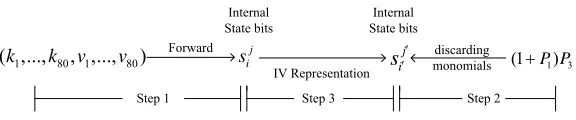
d, then the following techniques are used to reduce the Boolean polynomial of (1 +P1)P3 by discarding monomials in advance. The whole process could be
divided into the following three steps shown in Figure 1.
– Step 1.We compute forward to express the ANF of some internal state bits over IV bits and key bits. In Trivium, the internal state bitssji (0≤i≤2, 0≤j≤340) are computed in a PC.
– Step 2. During the iterative computation of the ANF representation of (1 +P1)P3 in the backward direction (decryption), we introduce the fast
discarding monomial technique in Section 3.4, which includes the following two algorithms:
• First, we propose thedegree evaluation algorithm to obtain the degree bounds of internal state bits. As the monomials of (1 +P1)P3’s ANF is a
product of these internal state bits, the degree of a monomial is bounded by the sum of the degrees of the multiplied internal state bits, which is regarded as the degree estimation of the monomial. If the estimated degrees of monomials are lower thand, they are discarded directly. • Second, we exploit the iterative structure of Trivium, and find that the
(1 +P1)P3’s ANF contains many products of consecutive internal state
bits. Thus, we pre-compute the degree reductions of those products, which is dt = Pideg(xi)−deg(Qixi), where xi is an internal state
bit. Thus, the degree of a monomial is upper bounded by the difference value between the sum of the multiplied internal state bits and the corresponding degree reductiondt. If it is smaller thand, the monomial
is discarded.
– Step 3. For the left monomials of (1 +P1)P3’s ANF, we introduce IV
representation technique in Section 3.5 to determine the upper bound degree of (1 +P1)P3 or find thed-degree missing product of certain IV bits
(missing IV term). In IV representation technique, the symbolic key bits in the internal state bits are removed and only IV bits are left. Combining with repeated IV term removing algorithm, we can simplify monomials of (1 +P1)P3’s ANF without losing the missing IV term information. If we find
an IV term is not in the IV representation of (1 +P1)P3, we can conclude
that it is also not in (1 +P1)P3.
1 80 1 80
( ,...,k k , ,...,v v ) Forward
Internal State bits
j i
s
IV Representation
discarding monomials
Step 1 Step 3
j i
s
Internal State bits
Step 2
1 3 (1P P)
3.4 Fast Discarding Monomial Techniques
In Step 2 of Figure 1, during the iterative computation of the ANF representation of (1 +P1)P3 in the backward direction (decryption), there arise more and
more state terms. We will give several techniques to simplify the polynomial by discarding monomials in advance. In this Step, repeated state terms arise according to the Trivium encryption scheme. The repeated state terms are removed using Algorithm 1. The complexity of Algorithm 1 is O(n), supposing there arenstate terms.
Algorithm 1Repeated-(state)term Removing Algorithm Input: The vectorT withnterms, i.e.,T1,T2,. . .,Tn.
Output: UpdatedT withmterms, wherem≤n.
1: Initialize an empty Hash SetH. 2: for i←1 :n do
3: Compute the Hash value ofTi, i.e.,H(Ti) 4: if H.contains(Ti) istrue then
5: H.delete(Ti) 6: else
7: H.insert(Ti)
8: end if
9: end for
Degree evaluation technique As we are proving the degree of the Boolean polynomial (1+P1)P3to bed, thus many monomials with lower degree produced
during the iterative computation backward (decryption) in Step 3 are deleted without consideration (we do not need to continue the iterative computation over those monomials). We estimate those monomials using degree information of the internal state bits in lower rounds. This section presents a degree evaluation algorithm for the internal state bits. For example, we are going to estimate the degree ofbi=bi−3+bi−1bi−2.
deg(bi) = deg(bi−3+bi−1bi−2)
=max{deg(bi−3),deg(bi−1bi−2)}
≤max{deg(bi−3),deg(bi−1) + deg(bi−2)}
(5)
If we continue to decomposebi, we find
bi−1bi−2= (bi−4+bi−2bi−3)(bi−5+bi−3bi−4)
=bi−4bi−5+bi−3bi−4+bi−2bi−3bi−5+bi−2bi−3bi−4,
(6)
If deg(bi−1) = deg(bi−2bi−3) and deg(bi−2) = deg(bi−3bi−4), then in Equ.(5),
deg(bi−1) + deg(bi−2) may add deg(bi−3) twice. So in order to obtain a more
accurate degree estimation, we are willing to decompose bi for several rounds
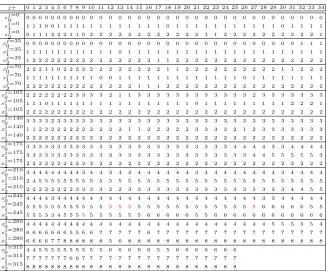
For Trivium, the ANFs ofsji (0≤i≤2, 0≤j≤340) are exactly obtained in a PC and their exact degrees can be obtained. For example, in the cryptanalysis of 855-round Trivium, we compute ANF of sji (0≤i≤2, 0≤j≤340) over 75 free IV variables6, the degrees are shown in Table 2. To estimate the degree of
sr
i forr >340, we decomposesri until the state terms are the product of internal
state bitssji forj < end=br
32c ×32−128 considering the efficiency tradeoff of
the computation.
Table 2.Degree deg(sji) ofsji for 0≤i≤2, 0≤j≤340
j+ 0 1 2 3 4 5 6 7 8 9 10 11 12 13 14 15 16 17 18 19 20 21 22 23 24 25 26 27 28 29 30 31 32 33 34
sj0=0 0 0 0 0 0 0 0 0 0 0 0 0 0 0 0 0 0 0 0 0 0 0 0 0 0 0 0 0 0 0 0 0 0 0 0
sj1=0 1 1 1 0 0 1 1 1 1 1 1 1 1 1 1 1 1 1 0 1 1 1 1 1 1 1 1 1 1 1 0 1 1 1 1
sj2=0 0 1 1 1 2 2 2 1 1 0 2 2 2 2 2 2 2 2 2 2 2 2 1 1 2 2 2 2 2 2 2 2 2 2 1
sj0=35 0 0 0 0 0 0 0 0 0 0 0 0 0 0 0 0 0 0 0 0 0 0 0 0 0 0 0 0 0 0 0 0 1 1 1
sj1=35 1 1 1 1 1 1 1 1 1 1 1 1 1 0 1 1 1 1 1 1 1 1 1 1 1 1 1 1 1 1 1 1 1 1 1
sj2=35 1 2 2 2 2 2 2 2 2 2 2 2 2 2 2 2 2 1 1 2 2 2 2 2 2 2 2 2 2 2 2 2 2 2 2
sj0=70 2 2 2 1 1 0 2 2 2 2 2 2 2 2 2 2 2 2 1 1 2 2 2 2 2 2 2 2 2 2 1 1 2 2 2
sj1=70 1 1 1 1 1 1 1 1 1 1 1 0 0 1 1 1 1 1 1 1 1 1 1 1 1 1 0 1 1 1 1 1 1 1 1
sj2=70 2 2 2 2 2 2 2 2 2 2 2 2 2 2 2 1 1 1 2 2 2 2 2 2 2 2 2 2 2 2 2 2 2 2 2
sj0=1052 2 2 2 2 2 2 2 3 3 3 3 2 1 1 3 3 3 3 3 3 3 3 3 3 3 3 2 3 3 3 3 3 3 3
sj1=1051 1 1 0 1 1 1 1 1 1 1 1 1 1 1 1 1 1 1 1 1 0 1 1 1 1 1 1 1 1 1 2 2 2 1
sj2=1052 2 2 2 2 2 2 2 2 2 2 2 2 2 2 2 2 2 2 2 2 2 2 2 2 2 2 2 2 2 2 2 2 2 2
sj0=1403 3 3 3 2 3 3 3 3 3 3 3 3 3 3 3 3 3 3 3 3 3 2 3 3 3 3 3 3 3 3 3 3 3 3
sj1=1401 1 2 2 2 2 2 2 2 2 2 2 2 2 1 1 2 2 2 2 2 3 3 3 3 2 1 2 3 3 3 3 3 3 3
sj2=1402 2 2 2 2 2 2 2 2 2 2 2 2 2 2 2 2 2 2 2 2 2 2 2 2 2 2 2 2 2 2 2 2 2 2
sj0=1753 3 3 3 3 3 3 3 3 3 3 3 3 3 3 3 3 3 3 3 3 3 3 3 3 4 4 4 4 3 3 4 4 4 4
sj1=1753 3 3 3 3 3 3 3 3 3 3 3 3 3 3 3 3 3 3 3 3 3 3 3 3 3 3 4 4 5 5 5 5 5 3
sj2=1752 2 2 2 2 2 2 2 2 2 2 2 2 2 2 2 2 2 2 2 2 2 2 2 2 2 2 2 2 2 2 2 2 2 2
sj0=2103 4 4 4 4 4 4 4 4 3 4 4 3 4 4 4 4 4 4 4 4 3 4 4 4 4 4 4 4 4 3 4 4 4 4
sj1=2102 4 5 5 5 5 5 5 5 5 5 5 5 5 5 5 5 5 5 5 5 5 5 5 5 5 5 5 5 5 5 5 5 5 5
sj2=2102 2 2 2 2 2 2 2 3 3 3 3 2 2 3 3 3 3 3 3 3 3 3 3 3 3 3 3 3 3 3 4 4 5 5
sj0=2454 4 4 4 3 4 4 4 4 4 4 4 4 4 4 4 4 4 4 4 4 4 4 4 4 4 4 4 3 3 4 4 4 4 4
sj1=2455 5 5 5 5 5 5 5 5 5 5 5 5 5 5 5 5 5 5 5 5 5 5 5 5 5 5 5 6 6 6 6 6 5 5
sj2=2455 5 5 3 3 4 5 5 55 5 5 5 5 5 5 6 6 6 6 6 5 5 6 6 6 6 6 6 6 6 6 6 6 6
sj0=2804 4 4 4 4 4 4 4 4 4 4 4 4 4 4 4 4 4 4 4 4 4 4 4 4 4 4 4 4 5 5 5 5 5 4
sj1=2806 6 6 6 6 6 6 5 5 6 6 7 7 7 7 7 6 7 7 7 7 7 7 7 7 7 7 7 7 7 7 7 7 7 7
sj2=2806 6 6 6 7 7 8 8 8 8 8 8 5 6 8 8 8 8 8 8 8 8 8 8 8 8 8 8 8 8 8 8 8 8 8
sj0=3154 4 5 5 5 5 5 5 5 5 5 5 6 6 6 6 6 5 5 6 6 6 6 6 6 6
sj1=3157 7 7 7 7 7 7 6 6 7 7 7 7 7 7 7 7 7 7 7 7 7 7 7 7 7
sj2=3158 8 8 8 8 8 8 8 8 8 8 8 8 8 8 8 8 8 8 8 8 8 8 8 8 8
For example, we estimate the degree upper bound of s341
1 , where end =
br
32c ×32−128 = 192. We first expresss 341
1 using state bits in less rounds, and
discard the state terms of degree lower thand.
– Step 1. First, we expresss341
2 =s2721 +s2591 s2581 +s2571 +s2542 according to
Equ. (1).
– Step 2. According to Table 2 highlighted in red, let
d = max{deg(s272
1 ),deg(s2591 ) + deg(s2581 ),deg(s2571 ),deg(s2542 } =
max{5,5 + 5,5,5}= 10.
6
– Step 3. Discarding the state terms of degree lower than 10, we get
s341∗
2 = s2591 s2581 . Iteratively compute s3412 ∗ and discard state terms with
degree lower than 10, there is no state term surviving. We resetd=d−1 and repeat the above decomposition and discarding process. We can get the result s341∗∗
2 = s1660 s1670 s1930 + s1670 s1680 s1920 + s1660 s1670 s1680 +
s165
0 s1670 s1680 +s1670 s1680 s1801 +s1660 s1670 s1811 . – Step 4.Note that there is still a state bits193
1 ins3412 ∗∗ that is bigger than
end=192. So we continue to iteratively compute and discard state terms with degree lower than 9, and we get:
s341∗∗∗
2 =s562 s572 s832 s842 s1012 +s572 s582 s832 s842 s1002 +s562 s572 s582 s832 s842 +
s97
0 s572 s582 s832 s842 +s980 s562 s572 s832 s284+s1240 s562 s572 s1012 +s1240 s572 s582 s1002 +
s1240 s562 s572 s582 +s1240 s552 s572 s582 +s552 s572 s582 s832 s842 +s970 s1240 s572 s582
+s980 s1240 s562 s572 +s572 s582 s822 s832 s1022 +s582 s592 s822 s832 s1012 +s572 s582 s592 s822 s832 +
s562 s582 s592 s822 s283+s980 s582 s592 s822 s283+s990 s572 s582 s822 s832 +s1230 s572 s582 s1022 +
s1230 s582 s592 s1012 +s1230 s572 s582 s592 +s1230 s562 s582 s592 +s980 s1230 s582 s592
+s99
0 s1230 s572 s582 +s562 s572 s582 s592 s1012 +s098s562 s572 s582 s592 +s552 s562 s572 s582 s1022 +
s55
2 s562 s582 s592 s1012 +s552 s562 s572 s582 s592 +s980 s552 s562 s582 s592 +s990 s552 s562 s572 s582 +
s114
0 s572 s582 s1022 +s1140 s258s592 s1012 +s1140 s572 s582 s592 +s1140 s562 s582 s592 +s890 s900 s572 s582 s1002 +
s98
0 s1140 s582 s592 +s990 s1140 s572 s582 +s1150 s562 s572 s1012 +s1150 s572 s582 s1002 +s1150 s562 s572 s582 +
s115
0 s552 s572 s582 +s970 s1150 s572 s582 +s098s1150 s562 s572 +s089s900 s562 s572 s1012 +
s89
0 s900 s562 s572 s582 +s890 s900 s552 s572 s582 +s890 s900 s970 s572 s582 +s890 s900 s980 s562 s572 .
(7)
– Step 5. Here, there is no state bit in rounds more than end = 192, the expression ends and there are still state terms that survive. Then the current degreed= 9 is the estimated degree ofs341
2 .
– Step 6.Note that, if there is no state item ins3412 ∗∗∗surviving, which means the degree added twice or more shown in Equ. (6) happens to the iterative computation ofs3412 . So the degree must be less than 9. We resetd= 8 and
continue the above steps 3-5 to get a more accurate degree bound.
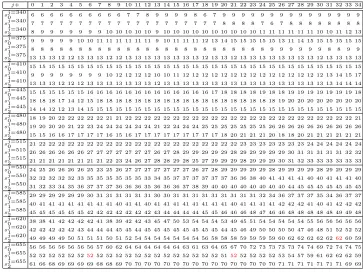
We summarise the above 6 steps as Algorithm 2. We only estimate degree of
sri forr≤665 and list the results in Table 3.
Degree reduction technique In this part, we formally consider the property in Equ.(6), that deg(bi−3) is added twice. We call itdegree reduction. Define the
degree reductiondtas
dt=
X
i∈I
deg(xi)−deg(
Y
i∈I
xi), (8)
wherexi is a state bit.
We pay attention to the degree reduction of the state termQl+t−1
j=l s j i for a
specifici∈[0,2]. This state term results from the iteration structure of Trivium scheme, whose high degree state terms come from the multiplication of sjisji+1
Algorithm 2Degree Evaluation Algorithm (DEG) of State Bit Input: The valuetandrwhich indicates the state bitsrt.
Output: DEG(sr
t)=d.
1: Initialize the degree bounddsimilar to the aboveStep 2., the end pointend. 2: len←0
3: whilelen= 0do
4: Iteratively expresssr
t using state bits s j
i, where 0≤j ≤2 and 0≤ j < end. During each expression, discard the state terms of degree lower thand. Letlen
be the number of remaining state terms. 5: if len= 0then
6: d←d−1
7: end if
8: end while
9: Returnd
Table 3.The estimated upper bound degreeDEG(sji) ofsr
i forr≤689
j+ 0 1 2 3 4 5 6 7 8 9 10 11 12 13 14 15 16 17 18 19 20 21 22 23 24 25 26 27 28 29 30 31 32 33 34
sj0=340 6 6 6 6 6 6 6 6 6 6 7 7 8 9 9 9 9 8 6 7 9 9 9 9 9 9 9 9 9 9 9 9 9 9 9
sj1=340 7 7 7 7 7 7 7 7 7 7 7 7 7 7 7 7 7 7 7 7 8 8 8 8 7 6 7 8 8 8 8 8 8 8 8
sj2=340 8 9 9 9 9 9 9 9 10 10 10 10 10 9 10 10 10 10 10 10 10 10 10 10 11 11 11 11 11 11 10 10 11 12 13
sj0=375 9 9 9 9 9 10 10 11 11 11 11 11 11 9 10 11 11 11 12 13 14 15 15 15 15 15 13 11 14 15 15 15 15 15 15
sj1=375 8 8 8 8 8 8 8 8 8 8 8 8 8 8 8 8 8 8 8 8 8 8 8 8 8 9 9 9 9 9 9 8 8 9 9
sj2=37513 13 13 12 12 13 13 13 12 12 13 13 13 13 13 13 13 13 12 13 13 12 13 13 13 13 13 13 13 13 12 13 13 13 13
sj0=41015 15 15 15 15 15 15 15 15 15 15 15 15 15 15 15 15 15 15 15 15 15 15 15 15 15 15 15 15 15 15 15 15 15 15
sj1=410 9 9 9 9 9 9 9 9 10 12 12 12 12 10 10 11 12 12 12 12 12 12 12 12 12 12 12 12 12 12 12 13 14 15 17
sj2=41013 13 13 12 12 12 13 13 13 13 13 13 13 12 13 13 13 13 13 13 13 13 13 13 13 13 13 13 13 13 13 13 14 14 14
sj0=44515 15 15 15 15 15 16 16 16 16 16 16 16 16 16 16 16 16 16 17 18 18 18 18 19 18 18 19 19 19 19 19 19 19 18
sj1=44518 18 18 17 14 12 15 18 18 18 18 18 18 18 18 18 18 18 18 18 18 18 18 18 18 18 19 20 20 20 20 20 20 20 20
sj2=44514 14 12 12 13 14 15 15 15 15 15 15 15 15 15 15 15 15 15 15 15 15 15 15 15 15 15 15 15 15 15 15 15 15 15
sj0=48018 19 20 22 22 22 22 22 21 21 22 22 22 22 22 22 22 22 22 22 22 22 22 22 22 22 22 22 22 22 22 22 22 22 21
sj1=48019 20 20 20 21 22 23 24 24 24 24 24 24 21 22 24 24 24 25 25 25 25 25 25 25 26 26 26 26 26 26 26 26 26 26
sj2=48015 15 16 16 17 17 17 17 16 15 16 17 17 17 17 17 17 17 17 17 18 20 21 21 21 20 18 18 20 21 21 21 21 21 21
sj0=51521 22 22 22 22 22 22 22 22 22 22 22 22 22 22 22 22 22 22 22 22 22 23 23 23 23 23 23 23 24 24 24 24 24 24
sj1=51526 26 26 26 26 26 27 27 27 27 27 27 27 26 27 28 29 29 29 29 29 28 29 29 29 29 29 30 31 31 31 31 31 32 32
sj2=51521 21 21 21 21 21 21 21 22 23 24 26 27 28 28 29 28 25 27 29 29 29 28 29 29 29 30 31 32 33 33 33 33 33 33
sj0=55024 25 26 26 26 26 25 23 25 26 27 27 27 27 27 27 27 26 27 28 29 29 29 29 29 28 29 29 29 29 28 29 29 29 29
sj1=55032 32 32 32 32 33 35 35 35 35 35 35 33 34 35 37 37 37 37 37 37 36 36 38 40 41 41 41 41 40 40 41 41 41 40
sj2=55031 32 33 34 35 36 37 37 37 36 36 36 35 36 36 36 37 38 39 40 40 40 40 40 40 40 40 44 45 45 45 45 45 45 45
sj0=58529 29 29 29 29 29 30 31 31 31 31 31 31 30 30 31 31 31 31 31 31 31 31 31 32 34 36 37 37 37 35 34 36 37 37
sj1=58540 41 41 41 41 41 41 41 41 40 41 41 40 41 41 41 41 41 41 41 41 40 41 41 41 41 42 42 42 41 40 41 42 42 42
sj2=58545 45 45 45 45 45 42 42 42 42 42 42 42 43 44 44 44 44 45 45 46 46 46 48 47 46 46 48 48 48 48 48 49 49 48
sj0=62038 38 41 42 42 42 42 41 38 39 42 42 43 45 47 50 53 54 54 54 53 49 45 51 54 54 54 54 54 55 56 56 56 56 56
sj1=62042 42 42 42 42 43 44 44 44 45 45 44 45 45 45 45 45 45 45 45 44 45 46 49 50 50 50 50 47 46 48 51 52 52 52
sj2=62049 49 49 49 50 51 51 51 50 51 52 54 54 54 54 54 54 54 56 58 58 58 59 59 59 59 60 62 62 62 62 626260 59
sj0=65556 56 56 56 56 56 56 57 60 62 64 64 64 64 64 64 63 61 63 64 65 67 70 72 73 73 73 73 74 74 69 72 74 74 75
sj1=65552 52 52 52 52 525252 52 52 52 52 52 52 52 52 52 52 52 52 515252 52 52 52 53 54 57 59 61 62 62 62 59
are in the form Ql+t−1
j=l s j
i. Define the degree reduction dt =P l+t−1
j=l deg(s j i)−
deg(Ql+t−1
j=l s j i).
The degree reduction can help discard state terms of lower degree dramatically, as it can help predict the change of degree before expression operation7. We take the state term s340
1 s3411 as an example to illustrate the
process to compute the degree reductiondt. Algorithm 2 is first used to obtain
the degree of state bits as shown in Table 2 and 3. Letendbe br
32c ×32−128 = 192, too. The degree bounddis initialized as
d=DEG(s3401 ) +DEG(s1341) anddt = 0. Express the s3401 s3411 by one iteration
using Equ.(1). Discard the state terms of degree lower thand−dt=d, there is
no state term surviving. Increase thedtby 1, such thatdt= 1. Expresss3401 s3411
again and discard the state terms of degree lower thand−dt=d−1, the result
is s249
0 s2500 s2621 +s2480 s2490 s2631 . Continue to compute iteratively, the remaining
state terms ares170
0 s1710 s1800 s1402 s1412 +s1700 s1710 s1810 s1392 s1402 +s1710 s0172s1790 s1392 s1402 +
s171
0 s1720 s1800 s1382 s1392 . There is no state bitss
j
i withjbigger thanend= 192 in all
the state terms, hence the expression ends. Degree reductiondt= 1 is returned.
Thus the deg(s340
1 s3411 )≤ DEG(s3401 ) +DEG(s3411 )−dt = 7 + 7−1 = 13. The
degree reduction algorithm is shown in Algorithm 3
Algorithm 3Degree Reduction Algorithm of State Term
Input: The valuei,r,twhich indicates the state term degree reduction.
Output: The degree reductiondt=Plj+=t−l 1deg(sji)−deg( Ql+t−1
j=l s j i).
1: Initialize the degree bound d =Pli+=lt−1DEG(sji) , degree reductiondt = 0, end pointendand number of survived state termslen.
2: whilelen= 0do
3: Express the state term Qlj+=t−l 1sji using state bits s j
i, where 0 ≤ i ≤ 2 and 0≤j < end, discard the state terms of degree lower thand−dt. Letlenbe the number of remaining state terms.
4: if len= 0then
5: dt←dt+ 1
6: end if
7: end while
8: Returndt
3.5 IV Representation Techniques
In the cryptanalysis of stream ciphers, the output is a boolean function over key and IV bits. But obtaining the exact expression is hard, thus we propose
IV representation technique to reduce the computation complexity for obtaining the degree information.
Definition 1. (IV representation) Given a state bit s=P
I,J
Q
i∈IviQj∈Jkj, the IV representation ofsis sIV =PIQi∈Ivi.
7
For example, if a boolean polynomial iss=v0k1+v0k0k2+v1k1k2+v0v1k2,
then its corresponding IV representation issIV =v0+v0+v1+v0v1.
IV representation with repeated IV terms Removing Algorithm. Due to neglection of key bits, there are lots of repeated IV terms. Here we give an algorithm to remove the repeated IV terms ofsIV. The details of the algorithm
are shown in Algorithm 4. This algorithm is based on a Hash function. First, an empty hash set is initialized. For each IV term Ti, compute the hash value
as H(Ti) (Line 3), then determine ifTi is already in H. If not, then insert Ti
into H (Lines 4-5). Applying Algorithm 4 to the above example, the result is
v0+v1+v0v1. Note that this algorithm is slightly different from Algorithm 1.
If we apply Algorithm 1 tosIV, the result isv1+v0v1.
In the iterative computation process of the output bit of Trivium, it should be noted that if an IV term exists in s, it must also exist in sIV, but not the
opposite. For example,x1=v0(k1k2+k0k2) +v1+v0v1k2,x2=v2k0k1+v1v2k1
and s=x1x2. We use the IV representations ofx1 and x2 to approximate the
IV representation of s. Thus, x1IV = v0+v1+v0v1, x2IV = v2+v1v2, and
sIV =x1IVx2IV =v0v2+v1v2+v0v1v2. However,s=x1x2=v1v2(k0k1+k1).
So if we find an IV term is not in sIV, we can conclude that it is not
in s either. We use this to determine the degree upper bound of the output ANF of Trivium.
Algorithm 4Repeated-IV term Removing Algorithm Input: The vectorT withnIV terms, i.e.,T1,T2,. . .,Tn.
Output: UpdatedT withmIV terms, wherem≤n.
1: Initialize an empty Hash setH. 2: for i←1 :n do
3: Compute the Hash value ofTi, i.e.,H(Ti). 4: if H.contains(Ti) isfalse then
5: H.insert(Ti).
6: end if
7: end for
After using IV representation combined with Algorithm 4, all the existent IV terms are left by ignoring their repetition. With collision-resistent hash function
H, the time complexity of Algorithm 4 is O(n) for processing n IV terms. It needs several minutes to apply Algorithm 4 on 1 billion IV terms on a single core.
4
Key Recovery Attack on 855-round Trivium
The output of 855-round Trivium can be described using the internal state bits:
z855=s7900 +s 763 0 +s
787 1 +s
772 1 +s
790 2 +s
745
2 . (9)
As a first step of the attack on 855-round Trivium, we need to determineP1.
4.1 Determining the Nullification Scheme for the Output Polynomial of 855-round Trivium
For 855-round Trivium, the degree of output bitzis very high, as shown in [19]. So it is not easy to find the missing IV terms in the complex z =P1P2+P3.
However, based on the new observation of Boolean polynomial introduced in Section 3.1. we can choose P1 to reduce the Boolean polynomial (1 +P1)z =
(1 +P1)P3such that the degree of (1 +P1)P3 is lower. The lower, the better. In
fact, the lower the degree of a state term, the less high degree IV terms it can deduce.
Degrees of state bits are obtained first in order to determine the high degree state terms. The exact Boolean polynomial of sji for i∈ [0,2] and j ∈ [0,340] can be obtained. The other degree upper bounds can be obtained by executing Algorithm 2.
For a search of P1, we use the decomposition of Trivium and preserve the
high degree state terms (bigger than a given bound dependent on our computing ability in a PC), where the degree of state terms means the sum of degrees of each state bit in the earlier rounds involved. We decompose until all the state bits are within the range of [0,276]. The key points to determineP1come from
3 criteria: (1) the frequency of P1 is high; (2) the degree of P1 is low; (3) the
equivalent key guesses inP1are minimized. We calculate the frequency of state
bits and find thats2101 occurs in about 34 of all the preserved high state terms. The degree of s2101 is 5 and can be reduced to 2 after nullifying the 5 IV bits,
and there are only 3 equivalent key bits to be guessed. So we chooseP1=s2101 .
The output polynomial can be rewritten as
z=s2101 P2+P3, (10)
where P2 and P3 do not contain s2101 . Polynomial P2 is so complex that it is
hard to compute its degree and density information while P3 is relatively
simple. Here
P1 = s2101 = v59v60v61 +v59v60v76 +v17v59v60 +v30v31v59v60 +v32v59v60+
v59v60v62+v59v60v77+v59v60k20+v59v61v73v74+v59v73v74v76+v17v59v73v74+
v30v31v59v73v74+v32v59v73v74+v59v62v73v74 +v59v73v74v77+v59v73v74k20+
v59v60v74v75+v59v60v75v76+v59v73v74v75+v59v73v74v75v76+v59v61v75+v59v74v75
+v17v59v75+v30v31v59v75+v32v59v75+v59v62v75 +v59v75v77 +v59v75k20+
v60v61v72v73 +v60v72v73v76+v17v60v72v73+v30v31v60v72v73 +v32v60v72v73+
v60v62v72v73+v60v72v73v77+v60v72v73k20+v61v72v73v74+v72v73v74v76+v17v72v73
v74+v30v31v72v73v74+v32v72v73v74+v62v72v73v74+v72v73v74v77+v72v73v74k20+
v60v72v73v74v75 + v60v72v73v75v76 + v72v73v74v75v76 + v61v72v73v75 +
v72v73v75k20+v60v61v74+v60v74v76+v17v60v74+v30v31v60v74+v32v60v74+
v60v62v74 + v60v74v77 + v60v74k20 + v17v73v74 + v30v31v73v74 + v32v73v74 +
v62v73v74 + v73v74v77 + v73v74k20 + v16v60v61 + v16v60v74v75 + v16v60v76 +
v16v61v73v74+v16v73v74v75+v16v73v74v76+v16v61v75+v16v74v75 +v16v17+
v16v30v31+v16v32+v16v62+v16v77+v16k20+v29v30v60v61+v29v30v60v74v75+
v29v30v60v76 + v29v30v61v73v74 + v29v30v73v74v75 + v29v30v73v74v76 +
v29v30v61v75+v29v30v74v75+v17v29v30+v29v30v31+v29v30v32 +v29v30v62+
v29v30v77+v29v30k20+v31v60v61+v31v60v74v75+v31v60v76+v31v61v73
v74+v31v73v74v75+v31v73v74v76+v31v61v75+v31v74v75+v17v31+v30v31+v31v62+
v31v77+v31k20+v60v61+v61v75+v61v74v75+v17v61+v30v31v61+v32v61+v61k20+
v60v74v75v76+v60v76+v73v74v75v76+v17v76+v30v31v76+v32v76+v76v77+v76k20+
v60v61k19+v60v74v75k19+v60v76k19+v61v73v74k19+v73v74v75k19+v73v74v76k19+
v61v75k19+v74v75k19+v17k19+v30v31k19+v32k19+v62k19+v77k19+k19k20+
v34v35+v34v48v49+v34v50+v35v47v48+v47v48v49+v47v48v50+v35v49+v48v49+
k57+v69+v4v5+v6+v36+v51+v60+v73v74+v75+k63+v62v74v75+v74v75v77+
v75v76+v18+v33+v63+v78+k21+k28k29+k3+k30+k12+k37k38+k39+v24.
IV Nullification The degree of s2101 is 5 and the IV bits involved in s2101 are
shown in Table 4.
Table 4.Count of IV bits ins2101 before IV nullification.
IV v4 v5 v6 v16v17v18v24v29v30v31v32v33v34v35v36v47v48 Count 1 1 1 14 14 1 1 14 27 26 13 1 3 3 1 3 5
IV v49v50v51v59v60v61v62v63v69v72v73v74v75v76v77v78 Count 4 2 1 28 44 26 13 1 1 26 56 62 46 26 14 1
In order to simplifys210
1 so that it is easier to obtain the degree bound of
(1 +s210
1 )P3, we nullify v74,v60,v75,v30 andv48.
After nullifying the 5 IV bits, we obtain the simplified boolean function:
s210
1 =v16v17+v16v32+v16v62+v16v77+v16k20+v17v31+v31v62+
v31v77+v31k20+v17v61+v32v61+v61k20+v17v76+v32v76+v76v77+
v76k20+v17k19+v32k19+v62k19+v77k19+k19k20+v34v35+v34v50+
v35v49+k57+v69+v4v5+v6+v36+v51+k63+v18+v33+v63+
v78+k21+k28k29+k3+k30+k12+k37k38+k39+v24.
(11)
Here, the degree ofs210
1 is 2 and key information equivalent to 3 bits ins2101 are
k19,k20andk57+k63+k21+k28k29+k3+k30+k12+k37k38+k39. The IV bits
involved ins2101 are shown in Table 5.
After determiningP1=s2101 , we multiply 1 +s2101 in both sides of Equ.(10),
then (1 +s210
1 )z= (1 +s2101 )P3. Finding the non-randomness in (1 +s2101 )P3will
help us to construct the cube tester of 855-round Trivium. More specifically, we will determine the nonexistent IV terms of degree 70 in (1+s210
Table 5.Frequency of IV bits ins2101 after IV nullification.
IV v4 v5 v6 v16v17v18v24v31v32v33v34v35 Count 1 1 1 5 5 1 1 4 4 1 2 2
IV v36v49v50v51v61v62v63v69v76v77v78 Count 1 1 1 1 3 3 1 1 4 4 1
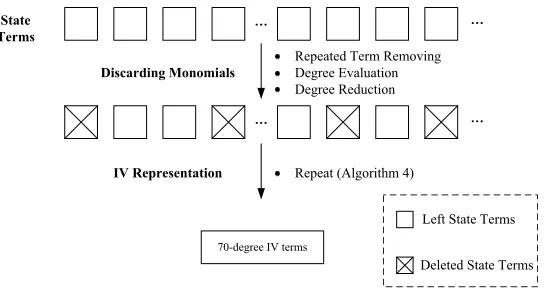
reduce the polynomial, then IV presentation technique is applied to determine the nonexistent IV terms. The framework is presented in Figure 2 and details are shown in the following Section 4.2.
…
…
State
Terms …
…
Repeated Term Removing Degree Evaluation Degree Reduction Discarding Monomials
Repeat (Algorithm 4) IV Representation
70-degree IV terms
Left State Terms
Deleted State Terms
Fig. 2.Framework of determining the missing IV terms
4.2 Determining the Degree Bound of Reduced Polynomial
We are going to iteratively compute (1 +s210
1 )P3. In each iteration, many state
terms of (1 +s210
1 )P3 are produced. Based on our computing ability, we can
compute the IV terms of degree around 70. In computing the 70-degree IV terms, we use a cluster of 600-2400 cores. Since we are finding the 70-degree missing IV terms, state terms with degree less than 70 are removed without consideration, because they do not contain those 70-degree IV terms certainly. The removing process could be divided into 2 steps:
1. Deleting state terms according to degree evaluation; 2. Deleting state terms according to degree reduction.
can be updated. Then we execute Algorithm 2 to obtain the degrees of the other state bits, partially in Table 2 and 3. For example, given a state termb1b2, we
first find DEG(b1) and DEG(b2) in Table 2 and 3, if DEG(b1) +DEG(b2)<70,
then deg(b1b2)≤ DEG(b1) +DEG(b2)<70, deleteb1b2.
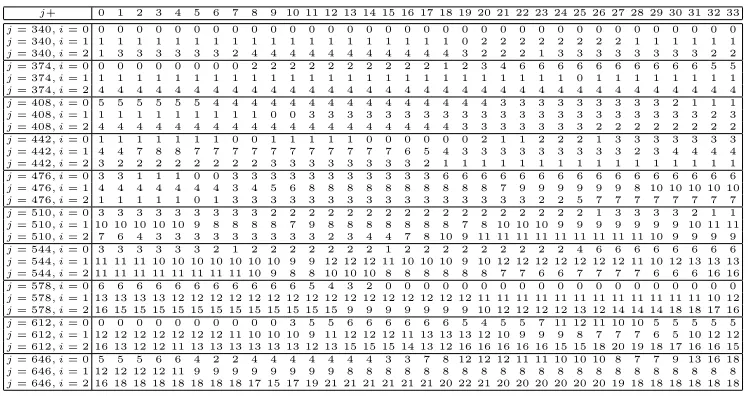
Degree reduction phase In the structure of stream ciphers based on NFSR, degree reduction arises often due to the iterative structure. We use Algorithm 3 to obtain the degree reduction, which is shown in Table 6, Table 7 and Table 8 for products of 2 consecutive state bits sjisji+1 (t = 2), 3 consecutive state bits sjisji+1sji+2 (t = 3) and 4 consecutive state bits sjisji+1sji+2sji+3 (t = 4), respectively. Note that we only list the degree reduction when j ≥ 340. The degree reduction forj <340 is much easier to obtain in a PC.
Table 6.Degree reductionsdt(sjis j+1 i ) ofs
j is
j+1
i witht= 2
j+ 0 1 2 3 4 5 6 7 8 9 10 11 12 13 14 15 16 17 18 19 20 21 22 23 24 25 26 27 28 29 30 31 32 33
j= 340, i= 0 0 0 0 0 0 0 0 0 0 0 0 0 0 0 0 0 0 0 0 0 0 0 0 0 0 0 0 0 0 0 0 0 0 0
j= 340, i= 1 1 1 1 1 1 1 1 1 1 1 1 1 1 1 1 1 1 1 1 0 2 2 2 2 2 2 2 2 1 1 1 1 1 1
j= 340, i= 2 1 3 3 3 3 3 3 2 4 4 4 4 4 4 4 4 4 4 4 3 2 2 2 1 3 3 3 3 3 3 3 3 2 2
j= 374, i= 0 0 0 0 0 0 0 0 0 2 2 2 2 2 2 2 2 2 2 1 2 3 4 6 6 6 6 6 6 6 6 6 6 5 5
j= 374, i= 1 1 1 1 1 1 1 1 1 1 1 1 1 1 1 1 1 1 1 1 1 1 1 1 1 1 0 1 1 1 1 1 1 1 1
j= 374, i= 2 4 4 4 4 4 4 4 4 4 4 4 4 4 4 4 4 4 4 4 4 4 4 4 4 4 4 4 4 4 4 4 4 4 4
j= 408, i= 0 5 5 5 5 5 5 4 4 4 4 4 4 4 4 4 4 4 4 4 4 4 3 3 3 3 3 3 3 3 3 2 1 1 1
j= 408, i= 1 1 1 1 1 1 1 1 1 1 0 0 3 3 3 3 3 3 3 3 3 3 3 3 3 3 3 3 3 3 3 3 3 2 3
j= 408, i= 2 4 4 4 4 4 4 4 4 4 4 4 4 4 4 4 4 4 4 4 3 3 3 3 3 3 3 2 2 2 2 2 2 2 2
j= 442, i= 0 1 1 1 1 1 1 1 0 0 1 1 1 1 1 0 0 0 0 0 0 2 1 1 2 2 2 1 3 3 3 3 3 3 3
j= 442, i= 1 4 4 7 8 8 7 7 7 7 7 7 7 7 7 7 7 6 5 4 3 3 3 3 3 3 3 3 3 2 3 4 4 4 4
j= 442, i= 2 3 2 2 2 2 2 2 2 2 3 3 3 3 3 3 3 3 2 1 1 1 1 1 1 1 1 1 1 1 1 1 1 1 1
j= 476, i= 0 3 3 1 1 1 0 0 3 3 3 3 3 3 3 3 3 3 3 6 6 6 6 6 6 6 6 6 6 6 6 6 6 6 6
j= 476, i= 1 4 4 4 4 4 4 4 3 4 5 6 8 8 8 8 8 8 8 8 8 8 7 9 9 9 9 9 9 8 10 10 10 10 10
j= 476, i= 2 1 1 1 1 1 0 1 3 3 3 3 3 3 3 3 3 3 3 3 3 3 3 3 2 2 5 7 7 7 7 7 7 7 7
j= 510, i= 0 3 3 3 3 3 3 3 3 3 2 2 2 2 2 2 2 2 2 2 2 2 2 2 2 2 2 1 3 3 3 3 2 1 1
j= 510, i= 1 10 10 10 10 10 9 8 8 8 8 7 9 8 8 8 8 8 8 8 7 8 10 10 10 9 9 9 9 9 9 9 10 11 11
j= 510, i= 2 7 6 4 3 3 3 3 3 3 3 3 3 2 3 4 4 7 8 10 9 11 11 11 11 11 11 11 11 11 10 9 9 9 9
j= 544, i= 0 3 3 3 3 3 3 2 1 2 2 2 2 2 2 2 1 2 2 2 2 2 2 2 2 2 4 6 6 6 6 6 6 6 6
j= 544, i= 1 11 11 11 10 10 10 10 10 10 10 9 9 12 12 12 11 10 10 10 9 10 12 12 12 12 12 12 12 11 10 12 13 13 13
j= 544, i= 2 11 11 11 11 11 11 11 11 10 9 8 8 10 10 10 8 8 8 8 8 8 7 7 6 6 7 7 7 7 6 6 6 16 16
j= 578, i= 0 6 6 6 6 6 6 6 6 6 6 6 5 4 3 2 0 0 0 0 0 0 0 0 0 0 0 0 0 0 0 0 0 0 0
j= 578, i= 1 13 13 13 13 12 12 12 12 12 12 12 12 12 12 12 12 12 12 12 12 11 11 11 11 11 11 11 11 11 11 11 11 10 12
j= 578, i= 2 16 15 15 15 15 15 15 15 15 15 15 15 15 9 9 9 9 9 9 9 10 12 12 12 12 13 12 14 14 14 18 18 17 16
j= 612, i= 0 0 0 0 0 0 0 0 0 0 0 3 5 5 6 6 6 6 6 6 5 4 5 5 7 11 12 11 10 10 5 5 5 5 5
j= 612, i= 1 12 12 12 12 12 12 12 11 10 10 10 9 11 12 12 12 11 13 13 13 12 10 9 9 9 8 7 7 7 6 5 10 12 12
j= 612, i= 2 16 13 12 12 11 13 13 13 13 13 13 12 13 15 15 15 14 13 12 16 16 16 16 16 15 15 18 20 19 18 17 16 16 15
j= 646, i= 0 5 5 5 6 6 4 2 2 4 4 4 4 4 4 4 3 3 7 8 12 12 12 11 11 10 10 10 8 7 7 9 13 16 18
j= 646, i= 1 12 12 12 12 11 9 9 9 9 9 9 9 9 8 8 8 8 8 8 8 8 8 8 8 8 8 8 8 8 8 8 8 8 8
j= 646, i= 2 16 18 18 18 18 18 18 18 17 15 17 19 21 21 21 21 21 21 20 22 21 20 20 20 20 20 20 19 18 18 18 18 18 18
In the cryptanalysis of Trivium, the degree reduction may be more complicated. Further degree reduction for t > 4 is hard to be obtained using PC for loop executing Algorithm 3. Some man-made work should be involved to obtain further degree reduction. The degree reduction can help discard state terms of lower degree dramatically. For example, if the state term b1b2 goes
through degree evaluation phase, that means DEG(b1) +DEG(b2) ≥ 70, then
we check if DEG(b1) +DEG(b2)−dt(b1b2) < 70. If yes, deg(b1b2) < 70 and
delete it.
For example, the Equ. (9) can be expressed furthermore using state bits:
Table 7.Degree reductionsdt(sjis j+1 i s
j+2 i ) ofs
j is
j+1 i s
j+2
i witht= 3
j+ 0 1 2 3 4 5 6 7 8 9 10 11 12 13 14 15 16 17 18 19 20 21 22 23 24 25 26 27 28 29 30 31 32 33
j= 340, i= 0 0 0 0 0 0 0 0 0 0 0 0 0 0 0 0 0 0 0 0 0 0 0 0 0 0 0 0 0 0 0 0 0 0 0
j= 340, i= 1 1 1 1 1 1 1 1 1 1 1 1 1 1 1 1 1 1 1 0 0 2 2 2 2 2 2 2 2 1 1 1 1 1 1
j= 340, i= 2 0 3 3 3 3 3 2 2 4 4 4 4 4 4 4 4 4 4 4 3 2 2 1 1 3 3 3 3 3 3 3 2 0 1
j= 374, i= 0 0 0 0 0 0 0 0 0 1 1 1 1 1 1 1 1 1 0 0 0 1 3 5 5 5 5 5 5 5 5 5 5 5 5
j= 374, i= 1 1 1 1 1 1 1 1 1 1 1 1 1 1 1 1 1 1 1 1 1 1 1 1 1 0 0 1 0 0 0 0 0 0 0
j= 374, i= 2 3 3 3 3 3 3 3 3 3 3 3 3 3 3 3 3 3 3 3 3 3 3 3 3 3 3 3 3 3 3 3 3 3 3
j= 408, i= 0 5 5 5 5 5 3 3 3 3 3 3 3 3 3 3 3 3 3 3 3 3 2 3 3 3 3 3 3 3 3 2 1 1 1
j= 408, i= 1 0 0 0 0 0 0 0 0 0 0 0 3 3 3 3 3 3 3 3 3 3 3 3 3 3 3 3 3 3 3 3 2 1 2
j= 408, i= 2 3 3 3 3 3 3 3 3 3 3 3 3 3 3 3 3 3 3 3 3 3 3 3 2 2 2 1 1 1 1 1 1 1 0
j= 442, i= 0 1 1 1 0 0 0 0 0 0 0 0 0 0 0 0 0 0 0 0 0 1 0 0 2 2 1 1 3 3 3 3 3 3 3
j= 442, i= 1 2 3 7 8 8 7 7 7 7 7 7 7 7 7 7 7 6 5 4 3 3 3 3 3 3 3 3 2 1 2 4 4 4 4
j= 442, i= 2 2 2 2 2 2 2 2 1 1 3 3 3 3 3 3 3 3 2 1 1 1 1 1 1 1 1 1 1 1 1 1 1 1 1
j= 476, i= 0 3 0 0 0 0 0 0 0 0 0 0 0 0 0 0 0 2 1 6 6 6 6 6 6 6 6 6 6 6 6 6 6 6 0
j= 476, i= 1 4 4 4 4 4 4 3 2 3 4 6 8 8 8 8 8 8 8 8 8 7 7 9 9 9 9 9 8 8 10 10 10 10 10
j= 476, i= 2 1 1 1 1 0 0 1 3 3 3 3 3 3 3 3 3 3 3 3 3 3 3 2 0 1 5 7 7 7 7 7 7 7 7
j= 510, i= 0 0 0 0 0 0 0 0 0 0 0 0 0 0 0 0 0 2 2 2 2 2 2 2 2 2 1 1 3 3 3 3 0 0 0
j= 510, i= 1 10 10 10 10 10 9 8 8 8 7 7 9 8 7 7 7 7 7 6 5 7 9 9 9 9 9 9 9 8 8 7 9 11 10
j= 510, i= 2 7 6 4 3 3 3 3 3 3 3 3 2 1 2 2 3 7 8 9 9 11 11 11 11 11 11 11 11 11 9 7 7 7 9
j= 544, i= 0 1 1 1 1 1 0 0 0 0 0 0 0 0 0 0 0 1 1 1 1 1 1 1 0 0 2 5 5 5 5 5 5 5 5
j= 544, i= 1 10 10 10 9 10 10 10 10 10 9 7 8 12 11 10 9 9 9 8 6 8 11 11 11 11 11 11 10 7 7 10 11 11 11
j= 544, i= 2 11 11 11 11 11 11 11 10 8 7 6 6 7 7 7 4 4 4 4 4 3 1 1 0 0 1 0 0 0 0 0 0 15 15
j= 578, i= 0 5 5 5 5 5 5 5 5 5 5 5 3 0 0 0 0 0 0 0 0 0 0 0 0 0 0 0 0 0 0 0 0 0 0
j= 578, i= 1 11 11 11 11 11 11 11 11 11 11 11 11 11 11 11 11 11 11 11 11 11 11 11 11 11 11 11 11 11 11 11 10 10 12
j= 578, i= 2 15 15 15 15 15 15 15 15 15 15 15 15 15 6 6 6 6 6 6 5 8 10 10 10 9 11 10 12 12 12 18 18 17 16
Table 8.Degree reductionsdt(sjis j+1 i s
j+2 i s
j+3 i ) ofs
j is
j+1 i s
j+2 i s
j+3
i witht= 4
j+ 0 1 2 3 4 5 6 7 8 9 10 11 12 13 14 15 16 17 18 19 20 21 22 23 24 25 26 27 28 29 30 31 32 33
j= 340, i= 0 0 0 0 0 0 0 0 0 0 0 0 0 0 0 0 0 0 0 0 0 0 0 0 0 0 0 0 0 0 0 0 0 0 0
j= 340, i= 1 2 2 2 2 2 2 2 2 2 2 2 2 2 2 2 2 2 1 1 0 4 4 4 4 4 4 3 3 2 2 2 2 2 2
j= 340, i= 2 2 6 6 6 6 5 5 4 8 8 8 8 8 8 8 8 8 7 6 5 4 3 3 2 6 6 6 6 6 6 5 3 2 4
j= 374, i= 0 0 0 0 0 0 0 0 0 4 4 4 4 4 4 4 4 3 2 0 2 5 8 12 12 12 12 12 12 12 12 11 11 10 10
j= 374, i= 1 2 2 2 2 2 2 2 2 2 2 2 2 2 2 2 2 2 2 2 2 2 2 2 1 0 0 2 2 2 2 2 2 2 2
j= 374, i= 2 8 8 8 8 8 8 8 8 8 8 8 8 8 8 8 8 8 8 8 8 8 8 8 8 8 8 8 8 8 8 8 8 8 8
j= 408, i= 0 10 10 10 10 9 8 8 8 8 8 8 8 8 8 8 8 8 8 8 7 7 6 6 6 6 6 6 6 5 4 3 2 2 2
j= 408, i= 1 2 2 2 2 2 2 2 1 0 0 0 6 6 6 6 6 6 6 6 6 6 6 6 6 6 6 6 6 6 6 5 4 2 3
j= 408, i= 2 8 8 8 8 8 8 8 8 8 8 8 8 8 8 8 8 8 7 7 6 6 6 6 6 5 5 4 4 4 4 4 4 3 2
j= 442, i= 0 2 2 2 2 2 1 0 0 0 2 2 2 1 0 0 0 0 0 0 0 1 0 1 4 3 3 2 6 6 6 6 6 6 6
j= 442, i= 1 5 7 13 15 15 14 14 14 14 14 14 14 14 14 13 12 10 8 7 6 6 6 6 6 6 6 5 4 2 4 8 8 8 8
+s694
0 +s7091 +s7060 +s0680s6810 +s6790 +s6941 +s7211 +s7071 s7081 +s7061 +s7032 +s6761 +
s662
1 s6631 +s6611 +s6582 .Thens6522 ,s6761 ,s6611 , can be discarded because their degree
are lower than 68, shown in Table 3 highlighted in red, and the total degree of the multiplication of each one with (1 +s210) is lower than 70. In addition, the
state terms highlighted in blue can be discarded by removing the repeated state terms. Furthermore, the output can be expressed using state bits in lower rounds and more state terms can be discarded.
After the above 2 steps to reduce (1 +s2101 )P3, the degrees of the left state
terms are possibly higher or equal to 70. As the dimension is high, a cube tester over such a big dimension is far beyond our computing ability. For the left state terms, we use IV representation for each left state terms and remove the repeated IV terms using Algorithm 4 in order to determine the missing 70-degree IV terms. After the above steps, there is no 70-degree IV term in (1 +s210
1 )P3.
So the degree of (1 +s210
1 )P3 is strictly lower than 70, which is summarized as
the following Lemma 2.
Lemma 2. Set the v74, v60, v75, v30 and v48 to zeros, then the degree of
(1 + s210
1 )z855 is bounded by 70, where z855 is the output after 855-round
initializations.
According to Lemma 2, we strictly prove that the degree of the reduced polynomial is lower than 70, so the sum over any selected cube of dimension 70 is zero, such that the distinguishers can be constructed.
4.3 Online Phase and Complexity Analysis
We first guess the 3 key bits ins210
1 , i.e.k19,k20andk57+k63+k21+k28k29+k3+
k30+k12+k37k38+k39as shown in Equ. (11), for the right guess the result is 0
while for wrong guesses, the result is 1 with probability 12. If the sum over cubes of dimension 70 is 1, then the key guess is wrong and dropped (Line 7). After the first cube sum, about half key bits remain, and sum over another cube again. The remaining guess is the key. The on-line phase is shown in Algorithm 5.
Algorithm 5On-line Attack
1: Initialize the possible key spaceKEY with size of 23. 2: for i←1 : 3 do
3: forEach possiblekeyinKEY do
4: Compute the values2101 , so that obtain the value of (1 +s 210 1 )z, 5: Compute cube sumszsumof (1 +s2101 )z,
6: if zsum= 1then 7: DeletekeyfromKEY.
8: end if
9: end for
For each guess, we need to sum over a cube of dimension 70, so that the complexity is 23·270+ 22·270+ 21·270≈274.
After the above process, the bitsk19,k20 andk57+k63+k21+k28k29+k3+
k30+k12+k37k38+k39can be determined.k19andk20are single master key bits.
Letc=k57+k63+k21+k28k29+k3+k30+k12+k37k38+k39(cis 0 or 1), then
it can be rewritten ask57=k63+k21+k28k29+k3+k30+k12+k37k38+k39+c.
We guess the other 77 key bits excluding k19, k20 and k57, the value k57 can
be obtained directly. So the other 77 key bits excludingk19, k20 andk57can be
recovered by brute force. Thus the complexity to recover all the key bits is 277.
4.4 Experimental Verification
We apply a powerful nullification technique to reduce the output polynomial, and prove the degree bound of the reduced polynomial theoretically and recover key bits. To make the attack more clear, we give an attack instance. We give two attacks on 721-round Trivium: a distinguishing attack and a key-recovery attack.
Obtain the Degree Upper Bound of Output of 721-round Trivium
InitialIVi =viwithi∈[0,79]. In the example attack on 721-round Trivium, we
only use 40 freedom variables, i.e. setv2·j+1= 0 forj ∈[0,39] and the other 40
IV bits are freedom variables.
The exact boolean functions of the first 340 state bitssji for i ∈ [0,2] and
j ∈ [0,340] can be obtained directly on PC. Hence, the degrees of them can be obtained directly. Degrees upper bounds of other state bits can be evaluated using Algorithm 2 and are shown in Table 9. Note that in Table 9, the estimated degrees of some state bits are larger than 40, e.g. DEG(s6652 ) = 41, which is because the accuracy of Algorithm 2 decreases for state bits with large rounds. Thus we only apply this algorithm tosji forj≤665.
The output of 721-round Trivium isz721=s6560 +s 629 0 +s
653 1 +s
638 1 +s
656
2 +
s6112 . According to Table 9, the 6 state terms (bits) highlighted in red are of degree lower than 40, so the degree ofz721 is lower than 40, which can serve as
distinguishers. This result can be obtained easily by rough computing.
Next, we give a more accurate bound of z721. In the following, we will
determine whetherz721’s degree is bigger than 37. The 6 state bits are expressed
using state bits in lower rounds again and substituted intoz721, which is called
the substitution or expression process in [9]. Then z721 = s5902 +s5462 s5472 +
s545
2 +s5870 +s5632 +s2519s5202 +s5182 +s5600 +s5870 +s5610 s5620 +s5600 +s5751 +s5720 +
s546
0 s5470 +s5450 +s5601 +s5871 +s5731 s5741 +s5721 +s5692 +s5421 +s1528s5291 +s5271 +s5242 .
According to degree upper bounds Table 9, deg(s590
2 ) = 27 < 37 highlighted
in blue, so s590
2 is removed. Then deg(s5462 s5472 ) ≤ DEG(s5462 ) +DEG(s5472 ) =
20 + 21 = 41 and 41≥37, so the degree of s546
2 s5472 is possibly bigger than 36
and left. After discarding all the state terms whose degrees are lower than 36,
z721|deg>36 =s5462 s5472 +s5731 s5741 . Continue substitution and expression process
Table 9.Degree upper boundsDEG(sji) of the state bitss j
i forj≤665
j+ 1 2 3 4 5 6 7 8 9 10 11 12 13 14 15 16 17 18 19 20 21 22 23 24 25 26 27 28 29 30 31 32 33 34 35
sj0=0 0 0 0 0 0 0 0 0 0 0 0 0 0 0 0 0 0 0 0 0 0 0 0 0 0 0 0 0 0 0 0 0 0 0 0
sj1=0 1 0 1 0 1 0 1 0 1 0 1 0 1 0 1 0 1 0 1 0 1 0 1 0 1 0 1 0 1 0 1 0 1 0 1
sj2=0 0 1 0 1 0 1 1 1 1 1 1 1 1 1 1 1 1 1 1 1 1 1 1 1 1 1 1 1 1 1 1 1 1 1 1
sj0=35 0 0 0 0 0 0 0 0 0 0 0 0 0 0 0 0 0 0 0 0 0 0 0 0 0 0 0 0 0 0 0 0 1 0 1
sj1=35 0 1 0 1 0 1 0 1 0 1 0 1 0 1 0 1 0 1 0 1 0 1 0 1 0 1 0 1 0 1 0 1 0 1 0
sj2=35 1 1 1 1 1 1 1 1 1 1 1 1 1 1 1 1 1 1 1 1 1 1 1 1 1 1 1 1 1 1 1 1 1 1 1
sj0=70 0 1 1 1 1 1 1 1 1 1 1 1 1 1 1 1 1 1 1 1 1 1 1 1 1 1 1 1 1 1 1 1 1 1 1
sj1=70 1 0 1 0 1 0 1 0 1 0 1 0 1 0 1 0 1 0 1 0 1 0 1 0 1 0 1 0 1 0 1 0 1 0 1
sj2=70 1 1 1 1 1 1 1 1 1 1 1 1 1 1 1 1 1 1 1 1 1 1 1 1 1 1 1 1 1 1 1 1 1 1 1
sj0=105 1 1 1 1 1 1 1 1 1 1 2 2 2 2 2 2 2 2 2 2 2 2 2 2 2 2 2 2 2 2 2 2 2 2 2
sj1=105 0 1 0 1 0 1 0 1 0 1 0 1 0 1 0 1 0 1 0 1 0 1 0 1 0 1 0 1 1 1 1 1 1 1 1
sj2=105 1 1 1 1 1 1 1 1 1 1 1 1 1 1 1 1 1 1 1 1 1 1 1 1 1 1 1 1 1 1 1 1 1 1 1
sj0=140 2 2 2 2 2 2 2 2 2 2 2 2 2 2 2 2 2 2 2 2 2 2 2 2 2 2 2 2 2 2 2 2 2 2 2
sj1=140 1 1 1 1 1 1 1 1 1 1 1 1 1 1 1 1 1 1 1 1 1 1 1 2 2 2 2 2 2 2 2 2 2 2 2
sj2=140 1 1 1 1 1 1 1 1 1 1 1 1 1 1 1 1 1 1 1 1 1 1 1 1 1 1 1 1 1 1 1 1 1 1 1
sj0=175 2 2 2 2 2 2 2 2 2 2 2 2 2 2 2 2 2 2 2 2 2 2 2 2 2 2 2 2 2 2 2 2 2 2 2
sj1=175 2 2 2 2 2 2 2 2 2 2 2 2 2 2 2 2 2 2 2 2 2 2 2 2 2 2 2 2 2 2 2 3 3 3 3
sj2=175 1 1 1 1 1 1 1 1 1 1 1 1 1 1 1 1 1 1 1 1 1 1 1 1 1 1 1 1 1 1 1 1 1 1 1
sj0=210 2 2 2 2 2 2 2 2 2 2 2 2 2 2 2 2 2 2 2 2 2 2 2 2 2 2 2 2 2 2 2 2 2 2 2
sj1=210 3 3 3 3 3 3 3 3 3 3 3 3 3 3 3 3 3 3 3 3 3 3 3 3 3 3 3 3 3 3 3 3 3 3 3
sj2=210 1 1 1 1 1 2 2 2 2 2 2 2 2 2 2 2 2 2 2 2 2 2 2 2 2 2 2 2 2 2 2 2 2 2 2
sj0=245 2 2 2 2 2 2 2 2 2 2 2 2 2 2 2 2 2 2 2 2 2 2 2 2 2 2 2 2 2 2 2 2 2 2 2
sj1=245 3 3 3 3 3 3 3 3 3 3 3 3 3 3 3 3 3 3 3 3 3 3 3 3 3 3 3 3 3 3 4 4 4 4 4
sj2=245 3 3 3 3 3 3 3 3 3 3 3 3 3 3 3 3 3 3 4 4 4 4 4 4 4 4 4 4 4 4 4 4 4 4 4
sj0=280 2 2 2 2 2 2 2 2 2 2 2 2 2 2 2 2 2 2 2 2 2 2 2 2 2 2 2 2 2 2 2 3 3 3 3
sj1=280 4 4 4 4 4 4 4 4 4 4 4 4 4 4 4 4 4 4 4 4 4 4 4 4 4 4 4 4 4 4 4 4 4 4 4
sj2=280 4 4 4 4 4 4 4 4 5 5 5 5 5 5 5 5 5 5 5 5 5 5 5 5 5 5 5 5 5 5 5 5 5 5 5
sj0=315 3 3 3 3 3 3 3 3 3 3 3 3 3 3 4 4 4 4 4 4 4 4 4 4 4 4 4 4 4 4 4 4 4 4 4
sj1=315 4 4 4 4 4 4 4 4 4 4 4 4 4 4 4 4 4 4 4 4 4 4 4 4 4 4 4 4 4 4 4 4 4 4 4
sj2=315 5 5 5 5 5 5 5 5 5 5 5 5 5 5 5 5 5 5 5 5 5 5 5 5 5 5 5 5 5 5 5 5 5 5 5
sj0=350 4 4 4 4 5 6 6 6 6 6 6 6 6 6 6 6 6 6 6 6 6 6 6 6 6 6 6 6 6 6 6 6 6 6 7
sj1=350 4 4 4 4 4 4 4 4 4 4 4 4 4 4 4 4 4 4 4 4 4 4 4 4 4 4 4 4 4 4 4 4 4 4 4
sj2=350 5 5 6 6 6 6 6 6 6 6 6 6 6 6 6 6 7 7 7 7 7 7 7 7 7 7 7 7 7 7 7 7 7 7 7
sj0=385 7 7 7 7 7 7 7 7 7 7 7 7 8 9 9 9 9 9 9 9 9 9 9 9 9 9 9 9 9 9 9 9 9 9 9
sj1=385 4 4 4 4 4 4 4 4 4 4 4 4 4 4 4 4 4 5 6 6 6 6 6 6 6 6 6 6 6 6 6 6 6 6 6
sj2=385 7 7 7 7 7 7 7 7 7 7 7 7 7 7 7 7 7 7 7 7 7 7 7 7 7 7 7 7 7 7 7 7 7 7 7
sj0=420 9 9 9 9 9 9 9 9 9 9 9 9 9 9 9 9 9 9 9 9 9 9 9 9 9 9 9 9 9 9 9 9 9 10 10
sj1=420 7 8 8 8 8 8 8 8 8 8 8 8 8 8 8 8 8 8 8 8 8 8 8 8 8 9 11 11 11 11 11 11 11 11 11
sj2=420 7 7 7 7 7 7 7 7 7 7 7 7 7 7 7 8 8 8 8 8 8 8 8 8 8 8 8 8 8 8 8 8 8 8 8
sj0=45510 10 10 10 10 10 10 10 10 10 10 11 12 12 12 12 12 12 12 12 12 12 12 12 12 12 12 12 12 13 13 13 13 13 13
sj1=45511 11 11 11 11 11 11 11 12 12 12 12 12 12 12 12 12 12 12 12 13 13 13 13 13 13 13 13 13 13 13 13 13 14 15
sj2=455 8 8 8 8 8 8 8 8 8 8 8 8 8 8 8 8 8 8 8 8 8 8 8 8 8 8 8 8 8 9 10 10 10 10 10
sj0=49013 13 13 13 13 13 13 13 13 13 13 13 13 13 13 13 13 13 13 13 13 13 13 13 13 13 13 13 13 13 13 13 13 13 13
sj1=49015 15 15 15 15 15 15 15 15 15 15 15 15 15 15 15 15 15 15 16 16 16 16 16 16 16 16 16 16 16 16 16 16 17 17
sj2=49010 10 10 10 10 10 10 10 10 10 10 10 11 13 14 14 14 14 14 14 14 14 14 14 14 14 14 14 14 14 14 14 14 14 14
sj0=52513 13 13 13 13 13 13 13 13 13 13 13 13 13 13 13 13 13 13 13 13 13 13 14 14 14 14 14 14 14 14 14 14 14 14
sj1=52517 17 17 17 17 17 17 17 17 17 17 17 17 17 17 17 17 17 17 17 17 17 17 17 17 17 17 18 19 19 19 19 20 21 21
sj2=52514 14 15 17 18 18 18 19 19 19 19 19 19 19 19 19 19 19 19 1920 2121 21 21 21 21 21 21 21 21 21 22 23 23
sj0=56014 14 15 15 15 15 15 15 15 15 15 15 15 15 15 15 15 15 15 15 15 15 15 15 15 15 15 15 15 15 15 15 15 16 18
sj1=56021 21 21 21 21 21 22 23 23 23 23 23 23 23 23 23 23 23 23 23 23 23 23 23 23 23 23 23 23 23 23 23 23 23 23
sj2=56023 23 23 23 23 23 23 23 23 23 24 25 25 25 25 25 27 27 27 27 27 27 27 27 27 27 27 27 272727 26 26 26 26
sj0=59519 19 19 19 20 20 20 20 20 20 20 20 20 20 20 20 21 23 24 24 24 24 24 24 24 24 24 24 25 27 27 27 272727
sj1=59523 23 23 23 23 23 23 23 23 23 23 23 23 23 23 23 23 23 24 24 24 24 24 24 24 24 24 24 24 24 24 25 26 26 26
sj2=59526 26 26 26 26 26 26 26 26 26 27 28 29 29 292929 29 29 29 30 30 30 30 30 30 30 30 30 30 30 31 31 31 31
sj0=63027 27 27 27 27 27 28 31 33 33 33 34 34 34 34 34 34 34 34 34 34 34 34 34 363737 37 37 37 37 37 37 37 37
sj1=63026 26 26 26 26 26 262626 27 28 28 28 28 28 28 28 28 28 28 28 282829 29 29 29 29 29 29 29 30 30 30 30
36, so that the degree bound of z721 is 36. The details of the above step are
shown in Appendix A.
A Key-recovery Attack on 721-round Trivium Similar to the IV setting above for distinguishing 721-round Trivium, we setv2·j+1= 0 forj∈[0,39] and
the other 40 IV bits are freedom variables.
According to our attack outline introduced in Section 3.2, we need to determine the nullification scheme first. We express the output of 721-round Trivium iteratively and calculate the frequency of state bits in the polynomial. Then we chooses290
1 as P1, the output can be rewritten as z721=s2901 P2+P3.
Multiply 1 +s290
1 withz721such that the result is (1 +s2901 )z721= (1 +s2901 )P3.
We study the reduced polynomial (1 + s290
1 )P3. In order to decrease the
number of key bits in s290
1 , we choose to nullifyv58, v64 andv72, so that there
are 37 freedom variables. Set the degree bound to 32, we express (1 +s290 1 )P3
using internal state bits furthermore and discard state terms whose degree are lower than 32 +dt, wheredt is the corresponding degree reduction. We use IV
presentation, combined with Algorithm 4 in order to obtain the IV terms of degree higher than 32. Finally, there is no IV term. Hence, we prove that the degree of (1 +s290
1 )z721 is lower than 32. Then the sum of (1 +s2901 )z721 over
any selected cube of dimension 32 is zero. This process can be executed in an hour in a PC.
Guess the key bit involved in s2901 . For right guess, sum over a cube of
dimension 32 is zero while for wrong guesses, the result is 1 with probability
1
2. The key bits involved in s 290
1 are shown in Table 10. After 19 summations
over cubes of dimension 32, the 19 key bits can be recovered. The complexity is about 2×219×232= 252. The other key bits can be recovered using brute force
with a complexity of 261. Hence, the total complexity of recovering all key bits
of 721-round Trivium is 261.
Table 10.The key bits involved ins2901 .
Equivalent key bits
k18, k17, k63, k61, k59, k60+k16k17, k35+k60k61+k62, k33+k58k59+k60, k15+k40k41+k42,
k42k43+k44, k48+k73k74+k75+k61k62, k47+k72k73+k74+k60k61+k62, k46+k71k72+
k73+k59k60, k45+k70k71+k72+k58k59+k60, k34k35+k34k60k61+k34k62+k35k59k60+
k59k60k61+k59k60k62+k35k61+k60k61+k21+k46k47+k48+k36, k33k34+k33k59k60+
k33k61+k34k58k59+k58k59k60+k58k59k61+k34k60+k59k60+k20+k45k46+k47+k35+k62,
k16k17+k16k42k43+k16k44+k17k41k42+k41k42k43+k41k42k44+k17k43+k42k43+k3+
k28k29+k30+k45+k48+k73k74+k75+k61k62+k9, k15k16+k15k41k42+k15k43+k16k40k41+
k40k41k42+k40k41k43+k16k42+k41k42+k2+k27k28+k29+k44+k47+k72k73+k74+
k60k61+k62, k∗(A complex expression of key bits).
5
Conclusions
based on NFSRs. These techniques can help obtain more accurate degree bounds. We apply these techniques to the cryptanalysis of reduced round Trivium. For recovering the key bits of Trivium, we propose a new nullification technique. Combined with the distinguishers, we propose a key-recovery attack on 855 round Trivium, where 3 equivalent key bits can be recovered with complexity of 274.
The other key bits can be recovered by brute force with a complexity of 277.
Furthermore, our flexible methods can be applied to attack more round of Trivium by adjustment ofP1, which is our future work. In addition, the degree
evaluation and degree reduction techniques can be applicable to other encryption primitives such as Grain family.
Acknowledgement
The authors would like to thank anonymous reviewers for their helpful comments. We also thank National Supercomputing Center in Wuxi for their support of Sunway TaihuLight, which is the most powerful supercomputer. This work was supported by the National Key Research and Development Program of China (Grant No. 2017YFA0303903), and National Cryptography Development Fund (No.MMJJ20170121), and Zhejiang Province Key R&D Project (No. 2017C01062).
References
1. Aumasson, J., Dinur, I., Meier, W., Shamir, A.: Cube testers and key recovery attacks on reduced-round MD6 and Trivium. In: Fast Software Encryption, 16th International Workshop, FSE 2009. pp. 1–22. Springer (2009)
2. De Canniere, C., Preneel, B.: Trivium. New Stream Cipher Designs pp. 244–266 (2008)
3. Dinur, I., G¨uneysu, T., Paar, C., Shamir, A., Zimmermann, R.: An experimentally verified attack on full grain-128 using dedicated reconfigurable hardware. In: ASIACRYPT. vol. 7073, pp. 327–343. Springer (2011)
4. Dinur, I., Shamir, A.: Cube attacks on tweakable black box polynomials. In: Joux, A. (ed.) Advances in Cryptology–EUROCRYPT2009. LNCS, vol. 5479, pp. 278– 299. Springer, Heidelberg (2009)
5. Dinur, I., Shamir, A.: Breaking Grain-128 with dynamic cube attacks. In: Fast Software Encryption - 18th International Workshop, FSE 2011. pp. 167–187 (2011) 6. Englund, H., Johansson, T., Turan, M.S.: A framework for chosen IV statistical analysis of stream ciphers. In: Progress in Cryptology - INDOCRYPT 2007, 8th International Conference on Cryptology in India, Chennai, India, December 9-13, 2007, Proceedings. pp. 268–281 (2007)
7. Fischer, S., Khazaei, S., Meier, W.: Chosen IV statistical analysis for key recovery attacks on stream ciphers. In: Progress in Cryptology - AFRICACRYPT 2008. pp. 236–245. Springer (2008)
9. Fu, X., Wang, X., Chen, J.: Determining the nonexistent terms of non-linear multivariate polynomials: How to break grain-128 more efficiently. IACR Cryptology ePrint Archive 2017, 412 (2017),http://eprint.iacr.org/2017/412
10. International Organization for Standardization(ISO): ISO/IEC 29192-3:2012, Information technology – Security techniques – Lightweight cryptography – Part 3: Stream ciphers (2012)
11. Knellwolf, S., Meier, W., Naya-Plasencia, M.: Conditional differential cryptanalysis of NLFSR-based cryptosystems. In: Advances in Cryptology-ASIACRYPT2010. pp. 130–145. Springer (2010)
12. Knellwolf, S., Meier, W., Naya-Plasencia, M.: Conditional differential cryptanalysis of Trivium and KATAN. In: International Workshop on Selected Areas in Cryptography. pp. 200–212. Springer (2011)
13. Knudsen, L.R.: Truncated and higher order differentials. In: Fast Software Encryption: Second International Workshop. Leuven, Belgium, 14-16 December 1994, Proceedings. pp. 196–211 (1994)
14. Knudsen, L.R., Wagner, D.A.: Integral cryptanalysis. In: Fast Software Encryption, 9th International Workshop, FSE 2002, Leuven, Belgium, February 4-6, 2002, Revised Papers. pp. 112–127 (2002)
15. Lai, X.: Higher Order Derivatives and Differential Cryptanalysis, pp. 227–233. Springer US, Boston, MA (1994)
16. Liu, M.: Degree evaluation of nfsr-based cryptosystems. In: Advances in Cryptology - CRYPTO 2017 - 37th Annual International Cryptology Conference, Santa Barbara, CA, USA, August 20-24, 2017, Proceedings. pp. 227–249 (2017) 17. Liu, M., Yang, J., Wang, W., Lin, D.: Correlation cube attacks: From weak-key
distinguisher to key recovery. Cryptology ePrint Archive, Report 2018/158 (2018),
https://eprint.iacr.org/2018/158
18. Todo, Y.: Structural evaluation by generalized integral property. In: Advances in Cryptology - EUROCRYPT 2015 - 34th Annual International Conference on the Theory and Applications of Cryptographic Techniques, Sofia, Bulgaria, April 26-30, 2015, Proceedings, Part I. pp. 287–314 (2015)
19. Todo, Y., Isobe, T., Hao, Y., Meier, W.: Cube attacks on non-blackbox polynomials based on division property. In: Advances in Cryptology - CRYPTO 2017 - 37th Annual International Cryptology Conference, Santa Barbara, CA, USA, August 20-24, 2017, Proceedings, Part III. pp. 250–279 (2017)
20. Wang, X., Yin, Y.L., Yu, H.: Finding collisions in the full SHA-1. In: Advances in Cryptology - CRYPTO 2005. pp. 17–36. Springer (2005)
21. Wang, X., Yu, H.: How to break MD5 and other hash functions. In: Advances in Cryptology-EUROCRYPT 2005. pp. 19–35. Springer (2005)
A
The Details of Determining the Degree Upper Bound
of Output for 721-round Trivium
For z721|deg>36 =s5462 s5472 +s5731 s5741 , the 4 state bits s5462 , s5472 , s5731 , s5741 can
be expressed using state bits furthermore. Substitute the 4 state bits using the expression and discard the state terms whose degree is lower than 37, then the resulted z721|deg>36 = s4631 s4641 s4781 + s4641 s4651 s4771 + s4810 s4820 s5080 +
s482
0 s4830 s5070 +s4820 s4830 s4951 +s4810 s4820 s4961 . Then the state bits involved in the