THE COMMUNITY SAFETY OF
INTERNATIONAL STUDENTS IN
MELBOURNE: A SCOpINg STUDY
INSTITUTE FOR COMMUNITY, ETHNICITY AND POLICY ALTERNATIVES
(ICEPA), VICTORIA UNIVERSITY
FEBRUARY, 2010
PROFESSOR HURRIYET BABACAN
MS jOANNE PYkE
MS ALExANDRA BHATHAL
DR GURjEET GILL
ASSOCIATE PROFESSOR MICHELE GROSSMAN
ASSOCIATE PROFESSOR SANTINA BERTONE
Institute for Community, Ethnicity and Policy Alternatives (ICEPA)
Victoria University
Ballarat Road, Footscray Park
PO Box 14428
Melbourne, VIC 8001, Australia
Ph: +61 3 9919 5477
Fx: +61 3 9919 5479
CONTENTS
ACKNOWLEDGEMENTS AND FOREWORD 1
ExECuTivE SuMMARy 2
SECTiON 1: iNTRODuCTiON 7
SECTiON 2: BACKGROuND AND CONTExT 11
2.1 Introduction 11
2.2 Violent crimes against international students 11
2.3 The media response and public debate 12
2.4 International students in Australia and Melbourne 14
2.5 Administration and regulation of international education in Australia 15 2.6 Education and training reform and immigration policy 17
2.7 Responses to the issues by government and community 21
2.8 Conclusion 25
SECTiON 3: LiTERATuRE 26
3.1 Introduction 26
3.2 Community safety 26
3.3 Ethnicity and ‘race’ 29
3.4 Experiences of international students – the literature 38
3.5 how the literature shapes this research 42
SECTiON 4: RESEARCH METHOD 44
4.1 Research Design, methods and limitations 44
4.2 Conclusion 47
SECTiON 5: FiNDiNGS 48
5.1 Introduction 48
5.2 Survey Results 48
5.3 Findings from stakeholder interviews 63
5.4 Findings from student interviews 74
5.5 Summary of Key Findings 91
5.6 Conclusion 94
SECTiON 6: DiSCuSSiON OF FiNDiNGS 95
6.1 Introduction: 95
6.2 What are the safety issues facing international students? 96
6.3 What are the causes of the violence? 98
6.4 What are the responses necessary to enhance student safety? 102
6.5 Conclusion 106
REFERENCES 107
ATTACHMENT 1: iNTERNATiONAL STuDENT iNTERviEW QuESTiONS 118
ATTACHMENT 2: STuDENT SuRvEy 119
ATTACHMENT 3: KEy iNTERviEW QuESTiONS FOR STAKEHOLDERS 127
LiST OF CHARTS AND FiGuRES
Figure 2.1: International students in Australia 2008 – top ten countries of origin 14 Figure 2.2: Top 10 nationalities of student enrolments by State/Territory, year-to-date
June 2009 – percentage distribution across Australian states and territories 16 Chart 2.1 Growth in international student numbers in Australia, 2002 – 2008 13 Chart 2.2: International student enrolments by sector, June 2009. 15 Chart 2.3: Onshore student visa holders to skilled migrant pathways, 2005 – 2008 20
Chart 5.1: Country of birth of survey respondents 48
Chart 5.2: International/domestic students by age group 48
Chart 5.3 International/local students by institution 49
Chart 5.4: International students compared with domestic student perceptions of safety in
Melbourne. 50
Chart 5.5: Frequency of different safety threats reported by international and domestic students 51 Chart 5.6: Racial, cultural or religious elements of threats to safety by local or international
student status 52
Chart 5.7 Racial, cultural or religious elements of threats to safety by local or international
student status 52
Chart 5.8 International or domestic students by places where safety is threatened 54 Chart 5.9: Reasons for not reporting incidents threatening to safety 55 Chart 5.10 Response by international and domestic students about who they would call first if
they are at risk. 56
Chart 5.11 Strategies used to protect safety in public spaces 57 Chart 5.12 Perceived safety of international students by international and domestic
student response. 58
Acknowledgements and foreword
This report is the outcome of extensive collaboration by many researchers, community and industry stakeholders, students and colleagues both within and external to Victoria University (VU). The project was conceived by icEPA Director, Professor Hurriyet Babacan and commissioned by Professor Linda rosenman, Deputy Vice-chancellor, research and region. The research team was led by Professor Babacan who was responsible for the conceptual development of the project, all aspects of the project implementation and played a key role articulating the theoretical approach to the study. The key author and project coordinator was Joanne Pyke, senior researcher at icEPA who also implemented the survey, undertook many of the stakeholder interviews and was responsible for the analysis of much of the data. Joanne also integrated all of the contributions from each collaborating researcher to ensure the integration of the final report. Alex Bhathal was researcher to the project who was responsible for much of the background research, media analysis and data collection. Dr Gurjeet Gill managed the ethics approval processes, contributed to the community safety dimensions of the analysis and contributed to data collection and analysis. Associate Professor santina Bertone developed the initial survey design, participated in project planning and data collection as well as bringing her expertise in migration policy to the theoretical literature review and broader analysis of the research findings. Associate Professor Michele Grossman also contributed to the project planning, implementation and to the report. in particular, Michele undertook the interviews with Victoria Police officers, analysed this data and contributed the police comments to the findings and the recommendations. The project was also supported by researchers who undertook many of the student interviews including sue Mate, Lisa Farrance, Dr siva Krishnan and Dr Devaki Monani. Dr Graham Hepworth from the statistical consulting centre at the University of Melbourne undertook detailed survey data analysis and statistical testing. Professor Jill Astbury also contributed to this analysis and played a leadership role in the final stages of project completion. Jim Buckell, communications officer at Victoria University’s Government Liaison Unit, has also played a key role in ensuring the dissemination of the research findings and managing liaison with the media.
The ‘Community Safety of International Students in Melbourne: a Scoping Study’ was designed and implemented by the Institute for Community, Ethnicity and Policy Alternatives (ICEPA), a key research institute of Victoria University (VU). The need for the research arose from concern about the increasing incidence of violence against international students, particularly those of Indian background, and the polarised and often heated public debate about whether or not the violence was racially or opportunistically motivated.
This research was funded by VU and undertaken between June and November 2009 by a VU research team comprising Professor hurriyet Babacan, Ms Joanne Pyke, Ms Alex Bhathal, Dr Gurjeet Gill, Associate Professor Michele Grossman and Associate Professor Santina Bertone. Our findings are informed by evidence gathered using four research methods including a media analysis and an on-line student survey of 1,013 students (515 international students and 498 domestic students). The three largest groups of international student respondents were from South Asia (India, Nepal, Pakistan, Bangladesh and Sri Lanka) (25%) followed by students from South East Asia (Vietnam, Thailand, Malaysia, Indonesia) and the Pacific (12%) and North Asia (China, Mongolia, Korea, Japan, Taiwan) (10%). Other methods included in-depth, and face-to-face interviews with 35 international students and in-depth interviews with 29 key stakeholders. Stakeholders included representatives of government, education and training associations, community service providers, the Consul Generals in Victoria of India and China, members of Victoria Police and student associations.
The aims of the research were:
• To investigate perceptions and experiences concerning the safety of international students enrolled in public and private education institutions in Melbourne
• To gauge the motivating factors in crime against international students, to understand its impacts and explore the extent to which crimes were primarily racist, opportunistic, or involved a combination of these factors
• To examine the policy responses of key stakeholders including educational institutions, both public and private; police; public transport authorities and other key government and non-government agencies
• To document ideas, strategies and responses that will improve international student safety in Melbourne
• To identify areas in which further research can contribute greater knowledge and policy directions for enhancing international student safety in the community
Because this was a scoping study, we do not claim to have arrived at definitive conclusions or that the research findings can be generalised beyond the time and place in which the research was conducted. Rather, the aim was to identify issues of strategic significance and to highlight
future research, policy and planning priorities. At the same time, the research incorporates a thorough analysis of the views and opinions of substantial numbers of people, all with experience and an interest in ensuring the safety of international students in Australia generally, and in Melbourne in particular.
The research was limited by a number of factors. A key limitation arose from the timing of the project, with most data collection taking place during the mid-year break in July 2009, thus restricting access to the full population of students. Another important limitation was that the survey was not administered to a representative sample of the student population and the respondents to the in depth interviews were self-selected. Therefore the research findings cannot be extrapolated to the population as a whole. The research was also conducted at a time of high levels of media coverage of attacks on international students, which appeared to have informed the perceptions of safety of both students and stakeholders. For example, many open-ended comments were prefaced by references to the media, such as, ‘it would appear from the media that …’, indicating the extent to which media coverage has influenced perceptions of safety and ideas about those who are at risk. A further limitation was that important contextual data about the ethnicity of the victims of crime and details about where international students live is either not publicly available or is not consistently collected. As such, it is not possible to draw definitive conclusions about the extent to which international students generally, and Indian students in particular, are victims of violence compared with the Australian born population. This lack of data is identified as an important issue in itself and one identified priority is to address this gap in order to more effectively plan and implement strategies to tackle issues that impact on international student community safety.
Due to these limitations, we do not claim to have arrived at definitive conclusions or that the research findings can be generalised. Rather, the aim was to identify issues of strategic significance and to highlight future research, policy and planning priorities. At the same time, the research incorporates a thorough analysis of the views and opinions of substantial numbers of people, all with experience and an interest in ensuring the safety of international students.
Key findings – community safety issues
• The vast majority (82%) of students surveyed, both international and domestic, felt Melbourne overall was a safe place to live; believed they lived in a safe part of Melbourne (81%); felt safe at their workplace (93%) and, felt safe when attending college or university (92%).
• Differences did exist, however, between the two student groups. Fewer international students (78%) agreed Melbourne was a safe place to live than local students (86%) and were more likely to report that when safety is threatened, there is a racial, religious or cultural element to that threat (50% vs 17%).
• More than half of international students surveyed (57%) said they found Australia was less safe than they had expected.
• Fifty per cent (201 students out of 403) of international students who reported perceived threats to their safety believed these threats had a racial, religious or cultural dimension, compared with 17% of domestic students.
• Nearly half of all the international students surveyed (49%) believed international students were unsafe compared with 34% domestic students. The odds of international students having this belief were 1.8 times greater than those of domestic students. • There is a discrepancy between the views of stakeholders and
international students on the community safety of international students. The majority of stakeholders believed that most violence against international students was opportunistic rather than racist in motivation. In contrast, in the survey results and interviews with international students, while threats to safety were understood as having multiple causes, racism was the cause most commonly identified.
• The vast majority of students surveyed feel safe in their place of employment, with 95% of domestic and 90% of international students reporting feeling safe while at work. Compared with domestic students, however, international students were twice as likely to report feeling unsafe at work (10% international/5% domestic). This gap between international and domestic student responses continues in relation to experiencing verbal abuse (58% international/44% domestic), being physically attacked (11% international/7.5% domestic) and being robbed (10% international/5% domestic). These results expose some general issues about community safety for all students with domestic students reporting high levels of safety risk in many categories. At the same time, it appears that safety risks are significantly greater for international students.
Key findings -threats to safety
• A key theme expressed by all respondents was that issues relating to violence against international students are complex. This is due to the diversity of the international student body as each individual experiences different risk factors according to a range of factors including gender, religion, class, educational institution, age and English language skills. Nevertheless, interview and survey data indicates that violence motivated by racism is perceived by a significant proportion of international students as a pervasive element in the cocktail of factors that produce risks to their safety. • Both international and domestic students and stakeholders said
that the key threats to safety included a combination of four main environmental factors, including higher risk of violence at night, being on public transport or in public spaces, particular localities that are unsafe and the use of alcohol and drugs.
• International students are exposed to environmental safety risk factors to a greater extent than domestic students due to a number of social-economic factors including: insufficient affordable housing, with current housing often located in areas considered less safe; their need to work in casual and precarious employment, often at night; their relative lack of private transport options and the relative absence of family and social networks. All research respondents believe that socio-economic factors make a key contribution to the conditions of safety for international students.
• There was a widely held perception by student survey respondents that those whose appearance least resembles the white, Anglo-Celtic majority are at greater risk. International students were much more likely to identify racial appearance as a safety risk factor compared with domestic students (61% compared with 39%). • A majority of Victoria Police interviewees felt the boundary lines
between ‘opportunistic’ and ‘racist’ motives in a number of recent assaults against international students are not always as clear cut as current debate might suggest. Most police could think of particular incidents in which both opportunism and racism were combined. Some police officers felt that racism, while it might not always be a primary motivation for crimes against the person in relation to international students, was sometimes a clear secondary element used to further humiliate or weaken the resistance of victims during the course of a robbery or an assault.
• Perpetrators of violence are understood to be groups of young, less educated and alienated men. This view was common across all stakeholders and student respondents to this study.
key findings – impacts of threats to safety
• Both domestic and international students say they have adjusted their behaviour in response to perceived risks. These behaviours include self-imposed limitations on travel and night-time activities. For example, 53% of international student survey respondents say they do not travel at night as a measure to protect their safety. The major theme of comments made by all students was in relation to implementing prevention strategies such as travelling in groups, letting people know where you are going and being vigilant about surrounding environments.
• A number of international students interviewed and surveyed in this research reported being unsupported by bystanders when they were being attacked. Such reports reinforce the notion that Melbourne is an uncaring place. This is a response that arises when there are low levels of trust or belonging, both key elements of social life in safe communities.
• There is a gap between what some international students expect of the police and what police themselves understand their role to be. Some international students said they did not feel the police were helpful or effective enough, and some also felt that some police at times displayed ethnic or racial bias. however, some police are concerned that their efforts to support international student victims of violent crime are not always accepted or welcome, and they are also concerned that lack of familiarity by international students with Australia’s legal system may be contributing to frustrations with police and the justice system more generally when student safety is at risk.
• The findings also indicated that international student interviewees highlighted the concerns for their safety expressed by parents, family and friends overseas. Media coverage, particularly in India, but in other countries as well, has created awareness of the violence and contributed to concern about the safety of international students in Australia.
implications of key findings
Overall, the findings from this research show that the threats to safety experienced by international students have individual, community and international repercussions. The findings also highlight the extent to which international student safety is linked to broader environmental risk factors and systemic problems with public transport, housing and employment conditions. Findings also highlight that racism or cross-cultural misunderstanding is one pervasive element in a mix of interrelated factors. The circumstances of international students are diverse, but in general, they are particularly exposed to these threats to safety, with the relative absence of local family support, limited understanding of, or access to services and relatively limited options in terms of transport, housing and employment. Minimisation or denial of the relationship between these systemic problems and racism can entrench rather than redress the vulnerability and marginalisation of international students. The general response has been to encourage international students to change their behaviour to stay safe. While most students and stakeholders, and many in the general community, would agree that each of us bears some responsibility in looking out for our own safety and minimising risks where possible, the evidence from this study suggests that there is considerable scope to minimise existing threats to the community safety of international students.
HOW CAN THiS RESEARCH BE uSED TO STRENGTHEN COMMuNiTy SAFETy FOR iNTERNATiONAL STuDENTS? This study canvasses and acknowledges the many policy and program responses by all stakeholders in addressing international student safety over the period in which this research has been conducted. We also reiterate that this is a scoping study that does not claim to have definitive answers to the complex issues we have considered in this exploratory
research. At the same time, this research has generated some important insights about international student safety and we identify priorities and actions that we believe are important in addressing the issue of risks to international student safety.
Name and address racism
Evidence from both the student survey and international student interviews show that a large proportion of international students identify that there is a racial, cultural or religious element to threats to safety. Furthermore, both students and stakeholders suggest that there is a need to name and identify racism in all of its manifestations. This means acknowledging that racism exists and is at least one element of safety concerns. We also argue that there is also an ethical imperative to do this given that international students have been encouraged by government and the education and training sector to come to study in Australia and that their contribution to the Australian economy, particularly in Victoria, is so significant. We suggest that the Federal and Victorian governments in particular, but also those authorities and organisations that contribute to the broader community safety landscape in Melbourne specifically and Australia more generally, need to position themselves as advocates for the elimination of racism. Acknowledging and acting on racism has a variety of meanings for different sectors. At a minimum, it means recognising that international students have particular needs and experiences that need to be acknowledged and addressed. The following section elaborates on how this applies to various sectors.
Education and training providers
The key implication of naming racism in the provision of education and training services is greater recognition that the needs of international students are different from domestic students. Two key priorities we identify for education and training institutions are that:
• As part of their planning processes, educational institutions can ensure comprehensive and regular monitoring and understanding of student characteristics, needs and experiences. This monitoring could include factors such as ethnicity, race and gender and the broader characteristics that impact on individual safety such as mode of travel and type of accommodation and employment. Findings would ideally inform continuous review and development of services, infrastructure and strategic planning to maximise student safety.
• Changes to the use of funding by education and training providers could be considered so that reinvestment of international student fees into support services for international students is a central component of institutional budgeting processes. Such reinvestment could be used in part to fund the monitoring of international student needs and experiences above, and in part to provide support in relation to housing, employment, transport and greater awareness of and support for enhancing community safety for all international students regardless of background or length of stay in Australia.
victoria Police
enable a greater understanding of offender patterns, profiles and motivations surrounding assaults and violent robberies targeting international students. This includes the capacity for improved data capture to produce more finely-grained information about offenders as well as victims. Such data would significantly enhance the capacity of the police to develop and share more precisely informed strategies for risk assessment and crime reduction and prevention, thereby contributing to enhanced community safety for international students.
• The proactive community policing measures implemented by Victoria Police also align with priorities we identify through this research. Such measures have already proved effective in enhancing good communication and consultation between the police and members of the community from diverse social and cultural backgrounds and can be continued and strengthened. These include: police-community consultations on safety and violence; working with education and service providers to enhance situational awareness about staying safe in public places; the cooperative development of strategies for auditing and addressing high risk and ‘hot spot’ places and behaviours that threaten safety in local areas; and, enhanced cross-cultural training for operational police.
• A further important strategy could be to consult with community leaders and associations from countries with the largest groups of international students, particularly India and China. Such consultation could inform research on how best to address barriers facing students when contacting or engaging with police as well as how to better support international students who are victims of crime.
• We also identify the need for well-articulated local and national strategies in consultation with community organisations and State and Federal governments to assess risks for international student safety, educate international students about how the police and justice systems operate in Australia, and how international students can access these systems and exercise their rights.
• The need for a complaints mechanism that is accessible by and specific to the needs of international students was identified. It is also important that the information about its processes is widely communicated to the international student population through a range of networks and providers.
• There is also potential to review current approaches to cross-cultural training for operational police to enhance their capacity to promote positive engagement with international students and to respond effectively to the needs and experiences of international student victims of violent assault and other threats to community safety and wellbeing.
Government Agencies
• The capacity for planning could be enhanced by an expanded evidence base about the community safety of international students. Building on the learnings from this research, a fruitful strategy would be the implementation of a national survey
to further investigate the findings of the current study with a representative sample of students coupled with consultation with education providers and stakeholders in every state and territory. Such a study would be usefully augmented by the expansion of Australian Bureau of Statistics census data to include international students from their first year of residence in Australia.
• We suggest the need for the implementation of a national inquiry to review progress against recommendations of the 1991 National Inquiry into Racist Violence to more clearly identify the racist dimensions of threats to community safety, including the safety of international students, and to inform future responses to ensure this threat to community safety is eliminated.
• While there are many important policy and program developments underway in relation to improving international student safety, all stakeholders emphasise the importance that these efforts engage all stakeholders and that they be coordinated and rapid in implementation. This includes involvement across government sectors, community services, education providers and community representatives at both a state and national commonwealth level. • Given the importance of public transport as a safety risk factor, it is
suggested that there be investigation of the frequency and patterns of threats to community safety on and around public transport and in public spaces as part of a coordinated, whole of government response, based on the high levels of use of both public transport and public spaces by international students in particular.
• The review and enhancement of communication and information for students both pre and post arrival in Australia could address many issues identified through this research. It is proposed that a key emphasis could be on providing information that creates realistic expectations and understandings for international students about the opportunities and challenges of studying and living in Australian communities, particularly in major capital cities, with regard to community safety and support.
Other sectors
• This research identifies that the employment conditions of international students is one element that could be improved to enhance community safety. There is potential to investigate employment opportunities available for international students as well as risks of exploitation. While survey results showed that 90% of international students feel safe at work, this evidence also indicates that a proportion (10%) identify feeling unsafe at work. Detailed research is required to understand the extent to which international students are exposed to safety risks at work. • Our research has raised the possibility that established ethnic
Conclusions
This research addressed four key questions about the safety of international students: the perceived causes of violence against international students; the actual experiences of international students regarding their safety; the impacts of violence; and, what can be done to ensure the safety of international students. Our research was informed by an understanding that these questions and their responses are framed by their social, historic and economic contexts and that the recent increase in violence against students is an outcome of broader social problems and conditions. At the same time, we acknowledge the situational nature of attacks against international students and the limitations in making definitive claims about singular causes of violence. Overall, the intention of this research is to make a contribution to better understanding and address the threats and risks to which international students are exposed. In doing so, we urge that future efforts to enhance international student safety efforts and responses are coordinated, collaborative and implemented across the government, community, education and industry sectors which all have a role to play in ensuring community safety. An important objective of our research was to investigate the polarisation of views about the causes of violence against international students that has led to a simplified public debate that explains the crimes as an outcome either of racism or opportunism. Such polarisation has the effect of disguising the full complexity of any incident of violence where it is entirely possible that amongst other factors, both racism and opportunism can be present at the same time in particular incidents of violence and assault. Our central argument is that racism is often one element of violent crimes and is symptomatic of a broader social landscape that is shaped by racial and ethnic tensions within some sectors of the community. We support this argument by drawing on the evidence gathered through this research. We argue that to ignore the role of racism runs the risk of failing to identify a key dimension of community safety and that denial serves to entrench rather than address problems with racist dimensions.
SECTION 1: INTRODUCTION
‘The continued assaults in our community question our collective
commitment and capacity to create and maintain the tolerant and
inclusive society extolled in the recruitment brochures…(Davis 2009).
As the number of international students in Australia has grown rapidly in recent years, their safety and wellbeing have been the focus of increasing attention. There have been allegations of exploitation by employers, by migration agents and by poor quality and in some cases, fraudulent private education providers (Trounson 2009). International students have been targeted in racial violence in South Australia and Newcastle; they have died in murders, drownings and in fires in unsafe accommodation (Smith 2009). Growing concern and media attention on threats to international student safety in Australia peaked in May this year when a series of brutal and highly publicised violent attacks occurred against Indian international students in Melbourne. Indian media coverage highlighted the racist nature of the attacks and as interest in the attacks gained increasing international media attention, the safety of international students in Australia has taken on the nature of a foreign policy crisis for this country (Sheridan 2009), which threaten the nation’s third largest export industry. While the question of international student safety and the public debate about the nature of crime against international students now rank high on the public agenda, the issue has many dimensions, in particular those relating to human rights.
It is in this context that Victoria University (VU) has commissioned this scoping research to investigate the safety and wellbeing of international students in metropolitan Melbourne. VU has sought to take a proactive and culturally sensitive approach to the safety of its student body and other key stakeholders and aims to contribute to the formulation of effective policy and strategies in this area.
In the absence of reliable data about the extent and nature of crime against international students and in the absence of even basic demographic information such as the geographical distribution of residence in Melbourne for international students, there is an urgent need to investigate these attacks so that police, public transport providers, government departments and education institutions can respond appropriately and on the basis of sound evidence about the incidence, nature and motivating factors in the attacks.
The aims and objectives of our research were determined by its key goal, which is to provide an evidence base to inform policy on international student safety. It is hoped that this will assist in formulating strategies to eliminate threats to international student safety in Melbourne and to improve responses and services to support the community safety and wellbeing of international students.
The study sought to achieve this research goal through:
1. Exploring the perceptions and experiences of safety of international students enrolled in public and private education institutions in metropolitan Melbourne, in order to:
a. gauge the motivating factors in crime against international students, in particular, the extent to which incidents are racist or opportunistic in nature;
b. understand the impacts of crime against international students and the effects and implications of existing responses to it by government authorities, services and education providers. 2. Examining policies and responses of key stakeholders including
educational institutions, both public and private; police; public transport authorities; key government and non-government agencies;
3. Documenting ideas about strategies and responses to improve international student safety from international and domestic students in metropolitan Melbourne; key stakeholders including education providers, relevant government and non-government agencies; Melbourne-based representatives of the Governments of India and China and representatives from Indian and Chinese ethnic organisations and from student bodies. As a scoping study, the intent is not to undertake an exhaustive coverage of all responses, but to highlight key issues for further consideration.
The research design adopted for this study accommodates the complexity and multi-factorial nature of international student safety and its threats, by implementing a four-stage methodology which encompasses both quantitative and qualitative data collection approaches to ensure that we gain information about the scope and extent, but also about the nature and implications of threats to international student safety. Again, we make no claims that the research reaches conclusive findings that are representative of the experience of all students. Rather, the aim is to explore student experiences at one snapshot in time to reveal broader issues and questions for further and strategic planning.
international students has also been supported by immigration policy that has shifted towards supporting skilled migrant entry to address skills gaps and to support economic growth. Much of the international student entry is now from India and China – a significant departure from earlier migration patterns which encouraged entry primarily from Europe. These policy developments are common to other OECD countries with which Australia competes for its share of international student enrolments. They are, however, the platform for the progressive and exponential growth of international student enrolments in Australia in recent decades which is highly significant in terms of the ethnic and cultural fabric of Melbourne’s population. Finally, we discuss how issues of international student safety have been treated by the media which has generated a widespread and polarised public debate about the meanings and causes of violence against international students. As we identify through media analysis, much of this debate is polarised about the extent to which crimes against students are motivated by racism or by opportunism. This is a central area of investigation of this study. We also identify the seriousness by which government and other stakeholders invested in international student safety have responded to the issues and we outline key responses by government, the education and training sector, the police and other student associations. These responses have been rapid, expansive and in continuous development.
Section Three reviews the literature that is relevant to understanding and explaining international student safety issues. First, we discuss the literature related to the concept of community safety which is concerned with understanding safety within its social and economic context as well as its relationship to wellbeing and the rights of individuals to carry out their lives free from fear of violence, attack or harassment. We also overview theories of race, ethnicity and racism and canvass the literature that explains processes that produce social inequalities based on race and the implications of this for social inclusion and wellbeing. We explore the literature that investigates the links between racism and fear and how this operates to define social marginalisation on the basis of race. We also explore the research on ‘hate crime’ and racial incidents and how incidents of crime are embedded in social power relations. A key thread of this literature is in understanding the extent to which violent crimes are commonly perpetrated by those from dominant cultures who are themselves marginalised. An emphasis of this research is to understand the broader social dynamics that produce such marginalisation and racial tensions and racially based conflict that emerges within different contexts and circumstances. We go on to canvass legal measures in place aimed at the elimination of racism and the promotion of equal opportunity. We highlight the limitations of such legislation due to its complaints-based nature and the problems in addressing the full manifestations of racism. We go on to explore theories of ‘racism denial’ which explore why racism is so difficult to pin down. Theories of race denial understand racism as being as much about a failure to identify the centrality of race and identity to identity and social relations as it is about manifestations of direct discrimination. The outcome is inaction and systems that are constructed around the needs of dominant groups rather than those who are defined as ‘other’. We go on to discuss the research that identifies the impacts of racism and how this affects behaviour and an individual’s sense of belonging. Such impacts are multiple and contradictory but
include responses such as anger, self blame, contempt, depression, behavioural problems, amongst others. Importantly, racism does impact on individual wellbeing – how it manifests is dependent on a range of circumstances. We go on to canvass the research on the international student experience with a particular focus on community safety. This is a relatively unexplored area. however there are a number of recent and emerging studies that seek to understand the rationale for international student decision making about the extent to which student expectations are met, constraints and barriers in undertaking study in Australia, student perceptions of the quality and experience of education, as well as student wellbeing (City of Melbourne 2008; ACPET 2009; Universities Australia 2009a). Importantly, these studies highlight the differences between international students and domestic students and conclude that they have different needs and outcomes.
Some key findings include the following
• More than half of the international students both surveyed and interviewed international students report experiencing threats to safety that range from verbal abuse to violent attack;
• half of all threats to safety were identified by international students as including a racist element evidenced by racist verbal abuse; • The dominant view of stakeholders is that attacks against
international students are primarily opportunistic in motivation; • The majority of international students surveyed say that Melbourne
is less safe than they expected;
• International students are more likely than domestic students to say they take measures to protect their own safety, particularly in relation to avoiding travelling at night;
• Most stakeholders believe that international students should be supported in taking measures to protect their own safety by avoiding unsafe situations and engaging in behaviours that might provoke dangerous situations;
• Student respondents widely report difficulties in avoiding situations that might threaten safety due to the need to use public transport and at times considered unsafe, due to employment and/or time-tabling;
• Safety is most at threat using public transport at night, in particular in the CBD and some metropolitan areas and suburbs, and when drugs and alcohol are involved;
• Socio-economic factors such as housing shortages mean that many international students have to live long distances from educational institutions, lack transport options, and are vulnerable to unsafe or precarious employment are key factors in international student safety;
• Due to a lack of family and social networks and supports, international students are more reliant on police protection but are often reluctant to report threats to safety to police and commonly report a fear of talking to the police on the basis that they believe that they have no rights as non-citizens or that they think that they won’t be taken seriously. Some international students report a lack of confidence in assessing unsafe situations or having the language to describe and report threats to safety;
• Some students who have been victims of violence report that they received little assistance from bystanders, that the police response was inadequate and that they believe there was a primary racist motivation to the attacks;
• Indian and Chinese students are widely identified as being less safe than other international students and international students are identified as being less safe than domestic students.
These and other findings are reported in detail in Section Five. In Section Six, we discuss the implication of the findings and draw on the broader research to inform an argument about future directions in maximising international student safety. In particular, we discuss the complexity of the issues and the extent to which international student safety is dependent on a range of factors but that some students face greater risks than others. Factors that contribute to risk include race and ethnicity and our findings show that there is a widely held understanding that the extent to which any one student is different from the Anglo-Celtic norm does increase the risk of being a victim of violence. Skin colour and religion were two key factors that were agreed across the research respondents. These factors alone are not explanatory, however, and other factors such as class, gender, course of study, mode of travel, place of residence, age and so on all combine to shape the extent to which any one individual is safe. Socio-economic conditions are also of key importance and international students are particularly vulnerable because of broader social pressures due to their predominant reliance on public transport, and their need for affordable accommodation and part-time employment. Partly due to a rapidly increasing population in Melbourne, international students are particularly affected by housing shortages, strains on public transport and labour market conditions that mean that available employment is in relatively unsafe occupations such as taxi-driving and service industries that involve shift-work at night. These conditions combined serve to make them ‘soft targets’ for perpetrators of crime.
The polarised debate between racism versus opportunism as a cause of violence is unhelpful in revealing the complexities of the international student experience. Our evidence, which is supported by the broader literature, shows that racism is one of many dimensions in the community safety context. Denial of this serves to contribute to inaction and, in this context, places the onus on international students rather than the perpetrators of crime or a critical examination of the broader social and economic context. The outcome is government inaction and the potential to exacerbate issues of racism and violence. The stronger position, we argue, is to identify and name racism as one key factor thereby contributing to the image of Australia as a country serious about the elimination of racism and the protection of community safety for all. We agree with the Vice Chancellor of the University of Melbourne, Glyn Davis (2009), that there is an ethical obligation, given our reliance on the international student industry, to take safety issues very seriously and to address all dimensions of the issues at hand.
SECTION 2: BACkgROUND AND CONTExT
2.1 introductionThis Section provides a discussion and overview of the context in which the issues relating to international student safety are considered. First, we discuss the nature of the issues that relate to international student safety and discuss the available data on incidents of violence and importantly, the gaps in knowledge in this area. We then provide an overview of the media response and public debate over these issues. Third, we give a profile of the scale and characteristics of the international student body in Australia at the time this research has been undertaken. We then set the policy context that has generated the conditions in which international students arrive and stay in Australia. In this Section, we concentrate on the extent to which attracting international students as fee paying customers of education and training services has been a key strategy in education reform measures over recent decades, which has had the aim of expanding education and training and establishing this as an export industry. We also discuss the immigration policy context which determines the conditions under which international students enter and reside within Australia. Finally, we discuss the responses by government and community to issues raised. Combined, this background sets the scene for the issues relating to community safety for international students. The following Section starts by describing international student safety issues and the availability, or lack, of data on violent incidents.
2.2 violent crimes against international students
In recent years, a number of highly publicised deaths and tragedies, and an escalation in incidents of violence involving international students, have triggered increasing concern about the safety and security of international students in Australia (Smith 2009). Incidents have included:
...racial violence against international students in South Australia in 2006, organised racial targeting in Newcastle in 2004, a large string of violent attacks in Melbourne in 2007, the exposure of many deaths of international students in Sydney in 2008 and the drowning and house fire deaths of students in Victoria in 2008 (Smith 2009).
Within Melbourne, there has been concern within the Indian community and amongst student groups for approximately five years about an increase in violent crime against international students (Rost 2009). While these events have been commented on widely by the media, a lack of available data on the ethnicity of victims in Australia makes it impossible to accurately estimate the number of crimes against international students which are known to police (Mukherjee 2002). Data on the ethnic appearance of victims of crime is actually collected by police in Victoria and NSW. however, it is not published, partly due to the random nature of its collection (Rao 2009). There is also evidence of the likelihood of high rates of underreporting of crime by international students (Topsfield 2009; Ramachandran 2009b).
At the same time, it is possible to glean information about the rate and nature of crime against international students through media reports. In 2008, there were five high profile violent crimes against academics and students, one of whom was from China and four who are of Indian background. One of the attacks against a visiting Chinese academic, Dr Zhongiun Cao, that occurred in January, 2008, was fatal. The other assaults resulted in near death and serious injury including stab wounds, loss of eye sight and brain injury (Chopra 2009; Nanda 2009; Wade & Das 2009; Millar & Doherty 2009d).
In 2009, there have been 20 violent crimes against students of Indian background, some of whom are Australian citizens. There are also at least five violent incidents in the past two years against Chinese and Asian students. Four victims died as a result of these attacks (Lawrence 2008; Cardy 2009; Denholm 2009; Ramachandran 2009c).
Victoria Police have made two statements during 2009 releasing statistics on crime against Indians. In the first statement, police estimated that around 30% of robbery victims in Region 2, Division 1 (comprising the domestic government areas (LGAs) of Brimbank, hobsons Bay, Maribyrnong, Melton and Wyndham in Melbourne’s west) ‘are of Indian appearance’ (Victoria Police 2009c). This was in the context of a general increase in robberies in the western suburbs, from 417 in the 2006-7 financial year to 530 in 2007-8 (Victoria Police 2009b).
The second statement, by Chief Commissioner Simon Overland on 2nd June, 2009, released state-wide data showing that in the 2007-8 financial year, ‘1,447 people of Indian origin were victims of crimes against the person such as robberies and assaults, an increase from 1,082 the previous year’. This figure represents 3.9% of the total 36,765 victims of crime against the person recorded for 2007-8 and the statement compared the Indian figure with that recorded for ‘Caucasians’ of 24,260 victims (Victoria Police 2009b).
Estimates have been made by others with a concern about issues of violence against Indians. In early June 2009, an Indian community leader in Sydney, Dr Yadh Singh, estimated that there have been more than 100 attacks on Indian students in the past year and twenty in the month from April to May this year, most of which were not reported to police (Ramachandran 2009b). The Federation of Indian Students of Australia (FISA), which established a hotline for victims of crime in 2006, has been widely quoted as estimating that around 70 physical assaults against Indian students have occurred in the past year in Melbourne (BBC News 2009; The Age 2009).
In a report in May 2008, the herald Sun stated that seventeen international students had died in Victoria in the previous year ‘from boarding house fires, murders, car crashes and drownings.’ (herald Sun 2008a). Five international students died in two separate cases in 2008 when their overcrowded accommodation burnt down (Dunn & higginbottom 2008b; Archer 2009).
An Age report found that 54 international students had died in the year between November 2007 and November 2008, including ‘several suicides’, in comparison with a response by the government in Parliament in February 2009 which stated that 51 students had died and that there were no suicides (Johnston & Wade 2009).
In the twelve months to May 2008, FISA reported that there had been 13 suicides by international students from India (herald Sun 2008a). There have been two reported suicides by Indian students in Sydney (Indian Express 2009c). In addition, during 2008 and 2009 in Melbourne, there have been three reported cases of suicide by young men from India, two current students and one who had just gained permanent residency of Australia. Parents and relatives of the two are calling for further investigation. Each of these young men died after being hit by trains (hodge 2009a).
Combined, these incidents raise concerns about the international student vulnerability and the risk factors generated by the conditions in which they undertake study while in Australia.
2.3 The media response and public debate
Media coverage of attacks on international, particularly Indian, students in Australia has played a major role in both creating and framing debate on issues of safety. In Australia, a protest by Indian students in late May was followed by increased media coverage of attacks on Indian students nationally (SBS 2009). Internationally this year, as coverage spread from India to the BBC and on to other international news services, ensuring wide global coverage, the attacks on Indian students have shaped into a ‘foreign policy crisis for Australia’ (Sheridan 2009). It is also arguable that the media have played a role in prompting, if not determining the nature of some responses by the Australian and Victorian governments.
The issues have attracted international coverage and the Indian media have focused on the racial nature of the attacks (Press Trust of India 2009; Sheridan 2009). This attention has been accompanied by protests against Australia, including some where effigies of Prime Minister Rudd have been burnt (Malkin 2009). The publicity has extended to Europe with attacks on Indian students and allegations of fraud and corruption and exploitation of Indian students by ‘unscrupulous’ education providers being the subject of a BBC news feature in
September (Bryant 2009). The UK Telegraph also ran a story on the June protests by Indian students in Sydney (Malkin 2009). In the USA in July, the Wall Street Journal ran a story on the attacks and on the Indian responses, as well as covering the visit of a delegation of Australian education authorities to India (Gokhale 2009).
The level of general community interest in the issue in Australia is indicated by the numbers of online comments which some media articles
have attracted, including an ABC news article entitled ‘It’s racism: Indian media seizes on student scam report’, which had 135 comments posted (Sara 2009) and an article on protests by Indian students in the Sydney suburb of harris Park which had 209 comments (Dale 2009).
Analysis of media content shows an increasing rate of reportage on violence against international students during the past six months, across both Australian and Asian print media outlets. In the Australian print media, 30% of articles mentioning international students in this period of 2009 relate to violence – double the proportion in coverage for the past ten years. In the Asian print media one third of articles in the first six months of 2009 relate to violence, compared with ten percent in the preceding ten years.
In this period, proportionately more articles in Asian publications mention racism as a possible cause of violence against international students than within the Australian media. In comparison, only 151 articles in the Australian print media mention racism as a cause of violence against international students, while in the Asian print media, 252 articles do so. Of stories relating to violence against international students in the Australian press, 88 mention opportunism, including drug use of perpetrators as being a contributing factor. In the Asian press, 97 mention opportunism, including drug use as a contributing factor. Of stories relating to violence against international students in the Australian press in the first six months of 2009, 241 mention safety while in the Asian press, 414 do so.
offences (Victoria Police 2009c). Evidence about the structural causes of crime can also be found in police crime data which show a strong relationship between youth, socio-economic disadvantage and violent street crime for offences committed in Melbourne’s CBD (Millar 2009e). half the violent crimes in Melbourne’s CBD between 2003 and 2008 were committed by people from disadvantaged suburbs in Melbourne’s north and west and these suburbs were overrepresented in offences at a rate of 86% above the mean (Millar 2009c).
The public debate about the extent to which crimes are motivated by racism or opportunism was prompted by public comments made by Victoria Police representatives in early 2009 making the claim that crimes against international students were believed to be ‘opportunistic’ and committed by perpetrators looking for ‘soft targets’ (Johnston & ham 2009). This perspective provoked a series of counter comment and actions from other Indian community stakeholders and organisations for lacking in sensitivity and as tantamount to denying that there are racist elements within the community (Johnston and ham 2009). Combined with incidents of on-going violence and the increasing polarisation of the debate about racism, a number of highly published actions have taken place, initiated by various Indian community associations. These include, an overnight protest by Indian taxi drivers that shut down a major intersection in Melbourne’s CBD (Dobbin 2008), an organised protest outside the Sunshine Police Station (Battersby 2008) and a march of thousands of Indian students through the centre of the Melbourne CBD. Two protests were also staged in Sydney in June 2009 as well as a
2002 2003 2004 2005 2006 2007 2008 0
100,000 200,000 300,000 400,000 500,000
0 5 10 15 20
International student numbers % Growth
self-organised safety campaign at St Albans train station in Melbourne to protect Indian students (Cooper 2009).
An important dimension of the debate is the extent to which the issues have generated division within the Indian community. Students and their representatives, particularly from FISA have consistently expressed a lack of faith in police action and responses. They have objected to comments made by the Victorian police leadership characterising Indian students as ‘passive, vulnerable and soft targets’ which they believe have contributed to the further vulnerability of Indian students (Thaindian 2009). FISA has also consistently emphasised that racism is an important motivating factor in attacks on Indian students and in their treatment as a whole in Australia (herald Sun 2008a; Wade and Das 2009).
In contrast, other Indian community leaders have expressed their disagreement with portrayals of Australia as racist (Ramachandran 2009). Dr Yadh Singh, who heads the Sydney Indian Consulate’s committee on Indian student concerns agreed with police understandings of the attacks: “Most of the attacks are what we call ‘opportunistic attacks’” and also endorsed the characterization of Indian students as ‘easy targets for various reasons’ (Indian Express 2009b). Ravi Bhatia, the Indian born CEO of the telecommunications corporation Primus has attributed the violence to a ‘small minority’ and called on Indian students to allow Australian authorities ‘time to address grievances’ (Indian Express 2009b).
There have also been responses from the governments of India and China, with in relation to the issues promoting official visits from both countries and a number of public statements. For example, in May 2009, Indian Foreign Minister S.M. Krishna made the statement that he was ‘appalled’ by the violence against Indian students.
Further, his intention to visit Australia was to: ‘… impress upon the Australian authorities that such attacks should not be permitted and that it is their responsibility to ensure the wellbeing and security of our students studying in Australia’ (Wade and Das 2009). Similar statements were issued from Chinese government representatives in Australia around the same period, with a request in early June to the Australian government from Consul Liu Jin to ‘provide better protection to international students from China and other countries and ensure their legitimate rights in Australia’ (Gilmore & Millar 2009).
Combined, the media treatment of the issues has been extensive, generating debate and contention across the broader community and especially within the Indian community in Australia, about the nature and implications of the issues of violence against international students but also about student welfare more broadly. It has prompted a range of policy responses which we discuss in greater detail later in this Section. Before identifying these reactions, however, we next describe the characteristics of the international student population in Australia and metropolitan Melbourne. here we demonstrate the significance of the international education industry to Australia as a whole and significance of international students as an increasing presence within Melbourne’s population.
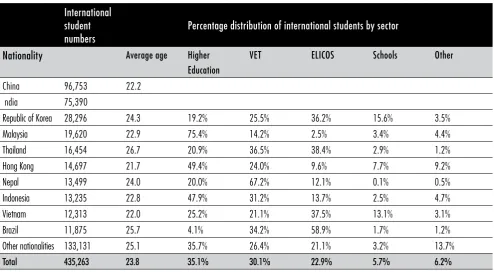
International student
numbers Percentage distribution of international students by sector
Nationality Average age Higher
Education
VET ELICOS Schools Other
China 96,753 22.2 40.9% 18.7% 24.8% 11.3% 4.3%
India 75,390 24.0 30.1% 51.1% 17.7% 0.1% 0.9%
Republic of Korea 28,296 24.3 19.2% 25.5% 36.2% 15.6% 3.5%
Malaysia 19,620 22.9 75.4% 14.2% 2.5% 3.4% 4.4%
Thailand 16,454 26.7 20.9% 36.5% 38.4% 2.9% 1.2%
hong Kong 14,697 21.7 49.4% 24.0% 9.6% 7.7% 9.2%
Nepal 13,499 24.0 20.0% 67.2% 12.1% 0.1% 0.5%
Indonesia 13,235 22.8 47.9% 31.2% 13.7% 2.5% 4.7%
Vietnam 12,313 22.0 25.2% 21.1% 37.5% 13.1% 3.1%
Brazil 11,875 25.7 4.1% 34.2% 58.9% 1.7% 1.2%
Other nationalities 133,131 25.1 35.7% 26.4% 21.1% 3.2% 13.7%
Total 435,263 23.8 35.1% 30.1% 22.9% 5.7% 6.2%
Figure 2.1: International students in Australia 2008 – top ten countries of origin source: reproduced from AEi (2009a).
2.4 international students in Australia and Melbourne In 2008, there were 435,263 international students living in Australia (AEI 2009d). International student enrolments in Australia account for 18% of all tertiary enrolments. This is the highest proportion amongst any of the Organisation for Economic Cooperation and Development (OECD) nations (OECD 2008: 348). In 2006, Australia ranked fifth amongst OECD recipients of international higher education students, after the US, UK, Germany and France (OECD 2009). International education now ranks as Australia’s third largest export industry, generating $14.2 billion in export income for Australia in 2007-8 (AEI 2008a).
Policy shifts in Australia’s approach to international education commenced in the late 1980s and coincided with the global growth of international education. This has resulted in enrolments of international students in Australia increasing very rapidly in recent years (AEI 2007). In the three years to 2008, the number of international students in Australia rose 36.7% from 317,909 in 2006 to 435,263 in 2008 (Access Economics 2009). As Chart 2.1 shows, this growth has been fluctuating but continuous.
0 50,000 100,000 150,000 200,000
0.00% 5.00% 10.00% 15.00% 20.00% 25.00% 30.00% 35.00% 40.00% Enrolments
% Share
Chart 2.2: International student enrolments by sector, June 2009. source: AEi 2009b.
and India with a 139 and 94% increase in enrolments respectively during 2008 (AEI 2009a). ELICOS sector enrolments increased by 23.4% in 2008 to 125,727. Again, enrolments of Indian students featured strongly in this growth, increasing 75.2% from 2007 (AEI 2009f).
2.5 Administration and regulation of international education in Australia
International education in Australia operates within a complex administrative and regulatory framework, comprising both federal and state government regulatory bodies and legislation. The overall regulatory framework is provided by the Commonwealth Education Services for Overseas Students (ESOS) Act 2000 and regulations adopted in 2001, the Commonwealth Register of Institutions and Courses for Overseas Students (CRICOS) and the National Code of Practice for Registration Authorities and Providers of Education and Training to Overseas Students, all administered by the Commonwealth Department of Education, Employment and Workplace Relations (DEEWR). The National Code of Practice, revised in 2007, requires providers of education services to international students to comply with 15 standards designed to protect the consumer rights and welfare of international students, including providing adequate orientation to enable students to adjust to life in Australia, information on health, emergencies, accommodation and legal services, access to support services and a clear complaints and appeals process (DEST 2007). Providers of education services to international students must be registered on CRICOS, with approvals and auditing managed through the state regulatory bodies. In Victoria’s case, the regulatory body is the Victorian Registration and Qualifications Authority (VRQA).Since 1990, all international students in Australia have paid the full cost of their education, unless they Asia is the dominant market for Australian international education
services: the top five countries of origin for international students in Australia are currently China, India, Republic of Korea, Malaysia and hong Kong: nine of the top ten countries of origin are located in Asia (AEI 2009a). The current average age of international students in Australia is 23.8 years (AEI 2009a). There are more male than female students (55.7% to 44.3%), due to the preponderance of male student enrolments from South Asian countries, including ‘India (75.5% of students were male), Nepal (71.3%), Sri Lanka (66.7%) and Bangladesh (84.4%) and Pakistan (92.3%)’ (AEI 2009a).
International students are enrolled in a range of institutions and education and training providers across Australia, including 39 universities, 68 Technical and Further Education (TAFE) colleges and 1066 private registered training organisations (RTOs) (DEEWR 2009). Enrolments of international students fall into four main sectors: higher Education, where university and non-university higher education institutions award degree or diploma qualifications; Vocational Education and Training (VET) where a range of TAFE Institutes and private RTOs offer vocational and industry training through certificate and diploma qualifications within the Australian Quality Training Framework; primary and secondary schools and English language intensive courses for overseas students (ELICOS). The VET and higher Education sectors combined take the vast majority (72.1%) of international student enrolments across Australia (AEI 2009c) as illustrated in Chart 2.2 below.
are in receipt of government or institutional scholarships (Australian Government 2008: 90). While there are complexities in estimating the average cost of education, Access Economics (2009) estimates that in the 2007/08 financial year, 370,238 international students spent approximately $6.5 million dollars on education including education fees, which equates to approximately $17,500 per student. This figure is not inclusive of all moneys spent in Australia on living and other costs necessary for sustenance while studying.
Student distribution by state
The total distribution of international students across Australia roughly mirrors that of the total Australian population. however, for some nationalities this is not the case and three nationalities have a distribution across Australia that varies significantly from the typical pattern:
• Almost half of all Indian students are studying in Victoria, which takes fewer students overall than NSW and only 24.8% of Indian students are studying in NSW;
• 68.5% of students from Nepal are studying in NSW;
• 62% of students from Thailand are studying in NSW (AEI 2009e). For other nationalities, such as China, the distribution is roughly in line with the total Australian population as shown by Figure 2.2 below.
International students in Victoria
The number of international students in Victoria has grown significantly in recent years. There were 144,034 student enrolments in Victoria to June 2009 (AEI 2009e), compared with 74,208 in 2002 (AEI 2002), an increase of 112% over seven years (Department of Innovation, Industry and Regional Development (DIIRD 2008a: 7). International education is now Victoria’s largest export, generating $4.45 billion in revenue in 2007-8 (ABS 2008).
Following the national distribution of international students across education sectors, international student enrolments in Victoria are largely in the higher education and VET sectors. There are 48 education institutes and organisations registered to deliver higher Education courses to international students in Victoria, including nine Victorian based
Nationality NSW VIC QLD SA WA TAS NT ACT Total %
China 48,031 42.9% 34,357 30.7% 11,926 10.6% 8,537 7.6% 5,149 4.6% 1,165 1.04% 83 0.07% 2,607 2.3% 111,855 23.9 India 22,227 24.8% 42,573 47.5% 14,191 15.8% 5,059 5.6% 4,810 5.3% 168 0.2% 89 0.09% 448 0.5% 89,564 19.2 korea, Republic
of (South) 12,72846.2% 4,73117.1% 6,48123.5% 1,4165.1% 1,3724.9% 3381.2% 130.04% 4471.6% 27,526 5.9
Malaysia 3,297
3,297 7,533 37.9% 2,035 10.25% 2,189 11.0% 3,632 18.3% 665 3.3% 15 0.07% 473 2.4% 19,839 4.2 Nepal 12,954 68.5% 3,605 19.0% 1,394 7.3% 384 2.0% 479 2.5% 23 0.12% 55 0.3% 24 0.13% 18,918 4.0
Thailand 11,550
62.2% 3,640 19.6% 1,737 9.3% 298 1.6% 923 4.9% 165 0.9% 49 0.3% 189 1.02% 18,551 3.7
Viet Nam 5,588
33.0% 7,354 43.5% 1,357 8.02% 1,005 5.9% 1,090 6.4% 114 0.7% 27 0.16% 373 2.2% 16,908 3.61 Indonesia 6,276 46.9% 4,443 33.1% 626 4.6% 298 2.2% 1,448 10.8% 19 0.14% 85 0.6% 190 1.4% 13,385 2.9 Brazil 5,956 50.3% 693 5.9% 3,610 30.5% 82 0.7% 1,460 12.3% 12 0.1% 6 0.05% 17 0.14% 11,836 2.5
Hong kong 3,804
33.9% 3,154 28.1% 1,662 14.8% 1,124 10.0% 1,110 9.9% 108 0.96% 7 0.06% 245 2.2% 11,214 2.4
Other nationalities 45,030 25.4% 31,951 25.0% 27,644 21.6% 4,838 3.8% 14,709 11.5% 1,107 0.9% 231 0.2% 2,301 1.8% 127,811 27.3
Total 177,441 144,034 72,663 25,230 36,182 3,883 660 7,314 467,407 100