Power Quality Improvement Wind/PV Hybrid
System by using Facts Device
Prachi P. Chintawar
1, Prof. M. R. Bachawad
2PG Student [EPS], Dept. of EE, Government College of Engg, Aurangabad, Maharashtra, India1
Assistant Professor, Dept. of EE, Government College of Engg, Aurangabad, Maharashtra, India2
ABSTRACT:In recent year, for electrical energy production renewable energy played more and more important role in system. Two or more different system use for making energy called hybrid system. In this paper hybrid system is a combination of wind energy and solar PV array with showing hybrid system is more important than indivisiual one. The proposed DC-DC boost converters are used for both sources i.e. wind and PV having less number of switches. Using PI controller, varying DC output are converted into constant. Hybrid system not only improve the power but also cost of the system. This paper proposed that the power quality improvement of hybrid system using D-STATCOM use in the system. To remove the harmonics in the current and give constant power supply. This proposed hybrid system simulates on MATLAB software.
KEYWORDS: DC-DC boost converter, D-STATCOM, PV array, SPWM inverter, Wind energy
I.INTRODUCTION
Day increasing the rate of fossil fuel is making the supply demand of electricity but impossible in remote areas. Renewable energy is the best option for developed countries to produced electric power in location where expensive to use the conventional grid supplies. Most of the researchers are research how to utilize energy and how to conserve energy in better way. For electric power generation Renewable hybrid system utilized. Separately any renewable also generation Electric Power but hybrid system give constant Power to load. Year by Year demand of electricity rapidly increasing. But Energy generation plant not provide that much of energy, so there will be increasing load shading Problems. Because of this reason Renewable energy sources have become import for these days. In number of application multiple renewable energy system are required to connect load or grid [1]. For good power management multiport DC-DC converters are proposed to hybrid application. To generate variable DC into fixed DC the DC-DC converter is use. There are many renewable hybrid energy system like PV-Hydro, PV-Fuel cell, PV-Biomass, Wind-PV etc. Pollution free and inexhaustible energy are present on earth that is the solar energy [4]. PV panel can extract the solar irradiance and produced large amount of power. Wind energy is the form of kinetic energy and this energy is convert into whatever customer demands. Windmill is use in many ruler area for water pumping. Wind turbines gives mechanical power and then with the help of generator gives electric power. In this paper, Wind-PV hybrid renewable energy connected to load for proper power management with uses only one controllable switch. Generation power from wind is AC that converted first into DC then applied DC-DC Boost converter. Similarly from PV is DC that directly applied to new converter. This Multiport DC-DC boost converter are control by PI/PID Controller. This PV-Wind Hybrid system provides electricity power to private house, firm house, apartment, street light, etc. electrical power depending on the need of where the site is use. Aim of my project to connect the wind-PV to dc link capacitor and fulfil all the needs from customer. The settling time be reduced than the indivisiual one with increasing output.
II.PROPOSED SYSTEM SUMMARY
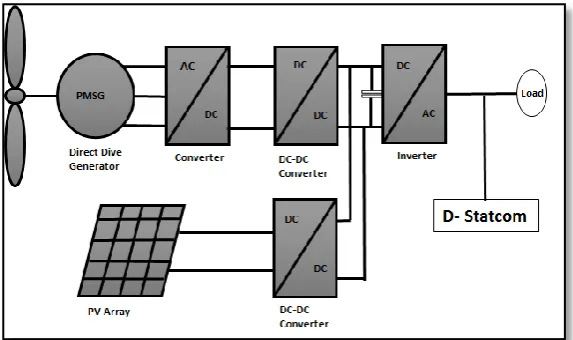
Because variable power produced from WIND-PV hybrid system, the output of inverter is variable. Harmonics are present in the system and inverting voltage is variable. Then implement Distribution side means load side is D-STATCOM (distributed static compensator) to reduced harmonics compensation and gives the voltage stability all time. Shunt connected reactive power compensation device that is D-STATCOM to capable generating and absorbing reactive power. The AC power is obtain from inverter and produced to non-linear load with having fluctuation. To reduce that fluctuation, D-STATCOM is very important to improvement of power quality of supply.
Fig. 1 Hybrid system model with FACTS device
III.SYSTEM COMPONENT MODELLING A. WIND SYSTEM
One of the quickly growing electricity in the world is wind generation. Wind is the form of kinetic energy that converted to first mechanical with the help of turbine. For generation of electricity from wind, system having PMSG, inverter, Rectifier. In the system wind turbine capture the energy from wind, and generator convert that mechanical energy into electrical. With the help of power electronics apparatus converts the power from low to high quality and it control the rotor generatorspeed. Power generated by wind turbine-
𝑃 =1
2𝜚𝐴𝐶𝑝(𝜆)𝑉
3 (1)
𝜚=Air density
𝐴= Area of swept out by turbine
𝑉=wind speed
𝐶𝑝(𝜆)=power coefficient
𝜆= tip speed ratio
Maximum value of power coefficient theoretically is 0.59. It is depend on two variable 𝜆 and pitch angle. Tip speed ratio is given by
𝜆 =𝑅𝑛𝜋
30𝑉 (2)
The power coefficient of the wind turbine-
𝐶𝑝 𝜆 = 𝐶1 𝐶2
𝜆1− 𝐶3𝛽 − 𝐶4 𝑒
−𝐶5
𝜆𝑖+ 𝐶
6𝜆 (3)
1 𝜆𝑖
= [ 1 𝜆 + 0.089−
0.035 𝛽2+ 1]
When 𝛽= 0 that is the pitch angle then 𝜆 = 6.325𝐶𝑝is maximum value
In this project use for generating power from wind use PMSG generator that is permanent magnet synchronous generator. One of the main advantage is that it does not need reactive magnetizing current. In synchronous generator, magnetic field is created by using permanent magnet, or conventional field winding. It can used with any gear box for direct drive application [3]. Application of PMSG in wind turbine Because of their property of self-excitation which allow an operation of high power and high-efficiency. Permanent magnet use typically low power generated application and having low-cost. DC-DC boost converter are used to converter the low power to high.
Fig. 2 Matlab wind model
B. PV SOLAR SYSTEM
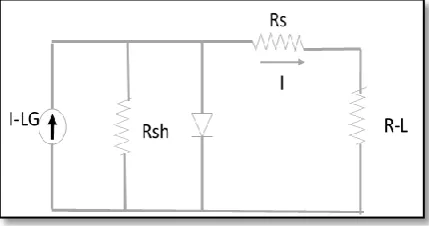
The corresponding characteristic of the solar cell is below:
𝐼 = 𝐼𝐿𝐺 − 𝐼𝐷− 𝐼𝑅𝑠ℎ (4)
I = ILG− IOS 𝑒𝑥𝑝 q
AKT V + IRs − 1 − V+IRs
Rsh (5)
𝐼: Cell output current. A 𝑉: cell output voltage 𝐼𝐿𝐺: Photon current. (A)
𝐼𝑜𝑠: PV cell’s reverse saturation current. (A)
𝐾: Boltzmann’s constant. (1.38 ∗ 10 − 23 J/°K) 𝑞: Electron charge. (1.6 ∗ 10 − 19 C)
𝑎, 𝑏: Ideality constant, between 1 and 2 𝑅𝑠ℎ: PV cell parallel resistance. (Ω)
𝑅𝑠: PV cell series resistance. (Ω)
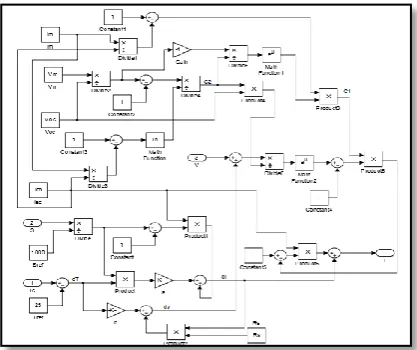
Under short circuit and open circuit condition mathematical model of PV cell has been created
Fig. 4 Mathematical PV model
C. DC-DC BOOST CONVERTER
DC-DC converter are operate as a Boost, Buck and Buck-Boost in different way with different voltage output. There is one MOSFET/IGBT used for ON-OFF control. ON-OFF control is depend on the switching circuit.
1. Open loop system 2. Closed loop system
Fig. 5 DC-DC Boost converter
D. PI CONTROLLER
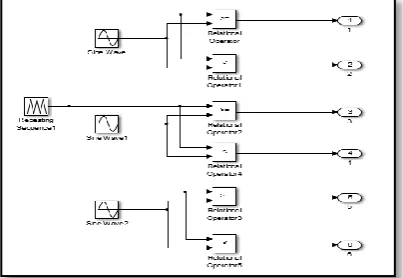
Produced rectified voltage maintain constant at all time with DC-DC boost converter. The boost converter control by PI controller. In close loop controller the output value is compared with reference value and error calculate. These error goes to PI controller and give the constant output. These constant value compared with repeating sequence to generate gate pulse. Gate pulse give the duty cycle of MOSFET/IGBT to control the output.PI controller does not give fast response. But the good result is given than PID because there’s one addition function derivatives [1].
Fig. 6 PI controller
E. SPWM INVERTER
Low frequency sinusoidal pulse compare with high frequency repeating sequence known as a carrier signals. Comparison between the carriers based signal or repeating sequence and sinusoidal signal known as SPWM method i.e. sinusoidal pulse width Modulation. In this method controlled AC output voltage with adjusting the ON-OFF period by giving the fixed DC to inverter. In SPWM i.e. sinusoidal pulse width modulation gives the output AC 𝑉𝑚𝑎𝑥 =
F. D-STATCOM
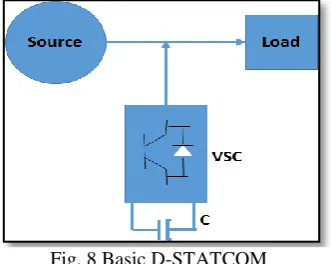
Capable to generating and absorbing reactive power the D-STATCOM is a controlled reactive sources. D-STATCOM includes the VSC i.e. voltage sources converter and DC link capacitor connected in parallel or shunt. In practical D-STATCOM there is some losses because of transformer and converter MOSFET/IGBT. These losses take active power from AC lines and difference occur in the VSC voltage and AC voltage. The aim of the D-STATCOM is to control the voltage at a PCC i.e. power point coupling where the lode is connected to the system.
VSC are connected in shunt with a many function ref. paper [7] 1. Voltage regulation
2. Reactive power compensation 3. Eliminations harmonics 4. Power factor correction
There are many method to Extraction of current component. But there is Instantaneous reactive power theory i.e. PQ theory is used. Instantaneous reactive Power theory is based on reactive and real power in time domain. It is also valid for steady state and transient operation.
Fig. 8 Basic D-STATCOM
IV. OVERALL SIMULATION A. Hybrid system simulation model
B. Matlab model for PQ Theory
Fig. 10Block diagram for PQ theory
C. Matlab model for hysteresis loss current control
Fig. 11 Hysteresis loss current control
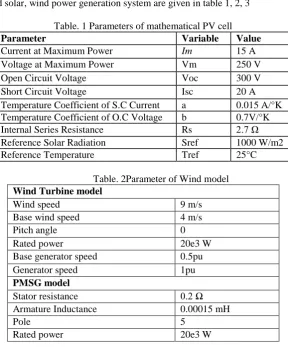
Input data use for hybrid solar, wind power generation system are given in table 1, 2, 3
Table. 1 Parameters of mathematical PV cell
Parameter Variable Value
Current at Maximum Power Im 15 A
Voltage at Maximum Power Vm 250 V
Open Circuit Voltage Voc 300 V
Short Circuit Voltage Isc 20 A
Temperature Coefficient of S.C Current a 0.015 A/°K Temperature Coefficient of O.C Voltage b 0.7V/°K
Internal Series Resistance Rs 2.7 Ω
Reference Solar Radiation Sref 1000 W/m2
Reference Temperature Tref 25°C
Table. 2Parameter of Wind model
Wind Turbine model
Wind speed 9 m/s
Base wind speed 4 m/s
Pitch angle 0
Rated power 20e3 W
Base generator speed 0.5pu
Generator speed 1pu
PMSG model
Table. 3Parameter use in simulation
Load 16e3 W,0.8 pf,50 Hz,400 V
DC-DC boost converter C=1e-3 F L= 0.005 H DC link capacitor 20e-3 F Transformer 20e3 W , 50 Hz
Winding 1=100 V Winding 2=250 V Rm=Lm=200
V.RESULT WITH DISCUSSION
Output Power of wind take more time to constant than the hybrid Wind-PV. The settling time for wind is 1.2 sec and for hybrid wind PV is to take 0.4-0.6 sec, so hybrid generation of power is more important than the indivisiual one. Power become increase with the help of PV i.e. solar plant. Because when in winter the sun become low and wind high in summer vice-versa. In part A. wind power shown and then in part B. hybrid generation of power without D-STATCOM and at last in part c. hybrid generation of power with D-D-STATCOM.
A. Wind generation system
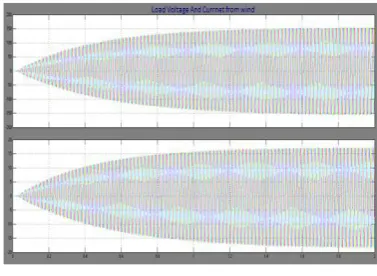
Fig.12Load voltage and current from wind system
In the fig. 12, it shows the graph of load voltage and current from wind system. Because of generator is use in wind system take more time to start,so settling time increase. To reduce that settling time PV system or Battery is use.
B. Hybrid Wind-PV generation system
In the fig. 13, it shows that the graph of hybrid system wind-PV. Because of PV hybrid power increases than indivisiual wind system. Harmonics present in the system because hybrid system without D-STATCOM i.e. without facts device
C. Hybrid Wind-PV system with D-Statcom
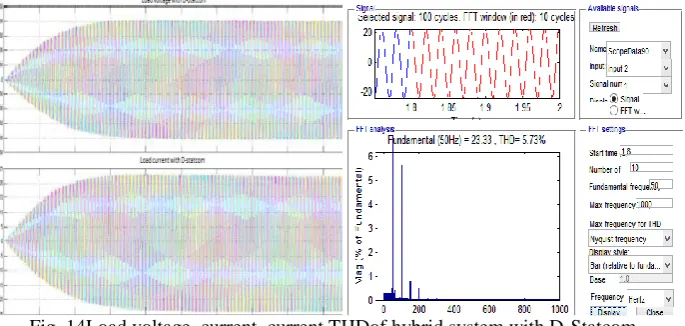
In the fig 14. Shows below, this hybrid system wind-PV with D-STATCOM. To reduce harmonics present in the system some facts device is used. For variable generation of power, D-STATCOM is useful device to reduce harmonics and maintain power in both side.
Fig. 14Load voltage, current, current THDof hybrid system with D-Statcom
VI.CONCLUSION
To improvement power quality of the hybrid system it needs the study of all controllers and facts devices. In this work, a fast and cost effective D-Statcom is proposed for reducing the problems of harmonics and maintain AC voltage at both side in distribution system. The result of the simulation are shown with and without D-Statcom. Hysteresis loss current control used to find the error signals which is the difference between the reference current and the load current to trigger the switches of an inverter using PWM (pulse width modulation). The D-Statcom use in the distribution system without any difficulties and injected voltage component to correct the supply voltage by keeping the load voltage constant. In this study, the D-Statcom is reduced the ability of harmonics in the system, total harmonics reduction has been proved by implementation of simulation. The D-Statcom using the PQ theory with Hysteresis loss current control with RL load. Through analysis and simulation, it is shown that the proposed system is more compressive than the other conventional controller. According to IEEE standards THD should be less than the 10%. With using D-Statcom in distribution side the THD are reduced up to 5.73%.
REFERENCES
[1] Dr. T. Govindaraj and Mr. K. Bharanidharan, “Stability and Reliability Improvement in Solar Wind Hybrid Power System with Battery Energy Storage Station,” International journal of emerging trend in electrical and electronics, vol. 10, no. 3, pp.49-57, April 2014.
[2] Ahmed M. Atallah, Almoataz Y. Abdelaziz, and Raihan S. Jumaah,” Implementation of perturb and Observe mppt of pv system with direct Control method using buck and buck boost Converters,” Emerging trend in Electrical and Instrumentation Engineering:An international journal,vol. 1, no. 1, pp.31-45, Feb. 2014.
[3] Prerna Badoni, S. Bhanu Prakash,” Modeling and Simulation of 2 MW PMSG Wind Energy Conversion Systems,”IOSR Journal of Electrical and Electronics Engineering,vol. 9, no. 7, pp.53-58, Jul-Aug. 2014
[4] Gilbert M. Masters, Renewable and Efficient Electric Power Systems, A JOHN WILEY & SONS, INC., PUBLICATION, Canada, 2004. [5] Rajesh Kumar Ahuja, Amit Kumar,”Analysis, Design and Control of Sinusoidal PWM Three Phase Voltage Source Inverter Feeding Balanced
Loads at Different Carrier Frequencies Using MATLAB,” International Journal of Advanced Research in Electrical, Electronics and Instrumentation Engineering, vol. 3, no. 5, pp.9557-9963, May 2014.
[6] S.Angalaeswari, M.G.Thejeswar, R.SanthanaPoongodi, W.ValeedBasha, P.Sasikumar,”Power Quality Improvement of Standalone Hybrid Solar-Wind Power Generation System using FACTS Devices,” vol. 3, no. 3, pp. 7987-7992, mar. 2014.