Optimized Interference Canceling for Co-located
Base Station Transceivers
Shabbir Ahmed,
Student Member, IEEE,
and Mike Faulkner,
Member, IEEE
Abstract—Strong jamming signals from co-located transmit-ters can cause intermodulation and desensitization in receiver circuits. Cancellation circuits can remove the interference, but generate noise and distortion of their own. We analyze such a system using a Signal to Interference and Noise Ratio measure. We show that the cancellation coupler can be optimized to maximizes the Signal to Interference and Noise Ratio. The optimum coupler value is proportional to the expected level of the jammers. A hardware prototype reduced the jammers by 46dB in a controlled experiment and by 25dB in an over-the-air experiment. A convergence time of 8.4ms was sufficient for this application.
Index Terms—Co-location, Intermodulation distortion, Interference suppression, Land mobile radio equipment, Radio receivers.
I. INTRODUCTION
C
O-LOCATION of multi-platform transceivers on one common site has been a major challenge for radio frequency (RF) systems in different fields of communication. Government armed forces with many different platforms are often forced to share a small site because of their mobile nature (e.g. battleships, aircrafts, and vehicles) [1] [2]. RF platforms range from VHF/UHF dual-band multi-mode for voice and digital communications, UHF satellite communi-cations transceiver, UHF transceiver for line-of-sight tactical communications, GPS receivers, radars, surveillance systems, and others. They all have the potential to interfere with each other because of the close proximity of the antennas. In recent times co-location has been an area of concern for many commercial wireless service providers. Service providers are having to deploy a larger number of base stations every year to provide for the fast growing subscriber base. In addition to this there is a growing trend for base station consolidation amongst different service providers. Here many service providers share the same site and this reduces maintenance, rental, logistics and other costs. Also community concerns such as visual pollution and health are making it difficult to establish new green field base station sites.Co-location of base stations helps in reducing the near far problem at the user equipments (UE) because both desired and unwanted signals have a similar signal strength. This allows UEs to have reduced filtering and dynamic range requirements. But, co-location is a major disadvantage for the base station receivers themselves; they have to receive weak desired signals in the presence of high power transmit signals from neighboring base station antennas. The spectrum can
The authors are with the College of Engineering and Science, Victoria University, PO Box 14428, Melbourne, Victoria 8001, Australia (email: [email protected], [email protected]).
get congested very quickly because each additional antenna can carry many transmissions at different carrier frequencies. Multi-carrier power amplifiers or multi-coupling networks of cavity filters are often used to combine the high power signals prior to the antenna. At the victim receiver, such high power transmit/jamming signals cause desensitization and blocking [3] [4] by forcing its circuits into saturation. A more significant concern is the formation of intermodulation products.
The low noise amplifier (LNA) and mixer stages are most susceptible to large jamming signals. Odd order and especially third-order intermodulation products (IM3) are generated and cause spectral expansion of the jamming signal into its ad-jacent channels, which decays with frequency. If more than one high power jammer exists then intermodulation spurs are generated at multiples of the carrier separation. These can fall on the receive channel. Even order products are caused by circuit imbalances or self-mixing in the mixer. In the case of a direct conversion receiver, the second-order intermodulation products fall directly on the baseband irrespective of the jammer’s frequency [5].
One of the issues of co-location is that the early occupier of the site initially experiences none of these problems. As more transmitters are added, sensitivity degrades. A possible solution is to replace the victim transceiver with one that has a higher dynamic range. However, this is expensive and the initial occupier would be very reluctant to pay. Therefore, there is a need for some method that can mitigate the problem without requiring a modification or any intrusion into the existing transceiver hardware. A potential solution is to reduce the powers of the jamming signals as seen by the victim receiver.
Netcom [6] proposed a non-intrusive solution that involved the placement of band pass filters in front of the LNA to admit only the desired signals. However, complex and expensive high Q cavity filters with low insertion loss would be required to sufficiently attenuate the large transmitter signals, which, in some cases, have output powers of +47dBm (50W) [7]. The problem is more difficult if the filters have to be tunable.
Primary Antenna
e Coupler 1
pri
x s Coupler 2
e
g
r Victim Receiver
Reference Antenna
ref
x Gain-Phase Adjuster
DAC
ADC
Control Remote
Terminal
Colocated Jammer (Aggressor)
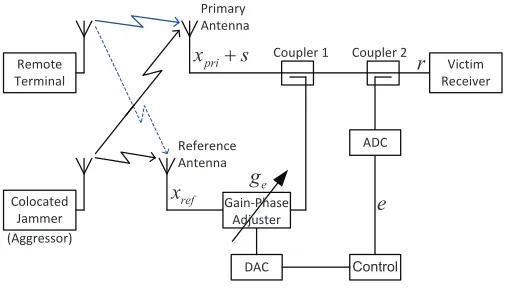
Fig. 1. An Adaptive Cancellation System
UE devices operating in frequency division duplex (FDD) also have the problem of the transmitter acting as an aggressor on to the receiver. The regular solution is to use passive SAW (surface acoustic wave) duplexing filters, but their power handling is not high enough when used in base station en-vironments. An alternate approach taken by authors of [8] and [9] is to use cancellation loops. A direct feed from the transmitter is used in an adaptive feed-forward cancellation loop to effectively remove the interfering transmit signal and noise from the receiver. Both papers publish good cancellation performance, however neither of them consider noise and distortion generated in the canceling loops themselves. This is a key factor in any practical deployment, particularly when power levels are high.
In a co-located base station scenario each of the transceivers are independent and a direct feed from co-located aggressor transmitters is not always possible. In this paper we consider a related canceling technique that is similar to adaptive noise cancellation [10]. Our paper describes an adaptive cancellation system that is capable of mitigating interference from one such co-located antenna, as depicted in Fig. 1. The primary antenna picks up the desired signal (s) with the jamming signal (xpri). The reference antenna is directed to pick only the jamming signal (xref) (or more practically have a much larger interference to signal ratio than the primary). The reference input is then gain and phase adjusted and coupled into the primary path to cancel the jamming signal.
The cancellation system in mitigating large co-located jam-mers effectively increases the receivers capacity to handle strong signals. However, the effective distortion and noise of the total system now depends on the characteristic properties of the gain-phase adjuster (GPA) in the reference path. Ideally the GPA should not produce any distortions or noise, but in reality that is not possible. Hence, the goal is to limit the distortion and the noise generated by the reference path to a level that is lower than the distortion and noise generated by the receiver on its own without the cancellation system.
As in most RF circuits it is possible to trade off noise for distortion and vice-a-versa. In this system it isCoupler1that determines the trade-off [11]. If the coupling is weak then a larger canceling signal,xref, is needed to removexpri, which toughens the IP3 (third order intercept point) requirements for the canceling branch. On the other hand a strong coupling
coefficient reduces the desired signal,s, and contributes to an increase in the receiver noise figure. The cancellation coupler is therefore a compromise between achieving higher values of IP3 and lower values of noise figure. To our knowledge no analysis has shown what the optimum coupling should be.
In this paper we carry out a novel signal to interference and noise ratio (SINR) analysis on the cancellation system. We develop an expression for the optimum coupler value that maximizes the SINR. In addition we describe an au-tomated cancellation system that studies the energy at the output of the cancellation using an Universal Software Radio Peripheral (USRP) [12] and minimizes the energy using an one dimensional iterative search algorithm. We then carry out experiments to show that our theoretical analysis aligns with practical results. A significant improvement in SINR can be achieved using this cancellation system. Further, an over-the-air setup illustrates the effects of the system on the wanted signal.
Section II derives theoretical expressions for the SINR of the system and then Section III derives an equation for the optimum coupler. Section IV describes the hardware setup and convergence technique of the cancellation system. Section V compares SINR results from the test-bed with the theoretical predictions. Section VI addresses practical issues of the over-the-air deployment. And finally Section VII is the conclusion.
II. DERIVATION OFSIGNAL TOINTERFERENCE ANDNOISE
RATIO(SINR)FOR THECANCELLATIONSYSTEM
The compromise between the level of intermodulation dis-tortion and noise at the receiver can be evaluated simultane-ously with a single parameter, i.e. the SINR. In this section we develop expressions for the desired signal, noise and third-order intermodulation distortion from which the SINR can be evaluated.
In this paper it is to be noted that lower case variables represent complex envelop voltages that characterizes both the amplitude and the gain of the signal, and upper case variables represent respective powers, e.g. S = E(|s|
2)
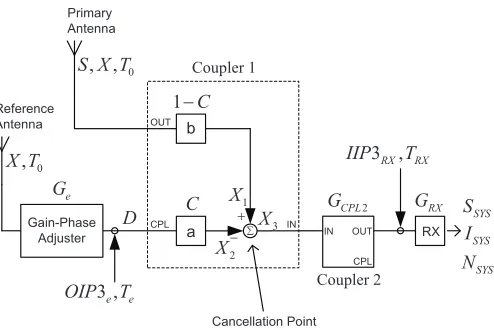
2 . In order to analyze the circuit, the proposed system in Fig. 1 is redrawn withCoupler1andCoupler2restructured as shown in Fig. 2. The samplingCoupler2extracts the feedback signal for the convergence algorithm. The signal of interest for the feedback circuit is the residue of the canceled jamming signal,X3. This signal is not required to be totally eliminated provided it is reduced to a level that produces no significant intermodulation in the receiver. As such the feedback signal is still large and so there is no undesirable consequences if it is further attenuated through Coupler2. In fact it is desirable to have a weak coupling value so that the sensitivity of the receiver to the wanted signal,S, is least effected. Here we assume a coupling value of ≤ −20dB, such that it has negligible through path loss (ie.GCP L2≈1).
Coupler1 cancels the jammer. The coupling path gain is
Cand hence the through path gain is1−C. We note that the domain of C is limited to0 < C <1. Couplers are passive devices and are assumed not to produce any distortion.
Primary Antenna
Reference Antenna
RX
3 ,e e
OIP T
3RX, RX
IIP T
b
a
1 C
e
G
RX
G 0
,
X T
0
, ,
S X T
!
C
Gain-Phase Adjuster
1 X
2 X
3 X "
Cancellation Point
D
SYS
I
CPL
2
CPL
G
OUT
CPL IN
SYS
N
SYS
S
Coupler 1
IN OUT
Coupler 2
Fig. 2. Signal to Interference Noise Analysis
of the receiver is GRX. However, the output IP3, OIP3e, and the noise temperature, Te, of the GPA is specified at its output, to be compatible with data sheet specifications of some devices, as well as to isolate the system optimization from the components in the reference path. Note, the effectiveGe, OIP3eandTeof the reference arm is often the combination of a number of components including attenuators, amplifiers and the vector modulators. These components can be optimized separately once the output and input characteristics of the reference arm have been decided. If manufacturers of vector modulators specify distortion or noise at the device output, then they become independent of the actual gain setting, which simplifies the analysis.
We now develop expressions for the interference, ISY S, noise, NSY S, and signal, SSY S, at the receiver output.
A. Third-order Intermodulation Distortion at the Receiver
For simplicity we consider that both the primary and the reference antenna pick equal powered jamming signal, i.e.
XP RI = XREF = X. At the cancellation point, the can-cellation signal (x2) is subtracted from the jamming signal
(x1) to give the resultant signal (x3 = x1−x2). X3 is the power of the resultant signal. The study here considers that the cancellation system has converged and perfect cancellation is achieved at the cancellation point, i.e.X1=X2 andX3= 0. Hence, the GPA gain,
Ge= 1−C
C (1)
When X3 = 0 or significantly small, the receiver does not produce any third-order intermodulation distortion com-ponents, thus distortion components are only produced at the GPA. The third-order intermodulation distortion [4], D, produced at the GPA output is,
D= Ge
3.X3
OIP3e2
(2)
Substituting for Ge from Equation (1), the third-order intermodulation distortion at the receiver output is given by,
ISY S=
GRXX3(1−C)3 OIP3e2C2
. (3)
B. Signal and Noise at the Receiver
As mentioned earlier the primary antenna is aimed at picking the desired receive signal, hence, the signal level at the receiver output is given by,
SSY S=S(1−C)GRX (4)
The primary and the reference antenna noises are uncorre-lated to one another. They are white noise and have a noise temperature of T0 (standard noise temperature, 290K). Thus the total noise at the receiver output is given by,
NSY S=k.B.GRX(TRX+TeC+T0) (5) wherekis the Boltzmann’s constant (1.38 x10- 23J/K) andB
is the signal bandwidth (Hz).
All of the above three equations are affected by the coupler coefficient, C. Both the signal, SSY S and the interference ISY S tend to zero as C → 1. Surprisingly, the signal to interference ratio improves, but unfortunately this does not apply to the SINR which includes the effect of noise.
C. Signal to Interference and Noise Ratio
Combining Equations (3, 4 and 5), the signal to interference and noise ratio at the receiver is as follows,
SIN RSY S= X3 (1−C)3 S(1−C)
OIP3e2C2+k.B(TRX+TeC+T0)
(6)
and is a function of the dynamic range of the reference path, the excess noise temperature of the receiver, the power of the jammer and coupler value. In the next section we determine theCoupler1 value that gives the highest SINR.
III. OPTIMUMCOUPLING
For a certain strength of the jamming signal, X, we can optimize the coupler valueCto give the largest possible SINR. We differentiateSIN RSY S with respect toC,
dSIN RSY S
dC =
S.OIP3e2.C(2(1−C)3X3−k.B.OIP3e2.C3(T0+Te+TRX))
(k.B.OIP3e2.C2(T0+CTe+TRX)+(1−C)3X3) 2
(7)
Setting dSIN RSY S
dC = 0, for0< C <1gives,
1−C
C =
3 r
k.B.OIP3e2(T0+Te+TRX)
2X3 (8) which has one real root and two imaginary roots.Cis a power gain and must be real, therefore there is only one extremum. Thus,
Copt=
21/3X
Q1/3+ 21/3X (9)
where,
Q=k.B.OIP3e2.(T0+Te+TRX) (10) Inspecting Equation (6), we note that SINR is always positive, and has a value of 0 at both ends ofC’s domain.
SIN RSY S>0 C→0, SIN RSY S →0 C→1, SIN RSY S →0
Hence, Copt gives the maximum value ofSIN RSY S. From, Equation (9),Coptis a function ofXandQ.X is the power jamming signal. When X is large the third term starts dominating andCoptasymptotes to1, i.e.,Copt(dB)→0in the log scale, as shown in Fig. 3. Further, using Taylor’s series,
Copt=
21/3
Q1/3X−
22/3
Q2/3X 2+ 2
QX
3− 24/3
Q4/3X
4+... (12) When X is small the first term in Equation (12) dominates and there is a linear relationship between X and Copt with a slope of1 in the log scale (i.e. Copt(dB) is proportional to X(dB)), as shown in figure,
Copt(dB) =−1
3Q(dBW
3) +X(dB) + 1(dB)
(13)
Qis a function of the dynamic range components (OIP3e and Te) of the reference path and the noise figure (TRX) of the receiver; Q has a unit of Watts3. Note, Q is not dependent on IIP3RX, since we assume perfect cancellation and therefore no jamming signal reaches the receiver. In the linear region increasing Q by 10dB decreases Copt by
31
3dB. The value of Q characterizes the reference path and the sensitivity of the receiver. An increase in Q makes noise in the system more dominant; a 10dB increase in Q could either be a 10dB increase in noise,kB(T0+Te+TRX), or a 10dB increase inOIP3e2, which signifies a 10dB decrease in distortion Equation (2); in either case the noise to distortion ratio increases by 10dB. Vice versa, a decrease in Q makes distortion in the reference path more dominant.
The effect of the receiver noise figure is also covered in these equations. Receivers with low sensitivity (highTRX) will have a highQvalue, implying a larger jamming signal for the same optimum coupler value. This is intuitively correct since a high effective noise floor allows higher distortion levels.
IV. HARDWARESETUP ANDCONVERGENCE
A two-tone test is carried out on the proposed cancellation system to further study the SINR characteristics of the system and verify our theory with practical results.
In order to have a controlled experiment that focuses on the actual SINR performance of the cancellation scheme, signals were all directly coupled into the system, no antennas were
Colocated Jammer, X(dBm)
-40 -30 -20 -10 0 10 20
Q=-60dBW3
Q=-70dBW3
Q=-80dBW3
-50 -45 -40 -35 -30 -25 -20 -15 -10 -5 0
C
o
u
p
le
r,
Co
p
t
(d
B
)
Fig. 3. Optimum Coupler,Copt, as a function of the jammer,X, and the
Qvalue (Qis primarily a function of the dynamic range of the components in the reference path).
Primary Path
Rx
Amplifier Mini-Circuits ZHL-42 Power
Splitter
Coupler 1 Coupler 2
-10dB -20dB
I Q
Vector Modulator Hittite HMC630LP3E
DAC
Computer
ADC (USRP)
Reference Path
USB USB
Signal Generator B
Spectrum Analyzer
!
e n
Mini-Circuits Monolithic Amplifier
ERA-3 Signal
Generator A
-20dB
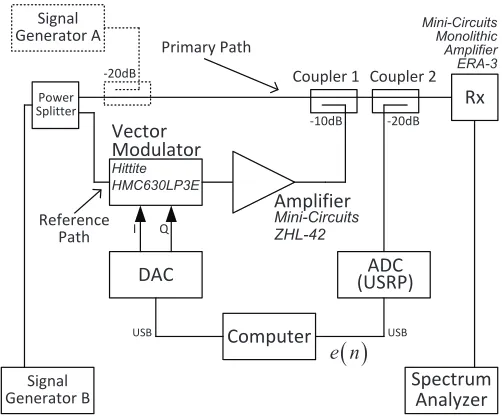
Fig. 4. Laboratory Setup: Signal Generator A generates the desired signal,
S, and Signal Generator B generates the two tone jamming signal which is split into two with the Power Splitter to have equal levels of jammer,X, on both the Primary and the Reference Path.
used. Fig. 4 shows the two tone test setup of the proposed cancellation system. The gain-phase adjuster is realized with the use of a vector modulator [13] and an amplifier [14]. The vector modulator provides the required attenuation on the reference path when the jamming signal is larger than that of the primary. The amplifier provides the gain required to compensate for the coupler and the amplification required to eliminate the jammer in the primary path. An attenuator in front of the GPA might also be required if the copy of the jamming signal on the reference path is high.
The adaptive cancellation process works by learning the energy at the output of the cancellation and minimizing it. We use a−20dB coupler (Coupler2) to couple out a sample from the cancellation output; a USRP is used to measure the sample in IQ components within a computer, then an algorithm evaluates the energy of the sample, the algorithm takes the energy as a cost function and minimizes it by iteratively changing the input voltage to the vector modulator using a DAC. The cost function is given by,
0 5 10 15 20 25 30 35 40 45
C
os
t
F
unc
ti
on,
E
(dB
)
Number of Iterations
70 80 90 100 110 120 130
A
Unit dBm
1AVG 1SA
RBW 10 kHz VBW 10 kHz SWT 50 ms Ref Lvl
15 dBm Ref Lv
15 dBm
RF Att 40 dB
C
a
n
c
e
lla
tio
n
o
f 4
6
.3
4
d
B IM3 products
below the noise floor
without cancellation system with cancellation system
-85 -80 -70 -60 -50 -40 -30 -20 -10 0 10 15
200 kHz/
Center 920 MHz Span 2 MHz
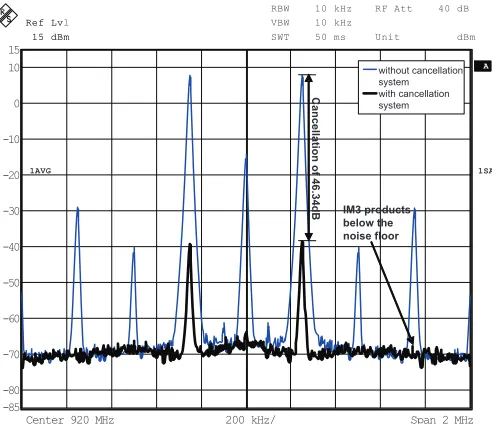
Fig. 6. Spectrum at the receiver with and without the proposed cancellation system during a two-tone test with an input power of -10dBm. The desired signal is not included.
CF =
1500
X
n=1
en·e∗n (14)
where e(n) is a complex baseband sample from the USRP working as an ADC. If we assume the noise, signal and the distortion products are uncorrelated then,
CF =
(1−C) +GeC−2 p
Ge(1−C)C
X
+SSY S+ISY S
GRX +k.B(TeC+T0)
!
C2
(15) where the coupling path gain of Coupler2, C2 = −20dB, and reaches a global minimum of,
CFmin=
S
SY S+ISY S GRX
+k.B(TeC+T0)
C2 (16)
when Equation (1) applies.
The DAC has a resolution of 1mV, the algorithm iterates and minimises energy (CF) in steps of 100mVs and then 10mVs and finally 1mV. Fig. 5 shows such a learning curve during a two-tone test. The cost function takes about 45 iterations to reach its minimum value. Each iteration takes
187.5µs to obtain 1500 samples for the CF estimate at a USRP sample rate of 8M samples/s. The total convergence time is a respectable 8.4375ms.
Fig. 6 illustrates the spectrum at the receiver with and without the cancellation system. The IM3 products are reduced below the noise floor of the spectrum analyzer. The automated cancellation system achieves a cancellation of about 46dB, which is 7dB less than what was achieved with a manual cancellation system [11]. One of the causes is a large noise component, k.B(TeC+T0)C2, in the CF due to the wide bandwidth of the measuring system (in this case 8MHz). A wide-band receiver is needed in the feedback loop since the exact frequency of the jamming signal is unknown. An
-40 -35 -30 -25 -20 -15 -10 -5 0 5 10 -20
-10 0 10 20 30 40
50 Xd=-14.1 Xd=-4.6 Xd=1.3
Colocated Jammer, X (dBm)
S
IN
R
(d
B
)
Theory without cancellation system
Theory with cancellation system with -10dB coupler Practical measurements with -10dB coupler Theory with cancellation system with -20dB coupler Theory with cancellation system with -3dB coupler
Fig. 7. SINR vs Jammer with Different Couplers. Noise bandwidth, B = 5MHz.
alternate solution using a frequency scanning narrowband receiver would also work.
V. RESULTS
Fig. 7 compares the SINR of the receiver without the cancellation system (from hereon referred to as the ‘do-nothing’ system) to the receiver with the cancellation system over a range of co-located jammers from -40dBm to 10dBm. The theoretical calculations are based on a receiver with
GRX = 19dB, input IP3, IIP3RX = 6dBm and a noise factor,FRX = 2.7dB; these specifications align with the Mini-Circuits Monolithic Amplifier ERA-3 [15] that we use for our practical measurements. Similarly, for theOIP3e value and the Te value of the GPA we refer the combined specification values of the vector-modulator (Hittite HMC630LP3E) and amplifier (Mini-Circuits ZHL-42) to the amplifier output.
At low jamming levels the ‘do-nothing’ system has better SINR performance than the proposed cancellation system. This is because of additional noise from the reference path and the reduction in signal amplitude caused by the coupler. But at higher jamming levels increasing receiver distortion in the ‘do-nothing’ system causes it’s SINR to fall below that of the cancellation system. The cancellation system removes the jamming signal on the primary path before the receiver and hence there is no receiver distortion. The distortion in the system then depends on the combined IP3 properties of the components in the reference path. Eventually reference path distortion becomes dominant as X continues to increase and the cancellation system enters the waterfall region. The slope of all curves in the waterfall region are the same, so despite worsening SINR’s the canceling system always outperforms the ‘do-nothing’ system.
dominated by the noise term. The SIN RSY S value forms a plateau at,
SIN RSY S|plateau=
S(1−C)
k.B(TRX+TeC+T0)
. (17)
As the jamming levels start getting larger, i.e. X > Xd, the distortion component dominates the SINR value,
SIN RSY S|waterf all=S(1−C) ,
X3(1−C)3
OIP3e2C2
(18)
and we have the waterfall region on the logarithmic graph with a slope of three.
Fig. 7 also compares the SINR performances with different coupler values. Consider the middle curve that is optimized for a jammer of Xd=−4.6dBm and uses a−10dB coupler (i.e. C = −10dB). A higher coupling factor on Coupler1
requires less gain on the GPA for the cancellation. Hence, smaller distortions are produced for the same level of jammer. This is illustrated by the −3dB coupler line, optimized for
Xd= 1.3dBm. Better SINR performance is obtained forX >
0dBm. But this performance enhancement comes at a price, higher coupling allows more noise from the reference path and hence the noise dominated plateaus are at lower SINR levels. The figure illustrates the plateau of the −3dB coupler at9dB SINR which is less than the plateau of the −10dB coupler at 18.6dB SINR. Vice versa, a−20dB coupler that optimizes forXd=−14.1dBm gives lower SINR performance than the
−10dB coupler system for X >−10dBm; and has a plateau at29dB SINR better than18.6dB SINR of the−10dB coupler. SINR measurements were performed on the hardware test-bed to corroborate the analysis results. A−10dB cancellation coupler (Coupler1) was used. The spectrum analyzer was used to measure the signal, noise and distortion components at the output of the receiver’s LNA. The two tone jamming signal was generated, with powers ranging from -25dBm to 8dBm to measure the IM3 products. The above were used to calculate the SINR and plotted against the input jamming signal levels, X as shown by the dotted line of Fig. 7. Our practical measurements fell slightly short of the theoretical results of the system; this is because of distortion products produced by the signal generator themselves and difficulties of measuring distortion levels close to the spectrum analyzer’s own noise floor. These extra distortion products affect the result mostly in the transition region from a noise dominated plateau to a distortion dominated waterfall, where neither the noise or the distortion from our system is dominant. Apart from the transition region, the results agreed with the analysis in the plateau region and waterfall region to within 1dB.
VI. PRACTICALISSUES
A key issue in the practical realization of the technique is to resolve the most probable situation where the reference antenna picks up a copy of the desired signal (sref) along with the copy of the jamming signalxref. This component (sref) of the desired signal (shown dotted in Fig. 1) in the reference path may cause the cancellation of the desired signal (s) at the re-ceiver. As such, the scheme requires the signal to interference
d2
d1
Primary Antenna Reference Antenna
DAC
Vector Modulator
Amplifier
Coupler 1 Coupler 2
Aggressor Antenna & USRP Victim USRP
ADC (USRP)
GNURADIO Software
Fig. 8. Experimental Setup
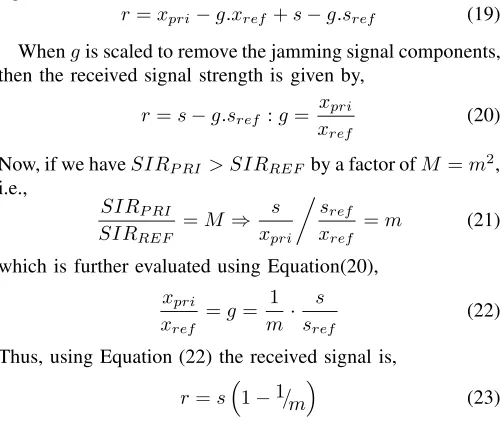
ratio on the primary antenna (SIRP RI = S/XP RI) to be adequately more than the signal to interference ratio on the reference antenna (SIRREF = SREF/XREF) to avoid any major cancellation of the desired signal.
At the receiver, after the reference path is scaled by the coefficient g and subtracted from primary path the received signal is,
r=xpri−g.xref +s−g.sref (19) Whengis scaled to remove the jamming signal components, then the received signal strength is given by,
r=s−g.sref :g= xpri xref
(20)
Now, if we haveSIRP RI > SIRREF by a factor ofM =m2, i.e.,
SIRP RI
SIRREF
=M ⇒ s xpri
sref xref
=m (21) which is further evaluated using Equation(20),
xpri xref =g=
1
m· s
sref (22)
Thus, using Equation (22) the received signal is,
r=s1−1/m (23)
The phase of m determines whether or not the received signal, r, is canceled or boosted. This phase is determined by the uncontrolled incoming components of the desired signal. The worst case phase angle arg (m) = 0 is assumed. The nulling of the jammer will not effect the received signal if
reference antenna. Alternatively, if this is not practical, we take advantage of the fact that the desired signal is generally weak and far away from the base station, in which case its average signal strength will be the same on both the primary and the reference antennas. Therefore the SIRs can be changed by altering their distances to the aggressor antenna; normally, we decrease the SIR on the reference antenna by mounting it closer to the aggressor than the primary antenna. Alternatively, the reference antenna could be made directional and pointed at the aggressor. In the experiment of Fig. 8 we use omni-directional discone antennas and mount the reference antenna d1 = 0.15 meters from the aggressor, whereas the primary/victim antenna is mounted d2 = 1.15 meters from the aggressor to give an SIR ratio of M = (d2/d1)2 = 59 (based on the 1/d2 path loss model). According to Equation (23), the worst case cancellation on the desired signal, S, is limited to a maximum value of −1.2dB. And in the best case the desired signal could gain +1.06dB.
Fig. 8 shows the over-the-air experimental setup. This is in accordance with the block diagram in Fig. 1. The transmitter and the receiver for the desired signal in the experiment are USRP units using GNU radio software. The co-located aggressor is also a USRP unit transmitting two large jamming signals with the help of an amplifier (Mini-Circuits ZHL-42). The cancellation loop on the reference path uses a −20dB coupler (Coupler1) with 13dB net amplification (Minicircuits ZX60-33LN+6dB attenuator) and the same Hittite vector modulator. The lower net amplification reduces cancellation loop noise, but is still high enough to cancel the jammers.
To demonstrate the performance of the system with ulated signals we use a narrow band (12.5kHz) QPSK mod-ulated signal for both the desired and aggressor signals. The symbol rate is 7.8125ksymbols/sec and filtered with a Nyquist filter with 50% excess bandwidth.
Fig. 9 shows the four constellation points of the received de-sired signal, along with a 2MHz frequency spectrum centred at 920MHz showing the jammers, the intermodulation products and the desired signal.
Fig. 9(a) shows three spectrum traces. Trace A (purple) at the bottom represents the noise floor with a 50Ωtermination replacing the antenna at the primary input and the cancellation loop turned off (i.e. the components of the cancellation loop switched off adding zero noise to the overall system). The noise figure of the receiver without the cancellation loop is measured to be 2.2dB. Trace B (red) in the middle represents the noise floor of the total system with the cancellation loop turned on and 50Ωterminations at the primary and reference antenna inputs. The noise figure of the receiver with the cancellation loop turned on is measured to be 7.2dB. The increase of 5dB in the receiver noise figure is due to the noise added by the components of the cancellation loop.
Trace C on the top (blue) shows reception from the primary antenna without any jammer and the cancellation circuit turned off. The low power transmitter for the desired signal is mounted in the next room and its spectrum is shown by the peak at 920.75MHz (shown as an offset of 0.75MHz on the figure, with 0 representing 920MHz). The scatter plot on the left hand side shows the received QPSK constellations at a
signal to noise ratio of about 26dB. The spur at 920.27MHz is an unrelated external transmission. The spur in the middle is the LO leakage of the relatively inexpensive USRP receivers. A point to note is the overall radiated noise received in the 900MHz ISM band dominates the receiver noise (Trace A) by about 7dB. This noise floor will dilute the effect of a 5dB rise in the receivers noise figure when the cancellation loop is activated.
The aggressor transmitter carries two equal power transmis-sions at 919.75MHz and 920.25MHz. These couple into the victim USRP receiver at an aggregate jamming strength of -36dBm; enough to generate intermodulation products includ-ing the two dominant components at the third order frequen-cies of 919.25MHz and 920.75MHz. The latter falls directly on to the channel of our desired signal and causes interference. Fig. 9(b) shows the constellations are unrecognizable as a result of the interference. The spectrum shows the jammers, the desired signal and the odd and even order intermodulation products. The desired signal is completely masked by the distortion products. Note, the integrity of the transmitted spectrum from the jammer was verified using a spectrum analyzer; no intermodulation products were produced by the jammer.
Fig. 9(c) illustrates the performance of the system with interference canceling switched on. The system canceled the jammers by a margin of 25dB. Theoretically, this would be sufficient to reduce the third-order intermodulation products by 75dB; well below the noise floor. The constellations are improved, but not to the extent of the original signal without interference. The constellation blooms are about 4dB larger. A detailed investigation shows that the 4dB rise in noise floor is partly due to the additional noise of the canceling loop (≈2.1dB) and partly to the noise transmitted from the jammers themselves. The latter can be fixed by better transmitter filtering (e.g. the duplexing filters and/or RF filtering before the final power amplifier stage).
As for the desired signal itself, its amplitude has hardly changed. In this instancemhas a phase almost perpendicular to our desired signal causing a small cancellation of approxi-mately 0.3dB.
VII. CONCLUSION
Co-location introduces undesired interference that produces distortion in the victim receiver. An adaptive cancellation sys-tem is used to overcome the interference and the performance improvement is optimized using an SINR analysis.
We confirmed that the choice of the cancellation coupler (Coupler1) determines the balance between noise and distor-tion in the system. Furthermore, we proved there is a unique optimum coupler value (Copt) that optimizes the SINR for a given power of the jamming signal (X). The expression for
Copt showed that at lower values of X, Copt is linear with X illustrated by a slope of1in the logarithmic scale (Fig. 3). The displacement of the line is set byQwhich is a function of
Constellation
A
mplitude
(dB
)
Frequency (MHz)
-0.4 0 0.4 0.8 -0.8
-200 -100 0 100 200 -200
-100 0 100 200
-20 0 20 40 60 80
-40
Receiver noise floor with cancellation OFF (A) Receiver noise floor with cancellation ON (B) Received spectrum with cancellation OFF (C)
(a) Without Jammers
Constellation
A
m
p
lit
u
d
e
(d
B
)
Frequency (MHz)
-0.4 0 0.4 0.8 -0.8
-200 -100 0 100 200 -200
-100 0 100 200
-20 0 20 40 60 80
-40
(b) With Jammers
-200 -100 0 100 200
Constellation
A
mplitude
(dB
)
Frequency (MHz)
-0.4 0 0.4 0.8 -0.8
-200 -100 0 100 200
-20 0 20 40 60 80
-40
(c) With Jammers and Cancellation System
Fig. 9. Experiment Results. Signal constellation scatter plots (LHS) and GNU Radio spectrum plots (RHS). The GNU Radio spectrum plots show relative scales with 75dB representing -39dBm, and on the frequency scale 0 representing 920MHz.
the same optimum coupler. These equations can be used for choosing the reference path components to achieve a certain desired design performance of the scheme.
Jammers below the design jamming level,Xd(optimized by a certain coupler value), generate negligible distortion and the SINR graph forms a plateau. For jammers aboveXd, distortion components dominate and we have the waterfall region in the SINR graph. We have developed expressions for the plateau and waterfall regions. We note that in the plateau region, the SINR is dominated by noise from the reference path and at low signals this leads to a degradation in performance compared to the ‘do-nothing’ scheme. It should be possible to identify this situation by measuring the energy on the reference antenna. In
the absence of any jammer we can turn OFF the cancellation path and revert back to the original sensitivity of the receiver; minus the small1−C insertion loss ofCoupler1 (≈0.5dB for a −10dB coupler).
The controlled experiment prototype using a −10dB can-cellation coupler (Coupler1) gave improved SINR (com-pared to the basic ‘do-nothing’ system) for jamming signals
predictions. Further, the over-the-air problem of signal self-cancellation can be controlled by proper placement of the reference antenna.
The system was made adaptive by reducing the energy at the cancellation output. A simple energy (diode) detector could be used for this purpose. The automated cancellation system is reasonably fast requiring a total of 8.4375ms (about 45 iterations) to converge; it reduced the jamming signal by 46dB (controlled experiment) and 25dB (over-the-air experiment); more than enough to suppress the IM3s. If faster convergence is necessary, then it should be possible to borrow algorithms from the extensive signal processing literature on null steering, phased array antennas, direction of arrival estimation and acoustic noise canceling [16] [17] [18].
An over-the-air demonstration in the 900MHz ISM band showed a 25dB reduction in jammer power and the elimination of all distortion products. The trade-off was a 5dB increase in receiver noise figure. In a quiet site, this directly transforms into a loss of receiver sensitivity. However sites that operate in an interference limited mode (urban cellular sites or ISM sites for example) will be degraded less by the loss in noise figure.
The paper establishes that a significant SINR performance enhancement can be achieved using a reference antenna based adaptive cancellation system.
REFERENCES
[1] F. German , K. Annamalai, M. Young , M. C. Miller, “Simulation and Data Management for Cosite Interference Prediction,” in Proc. IEEE International Symposium on Electromagnetic Compatibility, July 2010. [2] I. Demirkiran, D. D. Weiner, A. Drozd and I. Kasperovich,
“Knowledge-based Approach to Interference Mitigation for EMC of Transceivers
on Unmanned Aircraft,” in Proc. IEEE International Symposium on
Electromagnetic Compatibility, July 2010.
[3] J. J. Gavan and M. B. Shulman, “Effects of Desensitization on Mobile Radio System Performance, Part I: Quantitative Analysis,”IEEE Transac-tions on Vehicular Technology, vol. VT-33, no. 4, pp. 285-290, November 1984.
[4] B. Razavi, RF Microelectronics, Upper Saddle River, NJ: Prentice Hall, 1998.
[5] B. Razavi, “Design Considerations for Direct-Conversion Receivers,”
IEEE Transactions on Circuit and Systems II: Analog and Digital Signal Processing, vol. 44, no. 6, June 1997.
[6] W. Guthrie and D. Hanson. (2005, June 13). Co-Location Interference Mitigation.White Paper. Netcom Inc., USA. http://www.netcominc.com [7] Alain Roussel, Charles W. T. Nicholls, and Jim S. Wight, “Frequency Agile RF Feedforward Noise Cancellation System,” inProc. IEEE Radio and Wireless Symposium, 2008.
[8] S. Kannangara and M. Faulkner, “Analysis of an Adaptive Wideband Du-plexer With Double-Loop Cancellation,”IEEE Transactions on Vehicular Technology, vol. 56 , issue 4, July 2007.
[9] A. Raghavan, E. Gebara, E. M. Tentzeris and J. Laskar, “Analysis and Design of an Interference Canceller for Collocated Radios,”IEEE Transactions on Microwave Theory and Techniques, vol. 53, no. 11, November 2005.
[10] B. Widrow, J. R. Glover, J. M. McCool, J. Kaunitz, C. S. Williams, R. H. Hearn, J. R. Zeidler, E. Dong, Jr., and R. C. Goodlin, “Adaptive noise canceling: Principles and applications,” Proc. IEEE, vol. 63, pp. 1692-1716, 1975.
[11] S. Ahmed and M. Faulkner, “An Adaptive Cancellation System for a Co-Located Receiver and its Dynamic Range,” inProc. IEEE Radio and Wireless Symposium, January 2011.
[12] Ettus Research LLC. Universal Software Radio Peripheral.Data Sheet. [Online]. Available: http://www.ettus.com/downloads/ettus ds usrp v7. pdf
[13] Hittite Microwave Corporation. HMC630LP3E Vector Modulator.Data Sheet. [Online]. Available: http://www.hittite.com/content/documents/ data sheet/hmc630lp3.pdf
[14] Mini-Circuits. ZHL-42 Amplifier.Data Sheet. [Online]. Available: http: //www.minicircuits.com/pdfs/ZHL-42.pdf
[15] Mini-Circuits. Monolithic Amplifier ERA-3. Data Sheet. [Online]. Available: http://www.minicircuits.com/pdfs/ERA-3+.pdf
[16] L. C. Godara, “Application of Antenna Arrays to Mobile Communica-tions, Part II: Beam-Forming and Direction-of-Arrival ConsideraCommunica-tions,” in
Proceedings of the IEEE, vol. 85, issue 8, pp. 1195-1245, August 1997. [17] H. Krim and M. Viberg, “Two Decades of Array Signal Processing Research: The Parametric Approach,”IEEE Signal Processing Magazine, vol. 13, issue 4, pp. 67-94, July 1996.
[18] S. M. Kuo and D. R. Morgan, “Active Noise Control: A Tutorial Review,” inProceedings of the IEEE, vol. 87, issue 6, pp. 943-973, June 1999.
Shabbir Ahmed graduated in Computer Science from North South University, Bangladesh in 2005. Following his graduation, he worked as an engineer in the telecommunication industry in Bangladesh for two and half years. He has experience in lay-ing out fibre-optic links, deploylay-ing base stations and working with network switching subsystems. Shabbir joined the Centre for Telecommunication and Microelectronics at Victoria University in April 2008 for his Ph.D. He is among the few who has got the EAL Postgraduate Student Mobility Scholarship Program in Australia. His Ph.D. research investigates the major causes of interference that arise in colocating base station transceivers. His research interests are in software radios and RF systems.