Parasitic cuckoo catfish exploit parental responses to stray offspring 1
2
M. Polačik1, M. Reichard1, C. Smith1,2,3, R. Blažek1 3
4
1 The Czech Academy of Sciences, Institute of Vertebrate Biology, Květná 8, 603 65 Brno, 5
Czech Republic 6
2 Department of Ecology and Vertebrate Zoology, University of Łódź, Łódź, Poland 7
3 School of Biology and Bell-Pettigrew Museum of Natural History, University of St 8
Andrews, St Andrews, Fife KY16 9TS, UK 9
Summary 12
Interspecific brood parasitism occurs in several independent lineages of birds and social insects, 13
putatively evolving from intraspecific brood parasitism. The cuckoo catfish, Synodontis 14
multipunctatus, the only known obligatory non-avian brood parasite, exploits mouthbrooding 15
cichlid fishes in Lake Tanganyika, despite the absence of parental care in its evolutionary 16
lineage (family Mochokidae). Cuckoo catfish participate in host spawning events, with their 17
eggs subsequently collected and brooded by parental cichlids, though they can later be 18
selectively rejected by the host. One scenario for the origin of brood parasitism in cuckoo catfish 19
is through predation of cichlid eggs during spawning, eventually resulting in a spatial and 20
temporal match in oviposition by host and parasite. Here we demonstrate experimentally that, 21
uniquely among all known brood parasites, cuckoo catfish have the capacity to re-infect their 22
hosts at a late developmental stage following egg rejection. We show that cuckoo catfish 23
offspring can survive outside the host buccal cavity and re-infect parental hosts at a later 24
incubation phase by exploiting the strong parental instinct of hosts to collect stray offspring. 25
This finding implies an alternative evolutionary origin for cuckoo catfish brood parasitism, with 26
the parental response of host cichlids facilitating its evolution. 27
28
Keywords: brood parasite, Cichlidae, coevolutionary arms race, host-parasite evolution 29
Introduction 33
Brood parasitism provides some of the best examples of coevolutionary arms races in nature. 34
Brood parasites avoid costs associated with reproduction by exploiting the parental care of their 35
hosts, whereas hosts are selected to avoid the loss of fitness imposed by brood parasites through 36
evolving defences against exploitation. The study of avian brood parasite systems in particular 37
has illustrated a number of mechanisms by which host defences and subsequent parasite 38
counteradaptations can evolve [1,2]. For example, hosts recognize parasitic eggs and chicks on 39
the basis of visual [3,4] and olfactory [5] cues and can reject parasitic eggs [6,7] and chicks 40
[8,9]. In turn, avian brood parasites show the evolution of sophisticated behavioural repertoires 41
[10], morphological adaptations [11], and egg and chick mimesis [12,13] to overcome host 42
defences. 43
The wealth of information available on avian brood parasitism [1,2,10,14,15] is in sharp 44
contrast with the scarcity of data on the only recognized obligatory non-avian vertebrate brood 45
parasite, the cuckoo catfish Synodontis multipunctatus Boulenger 1898. The cuckoo catfish is 46
endemic to African Lake Tanganyika where it coexists with many species of mouthbrooding 47
cichlid fishes [16]. Mouthbrooding is an advanced mode of parental care in fishes in which the 48
eggs are incubated in the buccal cavity of a parent and where hatched offspring are subsequently 49
protected. The spawning rituals of mouthbrooding cichlids involve elaborate courtship and 50
repeated release of small batches of eggs that are quickly collected in the buccal cavity of one 51
or both parents (typically the female) [17]. In Lake Tanganyika, spawning by cichlids can be 52
interrupted by groups of cuckoo catfish, which join the spawning pair of cichlids and deposit 53
their own eggs [16]. In the subsequent mêlée, the parental cichlid frequently collects the eggs 54
of the cuckoo catfish together with its own (e.g. Movie S2 in [18]). Catfish eggs are nonmimetic 55
and typically smaller and rounder than the eggs of Tanganyikan mouthbrooders [19]. Cichlid 56
where they are protected from predators. Cichlid eggs hatch within one week but remain in the 58
buccal cavity for an additional 1-2 weeks until they deplete their yolk sacs and start exogenous 59
feeding [20]. The hatching of catfish eggs precedes that of the host cichlid. Once young catfish 60
deplete their yolk, at about 6 days post fertilisation [18], they start feeding on the host embryos. 61
By preying on the young cichlids, the catfish compromises the reproductive success of the host, 62
often consuming the host clutch entirely. Thus, a final outcome of incubation may be a mixed 63
brood comprising both cuckoo catfish and cichlids, but more typically just catfish [18]. 64
While the contribution of avian systems to our understanding of brood parasitism is 65
substantial, the opportunity to research a system with a different evolutionary origin may 66
provide a broader understanding of how selection shapes host-parasite coevolution [14]. The 67
catfish-cichlid system is also much more amenable to laboratory research, enabling substantial 68
experimental manipulation [18,21,22]. Like many avian brood parasites, cuckoo catfish 69
eliminate host progeny, though in the case of the cuckoo catfish this is achieved through direct 70
predation [22]. Indeed, the cichlid host provides the parasite with both food and protection while 71
incubation itself appears less critical compared to egg incubation in birds. Because of the 72
necessity of simultaneous spawning with the host, cryptic infestation [14] is impossible and 73
adult cuckoo catfish are always exposed to potential aggression from the host. Unlike in birds, 74
however, where obligatory brood parasitism likely evolved from intra-specific brood parasitism 75
[14,23], the cuckoo catfish (and its related species) perform no parental care, implying that the 76
origin of brood parasitism in the cuckoo catfish may differ markedly from that in birds. 77
In a recent laboratory study, we demonstrated that females of a sympatric host cichlid 78
Simochromis diagramma (Günther 1894) can selectively eliminate cuckoo catfish eggs by 79
ejecting them from their buccal cavity while retaining their own brood, with rejection rates of 80
parasite eggs extremely high (90%) [18]. In contrast to avian egg incubation, in which 81
environments inside and outside the mouth of a host cichlid are similar and mouthbrooding 83
primarily protects offspring from predation [20]. In many mouthbrooding cichlids, parents 84
frequently release their offspring from their buccal cavity to forage and collect them back into 85
their mouth upon sighting a predator [17]. Consequently, we hypothesized that rejected cuckoo 86
catfish eggs may have the capacity to survive and hatch in the external environment and 87
subsequently infect their host when collected as a stray offspring by a brooding parent. We 88
conducted three experiments that tested: (1) the ability of cuckoo catfish to develop outside the 89
host buccal cavity, (2) whether hatched cuckoo catfish offspring actively seek a host after 90
rejection, and (3) the propensity of host females to accept the early and late incubation stages 91
of cuckoo catfish from the environment. 92
93
Material and Methods 94
Experimental fish 95
Four fish species were used in experiments and were maintained under identical 96
conditions (water temperature 26-28 °C, water conductivity 550 µS cm-1, 13:11 light:dark 97
photoperiod). Cuckoo catfish eggs and early juveniles originated from 10 pairs of adults 98
imported from Lake Tanganyika in 2012 and 40 pairs of their F1 progeny. We used in vitro 99
fertilisation (see [18]) to produce catfish eggs. The fertilised eggs were either directly used in 100
the experiment or incubated in plastic incubators (tumblers representing an artificial buccal 101
cavity and made of 120 x 15 mm tubing with an inflow rate of 0.25 l min-1) to obtain 102
experimental juveniles (see below). Juveniles were fed live Artemia sp. nauplii once each day. 103
A sympatric natural host of cuckoo catfish [16], the mouthbrooding Lake Tanganyika 104
cichlid Simochromis diagramma, were obtained from a commercial seller. All adult fish (N = 105
72) were individually marked with Passive Integrated Transponder tags 106
frozen commercial fish food. Aquaria were checked daily for the presence of recently mated 108
(<24 h) females; readily identified by their extended buccal cavity. Brooding females were 109
gently transferred into a 54 l treatment aquarium equipped with an air-driven sponge filter and 110
a 150 mm ceramic cave as a refuge. There the female either underwent an experimental 111
treatment (see below) or served as a source of experimental embryos for control replicates. 112
The Lake George mouthbrooding cichlid Haplochromis aeneocolor Greenwood 1973 113
was used as an experimental allopatric host and were obtained from a commercial seller. The 114
allopatric host was used as a control to isolate evolved host responses resulting from the 115
coevolution between the cuckoo catfish and its sympatric hosts. They were housed in three 350 116
l aquaria at a sex ratio of 6M:20F (N = 78) and were otherwise treated in the same way as S. 117
diagramma in terms of individual tagging, feeding, brooding female checks and subsequent 118
experimental procedures. 119
Allopatric South American Sterba’s corydoras Corydoras sterbai Knaack 1962 were 120
obtained from a commercial seller and were used as a taxonomically and geographically 121
unrelated control to the juvenile cuckoo catfish. Parental fish were housed in 140 l aquarium 122
where they spawned naturally. The eggs were removed from the aquarium and briefly raised on 123
an Artemia nauplii diet until their use in the experiment (see below). 124
125
Experiment 1: Host and parasite egg survival outside the female buccal cavity 126
127
We experimentally tested the survival of cichlid and cuckoo catfish eggs outside their 128
normal incubation environment; i.e. the buccal cavity of a parental cichlid. Based on our 129
previous finding on the ability of the sympatric cichlid host S. diagramma to reject catfish eggs 130
after rejection by a host. In contrast, we predicted high pre-hatching mortality of the cichlid 132
eggs. 133
A total of 1,448 cuckoo catfish eggs were obtained through in vitro fertilisations (IVF) (see 134
[18] for details on the IVF). Each IVF event involved multiple parental fish (2-5 females, 3-5 135
males) to produce genetically variable offspring. Fertilised eggs were split into two groups. The 136
treatment group eggs (599 eggs) were transferred to 64 L aquaria equipped with a 400 l h-1 137
power filter and 0.75 l min-1 aeration. Each egg was placed into a single cell (20 by 20 mm, 20 138
mm deep) of a 5 x 5 compartmentalised plastic dish on a 5 mm layer of fine sand in each 139
compartment and observed daily. A total of 24 independent replicates (clutches) were 140
completed, using 25 eggs per each replicate (with a single exception of 24 eggs in one replicate). 141
In the first 10 replicates (250 eggs in total), we recorded survival to the age of 72 h (to 142
standardise comparison with host development), time to hatching (duration of pre-hatching 143
development) and survival to hatching (hatching success). The same data were recorded in an 144
additional 14 clutches (349 eggs in total) but with a follow-up observation on the first day of 145
external feeding to measure the proportion of juveniles that started to feed successfully. Control 146
cuckoo catfish eggs originated from the same IVFs as the first 10 replicates, with 27-191 eggs 147
per replicate (849 control eggs in total). Control eggs were placed in artificial incubators that 148
ensured constant movement of the eggs to imitate conditions in the buccal cavity of a host. The 149
eggs that were found not to be developing during the first inspection; i.e. 24 h after fertilisation, 150
were regarded as unfertilised. Mean fertilisation rate did not differ between incubators and 151
aquaria (p = 0.89) and was 45.6% and 44.0% in the incubators and aquaria, respectively. 152
Cichlid eggs were incubated using the same protocol as for catfish eggs. A total of 317 S. 153
diagramma eggs (14 replicates) and 595 H. aeneocolor eggs (24 replicates) that originated from 154
natural spawning (see Experimental fish) were tested. Brooding females of each species that 155
the cuckoo catfish eggs, survival until hatching was scored from the eggs that were alive after 157
24 h, accounting for unfertilised eggs. The rate of fertilisation (after 24h) was 79.4% in S. 158
diagramma and 73.3% in H. aeneocolor. 159
The survival of cuckoo catfish and host embryos outside the buccal cavity until hatching 160
were expressed as a bivariate vector (ratio of surviving to fertilised eggs for each clutch) and 161
differences between cuckoo catfish and sympatric and allopatric cichlids were tested using a 162
Generalized Linear Model with binomial error distribution and log-link function in the glm 163
package in the R statistical environment [24]. Given that hatching in cichlids occurred later than 164
hatching in the cuckoo catfish (3 vs. 6 days), as an additional control we tested survival over 165
the first 3 days of incubation to accommodate this disparity in time to hatching. We also 166
compared the hatching success of cuckoo catfish eggs between a sand substrate (treatment) and 167
incubator (control) using a Generalized Mixed Model with binomial error in the lme4 package. 168
This analysis included clutch ID as a random term to account for a paired design in the data, 169
since clutches were split between the two incubation methods. Duration of pre-hatching 170
development was tested on the same dataset, using the same GLMM procedure but with a 171
Poisson error distribution (number of days). 172
173
Experiment 2: Behaviour of parasite offspring in the presence of a brooding host female 174
175
We tested the behavioural response of free-swimming cuckoo catfish offspring to the 176
presence of a brooding cichlid female. We predicted that juvenile catfish would actively seek 177
brooding host females to increase the probability of being collected and brooded, manifested as 178
a positive spatial association between brooding female and the free-swimming parasite juvenile. 179
A 120 l aquarium (750 x 400 x 400 mm) was divided into three equally-sized sections 180
separated from the central section with transparent plastic dividers. A female S. diagramma that 182
had recently spawned (<24 h) was placed in either the left or right lateral section. The dividers 183
restricted the female from entering the central section but enabled full olfactory contact between 184
the test fish through 30 holes (10 mm in diameter) and by positioning the divider 20 mm above 185
the bottom of the tank. A single cuckoo catfish (4-8 days old, median = 6 days, N = 30, mean 186
total length, measured through digital imaging (95% confidence limits) = 13.5 (13.0-14.0 mm)) 187
or a control corydoras catfish (10-20 days old, N = 30, mean body size (95% confidence limits) 188
= 13.6 (13.1-14.1 mm)) was placed in the middle of the test aquarium and covered with a 189
transparent pot and allowed to acclimatize. After 5 min, the pot was gently removed and the 190
catfish released. The arrangement of the tank enabled unrestricted movement of the 191
experimental juveniles while time spent in respective sections of the test aquarium was recorded 192
for a period of 45 min. Three individual juvenile cuckoo catfish and three corydoras catfish 193
were tested with each of 10 host females, providing 30 cuckoo catfish replicates and 30 control 194
corydoras replicates. 195
To test whether juvenile cuckoo catfish preferred to associate with the host cichlid, we used 196
a Generalized Linear Mixed Model with Gamma error distribution and identity-link function in 197
the lme4 package. We tested whether juvenile cuckoo catfish associated with the brooding host 198
female more often than control corydoras juveniles, and whether the cuckoo catfish spent more 199
time in the preference compartment than would be expected at random (i.e. 33% of time). The 200
analysis included female ID as a random term to account for repeated use of the same females 201
over six successive replicates. 202
203
Experiment 3: parasite re-infection of the host 204
We tested the potential of juvenile cuckoo catfish to re-infect brooding females of their 206
sympatric and allopatric cichlid hosts. We predicted that small, free-swimming cuckoo catfish 207
that were rejected by the host (see [18]) might be able to return to the buccal cavity of a brooding 208
host cichlid by exploiting their strong parental response to recover dropped or stray offspring. 209
Naturally spawned brooding females of both sympatric S. diagramma and allopatric H. 210
aeneocolor were transferred to treatment aquaria (see Experimental fish). These fish were 211
presented with cuckoo catfish and conspecific offspring for a period of 48 h. After exposure, 212
all offspring were gently washed out of the buccal cavity of the host to determine whether the 213
female had accepted the experimentally exposed offspring or consumed them. In order to 214
disentangle the effect of host brooding stage on host response, experimental exposure took place 215
before hatching (i.e. at the egg incubation phase, with trials starting 0-1 day post fertilisation in 216
both cichlid species) or after hatching (embryo incubation phase, S. diagramma: starting 14-15 217
days post fertilisation; H. aeneocolor: starting 8-9 days post fertilisation given its more rapid 218
development). 219
At the host egg incubation phase, a total of 20 S. diagramma and 20 H. aeneocolor brooding 220
females were used. Each female was used only once. We presented 10 females of each host 221
species with five juvenile cuckoo catfish (age 1-6 days post hatching) and an additional 10 222
females with 4-6 swimming embryos of their own species, obtained from a non-223
experimental female (age 2-8 and 2-7 days post hatching in S. diagramma and H. aeneocolor, 224
respectively). Experimental aquaria were visually isolated from external cues for a period of 48 225
h. During trials juvenile catfish were provided with 2 ml of live Artemia nauplii suspension 226
once each day. 227
At the embryo incubation phase, the same protocol was used but high acceptance rates of 228
conspecific and parasitic offspring (see Results) prompted inclusion of an additional, 229
diagramma and 10 H. aeneocolor females were presented with five juvenile corydoras (aged 231
10-20 days post hatching to match the cuckoo catfish body size) following an identical protocol 232
to that for cuckoo catfish. 233
Each host female was only used once at a particular incubation phase, though there was 234
partial overlap (65%) of females used between incubation phases. To distinguish conspecific 235
experimental offspring from the test female’s own offspring at the embryo incubation phase, 236
experimental offspring were lightly stained using a 1 hour bath in Alizarin Red solution, freshly 237
prepared before each replicate by diluting 150 mg of Alizarin Red dye in 1 litre of tank water 238
at 26°C. 239
After 48 h each experimental host cichlid female was gently netted out of the aquaria and 240
the entire contents of her buccal cavity washed out [18]. The number of juveniles and embryos 241
inside the buccal cavity was recorded. The offspring that remained in the aquarium (i.e. those 242
not accepted by the experimental female) were also netted and counted. For conspecific 243
treatments, all embryos were inspected using a binocular microscope under fluorescent light 244
(wave length 532 nm). Alizarin-stained individuals were identified from their fluorescently red 245
skeletal structures [25]. 246
To compare re-infection rates between sympatric and allopatric host species and among 247
young stages of cuckoo catfish, conspecific control and catfish control (corydoras), we used a 248
Generalized Linear Model with binomial error distribution and log-link function. Given the 249
repeated use of a subset of females for the egg and embryo incubation phases (but while 250
incubating different clutches), we analysed the two datasets separately. Re-infection rates were 251
calculated as a bivariate vector (ratio of accepted offspring to offered offspring); the number of 252
offered offspring was typically 5 but varied between 4 (5 replicates) and 6 (1 replicate). A quasi-253
binomial error structure was used for data from the egg incubation phase given a high incidence 254
offspring species (cuckoo catfish, conspecific and corydoras in the embryo incubation phase 256
dataset) and their interactions. Interactions between host and offspring were always non-257
significant and were removed from the final models. For each treatment group, the proportion 258
of embryos accepted by a female and the proportion of host females that collected at least a 259
single embryo (acceptor hosts) were calculated. 260
261
Results 262
Experiment 1: Host and parasite survival outside the female buccal cavity 263
The success of incubation on a sand substrate was good for cuckoo catfish but poor in 264
cichlids (Figure 1). Hatching success in cuckoo catfish was 78%, but only 1.5% in both 265
sympatric and allopatric hosts (GLM with binomial distribution: c2 = 33.1, df = 2, p < 0.001, N 266
= 61 clutches). This difference remained after controlling for an unequal embryo developmental 267
time in cuckoo catfish and cichlids; on day 3 post fertilisation on a sand substrate catfish egg 268
survival was 78.5% but only 15% for allopatric and 3.5% for sympatric host eggs (c2 = 87.7, 269
df = 2, p < 0.001). All hatched cuckoo catfish started to feed exogenously (at day 7 post 270
fertilisation, N = 152 fish from 14 clutches), as did all cichlids (the day of first feeding not 271
recorded). 272
There was no difference in cuckoo catfish egg survival to hatching on sand in comparison 273
with eggs raised in an artificial incubator (GLMM with binomial error: z = 0.60, p = 0.269, n = 274
10 paired samples) and no difference in the time to hatching (GLMM with a Poisson error: z = 275
0.14, p = 0.89, n = 10). Catfish eggs typically hatched in 3-4 days (day 3: 16 clutches, day 4: 276
16 clutches), with a single clutch hatching on day 2. All eggs from the same clutch always 277
hatched synchronously on the same day. 278
279
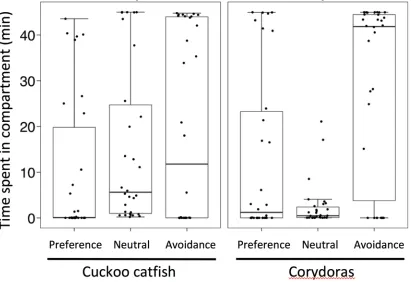
Juvenile cuckoo catfish were not attracted by brooding sympatric host females. There 281
was no difference in association with brooding host females between the cuckoo catfish and 282
corydoras juveniles (GLMM with Gamma distribution, z = 0.60, p = 0.547, N = 30 juveniles 283
per treatment). Time spent by cuckoo catfish juveniles in each compartment was similar, while 284
corydoras showed a tendency to avoid the central compartment (Fig. 2). 285
286
Experiment 3: Parasite re-infection of the host 287
Both cichlid species accepted hatched heterospecific and conspecific offspring, though 288
sympatric females did so at a higher rate. Host females showed a greater propensity to collect 289
offspring at the embryo brooding stage than at the earlier egg brooding stage (Fig. 3). 290
While incubating their own unhatched eggs, acceptance rates of heterospecific and 291
conspecific offspring were low, with no difference between sympatric and allopatric cichlids 292
(GLM with quasibinomial error, z = 0.01, p = 0.994), nor between unrelated conspecific and 293
parasite offspring (z = 1.30, p = 0.194). Sympatric females accepted 22% of cuckoo catfish 294
juveniles (3 out of 10 females accepted at least a single juvenile; i.e. were acceptors) and 10% 295
of conspecific embryos (a single acceptor out of 10). No allopatric females accepted any 296
conspecific or parasitic offspring at the egg incubation stage (Fig. 3a). 297
When incubating their own hatched embryos, the acceptance rate was significantly higher in 298
sympatric females (GLM with binomial error, z = 3.14, p = 0.002) and differed among offspring 299
species (z = 5.49, p < 0.001). Acceptance was low in corydoras catfish (sympatric hosts: 14% 300
offspring collected, 40% acceptor females; allopatric hosts: 6% offspring, 20% acceptors), but 301
high in parasitic cuckoo catfish (sympatric hosts: 94% offspring collected, 100% acceptor 302
females; allopatric hosts: 38% offspring, 50% acceptors) and conspecific embryos (sympatric 303
hosts: 84% offspring collected, 100% acceptor females; allopatric hosts: 58% offspring, 100% 304
306
Discussion 307
We showed that the eggs and embryos of parasitic cuckoo catfish are capable of surviving 308
at high rates outside the buccal cavities of their hosts, at least in a laboratory setting. Further, a 309
strong parental response by both allopatric, but especially sympatric, hosts (Fig. 3), provided 310
actively swimming cuckoo catfish offspring (1-6 days post hatching) with an opportunity to 311
parasitize hosts long after oviposition. Parental females of both tested cichlid species readily 312
collected cuckoo catfish offspring, as well as control conspecific embryos and, to a lesser 313
extent, offspring of geographically distinct corydoras catfish when incubating their own 314
hatched embryos. Acceptance rate was much lower during the egg incubation phase. In contrast 315
to our predictions, we detected no directional behavioural response by cuckoo catfish offspring 316
to brooding host females, suggesting that they do not actively seek potential hosts. 317
The implications of our study are that, uniquely among all known brood parasites, cuckoo 318
catfish have the capacity to infect hosts at two qualitatively different ontogenetic stages; as an 319
egg and later as an actively swimming juvenile. Hence, even after rejection at the egg stage, 320
juvenile cuckoo catfish could complete development to the free-swimming stage and return to 321
the buccal cavity of a host, at least under the conditions imposed in this study. Indeed, the ability 322
to reject parasitic eggs, but not to discriminate against juvenile parasites (but see [26,27]) 323
resembles the situation seen in many avian brood parasite systems. This situation can be 324
explained under a number of alternative hypotheses (reviewed by [28]), but probably arises 325
through low selection pressure imposed by a low frequency of occurrence of parasite offspring 326
following frequent rejection [28,29]. 327
The ability of juvenile cuckoo catfish to re-infect hosts appears to derive primarily from a 328
parental response of the hosts to collect stray offspring, rather than from juvenile cuckoo catfish 329
unrelated non-parasitic corydoras in the mouth of brooding females strongly suggests that re-331
infection is accomplished by the host actively collecting free-swimming juveniles. Our data 332
also show that the motivation to collect the fish is higher when the offspring in the buccal cavity 333
have already hatched. This finding suggests that mouthbrooding females can reference the 334
developmental status of their broods and modify their behaviour in response. The cost of 335
parasitism at this later stage can be either lower or higher than when the brood is infected at the 336
time of spawning and depends on the timing of acceptance and the number and size of the 337
accepted parasitic offspring. In many cases, parental host cichlids may be unable to distinguish 338
their own offspring from unrelated or even heterospecific young. Mobile young stages often 339
stray from their parents, or are displaced when predators attack a parent or brood. The 340
inadvertent adoption of such young by unrelated parents is probably not uncommon in teleost 341
fishes [20,21]. The costs of policing care by parents, including expelling unrelated offspring, is 342
potentially expensive if the error rate in discriminating genetically related and unrelated young 343
is significant. In addition, if the fitness cost to a parent of caring for small numbers of genetically 344
unrelated offspring is trivial, the strength of selection to evolve mechanisms to discriminate and 345
expel unrelated young may be limited. Parasite infection facilitated by the host itself is also 346
known in the butterfly Phengaris arion whose larvae parasitise ant colonies. However, P. arion 347
larvae manipulate the ants into carrying them to their nest using chemical and acoustic signals 348
[30] whereas the propensity to accept offspring of other cichlid species is a general feature of 349
many mouthbrooders [21,31,32]. Our tests demonstrated sympatric S. diagramma to be a 350
relatively stronger acceptor than the allopatric H. aeneocolor but this finding has limited general 351
application as the comparison only included two species. Whether cuckoo catfish similarly use 352
behavioural, visual, olfactory or auditory signals to manipulate hosts into retrieving them is an 353
The active compliance by hosts in their own infection by cuckoo catfish as a by-product of 355
parental care also offers a hypothetical trajectory for the origin of this brood–parasitic 356
relationship. While the evolution of obligatory brood parasites in birds is believed to originate 357
from intra-specific brood parasitism (e.g. [23,33]), this scenario is not plausible in Synodontis 358
catfishes since they belong to a lineage that lacks parental care. One scenario for the evolution 359
of brood parasitism in cuckoo catfish could be through predation of cichlid eggs during 360
spawning, which might eventually result in a spatial and temporal match of spawning by both 361
the parasite and its host. The results of the present study, however, suggest an alternative 362
evolutionary pathway, with the relationship potentially evolving through accidental incubation 363
of ancestral cuckoo catfish juveniles by brooding cichlids, with the fitness benefits of 364
mouthbrooding reinforcing a spatial and temporal association of the catfish with cichlid hosts. 365
This hypothesised evolutionary pathway is analogous to the widely accepted theory for the 366
evolution of trophically transmitted parasites from free-living species (e.g. [34]). 367
Cuckoo catfish eggs and juveniles showed high survival rates outside the buccal cavity of 368
the host, potentially weakening reliance by the parasite on the host, especially in comparison 369
with the negligible survival of cichlid embryos. Simultaneous spawning by cuckoo catfish and 370
cichlids involves aggressive behaviour by the spawning cichlid pair with the catfish often forced 371
away from the spawning site [21]. Even in the confines of an aquarium setting, catfish and 372
cichlid eggs can be swept away from the spawning arena during aggressive disputes (M. 373
Polačik, R. Blažek pers. obs.). Under these conditions, some uncollected cuckoo catfish eggs, 374
as well as the eggs rejected by a host female, may be able to survive, hatch and develop along 375
an alternative, non-parasitic developmental pathway. Cuckoo catfish are considered an obligate 376
brood parasite in the scientific literature (e.g. [16,18, 21,22]), though evidence from the wild is 377
indeterminate being based solely on the failure, thus far, to detect juvenile cuckoo catfish 378
pers. obs.) and anecdotal information from fish hobbyists suggest that cuckoo catfish can 380
occasionally reproduce without parasitizing cichlids, though whether outcomes in the benign 381
environment of the aquarium necessarily translate to nature is clearly a question that needs to 382
be addressed. Obligate brood parasitism is believed to typically evolve along a trajectory 383
starting with facultative parasitism (e.g. [23]) and it is conceivable that cuckoo catfish have yet 384
to complete the transition to the full, obligate brood parasitism. There is also a possibility that 385
different populations of the cuckoo catfish, which is widespread across Lake Tanganyika [35] 386
may express different levels of reliance on their hosts. 387
In conclusion, the relationship between the cuckoo catfish and mouthbrooding cichlids 388
represents a unique example of a versatile vertebrate brood-parasitic system that is unusually 389
amenable to experimental manipulation. We present data suggesting that cuckoo catfish 390
offspring can complete development without exploiting a host, at least in a laboratory setting 391
when predation is excluded. In addition, a strong parental response by mouthbrooding cichlids 392
to collect stray offspring may facilitate re-infection of hosts by cuckoo catfish juveniles after 393
rejection at the egg stage, and may even represent an evolutionary pathway for brood parasitism 394
by cuckoo catfish with the strong parental instinct of host cichlids facilitating the origin of brood 395
parasitism. 396
397
References 398
1. Soler M 2014. Long-term coevolution between avian brood parasites and their hosts. 399
Biol. Rev. 89, 688-704. (doi: doi: 10.1111/brv.12075) 400
2. Soler M 2018. Avian Brood Parasitism: Behaviour, Ecology, Evolution and 401
Coevolution. Springer. 402
3. Yang C, Møller AP, Røskaft E, Moksnes A, Liang W, Stokke BG 2014. Reject the 403
odd egg: egg recognition mechanisms in parrotbills. Behav. Ecol. 25, 1320-1324. (doi: 404
10.1093/beheco/aru124) 405
4. Noh HJ, Gloag R, Langmore NE 2018. True recognition of nestlings by hosts selects 406
for mimetic cuckoo chicks. Proc. R. Soc. B 285, 20180726. (doi: 407
5. Soler JJ, Pérez-Contreras T, De Neve L, Macías-Sánchez E, Møller AP, Soler M 2014. 409
Recognizing odd smells and ejection of brood parasitic eggs. An experimental test in 410
magpies of a novel defensive trait against brood parasitism. J. Evol. Biol 27, 1265-411
1270. (doi: 10.1111/jeb.12377) 412
6. Wang L, Liang W, Yang C, Cheng SJ, Hsu YC, Lu X 2016. Egg rejection and clutch 413
phenotype variation in the plain prinia Prinia inornata. J. Avian Biol. 47, 788-794. 414
(doi: 10.5061/dryad.j4d25) 415
7. Soler M, Ruiz-Raya F, Roncalli G, Ibáñez-Álamo JD 2017. Relationships between 416
egg-recognition and egg-ejection in a grasp-ejector species. PloS one 12, e0166283. 417
(doi: 10.1371/journal.pone.0166283) 418
8. Langmore NE, Hunt S, Kilner RM 2003. Escalation of a coevolutionary arms race 419
through host rejection of brood parasitic young. Nature 422, 157. (doi: 420
10.1038/nature01460). 421
9. Sato NJ, Tokue K, Noske RA, Mikami OK, Ueda K 2010. Evicting cuckoo nestlings 422
from the nest: a new anti-parasitism behaviour. Biol. Lett. 6, 67-69. (doi: 423
10.1098/rsbl.2009.0540) 424
10.Davies NB 2011. Cuckoo adaptations: trickery and tuning. J. Zool. 284, 1-14. 425
(doi:10.1111/j.1469-7998.2011.00810.x) 426
11.Honza M, Picman J, Grim T, Novák V, Čapek Jr. M, Mrlík V 2001. How to hatch 427
from an egg of great structural strength. A study of the common cuckoo. J. Avian Biol. 428
32, 249-255. (doi: 10.1007/s10336-015-1163-z) 429
12.Brooke MDL, Davies NB 1988. Egg mimicry by cuckoos Cuculus canorus in relation 430
to discrimination by hosts. Nature 335, 630. 431
13.Langmore NE, Stevens M, Maurer G, Heinsohn R, Hall ML, Peters A, Kilner RM 432
2011. Visual mimicry of host nestlings by cuckoos. Proc. R. Soc. B 278, 2455-2463. 433
(doi: 10.1098/rspb.2010.2391) 434
14.Spottiswoode CN, Kilner RM, Davies NB 2012. Brood parasitism. The evolution of 435
parental care. Oxford, UK: Oxford University Press, 226-356. 436
15.Medina I, Langmore NE 2016. The evolution of acceptance and tolerance in hosts of 437
avian brood parasites. Biol. Rev. 91, 569-577. (doi: 10.1111/brv.12181) 438
16.Sato T 1986. A brood parasitic catfish of mouthbrooding cichlid fishes in Lake 439
Tanganyika. Nature 323, 58. (doi: 10.1038/335630a0) 440
17.Keenleyside MH 1991. Cichlid fishes: behaviour, ecology and evolution (Vol. 2). 441
Springer Science & Business Media. 442
18.Blažek R, Polačik M, Smith C, Honza M, Meyer A, Reichard M 2018. Success of 443
cuckoo catfish brood parasitism reflects coevolutionary history and individual 444
experience of their cichlid hosts. Sci. Adv. 4, eaar4380. (doi: 10.1126/sciadv.aar4380) 445
19.Cohen MS 2015. Host-parasite interactions of the African cuckoo catfish (Synodontis 446
multipunctatus), thesis, University of Colorado at Boulder. 447
20.Wootton RJ, Smith C 2015. Reproductive biology of teleost fishes. Chichester, UK: 448
John Wiley & Sons. (doi: 10.1002/9781118891360) 449
22.Cohen MS, Hawkins MB, Knox-Hayes J, Vinton AC, Cruz A 2018. A laboratory 451
study of host use by the cuckoo catfish Synodontis multipunctatus. Environ. Biol. Fish. 452
101: 1417. (doi: 10.1007/s10641-018-0788-1) 453
23.Hamilton WJ, Orians GH 1965. Evolution of brood parasitism in altricial birds. 454
Condor 67, 361-382. (doi: 10.2307/1365631) 455
24.R Core team 2018. R: A language and environment for statistical computing. R 456
Foundation for Statistical Computing, Vienna, Austria. URL http://www.R-457
project.org/. 458
25.Bensimon-Brito A, Cardeira J, Dionísio G, Huysseune A, Cancela ML, Witten PE 459
2016. Revisiting in vivo staining with alizarin red S-a valuable approach to analyse 460
zebrafish skeletal mineralization during development and regeneration. BMC Dev. 461
Biol. 16: 2. (doi: 10.1186/s12861-016-0102-4). 462
26.Yang C, Wang L, Chen M, Liang W, Møller AP 2015. Nestling recognition in red-463
rumped and barn swallows. Behav. Ecol. Sociobiol. 69, 1821-1826. (doi: 464
10.1007/s00265-015-1994-x). 465
27.Huo J, Yang C, Su T, Liang W, Møller AP 2018. Russet Sparrows spot alien chicks 466
from their nests. Av. Res. 9:12. (doi: 10.1186/s40657-018-0104-y). 467
28.Grim T 2006. The evolution of nestling discrimination by hosts of parasitic birds: why 468
is rejection so rare? Evol. Ecol. Res. 8, 785-802. 469
29.Grim T 2011. Ejecting chick cheats: a changing paradigm? Front. Zool. 8, 14. (doi: 470
10.1186/1742-9994-8-14) 471
30.Hayes MP 2015. The biology and ecology of the large blue butterfly Phengaris 472
(Maculinea) arion: a review. J. Insect Conserv. 19, 1037-1051. (doi: 10.1007/s10841-473
015-9820-3) 474
31.Ribbink AJ, Marsh AC, Marsh B, Sharp BJ 1980. Parental behaviour and mixed 475
broods among cichlid fish of Lake Malawi. Afr. Zool. 15, 1-6. (doi: 476
10.1080/02541858.1980.11447677) 477
32.Ochi H, Yanagisawa Y 1996. Interspecific brood-mixing in Tanganyikan cichlids. 478
Environ. Biol. Fish. 45, 141-149. (doi: 10.1007/BF00005227) 479
33.Shaw RC, Hauber ME 2009. Experimental support for the role of nest predation in the 480
evolution of brood parasitism. J. Evol. Biol. 22, 1354-1358. (doi: 10.1111/j.1420-481
9101.2009.01745.x) 482
34.Poulin R, Randhawa HS 2015. Evolution of parasitism along convergent lines: from 483
ecology to genomics. Parasitology 142, S6-S15. (doi: 10.1017/S0031182013001674) 484
35.Koblmüller, S., Sturmbauer, C., Verheyen, E., Meyer, A., & Salzburger, W. (2006). 485
Mitochondrial phylogeny and phylogeography of East African squeaker catfishes 486
(Siluriformes: Synodontis). BMC Evol. Biol. 6, 49. (doi: 10.1186/1471-2148-6-49) 487
488
Acknowledgements 489
We thank to Radomil Řežucha for the help with Experiment 2 and Jiří Farkač, Adam Veleba 490
Ethics 492
Research adhered to all national and institutional animal care and use guidelines (permit No. 493
CZ62760203) 494
Data Accessibility 495
Primary data will be deposited on the Figshare repository. 496
Authors’ Contributions 497
The study was conceived by M.P. and R.B. and designed by M.P., R.B. and M.R. Data 498
collection: M.P. and R.B. Data analysis: M.R. Data interpretation: M.P., C.S., R.B. and M.R. 499
Drafting ms: M.P. with important contributions made by all authors. 500
Competing Interests 501
None. 502
Funding 503