Touching knowledge: Digital media practice and medium
theory informing learning on mobile touch screen devices
Victor Alexander Renolds
Bachelor of Communications (Interactive Multimedia)
College of Arts & Education Victoria University.
Submitted in fulfilment of the requirements of the degree of Master of Arts
Abstract
The years since 2007 have seen the worldwide uptake of a new type of mobile computing device with a touch screen interface. While this context presents accessible and low cost opportunities to extend the reach of higher education, there is little understanding of how learning occurs when people interact with these devices in their everyday lives.
Medium theory concerns the study of one type of media and its unique effects on people and culture (Meyrowitz, 2001, p. 10). My original contribution to knowledge is to use medium theory to examine the effects of the mobile touch screen device (MTSD) on the learning experiences and practices of adults. My research question is: What are the qualities of the MTSD medium that facilitate learning by practice?
The aim of this thesis is to produce new knowledge towards enhancing higher education learning design involving MTSDs. The project involved a class of post-graduates studying communications theory who were asked to complete a written major assessment using their own MTSDs. Their assignment submissions form the qualitative data that was collected and analysed, supplemented with field notes capturing my own post-graduate learning experiences whilst using an MTSD.
I predominantly focus on the ideas of Marshall McLuhan within the setting of medium theory as my theoretical framework. The methods I use are derived from McLuhan’sLaws of the Media(1975), its phenomenological underpinnings and relevance to the concept of ‘flow’ (Csikszentmihalyi,2014b, p. 24).
Master by Research Declaration
I, Victor Alexander Renolds, declare that the Master by Research thesis entitled “Touching knowledge: Digital media practice and medium theory informing learning on mobile touch screen devices” is no more than 60,000 words in length including quotes and exclusive of tables, figures, appendices, bibliography, references and footnotes. This thesis contains no material that has been submitted previously, in whole or in part, for the award of any other academic degree or diploma. Except where otherwise indicated, this thesis is my own work.
Acknowledgements
I would like to express my gratitude to my supervisors, Associate Professor Tom Clark (Prin-cipal) and Dr Stefan Schutt (Associate), for their expert and lasting support. Tom, thank you for your clear guidance, insight and unwavering encouragement. Stefan, thank you for the deliberations, practical advice and generosity with your time. I also thank Dr Mark Cot´e (Associate) at Kings College London for his guidance and support as my supervisor during the design phase of the project.
I would also like to thank the following people with whom this research project has been made possible:
Professor Arshad Omari (Edith Cowan University) and David McLean (RMIT University) for their support as my referees
My colleagues and friends at La Trobe University, especially Associate Professor Matthew Riddle, Dr John Bevacqua, Bowen Yang, Mike Harbour, Ann Moss, Debbi Weaver, Lyndon Walker, Logan Balavijendran, Daniela Signor, Lisanne De Jong, David Scrim-geour, Matthew Carter, Donna Bisset, Dan Laurence, Mungo Jones, Simon Knight, Terry Young, Kenneth Neven, Brian Dunell, Kate Mitchell, Tom Cotton
Mark Jenkinson, Erik Adams
Eugenie Tuck, Robert Millard and Claire Thomas
My siblings, Anna, Dot, Roger and Rex
My partner, Dr Olivia Millard, our daughter Morgan and my son Noah
Contents
1. Introduction 9
Background and context of the study . . . 9
The problem . . . 11
Aim, significance and scope of the study . . . 12
Operational definitions . . . 12
Summary and thesis outline . . . 16
2. Medium and flow 21 Medium theory . . . 21
The Toronto School . . . 24
McLuhan and the digital age . . . 31
The digital media practitioner . . . 33
Design, human computer interaction and the MTSD . . . 33
Calm technology . . . 37
Flow theory and phenomenology . . . 38
Summary and conclusions . . . 42
3. Learning medium as context 44 Touching the (MTSD) medium . . . 44
Touch as communication and the tablet in the classroom . . . 45
The tetrad . . . 46
McLuhan’s Laws of the Media . . . 47
The MTSD and the tetrad . . . 48
Enhancement . . . 49
Obsolescence . . . 51
Reversal . . . 54
Conclusions about the learning medium as context . . . 55
5. Analysis: The flow and simultaneousness of practice 57 Introduction . . . 57
First impressions . . . 58
Reflect on the initial findings . . . 60
The Epoche: Personal learning interaction experiences with the MTSD . . . . 61
The distraction can be work . . . 62
Note taking exercises July 2015 . . . 63
Time and space . . . 65
Existing at once in the past, present and future . . . 66
Significant statements . . . 67
Themes that have emerged from the data . . . 70
Textural description of what happened . . . 72
Hegemony and flow qualities of the MTSD . . . 72
Flow control and interruption . . . 73
Learning and teaching implications . . . 75
Paradoxical effects of the MTSD and mobile technologies . . . 76
Structural description . . . 78
Impact of the initial findings . . . 79
Conclusions . . . 79
6. Conclusions: The MTSD and flow as medium 82 Introduction . . . 82
Essence of the phenomena: Using the MTSD for learning practice . . . 83
The conclusions . . . 83
Hegemony . . . 84
Paradox . . . 85
Flows . . . 86
Simultaneous model . . . 86
The paradox of flows . . . 88
Implications in society . . . 88
Recommendations . . . 90
Between design . . . 91
Wider pedagogical implications . . . 93
Medium theory . . . 94
Contribution to knowledge . . . 95
Theory of oscillating logic . . . 95
Between design . . . 95
Epilogue . . . 96
Bibliography 97 Appendices 103 Appendix A: Mobile phone-Tablet Assignment (20%) . . . 103
Appendix B: Information For participants . . . 105
Appendix C: Consent form for participants involved in research . . . 107
Appendix D: Researcher notes . . . 109
List of Tables
3.1 Four laws of the tetrad . . . 47 5.2 Significant statements by students . . . 70 5.3 Themes . . . 72
List of Figures
1.1 How I experience using a medium: artist and medium are interdependent, as are learning and practice (“X” denotes experience). . . 16 5.2 Student description of mindmap . . . 74 5.3 Student mindmap of two learning processes using a tablet . . . 74 6.4 Flows: Information, thoughts — stream of consciousness — flow state, and
1. Introduction
Background and context of the study
It is January 2017, and I am working at the department of Learning and Teaching at La Trobe University. My experience working in this role titled Mobile Learning Designer seems all at once a world away and yet deeply connected to that of my Radio Technician apprenticeship in 1979, which I left to pursue a career as a professional musician and artist, well before the advent of digital communications and mobile devices. My education as a young musician was to learn throughexperience, by practice and knowledge shared or handed down from respected elders. I learnt by doing and participating in what was going on, and it all revolved around the medium of the electric guitar.
In 2004, it seemed to me that what was going on was the rise of the digital revolution: I was teaching at the School of Multimedia and Communications, Edith Cowan University having just completed my Communications degree there as a “mature-age student”1 while (still) practising as an independent artist. Having experienced first-hand how digital technologies could present new and affordable possibilities in education and for artists, I was motivated to see where these possibilities might lead. In 2006, I thought that mobile computing in the form of the smartphone looked promising although I found the devices available at that time not particularly affordable and cumbersome to use.
By the time the iPhone was launched in Australia in 2008 I imagined that it was a new type of medium that would change my life – and it did in how I accessed information, took notes, recorded and created music, took photographs and video. I found the touch screen of the device compelling and much easier to use than my previous smartphone without a touch screen. What I didn’t fully understand at the time was how profoundly the device would change not only my own habits or patterns of accessing information, communication, my arts practice and how I learned, but similar changes in the habits and practices of those around me. I 1
noticed the scale and the pace of this change: when I commenced a professional development support role at a member service organisation in August 2008, there were barely any iPhones or other devices with a touch screen around. By 2014, smartphone and tablet sales made up close to half the entire revenue of the global consumer electronics industry according to research conducted byAndreessen Horowitz(2015) – I refer to this group of devices as mobile touch sceen devices, or the MTSD.
When the iPad arrived in 2010 (Apple, 2010), several colleagues declared that it was an educational tool and I was soon tasked with investigating its potential for professional development purposes. I began searching online, reading articles, discussing with colleagues and meeting with external consultants to find that there was much speculation but a lack of evidence to support that the iPad had proven to be effective in adult learning and teaching contexts. I noticed that people also referred to the iPad as a “tablet” which as a metaphor caught my attention in relation to the semiotics of this term; I immediately drew a a comparison to the tablet in its various forms used for scholarly purposes and a representation of knowledge that can be traced back to the cuneiform etched clay tablets of Mesopotamia, around 3200BC (Kumaret al.,2003).
By 2012 it seemed that most of my colleagues and people I commuted with owned some kind of mobile touch screen device; an Apple or Android smartphone and/or tablet. The phenomenon had changed and re-set the direction of my career to become about online learning and digital publishing with an emphasis on the role of mobile devices and technologies. At work that year, after observing the uptake of Apple iOS and Android devices via Google Analytics (2017), we optimised the interface of the learning management system for smartphones and tablets. While that year at work we learnt that people were using their MTSDs to access the learning management system (LMS), there was still not much data that might help explain how people were using it in their learning.
I remember becoming confused once when one of the (instructional) designers in my team asked “I want to know what the technology can do?” because as the designers of online learning resources, I believed it was our job to know what the technology can do. But then I remembered Marshall McLuhan’s widely quoted postulation ‘The Medium is the Message’ (2003, pp. 7-23) which he elaborated on some thirty years before the rise of the Internet:
I saw how this view of technology might show my colleague’s question in a different light. I began to think more about what the personal and social implications of the MTSD might be, and somehow put these insights to use in our learning designs. Before long I had applied to Victoria University for a research place that has resulted in this study and thesis.
The problem
Although mobile touchscreen devices have proliferated in recent years there is little under-standing of how learning occurs when people interact with these devices in their everyday lives. Particularly lacking is an understanding of how students use their devices for their studies across formal and informal contexts between the home, workplace and classroom.
Within the pedagogical literature, mobile learning has not produced the results we had hoped for in our understanding and practice of how to use mobile devices in education. Norbert Pachler, Ben Bachmair and John Cook (Mobile Learning: Structures, Agency, Practices), urgently called for schools and institutions to attempt to understand the place of mobile devices alongside other technologies and how this could enhance the learning and learning experiences of students (2010, p. 340). My concern is that this ambition, particularly in higher education, is yet to be achieved – academics, learning designers (and other relevant support roles in universities) are still working it out, or working it through. I see the main issue is that mobile learning or m-learning (and other relevant frameworks such as TPACK2 for example) have not taken into consideration how the proliferation of mobile devices since the advent of the MTSD may have changed the way that people learn. This central issue is perhaps best described by Pachler et al:
However, there exist as yet no comprehensive theoretical and conceptual frame-works to explain the complex interrelationship between the characteristics of rapid and sometimes groundbreaking technological developments, their potential for learning as well as their embeddedness in the everyday lives of users (Pachler
et al.,2010, p. 3).
Pachler et al also explain that there is a ‘lack of clarity’ as to what is even understood by the termmobile learning and whether there is ‘a need for a separate field of enquiry’ (Pachler
et al.,2010, pp.4-5). To some extent, this should explain the reason I have turned to medium
2Thetechnological pedagogical content knowledge(TPACK) framework (Mishra and Koehler,2006), while
theory as an alternative theoretical framework; because it is concerned with the effects of how we interact with new mediums (and the MTSD is still relatively new). Ten years ago, people were not using their mobile devices to communicate, access information or create and publish content in the ways we are able to using our MTSDs today. To describe just one example, it was not possible to capture high definition video and publish it to a social media platform with a few taps on a device. In this regard, mobile devices at that time had a fraction of the capabilities and the usability that are evident today. While the technologies that make up what one can do with a mobile device has rapidly moved on, it seems to me that pedagogical research has struggled to keep up, so I am proposing a different theoretical approach that adapts what I consider to be a relevant and time-tested alternative framework, medium theory, in an attempt to find a clarity that others have noted is lacking.
Aim, significance and scope of the study
The aim of this thesis is to produce new knowledge towards higher education learning design involving MTSDs. To help produce this knowledge, I ran a study with a class of post-graduates studying communications theory. Working with the subject co-ordinator, I designed one of the major assessments for the subject, a written critical analysis of a blog post entitled ‘Mobile McLuhan’ (Woodill, 2012). As part of the assignment, students were asked to use their own MTSDs and discuss this in their analysis. The students’ assignment submissions form the qualitative data that I collected and analysed, supplemented with field notes capturing my own post-graduate learning experiences whilst using an MTSD throughout the writing of this thesis.
While my study involved a pedagogical intervention, I wish to make it clear that pedagogy is the object of this study and not the subject – the MTSD is the subject. The purpose of my investigation is to use medium theory to examine the effects of the MTSD on the learning experiences and practices of adult individuals rather than use a more conventional pedagogical approach. I am not aware that medium theory has been used in this way before, specifically to observe the effects of a new medium on the experience of learning, and therefore this approach is also my contribution to knowledge.
Operational definitions
I use each term.
Code– is referred to in two specific ways. I use code in a historical and cultural sense as a written language imbued or bound to a medium type that is essential to the way the medium works or has an effect; for example, cuneiform or music notation. As a written language, the code will have a syntax: specific knowledge and skills about the syntax are required for the people in society who use it to produce artefacts or their effects; the scribed clay tablet or musical performance to follow on from the previous examples.
This leads to the second way that I refer to code: the computer programming languages that consist of instructions or commands (software) that make it possible for individuals to have operativeinteractions with the MTSD (hardware) and other computer based mediums.
Flow and flow. I use Flow (upper case) to refer to an affective state that is attained when an individual participates in an activity that involves skill and challenge. Flow was conceptualised by the Hungarian psychologist, Mihaly Csikszentmihalyi, while studying arts students in the 1960s (2014b, p. 230). The aspect of Flow most relevant to this thesis is the experience of participating in a task:
In Flow, a person is fully concentrated on the task at hand. There is a feeling that action and awareness merge in a single beam of focused consciousness (2014b, p. 24).
I use flow (lower case) to denote a process or part of an activity that forms an internal or external pattern – a flow of thoughts, feelings and perception or the sequence of physical (learning) activities.
Hegemony. It is from an individual’s perceptual experience of his/her own control of a specific context by which I refer to hegemony. Joseph(2002) provides a thorough reference for understanding hegemony from Gramsci to historical structural and post-structural understand-ings. He discusses that hegemony is not just concerned with a ruling bloc or ‘hegemonic elite’ (Quan-Haase, 2016, p. 265) but with the conditions which ‘allow it to put itself forward as leading’ (Joseph,2002, p. 125). O’Sullivan et al. (1994) remind us that the hegemonic elite actively seek consent from others to adopt viewpoints that align with their interests (1994, p. 133). In this respect, this thesis is but one aspect of hegemony.
Learning – anychange of scale or pace or pattern that is introduced into the experience and thoughts of the individual. The rationale behind this definition is provided in Chapter 2.
Medium theory – as defined by Joshua Meyrowitz in following Marshall McLuhan’s ap-proach to regard how each medium is a unique environment type that can reshape people and culture (Meyrowitz,2001, p. 10).
Motivation (intrinsic and extrinsic). Underpinning the work of Mihaly Csikszentmihalyi and the concept of Flow as it relates to this thesis are the research efforts that have been made towards understanding motivation. According toRyan and Deci, motivation means ‘to be moved to do something’ (2000, p. 54). Talcott Parsons is one of the seminal figures to examine the distinction between intrinsic and extrinsic motivation along with Edward Deci, Richard Ryan, Teresa Amabile and Beth Hennessey.
In basic terms, intrinsic motivation means to do something because it is enjoyable or interesting, whereas extrinsic motivation means to do something because of a separable or external outcome such as a reward or punishment.
Intrinsic motivation has long been valorised in research: ‘People are most creative when they feel motivated primarily by the interest, enjoyment, satisfaction, and challenge of the work itself – and not by extrinsic motivators’ (Amabile, 2012). While hundreds of empirical studies have established the detrimental effects of extrinsic motivation, research has also shown that extrinsic motivation can also enhance intrinsic motivation; for example, in social contexts when individuals compete, but this depends on the perception of the individual. In more recent years, research has been undertaken to encourage a more systematic approach to facilitate cre-ative outcomes resulting from both intrinsic and extrinsic motivation in organisational settings (Hennessey,2015, pp. 201-203).
There are also sections in this thesis where I use the term intrinsic on its own, to refer to motivations, thoughts, feelings and reasons. Where I similarly use the term extrinsic on its own, I am referring to the pattern of use of the MTSD and other mediums.
Ryan and Deci discuss intrinsic motivation as an important construct that reflects the natural human tendency to learn; and that both classes of motives are needed to enable autonomy against the backdrop of external control (Ryan and Deci,2000, pp. 54-64).
MTSD– or themobile touch screen device refers to the most used mobile devices with a touch screen, predominantly the iPhone and iPad, along with their Android smartphone and tablet counterparts.3
Phenomenology. According toSmith (2016), phenomenology is a philosophical tradition that began in the first half of the 20th century. Beginning with Edmund Husserl, Martin 3
Heidegger, Maurice Merleau-Ponty and Jean-Paul Sartre are also among the early proponents of phenomenology and remain authoritative figures. Kockelmans warns that the task of defining phenomenology is a ‘sphere of ambiguity’ (1967, p. 24) yet in simple terms, phenomenology can be understood as the way that we experience things – the study of phenomena. In this respect, the phenomenon of the mobile touch screen device (MTSD) is the research subject.
Rather than attempt to expatiate on this simple definition, it might prove more useful to highlight the aspects of phenomenology that are most relevant to this study. The follow-ing description should be considered from the perspective of the perceived experience of an individual’s interactions with a medium, such as the MTSD, in the context of learning:
The basic intentional structure of consciousness, we find in reflection or analysis, involves further forms of experience. Thus, phenomenology develops a complex account of temporal awareness (within the stream of consciousness), spatial aware-ness (notably in perception), attention (distinguishing focal and marginal or “hori-zonal” awareness), awareness of one’s own experience (self-consciousness, in one sense), self-awareness (awareness-of-oneself), the self in different roles (as think-ing, actthink-ing, etc.), embodied action (including kinesthetic awareness of one’s move-ment), purpose or intention in action (more or less explicit), awareness of other persons (in empathy, intersubjectivity, collectivity), linguistic activity (involving meaning, communication, understanding others), social interaction (including col-lective action), and everyday activity in our surrounding life-world (in a particular culture) (Smith,2016).
I regard these aspects of phenomenology as discipline and as part of the process and practice of writing this thesis.
Perhaps the most significant phenomenological aspect relevant to the study is thegestalt, what Merleau-Ponty argued is the basis of perceptual experience, a meaningful whole consisting of a visible figure against a hidden ground (Toadvine,2016). In the following chapters, I explore and expand on this concept, as it applies to the MTSD through the concepts of Marshall McLuhan and linking this work to the ideas of Heidegger and other relevant theorists.
Learning
Practice
Medium
Artist
(Student)
X
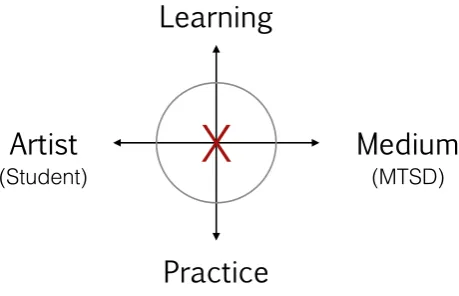
(MTSD)Figure 1.1: How I experience using a medium: artist and medium are interdependent, as are learning and practice (“X” denotes experience).
guiding principle by adopting methods derived from Moustakas that seek to better understand the phenomenon (the MTSD) by working to remove biased viewpoints about the participants (1994, pp. 3-9).
Summary and thesis outline
outline how I set out to answer this question as I review and draw on the relevant literature to support my discussion and analysis of the student assignment data.
In Chapter 2, I describe in greater detail the origins of medium theory, The Toronto School and their significance to this study; to this end I define and explain terms that I use in this study and why I use them. I define digital media practice and argue that it is a significant enabler of using the MTSD to learn by practice. In order to contextualise medium theory to the MTSD and its relevance to learning by practice (learning by doing), I ascribe a definition of “learning” based on a broader definition of medium theory and introduce the concepts of intrinsic and extrinsicflows. I note the relevance of metaphor in the history of thetablet and theartist in their association to knowledge, education and the MTSD.
From a medium theory perspective, I question notions about what constitutes a “medium” and “content” in the effort to better understand the ways of using the MTSD that control these aspects which might lead to learning experiences. Key to this are our physical touch points of interaction with the MTSD and I draw on McLuhan to begin my argument that a significant effect of the MTSD is on our sense of touch and how this effect interacts with the mind. I look at the origin of the design approaches that have led to the development and existence of the MTSD as we experience using it today, noting that the touch screen provides a distinct experience resulting from its re-configurable touch interface. I discuss human computer interaction (HCI) design approaches, particularly the work of Mark Weiser and John Seely Brown that concern the perceptual effects of HCI relevant to the study. I introduce Mihaly Csikszentmihalyi’s concepts of theflow experience and intrinsic motivation. I tie these concepts to Heidegger’s metaphor of the hammer yielding carpenter readiness-to-hand and make this relevant to medium theory and the MTSD through the common phenomenological observation ofexperience.
In Chapter 3, I focus on the ideas of Marshall McLuhan within the setting of medium theory as my theoretical framework, while the methods I use are derived fromMcLuhan’s Laws of the Media(1975) and its phenomenological underpinnings. I draw on McLuhan’s laws to discuss the experiential aspects that involve the use of the MTSD as a learning tool and the intrinsic effects of this (extrinsic) practice. Following McLuhan’s approach, I examine the visible and invisible aspects of the MTSD, or its figure and ground (McLuhan,1975, p. 74).
(2002). Through this discussion, I develop the theme of paradox as my central method. I also bring into play McLuhan’s role of the artist in society and connect this concept to my ideas about the digital media practitioner and learning practice.
I demonstrate how the application of medium theory, specifically the Laws of the Media can uncover new ways for us to think about the intrinsic and cognitive processes in the mind of the individual. I build on McLuhan’s Laws of the Media and Piaget’s observations about modes of thinking to identify a combined mode of thinking that I associate with the use of the MTSD for learning.
Chapter 4 expands on the research question, aims and descriptions of the experiment design and methodological approaches adopted to conduct the research study. I explain the purpose of the study and how I came to see the relevance of phenomenology to the investigation. Guided by the principles of respect and trust, I detail my rationale behind the design of the study including the methods and procedures of data collection and measures taken to ensure the integrity of the data. I discuss how my approach to trust the voices of the research participants differs from conventional “user experience” (UX) approaches. I describe the transcendental phenomenological methods (Moustakas, Cresswell) used to support my central discussion about the MTSD and its effects on the individual’s experience of learning practice.
Situating my work in the domain of medium theory with a pedagogical objective, I also draw on the domains of phenomenology, flow theory, educational psychology and human-computer interaction (HCI). I have returned to the source of the literature in these areas, looking for new ways to apply original ideas, rather than the varied interpretations of others, many of which were made before the mass uptake of the MTSD. Through my review of the literature, I am able to draw from and connect some of the key ideas of Marshall McLuhan, Martin Heidegger, Jean Piaget, Mihaly Csikszentmihalyi and Mark Weiser to form a fresh and distinct frame for the study. This approach has helped me to focus on exploring the universal concepts that are of significance to my study of the MTSD – experience, learning, content, information, human computer interaction and flow.
participants about their learning practices using the MTSD alongside my own interpretations. From this I identify themes by grouping the significant statements which in turn informs my textural description of what happened during the research study. I conclude this chapter with reflections of the intervention.
The analysis reveals two new distinct types of flows involving the MTSD in the learning experiences and practices of the students. The first extrinsic flow is the pattern of learning tools used by students in which the MTSD becomes a conduit between learning contexts occurring in the classroom, home, workplace and everywhere in between. Contrasting is the intrinsic flow of the mind and thoughts of the individual participating in using the MTSD for learning. I compare this intrinsic condition that the students described with the corresponding ideas of Csikszentmihalyi and Heidegger. Students described this experience as ‘flowing’, ‘constant’ and/or a ‘stream of consciousness’ (student participant quotes).
The key finding of the analysis is that the experience of being in control is a central issue for students when they use the MTSD to learn. Students described the experience in contradictory terms: as a heightened sense of control of their learning when using MTSDs, and/or being overwhelmed by the technology and the volume of information. I pursue this issue as paradox, which becomes the centrepiece theme and method deployed for the further analysis of the MTSD. I lay out in detail the four themes that emerge from data analysis i) Hegemony: Experience of control, ii) Flow qualities of the MTSD, iii) Learning and teaching implications, and iv) Paradoxical effects of the MTSD and mobile technologies.
In Chapter 6, I begin with a composite description of the student participants’ use and experience of the MTSD in their learning practices, and that having a sense of control is central. The conclusions section provides a narrative summary of the study through the themes and concepts discussed through the subject of the MTSD in this thesis. I provide a conclusion about the overall effects of the MTSD on society and discuss the need for a new digital literacy. I then return to discuss the artist, highlighting examples of artists’ work to support the notion that there are existing methods that offer potential for re-thinking pedagogical approaches to the MTSD.
2. Medium and flow
Medium theory
A medium of communication has an important influence on the dissemination of knowledge over space and over time and it becomes necessary to study its characteristics in order to appraise its influence in its cultural setting. According to its characteristics it may be better suited to the dissemination of knowledge over time than over space, particularly if the medium is heavy and durable and not suited to transportation; or to the dissemination of knowledge over space than over time, particularly if the medium is light and easily transported. The relative emphasis on time or space will imply a bias of significance to the culture in which it is embedded (Innis,2008, p. 33).
Medium theory is concerned with the effects that a medium, whether a pen, article of clothing or computer circuit, has on us as individuals and communities. Building on the work of Harold Innis, Marshall McLuhan first illuminated the significance of the effect of a technological medium above what it can do with his slogan ‘The medium is the message’ (McLuhan,2003, p. 7). At the heart of this postulation is the observation that the mass uptake of a new invention introduces changes in the way we live - our daily routines, the supporting infrastructures and how these are controlled. The invention and adoption of the automobile, for example, massively changed the way that people commuted and travelled. The demand saw the world-wide development of sophisticated road systems to support commuting and the business of transportation. As a consequence of the mass production of vehicles and uptake of fossil fueled transportation, the ownership and control of oil production became a cornerstone in world affairs. There are other numerous examples where a new medium that is adopted widely has effected significant global change - the printing press, electricity, the telegraph, the telephone, the aeroplane, radio, television, the computer and the Internet.
Internet have been the “digital economy”, “social media” and “online education”. Business, social interactions and the way we learn have all changed by what is now possible because of the Internet – the facilitation of cross-border communications and transactions – in McLuhanesque terms, the global village (2011, pp. 25-36). The Internet is a re-invention of the global village conceived by McLuhan into the virtual world of the digital age. And we are all part of it:
What we are considering here, however, are the psychic and social consequences of the designs or patterns as they amplify or accelerate existing processes. For the “message” of any medium or technology is the change of scale or pace or pattern that it introduces into human affairs (McLuhan,2003, p. 8).
My specific interest in the mobile touch screen device (or MTSD) medium, is in the effect that it has on the individual, especially when the individual is involved with the MTSD in the activity that we calllearning. Drawing here from McLuhan’s view concerning human affairs, what I mean by “learning” is anychange of scale or pace or pattern that is introduced into the experience and thoughts of the individual, how these thoughts travel and the individual’s prac-tices associated with that learning. The definition of learning that Csikszentmihalyi provides correlates with the definition I have derived from McLuhan.
Learning is an increase in complexity in the information-processing capacity of an organism. It can be consciously pursued, or it can involve changes that happen accidentally as a result of the organism’s interacting with his or her environment or reflecting on previous experience in an unintended way. In the first case we have deliberate, voluntary, intentional learning; in the second, spontaneous, incidental, unplanned learning. Deliberate learning can be either intrinsically or extrinsically motivated (Csikszentmihalyi,2014a, pp. 528-529).
(2014a, p.530). I use the term extrinsic to refer to external elements interacting with the individual from outside—mostly physical mediums and information—and how the individual uses these elements in the practice of learning.4 The distinct feature of the way I have framed learning in this study is to question changes in the scale, pace and pattern of intrinsic and/or extrinsic aspects as meters or markers of learning; this feature is derived from McLuhan.
From this viewpoint, my research question is: What are the qualities of the MTSD medium that facilitate learning by practice?
Investigating this question involves the dynamics of the tension between external flows including mediums and information that the individual is exposed to, and the internal expe-riential flows of the individual specific to performing a learning task. A sub-question is: is it possible to tell when the use of the MTSD is motivating the individual or when a cognitive process occurs that enhances learning? I shall later in this chapter return to Csikszentmihalyi in consideration of this question, along with considerations that medium theory poses concerning our interactions with the technology and content, as these arise in my discussion concerning the MTSD. In this thesis and field study, I pose another sub-question: How does the learner use the MTSD to solve the problem of learning?5 The purpose of this sub-question is to identify the role that the MTSD plays for the student as a learning tool; and the qualities of the MTSD that emerge when solving the problem of learning is in effect. This involves a condition accompanying this question that the student is interacting with the MTSD with the intention to learn. It is important to make this distinction because of the multitude of purposes that an MTSD can be used for other than learning such as social, entertainment or business purposes. In this regard, this sub-question works within the design of the study to maintain a focus on the aim of the thesis to produce new knowledge concerning MTSDs for enhancing higher education learning designs.
Since the earliest Mesopotamian cuneiform texts around 3200BC (Kumaret al.,2003), the metaphor of the tablet has symbolised knowledge, learning and the classroom environment. With a culturally agnostic metaphor for knowledge, one can build and connect to newer con-cepts (Yost,2008). Symbolically connected as a metaphor for learning, the ancient clay tablet and the MTSD are also both tactile learning mediums. The common issue I see concerning the two mediums is that to fully control and use the technology in its cultural setting, one requires specialist knowledge and skills (in scribing or coding). Associated with this are the 4
I further discuss the practice of learning later on in this chapter and again when detailing my methodology in Chapter 4.
5Informed by my practice as a learning designer, I propose that using the MTSD to learn is a problem
forms of power that can be acquired in understanding and manipulating the language that makes the technology work. There are many contemporary individuals, Elon Musk (PayPal, Tesla, SpaceX), Bill Gates (Microsoft) and Steve Wozniak (Apple) to name just a few who have made an impact on the world by translating technologies into consumer products with their specialist knowledge as (computer) programmers. I put forward these elite individuals as an (amplified) example of this notion.
In recent years, the term “coder” has emerged to represent a person with computer pro-gramming knowledge and skills who writes ‘code’ as this relates to computer science (2017). I refer to code as a language and the underlying means to understand and control human interactions with the MTSD or another computer based medium. For the everyday learning designer in higher education, most of us “in the trade” know that having some coding skills is a digital literary asset that will help us to solve problems we might encounter in our roles. This digital literacy asset in turn informs our design decisions depending on the options available due to one’s proficiency. In this way, coding is also a consideration for the academic and the student in their digital media practice because it is an enabler to control and prepare digital media for the MTSD (or computer)—if one practices. While the operation of the MTSD utilises the language of touch and gestures, in the background, it is the language of code that controls the device via these interactions—touch events processed by code.6
The Toronto School
The physical durability of a medium has bearing on its informative and expressive qualities. Zhao (2005, p. 14) refers to the Harold Innis communication model within space-time and the durability of analogue mediums such as clay, parchment and paper. The durability of digital media, as utilised by computers and devices, is dependent on the durability of the systems (people and infrastructures) that support its existence. Thus, in many instances, an analogue medium’s durability is more autonomous than that of a digital medium and more likely to persist in time. Consider a future generation finding a hundred year old time capsule containing an oil painting and its digital counterpart on an MTSD; or a clay tablet and a smartphone of today. For me, the question arises of how to evaluate the communicative value of digital media artefacts that have condensed life spans, particularly in instances where 6
communicative value could easily outlive the medium – such as my example of the digital image on the MTSD in the time capsule. It is in asking such questions while stepping back in time that I seek to go beyond the fast changing affordances of the MTSD, such as any specific app, to explore enduring qualities of the MTSD that are likely to persist in some other form and remain relevant in how they affect the learning experiences of individuals.
The work of Harold Innis (1894-1952), Eric Havelock (1903-1988), Marshall McLuhan (1911-1980) and Walter J. Ong (1912-2003), collectively known as the Toronto School of com-munication theory, is a far reaching tradition. Their work stems from exploring Ancient Greek Literature and examining cultural change in relation to the introduction of new technologies, especially by contrasting oral to literate forms. Innis is regarded as McLuhan’s mentor while McLuhan supervised Ong’s scholarly research. Cot´e (2010) discusses Innis and McLuhan’s insights of media artefacts inTechnics and the Human Sensorium: Rethinking Media Theory through the Body:
Their basic insight is that media artefacts significantly impact both culture and the human mind. On the one hand, Innis examined how the dominant medium in a given historical period enabled and constrained forms of political and economic organization in what he called the bias of communication. McLuhan, on the other hand, primarily focused on the impact of media and communication systems on the calibration of the ratio of sensory perception (Cot´e,2010).7
However, McLuhan makes it clear that to understand a medium means to approach it as an environment: ‘Any understanding of social and cultural change is impossible without a knowledge of the way media works as environments’ (McLuhan,2002, p. 26).
In Orality and Literacy (2002), Walter J. Ong discusses the development of the written word and type as technology; he also draws attention to the human condition as we try to match the evolution rate of text based technologies, including computers. He optimistically describes the human adoption of technology: ‘Technology, properly interiorized, does not degrade human life but on the contrary enhances it’ (2002, p. 82). He views the human adoption of technology involves a mechanical process of human interaction that needs to be ‘interiorized’ by its user to take effect illustrating this point with the musician’s use of his or her instrument as the technology:
7
Also of significance to the effects of media on our sensory perception is the “common sense”, or thesensus
To achieve such expression ... has to have interiorized the technology, made the tool or machine second nature, a psychlogical part of himself or herself. This calls for years of “practice” (2002, p. 82).
When it comes to the MTSD, the mechanical aspect of the interiorizing that Ong speaks of is the human interaction that involves touch – I shall return to this crucial point further on. Ong’s ‘expression’ is in other words a proficiency that the artist needs to develop in being able to get the medium to do what the artist wants it to do, through physical interaction and touch. The expression that Ong’s musician takes years to develop interacting with traditional instruments that have been with us for centuries, compared to the expressions made possible since MTSDs has been widespread, around ten years, might according to Innis indicate that the life of the MTSD is shortlived. If this is the case it might be for a reason other than the durability – perhaps the MTSD will be shortlived because the expressions through our interactions with the MTSD will become less meaningful to us when there is a new medium ready to easily take its place.
Ong (2002, p. 112) discusses the transformation of individuals and the world through Learned Latin – the ‘Interaction produced all sorts of special results’. In the context of learning for the purpose of this discussion, it follows that interaction with a medium is essential for there to be results. When applied to the computer and the MTSD, this becomes more humanly complex within an interactive non-linear environment with dynamic content potentially loading from any world location, together with communication and information flows of one to one, one to many and many to many. The state of these information flows are essential to what has been termed as “mobility”, in particular “mobile” learning, and how these are relevant and applicable to the practice of learning using the MTSD:
I see that ‘boundary and context-crossing’ are indeed flows in the practice of learning using the MTSD that de-emphasise content. For this purpose, I shall now explore the notion of de-emphasising content further in order to support the significance of a flow that carries a person in new patterns across boundaries and contexts that leads to new understandings – or what we also describe as learning.
McLuhan’s concepts (2003) of the interaction between humans, technology and society are a legacy that persists. I propose that ‘the medium is the message’ entails the mobile touch screen device is the message of this time.
McLuhan thought of technology as an extension of ourselves. ‘Any technology could do anything but add itself onto what we already are’ (2003, p. 19). Technology as humans experience in its extreme, is in the time and place of war. Much can be taken away from a person and community, whether there is the will to engage with the technology of war or not. This is different to McLuhan’s concept of ‘amputation’, as compared to ‘extension’ of one’s ‘being in a new technical form’ (2003, p. 23). Although, if technology can add as McLuhan suggests and also take away, then to describe both at once, would this not be change? Just as he puts forward that cubism collapses a dimension of space to reveal more of the whole (2003, p. 25), we can apply McLuhan to McLuhan, to see that change through technology is also an extension of ourselves. The properties and quality of our collective will determine the changes that are party to that extension.
Whether the technology adds to or changes us, for instance to learn, then what is the role of content? To begin to apply this train of thought to MTSDs, we can consider two more of McLuhan’s concepts: the first is that of ‘content’ as media (2003, p. 23); and the second is our level of participation in hot and cool media (2003, pp. 39-50). We engage passively with hot media because it is ‘high definition’, not relating to machine pixels – it is saturated with information and requires low interpretation to make sense. Cool media requires active engagement and a high level of interpretation for us to make meaning of it.
by the producer as a medium. So too, are the lyrics of a song or the sound and score of a composition by their respective creators. Does the artist, author, composer or architect think of their practice or work as “content”? Hardly! The word content is stagnant in meaning, while the word medium is imbued with life in its purpose to communicate. In this way, analysing the medium of what the word “content” might be betrays a hidden nature. In this case the word content has the potential to render a meaningless message. When there is a volume of any medium as a result of mass production, it eventually becomes viewed and treated as content, classified as something that needs to be managed or controlled; worthy of investigation in its own right. The constant grind (or function) for the digital content developer or publisher is to fill a quota of content to publish a product that has pre-determined attributes such as volume, style and format or layout. In my experience, this is more about an overall aesthetic or brand, and efficiency for speed to market, than the consideration of how to best tailor a medium to suit the medium that conveys it, so that messages are communicated with an accuracy as intended by the author. With the obsession to find content to fill placeholders, the publisher ultimately creates media diluted in its purpose to communicate ideas or express artforms. The constant driver behind this dilution is marketing logic, where at its most obvious, third party advertising competes with screen real estate, although the nuances of conforming to brand touch all aspects of messaging. McLuhan states:
Owners are aware of the media as power, and they know that this power has little to do with “content” or the media within the media (McLuhan,2003, p. 77).
Owners might also know that the cost of power is the dilution of the informative and expressive communication flows that education depends on.
The singular MTSD might now be seen as a complex medium containing or connecting to other mediums that each have a potential message or meaning. Within this complex model, each individual medium as found or perceived would have its own expressive of informative effectiveness. To understand how hot or cool the overall effect of the MTSD is at a moment in time, or to otherwise assign to it a temperature is problematic. When McLuhan formulated this concept, he regarded television, in its black and white visual and low-fidelity audio form, as a cool medium. By contrast, today’s high definition colour TV with high-fidelity audio might be regarded as a hot medium.
essential component of a system is people without which the system does not function, it ceases to exist. McLuhan:
What I am saying is that media as extensions of our senses institute new ratios, not only among our private senses, but among themselves, when they interact among themselves (McLuhan,2003, p. 78).
Unless robots or another technology arise to procreate and sustain their own existence, the shortfall in McLuhan’s model is that humans are required for this to happen. Extensions cannot operate without the human. To some degree McLuhan acknowledges that this process occurs within a system, although human embodiment is in the macro social collective (2003, p. 95). Whereas each individual human participant can also act autonomously – without human support, media cannot. At our starkest, the human can learn through awareness and observation alone.
Critics of McLuhan include Michael Warner, who argues for the prominence of the socio-political. Warner’s criticism targets the emphasis on media and technologies over historical social and political conditions: ‘When media and technologies receive this type of transcenden-tal status, their social investments and rhetorical meaning disappear from the field of analysis, only to return in a mystified form, disguised as the previously latent logic of the technology’ (1990, p. 8). Warner rejects the notion of technology determining culture (technological determinism): ‘The assumption that technology is prior to culture results in a kind of retrode-termination whereby the political history of a technology is converted into the unfolding nature of that technology’ (1990, p. 9). There has since been a body of work built on the founda-tions of the Toronto School, that with the advent of the Internet, includes research such as the question of identity and embodiment in relationship to society and technology (Viseu,1999). It was Joshua Meyrowitz who, speaking of Marshall McLuhan at a keynote address at New York University in 2001 said he had come to ‘unbury’ him, ‘wrestle with his legacy and add encouragement for moving beyond McLuhan’ (Meyrowitz,2001, p. 8). A significant purpose of the address was to re-contextualise McLuhan’s theories to the academic research at the time. Meyrowitz notes:
Reworking ‘The medium is the message’ from McLuhan’s defining workUnderstanding Media (McLuhan,2003, p.7), Meyrowitz offers his rationale in establishing the term “medium the-ory” to distinguish McLuhan’s theories and legacy from the wider body of work researching communications and media:
Each medium is a unique type of environment whose widespread use reshapes peo-ple and culture. I’ve called this approach “mediumtheory”—following McLuhan in the singular “medium” as the key “message”—rather thanmediaecology ormedia theory in general, because medium theory focuses on the unusual characteristics that distinguish one medium, or one type of media, from other media (Meyrowitz, 2001, p. 10).
In contrast, Neil Postman defined the term media ecology in his keynote address, The Hu-manism of Media Ecology at the first convention of the Media Ecology Association (2000). The emphasis of Neil Postman’s view when he speaks of ‘media ecology’ is on the broader effects of mass media on society, compared to my approach emphasising the effect of the singular medium, the MTSD, that follows the model set by Joshua Meyrowitz. The usefulness of my position in following McLuhan’s concepts and framing the medium rather than media is in its application to the specific activity of learning in society concerning higher education; by focussing on the effects of the singular MTSD medium on the research participants (and myself) I achieve a means of scoping my study to a particular mise-en-scene or frame from which I can induce and argue concepts that can be applied more generally, such as principles for higher education learning design involving the MTSD and the broader effects of the MTSD on people using it in learning contexts.
McLuhan and the digital age
tablets (the MTSD) have played in changing global communications:
The digital world today is very different than the way it was then, when there was no Facebook, Twitter, or YouTube, no smartphones or tablets, in short, no social media and the devices we carry in our pockets to be in touch with these media 24 hours a day (Levinson,2015, p. 3).
Using Mcluhan’s ideas Levinson notes human expressions made possible by smartphones and tablets, such as the ‘selfie’ and even the app, Snapchat, which is only available on the MTSD. But he does not attribute the MTSD (or the smartphone and tablet in his terms) as a medium or mediums that have played a part in world events. Levinson discusses social media as having a role in the Arab Spring but completely overlooks the fact that much, if not most social media in the world today is tasked to the mobile device. On 5 May, 2015, Google confirmed on their advertising blog what marketers had been projecting would occur for several years:
More Google searches take place on mobile devices than on computers in 10 coun-tries including the US and Japan (Google,2015).
And Google’s figures only take into account smaller MTSD smart phones; they do not count the larger MTSD tablets in this statistic.8
Apparently, in 2015 Apple’s marketing machine seem to know full well how the MTSD has changed the world—and are clearly making efforts to further capitalise on it with a revised interface—an enhanced MTSD that not only responds to touch, but thepressure of the touch:
The original iPhone introduced the world to Multi-Touch, forever changing the way people experience technology. With 3D Touch, you can do things that were never possible before. It senses how deeply you press the display, letting you do all kinds of essential things more quickly and simply. And it gives you real-time feedback in the form of subtle taps from the all-new Taptic Engine (Apple,2015b).
The Apple marketing web page (2015a) includes an animation of a hand holding an iPhone 6S; the thumb moves to touch a link on the screen, then appears to apply extra pressure to open a specific type of window for this pressured touch form of interaction. The animation promotes the functionality of the new types of touch events of the interface that respond to pressure - ‘peek’ and ‘pop’. This enhanced MTSD facilitates a new form of interaction that responds to the depth of touch so that the harder one presses, the more is revealed. McLuhan 8According to statistics gathered by Dublin based StatCounter, Internet usage by mobile and tablet devices
(2002) playfully proposed that the wheel is an extension of the foot; the book an extension of the eye; clothing an extension of the skin; and electric circuitry an extension of the nervous system—now it seems, the MTSD extends the finger, and does so by re-biasing the ratio of the senses towards touch.
The digital media practitioner
With our dependency in this age on digital communications and media, the ideal subject of interest for my research is the “digital media practitioner”. In professions such as medicine and law, it is the role of the practitioner to assist patients and clients to better understand an ailment or law that applies to them, to assist in a practical way with advice and treatment. While there are many professions associated with digital media, there are no agnostic digital media practitioner professional standards, code of conduct or ethical standards; and in educational institutions, digital literacy frameworks that might work to address some of the ethical issues involving digital media practices are still emerging.9
Adapting the McLuhan concept that content is actually media, we can say in a practical sense that a digital media practitioner uses digital tools to create containers for conveying messages, the expression of an artform or to contain more media containers. My purpose is to associate this ideal subject who uses the MTSD with the archetype of the artist, which I can ascribe to the student research participants. My rationale in this regard is to use the artist archetype to counter balance the metaphor of the ancient tablet in the scholarly context; to this end, I shall develop the facets of the digital media practitioner linked to the artist as my discussion progresses in the following chapter.
Design, human computer interaction and the MTSD
The MTSD as a ubiquitous medium emerged with the introduction of the Apple iPhone in 2007, the mass production of its distinct form and function the result of the industrial design culture at Apple nurtured by its co-founder and chief executive officer, the late Steve Jobs. In his biography,Isaacson(2011) details how Steve Jobs was influenced by industrial design from an early age; Apple’s industrial design team are still led by the celebrated industrial designer Sir Jonathan Paul “Jony” Ive who received a 2007 National Design Award (product design category) in the U.S. for his work on the iPhone (Trescott, 2007). The Apple approach is prescriptive, where the designers have much of the control over how products should function 9
Three different examples of digital literacy frameworks fromOpen University,University of Queensland
(Isaacson,2011, pp. 1003,1625). And yet, the MTSD is also the result of human computer interaction (HCI) research and practice that has expanded rapidly since the emergence of the personal computer. According toMyers(1998), HCI together with the world-wide web largely came about from government funded HCI research in universities. This is significant because it distinguishes that while the MTSD owes its ubiquitousness from industrial design, it also owes its existence to HCI in its design – after all, the MTSD is also a computer.
I see that the human necessity to touch, contrasted with the necessity to touch an MTSD for it to operate, are not mutually exclusive. Since the MTSD, human computer interactivity has afforded a closeness with various mediums previously not possible or permitted. To peruse an image gallery on an MTSD, one must touch or swipe the images to navigate. Cultures that value the preservation of paintings or photographs prohibit the touching of these types of mediums. This cultural barrier is removed when the medium artefact is digitised and purposed for use on an MTSD. Within families, small children with soiled hands who are not so careful with a printed photograph can not only use an MTSD to interact with a gallery but they can take their own photographs with just one touch. This example demonstrates the cultural shift that I see the MTSD now facilitates with learning possibilities through interactions via its interface biased to our touch sense. In the next chapter I shall extend this branch of my discussion to consider the implications of touch interactions with the MTSD on the intrinsic flow of the mind.
Touch as a means of accessing, interrogating and negotiating information as it is housed within an MTSD is almost10the direct physical meeting between human and media—the icon, image and word—on the touch screen. Gone are the peripherals that constrain movement and mobility; by comparison, the computer with a mouse and keyboard facilitates a more remote, less physically direct interactivity with digital mediums. The peripheral mouse or keyboard in one location must be operated before a result of the operation appears on the screen in another; the MTSD scales down the proximity between the interaction and its result to enhance the directness of the sense of touch. The development since 1984 (The Economist,2008) of multi-touch event actions that these devices support brings into play a new level of sophistication and intimacy of interaction between human and machine—gestures, pinches and swipes with one, two, three, four or more fingers—all meaning and resulting in something different. At once, the touch screen is the modus operandi and the viewing pane – three dimensions collapsed into and onto the same two dimensional space. It is this space-time warped, multi-touch quality 10
that differentiates the MTSD from any other mobile device medium. When connected online, geographical distances between individuals and information collapse, compressing our human experience of the time dimension. The MTSD, as an autonomous media artefact vessel, allows the individual to reach many others and much information in many ways – just by touch. The modes of mass information flows – via email, web pages, text messaging, audio visual media et al bolstered by social media platforms are further compounding and compressing the space-time dimensions that we experience.
The luxury that the touch screen interface has afforded the designer and user is the infinitely re-configurable interface. Every app that is designed for the MTSD screen can start with a blank canvas for the interface and only include what is needed, when it is needed. For example, the controls of the Apple iOS video player become hidden when not used, but can be retrieved by touching the video to activate their visibility. The heat, as McLuhan might argue, is hybridised, biased towards the software (2003, pp. 53-61).
Lev Manovich has made significant observations on the effects of computerisation on the world, the new cultural forms that he discusses inThe Language of New Media(2001)—where “new media” is what we also know as (interactive) “digital media”. Regarding his work as a stage in medium theory that traces back to the work of Harold Innis and Marshall McLuhan (2013, p. 10), Manovich builds on the research and practice of Alan Kay who worked at the research and development company of information technology, Xerox PARC in the 1970s. Manovich covers a lot of ground and perhaps he intends to make up for scholars who have neglected to record the emergence of the computer age:
Where were the theoreticians at the moment when the icons and buttons of mul-timedia interfaces were like wet paint on a just-completed painting, before they became universal conventions and thus slipped into invisibility? (2001, p. 224).
According to Manovich, Kay was a significant figure among the first at Xerox PARC to recog-nise and realise the cultural implications and potential of computer technologies at this time, and how to design meaningful human computer interactions with the graphical user inter-face (GUI) and its use of metaphors which facilitated the creation of mediums—especially interactive mediums—that had not previously existed; this has led to digital practices now commonplace – blogging, digital video editing, compositing, interactive multimediaet al:
others appear to have locked the computer into being a simulation machine for “old media” (Manovich,2013, p. 58).
Here, Manovich reminds us that the rise of the computer as a medium—and this includes the MTSD—has been successful because of the way that software has been used to simulate physical mediums through the use of metaphors. Where I diverge from Manovich to begin my enquiry about the MTSD is here – by re-emphasising that the MTSD is a metaphor for the ancient scholastic tablet, whereas the focus of Manovich is on the cultural effects of software and the nature and types of new mediums that software has made possible.
It would be amiss not to mention hybrid mediums among Manovich’s new medium types, which McLuhan defined as the cultural effect of two newly combined mediums; for example, the combination of the car and the electric light resulted in vehicles that can be driven all night (2003, p. 57) – think road-train and fresh food or fast food... Manovich on the other hand is specifically talking about new combinations of digital mediums represented by software that overlap with multimedia (2013, pp.166-169). Here, he uses two metaphors for hybridization: biological reproduction resulting in a new medium with the ‘DNA’ of its parents; and remix where different medium types are combined to form new combinations – think DJs, VJs and mash-ups. My view is a step back towards McLuhan in that I regard that the hybrid of the iconic tablet and software have been fused to create the MTSD resulting in the release of a great deal of cultural energy. To illustrate involves another example, this time the combination of mediums that are connected within and with-out the MTSD – its camera, software and the social media platforms by which photographs are shared; according to Deloitte Global around 2.5 trillion photos will be shared or stored online in 2016, largely due to ‘smartphone capabilities’ (2016). These types of observations about the mobile technology are remarkable because the term “smartphone” does not accurately portray the truer and apparently invisible nature of this medium – the five most ubiquitous brands of smartphone in the world today (Gartner, Inc.,2016) Samsung, Apple, Huawei, Oppo and Xiaomi all have touch screens.
that houses “content mediums” or “new mediums” with distinct properties; even if the new medium represents a physical artefact, its digital properties allow it to be manipulated in ways that its physical counterpart could never be changed. For example, the multitude of ways that digital photographs can be manipulated with image editing software has led to colloquialisms such as “it’s been Photoshopped”.
Where my perspective alters from Manovich is by commencing with the quality of our reconfigured sense of touch interactions with the computer medium that defines our relationship with it; in this sense the MTSD with its multi-touch screen interface enhances our physical connection with it, even if software design plays an undeniably dependant role. Our connection with the MTSD starts and ends physically with touch, without which our other senses would not be satiated with vision or sound. It is not yet the case that alternative sensory interfaces, for instance sound driven interfaces made possible by voice command technologies such as Siri challenge the ubiquity and cleverness of the mobile touch screen device interface.
Calm technology
Mark Wieser (1952-1999) was chief scientist at the research and development company of information technology, Xerox PARC. Wieser first proposed ubiquitous computing in his arti-cle The Computer for the Twenty-First Century (1999), envisaging a world where computer mediums of various sizes are as common as electrical wiring—invisibly integrated into the way we live. The distinct feature of ubiquitous computing (or ubicomp), as Weiser prescribed, was ‘to conceive a new way of thinking about computers in the world, one that takes into account the natural human environment and allows the computers themselves to vanish into the background’. He positioned this concept opposite to “virtual reality”, which simulates the physical world, rather than to augment it in the way he saw that ubiquitous computing would. Extending the vision of ubiquitous computing, Weiser and his colleagues, particularly John Seely Brown, saw that a new approach which they called “calm technology” was required to achieve the potential of information technology—one that encalms and informs, not by demanding to be the centre of our attention, but to occupy the periphery of our attention. It is this concept of “periphery” that Weiser likens to Heidegger’s readiness-to-hand (1999) that, as I shall soon explicate, results in the invisibility of the medium and the self—only the task and the enjoyment of the task that a person is doing remains.
(1996a). The MTSD and other mobile technologies are often regarded in research as part of the era of the third wave or ubiquitous computing. Weiser and Brown worked to begin designing calm technology, in that the problem they recognised as being calm technology is to ‘encalm and inform’ people; and that to solve this problem of the twenty-first century required a dialogue. They saw this as a substantial issue:
Designs that encalm and inform meet two human needs not usually met together. Information technology is more often the enemy of calm. Pagers, cellphones, newservices, the World-Wide-Web, email, TV, and radio bombard us frenetically. Can we really look to technology itself for a solution (Weiser and Brown, 1996b, p. 1)?
The significance of Weiser and Brown’s work to my investigation of the MTSD and its purpose in learning is in their design approach to calm technology. There are common phenomenological underpinnings that recognise the visibility and invisibility of technology that have an effect on how well we might be informed by them—or learn with them. Weiser and Brown’s view is that we are best informed when the technology demands the periphery of our perception of the world. But to design for “calm”, in which we use ubiquitous computing to optimise the physical environment for people to be informed (or learn), involves designing for both the periphery and the centre of our perception (1996a). I revisit Weiser and Brown’s peripheral and central perception in how it applies to my investigation of the MTSD medium and learning in the next chapter.
Flow theory and phenomenology
Flow theory as proposed by Mihaly Csikszentmihalyi (2014b, pp. 230-231) is a means of un-derstanding intrinsic motivation. In Csikszentmihalyi’s terms, ‘Flow’ is a psychological state of optimal experience that he identified by observing and researching the practice of artists, ath-letes and professionals over more than four decades with his colleagues Nakamura, Rathunde and Whalen. A Flow experience is one in which a person is participating in an activity that is optimally challenged for that person’s knowledge and skills; it is also an activity that the indi-vidual finds enjoyable. Characteristics of this intrinsic immersion in participation are ‘merging of action and awareness’, a ‘sense of control’ and an ‘altered sense of time’ (Csikszentmihalyi, 2014b, pp. 230-231). Examples of what the activity might be are a social conversation, rock climbing, a game of chess or a learning task in the classroom or online.