Consumption
of Native Forage Species by
Captive Mule Deer During Summer
ARTHUR D. SMITH
Associute Professor, I’tah Stute ;lgricz&ural College, and Associate Project Leader, Federal Aid, Utah State Fish and Game Commission, Logan
A
MONG the problems related to evaluating the degree to which competition takes place between game species and domestic livestock are those of determining the forage species which are preferred by each class of animal and the amounts of forage consumed. Field observations may be expected to yield qualitative results. Methods of analyses which have been used to date are poorly adapted to providing quantitative data, although forage estimates in terms of weight may under certain conditions be practicable. In consequence of the im- portance of information relative to forage consumption and the problems involved in securing such information, studies were conducted in which mule deer were con- fined to pens and fed fresh native forage.PROCEDURE
During the summers of 1947 and 1948, two mule deer were held captive near Logan, Utah and fed fresh forage daily. The feeding period began in May 1947 and near the first of June 1948, terminat- ing in each instance about the first of October. During 1949 and 1950 both deer and sheep were fed for one-day periods to determine the relative preference for in- dividual forage species.
The deer used for the summer-long feeding periods were trapped on a state feeding ground during March of 1947. They were short yearlings at the time, hence were one and two years old during 1947 and 1948, respectively. During 1949 a yearling doe caught from the range dur- ing the winter of 1948-49 and a two-year-
old buck which had been caught as a fawn and raised as a pet were used. In 1950 the same buck was used as in 1949 and a yearling doe which had been trapped during the previous winter. The sheep used were dry ewes which had been culled from range bands prior to entering the summer ranges.
The animals were held in individual pens. Forage was collected from the ranges in the vicinity. Browse forage was collected by cutting stems of the brush and tying these into large bundles. The bundles were then placed upright against a rack where they were secured by means of wire. The cut stems were inserted in cans filled with water. Each bundle was weighed when it was placed in the pens. Additional bundles were weighed and dis- posed in a manner similar to those offered the deer but were placed out of reach of the animals. When the browse was re- moved from the pens and weighed, these check bundles were reweighed as a means of calculating what the weight of the browsed bundles would have been had no consumption of forage taken place from them.
Samples of the browse were taken from the check bundles when the material was removed from the pens. These were dried and used to determine the dry weight basis of the material consumed. Experi- ence indicates that samples ,can be re- moved which contain the same propor- tion of leaves and twigs that the deer remove.
be maintained in a fresh attractive state. both the browse and herbaceous feeds This objective was accomplished in the fresh and attractive.
main, although not all plants reacted Samples of the forage were taken for alike under this treatment. Some species determination of the dry weight when the lost moisture quite rapidly and at the material was placed in the manger. Mate- end of the twenty-four hour period ap- rial not eaten was removed from the peared rather wilted. The willows espe- manger and reduced to dry weight. This cially were observed to behave in this weight was subtracted from the total fashion. Others such as curlleaf mahogany placed in the manger after that had been and juniper increased in weight upon corrected to dry weight on the basis of being placed in water. Elderberry was the sample taken.
found not to be adapted to feeding in The feeding tests were discontinued this fashion and after one or two trials about October 1. At that time the leaves the foliage was removed in the field and were falling and it was believed that fed as were the herbaceous plants. further tests would be inaccurate.
Herbaceous plants were clipped in the
field and placed in mangers. During the RESULTS
early summer they did not wilt severely, Table 1 shows the average daily con- but as the weather became dry andwarm, sumption of forage classes by the two they remained fresh but a short time. deer during three-week periods.
TABLE 1
FORAGE CONSUMPTION BY MULE DEER 31
\
Average daily consumption in pounds by two mule deer during the summers of 1947 and 1948 by periods, and average consumption in pounds per hundredweight (air dry)
PERIOD
DATES . . . . . . .
YEAR
Browse
Deer 84...
Deer 85 . . . . . . . . . . . . . . . Herbs
Deer 84... Deer 85... Total
Deer 84...
Deer85... . . . .._...
Consumption, poundslcwt
Deer 84 . . . ..__ . . . . . .
1
MAY
l-30 1947*
0.81 0.88
1.28 1.30
2.10 2.18
3.13
-
Deer85... 2.91
1.462.501.893.551.603.022.483.133.144.353.814.97 1.561.961.723.061.622.692.483.033.003.854.014.15
1.241.541.231.940.961 200.691.080.731.130.52Ot 1.091.491.161.330.951.230.651.380.680.700.610
2.704.033.125.492.554.223.174.213.875.484.324.97 ’ 2.653.462.884.402.563.923.144.403.684.554.624.15
3.483.743.684.712.763.443.123.433.574.313.843.67 3.153.563.184.242.653.552.993.753.233.643.8713.16
* Feeding was not conducted during May 1948. t None offered.
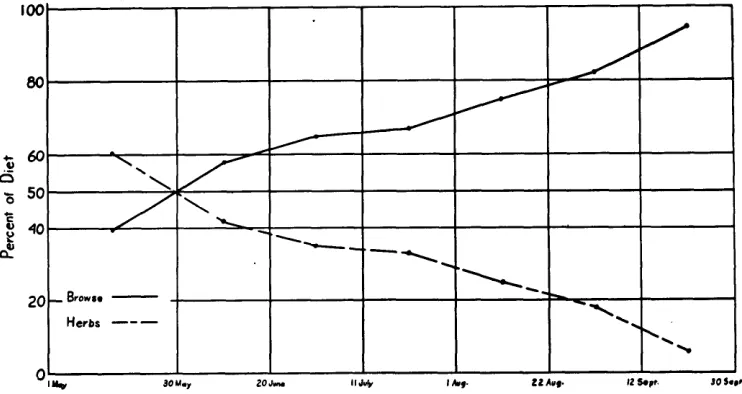
sumed is attributable to the fact that the herbs dry up as the season advances, hence, during the last months few species were sufficiently green to attract the ani- mals. Browse then made up the greater part of the diet.
In the early spring and summer, forbs appeared to constitute the bulk of the feed. This is not verified in all cases by the data in Table 1. The moisture content of the forbs was consistently higher than in the case of browse species. For this reason, although until mid-summer the total volume of browse consumed seemed less than the volume of forbs eaten; only in May was the consumption of her- baceous material greater than that of browse on a dry-weight basis. By the middle of September 1948 herbaceous material was so dry as to become of little significance. During 1947 more favorable moisture conditions existed and herbs constituted more than 15 percent of the diet even during late September. Figure 1 shows the average percentage of the daily diets made up of browse and herbs throughout the feeding period.
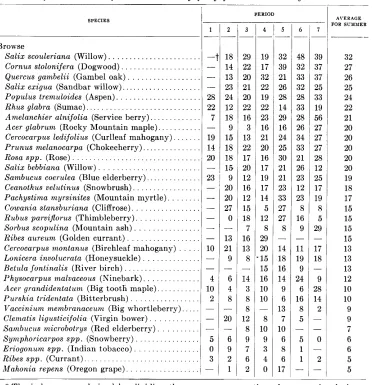
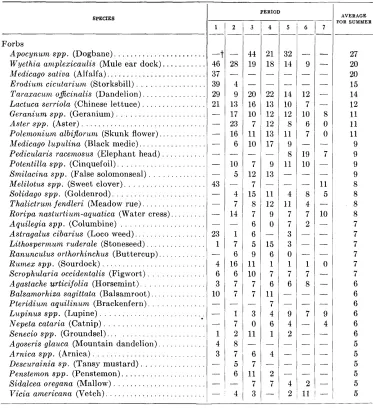
The data on consumption by species are given in Tables 2 and 3. Two factors
make these data imperfect measures of forage preference. The great number of species involved made it impossible in the time period involved to form all the possible combinations of species. Further- more, the amount consumed from any species varied greatly from one feeding to another, making it difficult to insure that every species fed was equally avail- able at all times. These factors probably make it impossible to evaluate precisely the preference shown toward any species. It is believed, however, that these data are indexes of the desirability of the species fed as forage for deer.
Other species than those shown in Tables 2 and 3 were fed. Only those with average daily consumption equal to or greater than five percent of the average daily forage intake are included. In general, consumption of the browse spe- cies was higher than that of forbs. Only four forbs ever constituted as high as 20 percent of daily food intake.
During specific periods, forb species were found to be of greater importance than indicated by t,he averages in Table 3. During period one the browse leaves were poorly developed and early growing
loo
20 _ Brow. -
Herbs ---
0
‘k 30 M.). 2OJwu I2 sop”
FORAGE CONSUMPTION BY MULE DEER
TABLE 2
Preference indexes* of northern Utah range forage for mule deer during summer
SPECIES
1 2 3 4 5 6 7
Browse
Salix scouleriana (Willow). ... _- 18 29 19 32 48 39
Cornus stolonifera (Dogwood). ... - 14 22 17 39 32 37
Quercus gambelii (Gambel oak). ... - 13 20 32 21 33 37
Salix exigua (Sandbar willow). ... - 23 21 22 26 32 25
Populus tremuloides (Aspen). ... 28 24 20 19 28 28 33 Rhus glabra (Sumac). ... 22 12 22 22 14 33 19 Amelanchier alnifolia (Service berry). ... 7 18 16 23 29 28 56 Acer glabrum (Rocky Mountain maple). ... - 9 3 16 16 26 27 Cercocarpus Zedifolius (Curlleaf mahogany). ... 19 15 13 21 24 34 27 Prunus melanocarpa (Chokecherry). ... 14 18 22 20 25 33 27 Rosa spp. (Rose) ... 20 18 17 16 30 21 28 Salix bebbiana (Willow) ... - 15 20 17 21 26 12 Sambucus coerulea (Blue elderberry). ... 23 9 12 19 21 23 25 Ceanothus velutinus (Snowbrush). ... - 20 16 17 23 12 17 Pachystima myrsinites (Mountain myrtle). ... - 20 12 14 33 23 19 Cowania stansburiana (Cliffrose). ... - 27 15 5 27 8 8 Rubus parvi$orus (Thimbleberry). ... - 0 18 12 27 16 5 Sorbus scopulina (Mountain ash) ... - - 7 8 8 9 29 Ribes aureum (Golden currant) ... - 13 16 29 - - - Cercocarpus montanus (Birchleaf mahogany) ... 10 21 13 20 14 11 17 Lonicera involucrata (Honeysuckle) ... - 9 8 15 18 19 18 Betula jontinalis (River birch) ... - - - 15 16 9 - Physocarpus malvaceous (Ninebark). ... 4 6 14 16 14 24 9 Acer grandidentatum (Big tooth maple). ... 10 4 3 10 9 6 28 Purshia tridentata (Bitterbrush). ... 2 8 8 10 6 16 14 Vaccinium membranaceum (Big whortleberry) ... - - 8 - 13 8 2 Clematis ligusticifolia (Virgin bower) ... - 20 12 8 7 5 - Sambucus microbotrys (Red elderberry). ... - - 8 10 10 - - Symphoricarpos spp. (Snowberry). ... 5 6 9 9 6 5 0 Eriogonum spp. (Indian tobacco) ... 0 9 7 3 8 1 - Ribes spp. (Currant). ... 3 2 6 4 6 1 2 Mahonia repens (Oregon grape). ... - 1 2 0 17 - -
PERIOD
AVERAGE FOR SL’YMER
32 27 26 25 24 22 21 20 20 20 20 20 19 18 17 15 15 15 15 13 13 13 12 10 10 9 9 7 6 6 5 5
* The indexes were derived by dividing the average consumption of any species during a period by the average daily forage intake during the corresponding period.
t Dash indicates none fed.
33
forbs, mule ear dock, alfalfa, storks- bill, sweet clover, and locoweed were es- pecially attractive. Mule ear dock was the most important single plant in periods one and two and continued to be impor- tant until well into August, a result which was not anticipated. The high consumption of dogbane was surprising, particularly during period three. Although geranium was never high in level of con-
sumption, it was important during all periods except period one, and throughout later periods remained one of the most important of the native forbs. Dandelion, aster, Chinese lettuce, skunk flower, and black medic all were consumed in mod- erate quantities during mid-summer.
TABLE 3
Preference indexes* of northern range forage for mule deer during summer
SPECIES
Forbs
Apocynum spp. (Dogbane). ...
Wyethia amplexicaulis (Mule ear dock). ...
Medicago sativa (Alfalfa). ...
Erodium cicuturium (Storksbill) ...
Turaxacum oficinulis (Dandelion). ...
Luctucu serriolu (Chinese lettuce) ...
Geranium spp. (Geranium) ...
Aster spp. (Aster). ...
Polemonium ulbiftorum (Skunk flower). ...
Medicugo Zupulinu (Black medic). ...
Pediculuris rucemosus (Elephant head) ...
Potent&z spp. (Cinquefoil). ...
Smilacinu spp. (False solomonseal) ...
Melilotus spp. (Sweet clover). ... Sotidugo spp. (Goldenrod). ...
Thulictrum fendleri (Meadow rue). ...
Roripu nasturtium-uquuticu (Water cress). ...
Aquilegiu spp. (Columbine) ...
Astrugulus ciburius (Loco weed). ...
Lithospermum ruderule (Stoneseed). ...
Rununculus orthorhinchus (Buttercup). ...
Rumex spp. (Sourdock) ...
Scrophuluriu occidentalis (Figwort) ...
Agustuche urticifoliu (Horsemint). ...
Bulsumorhizu sugittutu (Balsamroot). ...
Pteridium uquilinum (Brackenfern). ...
Lupinus spp. (Lupine) ... Nepetu cutaria (Catnip). ... Senecio spp. (Groundsel). ...
Agoseris gluucu (Mountain dandelion). ...
Arnicu spp. (Arnica) ...
Descuruiniu sp. (Tansy mustard). ...
Penstemon spp. (Penstemon). ...
Sidulceu oreganu (Mallow) ... Viciu americana (Vetch). ...
-
I
1 -i 46 37 39 29 21 - - - - - - - 43 - - - - 23 1 - 4 6 3 10 - - - 1 4 3 - - - -t -
28 2 - 4 9 13 17 23 16 6 - 10 5 - 4 7 14 - 1 7 6 16 6 7 7 - 1 7 2 8 7 5 6 - 4 44 19 - 21 18 - - - 20 22 16 13 10 12 7 12 11 13 10 17 - 7 12 7 15 8 7 6 6 5 9 11 10 7 7 - 9 13 - 11 12 9 0 - 3 0 11 - 15 6 1 7 6 11 7 4 6 1 - -
6 4
7 - 11 2
7 7
3 - PERIOD
-
5 6
32 14 - - 14 10 12 8 11 9 8 11 - - 4 11 7 7 3 3 0 1 7 6 - - 9 - - 12 7 10 6 7 - 19 10 - - 8 4 7 2 - - 9 4 2 - - - - 4 2 - 1 7 8 - - 7 - - - - - - 2 11 ._ AVERAGE FOR SUMMER 7
- -
- 27 - 20 - 20
- 15 - 14 - 12
8 11
0 11
0 11
- 9
7 9
- 9
- 9
11 8
5 8
- 8
10 8
- 7
- 7
- 7
- 7
0 7
- 7
- 6
- 6
- 6
9 6
4 6
- 6
- 5
- 5
- 5
- 5
- 5
- 5
* The indexes were derived by dividing the average consumption of any species during a period by the average daily forage intake during the corresponding period.
t Dash indicates none fed.
FORAGE CONSUMPTION BY MULF, DEER 35
rust was prominent on birchleaf mahog- any during the later periods which ap- peared materially to reduce its palatabil- ity. This rust was not present during the early season. A similar cause may have been operative in the case of service- berry, since it was affected in likemanner.
Bitterbrush was not eaten in large quantities in these tests. During the last two periods, however, it increased in importance. By contrast, cliff rose, a similar plant which also is important as winter forage, was taken more readily during mid-summer than it was toward the end of the summer. Bigtooth maple, while not eaten readily during mid- summer, was nevertheless eaten with some relish at later periods. This resulted in its being higher on the list than species commonly believed to be better forage plants, among them bitterbrush and snowberry.
In addition to the species listed in Table 2, there were seven browse species which were included in the tests but which were uneaten or so lightly touched that they were not considered to be important summer forages for deer. These included alder (A Znus tenuifolia) , yellow brush
(Chrysothamnus viscidiflorus), big rabbit- brush (C. nauseosus), buff alo berry (Lep-
argyrea canadensis), ocean spray (Seri- cotheca discolor) sagebrush (Artemisia
spp.) and juniper (Juniper spp.) .
Twenty-seven herbs were included in addition to those shown in the tables. Several of those were eaten to some ex- tent. Hawksbeard (Crepis acuminata),
scarlet gilia (G&a aggregata) , evening
primrose (Oenothera sp.), monkshood
(Aconitum columbianum) , and bluebells
(Mertensia Zeonardi) all show an average consumption of four percent of the daily average. The reaction to bluebells is es- pecially interesting in this connection since the plant is regarded as an impor- tant forage for sheep. In spite of the low
consumption of these plants individually, it is probable that in the aggregate they contribute an appreciable amount to the diet of deer on the range. Butterweed
(Senecio serra), another particularly good sheep forage was eaten very lightly in these tests.
Of the several grasses offered, only cul- tivated rye (Secale) and smooth brome
(Bromus inermis) were found to be eaten and these but lightly. Neither of these was eaten after it matured beyond the boot stage.
The two deer exhibited some rather well defined differences throughout the sum- mer in respect to their apparent liking for certain plants. Deer 85 consumed considerably less oak than did deer 84. Similarly, deer 84 ate on the average about a quarter of a pound of balsamroot each time it was fed, while it was largely left untouched by the other animal. Throughout, deer 84 appeared to be less particular in his forage preferences, utiliz- ing forbs more heavily and eating of more individual species than did deer 85.
It is interesting to note that stems of the herbaceous plants and the leaf petio- les of those plants with large leaves were eaten but slightly. Even in the case of plants which were eaten readily such as geranium, mule ear dock and skunk flower, the leaf blades were severed from the stems of petioles, which seems the more remarkable in view of the fact that the plants were not attached, making leaf removal more difficult than it is in nature. This behavior forms an interest- ing contrast to that observed during the winter when woody stems are eaten back even beyond the point marking the cur- rent growth.
vidual periods, the consumption was as low as 2.65 pounds per hundred weight, and as high as 4.71 pounds. The highest periodic consumption in 1948 occurred in late June and early July. This was not true in 1947, although in both years the level of consumption throughout this period was greater than during the two periods following. With the onset of cooler weather in late summer, the con- sumption of forage increased from hot summer months.
Throughout the tests, great differences in daily consumption were evident. On individual days less than a pound of air dry material was consumed. At other times, and particularly toward the close of the feeding period, daily intakes of 5 pounds and more were not uncommon. This variation was not explainable by the particular plants which were offered, for on individual days the same species would be eaten now heavily, now moderately.
COMPARATIVE FORAGE PREFERENCES
OF SHEEP AND’ MULE DEER
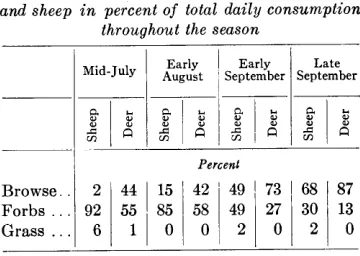
During the summer of 1949, deer and sheep were held in pens and fed for one- day periods. Four feeding dates were selected: mid-July, early August, early September, and late September. In 1950 feeding was conducted on only the first and last of these feeding dates. Two of each kind of animal were used in the feeding trials each year. The results are summarized in Table 4.
It may be noted that the results se- cured from deer in these tests show the same general trend throughout the sea- son as was found in the earlier feeding tests (See Fig. 1). However, comparable percentage consumptions of ‘browse and herbs were not attained at the same season, browse being less important and herbs correspondingly more important during mid-season than in the earlier tests.
TABLE 4
Comparative consumption by forage class of deer
and sheep in percent of total daily consumption throughout the season
Browse. Forbs . . Grass . .
Mid- July August Early i September Early September Late
There is a marked difference between the two kinds of animals in the impor- tance of the forage classes. Browse proved considerably more important in the diet of the deer than in that of the sheep, especially during the earlier periods. Grass was generally more important to sheep than to deer, and this difference may have been even greater had the tests been begun earlier. Sheep, like deer, displayed a definite tendency to shift from forbs to browse as the season progressed.
SUMMARI
Forage preference studies were con- ducted near Logan, Utah with captive mule deer. Deer were confined to pens and fed fresh forage collected from the range in the vicinity. The feeding period ex- tended from May to October during the summers of 1947 and 1948. In 1949 and 1950 two deer and two sheep were fed for one-day periods in order to compare their forage preferences.
FORAGE CONSUMPTION BY MULE DEER 37
sumed as little as 2.65 and as much as 4.71 pounds per hundred weight during specific periods.
As measured by the volume consumed, Scouler’s willow, dogwood, gambel oak, sandbar willow and aspen were the most important browse plants. Bitterbrush stood relatively low in the scale as com- pared to other browse plants, especially during early periods.
Few forbs attained the average con- sumption figures found in the case of browse plants, only dogbane exceeding 20 percent of the average daily forage in- take. Of the most common forage plants,
mule ear dock, dandelion, geranium, and skunk flower were most important.
Two important sheep forages, ground- se1 and bluebells, were eaten very lightly by deer in these tests.
Comparative feeding tests using mule deer and sheep showed that forbs were more important in the diet of sheep than of deer. During mid-July browse made up but 2 percent of the forage consumed by the sheep, while at the same time it constituted 44 percent of that of mule deer. By late September browse made up 68 and 87 percent of the consumption of sheep and deer, respectively.
SOMETHING SPECIAL
A man wrapped up in himself makes a very small bundle.
If you would have a faithful servant, and one that you like, serve yourself.
Some are weather-wise, some are otherwise.-Benjamin Franklin. f&
The winds and waves are always on the side of the ablest navigator.-Gibbon.
9%