
Towards Secure Distance Bounding
?
Ioana Boureanu1, Aikaterini Mitrokotsa2, and Serge Vaudenay3
1 Akamai Technologies Limited, London, UK,
2 Chalmers University of Technology, Gothenburg, Sweden
3 EPFL, CH-1015 Lausanne, Switzerland
http://lasec.epfl.ch
Abstract. Relay attacks (and, more generally, man-in-the-middle attacks) are a serious threat against many access control and payment schemes. In this work, we present distance-bounding protocols, how these can deter relay attacks, and the security models formalizing these protocols. We show several pitfalls mak-ing existmak-ing protocols insecure (or at least, vulnerable, in some cases). Then, we introduce the SKI protocol which enjoys resistance to all popular attack-models and features provable security. As far as we know, this is the first protocol with such all-encompassing security guarantees.
1
Why Distance-Bounding?
It is well known that a chess beginner can win against a chess grand-master easily by defeating two grand-masters concurrently, taking different colors in both games, and relaying the move of one master to the other. This is a pure relay attackwhere two masters play against each other while each of them thinks he is playing against a beginner.
In real life, relay attacks find applications in access control. For instance, a car with a wireless key can be opened by relaying the communication between the key (the token) and the car. RFID-based access control to buildings can also be subject to relay attacks [21]. The same goes for (contactless) credit-card payments: a customer may try to pay for something on a malicious terminal which relays to a fake card paying for something more expensive [15].
To defeat relay attacks, Brands and Chaum [9] introduced the notion ofdistance bounding protocol. This relies on the fact that information is local and it cannot travel faster than light. So, an RFID reader can identify when participants are close enough because the round-trip communication time has been small enough. The idea is that a proverholding a keyxproves to averifierthat he is close to him. Ideally, this notion should behave like a traditional interactive proof system in the sense that it must satisfy:
– completeness (i.e., an honest prover close to the verifier will pass the protocol with high probability)
– soundness (i.e., if the verifier accepts the protocol, then it must be the case that the information held by all close participants includesx)
– security (i.e., if the prover honestly runs the protocol, the provided information does not provide any advantage to defeat soundness).
The last property is weaker than zero-knowledge and is generally required in identifica-tion protocols. In practice, the literature does not define distance-bounding like this but rather considers several popular threat models, as per the following summary.
– Distance fraud[9]: a far-away malicious prover tries to pass the protocol.
– Mafia fraud[14]: an adversary between a far-away honest prover and a verifier tries to get advantage of his position to make the verifier accept. (This generalizes relay attacks as the adversary may also modify messages.)
– Terrorist fraud [14]: a far-away malicious prover, with the help of an adversary, tries to make the verifier accept, but without giving the adversary any advantage to later pass the protocol alone. For instance, the malicious prover wants to make the verifier accept, although he is far away, but does not want to give his secretxto the adversary.
– Impersonation fraud[3]: An adversary tries to impersonate the prover and make the verifier accept.
– Distance hijacking[13]: A far-away prover takes advantage of some honest provers running the protocol to make the verifier accept.
In our model [8], we factor all these common threats into three possible frauds.
– Distance fraud: this is the classical notion in which we also consider concurrency with many other participants. I.e., we include other possible provers (with other secrets) and verifiers. Consequently, our generalized distance fraud also includes distance hijacking.
– Man-in-the-middle: we consider an adversary (maybe at several locations) who can interact with many honest provers (possibly with different keys) and verifiers during alearning phase. Then, theattack phasecontains honest provers with the keyx, far away from a verifierV, and possibly many other honest provers (with other keys) and other verifiers. The goal of the adversary is to makeVaccept the prover holding x. Clearly, this generalizes mafia fraud and includes impersonation fraud.
– Collusion fraud: A far-away prover holdingxhelps an adversary to make the ver-ifier accept the proof. This might be in the presence of many other honest partici-pants. However, there should be no man-in-the-middle attack constructed based on this malicious prover. I.e., the adversary should not extract from him any advantage to run (later) a man-in-the-middle attack.
Ideally, we could just keep this last notion which includes all others and is closer to the soundness and the security notion in the interactive proof system.
Table 1.Best Attack Results on Existing Distance-Bounding Protocols [7]
Protocol Success Probability
Distance-Fraud MIM Collusion-Fraud Brands & Chaum [9] (1/2)n [18] (1/2)n [25] 1 [25] Bussard & Bagga [10] 1 [4] (1/2)n [10] 1 [4]
ˇ
Capkunet al.(SECTOR) [11](1/2)n [18] (1/2)n [25] 1 [25] Hancke & Kuhn [20] (3/4)n [18] (3/4)n [25] 1 [25] Reidet al.[34] (3/4)n [18] (3/4)nor 1 [26,4](3/4)ν [25] Singel´ee & Preneel [35] (1/2)n [18] (1/2)n [25] 1 [25] Tu & Piramuthu [36] (3/4)n [30] 1 [25] (3/4)ν [30] Munilla & Peinado [29] (3/4)n [18] (3/5)n [18] 1 [18] Swiss-Knife [25] (3/4)n [25] (1/2)n [25] (3/4)ν [25] Kim & Avoine [24] (7/8)n [18] (1/2)n [18] 1 [18] Nikov & Vauclair [31] 1/k* [25] (1/2)n [25] 1 [25] Avoineet al.[2] (3/4)n [2] (2/3)n [2] (2/3)ν [2]
*kis an additional parameter in this protocol.
2
Towards a Secure Protocol
We first look at the Hancke-Kuhn protocol [20] in Fig. 1. Here, we use a symmetric key xand two vectorsa1,a2ofnbits which are derived from an exchange of nonces. Then, the distance bounding phase proceeds innrounds. In each round, the verifier selects a randomci∈ {1,2}, sends it to the prover and expects to receiveri, theith bit ofaci. The
verifier measures the round-trip communication time and rejects the proof if it took too long to respond or the response is incorrect.
This protocol is vulnerable to a trivial terrorist fraud (actually, it was not meant to resist to it): the malicious prover does the initial phase which is not time-critical, then givesa1anda2to the adversary who can become a proxy for the prover to the verifier. Clearly,a1anda2do not leakx.
To fix this problem, Reidet al.[34] introduce the protocol in Fig. 2 which we call DBENC in [5]. Here, onlya1is derived from the initial nonces anda2is set toa1⊕x. So, a malicious prover providinga1anda2to an adversary would also leakx.
First of all, we stress that nonces must really be “numbers once used”, as their name suggests. I.e., they shall not repeat. Otherwise, this protocol (as well as many others) would leak some sensitive information, as noticed in [28].
Second, we observe that this protocol unfortunately becomes vulnerable to a man-in-the-middle attack [25]. The idea of the attack is that the adversary relays, during a learning phase, the communication between a close prover and a verifier, but flips one challenge cj. The value rj which is sent as a response to the verifier is selected
at random. So, from the prover, the adversary learns the response to cj, and by the
final output of the verifier (acceptance or rejection), the adversary deduces what is the correct answer to 1−cj. So, he learns the jth bit ofa1anda2and deducesxj. He can
Verifier Prover
secret:x secret:x
initialization phase
pickNV NV
−−−−−−−−−−→
NP
←−−−−−−−−−−pickNP
a1ka2=fx(NP,NV) a1ka2=fx(NP,NV)
distance bounding phase fori=1 ton pickci∈ {1,2}
starttimeri ci
−−−−−−−−−−→
stoptimeri ri
←−−−−−−−−−−ri=
a1,iifci=1 a2,iifci=2 check responses
check timers OutV
−−−−−−−−−−→
Fig. 1.The Hancke-Kuhn Distance-Bounding protocol [20]
Verifier Prover
secret:x secret:x
initialization phase
pickNV
NV
−−−−−−−−−−→pickNP
a1=fx(NP,NV)
NP
←−−−−−−−−−−a1=fx(NP,NV) a2=a1⊕x a2=a1⊕x
distance bounding phase fori=1 ton pickci∈ {1,2}
starttimeri ci
−−−−−−−−−−→
stoptimeri ri
←−−−−−−−−−−ri=aci,i
check responses
check timers OutV
−−−−−−−−−−→
the verifier, thanks tox. Other instances of DBENC wherea2=a1⊕xare replaced by addition modulo someqor addition with a random factor, can also be broken, as shown in [4].
In [28], it was suggested to replacea1= fx(NP,NV)anda2=a1⊕xbya1ka2= fx(NP,NV)and a release of(R,x⊕hR(a1,a2))for some randomR, wherehis a universal hash function. However, proving the security of such a protocol does not seem to be easy.
Verifier Prover
secret:x secret:x
initialization phase NP
←−−−−−−−−−−pickNP
pickNV −−−−−−−−−−→NV
a1ka2=fx(NP,NV) a1ka2= fx(NP,NV)
distance bounding phase fori=1 ton pickci∈ {1,2,3}
starttimeri ci
−−−−−−−−−−→
stoptimeri ri
←−−−−−−−−−−ri=
a1,i ifci=1 a2,i ifci=2 xi⊕a1,i⊕a2,iifci=3 check responses
check timers OutV
−−−−−−−−−−→
Fig. 3.The TDB Distance-Bounding protocol [2]
The problem seems more easily amended by considering the TDB protocol [2] in Fig. 3. Now, there are three possible challengesci∈ {1,2,3}. The answer to 1 and to
2 consists of bits from a1 anda2, respectively. Botha1 anda2 are derived from the nonces. The answer to 3 is a bit froma3=a1⊕a2⊕x. The main idea is that we use a threshold secret-sharing scheme to splitxiinto three shares, so that two shares alone
leak no information.
The security of TDB assumes thatf is a PRF. Unfortunately, this assumption alone is not enough to guarantee the security and some related security results from the lit-erature are incorrect. Indeed, as shown in [5], we can artificially construct PRFs which make the protocol insecure. The PRF construction is done byPRF programming. For instance, given a PRFg, we construct a new function f defined by the following in-stances:
fx(NP,NV) =
xkx ifNP=x
gx(NP,NV)otherwise
would havea1=a2=a3. So, the responseriis predicted before receiving the challenge
ci. Consequently, the prover can make sure that the response arrives on time, without
even knowingci: he just replies before receivingci.
Verifier Prover
secret:x secret:x
initialization phase
picka,NV NP
←−−−−−−−−−−pickNP
M=a⊕fx(NP,NV) M,NV
−−−−−−−−−−→a=M⊕fx(NP,NV)
distance bounding phase fori=1 ton pickci∈ {1,2,3}
starttimeri ci
−−−−−−−−−−→
stoptimeri ri
←−−−−−−−−−−ri=
a1,i ifci=1 a2,i ifci=2 xi⊕a1,i⊕a2,iifci=3 check responses
check timers OutV
−−−−−−−−−−→
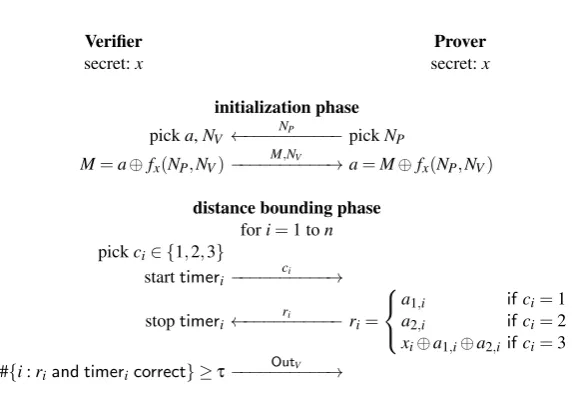
Fig. 4.The TDB Distance-Bounding protocol with PRF Masking [5]
We fix this PRF-based problem by using PRF masking [5,7,8] as shown in Fig. 4. There, the vectorsaare chosen by the verifier. So, the malicious prover cannot induce some properties ontoato mount distance frauds.
But, we can also mount a man-in-the-middle attack by PRF programming. Given a PRFg, we first define a predicatetrapdoorx(α¯kt)⇐⇒t=gx(α¯)⊕right half(x). It must be hard, by playing with agxoracle, to construct a string satisfying this predicate.
However, when playing with the prover in a learning phase, and using the challenges c= (1, . . . ,1,3, . . . ,3), the adversary obtains such a string ¯α. We define
fx(NP,NV) =
a1ka2=αkβkγkβ⊕gx(α)if¬trapdoorx(NV)
where(α,β,γ) =gx(NP,NV)
a1ka2=xkx otherwise
We can easily see thatfis a PRF. Then, the learning phase works as follows:
1: play withPand sendc= (1, . . . ,1,3, . . . ,3)to obtain from the responses ¯αkt satis-fyingtrapdoorx
2: play withPagain withNV=α¯ktand getx Based onx, the adversary can impersonate the prover.
In [5], we report other protocols which are weak, with respect to PRF programming (see Table 2).
Table 2.Protocol which can be Broken by PRF Programming Techniques [5]
Protocol Distance-Fraud MIM
TDB Avoine-Lauradoux-Martin [2] √ √
D¨urholz-Fischlin-Kasper-Onete [17] √ –
Hancke-Kuhn [20] √ –
Avoine-Tchamkerten [3] √ –
Reid-Nieto-Tang-Senadji [34] √ √
Swiss-Knife Kim-Avoine-Koeune-Standaert-Pereira [25] – √
leaking fx(y), sometimes fx(y)⊕x, and sometimes a mixture of both, does not
com-promise the security. More precisely, we require the(ε,T)-circular keyingproperty [8]. This assumes that an adversary
A
of complexity at mostT making queries of the form (yi,ai,bi)to an oracley,a,b7→(a·x0) + (b·fx(y))
cannot distinguish (up to an advantageε) whetherxandx0have been selected by having x=x0 orxandx0are independent. To make it possible, the adversary must follow the constraint that for eachi1, . . . ,iq,c1, . . . ,cqsatisfyingyi1 =· · ·=yiq and∑
q
j=1cjbij =0,
we have that∑qj=1cjaij=0. As a sanity check, we prove that this notion makes sense by
constructing a circular-keying secure PRF in the random oracle model [8]. Furthermore, this property excludes programmed PRFs as per mentioned before.
All the previous protocols assume that there is no noise to harm the protocol ex-ecution. However, the distance bounding phase is subject to high constraints. Indeed, an allowed error of one microsecond in the time measurement will correspond to an imprecision of 300 meters in the distance estimate, due to the speed of light. Clearly, this may not defeat relay attacks. To reach a precision of 10 meters, the prover shall not spend more than 33 nanoseconds for receivingci, computing ri, and sending ri.
So, computation or transmission will eventually be subject to noise. To keep the com-pleteness property, we need to tolerate a linear number of errors, depending on the noise level. Thus, in the following protocol (depicted on Fig. 5), onlyτout ofnrounds should be correct for a successful run of the protocol.
As noticed by Hancke [19], this introduces a new vulnerability to terrorist fraud. The idea of his attack is that the malicious prover will run the initialization phase, then forτout ofnvalues ofihe will reveal the response functionci7→ri to the adversary.
Verifier Prover
secret:x secret:x
initialization phase
picka,NV NP
←−−−−−−−−−−pickNP
M=a⊕fx(NP,NV) M,NV
−−−−−−−−−−→a=M⊕fx(NP,NV)
distance bounding phase fori=1 ton pickci∈ {1,2,3}
starttimeri ci
−−−−−−−−−−→
stoptimeri ri
←−−−−−−−−−−ri=
a1,i ifci=1 a2,i ifci=2 xi⊕a1,i⊕a2,iifci=3 #{i:riand timericorrect} ≥τ−−−−−−−−−−→OutV
Fig. 5.The TDB Distance-Bounding protocol with PRF Masking and Noise Tolerance
3
The SKI Protocol
To address all previously noticed vulnerabilities, we introduce the SKI protocol.1This protocol appeared in [7,8]. It enjoys provable security. The protocol is depicted in Fig. 6. There, the function f must be a PRF with circular-keying security.
Given a vectorµ, the linear functionLµis defined by
Lµ(x) = (µ·x, . . . ,µ·x)
Namely, all bits are set to the dot product betweenµandx. Withx0=Lµ(x), Hancke’s
terrorist fraud would reveal a majority of the bits ofx0thus leakingLµ(x). SinceLµis
not chosen by the prover, by repeating the attack, we can collect enough information aboutxto reconstructx. So, Hancke’s terrorist fraud is prevented.
We letsdenote the bit-length of the secretx. I.e., it is no longer necessarily equal to n, the number of rounds.
We define the following function:
B(n,τ,q) =
n
∑
i=τ
n
i
qi(1−q)n−i
To studycompleteness, we assume that there is a probability ofpnoisethat one round is incorrectly executed by honest players. The probability that an honest prover, close to the verifier, passes the protocol isB(n,τ,1−pnoise). By using the Chernoff bound [12], this is greater than 1−e−2ε2nfor
τ
n<1−pnoise−ε (1)
Verifier Prover
secret:x secret:x
initialization phase NP
←−−−−−−−−−−pickNP
picka,Lµ,NV −−−−−−−−−−→M,Lµ,NV
M=a⊕fx(NP,NV,Lµ) a=M⊕fx(NP,NV,Lµ)
x0=Lµ(x) x0=Lµ(x)
distance bounding phase fori=1 ton pickci∈ {1,2,3}
starttimeri ci
−−−−−−−−−−→
stoptimeri ri
←−−−−−−−−−−ri=
a1,i ifci=1 a2,i ifci=2 x0i⊕a1,i⊕a2,iifci=3 #{i:riand timericorrect} ≥τ−−−−−−−−−−→OutV
Fig. 6.The SKI Distance-Bounding Protocol [7,8]
We now describe the best distance fraud against SKI. The malicious prover just runs the initialization phase. During the distance-bounding phase, he anticipates the challengeciby sending somerisuch thatrihas the largest preimage set by theci7→ri
response function. This maximizes the chances to win. We can easily see that a single round will pass with probability 34. So, the distance fraud succeeds with probability
B(n,τ,34). By using the Chernoff bound, this is lower thane−2ε2nwhen
τ n >
3
4+ε (2)
The best man-in-the-middle attack runs as follows: the adversary first relays mes-sages between the prover and the verifier in the initialization phase. Then, he plays with the prover a distance-bounding phase to learn some answers. He can then play with the verifier, with the responses that he has learnt, or with random ones if he ignores the correct one. The probability to pass a round correctly is 23. So, the man-in-the-middle attack succeeds with probabilityB(n,τ,23). By using the Chernoff bound, this is lower thane−2ε2nwhen
τ n >
2
3+ε (3)
The best collusion fraud consists of running the initialization phase between the ma-licious prover and the verifier. Then, the prover selects somec∗1, . . . ,c∗nand setFi∗(c) = Fi(c)for eachc6=c∗i, where Fi is the response functionci7→Fi(ci) =ri. TheFi∗(c
∗ i)
B(n,τ,56). By using the Chernoff bound, this is lower thane−2ε2nwhen
τ n >
5
6+ε (4)
To summarize equations (1)-(2)-(3)-(4), wheneverpnoise<16−2ε, we can adjustτ
and have the failure cases bounded bye−2ε2n. Actually, we can formally prove that the
above attacks are optimal. We obtain the following result.
Theorem 1 (Boureanu-Mitrokotsa-Vaudenay [8]).If f is a(ε,T)-circular-keying se-cure PRF and the verifier requires at leastτcorrect rounds,
– all distance frauds (with complexity bounded by T ) have a success probability bounded byPr[success]≥B(n,τ,34) +ε;
– all man-in-the-middle attacks (with complexity bounded by T ) have a success prob-ability bounded byPr[success]≥B(n,τ,32) +r222−k+ε, where k is the nonce length and r is the number of participants in the experiment;
– for all collusion frauds such that p=Pr[CF succeeds]≥B(n2,τ−n
2, 2 3)1
−cand p−1
polynomially bounded, there is an associated man-in-the-middle attack with P∗ such thatPr[MiM succeeds]≥ 1−B(n
2,τ−
n
2, 2 3)c
s
, for any c.
Although it does not explicitly appear for distance-fraud and man-in-the-middle, we note thatsplays a role in theεanyway: ifsis too small, f cannot be a secure PRF soε cannot be negligible.
To optimizeτwith respect to the expected loss in the case of a failed authentication or of an attack, we can follow the method in [16]. It requires to quantify all possible types of losses.
There exist several variants of SKI with different properties. Namely, we can con-sider secret sharing schemes other than the one in Fig. 6. We can concon-sider other leakage schemesLµas well. We refer to [7,8] for details.
4
Conclusion
Modeling the different types of frauds for distance-bounding is not easy. When adopting an appropriate model, we can see that none of the existing distance-bounding protocols in the literature resist all frauds, with the exception of SKI. SKI is very lightweight, with several possible variants, of which herein we showed two. Under the assumption that the underlying primitive is a PRF with circular-keying security and that the level of noise in each round (in honest executions) is lower than 16, we can achieve provable secure distance-bounding.
noisepnoiseclose to 14. One problem with this option is that proving security does not seem easy and, finally, it may be weak against PRF programming [5].
Another line of research consists of adding privacy preservation. People already suggested to protectlocation privacy[33], but this suffers from severe limitations as shown in [1,27]. Anonymity could also be considered in a way similar to RFID proto-cols [37,32,23]. One proposal is made in [22] but without terrorist fraud protection.
Acknowledgements
We warmly thank Shiho Moriai, program chair of FSE’13, and her program committee, for inviting us to present our results on distance bounding.
This work was partially supported by
– the National Competence Center in Research on Mobile Information and Commu-nication Systems (NCCR-MICS), under the Swiss National Science Foundation; – the Marie Curie IEF Project Grant No. 252323 “PPIDR: Privacy-Preserving
Intru-sion Detection and Response in Wireless Communications”.
References
1. J.-P. Aumasson, A. Mitrokotsa, P. Peris-Lopez. A Note on a Privacy-Preserving Distance-Bounding Protocol. InInformation and Communications Security ICICS’11, Beijing, China, Lecture Notes in Computer Science 7043, pp. 78–92, Springer-Verlag, 2011.
2. G. Avoine, C. Lauradoux, B. Martin. How Secret-Sharing can Defeat Terrorist Fraud. In ACM Conference on Wireless Network Security WISEC’11, Hamburg, Germany, pp. 145– 156, ACM, 2011.
3. G. Avoine, A. Tchamkerten. An Efficient Distance Bounding RFID Authentication Proto-col: Balancing False-Acceptance Rate and Memory Requirement. InInformation Security ISC’09, Pisa, Italy, Lecture Notes in Computer Science 5735, pp. 250–261, Springer-Verlag, 2009.
4. A. Bay, I. Boureanu, A. Mitrokotsa, I. Spulber, S. Vaudenay. The Bussard-Bagga and Other Distance-Bounding Protocols under Attacks. To appear in the proceedings of INSCRYPT’12. 5. I. Boureanu, A. Mitrokotsa, S. Vaudenay. On the Pseudorandom Function Assumption in (Secure) Distance-Bounding Protocols - PRF-ness alone Does Not Stop the Frauds! In LATINCRYPT’12, Santiago, Chile, Lecture Notes in Computer Science 7533, pp. 100–120, Springer-Verlag, 2012.
6. I. Boureanu, A. Mitrokotsa, S. Vaudenay. On the Need for Secure Distance-Bounding. To appear in the proceedings of ESC’13.
7. I. Boureanu, A. Mitrokotsa, S. Vaudenay. Secure & Lightweight Distance-Bounding. To ap-pear in the proceedings of LightSec’13.
8. I. Boureanu, A. Mitrokotsa, S. Vaudenay. Practical & Provably Secure Distance-Bounding. Submitted.
9. S. Brands, D. Chaum. Distance-Bounding Protocols (Extended Abstract). InAdvances in Cryptology EUROCRYPT’93, Lofthus, Norway, Lecture Notes in Computer Science 765, pp. 344–359, Springer-Verlag, 1994.
11. S. ˇCapkun, L. Butty´an, J. P. Hubaux. SECTOR: Secure Tracking of Node Encounters in Multi-Hop Wireless Networks. InACM Workshop on Security of Ad Hoc and Sensor Net-works SASN’03, Fairfax VA, USA, pp. 21–32, ACM, 2003.
12. H. Chernoff. A Measure of Asymptotic Efficiency for Tests of a Hypothesis Based on the sum of Observations.Annals of Mathematical Statistics, vol. 23 (4), pp. 493-507, 1952. 13. C.J. F. Cremers, K.B. Rasmussen, B. Schmidt, S. ˇCapkun. Distance Hijacking Attacks on
Distance Bounding Protocols. InIEEE Symposium on Security and Privacy S&P’12, San Francisco CA, USA, pp. 113–127, IEEE Computer Society, 2012.
14. Y. Desmedt. Major Security Problems with the “Unforgeable” (Feige-)Fiat-Shamir Proofs of Identity and How to Overcome Them. InCongress on Computer and Communication Security and Protection Securicom’88, Paris, France, pp. 147–159, SEDEP Paris France, 1988.
15. S. Drimer, S.J. Murdoch. Keep your Enemies Close: Distance Bounding Against Smartcard Relay Attacks. InUSENIX Security Symposium, Boston MA, USA, pp. 87–102, USENIX, 2007.
16. C. Dimitrakakis, A. Mitrokotsa, S. Vaudenay. Expected Loss Bounds for Authentication in Constrained Channels. InProceedings of the IEEE INFOCOM’12, Orlando FL, USA, pp. 478–485, IEEE, 2012.
17. U. D¨urholz, M. Fischlin, M. Kasper, C. Onete. A Formal Approach to Distance-Bounding RFID Protocols. InInformation Security ISC’11, Xi’an, China, Lecture Notes in Computer Science 7001, pp. 47–62, Springer-Verlag, 2011.
18. A. G¨urel, A. Arslan, M. Akg¨un. Non-uniform Stepping Approach to RFID Distance Bounding Problem. InData Privacy Management and Autonomous Spontaneous Security DPM/SETOP’10, Athens, Greece, Lecture Notes in Computer Science 6514, pp. 64–78, Springer-Verlag, 2011.
19. G.P. Hancke. Distance Bounding for RFID: Effectiveness of Terrorist Fraud. InConference on RFID-Technologies and Applications RFID-TA’12, Nice, France, pp. 91–96, IEEE, 2012. 20. G.P. Hancke, M.G. Kuhn. An RFID Distance Bounding Protocol. InConference on Security and Privacy for Emerging Areas in Communications Networks SecureComm’05, Athens, Greece, pp. 67–73, IEEE, 2005.
21. G.P. Hancke, K. Mayes, K. Markantonakis, Confidence in Smart Token Proximity: Relay Attacks Revisited.Computer & Security, vol. 28, pp. 615–627, 2009.
22. J. Hermans, C. Onete, R. Peeters. Efficient, Secure, Private Distance Bounding without Key Updates. InACM Conference on Security and Privacy in Wireless and Mobile Networks WISEC’13, Budapest, Hungary, pp. 207–218, ACM, 2013.
23. J. Hermans, A. Pashalidis, F. Vercauteren, B. Preneel. A New RFID Privacy Model. In Com-puter Security ESORICS’11, Leuven, Belgium, Lecture Notes in Computer Science 6879, pp. 568–587, Springer-Verlag, 2011.
24. C.H. Kim, G. Avoine. RFID Distance Bounding Protocol with Mixed Challenges to Prevent Relay Attacks. InCryptology and Network Security, 8th International Conference CANS’09, Kanazawa, Japan, Lecture Notes in Computer Science 5888, pp. 119–133, Springer-Verlag, 2009.
25. C.H. Kim, G. Avoine, F. Koeune, F.-X. Standaert, O. Pereira. The Swiss-Knife RFID Dis-tance Bounding Protocol. InInformation Security and Cryptology ICISC’08, Seoul, Korea, Lecture Notes in Computer Science 5461, pp. 98–115, Springer-Verlag, 2009.
26. A. Mitrokotsa, C. Dimitrakakis, P. Peris-Lopez, J.C. Hermandez-Castro. Reid et al.’s Dis-tance Bounding Protocol and Mafia Fraud Attacks over Noisy Channels.IEEE Communica-tions Letters, vol. 14, pp. 121–123, 2010.
28. A. Mitrokotsa, P. Peris-Lopez, C. Dimitrakakis, S. Vaudenay. On Selecting the Nonce Length in Distance-Bounding Protocols. To appear in the Computer Journal (Oxford), Special Issue on “Advanced Semantic and Social Multimedia Technologies for Future Computing Envi-ronment”. 2013.doi: 10.1093/comjnl/bxt033
29. J. Munilla, A. Peinado. Distance bounding protocols for RFID enhanced by using void-challenges and analysis in noisy channels.Wireless Communications and Mobile Computing, vol. 8, pp. 1227–1232, 2008.
30. J. Munilla, A. Peinado. Security Analysis of Tu and Piramuthu’s Protocol. InConference on New Technologies, Mobility and Security NTMS’08, Tangier, Morocco, pp. 1–5, IEEE, 2008. 31. V. Nikov, M. Vauclair. Yet Another Secure Distance-Bounding Protocol. InInternational Conference on Security and Cryptography, Porto, Portugal, pp. 218–221, INSTICC Press, 2008.
32. K. Ouafi, S. Vaudenay. Strong Privacy for RFID Systems from Plaintext-Aware Encryption. In Cryptology and Network Security, 8th International Conference CANS’12, Darmstadt, Germany, Lecture Notes in Computer Science 7712, pp. 247–262, Springer-Verlag, 2012. 33. K.B. Rasmussen, S. ˇCapkun. Location Privacy of Distance Bounding Protocols. In15th ACM
Conference on Computer and Communications Security, Alexandria VA, USA, pp. 149–160, ACM Press, 2008.
34. J. Reid, J.M.G. Nieto, T. Tang, B. Senadji. Detecting Relay Attacks with Timing-Based Pro-tocols. InACM Symposium on Information, Computer and Communications Security ASI-ACCS’07, Singapore, pp. 204–213, ACM, 2007.
35. D. Singel´ee, B. Preneel. Distance Bounding in Noisy Environments. InSecurity and Pri-vacy in Ad-hoc and Sensor Networks ESAS’07, Cambridge, UK, Lecture Notes in Computer Science 4572, pp. 101–115, Springer-Verlag, 2007.
36. Y.J. Tu, S. Piramuthu. RFID Distance Bounding Protocols. InEURASIP Workshop on RFID Technology, Vienna, Austria, 2007.
![Table 1. Best Attack Results on Existing Distance-Bounding Protocols [7]](https://thumb-us.123doks.com/thumbv2/123dok_us/7943180.1318530/3.595.154.462.140.304/table-best-attack-results-existing-distance-bounding-protocols.webp)
![Fig. 1. The Hancke-Kuhn Distance-Bounding protocol [20]](https://thumb-us.123doks.com/thumbv2/123dok_us/7943180.1318530/4.595.215.400.440.606/fig-the-hancke-kuhn-distance-bounding-protocol.webp)
![Fig. 3. The TDB Distance-Bounding protocol [2]](https://thumb-us.123doks.com/thumbv2/123dok_us/7943180.1318530/5.595.203.448.221.425/fig-the-tdb-distance-bounding-protocol.webp)
![Fig. 4. The TDB Distance-Bounding protocol with PRF Masking [5]](https://thumb-us.123doks.com/thumbv2/123dok_us/7943180.1318530/6.595.200.449.173.365/fig-tdb-distance-bounding-protocol-prf-masking.webp)
![Table 2. Protocol which can be Broken by PRF Programming Techniques [5]](https://thumb-us.123doks.com/thumbv2/123dok_us/7943180.1318530/7.595.162.454.134.216/table-protocol-broken-prf-programming-techniques.webp)
![Fig. 6. The SKI Distance-Bounding Protocol [7,8]](https://thumb-us.123doks.com/thumbv2/123dok_us/7943180.1318530/9.595.175.449.114.317/fig-the-ski-distance-bounding-protocol.webp)
