Proposed framework of E-Learning in remote areas of
Uttarakhand: In perspective with Mobile communication
Saumya Bajpai
Department of Computer Science & Engineering, Graphic Era University Dehradun,248002, India
Abstract
e-learning is termed as teaching and learning by using any electronic media facilitating the implementation of e-learning in various perspectives .E-learning is a boon for teachers and also for learners .E-learning meant for distance learning or remote learning but also can be used for peer to peer side .This paper presents implementation of e-learning in remote areas of Uttarakhand by using mobile communications (m-learning) possibly will be cellular phones or tablets. Mobile devices are the cheapest and user friendly communicating device which can be easily accessed by any individual in remote areas .To make them happier and responsible citizen we need to help them with this new and interactive way of learning, therefore schools must need to deploy innovative way than traditional school learning. IT integrates with education in order to provide better education in remote areas to the stakeholders like teachers, students and parents. "Information and communication technology which is a by-product of science and technology explosion has revolutionized the world of learning."
Keywords: Information Technology (IT),Mobile Communications, communicating devices.
1.
Introduction
In the scaffold of Uttarakhand with special reference to geographical site of schools in interior rural areas, inadequate transport and communication facilities make it imperative to take advantage of IT, to provide accessibility of quality education to every child. [1]Uttarakhand is carved out from Uttar Pradesh on 9th November 2000 and became the 27th state in the country of India. It has 13 districts Almora, Bageshwar, Chamoli, Champawat, Dehradun, Haridwar, Nainital, Pauri, Garhwal, Pithoragarh, Rudraprayag, Tehri, Garhwal, Udham Singh Nagar, and Uttarkashi. [2]As per 2011 Census, it has actual population of 10,086,292 (5,137,773 males and 4,948,519 females) and literacy rate was 78.82 per cent (male 87.40 per cent and female 67.06 per cent). There are 7227 Gram Panchayats and inhabitant villages. Of the total population of Uttarakhand state, around 69.77 percent live in the villages of rural areas. In rural areas of Uttarakhand, literacy rate for males and female stood at 86.62 % and 66.16 %. Average literacy rate in Uttarakhand for rural areas was 76.31 percent.
Exertion made during a presentation describes e-teaching strategies explaining how E teaching-learning can achieve better interactivity. In Japan Research done on mobile devices presenting studies in mobile learning [3].One hundred percent
reported owning a mobile phone. Ninety-nine percent send e-mail on their mobile phones, exchanging some 200 e-e-mail messages each week. Sixty-six percent e-mail peers about classes; 44% e-mail for studying. In contrast, only 43% e-mail on PCs, exchanging an average of only two messages per week. Only 20% had used a personal digital assistant. Although learning through mobile phones may take longer time compared to computers, the learners feel a greater sense of freedom of time and place, so that they can take the advantage of spare time to learn a second language when and where they are. Therefore to enhance quality and quantity of literates in Rural and Remote areas Mobile learning is best solution .In Information Technology world, remote areas also promotes for effective learning. Moreover, teacher can be present at any site without keeping in mind about situate and pace. Students need not worry about time and condition; in turn students necessitate surfing the mobile learning.
Fig. 1: Rural-Urban % of Uttarakhand
2.
Related Work
2.1 ICT Project (Information and Communication Technology)
Department of School Education, Government of Uttarakhand (DoSE) proposes to set up Information & Communication Technology (ICT) system in five hundred (500) schools across
70% 30%
Rural Urban Uttrakhand
Rural
Uttarakhand. The private partner is expected to implement the project in BOOT mode[4].
2.2 E-learning strategies
E-learning strategies anticipated through this presentation an attempt has been made how information technology (Internet) canister be used to update teaching learning progression including E- Lecturing ,E- Access Network Resources ,E- Discussion Forum ,E - Structured Group Activity- Mentoring ,E- Quality Learning Simulation - Tutoring ,E - Informal Peer Interaction ,E- Connected Education ,E- Learning Objects ,E- Learning Resources ,E-Social Networking.[6]
2.3 Research done on mobile learning in rural India-
Cell phones can be deployed in school to facilitate informal learning as compared to traditional learning. In underdeveloped regions, particularly rural areas, many schools are not only poorly equipped or lack highly-trained teachers. [7]Study done how the rural areas children access their cell phones, supervised in 26 weeks results. Mobile learning has been applied to the domains of nursing education, online communities and distance education.
2.4 Spoken Tutorial Project, IIT Bombay
At this juncture, project includes distance learning courses in[8] Uttarakhand for students and teachers’ .Training centers are Government Polytechnic Dehradun, Srinagar, Uttarkashi, Nainital & Kashipur.Course is deliberated for self learning Skype based, computer lab enabled with 15-20 systems. Major disadvantage of this distance learning course is inaccessible to mass people. Fewer computer systems can’t help huddle of learners.
2.5 Aakash Project
More or less 5 years ago the government was loomed by an union with a proposal that the Government of India should purchase bulk quantities of a device at an offer price of US$ 100 per device, which on auxiliary Discussions were found to be over US$ 150 per device. The device, while it was billed as a “laptop” was found to have limited functionality and was targeted at school children. Since requirements in India were of very large statistics, MHRD felt that the device should be ideally worth at under US$50/device with the decisive goal of reaching $10 per device much later.[9] Their response was that it was impossible to produce a device at such a low cost. This was the genesis of the program that was then set up by MHRD under this mission with the objective of designing a functional computing device a tan ex-factory cost that was around US$ 35/device. A number of small teams consisting of hardware and software designers and persons with experience of commercial issues and negotiation were, the core team of experts decided to create specifications for a made-for-purpose device, meant especially for educational purposes. Since the Mission (NMEICT) is meant f-936-
or higher education, this device has all the capabilities required by a student, including wifi, streaming video (to play
NPTEL lectures), e-book reader etc. Various open-source educational software packages like Sci-lab etc will also be ported on to this device.
Using this device, students can also access all the content created under the other components.
3. Principle
E-Learning as austerely being accessible using technological tools that are web-based, web-distributed, or web-capable. The faith that e-Learning not only covers content and instructional routines delivered via CD-ROM, the Internet or an Intranet but also includes audio- and videotape, satellite broadcast and interactive TV. Training was made available to groups experiencing complexity in accessing formal nose to nose courses for instance, those who lived in remote areas or worked during classroom/lecture hall times. Into the bargain in these early days it benefited women who were not allowed to register in the traditional male-only erudition institutes. Those with assured physical and sensory disabilities also benefited.
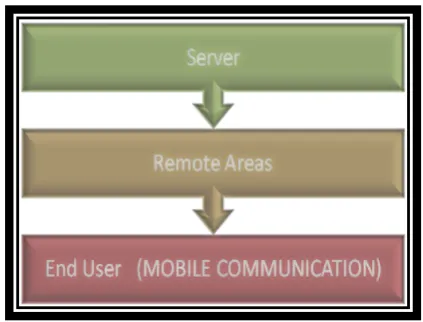
In figure 3.1 the basic road map to implement e-learning in remote areas of Uttarakhand using mobile communication devices such as tablets, multimedia mobile phones .Servers are powered machine that are present on some other site while the client machines are the present on remote site. Server machines contain all the details and study material regarding various courses, these servers may present in Dehradun or any region outside Uttarakhand. Servers get connected to the remote areas of Uttarakhand like Champawat, Uttarkashi and so on. While, in turn these end users (mobile communication devices) that are many tablets or multimedia cellular phones are connected to the server at any pace and place. This systematic and simplified diagram explains Client-Server architecture for e-learning in remote areas.
4. Graphical Analysis
Mobile devices are the most common communication
device which is owned by 100% mass, basically for voice transfer and communication. But now-a-days multimedia cellular phones are the biggest source of entertainment as well as for the study hub .Mobile devices are quite easy to access and anybody from any origin, from any language, from any tradition could interact easily. Let us say Ram, a student interested to study but can’t go to school because teachers are not available due to unavailability of transport facilities. Another student Mohan isn’t able to continue his studies because he need to help his parents to bring some earnings thus he has no spare time to go to school daily, while some girl Meera is not allowed for attending schools due to some old traditional thoughts. Radhika being a female she has to complete her household activities all the time thus having no idle time to go to school .thus all above cases(students) are keen to study but due to some circumstances students are not able to go to school for mere reason.
Here comes a solution to all the above problems that is E-learning through mobile communication in such areas (remote areas) ,Ram could be able to learn and study without teachers through videos and tutorials, Mohan could carry mobile device at his workplace and at the spare time for one or two hours he could continue m- learning ,where Meera can learn and study her academics by sitting at home only as well as Radhika can study too after finishing her indoor activities she try to extract out some little time for learning through mobile devices . End User or Mobile User need only to connect to the mobile operators. In turn, mobile operators will provide the internet services. If every student in remote areas could connect through mobile communication then mobile based learning certainly increase the literacy rate in Uttarakhand.
Fig. 4:Graph Representation after deploying Mobile learning
Literacy Rate in Uttarakhand since past 10 years is increasing deliberately but after deploying mobile based learning in remote areas of Uttarakhand the literacy rate increases drastically. Graph shows average literacy rate in 2001 was 71.62 per cent (male 81.2 per cent and female 63.36 per cent) while in 2011 literacy rate was 78.82 per cent (male 87.40 per cent and female 67.06 per cent).But after deployment of m-learning could be 94 per cent (95% male and 90% female).
5. Framework
Theoretical mock-up as a framework for their classification by stating that eLearning is not only procedural but also shows some renovation of an individual's experience into the individual's knowledge through the knowledge construction process.
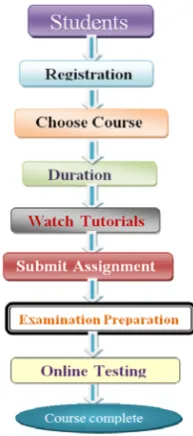
Fig. 5 (a): Client Side (Student)
5.1 Procedure at Client-Side (student)
Step1 Students are required for the active participation. This is a mobile learning technology enhancement in remote areas regarding traditional schools.
Step 2 Students could be anyone who is interest and want to complete his/her studies. Hence Practioner need to register himself/herself online.
Step 3 Student is required to choose a course, which subject he wants to opt.
0 10 20 30 40 50 60 70 80 90 100
2001 2011
M-learning
Step 4 Students need to select his/her course duration (if the Practioner is undergraduate/postgraduate), other courses for primary and secondary students are yearly courses.
Step 5 after completing above process, Students could start learning a course achieving e-learning through mobile communication. Students can learn through video lectures, pdf files and animated stories.
Step 6 when the students are done with their tutorials, they have to complete his/her assignments and submit back on regular basis, and so that trainer could evaluate and send the feedback.
Step 7 Examination preparation will be started students can ask any doubt to trainer (teacher) regarding their course, trainer will provide the better solution regarding their query .Trainer will also provide some review material to students for better preparation.
Step 8 As soon as course is over students can give their examination on the conducted date. They need to submit their answers within certain time duration. Students could give their exam at any time from any place.
Step 9 Course is completed after examination is qualified. Students are welcome for the next course
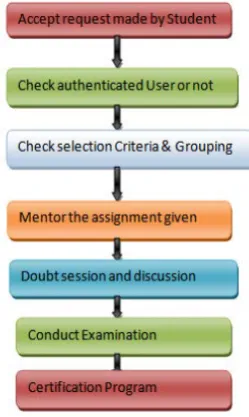
Fig. 5(b): Server Side (teacher)
5.2 Procedure at Server-Side (Trainer/Teacher)
Step 1 At server side teacher is available ,server may be present far away from the remote areas ,trainer need to accept the request made by students ,that is at server side request for
registration is accepted and server side must provide a unique enrollment number to each student who has done registration
Step 2 Now server side must check whether the student is authenticated or not. And to check he/she has submitted the right details
Step 3 Server side provides various selection criteria regarding courses. Students can select any course and Server side must perform grouping to all the same course students so that course for every student of same class must have universal course.
Step 4 now trainer should start giving his video lectures, study material, assignments to desire groups and class .When assignment are submitted back by the students’ trainer checks their work.
Step 5 Doubt sessions and discussions could be done on regular basis so that trainer could guide and interact frequently. These doubt sessions will increase the teacher-student interactivity.
Step 6 Server side should conduct fair examination paper online, students whose course duration completed should be ready for the examination test. Trainer must evaluate their copy and generate the result.
Step 7 Students who are passed, are given the certification other students are supposed to prepare for next examination.
6.
Conclusion
definition of what is meant by informal learning but exploited the potential of the secondary unclear boundary portrayals and as a result we identify a need to build a conceptual framework to be aware of informal settings. The paper on m Learning points to a variety of reimbursement that mobile phones could have on the educational sector. For heuristic purposes, the impacts of mobile phones on educational upshots that are identified in the m learning literature can be off the record into two broad categories. On the one hand, mobiles evidently impact educational outcomes by improving access to education whilst maintaining the quality of education delivered. On the other hand, mobiles ostensibly impact educational outcomes by methods collectively known as new learning facilitating alternative learning processes and instructional.
REFERENCES
[1] http://en.wikipedia.org/wiki/Uttarakhand
[2] http://www.census2011.co.in/census/state/uttarakhan d.html
[3] Using Mobile Phones in English Education in Japan Thornton, Patricia; Houser, Chris
[4] Hall, Ian, and Steve Higgins. "Primary school students' perceptions of interactive whiteboards."1T1TJournal of Computer Assisted
Learning1T1T21.2 (2005): 102-117.
[5] Chen, Yuh-Shyan, et al. "A mobile scaffolding-aid-based bird-watching learning system."1T1TWireless and
Mobile Technologies in Education, 2002.
Proceedings. IEEE International Workshop on.
IEEE, 2002.
[6] Ellaway, Rachel, and Ken Masters. "AMEE Guide 32: e-Learning in medical education Part 1: Learning, teaching and assessment."1T1TMedical teacher1T1T30.5
(2008): 455-473.
[7] Abrami, Philip C., et al. "A review of e-learning in Canada: A rough sketch of the evidence, gaps and promising directions."1T1TCanadian Journal of Learning and Technology/La revue canadienne de l’apprentissage et de la technologie1T1T32.3 (2008).
[8] Brown, Mark, Bill Anderson, and Fiona Murray. "E-learning policy issues: Global trends, themes and tensions."1T1TICT: Providing choices for learners and
learning. Proceedings ASCILITE, Singapore 2007.
2007.
[9] Bell, Mark, Graeme Martin, and Thomas Clarke. "Engaging in the future of e-learning: a scenarios-based approach."1T1TEducation+ Training1T1T46.6/7