Iranian Journal of Environmental Technology
2nd Year, Vol. 2, No. 3, Spring & Summer 2016
Received: April 3, 2016/ Accepted: August 03, 2016. Page: 27- 40
*Corresponding author
Copyright ©2016, University of Isfahan. This is an Open Access article distributed under the terms of the Creative Commons Attribution License (http://creativecommons.org/licenses/BY-NC-ND/4.0/), which permits others to download this work and share it with others as long as they credit it, but they cannot change it in any way or use it commercially.
Evaluation of moving bed biofilm reactor (MBBR) by applying adaptive neuro-fuzzy inference systeme (ANFIS), radial basis
function (RBF) and Fuzzy Regression Analysis
Mohammad Delnavaz *
Assistant Professor of Environmental engineering, Kharazmi University, Tehran, Iran, [email protected]
Hossein Zangooei
MSc. of Environmental engineering, Kharazmi University, Tehran, Iran, [email protected]
Abstract
The purpose of this study is to investigate the accuracy of predictions of aniline removal efficiency in a moving bed biofilm reactor (MBBR) by various methods, namely by RBF, ANFIS, and fuzzy regression analysis. The reactor was operated in an aerobic batch and was filled by light expanded clay aggregate (LECA) as a carrier for the treatment of Aniline synthetic wastewater. Exploratory data analysis was used to detect relationships between the independent and the dependent evaluated data. The models were found to be efficient and robust tools in predicting MBBR performance. Results showed that increasing the neurons in the hidden layer would improve the function of RBF network. The ANFIS model made according to the membership functions of generalized bell, triangular, and Gaussian with R2 equals to 0.99 and RMS error of 0.027 for the anticipation of the concentration of Aniline and R2 equals to 0.99 and RMS error of 0.034 for the prediction of removal COD efficiency.
Key words:Aniline, ANFIS, Fuzzy Regression Analysis, Moving Bed Biofilm Reactor,
ANN
Highlights
Application of ANN-based models (RBF network), ANFIS models and Fuzzy
regression as a robust tool in predicting MBBR efficiency
Determination of process efficiency in various operation conditions for the treatment of aniline synthetic wastewater
28 Iranian Journal of Environmental Technology, 2nd Year,Vol. 2, No. 3, Spring & Summer 2016
Introduction
Aniline is a toxic, organic compound that readily dissolves in water up to 3.5 percent. Due to its high solubility in water, the risk of possible pollution in water resources, especially in cases of chemical
spills, is increased. Therefore, any
wastewater containing this prototypical aromatic amine (such as dyes, plastic, paint,
pigments, herbicides, pharmaceutical
preparation and rubber accelerators
production) (1-4) is a serious problem and should be treated before being discharged into the environment (5).
Wastewater containing aromatic amines has been shown to be successfully treated by photocatalytic process, electrolysis,
adsorption, electro-Fenton, advanced
oxidation and biological treatment. This compound is hard biodegradable, making further studies on advanced biological processes necessary (6).
The MBBR was created in Norway at the Norwegian University of Science and
Technology in cooperation with a
Norwegian company, Kaldnes
Miljǿteknologi (now AnoxKaldnes AS) (7, 8). Polyethylene carrier elements in the MBBR process provide sites for biomass attachment in a suspended growth medium. These elements increase the bacteria concentration to be maintained in the reactor, as opposed to the activated sludge process in which biomass volume is suspended in the reactor. The carrier elements can be placed in either an anoxic reactor or an aeration basin. Less space is required in the MBBR process compared to traditional wastewater treatment systems because of biomass attachments on carriers. MBBR was developed to adopt the best features of activated sludge and bio filter processes in one reactor (8). During the
past decade it has been successfully used for the treatment of many industrial effluents, and as well municipal wastewater (7). Ayati et al applied two cylindrical MBBRs in upflow stream conditions for the degradation of aromatic compounds at low concentration of synthetic wastewsater (from 700 to 1000 mg/L) maximum removal efficiency (over 80 %) was obtained (9).
In biological wastewater treatment
systems such as MBBR, influent
characteristic variability might have an influence on operational control. As a result, the modeling of biological process has been a difficult task as most of the available models are just approximations based on probabilities and assumptions. Recently, simulation methods such as ANNs, ANFIS, and Fuzzy Regression Analysis have been increasingly applied in
environmental and water resource
engineering areas.
The main advantage of these methods over physically based models is that they do not require the complex nature of the underlying process under consideration to be explicitly described in a mathematical form (10). Consequently, unlike traditional
parametric models, in an artificial
Evaluation of moving bed biofilm reactor (MBBR) by applying adaptive neuro-fuzzy inference systeme (ANFIS)… 29
Delnavaz et al (12) proposed a feed-forward back-propagation neural network to predict the performance of MBBR. The results showed that the optimum ANN model has obtained the correlation for the training and testing sets 0.99 and 0.96 and the RMS errors were 0.02 and 0.042, respectively.
Cristea et al. (13) have studied the capacity of neural networks for the assessment of plant behavior in integrated urban wastewater system simulations. They have proposed that ANN based simulators
reveal high accuracy for predicting
important process variables and a reduction of the simulation time, compared to the first
principle wastewater treatment plant
(WWTP) simulator.
Sadrzadeh et al (14) have used neural networks to predict the separation of lead ions from wastewater using electro-dialysis. They have examined a number of
different network structures and
architectures to compute the amount of lead ions separation. Exceptional alignment
between the predicted values and
experimental data has been revealed by ANN modeling.
ANN modeling for treatment of zinc-containing wastewater in a sulfidogenic CSTR by a biological process was studied by Sahinkaya (15). Effluent concentrations of sulfate, COD, acetate and zinc were estimated successfully by the developed model.
The simulation of copper (II) bio-sorption efficiency by ANN was done by Prakash et.al (16). The performance of the network for estimating the sorption efficiency was found to be very effective.
While other researchers applied ANN for the prediction of various methods of wastewater treatment, the MBBR modeling
was done solely by mathematical models. Modeling techniques could be an excellent way of reducing the frequency at which testing is needed and may have other advantages. Therefore, the novelty of this paper is that it presents predictive models based on the concept of ANN, ANFIS and Fuzzy Regression Analysis in predicting aniline treatment efficiency using MBBR in various conditions.
Material and Method
Reactor setup: All experiments were done in environmental engineering laboratory of civil and environmental engineering faculty
of Tarbiat Modares University. The
cylindrical MBBR reactor was used in this study (Fig. 1), with each reactor having an
internal diameter, height, and wall thickness
of 10, 70 and 0.4 centimeters respectively (6). The basis of the process relies on elements of biofilm carrier that are made
from different materials such as
polyethylene, PVC, and porous aggregates. DO and pH were fixed in the range of
aerated biological processes, and
indispensable nutrients (COD/N/P =
100/5/1) were added to the reactor. The
effective depth of wastewater in the reactor
was 60 cm, filled with up to 50% floating
biofilm carrier elements made of LECA
(Light Expanded Clay Aggregate) with a
density of 0.55 gr/cm3. LECA is an
30 Iranian Journal of Environmental Technology, 2nd Year,Vol. 2, No. 3, Spring & Summer 2016
Fig.1- Schematic picture of MBBR Pilot (6)
Synthetic feed wastewater was prepared using aniline, which was supplied by Merck Company. Aniline served as the sole carbon and energy substrate for the biomass in the MBBR. In order to have COD/N/P = 100/5/1 and adequate alkalinity for aerobic conditions (6.5-8), necessary nutrients
(urea, KH2PO4, K2HPO4) were added as a
supplemental feed to the reactors for all experimental trials.
The parameters of pH, soluble Chemical Oxygen Demand (COD) filtered through Vattman paper No.42, and Dissolved Oxygen (DO) were measured daily. ) DO
concentration was always controlled above
3 mg/L during the filling and reacting
cycles by adjusting the aeration rate.
Coarse bubble air produced by the air pump caused suspension of carriers in the reactor. Mixed Liquor Suspended Solids (MLSS) and Mixed Liquor Volatile Suspended Solids (MLVSS) were examined on
acclimation stage. All laboratory
experiments were done at room temperature
(25–28ºC(. All analytical tests were done
according to the Standard Method
Handbook (17). The aniline concentrations were measured by an ultraviolet absorption procedure, as given in the Standard Methods, using a Lambda EZ 150 UV/Vis Spectrophotometer.
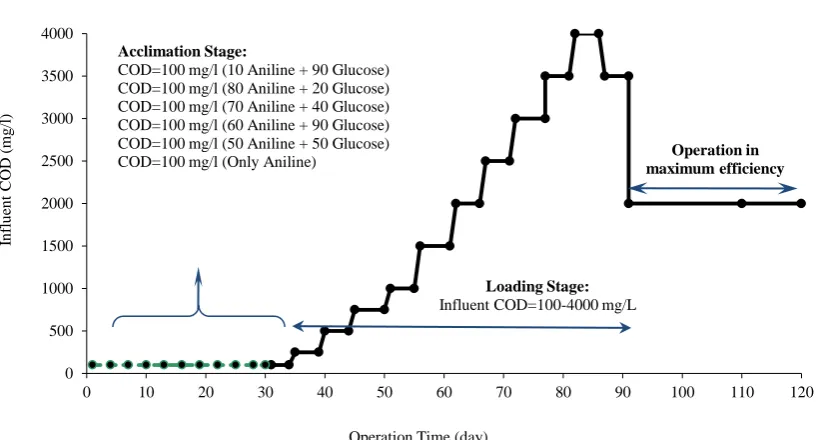
During the start up, the reactors (30 days) with the sludge seed were acquired from Ekbatan Wastewater Treatment Plant, located in the west of the capital city of Tehran, and microbial adaptation were conducted with a solution of synthetic wastewater and glucose. At this stage, the removal efficiency reached 80% for CODaniline/CODglucose= 0.5. Subsequently,
Evaluation of moving bed biofilm reactor (MBBR) by applying adaptive neuro-fuzzy inference systeme (ANFIS)… 31
Fig. 2- Duration of reactor operation in acclimation and loading stage
ANN approach: Due to the complexity
and non-linearity of environmental
phenomena, including water and
wastewater treatment processes, ANN acts like a human brain and can be used as a suitable method (18). Equations 1 and 2 show the general trend of the function of ANNs (19).
(1)
( )
(2)
∑
Where represents the inputs of the
model, represents the number m output
layer, f represents the transfer function, L
represents the number of interfaces with the
previous layer, is equivalent to the
weight of each interface and represents
the Bias, the constant part of the transfer function.
The neural network-based modeling process contains five main aspects: (1) data
acquisition, analysis, and problem
representation; (2) architecture
determination; (3) learning process
determination; (4) training of the networks; and (5) testing of the trained network to evaluate the model.
The RBF neural network compared to a multilayer perceptron (MLP) network needs a shorter design time, but on the other hand requires more neurons. This network has the best performance when there are many training vectors (20). RBF networks are defined by the function
“newrb”. This function has the ability to
create a trained network with zero errors. The procedure for these networks is to increase the number of Neurons in the hidden layer through the training process to get the performance function to target levels or to achieve the maximum specified number of neurons. Performance functions used in this study were error parameters MSE. One of the remarkable things about RBF networks is that they do not need any assumptions about the model’s shape in the modeling process. These networks are generally model-based (21). Fig. 3 displays the view of different RBF network layers. In this research RBF networks were developed by coding in MATLAB.
0 500 1000 1500 2000 2500 3000 3500 4000
0 10 20 30 40 50 60 70 80 90 100 110 120
In
fl
u
en
t
C
O
D
(
mg
/l
)
Operation Time (day)
Acclimation Stage:
COD=100 mg/l (10 Aniline + 90 Glucose) COD=100 mg/l (80 Aniline + 20 Glucose) COD=100 mg/l (70 Aniline + 40 Glucose) COD=100 mg/l (60 Aniline + 90 Glucose) COD=100 mg/l (50 Aniline + 50 Glucose)
COD=100 mg/l (Only Aniline) maximum efficiencyOperation in
Loading Stage:
32 Iranian Journal of Environmental Technology, 2nd Year,Vol. 2, No. 3, Spring & Summer 2016
Fig.3- Architecture of RBF model (22)
Fuzzy regression analysis: Regression analysis is a statistical tool used to develop the model, which uses a set of measured data, including the uncertainty of a population, to provide an equation to predict the whole population. Accordingly, one of the variables could be predicted from the other. The overall objective of regression analysis is to find an appropriate and efficient mathematical equation to determine coefficients of the model with the best fitness of the observed data.
The fuzzy theory set was provided in 1965 by Zadeh (22). According to that rheory, if the data is not conclusive in a system examined by regression analysis becuase the random variables are affected by human error or available as dialogic form, fuzzy regression analysis can be a more appropriate tool for simple regression analysis. The basic concept of this method was proposed by Tanaka et al. in 1982 (23).
The fuzzy regression model can be classified into two types based on the functional relationship between dependent and independent variables. If the functional relationship is known, the model is called a
parametric fuzzy regression model;
otherwise, it is called a nonparametric fuzzy regression model. Many methods
have been developed to construct
parametric and nonparametric fuzzy
regression models (24). These methods are classified into numerical and statistical methods. Numerical methods identify the fuzzy regression model by minimizing the sum of the spreads of the estimated dependent variable. Choi and Buckley (25) and Taheri and Kelkinnama (26) suggested the least absolute deviation method, which is an alternative to the method of least squares. Generally, the fuzzy regression analysis has been criticized, because it is sensitive to outliers; also the spreads of the estimated value become wider as more data is included in the model (26, 27).
In this study, using the software FuReA, fuzzy regression was performed. The software allows users to simulate the dependent parameters using independent parameters of the linear and non-linear functions. Equations 3 and 4 shows the sample functions used in this method considering two independent variables. Equations 3 and 4 indicate linear and quadratic functions respectively (28, 29).
Influent Feed
Influent COD
Retention Time
Reactor Efficiency
Effluent Concentration of Aniline
Input Layer Output Layer
(linear) Hidden Layer
Evaluation of moving bed biofilm reactor (MBBR) by applying adaptive neuro-fuzzy inference systeme (ANFIS)… 33
(3)
(4)
Where is independent variable and is constant factor.
ANFIS Model: Fuzzy systems are rule-based expert systems rule-based on fuzzy rules and fuzzy inference. A fuzzy inference system (FIS) can be viewed as a real-time expert system used to model and utilize a
human operator’s experience or process
engineer’s knowledge (30). Fuzzy logic can
model nonlinear functions of arbitrary complexity. It provides an alternative solution to nonlinear modeling because it is closer to the real world. Nonlinearity and
complexity are handled by rules,
membership functions, and the inference process, which in turn results in improved performance, simpler implementation, and reduced design costs (31). Neuro-fuzzy consists of fuzzy nodes instead of simple input and output nodes. It uses neural network learning functions to refine each part of the fuzzy knowledge separately. Learning in a distinguished network is faster than learning in the whole network (32).
One approach for the derivation of a fuzzy rule base is to use self-learning
features of ANNs, aimed at defining the membership function based on input– output data. The ANFIS is a fuzzy inference system implemented in the framework of an adaptive neural network. By using a composite learning procedure, ANFIS can construct an input–output data pair for neural network training. ANFIS is more effective than the simple fuzzy logic algorithm and neural networks, since it provides a procedure for fuzzy modeling to get relationshibps between the data, in order to compute the membership function parameters that best allow the associated fuzzy inference system to track the given input/output data (30).
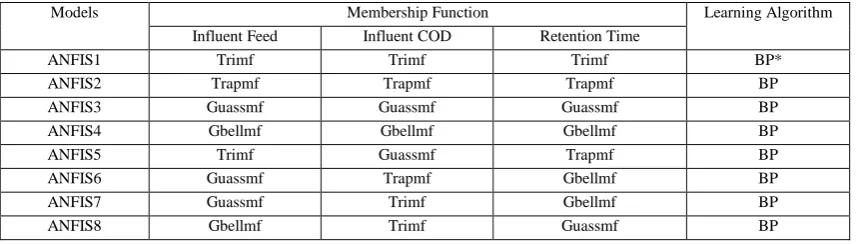
In this research, data sets were divided into training and testing data sets. Four membership functions used in this study
were Gaussian (Guassmf), triangular
(Trimf), trapezoidal (Trapmf) and
generalized bell (Gbellmf) functions and the training’s epochs are 300 times. All ANFIS models were done by MATLAB toolbox. Table 1 shows the characters of all models composed in this study.
Table. 1- The characters of ANFIS models
Learning Algorithm Membership Function
Models
Retention Time Influent COD
Influent Feed
BP* Trimf
Trimf Trimf
ANFIS1
BP Trapmf
Trapmf Trapmf
ANFIS2
BP Guassmf
Guassmf Guassmf
ANFIS3
BP Gbellmf
Gbellmf Gbellmf
ANFIS4
BP Trapmf
Guassmf Trimf
ANFIS5
BP Gbellmf
Trapmf Guassmf
ANFIS6
BP Gbellmf
Trimf Guassmf
ANFIS7
BP Guassmf
Trimf Gbellmf
ANFIS8
34 Iranian Journal of Environmental Technology, 2nd Year,Vol. 2, No. 3, Spring & Summer 2016
Selection of Database: In this study, the database was collected throughout a six-month continuous period. The reactor was fed with aniline synthetic wastewater. Evaluation efficiency was done at different retention times of 8, 24, 48 and 72 hours and different influent COD from 100 to
4000 mg/L. A total of 300 data pairs have
been selected from the experimental database, as mentioned earlier. About 70 percent of data were used for training and about 20 percent for testing and 10 percent for validation of the ANFIS and RBF neural network.
Model training: The training procedure involved presenting the network with the set of experimental data in a patterned format. Each training pattern included the input set of three parameters representing influent feed, influent COD, and retention time and the corresponding output set representing reactor efficiency and aniline effluent concentration. The errors between the target value and predicted output were calculated and stored. The network was then presented with the second training pattern and so on until the network had
gone through all the data available for training the network.
Model validation: The testing subset data was used to measure the network distribution (i.e. how accurately the network predicts targets for inputs that were not in the training set). This is sometimes referred to as holdout validation. The correlation and RMS error values were used as the performance criteria and monitored during training.
Results
Experimental results: The effect of different retention times (8, 24, 48 and 72 hours) on the COD removal rate was studied after every step increase in COD. As shown in Fig. 4, at low influent COD (from 500 to 2000 mg/L) the maximum efficiencies was 90% in COD=2000 mg/L after 3 days. A decrease in the removal efficiencies was observed for influent COD from 2000 to 4000 mg/L. It is important to mention that all experiments were done at room temperature and under steady-state conditions.
Fig.4- Variation of influent COD in different retention time 0
20 40 60 80 100
500 1000 1500 2000 2500 3000 3500 4000
C
O
D
R
emo
v
ed
(
%)
Influent COD (mg/l)
Evaluation of moving bed biofilm reactor (MBBR) by applying adaptive neuro-fuzzy inference systeme (ANFIS)… 35
Evaluation of MBBR performance by RBF model: The network was trained to predict MBBR performance for treatment of aniline synthetic wastewater using a total of 300 pair data sets. The number of neurons in a hidden layer of RBF network was increased from zero to the possible maximum value (the number of data) by network and fixed RMS error was equal to zero. Fig. 5 shows the trend of changing RMS error based on increasing the number of neurons in the hidden layer.
RBF models automatically increased the number of neurons in the hidden layer to achieve a minimum performance function
error. Results showed by increasing number of neurons in the hidden layer RMS error limited to zero.
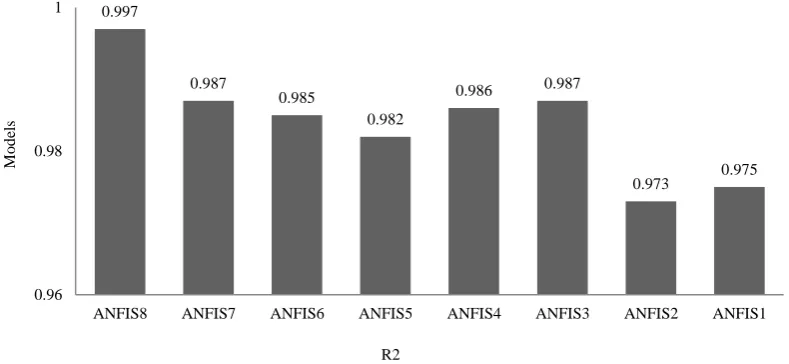
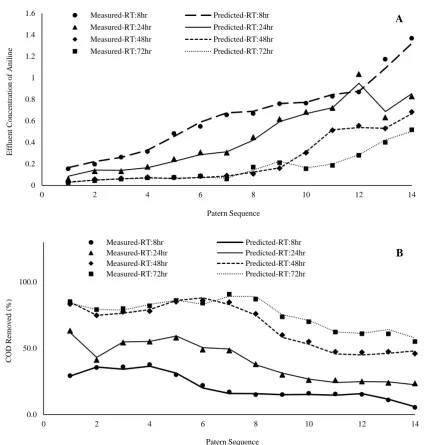
Evaluation of MBBR performance by ANFIS model: The model composed of generalized bell, triangular, and Gaussian membership functions for applying input variables (influent feed, influent COD, and retention time) has the best performance to predict the removal COD efficiency and the effluent aniline concentration (Fig. 6). The predicted removal COD efficiency and effluent aniline concentration values for different retention times using this model has been depicted in Fig. 7.
Fig. 5- The trend of changing RMS error based on increasing the number of neurons in hidden layer
Fig. 6- The performance of ANFIS models 0
50 100 150 200 250 300 350
0 10 20 30 40 50 60
R
M
S
Er
ro
r
Number of hidden layer's nerouns
0.997
0.987
0.985
0.982
0.986 0.987
0.973 0.975
0.96 0.98 1
ANFIS8 ANFIS7 ANFIS6 ANFIS5 ANFIS4 ANFIS3 ANFIS2 ANFIS1 R2
M
o
d
el
36 Iranian Journal of Environmental Technology, 2nd Year,Vol. 2, No. 3, Spring & Summer 2016
Fig. 7- The predicted effluent aniline concentration (a) and removal COD efficiency (b) values with using the best ANFIS model
Results showed that ANFIS8 model had
the maximum R2 by Gbellmf, Trimf and
Guassmf Membership Functions in Influent Feed, Influent COD and Retention Time, respectively. In the similar research, the
best results obtained for R2 and RMS equal
to 0.96 and 0.042 respectively, when ANN by hyperbolic tangent, Gaussian and sigmoid transfer functions in hidden and output layers (6).
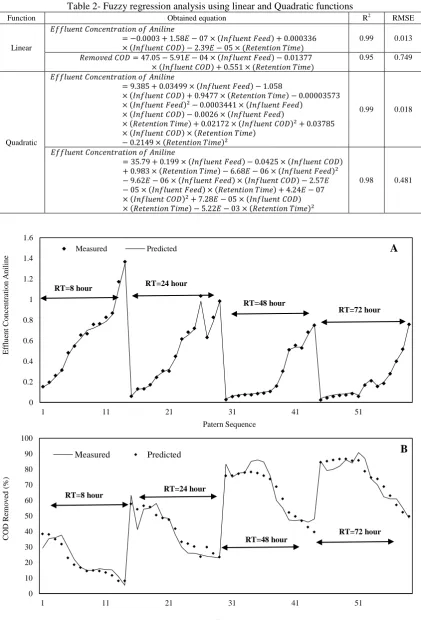
Evaluation of MBBR performance by Fuzzy Regression Analysis model: Fuzzy regression analysis, using linear and nonlinear functions, showed that the quadratic function had the best performance in predicting the efficiency and effluent aniline concentration (Table 2). Fig. 8 depicts the comparison of the predicted values using fuzzy regression obtained by this function with the measured values.
0 0.2 0.4 0.6 0.8 1 1.2 1.4 1.6
0 2 4 6 8 10 12 14
Ef
fl
u
en
t
C
o
n
ce
n
tr
at
io
n
o
f
A
n
il
in
e
Patern Sequence Measured-RT:8hr Predicted-RT:8hr Measured-RT:24hr Predicted-RT:24hr Measured-RT:48hr Predicted-RT:48hr Measured-RT:72hr Predicted-RT:72hr
A
0.0 50.0 100.0
0 2 4 6 8 10 12 14
C
O
D
R
emo
v
ed
(
%)
Patern Sequence
Measured-RT:8hr Predicted-RT:8hr Measured-RT:24hr Predicted-RT:24hr Measured-RT:48hr Predicted-RT:48hr Measured-RT:72hr Predicted-RT:72hr
Evaluation of moving bed biofilm reactor (MBBR) by applying adaptive neuro-fuzzy inference systeme (ANFIS)… 37
Table 2- Fuzzy regression analysis using linear and Quadratic functions
RMSE R2
Obtained equation Function
0.013 0.99
( ) ( ) ( ) Linear
0.749 0.95
( ) ( ) ( )
0.018 0.99
( )
( ) ( ) ( ) ( )
( ) ( )
( ) ( ) ( ) ( )
( ) Quadratic
0.481 0.98
( ) ( ) ( ) ( ) ( ) ( ) ( ) ( ) ( ) ( ) ( ) ( )
Fig. 8- The predicted effluent aniline concentration (a) and removal COD efficiency (b) values with using fuzzy regression analysis
0 0.2 0.4 0.6 0.8 1 1.2 1.4 1.6
1 11 21 31 41 51
Ef
fl
u
en
t
C
o
n
ce
n
tr
at
io
n
A
n
il
in
e
Patern Sequence
Measured Predicted A
0 10 20 30 40 50 60 70 80 90 100
1 11 21 31 41 51
C
O
D
R
emo
v
ed
(
%)
Patern Sequence
Measured Predicted B
RT=8 hour
RT=48 hour RT=24 hour
RT=72 hour RT=8 hour
RT=48 hour RT=24 hour
38 Iranian Journal of Environmental Technology, 2nd Year,Vol. 2, No. 3, Spring & Summer 2016
Table 3- The performance of different modeling methods
Modeling method R2 RMSE
RBF network effluent aniline 0.99 0.003
removal COD efficiency
ANFIS effluent aniline 0.99 0.027
removal COD efficiency 0.99 0.034 Fuzzy regression analysis effluent aniline 0.99 0.018 removal COD efficiency 0.98 0.481
Table 3 illustrates the best performance of RBF network, ANFIS, and fuzzy regression analysis used in this study. The results show that this modeling method has appropriate performance to predict the effluent concentrations of aniline and MBBR efficiency.
Results showed that ANFIS and RBF had more ability than fuzzy regression analysis in simulating the Aniline and COD
removal efficiency in different
experimental conditions.
Discussion and Conclusion
In this paper, prediction of MBBR in the treatment of aniline synthetic wastewater as a hard biodegradable compound was evaluated. Results showd MBBR as an advanced biological process had a proper COD removal efficiency for the treatment of aromatic amine wastewater. The removal efficiency was affected by concentration and detention time as an operating parameter. The best removal efficiency of 91% in COD of 2000 mg/L after 72 hour was obtained. The ANN, ANFIS, and fuzzy regression modeling were trained and tested on 8, 24, 48, and 72 hour sets of COD and aniline concentration measurements were taken over a period of 6 months. The results showed that the modeling methods used in this study have the ability to predict the effluent concentrations of aniline and removal of COD efficiency. Increasing the neurons in the hidden layer would improve
the function of the RBF network, therefore
the gain of R2 was set to 1 and the RMS
error was set to zero. The ANFIS model
made according to the membership
functions of generalized bell, triangular,
and Gaussian with R2 equals to 0.99 and
RMS error of 0.027 for the anticipation of the concentration of Aniline and coefficient of determination 0.99 and RMS error of 0.034 for the prediction of removal COD efficiency, had positive results in the process of MBBR modeling. RBF models automatically increased the number of neurons in the hidden layer to achieve a minimum performance function error. Results demonstrate that ANFIS unlike RBF neural networks require a smaller number of neurons, and also have the ability to change various design parameters to achieve optimal results.
Acknowledgement
The authors would like to acknowledge Tarbiat Modares University for their partial financial support in this research. The valuable supports of Dr. Bita Ayati & Environmental Engineering Laboratory of Civil and Environmental Engineering Faculty of Tarbiat Modares University are also appreciated.
References
Evaluation of moving bed biofilm reactor (MBBR) by applying adaptive neuro-fuzzy inference systeme (ANFIS)… 39
(2) Ren, Z., Zhu, X., Liu, W., Sun, W., Zhang, W., Liu, J. Removal of Aniline from Wastewater Using Hollow Fiber Renewal Liquid Membrane. Chinese Journal of Chemical Engineering2014, 22, pp 1187–1192.
(3) Dvořák, L., Lederer, T., Jirků, V., Masák, J., Novák, L. Removal of aniline, cyanides and diphenylguanidine from industrial wastewater using a full-scale moving bed biofilm reactor. Process Biochemistry2014, 49, pp 102–109.
(4) Jiang, L., Liu, L., Xiao, S., Che, J. Preparation of a novel manganese oxide-modified diatomite and its aniline removal mechanism from solution. Chemical Engineering Journal 2016, 284, pp 609-619
(5) Zhang, J., Wu, Y., Qin, C., Liu, L., Lan, Y. Rapid degradation of aniline in aqueous solution by ozone in the presence of zero-valent zinc, Chemosphere2015, 141, pp 258–264.
(6) Delnavaz, M., Ayati, B., Ganjidoust, H. Biodegradation of aromatic amine compounds using moving bed biofilm reactors, Iran. Journal of Environmental Health Science & Engineering
2008, 5, pp 243-250.
(7) Wang, X. J., Xia, S. Q., Chen, L., Zhao, J. F., Renault, N. J., Chovelon, J. M. Nutrients removal from municipal wastewater by chemical precipitation in a moving bed biofilm reactor. Process Biochemistry2006, 41, pp 824–828.
(8) Rusten, B., Eikebrokk, B., Ulgenes, Y., Lygren, E. Design and operations of the Kaldnes moving bed biofilm reactors, Aquacult. Eng. Aquacultural Engineering 2006, 34, pp 322–331.
(9) Ayati, B., Ganjidoust, H., Mir Fattah, M. Degradation of aromatic compounds using moving bed biofilm reactor. Journal of Environmental Health Science & Engineering
2007, 4, pp 107-112.
(10) Mohan Raju, M., Srivastava, R. K., Bisht, D. C. S., Sharma, H. C., Kumar, A. Development of Artificial Neural-Network-BasedModels for the Simulation of Spring Discharge. Lecture Notes in Artificial Intelligence 2011, 2011, pp 1-11.
(11) Anderson, D., McNeill, G. Artificial Neural Networks Technology, Data & Analysis Center for Software, Kaman Sciences Corporation: New York, 1992.
(12) Delnavaz, M., Ayati, B., Ganjidoust, H. Prediction of Moving Bed Biofilm Reactor (MBBR) Performance for the Treatment of
Aniline Using Artificial Neural Networks (ANN). Journal of Hazardous Materials 2010, 179, pp 769–775.
(13) Cristea, V. M., Pop, C., Agachi, P.S. Artificial Neural Networks Modeling of PID and Model Predictive Controlled Wastewater Treatment Plant Based on the Benchmark Simulation Model No.1, Computer Aids for Chemical Engineering 2009, 26, pp 1183-1188.
(14) Sadrzadeh, M., Mohammadia, T., Ivakpour, J., Kasiri, N. Neural network modeling of Pb2+ removal from wastewater using electro-dialysis. Chemical Engineering and Processing: Process
2009, 48, pp 1371–1381.
(15) Sahinkaya, E. Biotreatment of zinc-containing wastewater in a sulfidogenic CSTR: Performance and artificial neural network (ANN) modeling studies. Journal of Hazardous Materials 2009, 164, pp 105–113.
(16) Prakash, N., Manikandan, S. A., Govindarajan, L., Vijayagopal, V. Prediction of biosorption efficiency for the removal of copper(II) using artificial neural networks. Journal of Hazardous Materials 2008, 152, pp 1268–1275.
(17) Clescerl, L.S., Greenberg, A.E., Eaton. A.D. Standard method for the examination water and wastewater, 20th ed. American Public Health Association: Washington DC. 2005.
(18) Bestamin, O., Ahmet, D. Neural network prediction model for the methane fraction in biogas from field scale landfill bioreactors. Environmental Modelling & Software 2007, 22, pp 15 -822.
(19) Hagan, M. T., Demuth, H. B., Beale, M. H. Neural network design. Stamford, CT: Thomson Learning, 1996.
(20) Bagheria, M., Mirbagheria, S. A., Ehteshamia, M., Bagherib, Z. Modeling of a sequencing batch reactor treating municipal wastewater using multi-layer perceptron and radial basis function artificial neural networks. Process Safety and Environmental Protection
2015, 93, PP 111–123.
(21) Turkdogan-Aydınol, F. I., Yetilmezsoy, K. A fuzzy-logic-based model to predict biogas and methane production rates in a pilot-scale mesophilic UASB reactor treating molasses wastewater, Journal of Hazardous Materials
40 Iranian Journal of Environmental Technology, 2nd Year,Vol. 2, No. 3, Spring & Summer 2016
(22) Zadeh, L. A. Fuzzy sets. Information and Control 1965, 8, pp 338-353.
(23) Tanaka, H., Uejima, S., Asai, K. Linear regression analysis with fuzzy model, IEEE Transactions on Systems, Man, and Cybernetics: Systems 1982, 12, pp 903-907.
(24) Jung, H. Y., Yoon, J. H., Choi, S. H. Fuzzy linear regression using rank transform method. Fuzzy Sets and Systems 2014, 274, pp 97-108.
(25) Choi, S. H., Buckley, J. J. Fuzzy regression using least absolute deviation estimators. Soft computing 2008, 12, pp 257-263.
(26) Taheri, S. M., Kelkinnama, M. Fuzzy linear regression based on least absolute deviations. Iranian Journal of Fuzzy Systems 2012, 9, pp 121-140.
(27) Nasrabadi, E., Hashemi, M., hatee, M. G. An LP-based approach to outliers detection in fuzzy regression analysis. International Journal of Uncertainty, Fuzziness and Knowledge-Based Systems 2007, 15, pp 441-456.
(28) Dubois, D., Prade, H. Fuzzy Sets and Systems: Theory and Applications, Academic Press: New York, 1980.
(29) Badalians Gholikandi, G., Delnavaz, M., Riahi, R. Use of Artificial Neural Network for Prediction of Coagulation/Flocculation Process by PAC in Water Treatment Plant. Environmental Engineering and Management Journal 2011, 10, pp 1719-1725.
(30) Jang, J. S. R. ANFIS: adaptive network based fuzzy inference system. IEEE Transactions on Systems, Man, and Cybernetics: Systems 1993, 23, pp 665–685.
(31) Salahia, A., Mohammadia, T., Mosayebi Behbahanib, R., Hemmatic, M. Asymmetric polyethersulfone ultrafiltration membranes for oily wastewater treatment: Synthesis, characterization, ANFIS modeling, and performance. Journal of Environmental Chemical Engineering 2015, 3, pp 170-178.