(Batch) Fully Homomorphic Encryption over Integers for
Non-Binary Message Spaces
Koji Nuida∗† Kaoru Kurosawa§
∗ National Institute of Advanced Industrial Science and Technology (AIST),
Japan,[email protected]
† JST, PRESTO
§ Ibaraki University, Japan, [email protected]
Abstract
In this paper, we construct a fully homomorphic encryption (FHE) scheme over integers with the message space ZQ for any prime Q. Even for the binary caseQ= 2, our decryption circuit has a smaller degree than that of the previous scheme; the multiplicative degree is reduced fromO(λ(logλ)2) toO(λ), whereλis
the security parameter. We also extend our FHE scheme to a batch FHE scheme.
Keywords: Fully homomorphic encryption, non-binary message
1
Introduction
Fully homomorphic encryption (FHE) enables computation of any function on the encrypted data. Many FHE schemes appeared recently after the first construction of Gentry [9]. In [9], the following general framework for constructing FHE schemes was also presented. (1) Construct a somewhat homomorphic encryption (SHE) scheme which can evaluate a limited class of functions homomorphically. (2) Transform (or
squash) the SHE scheme into a bootstrappable scheme whose decryption circuit has a low enough multiplicative degree. (3) Apply Gentry’s transformation to get an FHE scheme from the bootstrappable scheme.
At Eurocrypt 2010, van Dijk et al. [8] constructed an “FHE scheme over the inte-gers”. At Eurocrypt 2013, Cheon et al. [3] extended it to a batch FHE scheme, where the message space is extended fromZ2to (Z2)k. In [3], they also presented a batchSHE
scheme for the message spaceZQ1 × · · · ×ZQk. However, FHE has not been achieved
1.1 What Is the Problem?
Letλbe the security parameter, and letMdenote the message space. In the scheme of van Dijk et al. [8],M=Z2and the ciphertextcof a plaintextm∈ Misc=pq+2r+m,
wherep is a secret prime and r is a small noise. In their SHE scheme, the decryption is given by m = (cmodp) mod 2 = c−p· ⌊c/p⌉mod 2 = c− ⌊c/p⌉mod 2. In the bootstrappable scheme, the (squashed) decryption algorithm works as
m←(cmod 2)⊕ (⌊ Θ
∑
i=1 sizi
⌉ mod 2
)
. (1)
Here (s1, . . . , sΘ) ∈ {0,1}Θ is the secret key with Hamming weight λ and each zi = (zi,0.zi,1. . . zi,L)2is a real number withL=⌈log2λ⌉+3 bits of precision after the binary
point, satisfying∑Θi=1sizi≈c/p.1 They constructed a low multiplicative degree circuit computing (⌊∑Θi=1sizi⌉mod 2) in (1) by two steps [8]:
1. The first circuit computesWj = ∑Θ
i=1sizi,j forj= 0,1, . . . , L. Hence Θ
∑
i=1
sizi =W0+ 2−1W1+. . .+ 2−LWL .
2. By applying the three-for-two trick repeatedly, the second circuit computesaand
bsatisfying
W0+ 2−1W1+. . .+ 2−LWL=a+bmod 2 .
Now to compute Wj, we have at least to homomorphically compute a half adder; it needs a pair of polynomials, one for the sum and the other for the carry. However, such a polynomial computing the carry is not known for non-binary cases.2 This is the main reason why it is hard to extend the circuit above to non-binary message spaces.
On the other hand, the multiplicative degree of the first circuit is λsince Wj ≤λ, and it is O((logλ)2) for the second circuit. Hence, the total degree of the decryption circuit isO(λ(logλ)2).
1.2 Our Contributions
In this paper, we solve the problem above; for M = ZQ where Q is any (constant) prime, we construct an FHE scheme over integers based on a new design principle. We also extend it to a batch FHE scheme with M=ZQ1 × · · · ×ZQk, where Q1, . . . , Qk
may be different. Our main advantages are as follows: 1See [8] for how to computez
ifromcand the public key.
2
In fact, they exploited the fact that the binary expression ofWjis given by elementary symmetric
1. The FHE scheme forQ >2 was not achieved in [3, 8].
2. Our decryption circuit has multiplicative degreeO(λ) for anyQ; even for Q= 2, it is significantly improved from O(λ(logλ)2) of [3, 8].
For M = ZQ, the encryption is given by c = pq+Qr +m. The decryption of the SHE scheme is given by m = (cmodp) modQ= c−p· ⌊c/p⌉modQ. Then our squashed decryption algorithm works as
m←c−p·
⌊ Θ ∑
i=1 sizi
⌉
modQ .3
Here,zi= (zi,0.zi,1. . . zi,L)Q is a real number with L=⌈logQλ⌉+ 2 digits of precision after the Q-ary point satisfying∑Θi=1sizi ≈c/p.
Now we first determine a polynomial f(x, y) computing the carry of a half adder for any prime Q. Namely, whenx, y∈ZQ and x+y =β·Q+α∈Z, our polynomial
f computes β =f(x, y) modQ. It has degreeQ which is proven to be the lowest. See Sec. 3. Then we compute ∑Θi=1sizi = (w0.w1. . . wL)QmodQas follows.4
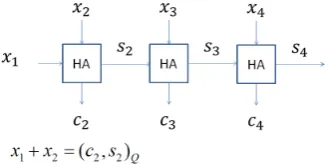
• First, we compute the sum of the last digits as shown in Fig. 1 (where each box is a half adder) so that we obtainwL and the Θ−1 carriesβ1, . . . , βΘ−1 with
s1z1,L+· · ·+sΘzΘ,L=wL+Q·(β1+. . .+βΘ−1) .
• Secondly, we compute (s1z1,L−1+· · ·+sΘzΘ,L−1) + (β1+. . .+βΘ−1) similarly so
that we obtainwL−1 and the 2(Θ−1) carries.
• Iterating this process, we obtain (w0.w1. . . wL)Q.5
The circuit computing each step has multiplicative degreeQ (= degf). Hence, the multiplicative degreeDof our decryption circuit isQL+1=O(λ), which is significantly lower thanO(λ(logλ)2) of [3, 8].
Finally, in the same way as [3, 8], we make our scheme bootstrappable by letting the bit length of p be ρ·Θ(D), where ρ is the size of noise r in a fresh ciphertext c. Since the degreeDof the decryption circuit has been decreased in comparison to [3, 8], the size of p is also reduced, therefore the size of our ciphertexts is much smaller than that of [3, 8] even for the previously known caseQ= 2. See Table 1.
Moreover, we emphasize that we also give aconcrete, not just asymptotic, condition for the parameters of our scheme to make the scheme bootstrappable; see (13).
3
In Sec. 6.1, the information ofpis involved in an elementX and is reflected by public key compo-nentsuℓ, therefore the decryption does not needpitself.
4
For the sake of our analysis in Sec. 7, our algorithm in Sec. 4 is described in a different, but essentially equivalent manner.
5
We choose the parameters to guarantee thatw1∈ {0, Q−1}; consequently⌊
∑Θ
Table 1: Bootstrappable Bit Lengths of Secret Primep
binary message non-binary message DGHV’10 [8], CCK+’13 [3] ρ·Θ(λ(logλ)2) —
Our result ρ·Θ(λ) ρ·Θ(λ)
1.3 Organization of the Paper
In Sec. 2, we summarize some definitions and notations used in this paper. In Sec. 3, we study the polynomial expression of the carry function in the addition of twoQ-ary digits for any prime Q. Based on the result, in Sec. 4, we construct an algorithm for addition of Q-ary integers which is composed of polynomial evaluations modulo Q. Then, in Sec. 5, we recall the previous SHE; and in Sec. 6, we describe our proposed bootstrapping algorithm based on the result in Sec. 4. Finally, in Sec. 7, we analyze our proposed method to verify that the bootstrapping is indeed achieved.
2
Preliminaries
In this paper, we naturally identify the integer residue ring Zn := Z/nZ modulo an integer n > 0 with the set {0,1, . . . , n−1}. For real numbers x, y, we write x ≡ y
(modn) if (x−y)/n∈Z. On the other hand, we consider the following two kinds of remainder operations; we definexmodnto be the uniquey∈Zn withy≡x (mod n), and xModnto be the unique integer y in (−n/2, n/2] withy≡x (mod n).
For a Q-ary representationA= (a0.a1, a2, . . .)Q (with aj ∈ZQ) of a real numberA and an integerL≥0, we define
(A)L:= (a0.a1, a2, . . . , aL)Q .
For a prime Q, an integeraand an integer b∈ZQ, we define (
a b
)
Q
:=a(a−1)· · ·(a−b+ 1)·InvQ(b!) (2)
which is a polynomial in a of degreeb ≤Q−1, where InvQ(x) (for x ∈Z coprime to
Q) denotes the unique integery∈ZQ withxy ≡1 (mod Q). Then we have (
a b
)
Q
≡
(
a b
)
(modQ) (3)
3
Q
-ary Half Adder
LetQbe a prime. For x, y∈ZQ, let
x+y= (c, s)Q=c·Q+s .
It is clear that s = x +ymodQ. In this section, we construct the lowest degree polynomialfcarry,Q(x, y) yielding the carry c, as follows:
Theorem 1. We define a polynomial fcarry,Q(x, y) over the fieldZQ by
fcarry,Q(x, y) := Q∑−1
i=1 ( x i ) Q ( y Q−i
)
Q
,
having total degreedegfcarry,Q=Q(see(2)for the notations). Then for anyx, y∈ZQ,
we have
c=fcarry,Q(x, y) modQ .
Theorem 2. The total degree offcarry,Q is lowest among all polynomials g(x, y) over ZQ satisfying that c=g(x, y) modQ for anyx, y∈ZQ.
From now, we prove these two theorems.
Theorem 1. We first show that, for any x, y∈ZQ,
c= (
x+y Q
)
modQ . (4)
If 0≤x+y < Q, then we have c= 0, while we have (x+Qy)= 0 by the definition of the binomial coefficient. For the other caseQ≤x+y <2Q, we have c= 1, while we have
(
x+y Q
) =
(
x+y x+y−Q
)
≡ (x+y)(x+y−1)· · ·(Q+ 1)·InvQ((x+y−Q)· · ·1)
≡ (x+y−Q)(x+y−Q−1)· · ·1·InvQ((x+y−Q)· · ·1)
≡ 1 (modQ)
(see Sec. 2 for the definition ofInvQ). Therefore (4) holds. Next, from the meaning of (x+Qy), it is easy to see that
(
x+y Q ) = ( x 0 )( y Q ) + ( x 1 )( y Q−1
) +· · ·+ ( x Q )( y 0 ) .
Now we have 0 ≤ x < Q and 0 ≤ y < Q since x ∈ ZQ and y ∈ ZQ, therefore (x
Q )
We use the following property in the proof of Theorem 2:
Lemma 1. Let f′(x, y) be a polynomial overZQ of degree at most Q−1 with respect
to each of x and y. If f′(x, y) = fcarry,Q(x, y) for every x, y ∈ ZQ, then f′ coincides
withfcarry,Q as polynomials.
Proof. Assume that f′ ̸=fcarry,Q as polynomials. Setg:= fcarry,Q−f′, which is now a non-zero polynomial. Writeg(x, y) =∑Qi=0−1gi(y)xi, where eachgi(y) is a polynomial of degree at most Q−1. Then gi is a non-zero polynomial for at least one index i. By the polynomial remainder theorem, we have gi(b) = 0 for at most Q−1 elements
b∈ZQ; therefore gi(b)= 0 for some̸ b∈ZQ. Nowg(x, b) is a non-zero polynomial in x of degree at mostQ−1, thereforeg(a, b)̸= 0 for somea∈ZQ by the same reason. On the other hand, we must haveg(x, y) =fcarry,Q(x, y)−f′(x, y) = 0 for anyx, y∈ZQ; this is a contradiction. Hence Lemma 1 holds.
Theorem 2. If such a polynomialg(x, y) has degree at leastQwith respect tox (respec-tively,y), then degg(x, y) can be decreased without changing the values g(x, y) modQ
by using the relation xQ ≡ x (modQ) (respectively, yQ ≡ y (mod Q)) derived from Fermat’s Little Theorem. Iterating the process, we obtain a polynomial g∗(x, y) of degree at most Q−1 with respect to each of x and y, satisfying that degg∗ ≤degg
and g∗(x, y)≡g(x, y)≡fcarry,Q(x, y) (modQ) for any x, y∈ZQ. Then Lemma 1 im-plies that g∗ =fcarry,Q as polynomials. Hence we have degfcarry,Q = degg∗ ≤degg. Therefore Theorem 2 holds.
4
Low-Degree Circuit for Sum of Integers
For i = 1, . . . , m, let ai = (ai,1, . . . , ai,n)Q. In this section, we give a circuit of low (multiplicative) degree which computes
a1+. . .+ammodQn. (5)
We call them×n matrixA= (ai,j)i,j thematrix representation of (a1, . . . ,am). First we define an algorithmStreamAddQ(x1, . . . , xm) forx1, . . . , xm∈ZQ (see also Fig. 1).
StreamAddQ(x1, . . . , xm)
s2 ←x1+x2 modQ
c2←fcarry,Q(x1, x2) modQ %(c2, s2)Q=x1+x2
Fori= 3, . . . , m,
si ←si−1+xi mod Q
ci←fcarry,Q(si−1, xi) modQ %(ci, si)Q=si−1+xi Return (sm,(c2, . . . , cm))
Figure 1: StreamAddQ(x1, . . . , x4)
For (sm,(c2, . . . , cm))←StreamAdd(x1, . . . , xm), it is easy to see that
x1+· · ·+xm =sm+Q×(c2+. . .+cm) . (6)
We next define an algorithmMatrixAddQ(A), whereA= (ai,j)i,j is anm×nmatrix as above.
MatrixAddQ(A)
Forj= 1, . . . , n,
(αj,(β2,j, . . . , βm,j))←StreamAddQ(a1,j, . . . , am,j) % Apply StreamAddQ to the jth column of A. Forj= 1, . . . , n−1,
(b1,j, . . . , bm,j)←(αj, β2,j+1, . . . , βm,j+1)
% Shift (β2,j+1, . . . , βm,j+1)T to the left.
ReturnB = (bi,j) and αn, whereB is anm×(n−1) matrix
Visually, it can be expressed as
B =
. . . , αn−1
. . . , β2,n ..
. ...
. . . , βm,n
, αn ← (StreamAddQ) ←
. . . , a1,n ..
. ...
. . . , am,n =A
Given (B = (bi,j), αn)←MatrixAddQ(A), let bi = (bi,1, . . . , bi,n−1,0)Q fori= 1, . . . , m. Then from (6), we can see that
a1+. . .+am≡(b1+. . .+bm) +αn (modQn) .
FinalAddQ(A)
LetA(0) ←A
Forj= 1, . . . , n,
(A(j), dn−j+1)←MatrixAddQ(A(j−1)), whereA(j) is an m×(n−j) matrix Return (d1, . . . , dn)
Suppose that A is the matrix representation of (a1, . . . ,am). Let
(d1, . . . , dn)←MatrixAddQ(A) .
Then it is easy to see that the followings hold (since degfcarry,Q=Q):
Theorem 3. We have (d1, . . . , dn)Q=a1+. . .+am modQn.
Theorem 4. Fori= 1, . . . , n, there is a polynomial fQ,i(x1,1, . . . , xm,n) over ZQ
sat-isfying degfQ,i=Qn−i and di=fQ,i(a1,1, . . . , am,n) modQ.
5
Batch SHE Scheme over Integers
In this section, we describe an SHE scheme over integers with message space M = (ZQ1)h1 × · · · ×(ZQk)
hk, where k ≥ 1, h
j ≥ 1 and Q1, . . . , Qk are distinct primes. This scheme is essentially the one proposed in [3] which is semantically secure under the (ρ, η, γ)-decisional approximate GCD assumption (see [3] for details), with slight notational modifications.6 7 To simplify the notations, set
I:={(i, j)|i, j∈Z,1≤i≤k,1≤j≤hi} .
The choices of other parameters ρ, γ, η, τ are discussed later.
• Key generation KeyGen(1λ): Choose η-bit primespi,j for (i, j)∈ I uniformly at random in a way that allpi,j and Qi′ are different. Choose
q0 $
←[1,2γ/ ∏ (i,j)∈I
pi,j )
∩ROUGH(2λ2)
6
In fact, our proposed bootstrapping method is directly extendable to the variant of their scheme in [3] based on the error-free approximate GCD assumption.
7
We note that the components of the message space is changed from (−Q/2, Q/2]∩Z as in [3] to {0,1, . . . , Q−1}, but it does not affect the security of the scheme. Indeed, by the map c 7→ c+∑(i,j)∈I⌊(Qi−1)/2⌋x′i,j we can convert any ciphertext with the former message space to that with
in a way thatq0 is coprime to all pi,j and allQi′, whereROUGH(2λ 2
) denotes the set of integers having no prime factors less than 2λ2. Set
N :=q0 ∏
(i,j)∈I pi,j .
Choose eξ;0 and eξ;i,j forξ ∈ {1, . . . , τ} and (i, j)∈ I by
eξ;0 $
←[0, q0)∩Z, eξ;i,j
$
←(−2ρ,2ρ)∩Z .
Then letxξ be the unique integer in (−N/2, N/2] satisfying
xξ≡eξ;0 (modq0), xξ≡eξ;i,jQi (modpi,j) for (i, j)∈ I .
Similarly, for (i, j),(i′, j′)∈ I, choose e′i,j;0 and ei,j;i′,j′ by
e′i,j;0←$ [0, q0)∩Z, ei,j;i′,j′
$
←(−2ρ,2ρ)∩Z ,
and letx′i,j be the unique integer in (−N/2, N/2] satisfying
x′i,j ≡e′i,j;0 (modq0) ,
x′i,j ≡e′i,j;i′,j′Qi′+δ(i,j),(i′,j′) (modpi′,j′) for (i′, j′)∈ I ,
whereδ∗,∗ are Kronecker delta. Then output a public keypk consisting of all N,
xξ and x′i,j, and a secret keysk consisting of allpi,j.
• Encryption Enc(pk, ⃗m): Given a plaintext m⃗ = (mi,j)(i,j)∈I ∈ M, output a
ci-phertextcdefined by
c:= ∑
(i,j)∈I
mi,jx′i,j+ ∑
ξ∈T
xξModN ∈(−N/2, N/2]∩Z ,
whereT is a uniformly random subset of {1,2, . . . , τ}.
• DecryptionDec(sk, c): Given a ciphertextc, output m⃗ ∈ M given by
⃗
m:= ((cModpi,j) modQi)(i,j)∈I .
• Evaluation Eval(pk, f, c1, . . . , cn): Given a polynomial f with integer coefficients and ciphertextsc1, . . . , cn, outputc∗ given by
Following the arguments in [3], we let the parameters ρ, γ, η and τ satisfy the following conditions (see Sec. 6.3 for further details):
• ρ=ω(λ), to resist the attack by Chen and Nguyen [4] for the approximate GCD assumption.
• γ > η2/ρ, to resist Howgrave-Graham’s attack [11] for the approximate GCD assumption.
• η= Ω(λ2) andγ = (∑ik=1hi)·η+ Ω(λ2), to resist Lenstra’s elliptic curve method [13] for factoring the integerN (the latter is to make the (approximate) bit length
γ−(∑ki=1hi)·η ofq0 sufficiently large).
• γ =η2ω(logλ), to resist the attack by Cohn and Heninger [5] and the attack using
Lagarias algorithm [12] on the approximate GCD assumption. (This implies the condition γ = Ω(λ3) arisen from the general number field sieve [2] for factoring
N.)
• τ =γ+ω(logλ), in order to use the Leftover Hash Lemma in the security proof (see [3] for the details).
6
Our FHE Scheme: Bootstrapping for Large Plaintexts
We now describe our bootstraping algorithm for the SHE scheme in Sec. 5 with non-binary plaintexts, based on our results in Sec. 4.
6.1 Squashed Scheme
In this subsection, we squash the decryption algorithm of the SHE scheme in Sec. 5, i.e., we modify the scheme in such a way that the multiplicative degree of the resulting decryption circuit is low enough to make the bootstrapping possible. It is a natural generalization of the squashing method in [8] to the large message space. The choices of additional parametersκi, θi, Θi and Li fori∈ {1, . . . , k} will be discussed in Sec. 6.3. Set
Θmax:= max{Θ1, . . . ,Θk} . From now, we describe the squashed scheme.
• Key GenerationKeyGen∗(1λ): First, generate (pk,sk)←KeyGen(1λ) as in Sec. 5. Then choose a subset Π of the product of symmetric groups Sh1 × · · · × Shk
satisfying that Π contains the identity permutationidand Π generates the group
Sh1×· · ·×Shk. Secondly, for each (i, j)∈ I, choose uniformly at random a Θi-bit
vector
(si,j;1, . . . , si,j;Θi)∈ {0,1}
with Hamming weightθi, and set
Xi,j :=⌊Qiκi·(pi,jModQi)/pi,j⌉ . For 1≤i≤k and 1≤ℓ≤Θi, choose
ui,ℓ
$
←[0, Qiκi+1)∩Z
in such a way that
Θi
∑
ℓ=1
si,j;ℓui,ℓ≡Xi,j (modQiκi+1) for 1≤j≤hi .
Moreover, for eachσ= (σ1, . . . , σk)∈Π, generate
vℓσ ←Enc(pk, ⃗mσℓ) for 1≤ℓ≤Θmax ,
wherem⃗σℓ = (mσℓ;i,j)(i,j)∈I ∈ M is defined by
mσℓ;i,j =si,σi(j);ℓ ifℓ≤Θi, m
σ
ℓ;i,j = 0 otherwise.
Then output a public keypk∗ consisting of all pk, Π, ui,ℓ and vℓσ, and secret key
sk∗ consisting of allsi,j;ℓ.
• Encryption Enc∗(pk∗, ⃗m) and evaluation Eval∗(pk∗, f, c1, . . . , cn): These are the same as the scheme in Sec. 5 (with public key pk).
• Decryption Dec∗(sk∗, c): Given a ciphertext c, for 1 ≤ i ≤ k and 1 ≤ ℓ ≤ Θi, compute
zi,ℓ:= (c·ui,ℓ/Qiκi modQi)Li .
Then outputm⃗ = (mi,j)(i,j)∈I defined by
mi,j :=c− ⌊Θ
i
∑
ℓ=1
si,j;ℓzi,ℓ ⌉
modQi for each (i, j)∈ I .
We note that, the possible difference of the security of this scheme from the one in Sec. 5 comes from the components ui,ℓ involved in the new public key, which are dependent on the secret values si,j;ℓ. The situation is the same as the previous FHE schemes [3, 8]. In [8], it was observed that revealing the secret by using the “hints”ui,ℓ is related to the sparse subset sum problem and the low-weight knapsack problem. They proposed the following choices of parametersθi and Θi to avoid the known attacks:
• Θi isω(logλ) times the bit lengths (κi+ 1) log2Qi of ui,ℓ.
6.2 Our Bootstrapping Procedure
In this subsection, we describe our proposed bootstrapping algorithm based on the results in Sec. 4. More precisely, in the same manner as the previous FHE scheme with modulo-two plaintexts [3], we construct “permuted bootstrapping” algorithm
Bootstrap(pk∗, c, σ) for a ciphertext c for plaintext (mi,j)(i,j)∈I and a permutation σ ∈ Π, which generates a ciphertext for permuted plaintext (mi,σi(j))(i,j)∈I with
re-duced noise (the caseσ =id yields the usual bootstrapping).
Let StreamAdd′Q be a variant of the algorithm StreamAddQ defined in Sec. 4, ob-tained in such a way that the inputs are ciphertexts rather than elements of ZQ, and the additions and evaluations of the polynomial fcarry,Q inStreamAddQ moduloQare replaced with the corresponding homomorphic evaluations for ciphertexts, i.e., addi-tions and evaluaaddi-tions of fcarry,Q “ModuloN”. Let MatrixAdd′Q and FinalAdd′Q be the corresponding variants of MatrixAddQ and FinalAddQ, respectively. We construct the algorithmBootstrap(pk∗, c, σ) by usingFinalAdd′Q, as follows:
• Permuted bootstrapping Bootstrap(pk∗, c, σ): First, compute zi,ℓ for 1 ≤ i ≤ k and 1≤ℓ≤Θi as in Dec∗, and write
zi,ℓ = (zi,ℓ;0.zi,ℓ;1, . . . , zi,ℓ;Li)Qi
wherezi,ℓ;ξ ∈ZQi for each 0≤ξ≤Li. For 0≤ξ≤Li, set
vi,ℓ;ξ :=zi,ℓ;ξ·vℓσModN . (7)
Then compute
(wi;0, wi;1, . . . , wi;Li)←FinalAdd
′
Qi(Vi) ,
whereVi= (vi,ℓ;ξ)1≤ℓ≤Θi,0≤ξ≤Li is a Θi×(Li+ 1) matrix consisting of ciphertexts.
Moreover, for 1≤i≤k, compute
c⟨i⟩ ←crti·(wi;0−wi;1) ModN ,
wherecrtidenotes the unique integer in (−( ∏k
i′=1Qi′)/2,( ∏k
i′=1Qi′)/2] withcrti ≡
δi,i′ (modQi′) for any 1≤i′ ≤k. Finally, output
c∗←
(
cMod
k ∏
i=1 Qi
)
−c⟨1⟩− · · · −c⟨k⟩ModN .
From Theorem 4, the multiplicative degree of the FinalAdd′ circuit is
QiLi+1=Qi⌈logQiλ⌉+3≤QilogQiλ+4=Qi4·λ
6.3 Choice of Parameters
We give an instance of the choice of parameters for our scheme, where we regard all of
k,Qi and hi as constants. First, we set
ρ= Θ(λlog log logλ), η= Θ(λ2log logλ), γ= Θ(λ4(logλ)2), τ =γ+λ .
Then all the conditions mentioned in Sec. 5 are indeed satisfied. Secondly, for the additional parameters in the squashed scheme, we set
Li=⌈logQiθi⌉+ 2, κi=⌈(γ−log2(4Qi−5))/log2Qi⌉+ 2 ,
Θi = Θ((λlogλ)4), θi=λfor each 1≤i≤k .
(8)
Then the conditions mentioned in Sec. 6.1 are also satisfied. Moreover, the analysis given in Sec. 7 below shows that our scheme is indeed bootstrappable by using these parameters. We emphasize that the order of the bit length η of pi,j is only slightly higher thanρ·λ, which is significantly lower thanρ·λ(logλ)2 required in the previous FHE schemes [3, 8] (see also (13) in Sec. 7 for a concrete lower bound for η). This reduces the key sizes for the scheme, even in the previously achieved casesQi= 2.
7
Analysis of Our Proposed Scheme
In this section, we analyze our proposed scheme, especially our bootstrapping algorithm, to see the correctness of the scheme and estimate appropriate parameters. For the purpose, we introduce the following definition, which intuitively means the amount of noise in a ciphertext:
Definition 1. Let c be a ciphertext for plaintext m⃗ = (mi,j)(i,j)∈I. We define the
weight wti,j(c) of c at position (i, j) ∈ I to be the minimum integer satisfying the following for someαi,j(c), βi,j(c)∈Z:
c=αi,j(c)·pi,j+βi,j(c)·Qi+mi,j and |βi,j(c)·Qi+mi,j| ≤wti,j(c) . We evaluate the weights of fresh ciphertexts:
Proposition 1. For any c← Enc∗(pk∗, ⃗m) with m⃗ ∈ M, we have wti,j(c) ≤QiΓ for
any(i, j)∈ I, where we define
Γ :=(h1(Q1−1) +· · ·+hk(Qk−1) +τ )
·2ρ .
Proof. For (i, j)∈ I, sinceN is a multiple of pi,j, we have
c≡ ∑
(i′,j′)∈I
mi′,j′(e′i′,j′;i,jQi+δ(i′,j′),(i,j)) +
∑
ξ∈T
eξ;i,jQi
≡
∑
(i′,j′)∈I
mi′,j′e′i′,j′;i,j+ ∑
ξ∈T
eξ;i,j
Since mi′,j′ ∈[0, Qi′ −1] andeξ;i,j, e′i′,j′;i,j ∈(−2ρ,2ρ), the absolute value of the
right-hand side is bounded by
∑
(i′,j′)∈I
(Qi′−1) +τ
(2ρ−1)Qi+Qi−1≤ ( k
∑
i′=1
hi′(Qi′−1) +τ )
Qi2ρ .
Hence we havewti,j(c)≤QiΓ, therefore Proposition 1 holds.
The next property is implied directly by the definition of wti,j(c):
Proposition 2. Letcℓ be a ciphertext for plaintext(mℓ;i,j)(i,j)∈I,1≤ℓ≤n. Letf be a
polynomial, and letfabs denote the polynomial obtained by replacing the coefficients inf
with their absolute values. Then the outputc←Eval∗(pk∗, f, c1, . . . , cℓ)of the evaluation
algorithm is a ciphertext for plaintext (f(m1;i,j, . . . , mℓ;i,j) modQi)i,j ∈ M, and we
have
wti,j(c)≤fabs(wti,j(c1), . . . ,wti,j(cℓ)) for any(i, j)∈ I .
From now, we show the correctness of the squashed scheme:
Lemma 2. Let c be a ciphertext for plaintext m⃗ = (mi,j)(i,j)∈I with weight wti,j(c).
Then for any (i, j)∈ I, we have
Θi
∑
ℓ=1
si,j;ℓzi,ℓ =pi,j·αi,j(c) +βei,j·Qi+εi,j (9)
for the integerαi,j(c) in Definition 1, some integerβei,j and some value εi,j with|εi,j| ≤ e
εi,j(c), where
e
εi,j(c) :=Qiwti,j(c)/(2pi,j) +θi·Qi−Li+N Qi−κi/4 .
Proof. First, by the definition ofzi,ℓ, we havezi,ℓ=c·ui,ℓ/Qiκi+Ai,ℓQi+ ∆i,ℓfor some ∆i,ℓ with|∆i,ℓ|< Qi−Li and an integerAi,ℓ. Then we have
Θi
∑
ℓ=1
si,j;ℓzi,ℓ=c·
Θi
∑
ℓ=1
si,j;ℓui,ℓ/Qiκi +A′i,jQi+ ∆′i,j (10)
for some A′i,j ∈ Z and ∆′i,j := ∑Θi
ℓ=1si,j;ℓ∆i,ℓ with |∆′i,j| < θi ·Qi−Li (recall that (si,j;1, . . . , si,j;Θi) has Hamming weight θi). Now, by the definitions of Xi,j and ui,ℓ,
there are an integer Bi,j and a value ∆′′i,j ∈[−1/2,1/2] satisfying that the right-hand side of (10) is equal to
Moreover, by the expression of c as in Definition 1, the right-hand side above is equal to the right-hand side of (9), where
e
βi,j :=cBi,j +A′i,j−
pi,j−(pi,jModQi)
Qi ·
αi,j(c)∈Z ,
εi,j := (pi,jModQi)(βi,j(c)·Qi+mi,j)/pi,j+ ∆′i,j+ ∆′′i,jc/Qiκi .
Now, by the definition ofwti,j, we have |βi,j(c)·Qi+mi,j| ≤wti,j(c) and
|εi,j| ≤(Qi/2)·wti,j(c)/pi,j+θi·Qi−Li+ (1/2)·(N/2)/Qiκi =εei,j(c) .
Hence, Lemma 2 holds.
Proposition 3. Letcbe as in Lemma 2. Ifεei,j(c)<1/2for any(i, j)∈ I (see Lemma
2 for the definition), then Dec∗(sk∗, c) outputs m⃗ correctly.
Proof. Recall the result of Lemma 2. Then for (i, j) ∈ I, we have|εi,j|<1/2. There-fore, by Definition 1, we have
c−
⌊Θ
i
∑
ℓ=1
si,j;ℓzi,ℓ ⌉
≡c−pi,j·αi,j(c)≡mi,j (modQi) .
Hence, Proposition 3 holds.
From now, in order to analyze our bootstrapping algorithm, we consider the follow-ing condition for ciphertexts which is in general stronger than the condition mentioned in Proposition 3 for correct decryption:
Definition 2. We say that a ciphertext c is bootstrappable, if eεi,j(c) < 1/Qi for any (i, j)∈ I (see Lemma 2 for the definition ofεei,j(c)).
We analyze the algorithmBootstrap(pk∗, c, σ). We assume thatcis bootstrappable. For any ciphertextc′, let m(c′) = (m(c′)i,j)(i,j)∈I denote the plaintext for c′. Set
w′i:=wi;0−wi;1ModN for any 1≤i≤k .
We analyzeFinalAdd′Qi(Vi) for 1≤i≤k. First, for 1≤j ≤hi, we have m(vi,ℓ;ξ)i,j =
si,σi(j);ℓzi,ℓ;ξ for eachℓ, ξ. Therefore, by Theorem 3 (applied to the Li-digit shift of the sum ofsi,σi(j);ℓzi,ℓ to the left), we have
(m(wi;0)i,j.m(wi;1)i,j, . . . , m(wi;Li)i,j)Qi
≡
Θi
∑
ℓ=1
(see Lemma 2 for the last relation). By Lemma 2, we have |εi,σi(j)|<1/Qi since c is bootstrappable. Therefore, one of the followings holds:
{
m(wi;1)i,j = 0 andpi,σi(j)·αi,σi(j)(c)≡m(wi;0)i,j (modQi) ,
m(wi;1)i,j =Qi−1 andpi,σi(j)·αi,σi(j)(c)≡m(wi;0)i,j+ 1 (modQi) .
In any case, we have
m(w′i)i,j ≡m(wi;0)i,j−m(wi;1)i,j ≡pi,σi(j)·αi,σi(j)(c) (modQi) .
On the other hand, Definition 1 applied to ciphertextswi′′ implies that
c∗ =pi,jαi,j(c∗) + (cModQ1· · ·Qk)− k ∑
i′=1
crti′ (
βi,j(wi′′)·Qi+m(w′i′)i,j )
,
whereαi,j(c∗) =− ∑k
i′=1crti′·αi,j(wi′′). Now, by the definition of crti′,
(cModQ1· · ·Qk)− k ∑
i′=1
crti′ (
βi,j(w′i′)·Qi+m(w′i′)i,j )
≡c−m(w′i)i,j ≡c−pi,σi(j)·αi,σi(j)(c)≡m(c)i,σi(j) (modQi)
(note thatc=pi,σi(j)·αi,σi(j)(c) +βi,σi(j)·Qi+m(c)i,σi(j) by Definition 1). Therefore,
c∗ is a ciphertext for plaintext (mi,σi(j)(c))(i,j)∈I, with weights satisfying the following
(since|crti′| ≤Q1· · ·Qk/2):
wti,j(c∗)≤
(cModQ1· · ·Qk)− k ∑
i′=1
crti′ (
βi,j(wi′′)·Qi+m(wi′′)i,j )
≤ Q1· · ·Qk 2
( 1 +
k ∑
i′=1
wti,j(w′i′) )
≤ Q1· · ·Qk 2
( 1 +
k ∑
i′=1
(
wti,j(wi′;0) +wti,j(wi′;1)
))
.
From now, we evaluate the weightswti,j(wi′;0) and wti,j(wi′;1):
Lemma 3. Let (i, j) ∈ I. For two ciphertexts c1, c2, suppose that wti,j(c1) ≤ α and
wti,j(c2)≤β, where 1< β < α. Then we have
wti,j(fcarry,Q(c1, c2))≤ ⌊Q/2⌋ ·
β β−1 ·
(α/β) (α/β)−1 ·α
Proof. First, each monomial in fcarry,Q(t1, t2) is of the form at1d1t2d2 with |a| ≤Q/2, d1, d2 ∈ {1,2, . . . , Q−1}and d1+d2 ≤Q. Therefore, by Proposition 2, we have
wti,j(fcarry,Q(c1, c2))≤ ⌊Q/2⌋
∑
d1,d2∈{1,2,...,Q−1}
d1+d2≤Q
αd1βd2 .
Now the sum in the right-hand side is
Q∑−1
d1=1 αd1
Q∑−d1
d2=1 βd2 =
Q∑−1
d1=1
αd1 β β−1(β
Q−d1 −1)≤ β
β−1 Q∑−1
d1=1
αd1βQ−d1
(where we used the relationβ >1), and similarly, the sum in the right-hand side above is
αβQ−1
Q∑−2
d1=0
(α/β)d1 ≤αβQ−1·(α/β)
Q−1
(α/β)−1 =α
Q−1β· (α/β)
(α/β)−1
(where we used the relationα/β >1). Hence, Lemma 3 holds.
Lemma 4. Let A = (aℓ,ξ)ℓ,ξ be a matrix of ciphertexts aℓ,ξ with Θ rows. Let µ > 1.
For each (i, j) ∈ I, if wti,j(aℓ,ξ) ≤ µ for any ℓ, ξ, then the output ((bℓ,ξ)ℓ,ξ, d) of
MatrixAdd′Q(A) satisfies that wti,j(d)≤Θ·µ and
wti,j(bℓ,ξ)≤ ⌊Q/2⌋ ·
µ µ−1·
Θ Θ−1 ·Θ
Q−1µQ for anyℓ, ξ . (11)
Proof. For the intermediate objects sξ and cξ in the subroutine StreamAdd′Q whose inputs are Θ components of A, we have wti,j(sξ) ≤ Θµ for any ξ by the choice of µ, while Lemma 3 with α := Θµ and β := µ implies that wti,j(cξ) is bounded by the right-hand side of (11). Hence, Lemma 4 holds (note that the right-hand side of (11) is larger than Θµ).
Lemma 5. Let (i, j)∈ I and 1≤i′ ≤k. For ξ = 1, . . . , Li′ + 1, let (V(ξ), wi′;Li′+1−ξ)
denote the output of the subroutine MatrixAdd′Q
i′(V
(ξ−1)) in FinalAdd′
Qi′(Vi′), where
V(0):=Vi′. Then we have wti,j(wi′;Li′+1−ξ)≤(Ξi,i′)Qi′
ξ−1
, where
Ξi,i′ := (⌊
Qi′ 2
⌋
Qi′QiΓ
Qi′QiΓ−1 · Θi′ Θi′−1
)(Qi′−1)−1
·Θi′Qi′QiΓ
Proof. We show that wti,j(v(ξ)) ≤µξ/Θi′ for any 0≤ξ ≤Li′ + 1 and any component
v(ξ) of V(ξ), where
µξ:= (⌊
Qi′ 2
⌋
Qi′QiΓ
Qi′QiΓ−1· Θi′ Θi′ −1
)1+Qi′+···+Qi′ξ−1
·(Θi′Qi′QiΓ)Qi′
ξ
.
Once this is shown, we have wti,j(wi′;Li′+1−ξ) ≤ µξ−1 by Lemma 4, while we have µξ ≤ (Ξi,i′)Qi′
ξ
since 1 +Qi′ +· · ·+Qi′ξ−1 ≤ Qi′ξ/(Qi′ −1), therefore the claim will follow.
First, for ξ = 0, we have µ0/Θi′ =Qi′QiΓ, while we have wti,j(v(0)) ≤ Qi′QiΓ by (7) and Proposition 1. Hence, the claim holds for the case.
For ξ >0, we use the induction onξ. First, we have
µξ−1/Θi′
µξ−1/Θi′−1 ≤
Qi′QiΓ
Qi′QiΓ−1
sinceµξ−1/Θi′ ≥µ0/Θi′ =Qi′QiΓ. Then by Lemma 4 and the induction hypothesis, we have
wti,j(v(ξ))≤ ⌊
Qi′ 2
⌋
Qi′QiΓ
Qi′QiΓ−1· Θi′ Θi′ −1 ·
Θi′Qi′−1 (
µξ−1
Θi′ )Qi′
= µξ Θi′
.
Hence the claim holds for the case, therefore Lemma 5 holds.
By Lemma 5, we have
wti,j(c∗)≤
Q1· · ·Qk 2
( 1 +
k ∑
i′=1
(
(Ξi,i′)Qi′
L i′
+ (Ξi,i′)Qi′
L i′ −1)
)
≤ Q1· · ·Qk 2
k ∑
i′=1
(
1 + (Ξi,i′)Qi′
L i′
+ (Ξi,i′)Qi′
L i′ −1)≤
Q1· · ·Qk k ∑
i′=1
(Ξi,i′)Qi′
L i′
where we used the relation
1 + (Ξi,i′)Qi′
Li′ −1
≤((Ξi,i′)Qi′
Li′ −1)2
≤((Ξi,i′)Qi′
Li′ −1)Qi′
(note that (Ξi,i′)Qi′
Li′ −1
≥2). Summarizing, we have the following result:
Theorem 5. Suppose that the parameters satisfy
Qi·Q1· · ·Qk k ∑
i′=1
(Ξi,i′)Qi′
Li′
/(2pi,j) +θi·Qi−Li +N Qi−κi/4<1/Qi (12)
for any (i, j)∈ I (see Lemma 5 for the definition of Ξi,i′). Then, for any ciphertext c
for plaintext (mi,j)(i,j)∈I which is bootstrappable in the sense of Definition 2 and any σ∈Π, the output c∗ ←Bootstrap(pk∗, c, σ) is a ciphertext for plaintext (mi,σi(j))(i,j)∈I
Finally, we investigate the choice of parameters to satisfy the condition (12). First, for the parametersLi and κi in (8), we have
θi·Qi−Li+N Qi−κi/4≤1/Qi2+ (4Qi−5)/(4Qi2) = 1/Qi−1/(4Qi2)
sinceN ≤2γ, while we have Qi′Li′ ≤θi′Qi′3. On the other hand, we have pi,j ≥2η−1 sincepi,j is anη-bit prime. Therefore, to satisfy (12), it suffices to satisfy the following (where we usedθi′ =λas in Sec. 6.3):
Qi·Q1· · ·Qk k ∑
i′=1
(Ξi,i′)λQi′ 3
/2η ≤1/(4Qi2) ,
or, more strongly,
η≥2 + log2(Qi3·Q1· · ·Qk·k) +λ max
1≤i′≤kQi′
3log
2Ξi,i′ . (13)
From now, we study the asymptotic behavior of the parameters. By using the relation
t/(t−1)≤e(t−1)−1 fort >1, we have
Ξi,i′ ≤ (
Qi′ 2 ·e
(Qi′QiΓ−1)−1+(Θi′−1)−1
)(Qi′−1)−1
Θi′Qi′QiΓ ,
therefore
log2Ξi,i′ ≤ 1
Qi′−1 (
log2Qi′−1 + (
1
Qi′QiΓ−1
+ 1 Θi′−1
) log2e
)
+ log2Θi′ + log2Qi′ + log2Qi+ log2Γ .
Moreover, we have
log2Γ =ρ+ log2(h1(Q1−1) +· · ·+hk(Qk−1) +τ) .
Now, for the choice of parameters in Sec. 6.3, the termρ in log2Γ is dominant among the terms in the upper bound for log2Ξi,i′ above, therefore it suffices to setη=ω(ρ·λ) to satisfy (13) asymptotically. Hence, the choice of parameters in Sec. 6.3 is suitable to enable the bootstrapping.
References
[1] J. Boyar, R. Peralta, D. Pochuev: On the Multiplicative Complexity of Boolean Functions over the Basis (∧,⊕,1). Theor. Comput. Sci., 235(1), pp.43–57, 2000.
[2] J. Buhler, H. W. Lenstra Jr., C. Pomerance: Factoring Integers with the Number Field Sieve. In: A. Lenstra, H. W. Lenstra Jr. (eds.), The Development of the Number Field Sieve, Lecture Notes in Mathematics vol.1554, pp.50–94, Springer, 1993.
[3] J. H. Cheon, J.-S. Coron, J. Kim, M. S. Lee, T. Lepoint, M. Tibouchi, A. Yun: Batch Fully Homomorphic Encryption over the Integers. In: EUROCRYPT 2013, LNCS 7881, pp.315–335, 2013.
[4] Y. Chen, P. Nguyen: Faster Algorithms for Approximate Common Divisors: Breaking Fully-Homomorphic-Encryption Challenges over the Integers. In: EU-ROCRYPT 2012, LNCS 7237, pp.502–519, 2012.
[5] H. Cohn, N. Heninger: Approximate Common Divisors via Lattices. IACR Cryp-tology ePrint Archive 2011/437, 2011.
[6] J.-S. Coron, T. Lepoint, M. Tibouchi: Scale-Invariant Fully Homomorphic En-cryption over the Integers. In: PKC 2014, LNCS 8383, pp.311–328, 2014.
[7] J.-S. Coron, A. Mandal, D. Naccache, M. Tibouchi: Fully Homomorphic Encryp-tion over the Integers with Shorter Public Keys. In: CRYPTO 2011, LNCS 6841, pp.483–500, 2011.
[8] M. van Dijk, C. Gentry, S. Halevi, V. Vaikuntanathan: Fully Homomorphic En-cryption over the Integers. In: EUROCRYPT 2010, LNCS 6110, pp.24–43, 2010.
[9] C. Gentry: Fully Homomorphic Encryption Using Ideal Lattices. In: STOC 2009, pp.169–178, 2009.
[10] C. Gentry, S. Halevi, N. P. Smart: Better Bootstrapping in Fully Homomorphic Encryption. In: PKC 2012, LNCS 7293, pp.1–16, 2012.
[11] N. Howgrave-Graham: Approximate Integer Common Divisors. In: CaLC, pp.51– 66, 2001.
[12] J. C. Lagarias: The Computational Complexity of Simultaneous Diophantine Ap-proximation Problems. SIAM J. Comput., 14(1), pp.196–209, 1985.
[14] N. P. Smart, F. Vercauteren: Fully Homomorphic Encryption with Relatively Small Key and Ciphertext Sizes. In: PKC 2010, LNCS 6056, pp.420–443, 2010.
[15] N. P. Smart, F. Vercauteren: Fully Homomorphic SIMD Operations. Des. Codes Cryptography, 71(1), pp.57–81, 2014.