Higher-Order Glitches Free Implementation of
the AES using Secure Multi-Party Computation
Protocols
– Extended Version –
Thomas Roche1? and Emmanuel Prouff2
1 ANSSI, 51 boulevard de La Tour-Maubourg 75700 Paris, France
thomas.roche(at)ssi(dot)gouv(dot)fr
2 Oberthur Technologies, 71-73, rue des Hautes Pˆatures 92726 Nanterre, France
e.prouff(at)oberthur(dot)com
Abstract. Higher-order side channel attacks (HO-SCA) is a powerful technique against cryptographic implementations and the design of ap-propriate countermeasures is nowadays an important topic. In parallel, another class of attacks, calledglitches attacks, have been investigated which exploit the hardware glitches phenomena occurring during the physical execution of algorithms. Some solutions have been proposed to counteract HO-SCA at any order or to defeat glitches attacks, but no work has until now focussed on the definition of a sound countermea-sure thwarting both attacks. We introduce in this paper a circuit model in which side-channel resistance in presence of glitches effects can be characterized. This allows us to construct the first glitches free HO-SCA countermeasure. The new construction can be built from any Secure Multi-Party Computation protocol and, as an illustration, we propose to apply the protocol introduced by Ben’Oret al. at STOC in 1988. The adaptation of the latter protocol to the context of side-channel analysis results in a completely new higher-order masking scheme, particularly interesting when addressing resistance in the presence of glitches. An application of our scheme to the AES block cipher is detailed, as well as an information theoretic evaluation of the new masking function that we callpolynomial masking.
1 Introduction
Higher-0rder Side-Channel Analysis is a class of physical cryptanalyses
against cryptosystems. They generalize the seminal attacks introduced in the late nineties by Kocher et al. [15]. Contrary to the latter ones that only exploit instantaneous leakages, HO-SCA attacks mix observations
? This work has been conducted when the author was Post-doc at the University of
of several leakages to recover information about the secret parameters. The number of different leakages (e.g. corresponding to different times during the processing or to different locations in a circuit implementing the algorithm) defines the attackorder.
A very common countermeasure to protect block cipher implementa-tions against HO-SCA is to randomize the key-dependent variables by
masking (a.k.a. sharing) techniques [4, 12]. The masking can be charac-terized by both the numbernof random shares and the smallest number d+ 1 of them that are required to re-construct the variable. It is usu-ally called a (n, d)-sharing. In most of masking techniques proposed until now, the parameters verify n = d+ 1 but they can sometimes differ as in [24] and this paper. A scheme specifying how to apply (n, d)-sharing to protect an operation, or more generally an algorithm implementation, is called dth-order masking scheme. It aims at defining amodus operandi
that thwarts any SCA attack of order lower than or equal to d. Since the complexity of mounting a HO-SCA increases exponentially with the order (seee.g. [3]), adth-order masking scheme will eventually bring sat-isfying security when d grows. It certainly explains why they received so much attention from the SCA community and this popularity led to the construction of several dth-order masking schemes with formal secu-rity proof [13, 28–30]. However proving resistance against dth-order SCA is not sufficient alone to assess the practical security of an implemen-tation. In [17], Mangard et al. have indeed pointed out the presence of so-called hardware glitches — common in CMOS technology — that de-teriorate the effect of masking and imply more information leakage than the simple value of the variables specified by the implementation. Since the seminal work [17], several papers have successfully applied so-called
glitches attacks against implementations that were secure in the classical HO-SCA adversary model. This has raised the need for implementations with proven security in the presence of glitches, but up to now, a unique masking scheme has been presented with such a proof [24]. This masking scheme is an interesting step forward but it is only resistant against 1st -order SCA, which leaves open the problem of specifying cryptographic implementations secure against higher-order SCA attacks in presence of glitches.
1.1 Related Works
by Nikova et al. [22–24]. In those papers, a scheme is proposed with proven 1st-order SCA resistance in presence of glitches. Unfortunately, adapting it to also counteract SCA of order greater than 1 seems difficult while keeping the efficiency and performance on acceptable level. On the other hand, two implementations proven secure against dth-order SCA attacks for any d have been proposed by Ishai et al. [13] and Rivain et al.[29]. Ishaiet al. ’s solution is dedicated to hardware implementations. It clearly does not thwart glitches attacks and modifying it accordingly is an (open) issue. Rivainet al.’s solution is dedicated to software contexts. When embedded in a physical device, there is no guaranty that no glitches effects will occur during the processing. Providing such a guaranty would impose that all the elementary operations are performed sequentially on a circuit which is re-initialized between each operation. However, such a process, if possible, would induce a prohibitive computational overhead.
1.2 Our Contribution
to achieve dth-order security [13, 29] (or glitches freeness at the first or-der [24]). Our last contribution is the comparison of the two masking schemes in an information theoretic context (following the same outlines as in [9, 26]). We show that the algebraic complexity of the new masking function makes it much stronger against SCA attacks.
1.3 Paper Organization
The paper is organized as follows: in Section 2 are formally introduced the definitions of a dth-order secure implementation in both the classical adversary model, and the adversary model in presence of glitches. Hence, a framework is introduced inside which a cryptographic circuit ruled by a SMC protocol can be proved to be glitches free. The SMC protocol proposed in [1] is recalled in Section 3, as well as the transition elements that make it a concrete dth-order masking scheme in the context of SCA. In Section 4, a full description of the new masking scheme applied to the AES-128 block cipher is exhibited. In Section 5, the so calledpolynomial masking functionis extracted from our scheme and compared through an information theoretic evaluation to the classical additive masking func-tion. Finally we conclude and propose future work.
2 Models and Multi-Party Circuits
In this section, we introduce a framework in which the resistance of a (hardware or software) implementation against HO-SCA in presence of glitches attacks can be stated. First, we give a formal definition of the attacks. Then, in Sects. 2.2 and 2.3 we exhibit sufficient conditions and general principles to thwart the attacks.
2.1 Computation and Adversary Models
SCA attacks exploit a dependency between a subpart of the secret param-eter and the variations of a physical leakage as function of a known input. This dependency results from the manipulation of some variables, called
In this paper, we shall see the implementation targeted by a SCA attack as a circuit, whose formal definition is given hereafter:
Definition 1 (Circuit Cf). Let f be a function and let O be a set of elementary operations. A circuitCf implementingf thanks to operations
inO is an oriented graph where each cell ci defines an elementary opera-tion and each edge bears an intermediate variable Vij which is an output of the operation ci and an input of the operation cj.
Remark 1. The above notion of circuit encompasses both hardware and software implementations. In the hardware context, the set O may only contain the logical binary operationsXORandAND. In the software context, the set O may only contain field operations ⊕ and ⊗ in GF(2m), where
m is the architecture size.
Several adversary models have been proposed in the literature to cap-ture a practical SCA attacker against a circuit Cf. Among them, the probing adversary model is the most popular one. We give hereafter a formal definition of this adversary in our framework.
Definition 2 (dth-order Probing Adversary Model). Let Cf be a circuit with (Vij)(i,j)∈I as edges and let d be a positive integer. Let L be a set of noisy leakage functions. A dth-order Probing Adversary against
Cf is an adversary that can choose a subset J of I with#J =d and can observe the random variable (Lij(Vij))(i,j)∈J, where(Lij(·))ij is ad-tuple of functions in L.
Remark 2. In the hardware context (when the circuit Cf is defined with respect to operations XOR and AND), the Probing Adversary Model with L reduced to the identity function exactly fits with the definition given by Ishai et al. in [13]. In the software context (when the circuitCf is defined with respect to operations on m-bit words with m being the architecture size), our definition corresponds to the classical notion of dth-order SCA [2, 14, 19, 25]. In this case,L is usually defined as the set of noisy leakage functions L(·) = HW(·) +B(µ, σ), where B is a gaussian independent noise with mean µ and standard deviation σ and where HW denotes the Hamming weight function.
Notation. An attack performed by the adversary in Definition 2 is called dth-order probing attack. A circuit secure against those attacks is said to bed-probing secure.
se-cured w.r.t. dth-order Probing Adversary, for anyd. This work has been extended in [29] by Rivain and Prouff to transform any circuit with oper-ations in any finite field. The two works [13] and [29] show that achieving perfect security in the Probing Adversary Model is possible. In paral-lel however, several publications have shown that schemes secure in this model can still be broken in practice (see e.g. [17] and [18]). The reason for this is that in physical implementations (e.g.in CMOS), a lot of unin-tended switching activities occur. These uninunin-tended switching activities are usually referred to as dynamic hazards orglitches.
The effect of glitches on the side-channel resistance of masked circuits has first been analyzed in [17]. The same year, a technique to model this effect has been published in [33]. Hereafter, we apply the latter technique to model an adversary which performs dth-order probing attacks against a circuit susceptible to glitches. For such a purpose, we transform our
static definition of a circuit into a dynamic one. Actually, this simply amounts to assume that the random variable Vij not only relies on the
pair (i, j) but also on a third time parameter t. We denote byVij(t) the
dynamic version of Vij and call dynamic the corresponding circuit. The
main difference between the two models is that, in the probing model, the value taken by Vij is assumed to be constant, whereas its dynamic
version Vij(t) can change over the time, even when the circuit input is
fixed. Example 1 illustrates a side effect of glitches (i.e.several switchings of a single gate during a clock cycle).
Example 1 (Example of Glitches effects). The figure hereafter represents a Boolean mask refreshing on a sensitive variable Z. The expected be-haviour is the following sequential evaluation of the gates: Z⊕M1 −→ Z⊕M1⊕M2 −→ Z⊕M2. However if, for some propagation delay rea-sons, the mask M2 is late to arrive at the first XOR gate, the value Z ⊕M1 will be XORed with a constant (let say 0) value before being directed to the second XOR gate. This results in the following sequence: Z⊕M1 −→Z⊕M1 −→Z. In this case, it can be noted that each XOR gate switches twice during a clock cycle (before and after the arrival of M2). Moreover there exists a period of time, inside the clock cycle, where the manipulation of Z is not protected3.
3 The example is a simplified description of a device behaviour where a propagation
M1
Z⊕M1 M2
Z⊕M2
Notation. In the following, the internal state transition at time t0 of a circuit Cf with (Vij)(i,j)∈I as edges refers to all the non-zero transitions
of the value taken by the (Vij(t))(i,j)∈I at time t = t0. It is denoted by
Cf(t0).
Definition 3 (dth-order Glitches Adversary Model). Let Cf be a circuit and letdbe a positive integer. LetL be a set of leakage functions. Adth-order Glitches Adversary againstCf is an adversary that can choose
d times t1, t2, ..., td and can observe the internal state transition at the
d selected times (Li(Cf(ti))i≤d, where, for each i≤d, Li(·) is a function in L.
Remark 3. Definition 3 implicitly makes the classical assumption that
only computation leaks information. This assumption introduced in 2004 independently by Bl¨omer et al. [2] and Mikali and Reyzin [20] states that the leakage at time t only leaks information on the internal state transi-tionCf(t). It is moreover assumed that the targeted circuit is implemented on a single Hardware platform. If the circuit is executed over several plat-forms leaking independently, then the glitches adversary must not only choose a time t but must also select the platforms to spy at this time. In this case, the order can be defined as the number of different times in the attack, each time being itself weighted by the number of different platforms spied at this time.
Remark 4. Definition 3 implies that, in presence of glitches, a unique side-channel observation at time tcan potentially give information about the whole current computations. This adversary category is very powerful and is actually much stronger than the current attackers of embedded systems. By analyzing the security with respect to such kind of strong adversaries, the purpose is to build a set of countermeasures with the minimum of assumptions on the adversary capabilities.
Notation. An attack performed by the adversary defined in Definition 3 is called dth-order glitches attack. A circuit secure against those attacks is said to be d-glitches free.
Security in the glitches adversary model implies security in the probing adversary model whereas the converse is obviously false. In the following sections, we introduce the notions of d-probing securityand of d-glitches freeness. For both security notions, we exhibit generic construction prin-ciples that enable to design circuits achieving them.
2.2 Security in the Probing Adversary Model
The following definition formalizes the notion of security w.r.t. dth-order probing adversaries. Note that this definition corresponds to that involved in numerous papers (e.g. [2, 5, 14, 19, 25, 26]).
Definition 4 (d-probing Security). Let dbe a positive integer. A cir-cuitCf with family of edgesV isd-probing secureif and only if no family of at most delements in V is sensitive.
Remark 5. Definition 4 substantially states that a cryptographic circuitCf is secure against dth-order probing attacks if, for any sensitive variable Z
and any subsetV0 ⊆ V of sized, we havePr(Z | V0) = Pr(Z). It implicitly refers to the most powerful dth-order probing adversary who works with a family of leakage functions reduced to the identity.
To achieve d-probing security, the most widely used approach is to split each sensitive variable appearing in the algorithmic description of the cryptosystem into several shares and to replace operations on the sensitive data by operations on the shares. We give hereafter a formal description of this technique called (n, d)-sharingin the sequel.
Definition 5 ((n, d)-sharing).Letnanddbe two positive integers such that n > d. A (n, d)-sharing of a variable Z ∈ GF(2m) is a family of n
variables (Zi)1≤i≤n such that:
1. there exists a deterministic function F from GF(2m)n into GF(2m) for which;
F(Z1,· · · , Zn) =Z ,
2. for every subsetI ⊂[1;n]with cardinality lower than or equal to d;
In relation with the notion of (n, d)-sharing we will sometimes use the notion of independent sharings. A formal definition is given hereafter.
Definition 6 (Independence of (n, d)-sharings). Let nand dbe two positive integers such thatn > d. Two(n, d)-sharings(Zi)i≤nand(Zi0)i≤n of two (not necessarily distinct) variables Z and Z0 are said to be inde-pendent if for every pair of subsets (I, I0) in [1;n], each of cardinality lower than or equal to d, we have Pr((Zi)i∈I | (Zi0)i∈I0) = Pr((Zi)i∈I).
Remark 6. Two (n, d)-sharings are independent if they involve indepen-dent masking materials (i.e. different random values). The replacement of a (n, d)-sharing of Z by a new independent one is sometimes called
re-randomization or masks refreshingin the literature [1, 29].
In the SCA literature, the family (Zi)1≤i≤nis usually called amasked representation at orderdofZ. The functionF is usually simply defined as the sum of theZi andnis chosen equal to (d+ 1). Several ways have been
proposed to apply such a d-sharing to protect a circuit against probing attacks. To the best of our knowledge, only the circuit implementations proposed by Ishai et al. [13] and Rivain and Prouff [29] are d-probing secure for any fixed value d. Unfortunately, those schemes are not by construction secure in the Glitches Adversary Model (i.e.without further assumption, such ad-probing secure implementation might be susceptible to an adversary performing first-order glitches attacks)4
2.3 Security in The Gliches Adversary Model
To achieve security in the Glitches Adversary Model, we develop hereafter a strategy that consists inhermeticallyseparating some parts of the com-putation. The idea is to split a circuit Cf implementing a functionf into
several sub-circuitsCf i such that the observation ofdor fewer sub-circuits gives no information on the original circuit input. The security/pertinence of this approach is essentially based on the following simple observation: if n sub-circuits Cf i operate each on a single element of a (n, d)-sharing and if their processing leaks independently, then the circuit composed of thensub-circuits isd-glitches free. Of course, this observation alone does not directly permit to design a d-glitches free circuit implementing any functionf. Indeed, the above construction implies that each sub-circuit is input with a single share of a sharing and cannot access the other shares. 4 Indeed, the construction of [13, 29] assume that some sequences of operations are
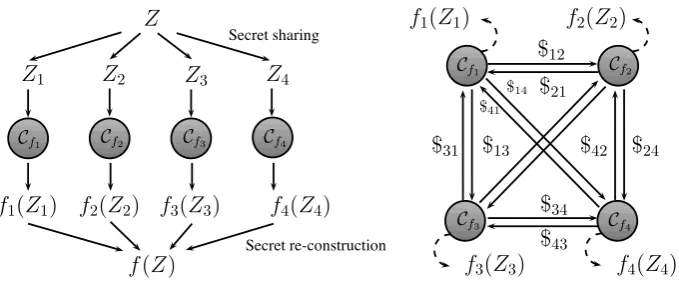
By consequence, only a certain type of functionf (homomorphic with re-spect to the sharing) can be split intonindependent computations, each of them operating only a single share off’s input and returning a sharing of f’s output (see Figure 1).
Z
Z1 Z2 Z3 Z4
Cf1 Cf2 Cf3 Cf4
f1(Z1) f2(Z2) f3(Z3) f4(Z4)
f(Z)
Secret sharing
Secret re-construction
Fig. 1.Multi-party Circuit for a ho-momorphic functionfandn= 4
Cf1 Cf2
Cf3 Cf4
f1(Z1) f2(Z2)
f3(Z3) f4(Z4)
$13
$31 $42 $24
$12
$21
$34
$43 $14
$41
Fig. 2.Multi-party Circuit for any functionfandn= 4
Secure Multi-Party Computation protocols extend the above idea (il-lustrated in Fig. 1) to any functionf (i.e.not only homomorphic function for which, as we have seen, the solution is straightforward). For such an extension to be possible, each sub-circuit Cf i is provided with the new ability to send information about its intermediate results to the other sub-circuits. To ensure that this has no impact on thed-glitches freeness of the overall circuit (composed of thensub-circuits), the sent information must itself be shared between all thensub-circuits. Under this constraint, each sub-circuit can only be given a single share of a (n, d)-sharing of the inter-mediate result of another sub-circuit. Moreover, to build a sound proof of security we also must ensure that all the shares accessed by a sub-circuit come from distinct and independent (n, d)-sharings. The hence obtained construction can be formalized by extending each sub-circuit Cf i with a family of n−1 channels ($ij)j6=i, the channel $ij being dedicated to the
Definition 7. Let f be a function and let Z denote its input. Let (Zi)i be a (n, d)-sharing of Z. A circuit Cf composed of (a minimum of5) n extended sub-circuits(Cf1,($1j)j6=1), ...,(Cf N,($N j)j6=N)isa (n, d )-multi-party circuit iff:
– every Cf i is input with a shareZi only,
– eachCf i can access, through $ij, to a share of an(n, d)-sharing of an intermediate result of the sub-circuitCf j,
– all the shares accessed by a sub-circuitCf i relate to mutually indepen-dent(n, d)-sharings,
– the Cf i outputs form a (n, d)-sharing of f(Z). – for i6=j, Cf i leaks independently to Cf j.
We give in Fig. 2 an example of a (n, d)-multi-party circuit for n= 4. The following proposition states on the security of our construction against glitches attacks.
Proposition 1. A (n, d)-multi-party circuit is secure in the dth-order Glitches Adversary Model.
Sketch of proof.The most powerfuldth-order glitches attack an adversary can perform against a circuit can only allow him to recover the entire input of the circuit. By definition of a (n, d)-sharing, each sub-circuit op-erates on a single elementZi of a (n, d)-sharing ofZ. Then the adversary
needs to attack at least d+ 1 sub-circuits to recover information on a shared variable Z. The other variables manipulated by a circuit come from channels $ij and (by definition) they rely on independent (n, d
)-sharings. By consequence, the adversary cannot combine them to recover more information than a single share of the input Zj of another circuit.
Eventually, since the sub-circuits are assumed to leak independently, we deduce that the adversary has to perform at least a (d+1)th-order glitches
attack to break the scheme.
Remark 7. To define a multi-party circuit we implicitly assumed that it was possible to separate the sub-circuits executions. It is out of the scope of this paper to propose such execution separation but we give in Ap-pendix A two separation models. The cost of the sub-circuit separation may seem expensive with respect to a block cipher implementation, but we believe that it is mandatory in order to develop sound resistance against glitches effects (without relying on ad-hoc logic styles). The construction we propose in the sequel aims at minimizing the sub-circuits number.
5
In the next section we recall the basics about Secure Multi-party Com-putation and, in particular, a protocol introduced by Ben Or et al.in [1]. Then, we argue that this protocol can be adapted to our context in order to design (n, d)-multi-party circuits as long asnis greater than 2d. Even-tually, in Section 4, the construction is applied to define, for any d >1, d-glitches free implementations of the AES.
3 Secure Multi-Party Computation
Secure Multi-Party Computation represents a rich area of research ini-tiated by the seminal work of Yao in 1986 [34]. For a n-ary function f and a family ofnplayers (Ii)i≤n, each holding a private valueZi, asecure multi-party computationis a joint protocol enabling the playersIito
com-pute f(Z1,· · ·, Zn) while under attack by an external adversary and/or
by a subset of malicious players (also called the colluding players). The attack purpose is to learn the private information of the – non-colluding – honest players or to cause the computation to be incorrect. To study the resistance of a protocol against those threats, two kinds of adversaries are usually introduced. The first one, usually called active, is allowed to let the malicious parties deviate from the protocol in arbitrary ways. It is out of the scope of this paper. The second kind of adversary, called pas-siveorsemi-honest, is only allowed to create collusions of players to gain information about the secret. The corrupted players still follow the proto-col and never forge wrong data. A security threshold parameter d≤nis used to indicate the maximum number of players the adversary is allowed to corrupt. A SMC protocol secure against a passive or active adversary with thresholddis called ad-private protocol. We show in this section how the problem of designing SMC protocols secure for this adversary model is related to the problem of designing multi-party circuits secure in the Glitches Adversary Model. Before that, we recall in the next section the main aspects of the SMC protocol introduced by Ben Or et al.in [1] on the basis of an idea proposed by Shamir in 1979.
3.1 Shamir’s Secret Sharing Scheme and BGW’s protocol
In a seminal paper [31], Shamir has introduced a simple and elegant way to share a secret Z (considered here in a field K ≡ GF(2m)) be-tween n < 2m players such that no collusion of d < n players can
term Z and secret coefficients ai (i.e. PZ(X) = Z +Pdi=1aiXi). Then, he chooses n distinct non-zero elements α1,· · · , αn in K, makes them
publicly available anddistributes to each playerIi the valueZi =PZ(αi).
To re-construct the secretZ, the players publish their private values Zi,
reconstructPZ by polynomial interpolation (always possible sincen > d)
and evaluate PZ(X) in 0 (we have Z =PZ(0)). It can be easily checked
that Shamir’s sharing fits with the notion of (n, d)-sharing given in Def-inition 5 with reconstruction function F defined s.t. F(Z1,· · ·, Zn) =
Pn
i=1Zi Qn
k=1,k6=i−αk(αi −αk)−1. Indeed, by definition of the Zi and
due to Lagrange’s Interpolation, the value F(Z1,· · · , Zn) equals PZ(0)
that is Z.
Remark 8. The productsQn
k=1,k6=i−αk(αi−αk)−1for allican be precom-puted once for all. They actually correspond to the first row (λ1,· · ·, λn) of the inverse of the Vandermonde (n×n)-matrix(αji)1≤i,j≤n. We hence have F(Z1,· · · , Zn) =Pni=1λiZi.
Remark 9. An example of algorithm specifying how to generate the(n, d) -sharing of an element along with an example of algorithm specifying how to reconstruct it are given in Sect. 4 (Algorithms 9 and 10 respectively).
Starting from Shamir’s secret sharing, Ben Or et al. have defined in [1] ad-private SMC protocol in the case where the number of playersn satisfiesn >2d. This construction, calledBGW’s protocolin the following, is in fact a constructive proof of the following theorem (see [1, Theorem 1]):
Theorem 1. For every (probabilistic) functionf andn >2d, there exists a d-private protocol.
In BGW’s protocol, the input (Z1,· · ·, Zn) of the function f whose
com-putation must be made d-private is assumed to correspond to Shamir’s sharing of a secret variableZ. Namely, they correspond to the evaluation of a degree-dsecret polynomialPZ(X) inndistinct non-zero public points
α1, ...,αn. It is moreover assumed that each player Ii has been initially
provided with a shareZi which is unknown to the others. Then, the
but evaluated in the same public pointsα1, ...,αn (i.e.Vi and Vi0 satisfy
Vi = PV(αi) and Vi0 = PV00(αi) respectively). Moreover, for each C to
process, BGW’s protocol is designed such that each playerIi has either a
single shareVi (ifCis univariate) or a single pair of shares (Vi, Vi0) (ifCis
bivariate). Eventually, BGW’s protocol describes a d-private multi-party computation for each kind of field operation C depending on its nature. We recall them hereafter, where it is assumed that the polynomials PV
and PV0 are defined over K[X].
If C is an affine transformation over K applied on a shared variable V, then the protocol consists in asking each player Ii to
ap-ply C on its private share Vi. After this step, each player owns a new
share C(Vi) and the family (C(Vi))i is a (n, d)-sharing of C(V). Indeed,
since C is affine,C(PV(X)) is a degree-d polynomial PC(V)(X) such that PC(V)(0) =C(V) and eachC(Vi) corresponds to the evaluation ofPC(V) in αi (i.e.PC(V)(αi) =C(Vi)).
If C is the addition operation ⊕ over K applied on two shared intermediate states V and V0, then the protocol consists in asking each playerIi to computeC(Vi, Vi0) =Vi⊕Vi0. After this step, each player owns
a new share C(Vi, Vi0) and the family of shares (C(Vi, Vi0))i is a (n, d
)-sharing of C(V, V0). Indeed, by construction of the Vi and Vi0, we have C(Vi, Vi0) =PV(αi)⊕PV0(αi) which implies that C(Vi, V0
i) corresponds to
the evaluation of the polynomialPV(X)⊕PV0(X) inαi. This polynomial
is of degree at mostdand satisfies (PV(0)⊕PV0(0)) =V ⊕V0 =C(V, V0).
If C is the multiplication operation ⊗ over K applied on two shared intermediate states V and V0, then the protocol is more complex than the previous ones. Actually, since this operation is not homomorphic with respect to sharing law, the protocol must involve communication between the players. Also, it will involve the first row (λ1,· · · , λn) of the
inverse of the Vandermonde (n×n)-matrix (αij)1≤i,j≤nand it is composed
of three steps6.
1. Each playerIi computesC(Vi, Vi0) =Vi⊗Vi0=PV(αi)⊗PV0(αi).
2. Each playerIirandomly generates a degree-dpolynomialQisuch that
Qi(0) =C(Vi, Vi0) and for everyj6=i, sends the valueQi(αj) to player
Ij.
3. Each playerIicomputes the linear combinationQ(αi) =Pnj=1λjQj(αi). The sharesC(Vi, Vi0) computed by the players at Step 1 correspond to
the degree-2dpolynomialPV(X)×PV0(X). As desired, the constant term
6
of this polynomial is C(V, V0). However, the family (C(Vi, Vi0))i built by
Step 1 is not a (n, d)-sharing since the corresponding polynomial is firstly not of degreedand secondly, is not a random polynomial (its distribution over the set of degree-2d polynomials with constant term C(V, V) is not uniform). To overcome this issue, Steps 2 and 3 perform both a degree reduction and a re-randomization of the shares. More precisely, Step 2 al-lows playerIito compute the (n, d)-sharing (Qi(αj))j of its shareC(Vi, Vi0)
thanks to a random polynomialQi, and to send those shares to the other
players. Then, in Step 3 each playerIi computesQ(αi) =Pnj=1λjQj(αi). The family (Q(αi))i corresponds to the evaluation in (αi)i of the
poly-nomial Q(X) =P
jλjQj(X), which, by construction, is of degreed and
admitsC(V, V0) as constant term. It is therefore a (n, d)-sharing ofC(V, V0) (see [10] for more details).
All the previous operations are defined over the field K. In a block cipher algorithm, they are often combined with GF(2)-affine transforma-tions. The latter ones are rarely affine over K since they do not sat-isfy C(λV) = λC(V) for every λ ∈ K. Of course, any such GF(2)-affine function can be represented as a field transformation f taking the form y∈K7→f(y) =b−1+Pm−k=01bky2
k
for somebk∈K. If one denotes byψ
the natural mapping GF(2)m 7→GF(2m), we have C(V) =ψ−1f(ψ(V)). Thanks to this representation, any GF(2)-affine transformation can be securely evaluated thanks to the BGW protocol recalled previously. How-ever, such a processing implies numerous secure multiplications. In the following, we propose an alternative scheme which allows us to process any GF(2)-affine transformation without secure multiplications. For this purpose we introduce a new condition on the public pointsαi involved in
Shamir and BGW schemes. Then, the idea is to perform the evaluation of each monomialbky2
k
separately. Thanks to the new condition on the αi,
we show that this processing can be done without secure multiplication and just needs a subsequent re-indexing of the players.
Improved processing for a transformationC in the form V 7→ bkV2
k
(GF(2)-affine but not linear over K). For such a processing, a special attention must be paid in order to avoid the need for costly multiplication operations. To this end, we need the public points αi to
satisfy the following conditions:
– Distinct and Non-zero Condition.The elementsαiare all distinct and
non-zero.
– Stability Over Frobenius Automorphism.For everyαi, there existsαj
The first constraint is already a prerequisite for Shamir’s sharing scheme. As the security of the latter scheme, as well as that of Ben-Or et al.
scheme, stands for any choice of distinct and non-zero αi, the second
condition induces no flaw. Moreover, we prove in Appendix D that it is always possible to find such a set of {αi} in GF(28) and we exhibit a
construction (an analysis for any mis let for further research).
Similarly to the other operations, we assume that each playerIi owns
the ith element of the (n, d)-sharing of V. The only additional assump-tion is that the αi satisfy the stability condition. To securely execute the
transformation C : V 7→ bkV2 k
, we propose that each player processes separately the transformation PV(αi) 7→ C(PV(αi)) = bk(PV(αi))2
k
to its share. Let us denote by P0 the degree-d polynomial built from PV
by applying the transformationC to its coefficients. By construction, we have P0(α2ik) =C(PV(αi)) and the set of shares {P0(α2
k
i )}i≤n is a (n, d
)-sharing ofC(V). From now, we can hence change the notationP0forPC(V). If the αi do not satisfy the stability condition, then the (n, d)-sharings
{PV(αi)}i≤n and {PC(V)(α2
k
i )}i≤n correspond to different sets of public
points (one being the image of the other by Frobenius transformation). Such a situation is not favourable since it implies a supplementary pro-cessing to update the set of public points. On the opposite, when the αi do satisfy the stability condition, then the sets {α2
k
i }i and {αi}i are
the same and we getnPC(V)(α2
k i )
o
i≤n=
PC(V)(αi) i≤n. In other terms,
the multi-party computation proposed above enables the definition of a (n, d)-sharing of C(V) with unchanged set of public points. Moreover, since the processing C:y 7→ bky2
k
can be tabulated, the overall compu-tation only involvesnlook-up table accesses (one for each player) and no costly multiplication.
Remark 10. The Frobenius operation inGF(2m) may be seen as a special case of the transformation C(V) =bkV2
k
and shall be treated similarly. A detailed description of the first-order masking scheme for the Frobenius operation and for theGF(2)-affine transformation of the AES is provided in Appendix E.
with the traditional Secure Multi-Party Computation context but is ac-ceptable in the context of multi-party circuits.
3.2 SMC protocol and Multi-Party Circuits
The design of a (n, d)-multi-party circuit from BGW’s protocol is merely based on the following remark: the d-privacy for a set of n semi-honest players evaluating a function f coincides with the d-probing security for a set of n circuits implementing f. Hence, if each player Ii in BGW’s
protocol is replaced by an extended sub-circuit (Cf i,($ij)j6=i), then the
previous description specifies a (n, d)-multi-party circuit. Moreover, such a design can be specified for any function f as long as n and d satisfy n >2d. Iff is defined over the finite field GF(2m) with addition and
mul-tiplication laws⊕and⊗, the sub-circuitsCf i are defined with respect to the elementary operations {A(m),⊕,⊗}, whereA(m) denotes the set of affine functions over GF(2m). By construction, each extended sub-circuit
(Cf i,($ij)j6=i) always operates on a single share of a sensitive variable and
has never access to the other shares nor a function of them (cf. defini-tion 7). Consequently, the observadefini-tion of an extended sub-circuit cannot give more information than a single share of a (n, d)-sharing. Hence, since the sub-circuit executions do not overlap, and by definition of a (n, d )-sharing, a glitches adversary must observe the behavior of at least d+ 1 extended sub-circuits (Cf i,($ij)j6=i) to recover sensitive information.
Eventually, to fully specify how to put BGW’s protocol into practice for a (n, d)-multi-party circuit, it just remains to clarify the following practical points:
– Messages exchange between sub-circuits (a.k.a. players) dur-ing Step 2 of the secure processdur-ing of ⊗. The exchange of mes-sages is done thanks to the channels $ij. In software, each channel $ij
between a pair of sub-circuits (Cf i,Cf j) may simply consist in a RAM space which is not accessed by another circuitsCf k with k6= i, j. In hardware, the designer can code a unique communication channel for each pair of circuits running sequentially. Another solution could be to run each sub-circuit in a different environment (e.g. different plat-forms) and to implement a channel between each pair of them (see Appendix A).
Cf i is provided with a procedure that enables it to write data on $ij
and to erase those data from its own memory. This procedure is called
write-then-erasein the following.
– The initial shares distribution by a honest entity (the Dealer).
In our context, the role of the Dealer is played by a special procedure run before processing the multi-party circuit. This procedure shares the sensitive variable as usually done in the literature to counteract dth-order probing attacks. To also achieve security in the dth-order Glitches Adversary Model, the computation is split into elementary operations that are processed sequentially. Although expensive this strategy can always be followed to go from probing attack security to glitches attacks security (see next section on the comparison with state of the art solutions). The actual algorithm is presented in next Section (Algorithm 9).
Because it is the most tricky part in BGW’s protocol, we develop hereafter the algorithm processed by each sub-circuitCf iwhen computing the (n, d)-sharing of the product of two shared values over a field GF(2m). It exactly corresponds to the multiplication operation discussed in the previous section when developed in the context of extended sub-circuits instead of players.
Notation. Instruction read(X,$ij) reads the content of $ij (viewed as a
channel or a memory address) and updateXwith it. Instructionwrite(X,$ij)
writes the value X on $ij.
Algorithm 1 Secure Multiplication Part Dedicated to a Sub-Circuit (Cf i,($ij)j6=i) Input:theith element PV(αi) of a (n, d)-sharing ofV, the ithelement PV0(αi) of a (n, d)-sharing ofV0and a set of channels ($ij)j6=i.
Output:theith elementQV⊗V0(αi) of a (n, d)-sharing ofV ⊗V0.
Public:thendistinct pointsαi, the first row (λ1,· · ·, λn) of the inverse of the matrix (αji)1≤i,j≤n
1. doWi←PV(αi)⊗PV0(αi)
*** Randomly generate ad-tuple(aj) of coefficients inGF(2m) 2.forj= 1 tod
doaj←rand(GF(2m))
*** Compute a(n, d)-sharing(Qi(α1),· · ·, Qi(αn))ofWi. 3.forj= 1 ton
doQi(αj)←Wi⊕Ldk=1akαki
write(Qi(αj),$ij)
*** Receive a shareQj(αi)from each sub-circuit Cj through$ji. 5.forj= 1 ton,j6=i
read(Qj(αi),$ij)
*** Compute the shareQV⊗V0(αi) 6. do QV⊗V0(αi)←Lnj=1λjQj(αi).
Steps 2 enables to randomly generate a degree-dpolynomialQi(X) =
Wi +Ldj=1ajXj. Step 3 evaluates Qi(X) in each public point αj to construct a (n, d)-sharing (Qi(αj))j of Wi. Step 4 sends those shares to
the other sub-circuits and Step 5 enablesCf i to receive the sharesQj(αi)
computed by the other sub-circuits Cf j. Eventually, Step 6 computes a share of V ⊗V0 for sub-circuitCf i.
3.3 Complexity of the Scheme and Comparison
Complexity Evaluation Except the multiplication, the proposed scheme replaces each operation of a given function by n similar operations (see Section 4 for an application of the scheme to AES-128 block cipher). Con-cerning the multiplication⊗over GF(2m), it is performed by asking each
of the sub-circuits to run Algorithm 1. As a consequence, the multiplica-tion⊗is replaced byn2(d+ 1) +nmultiplications,n2(d+ 1)−nadditions and 2(n−1)read/write operations. In the following table, we develop this complexity for n= 2d+ 1 (which is the smallest value n allowed in BGW’s protocol). For comparison purpose, we also give the complexity of the secure multiplication proposed in [29]. We recall that when applied with n = 2d+ 1, the multiplication algorithm proposed in Algorithm 1 offers the same (perfect) resistance against d-probing attacks than the method proposed in [29].
Method multiplications additions random bytes This paper 4d3+ 8d2+ 3d4d3+ 8d2+ 7d+ 2 d(2d+ 1)
[29] 2d2+ 2d d2+d+ 1 d(d+ 1)/2
Table 1.Complexity of the secure processing of a field multiplication.
In [24], Nikovaet al.have already attempted to apply the multi-party computation theory in the context of hardware implementations, with 1-glitches freeness in mind. Contrary to our proposal where data are shared thanks to Shamir’s scheme, Nikova et al. ’s construction relies on the classical additive sharing (namely the circuit’s input is additively masked with several, say n−1, random variables). To secure the processing on the masked input and the masks, they propose to split the computation according to a set of security rules. The obtained circuit sharing differs from ours in the two following main points. First, the security is only proven against first-order attacks, which implies that Nikova et al. ’s construction cannot be used to design (n, d)-multi-party circuits ford >1. Secondly, the sharing is not explicit and involves an exhaustive search that becomes impossible when the sizemof the circuit input is greater than 5. Moreover, there is no guaranty that the approach works for any circuit. In particular, Moradiet al. [21] discuss the difficulty of applying Nikova
et al. ’s scheme to the AES s-box. In [24], the scheme has been applied to the block cipher Noekeon [6]. Instead of taking the direction proposed in the present paper where the circuit is divided into several sub-circuits leaking independently, they take an opposite position where the different shares of a variable are manipulated simultaneouslyby the same circuit. Our scheme could also be implemented in such a way but the resulting security against dth-order attacks would be significantly reduced. Indeed the manipulation of all the shares at the same time makes the overall leakage at this time dependent on all the shares altogether. This enables — at least theoretically — to mount a 1st-order SCA attack. This fact is clearly pointed out in [24] but assumed to only lead to unpractical attacks. This has actually been validated in practice by Moradi et al. , who exhibit in [21] a first-order MIA on their AES implementation based on Nikova’s scheme.
On the opposite side, the constructions proposed in [13] (operations in GF(2)) and in its extension [29] (operations in GF(2m)) ared-probing
BGW’s protocol, and then our scheme, was designed to minimize the num-ber of players (thus the numnum-ber of sub-circuits here) to 2d+ 1. Hence, even though the overall bit-complexity of our scheme is one order of mag-nitude more expensive than Rivain-Prouff’s scheme, its limited cost in sub-circuits number makes it competitive when the design of sub-circuits is prohibitive (see remark 7 and Appendix A).
4 Glitches Free HO-Masking of the AES
We apply here the construction proposed in Section 3.2 to design a multi-party circuit implementing the AES-128 block cipher. The AES-128 block cipher iterates 10 times a round transformation on a 16-bytes internal state initially filled with the plaintext. The transformation is composed of a key additionAddRoundKey, a nonlinear layerSubByteswhich applies the same substitution-box (s-box) to every byte of the internal state and a linear layer composed of the so-called transformations ShiftRows and MixColumns. The s-box S is defined as the left-composition of a trans-formation ηA affine over GF(2)8, with the power function y 7→y254 over
the field GF(256)' GF(2)[X]/(X8 +X4+X3+X+ 1). In the follow-ing, we propose a (n, d)-multi-party circuit (Cf1,· · ·,Cf n) implementing the AES-128 algorithm. First, for each of the four AES transformations listed above we detail in Algorithms 3 to 7 the processing done by each sub-circuit. To specify the algorithms, we exactly applied the protocols discussed in Section 3.1. Eventually, we combine them to specify the pro-cessing that must be done by each sub-circuitCf i in order to ensure that the family (Cf1,· · ·,Cf n) is ad-glitches free implementation of the
AES-128.
Let us start our description with the exponentiation computationy 7→
y254 which is the most tricky part to protect. As shown in [29], it can be split in a sequence of raisings to powers in the form 2j (which will be
treated as operations in the form V 7→ bkV2 k
– see Sect. 3.1 –) and of 4 field multiplications. For anyj, let us denote byηjthe power functiony 7→
y2j, the exponentiation algorithm proposed in [29] is recalled hereafter:
Algorithm 2 Exponentiation to the 254 Input:V
Output:Y =V254
1.Z←η1(V) [Z =V2]
2.Y ←Z⊗V [Y =V2V =V3]
4.Y ←Y ⊗W [Y =V3V12=V15]
5.Y ←η4(Y) [Y = (V15)16=V240]
6.Y ←Y ⊗W [Y =V240V12=V252]
7.Y ←Y ⊗Z [Y =V252V2=V254]
Starting from Algorithm 2 and applying Algorithm 1 to securely pro-cess the multiplications ⊗, we develop hereafter the s-box computation routine processed by each extended sub-circuit (Cf i,($ij)j6=i). We split the
description in two algorithms dedicated to the exponentiation y 7→ y254 and to theGF(2)-affine functionηA respectively.
Algorithm 3 Secure Exponentiation Routine Dedicated to an Extended Circuit (Cf i,($ij)j6=i)
Input: the ith element PV(αi) of a (n, d)-sharing of V and a family of channels ($ij)j6=i.
Output:theith elementPV254(αi) of a (n, d)-sharing ofV254.
Public:thendistinct pointsαi, the first row (λ1,· · ·, λn) of the inverse of the matrix (αji)1≤i,j≤n
1. doPZ(αj)←η1(PV(αi)) (wherej iss.t.αj=η1(αi)) [Z=η1(V)]
dowrite-and-erasure(PZ(αj),$ij) 2. for js.t.αi=η1(αj) do
read(PZ(αi),$ji)
3. doPY(αi)←Algorithm 1(PV(αi), PZ(αi),($ij)j6=i) [Y =V ⊗Z] 4. doPW(αj)←η2(PY(αi)) (wherejiss.t.αj=η2(αi)) [W =η2(Y)]
dowrite-and-erasure(PW(αj),$ij) 5. for js.t.αi=η2(αj) do
read(PW(αi),$ij)
6. doPY(αi)←Algorithm 1(PY(αi), PW(αi),($ij)j6=i) [Y =Y ⊗W] 7. doPY(αj)←η4(PY(αi)) (wherej iss.t.αj=η4(αi)) [Y =η4(Y)]
dowrite-and-erasure(PY(αj),$ij) 8. for js.t.αi=η4(αj) do
read(PY(αi),$ij)
9. doPY(αi)←Algorithm 1(PY(αi), PW(αi),($ij)j6=i) [Y =Y ⊗W] 10. doPY(αi)←Algorithm 1(PY(αi), PZ(αi),($ij)j6=i) [Y =Y ⊗Z] 11.return PY(αi)
Before presenting the secure processing of the GF(2)-affine partηAof
the AES s-box, we recall that for everyy ∈GF(2)[X]/(X8+X4+X3+ X+ 1) it is defined by:
ηA(y) = 0x63 + 0x05⊗y+ 0x09⊗y2+ 0xf9⊗y4+ 0x25⊗y8
In the rest of the paper, the constant terms 0x63, 0x05, ..., 0x8f are denoted by a−1,a0, ..., a7 respectively.
For efficiency reasons, we apply hereafter the alternative scheme pro-posed in Sect. 4 to process GF(2)-affine functions. This implies that the public pointsαi have been chosen to satisfy the stability condition stated
in Sect. 4 (the construction proposed in Appendix D can for instance be used for this purpose).
Algorithm 4 Secure ηA Processing Routine Dedicated to an Extended Circuit (Cf i,($ij)j6=i)
Input: the ith element PV(αi) of a (n, d)-sharing of V and a family of channels ($ij)j6=i.
Output:theith elementPηA(V)(αi) of a (n, d)-sharing ofηA(V).
Public:thendistinct pointsαi, the first row (λ1,· · ·, λn) of the inverse of the matrix (αji)1≤i,j≤n
1. doPa0V(αi)←a0⊗PV(αi)
2. for t= 1to7 do
3. doPa
tV2t(α2 t
i )←at⊗PV(αi)2 t
4. forjs.t.αj=α2 t i do
write-and-erasure(Pa tV2t(α
2t
i ),$ij) [Pa tV2t(α
2t
i ) =PatV2t(αj)] 5. forjs.t.α2jt=αi do
read(Pa tV2t(α
2t
j ),$ij) [Pa
tV2t(α
2t
j ) =PatV2t(αi)] 6. doPηA(V)(αi)←Pa−1(αi)⊕Pa0V(αi)⊕...⊕Pa
7V27(αi)
7.returnPηA(V)(αi)
We now develop hereafter the routinesAddRoundKey,ShiftRows and
MixColumns processed by each extended sub-circuit (Cf i,($ij)j).
Algorithm 5 AddRoundKeyProcessing Routine Dedicated to an Extended Circuit (Cf i,($ij)j6=i)
Input:theith share (Psj(αi))j≤16 of a (n, d)-sharing of the AES state (sj)j≤16 and
theithshare (Pkj(αi))kj≤16of a (n, d)-sharing of the round key (kj)j≤16. Output:theith share (Psj⊕kj(αi))j≤16of a (n, d)-sharing of (sj⊕kj)j≤16.
1.fori= 1to16
doPsj⊕kj(αi)←Psj(αi)⊕Pkj(αi) 2.return(Psj⊕kj(αi))j≤16
Algorithm 6 ShiftRows Processing Routine Dedicated to an Extended Circuit (Cf i,($ij)j6=i)
Output:theithshare (Psj(αi))j≤16of a (n, d)-sharing of (sj)j≤16=ShiftRows((sj)j≤16).
1. (Psj(αi))j≤16←ShiftRows((Psj(αi))j≤16) 2.return(Psj(αi))j≤16
The followingMixColumns processing starts from the implementation recalled in Appendix B.
Algorithm 7 MixColumns Processing Routine Dedicated to an Extended Circuit (Cf i,($ij)j6=i)
Input:theith share (Psj(αi))j≤16.
Output:theithshare (Psj(αi))j≤16of a (n, d)-sharing of (sj)j≤16=MixColumns((sj)j≤16). 1.for`= 0to3
doPtmp(αi)←Ps1+`(αi)⊕Ps5+`(αi)⊕Ps9+`(αi)⊕Ps13+`(αi) doPs1+`(αi)←02⊗(Ps1+`(αi)⊕Ps5+`(αi))⊕Ptmp(αi)⊕Ps1+`(αi) doPs5+`(αi)←02⊗(Ps5+`(αi)⊕Ps9+`(αi))⊕Ptmp(αi)⊕Ps5+`(αi) doPs9+`(αi)←02⊗(Ps9+`(αi)⊕Ps13+`(αi))⊕Ptmp(αi)⊕Ps9+`(αi) doPs13+`(αi)←Ps1+`(αi)⊕Ps5+`(αi))⊕Ps9+`(αi)⊕Ptmp(αi) 2.return(Psj(αi))j≤16
The AES key-scheduling function can itself be split into only affine transformations and s-box computations. Hence, the same strategy can be followed to split its processing between theCf i as we did with the AES round transformation. TheKeySchedulingsecure processing routine ded-icated to the extended circuit (Cf i,($ij)j6=i) is denoted byKeyScheduling sec.
We now propose an algorithmic description of the computations im-plemented by each extended sub-circuit (Cf i,($ij)j6=i) such that the family
(Cf i,($ij)j6=i)i is a (n, d)-multi-party circuit implementing the AES. We
stress here that all these algorithms are a direct expression of BGW’s secure protocol and that there is no need for a special treatment due to the context. The correctness/security of these algorithms is hence not discussed here and the reader can refer to Section 3 or directly to the original paper [1] to convince him/herself about it.
Algorithm 8 Secure AES Processing Routine Dedicated to an Extended Circuit (Cf i,($ij)j6=i)
Input:theith share (Psj(αi))j≤16 of a (n, d)-sharing of the AES state (sj)j≤16 and theithshare (Pkj(αi))kj≤16of a (n, d)-sharing of the master key (kj)j≤16.
Output:theith elementPV(αi) of a (n, d)-sharing ofS(V).
Public:thendistinct pointsαi, the first row (λ1,· · ·, λn) of the inverse of the matrix (αji)1≤i,j≤n
1.forr= 1to10
2. do(Psj(αi))j≤16←Algorithm-5 ((Psj(αi))j≤16,(Pkj(αi))j≤16)[AddRoundKeyPart] 3. forj= 1 to16
doPsj(αi)←Algorithm-3(Psj(αi),($ij)j6=i) [SubBytesExp. Part] doPsj(αi)←Algorithm-4(Psj(αi),($ij)j6=i) [SubBytesηA. Part] 4. do(Psj(αi))j≤16←Algorithm-6((Psj(αi))j≤16) [ShiftRowsPart]
5. do(Psj(αi))j≤16←Algorithm-7((Psj(αi))j≤16) [MixColumnsPart] 6. do(Pkj(αi))j≤16←KeyScheduling sec((Pkj(αi))j≤16,($ij)j6=i)[KeySchedulingPart]
*** Last round ***
7. do(Psj(αi))j≤16←Algorithm-5 ((Psj(αi))j≤16,(Pkj(αi))j≤16)[AddRoundKeyPart] 8. for j= 1to16
doPsj(αi)←Algorithm-3(Psj(αi),($ij)j6=i) [SubBytesPart] 9. do(Psj(αi))j≤16←Algorithm-6((Psj(αi))j≤16) [ShiftRowsPart]
10. do(Pkj(αi))j≤16←KeyScheduling sec((Pkj(αi))j≤16,($ij)j6=i)[KeySchedulingPart] 11. do(Psj(αi))j≤16←Algorithm-5 ((Psj(αi))j≤16,(Pkj(αi))j≤16)[AddRoundKeyPart]
12.return (Psj(αi))j≤16
By construction, the family of extended sub-circuits (Cf i,($ij)j6=i)i,
each of them processing Algorithm 8, implements the AES-128 block ci-pher. It is moreover a (n, d)-multi-party circuit since it is an instance of BGW’s protocol.
To construct the (n, d)-sharings of the plaintext and the master key which are distributed to the sub-circuits, the following algorithm is ap-plied:
Algorithm 9 (n, d)-sharing Construction Input:a 16-byte vector (Vj)j≤16
Output:a (n, d)-sharing ((PVj(α1))j≤16,· · ·,(PVj(αn))j≤16) of (Vj)j≤16.
Public:ndistinct pointsαi.
1.forj= 1 to16
Randomly generate a family(ai)i≤dof coefficients in GF(256). 2. for t= 1 tod
doat←rand(GF(256))
ComputePVj(αi) =m+Pj≤daj·αji 3. for i= 1to n
doPVj(αi)←Vj 4. for t= 1tod
5.return((PVj(α1))j≤16,· · ·,(PVj(αn))j≤16)
Eventually, the following algorithm is applied to reconstruct the AES output from the (n, d)-sharing
((Psj(α1))j≤16,· · ·,(Psj(αn))j≤16) returned by the sub-circuitsCf i at the end of Algorithm 8.
Algorithm 10 Reconstruction
Input:a (n, d)-sharing ((Psj(α1))j≤16,· · ·,(Psj(αn))j≤16)
Output:the un-shared value (sj)j≤16.
Public:the first row (λ1,· · ·, λn) of the inverse of the matrix (αji)1≤i,j≤n.
1.forj= 1 to16
Process Lagrange’s Interpolation.
2. for i= 1to n
dosj←Pni=1λiPsj(αi) 3.return(sj)j≤16)
This concludes the full algorithmic description of a d-glitches free AES-128 implementation. We will now focus on the study of Shamir’s secret sharing scheme as a masking scheme.
5 The Polynomial Masking Function
In previous sections we have used Shamir’s sharing scheme to secure the sensitive data manipulations and we have applied SMC protocols to en-able secure elementary computations on the shared varien-ables. This section focusses on Sharing’s scheme and studies it as a masking technique, here-after referred aspolynomial masking. In particular, we compare its SCA resistance w.r.t. the classical Boolean masking [12] which is up to now the only masking which has been applied to define d-probing resistant implementations for anyd [13, 29].
Since the efficiency of adth-order SCA decreases exponentially when d grows (see Sect. 1), the amount of information leaking on a shared sensitive variable when targeting all the shares, is a sound way to compare two (n, d)-sharings [9,32]. To quantify this amount, we need to model the relationship between the physical leakage and the value of the variable manipulated at the time of the leakage. For such a purpose, we associate each d-tuple of shares (Z0,· · · , Zd) with a (d+ 1)-tuple of leakages L=
(L0,· · · , Ld) s.t. Li = HW(Zi) +βi, with βi an independent Gaussian
L ← (Z0,· · · , Zd) to refer to this association. Since we assumed that
the variable Z and the masking material are uniformly distributed over their definition sets, the signal-to-noise ratio (SNR) of the leakage can be defined as Var [HW(Zi)]/Var [βi] (that is 2/σ2 if we assume that Zi is
8-bit long).
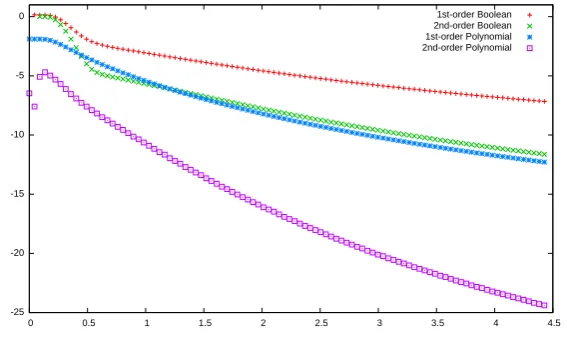
To evaluate the information revealed by each tuple of shares for Boolean and polynomial masking techniques, we computed the mutual informa-tion7 I(Z,L) between the sensitive variable Z and L. We list hereafter the leakages we considered and the underlying leaking variables:
1st-order Boolean masking: L← (Z⊕B, B) . (2) 2nd-order Boolean masking: L← (Z⊕B1⊕B2, B1, B2) . (3) 1st-order Poly. masking: L← (PZ(α1), PZ(α2)) . (4) 2nd-order Poly. masking: L←(PZ(α1), PZ(α2), PZ(α3)) . (5)
Remark 12. The polynomialPZ considered in (4)and (5)is an otherwise random polynomial with constant coefficient Z and degree at most 1 and 2 respectively. The αi are distinct public values.
Figure 3 summarizes the information theoretic evaluation for each leakage (1) to (4). Fordequal to 1 or 2, it can be observed that the amount of information revealed by the d+ 1 elements of the Boolean masking is greater than that revealed by thed+ 1 elements of the polynomial mask-ing. Moreover, the gap between the two amount of information gets wider as the noise increases and, apparently, when the order dincreases. This can be explained by the greater algebraic complexity of the polynomial masking function compared to the Boolean one. Indeed, the algebraic de-gree of polynomial masking increases with the masking order dwhereas Boolean masking stays linear. Eventually, it can also be observed that, at a fixed order (1 or 2 here), the difference in the amount of informa-tion retrieved on the sensitive variable between Boolean and polynomial maskings is exponential in the square root of the noise standard deviation σ.
Following the same reasoning as in [9, 32], we deduce from the ob-servations above that polynomial masking offers a better resistance to HO-SCA attacks. Our analysis also suggests that difference between the 7 As shown in [32], the number of measurements required to achieve a given
two resistance levels increases with the noise standard deviation and the order.
-25 -20 -15 -10 -5 0
0 0.5 1 1.5 2 2.5 3 3.5 4 4.5
1st-order Boolean 2nd-order Boolean 1st-order Polynomial 2nd-order Polynomial
Fig. 3.Mutual information (log10) between the leakage and the sensitive variable over an increasing noise standard deviation (x-axis).
6 Conclusion
of Shamir’s secret sharing which is a core primitive of [1]. In particular, we have argued that it is much more robust that the classical Boolean sharing.
The multi-party circuit model permits the systematic use of SMC protocols for building d-glitches free schemes. As a first approach, we based our study on very strong hypotheses on the attacker power. Even if such brutal approach allows us to develop sound proofs of security, the resulted secure implementation is costly. Future works could investigate more realistic (weaker) adversary models in order to build lighter secure implementations, or, to the same purpose, study alternative SMC proto-cols, less generic than BGW’s protocol but more efficient. Another avenue could be to study some existing optimizations of BGW’s protocol (e.g.
the optimization based on Franklin and Yung’s trick [8] that is based on efficient parallel computations).
References
1. M. Ben-Or, S. Goldwasser, and A. Wigderson. Completeness theorems for non-cryptographic fault-tolerant distributed computation. InSTOC ’88: Proceedings of the twentieth annual ACM symposium on Theory of computing, pages 1–10, New York, NY, USA, 1988. ACM.
2. J. Bl¨omer, J. G. Merchan, and V. Krummel. Provably Secure Masking of AES. In M. Matsui and R. Zuccherato, editors,SAC 2004, volume 3357 ofLNCS, pages 69–83. Springer, 2004.
3. S. Chari, C. Jutla, J. Rao, and P. Rohatgi. A Cautionary Note Regarding Evalu-ation of AES Candidates on Smart-Cards. InSecond AES Candidate Conference – AES 2, Mar. 1999.
4. S. Chari, C. Jutla, J. Rao, and P. Rohatgi. Towards Sound Approaches to Coun-teract Power-Analysis Attacks. In M. Wiener, editor, Advances in Cryptology – CRYPTO ’99, volume 1666 ofLNCS, pages 398–412. Springer, 1999.
5. J.-S. Coron. A New DPA Countermeasure Based on Permutation Tables. In R. Ostrovsky, R. D. Prisco, and I. Visconti, editors, SCN 2008, volume 5229 of
LNCS, pages 278–292. Springer, 2008.
6. J. Daemen, M. Peeters, G. Assche, and V. Rijmen. The Noekeon Block Cipher. In
Proceedings of first NESSIE Workshop, 2000. http://cryptonessie.org.
7. T. Eisenbarth, C. Paar, and B. Weghenkel. Building a side channel based dis-assembler. In M. Gavrilova, C. Tan, and E. Moreno, editors, Transactions on Computational Science X, volume 6340 of Lecture Notes in Computer Science, pages 78–99. Springer Berlin / Heidelberg, 2010.
8. M. Franklin and M. Yung. Communication complexity of secure computation (extended abstract). InSTOC ’92: Proceedings of the twenty-fourth annual ACM symposium on Theory of computing, pages 699–710, New York, NY, USA, 1992. ACM.
10. R. Gennaro, M. O. Rabin, and T. Rabin. Simplified vss and fact-track multiparty computations with applications to threshold cryptography. InPODC, pages 101– 111, 1998.
11. Goldack. Side-channel based reverse engineering for microcontrollers, 2008. Mas-ter’s thesis, Ruhr-Universit¨at, Bochum, Germany.
12. L. Goubin and J. Patarin. DES and Differential Power Analysis – The Duplication Method. In C¸ . Ko¸c and C. Paar, editors,CHES ’99, volume 1717 ofLNCS, pages 158–172. Springer, 1999.
13. Y. Ishai, A. Sahai, and D. Wagner. Private circuits: Securing hardware against probing attacks. In D. Boneh, editor,CRYPTO, volume 2729 ofLecture Notes in Computer Science, pages 463–481. Springer, 2003.
14. M. Joye, P. Paillier, and B. Schoenmakers. On Second-order Differential Power Analysis. In Rao and Sunar [27], pages 293–308.
15. P. Kocher, J. Jaffe, and B. Jun. Introduction to Differential Power Analysis and Related Attacks. Technical report, Cryptography Research Inc., 1998.
16. R. Lidl and H. Niederreiter.Finite fields, volume 20 ofEncyclopedia of Mathematics and its Applications. Cambridge University Press, seconde edition, 1997. Avec une introduction de P. M. Cohn.
17. S. Mangard, T. Popp, and B. M. Gammel. Side-Channel Leakage of Masked CMOS Gates. In A. Menezes, editor,Topics in Cryptology – CT-RSA 2005, volume 3376 ofLNCS, pages 351–365. Springer, 2005.
18. S. Mangard and K. Schramm. Pinpointing the Side-Channel Leakage of Masked AES Hardware Implementations. In L. Goubin and M. Matsui, editors, CHES 2006, volume 4249 ofLNCS, pages 76–90. Springer, 2006.
19. T. Messerges. Using Second-order Power Analysis to Attack DPA Resistant Soft-ware. In C¸ . Ko¸c and C. Paar, editors,CHES 2000, volume 1965 ofLNCS, pages 238–251. Springer, 2000.
20. S. Micali and L. Reyzin. Physically Observable Cryptography (Extended Ab-stract). In M. Naor, editor, Theory of Cryptography Conference – TCC 2004, volume 2951 ofLecture Notes in Computer Science, pages 278–296. Springer, 2004. 21. A. Moradi, A. Poschmann, S. Ling, C. Paar, and H. Wang. Pushing the limits: A very compact and a threshold implementation of aes. In K. G. Paterson, editor,
EUROCRYPT, volume 6632 ofLNCS, pages 69–88. Springer, 2011.
22. S. Nikova, C. Rechberger, and V. Rijmen. Threshold implementations against side-channel attacks and glitches. In P. Ning, S. Qing, and N. Li, editors,IICICS’06, volume 4307 ofLNCS, pages 529–545. Springer, 2006.
23. S. Nikova, V. Rijmen, and M. Schl¨affer. Secure Hardware Implementation of Non-linear Functions in the Presence of Glitches. In P. J. Lee and J. H. Cheon, editors,
ICISC 2008, volume 5461 ofLNCS, pages 218–234. Springer, 2008.
24. S. Nikova, V. Rijmen, and M. Schl¨affer. Secure hardware implementation of non-linear functions in the presence of glitches. J. Cryptology, 24(2):292–321, 2011. 25. G. Piret and F.-X. Standaert. Security Analysis of Higher-Order Boolean Masking
Schemes for Block Ciphers (with Conditions of Perfect Masking).IET Information Security, 2:1–11, 2008.
26. E. Prouff and T. Roche. Attack on a higher-order masking of the aes based on homographic functions. In G. Gong and K. Gupta, editors,Progress in Cryptology - INDOCRYPT 2010, volume 6498 of Lecture Notes in Computer Science, pages 262–281. Springer Berlin / Heidelberg, 2010.
28. M. Rivain, E. Dottax, and E. Prouff. Block Ciphers Implementations Provably Secure Against Second Order Side Channel Analysis. Cryptology ePrint Archive, Report 2008/021, 2008. http://eprint.iacr.org/.
29. M. Rivain and E. Prouff. Provably secure higher-order masking of aes. In S. Man-gard and F.-X. Standaert, editors,CHES, volume 6225 ofLNCS, pages 413–427. Springer, 2010.
30. K. Schramm and C. Paar. Higher Order Masking of the AES. In D. Pointcheval, editor,CT-RSA 2006, volume 3860 ofLNCS, pages 208–225. Springer, 2006. 31. A. Shamir. How to Share a Secret. Commun. ACM, 22(11):612–613, Nov. 1979. 32. F.-X. Standaert, N. Veyrat-Charvillon, E. Oswald, B. Gierlichs, M. Medwed,
M. Kasper, and S. Mangard. The world is not enough: Another look on second-order dpa. In M. Abe, editor,Advances in Cryptology - ASIACRYPT 2010, volume 6477 ofLecture Notes in Computer Science, pages 112–129. Springer Berlin / Hei-delberg, 2010.
33. D. Suzuki, M. Saeki, and T. Ichikawa. DPA Leakage Models for CMOS Logic Circuits. In Rao and Sunar [27], pages 366–382.
34. A. C.-C. Yao. How to generate and exchange secrets. InProceedings of the 27th Annual Symposium on Foundations of Computer Science, pages 162–167, Wash-ington, DC, USA, 1986. IEEE Computer Society.
A Sub-circuits Separation Models
– Temporal Separation(suited to sequential execution): the sub-circuits are processed sequentially without overlapping. Depending on the platform, it may need a state re-initialization step between each sub-circuit execution, such that an operation has no influence on the side-channel leakage of the next operation (owned by the next sub-circuit). Indeed, glitches attacks may be related to the notion of persistence of an operation. In Software for instance, when considering a pipelined processor, the power consumption of the current executed instruction can be influenced by previous or next instructions (see for instance Goldack Master Thesis on SCA based Retro-Engineering [11] and the recent paper of Eisenbarthet al. [7]).
B MixColumns Processing
In the paper, we will assume thatMixColumnsis implemented as
s00,c←O2(s0,c⊕s1,c)⊕tmp⊕s0,c
s01,c←O2(s1,c⊕s2,c)⊕tmp⊕s1,c
s02,c←O2(s2,c⊕s3,c)⊕tmp⊕s2,c
s03,c←s00,c⊕s01,c⊕s02,c⊕tmp
wheretmp =s0,c⊕s1,c⊕s2,c⊕s3,c and where O2denotes a look-up table
for the functionx7→02·x.
C First-Order Glitches Free Masking Scheme of The
Product in GF(2m)
In this annexe, we give a block diagram description of the execution of a product in GF(2m) following the scheme presented in Section 3.2 for a masking order equal to 1. We denote by A and B the two values to be multiplied. The Shamir’s secret sharing of A (resp. B) is denoted by
{PA(α1), PA(α2), PA(α3)} (resp. {PB(α1), PB(α2), PB(α2)}), where PA
(resp. PB) is a random polynomial of degree at most 1 with constant
coefficient equal to A (resp. B) and where {α1, α2, α3} are public fixed elements of GF(2m)?.
On Figure C, the {λi} denote the elements of the first row of the
in-verse of the Vandermonde (n×n)-matrix (αji)1≤i,j≤n, these values are
fixed and considered pre-computed once for all. Moreover, the notation PX ←(X, RN G) means the generation of a polynomial PX of degree at
most 1 such that its constant coefficient is equal toX and the other one is random (i.e.generated by ”RNG”).
D Design of Sub-Sets in GF(28) Stable By Frobenius Transformation
Theorem 2. For any integerd <28, there exists a sub-setS ⊆GF(28)? with cardinality d and such thatx∈S implies x2∈S.
Proof. In the following, we will denote byβa primitive element of GF(28). For somes∈ {0,· · · ,28−1}, let us consider the setC
s={s,2s,· · · ,2ms−1s}
wheremsis the smallest integer such that 2mss≡smod (28−1) (the set
Cs is usually called 2-class cyclotomic ofs modulo 28−1). By
C
f1C
f2C
f3PA(α3), PB(α3)
W3=PA(α3)⊗PB(α3)
PW3←(W3, RN G)
PW1(α3)
PW1(α1) PW1(α2) PW3(α1) PW3(α2) PW3(α3)
PA(α2), PB(α2)
W2=PA(α2)⊗PB(α2)
PW2←(W2, RN G)
PA(α1), PB(α1)
W1=PA(α1)⊗PB(α1)
PW1←(W1, RN G)
PW2(α3)
PW2(α1) PW2(α2)
PW3(α1)
PW1(α1) PW2(α1) PW1(α2) PW2(α2) PW3(α2) PW1(α3) PW2(α3) PW3(α3)
PA⊗B(α1) =PλjPWj(α1) PA⊗B(α2) =
P
λjPWj(α2) PA⊗B(α3) =
P
λjPWj(α3)
squaring in GF(28)). Moreover, it is well known thatC
s is the set of the
roots of the βs’s minimal polynomial, which degree divides 8. Hence, the cardinal of Cs, denoted Ns, also divides 8.
Using Moebius Inversion Formula, it is possible to enumerate all sets
Cs of fixed cardinal Ns that divides 8 (see, for instance, [16, Theorem
3.25]), we then have:
– 2 sets of 1 element
– 1 set of 2 elements
– 3 sets of 4 elements
– 30 sets of 8 elements
Finally it can be checked that for any d < 28 it is possible to construct a set S of cardinality d by union of some of the sets enumerated above (minus the set containing 0). Such a setSwould contain distinct and non-zero elements. Moreover it would be stable by the Frobenius operation.
E First-order Glitches Free Masking of the AES S-Box
Hereafter we detail the masking of the AES s-box for d = 1 (i.e. three shares). As recalled in Sect. 4, this function takes the formηA◦Inv where
multiplications are computed over GF(2)[X]/(X8+X4+X3+X+ 1). We first focus on the field inversion computation (Algorithm 3) and then we detail how to process the affine part of the s-box. We assume that the secure s-box processing is done for a variable V that is split into n= 3 shares V0 = PV(α0), V1 = PV(α1) and V2 = PV(α2) where PV(X) is
a random degree-1 polynomial with constant term V and where α0, α1 and α2 satisfy the two conditions given in Sect. 3.1. In the following, we assume thatPV(X) equalsV +aX and we choseα0= 1, α1 = 0xbc and α2= 0xbd.
– By definition ofPV, at the beginning of Algorithm 3, we have:
V0 =V +aα0 , (6)
V1 =V +aα1 , (7)
V2 =V +aα2 . (8)
– After the first squaring (Step 1 in Algorithm 3), the three sub-circuits
Cf i have a (3,1)-sharing (Z0, Z1, Z2) of the variable Z =V2. By con-struction, the shares satisfy:
Z0 =V2+ (aα0)2 =V2+a2α0 (9) Z1 =V2+ (aα1)2 =V2+a2α2 (10) Z2 =V2+ (aα2)2 =V2+a2α1 , (11) sinceα12 =α2. Reordering of the shares is needed since Z1 relates to public points α2 whereas Z2 relates to α1. Circuits Cf1 and Cf2 are
hence up to now assumed to exchange their roles for the remaining of the protocol.
– After Algorithm 3 next step, theCf i have built shares Y0,Y1 and Y2 such that:
Y0=V3+bα0 (12) Y1=V3+bα1 (13) Y2=V3+bα2 , (14) wherebis some new coefficient.
– Then comes the rising to the power 4 and the sub-circuits have three new shares W0,W1 and W2 such that: