O R I G I N A L R E S E A R C H
Use of an online medical database for clinical
decision-making processes: assessment of
knowledge, attitude, and practice of oral health
care providers
This article was published in the following Dove Press journal: Advances in Medical Education and Practice
Emmanuel Nzabonimana1
Moses M Isyagi2
Kato J Njunwa3
Donna M Hackley1,4
Mohammed S Razzaque1,4,5
1Department of Preventive & Community
Dentistry, University of Rwanda School of Dentistry, Kigali, Rwanda;
2Department of Oral Maxillofacial
Surgery & Pathology, University of Rwanda School of Dentistry, Kigali,
Rwanda;3Research, Innovation &
Postgraduate Studies, University of
Rwanda, Kigali, Rwanda;4Department of
Oral Health Policy & Epidemiology, Harvard School of Dental Medicine,
Boston, MA, USA;5Department of
Pathology, Lake Erie College of Osteopathic Medicine, Erie, PA, USA
Purpose: This study was conducted to determine the level of knowledge, attitude, and practice of oral health care providers toward the use of online medical databases for clinical decision-making processes.
Subjects and methods: The study population included all the licensed oral health care providers living in Rwanda, registered either with the Rwanda Allied Health Professional Council (RAHPC) or Rwanda Medical and Dental Council (RMDC). A self-administered questionnaire was used to collect demographic data as well as data regarding knowledge, attitude, and practice of oral health care providers regarding the use of online medical databases for making clinical decisions. A pilot study with 12 oral health care providers was done before the main study to pretest the questionnaire.
Results: The study results show that among the 201 respondents, 80% (N=160) reported using internet-based resources to support their clinical decisions, while 20% (N=41) of oral health care providers do not use online resources when making their clinical decisions. In general, there was a positive attitude towards internet-based resources among the partici-pants, as 92% (N=184) respondents believe that internet-based resources are helpful in clinical decision-making processes. Of clinical importance, 68% respondents (N=136) believe that by using current internet-based information, better clinical care can be offered to their patients.
Conclusion: Educating oral health care providers on the useful and appropriate online resources available for supporting clinical decision-making processes might increase the efficiency of patient care.
Keywords:oral health, internet access, clinical resources, awareness
Introduction
Historically, most health care providers have relied on printed materials to inform
their treatment plan decisions for their patients.1 However, the printed literature
often provided by the traditional library must be refreshed periodically to provide updated information to be useful for unique clinical questions that arise at the point
of patient care.1Searching for relevant clinical information in paper-based format is
very time consuming.2Fortunately, the availability of portable wireless devices can
make medical information readily accessible so that clinicians can deliver efficient
patient care.3
Correspondence: Mohammed S Razzaque Department of Pathology, Lake Erie College of Osteopathic Medicine, 1858 West Grandview Boulevard, Erie, PA 16509, USA
Email [email protected]
Advances in Medical Education and Practice
Dove
press
open access to scientific and medical researchOpen Access Full Text Article
Advances in Medical Education and Practice downloaded from https://www.dovepress.com/ by 118.70.13.36 on 19-Aug-2020
The lack of real-time availability of the necessary information at the point of patient care delivery is an obstacle faced by health care providers in developing countries. The lack of familiarity with use of computer-ized information technology and often limited internet access hinder health care providers from taking advan-tage of online medical resources and hence likely impair
the clinical decision-making process.4 With various
communicable and noncommunicable diseases on the rise in developing countries, dental and medical health care providers must continuously seek current knowl-edge related to the diagnosis and management of these conditions. By using current online dental and medical resources, physicians and oral health professionals are likely to improve their clinical decision-making
pro-cesses to provide better patient care.5 The online
med-ical database tools facilitate health care workers to make better-informed clinical decisions in a shorter period of time resulting in more accurate diagnosis and more
effective treatment of the patient.6
For this reason, medical and dental health care provi-ders must be familiar with the online medical databases and resources. In developed countries, use of online or web-based tools to aid clinical care is a widespread prac-tice. A study in Sweden related to the follow-up care of chronic heart failure patients found that 67% of health care workers used web-based or online resources, with 74% of respondents reporting positive attitudes toward application of information, communication and technology (ICT) in health care; interestingly, up to 96% were optimistic regarding the future positive contribution of ICT in health
care.7 On the African continent, limited access to ICT
infrastructure and low rates of computer literacy have been cited as an obstacle towards uptake and utilization of web-based health care resources for clinical decision making and providing health care, especially amongst female health care workers, who form the bulk of the
health care workforce in Africa.8In Rwanda, the national
ICT policy encourages the leverage of ICT in all sectors to achieve the Vision 2020 goals to improve the overall health status of the population. This also applies to the health sector where electronic medical records (EMR) and
electronic health management information system
(EHMIS) technologies to enhance patient care are being rolled out. The extent of use of online medical databases to support clinical decision-making processes and patient care among the oral health care providers in Rwanda is not yet known.
This study seeks to ascertain knowledge, attitude, and practice of oral health care providers on their use of online medical databases in the clinical decision-making process. We have surveyed all of the dental therapists and dental surgeons living in Rwanda who were registered either with the Rwanda Allied Health Professional Council (RAHPC) or the Rwanda Medical and Dental Council (RMDC) on March 2016.
Materials and methods
Study design
A cross-sectional quantitative survey method was used to assess knowledge, attitude, and practice of oral health care providers towards the use of the online medical database for making clinical decisions.
Study population
The study population included all licensed oral health care providers (dental therapists and dental surgeons) registered within the RAHPC and the RMDC who reside in Rwanda. A census approach was adopted, and all 245 licensed oral health care providers were sampled.
Data collection
An online and printed self-administered structured ques-tionnaire with open-ended and closed questions was used to collect data regarding knowledge, attitude, and prac-tices of oral health care professionals towards the use of online medical databases for making clinical decisions. The questionnaire was written both in English and French in simple language to be understood by the participants.
The questionnaire was adapted, validated and modified
from earlier published studies.9,10An electronic
question-naire was designed and piloted with 12 dental health professionals before being disseminated using an online Google form for participants with internet access and a paper version for participants with slow or with no internet access. The pilot study was done to determine if the questionnaire met the study objectives and the validity of translation. The questionnaire captured the following variables: (a) dependent variables: use of inter-net-based resources to support the clinical decision; (b) independent variables: demographic characteristics (edu-cation level, sex, age); knowledge about the online med-ical database (computer access and literacy, awareness of different medical resources. Attitude toward the use of online medical resources (perception, belief, etc).
Advances in Medical Education and Practice downloaded from https://www.dovepress.com/ by 118.70.13.36 on 19-Aug-2020
Data analysis
Data from online responses were analyzed using Statistical Package for the Social Sciences (SPSS) Version 20 (IBM Corporation, Armonk, NY, USA). Both descriptive statis-tics and bivariate analysis were used, using SPSS analyz-ing software. Descriptive statistics was generated for the variables used to measure the level of knowledge,
atti-tudes, and practice, along with the demographic profiling
of the respondent oral health care providers. Bivariate analysis was used to generate both cross tabulation and chi-squared tests to analyze the relationship that may exist between outcome variables and explanatory variables.
A P-value of 0.05 was used to assess the strength of the
relationship, where P-value <0.05 implies a statistically
significant relationship between the outcome variable and
predictors.
Ethical considerations
Ethical clearance for conducting the research was obtained from the University of Rwanda College of Medicine and Health Sciences (CMHS) Institutional Review Board (IRB) Ethical Committee Permission number 096/CMHS IRB/2016. The permission to access the contact details of members of RAHPC and
RMDC on the participants was kept confidential and
protected from unauthorized users. For the electronic version, participants were informed about the objec-tives and purpose of the study via email and invited to participate in the online Google form. Those parti-cipants who expressed interest in participating in the survey were directed to a consent page where they gave electronic informed consent before being directed to the main questionnaire. There was no obligation for the participants to respond the questionnaire. For the paper version, informed consent was signed before collecting the data with the self-administered question-naire. Participating oral health care providers were
neither benefited nor harmed from their voluntary
par-ticipation, but they may become aware of available online medical databases for clinical decision-making processes.
Inclusion and exclusion criteria
Only dental therapists and dental surgeons with an active professional license to practice dentistry in Rwanda, as of March 2016, were included in this study. Unregistered oral health care providers were
excluded from this study. Registered oral health care providers without an active license were also excluded from this study.
Results
Demographic characteristics of the
participants
Of the 201 respondents, 68% (N=137) were male and 32% (N=64) female, giving a male to female ratio of 2:1. The majority of respondents, 65% (N=130) were in the 31 to 40
years of age group (Table 1). In terms of work location, 65%
(N=131) of respondents were from urban areas; The majority of respondents, 51% (N=102), were employed in the private health sector. The demographic details of the study population
are summarized inTable 1
Table 1Demographic information of the studied population
Demographic variable
Frequency (N)
Percentage %
Sex
Male Female
137 64
68 32
Age groups, N=201
20–30 years
31–40 years
41–50 years
53 130 18
26 65 9
Working location
Urban area Rural area
131 70
65 35
Employment
Private health sector Public health sector
131 70
65 35
Table 2 Frequency and percentage distribution on the aware-ness of peer-reviewed clinical decision support tools among oral health care providers
Awareness of clinical decision support tools among oral health care providers
PubMed N (%)
Drug. com N (%)
Medscape N (%)
MedlinePlus N (%)
Yes 82 (41) 59 (29) 33 (16) 30 (14)
No 119 (59) 142 (71) 168 (84) 171 (85)
Advances in Medical Education and Practice downloaded from https://www.dovepress.com/ by 118.70.13.36 on 19-Aug-2020
Level of awareness of online clinical
decision-making tools
The majority of the respondents 59% (N=119) were not aware of PubMed database, 70% (N=142) were not aware of the database drug.com, 83% (N=168) were not aware of Medscape and 85% (N=171) were not aware of MedlinePlus as clinical decision-making
sup-port tools (Table 2). Despite low awareness of medical
databases, 81% (N=161) of oral health care providers were using Google, and also 60% (N=119) were using
YouTube videos for their professional needs (Table 3).
Attitude toward the use of online medical
databases and resources
There was a high agreement amongst the respondents regard-ing the use of online medical databases and resources for supporting clinical decision; most of the respondents believe that availability of online resources can help them to make clinical decisions to resolve challenging clinical situations. The
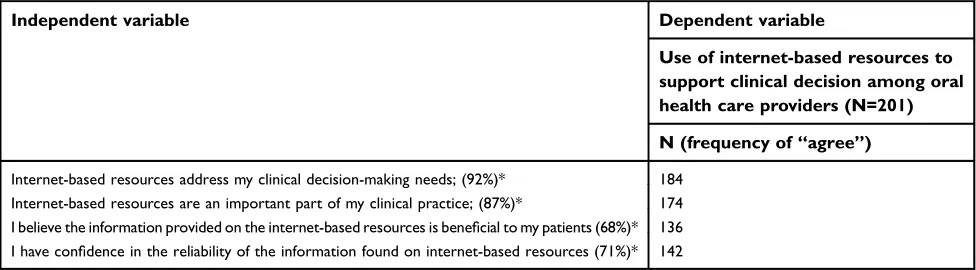
analyzed data is presented inTables 4 and5. A significant
association was found between the use of internet-based resources to address clinical decision-making needs.
Internet-based resources were also believed to be beneficial to patient
care (Table 5).
Usage of a smartphone application for
clinical decision-making amongst
respondents
Of the 201 respondents, 49.7% (N=100) agree that the use of a smartphone application for clinical decision making is
Table 3 Frequency and percentage distribution of other online resources used for making a clinical decision
Resources Yes, N (%) No, N (%)
YouTube 119 (60) 81 (40)
Google 161 (81) 39 (19)
Wikipedia 70 (35) 131 (65)
Yahoo search 33 (16) 168 (84)
Table 4Summarized data of attitude toward the use of online medical databases and resources
Attitude toward the use of online medical database Oral health care providers
Agree, N (%)
Disagree, N (%)
Neutral, N (%)
Internet-based resources address my clinical decision-making needs. 184 (92) 11 (5) 6 (3)
Internet-based resources are an important part of my clinical practice. 174 (87) 14 (7) 13 (6)
I believe the information provided on internet-based resources is beneficial to my patients. 136 (68) 9 (4) 56 (28)
I believe that having internet and computer in our dental services will facilitate proper use of online resources.
197 (98) 2 (1) 1 (1)
I have confidence in the reliability of the information found on internet-based resources. 142 (71) 27 (13) 32 (16)
Table 5Association between attitude and using internet-based resources for taking clinical decision support.
Independent variable Dependent variable
Use of internet-based resources to support clinical decision among oral health care providers (N=201)
N (frequency of“agree”)
Internet-based resources address my clinical decision-making needs; (92%)* 184
Internet-based resources are an important part of my clinical practice; (87%)* 174
I believe the information provided on the internet-based resources is beneficial to my patients (68%)* 136
I have confidence in the reliability of the information found on internet-based resources (71%)* 142
Note: *P-value <0.05
Advances in Medical Education and Practice downloaded from https://www.dovepress.com/ by 118.70.13.36 on 19-Aug-2020
useful, while 20.4% (N=41) disagree on the use of the smart-phone as a useful tool. The remaining 29% of the respondents
were neutral. Thefindings are summarized inTable 6.
List of frequently searched online
information amongst oral health care
providers
With regard to which information was most often searched for on line, 34.8% (N=70) of the respondents reported searching for clinical procedure information, while 24.8% (N=50) searched for drug prescription information and 5% (N=10) of respondents searched for information on drug
interaction (Table 7).
Distribution of use of internet resources
for clinical decision-making by gender
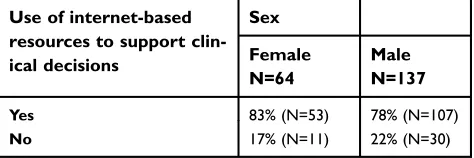
The relationship between sex and the use of internet-based resources during clinical decision-making process results show that 78% (N=107) of males among total male respondents (N=137) used internet-based resources to support their clinic decision, while 83% (N=53) of
females among 64 total female respondents used
internet-based resources to support their clinical
deci-sion (Table 8).
Discussion
The study results show that among the total 201 of oral health care provider respondents, 80% (N=160) were using internet-based resources to support their clinic decisions, while 20% (N=41) were not using online resources to make their clinic decisions. Our results show that 81% of oral health care providers were using Google as the main entry point for identifying online clinical decision-making tools during patient care and this is comparable to a recently published study that showed most of the health care providers utilized Google more often on a daily basis
as a supporting tool for making their clinical decisions.11
However the information found on this search engine should be carefully screened to ensure use of peer-reviewed sources.
There was insufficient knowledge amongst oral health
care providers related to the awareness of specific online
medical database for supporting clinical decision as we see that 94% of the respondents own a smartphone, but the
only 6% of respondents are aware of the specific mobile
applications that support clinical decisions. Increasing awareness of the utility of smartphone applications in accessing online medical databases is needed. This study reveals that in general, the oral health scare providers are willing to take advantage of the peer-reviewed online sources for information supporting their clinical decisions.
However, one of the negative findings is the use of
non-peer reviewed sites to inform clinical decisions.
Accurate and prompt decisions for diagnosis and treat-ment are necessary for optimal oral health care delivery.
Table 6Usage of smartphone applications for clinical decision making amongst the respondents
Oral health care providers
Use of smartphone applications for clinical decision-making processes
Agree N (%)
Disagree N (%) Neutral N (%)
Total N (%)
Total 100 (49.7) 41 (20.4) 60 (29.9) 201 (100.0)
Table 7Distribution of the information frequently search online amongst oral healthcare providers
Information frequently searched online
Diagnostic Drug prescription Drug adverse effects Clinical procedures Drug interactions
28 (13.9%)
50 (24.9%)
33 (16.4%)
70 (34.8%)
10 (5%)
Table 8 Distribution of participants by use of internet-based resources for clinical decision and gender
Use of internet-based resources to support clin-ical decisions
Sex
Female N=64
Male N=137
Yes 83% (N=53) 78% (N=107)
No 17% (N=11) 22% (N=30)
Advances in Medical Education and Practice downloaded from https://www.dovepress.com/ by 118.70.13.36 on 19-Aug-2020
Computerized clinical decision support systems (CDSS) have many features that could be of enormous help in dealing complicated or new situations. The effective use of online medical databases for CDSS can be utilized with only a minimal level of computer literacy. Web-based online CDSS applications such as Medscape are accessible via computer or smartphone to inform health care provi-ders about diagnostic investigations, drug dosing, drug interactions, and adverse effects, all of which are critical
in a clinical setting.12
Conclusion
In conclusion, in our study the majority of registered oral health care providers in Rwanda can retrieve online infor-mation through internet-based tools; however, an effort to encourage practitioners to refer to peer-reviewed sources is needed to ensure that practitioners are utilizing reliable, current and evidence-based information to manage their patients, by providing necessary care, ranging from
pre-ventive care13–15 to nutritional care16–22 to therapeutic
care.23–25 Organizing courses to inform the oral health
care providers about peer-reviewed online professional databases will increase the accuracy of their clinical deci-sion-making.
Study limitations
Study limitations: (1) anticipated problems and limitations included nonresponse, limited time for data collection, data analysis and logistical challenges related to lack of funding, transport problems and internet accessibility. To address these problems both online and hard copy ques-tionnaires were used to address internet connectivity issues. Dental health workers who refused to consent in this study were excluded. (2) Potential policy implication: the results reveal a need for more advanced education amongst Rwandan practitioners in resources and methods for evidence-based practice.
Acknowledgments
Doctors Hackely and Razzaque are faculties at the School of Dentistry at the University of Rwanda College of Medicine & Health Sciences through Rwanda Human Resources for Health (HRH) program in collaboration with Harvard School of Dental Medicine. The article pro-cessing charge of this manuscript is supported by the Lake Erie College of Osteopathic Medicine (LECOM).
Disclosure
The authors report no conflicts of interest in this work.
References
1. Del Fiol G, Workman TE, Gorman PN. Clinical questions raised by clinicians at the point of care: a systematic review.JAMA Intern Med. 2014;174(5):710–718. doi:10.1001/jamainternmed.2014.368 2. Chiu YW, Weng YH, Lo HL, et al. Physicians’characteristics in the
usage of online database: a representative nationwide survey of regional hospitals in Taiwan. Inform Health Soc Care. 2009;34 (3):127–135. doi:10.1080/17538150903102372
3. Bergeron B. Online medical databases.MedGenMed.2003;5(2):44. 4. Bertulis R. Barriers to accessing evidence-based information.Nurs
Stand.2008;22(36):35–39. doi:10.7748/ns2008.05.22.36.35.c6541 5. Westbrook JI, Gosling AS, Coiera E. Do clinicians use online
evi-dence to support patient care? A study of 55,000 clinicians. J Am Med Inform Assoc.2004;11(2):113–120. doi:10.1197/jamia.M1385 6. Patel R, Green W, Shahzad MW, Larkin C. Use of mobile clinical
decision support software by junior doctors at a UK Teaching Hospital: identification and evaluation of barriers to engagement. JMIR Mhealth Uhealth.2015;3(3):e80. doi:10.2196/mhealth.3949 7. Gund A, Lindecrantz K, Schaufelberger M, Patel H, Sjoqvist BA.
Attitudes among healthcare professionals towards ICT and home follow-up in chronic heart failure care. BMC Med Inform Decis Mak.2012;12:138. doi:10.1186/1472-6947-12-114
8. Sukums F, Mensah N, Mpembeni R, Kaltschmidt J, Haefeli WE, Blank A. Health workers’knowledge of and attitudes towards com-puter applications in rural African health facilities. Glob Health Action.2014;7(1):24534. doi:10.3402/gha.v7.25484
9. Bahammam MA, Linjawi AI. Knowledge, attitude, and barriers towards the use of evidence based practice among senior dental and medical students in western Saudi Arabia. Saudi Med J. 2014;35 (10):1250–1256.
10. Gupta SK, Nayak RP, Shivaranjani R, Vidyarthi SK. A questionnaire study on the knowledge, attitude, and the practice of pharmacovigi-lance among the healthcare professionals in a teaching hospital in South India.Perspect Clin Res.2015;6(1):45–52. doi:10.4103/2229-3485.148816
11. De Groote SL, Shultz M, Blecic DD. Information-seeking behavior and the use of online resources: a snapshot of current health sciences faculty.J Med Libr Assoc.2014;102(3):169–176. doi:10.3163/1536-5050.102.3.006
12. Sahota N, Lloyd R, Ramakrishna A, et al. Computerized clinical decision support systems for acute care management: a decision-maker-researcher partnership systematic review of effects on process of care and patient outcomes.Implement Sci.2011;6:91. doi:10.1186/1748-5908-6-91
13. Sams LD, Rozier RG, Quinonez RB. Training Requirements and. Curriculum content for primary care providers delivering preventive oral health services to children enrolled in medicaid. Fam Med. 2016;48(7):556–560.
14. Vamos CA, Quinonez R, Gaston A, Sinton J. Addressing early pre-ventive oral health care among young children: a pilot evaluation of the Baby Oral Health Program (bOHP) among dental professionals. J Dent Hyg.2014;88(4):202–212.
15. Kandelman D, Arpin S, Baez RJ, Baehni PC, Petersen PE. Oral health care systems in developing and developed countries.Periodontol 2000. 2012;60(1):98–109. doi:10.1111/j.1600-0757.2011.00427.x
16. Touger-Decker R, Mobley C. Academy of nutrition and dietetics. Position of the academy of nutrition and dietetics: oral health and nutrition. J Acad Nutr Diet. 2013;113(5):693–701. doi:10.1016/j. jand.2013.03.001
Advances in Medical Education and Practice downloaded from https://www.dovepress.com/ by 118.70.13.36 on 19-Aug-2020
17. Uwitonze AM, Murererehe J, Ineza MC, et al. Effects of vitamin D status on oral health. J Steroid Biochem Mol Biol. 2018;175:190–194. doi:10.1016/j.jsbmb.2017.01.020
18. Brown RB, Razzaque MS. Phosphate toxicity and tumorigenesis. Biochim Biophys Acta.2018;1869(2):303–309.
19. Uwitonze AM, Razzaque MS. Role of magnesium in vitamin D activation and function. J Am Osteopath Assoc. 2018;118 (3):181–189. doi:10.7556/jaoa.2018.037
20. Uwitonze AM, Uwambaye P, Isyagi M, et al. Periodontal diseases and adverse pregnancy outcomes: is there a role for vitamin D? J Steroid Biochem Mol Biol. 2018;180:65–72. doi:10.1016/j. jsbmb.2018.01.010
21. Goodson JM, Shi P, Razzaque MS. Dietary phosphorus enhances infl am-matory response: A study of human gingivitis.J Steroid Biochem Mol Biol.2019;188:166–171. doi:10.1016/j.jsbmb.2019.01.023
22. Goodson JM, Shi P, Mumena CH, Haq A, Razzaque MS. Dietary phosphorus burden increases cariogenesis independent of vitamin D uptake.J Steroid Biochem Mol Biol.2017;167:33–38. doi:10.1016/j. jsbmb.2016.10.006
23. Mallineni SK, Yiu CK. Dental treatment under general anesthesia for special-needs patients: analysis of the literature.J Investig Clin Dent. 2016;7(4):325–331. doi:10.1111/jicd.12174
24. Daher A, Abreu MH, Costa LR. Recognizing preschool children with primary teeth needing dental treatment because of caries-related toothache.Community Dent Oral Epidemiol. 2015;43(4):298–307. doi:10.1111/cdoe.12154
25. Velan E, Sheller B. Providing dental treatment for children in a hospital setting. Dent Clin North Am. 2013;57(1):163–173. doi:10.1016/j.cden.2012.09.003
Advances in Medical Education and Practice
Dove
press
Publish your work in this journal
Advances in Medical Education and Practice is an international, peer-reviewed, open access journal that aims to present and publish research on Medical Education covering medical, dental, nursing and allied health care professional education. The journal covers undergraduate education, postgraduate training and continuing medical education
including emerging trends and innovative models linking education, research, and health care services. The manuscript management system is completely online and includes a very quick and fair peer-review system. Visit http://www.dovepress.com/testimonials.php to read real quotes from published authors.
Submit your manuscript here:http://www.dovepress.com/advances-in-medical-education-and-practice-journal
Advances in Medical Education and Practice downloaded from https://www.dovepress.com/ by 118.70.13.36 on 19-Aug-2020