GA Based Spatial Time Scheduler for Reliable
Multicasting in Wireless Ad-hoc Network
A.P.Shanmugasundaram.,M.C.A., M.Phil. Karpagam University,
Pollachi Main Road, Eachanari Post, Coimbatore, Tamilnadu, India.
C.Chandrasekar.M.C.A., M.Phil.,Ph.D., Computer Science Department, Assistant Professor, Periyar University,
Salem, Tamilnadu, India.
Abstract- Wireless Ad-hoc network is one of the most innovative network technologies which are carried out using multicasting applications in various domains. Partially Observable Markov Decision Process (POMDP) provided higher structural security but did not provide multicasting packets in the wireless ad-hoc network. Works conducted on Resource Biasing Approach attained multi casting efficiency by increasing the level of throughput but the time scheduling process in the wireless ad-hoc network is not up to the performance grade. Resource Biasing Approach did not provide detailed investigation on multicasting route scheduling protocols in the wireless ad-hoc network. The nodes in Wireless ad hoc network with dynamic in nature communicate with each other causing the interference during the multi-casting process, so that the plan is to avoid the multi multi-casting interference using time scheduler and routing protocol. Spatial Time Scheduling Multiple Access (STSMA) Framework is proposed in this paper to perform the effective multicast scheduling in the wireless ad-hoc network. STSMA Framework is carried out in two steps. In the first step, the minimization of hop count is performed while packets are transferred through multicasting in the wireless ad-hoc network. The basic approach of STSMA Framework is to construct the time scheduler using the Resource Median Multicast Routing protocol for minimizing traffic during multicasting in wireless ad-hoc network. The minimization of hop count reduces the average data delay time. During the second step, Enhanced Genetic Algorithm (EGA) is formulated to decrease the multicasting computational complexity involved in wireless ad-hoc network. The demand of the users (i.e.,) traffic path are handled efficiently using STSMA Framework with EGA technique. EGA consider large number of population (i.e.,) traffic problems during multicasting and performs the selection, crossover, and mutation operations to effectively perform the spatial time scheduling. Packet loss rate is reduced up to 25 % in STSMA Framework during multicasting in wireless ad-hoc network. Simulation is carried with the multicast scheduling cost, average error rate, packet loss rate, and traffic control efficiency parameters.
Keywords: Enhanced Genetic Algorithm, Hop Count Minimization, Spatial Time Scheduler, Wireless Network, Multicasting Routing Protocol.
1. INTRODUCTION
Wireless Ad-hoc network has come out as one of the key enablers for different types of multicasting applications. In recent years the wireless ad-hoc networks have been a means of providing internet access to users in distant regions by extending the exposure of ground stations in multicast manner. Many wireless ad-hoc network applications such as scattered interactive model, router upgrading and distributed node replication necessitate effectual routing, time scheduling and data delivery schemes. These schemes are essential types for performing cluster communications in wireless ad-hoc network. In recent years, the common applicability of wireless ad-hoc communication has motivated the research on cluster based multicast routing. The wireless network does not possess a pre-organized infrastructure. Usually, the wireless nodes in wireless network proceed as the end system and routers at similar time with two states observed in wireless ad-hoc networks are the stationary and mobile. In stationary ad-hoc network, the transformation of packets is not transform from one position to another whereas in case of the mobile ad-hoc network, the transformation is performed based on the random positioning. As a result, the routing protocols are initiatedtoutilize information about the links during multicasting in wireless ad-hoc network.
Adaptive Beamforming System in [4] integrated feedback rate and coherence scheduling time for considerably increasing the robustness with channel dynamics during multicasting wireless ad-hoc network. Client specific SNR-rate mapping was integSNR-rated with the user scheduling optimization problem but failed to reduce the overall schedule length in wireless LAN. Resource Biasing Approach as depicted in [2] defined the wireless network service maximization problems. Mixed-bias strategies with maximization problem definition attain an advanced multicasting flow throughput profile and resourceful network utilization but detailed investigation was not performed on NUM based route time scheduling protocols. Probability-based Prediction and Sleep Scheduling protocol (PPSS) recover the energy efficiency in [19] with proactive wake up tasks. PPSS with distributed algorithm which executed on entity nodes, made PPSS scalable for large-scale WSN. But PPSS failed to optimize the sleep scheduling and target prediction on sudden transforms in sensor network. Robust Tracking (RT) algorithms and reasoning logics, as described in [5] performed multicasting operation on the WiMAX infrastructure. RT algorithm does not offer the effectual optimization outcome while communicating with the help of multicast routing in wireless ad-hoc network.
Multiple receiver transmission (MRT) and the Fast NAV truncation (FNT) as illustrated in [20] improved the receiver blocking problem which devoid of adopting additional control channels. The adaptive receiver transmission (ART) scheme enhanced the throughput performance with active alteration of the chosen receivers but failed to validate the effectiveness of the ART protocol. Energy-Efficient Multicasting as presented in [6] build burst broadcast schedules with reduced energy utilization. But the energy-efficient multicasting did not improve the excellence of scheduling experience on the majority of multicast subscribers in WiMAX networks. Optimal Peer-to-Peer Scheduling (OPPS) method as described in [3] with dynamic algorithm opportunistically extracted the packets from current neighbors. OPPS method attained significant throughput by wireless peering and node transmissions when the file availability probability was large. But the OPPS does not deal with the packet delay time scheduling problem in ad-hoc networks. Cross-Layer Scheduling as described in [7] aimed to shift the definite queue backlog into the practical backlogs. Control and scheduling algorithm ALG with multi-hop model stabilized the network but was not effective in power management and multicast scheduling policies in wireless ad-hoc network. Epidemic-based multicast method as presented in [14] dealt with the active and random topology changes due to mobility. Epidemic mechanism maintained the global view of the network by attaining the lower overhead. The variation of the node density reduced the performance of the system in ad-hoc network while performing the multicast operation. Multi Channel Scheduler as described in [11] performed the concatenation operation on the lesser load packets. The load packets were then placed into large frames and were then sent to similar channels. Similar channel carried out the intelligent channel selection among
intermediate nodes in wireless ad-hoc network. But the algorithm failed to decide the call admission on multicasting links according to the experiential information. The optimal scheduling carried out using Graph Theoretic optimization in [10] decided the admission procedures on multicasting links. Maximum Weighted Independent Set (MWIS) problem solved the channel interference in the wireless network but did not solved the multicasting traffic using genetic mathematical approach. Structural results method as shown in [1] resolved the continuous data transmission in a huge network with a mixture of wireless nodes. Structural results derived for the combined continuous user authentication and intrusion detection problem was not effectual in making the scheduling decisions. Existing Partially Observable Markov Decision Process (POMDP) provided higher structural security result but was not effective during multicasting the packets in the wireless ad-hoc network.
In this work, focus is made on developing the Spatial Time Scheduling Multiple Access Framework. The framework integrated the enhanced genetic algorithm with the multicasting scheduling operations and is demonstrated in two steps. In the first step, STSMA Framework develops the time scheduler for removing the multicasting traffic in wireless ad-hoc network. The wireless network uses the Resource Median Multicast Routing protocol for minimizing the hop count in the wireless ad-hoc network. In the second step, Enhanced Genetic Algorithm (EGA) is developed to decrease the multicasting computational complexity with a large number of population (i.e.,) traffic problems. Enhanced Genetic Algorithm in STSMA framework reduces the data delay time while multicasting the packets in wireless ad-hoc network and is significantly better in hop count minimization.
The structure of this paper is as follows. In Section 1, the basic problems of the multicast route scheduling protocols in wireless network is described. In Section 2, an overall framework of the Spatial Time Scheduling Multiple Access with Enhanced genetic Algorithm in multicasting wireless ad-hoc network is presented. Section 3 and 4 outline simulation results with parametric factors and present the result graph for research on multicasting wireless network scheduling policies. Finally, Section 5 demonstrates the related work and Section 6 concludes the work.
Spatial Time Scheduling Multiple Access Frameworks In Wireless Network
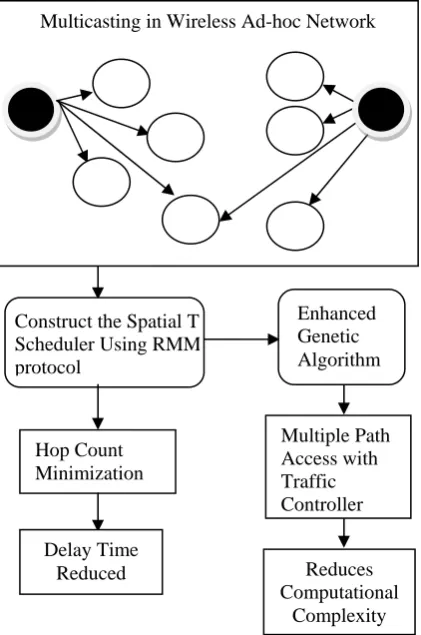
Fig 1 Architecture Diagram of STSMA Framework
As illustrated in Fig 1, the framework of STSMA reduces the delay time and computational complexity during multicasting in wireless ad-hoc network while performing the scheduling operations. The goal of STSMA Framework is to optimize multicasting network performance without any interference while developing the scheduling policies. The scheduling operation in the STSMA Framework is carried out in two steps.
During the initial step, STSMA framework constructs optimal time scheduler for the effective multicasting and routing in wireless-ad-hoc network. The time scheduler schedules the packets using Resource Median Multicast Routing protocol in wireless ad-hoc network. The routing easily multicast the information to the different destination addresses within the scheduled time. As a result the average error rate is reduced in STSMA Framework. Spatial Time Scheduler also minimizes the hop count for easy multicasting of data packets in wireless ad-hoc network.In the second step of the STSMA Framework, Enhanced Genetic Algorithm is designed to access the different population (i.e.,) destination address of packets. The scheduling policies reduce the traffic occurrence on the multicasting using the genetic properties. The spatial time scheduler easily transfers the data packets to the multicasting destination address with minimal computational complexity. Enhanced Genetic Algorithms significantly extend the work by formulation of the mathematical programming approach with the population, selection, crossover and mutation operations. The genetic
operations in the STSMA Framework improve the multicasting efficiency in the wireless ad-hoc network. 1.1 Construction of Multicasting Spatial Time
Scheduler
In Spatial Time Scheduler, the basic work is to schedule the multicasting routing system without any traffic in wireless ad-hoc network. The routing system taken for the multicasting spatial time scheduling is Resource Median Multicast Routing. The Resource Median Multicast Routing in wireless ad-hoc network easily reduces the average error rate while multicasting the information to different destination addresses. Resource Median Multicast routing mainly group the communication based on the resources to achieve throughput, greater efficiency and concurrence in wireless ad-hoc network.
The schedule queue length is reduced in Multicasting Spatial Time Scheduler. As a result the average error rate is reduced. Spatial Time Scheduler in STSMA Framework consists of a collection of ‘N’ nodes in the wireless ad-hoc network. For easy scheduling of the packets, the transmission of the packet to different destination addresses is performed through the intermediate node ‘ ’, ’ ’ …….. ’. Spatial time Scheduler is computed as,
ℎ =
, …. ∗ , , … ( , , … … . . ) ….Eqn (1) Where is the spatial time taken to transfer the packets from the source‘s’ to the destination ‘d’. The different destination addresses in the wireless ad-hoc network are denoted as d1, d2, d3…dn. is the distance travelled from the source to destination using the intermediate nodes. In the wireless ad-hoc network environment, the probability of a packet transferring is performed with different destination addresses from the source point. In STSMA Framework, the delay time is controlled by scheduling only the multicast links using the spatial time slot. The steps involved during the spatial time scheduling are represented in Fig 2.
Fig 2 Spatial Time Scheduler
Spatial Time Scheduler in Fig 2 takes the unassigned task for the process. The unassigned task is allotted based on the load size to different spatial time options. The spatial time options are used to allocate the packets for multicasting through different destination addresses. The packets are transmitted to the different destination by reducing the hop
Unassigned task (Packets
)
Spatial Time Scheduler
Spatial Time Options
Assigns task with spatial Time Slot
Construct the Spatial T Scheduler Using RMM protocol
Hop Count Minimization
Enhanced Genetic Algorithm
Multiple Path Access with Traffic Controller
Delay Time
Reduced Reduces
count in the wireless ad-hoc network through the spatial time slot. For the set of Multicast Link ‘ML’, result is computed as,
ℾ, , , ,… =
. …. ∗ , , … ( , , …….. )
∑∀ ∈ , , … . …. ∗ , , … ( , , …….. )= …… Eqn (2)
Eqn (2) used to compute the interference free result while multicasting in wireless ad-hoc network. is the threshold value predefined to perform effective time scheduling without any delay in wireless ad-hoc network. is used as an exactness for time scheduling while multicasting the information from the source to the destination. The source and the multicast nodes are connected and spatial time scheduler is formulated for the successful transmission without any interference in wireless ad-hoc network. The interference free result is obtained and it is used to compute the traffic rate during the multicasting of packets from the source to the destination in wireless ad-hoc network. In STSMA multicasting, the Resource Median Multicast
Routing (RMMR) algorithm indicates the effective multicasting linking in wireless ad-hoc network with channel state information. The average traffic load in multicasting is analyzed using , , , .. .
, , , .. = ∑∀ ∈ , , … ( )= ( ) , , , … ……Eqn (3)
Using Eqn (3) the traffic is reduced from the source to the different destination addresses in the wireless ad-hoc network. , , , … Perform routing through the multicast links and computation is shown in Eqn (4)
, , , … = ∑ , 1, 2, 3 … …….Eqn (4) In STSMA framework, route selection provides the strong structural results on the performance of wireless ad-hoc network. The route selection in STSMA framework provides lesser computational complexity on multicasting in the wireless ad-hoc network.
1.1.1 Spatial Time Slot
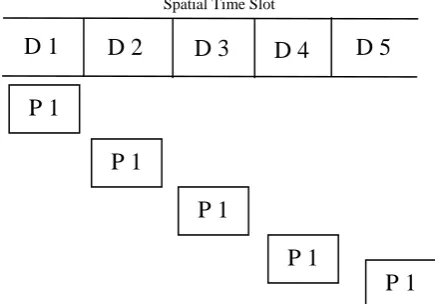
Spatial Time Slot in STSMA framework, minimize the hops count while multicasting the information in the wireless ad-hoc network. The spatial time slot is represented as,
Spatial Time Slot
Fig 3 Spatial Time Slot based Packet Multicasting
Spatial Time Slot varies for the different destination address. The destination node distance varies while packet transfers through multicasting. The slotted area shows the distance between each destination node and hop count minimization in spatial time scheduler reduces the delay time in wireless ad-hoc network.
1.2 Enhanced Genetic Algorithm for Multicast Traffic Controlling
Enhanced Genetic Algorithm in STSMA framework is used to effectively perform the routing and multicasting in wireless ad-hoc network. Enhanced Genetic Algorithm initially generates the population (i.e.,) multicast routing paths in the wireless ad-hoc network. After the generation of population, spatial time scheduler provides feasible solution with minimal delay time.
1.2.1 Selection
EGA based STSMA framework selects the subset of a routing (i.e.,) population by generating offspring for the next generation. The enhanced genetic algorithm form of selection is based on ranking all nodes of the population according to their robustness in wireless ad-hoc network. The robust nodes are allowed to performed in order to create new nodes for the next generation, whereas the least fit individuals are removed from the routing (i.e., hop count minimization).
1.2.2 Crossover
EGA based STSMA framework performs the crossover operation in wireless ad-hoc network from the set of selected nodes during multicasting. STSMA framework ensures that the routing path and time slots are scheduled to the same threshold value in the wireless ad-hoc network (as described in Eqn (2)). The enhanced genetic algorithm schedules the time slot for effective multicasting link formation in wireless ad-hoc network.
1.2.3 Mutation
EGA based STSMA framework introduce small logical variations to remove the traffic occurrence on the multicasting path in the wireless ad-hoc network. Mutation operation provides the granularity result by logical change in the spatial time slot options. EGA mutation operation leads to an improvement in multicasting by reducing the complexity issue in wireless ad-hoc network.
The algorithmic step description of STSMA framework is defined as,
Input: Wireless network nodes ‘N’ with multicasting route path
Output: Minimal Delay time, Computational Complexity, Hop Count Minimization
//Spatial Time Scheduler
Step 1: Unassigned Task ‘P1’,’P2’, ‘P3’…’Pn’
Step 2: RMMR protocol constructs routing , , , … =
∑ , 1, 2, 3 …
Step 2.1: Based on the resource constraints
Step 3: Spatial Time Scheduler
. …. ∗ , , … ( , , … … . . )
Step 3.1: Based on the spatial time options //Enhanced Genetic Algorithm
Step 4: Selection: Generate offspring to select the route
P 1
P 1
P 1
P 1
P 1
Ste 5: Crossover: Alternate route path chosen from the wireless network to reduce hop count
Step 6: Mutation: Logical variations to remove the traffic occurrence while multicasting
More precisely, the STSMA framework initialized with a valid routing and the subsequent operations ensures minimal computational complexity. A valid routing in EGA defines a list of multiple intermediate link nodes with the flow’s source and ending with the multicasting destination paths in wireless ad-hoc network. The genetic operations are efficiently implemented in the time scheduler process to easily achieve the multicasting in wireless ad-hoc network.
2. EXPERIMENTAL EVALUATION OF STSMA
FRAMEWORK
Spatial Time Scheduling Multiple Access (STSMA) Framework in Wireless Ad-hoc Network is experimented using the ns-2 network simulator. The ns2 simulator uses random surrounding data path of 1000 ×1200 size with approximately 100 neighboring wireless nodes. The wireless nodes hold 20 simulation milliseconds. The wireless networks continue there for an effective detection of intrusions with qualitative performance. In the Random Way Point (RWM) model, each wireless node shift to an erratically chosen location. The RWM uses standard number of wireless nodes for multi path transmission. The chosen location with a randomly selected speed consists of a predefined amount and speed count.
Spatial Time Scheduling Multiple Access (STSMA) Framework randomly selected the position with a predefined speed. The random progression is constant during the simulation period of the wireless sensor network. Distance Vector Routing (DSR) is performed in wireless network with predefined information. The packet size of 500 Kilo bits per second (Kbps) and movement of wireless node is about 5 Bytes per unit time. Transmission speed of packet is measured in 2.0 milliseconds (ms). Simulation work is carried out with the factors such as traffic control efficiency, scheduling cost, average error rate, packet loss rate, throughput, and delay time.
Traffic Control Efficiency in STSMA Framework defines the amount of traffic minimized while multicasting the information from the source to the different destination address in wireless ad-hoc network. Traffic Control effectiveness are measured in terms of percentage (%). Scheduling cost is measured in terms of milliseconds, where it defines the amount of time taken to perform the spatial time scheduler. The time consumption is used to easily measure the spatial scheduler cost and it is measured in terms of milliseconds (ms).
Average error rate defines as the mean complete accuracy achieved by removing the error while multicasting the information from source to destination in wireless ad-hoc network. The wireless ad-hoc network easily achieved the result without error percentage using the EGA technique.
= .
Packet Loss Rate is defined as the amount of packet transferred to the multicast paths from the source address in wireless ad-hoc network. The packet loss is reduced in the STSMA Framework and it is computed as
= .
.
For instance, 50 packets are transferred in the multicast path, in which the 49 packets delivered to different destination address but the 1 packet loss take place while transferring in the wireless ad-hoc network. The percentage of packet loss rate is about 2 % in simulation results. Network throughput is defined as the average delivers of packets from the source to the different destination paths in wireless ad-hoc network. Network throughput is measured in terms of Kilo bits per second (Kbps). Delay time is the amount of time elapsed while performing the spatial time scheduler for the multicasting operation in the wireless ad-hoc network.
=
TT is the Threshold Time RT is the Received Time
The threshold time is fixed for the each transfer of packet through multicasting and received time is the amount of time it reached the destination address. These computation results is used to easily predict the delay time and measured in terms of seconds (sec).
3. RESULT ANALYSIS
STSMA Framework performs the simulation and the result is compared with the existing Partially Observable Markov Decision Process (POMDP) and Resource Biasing Approach (RBA). STSMA Framework compares the simulation result through the table and graph on the factors such as traffic control efficiency, scheduling cost, average error rate, packet loss rate, throughput, and delay time.
Traffic Queue Length (meter)
Traffic Control Efficiency (%)
POMDP RBA STSMA
Framework
3 73 82 91 6 79 83 92 9 76 86 95 12 80 87 93 15 79 85 92 18 82 88 95 21 84 89 98
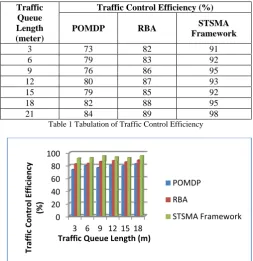
Table 1 Tabulation of Traffic Control Efficiency
Fig 4 Performance of Traffic Control Efficiency
0 20 40 60 80 100
3 6 9 12 15 18
Traffic Co
n
tro
l Efficie
n
cy
(%)
Traffic Queue Length (m)
POMDP
RBA
Table 1 and Fig 4 illustrate the traffic control efficiency based on the traffic queue length. The queue length is measured in terms of meter (m). The interference free result is obtained with the effective controlling of traffic in wireless ad-hoc network with the help of the results of Eqn (3). , , , .. indicates the effective multicasting by minimizing the traffic in wireless adhoc network with 15 -25 % improved traffic control efficiency in POMDP [1] and 6 - 10 % improved when compared with the RBA [2].
No. of packets
Scheduling Cost (Measured in terms of milliseconds)
POMDP RBA STSMA
Framework 10 0.30 0.28 0.26 20 0.33 0.29 0.27 30 0.39 0.33 0.31 40 0.33 0.40 0.39 50 0.42 0.42 0.38 60 0.45 0.40 0.37 70 0.49 0.41 0.39
Table 2 Tabulation of Scheduling Cost
Fig 5 Measure of Scheduling Cost
Fig 5 measures the scheduling time in terms of seconds in the wireless ad-hoc network. Scheduling cost is reduced by assigning the task based on the load size to different scheduler options. Spatial time options is used to allocate the packets for multicasting through different destination address and as a result reduces the scheduling cost by 9 – 20 % when compared with the POMDP [1]. The packets are transmitted to the different destination by reducing the cost in the wireless ad-hoc network with the help of the spatial time slot and 2 – 10 % reduced when compared with the RBA [2].
No. of nodes
Average Error Rate (Error %)
POMDP RBA STSMA
Framework
10 0.10 0.09 0.08
20 0.15 0.14 0.12
30 0.22 0.22 0.18
40 0.25 0.24 0.22
50 0.20 0.17 0.15
60 0.25 0.22 0.19
70 0.28 0.25 0.22
80 0.30 0.28 0.25
90 0.31 0.27 0.24
100 0.31 0.25 0.23 Table 3 Tabulation of Average Error Rate
Fig 6 Measure of Average Error Rate
Fig 6 describes the average error rate based on the node count. The time scheduler schedules the packets using the Resource Median Multicast Routing protocol in wireless ad-hoc network, so that the error rate (i.e.,) computational complexity is reduced by 12 – 25 % when compared with the POMDP [1]. The routing easily multicast the information to the different destination addresses within the scheduled time, so that that
the average error rate is reduced in STSMA Framework by 8 – 22 % when compared with the RBA.
Send Packet
Count
Packet Loss Rate (Loss %)
POMDP RBA STSMA
Framework 50 2.65 2.25 2 100 7.12 6.25 5.3 150 10.12 9.12 8.56 200 15.12 13.23 12.12 250 22.01 20.05 18.45
300 20.45 17 15.74
350 25.2 18.85 20 Table 4 Tabulation of Packet Loss Rate
Fig 7 Packet Loss Rate Measure
Fig 7 describes the packet loss rate based on the packet count sent from the source to the different destination address in the wireless ad-hoc network. Mutation operation in the EGA technique operation provides granularity result by logical change in the spatial time slot options, so that the packet loss rate is reduced. The packet loss rate is reduced from 15 - 25 % when compared with the POMDP [1] and 6 -15% in STSMA Framework when compared with the RBA [2].
0 0.1 0.2 0.3
10 20 30 40 50 60 70
Scheduling Cost
(ms)
No.of packets
POMDP
RBA
STSMA Framework
0 0.1 0.2 0.3 0.4
10 30 50 70 90
Ave
rage
Error
Rate
(Error
%)
No.of nodes
POMDP
RBA
STSMA Framework
0 10 20 30
50
100 150 200 250 300
350
Packet Loss Rate
(Loss %)
Send Packet Count
POMDP
RBA
Packet Size (KB)
Throughput (Kbps)
POMDP RBA STSMA
Framework
15 1273 1372 1486
30 1354 1484 1577
45 1474 1571 1791
60 1368 1539 1743
75 1579 1648 1863
90 1882 1990 2092
105 1783 1891 1995
120 2083 2152 2277
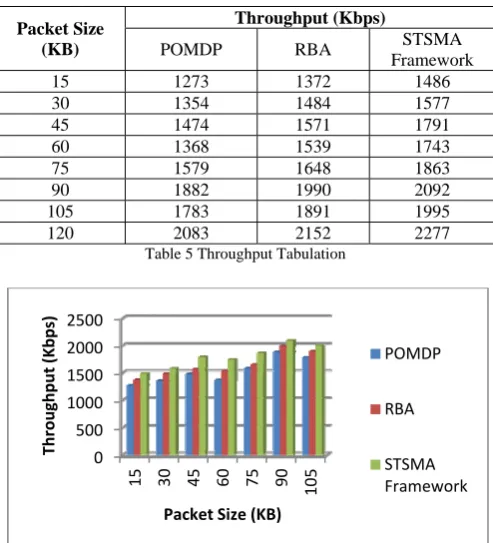
Table 5 Throughput Tabulation
Fig 8 Throughput Measure
Fig 8 measures the throughput based on the packet size. The packet size is measured in terms of Kilo Bytes (KB). The Enhanced Genetic Algorithm initially generates the population (i.e.,) multicast routing paths in the wireless ad-hoc network with the selection, crossover, and mutation operations. The implementation of these operations in EGA improves the throughput from 11 – 27 % when compared with the POMDP [1]. After the generation of population, spatial time scheduler provides the feasible solution with the 5 – 14 % improved throughput when compared with the RBA [2].
Threshold value of packets (p)
Delay Time (sec)
POMDP RBA STSMA
Framework
5.5 (50 p) 59 55 49
10.5 (100 p) 54 52 47
15.5 (150 p) 55 50 48
20.5 (200 p) 50 48 45
25.5 (250 p) 43 40 37
30.5 (300 p) 42 39 35
35.5 (350 p) 40 37 33
Table 6 Tabulation for Delay Time
Fig. 9 Delay Time Measure
Fig 9 describes the delay time based on the threshold value of the packets in the wireless ad-hoc network. In STSMA Framework, delay time is controlled by scheduling only the multicast links in the spatial time slot. Multicast Link improves the probability of packet transferring with different destination address from the source points. Eqn (2) with the threshold value is used to compute the time taken for the spatial time scheduler. The delay time is reduced up to 10 – 17 % when compared with the POMDP [1] and 4 – 10 % reduced when compared to the RBA [2].
Finally, Enhanced Genetic Algorithm (EGA) is developed to decrease the multicasting computational complexity in wireless sensor network. STSMA framework reduces the multicasting delay time while performing the spatial time scheduling process in the wireless ad-hoc network.
4. RELATED WORK
Delay-based Back-Pressure Scheduling in wireless network as demonstrated in [13] resolved the packet transferring problem by scheduling the link. The scheduler link is based on the encountered packet delay. Extremely long delays occurred by assured flows from source to destination with the help of queue-based scheduling schemes without any loss of throughput. An online algorithm as described in [17] was designed to make the best use of the minimum normalizes tail probability in wireless ad-hoc network. The scheduler longer is memory less, but the transmission rates make the scheduling decision with less success ratio. Probabilistic Delta Consistency (PDC) as demonstrated in [9] provided the flexibility on wireless ad-hoc network when compared to the existing reliability scheduling models. The reliability model covered all type of cases in wireless network. But PDC failed to satisfy heterogeneous consistency requirements of diverse form of multicasting and enable cooperation in the midst of caching nodes for successful broadcasting of data updates. Polynomial pool-based key pre-distribution scheme as illustrated in [18] created a pair wise key with the mobile sink. A pair wise key with the mobile sink performed better in terms of network resilience but did not performed multicasting in sensor network.
CSMA-CA scheduling achieved rate region in wireless network by deriving the neighborhood topology which yielded the worst case throughput ratio [15]. The collisions observed at the max-min allocation results were determined with the max-min fair rate point. Data Center Networks (DCN) presented the significant insights in [12] to handle the different transmission problem in wireless ad-hoc network. DCN contains the traffic while performing the service deployment and load balancing strategies. Network traffic management covered the breadth of approaches which solved the traffic management problems.
5. CONCLUSION
Spatial Time Scheduling Multiple Accesses (STSMA) combined the routing and multicasting operation together using the Enhanced Genetic Algorithm to reduce the minimal complexity. STSMA Framework performs the effective multicasting in wireless ad-hoc network. The 0
500 1000 1500 2000 2500
15 30 45 60 75 90 105
Th
roughput (Kbps)
Packet Size (KB)
POMDP
RBA
STSMA Framework
0 10 20 30 40 50 60
5.
5 (50
p)
10.
5 (100
p)
15.
5 (150
p)
20.
5 (200
p)
25.
5 (250
p)
30.
5 (300
p)
35.
5 (350
p)
Delay Time
(sec)
Threshold Value of packets (p)
POMDP
RBA
spatial time scheduler constructed with the RMMR protocol minimize the hop count and reduces the delay time. The time taken for multicasting is reduced using the STSMA Framework with EGA. EGA performs the selection, crossover, and mutation operations to improve the performance and control the traffic on the multicasting path. The algorithm presented for the STSMA framework performed routing and time scheduling iteratively in order to improve the performance. STSMA Framework reduced the multicast scheduling cost up to 6.357 % when compared with the POMDP and averagely 8.477 % minimal delay time. A significant improvement of up to 27% in STSMA throughput was observed in the simulation examples with different node count.
REFERENCES
[1] Shengrong Bu., F. Richard Yu., Xiaoping P. Liu., and Helen Tang., “Structural Results for Combined Continuous User Authentication and Intrusion Detection in High Security Mobile Ad-Hoc Networks,” IEEE TRANSACTIONS ON WIRELESS COMMUNICATIONS, VOL. 10, NO. 9, SEPTEMBER 2011
[2] Sumit Singh., Upamanyu Madhow., Elizabeth M. Belding., “Shaping Throughput Profiles in Multihop Wireless Networks: A Resource Biasing Approach,” IEEE Transactions on Mobile Computing, Volume:11 , Issue: 3 , 2012
[3] Michael J. Neely., “Optimal Peer-to-Peer Scheduling for Mobile Wireless Networks with Redundantly Distributed Data,” IEEE TRANSACTIONS ON MOBILE COMPUTING, 2013
[4] Ehsan Aryafar., Mohammad (Amir) Khojastepour., Karthikeyan Sundaresan., Sampath Rangarajan.,, and Edward W. Knightly., “ADAM: An Adaptive Beamforming System for Multicasting in Wireless LANs,” IEEE/ACM Transactions on Networking, (Volume:21 , Issue: 5 )., 2013
[5] Hsu-Yung Cheng., Victor Gau., Chih-Wei Huang., Jenq-Neng Hwang., “Advanced formation and delivery of traffic information in intelligent transportation systems,” Expert Systems with Applications., Elsevier journal., 2012
[6] Somsubhra Sharangi., Ramesh Krishnamurti., and Mohamed Hefeeda., “Energy-Efficient Multicasting of Scalable Video Streams Over WiMAX Networks,” IEEE TRANSACTIONS ON MULTIMEDIA, VOL. 13, NO. 1, FEBRUARY 2011
[7] Dongyue Xue., Eylem Ekici., “Delay-Guaranteed Cross-Layer Scheduling in Multi-Hop Wireless Networks,” arXiv:1009.4954v2 [cs.IT] 25 Jan 2011
[8] Dharmendra Sutariya., and Pariza Kamboj., “Survey of QOS Multicast Routing Protocol for MANET,” International Conference on Emerging Result in Computing, Information and Communication, Elsevier Journal., 2013
[9] Yu Huang., Jiannong Cao., Beihong Jin., Xianping Tao., Jian Lu., and Yulin Feng., “Flexible Cache Consistency Maintenance over Wireless Ad Hoc Networks,” IEEE TRANSACTIONS ON PARALLEL AND DISTRIBUTED SYSTEMS, VOL. 21, NO. 8, AUGUST 2010
[10] Peng Wang., Stephan Bohacek., “Practical Computation of Optimal Schedules in Multihop Wireless Networks,” IEEE/ACM TRANSACTIONS ON NETWORKING, VOL. 19, NO. 2, APRIL 2011
[11] Wei-Chih Hong., and Zsehong Tsai., “A Multichannel Scheduler for High-Speed Wireless Backhaul Links with Packet Concatenation,” IEEE TRANSACTIONS ON MOBILE COMPUTING, VOL. 9, NO. 2, FEBRUARY 2010
[12] Kashif Bilal., Saif Ur Rehman Malik., Osman Khalid., Abdul Hameed., Enrique Alvarez., Vidura Wijaysekara., Rizwana Irfan., Sarjan Shrestha., Debjyoti Dwivedy., Mazhar Ali., Usman Shahid Khan., Assad Abbas., Nauman Jalil., Samee U. Khan., “A taxonomy and survey on Green Data Center Networks,” Future Generation Computer Systems., Elsevier Journal., 2012
[13] Bo Ji., Changhee Joo., and Ness B. Shroff., “Delay-Based Back-Pressure Scheduling in Multihop Wireless Networks,” arXiv:1011.5674v3 [cs.NI] 7 Nov 2012
[14] Oznur Ozkasap., Zulkuf Genc., Emre Atsan., “Epidemic-based reliable and adaptive multicast for mobile ad hoc networks,” Computer Networks., Elsevier Journal., 2009
[15] Apoorva Jindal., Konstantinos Psounis., “On the Efficiency of CSMA-CA scheduling in Wireless Multi-hop Networks,” IEEE/ACM TRANSACTIONS ON NETWORKING, 2013
[16] K.Srinivasa Rao., 2R.Sudhistna Kumar., P. Venkatesh., R.V.Sivaram Naidu.,and A.Ramesh., “Development of Energy Efficient and Reliable Congestion Control Protocol for Multicasting in Mobile Ad-hoc Networks compare with AODV Based on Receivers,” International Journal of Engineering Research and Applications (IJERA)., 2012
[17] Na Chen., and Scott Jordan., “Downlink Scheduling with Guarantees on the Probability of Short-Term Throughput,” IEEE TRANSACTIONS ON WIRELESS COMMUNICATIONS, VOL. 8, NO. 2, FEBRUARY 2009
[18] Amar Rasheed., and Rabi N. Mahapatra., “Key Pre distribution Schemes for Establishing Pairwise Keys with a Mobile Sink in Sensor Networks,” IEEE TRANSACTIONS ON PARALLEL AND DISTRIBUTED SYSTEMS, VOL. 22, NO. 1, JANUARY 2011 [19] Bo Jiang., Binoy Ravindran., and Hyeonjoong Cho.,
“Probability-Based Prediction and Sleep Scheduling for Energy-Efficient Target Tracking in Sensor Networks,”IEEE TRANSACTIONS ON MOBILE COMPUTING, VOL. 12, NO. 4, APRIL 2013 735 [20] Kai-Ten Feng., Jia-Shi Lin., and Wei-Neng Lei., “Design and