Optimal Resource Allocation Strategy Using
Energy Efficient Optimized Clustering With
Genetic Optimization In Cooperative CRN’s
.
Rohini Vashisth1, Dr. Vinit Grewal2 12
ECE, Guru Nanak Dev University Regional Campus Jalandhar
Abstract-Now we are in the era of 4G technologies but as per the advancement in technology the expectations of users from the network increased resulting available unlicensed radio spectrum crowded day by day. As a result the usages of unlicensed spectrum are increased and On the other hand the licensed spectrums are underutilized results in spectrum scarcity. So the cognitive radio is the technique which intelligently senses the environment and gives the opportunity to the unlicensed users to access the licensed band under some conditions. The one of the main target in cognitive radio is to sense the environment and to find the spectrum hole known as spectrum sensing. The energy consumption is the main factor when we consider the spectrum sensing in the cognitive radio because the cognitive radios are basically low power sensors. There are two types of spectrum sensing i.e. non cooperative and cooperative. In the non cooperative spectrum sensing scheme the energy consumption is more as that of cooperative spectrum sensing technique because it generates the result by cooperating all other local sensing nodes. In this research main aim is to design energy efficient spectrum sensing algorithms keeping in mind the end goal to limit the maximum energy consumption. For this we design optimal clustering by using an artificial intelligence like genetic algorithm which is one of the inspired techniques by evolutionary and biological behavior. In our model the cluster heads are re-established in each round so that the load is well distributed among all the nodes of the network resulting energy efficiency and increased lifetime of the network.
Index Terms- Cognitive Radio, Genetic algorithm,
spectrum sensing.
I. INTRODUCTION
Now a day the expectations of users from the wireless communication network increased dramatically. As it is seen that the number of personal gadgets increased per person from one to many so the requirement of more and more radio spectrum needed. Every user wants more and more applications, higher data rate, higher capacity and higher mobility for their portable devices. The part of spectrum used for all these future potential applications are already very highly utilized resulting spectrum scarcity. According to the estimations provided by different countries demonstrates that the 5% to 50% part of the radio spectrum is not used efficiently by allocated users. This inefficiency results comes about because of static spectrum allocations, fixed radio functions, rigid regulations and limited network coordination. To fulfill this requirement of the radio spectrum there is the need to use the spectrum
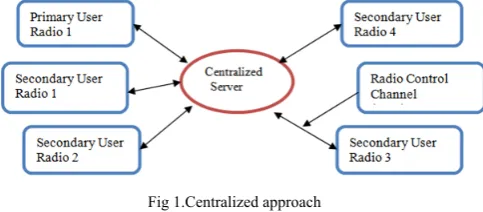
approach. For this we design optimal clustering by using an artificial intelligence like genetic algorithm which is one of the inspired techniques by evolutionary and biological behavior. Cognitive radio cooperative spectrum sensing happens when there may be the sharing of the detected information picked up by the cognitive radios in the cognitive radio network. This process gives a superior picture of the range utilization over the area where the cognitive radios are found. The centralized and distributed are the two strategies followed by the cooperative spectrum sensing. Within the centralized approach there's a master node in the network of nodes. Every one of the nodes sends their information to this master node. At this point master node analyze the information and decide if the spectrum is in use or not. Alternatively in the distributed technique the control of the cluster does not depend upon one single node. All the different nodes are able to share sensed information with each other and take decisions on behalf of that sensed information.
Fig 1.Centralized approach
II. RELATED WORK
Cognitive radio research is mainly due to the dramatically increased expectations of users from wireless communication networks. This work is stimulated by means of the FCC Report and Order allowing the operation of networks along with low-power devices and sensors in the VHF-UHF band as well as by means of the IEEE 802.22 group regulating the dynamic spectrum get access for TV bands and wireless microphones. The Joseph Mitola first proposed this concept of cognitive radio in a seminar at KTH in 1998 and published in article Mitola et.al 1999. The need of this concept arise because every user wants more and more applications, higher data rate, higher capacity and higher mobility for their portable devices and each of them have more than one device along with them. So all these future potential applications need more spectrums which is very crucial task now a days because the part of spectrum used for all these applications are already very highly utilized resulting spectrum scarcity. Due to this reason cognitive radio is one of the emerging technology and many researchers are working in the field of it so that the spectrum will used efficiently and overcome from the problem of spectrum scarcity. Although this concept has emerged primarily to enhance spectrum utilization, the importance of energy consumption poses new challenges, because energy efficiency and communication performance can be at odds. As cognitive radios are basically low power sensors So there are number of researchers work on the energy efficiency techniques for the networks of cognitive radio. The challenges of energy
efficiency in cognitive radio network [2]. The usage of history to help achieve energy efficient spectrum sensing in infrastructure cognitive radio networks is focused by [13]. The scheme employs an iteratively developed history processing database which is used by cognitive radios to make decision about spectrum sensing, subsequently resulting into reduced spectrum scanning and improved energy efficiency. The key objectives for allotted or distributed spectrum sensing in cognitive sensor networks are the Reliability and energy consumption in detection [10]. They proposed joint sleeping and censoring scheme as an energy efficient spectrum sensing technique in light of the fact that in conventional distributed sensing approaches, in spite of the fact that the detection performance improves with the number of radios, but the energy consumption is more in network. So the target of proposed plan is to minimize the energy consumed in distributed sensing subject to constraints on the detection performance, through optimally choosing the sleeping and censoring design parameters. The different techniques have been analyzed to improve the energy efficiency of CRNs [8]. To deal with the Energy Efficient optimization problem with multiple interference power constraint the Water filling factors aided search method is used. The issue of resource allocation optimization for a single-cell multiuser cognitive radio network within the presence of primary user networks [14]. The authors addressed two particular challenges i.e. the incorporation of primary user activity in the design of resource allocation technique and the restricted hardware capabilities of cognitive terminals in comparison with these available at the cognitive base station. So author proposed a novel resource allocation framework based on bandwidth power product minimization.
III.PROPOSED WORK
Based on the literature survey proposed objective is to deploy an energy efficient spectrum sensing using optimum hierarchical clustering method in which the cluster head selection probability is computed by using genetic algorithm optimization. As a result the network life time and energy is increased.
The implementation of objectives entitled in this work will be implemented using Multi-User Multi-Relay DF Cognitive Radio Network system model with M Intermediate users (IUs) that act as nearby detecting gadgets are thought to be organised into clusters, the place every cluster has a cluster head that settles a cluster decision based on the local decisions received from its cluster members and report the outcome to the cognitive base station that acts as a fusion centre FC by way of the secondary user.
the point, When the energy of the received signal show that the primary user is available, which will portrayed by exist hypothesis H1, otherwise, the primary user is absent, which will be represented by null hypothesis H0.
The framework structure of a cognitive radio network according to clustering process is illustrated in Fig 2.
Fig 2.Cluster-based cooperative spectrum sensing [16]
In this scheme the following assumptions are made: 1. First, all IRs are grouped into clusters utilizing our
intelligent genetic algorithm and energy distribution based protocol, which proposed for cognitive radio network. This protocol provides an efficient clustering arrangement algorithm, wherein the cluster heads CHs are chosen by way of the proposed scheme in centralized and intelligent way, with minimization of data transmission energy between a CH and other members in a cluster, as per the best reporting channel gain and the energy level of the IUs.
2. Second, the CRN topology is stable and consists of one fusion centre FC, one primary transmitter and M of Intermediate users IUs and N Secondary users SUs. The FC has the area information of all CRs, potentially decided utilizing global Positioning method (GPS). The instantaneous channel state information of the reporting channel is available on the CRs. The channel between any two IUs in the equal cluster is excellent in view that they are nearly every different.
Procedure of cluster-centered spectrum sensing algorithm 1. IUj in cluster i conducts spectrum sensing exclusively
and settles a neighborhood choice i.e. local decision Dij for i =1,…,K , j =1,…,Ni , where K is the quantity
of =∑Mi , where M is the complete number of IUs
clusters, N is the quantity of SUs in cluster i and in the
network.
2. Then, just the IUij that has a nearby double choice will report its outcomes to the CHi to settle on a cluster decision Ci based on OR-rule information combining strategy, otherwise no reporting decision is taken. 3. Finally, all the CHsi for i = 1,2,… .,K that have a
group choice Ci = 1 are permitted to send their outcomes to FC and after that a ultimate conclusion F is made by a FC utilizing OR-govern, as
On the off chance that no cluster decision is accounted for
(i.e. Ci = 0), which implies no primary signal is recognized, and after that final decision F = 0 is taken.
A. Radio energy dissipation model
Energy attenuation model depending upon the distance value between two node i.e. transmitter and receiver is utilized. As per this radio energy dissipation demonstrated in [15] as a way to gain an suitable Signal-to-Noise Ratio (SNR) in transmitting an L-bit message over a distance d, the energy consumed by the radio is given by:
, . . ∈ .
. . ∈ .
Here is the energy dissipated per bit to run the transmitter or the receiver circuit, ∈ and ∈ depend on the transmitter amplifier model we use, and d is the
distance between the sender and receiver.
By equating the two expressions at d = d0, we have
∈ /∈ . To receive an L-bit message the radio
expends . .
B. Selection of CHs using Genetic algorithm
A subset of Evolutionary Algorithms, Genetic Algorithm is used for generating optimal or near optimal solutions to complex problems by relying on techniques inspired by natural selection. Genetic algorithms are usually employed for generating optimal or near optimal solutions to complex problems by means of genetic operators viz., crossover, mutation and selection. A genetic algorithm works by evolving a population of possible solutions to a complicated problem towards an optimal solution. Every possible solution has its own group of characteristics (referred to as chromosomes or genotype) that can be changed and mutated. Traditional representation of solutions involves binary strings of 0s and 1s. However, other representations are also available.
To start with, a random pool of all possible solutions (represented as chromosomes) to a given problem is generated. This population is then modified time and again in order to reach an ideal solution. At each step, one or more chromosomes from the current population are picked up as per some fitness function of the problem under consideration. These best fit individuals are then used to create new off springs, which are further added to the next generation. The new iteration of candidate solutions is then utilized within the next iteration of the algorithm. More often than not, the calculation stops when largest number of generations has been reached, or an satisfactory fitness
value has been accomplished. The CH selection is obtained
by solving the Genetic Algorithm terms of AI expectation. At the same time, we employ the proposed energy-efficient optimum clustering method to perform the resource allocation. We will demonstrate the effectiveness of the Proposed algorithm in terms of the energy efficiency (Lifetime of Network), spectrum-efficiency and computational complexity in MATLAB.
IV. RESULTS AND DISCUSSIONS
We are going to use 100×100 m Wireless Field of Area to apply the Method. The base Station is Placed at 50×50m field i.e. in the Centre of Cognitive radios (PU, IUs, SUs). The considered amount of dissipated energy is Zero initially and the residual energy is the Amount of initial energy in a CR user, Thus total energy can also be the amount of residual energy on account that it is the sum of dissipated & residual energy .
Table 1
Parameters for wireless radio energy model [15]
Our proposed algorithm considers a sensor network that is the hierarchically clustered. In our protocol, re-establishment of clusters is performed in each and every “round.” In each round the new IUs are chosen & accordingly load is well allocated & balanced among SUs of network. Furthermore, to split communication cost to sink each SU transmits to closest IUs. Just IUs needs to answer to PU & may expend the huge quantity of energy, but this happens from time to time for every SU. There is an optimum percentage popt of the SU in this protocol that
needs to wind up plainly the IU in each round accepting the uniform distribution of SUs in space. A random field is created and SUs are randomly placed, every SU contains a predetermined amount of energy.
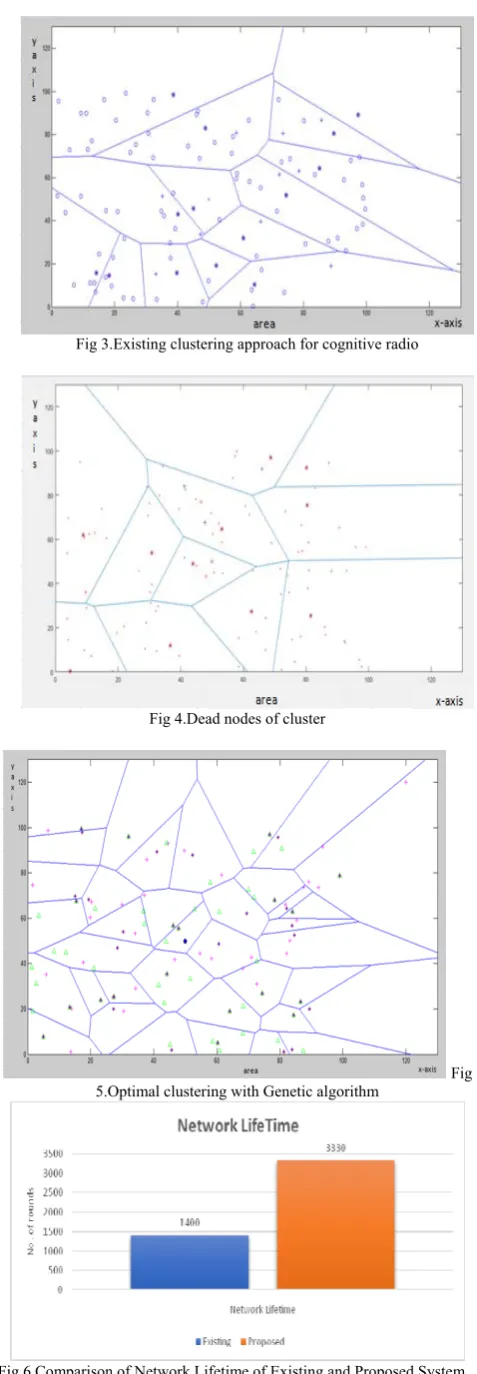
Figure 3 shows the existing hierarchical clustering approach for cognitive radio network having different number of primary and secondary users organised in such a way that all the users are divided into different clusters. Figure 4 shows the dead nodes of previously discussed cluster in figure 3. When User start sharing information between each other then there energy start decreasing with each round. When energy reached at a level of 0, that user is shown in red color and termed as dead user. Figure 5 shows the modified optimal clustering approach of proposed system where we apply Genetic Algorithm. In this scenario there is one primary user placed at the center of the network showing in the blue color dot. The secondary users are taken as advanced nodes and the normal nodes as per their different energy levels. Figure 6 compares the network lifetime of both the clustering schemes i.e. the existing one and the proposed one. The network of existing approach goes upto the 1400 rounds and then became dead on the other hand the network of proposed optimal clustering with genetic algorithm goes upto the 3330 rounds. So the lifetime of the network increased by 1930 rounds. This variation in the results of network lifetime also shows that the proposed scheme is energy efficient as we know that both the lifetime and energy of the network are directly proportional to each other.
Fig 3.Existing clustering approach for cognitive radio
Fig 4.Dead nodes of cluster
Fig 5.Optimal clustering with Genetic algorithm
Fig 6.Comparison of Network Lifetime of Existing and Proposed System
V.CONCLUSION
Cooperative spectrum sensing enhances the detection efficiency i.e. performance of the cognitive radio network. Nevertheless, any such attain in efficiency comes with a resulting greater network energy consumption which is a imperative aspect in a low-power radio systems. In spite of the fact that network energy consumption is a main factor, considering the way that cognitive radios are mainly low-power sensors, the individual energy consumption of every cognitive radio is a way more critical challenge, due to the fact that the highest power consumption of a low-power radio is restrained through its battery. In this work, the existing protocol had some limitations like energy consumption, network life time, forcefully selection of cluster heads, and load on nodes. This type of limitations degrades the existing protocol performance. New Energy Efficient Routing Protocol is proposed in the context of the drawbacks of the existing protocol. We studied number of optimization techniques some are based on local solution other on global solution. The rate of convergence of an algorithm is also a main factor through which we decided which technique we opt to find our solution. Re-clustering process plays vital role in protocol. During each round a specific percentage of total nodes are elected as cluster heads. CH elect according to their probability to chosen as CH in particular round. In proposed algorithm we elect cluster heads with the of GA approach. The results prove that proposed algorithm improves the network life span and energy consumption is less as compare to existing protocol.
REFERENCES
1. A.Gupta, R. K. Jha, “Survey of 5G Network: Architecture and Emerging Technologies,” IEEE Trans. Signal Proces , vol. 3, no. 11, pp. 1206-1232, Aug. 2015.
2. Ahmed Khattab, Magdy A. Bayoumi, “The Challenges Towards Energy-Efficient Cognitive Radio Networking”,IEEE Conference,
vol.1, pp 221-224, 2014.
3. Chen, M. Zhao, L. Zhang, and M. Lei, “Resource optimisation using bandwidth-power product for multiple-input multiple-output orthogonal frequency-division multiplexing access system in
cognitive radio networks”, IET Communications., vol. 9, no. 14, pp.
1710-1720, Sep. 2015.
4. C.-H. Lee and W. Wolf, “Energy Efficient Techniques for Cooperative Spectrum Sensing in Cognitive Radios,”IEEE Consumer Communications and Networking Conference, vol.3, pp
968-972, Jan 2008.
5. Sun, W. Zhang and K. B. Letaief, “Cooperative Spectrum Sensing for Cognitive Radios under Bandwidth Constraints,” IEEE Wireless Communications and Networking Conference, vol. 12, pp.213-217, Mar 2007.
6. H. A. Suraweera, P. J. Smith, and M. Shafi, “Capacity limits and performance analysis of cognitive radio with imperfect channel knowledge,”IEEE Transaction Vehicular Technologies, vol. 59, no. 4, pp. 1811–1822, May 2010.
7. Jingyi Dai, Shaowei Wang, “Clustering-Based Spectrum Sharing Strategy for Cognitive Radio Networks”, IEEE Journal on selected areas in communication, vol. 35, no.1 ,pp. 228 – 237, Jan. 2017. 8. K.Sathya, B.K.AnuPreethi, V.Vijayaraghavan, and M.Laavanya,
“Analysis of Energy Efficiency for Cognitive Radio Network,”
Asian Journal of Electrical Sciences, vol. 4, no. 2, pp.1-3, May 2015.
9. Moshe Masonta, Yoram Haddad, Luca De Nardis, Adrian Kliks, and Oliver Holland, “Energy Efficiency in Future Wireless Networks: Cognitive Radio Standardization Requirements”, IEEE Conference, vol.2, pp no. 31-35, 2012.
10. S. Maleki, A. Pandharipande and G. Leus, “Energy-Efficient Distributed Spectrum Sensing for Cognitive Sensor Networks,”
IEEE Sensors Journal, vol.11, pp.565573, Mar. 2011.
11. S. Appadwedula, V. V. Veeravalli and D. L. Jones, “Decentralized Detection With Censoring Sensors,” IEEE Transactions on Signal Processing, vol.13, pp 1362-1373, Apr 2008.
12. S. Appadwedula, V. V. Veeravalli and D. L. Jones, “Energy-efficient detection in sensor networks,” IEEE Journal on Selected Areas in Communications, vol.13, pp 693-702, Apr 2005.
13. Tazeen S. Syed, Ghazanfar A. Safdar, “History assisted Energy Efficient Spectrum Sensing for Infrastructure based Cognitive Radio Networks”, IEEE Transactions on Vehicular Technology, vol.1, pp
no. 1-15, 2016.
14. Y. Tachwali, B. F. Lo, I. F. Akyildiz, and R. Agusti, “Multiuser resource allocation optimization using bandwidth-power product in cognitive radio networks”, IEEE Journal on Selected Areas Communications, vol. 31, no. 3, pp. 451-463, Mar. 2013.
15. Krishna Gopal Vijayvargiya and Vishal Shrivastavaa, “An Amend Implementation on LEACH protocol based on Energy Hierarchy”,
International Journal of Current Engineering and Technology, vol.2, no. 4, pp. 427-431, Dec. 2012.
16. Neeraj Wadhwa and Vandana Sachdeva, “ Intelligent and Efficient Spectrum Sensing and Handoff Strategies in Cognitive Radio Networks”, International Journal of Emerging Technology and
![Fig 2.Cluster-based cooperative spectrum sensing [16]](https://thumb-us.123doks.com/thumbv2/123dok_us/7877385.1306866/3.595.64.278.149.332/fig-cluster-based-cooperative-spectrum-sensing.webp)