Scholarship@Western
Scholarship@Western
Electronic Thesis and Dissertation Repository
8-31-2015 12:00 AM
A Study of Pseudo-Periodic and Pseudo-Bordered Words for
A Study of Pseudo-Periodic and Pseudo-Bordered Words for
Functions Beyond Identity and Involution
Functions Beyond Identity and Involution
Manasi Kulkarni
The University of Western Ontario
Supervisor Dr. Lila Kari
The University of Western Ontario Graduate Program in Computer Science
A thesis submitted in partial fulfillment of the requirements for the degree in Doctor of Philosophy
© Manasi Kulkarni 2015
Follow this and additional works at: https://ir.lib.uwo.ca/etd
Part of the Theory and Algorithms Commons
Recommended Citation Recommended Citation
Kulkarni, Manasi, "A Study of Pseudo-Periodic and Pseudo-Bordered Words for Functions Beyond Identity and Involution" (2015). Electronic Thesis and Dissertation Repository. 3221.
https://ir.lib.uwo.ca/etd/3221
This Dissertation/Thesis is brought to you for free and open access by Scholarship@Western. It has been accepted for inclusion in Electronic Thesis and Dissertation Repository by an authorized administrator of
A STUDY OF PSEUDO-PERIODIC AND PSEUDO-BORDERED WORDS
FOR FUNCTIONS BEYOND IDENTITY AND INVOLUTION
(Thesis format: Integrated Article)
by
Manasi Kulkarni
Graduate Program in Computer Science
A thesis submitted in partial fulfillment
of the requirements for the degree of
Doctor of Philosophy
The School of Graduate and Postdoctoral Studies
The University of Western Ontario
London, Ontario, Canada
c
Periodicity, primitivity and borderedness are some of the fundamental notions in
combi-natorics on words. Motivated by the Watson-Crick complementarity of DNA strands wherein
a word (strand) over the DNA alphabet {A, G, C, T} and its Watson-Crick complement are
informationally equivalent, these notions have been extended to consider pseudo-periodicity
and pseudo-borderedness obtained by replacing the “identity” function with “pseudo-identity”
functions (antimorphic involution in case of Watson-Crick complementarity). For a given
al-phabetΣ, an antimorphic involutionθis an antimorphism, i.e.,θ(uv)=θ(v)θ(u) for allu,v∈Σ∗
and an involution, i.e., θ(θ(u)) = u for all u ∈ Σ∗. In this thesis, we continue the study of
pseudo-periodic and pseudo-bordered words for pseudo-identity functions including
involu-tions.
To start with, we propose a binary word operation, θ-catenation, that generates θ-powers
(pseudo-powers) of a word for any morphic or antimorphic involutionθ. We investigate various
properties of this operation including closure properties of various classes of languages under
it, and its connection with the previously defined notion ofθ-primitive words.
A non-empty wordu is said to beθ-bordered if there exists a non-empty wordvwhich is a prefix ofu whileθ(v) is a suffix of u. We investigate the properties ofθ-bordered (pseudo-bordered) and θ-unbordered (pseudo-unbordered) words for pseudo-identity functionsθ with
the property thatθis either a morphism or an antimorphism withθn = I, for a givenn≥ 2, orθ is a literal morphism or an antimorphism.
Lastly, we initiate a new line of study by exploring the disjunctivity properties of sets of
pseudo-bordered and pseudo-unbordered words and some other related languages for various
pseudo-identity functions. In particular, we consider such properties for morphic involutionsθ
and prove that, for anyi ≥2, the set of all words with exactlyiθ-borders is disjunctive (under certain conditions).
Keywords:morphic and antimorphic involutions, pseudo-bordered words, pseudo-unbordered
words, disjunctivity, pseudo-identity, pseudo-power, pseudo-periodicity, pseudo-primitivity.
Co-authorship statement
This thesis consists of three research articles out of which the articles presented in Chapter
3 and 4 are published while the article in Chapter 5 is submitted for publication to the journal
Acta Informatica and is undergoing a review process. All of them are co-authored with my supervisor Prof. Lila Kari. Note that, as customary in computer science, the author order is
alphabetical.
The major individual contributions are listed below. However, the results of this
collabo-ration cannot be decomposed into discrete sets of individual contributions, as some key results
arose during discussions, and would not have existed without this interaction.
Chapter 3, “Generating pseudo powers of a word”,
L.K. - topics, research ideas, manuscript writing and editing
M.K. - research ideas and proofs, results, manuscript draft and manuscript editing
Chapter 4, “Pseudo-identities and bordered words”,
L.K. - topics, research ideas, manuscript writing and editing
M.K. - research ideas and proofs, results, manuscript draft and manuscript editing
Chapter 5, “Disjunctivity and other properties of sets of pseudo bordered words”,
L.K. - topics, research ideas, manuscript writing and editing
M.K. - research ideas and proofs, results, manuscript draft and manuscript editing
First and foremost I would like to express my immense gratitude to my supervisor Dr. Lila
Kari for her support and guidance throughout my Ph.D. studies. She is an excellent mentor.
Not only did she guide me in my studies but she extended her warm support in my tough times.
I have hardly seen anybody who is always so energetic, enthusiastic and motivating. My
doc-toral program has been partially supported financially by the Natural Science and Engineering
Research Council of Canada Discovery grant to Dr. Lila Kari.
I would like to thank Prof. Lucian Ilie and Prof. Kaizhong Zhang for reading my thesis
proposal and for their constructive comments and suggestions.
I would like to acknowledge the University of Western Ontario for Western Graduate
Re-search Scholarship, and also for providing excellent teaching related and other workshops. I
would like to take this opportunity to thank the faculty and staff in the Department of
Com-puter Science for providing me with a supportive environment to carry out my research, and
for giving me an opportunity to demonstrate my leadership abilities.
Thanks to my colleagues in Biocomputing lab: Amirhossein Simjour, Rallis Karamichalis,
Srujan Kumar Enaganti and Dr. Steffen Kopecki for maintaining a friendly atmosphere in the
lab. Special thanks to Rallis Karamichalis for fruitful discussions and for reading drafts of my
work whenever I asked him to do so. I am very grateful to all my friends and roommates for
supporting me. Thanks to Amita, Ansh, Nikhil and London Marathi Mandal for providing me
with a home away from home.
Thanks to Dr. Kalpana Mahalingam and Mr. Shriprasad Tambe for their motivation and
encouragement to pursue Ph.D. studies.
Special thanks to my husband Amit, who supported me in all possible ways to pursue my
career and dreams. Without his support it would have been really hard to achieve this milestone
of my life. Last but not least, it would have been impossible to complete this journey without
the support of my parents and my brother, Saurabh. In spite of being thousands of miles away
they provided me with emotional support and constant encouragement. I never got a chance to
say thanks to my late grandfather, Eknath Shankpal who taught me to love mathematics. His
contribution to my success is enormous.
Eknath Shankpal
Contents
Abstract ii
Co-authorship Statement iii
Acknowledgements iv
List of Figures x
List of Tables xii
1 Introduction 1
2 DNA Encoded Information: A Literature Review 4
2.1 Introduction . . . 4
2.2 DNA codeword design and formal languages . . . 6
Basic definitions and notations . . . 7
2.2.1 Intra-molecular hybridizations: hairpins and pseudoknots . . . 8
Mathematical formalization . . . 8
Hairpin and pseudoknot avoidance . . . 11
2.2.2 Inter-molecular hybridizations . . . 15
2.3 DNA codeword design problem: other approaches . . . 20
2.4 DNA memory . . . 24
2.4.1 In vitroDNA memory . . . 24
Nested Primer Molecular Memory (NPMM) . . . 25
2.5 DNA computing inspired combinatorics on words . . . 29
2.6 Conclusion . . . 35
3 Generating Pseudo-Powers of A Word 44 3.1 Introduction . . . 44
3.2 Basic definitions and notations . . . 45
3.3 θ-catenation . . . 47
3.4 θ-primitive words . . . 56
3.5 Closure properties and language equations . . . 59
3.6 Conclusions and future work . . . 62
4 Pseudo-Identities and Bordered Words 66 4.1 Introduction . . . 66
4.2 Basic definitions and notations . . . 67
4.3 Properties of pseudo-(un)bordered words . . . 70
4.4 Disjunctivity of the set ofθ-(un)bordered words . . . 80
4.5 Conclusions . . . 87
5 Disjunctivity and Other Properties of Sets of Pseudo-Bordered Words 92 5.1 Introduction . . . 92
5.2 Basic definitions and notations . . . 94
5.3 Disjunctivity properties ofDθ(i) . . . 98
5.4 Disjunctivity of the setDi θ(1)\D(i) . . . 104
5.5 Disjunctivity of the set (Dθ(2)∩D(2))\(Dθ(1)∩D(1))k fork=1,2 . . . 108
5.6 Further remarks onDθ(i) and related languages . . . 115
5.7 Conclusions . . . 121
6 Conclusion and Discussion 127
7 Addendum 130
A Appendices 132
Curriculum Vitae 136
2.1 DNA hairpin structure formed by aθ-bordered word over the DNA alphabet
with non-overlappingθ-border, GTCAGCGATAG (θis an antimorphic
involu-tion over{A,G,C,T}) [39] . . . 9 2.2 Left: A pseudoknot found in E.coli transfer-messenger-RNA. Right:
Mathe-matical formalization in terms of a stringv1xv2yv3θ(x)v4θ(y)v5[43] . . . 10
2.3 Pseudoknot structure formed due to intra-molecular hybridization modelled as
aθ-pseudoknot-bordered wordxyγθ(x)θ(y) [43] . . . 10 2.4 Hairpin constructions corresponding to the languagesαHk where
α∈ {u,b,c, f,bc,b f,c f,bc f}, [56] . . . 14 2.5 A θ-bordered word u over the DNA alphabet, with overlapping θ-border v
wherew=θ(v) [39] . . . 16 2.6 Pseudoknot-like structure formed due to inter-molecular hybridization between
wordsβθ(x)θ(y) and xyα[43] . . . 16 2.7 Inter-molecular hybridization between two strands u andv, θ(v) being a
sub-word ofu[34] . . . 17 2.8 Undesired inter-molecular hybridizations, (a): two words that have WK-complementary
subwords, (b): a word that is WK-complementary to the catenation of two other
words [37] . . . 17
2.9 Classes of languages free from certain types of undesired hybridization [44] . . 19
2.10 Protocol to select maximally mismatched oligonucleotides, starting with a
pop-ulation of strands with primer pair P1 and P2C, which amplifies only very
mis-matched oligonucleotides [16] . . . 23
2.11 A recombinant plasmid with two DNA fragments as sentinels protecting the
encoded message in between, [68] . . . 28
2.12 Encryption of the first word of Richard Feynman’s suggested message to future
civilizations [11] . . . 29
2.1 Solutions to the extended Lyndon-Sch¨utzenberger equation . . . 33
Chapter 1
Introduction
The study on repetitions and square-free words by Axel Thue [2] initiated the further
explo-ration of word properties and formal languages, an area of discrete mathematics known as
combinatorics on words. This exploration includes studies about word operations and
prop-erties of words ([6]) such as periodicity, primitivity, conjugacy, commutativity, palindromes,
etc. It has also opened the door to the study of infinite words and sequences, with Thue-Morse
words, Sturmian words, Fibonacci words ([5]) being some of the representatives.
Due to the close connection of this field with mathematics, the question that arose in this
context was to generalize word properties by replacing the identity mapping with
pseudo-identity functions. The experiment that used Deoxyribonucleic Acid (DNA) as a medium to
encode information and solve computational problems, performed by Adleman ([1]) triggered
the study of word and language properties using the pseudo-identity functions such as the
antimorphic involution which is the mathematical formalization of the DNA Watson-Crick
(WK) complementarity (see Chapter 2).
A DNA strand can be viewed as a word over the DNA alphabet {A, G, C, T} wherein A
is a WK-complement of T and G is aWK-complement of C and vice versa. Two single DNA
strands, that are WK complements of each other and have opposite orientations, bind to each
other to form a DNA double strand via a process called base-pairing, or hybridization. Thus,
DNA WK-complementarity can be modelled as an antimorphic involution, a function that is
an antimorphism, i.e., for allu,v ∈Σ∗θ(uv) = θ(v)θ(u) and an involution, i.e., θ(θ(u)) = ufor allu∈Σ∗
.
In this thesis, we continue the exploration of word operations and properties for various
pseudo-identity functions including morphic and antimorphic involutions.
In Chapter 2, we give an overview of research related to theoretical aspects of DNA encoded
information along with some DNA memory models proposed in the literature.
Chapter 3 contains the article, “Generating pseudo-powers of a word”, in which we propose
binary word operations that produce θ-powers (θ-catenation) and Abelian-powers
(Abelian-catenation) for any morphic or an antimorphic involution θ, thereby generalizing the notion
of identity to pseudo-identity in terms of the binary word operation of catenation. We mainly
focus on the properties of the operation ofθ-catenation.
Chapter 4 contains the article, “Pseudo-identities and bordered words” where we continue
the study ofθ-bordered words initiated in [4] forθbeing not just a morphic or an antimorphic
involution, but any literal morphism or an antimorphism.
In Chapter 5, which contains the article, “Disjunctivity and other properties of sets of
pseudo-bordered words”, we continue to explore disjunctivity properties of some languages
related to the set of θ-bordered words for (anti)morphic involutions θ which was initiated in
[3]. In particular, we prove that, for all i ≥ 1, the set of all words with exactly i θ-borders,
Dθ(i), is disjunctive (under certain conditions).
We conclude the thesis with Chapter 6, a discussion of the main results in the thesis and
Bibliography
[1] L. Adleman. Molecular computation of solutions to combinatorial problems. Science, 266(5187):1021–1024, 1994.
[2] J. Berstel and A. Thue. Axel Thue’s papers on repetitions in words: a translation. D´epartements de math´ematiques et d’informatique, Universit´e du Qu´ebec `a Montr´eal,
1995.
[3] L. Kari and M. S. Kulkarni. Pseudo-identities and bordered words. In G. P˘aun, G.
Rozen-berg, and A. Salomaa, editors,Discrete Mathematics and Computer Science, pages 207– 222. Editura Academiei Romˆane, 2014.
[4] L. Kari and K. Mahalingam. Involutively bordered words. International Journal of Foun-dations of Computer Science, 18(05):1089–1106, 2007.
[5] M. Lothaire. Algebraic Combinatorics on Words, volume 90. Cambridge University Press, 2002.
[6] S.-S. Yu. Languages and Codes. Tsang Hai Book Publishing Co., 2005.
DNA Encoded Information: A Literature
Review
2.1
Introduction
The demand for reliable media to store information safely is growing rapidly with the vastly
increasing amount of data. Present day technologies are catering to the need to the best of
their abilities, but many of these commonly used technologies such as hard drives and flash
drives suffer from a lack of being sustainable through extreme environmental and some other
conditions such as drought, earthquake, radiation, etc. Hence, scientists are in search of
reli-able media as an alternative to present-day silicon-based computers and hard drives. DNA is
believed to be one of the very strong candidates, due to its natural ability to store the
informa-tion about the genetic make-up of an organism, and the informainforma-tion storage density. According
to [58], DNA can store up to 4.2×1021 bits per gram whereas conventional technologies can
store maximum of 109 bits per gram. The experiment performed by Leonard Adleman ([1])
confirmed the fact that DNA indeed can be used for computation and data storage purposes.
Adleman conducted an experiment to solve a 7-node instance of the NP-complete Hamiltonian
Path Problem. The basic idea was to encode the vertices and edges of the graph into DNA
2.1. Introduction 5
molecules and then to use sets of bio-operations to find the solution to the problem. This
ex-periment initiated the field of DNA or bio-molecular computing which studies the arithmetic
and logic operations that can be performed using molecular biology processes.
Recall that DNA (Deoxyribonucleic Acid) is the genetic information storage unit of every
cell in all living organisms (and many viruses). Each single-stranded DNA molecule consists
of a sequence of nucleotides. Each nucleotide is composed of: a cyclic five-carbon sugar ring
(the carbon atoms are numbered 1’ through 5’), a phosphate group, and a nitrogenous base
(Adenine, Guanine, Cytosine, or Thymine abbreviated as A, G, C, or T respectively). The
phosphate group is linked to the 5’ carbon of the sugar, and the nitrogenous base attaches to
the 1’ carbon of the sugar. The 5’-phosphate group of one nucleotide binds to the 3’-hydroxyl
group (the hydroxyl group attaches to the 3’ carbon of the sugar) of other nucleotide by covalent
bonds. This chain of alternating sugar and phosphate molecules forms the so called
sugar-phosphate backbone of a DNA strand. A single-stranded DNA molecule has an orientation
with one end being called the 5’ end (since the free phosphate group attaches to the 5’ carbon
of the sugar) and the other end the 3’ end (since the free hydroxyl group attaches to the 3’
carbon of the sugar). A double-stranded DNA molecule consists of two single-stranded DNA
molecules with opposite orientation which bind to each other with hydrogen bonds between
nucleotides in the process of hybridization: the nucleotide A binds to the nucleotide T and vice
versa, with double hydrogen bonds, whereas the nucleotide G binds to the nucleotide C and
vice versa, with triple hydrogen bonds. The bases A, T and G, C are said to be Watson-Crick
(WK)-complements of each other [67].
To bring the idea of storing information on DNA into practice, there are two issues that need
to be taken into consideration. First, we need to find a suitable encoding method considering
various constraints, so that the information can be stored and retrieved unambiguously without
losing it. Second, we need to find a suitable host to store this encoded information. The first
constraints. This chapter gives an overview of the solutions that deal with the above mentioned
issues. Note that rather than focussing on algorithmic aspects more emphasis will be given to
formal-language theoretical solutions that overcome the codeword design problem.
While synthesizing artificial DNA strands for the purpose of computation and storage, it
is important to design these strands in such a way that only the desired computations and
interactions will take place (positive design problem) while all other undesired computations and interactions are avoided (negative design problem). Briefly, the positive design problem is to design a set of DNA strands so that they will interact with each other in a programmable
way so as to produce the desired results, whereas the negative design problem is to design a
set of DNA strands so that these strands will not interact with each other in an unprogrammed
way and will not produce undesired outputs [17, 52, 59]. Here undesired outputs mean strands
that are the result of undesired self- or cross-hybridization.
The chapter is organized as follows. In Section 2.2 we discuss formal-language theoretical
solutions to the codeword design problem, followed by other solutions such as, software
simu-lation, and test tube experiments in Section 2.3. In Section 2.4 we discuss somein vitroandin vivoDNA memory models. In Section 2.5 we discuss generalizations of many classical con-cepts from the combinatorics on words inspired by the WK-complementarity of DNA strands,
with concluding remarks in Section 2.6.
2.2
DNA codeword design and formal languages
In this section we discuss mainly formal language theoretic and combinatorial solutions to the
negative design problem. According to [59] the input DNA strands involved in the computation
which need to avoid unwanted hybridizations should satisfy certain conditions such as: (i) there
should not be any strands with undesired secondary structures such as hairpin loops, (ii) no two
strings in the library should hybridize with each other, and (iii) no string and a complement of
2.2. DNAcodeword design and formal languages 7
The hybridization in which two parts of the same DNA strand are WK-complements of
each other, forming hairpin-like structures, is known asintra-molecular hybridization. When two DNA strands that are complete or partial WK-complements of each other hybridize then
such a hybridization is calledinter-molecular hybridization. Let us discuss some notations and definitions used in this section and in Section 2.5.
Basic definitions and notations
An alphabet Σ is a finite non-empty set of symbols. Σ∗ denotes the set of all words over Σ including the empty word λ and Σ+ = Σ∗\λ. We will denote the DNA alphabet by ∆ =
{A,C,G,T}. In this context, a set of codewords is a set of equi-length words over the DNA alphabet. The length of a wordu∈Σ+is denoted by|u|, whereas the length of an empty word
|λ|=0, andΣi denotes the set of all words of lengthioverΣfori≥ 1. An involutionθis a map
θ:Σ∗→Σ∗with the property thatθ2is the identity function. A mappingθis called a morphism
if for any wordsu,v∈Σ∗,θ(uv)= θ(u)θ(v) and an antimorphism ifθ(uv)= θ(v)θ(u). Recall that DNA WK-complementarity can be formalized as an antimorphic involution, a function which
is an antimorphism and an involution.
A wordx∈Σ+is aprefix(proper prefix) of the worduifu= xyfory∈Σ∗(
y∈Σ+), and this is denoted byx ≤p u(x <p u). Similarly, foru = xy, yis asuffix(proper suffix) ofuif x ∈Σ∗
(x ∈ Σ+) and this is denoted byy ≤s u(y <s u). Let us denote the set of all prefixes (proper
prefixes, suffixes, proper suffixes, respectively) of u by Pref(u) (PPref(u), Suff(u), PSuff(u), respectively). A wordv ∈ Σ+ is asubword of a word u ifu = xvyfor x,y ∈ Σ∗. By Sub(u) and Subk(u), we denote the set of all subwords ofu, and the set of all subwords of lengthkof
u, respectively. For a wordusuch thatu = xyfor x,y ∈ Σ∗
, yxis called acyclic permutation
ofu. The set of all cyclic permutations ofuis denoted by cp(u). For all other concepts in the combinatorics on words and formal languages, the reader is referred to [30, 47, 61, 70].
In the following subsection we discuss some secondary structures such as hairpins and
respectively. Note that the terms “words” and “strands” will be used interchangeably in the
fol-lowing sections.
2.2.1
Intra-molecular hybridizations: hairpins and pseudoknots
The hairpin loop is one of the primary secondary structures formed due to the intra-molecular
hybridization of a DNA molecule. Although the hairpin loop formation by a single-stranded
DNA molecule is useful in solving some combinatorial problems (see, e.g., [1, 60]) and in
improving the data transmission between two logic gates in DNA-based logic circuits [32], it is
undesirable for the purpose of encoding information, since such molecules become unavailable
for further computations. Hence, they should be avoided in most DNA computing experiments.
In this section we first discuss the formalization of hairpin loops as words over the DNA
alphabet, and present some combinatorial and formal language-theoretic properties of such
(sets of) words, and then we discuss languages which avoid DNA hairpin loop formation.
Mathematical formalization
A worduis called bordered if there exists a word v ∈Σ+such thatu = vx = yvfor x,y ∈ Σ+
and this is denoted byv<d u. Similarly,
Definition 2.1 [39] For any (anti)morphism1θ, a word u∈Σ+is said to beθ-bordered if there exists v ∈ Σ+ such that u = vx = yθ(v)for some x,y ∈ Σ+ and this is denoted by v <θd u. A non-empty word which is notθ-bordered is calledθ-unbordered.
Let us denote by Lθd(u) = {v | v ∈ Σ∗,v <θd u}the set of allθ-borders of a wordu ∈ Σ∗; by
νθ
d(u)= |L θ
d(u)|the number ofθ-borders of a wordu∈Σ
∗
, and byDθ(i)={u|u∈Σ+, νθd(u)=i} the set of all words with exactlyiθ-borders, fori≥ 1. Whenθis an antimorphic involution and aθ-bordered word over the DNA alphabet has non-overlapping θ-borders, it forms a
hairpin-like structure as shown in Figure 2.1.
2.2. DNAcodeword design and formal languages 9
Figure 2.1: DNA hairpin structure formed by aθ-bordered word over the DNA alphabet with non-overlappingθ-border, GTCAGCGATAG (θis an antimorphic involution over{A,G,C,T}) [39]
Example 2.1 Let Σ = {A,C,G,T} and θ be an antimorphic involution such that θ(A) = T ,
θ(C) = G and vice versa. Then, w = T CGT CT T ACGA = (T CGT)CT Tθ(T CGT) is θ -bordered whereas w0 = T GCT isθ-unbordered.
The following result provides a necessary and sufficient condition for a word to be θ
-bordered for an antimorphic involutionθ.
Lemma 2.2.1 [39] Let θ be an antimorphic involution. Then x ∈ Σ+ is θ-bordered iff x = ayθ(a)for some a∈Σand y∈Σ∗
.
For a morphic involution θ, the set of allθ-bordered words over Σ is not context-free but
it is context-sensitive, whereas for an antimorphic involutionθ, the set of allθ-bordered words
overΣ∗is a regular and dense language, [39].
Proposition 2.2.2 [39] Let u∈Σ+. Then
1. For a morphic involutionθ, Lθd(u)is a totally ordered set with<d.
2. For an antimorphic involutionθ, Lθd(u)is a totally ordered set with<p andθ(Lθd(u))is a
totally ordered set with<s.
Similar to a DNA strand, an RNA strand, which is a strand over the alphabet{A, G, C, U}
E. Coli transfer-messenger-RNA as shown in Figure 2.2 and has been formalized in [43] as a stringv1xv2yv3θ(x)v4θ(y)v5. However the authors of [43] consider a special case of the general
model of pseudoknot wherev1 =v2 =v4 =v5 =λand call such wordsθ-pseudoknot-bordered
words. Formally, a non-empty worduisθ-pseudoknot-bordered ifu= xyα= βθ(yx) for some wordsx,y, α, β∈ Σ+. An example of a pseudoknot, that is, a word of the formxyγθ(x)θ(y), is given in Figure 2.3.
Figure 2.2: Left: A pseudoknot found inE.colitransfer-messenger-RNA. Right: Mathematical formalization in terms of a stringv1xv2yv3θ(x)v4θ(y)v5[43]
Figure 2.3: Pseudoknot structure formed due to intra-molecular hybridization modelled as a
θ-pseudoknot-bordered wordxyγθ(x)θ(y) [43]
A worduis said to beθ-pseudoknot-border (orθ-pk-border) of a wordv∈Σ∗if there exists
a cyclic permutationwofusuch thatv= uα= βθ(w) for someα, β∈Σ∗. Furthermore, a
non-empty word is said to beθ-pseudoknot-unbordered (orθ-pk-unbordered) if it does not have any
2.2. DNAcodeword design and formal languages 11
andKθ(i)={u∈Σ+| |Lθcd(u)|=i}, the set of all words with exactlyiθ-pk-borders.
Example 2.2 Letθ be an antimorphic involution and let{a,b} ∈Σ be such thatθ(a) = b and
θ(b) = a. Then for x= baa and y = b, we have w = baabbaa= xybaa = baaθ(yx)which is a
θ-pk-bordered word, whereas w =aab isθ-pk-unbordered.
We state the following results from [43] regarding some properties of θ-pk-borders of a
word.
Proposition 2.2.3 [43] Letθbe an (anti)morphic involution onΣ∗. The following hold: 1. If a word w ∈ Σ+ has a θ-pk-border of length n then, for every a ∈ Σ, the number
of occurrences of a letter a in the prefix of length n of w is equal to the number of occurrences of the letterθ(a)in the suffix of length n of w.
2. For all a∈Σsuch thatθ(a),a, ak isθ-pk-unbordered, for all k ≥1.
3. For words v,w ∈ Σ+and n ≥ 1, if v ∈ Lcdθ (wn)and|wm−1| < |v| ≤ |wm|for some m ≥ 1,
then v∈Lθcd(wk), for all k with m≤k≤ n.
Now, we will discuss properties of languages that prevent the words of the language from
interacting with themselves in an undesirable manner.
Hairpin and pseudoknot avoidance
It is believed that the hairpins with smaller stem length are less stable than those with bigger
stem length, [44]. Hence, a strand which does not satisfy the stem length condition (of the stem
length being smaller than a given value) is free from such hairpin structures. Formally,
Definition 2.2 1. [38] Letθbe an (anti)morphic involution ofΣ∗and k be a positive integer.
2. [38] Denote by hpf(θ,k), the set of all hp(θ,k)-free words in Σ∗. The complement of hpf(θ,k) is hp(θ,k)=Σ∗\hpf(θ,k).
3. [38] A language L is calledθ-k-hairpin-free or simply hp(θ,k)-free if L⊆ hp f(θ,k).
It is obvious that an empty word and single letter words are hp(θ,1)-free whereas words of
length less than 2kare hp(θ,k)-free.
Proposition 2.2.4 [38] The languages hp(θ,k)and hp f(θ,k)are regular for k≥ 1.
Since the languages given in Proposition 2.2.4 are regular, it is interesting from a
theoret-ical point of view to see whether or not for a given automaton we can decide if the language
accepted by this automaton is free from hairpin structures. Kari et al. ([38]) formalizes these
problems asHairpin-Freedom ProblemandMaximal Hairpin-Freedom Problemas follows:
Hairpin-Freedom Problem
Input: A non-deterministic automatonM.
Output: Yes/No depending on whetherL(M) ishp(θ,k)-free.
Maximal Hairpin-Freedom Problem
Input: A deterministic automatonM1 accepting a hairpin-free language, and a NFAM2.
Output: Yes/No depending on whether there is a wordw∈L(M2)\L(M1) such thatL(M1)∪ {w}ishp(θ,k)-free.
The following theorem provides an answer to the question of decidability of hairpin-freedom
problems.
Theorem 2.2.5 [38]
1. The hairpin-freeness problem for regular (respectively context-free) languages is decid-able in linear (respectively cubic) time with respect to|M|.
2.2. DNAcodeword design and formal languages 13
Kari et al., [38], also discusses other variants of hairpins such as scattered hairpin and
hairpin frames and also the decidability problems for hairpin-freeness of these other variants.
Paun et al., [56], denotes by uHk the languagehp(θ,k) which contains words of the form
xvyθ(v)z where |v| ≥ k and calls it unrestricted hairpin language. The authors of [56] also define restricted hairpin languages in which the restriction is put on the annealing site2 of a
strand. We will mention these restricted languages and some of the properties of complements
of these languages, i.e., languages which are hairpin-free.
Definition 2.3 [56] For an antimorphic involutionθ, uHk ={zvwxy|z,v,w,x,y∈Σ∗,x=θ(v)and|v| ≥k},
bHk ={vwxy|v,w,x,y∈Σ∗,x=θ(v)and|v| ≥k},
cHk ={zvxy|z,v,x,y∈Σ∗,x=θ(v)and|v| ≥k},
f Hk = {zvwx|z,v,w,x∈Σ∗,x=θ(v)and|v| ≥k},
bcHk ={vxy|v,x,y∈Σ∗,x=θ(v)and|v| ≥k},
b f Hk = {vwx|v,w,x∈Σ∗,x= θ(v)and|v| ≥k},
c f Hk = {zvx|z,v,x∈Σ∗,x= θ(v)and|v| ≥k},
bc f Hk = {vx|v,x∈Σ∗,x=θ(v)and|v| ≥k}
The hairpin constructions corresponding to languages in Definition 2.3 are illustrated in
Figure 2.4.
Along with Proposition 2.2.4 which states that the languages hp(θ,k) and hp f(θ,k) are regular, results from [56] state that the languagesbHk,cHk, f Hkandb f Hkin Definition 2.3 are regular as well. We mention some of the results from [56] which are related to the complements
of languages defined above.
Theorem 2.2.6 1. The complement of the language bc f Hk, for k≥ 1, is linear.
2. The complements of languages bcHk and c f Hk, for k ≥1, are not context-free.
2A site where two WK-complementary single-stranded DNA sequences hybridize to form double-stranded
Figure 2.4: Hairpin constructions corresponding to the languagesαHk where
α∈ {u,b,c, f,bc,b f,c f,bc f}, [56]
Kari et al., [40], calls the words of the language bc f Hk, θ-palindromes for (anti)morphic involutionsθ. Formally, a word x ∈Σ∗ is called aθ-palindrome if x = θ(x). LetPθ denote the set of allθ-palindromes. The notion of θ-palindromes was independently introduced in [15].
We discuss the properties ofPθin Section 2.5.
As discussed in the previous subsection, hairpins can be modelled as θ-bordered words
with non-overlappingθ-borders. Hence,θ-unbordered words are the strings which will be free
from hairpin structures. Let us look at the necessary and sufficient condition for a word to be
θ-unbordered.
Proposition 2.2.7 [39] Let θ be either a morphic or an antimorphic involution. Then for u∈Σ+such that|u| ≥2, u isθ-unbordered iffθ(PPref(u))∩PSuff(u)=∅.
The following proposition provides a necessary and sufficient condition for the catenation
ofθ-unbordered words to beθ-unbordered.
Proposition 2.2.8 [39] Letθbe either a morphic or an antimorphic involution and let u,v∈Σ+
beθ-unbordered. Then uv isθ-unbordered iffθ(Pref(u))∩Suff(v)= ∅.
Also, for an antimorphic involution θ on Σ∗, the set of all θ-unbordered words D
θ(1) is
regular. A result from [39] states that it is decidable for a given non-empty word whether or
2.2. DNAcodeword design and formal languages 15
We have seen another type of structure formed due to intra-molecular hybridization of RNA
strands, pseudoknots. It is clear that θ-pseudoknot-unbordered (θ-pk-unbordered) words will
be free from pseudoknot-like secondary structures. The following result gives a necessary and
sufficient condition for a word to beθ-pk-unbordered.
Proposition 2.2.9 [43] Letθbe an antimorphic involution onΣ∗. Then for u ∈ Σ+, u isθ -pk-unbordered iffθ(cp(Pref(u))∩Suff(u)=∅.
Also, for an (anti)morphic involutionθonΣ∗, the set of allθ-pk-unbordered words overΣ∗,
Kθ(1), is a subset of set of allθ-unbordered words, Dθ(1), and a dense set, [43].
2.2.2
Inter-molecular hybridizations
In this section, we explore some secondary structures that result from inter-molecular
hy-bridizations of DNA strands, and solutions preventing the formation of such structures using
formal languages as a tool.
Let us begin with the notion of θ-bordered and θ-pseudoknot-bordered words defined in
the earlier section. Recall that a θ-bordered words with non-overlapping θ-borders can form
a hairpin-like structure. However, if such a word has overlappingθ-borders then it can
inter-act with another copy of itself forming a secondary structure as shown in Figure 2.5.
Simi-larly, RNA strands can form pseudoknot-like inter-molecular structures such as those depicted
in Figure 2.6. We have already seen some properties of the set of all θ-unbordered and θ
-pseudoknot-unbordered words in the previous subsection.
If a DNA strand involved in the computation, sayv, is WK-complementary to part of some other strand, sayu, in the computation, then this results in a secondary structure as shown in Figure 2.7.
Similarly, if subwords of two words are WK-complements of each other, then this results
into a secondary structure as shown in Figure 2.7(a). The structure shown in Figure 2.7(b) is a
Figure 2.5: Aθ-bordered worduover the DNA alphabet, with overlapping θ-bordervwhere
w=θ(v) [39]
Figure 2.6: Pseudoknot-like structure formed due to inter-molecular hybridization between wordsβθ(x)θ(y) and xyα[43]
The following definition gives the properties of languages that need to be satisfied for the
words of the language to avoid the above-mentioned undesired inter-molecular hybridizations.
Definition 2.4 For an (anti)morphic involutionθ, the language L is called: 1. [34]θ-nonoverlapping if L∩θ(L)= ∅;
2. [34]θ-compliant if∀w∈ L,x,y∈Σ∗,w,xθ(w)y∈L⇒ xy=λ; 3. [34]θ-p-compliant if∀w∈L,y∈Σ∗,w, θ(w)y∈L⇒y=λ; 4. [34]θ-s-compliant if∀w∈L,x∈Σ∗,w,xθ(w)∈L⇒ x= λ;
5. [34] strictlyθ-compliant if∀w∈L,x,y∈Σ∗,
w,xθ(w)y∈L⇒ xy=λand w ,θ(w);
2.2. DNAcodeword design and formal languages 17
Figure 2.7: Inter-molecular hybridization between two strands uandv, θ(v) being a subword ofu[34]
Figure 2.8: Undesired inter-molecular hybridizations, (a): two words that have WK-complementary subwords, (b): a word that is WK-WK-complementary to the catenation of two other words [37]
7. [35]θ-sticky-free if∀w∈Σ+,x,y∈Σ∗,
wx,yθ(w)∈L⇒ xy=λ; 8. [35]θ-3’-overhang-free if∀w∈L,x,y∈Σ∗wx, θ(w)y∈L⇒ xy= λ; 9. [35]θ-5’-overhang-free if∀w∈L,x,y∈Σ∗
xw,yθ(w)∈L⇒ xy= λ;
10. [35]θ-overhang-free if L is bothθ-3’-overhang-free andθ-5’-overhang-free;
11. [33]θ(k,m1,m2)-subword compliant if∀u∈Σ∗such that∀u∈Σkwe haveΣ∗uΣmθ(u)Σ∗∩
L= ∅for m1≤ m≤m2;
12. [33]θ-k-code if Subk(L)∩Subk(θ(L))= ∅for some k> 0.
Note thatθ-compliant languages avoid the situation in Figure 2.7,θ-k-codes avoid the situa-tion in Figure 2.8(a), andθ-free languages avoid situation in Figure 2.7(b). Also,θ-p-compliant
and θ-s-compliant languages avoid some special case of situations in Figure 2.7 and 2.8(a).
Languages which satisfy properties 11 (θ(k,m1,m2)-subword compliant) and 12 (θ-k-code)
a hairpin. Figure 2.9 depicts the unwanted hybridizations that other languages in Definition 2.4
avoid.
The following proposition shows the relationship between θ-sticky-free and θ-compliant
languages.
Proposition 2.2.10 [35] For every language L ⊆ Σ+ and for every given (anti)morphic invo-lutionθ:Σ+→Σ+, the following are equivalent:
1. L isθ-sticky-free; 2. θ(L)isθ-sticky-free;
3. PPref(L)∩θ(PSuff(L))=∅and L is bothθ-p-compliant andθ-s-compliant.
For an antimorphic involutionθ, a language which isθ-compliant and eitherθ
-3’-overhang-free orθ-5’-overhang free isθ-free, [35]. Figure 2.9 shows an overview of the relationships
between the aforementioned DNA languages, where arrows indicate the inclusion relation
among classes of languages that satisfy certain properties. For example, a language that is
θ-p-compliant isθ-3’-overhang free. For further details about the properties of DNA languages
defined in Definition 2.4, such as closure properties and relationship among these languages,
the reader is referred to [31, 33, 34, 35].
Kari et al., [37], introduced a general framework ofbond-free propertyto analyse if a given DNA language is free from certain type of undesirable bonds. A property P is a mapping
P: 2Σ∗ → {true,false}. A languageLsatisfies the propertyPifP(L)=true.
Definition 2.5 [37] A language propertyPis called a bond-free property of degree 2 if there exists binary word operations^lo,^upand an antimorphic involutionθsuch that for an
arbi-trary L ⊆Σ∗,P(L)=true iff
2.2. DNAcodeword design and formal languages 19
Figure 2.9: Classes of languages free from certain types of undesired hybridization [44]
where a binary word operation is a mapping ^ : Σ∗× Σ∗ → 2Σ∗, where2Σ∗ is the set of all
subsets ofΣ∗.
To study the bond-free properties of various languages, the tool that is used is word
op-eration on trajectories. Consider a trajectory alphabet V = {0,1} and assume V ∩Σ = ∅. A trajectory is any stringt ∈ V∗ which specifies the way in which an operation^is applied to
the letters of its two operands. As an example, we mention the definition of the binary word
operationshuffle on trajectories.
Definition 2.6 [37] Let t ∈V∗be a trajectory and let α, β ∈ Σ∗
. Then, the shuffle ofαwithβ on the trajectory t, denoted byαt βis defined as follows:
αtβ ={α1β1. . . αkβk|α=α1. . . αk, β= β1. . . βk,t= 0i11j1. . .0ik1jk,
Theorem 2.2.11 [37] The languages properties 2, 3, 4, 7, 8, 9 in Definition 2.4 are bond-free properties. Moreover, the associated sets of trajectories Tlo,Tup are regular where^lo =
Tlo,^up =Tup.
Theorem 2.2.12 [37] LetPbe a bond-free property associated with the regular set of trajec-tories Tlo,Tup. Then the following problem is decidable in quadratic time:
Input: an NFA A.
Output: Yes/No depending on whether L(A) satisfiesP.
For more properties of bond-free languages the reader is referred to [36, 37].
2.3
DNA codeword design problem: other approaches
In Section 2.2, we have seen a theoretical approach to address the DNA codeword design
problem. In this section, we explore a few other approaches including algorithmic, software
simulation and the construction ofin vitroDNA libraries.
In [5, 53, 58], authors considered the use of a restricted genetic alphabet in order to
re-duce the chances of undesirable secondary structure formations, in particular, the ones that
are formed due to inter-molecular hybridization of DNA strands. Brenner et al., [5], observed
that all the strands in the library that use all the four nitrogen bases, A, C, G, T increase the
chance of secondary structure formation to a great extent. Motivated by this observation, [58]
constructed DNA libraries using the restricted DNA alphabet{A,C,T}, with the help of a set of programs written in C++.
In order to avoid undesirable inter- and intra-molecular hybridizations it is clear that the
strands involved should be as dissimilar as possible. Hence, it was intuitive to consider a
re-striction on the Hamming distance between the strands. The Hamming distanceH(w1,w2), for
two equi-length words w1 and w2, is the number of positions in which the words w1 andw2
differ. The Hamming distance constraint poses the condition on any two wordsw1 andw2 to
2.3. DNAcodeword design problem: other approaches 21
w2 needs to beH(w1,W K(w2)) ≥ d. In addition, due to the parallelism in DNA computation,
another condition that usually needs to be satisfied is that all the strands should have the similar
melting temperatures3. Several software simulation packages and algorithms have been con-structed that consider the Hamming distance, melting temperature and some other conditions
to design DNA codewords and build DNA libraries that are free from undesirable secondary
structures (see, e.g., [2, 21, 29, 51, 65, 66]).
For example, [51] proposed a dynamic programming algorithm to calculate the total
num-ber of words of some specified length nwhich satisfy the following four constraints and ran-domly output such a word. Firstly, the Hamming distance between all pairs of distinct words
w1 and w2 should satisfy H(w1,w2) ≥ d, secondly, the Hamming distance between the
com-plement of one strand,wC1 and reverse of another strand,wR2 should be H(wC1,wR2)≥ d, thirdly, all the pairs of strands w1,w2 should satisfy H(w1,wR2) ≥ d and lastly, all the strands should
have a certain value of free energy4G4. The time complexity of this algorithm, as reported by
authors, isO(n2).
DNASequenceGenerator, a software tool created by [19], is capable of creating DNA se-quences that meet user’s requirements of melting temperature value, GC ratio values and
uniqueness. The GC ratio is the percentage of nucleotides G or C present in each word, whereas
uniqueness requests that any subsequence of certain length is allowed to occur at most once
in the pool. Another tool,DNASequenceCompiler, [18], is very similar to DNASequenceGen-erator. It translates formal grammars into DNA molecules representing the rules of the
gram-mar. This compiler translates each rule of the grammar as a partially double-stranded DNA
molecule where the double-stranded part represents a terminal letter, and the single-stranded
“sticky-ends” represent variables. The parse module of the compiler reads the symbol sets and
the rules of the grammar, and the physical and chemical requirements for the sequences. The
generator module (DNASequenceGenerator) generates the DNA sequences (of the form
men-3The melting temperature is the temperature at which half of the strands of DNA are in double helical structure
and the rest are in a dissociated state, i.e., they exists as two independent single strands.
4The (Gibbs) free energyGis usually given by the formulaG = H−T S, whereHis the enthalpy,S is the
tioned above). In order to produce the final word, these DNA sequences, which represent the
rules of the grammar, need to be concatenated and the concatenated DNA sequences need to
be unique. The coordinating module takes care of the uniqueness requirement for sequences.
Garzon, [23], observed that the set of molecules/strands produced by in silico methods is relatively smaller in size compared to those produced by in vitro methods. Deaton et al., [16], proposed a Polymerase Chain Reaction5 (PCR)-based protocol (Figure 2.10) to select a
library of non-cross-hybridizing oligonucleotides6 (shortly, oligos)in vitro. The key concept
is to regulate the temperature of the reaction so as to amplify (multiply) the desired DNA
molecules, i.e., the oligonucleotides which are maximally mismatched, with the help of PCR.
The initial population of equi-length oligos consisted of random sequences with the specific
primers P1 and WK-complement of P2, i.e., P2C attached to them at either ends (the same for
all strands). In the subsequent computation, by regulating the temperature, only strands that
are not perfect WK-complements of each other melted apart and were amplified using PCR
and hence the test tube ultimately contained a non-cross(self)hybridizing set of oligos. It was
observed that, at lower temperatures, maximally mismatched oligos were amplified over the
other oligos which are perfectly matched or had lower degree of mismatches.
Nuser et al., [55], proposed a computer simulation of the above mentioned PCR-based
protocol to gain insight about the behaviour of the protocol and to explore the computational
capability of the same. Instead of representing DNA words by a DNA sequence, the simulation
experiment rather represents such words by their concentration, i.e., the number of such words
present in the test tube and a vector of pairwise hybridization energies7with all other words in
the test tube. This facilitates the analysis of the result produced by the simulation in terms of
the number of maximally mismatched words produced. Initially, all the words in the test tube
had equal concentration. The simulation chose two random words according to their relative
concentrations in the test tube and each such pair was analysed for their hybridization energies.
5PCR is a technique used in molecular biology to amplify DNA molecule(s),that is, to generate many copies
of the particular DNA sequence with the help of DNA polymerase enzyme.
6Short, approximately 15-20bp DNA molecules
2.3. DNAcodeword design problem: other approaches 23
It was observed that if this (hybridization) energy value was less than the threshold of 0.5,
the two words hybridized with each other and hence they were not selected. Thus, only those
words with pairwise hybridization energy greater than 0.5 were selected and amplified, since
they did not hybridize with each other. The authors suggest that a modification in the protocol
can result into making the protocol useful for computations and, as an example, they generated
the sequence of Fibonacci numbers. Furthermore [7] attempted to characterize the library of
oligonucleotide that was generated by the PCR-based protocol and simulation experiment.
Figure 2.10: Protocol to select maximally mismatched oligonucleotides, starting with a popu-lation of strands with primer pair P1 and P2C, which amplifies only very mismatched oligonu-cleotides [16]
For a more detailed and exhaustive review of solutions, non-theoretical, in particular, to the
codeword design problem, we refer reader to [23, 52].
As we have seen in this and earlier sections, many attempts have been made to find the
optimal solution to the codeword design problem for DNA computing experiments. Note that,
2.4
DNA memory
As seen in earlier sections, extensive work was done to find a good encodings of DNA strands
considering various combinatorial and thermodynamic constrains. The next major step is to
store these encoded data effectively in reliable media, resistant to external factors, as well as
allowing easy and unambiguous retrieval.
Most of the work in the area of molecular memory is around the aim of building a
content-addressable memory8 using DNA. Eric Baum [3] was the first one to propose the idea of a
content-addressable DNA memory. Out of many approaches that he suggested in his paper,
one was to store binary words of a fixed length. He suggested to use two distinct
single-stranded DNA molecules to encode the bit “1” and the bit “0” and that, in order to obtain a
DNA molecule encoding for specific binary word, appropriate DNA sequences can be
concate-nated. To retrieve the required data from the memory, the technique to be used is to introduce
complementary sequences to the address correspondent of the data to be searched, attached to
magnetic beads. Thus, these complementary subsequences can then bind to the corresponding
sequence in the memory and such molecules could be further extracted and sequenced in order
to read the stored data.
Subsequently, several other attempts have been made to store data on DNA, including
mod-elling of DNA memories with the help of computer simulation (in silico) [28, 64], hairpin DNA memories [63], and somein vitroandin vivoexperiments. In this section, we particularly ex-plore the Nested Primer Molecular Memory (in vitro) experiment and some organic (in vivo) DNA memory experiments.
2.4.1
In vitro
DNA memory
The first use ofin vitromemory was demonstrated by Adleman’s experiment ([1]) to solve a 7-node instance of the Hamiltonian Path Problem wherein the vertices were encoded as suitable
2.4. DNAmemory 25
DNA strands and some operations such as PCR and gel electrophoresis were performed to
find the solution to the problem. Subsequently, several attempts have been made in order to
attain Baum’s dream of a content-addressable memory (e.g., see [8, 9, 22, 54, 69]). In [9],
the authors stored a book with 53,426 words, 11 JPG images and 1 JavaScript program on a
DNA microchip. The book was first converted to an html format and then encoded as DNA
strands by using an encoding scheme where 0 was represented as the bases A and C and 1
was represented as the bases G and T. Also, a 19-bit binary sequence was used for addressing
purposes and the data was read and retrieved using next-generation DNA sequencing9.
Recently, Goldman et al., [27] successfully encoded and decoded 154 Shakespeare’s
son-nets (ASCII text), a scientific paper (PDF format), a medium-resolution coloured photograph
(JPEG 2000 format) and 26-second excerpt from Martin Luther King’s 1963 ‘I have a dream’
speech (MP3 format). In the encoding scheme, they first replaced each byte of ASCII text with
five or six base-3 digits (trit), using a Huffman code, and each trit was in turn converted to a
DNA letter using an encoding scheme which ensures that no two nucleotides appear
consecu-tively. The authors reported successful and unambiguous retrieval of all the files using DNA
sequencing procedures.
Nested Primer Molecular Memory (NPMM)
Thein vitroDNA memory model proposed by [45] is one of the best examples of implementa-tion of the idea of content-addressable memory proposed by Baum. The model uses the simple
operation of nested PCR. In the proposed model, each DNA strand consists of three types of
blocks, a data block (the site for storing the encoded data over the DNA alphabet), the address
block (the site for specifying the address of the data block, namely the A block, the B block
and the C block) and the Re block (the site for the reverse primer to hybridize). The memory
capacity,M of NPMM is calculated as follows:
M(bit)=2×Data(bp)×PrimerBlock
where Data is the length of the sequence in the data block, Block is the number of address blocks and Primer is the number of primers in each address block. In the initial NPMM ex-periment, [45], the authors could extract a single target DNA strand from the diluted solution
of 27 strands (3 address blocks with 3 sequences in each address block). In the subsequent
experiment, the authors of [46] could extract a single DNA strand from the diluted solution of
12,167 strands (3 address blocks with 23 sequences in each address block). Finally, the authors
of [69] were able to retrieve the target DNA strand from the diluted solution of 16.8M strands
(6 address blocks with 16 sequences in each block). We will briefly explore the NPMM model
that was used to achieve this huge address space.
The NPMM consists of three layers of address space on each side of the data space (CLi,BLj,
ALk on the left and ARl,BRm,CRn on the right) with sixteen 20-mer sequences in each layer, hence it is of the form [CLi,BLj,ALk,DATA,ARl,BRm,CRn], wherei, j,k,l,m,n∈ {0,1, . . . ,15} and DATA is either a 20-mer, a 40-mer or a 60-mer DNA sequence. As an example, we will
describe the working of NPMM for the address
[CL3,BL0,AL10,DATA,AR12,BR4,CR1].
In the first step, PCR is performed using the primer pairCL3and WK(CR1) and as a result the
solution will have in large quantity molecules containing onlyCL3 andCR1. In the next step,
considering only the amplified molecules obtained from first step, PCR is performed using the
primer pairBL0and WK(BR4). In the last step, PCR is performed using AL10 and WK(AR12)
and as a result, the solution will contain only those DNA molecules which have the above
mentioned address, from which the data can then be retrieved by sequencing and decoding.
2.4. DNAmemory 27
the limitation for NPMM’s capacity. One major disadvantage of NPMM is the occurrence of
mutations that can happen during PCR.
2.4.2
Organic DNA memory
So far we have seen memory models which are either implemented using computer simulation
experiments or test tube experiments. In this section, we briefly explore memory models
imple-mented using living organisms as hosts to store the encoded data. One of the major obstacles in
using living organisms as a host can be the lack of substantial knowledge about the cellular and
molecular mechanism of the host organism, since inadequate knowledge about these
mecha-nisms can lead to the misinterpretation of foreign DNA sequences by these orgamecha-nisms which
subsequently can kill the host organism. Since the molecular mechanism of many bacteria is
well known, bacteria are one of the widely used hosts .
The authors of [68] identified two such hosts inEscherichia coli(E.coli) andDeinococcus radiodurans(Deinococcus) as the cellular and molecular mechanism of these bacteria is well understood, and the latter can survive in extreme conditions such as cold, dehydration, vacuum,
acid and radiation and hence can be an ideal host candidate. The encoding scheme that was
used was to assign 3-mer sequences to numbers and various symbols in the English alphabet.
For example, “1” was encoded as AAC, the letter “A” was encoded as AGG, etc. The next step
was to identify two fixed size DNA sequences (20-base-pair long) with the condition that they
should not occur in the bacterial genome yet they should satisfy all the genomic constraints
so that the introduction of such sequences should not cause any mutation, or kill the bacteria.
Another condition that had to be satisfied so as to preserve the integrity of the message without
killing the bacterium, was the introduction of stop codons in these DNA sequences so that the
bacterium would not misinterpret the embedded message as a protein-coding sequence. As a
first step, two 46bp long complementary oligonucleotides consisting of two different 20bp long
DNA sequences connected by a 6bp long restriction enzyme10 site were created. In addition,
this (restriction enzyme) site served as the location for the encoded message to be inserted
in the subsequent computation. Then this double stranded DNA molecule was cloned into a
recombinant plasmid11as shown in Figure 2.11.
Figure 2.11: A recombinant plasmid with two DNA fragments as sentinels protecting the en-coded message in between, [68]
This embedded DNA was then inserted into cloning vectors12 which then were transferred
intoE.coliby high voltage shocks. As a next step, the cloning vectors and encoded DNA were incorporated into the genome ofDeinococcusand retrieved by PCR. The authors reported the successful storage and retrieval of seven chemically synthesized DNA fragments with 57-99
base pairs of non-native information.
Other host organisms suggested (but not experimentally verified) by [11] were Bacillus subtilis(B. subtilis) andSaccharomyces cerevisiae(S. cerevisiae). The spore-forming capacity of these microorganisms is believed to be a protected medium, since it is a resistant structure
that bacteria use for survival in unfavourable conditions. Also, the molecular genetics of these
species is well-known, making them suitable hosts. Along with this, the authors also suggested
a few possible encodings to encode the message, as shown in Figure 2.12. Three encodings
were suggested: encode a complete word by a DNA sequence, encode each syllable of a word
by a different DNA sequence, or encode each letter of a word by a different DNA sequence.
The authors of [62] proposed some codes that can be useful for encrypting data in DNA and
name themHuffman code,comma codeandalternating code. The Huffman code is constructed using Huffman’s method which is based on the fact that some letters like a, e, s are used more
frequently than letters q, z, and hence encodes the former by shortk-mers such as AT, T, GT (for
2.5. DNAcomputing inspired combinatorics on words 29
Figure 2.12: Encryption of the first word of Richard Feynman’s suggested message to future civilizations [11]
a, e and s respectively) and the latter by comparatively longerk-mers such as CCCTA, CCCTG (for q and z respectively). In the comma code, consecutive 5-base codons are separated by a
single uniform base which does not occur in 5-base codon, e.g., A A A A. This kind
of design would help the user to orient the message even if the starting point is not mentioned,
and it is effective in detecting insertion and deletion mutations. An alternating code consists
of sixty four 6-base long alternating sequences of purines (A and G) and pyrimidines (C and
T), e.g., PQPQPQ where P=A or G and Q=C or T. Even though the comma code and the
alternating code are not economical to use (unlike the Huffman code), they are more suitable
for encoding data for long-term storage.
2.5
DNA computing inspired combinatorics on words
The mathematical formalization of DNA WK-complementarity as an antimorphic involution
has inspired generalizations of many classical and fundamental notions of formal languages
and combinatorics on words including conjugacy, commutativity, borderedness, periodicity,
palindromic property, etc. In this section, we discuss some generalizations of the above
men-tioned concepts, some of their properties, and generalization of two important results from
combinatorics on words, namely Fine and Wilf’s theorem and the Lyndon-Sch¨utzenberger
equation. Note that, in this section,θalways denotes an (anti)morphic involution unless
Recall that a word and its WK-complement encode the same information and that one can
be obtained from the other by an application of an antimorphism that interchanges A with T
and G with C and vice versa. Thus, it is natural to consider the notion of repetitions not being
limited to just a finite concatenation of a word with itself, but rather a finite concatenation
of a word and its WK-complement in some random order, thereby extending the notion of
repetitions to pseudo-repetitions. [14] defines the θ(pseudo)-power of a word u as a word of the formu1u2. . .un whereu1 = uandui ∈ {u, θ(u)}for 2 ≤ i ≤ n. As the notion of repetition leads to the notion of primitivity, the notion of pseudo-repetitions can lead to the concept of a
θ-primitive word. A word is said to be primitive if it cannot be expressed as a power of any
other word and a word is said to beθ-primitive if it cannot be expressed as aθ-power of any
other word, [14]. Ifw ∈ {u, θ(u)}∗such that
uis a smallest such word, thenuis said to be the
θ-primitive root ofwand is denoted byρθ(w).
Example 2.3 Let θ be an antimorphic involution on Σ = {A,C,G,T} such that θ(A) = T ,
θ(G)=C and vice versa. Then w=GT CGT CGAC =(GT C)(GT C)θ(GT C)is notθ-primitive, whereas v=GT AG and u=GT C areθ-primitive.
The following result states the relationship between primitive andθ-primitive words.
Proposition 2.5.1 [14] If a word w ∈Σ+isθ-primitive then it is also primitive. The converse is not always true.
Note that the θ-primitive root of a word is θ-primitive. The notion of θ-primitive words
leads to a generalization of the classical result of Fine and Wilf. We will first state the classical
result.
Theorem 2.5.2 [20] Let u,v,∈ Σ∗,|u|= n,|v|= m and d = gcd(n,m)13. If two powers ui and vj of u and v have a common prefix of length at least n+m−d, then u and v are powers of a common word. Moreover, the bound n+m−d is optimal.
2.5. DNAcomputing inspired combinatorics on words 31
Theorem 2.5.3 [14] Letθ : Σ∗ → Σ∗ be a morphic involution, u,v ∈ Σ+ with n = |u|,m = |v|
and d =gcd(n,m),α(u, θ(u))∈u{u, θ(u)}∗andβ(v, θ(v))∈v{v, θ(v)}∗. If twoθ-powersα(u, θ(u))
andβ(v, θ(v))have a common prefix of length at least n+m−d, then there exists a word t ∈Σ+
such that u,v∈t{t, θ(t)}∗
, i.e.,ρθ(u)=ρθ(v). Moreover, the bound n+m−d is optimal.
Theorem 2.5.4 [14] Letθ :Σ∗→ Σ∗be an antimorphic involution and u,v∈Σ+be such that
|u|> |v|. If there exists twoθ-powersα(u, θ(u))∈u{u, θ(u)}∗andβ(v, θ(v))∈v{v, θ(v)}∗sharing
a common prefix of length2|u|+2|v| −gcd(|u|,|v|), thenρθ(u)=ρθ(v). Furthermore, this bound
is optimal.
We know that every non-empty word is a unique power of a unique primitive word. We
state the similar result concerning the uniqueness ofθ-primitive words.
Theorem 2.5.5 [14] For any word w∈Σ+there exists a uniqueθ-primitive word t ∈ Σ+such that w∈t{t, θ(t)}∗, i.e.,ρ
θ(w)= t.
The study ofθ-periodicity has motivated researchers to consider further generalizations of
the concept of θ-periodicity, replacing the (anti)morphic involution with some more general
functions such as literal, erasing and uniform homomorphisms, [24, 25, 26]. Also, this notion
was independently generalized to periodic-like words [6], pseudoperiodic words [4],
weakly-periodic words [12] also known as Abelian weakly-periodic words [10].
The study of primitive words has inspired the study for a solution of a well-known equation
am= bncpwherem,n,p≥2
known as the Lyndon-Sch¨utzenberger equation, [48]. The following result demonstrates the
solution to the Lyndon-Sch¨utzenberger equation.
Theorem 2.5.6 [48] If words u,v,w satisfy the relation ul = vnwm for some positive integers
Czeizler et al., [13], initiated the study of a generalization of the Lyndon-Sch¨utzenberger
equation to accommodateθ-powers of a word. The equation that authors have considered is
u1. . .ul =v1. . .vnw1. . .wm
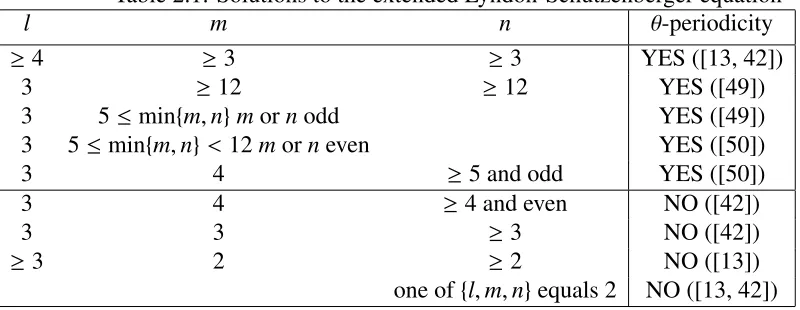
whereu1, . . . ,ul ∈ {u, θ(u)},v1, . . . ,vn ∈ {v, θ(v)}andw1, . . . ,wm∈ {w, θ(w)}forl,m,n ≥2. We mention the following result as a special case of the solution to the equation where n,m ≥ 3 andl≥ 6, whereas the Table 2.1 summarizes the remaining results proved in [13, 42, 49, 50].
Theorem 2.5.7 Let u,v,w ∈ Σ+, n,m ≥ 3, l ≥ 6, ui ∈ {u, θ(u)}for1 ≤ i ≤ l, vj ∈ {v, θ(v)}for 1≤ j≤ n and wk ∈ {w, θ(w)}for1≤ k≤ m. If u1. . .ul = v1. . .vnw1. . .wm, then there exists a
word t∈Σ+such that u,v,w∈ {t, θ(t)}+.
A wordu∈Σ∗is called aconjugateof a wordw∈Σ∗if there exists a wordv∈Σ∗such that
uv = vw. The notion of conjugacy was extended to the notion ofθ-conjugacy by [40]: if θis either a morphic or an antimorphic involution then a worduisθ-conjugateof another wordw
ifuv= θ(v)wfor somev∈Σ∗.
Example 2.4 Let θ be an antimorphic involution on Σ = {A,C,G,T} such that θ(A) = T ,
θ(G)= C and vice versa. Then u= ACCT and w =CT GT areθ-conjugates of each other for v=GT since(ACCT)(GT)= θ(GT)(CT GT).
Note that the θ-conjugacy relation for a morphic involution is transitive, whereas for an
antimorphic involution it need not be transitive. The following proposition provides the
char-acterization ofθ-conjugate words.
Proposition 2.5.8 [40] Let u be aθ-conjugate of w such that uv= θ(v)w for some v∈Σ∗. Then 1. For a morphic involutionθthere exists x,y∈Σ∗such that u= xy and one of the following
2.5. DNAcomputing inspired combinatorics on words 33
Table 2.1: Solutions to the extended Lyndon-Sch¨utzenberger equation
l m n θ-periodicity
≥4 ≥3 ≥3 YES ([13, 42])
3 ≥ 12 ≥ 12 YES ([49])
3 5≤min{m,n}mornodd YES ([49])
3 5≤ min{m,n}<12morneven YES ([50])
3 4 ≥5 and odd YES ([50])
3 4 ≥4 and even NO ([42])
3 3 ≥3 NO ([42])
≥3 2 ≥2 NO ([13])
one of{l,m,n}equals 2 NO ([13, 42])
(a) w= yθ(x)and v =(θ(x)θ(y)xy)iθ(x)for some i≥0.
(b) w= θ(y)x and v=(θ(x)θ(y)xy)iθ(x)θ(y)x for some i≥0. 2. For an antimorphic involution θ, there exists x,y ∈ Σ∗
such that either u = xy and w=yθ(x), or w =θ(u).
According to Proposition 2.5.8, for an antimorphic involutionθ, if two wordsuandwareθ -conjugates of each other, then one of the possibilities is thatw =θ(u), and hence the existence of a word and its θ-conjugate in the computation can lead to the formation of undesirable
secondary structures.
Corollary 2.5.9 [40] For a morphic involutionθonΣ∗,θ-conjugacy on words is a symmetric
relation.
A worduis said tocommutewith the wordvifuv= vu, [61]. Similarly, a worduis said to
θ-commutewith the wordyif xy= θ(y)x, [40]. Hence the existence of words thatθ-commute with each other can lead to the formation of undesirable secondary structures.
Example 2.5 Let θ be an antimorphic involution on Σ = {A,C,G,T} such that θ(A) = T ,
θ(G) = C and vice versa. Then the two words x = AT and y = CGAT θ-commute since
![Figure 2.3: Pseudoknot structure formed due to intra-molecular hybridization modelled as aθ-pseudoknot-bordered word xyγθ(x)θ(y) [43]](https://thumb-us.123doks.com/thumbv2/123dok_us/7763581.1275457/23.612.158.436.226.360/figure-pseudoknot-structure-molecular-hybridization-modelled-pseudoknot-bordered.webp)
![Figure 2.4: Hairpin constructions corresponding to the languages αHk whereα ∈ {u, b, c, f, bc, bf, cf, bcf}, [56]](https://thumb-us.123doks.com/thumbv2/123dok_us/7763581.1275457/27.612.174.422.72.214/figure-hairpin-constructions-corresponding-languages-ahk-wherea-bcf.webp)
![Figure 2.5: A θ-bordered word u over the DNA alphabet, with overlapping θ-border v wherew = θ(v) [39]](https://thumb-us.123doks.com/thumbv2/123dok_us/7763581.1275457/29.612.204.393.273.379/figure-bordered-word-dna-alphabet-overlapping-border-wherew.webp)
![Figure 2.7: Inter-molecular hybridization between two strands uof and v, θ(v) being a subword u [34]](https://thumb-us.123doks.com/thumbv2/123dok_us/7763581.1275457/30.612.177.452.197.284/figure-inter-molecular-hybridization-strands-uof-th-subword.webp)
![Figure 2.9: Classes of languages free from certain types of undesired hybridization [44]](https://thumb-us.123doks.com/thumbv2/123dok_us/7763581.1275457/32.612.131.498.75.323/figure-classes-languages-free-certain-types-undesired-hybridization.webp)
![Figure 2.10: Protocol to select maximally mismatched oligonucleotides, starting with a popu-lation of strands with primer pair P1 and P2C, which amplifies only very mismatched oligonu-cleotides [16]](https://thumb-us.123doks.com/thumbv2/123dok_us/7763581.1275457/36.612.229.399.256.505/protocol-maximally-mismatched-oligonucleotides-starting-amplies-mismatched-cleotides.webp)
![Figure 2.11: A recombinant plasmid with two DNA fragments as sentinels protecting the en-coded message in between, [68]](https://thumb-us.123doks.com/thumbv2/123dok_us/7763581.1275457/41.612.240.355.142.234/figure-recombinant-plasmid-fragments-sentinels-protecting-coded-message.webp)
![Figure 2.12: Encryption of the first word of Richard Feynman’s suggested message to futurecivilizations [11]](https://thumb-us.123doks.com/thumbv2/123dok_us/7763581.1275457/42.612.203.424.74.182/figure-encryption-rst-richard-feynman-suggested-message-futurecivilizations.webp)