Prover-Efficient Commit-And-Prove
Zero-Knowledge SNARKs
Helger Lipmaa
Institute of Computer Science, University of Tartu,
Estonia
E-mail: [email protected]
Abstract: Zk-SNARKs (succinct non-interactive zero-knowledge arguments of knowledge) are needed in many applications. Unfortunately, all previous zk-SNARKs for interesting languages are either inefficient for the prover, or are non-adaptive and based on a commitment scheme that depends both on the prover’s input and on the language, i.e., they are not commit-and-prove (CaP) SNARKs. We propose a proof-friendly extractable commitment scheme, and use it to construct prover-efficient adaptive CaP succinct zk-SNARKs for different languages, that can all reuse committed data. In new zk-zk-SNARKs, the prover computation is dominated by a linear number of cryptographic operations. We use verification to decrease the verifier’s computation; importantly, batch-verification can be used also in QAP-based zk-SNARKs.
Keywords:Batch verification, commit-and-prove, CRS, NIZK, numerical NP-complete languages, range proof,Subset-Sum, zk-SNARK
Reference to this paper should be made as follows: Lipmaa, , H. (201x) ‘Prover-Efficient Commit-And-Prove Zero-Knowledge SNARKs’,International Journal of Applied Cryptography, Vol. x, No. x, pp.xxx(Submitted)–xxx.
Biographical notes: Helger Lipmaa received his PhD from the University of Tartu in 1999. He is a lead research fellow in the Institute of Computer Science, University of Tartu.
1 Introduction
Recently, there has been a significant surge of activity in studying succinct non-interactive zero knowledge (NIZK) arguments of knowledge (also known as zk-SNARKs) (Ben-Sasson et al., 2013, 2014a,b; Bitansky et al., 2013; Costello et al., 2015; Danezis et al., 2014; Gennaro et al., 2013; Groth, 2010; Lipmaa, 2012, 2013; Parno et al., 2013). The prover of a zk-SNARK outputs a short (ideally, a small number of group elements) argument π that is used to convince many different verifiers in the truth of the same claim without leaking any side information. The verifiers can verify independently the correctness of π, without communicating with the prover. The argument must be efficiently verifiable. Constructing the argument can be less efficient, since it is only done once. Still, prover-efficiency is important, e.g., in a situation where a single server has to create many arguments to different clients or other servers.
Many known zk-SNARKs are non-adaptive, meaning that the common reference string, CRS, can depend on the concrete instance of the language (e.g., the circuit in the case of Circuit-SAT). In an adaptive zk-SNARK, the CRS is independent on the instance and thus can be reused many times.
This distinction is important, since generation and distribution of the CRS must be done securely. The most efficient known non-adaptive zk-SNARKs for NP-complete languages from (Gennaro et al., 2013) are based on either Quadratic Arithmetic Programs (QAP, for arithmetic Circuit-SAT) or Quadratic Span Programs (QSP, for Boolean Circuit-SAT). There, the prover computation is dominated by Θ(n) cryptographic operations (see App. A for a clarification on cryptographic/non-cryptographic operations), where
nis the number of the gates. QAP, QSP (Gennaro et al., 2013; Lipmaa, 2013) and other related approaches like SSP (Danezis et al., 2014) have the same asymptotic complexity.
QSP-based Circuit-SAT SNARK can be made adaptive by using universal circuits (Valiant, 1976). Then, the CRS depends on the construction of universal circuit and not on the concrete input circuit itself. However, since the size of a universal circuit is Θ(nlogn), the prover computation in resulting adaptive zk-SNARKs is Θ(nlog2n) non-cryptographic operations and Θ(nlogn) cryptographic operations. (In the case of QAP-based arithmetic Circuit-SAT SNARK, one has to use universal arithmetic circuits (Raz, 2010) that have an even larger size Θ(r4n), where r is the degree of the polynomial computed by the arithmetic circuit.
Thus, we will mostly give a comparison to the QSP-based approach.)
Since Valiant’s universal circuits incur a large constant c= 19 in the Θ(·) expression, a common approach (Kolesnikov and Schneider, 2008; Sadeghi and Schneider, 2008) is to use universal circuits with the overhead of Θ(log2n) but with a smaller constant c= 1/2 in Θ(·). The prover computation in the resulting adaptive zk-SNARKs is Θ(nlog3n) non-cryptographic operations and Θ(nlog2n) cryptographic operations.1
Another important drawback of the QSP/QAP-based SNARKs is that they use a circuit-dependent commitment scheme. To use the same input data in multiple sub-SNARKs, one needs to construct a single large circuit that implements all sub-SNARKs, making the SNARK and the resultingnew commitment scheme more complicated. In particular, these SNARKs are not commit-and-prove (CaP (Kilian, 1989; Canetti et al., 2002)) SNARKs. We recall that in CaP SNARKs, a commitment schemeC is fixed first, and the statement consists of commitments of the witness using C; see Sect. 2. Hence, a CaP commitment scheme is instance-independent. In addition, one would like the commitment scheme to belanguage-independent, enabling one to first commit to the data and only then to decide in what applications (e.g., verifiable computation of a later fixed function) to use it.
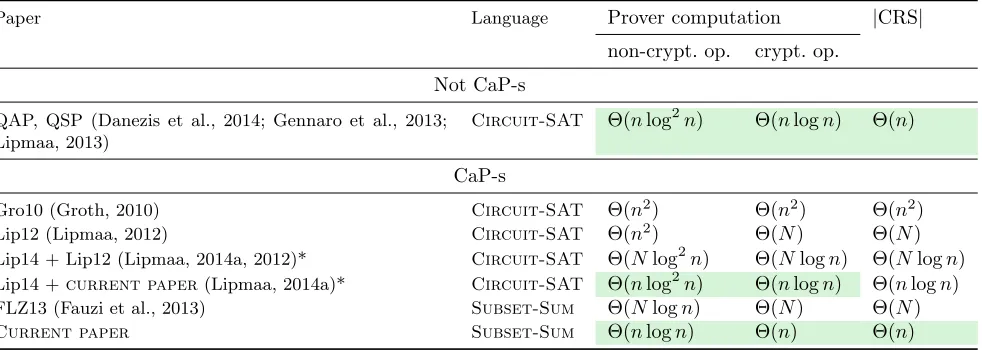
See Tbl. 1 for a brief comparison of the efficiency of proposed adaptive zk-SNARKs for NP-complete languages. Subset-Sum is here brought as an example of a wider family of languages; it can be replaced everywhere say withPartitionorKnapsack, see Sect. 8. Here, N=r−31(n) =o(n22
√
2 log2n), where
r3(n) is the density of the largest progression-free set in {1, . . . , n}. According to the current knowledge,r−31(n) is comparable to (or only slightly smaller than)n2forn < 212; this makes all known CaP SNARKs (Groth, 2010; Lipmaa, 2012; Fauzi et al., 2013) arguably impractical unless n is really small. In all cases, the verifier’s computation is dominated by either Θ(n) cryptographic or Θ(nlogn) non-cryptographic operations (with the verifier’s online computation usually being Θ(1)), and the communication consists of a small constant number of group elements.2Given all above, it is natural to ask the following question:
The Main Question of This Paper: Is it possible to construct adaptive CaP zk-SNARKs for NP-complete languages where the prover computation is dominated by a linear number of cryptographic operations?
Our Contributions. We answer the “main question” positively by improving on Groth’s modular approach (Groth, 2010). Using the modular approach allows us to modularize the security analysis, first proving the security of underlying building blocks (the product and the shift SNARKs), and then composing them to construct master SNARKs for even NP-complete languages. The security of master SNARKs follows easily from the security of the basic SNARKs. We also use
batch verification to speed up verification of almost all known SNARKs.
All new SNARKs use the same commitment scheme, the interpolating commitment scheme. Hence, one can reuse their input data to construct CaP zk-SNARKs for different unrelated languages, chosen only after the commitment was done. Thus, one can first commit to some data, and only later decide in which application and to what end to use it. Importantly, by using CaP zk-SNARKs, one can guarantee that all such applications use exactly the same data.
The resulting SNARKs are not only commit-and-prove, but also very efficient, and often more efficient than any previously known SNARKs. The new CaP SNARKs have prover-computation dominated by Θ(n) cryptographic operations, with the constant in Θ(·) being reasonably small. Importantly, we propose the most efficient known succinct range SNARK. Since the resulting zk-SNARKs are sufficiently different from QAP-based zk-SNARKs, we hope that our methodology by itself is of independent interest. Up to the current paper, Groth’s modular approach has resulted in significantly less efficient zk-SNARKs than the QSP/QAP-based approach.
In Sect. 3, we construct a new natural extractable trapdoor commitment scheme (the interpolating commitment scheme). Here, commitment to ~a∈Znp,
where n is a power of 2, is a short garbled and randomized version gL~a(χ)
1 (g
χn−1
1 )r of the Lagrange interpolating polynomial L~a(X) of ~a, for a random
secret key χ, together with a knowledge component. This commitment scheme is arguably a very natural one, and in particular its design is not influenced by the desire to tailor it to one concrete application. Nevertheless, as we will see, using it improves the efficiency of many constructions while allowing to reuse many existing results.
The new CaP zk-SNARKs are based on the interpolating commitment scheme and two CaP witness-indistinguishable SNARKs: a product SNARK (given commitments to vectors ~a, ~b, ~c, it holds that ci=
aibi; see (Groth, 2010; Fauzi et al., 2013; Lipmaa,
2012)), and a shift SNARK (given commitments to
~a, ~b, it holds that ~a is a coordinate-wise shift of ~b; see (Fauzi et al., 2013)). One can construct an adaptive Circuit-SAT CaP zk-SNARK from Θ(logn) product and shift SNARKs (Groth, 2010; Lipmaa, 2014a), or adaptive CaP zk-SNARKs for NP-complete languages like Subset-Sum (and a similar CaP range SNARK) by using a constant number of product and shift SNARKs (Fauzi et al., 2013).
Table 1 Prover-efficiency of knownadaptive zk-SNARKs for NP-complete languages. Here,nis the number of the gates (in the case ofCircuit-SAT) and the number of the integers (in the case ofSubset-Sum). Green background denotes the best known asymptotic complexity of theconcreteNP-complete language w.r.t. to the concrete parameter. The solutions marked with * use proof bootstrapping from (Costello et al., 2015)
Paper Language Prover computation |CRS|
non-crypt. op. crypt. op. Not CaP-s
QAP, QSP (Danezis et al., 2014; Gennaro et al., 2013; Lipmaa, 2013)
Circuit-SAT Θ(nlog2n) Θ(nlogn) Θ(n)
CaP-s
Gro10 (Groth, 2010) Circuit-SAT Θ(n2) Θ(n2) Θ(n2)
Lip12 (Lipmaa, 2012) Circuit-SAT Θ(n2) Θ(N) Θ(N)
Lip14 + Lip12 (Lipmaa, 2014a, 2012)* Circuit-SAT Θ(Nlog2n) Θ(Nlogn) Θ(Nlogn)
Lip14 +current paper(Lipmaa, 2014a)* Circuit-SAT Θ(nlog2n) Θ(nlogn) Θ(nlogn)
FLZ13 (Fauzi et al., 2013) Subset-Sum Θ(Nlogn) Θ(N) Θ(N)
Current paper Subset-Sum Θ(nlogn) Θ(n) Θ(n)
operations in (Fauzi et al., 2013). The speed-up is mainly due to the use of the interpolating commitment scheme.
In Sect. 5, we propose a variant of the CaP shift SNARK of (Fauzi et al., 2013), secure when combined with the interpolating commitment scheme. We prove that this SNARK is an adaptive argument of knowledge under a computational and a knowledge assumption. It only requires the prover to perform Θ(n) cryptographic and non-cryptographic operations.
Product and shift SNARKs are already very powerful by itself. E.g., a prover can commit to her input vector
~a. Then, after agreeing with the verifier on a concrete application, she can commit to a different yet related input vector (that say consists of certain permuted subset of ~a’s coefficients), and then use the basic SNARKs to prove that this was done correctly. Here, she may use the permutation SNARK (Lipmaa, 2014a) that consists ofO(logn) product and shift SNARKs. Finally, she can use another, application-specific, SNARK (e.g., a range SNARK) to prove that the new committed input vector has been correctly formed.
In Sect. 6, we describe a modular adaptive CaP zk-SNARK, motivated by (Fauzi et al., 2013), for the NP-complete language, Subset-Sum. (Subset-Sum was chosen by us mainly due to the simplicity of the SNARK; the rest of the paper considers more applications.) This SNARK consists of three commitments, one application of the shift SNARK, and three applications of the product SNARK. It is a zk-SNARK given that the commitment scheme, the shift SNARK, and the product SNARK are secure. Its prover computation is strongly dominated by Θ(n) cryptographic operations, wherenis the instance size, the number of integers. More precisely, the prover has to perform only nine (≈n)-wide multi-exponentiations, which makes the SNARK efficient not only asymptotically (to compare, the size of Valiant’s arithmetic circuit has constant 19, and this constant
has to be multiplied by the overhead of non-adaptive QSP/QAP/SSP-based solutions). Thus, we answer positively to the stated main question of the current paper. Moreover, the prover computation is highly parallelizable, while the online verifier computation is dominated by 17 pairings (this number will be decreased later).
In Sect. 7, we propose a new CaP range zk-SNARK that the committed value belongs to a range [L .. H]. This SNARK looks very similar to the Subset-Sum SNARK, but with the integer setS~ of theSubset-Sum language depending solely on the range length. Since here the prover has a committed input, the simulation of the range SNARK is slightly more complicated than of the Subset-SumSNARK. Its prover-computation is similarly dominated by Θ(n) cryptographic operations, where this time n:=dlog2(H−L)e. Differently from the Subset-Sum SNARK, the verifier computation is dominated only by Θ(1) cryptographic operations, more precisely, by 19 pairings (also this number will be decreased later). Importantly, this SNARK is computationally more efficient than any of the existing succinct range SNARKs either in the standard model (i.e., random oracle-less) or in the random oracle model. E.g., the prover computation in (Lipmaa, 2003) is Θ(n2) under the Extended Riemann Hypothesis, and the prover computation in (Fauzi et al., 2013) is Θ(r−3(n) logr−3(n)). It is also significantly simpler than the range SNARKs of (Chaabouni et al., 2012; Fauzi et al., 2013), mostly since we do not have to consider different trade-offs between computation and communication.
Circuit-SAT, the complexity of most other SNARKs is similar to that of Subset-Sum zk-SNARK. It is an interesting open problem why some NP-complete languages like Subset-Sum have more efficient zk-SNARKs in the modular approach (equivalently, why their verification can be performed more efficiently in the parallel machine model that consists of Hadamard product and shift) than languages like Circuit-SAT. We note that (Fauzi and Lipmaa, 2016) used recently some of the ideas from the current paper to construct an efficient shuffle argument. However, they did not use product or shift arguments.
In Sect. 9, we show that by using batch-verification (Bellare et al., 1998), one can decrease the verifier’s computation of all presented SNARKs. In particular, one can decrease the verifier’s computation in the new Range SNARK from 19 pairings to 8 pairings, one 4-way multi-exponentiation inG1, two 3-way multi-exponentiations in G1, one 2-way multi-exponentiation inG1, three exponentiations inG1, and one 3-way multi-exponentiation inG2.. Since one exponentiation is much cheaper than one pairing (Bos et al., 2013) and one
m-way multi-exponentiation is much cheaper than m
exponentiations (Straus, 1964; Pippenger, 1980), this results in a significant win for the verifier. A similar technique can be used to also speed up other SNARKs; a good example here is the Circuit-SAT argument from (Lipmaa, 2014a) that uses Θ(logn) product and shift arguments. To compare, in Pinocchio (Parno et al., 2013) and Geppetto (Costello et al., 2015), the verifier has to execute 11 pairings; however, batch-verification can also be used to decrease this to 8 pairings and a small number of (multi-)exponentiations.
Finally, all resulting SNARKs work on data that has been committed to by using the interpolating commitment scheme. This means that one can repeatedly reuse committed data to compose different zk-SNARKs (e.g., to show that we know a satisfying input to a circuit, where the first coefficient belongs to a certain range). This is not possible with the known QSP/QAP-based zk-SNARKs where one would have to construct a single circuit of possibly considerable size, sayn0. Moreover, in the QSP/QAP-based SNARKs, one has to commit to the vector, the length of which is equal to the total length of the input and witness (e.g.,n0 is the number of wires in the case of Circuit-SAT). By using a modular solution, one can instead execute several zk-SNARKs with smaller values of the input and witness size; this can make the SNARK more prover-efficient since the number of non-cryptographic operations is superlinear. This emphasizes another benefit of the modular approach: one can choose the valuen, the length of the vectors, accordingly to the desired tradeoff, so that largernresults in faster verifier computation, while smaller n results in faster prover computation. We are not aware of such a tradeoff in the case of the QSP/QAP-based approach.
We provide some additional discussion (about the relation between n and then input length, and about
possible QSP/QAP-based solutions) in Sect 10. We note that an early version of this paper, (Lipmaa, 2014b), was published in May 2014 and thus predates (Costello et al., 2015). The published version (Lipmaa, 2016) differs from this early version mainly by exposition, and the use of proof bootstrapping (from (Costello et al., 2015)) and batching.
2 Preliminaries
By default, all vectors have dimension n. Let
~a◦~b denote the Hadamard (i.e., element-wise) product of two vectors, with (~a◦~b)i=aibi. We
say that ~a is a shift-right-by-z of ~b, ~a=~bz, iff (an, . . . , a1) = (0, . . . ,0, bn, . . . , b1+z). For a tuple of
polynomials F ⊆Zp[X, Y1, . . . , Ym−1], define YmF=
(Ym·f(X, Y1, . . . , Ym−1))f∈F⊆Zp[X, Y1, . . . , Ym]. For
a tuple of polynomials F that have the same domain, denote hF(~a):= (hf(~a))f∈F. For a group G, let G∗
be the set of its invertible elements. Since the direct product G1× · · · ×Gm of groups is also a group, we
use notation like (g1, g2)c= (gc1, g2c)∈G1×G2 without prior definition. Let κ be the security parameter. We denotef(κ)≈κg(κ) if|f(κ)−g(κ)|is negligible inκ.
On input 1κ, a bilinear map generator BP returns
gk= (p,G1,G2,GT,ˆe), where G1,G2 and GT are three
multiplicative cyclic groups of prime order p (with logp= Ω(κ)), and ˆeis an efficient bilinear map ˆe: G1×
G2→GT that satisfies in particular the following two
properties, whereg1 (resp.,g2) is an arbitrary generator ofG1 (resp.,G2):
1. ˆe(g1, g2)6= 1, and 2. ˆe(g1a, g2b) = ˆe(g1, g2)ab. Thus, if ˆe(ga
1, g2b) = ˆe(gc1, g2d) thenab≡cd (mod p). We also give BP another input, n (intuitively, the input length), and allow p to depend on n. We assume that all algorithms that handle group elements verify by default that their inputs belong to corresponding groups and reject if they do not. In the case of many practically relevant pairings, arithmetic in (say) G1 is considerably cheaper than in G2; hence, we count separately exponentiations in both groups.
For κ= 128, the current recommendation is to use an optimal (asymmetric) Ate pairing (Hess et al., 2006) over Barreto-Naehrig curves (Barreto and Naehrig, 2005; Pereira Geovandro et al., 2011). In that case, at security level of κ= 128, an element ofG1/G2/GT can
be represented in respectively 256/512/3072 bits. To speed up interpolation, we will additionally need the existence of the n-th, wherenis a power of 2, primitive root of unity modulo p (under this condition, one can interpolate in time Θ(nlogn), otherwise, interpolation takes time Θ(nlog2n), (Gathen and Gerhard, 2003)). For this, it suffices that (n+ 1)|(p−1) (recall that p
is the elliptic curve group order). Fortunately, given κ
find a Barreto-Naehrig curve such that (n+ 1)|(p− 1) holds; such an observation was made also in (Ben-Sasson et al., 2014b). For example, if κ= 128 and
n= 210, one can use Alg. 1 of (Barreto and Naehrig, 2005) to find an elliptic curve group of prime order
N(x0) over a finite field of prime order P(−x0) for
x0= 1753449050, where P(x) = 36x4+ 36x3+ 24x2+ 6x+ 1, T(x) = 6x2+ 1, and N(x) =P(x) + 1−T(x). One can then use the curveE:y2=x3+ 6.
In proof bootstrapping (Costello et al., 2015), one needs an additional elliptic curve group ˜E over a finite field of order N(x0) (see (Costello et al., 2015) for additional details). Such elliptic curve group can be found by using the Cocks-Pinch method (Blake et al., 2005); note that ˜Ehas somewhat less efficient arithmetic thanE.
The security of the new commitment scheme and of the new SNARKs depends on the following q-type assumptions, variants of which have been used in many previous papers. The assumptions are parameterized but non-interactive in the sense that q is related to the parameters of the language (most generally, to the input length) and not to the number of the adversarial queries. All known (to us) adaptive zk-SNARKs are based on
q-type assumptions aboutBP.
Letd(n)∈poly(n) be a function. Then, BPis • d(n)-PDL (Power Discrete Logarithm, (Lipmaa,
2012)) secure if for any n∈poly(κ) and any non-uniform probabilistic polynomial-time (NUPPT) adversaryA,
Pr
gk←BP(1κ, n),
(g1, g2, χ)←rG∗1×G
∗
2×Zp:
A(gk; ((g1, g2)χ
i
)di=0(n)) =χ
≈κ0 .
• n-TSDH (Target Strong Diffie-Hellman, (Boneh and Boyen, 2004; Parno et al., 2013)) secure if for anyn∈poly(κ) and any NUPPT adversary A,
Pr
gk←BP(1κ, n),
(g1, g2, χ)←rG∗1×G∗2×Zp:
A(gk; ((g1, g2)χ
i
)ni=0) = (r,eˆ(g1, g2)1/(χ−r))
≈κ0 .
For algorithms A and XA, we write (y;y0)←
(A||XA)(χ) if A on input χ outputs y, and XA
on the same input (including the random tape of A) outputs y0 (Abe and Fehr, 2007). We will need knowledge assumptions w.r.t. several knowledge secrets
γi. Let m be the number of different knowledge
secrets in any concrete SNARK. Let F = (Pi)ni=0 be a tuple of univariate polynomials, and G1 (resp., G2) be a tuple of univariate (resp.,m-variate) polynomials. Let i∈[1.. m]. Then, BP is (F,G1,G2, i)-PKE (Power Knowledge of Exponent, (Groth, 2010)) secureif for any
NUPPT adversary A there exists an NUPPT extractor
XA, such that
Pr
gk←BP(1κ, n),
(g1, g2, χ, ~γ)←rG1∗×G∗2×Zp×Zmp,
~
γ−i←(γ1, . . . , γi−1, γi+1, . . . , γm),
aux←(gG1(χ) 1 , g
G2(χ, ~γ−i)
2 ), (h1, h2; (ai)ni=0)←
(A||XA)(gk; (g1, g
γi
2 )
F(χ),aux) : ˆ
e(h1, g
γi
2 ) = ˆe(g1, h2)∧h16=g Pn
i=0aiPi(χ)
1
≈κ0 .
Here, auxcan be seen as the common auxiliary input to A and XA that is generated by using benign auxiliary
input generation (Bitansky et al., 2014). IfF = (Xi)d i=0 for some d=d(n), then we replace the first argument in (F, . . .)-PKE with d. If m= 1, then we omit the last argument i in (F, . . . , i)-PKE. While knowledge assumptions are falsifiable, we recall that non-falsifiable assumptions are needed to design succincts SNARKs for interesting languages (Gentry and Wichs, 2011).
By generalizing (Boneh and Boyen, 2008; Groth, 2010; Lipmaa, 2012), one can show that the TSDH, PDL, and PKE assumptions hold in the generic bilinear group model.
Within this paper, m≤2, and hence we denote γ1 just by γ, andγ2 byδ.
Commitment Schemes. An extractable trapdoor commitment scheme in the CRS model (Blum et al., 1988) consists of two efficient algorithms Gcom (that
outputs a CRSckand a trapdoor) andC(that, givenck, a messagemand a randomizerr, outputs a commitment Cck(m;r)), and must satisfy the following security
properties.
Computational binding: without access to the trapdoor, it is intractable to open a commitment to two different messages.
Trapdoor: given access to the original message, the randomizer and the trapdoor, one can open the commitment to any other message.
Perfect hiding: commitments of any two messages have the same distribution.
Extractability: given access to the CRS, the commitment, and the random coins of the committer, one can open the commitment to the committed message.
Commit-And-Prove SNARKs. Let R={(u, w)} be an efficiently verifiable relation with |w|= poly(|u|). Here,
u is a statement, and w is a witness. Let L={u: ∃w,(u, w)∈ R}be an NP-language. Letn=|u|be the input length. For fixedn, we have a relation Rn and a
languageLn.
Following (Kilian, 1989; Canetti et al., 2002), we will define commit-and-prove (CaP) argument systems. Intuitively, a CaP non-interactive zero knowledge argument system for R allows to create a common reference string (CRS) crs, commit to some values wi
(say,ui=Cck(wi;ri), whereckis a part ofcrs), and then
prove that a subsetu:= (uij, wij, rij)
`m(n)
j=1 (for publicly known indices ij) satisfies that uij is a commitment of
wij with randomizerrij, and that (wij)∈ R.
Differently from most of the previous work (but see also (Costello et al., 2015)), our CaP argument systems will use computationally binding trapdoor commitment schemes. This means that without their openings, commitments ui=Cck(ai;ri) themselves do
not define a valid relation, sinceuican be a commitment
to any a0i, given a suitable r0i. Rather, we define a new relationRck:={(~u, ~w, ~r) : (∀i, ui=Cck(wi;ri))∧
~
w∈ R},and construct argument systems forRck.
Within this subsubsection, we let vectors~u, w~, and
~r be of dimension `m(n) for some polynomial `m(n).
However, we allow committed messageswithemselves to
be vectors of dimensionn. Thus, `m(n) is usually very
small. In some argument systems (like theSubset-Sum SNARK in Sect. 6), also the argument will include some commitments. In such cases, technically speaking,w~ and
~rare of higher dimension than ~u. To simplify notation, we will ignore this issue.
A commit-and-prove non-interactive zero-knowledge argument system (Kilian, 1989; Canetti et al., 2002) Π for R consists of an (R-independent) trapdoor commitment scheme Γ = (Gcom,C) and of a
non-interactive zero-knowledge argument system (G,P,V), that are combined as follows:
1. the CRS generator G (that, in particular, invokes (ck,tdC)←Gcom(1κ, n)) outputs (crs=
(crsp,crsv),td)←G(1κ, n), where both crsp and
crsv includeck, andtdincludes tdC.
2. the prover P produces an argument π, π← P(crsp;~u;w, ~~ r), where presumablyui=Cck(wi;ri).
3. the verifier V, V(crsv;~u, π), outputs either 1
(accept) or 0 (reject).
Now, Π isperfectly complete, if for all n= poly(κ),
Pr
"
(crs,td)←G(1κ, n),(~u, ~w, ~r)← Rck,n:
V(crsv;~u,P(crsp;~u, ~w, ~r)) = 1
#
= 1 .
Since Γ is computationally binding and trapdoor (and hence ui can be commitments to any messages),
soundness of the CaP argument systems only makes sense together with the argument of knowledge property.
(Another possibility is to define and prove culpable soundness (Groth et al., 2012), but the argument of knowledge property is more standard.)
Let b(X) be a non-negative polynomial. Π is a (b-bounded-auxiliary-input (Bitansky et al., 2014)) argument of knowledge forR, if for alln= poly(κ) and every NUPPTA, there exists an NUPPT extractorXA,
such that for every auxiliary inputaux∈ {0,1}b(κ),
Pr
(crs,td)←G(1κ, n),
((~u, π);w, ~~ r)←(A||XA)(crs;aux) :
(~u, ~w, ~r)6∈ Rck,n∧V(crsv;~u, π) = 1
≈κ0 .
See (Bitansky et al., 2014) for a motivation behind bounded auxiliary input. As in the definition of PKE, we can restrict the definition of an argument of knowledge to benign auxiliary information generators, whereauxis known to come from; we omit further discussion.
Π is perfectly witness-indistinguishable, if for all
n= poly(κ), it holds that if (crs,td)∈G(1κ, n) and
((~u;w, ~~ r),(u~;w~0, ~r0))∈ R2
ck,n with ri, r0i←rR, then the
distributions P(crsp;~u;w, ~~ r) and P(crsp;~u;w~0, ~r0) are
equal. Note that a witness-indistinguishable argument system does not have to have a trapdoor.
Π is perfectly composable zero-knowledge, if there exists a probabilistic poly-time simulator S, s.t. for all stateful NUPPT adversariesAandn= poly(κ),
Pr
(crs,td)←G(1κ, n),
(~u, ~w, ~r)←A(crs), π←P(crsp;~u;w, ~~ r) :
(~u, ~w, ~r)∈ Rck,n∧A(π) = 1
=
Pr
(crs,td)←G(1κ, n),
(~u, ~w, ~r)←A(crs), π←S(crs;~u,td) :
(~u, ~w, ~r)∈ Rck,n∧A(π) = 1
.
Here, the prover and the simulator use the same CRS, and thus we havesame-string zero knowledge(De Santis et al., 2001). For NP-complete languages, same-string NIZK can only be computationally sound (De Santis et al., 2001). Same-string statistical zero knowledge allows to use the same CRS an unbounded number of times (De Santis et al., 2001).
An argument system that satisfies above requirements is known asadaptive. An argument system where the CRS depends on the statement is often called non-adaptive. It is not surprising that non-adaptive SNARKs can be much more efficient than adaptive SNARKs; see (Jutla and Roy, 2013, 2014) for some examples.
3 New Extractable Trapdoor Commitment
Scheme
We now define a new extractable trapdoor commitment scheme. It uses the following polynomials. Assume nis a power of two, and letω be the n-th primitive root of unity modulop. Then,
• Z(X) :=Qni=1(X−ωi−1) =Xn−1 is the unique degreenmonic polynomial, such thatZ(ωi−1) = 0 for alli∈[1.. n].
• `i(X) :=Qj6=i((X−ω
j−1)/(ωi−1−ωj−1)), the
ith Lagrange basis polynomial, is the unique degree
n−1 polynomial, such that `i(ωi−1) = 1 and
`i(ωj−1) = 0 forj6=i.
Clearly, L~a(X) = Pn
i=1ai`i(X) is the interpolating
polynomial of ~a at points ωi−1, with La~(ωi−1) =ai,
and can thus be computed by executing an inverse Fast Fourier Transform. Moreover, (`i(ωj−1))nj=1=~ei (the
ith unit vector) and (Z(ωj−1))jn=1=~0n. Thus, Z(X)
and (`i(X))ni=1 aren+ 1 linearly independent degree≤
npolynomials, and henceFC:= (Z(X),(`i(X))ni=1) is a basis of such polynomials. Clearly,Z−1(0) ={j:Z(j) = 0}={ωi−1}n
i=1.
Interpolating Commitment Scheme: Let n= poly(κ), n >0, be a power of two. First, Gcom(1κ, n)
sets gk←BP(1κ, n), picks g
1←rG∗1, g2←rG∗2, and then outputs the CRS
ck←(gk; (gf1(χ), g2γf(χ))f∈FC)
for χ←rZp\Z−1(0) and γ←rZ∗p. The trapdoor is
equal toχ.
The commitment of ~a∈Zn
p, given a
randomizer r←rZp, is Cck(~a;r) := (g Z(χ) 1 , g
γZ(χ) 2 )r·
Qn i=1(g
`i(χ)
1 , g
γ`i(χ)
2 )
ai∈
G1×G2, i.e., Cck(~a;r) :=
(g1, g
γ
2)
r(χn−1)+L
~a(χ). The validity of a commitment
(A1, A
γ
2) is checked by verifying that ˆe(A1, g
γZ(χ) 2 ) = ˆ
e(gZ1(χ), Aγ2). To open a commitment, the committer sends (~a, r) to the verifier.
The condition Z(χ)6= 0 is needed in Thm. 1 to get perfect hiding and the trapdoor property. The condition
γ6= 0 is only needed in Thm. 7 to get perfect zero knowledge. Also, (a function of) γ is a part of the trapdoor in the range SNARK of Sect. 7.
Clearly, logg1A1= loggγ2A γ
2 =rZ(χ) +
Pn
i=1ai`i(χ). The second element, A γ
2, of the commitment is known as the knowledge component (Damg˚ard, 1991).
Theorem 1: The interpolating commitment scheme is perfectly hiding and trapdoor. If BP is n-PDL secure, then it is computationally binding. IfBPis(n,∅,∅)-PKE secure, then it is extractable.
Proof: Perfect hiding: since Z(χ)6= 0, then rZ(χ) (and thus also logg1A1) is uniformly random in Zp.
Hence, (A1, Aγ2) is a uniformly random element of the multiplicative subgroup h(g1, gγ2)i ⊂G∗1×G∗2 generated by (g1, g
γ
2), independently of the committed value. Trapdoor: given χ, ~a, r, a~∗, and c=Cck(~a;r), we
computer∗ s.t. (r∗−r)Z(χ) +Pn
i=1(a∗i −ai)`i(χ) = 0.
This is possible since Z(χ)6= 0. Clearly, c=Cck(a~∗;r∗).
Extractability: clear from the statement.
Computational binding: assume that there exists an adversary AC that outputs (~a, ra) and (~b, rb)
with (~a, ra)6= (~b, rb), s.t. the polynomial d(X) :=
(raZ(X) +Pni=1ai`i(X))−(rbZ(X) +Pni=1bi`i(X))
has a root at χ.
Construct now the following adversary Apdl that
breaks the PDL assumption. Given ann-PDL challenge, since FC consists of degree ≤n polynomials, Apdl
can compute a valid ck from (a distribution that is statistically close to) the correct distribution. He sends ck to AC. If AC is successful, then d(X)∈Zp[X] is a
non-trivial degree-≤npolynomial. Since the coefficients of d are known, Apdl can use an efficient polynomial
factorization algorithm to compute all roots ri ofd(X).
One of these roots has to be equal toχ.Apdlcan establish
which one by comparing each (say)g`1(ri)
1 to the element
g`1(χ)
1 given in the CRS. Clearly,g
`1(ri)
1 is computed from
g1 (which can be computed, given the CRS, since 1∈ span(FC)), the coefficients of`1(X), andri.Apdlhas the
same success probability as AC, while her running time
is dominated by that of AC plus the time to factor a
degree-≤npolynomial.
Thm. 1 also holds when instead of Z(X) and
`i(X) one uses any n+ 1 linearly independent
low-degree polynomials (say) P0(X) and Pi(X). Given
the statement of Thm. 1, this choice of the concrete polynomials is very natural: `i(X) interpolate linearly
independent vectors (and thus are linearly independent; in fact, they constitute a basis), and the choice to interpolate unit vectors is the conceptually clearest way of choosing Pi(X). Another natural choice of
independent polynomials is to set Pi(X) =Xi as
in (Groth, 2010), but that choice has resulted in much less efficient (CaP) SNARKs.
In Sect. 9 we show how to use batch-verification techniques to speed up simultaneous validity verification of many commitments.
4 New Product SNARK
~a,~b and ~c (together with the used randomizers), such that~a◦~b=~c. Thus,
R×ck,n:=
(u×, w×, r×) :
u× = ((A1, A
γ
2),(B1, B
γ
2),(C1, C
γ
2))∧
w× = (~a,~b, ~c)∧r× = (ra, rb, rc)∧
(A1, Aγ2) =Cck(~a;ra)∧
(B1, Bγ2) =Cck(~b;rb)∧
(C1, C2γ) =Cck(~c;rc)∧~a◦~b=~c
.
Next, we propose an efficient CaP product SNARK. For this, we need Lem. 2.
Lemma 2: LetA(X),B(X)andC(X)be polynomials withA(ωi−1) =a
i,B(ωi−1) =biandC(ωi−1) =ci,∀i∈
[1.. n]. LetQ(X) =A(X)B(X)−C(X). Assume that 1. A(X), B(X), C(X)∈span{`i(X)}ni=1, and
2. there exists a degreen−2polynomialπ(X), s.t.π(X) =
Q(X)/Z(X). Then~a◦~b=~c.
Proof: From (1) it follows that A(X) =L~a(X),
B(X) =L~b(X), and C(X) =L~c(X), and thus
Q(ωi−1) =aibi−ci for all i∈[1.. n]. But (2) iff
Z(X)|Q(X), which holds iffQ(X) evaluates to 0 at all
nvaluesωi−1. Thus,~a◦~b=~c. Finally, if (1) holds then degQ(X) = 2n−2 and thus degπ(X) =n−2.
If privacy and succinctness are not needed, one can think of the product argument being equal toπ(X). We achieve privacy by pickingra, rb, rc←rZp, and defining
Qwi(X) := (L~a(X) +raZ(X)) L~b(X) +rbZ(X)−
(L~c(X) +rcZ(X)). Here, the new addends of type
raZ(X) guarantee hiding. On the other hand, Qwi(X)
remains divisible by Z(X) iff~c=~a◦~b. Thus,~a◦~b=~c
iff
1. Qwi(X) can be expressed as Qwi(X) =
A(X)B(X)−C(X) for some polynomials A(X),
B(X) and C(X) that belong to the span of FC,
and
2. there exists a polynomialπwi(X), such that
πwi(X) =Qwi(X)/Z(X) . (1)
The degree ofQwi(X) is 2n, thus, ifπwi(X) exists,
then it has degreen.
However,|πwi(X)|is not sublinear inn. To minimize
communication, we let the prover transfer a “garbled” evaluation ofπwi(X) at a random secret point χ. More
precisely, the prover computes π×:=gπ1wi(χ), using the valuesgχ1i (given in the CRS) and the coefficientsπi of
πwi(X) = Pn
i=0πiXi, as follows:
π×:=g
πwi(χ)
1 ←
n Y
i=0
(g1χi)πi . (2)
Similarly, instead of (say)L~a(X) +raZ(X), the verifier
has the succinct interpolating commitmentCck(~a;ra) =
(g1, gγ2)
L~a(χ)+raZ(χ) of~a.
We now give a full description of the new product SNARK Π×, given the interpolating commitment scheme (Gcom,C) and the following tuple of algorithms,
(G×,P×,V×). Note that Cck(1~n; 0) = (g1, g
γ
2).
CRS generation G×(1κ, n): Let gk←BP(1κ), (g1, g2, χ, γ)←rG∗1×G∗2×Z2p with Z(χ)6= 0
and γ6= 0. Let crsp=ck←(gk; (g1, g
γ
2)FC(χ)) and
crsv←(gk;g γZ(χ)
2 ). Outputcrs×= (crsp,crsv). Common input: u×= ((A1, A
γ
2),(B1, B
γ
2),(C1, C
γ
2)).
Proving P×(crsp;u×;w× = (~a,~b, ~c), r× = (ra, rb, rc)):
Compute πwi(X) = Pn
i=0πiXi as in Eq. (1) and
π× as in Eq. (2). Output π×.
Verification V×(crsv;u×;π×): accept if ˆe(A1, B2γ) = ˆ
e(g1, C2γ)·ˆe(π×, g
γZ(χ) 2 ).
Since one can recompute it from ck, inclusion of g2γZ(χ)
in the CRS is only needed to speed up the verification. Here as in the shift SNARK of Sect. 5, validity of the commitments will be verified in the master SNARK. This is since the master SNARKs use some of the commitments in several sub-SNARKs, while it suffices to verify the validity of every commitment only once. Security. To obtain an argument of knowledge, we use knowledge assumptions in all following proofs. This SNARK is not zero-knowledge since the possible simulator gets three commitments as inputs but not their openings; to create an accepting argument the simulator must at least know how to open the commitment (A1B1/C1, A
γ
2B
γ
2/C
γ
2) to ~a◦~b−~c. It is witness-indistinguishable, and this suffices for the Subset-Sum and other master SNARKs to be zero-knowledge.
Theorem 3: Π× is perfectly complete and witness-indistinguishable. If the input consists of valid commitments, and BP is n-TSDH and (n,∅,∅)-PKE secure, then Π× is an (Θ(n)-bounded-auxiliary-input) adaptive argument of knowledge.
Proof: Perfect completeness: follows from the discussion in the beginning of this section. Perfect witness-indistinguishability: since the argumentπ× that satisfies the verification equations is unique, all witnesses result in the same argument, and thus this argument is witness-indistinguishable.
Argument of knowledge: Assume that Aaok is
an adversary that, givencrs×, returns (u×, π) such that V×(crsv;u×, π) = 1. Assume that the PKE assumption holds, and letXA be the extractor thatreturns openings
of the commitments inu×, i.e., (~a, ra), (~b, rb), and (~c, rc).
We now claim that XA is also the extractor needed to
Assume that this is not the case. We construct an adversary Atsdh against n-TSDH. Given an n
-TSDH challenge ch= (gk,((g1, g2)χ
i
)n
i=0), Atsdh
first generates γ←rZ∗p, and then computes (this is
possible since FC consists of degree ≤n polynomials)
and sends crs× to Aaok. Assume (Aaok||XA)(crs×)
returns ((u×= ((A1, Aγ2),(B1, B2γ),(C1, C2γ)), π),(w×= (~a,~b, ~c), r×= (ra, rb, rC))), s.t. ui=Cck(wi;ri) but
(u×, w×, r×)6∈ R×ck,n. Since the openings are correct,
~a◦~b6=~c but π is accepting. According to Lem. 2, thus
Z(X)-Qwi(X).
SinceZ(X)-Qwi(X), then for somei∈[1.. n], (X−
ωi−1)
-Qwi(X). Write Qwi(X) =q(X)(X−ωi−1) +r
for r∈Z∗p. Clearly, degq(X)≤2n−1. Moreover, we
writeq(X) =q1(X)Z(X) +q2(X) with degqi(X)≤n−
1. Since the verification succeeds, ˆe(g1, g2γ)Qwi(χ)= ˆ
e(π×, g
γZ(χ)
2 ), or ˆe(g1, g2γ)q(χ)(χ−ω
i−1)+r
= ˆe(π×, g
γZ(χ) 2 ), or ˆe(g1, g2γ)
q(χ)+r/(χ−ωi−1)
= ˆe(π×, gγZ(χ)/(χ−ω
i−1)
2 ), or
ˆ
e(g1,gγ2)
1/(χ−ωi−1) =(ˆe(π×, gγZ(χ)/(χ−ω
i−1) 2 )/ˆe(g
q(χ) 1 , g
γ
2))
r−1 .
Now, ˆ
e(g1q(χ), g2γ) = ˆe(gq1(χ) 1 , g
γZ(χ) 2 )·eˆ(g
q2(χ) 1 , g
γ
2) ,
and thus it can be efficiently computed from ((g1χi)ni=0−1, g2γ, gγZ2 (χ))⊂crs. Moreover,
Z(X)/(X−ωi−1) =`i(X)· Y
j6=i
(ωi−1−ωj−1) ,
and thus gγZ(χ)/(χ−ωi
−1)
2 can be computed
from gγ`i(χ)
2 by using generic group operations. Hence, eˆ(g1, g
γ
2)1/(χ−ω
i−1)
can be computed from ((g1χi)ni=0−1, g2γ, gγZ2 (χ),(gγ`i(χ)
2 )
n
i=1) (that can be computed from ch), by using generic group operations. Thus, the adversary has computed (r=
ωi−1,eˆ(g 1, g
γ
2)1/(χ−r)), for r6=χ. Since Atsdh knows
γ6= 0, he can finally compute (r,ˆe(g1, g2)1/(χ−r)), and thus break then-TSDH assumption.
Hence, the argument of knowledge property follows.
We remark that the product SNARK (but not the shift SNARK of Sect. 5) can be seen as a QAP-based SNARK (Gennaro et al., 2013), namely for the relation
~a◦~b−~c. (Constructing a QAP-based shift SNARK is possible, but results in using different polynomials and thus in a different commitment scheme.)
Efficiency. The prover computation is dominated by the following:
• one (n+ 1)-wide multi-exponentiation in G1. By using the Pippenger’s multi-exponentiation algorithm for large n this
means approximately n+ 1 bilinear-group multiplications, see (Pippenger, 1980). For small values of n, one can use the algorithm by Straus (Straus, 1964); then one has to execute Θ(n/logn) bilinear-group exponentiations. • three polynomial interpolations, one polynomial
multiplication, and one polynomial division to compute the coefficients of the polynomialπwi(X).
Since polynomial division can be implemented as 2 polynomial multiplications (by using pre-computation and storing some extra information in the CRS, (Gathen and Gerhard, 2003; Lipmaa, 2013)), this part is dominated by two inverse FFT-s and three polynomial multiplicationFFT-s.
The verifier computation is dominated by 3 pairings. (We will count the cost of validity verifications separately in the master SNARKs.) In the special case C1=A1 (e.g., in the Boolean SNARK, where we need to prove that ~a◦~a=~a, or in the restriction SNARK (Groth, 2010), where we need to prove that ~a◦~b=~a for a public Boolean vector~b), the verification equation can be simplified to ˆe(A1, B2γ/g
γ
2) = ˆe(π×, g
γZ(χ)
2 ), which saves one more pairing. In Sect. 9, we will describe a batch-verification technique that allows to speed up simultaneous verification of several product SNARKs.
Excluding gk, the prover CRS together with ck consists of 2(n+ 1) group elements, while the verifier CRS consists of 1 group element. The CRS can be computed in time Θ(n), by using an algorithm from (Ben-Sasson et al., 2013).
5 New Shift SNARK
In a shift-right-by-z SNARK (Fauzi et al., 2013) (shift SNARK, for short), the prover aims to convince the verifier that for 2 commitments (A, Aγ) and (B, Bγ),
he knows how to open them as (A, Aγ) =C
ck(~a;ra) and
(B, Bγ) =C
ck(~b;rb), s.t.~a=~bz. I.e.,ai=bi+zfori∈
[1.. n−z] andai= 0 fori∈[n−z+ 1.. n]. Thus,
Rrsft ck,n:=
(u×, w×, r×) :
u×= ((A1, Aγ2),(B1, B2γ))∧
w×= (~a,~b)∧
r×= (ra, rb)∧(A1, A
γ
2) =Cck(~a;ra)∧
(B1, B
γ
2) =Cck(~b;rb)∧(~a=~bz)
.
An efficient shift SNARK was described in (Fauzi et al., 2013). We now reconstruct this SNARK so that it can be used together with the interpolating commitment scheme. We can do it since the shift SNARK of (Fauzi et al., 2013) is almost independent of the commitment scheme. We also slightly optimize the resulting SNARK; in particular, the verifier has to execute one less pairing compared to (Fauzi et al., 2013).
with a concrete verification equation that also contains the argument, that we denote by π1. We write the discrete logarithm ofπ1(that follows from this equation) asFπ(χ) +Fcon(χ), where χis a secret key, andFπ(X)
andFcon(X) are two polynomials. The first polynomial,
Fπ(X), is identically zero iff the prover is honest.
Since the spans of certain two polynomial sets do not intersect, this results in an efficient adaptive shift SNARK that is an argument of knowledge under (two) PKE assumptions.
Now, for a non-zero polynomial Z∗(X) to be defined later, consider the verification equation ˆ
e(A1, g
γZ∗(χ)
2 )/ˆe(B1π1, g
γ
2) = 1 (due to the properties of pairing, this is equivalent to verifying that
π1=A
Z∗(χ)
1 /B1), with (A1, Aγ2) and (B1, Bγ2) being interpolating commitments to~a and~b, and π1=g
π(χ) 1 for some polynomialπ(X). Denoter(X) := (raZ∗(X)−
rb)Z(X). Taking a discrete logarithm of the verification
equation, we get that
π(X) = raZ(X) + n X
i=1 ai`i(X)
!
Z∗(X)−
rbZ(X) + n X
i=1 bi`i(X)
!
=Z∗(X) n X
i=1
ai`i(X)− n X
i=1
bi`i(X) +r(X)
= n−z X
i=1
ai`i(X) + n X
i=n−z+1 ai`i(X)
!
Z∗(X) +r(X)−
n−z X
i=1
bi+z`i+z(X)− z X
i=1
bi`i(X) .
Hence,π(X) =Fπ(X) +Fcon(X), where
Fπ(X) = n−z X
i=1
(ai−bi+z)`i(X) +
n X
i=n−z+1 ai`i(X)
!
·
Z∗(X) ,
Fcon(X) = n X
i=z+1
bi(`i−z(X)Z
∗
(X)−`i(X))− z X
i=1 bi`i(X)
!
+
r(X) .
Clearly, the prover is honest iff Fπ(X) =
0, which holds iff π(X) =Fcon(X), i.e., π(X)
belongs to the span of Fz−rsft := (`i−z(X)Z∗(X)−
`i(X))ni=z+1,(`i(X))iz=1, Z(X)Z∗(X), Z(X)). For the shift SNARK to be an argument of knowledge, we need that
1. (`i(X)Z∗(X))ni=1is linearly independent, and 2. Fπ(X)∩span(Fz−rsft) =∅.
Together, (1) and (2) guarantee that from π(X)∈ span(Fz−rsft) it follows that~ais a shift of~b.
We guarantee that π(X)∈span(Fz−rsft) by a
knowledge assumption (w.r.t. another knowledge secret
δ); for this we will also show that Fz−rsft is linearly
independent. As in the case of the product SNARK, we also need that (A1, Aγ2) and (B1, B2γ) are actually commitments ofn-dimensional vectors (w.r.t.γ), i.e., we rely on two PKE assumptions.
DenoteFπ:={`i(X)Z∗(X)}ni=1. For a certain choice ofZ∗(X), both (1) and (2) follow from the next lemma.
Lemma 4: Let Z∗(X) =Z(X)2. ThenFπ∪ Fz−rsft is
linearly independent.
Proof: Assume that there exist ~a∈Znp, ~b∈Znp,
c∈Zp, and d∈Zp, s.t. f(X) := Pn
i=1ai`i(X)Z∗(X) + Pn
i=z+1bi(`i−z(X)Z∗(X)−`i(X))− Pz
i=1bi`i(X) +
cZ(X)Z∗(X) +dZ(X) = 0. But then also f(ωj−1) = 0, for j∈[1.. n]. Thus, due to the definition of `i(X)
and Z(X), Pni=1bi~ei=~0n which is only possible
if bi= 0 for all i∈[1.. n]. Thus also f0(X) :=
f(X)/Z(X) =Pni=1ai`i(X)Z∗(X)/Z(X) +cZ∗(X) +
d= 0. But then also f0(ωj−1) = 0 for j ∈[1.. n]. Hence, cZ∗(ωj−1) +d=d= 0. Finally, f00(X) :=
f(X)/Z∗(X) =Pni=1ai`i(X) +cZ(X) = 0, and from
f00(ωj−1) = 0 for j ∈[1.. n], we get ~a=~0
n. Thus also
c= 0. This finishes the proof. Since the argument of knowledge property of the new shift SNARK relies onπ(X) belonging to a certain span, similarly to (Fauzi et al., 2013), we will use an additional knowledge assumption. That is, it is necessary that there exists an extractor that outputs a witness that π(X) =
Fcon(X) belongs to the span ofFz−rsft.
Similarly to the product SNARK, the shift SNARK does not containπ(X) =Fcon(X), but the valueπrsft=
(g1, gδ2)π(χ)for randomχandδ(necessary due to the use of the second PKE assumption), computed as
πrsft←(π1, π2δ) = (g1, g2δ)π(χ) =
n Y
i=z+1
((g1, g2δ)`i−z(χ)Z
∗(χ)−`
i(χ))bi·
z Y
i=1
((g1, g2δ)
`i(χ))−bi·
((g1, g2δ)
Z(χ)Z∗(χ))ra·((g
1, g2δ)
Z(χ))−rb .
(3)
We are now ready to state the new shift-right-by-z SNARK Πrsft. It consists of the interpolating
commitment scheme and of the following three algorithms:
CRS generation Grsft(1κ, n): Let Z∗(X) =Z(X)2.
Let gk←BP(1κ), (g
1, g2, χ, γ, δ)←G∗1×
G∗2×Z 3
p, s.t. Z(χ)6= 0, γ6= 0. Set ck←
(gk; (g1, g
γ
2)FC(χ)), crsp←(gk; (g1, gδ2)Fz−rsft(χ)),
crsv←(gk; (g1, g2δ)
Z(χ), gδZ(χ)Z∗(χ)
2 ). Return
crsrsft= (ck,crsp,crsv).
Common input: ursft= ((A1, Aγ2),(B1, B2γ)).
Proving Prsft(crsp;ursft;wrsft= (~a,~b), rrsft= (ra, rb)):
Verification Vrsft(crsv;ursft;πrsft= (π1, π2δ)): accept if ˆ
e(π1, g
δZ(χ) 2 ) = ˆe(g
Z(χ)
1 , π2δ) and ˆe(B1π1, g
δZ(χ) 2 ) = ˆ
e(A1, g
δZ(χ)Z∗(χ)
2 ).
Since crsv can be recomputed from ck∪crsp, then
clearly it suffices to take CRS to be crsrsft =
(gk;gFC(χ)∪Fz−rsft(χ)
1 , g
γFC(χ)∪δFz−rsft(χ)
2 ).
Theorem 5: Let Z∗(X) =Z(X)2, y= deg(Z(X)Z∗(X)) = 3n. Πrsft is perfectly complete
and witness-indistinguishable. If the input consists of valid commitments, and BP is y-PDL, (n,Fz−rsft, Y2Fz−rsft,1)-PKE, and (Fz−rsft,FC, Y1FC,
2)-PKE secure, then Πrsft is an (Θ(n
)-bounded-auxiliary-input) adaptive argument of knowledge.
Proof: Perfect completeness: follows from the derivation of the SNARK. Note that we added extra Z(χ) to exponents so that the verification equation is computable fromcrsrsft.Perfect witness-indistinguishability: since argument πrsft that
satisfies the verification equations is unique, all witnesses result in the same argument, and hence the shift SNARK is witness-indistinguishable.
Argument of knowledge: Assume that Aaok
is an adversary sucuh that Aaok(crsrsft) outputs, with
all but a negligible probability, the input ursft =
((A1, A
γ
2),(B1, B
γ
2)) and an accepting argument πrsft←
(π1, πδ2), s.t. ~a6=~bz. Observe that Aaok gets no
auxiliary input.
We now construct the following adversaryApdl that
breaks PDL. It gets as an input any-PDL challengech= (gk,((g1, g2)χ
i
)yi=0). He chooses random γ6= 0, δ, and then computes the CRScrsrsft of the shift SNARK (this
is possible since all involved polynomials are of degree ≤deg(Z(X)Z∗(X)) =y). Now,
1. from the (n,Fz−rsft, Y2Fz−rsft,1)-PKE assumption it
follows that there exists an extractor that, given access to Aaok’s secret coins and input crsrsft, returns (wrsft =
(~a,~b), rrsft= (ra, rb)) such that (A1, A
γ
2) =Cck(~a;ra),
and (B1, B
γ
2) =Cck(~b;rb), and
2. from the (Fz−rsft,FC, Y1FC,2)-PKE assumption it
follows that there exists an extractor that, given access to Aaok’s secret coins and inputcrsrsft, returns a polynomial
π∗(X), such that πrsft= (π1, π2δ) = (g1, gδ2)π
∗(χ) where
π∗(X) =P
f∈Fz−rsftπ
∗
f·f(X).
Then, given Aaok and those two extractors, we
can construct another adversary A∗aok that, given access to Aaok’s secret coins and input, can — with
all but a negligible probability — output ursft, an
accepting statement πrsft, and an extended witness
wrsft∗ = (~a,~b, ra, rb, π∗(X)).
Thus, Apdl forwards crsrsft to A∗aok, who returns
ursft, an accepting argument πrsft, and wrsft∗ . Thus,
Apdl has obtained all coefficients of π∗(X), such that
π1=g
π∗(χ)
1 . Since ˆe(B1π1, g
δZ(χ)
2 ) = ˆe(A1, g
δZ(χ)Z∗(χ)
2 ),
π∗(χ) =Fπ(χ) +Fcon(χ). Since π∗(X)∈span(Fz−rsft)
and Fπ∪ Fz−rsft is linearly independent by Lem. 4, we
have by preceding discussion thatπ∗(X) =Fcon(X) and
thus π∗(χ) =Fcon(χ) and hence Fπ(χ) = 0. Since Aaok
succeeded in cheating, Fπ(X) is a non-zero polynomial
withFπ(χ) = 0. ButApdlcan use an efficient polynomial
factorization algorithm to find all roots ri of Fπ(X).
One of those roots has to be χ; this can be tested by comparing say the values gZ(ri)Z∗(χ)
1 with the value
gZ(χ)Z
∗(χ)
1 given in the CRS. The claim follows. Efficiency. The prover computation is dominated by two (n+ 2)-wide multi-exponentiations (one in G1 and one inG2); there is no need for polynomial interpolation, multiplication or division. The communication is 2 group elements. The verifier computation is dominated by 4 pairings. In Sect. 9, we describe a batch-verification technique that allows to speed up simultaneous verification of several shift SNARKs. Apart from gk, the prover CRS and ck together contain 4n+ 6 group elements, and the verifier CRS contains 3 group elements.
A shift-left-by-z (necessary in (Lipmaa, 2014a) to construct a permutation SNARK) SNARK can be constructed similarly. A rotation-left/right-by-zSNARK (one committed vector is a rotation of another committed vector) requires only small modifications, see (Fauzi et al., 2013).
6 New Subset-Sum SNARK
For fixed n and p=nω(1), the NP-complete language Subset-Sum over Zp is defined as the language
LSubset-Sum
n of tuples (S~ = (S1, . . . , Sn), s), with Si, s∈ Zp, such that there exists a vector ~b∈ {0,1}n with Pn
i=1Sibi=s in Zp. Subset-Sum can be solved
in pseudo-polynomial time O(pn) by using dynamic programming (Pisinger, 1999). In the current paper, since n=κo(1) and p= 2O(κ), pn is not polynomial in the input sizenlog2p.
In a Subset-Sum SNARK, the prover aims to convince the verifier that he knows how to open commitment (B1, B2γ) to a vector~b∈ {0,1}
n, such that Pn
i=1Sibi=s. We show that by using the new product
and shift SNARKs, one can design a prover-efficient adaptiveSubset-Sumzk-SNARK Πssum. We emphasize
that Subset-Sum is just one of the languages for which we can construct an efficient zk-SNARK; Sect. 7 and Sect. 8 have more examples.
First, we use the interpolating commitment scheme. The CRS generation Gssum invokes CRS generations
Let~b∈ {0,1}n be such thatPn
i=1Sibi=s.
Let (B1, B
γ
2) be a commitment to~b.
Construct a product argumentπ1 to show that~b◦~b=~b. Let (C1, C
γ
2) be a commitment to~c←S~◦~b.
Construct a product argumentπ2 to show that~c=S~◦~b. Let (D1, D
γ
2) be a commitment tod~, wheredi=Pj≥icj.
Construct a shift-right-by-1 argument (π31, π32δ ) to show thatd~= (d~−~c)1. Construct a product argumentπ4 to show that~e1◦(d~−s~e1) =~0n.
Outputπssum= (B1, B2γ, C1, C2γ, D1, D2γ, π1, π2, π31, πδ32, π4).
Algorithm 1: The newSubset-SumSNARK Πssum(prover’s operations)
Let ~ei be the ith unit vector. The prover’s actions
are depicted by Alg. 1 (a precise explanation of this SNARK will be given in the completeness proof in Thm. 6). This SNARK, even without taking into account the differences in the product and shift SNARKs, is both simpler and moth efficient than theSubset-Sum SNARK presented in (Fauzi et al., 2013) where one needed an additional step of proving that~b6=~0n.
We remark that the vector d~, with di=Pj≥icj, is
called either avector scan, anall-prefix-sums, or a prefix-sum of~c(Blelloch, 1990), and (π31, πδ32) can be thought of as a scan SNARK (Fauzi et al., 2013) that d~ is a correct scan of~c.
After receiving πssum, the verifier computes S01←
Q i(g
`i(χ)
1 )Si as the first half of a commitment toS~, and then performs the following verifications:
1. Three commitment validations: eˆ(B1, gγ2) = ˆ
e(g1, Bγ2), eˆ(C1, g2γ) = ˆe(g1, C2γ), eˆ(D1, gγ2) = ˆ
e(g1, D
γ
2).
2. Three product argument verifications: ˆ
e(B1/g1, B2γ) = ˆe(π1, g
γZ(χ)
2 ), ˆe(S10, B
γ
2) = ˆ
e(g1, C2γ)·eˆ(π2, g
γZ(χ) 2 ), ˆe(g
`1(χ) 1 , D
γ
2/(g
γ`1(χ) 2 )
s) =
ˆ
e(π4, g
γZ(χ) 2 ).
3. One shift argument verification, consisting of two equality tests: ˆe(π31, g
δZ(χ) 2 ) = ˆe(g
Z(χ) 1 , πδ32), ˆ
e(D1/C1π31, g
δZ(χ)
2 ) = ˆe(D1, g
δZ(χ)Z∗(χ)
2 ).
Theorem 6: Πssum is perfectly complete and perfectly
composable zero-knowledge. It is an (Θ(n )-bounded-auxiliary-input) adaptive argument of knowledge if BP satisfies n-TSDH and the same assumptions as in Thm. 5 (forz= 1).
Proof: Perfect completeness:S~ ∈Subset-Sumiff there exists~b∈ {0,1}n such that Pn
i=1Sibi=s. Here,
π1 proves that bi∈ {0,1}, π2 proves that ci=Sibi,
(π31, πδ32) proves thatdj−cj=dj+1 forj < nanddn−
cn= 0 (and thus dn=cn, dn−1=cn−1+dn and in
generaldj = Pn
i=jci= Pn−1
i=j Sibi), and finallyπ4proves thatd1=s. Thus,
Pn
i=1Sibi=s. Thus, if the prover and
verifier are honest then all arguments are accepted.
Argument of knowledge: follows, under the corresponding assumptions onBP, from the argument of knowledge property of every basic SNARK. Assume that both PKE assumptions hold and that there exists an adversaryA=Aaok that breaks argument of knowledge
property of Πssum. We construct an adversaryAdl(resp.,
Atsdh) that breaks the PDL (resp., TSDH) assumption
as follows:
1. since BP is (n,F1−rsft, Y2F1−rsft,1)-PKE secure, there
exists an extractor that obtains~b,~candd~(and the used randomizersrb,rcandrd) from (B1, Bγ2), (C1, C2γ), and (D1, D2γ).
2. Fromπ1: due to (1),Atsdh has access to~b, and hence by
the TSDH assumption and since the product SNARK is an argument of knowledge,bi∈ {0,1}.
3. From π2: due to (1), Atsdh has access to~b and ~c, and
hence by the TSDH assumption and since the product SNARK is an argument of knowledge,~c=S~◦~b. 4. From (π31, π32δ ): sinceBPis (F1−rsft, Y1FC, Y1FC,2)-PKE
secure, there exists an extractor that obtains a witness (π∗
f)fthat the argument belongs to the correct span. Due
to this, Adl has access to all values required in Thm. 5,
and hence by the 3n-PDL assumption and since the shift SNARK is an argument of knowledge, di=Pj≥icj= P
j≥iSjbj for alli.
5. Fromπ4: due to (1),Atsdh has access tod~, and hence by
the TSDH assumption and since the product SNARK is an argument of knowledge,~e1◦(d~−s~e1) =~0n and thus
d1=Pni=1Sibi=s.
Hence, this argument system is a bounded-auxiliary-input argument of knowledge.
We note that this argument uses the extractors in the security proofs of Thm. 3 and Thm. 5, giving both times to the adversary an auxiliary input (the part of crsssum
that is notcrs× orcrsrsft) of length Θ(n).
Perfect composable zero-knowledge: follows from the presence of the trapdoor (this allows the simulator to open all commitments to ~0n), and from
the facts that~0n◦~0n =~0n and that~0n is a shift of~0n.
The simulator creates (B1, Bγ2), (C1, C2γ) and (D1, Dγ2) as random commitments to~0n, and uses the knowledge
scheme) to computer∗
esuch thatCck(~e1;~0) =Cck(~0n;re∗).
She then simulates all four basic arguments, based on her knowledge of the trapdoor. All product arguments are obviously correct when the committed values are equal to~0n:~0n =~0n◦~0n (this takes care of π1),~0n=S~◦~0n
(this takes care ofπ2),~0nis a right shift of~0n(this takes
care of (π31, π32δ )), and~0n◦(~0n−s~0n) =~0n (this takes
care ofπ4). It is composable zero-knowledge, because it is same-string zero knowledge.
Witness-indistinguishability of the basic SNARKs guarantees that the simulated argument comes from the same distribution as the real argument.
Efficiency. The prover computation is dominated by three commitments and the application of 3 product SNARKs and 1 shift SNARK, i.e., by Θ(nlogn) non-cryptographic operations and Θ(n) cryptographic operations. The latter is dominated by nine (≈n)-wide multi-exponentiations (2 in commitments to~candd~and in the shift argument, and 1 in each product argument), 7 in G1 and 4 in G2. The argument size is constant (11 group elements), and the verifier computation is dominated by offline computation of two (n+ 1)-wide multi-exponentiations (needed to once commit to S~) and online computation of 17 pairings (3 pairings to verifyπ2, 2 pairings to verify each of the other product arguments, 4 pairings to verify the shift argument, and 6 pairings to verify the validity of 3 commitments). In Sect. 9, we will describe a batch-verification technique that allows to speed up on-line part of the verification of theSubset-Sum SNARK.
As always, multi-exponentiation can be sped up by using algorithms from (Pippenger, 1980; Straus, 1964); it can also be highly parallelized, potentially resulting in very fast parallel implementations of the zk-SNARK.
7 New Range SNARK
In a range SNARK, given public range [L .. H], the prover aims to convince the verifier that he knows how to open commitment (A1, Aγ2) to a valuea∈[L .. H]. That is, that the common input (A1, Aγ2) is a commitment to vector~awith a1=aandai= 0 fori >1.
We first remark that instead of the range [L .. H], one can consider the range [0.. H−L], and then use the homomorphic properties of the commitment scheme to add L to the committed value. Hence, we will just assume that the range is equal to [0.. H] for some H ≥ 1. Moreover, the efficiency of the following SNARK depends on the range length.
The new range SNARK Πrng is very similar to
Πssum, except that one has to additionally commit to
a value a∈[0.. H], use a specific sparse S~ with Si=
(H+ 2i−1)/2i
(Lipmaa et al., 2002; Chaabouni et al., 2010), and prove thata=Pni=1Sibi for the committed
a. Since S~ = (Si)ni=1 does not depend on the instance (i.e., ona), the verifier computation is Θ(1). On the other
hand, since the commitment to a is given as an input to the prover (and not created by prover as part of the argument), Πrnghas a more complex simulation strategy,
with one more element in the trapdoor. Let n=blog2Hc+ 1. Define Si=
(H+ 2i−1)/2i for i∈[1.. n] and S~= (Si). We again use the
interpolating commitment scheme. To prove that a∈ [0.. H], we do the following.
The CRS generation Grng invokes the CRS
generations of the commitment scheme, the product SNARK and the shift SNARK, sharing the same gk and trapdoor td= (χ, δ/γ) between the different invocations. In this case, the trapdoor has to includeδ/γ
(which is well defined, since γ6= 0) since the simulator does not know how to open (A1, A
γ
2); see the proof of Thm. 7 for more details. We note that the trapdoor only has to contain δ/γ, and not γ and δ separately. The CRS also contains the first half of a commitment
S10 ←Q(g`i(χ)
1 )Si to S~, needed for a later efficient verification of the argument π2. Clearly, the CRS can be computed efficiently fromcrsrsft (forz= 1).
The prover’s actions on input (A1, Aγ2) are depicted by Alg. 2 (further explanations are given in the concise completeness proof in Thm.7). The only differences, compared to the prover computation of Πssum, are the
computation ofbi on step 1, and of π4 on step 2. After receivingπrng, the verifier performs the following checks:
1. Four commitment validations: ˆe(A1, g2γ) = ˆ
e(g1, Aγ2), ˆe(B1, g2γ) = ˆe(g1, B2γ), eˆ(C1, g2γ) = ˆ
e(g1, C2γ), ˆe(D1, gγ2) = ˆe(g1, D2γ).
2. Three product argument verifications: ˆ
e(B1/g1, B
γ
2) = ˆe(π1, g
γZ(χ)
2 ), eˆ(S10, B
γ
2) = ˆ
e(g1, C
γ
2)·ˆe(π2, g
γZ(χ)
2 ), ˆe(g
`1(χ) 1 , D
γ
2/A
γ
2) = ˆ
e(π4, g
γZ(χ) 2 ).
3. One shift argument verification, consisting of two equality tests: ˆe(π31, g
δZ(χ) 2 ) = ˆe(g
Z(χ) 1 , π32δ ), ˆ
e(D1/C1π31, g
δZ(χ)
2 ) = ˆe(D1, g
δZ(χ)Z∗(χ)
2 ).
Theorem 7: Πrngis perfectly complete and composable
zero-knowledge. If BP satisfies n-TSDH and the assumptions of Thm. 5, then Πrng is an adaptive (Θ(n
)-bounded-auxiliary-input) argument of knowledge. Proof: [Sketch] Completeness: a∈[0.. H] iff a=
Pn
i=1Sibi for some bi∈ {0,1} (Lipmaa et al., 2002)
(see (Chaabouni et al., 2010) for a formal proof). Here,
π1 proves that bi are Boolean, π2 proves that ci=
Sibi, (π31, πδ32) proves thatdj−cj =dj+1forj < nand
dn−cn= 0 (and thusdn=cn,dn−1=cn−1+dnand in
generaldj=Pni=jci=Pni=−j1Sibi), and finallyπ4proves that ~a= (0, . . . ,0, a) with d1−a=Pni=1Sibi−a= 0.
Thus,a=Pni=1Sibi and therefore,a∈[0.. H].
Perfect composable zero-knowledge: follows from the presence of the trapdoor (this allows the simulator to open all commitments to ~0n), and from
1 Leta=Pni=1Sibi forbi ∈ {0,1}.
Let (B1, B
γ
2) be a commitment to~b.
Construct a product argumentπ1 to show that~b=~b◦~b. Let (C1, C
γ
2) be a commitment to~c←S~◦~b.
Construct a product argumentπ2 to show that~c=S~◦~b. Let (D1, D
γ
2) be a commitment tod~, wheredi=Pj≥ici.
Construct a shift argument (π31, πδ32) to show that d~= (d~−~c)1.
2 Construct a product argumentπ4 to show that~e1◦(d~−~a) =~0n.
Outputπrng= (B1, B
γ
2, C1, C
γ
2, D1, D
γ
2, π1, π2, π31, π32δ , π4).
Algorithm 2: The new range argument Πrng
The simulator creates (B1, B2γ) and (C1, C2γ) as random commitments to ~0n, computes (D1, Dγ2)←(A1, Aγ2)·
Cck(~0n;rd∗) for a random rd∗, and uses the knowledge
of χ (and the trapdoor property of the commitment scheme) to computer∗esuch thatCck(~e1;~0) =Cck(~0n;re∗).
She then simulates the basic arguments, based on her knowledge ofχ. All product arguments are correct when the committed values are equal to~0n:~0n =~0n◦~0n(this
takes care ofπ1),~0n=S~◦~0n (this takes care ofπ2),~0n
is a right shift of~0n, and~0n◦~0n=~0n(this takes care of
π4).
To simulate the shift argument, the simulator uses the knowledge of δ/γ to set (π31, πδ32)← (D1,(D2γ)
δ/γ)Z(χ)−1·(C 1,(C2γ)
δ/γ). Clearly, the first
verification of the shift argument succeeds. For the second verification, note that ˆe((D1/C1)·π31, g
δZ(χ) 2 ) = ˆ
e(DZ1(χ), g2δZ(χ)) = ˆe(D1, g
δZ(χ)Z∗(χ)
2 ). Thus (π31, π32δ ) is an accepting shift argument.
Witness-indistinguishability of the basic SNARKs guarantees that the simulated argument comes from the same distribution as the real argument. Finally, this SNARK is composable zero-knowledge, because it is same-string zero knowledge. This finishes the proof.
Argument of knowledge: This part of the proof is very similar to the proof of Thm. 6 and thus omitted.
Efficiency. The prover computation is dominated by three commitments and the application of three product arguments and one shift argument, that is, by Θ(nlogn) non-cryptographic operations and Θ(n) cryptographic operations. The latter is dominated by nine (≈n)-wide multi-exponentiations (2 in commitments to~candd~and in the shift argument, and 1 in each product argument), seven inG1and four inG2. The argument size is constant (11 group elements), and the verifier computation is dominated by 19 pairings (3 pairings to verify π2, 2 pairings to verify each of the other product arguments, 4 pairings to verify the shift argument, and 8 pairings to verify the validity of 4 commitments). In this case, since the verifier does not have to commit to S~, the verifier computation is dominated by Θ(1) cryptographic operations.
The new range SNARK is significantly more computation-efficient for the prover than the previous
range SNARKs (Chaabouni et al., 2012; Fauzi et al., 2013) that have prover computation Θ(r−31(n) logn). Πrng has better communication (11 versus 31 group
elements in (Fauzi et al., 2013)), and verification complexity (19 versus 65 pairings in (Fauzi et al., 2013)). Moreover, Πrng is also simpler: since the
prover computation is quasi-linear, we do not have to consider various trade-offs (though they are still available) between computation and communication as in (Chaabouni et al., 2012; Fauzi et al., 2013). In Sect. 9, we will use batch verification to further speed up the verification of the Range SNARK.
8 Other SNARKs
As shown in (Fauzi et al., 2013), SNARKs for other interesting languages can be constructed, given efficient product and shift SNARKs. This includes NP-complete languages likePartition. One can plug in the interpolating commitment scheme and the new product SNARK to speed up corresponding SNARKs. Most of such SNARKs will have prover computation dominated by Θ(nlogn) non-cryptographic operations and Θ(n) cryptographic operations. Here, n is a language-dependent parameter (e.g., the size of the integer set in Subset-Sum). It is unknown how to achieve similar efficiency by using any other techniques. On the other hand, resultingCircuit-SATand arithmetic Circuit-SAT arguments are slower by a factor of Θ(logn).
In what follows, we give a brief description of some other NP-complete languages for which one can construct efficient adaptive zk-SNARKs by using the product-and-shift framework. We define the languages by using notation that facilitates design of such SNARKs.
Partition (Garey and Johnson, 1979) (p. 223). Partition is the set of all vectors S~ = (S1, . . . , Sn),
such that there exist ~b∈ {0,1}n with Pn
i=1Sibi=
1 2·
Pn
i=1Si. Thus, Partition is a special case
of Subset-Sum with s=12·Pni=1Si. A Partition