A Differential Fault Attack on Grain-128a using MACs
Subhadeep Banik, Subhamoy Maitra and Santanu Sarkar
Applied Statistics Unit, Indian Statistical Institute, 203 B T Road, Kolkata 700 108, India.
s.banik [email protected],[email protected],[email protected]
Abstract. The 32-bit MAC of Grain-128a is a linear combination of the first 64 and then the alternative keystream bits. In this paper we describe a successful differential fault attack on Grain-128a, in which we recover the secret key by observing the correct and faulty MACs of certain chosen messages. The attack works due to certain properties of the Boolean functions and corresponding choices of the taps from the LFSR. We present methods to identify the fault locations and then construct set of linear equations to obtain the contents of the LFSR and the NFSR. Our attack requires less than 211 fault injections and invocations of less than 212 MAC generation routines.
Keywords:Grain v1, Grain-128, Grain-128a, LFSR, MAC, NFSR, Stream Cipher.
1 Introduction
The Grain-128a authentication scheme was proposed in SKEW 2011 by ˚Agren et al. Any message in {0,1}∗ can be mapped to a 32-bit tag using this authenticated-encryption scheme. Grain-128a is
essentially part of the Grain family which was first proposed by Hell, Johansson and Meier in 2005 [13] as a part of the eStream project. The physical structure of the Grain family is simple as well as elegant and has been designed so as to require low hardware complexity. In response to cryptanalysis against the initial design of the cipher, the modified versions Grain v1 [13], Grain-128 [14] and Grain-128a [2] were proposed in due course. Analysis of this cipher is an area of recent interest as evident from number of cryptanalytic results [3–12, 16–19, 22, 23].
Fault attacks are known to be very efficient against stream ciphers in general, and have received attention in recent cryptographic literature [15]. For differential fault attack scenario in stream ciphers, the attacker is allowed to inject faults in the internal state, and then by analyzing the difference in the faulty and the fault-free keystreams, one should be able to deduce the complete or partial information about the internal state/secret key. The most common method of injecting faults is by using laser shots or clock glitches [20, 21]. Though the fault attacks usually rely on optimistic assumptions and study the cipher in a model that is weaker than the original version, they are not unrealistic as evident from literature. In this paper too, the model we study is a follow up of existing state-of-the-art literature [4, 6, 16]. A detailed justification of the feasibility of such fault model is presented in [6, Section IIIB].
Grain-128 has been successfully cryptanalyzed by employing fault attacks [6, 16]. In this case, the attacker has the advantage of accessing and analyzing the entire fault-free and faulty keystreams. In Grain-128a, this is not the case as it accommodates authentication too. The scheme does not make the first 64 keystream bits available to the attacker. Thereafter the keystream bits are used for encryption and authentication alternatively. The scheme outputs 32-bit MAC of any message and this can be used by the attacker. In our work, we have described an approach to find the secret key used in the authentication scheme by observing the correct and faulty MACs of certain specific messages.
1.1 Brief description of Grain family
The exact structure of the Grain family is explained in this section. It consists of ann-bit LFSR and an n-bit NFSR. Certain bits of both the shift registers are taken as inputs to a combining Boolean function, whence the keystream is produced. The update function of the LFSR is given by the equation yt+n=f(Yt), whereYt= [yt, yt+1, . . . , yt+n−1] is ann-bit vector that denotes the LFSR state at thetth
clock interval andφis a linear function on the LFSR state bits obtained from a primitive polynomial inGF(2) of degreen.
We abuse the + notation for Boolean XOR, i.e., GF(2) addition as well as standard arithmetic addition. However, that will be clear from the context.
The NFSR state is updated as xt+n = yt+g(Xt). Here, Xt = [xt, xt+1, . . . , xt+n−1] is an n-bit
vector that denotes the NFSR state at the tth clock interval and g is a non-linear function of the NFSR state bits.
The output keystream is produced by combining the LFSR and NFSR bits as zt = h0(Xt, Yt) = L
a∈Axt+a+h(Xt, Yt), whereA is some fixed subset of {0,1,2, . . . , n−1}.
The Grain family uses ann-bit keyK, and anm-bit initialization vectorIV, withm < n. The key is loaded in the NFSR and the IV is loaded in the 0thto the (m−1)thbits of the LFSR. The remaining mthto (n−1)thbits of the LFSR are loaded with some fixed padP ∈ {0,1}n−m. Hence at this stage,
the 2n bit initial state is of the formK||IV||P. Then, for the first 2nclocks, the keystream produced at the output point of the function h0 is XOR-ed to both the LFSR and NFSR update functions, i.e., during the first 2n clock intervals, the LFSR and the NFSR bits are updated as yt+n = zt+f(Yt),
xt+n=yt+zt+g(Xt). This is the Key Scheduling Algorithm (KSA).
After the completion of the KSA,ztis no longer XOR-ed to the LFSR and the NFSR but it is used
as the Pseudo-Random keystream bit. This is the Pseudo-Random Generation Algorithm (PRGA). Therefore during this phase, the LFSR and NFSR are updated as yt+n=f(Yt), xt+n=yt+g(Xt).
For Grain-128a authenticated encryption scheme the exact parameters are as follows. The size of Key n= 128 bits and the IV is of size m= 96 bits. The value of pad used is P = 0xF F F F F F F E. The LFSR update rule is given by
yt+128
∆
=f(Yt) =yt+96+yt+81+yt+70+yt+38+yt+7+yt.
The NFSR state is updated as follows
xt+128 = yt+g(xt+96, xt+95, xt+93, xt+92, xt+91, xt+88, xt+84, xt+82, xt+78, xt+70, xt+68, xt+67, xt+65,
xt+61, xt+59, xt+48, xt+40, xt+27, xt+26, xt+25, xt+24, xt+22, xt+13, xt+11, xt+3, xt),
where g(xt+96, xt+95, . . . , xt)
∆
= g(Xt) = xt+xt+26+xt+56+xt+91+xt+96+
xt+3xt+67+xt+11xt+13+xt+17xt+18+xt+27xt+59+xt+40xt+48+xt+61xt+65+
xt+68xt+84+xt+88xt+92xt+93xt+95+xt+22xt+24xt+25+xt+70xt+78xt+82.
The pre-output function zt is defined as
zt= M
j∈A
xt+j+yt+93+h(xt+12, yt+8, yt+13, yt+20, xt+95, yt+42, yt+60, yt+79, yt+94)
whereA={2,15,36,45,64,73,89}andh(s0, . . . , s8) =s0s1+s2s3+s4s5+s6s7+s0s4s8. The output
function is defined asyt=z64+2t.
Authentication Assume that we have a message of length L defined by the bits m0, . . . , mL−1. Set
of size 32 bits each, are used. The content of accumulator and shift register at time t is denoted by a0t, . . . , a31t and rt, . . . , rt+31. The accumulator is initialized through at0 =zt,0≤t≤31 and the shift
register is initialized throughrt=z32+t,0≤t≤31. The shift register is updated asrt+32=z64+2t+1.
The accumulator is updated as ajt+1 =ajt+mtrt+j for 0≤j≤31 and 0≤t≤L. The final content of
accumulator, a0L+1, . . . , a31L+1 is used for authentication.
2 Differential Fault Analysis on Grain-128a
We like to point out that to the best of our knowledge there is no existing fault attack on Grain-128a available in literature. Moreover, our attack strategy works using the MAC of certain messages instead of exploiting the keystream bits directly. Before proceeding further, let us now formalize the fault model.
1. The attacker is able to reset the system with the original Key-IV (as in [4, 6]) or the original Key and different IVs (as in [16]) and start the cipher operations again.
2. The attacker can inject a fault at any one random bit location of the LFSR or NFSR. As a result of the fault injection, the binary value in the bit-location (where the fault has been injected) is toggled. The attacker is not allowed to choose the location where he wants to inject the fault. However, as assumed in both [4, 6, 16] the fault in any bit may be reproduced at any later stage of operation, once injected.
3. Similar to [4, 6], the attacker can inject faults in the LFSR only, whereas the NFSR has been used for fault injection in [16].
4. The attacker has full control over the timing of fault injection, i.e., it is possible to inject the fault precisely at any stage of the cipher operation.
5. The attacker can obtain the MAC of any message of his choice including the empty message.
2.1 Obtaining the Location of the Fault
Our attack model assumes that the attacker is allowed to toggle the value at exactly one random location of the LFSR. The attacker, however can not explicitly choose the location where the fault is to be injected. In order for the attack to succeed, it is very important that it will be possible to identify the location of the LFSR where the fault has been induced.
Let S0 ∈ {0,1}256 be the initial state of the Grain-128a PRGA, and S0,∆φ be the initial state resulting after injecting fault in LFSR location φ ∈ [0,127]. Let Z = [z0, z1, . . . , z65] and Zφ =
[z0φ, z1φ, . . . , z65φ] be the first 66 keystream bits produced byS0 andS0,∆φ respectively. Then as per the authentication scheme the MAC σ(∅) of the empty message ∅ is given by the vector [z0 +z32, z1+
z33, . . . , z31 +z63] and similarly the MAC for the singular message bit 0 will be given by σ(0) =
[z0+z33, z1+z34, . . . , z30+z63, z31+z65]. The corresponding faulty MACs areσφ(∅) = [z0φ+z
φ
32, z
φ
1 +
z33φ, . . . , z31φ +z63φ] and σφ(0) = [zφ0 +z33φ, zφ1 +z34φ, . . . , zφ30+zφ63, z31φ +z65φ].
The task for the fault location identification routine is to determine the fault locationφby analyzing the difference between [σ(∅), σ(0)] and [σφ(∅), σφ(0)].
Definition 1. We define a 64-bit vector Eφ over GF(2) defined as follows. Let Eφ1 be the bitwise
logical XNOR (complement of XOR) of the MACs of σ(∅) and σφ(∅), i.e., Eφ1 = 1 +σ(∅) +σφ(∅),
(here + should be interpreted as ⊕) and similarly Eφ2 = 1 +σ(0) +σφ(0).Then Eφ=Eφ1||E2φ.
SinceS0 can have2224 values (each arising from a different combination of the 128bit key and96
bit IV, rest 32 padding bits are fixed), each of these choices of S0 may lead to different patterns ofEφ.
The bitwise logical AND of all such vectors Eφ is denoted as the Signature vector Sgnφ for the fault
Since it is computationally infeasible to generate 2224 patterns and AND them, below we present a clever idea to achieve this efficiently. Whenever Sgnφ(i) is 1 for 0≤i≤31, this implies that the ith
MAC bit produced by S0 and S0,∆φ for the empty message is equal for all choices of S0. Similarly if Sgnφ(i) is 1 for 32≤i≤63 this implies that the (i−32)th MAC bit produced by S0 and S0,∆φ for the zero message is equal.
For Grain-128a, two initial states of the PRGA S0, S0,∆127 ∈ {0,1}
256 which differ only in the
127th position of the LFSR, produce identical output bits in 62 specific positions among the initial 66 keystream bits produced during the PRGA. If an input differential is introduced in the 127th LFSR position, then at all rounds numberedk∈[0,65]\ {33,34,48,65}, the difference exists in positions that do not provide input to the Boolean functionh and hence at these clocks the keystream bit produced by the two states are essentially the same. At all other clock rounds the difference appears at positions which provide input to h. Hence the keystream produced at these clocks may be different. Since
σ(∅) = [z0+z32, z1+z33, . . . , z31+z63] and σφ(∅) = [z0φ+z
φ
32, z
φ
1 +z
φ
33, . . . , z
φ
31+z
φ
63],
this implies that all bits ofσ(∅) andσ127(∅) are equal except for the bits indexed by 1,2,16. Also since
σ(0) = [z0+z33, z1+z34, . . . , z30+z63, z31+z65] and σφ(0) = [z0φ+z
φ
33, z
φ
1+z
φ
34, . . . , z
φ
30+z
φ
63, z
φ
31+z
φ
65],
we can say that all bits of σ(0) and σ127(0) are equal except for the bits indexed by 0,1,15,31. Following the explanation given above, we can write Sgn127 in hexadecimal notation, Sgn79 =9FFF
7FFF 3FFE FFFE, which has 64−3−4 = 57 many 1’s and rest 0’s.
Generalizing the above idea, for two PRGA initial statesS0, S0,∆φ∈ {0,1}
256 which differ only in
theφthLFSR location, an analysis of the differential trails shows that out of the first 66 keystream bits
produced by them, the bits at a certain fixed rounds are guaranteed to be equal. Thus by performing the above analysis for all fault locationsφ (0≤φ≤127), it is possible to calculate all the Signature vectors. Table 1 presents the vectors for each fault locationφ, where the Fault Signature VectorsSgnφ
for 0≤φ≤127 are written in hexadecimal notation.
Steps for location Identification As mentioned above, the task for the fault identification routine is to determine the value of φgiven the vectorEφ, i.e., obtaining a uniqueSgnφ. For anyl-bit vector
V, let BV ={i: 0 ≤ i < l, V(i) = 1}. Now define a relation in {0,1}l such that for 2 elements
V1, V2∈ {0,1}l, we will have V1V2 ifBV1 ⊆BV2.
So we start with a Key-IV pairK, IV0 and record the MACs of the empty and zero messages. We
then reset the cipher with K, IV0 and apply a fault at some locationφ(that is selected randomly and
not known at this point) at the beginning of the PRGA, and obtain the corresponding faulty MACs of the empty and zero message. Using these we compute the Eφ vector as given in Definition 1. The
entire process requires 4 invocations of the MAC routine. Now we check the elements in BEφ. By the definition of Signature vector proposed above, we know that for the correct value ofφ,BSgnφ ⊆BEφ and hence SgnφEφ. So our strategy would be to search all the Signature vectors and formulate the
candidate set Ψ0 ={ψ: 0≤ψ≤127, Sgnψ Eφ}. If|Ψ0|is 1, then the single element inΨ0 will give
us the fault location φ. However, this may not necessarily be the case always. If|Ψ0|>1, we will be
unable to decide conclusively at this stage.
In such a scenario we reset the cipher withK, IV1(IV1different fromIV0) and record the fault-free
MAC of the empty and zero messages. We then reset the cipher withK, IV1 again and apply the fault
at the locationφ(our fault model considers that the fault can be applied at the same location without knowing it) at the beginning of the PRGA round and record the corresponding faulty MACs. Now we recalculate the vector Eφ as defined previously. We now search over the Signature vectors in the
candidate set Ψ0 and narrow down the set of possible candidates to Ψ1 ={ψ :ψ ∈Ψ0, Sgnψ Eφ}.
φ Sgnφ φ Sgnφ φ Sgnφ φ Sgnφ
0 8EFF BEFF 1DFF 7DFE 32 FFF7 EF67 FFF7 EF4E 64 F7F7 ED73 F7EF DCE7 96 D7FF 9DF3 8FFF 3BE7
1 C77F DF7F 8EFF BEFE 33 FFFB F7B3 FFFB F7A7 65 FBFB F6B9 FBF7 EE73 97 EBFF CEF9 C7FF 9DF2
2 E3BF EFBF C77F DF7F 34 FFFD FBD9 FFFD FBD3 66 FDFD FB5C FDFB F739 98 F5FF E77C E3FF CEF9
3 F1DF F7DF E3BF EFBF 35 FFFE FDEC FFFE FDE9 67 FEFE FDAE FEFD FB9D 99 FAFF F3BE F1FF E77D
4 F8EF FBEF F1DF F7DF 36 FFFF 7EF6 FFFF 7EF5 68 FF7F 7ED7 FF7E FDCE 100 FD7F F9DF F8FF F3BE
5 FC77 FDF7 F8EF FBEF 37 FFFF BF7B FFFF BF7A 69 FFBF BF6B FFBF 7EE6 101 FEBF FCEF FC7F F9DE
6 FE3B FEFB FC77 FDF7 38 CFFF 9FBD 9FFF 5FBC 70 CFDF 9FB5 9FDF 3F73 102 FF5F FE77 FE3F FCEF
7 CF1D BF7D 9E3B 7EFB 39 E7FF CFDE CFFF AFDE 71 E7EF CFDA CFEF 9FB9 103 FFAF FF3B FF1F FE77
8 678E DFBE 4F1D BF7D 40 73FF E7EF E7FF D7EF 72 F3F7 E7ED E7F7 CFDD 104 FFD7 FF9D FF8F FF3B
9 B3C7 6FDF A78E DFBF 41 B9FF F3F7 73FF EBF7 73 F9FB F3F6 F3FB E7EE 105 FFEB FFCE FFC7 FF9D
10D9E3 B7EF D3C7 6FDE 42 5CFF F9FB 39FF F5FB 74 7CFD F9FB F9FD F3F7 106 FFF5 FFE7 FFE3 FFCF
11ECF1 DBF7 E9E3 B7EF 43 AE7F FCFD 9CFF FAFD 75 BE7E FCFD 7CFE F9FB 107 FFFA FFF3 FFF1 FFE6
12F678 EDFB F4F1 DBF7 44 D73F FE7E CE7F FD7E 76 DF3F 7E7E BE7F 7CFD 108 FFFD 7FF9 FFF8 FFF3
137B3C 76FD 7A78 EDFB 45 6B9F FF3F E73F FEBF 77 EF9F BF3F DF3F BE7F 109 FFFE BFFC FFFC 7FF9
14BD9E 3B7E BD3C 76FD 46 B5CF FF9F 739F FF5F 78 F7CF DF9F EF9F DF3E 110 FFFF 5FFE FFFE 3FFC
15DECF 1DBF DE9E 3B7F 47 DAE7 FFCF B9CF FFAF 79 7BE7 EFCF 77CF EF9F 111 7FFF AFFF FFFF 1FFE
16EF67 8EDF EF4F 1DBE 48 ED73 FFE7 DCE7 FFD7 80 BDF3 F7E7 BBE7 F7CF 112 BFFF D7FF 7FFF 8FFE
17F7B3 C76F F7A7 8EDF 49 F6B9 FFF3 EE73 FFEB 81 CEF9 BBF3 9DF3 7BE7 113 DFFF EBFF BFFF C7FF
18FBD9 E3B7 FBD3 C76F 50 FB5C FFF9 F739 FFF5 82 E77C DDF9 CEF9 BDF3 114 EFFF F5FF DFFF E3FF
19FDEC F1DB FDE9 E3B7 51 FDAE 7FFC FB9C FFFA 83 F3BE 6EFC E77C DEF9 115 F7FF FAFF EFFF F1FF
207EF6 78ED 7EF4 F1DB 52 7ED7 3FFE FDCE 7FFD 84 F9DF 377E F3BE 6F7D 116 FBFF FD7F F7FF F8FF
21BF7B 3C76 BF7A 78ED 53 BF6B 9FFF 7EE7 3FFF 85 FCEF 9BBF F9DF 37BE 117 FDFF FEBF FBFF FC7F
22DFBD 9E3B DFBD 3C77 54 DFB5 CFFF BF73 9FFE 86 FE77 CDDF FCEF 9BDE 118 FEFF FF5F FDFF FE3F
23EFDE CF1D EFDE 9E3A 55 EFDA E7FF DFB9 CFFF 87 FF3B E6EF FE77 CDEF 119 FF7F FFAF FEFF FF1F
24F7EF 678E F7EF 4F1D 56 F7ED 73FF EFDC E7FF 88 FF9D F377 FF3B E6F7 120 FFBF FFD7 FF7F FF8F
25FBF7 B3C7 FBF7 A78F 57 FBF6 B9FF F7EE 73FF 89 FFCE F9BB FF9D F37B 121 FFDF FFEB FFBF FFC7
26FDFB D9E3 FDFB D3C6 58 FDFB 5CFF FBF7 39FF 90 FFE7 7CDD FFCE F9BD 122 FFEF FFF5 FFDF FFE3
27FEFD ECF1 FEFD E9E3 59 FEFD AE7F FDFB 9CFF 91 FFF3 BE6E FFE7 7CDE 123 FFF7 FFFA FFEF FFF1
28FF7E F678 FF7E F4F1 60 7F7E D73F 7EFD CE7F 92 7FF9 DF37 FFF3 BE6F 124 FFFB FFFD FFF7 FFF8
29FFBF 7B3C FFBF 7A79 61 BFBF 6B9F BF7E E73F 93 3FFC EF9B 7FF9 DF37 125 7FFD FFFE FFFB FFFC
30FFDF BD9E FFDF BD3C 62 DFDF B5CF DFBF 739F 94 1FFE 77CD 3FFC EF9B 126 3FFE FFFF 7FFD FFFE
31FFEF DECF FFEF DE9E 63 EFEF DAE7 EFDF B9CF 95 8FFF 3BE6 9FFE 77CD 127 9FFF 7FFF 3FFE FFFE
Table 1.Signature Vectors for different fault locations.
repeat the above process for another round for a different Key-IV pairK, IV2. If afterkrounds of this
process, |Ψk−1|= 1, then the single element inΨk−1 gives us the desired locationφ.
With detailed experiments taking an average over 220uniformly randomly chosen Key-IV pairs, it we found that the average value of k is 1.31 to uniquely identify a fault location in the LFSR. Since we are working with the MAC of empty and zero message, thus, for each location we need to inject µ= 2·1.31 = 2.62 faults.
Now let us argue that the LFSR fault location can be uniquely identified by the signature scheme proposed here. The signature scheme is based on both the empty and the zero message. Now a simple exhaustive search, through the Signature vectors for all fault locations, will show that Sgnφ1 Sgnφ2 for any two fault locations 0 ≤ φ1 6= φ2 ≤ 127. This implies that for any value of the fault location
φ∈[0,127] the fault identification scheme will eventually narrow down the candidate setΨk−1 to just
one element for some value of k.
One may wonder if the Signature vector were to be based on the difference of MAC of just the empty or the 0 message, whether a location identification scheme could have been proposed. The answer is no. Take the signature scheme based on the MAC difference of just the empty message in which l = 32. Studying the Signature vectors, one can check that the first 32 bits of Sgn21 = BF7B
3C76 andSgn36=FFFF 7EF6. Note that, for all locationsi∈[0,31] such thatSgn21(i) = 1, the value
of Sgn36(i) is also 1. This implies thatSgn21Sgn36. Now consider the case with the fault location
φ = 36. Then by the definition of the signature vector we have Sgn36 Eφ. Since is a partial
order on{0,1}l, this implies thatSgn
21Eφand so wheneverφ= 36 the fault location identification
of k. So the signature scheme can not be based on the MAC difference of the empty message only. If we were to base the signature scheme on the MAC difference of the 0 message bit, then too a look at the signature tables will show us that Sgn16 Sgn111 and the scheme would fail by the above
argument. It will be very interesting to find out a message for which the signature scheme will work just looking at the fault-free and faulty MACs on it.
2.2 Determining the LFSR State
Towards this, let us present a few more notations at this point.
1. St = [xt0, xt1, . . . , x127t y0t, yt1, . . . , y127t ] is used to denote the internal state of the cipher at the
beginning of round t of the PRGA when initialized with the Key-IV pair K, IV0. Thus xti (yti)
denotes the ith NFSR (LFSR) bit at the start of round t of the PRGA. When t = 0, we use S0= [x0, x1, . . . , x127 y0, y1, . . . , y127] to denote the internal state for convenience.
2. Stφis used to denote the internal state of the cipher at the beginning of roundtof the PRGA when initialized with the Key-IV pairK, IV0, when a fault has been injected in LFSR locationφat the
beginning of the PRGA round.
3. ziφ denotes the keystream bit produced in theith PRGA round, after faults have been injected in LFSR locationφ at the beginning of the PRGA round.zi is the fault-free ith keystream bit.
We start by making the following observations about the output Boolean functionh in Grain-128a:
h(s0, s1, s2, s3, s4, s5, s6, s7, s8) +h(s0, s1,1 +s2, s3, s4, s5, s6, s7, s8) =s3 (1)
h(s0, s1, s2, s3, s4, s5, s6, s7, s8) +h(s0, s1, s2,1 +s3, s4, s5, s6, s7, s8) =s2 (2)
h(s0, s1, s2, s3, s4, s5, s6, s7, s8) +h(s0, s1, s2, s3, s4, s5,1 +s6, s7, s8) =s7 (3)
h(s0, s1, s2, s3, s4, s5, s6, s7, s8) +h(s0, s1, s2, s3, s4, s5, s6,1 +s7, s8) =s6 (4)
Let us now explain in detail how we can obtain the bit-value at a specific location of the LFSR, say for example y108. Note that s0, s4 correspond to the NFSR locations 12,95 respectively and
s1, s2, s3, s5, s6, s7, s8 correspond to the LFSR locations 8,13,20,42,60,79,94 respectively. Now look
at (1) above and note that s2 corresponds to the LFSR location 13. If two internal states S and S∆
be such that they differ in the LFSR location 13 (and in no other tap locations that contribute to the keystream bit generation), then the difference of the keystream bit produced by them will be equal to the value in LFSR location 20. Similar analysis can be done corresponding to (2), (3), (4).
Assume that the attacker has injected a fault at location 127 of the LFSR at the beginning of the PRGA. Then at round 48 of the PRGA the input differential travels to location 79 of the LFSR, i.e., at round 48 the original state S48 and the faulty state S48127 differ in location 79 of the LFSR
and in no other location that contributes inputs to the output keystream bit at round 48. Then by equation (4), the sum of the corresponding fault-free and faulty bits produced at round 48 is given by z48+z48127=y6048=y108.
At round 16 of the PRGA, the differential does not sit on any LFSR location that contributes input to the output keystream bit at that round. Hence z16=z16127.
Now consider the fault-free and faulty MAC (due to the fault atφ= 127 at the beginning of the PRGA) of the empty message σ(∅) andσ127(∅). From the definition of the MAC of empty message, it can be deduced that the bit number 16 ofσ(∅)⊕σ127(∅) is given by z16+z48+z16127+z48127=y108.
Hence by looking at the difference in the correct and faulty MACs of the empty messages one can deduce the LFSR state bit y108 at the beginning of the PRGA.
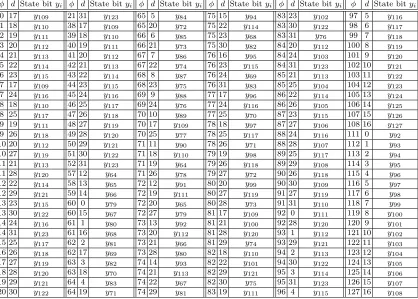
In Table 2 we give a list of 115 LFSR state bitsyithat can be recovered by observing the difference
φ d State bityi φ d State bityi φ d State bityi φ d State bityi φ d State bityi φ d State bityi
0 17 y109 21 31 y123 65 5 y84 75 15 y94 83 23 y102 97 5 y116
1 18 y110 38 17 y109 65 20 y72 75 22 y114 83 30 y122 98 6 y117
2 19 y111 39 18 y110 66 6 y85 75 23 y68 83 31 y76 99 7 y118
3 20 y112 40 19 y111 66 21 y73 75 30 y82 84 20 y112 100 8 y119
4 21 y113 41 20 y112 67 7 y86 76 16 y95 84 24 y103 101 9 y120
5 22 y114 42 21 y113 67 22 y74 76 23 y115 84 31 y123 102 10 y121
6 23 y115 43 22 y114 68 8 y87 76 24 y69 85 21 y113 103 11 y122
7 17 y109 44 23 y115 68 23 y75 76 31 y83 85 25 y104 104 12 y123
7 24 y116 45 24 y116 69 9 y88 77 17 y96 86 22 y114 105 13 y124
8 18 y110 46 25 y117 69 24 y76 77 24 y116 86 26 y105 106 14 y125
8 25 y117 47 26 y118 70 10 y89 77 25 y70 87 23 y115 107 15 y126
9 19 y111 48 27 y119 70 17 y109 78 18 y97 87 27 y106 108 16 y127
9 26 y118 49 28 y120 70 25 y77 78 25 y117 88 24 y116 111 0 y92
10 20 y112 50 29 y121 71 11 y90 78 26 y71 88 28 y107 112 1 y93
10 27 y119 51 30 y122 71 18 y110 79 19 y98 89 25 y117 113 2 y94
11 21 y113 52 31 y123 71 19 y64 79 26 y118 89 29 y108 114 3 y95
11 28 y120 57 12 y64 71 26 y78 79 27 y72 90 26 y118 115 4 y96
12 22 y114 58 13 y65 72 12 y91 80 20 y99 90 30 y109 116 5 y97
12 29 y121 59 14 y66 72 19 y111 80 27 y119 91 27 y119 117 6 y98
13 23 y115 60 0 y79 72 20 y65 80 28 y73 91 31 y110 118 7 y99
13 30 y122 60 15 y67 72 27 y79 81 17 y109 92 0 y111 119 8 y100
14 24 y116 61 1 y80 73 13 y92 81 21 y100 92 28 y120 120 9 y101
14 31 y123 61 16 y68 73 20 y112 81 28 y120 93 1 y112 121 10 y102
15 25 y117 62 2 y81 73 21 y66 81 29 y74 93 29 y121 122 11 y103
16 26 y118 62 17 y69 73 28 y80 82 18 y110 94 2 y113 123 12 y104
17 27 y119 63 3 y82 74 14 y93 82 22 y101 94 30 y122 124 13 y105
18 28 y120 63 18 y70 74 21 y113 82 29 y121 95 3 y114 125 14 y106
19 29 y121 64 4 y83 74 22 y67 82 30 y75 95 31 y123 126 15 y107
20 30 y122 64 19 y71 74 29 y81 83 19 y111 96 4 y115 127 16 y108
Table 2.LFSR state bits recovered
fault options for identifying some of the LFSR bits. The LFSR state bits not present in Table 2 are y0, y1, . . . , y12. However it can be verified that∀i∈[0,12], by applying a fault at location φ= 109 +i
the (17 +i)th bit in difference ofσ(∅) andσ109+i(∅) is equal to the state bit y1+127i. Sincey1271+i is a linear function ofy0, y1, . . . , y127, we can derivey0 toy12as follows. By the LFSR update rule of Grain-128a,
we have the following 13 equations
y1271+i =y96+i+y81+i+y70+i+y38+i+y7+i+yi, ∀i∈[0,12].
In the last equation y12 is the only unknown and its value can be calculated easily. Similarly y11 is
the only unknown in the previous equation. Solving the equations in this manner one can obtain the entire LFSR state at the beginning of the PRGA.
2.3 Determining the NFSR State
Once the LFSR internal state of the initial PRGA round is known, one can then proceed to determine the NFSR internal state. In [5] it was shown, that this could have been done efficiently for the initial version of the cipher i.e. Grain v0. After the attack in [5] was reported, the designers made the necessary changes to Grain v1, Grain-128 and Grain-128a so that for these new ciphers, determining the NFSR state form the knowledge of the LFSR state was no longer straightforward. In order to determine the NFSR bits, we look into the decomposition of the Boolean function h in more detail.
One may note that for Grain-128a, h(s) = s0 ·u(s) +v(s), where u(s) = s1+s4s8, and v(s) =
s2s3+s4s5+s6s7. Thus we note that
(ii) v(s0, s1, s2, s3, s4, s5, s6, s7, s8) +v(s0,1 +s1, s2, s3, s4, s5, s6, s7, s8) = 0.
Alsohcan be written ash(s) =s4·U(s) +V(s), whereU(s) =s5+s0s8, andV(s) =s2s3+s4s5+s6s7.
We also have
(i) U(s0, s1, s2, s3, s4, s5, s6, s7, s8) +U(s0, s1, s2, s3, s4,1 +s5, s6, s7, s8) = 1,
(ii)V(s0, s1, s2, s3, s4, s5, s6, s7, s8) +V(s0, s1, s2, s3, s4,1 +s5, s6, s7, s8) = 0.
Since s0, s4 correspond to NFSR variables, hsatisfies all the properties listed above.
As before, assume the scenario in which the attacker has injected a fault at location 8 of the LFSR at the beginning of the PRGA. Then at this round of the PRGA the input differential travels sits on location 8 of the LFSR i.e. at round 0 of the PRGA the original stateS0 and the faulty stateS08 differ
in location 8 of the LFSR and in no other location that contributes inputs to the output keystream bit at round 0. Then by the previous relation equation, the sum of the corresponding fault-free bits produced at round 0 is given byz0+z08=x012·1 + 0 =x12.
Also note that at round 32 of the PRGA the differential does not sit on any LFSR location that contributes input to the output keystream bit at that round. Hence z32=z832.
Now consider the fault-free and faulty MAC (due to fault atφ= 8 at the beginning of the PRGA) of the empty messageσ(∅) andσ8(∅). From the definition of MAC of empty message it can be deduced
that the bit number 16 ofσ(∅)⊕σ8(∅) is given byz0+z32+z08+z328 =x12.
Hence by looking at the difference in the correct and faulty MACs of the empty messages one is able to deduce the NFSR state bitx12at the beginning of the PRGA. In Table 3 we give an exhaustive
list of the NFSR state bitsxithat can be recovered by observing the difference of the faulty and correct
dth MAC bit of the empty message for different values of the fault locationφ.
φ d State bitxi φ d State bitxi φ dState bitxi φ d State bitxi φ d State bitxi φ d State bitxi
8 0 x12 24 16 x28 40 0 x44 49 7 x10² 57 15 x110 65 23 x118
9 1 x13 25 17 x29 41 1 x45 49 9 x53 57 17 x61 65 25 x69
10 2 x14 26 18 x30 42 0 x95 50 8 x10³ 58 16 x111 66 24 x119
11 3 x15 27 19 x31 42 2 x46 50 10 x54 58 18 x62 66 26 x70
12 4 x16 28 20 x32 43 1 x96 51 9 x10⁴ 59 17 x112 67 25 x120
13 5 x17 29 21 x33 43 3 x47 51 11 x55 59 19 x63 67 27 x71
14 6 x18 30 22 x34 44 2 x97 52 10 x105 60 18 x113 68 26 x121
15 7 x19 31 23 x35 44 4 x48 52 12 x56 60 20 x64 68 28 x72
16 8 x20 32 24 x36 45 3 x98 53 11 x106 61 19 x114 69 27 x122
17 9 x21 33 25 x37 45 5 x49 53 13 x57 61 21 x65 69 29 x73
18 10 x22 34 26 x38 46 4 x99 54 12 x107 62 20 x115 70 28 x123
19 11 x23 35 27 x39 46 6 x50 54 14 x58 62 22 x66 70 30 x74
20 12 x24 36 28 x40 47 5 x100 55 13 x108 63 21 x116 71 29 x124
21 13 x25 37 29 x41 47 7 x51 55 15 x59 63 23 x67 71 31 x75
22 14 x26 38 30 x42 48 6 x101 56 14 x109 64 22 x117 72 30 x125
23 15 x27 39 31 x43 48 8 x52 56 16 x60 64 24 x68 73 31 x126
74 0 x127
Table 3.NFSR state bits recovered
Finding the Remaining Bits From the table given above all state bits of the NFSR can be found exceptx0, x1, . . . , x11 andx76, x77, . . . , x94. These bits may be found as follows. It can be verified that
and S65+2173+2i differ in only the LFSR location 8 and no other location that affects the output bit at this round. Then by the previous relation
z65+2i+z65+273+2ii=x
65+2i
12 ·1 + 0 =x77+2i, ∀i∈[0,8].
It can also be verified that as a result of applying the fault at 73 + 2i,∀i∈ [0,8] at round 31 of the PRGA, the differential does not affect any location that provides inputs to the output bit. Hence, z31 =z3173+2i. Now consider the fault-free and faulty MAC of the message 0i+1 (string of i+ 1 zeros)
obtained by faulting LFSR location 73 + 2iat the beginning of the PRGA. From definition
σ(0i+1) = [z0+z33+i, z1+z34+i, . . . , z30−i+z63, z31−i+z65, z32−i+z67, . . . , z31+z65+2i], ∀i∈[0,8]
Hence the last bit in difference ofσ(0i+1) andσ73+2i(0i+1) is equal to
z31+z65+2i+z73+231 i+z65+273+2ii=x77+2i, ∀i∈[0,8].
Thus far we have recovered 106 of the 128 NFSR state bits. Consider the 0th bit ofσ(∅) given by
z0+z32=
M
t∈B
xt+y93+y125+h(x12, y8, y13, y20, x95, y42, y60, y79, y94)
+h(x44, y40, y55, y75, x127, y74, y92, y111, y126)
Here B ={2,15,36,45,64,73,89,34,47,68,77,96,105,121}. Note that x2 is the only unknown linear
term in the above equation, and so its value can be calculated immediately.
Definex127+i =xi127, y127+i =y127i for alli≥1. Then by using a similar analysis, it can be verified
that the ith bit of
σ(∅) +σ74+i(∅) =x127+i, ∀i∈[0,31]. (5)
Again consider the 0th bit ofσ(02j+1) for 0≤j≤8, given byz0+z33+2j
z0+z33+2j = M
t∈Bj
xt+y93+y126+2j+h(x12, y8, y13, y20, x95, y42, y60, y79, y94)
+h(x45+2j, y41+2j, y56+2j, y76+2j, x128+2j, y75+2j, y93+2j, y112+2j, y127+2j), ∀j∈[0,8].
Here Bj ={2,15,36,45,64,73,89,35 + 2j,48 + 2j,69 + 2j,78 + 2j,97 + 2j,106 + 2j,122 + 2j}. In the
above set of equations any xk with k > 127 may be calculated from (5). Any yk with k > 127 is a
linear function of y0, . . . , y127 which are already known. Hence x78+2j with 0 ≤ j ≤ 8 are the only
unknown linear terms in each of these equations and their values are also immediately determined. At this point the only unknown state bits are x0, x1, x3, . . . , x11, x76. Consider the pth bit of σ(∅) given
by zp+z32+p for p∈[1,9]\ {3}.
zp+z32+p= M
t∈B
xt+p+y93+p+y125+p+h(x12+p, y8+p, y13+p, y20+p, x95+p, y42+p, y60+p, y79+p, y94+p)
+h(x44+p, y40+p, y55+p, y75+p, x127+p, y74+p, y92+p, y111+p, y126+p), ∀p∈[1,9]\ {3}
In all these equationsx2+pis the only unknown linear term and its value can also be determined
imme-diately (the strategy does not work for p= 3 asx76 is still unknown). We are left withx0, x1, x5, x76.
The values of x0, x1, x5 can be obtained from the expansion of x128, x129, x133 from the NFSR
up-date rule. Now, x76 occurs as a linear term in bit number 3 of σ(∅) and its value too is calculated
2.4 Finding the Secret Key and Complexity of the Attack
It is known that the KSA and PRGA routines in the Grain family are invertible. Once we have all the bits of S0, by running the inverse KSA routine one can recover the secret key.
First we need to hit each of the locations of the LFSR. We inject the fault randomly in the LFSR locations and thus, we needτ = 128·P128
i=11i ≈695.4 expected number of fault injections. For each of
these injected faults, we need to identify the fault locations. Taking the value of µ from Section 2.1 that is the required number of expected faults for each LFSR location, the total number of faults to be injected =τ µ= 695.4·2.62 ≈1822. Additionally, as described in Section 2.3, 9 more fault injections are required for the locationsφ= 73,75, . . . ,89 to recover certain NFSR bits. Therefore, the expected number of faults that our attack needs is 1822 + 9 = 1831<211.
For each fault during the location identification stage, two MAC invocations are required, that amounts to 1822·2 = 3644. Additionally, 20 more invocations are required during some cases of NFSR bit recovery. Thus the total number of invocations is less than 212.
References
1. The ECRYPT Stream Cipher Project. eSTREAM Portfolio of Stream Ciphers. Revised on September 8, 2008. 2. M. ˚Agren, M. Hell, T. Johansson and W. Meier. A New Version of Grain-128 with Authentication. Symmetric Key
Encryption Workshop 2011, DTU, Denmark, February 2011.
3. J. P. Aumasson, I. Dinur, L. Henzen, W. Meier, and A. Shamir. Efficient FPGA Implementations of High-Dimensional Cube Testers on the Stream Cipher Grain-128. In SHARCS - Special-purpose Hardware for Attacking Cryptographic Systems, 2009.
4. S. Banik, S. Maitra and S. Sarkar. A Differential Fault Attack on the Grain Family of Stream Ciphers. To be presented in CHES 2012.
5. C. Berbain, H. Gilbert and A. Maximov. Cryptanalysis of Grain. In FSE 2006, LNCS, Vol. 4047, pp. 15–29, 2006. 6. A. Berzati, C. Canovas, G. Castagnos, B. Debraize, L. Goubin, A. Gouget, P. Paillier, S. Salgado. Fault Analysis of
Grain-128. In: IEEE International Workshop on Hardware-Oriented Security and Trust, pp. 7–14, 2009.
7. T. E. Bjørstad. Cryptanalysis of Grain using Time/Memory/Data tradeoffs (v1.0 / 2008-02-25). Available athttp: //www.ecrypt.eu.org/stream.
8. C. De Canni`ere, O. K¨u¸c¨uk and B. Preneel. Analysis of Grain’s Initialization Algorithm. In AFRICACRYPT 2008, LNCS, Vol. 5023, pp. 276–289, 2008.
9. I. Dinur, T. G¨uneysu, C. Paar, A. Shamir, R. Zimmermann. An Experimentally Verified Attack on Full Grain-128 Using Dedicated Reconfigurable Hardware. In ASIACRYPT 2011, LNCS Vol. 7073, pp. 327–343, 2011.
10. I. Dinur, A. Shamir. Breaking Grain-128 with Dynamic Cube Attacks. In FSE 2011, LNCS, Vol. 6733, pp. 167–187, 2011.
11. H. Englund, T. Johansson, and M. S. Turan. A framework for chosen IV statistical analysis of stream ciphers. In INDOCRYPT 2007, LNCS, Vol. 4859, pp. 268–281, 2007.
12. S. Fischer, S. Khazaei, and W. Meier. Chosen IV statistical analysis for key recovery attacks on stream ciphers. In AFRICACRYPT 2008, LNCS, Vol. 5023, pp. 236–245, 2008.
13. M. Hell, T. Johansson and W. Meier. Grain - A Stream Cipher for Constrained Environments. ECRYPT Stream Cipher Project Report 2005/001, 2005. Available athttp://www.ecrypt.eu.org/stream.
14. M. Hell, T. Johansson and W. Meier. A Stream Cipher Proposal: Grain-128. In IEEE International Symposium on Information Theory (ISIT 2006), 2006.
15. J. J. Hoch, A. Shamir. Fault Analysis of Stream Ciphers. In CHES 2004, LNCS, Vol. 3156, pp. 1–20, 2004.
16. S. Karmakar and D. Roy Chowdhury. Fault analysis of Grain-128 by targeting NFSR. In AFRICACRYPT 2011, LNCS, Vol. 6737, pp. 298–315, 2011.
17. S. Khazaei, M. Hassanzadeh and M. Kiaei. Distinguishing Attack on Grain. ECRYPT Stream Cipher Project Report 2005/071, 2005. Available athttp://www.ecrypt.eu.org/stream
18. S. Knellwolf, W. Meier and M. Naya-Plasencia. Conditional Differential Cryptanalysis of NLFSR-based Cryptosys-tems. In ASIACRYPT 2010, LNCS, Vol. 6477, pp. 130–145, 2010.
19. Y. Lee, K. Jeong, J. Sung and S. Hong. Related-Key Chosen IV Attacks on Grain-v1 and Grain-128. In ACISP 2008, LNCS, Vol. 5107, pp. 321–335, 2008.
20. S. P. Skorobogatov. Optically Enhanced Position-Locked Power Analysis. In CHES 2006, LNCS, Vol. 4249, pp. 61–75, 2006.
22. P. Stankovski. Greedy Distinguishers and Nonrandomness Detectors. In INDOCRYPT 2010, LNCS, Vol. 6498, pp. 210–226, 2010.