COFFE: Ciphertext Output Feedback Faithful Encryption
On-Line Authenticated Encryption Without a Block Cipher
Christian Forler1⋆, David McGrew2, Stefan Lucks1, and Jakob Wenzel1 1 Bauhaus-University Weimar, Germany, 2 Cisco Systems, USA
{Christian.Forler, Stefan.Lucks, Jakob.Wenzel}@uni-weimar.de [email protected]
Abstract. In this paper we introduce the first authenticated encryption scheme based on a hash function, called COFFE. This research has been motivated by the challenge to fit se-cure cryptography into constrained devices – some of these devices have to use a hash function, anyway, and the challenge is to avoid the usage of an additional block cipher to provide authenti-cated encryption.COFFEsatisfies the common security requirements regarding authenticated encryption, i.e., IND-CPA- and INT-CTXT-security. Beyond that, it provides the following additional security features: resistance against side-channel attacks and INT-CTXT security in the nonce-misuse scenario. It also support failure-friendly authentication under reasonable assumptions.
Keywords: authenticated encryption, provable security, side-channel , internet of things.
1 Introduction
The main goal for our work is to provide authenticated encryption in constrained implemen-tation environments where communication security is required, such as devices connected to the Internet of Things. That class of devices typically has a small microprocessor with no direct hardware support for any cryptographic primitives, so that all cryptography must be implemented in software. There is only limited memory available to hold executable object code on these processors, so it is imperative to provide the needed cryptographic services in the most compact way possible. One way to achieve this compactness is through the careful implementation of cryptographic primitives. However, it is also possible to facilitate compactness for an overall system by minimizing the number of primitives that must be included in an implementation. In this work we present a design for an on-line authenticated encryption (AE) scheme suitable for restricted devices using a standardized or soon-to-be standardized hash function, e.g., SHA-1 [23], SHA-2 [24], or SHA-3 [4]. Implementations of this scheme can omit a block cipher mode of operation; this is a useful approach since the code size for the block cipher is typically greater than that of the hash function, and hash functions are used in public key cryptography as well.
We focus on the challenge of providing an authenticated encryption scheme that is easily accessible to developers. To provide this accessibility, we take the approach of defining a hash function mode of operation. That is, our AE scheme uses a cryptographic hash function as its only primitive, and does not require direct access to any hash function internals such as the compression function. We chose this approach based on feedback from the practice community. Hash function implementations are widely available, but these implementations do not provide interfaces to the compression function.
Note that to provide data privacy and data integrity, we transform the given hash function into a keyed hash function (PRF). On systems using restricted devices, due to the limited
⋆The research leading to these results received funding from the Sillicon Valley Community Foundation,
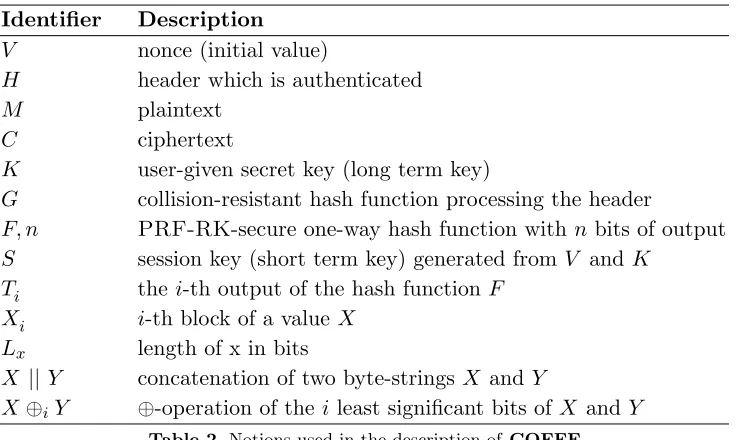
Scheme On-line Side-Channel Res. Misuse Res. Rate-1
COFFE(this paper) X X X X
SpongeWrap [5] X X X X
CHM [14] X X X X
CIP[15] X X X X
CWC [19] X X X X
EAX [3] X X X X
GCM [21] X X X X
Generic Composition [2] X X X X
HBS [16] X X X X
SIV [26] X X X X
Table 1.Comparison of existing AE-Schemes which can be instantiated with aPRF.
resources, it is desirable to minimize the cost of the code and the circuits for encrypting a message block [1], i.e., keep the size of the cryptographic footprint small. This means that we want only one costly operation per message block. We denote a scheme satisfying this property as a Rate-1 scheme. For example, the GCM authenticated encryption mode [21] is not a Rate-1 AE scheme, since it needs not only one block cipher call per message block, but also an additional galois field multiplication per message block, rendering GCM to be a Rate-2 AE scheme. Another example would be a Feistel-based scheme which requires at least three or four block cipher calls rendering such a scheme to a low-performance Rate-3 or Rate-4 scheme.
Since the implementation of an encryption scheme can be error prone (e.g., [6, 13, 18, 27, 28]) it would be desirable to provide a second line of defense to minimize the security fallout. A further preferable goal for our construction is to provide built-in resistance against side-channel attacks. Actually, the overlaying protocols, using an AE scheme, are responsible to provide this goal in an adequate form, e.g., TLS [8] and IPsec [12, 17] generate a new key for each session minimizing the measurements which can be done on the secret key. Obviously, an adversary can do a certain amount of measurements (depending on the size of the message) on the session key, but revealing the session key only compromises security for this specific encryption/decryption/authentication. Note that it does not compromise the currently used secret key. But, nevertheless, we provide side-channel resistance even if a protocol may fail to provide this kind of security.
than the one we actually propose. But, due to the reasons discussed here, we made a decision against a purely compression function based AE scheme in favour of a hash function based AE scheme.
Contribution. In this paper we introduce COFFE, a novel hash function based on-line AE scheme which, for the best of our knowledge, is the first scheme which fulfills our stated requirements. It can be part of a minimal cryptographic suite that includes hashing and digital signatures. Because it is an authenticated encryption with associated data (AEAD) algorithm, it could be used in the AEAD interface of the Datagram TLS security protocol [25], which has been identified by theIETF Constrained Applicationworking group as suitable for applications for internet of things. COFFE provides the standard INT-CTXT and IND-CPA (CCA3) security, one would expect from any good AE scheme, plus the following
nonstandard security features.
1. Misuse-resistant authenticity: It is standard for an authenticated encryption scheme to claim and prove security against nonce-respecting adversaries. Almost always, security breaks apart if nonces are ever reused [11]. While the privacy of COFFE only holds for nonce-respecting adversaries (unlike the scheme presented in [11]), we prove that its authenticity does not depend on unique nonces.
2. Failure-friendly authenticity: The security proofs of most modes of operation assume
PRF or PRP security for the underlying block cipher. If this fails, the mode is likely to
be insecure. While the privacy of COFFErequires the hash function under a secret key to behave like a random function, authenticity can be established even for failing pseudo-randomness. Our mode ensures authenticity under a weaker unpredictability assumption assuming a strong key. Due to space limitation, we will only give a brief and informal discussion on this (cf. Section 4.1).
3. Resistance against side-channel attacks:Resistance against side-channel attacks is usually a matter of the implementation of a cryptosystem, rather than of the cryptosystem itself. Nevertheless, the design of a cryptosystem can contribute and ease side-channel resistant implementations. COFFE generates a new session key for each message depending on the nonce and the secret key, resulting in a side-channel resistant implementation in the nonce-respecting scenario.
Due to the upcoming event of the CAESAR competition1, authenticated encryption has become a hot topic in the field of symmetric crypto. Nevertheless, sinceCOFFEis designed to fill a quite particular nische we do not intent to submit it to the CAESAR competition.
Outline. In Section 2 we introduce our on-line authenticated encryption scheme COFFE and a possible practical instantiation using SHA-224. Section 3 contains essential prelimi-naries for the security proof. The security-analysis is given in Section 4. Section 5 concludes the paper.
2 COFFE
In this section we introduce COFFE, our novel on-line authenticated encryption scheme, which is inspired by the CFB and OFB modes of operation [9] following the idea of using the chaining valueandthe ciphertext as a feedback for the next iteration (see Figure 1). In contrast to other published AE schemes [3, 10, 14, 19, 21, 26], COFFE is based on a cryp-tographic hash function F : {0,1}∗ → {0,1}n instead of a block cipher. Furthermore, the
S
F
H
F
T[0] T[1]
C[1] M[1]
C[0] 0* x S
F
T[2]
C[2] M[2]
C[1] 0* 4 S
F
C[L-1]0* 4
T[L]
C[L] M[L]
S
F
T C[L] 0* +5 K
F
V 0* LK LV 0
LT
Fig. 1.Illustration of the encryption and authentication process of COFFE.
integrity of the ciphertext does not depend on a nonce, but only on the security of F. It is also the first AE scheme, designed to be resistant against side-channel attacks. Table 2 introduce the notions and variables used throughout this paper.
Identifier Description V nonce (initial value)
H header which is authenticated
M plaintext
C ciphertext
K user-given secret key (long term key)
G collision-resistant hash function processing the header
F, n PRF-RK-secure one-way hash function with nbits of output
S session key (short term key) generated fromV and K Ti thei-th output of the hash functionF
Xi i-th block of a valueX Lx length of x in bits
X || Y concatenation of two byte-strings X and Y
X⊕iY ⊕-operation of thei least significant bits ofX and Y Table 2.Notions used in the description ofCOFFE.
The term ’0∗’, which is used in each call toF, denotes a zero-padding, where the number of zeros depends on the input size of the used hash function (or more precisely the compression function) and the kind of padding which is used inside the hash function. Thus, it is always chosen that one needs only one compression function call for one hash function invocation, which complies with our Rate-1 design goal. Thus, we consider a constant m-bit input for F, producing ann-bit output with m > n.
Algorithm 1 COFFE
Input: V {Nonce},H {Header},M {Message} Output: C {Ciphertext},T {Tag}
10: S←F(K ||V ||0∗||LK ||LV ||0) 11: (x, T0)←ProcessHeader(H, F)
12: (C, TL)←ProcessMessage(S, T0, M, x) 13: T←F(TL⊕ML||CL||0∗||LT ||LML+ 5)
14: return (C, T)
Input: V {Nonce},H {Header},C{Ciphertext} Output: M {Message}
20: S←F(K, V,0∗,|K|,|V|,0) 21: (x, T0)←ProcessHeader(H, F)
22: (M, TL)←ProcessCiphertext(S, T0, C, x) 23: T′←F(TL⊕ML||CL||0∗||LT ||LM
L+ 5)
24: if T 6=T′then 25: M ← ⊥ 26: end if 27: return M
Step 1: Session Key Generation. Domain0is used to generate the session keyS (short term key), which is derived from the secret keyK(long term key) and the nonceV as shown in lines 10 and 20 of Algorithm 1. Note that LK, LV, and the domain description value
are encoded as one- or two-byte values depending on the size of the key, and describe at least the three least significant bytes of the input. For practical applications we recommend to use a key size of n bits. Furthermore, the idea of the session key generation step is to support a built-in side-channel resistance due to the fact that a possible adversary can only evaluate one measurement on K per message. Moreover, due to the lack of a key scheduler in a hash function based setting, changing the key is free. COFFE benefits from this by using the secret keyK only once for processing a message or a ciphertext. Therefore, in the nonce-respecting scenario, the number of measurements forK andS an adversary can make are limited.
Algorithm 2 ProcessHeader
Input: H {Header},n{Output Length} Output: (x, T0){Initialization Pair} 10: LH←len(H)
11: if LH < nthen 12: return (1, H||10∗) 13: else if LH =nthen 14: return (2, H) 15: else
16: return (3, F(H)) 17: end if
collision-resistant hash function. The goal of this definition ofProcessHeaderis to achieve pair-wise distinct tuples (x, T0) for pair-wise distinct valuesHandH′. Under the assumption that there is no collision, we have
H6=H′ =⇒ (x, T0) =ProcessHedaer(H)6=ProcessHedaer(H′) = (x′, T0′), not necessarily meaning that x6=x′.
Remark. We use this separation process for security and performance reasons. Domain ’1’ is for the case that the authenticated data is less than one input block, thus, requiring 10∗ -padding to generate a full block. Domain ’2’ is for associated data actually fitting into exactly one block, where no padding is applied. When the data is larger than one block, we must apply the hash function. This case is represented by Domain ’3’. Omitting the invocation of the functionF for small headers (i.e.,LH ≤n) increases significantly the performance when
small messages with tiny headers are processed, e.g., IP packets.
Step 3: Encryption/Decryption. COFFE is generating a keystream which is XORed to a message to either encrypt or decrypt it. Since our scheme is designed to comply with the requirements of the use of standardized building block, it is construed to work with hash functions like SHA-1 and SHA-2. Thus, the input of the compression function is usually limited to less than 2n bits, due to the message padding. Note that the n-bit session keyS and the domain separation value are mandatory inputs and hence, we have only less then n-bit left. To provide adequate security against forgery attacks, we need to additionally process two from the three following values: keystream blockTi−1, message blockMi−1, and ciphertext block Ci−1. More precisely, if we only use Ti−1 in the next iteration step, the tag would become message-independent, i.e., the tag would not provide any integrity at all. Furthermore, if we use onlyCi−1 orMi−1, omittingTi−1, the tag value would only depend on the last ciphertext or plaintext block, respectively. Note that even processing only a single of those values is not possible using a naive approach without violating our requirement of one compression function call per hash function invocation. Thus, we decided to use the inputs toF in the following manner:
– n-bit valueS⊕Ti−1
– δ-bit domain separation value
– (α < n−δ)-bit ciphertext blockCi−1.
Our approach puts the hash function under a lot of stress, since it violates thePRF
indepen-dency assumption. Thus, we now have to assumeF to bePRF-secure in the XOR-related-key
model. More precisely, an adversary has partial control over the key-input toF, resulting in a chance to produce a collisionS⊕Ti−1 =S′⊕Tj−1 for two distinct keys S 6=S′. Our se-curity analysis in Section 4 shows that our approach still satisfies the birthday bound sese-curity.
LetM =M1, M2, . . . , MLdenote the message, whereL=
LM/αis the number of message
blocks processed. Here, all but the last blocks ofM andCare of sizeαbits. The last blocks of M andC consist of at mostα bit. Then, the encryption and decryption process of COFFE is defined in Algorithm 3, where ToHex(π) (see lines 10 and 20) outputs the first α/4 post decimal numbers of π interpreted as hex values (C0= 0x1415926. . .).
Algorithm 3 ProcessMessage/ProcessCiphertext
Input: S{Session Key},T0{Initial Chaining Value}, M {Message},x{Domain Specifier}
Output: C {Ciphertext} 10: C0 ←ToHex(π)
11: T1=F(S⊕T0, C0,0∗, x) 12: C1 =M1⊕αT1
13: fori= 2→L−1do
14: Ti=F(S⊕Ti−1, Ci−1,0∗,4)
15: Ci=Mi⊕αTi
16: end for 17: CL=ML⊕βTL
18: return C
Input: S{Session Key},T0 {Initial Chaining Value}, C{Ciphertext},x{Domain Specifier}
Output: M {Message} 20: C0←ToHex(π)
21: T1=F(S⊕T0, C0,0∗, x) 22: M1=C1⊕αT1
23: fori= 2→L−1do
24: Ti=F(S⊕Ti−1, Mi−1,0∗,4)
25: Mi=Ci⊕αTi
26: end for 27: ML=CL⊕βTL
28: return M
2.1 COFFE-SHA-224 – A Practical Instantiation
In this section we discuss a practical instantiation of COFFE using SHA-224 as the un-derlying hash function – called COFFE-SHA-224. First, we justify our usage of SHA-224 over SHA-256 as the underlying hash function.
Hash Function Choice. For the practical instantiation of COFFE, we where looking for a common, standardized, and flawless hash function which is suitable to be applied with restricted devices, where usually the size of a register is at most 32 bits. Thus, we made our choice in favour of a 32-bit optimized hash function, which renders SHA-224 and SHA-256 reasonable candidates to look at. Both SHA-224 and SHA-256 share the same compression function f :{0,1}256× {0,1}512 → {0,1}256. It compresses a 256-bit chaining value and a 512-bit message block into a 256-bit output value. These two hash function standards differ in two properties 1) they are using different initial values, and 2) SHA-224 truncates the output of the final compression function invocation while SHA-256 does not. Following the Merkle-Damg˚ard paradigm [7, 22], SHA-224 and SHA-256 apply the secure 10∗-padding followed by a 64-bit value encoding the message length. Thus, the maximum possible input size to fit our requirements is given by 512−1−64 = 447 bit. Due to the sake of simplification, we consider only byte-aligned values and we assume all values to be encoded octet-strings. Thus, we can only process message blocks with a size up to 440 bit, i.e., 55 byte. Using SHA-256 implies a 256-bit chaining value and thus,only 184 bits are left for the remaining input, including the domain separation byte and the previous ciphertext block. Furthermore, the tag generation step requires two additional input bytes – the length of the last message blockβ and the tag length LT. Hence, we can process 160-bit message blocks. Since the size of the hash value
of SHA-224 is reduced by 32 bits in comparison to SHA-256, we can process message blocks of 192 bits, which leads to an estimated performance speedup of about 20% in comparison to SHA-256. Furthermore, the 224-bit session key used in SHA-224 is sufficient to make practical attacks infeasible. This makes SHA-224 a logical choice for COFFE.
of COFFE is still reasonable, i.e., approximately 85% of SHA-224. To ensure an adequate security, we set the default parameter of the size of the secret key to 224 bits (LK = 224)
and the size of the nonce to 192 bits (LV = 192).
3 Technical Preliminaries
Notions. Let {0,1}n∗
denote an arbitrary number of blocks of size n and let ⊥ denote a rejection of a message, i.e., that the verification of a message failed. Furthermore, we write 0y for a string ofy zero-bits, and 0∗ for a string of zero or more zero-bits to fill a given input forF up to exactly the required input size.
We define an adversary as a computationally unbounded but always-halting algorithm A. In this paper we assume wlog. that the adversary A never asks a query which answer is already known. Further, we denote AO for an adversaryA with access to an oracle O.
Keyed Hash Function. A keyed hash function F :{0,1}k× {0,1}∗ → {0,1}n is a family of functions that computes a fixed-size hash value Y ∈ {0,1}n from a messageX ∈ {0,1}∗
of arbitrary length under a given key K∈ {0,1}k. We writeY =F
K(X) for Y =F(K, X).
It is easy to build a keyed hash function from an un-keyed hash function by dividing the input space into two parts, the key space and a new message space. In our approach, the key is derived by the session keyS and the previous chaining valueTi−1. Note, following Liskov et al. [20], these two values can be seen as a tweak and hence, we name this type of functions astweakable keyed hash functions.
Since we combine S and Ti−1 using an XOR operation, the underlying primitive of COFFE must be secure in the key model. Thus, we define the XOR-related-key PRF(PRF-XRK) security of a keyed hash functionF by the success probability of an
adversary trying to differentiate between the keyed hash function and a random function. In this scenario the adversary can freely choose thetweak input. In the following, we define three security notions, which are necessary to proof the security of our scheme.
Definition 1 (PRF). Let F : {0,1}k× {0,1}∗ → {0,1}n be a keyed hash function with a secret key K ← K$ , and A a fixed adversary. Let $(·) denote a random bit oracle which returns always n-bit random values. The PRF advantage of A in distinguishing F from a random function is defined as
AdvPRFF (A) =
Pr
K h
AFK(·)⇒1i−PrhA$(·)⇒1i
.
The PRF advantage among all adversaries that run in time at most t and make at most q queries to the available oracle is given by
AdvPRFF (q, t) = max
A {Adv PRF F (A)}.
Definition 2 (PRF-XRK). Let F : {0,1}k× {0,1}∗ → {0,1}n be a keyed hash function with a secret key K← K$ , andAa fixed adversary. Let$(·) denote a random bit oracle which returns always n-bit random values. The PRF-XRK advantage of A in distinguishing F from a random function is defined as
AdvPRF-XRKF (A) =
Pr
K h
AF⊕(K,·)(·) ⇒1
i
−PrhA$(·) ⇒1i
The PRF-RKadvantage among all adversaries that run in time at mosttand make at most
q queries to the available oracle is given by
AdvPRF-XRKF (q, t) = max
A
AdvPRF-XRKF (A) .
Note that this is a stronger assumption than the PRF security model as you can easily
reduce PRF-XRK security toPRFsecurity by fixing the tweak input. Thus, we have
AdvPRFF (q, t)≤AdvPRF-XRKF (q, t).
Authenticated Encryption (With Associated Data). An authenticated encryption scheme is a tripleΠ= (K,E,D). It aims to provide both privacy and data integrity. The key generation function K takes no input and returns a randomly chosen key K from the key space{0,1}k. The encryption algorithmE and the decryption algorithmDare deterministic algorithms that map values from{0,1}k× {0,1}n∗
× {0,1}v× {0,1}n∗
to a byte string or – if the input is invalid – the value⊥. For sake of convenience, we usually write EK(H, V, M)
for E(K, H, V, M) and DK(H, V, M) for D(K, H, V, M), where the message M and the
as-sociated data H are chosen from the set{0,1}n∗
, a key K from the key space {0,1}k, and
a nonce V from the nonce space {0,1}v. We require DK(H, V,EK(H, V, M)) = M for any
possible quadruple (K, V, H, M).
Definition 3 (CCA3).LetΠ = (K,E,D)be an authenticated encryption scheme,Aa fixed adversary, and K ← K$ be a randomly chosen key. The CCA3 advantage of A in breaking
Π is defined as
AdvCCA3Π (A) =
Pr
K h
AEK(·,·,·),DK(·,·,·) ⇒1
i
−PrhA$(·,·,·),⊥(·,·,·) ⇒1i
. (1)
The adversary’s random-bit oracle $(·,·,·) returns on a plaintext query (H, V, M)∈ {0,1}n∗ × {0,1}v × {0,1}n∗ a random string of length |EK(H, V, M)|. The ⊥(·,·,·) oracle returns ⊥
on every input. In this paper we assume that an adversary never asks a query for which the answer is already known, e.g., if it has received the result for an encryption query (C, T) = E(V, H, M), it will never ask for (V, H, M) = D(C, T), and vice versa. Bellare and Namprempre have shown in [2] that one can rewrite Equation 1 as
AdvCCA3Π (q, ℓ, t)≤AdvIND-CPAΠ (q, ℓ, t) +AdvINT-CTXTΠ (q, ℓ, t), (2) where AdvCCA3Π (q, ℓ, t) is the maximum advantage of all CCA3-adversaries, which run in
time at mostt, asks a total maximum ofq queries toE andD, and whose total query length is at most ℓblocks. Then, the IND-CPA-advantage is given by
AdvIND-CPAΠ (q, ℓ, t)≤
Pr
K h
AEK(·,·,·)⇒1i−PrhA$(·,·,·)⇒1i
.
Furthermore, the advantage of anINT-CTXT-adversary is given by the success probability
of winning the gameGINT-CTXT defined in Figure 2. Thus, we have
AdvINT-CTXTΠ (A)≤Pr[AGINT-CTXT ⇒1],
where
AdvINT-CTXTΠ (q, ℓ, t)≤max
A
AdvINT-CTXTΠ (A) .
For convenience, we introduce a notation for a restriction on a set. LetQ=A × B × C, then we denote Q|B,C = {(B, C)| ∃A : (A, B, C) ∈ Q} as the restriction of Q to B and C with
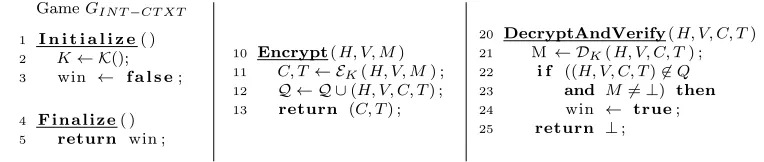
GameGIN T−CT XT 1 I n i t i a l i z e( ) 2 K← K(); 3 win ← f a l s e; 4 F i n a l i z e( ) 5 return win ;
10 Encrypt(H, V, M) 11 C, T← EK(H, V, M) ; 12 Q ← Q ∪(H, V, C, T) ; 13 return (C, T) ;
20 DecryptAndVerify(H, V, C, T) 21 M← DK(H, V, C, T) ; 22 i f ((H, V, C, T)6∈Q
23 and M6=⊥) then
24 win ← true; 25 return ⊥;
Fig. 2.GameGINT-CTXTis theINT-CTXTΠ game whereΠ = (K,E,D).
4 Security
This section describes the security for our genericCOFFEconstruction considered under the reasonable assumption that the size of the secret keyKcan be larger or equal to the size of the session key S, i.e., |K| ≥ |S|. The first step is to show the CPA-security when considering a nonce-respecting adversary. For the INT-CTXT-proof, we generalize the adversary by
allowing it to reuse a nonce, i.e., transforming it to a nonce-ignoring adversary.
Theorem 1. Let Π = (K,E,D) be a COFFE scheme as in Algorithm 1, i.e., K is the key derivation function, E =EncryptAndAuthenticate and D = DecryptAndVerify. Then,
AdvCCA3Π (q, ℓ, t) ≤ 8ℓ
2+ 3q2
2n + 2·Adv
PRF-XRK F∗ (q, ℓ, t)
+3ℓ 2+ 2q2
2n +
q
2LT + 2·Adv
PRF-XRK
F∗ (q+ℓ, O(t)) ≤ 11ℓ
2+ 5q2
2n +
q
2LT + 4·Adv
PRF-XRK
F∗ (q, ℓ, t), where LT denotes the length of the tag value in bits.
Proof. The proof follows from Equation 2 together with Lemma 1 and Lemma 2. ⊓⊔
Lemma 1. LetΠ = (K,E,D)be a COFFEscheme as in Algorithm 1. Letq be the number of total queries an adversary A is allowed to ask and ℓ be an integer representing the total length in blocks of the queries to E. Then,
AdvCP AΠ (q, ℓ, t)≤ 2(ℓ+q)
2+ 2ℓ2+q2
2n + 2·Adv
PRF-XRK F∗ (q, ℓ, t) ≤ 8ℓ
2+ 3q2
2n + 2·Adv
PRF-XRK
F∗ (q, ℓ, t).
Proof (Lemma 1). This proof is using common game playing arguments. As stated above, the length of the secret key K can differ from the length of the session key S. If this is the case, we can partitionF into two independentPRF’s:F1 :{0,1}|K|× {0,1}∗ → {0,1}n for
the generation of the session key andF2 :{0,1}|S|× {0,1}∗ → {0,1}n for the processing of the message and the generation of the authentication tag. Due to the domain separation, the partitioning of F is still valid if|K|=|S|, i.e., the domain of the session key generation is always 0 and the domain of the message processing is always>0.
Under this assumption, we can replace the functions F1 by a PRF. This can be upper bounded by
Furthermore, we can replace the functionF2by aPRF-XRK, since the adversary has partial control over the key S⊕T[i]. This can be upper bounded by
AdvPRF-XRKF2 (q+ℓ, O(t)). Due to the sake of simplification, we define
AdvPRF-XRKF∗ (q, ℓ, t) = max
AdvPRF-XRKF2 (q+ℓ, O(t)),AdvPRFF1 (q, O(t)) .
In the following analysis we always consider the full output length n of the tag generation step, i.e., even ifLT is smaller thann, we skip the truncation step for the proof. This is valid,
since showing security for the tag generation step without truncation implies CPA-security for the tag generation with truncation. Assume an adversary B which is successful by attacking the truncated version, then we can build an adversaryB′usingBto be successful with the same probability attacking the untruncated version.
Next, we denote Q as the query history of the adversary, where Q|Ti
µ,Ti contains the produced keystream Ti
µ with 1 ≤ µ ≤ ℓ and the tags Ti with 1 ≤ i ≤ q. Note that all
samples Tµi and Ti are output values of the hash function F2. We can say that COFFE is CPA-secure, if the produced keystream and the tag values within the query history are indistinguishable from a sequence R of distinct random values of the same size, where the length of this sequence is limited to ℓ+q. It is easy to see that this event can be upper bounded by
(ℓ+q)2 2n .
To complete our proof, we have to estimate the probability Pr[Dist] that all values within the listQ|Ti
µ,Ti are distinct. Therefore, we upper bound the probability Pr[Coll] for a collision of at least two of the values within this list, since
Pr[Dist] = 1−Pr[Coll].
To upper bound Pr[Coll], we first consider the input parameter of F2 represented by the quadruple (Si, T
µ, Cµ, d). Note that we ignore the 0∗-padding, which leads to a higher success
probability for an adversary. Let Zi = (Si, Tµi, Cµi, di) and Zj = (Sj, Tνj, Cνj, dj) with 1 ≤
i, j ≤q and 1≤ µ, ν ≤L∗, where L∗ denotes the number of blocks of the longest message.
A collision between two such tuples is given either when we have found a collision for F or we have found an input collision for the valuesSi⊕Ti
µ=Sj⊕Tνj. For our case analysis (cf.
Table 3), we encode the difference between two such input tuples Zi and Zj using a five-bit
value. For example, the value “10110” is defined as follows:
10110 :=
i6=j Tµi =Tνj
Si⊕Ti
µ6=Sj ⊕Tνj
Cµi 6=Cνj
di =dj,
where 1≤i, j ≤q and 1≤µ, ν ≤L∗.
Note that Table 3 contains a complete case analysis, since all possible cases are covered.
The cases which occur with a zero-probability are obviously seen as impossible and marked by “–”. The reason for the occurrence of these cases is a violation of the XOR relation be-tween the values Si and Ti
µ orSj and Tνj, respectively. For example,Si =Sj, Tµi =Tνj, and
Si ⊕Ti
µ 6= Sj ⊕T j
Case Event Case Event Case Event Case Event 00000 trivial 01000 – 10000 1 11000 2,4
00001 3 01001 – 10001 1 11001 3
00010 3 01010 – 10010 1 11010 3
00011 3 01011 – 10011 1 11011 3
00100 – 01100 3 10100 3 11100 1,3
00101 – 01101 3 10101 3 11101 3
00110 – 01110 3 10110 3 11110 3
00111 – 01111 3 10111 3 11111 3
Fig. 3.This table illustrates the case analysis for the proof of Lemma 1, where each case with a non-zero probability is covered by at least one event. The case “11000” is covered by two events depending on the considered domain (Event 2 covers the domain 1,2, and 3; Event 4 covers all other domains). The second special case “11100” is covered by Event 1 ifSi=Sjand by Event 3 ifSi6=Sj.
have happened before in the same query and is already covered by one of the other non-zero cases. In the following we analyze four events which cover all remaining cases with a non-zero probability given in Table 3.
After asking at most q queries, we check the adversaries query history Q – which contains all queries and their results – for the occurrence of bad events. We let the adversary win immediately if one of the bad events becomes true. Let denoteAy they-th event andAz the
z-th event. The occurrence of an event Ay implies that no event Az withz∈ {1, . . . , y−1}
occurred before. Hence, the order of the events matters.
Event 1: Session Key Collision. The first case describes the scenario where an adversary finds two values Si and Sj, generated using the function F
1, with i 6= j, Si = Sj, and 1≤i, j≤q. This can be upper bounded by
q2/2n.
Since F1 and F2 are independent, all values Si are independent from the values Ti (tag values) and Tµi (chaining values) with 1≤µ≤L∗.
If an adversary is able to find two values Si and Sj with i=6 j and Si = Sj, then it is
able to distinguish COFFE from a PRF using the following attack with a complexity of
O(1). Consider two queries (H, V, M) and (H, V′, M′), where M 6=M′ are two single-block messages of the same length, i.e., LM =LM′ and V 6= V′ with S =S′. Then, it is obvious
thatT0=T0′ andC0 =C0′. For the distinguishing attack we test whetherM1⊕C1=M1′⊕C1′. Therefore, we let the adversary win if it founds two nonces V 6=V′ which lead to the same S =S′.
Event 2: Input Collision – Associated Data. In this case we consider an adversary which finds two pairs (T0i⊕Si, xi) and (T0j ⊕Sj, xj) with T0i⊕Si =T0j ⊕Sj, xi =xj, and i 6= j. This leads to two colliding inputs for F in the first iteration. If no collision occurs, all T1i are independent random values. The success probability for this case can be upper bounded by
(q+ℓ)2 2n .
Event 3: Output Collision. For this case we consider an adversary which finds two values Tµi and Tνj withTµi =Tνj, 1 ≤µ, ν ≤L∗, 1 ≤i, j ≤q, and (µ, i)6= (ν, j). This can be upper
bounded by
If no collision is found, the values TLi and TLj with i 6=j must differ, where L denotes the index of the last chaining value. This implies that all authentication tags Ti can be seen as
independent random values.
Event 4: Input Collision – Message and Tag. In this case we consider an adversary which finds two values Tµi ⊕Si and Tνj ⊕Sj with Tµi ⊕Si = Tνj ⊕Sj for 1 < µ, ν ≤ L∗
and 1 ≤ i, j ≤ q. This leads to two colliding inputs for F2. Note that we assume that the adversary did not find an output collision before. The probability for this event can be upper bounded by
ℓ2/2n.
Our claim follows by adding up the individual bounds. ⊓⊔
Lemma 2. Let Π = (K,E,D) be a COFFE scheme as in Algorithm 1. We assume the adversary to be nonce-ignoring, i.e., it is able to choose two nonces Vi = Vj with i 6= j. Then,
AdvINT-CTXTΠ (q, ℓ, t) ≤ 3ℓ
2+ 2q2
2n +
q
2LT + 2·Adv
PRF-XRK
F∗ (q+ℓ, O(t)), where LT denotes the length of the tag value in bits.
The proof of Lemma 2 is given in Appendix A.
4.1 Authenticity under Weaker Assumptions (Sketch)
In the following we analyze the case where the underlying primitive of COFFEis not PRF-RK-secure. For example, assume thatc≥1 bits of the hash function outputTi are constant. Then, privacy is gone for good, since the adversary can easily learncbits of the message block Mi. But, as it turns out, the core structure ofCOFFEstill preserves message integrity under a reasonable “unpredictability” assumption, since an INT-CTXT-adversary apparently must
predict the output of the hash function, not just distinguish it from random. This observation holds even for nonce-ignoring adversaries. We make the following assumption.
If S is a random variable, or hard to distinguish from one, we could just assume the outputs FS(·,·) to be hard to predict. But, if we do not assume F to be a good PRF, we
cannot assume S = FK(·,·,·) to be uniformly and randomly distributed. We solve this by
defining a function
FK2(X, Y, Z) :=F(F(K⊕X, Y)⊕K, F(K⊕X, Y)⊕Z).
It is straightforward to rewrite COFFE as the sequential application of F2
K(·,·,·), rather
than as the sequential application of FS(X, Y) := F(S ⊕X, Y) with S = FK(V, LK, LV).
Note that we do not pay attention to the 0∗-padding and the domain. This leads to a higher success probability for the adversary.
Unpredictability of F2: Fix the key length LK and the length LT of the authentication
tag. Choose a secret LK-byte key K. Allow the adversary to make queries to the oracle
FK2. Let denote Q the query history containing all queries (Xi, Yi, Zi), with 1 ≤ i ≤
q, made by the adversary. We assume that no efficient adversary can find any tuple (X, Y, Z, T) with (X, Y, Z)∈ Q/ and F2
Under this assumption, forgeries (INT-CTXT-attacks) are infeasible. ForCOFFE, a forgery is a triple (nonce, ciphertext, tag) that is neither the output from the encryption oracle nor rejected by the decryption oracle – the only event, that would allow an INT-CTXT-adversary to win its game.Wlog.we assume the (nonce, ciphertext) pair of a forgery has not been used as the output of an encryption query, before. Thus, there has either been a weak collision, i.e., two calls of F2 under the secret key K with different inputs share the same output, or, there has been no such collision, and the INT-CTXT-adversary has correctly predicted the tag – directly violating our assumption. But even a weak collision is a violation of the unpredictability assumption, since an adversary finding a weak collision within q queries can easily be turned into an adversary predictingFK2(·,·,·) with probability>2/q2. (For an analysis aiming at good concrete security, we might formally assume weak collision resistance forF2.)
Cryptographic schemes could be used out of the specifications’ range or employing a primitive not quite as strong as demanded. Ideally, such schemes should provide a second line of defense.The brief analysis of COFFEunder an unpredictability assumption, as well as our analysis regarding nonce-ignoring adversaries above, show that COFFE actually provides a second line of defense, maintaining authenticity in situations where privacy could not be defended any more.
5 Conclusion
In this paper we presented COFFE, the first provably-secure authenticated encryption scheme that has been natively designed for the usage of a hash function, rather than a block cipher as the underlying primitive. COFFE provides the security one would expect from a traditional scheme, plus three additional properties:
1. It provides reasonable resistance against side-channel attacks based on statistical infor-mation, since for each encryption process a new short term key is derived from a nonce and thelong term key.
2. It provides ciphertext-integrity in a nonce-misuse scenario.
3. It provides ciphertext-integrity even if the underlying primitive leaks information about its input. This can be formally proven, based on some unpredictability and strong key assumptions.
Considering these properties,COFFEis designed to be well-suited for critical security appli-cations in resource-restricted, embedded devices, which require strong security requirements by providing only a small cryptographic suite.
References
1. Jari Arkko, Carsten Bormann, Peter Friess, Cullen Jennings, Antonio Skarmeta, Zack Shelby, and Hannes Tschofenig. Report from the Smart Object Security Workshop. InSmart Object Security Workshop, 2012. 2. Mihir Bellare and Chanathip Namprempre. Authenticated Encryption: Relations among Notions and
Analysis of the Generic Composition Paradigm. J. Cryptology, 21(4):469–491, 2008.
3. Mihir Bellare, Phillip Rogaway, and David Wagner. The EAX Mode of Operation. InFSE, pages 389–407, 2004.
4. G. Bertoni, J. Daemen, M. Peeters, and G. Van Assche. The Keccak SHA-3 submission. Submission to NIST (Round 3), 2011.
6. Nikita Borisov, Ian Goldberg, and David Wagner. Intercepting Mobile Communications: The Insecurity of 802.11. InMOBICOM, pages 180–189, 2001.
7. Ivan Damg˚ard. A Design Principle for Hash Functions. InCRYPTO, pages 416–427, 1989.
8. T. Dierks and E. Rescorla. The Transport Layer Security (TLS) Protocol Version 1.2. RFC 5246 (Proposed Standard), August 2008. Updated by RFCs 5746, 5878, 6176.
9. Morris Dworkin. Special Publication 800-38A: Recommendation for block cipher modes of operation. National Institute of Standards, U.S. Department of Commerce, December 2001.
10. Morris Dworkin. Special Publication 800-38C: Recommendation for block cipher modes of operation: the CCM mode for authentication and confidentiality. National Institute of Standards and Technology, U.S. Department of Commerce, May 2005.
11. Ewan Fleischmann, Christian Forler, and Stefan Lucks. Mcoe: A family of almost foolproof on-line authenticated encryption schemes. InFSE, pages 196–215, 2012.
12. D. Harkins and D. Carrel. The Internet Key Exchange (IKE). RFC 2409 (Proposed Standard), November 1998. Obsoleted by RFC 4306, updated by RFC 4109.
13. George Hotz. Console Hacking 2010 - PS3 Epic Fail. 27th Chaos Communications Congress, 2010. http: //events.ccc.de/congress/2010/Fahrplan/attachments/1780_27c3_console_hacking_2010.pdf. 14. Tetsu Iwata. New Blockcipher Modes of Operation with Beyond the Birthday Bound Security. InFSE,
pages 310–327, 2006.
15. Tetsu Iwata. Authenticated Encryption Mode for Beyond the Birthday Bound Security. In Serge Vaude-nay, editor,Progress in Cryptology - AFRICACRYPT 2008, First International Conference on Cryptology in Africa, Casablanca, Morocco, June 11-14, 2008. Proceedings, volume 5023 ofLecture Notes in Com-puter Science, pages 125–142. Springer, 2008.
16. Tetsu Iwata and Kan Yasuda. HBS: A Single-Key Mode of Operation for Deterministic Authenticated Encryption. InFSE, pages 394–415, 2009.
17. S. Kent. IP Encapsulating Security Payload (ESP). RFC 4303 (Proposed Standard), December 2005. 18. Tadayoshi Kohno. Attacking and Repairing the WinZip Encryption Scheme. InACM Conference on
Computer and Communications Security, pages 72–81, 2004.
19. Tadayoshi Kohno, John Viega, and Doug Whiting. CWC: A High-Performance Conventional Authenti-cated Encryption Mode. InFSE, pages 408–426, 2004.
20. Moses Liskov, Ronald L. Rivest, and David Wagner. Tweakable Block Ciphers.J. Cryptology, 24(3):588– 613, 2011.
21. David A. McGrew and John Viega. The Security and Performance of the Galois/Counter Mode (GCM) of Operation. InINDOCRYPT, volume 3348 of LNCS, pages 343–355. Springer, 2004.
22. Ralph C. Merkle. One Way Hash Functions and DES. InCRYPTO, pages 428–446, 1989.
23. NIST National Institute of Standards and Technology. FIPS 180-1: Secure Hash Standard. April 1995. See http://csrc.nist.gov.
24. NIST National Institute of Standards and Technology. FIPS 180-2: Secure Hash Standard. April 1995. See http://csrc.nist.gov.
25. E. Rescorla and N. Modadugu. Datagram Transport Layer Security Version 1.2. RFC 6347 (Proposed Standard), jan 2012. http://www.ietf.org/rfc/rfc6347.txt.
26. Phillip Rogaway and Thomas Shrimpton. A Provable-Security Treatment of the Key-Wrap Problem. In EUROCRYPT, pages 373–390, 2006.
27. Todd Sabin. Vulnerability in Windows NT’s SYSKEY encryption. BindView Security Advisory, 1999. Availalbe athttp://marc.info/?l=ntbugtraq&m=94537191024690&w=4.
28. Hongjun Wu. The Misuse of RC4 in Microsoft Word and Excel. Cryptology ePrint Archive, Report 2005/007, 2005. http://eprint.iacr.org/.
A Proof of Lemma 2
A.1 Proof Preliminaries
Length of Longest Common Prefix (LLCPn). The bit length of a string x ∈ {0,1}n
is denoted by |x| := n. For integers n, ℓ, d ≥ 1, set Dd
n = ({0,1}n)d, Dn∗ := S
d≥0Ddn, and
Dℓ,n = S0≤d≤ℓDnd. Note that Dn0 only contains the empty string. For M ∈ Dnd, we write
M =M1, . . . , Md withMi ∈Dn for 1≤i≤d. For P, R∈Dn∗, say,P ∈Dpn andR ∈Drn, we
define the length of the longest common n-prefix of P and R as LLCPn(P, R) = max
For a non-empty setQof strings in Dn∗, we define LLCPn(Q, P) as max
q∈Q{LLCPn(q, P)}. For
example, if P ∈ Q, then LLCPn(Q, P) =|P|/n.
1 LLCP′(R,(H, V, M))
2 p←0 ;
3 f o r each (H′, V′, M′)∈R do
4 i f (H′=H and V′=V) then
5 p = max{p,LLCPa(M′, M)};
6 return p;
Fig. 4.LLCP’ computes the LLCPaof two inputs, a triple (H, V, M) and a set of tuples R, where ais the
size of a message block.
A.2 Proof
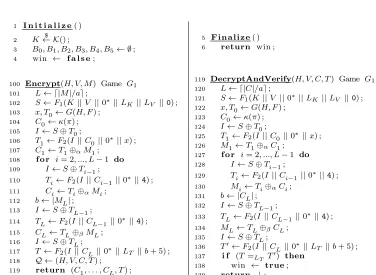
1 I n i t i a l i z e( ) 2 K← K$ () ;
3 B0, B1, B2, B3, B4, B5← ∅; 4 win ← f a l s e;
5 F i n a l i z e( ) 6 return win ;
100 Encrypt(H, V, M) Game G1 101 L← ⌈|M|/a⌉;
102 S←F1(K||V ||0∗||LK ||LV ||0) ; 103 x, T0←G(H, F) ;
104 C0←κ(π) ; 105 I←S⊕T0;
106 T1←F2(I||C0||0∗||x) ; 107 C1←T1⊕αM1;
108 f o r i= 2, ..., L−1 do
109 I←S⊕Ti−1;
110 Ti←F2(I||Ci−1 ||0∗||4) ; 111 Ci←Ti⊕αMi;
112 b← |ML|; 113 I←S⊕TL−1;
114 TL←F2(I ||CL−1 ||0∗||4) ;
115 CL←TL⊕βML; 116 I←S⊕TL;
117 T ←F2(I ||CL||0∗||LT ||b+ 5) ; 118 Q ←(H, V, C, T) ;
119 return (C1, . . . , CL, T) ;
119 DecryptAndVerify(H, V, C, T) Game G1 120 L← ⌈|C|/a⌉;
121 S←F1(K||V ||0∗||LK ||LV ||0) ; 122 x, T0←G(H, F) ;
123 C0←κ(π) ; 124 I←S⊕T0;
125 T1←F2(I||C0||0∗||x) ; 126 M1←T1⊕αC1;
127 f o r i= 2, ..., L−1 do
128 I←S⊕Ti−1;
129 Ti←F2(I ||Ci−1 ||0∗||4) ; 130 Mi←Ti⊕αCi;
131 b← |CL|; 132 I←S⊕TL−1;
133 TL←F2(I||CL−1||0∗||4) ;
134 ML←TL⊕βCL; 135 I←S⊕TL; 136 T′←F2(I ||C
L||0∗||LT ||b+ 5) ; 137 i f (T =LT T′) then
138 win ← true; 139 return ⊥;
Fig. 5. Games G1 for the proof of Lemma 2. The variable a denotes the block size of the message and ciphertext blocks witha≤n, wherenis the output size ofF,F1, andF2, each. The functionκ(π) returns the firsta/4 post decimal positions ofπinterpreted as a string of hex characters, andLT denotes the bit-length of the tag.
This proof borrows ideas from theINT-CTXT-proof presented by Fleischmann et al. [11].
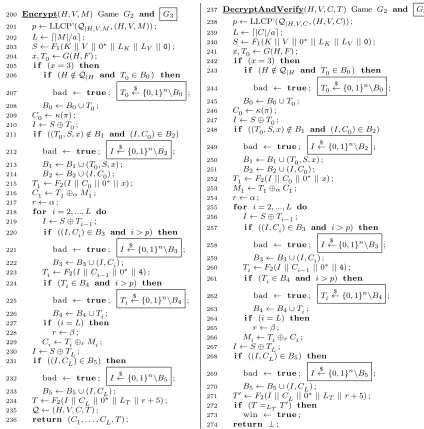
Our bound is derived by game-playing arguments. Consider gamesG1-G3 of Figure 5 and Figure 6, and a fixed adversaryA asking at mostq queries with a total length of at mostℓ blocks. We assume that the adversary never asks for a query for which the answer is already known. The functionsInitializeand Finalizeare identical for all games in this proof. Lets denote G0 as theINT-CTXT-game defined in Figure 2 (cf. Section 3). Therefore, we have
200 Encrypt(H, V, M) Game G2 and G3 201 p←LLCP’(Q|H,V,M,(H, V, M)) ; 202 L← ⌈|M|/a⌉;
203 S←F1(K||V ||0∗||L
K||LV ||0) ; 204 x, T0←G(H, F) ;
205 i f (x= 3) then
206 i f (H /∈ Q|H and T0∈B0) then 207 bad ← true; T0
$
← {0,1}n\B 0 ; 208 B0←B0∪T0;
209 C0←κ(π) ; 210 I←S⊕T0;
211 i f ((T0, S, x)∈/B1 and (I, C0)∈B2) 212 bad ← true; I← {$ 0,1}n\B
2 ; 213 B1←B1∪(T0, S, x) ;
214 B2←B2∪(I, C0) ; 215 T1←F2(I ||C0 ||0∗||x) ;
216 C1←T1⊕αM1; 217 r←α;
218 f o r i= 2, ..., L do
219 I←S⊕Ti−1;
220 i f ((I, Ci)∈B3 and i > p) then 221 bad ← true; I← {$ 0,1}n\B
3 ; 222 B3←B3∪(I, Ci) ;
223 Ti←F2(I||Ci−1 ||0∗||4) ;
224 i f (Ti∈B4 and i > p) then 225 bad ← true; Ti
$
← {0,1}n\
B4 ; 226 B4←B4∪Ti;
227 i f (i=L) then
228 r←β; 229 Ci←Ti⊕rMi; 230 I←S⊕TL;
231 i f ((I, CL)∈B5) then
232 bad ← true; I← {$ 0,1}n\B 5 ; 233 B5←B5∪(I, CL) ;
234 T ←F2(I||CL||0∗||LT ||r+ 5) ; 235 Q ←(H, V, C, T) ;
236 return (C1, . . . , CL, T) ;
237 DecryptAndVerify(H, V, C, T) Game G2 and G3 238 p←LLCP’(Q|H,V,C,(H, V, C)) ;
239 L← ⌈|C|/a⌉;
240 S←F1(K||V ||0∗||L
K||LV ||0) ; 241 x, T0←G(H, F) ;
242 i f (x= 3) then
243 i f (H /∈ Q|H and T0∈B0) then 244 bad ← true; T0
$
← {0,1}n\B 0 ; 245 B0←B0∪T0;
246 C0←κ(π) ; 247 I←S⊕T0;
248 i f ((T0, S, x)∈/B1 and (I, C0)∈B2) 249 bad ← true; I← {$ 0,1}n\B
2 ; 250 B1←B1∪(T0, S, x) ;
251 B2←B2∪(I, C0) ; 252 T1←F2(I ||C0 ||0∗||x) ;
253 M1←T1⊕αC1; 254 r←α;
255 f o r i= 2, ..., L do
256 I←S⊕Ti−1;
257 i f ((I, Ci)∈B3 and i > p) then 258 bad ← true; I← {$ 0,1}n\B
3 ; 259 B3←B3∪(I, Ci) ;
260 Ti←F2(I||Ci−1 ||0∗||4) ; 261 i f (Ti∈B4 and i > p) then 262 bad ← true; Ti
$
← {0,1}n\B 4 ; 263 B4←B4∪Ti;
264 i f (i=L) then
265 r←β; 266 Mi←Ti⊕rCi; 267 I←S⊕TL;
268 i f ((I, CL)∈B5) then
269 bad ← true; I← {$ 0,1}n\B 5 ; 270 B5←B5∪(I, CL) ;
271 T′←F
2(I||CL||0∗||LT ||r+ 5) ; 272 i f (T =LT T′) then
273 win ← true; 274 return ⊥;
In G1, the encryption- and verify-placeholders are replaced by their genericCOFFE coun-terparts as of Algorithm 1 and, using similar arguments as in the proof for Lemma 1, we can partitionF into two independentPRF’s F1 and F2. Thus,
Pr[AG0 ⇒1]≤Pr[AG1 ⇒1] + 2·AdvPRF-XRK
F∗ (q+ℓ, O(t)),
where
AdvPRF-XRKF∗ (q, ℓ, t) = max
AdvPRF-XRKF2 (q+ℓ, O(t)),AdvPRFF1 (q, O(t)) .
We now discuss the differences between G1 and G2. The sets B0, . . . , B5 are initialized as empty sets (cf. Line 3 of Figure 5) and collect fresh values as follows:
– B0 collects all fresh values T0, where|H|> n in lines 208 and 245. – B1 collects all fresh pairs (T0, S) in lines 213 and 250.
– B2 collects all fresh values I =T0⊕S in lines 214 and 251.
– B3 collects all fresh pairs (I =Tµ⊕S, Cµ) with 1≤µ≤L−1, where Lis the message
length in blocks. This is done in lines 222 and 259.
– B4 collects all fresh values Tµ with 1≤µ≤L in lines 226 and 263.
– B5 collects all fresh pairs (I =TL⊕S, CL). This is done in lines 233 and 270.
In lines 201 and 238, the LLCP’ oracle is inquired as defined in Figure 4. Finally, the variable
bad is set totrue if one of the if-conditions in lines 206, 211, 220, 224, 231, 243, 248, 257,
261, or 268 istrue.None of these modifications affect the values returned to the adversary
and therefore,
Pr[AG1 ⇒1] = Pr[AG2 ⇒1]. It follows that
Pr[AG2 ⇒1] = Pr[AG3 ⇒1] +|Pr[AG2 ⇒1]−Pr[AG3 ⇒1]|
≤Pr[AG3 ⇒1] + Pr[AG3sets bad]. (3)
We now proceed to upper bound the two terms contained in (3) – in right to left order. The success probability of GameG3 does not differ from the success probability of Game G2 unless one of the following cases occur, where each case causes a bad event, i.e., the variable bad is set to true. In the following, the indices i and j denote the i-th and j-th
query with 1≤i, j≤q, respectively.
Case 1 (Collision – Initial Chaining Value): In lines 207 and 244 the initial chaining valueT0 is set to a new random value if the functionGreturns the sameT0twice for two distinct values Hi 6=Hj with i6=j and|Hi|,|Hj|> n, i.e., in the case when x= 3. The probability for such a collision can be upper bounded by
q2/2n.
Case 2 (Input Collision – Domain 1, . . . ,3): In lines 212 and 249 the chaining valueI is set to a new random value if there is a non-trivial input collision between the two input values Ii =Si⊕T0i and Ij =Sj ⊕T0j withxi =xj, so thatIi =Ij withi6=j. We can upper bound the success probability for this case by
Case 3 (Input Collision – Domain 4): In lines 220 and 257 we test for a non-trivial input collision for the pairsρi = (Si⊕Tµi, Cµi) and ρj = (Sj⊕Tνj, Cνj) withi6=j,ρi =ρj,
and 1≤µ, ν ≤L−1. The success probability for this case can be upper bounded by ℓ2/2n.
Case 4 (Output Collision – Domain 4): In lines 224 and 261 we test, if the adversary has found a non-trivial collision of the form Ti
µ=Tνj with 2≤µ, ν ≤L−1 and (i, µ)6=
(j, ν). The success probability is then given by ℓ2/2n.
Case 5 (Input Collision – Domain 5): In lines 231 and 268 we test for a non-trivial input collision for the pairs ρi = (Si⊕TLi, CLi) and ρj = (Sj ⊕TLj, CLj) with i6= j and
ρi =ρj. We can upper bound the success probability for this case by
q2/2n.
By adding up the individual bounds, it follows that
Pr[AG3sets bad] ≤ 3ℓ
2+ 2q2 2n .
The adversary wins Game G3 iff the variable win is set to true, i.e., the if-condition in Line 272 holds. This implies that the adversary can only win with a fresh query to the DecryptAndVerify oracle, which leads to T =LT T
′, where T′ is computed as shown in
Line 271 and =LT denotes the comparison over the LT least significant bits. Lines 268 and 269 ensure that the input for the function F in Line 271 is always a fresh value, i.e., it was never asked before. Since F is modelled as a PRF, the probability for T =L
T T
′ can be
upper bounded by
1/2LT.
As we allow the adversary to ask at mostqqueries, the success probability for GameG3 can be upper bounded by
Pr[AG3 ⇒1] ≤ q/2LT.