ISSN (Print) : 2320 – 3765 ISSN (Online): 2278 – 8875
I
nternational
J
ournal of
A
dvanced
R
esearch in
E
lectrical,
E
lectronics and
I
nstrumentation
E
ngineering
(An ISO 3297: 2007 Certified Organization)
Vol. 5, Issue 12, December 2016
Copyright to IJAREEIE DOI:10.15662/IJAREEIE.2016.0512060 9305
Capacity Credit Based Reliability Analysis in
the Power System Considering Renewable
Energy Generator
C.K.Ponnusamy1, P.Madasamy2, K.Ramadas3, M.Arun4
Assistant Professor, Department of Electrical and Electronics Engineering, Jayaram Engineering College, Trichy,
Tamil Nadu, India1
Assistant Professor, Department of Electrical and Electronics Engineering, Alagappa Chettiar College of Engineering
and Technology, Karaikudi, Tamil Nadu, India 2,3
Assistant Professor, Department of Electrical and Electronics Engineering, Annamalai University, Tamil Nadu, India4
ABSRTACT: The rapidly increasing power demand gives the needs of attention in renewable energy generation. But due to high uncertainties, all time integrating renewable power becomes highly unbelievable. This situation is creating reliability evaluation and cost evaluation of power system with consideration of renewable energy generation. This paper mainly deals with the reliability evaluation based mathematical and probabilistic techniques. The proper FOR (Forced Outage Rate) value should be taken for reliability evaluation in efficient way. This can be done by mathematical formula for a year. This paper deals with the model consecutive replacing of conventional generation to renewable generation and calculation of capacity credit value in the test system using recursive formulae. The capacity credit value is calculated from the ELCC value.
KEYWORDS: FOR (Forced Outage Rate), Reliability, ELCC (Effective Load Carrying Capability)
I. INTRODUCTION
Wind is one of the fastest growing energy for human beings, and it is alternative source of conventional energy production as like fossil fuel generation. The impact of the wind energy is cost free and less maintenance as well [1]. As seen before due to the high uncertainties like epistemic and aleatory the renewable energy cannot take place all time in the power system. Because of these reasons renewable energy generators can’t give reliable power to the customers. So it becomes so essential to derive an index for the availability of power at all the time. Already there are many methodologies have been evaluated to look over the reliable power supply. They are EENS, LOLE, LOLP and F&D. But these methodologies can’t give full-fledged work for renewable generators. The reliability of a renewable energy generator depends on various factors. They are uncertainties, peak load, load constraints, failures etc. to study the effect of uncertainties in the power system, capacity credit and EENS based reliability analysis are taken for the proposal.
II. UNCERTAINTIES
ISSN (Print) : 2320 – 3765 ISSN (Online): 2278 – 8875
I
nternational
J
ournal of
A
dvanced
R
esearch in
E
lectrical,
E
lectronics and
I
nstrumentation
E
ngineering
(An ISO 3297: 2007 Certified Organization)
Vol. 5, Issue 12, December 2016
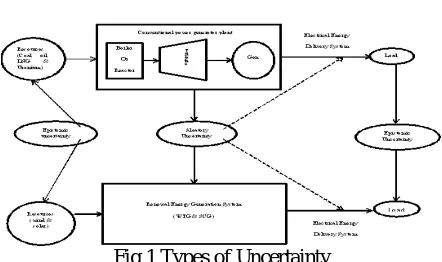
Fig 1 Types of Uncertainty
2.1 Aleatory Uncertainty
Aleatory uncertainty is due to the system failures like short circuit, breaker failure, over extraction of power and other component failure or system failure in various ways. This can be controlled by the proper monitoring and maintaining the overall system. This uncertainty can be easily measure rather the epistemic uncertainty.
2.2 Epistemic Uncertainty
The uncertainty produced by the natural causes named epistemic uncertainty. The causes are earth quake, flood, hurricane and various seismic problems. The expectation and measuring the uncertainty is very tough job as this depends more on natural causes.
III. CONSTRUCTION OF WIND SPEED MODEL
ISSN (Print) : 2320 – 3765 ISSN (Online): 2278 – 8875
I
nternational
J
ournal of
A
dvanced
R
esearch in
E
lectrical,
E
lectronics and
I
nstrumentation
E
ngineering
(An ISO 3297: 2007 Certified Organization)
Vol. 5, Issue 12, December 2016
Copyright to IJAREEIE DOI:10.15662/IJAREEIE.2016.0512060 9307
IV. EENS CALCULATION
ISSN (Print) : 2320 – 3765 ISSN (Online): 2278 – 8875
I
nternational
J
ournal of
A
dvanced
R
esearch in
E
lectrical,
E
lectronics and
I
nstrumentation
E
ngineering
(An ISO 3297: 2007 Certified Organization)
Vol. 5, Issue 12, December 2016
The input here taken are the load duration curve, unit of the generators and forced outage of the generators. The step size is calculated by the finding of maximum common factor of the all taken generators in MW. Split up the load duration curve from the multiples of the step size. The proceeding of finding each area will give the initial value of the iteration. The iteration depends on the number of units and the ratio of the maximum load and the step size. If the step size is very low the iteration will be large. The iteration count can be finding out by the above formula given in the flowchart. The iteration is for each generator. Thus the iteration starts and the EENS value can be finding by the above procedure.
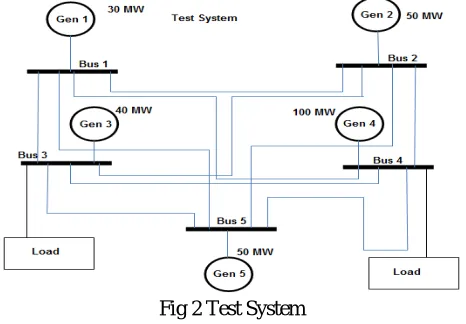
Fig 2 Test System
The test system is shown in figure.2. That consists of five generators and five buses consecutively. The load is working with busno.3 and bus no.4. Consider that test system transmission is ideal and full reliable for carrying power. The generators may individual or group of generators to supply the demand that is load. To evaluate reliability index the outage parameter is very much essential. The parameter named forced outage is given in table.1 for each generator.
V. FORCED OUTAGE RATE
ISSN (Print) : 2320 – 3765 ISSN (Online): 2278 – 8875
I
nternational
J
ournal of
A
dvanced
R
esearch in
E
lectrical,
E
lectronics and
I
nstrumentation
E
ngineering
(An ISO 3297: 2007 Certified Organization)
Vol. 5, Issue 12, December 2016
Copyright to IJAREEIE DOI:10.15662/IJAREEIE.2016.0512060 9309 Table 1 Forced Outage Rate
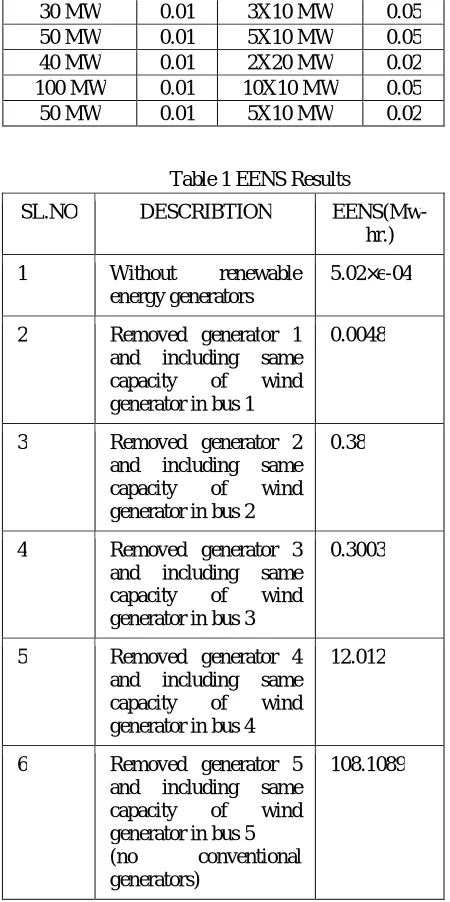
Table 1 EENS Results
The ultimate aim of the proposal is to use renewable energy generators at maximum level for the power system. So the condition is without conventional generation the power system has to be run with considerable reliability value. That means through the renewable generation only the power system has to run. The work done here is removing the conventional generators and replacing the renewable generators consecutively. While evaluating that; the EENS values are taken. The table shown below shows the EENS value. The EENS value is increasing consecutively while removing the conventional generators. It can be seen on scrutinizing the Table 2 EENS results.
Conventional Generator
FOR Renewable Generation
FOR
30 MW 0.01 3X10 MW 0.05
50 MW 0.01 5X10 MW 0.05
40 MW 0.01 2X20 MW 0.02
100 MW 0.01 10X10 MW 0.05
50 MW 0.01 5X10 MW 0.02
SL.NO DESCRIBTION
EENS(Mw-hr.)
1 Without renewable energy generators
5.02×e-04
2 Removed generator 1 and including same capacity of wind generator in bus 1
0.0048
3 Removed generator 2 and including same capacity of wind generator in bus 2
0.38
4 Removed generator 3 and including same capacity of wind generator in bus 3
0.3003
5 Removed generator 4 and including same capacity of wind generator in bus 4
12.012
6 Removed generator 5 and including same capacity of wind generator in bus 5 (no conventional generators)
ISSN (Print) : 2320 – 3765 ISSN (Online): 2278 – 8875
I
nternational
J
ournal of
A
dvanced
R
esearch in
E
lectrical,
E
lectronics and
I
nstrumentation
E
ngineering
(An ISO 3297: 2007 Certified Organization)
Vol. 5, Issue 12, December 2016
VI. ELCC
The ELCC (Effective Load Carrying Capability) was proposed by L.L. Garver in 1966. The purpose is to evaluate the actual contribution level of the new generator (renewable or conventional) for generation system expansion planning. It is proposed usefully in order to assess how much does a new generator cover future load with considering uncertainty of the generator. It is defined as difference of increasing system loads between before and after the new generator penetration in looking for same target risk level as ELCC (Effective Load Carrying Capability).
Therefore, the effective load-carrying capability (ELCC) is a way to measure a power plant’s capacity credit based on its influence on overall system reliability [3-4-5]. When a new generating unit is added into a power system, the ELCC of the unit is the amount of extra load that can be served while keeping a suitable level of reliability. The suitable level is the LOLE of the system before addition of the new generating unit. Thus, The LOLEs of existing and potential systems are equal. The concept of ELCC is Introduced by equation LOLEe =LOLEp are the loss of load probabilities (LOLPS) of the existing and potential systems. The LOLP is the LOLE dividing the period. ΔL is the extra load that can be served by the additional generation. Ca is the added generator’s capacity. For example, in a power system added wind farms, due to the nature of wind, the reliability of wind farms is lower than conventional power plants’. All the extra added wind power cannot supply load demand fully. The ELCC, specially, is more important and reasonable approach model for reliability evaluation of wind farms because wind turbine generator has usually high epistemic uncertainty. Additionally, the method which evaluates the LOLE of power system including wind turbine generators is different from it of conventional power plants. As it is, a two-state model used popularly for conventional generator can be used no more for wind turbine generator. A multi-state model should be used. B. Capacity Credit in View Point of Reliability two kinds of methods are developed for assessing capacity credit. One uses ELCC in viewpoint of reliability as previous comments. Anther uses capacity factor in view point of economics. They have a little bit difference. The ELCC is used in this paper because it is focused on development of reliability new index rather than economics viewpoint. Using above ELCC, the capacity Credit can be formulated by the extra load divided new generator capacity [6]. It means how much is the actual reliability contribution of new generator and it is one of the actual contribution assessment methods.
6.1 ELCC CALCULATION
ISSN (Print) : 2320 – 3765 ISSN (Online): 2278 – 8875
I
nternational
J
ournal of
A
dvanced
R
esearch in
E
lectrical,
E
lectronics and
I
nstrumentation
E
ngineering
(An ISO 3297: 2007 Certified Organization)
Vol. 5, Issue 12, December 2016
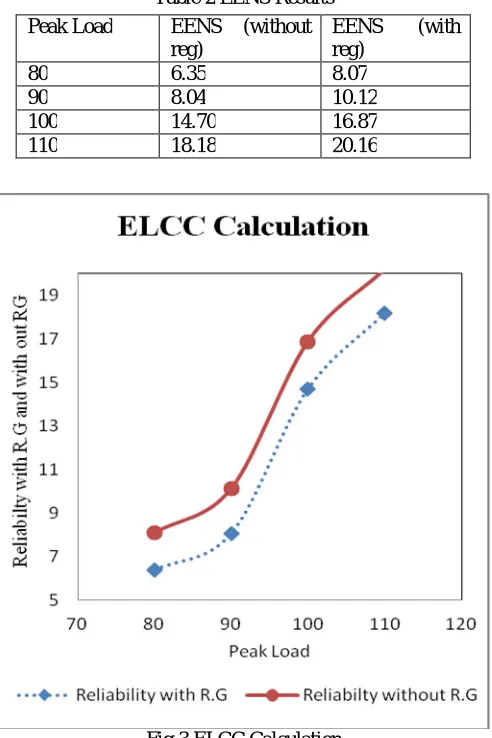
Copyright to IJAREEIE DOI:10.15662/IJAREEIE.2016.0512060 9311 the input data taken re peak load from the load duration curve and the EENS value obtained from the recursive formula without varying the load duration curve except the peak load. The result and input data is given in the following table. On scrutinizing the table the EENS value increasing exponentially increasing with the increasing of the peak load. The graph has been drawn as like in the above graph. The distance between the two curves while keeping the particular reliability in the system.
VII. EENS CALCULATION
As described above the load duration curve is taken, the change in peak load is given in the following table. The conventional units are taken 40MW in 3 numbers with the forced outage rate of 0.1 each and renewable energy generation with the same and forced outage rate is 0.02 the result is shown in below table.
7.1 CAPACITY CREDIT CALCULATION
Capacitive credit=
*
100
aC
L
For the EENS 12 the ELCC value is 2.5 MW. The extended renewable power using wind generator is 40 MW. The capacity credit is 6.25 [7].
The ELCC value is taken from the graph by measuring the distance of EENS value keeping 12MW-hr.
Table 2 EENS Results
Fig 3 ELCC Calculation Peak Load EENS (without
reg)
EENS (with reg)
80 6.35 8.07
90 8.04 10.12
100 14.70 16.87
ISSN (Print) : 2320 – 3765 ISSN (Online): 2278 – 8875
I
nternational
J
ournal of
A
dvanced
R
esearch in
E
lectrical,
E
lectronics and
I
nstrumentation
E
ngineering
(An ISO 3297: 2007 Certified Organization)
Vol. 5, Issue 12, December 2016
VIII CONCLUSION
This paper produces two results. First result is consecutive elimination of conventional generator and replacing of renewable energy generator. In that analysis the EENS value is increasing exponentially. So for the implementation of renewable power considering EENS value is very much important for the whole system. The second result is capacity credit followed by the ELCC value. The significant importance of ELCC is, it is very much useful for generation expansion planning. Higher in the ELCC value after the penetration of new generator indicates that load can be added at the user end level.
REFERENCES
1. “Wind Power Today”, Federal Wind Program Highlights, U.S. Department of Energy, Energy Efficiency and Renewable Energy, April, 2005. 2. Roy Billinton and Dange Huang, “Aleatory and Epistemic Uncertainty Considerations in Power System Reliability Evaluation”, PMAPS, May
25-29, 2008.
3. Wu Liang, Jeongje Park, Jaeseok Choi, A. A. El-Keib, Mohammad Shahidehpour and Roy Billinton, “Probabilistic Reliability Evaluation of Power Systems Including Wind Turbine Generators Using a Simplified Multi-State Model: A Case Study” IEEE PES GM2009, July 26-30, 2009, Calgary, AB, Canada.
4. L. L. Garver, “Effective load carrying capability of generating units,” IEEE Transactions on Power Apparatus and Systems, vol. PAS-85, no. 8, 1966, pp. 910-919.
5. Claudine D’Annunzio, Surya Santoso, "Noniterative Method to Approximate the Effective Load Carrying Capability of a Wind Plant", IEEE Transactions on Energy Conversion, vol. 23, no. 2, June, 2008, pp. 544-550.
6. Lennart S’Oder and Mikael Amelin, "A review of different methodologies used for calculation of wind power capacity credit" IEEE GM2008, Pittsburg, PA, USA.