ISSN 2286-4822 www.euacademic.org
Impact Factor: 3.1 (UIF) DRJI Value: 5.9 (B+)
'A Web Enabled (Phi) System' A Solution For
Medical Services
ALI KARAMALLAH JASIM AL-SAEDI MSC. Student Department of Computer Science and Information Technology Sam Higginbottom Institute of Agriculture, Technology and Science
Allahabad, Uttar Pradesh India RUAA SHALLAL ABBAS ANOOZ M.tech student Department of Electronics and Communication Engineering Sam Higginbottom Institute of Agriculture, Technology and Science, Allahabad, Uttar Pradesh India Foundation of Technical Education Technical College-Najaf, Najaf Iraq R. DILEEP KUMAR Assistant professor Department of Computer Science and Information Technology Sam Higginbottom Institute of Agriculture, Technology and Science Allahabad, Uttar Pradesh India
Abstract:
and complexity of medical data are increasing, there is a greater demand for data to support activities other than direct person care.
Medical record information needs every day to be accessed also for administrative, economic and legal purposes. This project was conceived to serve that purpose along with controlling and managing the Hospital’s administrative data.
Key words: Person health status information database systems, hospital management software, health institutes, hospitals, Iraq.
Introduction:
services through the established institutions. Software application can provide solution and services for the global health care industry. By using the cutting edge technologies, this project can be improved with efficient work flow and communication. Any time any where facilities of the internet have helped the Medical fields to integrate into a single unit. Various Hospitals across the globe can be connected together. They can share information and even services. Details of the Patients, their previous visits etc. are totally not perceptible without a computer. Relevant Information are always stored in the computer and are available instantly in front of the user. person health status information database system is a simple yet effective management structure. This system acts for the hospitals to manage the affairs of the hospital and to serves various organization by designing a person health information system in internet.
Objectives:
1. To Design and develop a personal health status information database system that serves various organization that are associated with individual.
2. To Design and develop hospital management database that represent heterogeneous data formats of medical data in an optimized storage techniques that help fast retrieval.
Components:
This project is integration various medical models that enable creating a Client /Server architecture based database with platform to access it. The major components of the system include:
Personal Health Record
Electroinic Health Record
Hospital Management System
i) Personal Health Record PHR
Definition
A personal health record, or PHR, is a health record where health data and information related to the care of a patient which is operated by institutions (such as hospitals) and contains data entered by clinicians or billing data to support insurance claims. The intention of a PHR is to provide a summary of an individual's medical history which is accessible online. The personal health record (PHR) is proposed as an innovative solution to the problems of fragmented communication and lack of interoperability among diverse organizations and health institution . It provides a single source (the patient’s PHR) for authentication and remote access of the health information data from all organizations.
Benefits of Personal Health Record
providers and early interventions can be promoted upon encountering deviation of health status. PHRs also make it easier for clinicians to care for their patients by facilitating continuous communication as opposed to episodic. Eliminating communication barriers and allowing documentation flow between patients and clinicians in a timely fashion can save time consumed by face-to-face meetings and telephone communication. Additionally, in the case of an emergency a PHR can quickly provide critical information to proper diagnosis or treatment.
Architecture of Personal Health Record
PHR architecture consists of three primary components: Data, Infrastructure and Applications.
1- Data refers to the information that is collected, analyzed, exchanged and stored by different information technologies. Examples include medical history, list of medical problems, medication history, etc.
2- Infrastructure is the computing platform which processes or exchanges healthcare data, such as software packages and websites.
3- Applications include the data exchange, transactional, analytical and content delivery capabilities of the system, such as, patient decision support system and disease education materials.
Personal Health Recordsolution types
One of the principal distinguishing features of a PHR is the platform by which it is delivered. The types of platforms include: paper, electronic device, and web.
Paper-based PHR
Personal health information is recorded and stored in paper format. Printed laboratory reports, copies of clinic notes, and health histories created by the individual may be parts of a paper-based PHR. This method is low cost, reliable, and accessible without the need for a computer or any other hardware. Paper-based PHRs may be difficult to locate, update, and share with others. Paper-based PHRs are subject to physical loss and damage, such as can occur during a natural disaster. Paper records can also be printed from most electronic PHRs.
Electronic device-based PHR
Personal health information is recorded and stored in personal computer-based software that may have the capability to print, backup, encrypt, and import data from other sources such as a hospital laboratory. The most basic form of a PC-based PHR would be a health history created in a word-processing program. The health history created in this way can be printed, copied, and shared with anyone with a compatible word processor.
a personal computer application or a web solution. Web-based PHR solutions
Web-based PHR solutions are essentially the same as electronic device PHR solutions, however, web-based solutions have the advantage of being easily integrated with other services. For example, some solutions allow for import of medical data from external sources. allow for data to be shared with other applications or specific people. A large number of companies have emerged to provide consumers the opportunity to develop online PHRs. Some have been developed by non-profit organizations, while others have been developed by commercial ventures. These web-based applications generate records that can be displayed for review or transmitted to authorized receivers. Despite the need for PHRs and the availability of various online PHR providers, there has not been wide adoption of PHR services.
ii)Electronic Medical Record EMR
Medical records, whether electronic or not, are a collection of information about a patient's healthcare that are essential for his or her present and future care As such, the medical record must contain sufficient information to identify the patient to whom it relates, as well as information relevant to the patient's treatment during current and future episodes of care, for example:
the patient's medical history.
the orders and results of any physical examination or tests.
information relating to allergies.
other factors that may need special consideration.
care. An EMR replaces paper-based medical records by electronically documenting the information relevant to a patient’s healthcare. the same term is used to mean different things. For example, EMR has been used to refer to clinical information in any electronic form (such as scanned records), which simply replaces paper records. The term ‘mini-EMR’ has been used to describe individual hospital department systems, . A more sophisticated definition of an EMR encompasses the information and capabilities required to support Health care service delivery, where the information is captured in a computer-readable form that supports interoperability and clinical decision support. In addition, it is likely that increasing numbers of consumers will have direct access to EMR systems[3].
Benefits of Electronic Medical Record
There are many potential benefits of the EMR. Unlike the paper record:-
1-it can potentially be used by anyone who needs it at any time. 2-It can also be accessed easily from remote sites. such as a
clinic across town or even across the country.
3-It is unlikely that data will be lost or misplaced. With an appropriate back-up mechanism,
4-it should serve as a permanent record of an individual’s interaction with the health care system. Furthermore, with the availability of all the patient’s data, new views and other summaries can be generated instantaneously.
5-with the potential for the incorporation of reminders and decision support, the likelihood of mistakes and omissions should decrease.
6-In addition to benefiting the individual patient, the EMR is also likely to benefit the larger population.Clinical research will likely be enhanced and researchers
8-Screening and other preventive measures will become easier to implement as patients of various attributes[4].
iii)Electronic Health Record
Any service, component, or combination thereof that can meet the requirements of at least one certification criterion adopted Examples of EHR include, but are not limited to, the following :
1. An interface or other software program that provides the capability to exchange electronic health information. 2. A software program that enables individual online
access to certain health information maintained by EHR technology.
3. Clinical decision support rules engine.
4. A software program used to submit public health information to public.
5. Health authorities and a quality measure reporting service or software program.
Most commercial EHRs are designed to combine data from the large ancillary services, such as pharmacy, laboratory, and radiology, with various clinical care components (such as nursing plans, medication administration records, and physician orders). The number of integrated components and features involved is dependent upon the data structures and systems implemented by the technical teams. The EHR, therefore, may import data from the ancillary systems via a custom interface or may provide interfaces that allow clinicians to access the silo systems through a portal. Or, the EHR may incorporate only a few ancillaries.
Differences between EMR and EHR
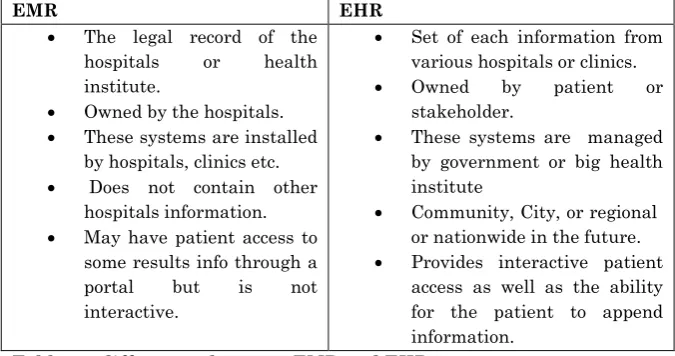
and electronic health record (EHR) interchangeably. However, these terms describe different concepts, both of which are crucial to the success of local, regional, and national goals to improve patient safety, improve the quality and efficiency of patient care and reduce healthcare delivery costs. EHR are reliant on EMR being in place, and EMR will never reach their full potential without interoperable EHR in place. It's important to understand the differences and to reduce confusion, see table 3.1.
EMR EHR
The legal record of the hospitals or health institute.
Owned by the hospitals.
These systems are installed by hospitals, clinics etc.
Does not contain other hospitals information.
May have patient access to some results info through a portal but is not interactive.
Set of each information from various hospitals or clinics.
Owned by patient or stakeholder.
These systems are managed by government or big health institute
Community, City, or regional or nationwide in the future.
Provides interactive patient access as well as the ability for the patient to append information.
Table 3.1 differences between EMR and EHR
iv)Hospital Management System
Need for Hospital Management system
control, superior patient care, strict cost control and improved profitability. Due to business and legal demands—like the Healthcare Insurance Portability and the Global norm- healthcare organizations are fully realizing the urgency to integrate their businesses. Unfortunately, most of the health information systems are still proprietary and often only serve one specific department within a healthcare system.[2].see diagrams 1.1
Diagram 1.1 why hospital management system
Traditional System in use:
record files slow in processing of records, space occupied by the file time waiting while waiting for the patient file to be retrieve by the receptionist. [1].
Problems with traditional system
1. Lack of immediate retrievals: -The information is very difficult to retrieve and to find particular information like- E.g. - To find out about the patient’s history, the user has to go through various registers. This results in inconvenience and wastage of time.
2. Lack of immediate information storage: - The information generated by various transactions takes time and efforts to be stored at right place.
3. Lack of prompt updating: - Various changes to information like patient details or immunization details of child are difficult to make as paper work is involved. 4. Error prone manual calculation: - Manual calculations
are error prone and take a lot of time this may result in incorrect information. For example calculation of patient’s bill based on various treatments.
5. Preparation of accurate and prompt reports: - This becomes a difficult task as information is difficult to collect from various registers. [11].
Proposed System:
This new system is design to keep track of all patient’s medical record/information such as admission and discharged, inpatient, outpatient, drug prescribed, and captures complete relevant patient information this will improve the efficiency of the management in a daily work as it can provide required records on time.
clinical transactions, and at the same time, provide better service to their consumers. [1].
Record / procedure
Patient’s record and procedure vary greatly according to patient data received and the extension of automation in processing data. These are some fundamental step which is common to patient record in all clinics and hospitals, some of these steps taken at each treatment of patient and assessment in clinical procedure include:
Assessment: To get the information and the assessment of patient’s symptom and signs.
Data entry: recording of data into a patient’s record (which may be a complex electronic data written records results etc)
Data retrieval: extracting data for interpretation.
Information interpretation: governance of interpretation of individual patient data utilization of existing knowledge and guidelines. Therefore, when these fields are put together they produce a medical record. [1].
Advantage of the new system
1. It aids hospital administrators by significantly improving operational control and streamlining operations.
2. It enables improved response to demands of patient care because it automates the process of collecting, collating and retrieving patient information
3. It provides doctors and hospital staff with the decision support system that they require for delivering patient care, which is comparable to global standards.
4. By enabling an automated and intelligent flow of patient information, the new system enables hospitals and doctors to better serve their patients.
benefits such as easier patient record management, reduced paperwork, faster information flow between various departments,greater organizational flexibility, reliable and timely information, minimal inventory levels, reduced wastage, reduced waiting time at the counters for patients and reduced registration time for patients.
6. The indirect benefits would be an improved image of the hospital and increased competitive advantage. [12].
Design Issues
Database Design
The database and table are very essential of this software because the tables hold the information or records that needed to be stored in the database. Therefore, the script is written in Microsoft SQL server management studio and the tables are generated automatically as the script runs successfully.
Design Hospital Management Database
The diagram 4.1 shows Entity relationship diagram in abstract form.
Diagram 4.1 shows Entity relationship
4.3 Design the web Personal HealthInformation System. The diagram 4.2 shows the Personal Health Information System. The diagram depicts major components of the system & their integration. Common Database usage with the help of internet makes these components access relevant data with simple interfacing application utilities.
Results:
Through the Internet organizations or health institute or any other beneficiary can receive information on the status of the health of any person through the use of the name or identification number of each person. The project provides support for students of various medical specialties, where every researcher can choose the type of specialization and this project will provide a variety of data about this specialty (diseases, diagnosis, treatment, type of medication etc. ...)
This project includes registration of Personal health information, storing the details into the system and also computerized billing This software has the facility to give a unique id for every patient and stores the details of every Person and the staff automatically It includes a search facility to know the current status of each room User can search availability of a doctor and the details of a patient using the id.
This project supports the concept of an Electronic Medical Record through the interconnection between administrative and medical information for the patient, put medical results for patient such as Operation, treatment, Prescription medicine with administrative information about same patient.
The System can be entered using a username and password It is accessible by an administrator or doctor or receptionist Only they can add data into the database The data can be retrieved easily.
user is unique by his password and username.
The project is improving health system efficiency and reduces waiting times. The doctor and other health providers will be able to make the best treatment decisions and provide patient with the best care when they can see all the information about the Personal health .The health providers will be able to function as a coordinated ‘team’, bringing a more collaborative approach to patient care The Person likely not needs to have tests repeated or procedures delayed until background information can be collected.
It is a faster and more secure, private way of sharing patient's personal health information among the health providers that need it. This project reduces distance as a barrier to quality care by removing the need to move physical files because they will be available electronically.
Conclusion:
REFERENCES
[1] Asabe, S. A, Oye, N. D, and Monday Goji. 2013. “Hospital patient database management system.” An international journal of advanced computer technology 2 (3).
[2] Balaraman, P., K. Kosalram. 2013. “E –Hospital Management & Hospital Information Systems – Changing Trends” I.J. Information Engineering and Electronic Business 1: 50-58.
[3] Austl. A. 2012. “Electronic medical record benefits.” Information Institute, Health Records Act 2001, s. 3(1). viewed 5 April 2012
[4] Hersh, William R. Biomedical Information Communication Center. Oregon Health Sciences University, BICC, 3 18 1
[5] 2000. “A federal, health and human services.” 18(11): 2270-2277.
[6] Garets, D. and M. Davis. “Electronic Medical Records vs. Electronic Health Records: Yes, There Is a Difference.”
HIMSS Analytics, LLC 230 E. Ohio St., Suite 600
Chicago, IL 60611-3270
[7] Visual Studio 2012 Product Guide.
http://www.microsoft.com/visualstudio/compare.
[8] Arul, E. and R. Balaji. 2010. Hospital management system. Computer Applications 2010 No A7108624 .
[9] Tood, B. “Database Server or SQL Server.” Advantage Database ADV-0759–1003
[10] Chung, L. “Microsoft Access or Microsoft SQL Server.” 2004, revised July 2006.
[11] Pavlopoulos, S., T. Tagaris, A. Berler, and D. Koutsouris. “Design and development of an Intranet Hospital Information System.” Electrical & Computer Engineering, National 157: 73.
(HMIS) guintegra November 2006
[13] Ismaeel, A., N. Hamead. 2014. “Mobile GIS and Open Source Platform Based on Android: Technology for System Pregnant Women.” International Journal of Scientific & Engineering Research 5(2).
[14] Mutiara, A.B., A. Muslim, T. Oswari, and R.A. Miharja. 2014. “A model of opened based electronic medical record in Indonesia.” Information Technology, Gunadarma University, Indonesia.
[15] Parveen, A., S. Habib, and W. Ahmad. 2013. “The cloud- changing the Indian healthcare system.” IJCSMC 2(5): 238 – 243.
[16] Mane, R., and S. Jagtap. 2013. “Intelligent AutoID and Positioning System for Hospitals.” International Journal of Electronics and Computer Science Engineering
[17] Salih, H. 2012. “Impact of Information Technology on Management Control at Al Bashir Public Hospital: A Case Study of Jordan.” International Journal of Business and Management 7(2).
[18] Monem, H. 2012. “Comprehensive Prioritized Perspectives of CRM System for Implementation in the Developing Countries’ Hospitals.” International Journal of Computer Applications 50(20).
[19] Homayounfar, P. 2012. “Process mining challenges in hospital information systems.” Computer Science and Information Systems 1135–1140.
[20] Baskaran, R. 2012. “An Overview of Applications, Standards and Challenges in Futuristic Wireless Body Area Networks.” IJCSI International Journal of Computer Science Issues 9(1).
[21] Adi, Y. 2012. “Hospital Information Sharing based on Social Network Web.” International Journal of Computer Applications 56(5).
Information Science 4(2).
[23] Nguyen, D. 2011. “A Web-Based Electronic Medical Records and Hospital Information System for Developing Countries.” Journal of Health Informatics in Developing Countries.
[24] Yang, H. 2010. “Analysis and Research on Non-Technological Factors with Hospital Informationization Construction.” Computer and Information Science 3(2). [25] Mohammad, R. 2010. “Design of a Hospital-Based
Database System (A Case Study of BIRDEM).” International Journal on Computer Science and Engineering 2(8): 2616-2621.
[26] Huan Kuo, C. 2009. “An interoperability infrastructure with portable prescription for improving patient safety- the framework of a national standard in Taiwan.” 2009 World Congress on Computer Science and Information Engineering.
[27] Kuang, L. “Watermarking Image Authentication in Hospital Information System.” Electronics and Computer Science and Technology.
[28] Chowdhury, B. “RFID-based Hospital Real-time Patient Management System Business.” La Trobe University Melbourne.
[29] Fraser, H. 2005. “Implementing electronic medical record systems in developing countries.” Informatics in Primary Care 13:83–95.
Ali Karamallah Jasim AL-Saedi
Received his bachelor of Computer Science in The University of Mustansiriyah from Iraq in 2007.and his Master in Computer Science in Department of Computer Science and information technology in SHIATS, Allahabad Email: [email protected]. From Iraq.
Ruaa Shallal Abbas Anooz
Received her bachelor of Communication Engineering in Technical Collage- Najaf From Iraq in 2006.and her M.Tech. in Communication System Engineering in Department of Electronics and Communication engineering in SHIATS, Allahabad.
Email: [email protected]. From Iraq.
R. Dileep Kumar