Aspect based Sentiment Analysis in Hindi: Resource Creation and Evaluation
Md Shad Akhtar, Asif Ekbal and Pushpak Bhattacharyya
Department of Computer Science and Engineering
Indian Institute of Technology Patna
Patna, India
{shad.pcs15,asif,pb}@iitp.ac.in
Abstract
Due to the phenomenal growth of online product reviews, sentiment analysis (SA) has gained huge attention, for example, by online service providers. A number of benchmark datasets for a wide range of domains have been made available for sentiment analysis, especially in resource-rich languages. In this paper we assess the challenges of SA in Hindi by providing a benchmark setup, where we create an annotated dataset of high quality, build machine learning models for sentiment analysis in order to show the effective usage of the dataset, and finally make the resource available to the community for further advancement of research. The dataset comprises of Hindi product reviews crawled from various online sources. Each sentence of the review is annotated with aspect term and its associated sentiment. As classification algorithms we use Conditional Random Filed (CRF) and Support Vector Machine (SVM) for aspect term extraction and sentiment analysis, respectively. Evaluation results show the average F-measure of 41.07% for aspect term extraction and accuracy of 54.05% for sentiment classification.
Keywords:Aspect based Sentiment Analysis, Sentiment Dataset, Indian Languages.
1.
Introduction
With the globalization of Internet, web generated contents are increasing at a tremendous pace. This huge amount of data has introduced several new challenges and opportuni-ties in the research communiopportuni-ties. These days customers or users are relying heavily on other user’s opinion about a product or service before experiencing themselves. In or-der to get an unbiased opinion one has to extract and read all the reviews which is not an easy task to perform. Senti-ment Analysis (Pang and Lee, 2008) refers to the problem of automatically determining the polarity of sentiment/opinion expressed by user in a chunk of text or review. In gen-eral, polarity of a review belongs to one of the four possi-ble classes: positive, negative, neutral and conflict. Aspect based sentiment analysis (ABSA) is a fine-grained analysis of sentiments at the aspect or feature or attribute level. The term ‘aspect’ refers to an attribute or a component of the product/service that has been commented on in a review. Overall problem of aspect based sentiment analysis can be thought as a two-step process. The first step, i.e., aspect term extraction focuses on identifying various terms that denote aspects, and the second step, i.e. sentiment classi-fication deals with classifying the sentiments with respect to the aspect. A review sentence, therefore, may contain more than one aspect term and the sentiment associated with each. Such a fine-grained analysis provides greater insight to the sentiments expressed in the written reviews. In re-cent times, there have been a growing trend for sentiment analysis at the more fine-grained level, i.e. for aspect based sentiment analysis (ABSA). Some of the recent systems that have emerged are (Toh and Wang, 2014; Chernyshevich, 2014; Wagner et al., 2014; Castellucci et al., 2014; Gupta et al., 2015). However, almost all these research are related to some specific languages, especially the English.
Sentiment analysis in Indian languages are still largely un-explored due to the non-availability of various resources and tools such as annotated corpora, lexicons, Part-of-Speech (PoS) tagger etc. Existing works (Joshi et al., 2010; Balamurali et al., 2012; Balamurali et al., 2011; Bakliwal et al., 2012; Mittal et al., 2013; Sharma et al., 2014; Das and Bandyopadhyay, 2010b; Das and Bandyopadhyay, 2010a; Das et al., 2012) involving Indian languages mainly discuss the problems of sentiment analysis at the coarse-grained level with the aims of classifying sentiments either at the sentence or document level.
(Bak-liwal et al., 2012), and (iii). none of these was meant for aspect based sentiment analysis.
The focus of our work is to provide a benchmark setup for creating a dataset for aspect based sentiment analysis in Hindi, and then developing models for aspect term ex-traction and sentiment analysis for the effective usage of this dataset. This will surely open avenues for research in sentiment analysis involving Indian languages. To the best of our knowledge ours is the very first initiative, where we make an attempt to provide a benchmark setup for ABSA in Indian languages. Few of the examples are shown in Table 1 that gives an idea of what kind of datasets we have created. Three review text are listed in Devanagri script along with their Roman transliteration1 and English translation form. The first review has one mulit-word aspect term while the other two has one single-word aspect term. Sentiment to-wards respective aspect terms are listed in the last column of the table.
For the effective usage of the dataset we develop mod-els for aspect term extraction and sentiment classification. We use Conditional Random Field (CRF) (Lafferty et al., 2001) as our learning algorithm for the aspect term extrac-tion task and Support Vector Machine (SVM) (Cortes and Vapnik, 1995) for sentiment classification task. Evaluation shows the overall precision, recall and F-measure values of 61.96%, 30.72% and 41.07%, respectively for aspect term extraction and an accuracy of 54.05% for sentiment classi-fication.
The rest of the paper is organized as follows: Various as-pects of resource creation and its challenges are discussed in Section 2.1.. In Section 3., we describe a brief overview of aspect based sentiment analysis task. Experiments and evaluation results are furnished in Section 4.. Finally, we conclude in Section 5.
2.
Benchmark Setup for ABSA in Hindi
To address the challenges as we pointed out earlier, we de-sign web crawler, collect raw data, clean and annotate user generated reviews. In subsequent subsections we discuss these processes.
2.1.
Data Crawling
We design a web crawler that downloads product reviews from various online sources. We have crawled more than 100 newspapers, blogs, e-commence websites etc. 2 Fol-lowing this process we have collected a total of 8,000
re-1
We use ITRANS tool for the transliteration
2
List of few sources.. http://www.jagran.com
view sentences covering 12 domains. The set of domains comprises Laptops, Mobiles, Tablets, Cameras, Home-appliances, Mobile apps, Smart watches, Headphones, Speakers, Television,Travel andMovies. Some statistics of this dataset are presented in Section 2.4..
2.2.
Pre-processing
We pre-process the crawled data to convert it into the de-sired forms. We perform the following steps to prepare the datasets for our use:
• At first, we identified and removed many irrele-vant reviews from the dataset. This was done semi-automatically to ensure that the data we use finally was suitable for sentiment analysis.
• From the remaining reviews we dropped off many unprintable characters and various emoticons like ‘:)’(smiley), ‘(Y)’(thumps up) etc.
• We scanned the reviews and corrected few of the ob-vious spelling mistakes by adding and/or deleting few characters or words.
• Many mismatched pairs (braces, quotes etc.) were cor-rected.
• Some sentences had missing sentence end marker (|), and hence we appended it.
A few examples of pre-processing are listed in Table 2.
2.3.
Data Annotation
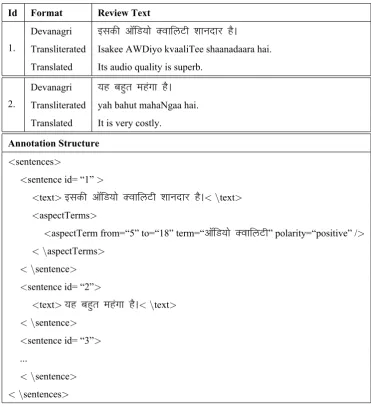
For annotation of dataset, we follow the guidelines, which are in line with SemEval 2014 (Pontiki et al., 2014) shared task. We convert datasets in xml form. Each aspect term that appears in a review sentence is annotated along with its associated sentiment. The sentiment is classified into four categories, viz.,positive,negative,neutralandconflict. Two instances of the dataset along with their xml struc-ture are presented in Table 3. At the top of the ta-ble, two example sentences are given in its original form, i.e., in Davanagri script along with its Roman transliter-ation and English transltransliter-ation. The first review contains only one aspect term and its polarity is positive. How-ever, the second review does not have any aspect term. The other half of Table 3 defines the annotation structure in xml format. The <sentences> node represents root node of the xml that contains every sentence of the re-view as its children i.e. <sentence>. To uniquely iden-tify each<sentence>, an ‘id’ is associated with it as an at-tribute. Each<sentence>node has two children, namely <text> and <aspectTerms>. The <text> node holds one review sentence, whereas<aspectTerms>containsn <aspectTerm>nodes as its children if a review sentence hasnaspect terms. For the example at handnequals to 1 and 0 for the two respective reviews. Each<aspectTerm> node holds four attributes: ‘term’, ‘from’, ‘to’ & ‘polar-ity’. Attribute ‘term’ defines aspect term represented by current node while ‘polarity’ stores the sentiment towards
Review Text Aspect Term Polarity
Devanagri इसक ऑ डयो वा लट शानदार है।
ऑ डयो वा लट positive Transliterated Isakee AWDiyo k vaaliTee shaanadaara hai.
Translated Its audio quality is superb.
Devanagri इस लैपटॉप का वजन 2.38 कलोमाम है जो भार है।
वजन negative
Transliterated Is laipaTawp kaa vajan 2.38 kilograam hai jo bhaaree hai.
Translated Weight of this laptop is 2.38 kilogram which is heavy.
Devanagri इसक ःब न 15.6 इंच क है।
ःब न neutral
Transliterated Isakee skreen 15.6 INch kee hai.
Translated Its has 15.6 inch screen.
Table 1: Example of Aspect Based Sentiment Analysis.
Review Text
Original (Devanagari) ःब न का रज़ो यूशन 1024 गुणा 600 है, जो काफ अ छ है
Original (Transliterated) skreen kaa riZolyooshan 1024 guNNaa 600 hai , jo kaaphee Achchh hai
Corrected ःब न का रज़ो यूशन 1024 गुणा 600 है , जो काफ अ छा है।
Corrected skreen kaa riZolyooshan 1024 guNNaa 600 hai , jo kaaphee Achchhaa hai.
Original (Devanagri) िसंगल माउस बटन साधारण साउंड वा लट ...:(
Original (Transliterated) siNgal maaUs baTan saadhaaraNN saaUND k vaaliTee...:(
Corrected िसंगल माउस बटन और साधारण साउंड वा लट है।
Corrected siNgal maaUs baTanAOrasaadhaaraNN saaUND k vaaliTeehai.
Table 2: Pre-processing examples.
the ‘term’ which is ‘positive’. Position of the aspect term in the review text is determined by attributes ‘from’ and ‘to’ which store the index of first and last character, respectively in the review text.
All the review documents collected are presented to three different annotators, who were native speakers of Hindi lan-guage. To check the goodness of annotations by differ-ent annotators we calculate inter-rater agreemdiffer-ent. Cohen’s Kappa coefficient (Cohen, 1960) is a statistical measure to analyze the inter-rater agreement and defined as
K=P r(a)−P r(e)
1−P r(e) (1)
where P r(a) & P r(e) are the observed and by chance agreement among raters. We perform Cohen’s Kappa coef-ficient on the datasets and an average agreement of 95.18% was obtained. This shows that the annotated dataset we generated is of acceptable quality. Finally, majority vot-ing based technique was employed to merge three anno-tated versions of datasets. Agreement/disagreement matri-ces among annotators for aspect term extraction task are listed in Figure 1.
2.4.
Dataset Statistics
After pre-processing, our dataset contains 5,417 review sen-tences across 12 domains. There are a total of 2,290 posi-tive, 712 negaposi-tive, 2,226 neutral and 189 conflict reviews (sentence-level). Overall it contains 100,279 and 4,509 to-kens and aspect terms, respectively. Polarity classification of these aspect terms count to 1,986 positive, 569 nega-tive, 1,914 neutral and 40 conflict sentiments. Overall and domain-wise details of this dataset are reported in Table 4.
3.
Method for Aspect Term Extraction and
Sentiment Analysis
In this section we describe the models that we develop for aspect term extraction and sentiment classification. For both the tasks we identify and implement a set of language independent features which are implemented without using any domain-specific external resources and/or tools.
3.1.
Aspect Term Extraction
Id Format Review Text
1.
Devanagri इसक ऑ डयो वा लट शानदार है।
Transliterated Isakee AWDiyo k vaaliTee shaanadaara hai.
Translated Its audio quality is superb.
2.
Devanagri यह बहुत महंगा है।
Transliterated yah bahut mahaNgaa hai.
Translated It is very costly.
Annotation Structure
<sentences>
<sentence id= “1”>
<text>इसक ऑ डयो वा लट शानदार है।<\text>
<aspectTerms>
<aspectTerm from=“5” to=“18” term=“ऑ डयो वा लट” polarity=“positive” />
<\aspectTerms>
<\sentence>
<sentence id= “2”>
<text>यह बहुत महंगा है।<\text>
<\sentence>
<sentence id= “3”>
...
<\sentence>
<\sentences>
Table 3: Dataset annotation structure.
intermediate and outside entities of aspect terms. For ex-ample, in the following aspect term“Audio Quality”, the first and second tokens have associated classes ‘B’ and ‘I’, respectively and rest of the tokens corresponds to ‘O’.
Its audio quality is superb.
इसक ऑ डयो वा लट शानदार है ।
Isakee AWDiyo k vaaliTee shaanadaara hai .
O B I O O O
We develop a model based on Conditional Random Field (CRF) (Lafferty et al., 2001) that has shown success in solv-ing similar kinds of problems. The classifier is trained with the following set of features:
1. Word & local context: Surface word and its local context which lies within a context window of size 3 are used as features for training the model.
2. Part-of-Speech (PoS):PoS tag information of the
cur-rent and the surrounding tokens are used as features in the proposed method,
3. Chunk information: Chunk information is a promi-nent feature for identifying the multi-word aspect terms.
4. Prefixes and suffixes: Prefix and suffix strings of surface word are used as the features. They are ex-tracted by stripping off a fixed length character se-quences from the beginning or end positions of words.
We have used LTRC shallow parser3for tokenization, POS and chunk information.
3.2.
Sentiment Classification
Once the aspect terms are identified, sentiment analysis is performed to predict the polarity of sentiment expressed to-wards this aspect term in the given review. We choose Sup-port Vector Machine (SVM) (Cortes and Vapnik, 1995) as the preferred classifier because of its efficiency in solving
3
Domains # Tokens # Sentences Aspect Terms
# Pos # Neg # Neu # Con Total
Laptops 6419 348 185 33 169 1 388
Mobiles 21923 1141 600 210 578 28 1416
Tablets 25323 1244 418 157 479 2 1056
Cameras 3097 150 107 11 64 1 183
Headphones 835 43 20 8 19 0 47
Home appliances 1746 84 10 0 34 0 44
Speakers 726 47 20 3 25 0 48
Smart watches 5709 330 47 22 149 2 220
Televisions 2179 135 41 3 99 1 144
Mobile apps 4577 229 98 20 46 0 164
Travels 14157 776 273 19 98 0 390
Movies 13588 890 167 83 154 5 409
Overall 100279 5417 1986 569 1914 40 4509
Table 4: Dataset statistics. Here, POS-positive, Neg-negative, Neu-Neutral and Con-Conflict
text analytic problems. The classifier is trained with the fol-lowing features:
1. Target aspect term and local context: Sentiment bearing words usually occur closer to the target aspect term. We extract target term along with its preceding and following few tokens, and use as features for train-ing. For the proposed method we fix context window size to 5.
2. Word Bigrams:Pair of two consecutive tokens in the local context are used as features to capture the co-occurrence behavior of the tokens.
3. Semantic Orientation (SO): Semantic Orientation (SO) (Hatzivassiloglou and McKeown, 1997) is a mea-sure of association of a token towards positive or neg-ative sentiments and can be defined as:
SO(t) =P M I(t, posRev)−P M I(t, negRev) (2)
whereP M I(t, posRev)stands for point-wise mutual information of a tokenttowards positive sentiment re-views.
4.
Experiments and Evaluation
As a base learning algorithm we make use of Conditional Random Field (CRF) and Support Vector Machine (SVM) for the aspect term extraction and sentiment classification tasks respectively. We use CRF++4and TinySVM5based packages for our experiments.
4
http://taku910.github.io/crfpp/
5http://chasen.org/ taku/software/TinySVM/
To evaluate the performance of the system, we use the eval-uation scripts made available by the SemEval 2014 shared task organizers. We perform 3-fold cross-validation to re-port the final evaluation results. We obtain average F-measure of 41.07% for aspect term extraction and accuracy of 54.05% for sentiment analysis. We also train, test and evaluate the models of aspect term extraction and sentiment analysis for each domain separately. Evaluation results are reported in Table 5. It is evident that the performance is greatly influenced by the amount of reviews available for a particular domain. The only exception is theTravel do-main which reports merely 15.03% for aspect term extrac-tion despite having relatively good amount of reviews. This could be becauseTravelcontains reviews from a diverse set of places e.g. ‘religious’, ‘hill stations’, ‘beaches’, ‘monu-ments’ etc. and most of the aspect terms belong to its spe-cific category.
4.1.
Error Analysis
B-ASP I-ASP O
B-ASP 4037 2 290
I-ASP 13 2844 435
O 72 64 92522
(a) Annotator 1 vs Annotator 2
B-ASP I-ASP O
B-ASP 4258 5 66
I-ASP 28 203 93
O 16 28 92614
(b) Annotator 1 vs Annotator 3
B-ASP I-ASP O
B-ASP 4007 14 101
I-ASP 4 2803 103
O 276 402 92567
(c) Annotator 2 vs Annotator 3
Figure 1: Agreement/Disagreement matrix for aspect term extraction task. Here, B-ASP, I-ASP and O denote the be-ginning, intermediate and outside of aspect term, respec-tively.
B-ASP I-ASP O
B-ASP 1210 128 2477
I-ASP 142 754 2105
O 1065 887 91511
(a) Aspect Term Extraction
Positive Negative Neutral Conflict
Positive 1416 30 540 0
Negative 376 51 142 0
Neutral 917 27 970 0
Conflict 30 4 6 0
(b) Sentiment Classification
Figure 2: Confusion matrix for ABSA.
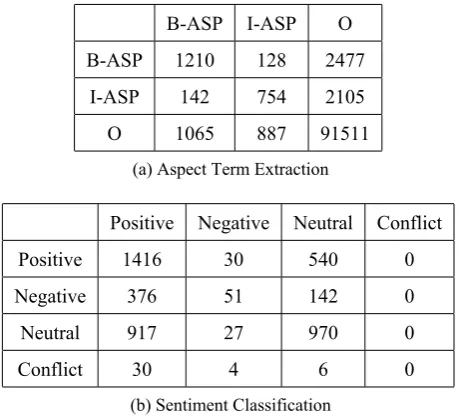
class may be addressed with more training instances as well as by implementing class-specific features. We also perform qualitative analysis of errors that the system incurs.
1. Aspect term extraction:
• We observe that the presence of prepositions and conjunctions inside an aspect entity confuses the
Domain Aspect term extraction Sentiment Pre Rec F-measure Accuracy
Laptops 74.59 56.87 64.53 50.98
Mobiles 67.48 44.42 53.57 54.07
Tablets 61.50 33.67 43.52 57.19
Cameras 60.0 31.76 41.53 59.06
Headphones 100.0 27.78 43.47 46.15
Home Appl. 100.0 16.67 28.57 79.23
Speakers 83.33 22.72 35.71 53.84
Smart watches 50.0 41.50 45.36 64.70
Televisions 75.60 42.46 54.38 65.47
Mobile apps 50.0 18.0 26.47 61.53
Travels 32.60 9.77 15.03 68.78
Movies 70.14 58.02 63.51 39.23
Overall 61.96 30.72 41.07 54.05
Table 5: Result of aspect term extraction and sentiment classification
system to correctly mark its boundry. For example, in the example review given below, “डः े क यूइंग
एंगल और ॄाइटनेस” (Disple kee vyooINg ENgal AOra braaITanes) is an aspect term but our system only predicts “डः े क यूइंग एंगल” (Disple kee vyooINg ENgal) as an aspect term and leaves “और ॄाइटनेस” (AOra braaITanes) umarked.
Review: “डवाइस के अनुसार डः े क यूइंग एंगल
और ॄाइटनेस अ छ और ूभा वत करने वाल है।” Transliteration: “DivaaIs ke Anusaara Disple kee vyooINg ENgal AOra braaITanes Achchhee AOra prabhaavit karane vaalee hai.
•When a noun phrase precedes or succeeds an aspect term, the system marks each token of the neighboring phrase as a part of the aspect term.
2. Sentiment Classification:
• When the sentiment bearing words occur far away from the aspect term, its sentiment is not correctly cap-tured by the system. In the following sentence“र यूम
नो ट फकेशन” (rijyoom noTiphikeshan) is an aspect term and its polarity is positive. The sentiment bearing word “खास” (khaas) is located 7 words away from the aspect term. Because of this long distance, classifier was not able to capture the sentiment properly. Review: “पे रःकोप एप म र यूम नो ट फकेशन फ चर
दया गया है जो बहुत ह खास है।”
It should be noted that, for the tasks, we make use of a very basic language and domain independent features. Perfor-mance of both these models can be improved by defining more domain-specific features. Systematic feature engi-neering might be useful to pickup the best set of features.
5.
Conclusion
In this paper we propose a benchmark setup for aspect based sentiment analysis in Hindi. We have crawled various on-line sources, performed pre-processing to clean the data, and annotated the dataset with aspect terms and polarity classes. The dataset comprises of Hindi product reviews crawled from various online sources across 12 domains. Based on this dataset we build supervised classifiers for as-pect term extraction and sentiment classification. Evalua-tion results on 3-fold cross-validaEvalua-tion show the overall pre-cision, recall and F-measure values of 61.96%, 30.72% and 41.07%, respectively for aspect term extraction and an accu-racy of 54.05% for sentiment classification. We also make the dataset available to the community for the advancement of further research involving Indian languages.
In future, we would like to investigate domain-specific fea-tures for both the tasks. We would also like to explore deep learning methods for aspect based sentiment analysis.
6.
Acknowledgements
We acknowledge undergraduate students Siddharth Kumar (IIEST, Shibpur), Kumari Geeta (BIT Patna) and Pooja Sharma (Manipal University) for contributing in collection and annotation of datasets.
7.
References
Bakliwal, A., Arora, P., and Varma, V. (2012). Hindi sub-jective lexicon: A lexical resource for hindi polarity clas-sification. Proceedings of the Eight International Con-ference on Language Resources and Evaluation (LREC). Balamurali, A. R., Joshi, A., and Bhattacharyya, P. (2011). Harnessing wordnet senses for supervised sentiment clas-sification. In Proceedings of the 2011 Conference on Empirical Methods in Natural Language Processing, EMNLP 2011, 27-31 July 2011, John McIntyre Confer-ence Centre, Edinburgh, UK, A meeting of SIGDAT, a Special Interest Group of the ACL, pages 1081–1091. Balamurali, A. R., Joshi, A., and Bhattacharyya, P. (2012).
Cross-lingual sentiment analysis for indian languages us-ing linked wordnets. In COLING 2012, 24th Interna-tional Conference on ComputaInterna-tional Linguistics, Pro-ceedings of the Conference: Posters, 8-15 December 2012, Mumbai, India, pages 73–82.
Castellucci, G., Filice, S., Croce, D., and Basili, R. (2014). Unitor: Aspect based sentiment analysis with structured learning. InProceedings of the 8th International Work-shop on Semantic Evaluation (SemEval 2014), pages 761–767, Dublin, Ireland, August. Association for Com-putational Linguistics and Dublin City University. Chernyshevich, M. (2014). IHS R&D Belarus:
Cross-domain Extraction of Product Features using Conditional Random Fields. pages 309–313.
Cohen, J. (1960). A Coefficient of Agreement for Nom-inal Scales. Educational and Psychological Measure-ment, 20(1):37.
Cortes, C. and Vapnik, V. (1995). Support-vector net-works. Mach. Learn., 20(3):273–297, September. Das, A. and Bandyopadhyay, S. (2010a). Phrase-level
po-larity identification for bangla. Int. J. Comput. Linguist. Appl.(IJCLA), 1(1-2):169–182.
Das, D. and Bandyopadhyay, S. (2010b). Labeling emo-tion in bengali blog corpus–a fine grained tagging at sen-tence level. InProceedings of the 8th Workshop on Asian Language Resources, page 47.
Das, A., Bandyopadhyay, S., and Gambäck, B. (2012). Sentiment analysis: what is the end user’s requirement? In Proceedings of the 2nd International Conference on Web Intelligence, Mining and Semantics, page 35. ACM. Gupta, D. K., Reddy, K. S., Ekbal, A., et al. (2015). Pso-asent: Feature selection using particle swarm optimiza-tion for aspect based sentiment analysis. InNatural Lan-guage Processing and Information Systems, pages 220– 233. Springer.
Hatzivassiloglou, V. and McKeown, K. R. (1997). Predict-ing the Semantic Orientation of Adjectives. In Proceed-ings of the ACL/EACL, pages 174–181.
Joshi, A., Balamurali, A., and Bhattacharyya, P. (2010). A fall-back strategy for sentiment analysis in hindi: a case study. Proceedings of the 8th ICON.
Lafferty, J. D., McCallum, A., and Pereira, F. C. N. (2001). Conditional Random Fields: Probabilistic Models for Segmenting and Labeling Sequence Data. In ICML, pages 282–289.
Mittal, N., Agarwal, B., Chouhan, G., Bania, N., and Pa-reek, P. (2013). Sentiment analysis of hindi review based on negation and discourse relation. Inproceedings of In-ternational Joint Conference on Natural Language Pro-cessing, pages 45–50.
Pang, B. and Lee, L. (2008). Opinion mining and senti-ment analysis. Foundations and trends in information retrieval, 2(1-2):1–135.
Pontiki, M., Galanis, D., Pavlopoulos, J., Papageorgiou, H., Androutsopoulos, I., and Manandhar, S. (2014). Semeval-2014 task 4: Aspect based sentiment analysis. InProceedings of the 8th International Workshop on Se-mantic Evaluation (SemEval 2014), Dublin, Ireland, Au-gust.
Sharma, R., Nigam, S., and Jain, R. (2014). Polar-ity detection movie reviews in hindi language. CoRR, abs/1409.3942.
Toh, Z. and Wang, W. (2014). Dlirec: Aspect term ex-traction and term polarity classification system. In Pro-ceedings of the 8th International Workshop on Semantic Evaluation (SemEval 2014), pages 235–240.