InScript: Narrative texts annotated with script information
Ashutosh Modi, Tatjana Anikina, Simon Ostermann, Manfred Pinkal
Universit¨at des SaarlandesSaarland, 66123, Germany
{ashutosh, tatianak, simono, pinkal}@coli.uni-saarland.de
Abstract
This paper presents the InScript corpus (Narrative TextsInstantiatingScriptstructure). InScript is a corpus of 1,000 stories centered around 10 different scenarios. Verbs and noun phrases are annotated with event and participant types, respectively. Additionally, the text is annotated with coreference information. The corpus shows rich lexical variation and will serve as a unique resource for the study of the role of script knowledge in natural language processing.
Keywords:scripts, narrative texts, script knowledge, common sense knowledge
1.
Motivation
Ascriptis “a standardized sequence of events that describes some stereotypical human activity such as going to a restau-rant or visiting a doctor” (Barr and Feigenbaum, 1981). Script events describe an action/activity along with the in-volved participants. For example, in the script describing
A VISIT TO A RESTAURANT, typical events areENTERING
THE RESTAURANT,ORDERING FOODor EATING.
Partici-pants in this scenario can include animate objects like the
WAITERand the CUSTOMER, as well as inanimate objects such asCUTLERYorFOOD.
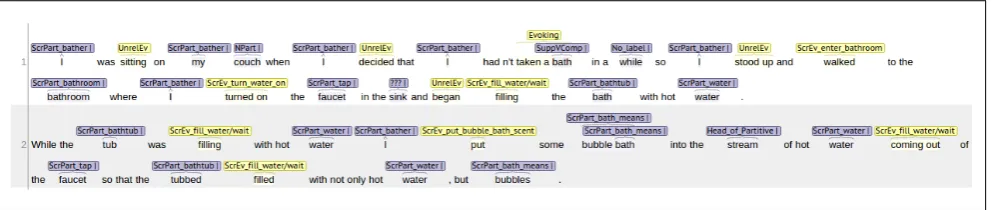
Script knowledge has been shown to play an important role in text understanding (Cullingford, 1978; Miikkulainen, 1995; Mueller, 2004; Chambers and Jurafsky, 2008; Cham-bers and Jurafsky, 2009; Modi and Titov, 2014; Rudinger et al., 2015). It guides the expectation of the reader, supports coreference resolution as well as common-sense knowl-edge inference and enables the appropriate embedding of the current sentence into the larger context. Figure 1 shows the first few sentences of a story describing the scenario
TAKING A BATH. Once the TAKING A BATHscenario is
evoked by the noun phrase (NP) “a bath”, the reader can effortlessly interpret the definite NP “the faucet” as an im-plicitly present standard participant of theTAKING A BATH
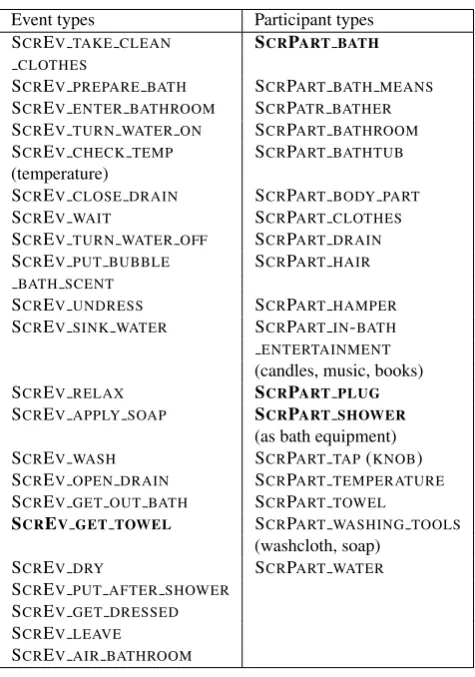
script. Although in this story, “entering the bath room”, “turning on the water” and “filling the tub” are explicitly mentioned, a reader could nevertheless have inferred the “turning on the water” event, even if it was not explicitly mentioned in the text. Table 1 gives an example of typical events and participants for the script describing the scenario
TAKING A BATH.
A systematic study of the influence of script knowledge in texts is far from trivial. Typically, text documents (e.g. nar-rative texts) describing various scenarios evoke many dif-ferent scripts, making it difficult to study the effect of a single script. Efforts have been made to collect scenario-specific script knowledge via crowdsourcing, for example the OMICS and SMILE corpora (Singh et al., 2002; Reg-neri et al., 2010; RegReg-neri, 2013), but these corpora describe script events in a pointwise telegram style rather than in full texts.
I was sitting on my couch when I decided that I hadn’t taken a bath in a while so I stood up and walked to the bathroom where I turned on the faucet in the sink and began filling the bath with hot water.
While the tub was filling with hot water I put some bubble bath into the stream of hot water coming out of the faucet so that the tubbed filled with not only hot water[...]
Figure 1: An excerpt from a story on theTAKING A BATHscript.
This paper presents the InScript 1corpus (Narrative Texts Instantiating Script structure). It is a corpus of simple narrative texts in the form of stories, wherein each story is centered around a specific scenario. The stories have been collected via Amazon Mechanical Turk (M-Turk)2. In
this experiment, participants (a.k.a. turkers) were asked to write down a concrete experience about a bus ride, a gro-cery shopping event etc. We concentrated on 10 scenar-ios and collected 100 stories per scenario, giving a total of 1,000 stories with about 200,000 words. Relevant verbs and noun phrases in all stories are annotated withevent types andparticipant typesrespectively. Additionally, the texts have been annotated with coreference information in order to facilitate the study of the interdependence between script structure and coreference.
The InScript corpus is a unique resource that provides a ba-sis for studying various aspects of the role of script know-ledge in language processing by humans. The acquisition of this corpus is part of a larger research effort that aims at using script knowledge to model the surprisal and informa-tion density in written text. Besides InScript, this project also released a corpus of generic descriptions of script ac-tivities called DeScript (for Describing Script Structure, Wanzare et al. (2016)). DeScript contains a range of short and textually simple phrases that describe script events in the style of OMICS or SMILE (Singh et al., 2002; Regneri et al., 2010). These generic telegram-style descriptions are
1The corpus can be downloaded at: http://www.
sfb1102.uni-saarland.de/?page_id=2582
get ingred.
add ingred.
prepare ingred.
Get Ingredients – gather all
ingredients
– get ingredients – …
Prepare Ingredients
– mix ingredients together in bowl – stir ingredient – …
Add Ingredients – pour ingredients in
bowl
– add ingredients to bowl
– …
I gotget ingredients the cake mix , eggs , oil , measuring cups and a baking pan from my pantry.
I addedadd ingredients two eggs , and
used my measuring cups to add oil and water to the bowl.
I mixedprepare ingredients the
ingredients thoroughly until they were smooth.
[…]
[…]
[image:2.595.52.284.65.260.2][…] […]
Figure 2: Connecting DeScript and InScript: an example from the BAKING A CAKEscenario (InScript participant annotation is omitted for better readability).
called Event Descriptions(EDs); a sequence of such de-scriptions that cover a complete script is called anEvent Sequence Description(ESD). Figure 2 shows an excerpt of a script in theBAKING A CAKEscenario. The figure shows
event descriptions for 3 different events in the DeScript cor-pus (left) and fragments of a story in the InScript corcor-pus (right) that instantiate the same event type.
Event types Participant types
SCREV TAKE CLEAN SCRPART BATH
CLOTHES
SCREV PREPARE BATH SCRPART BATH MEANS
SCREV ENTER BATHROOM SCRPATR BATHER
SCREV TURN WATER ON SCRPART BATHROOM
SCREV CHECK TEMP SCRPART BATHTUB
(temperature)
SCREV CLOSE DRAIN SCRPART BODY PART
SCREV WAIT SCRPART CLOTHES
SCREV TURN WATER OFF SCRPART DRAIN
SCREV PUT BUBBLE SCRPART HAIR
BATH SCENT
SCREV UNDRESS SCRPART HAMPER
SCREV SINK WATER SCRPART IN-BATH
ENTERTAINMENT
(candles, music, books)
SCREV RELAX SCRPART PLUG
SCREV APPLY SOAP SCRPART SHOWER
(as bath equipment)
SCREV WASH SCRPART TAP(KNOB)
SCREV OPEN DRAIN SCRPART TEMPERATURE
SCREV GET OUT BATH SCRPART TOWEL
SCREV GET TOWEL SCRPART WASHING TOOLS
(washcloth, soap)
SCREV DRY SCRPART WATER
SCREV PUT AFTER SHOWER
SCREV GET DRESSED
SCREV LEAVE
SCREV AIR BATHROOM
Table 1: Bath scenario template (labels added in the second phase of annotation are marked in bold).
2.
Data Collection
2.1.
Collection via Amazon M-Turk
We selected 10 scenarios from different available scenario lists (e.g. Regneri et al. (2010) , Raisig et al. (2009), and the OMICS corpus (Singh et al., 2002)), including scripts of different complexity (TAKING A BATH vs. FLYING IN AN AIRPLANE) and specificity (RIDING A PUBLIC BUSvs. REPAIRING A FLAT BICYCLE TIRE). For the full scenario list see Table 2.
Texts were collected via the Amazon Mechanical Turk plat-form, which provides an opportunity to present an online task to humans. In order to gauge the effect of different M-Turk instructions on our task, we first conducted pilot experiments with different variants of instructions explain-ing the task. We finalized the instructions for the full data collection, asking the turkers to describe a scenario in form of a storyas if explaining it to a childand to use a minimum of 150 words. The selected instruction variant resulted in comparably simple and explicit scenario-related stories. In the future we plan to collect more complex stories using different instructions. In total 190 turkers participated. All turkers were living in the USA and native speakers of En-glish. We paid USD $0.50 per story to each turker. On average, the turkers took 9.37 minutes per story with a max-imum duration of 17.38 minutes.
2.2.
Data Statistics
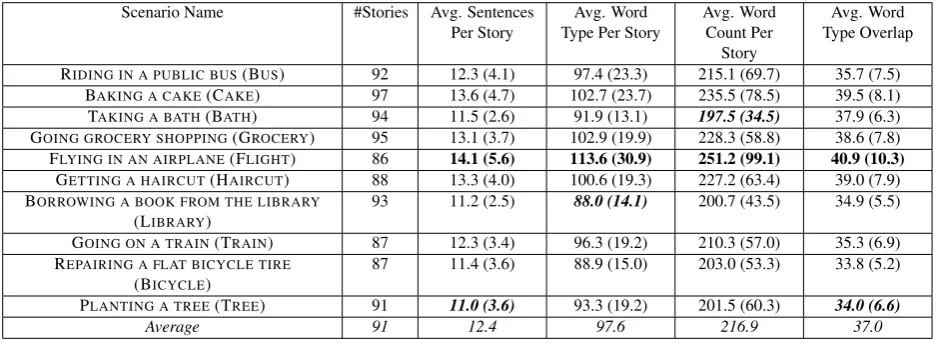
Statistics for the corpus are given in Table 2. On average, each story has a length of 12 sentences and 217 words with 98 word types on average. Stories are coherent and con-centrate mainly on the corresponding scenario. Neglecting auxiliaries, modals and copulas, on average each story has 32 verbs, out of which 58% denote events related to the re-spective scenario. As can be seen in Table 2, there is some variation in stories across scenarios: The FLYING IN AN AIRPLANEscenario, for example, is most complex in terms of the number of sentences, tokens and word types that are used. This is probably due to the inherent complexity of the scenario: Taking a flight, for example, is more complicated and takes more steps than taking a bath. The average count of sentences, tokens and types is also very high for theBA
-KING A CAKEscenario. Stories from the scenario often
resemble cake recipes, which usually contain very detailed steps, so people tend to give more detailed descriptions in the stories.
For bothFLYING IN AN AIRPLANEandBAKING A CAKE, the standard deviation is higher in comparison to other sce-narios. This indicates that different turkers described the scenario with a varying degree of detail and can also be seen as an indicator for the complexity of both scenarios. In general, different people tend to describe situations sub-jectively, with a varying degree of detail.
In contrast, texts from theTAKING A BATHandPLANTING A TREE scenarios contain a relatively smaller number of sentences and fewer word types and tokens. Both planting a tree and taking a bath are simpler activities, which results in generally less complex texts.
[image:2.595.53.291.411.750.2]Scenario Name #Stories Avg. Sentences Per Story
Avg. Word Type Per Story
Avg. Word Count Per
Story
Avg. Word Type Overlap
RIDING IN A PUBLIC BUS(BUS) 92 12.3 (4.1) 97.4 (23.3) 215.1 (69.7) 35.7 (7.5)
BAKING A CAKE(CAKE) 97 13.6 (4.7) 102.7 (23.7) 235.5 (78.5) 39.5 (8.1)
TAKING A BATH(BATH) 94 11.5 (2.6) 91.9 (13.1) 197.5 (34.5) 37.9 (6.3)
GOING GROCERY SHOPPING(GROCERY) 95 13.1 (3.7) 102.9 (19.9) 228.3 (58.8) 38.6 (7.8)
FLYING IN AN AIRPLANE(FLIGHT) 86 14.1 (5.6) 113.6 (30.9) 251.2 (99.1) 40.9 (10.3)
GETTING A HAIRCUT(HAIRCUT) 88 13.3 (4.0) 100.6 (19.3) 227.2 (63.4) 39.0 (7.9)
BORROWING A BOOK FROM THE LIBRARY
(LIBRARY)
93 11.2 (2.5) 88.0 (14.1) 200.7 (43.5) 34.9 (5.5)
GOING ON A TRAIN(TRAIN) 87 12.3 (3.4) 96.3 (19.2) 210.3 (57.0) 35.3 (6.9)
REPAIRING A FLAT BICYCLE TIRE
(BICYCLE)
87 11.4 (3.6) 88.9 (15.0) 203.0 (53.3) 33.8 (5.2)
PLANTING A TREE(TREE) 91 11.0 (3.6) 93.3 (19.2) 201.5 (60.3) 34.0 (6.6)
[image:3.595.62.533.68.240.2]Average 91 12.4 97.6 216.9 37.0
Table 2: Corpus statistics for different scenarios (standard deviation given in parentheses). The maximum per column is highlighted in
boldface, the minimum inboldface italics.
in theFLYING IN AN AIRPLANEandBAKING A CAKE sce-narios have the highest values here, indicating that most turkers used a similar vocabulary in their stories.
In general, the response quality was good. We had to dis-card 9% of the stories as these lacked the quality we were expecting. In total, we selected 910 stories for annotation.
3.
Annotation
This section deals with the annotation of the data. We first describe the final annotation schema. Then, we describe the iterative process of corpus annotation and the refinement of the schema. This refinement was necessary due to the complexity of the annotation.
3.1.
Annotation Schema
For each of the scenarios, we designed a specific annotation template. A script template consists of scenario-specific event and participant labels. An example of a template is shown in Table 1. All NP heads in the corpus were an-notated with a participant label; all verbs were anan-notated with an event label. For both participants and events, we also offered the labelUNCLEARif the annotator could not assign another label. We additionally annotated corefe-rence chains between NPs. Thus, the process resulted in three layers of annotation: event types, participant types and coreference annotation. These are described in detail below.
Event Type
As a first layer, we annotated event types. There are two kinds of event type labels, scenario-specific event type la-bels and general lala-bels. The general lala-bels are used across every scenario and mark general features, for example whether an event belongs to the scenario at all. For the scenario-specific labels, we designed an unique template for every scenario, with a list of script-relevant event types that were used as labels. Such labels include for example
SCREV CLOSE DRAINinTAKING A BATHas in Example
1 (see Figure 1 for a complete list for theTAKING A BATH
scenario)
(1) I start byclosingSCREV CLOSE DRAINthe drain at the
bot-tom of the tub.
The general labels that were used in addition to the script-specific labels in every scenario are listed below:
• SCREV OTHER. An event that belongs to the scenario, but its event type occurs too infrequently (for details, see below, Section 3.4.). We used the label “other” because event classification would become too fine-grained otherwise.
Example: After I am dried I put my new clothes on andclean upSCREV OTHERthe bathroom.
• RELNSCREV. Related non-script event. An event that canplausibly happen during the execution of the script and is related to it, but that is not part of the script. Example: After finding on what I wanted to wear, I went into the bathroom andshutRELNSCREVthe door.
• UNRELEV. An event that is unrelated to the script. Example: I sank into the bubbles andtookUNRELEV a
deep breath.
Additionally, the annotators were asked to annotate verbs and phrases that evoke the script without explicitly refer-ring to a script event with the label EVOKING, as shown in Example 2.
(2) Today Itook a bathEVOKINGin my new apartment.
Participant Type
As in the case of the event type labels, there are two kinds of participant labels: general labels and scenario-specific labels. The latter are part of the scenario-specific templates, e.g. SCRPART DRAINin the TAKING A BATHscenario, as can be seen in Example 3.
(3) I start by closing thedrainSCRPART DRAIN at the bottom
of the tub.
The general labels that are used across all scenarios mark noun phrases with scenario-independent features. There are the following general labels:
Figure 3: Sample event and participant annotation for theTAKING A BATHscript.
Example: I find mybath matSCRPART OTHER and lay it
on the floor to keep the floor dry.
• NPART. Non-participant. A referential NP that does not belong to the scenario.
Example:I washed myself carefully because I did not want to spill water onto thefloorNPART.
• SUPPVCOMP. A support verb complement. For fur-ther discussion of this label, see Section 3.5.
Example: I sank into the bubbles and took a deep breathSUPPVCOMP.
• HEAD OF PARTITIVE. The head of a partitive or a partitive-like construction. For a further discussion of this label cf. Section 3.5.
Example:I grabbed abarHEAD OFPARTITIVEof soap and
lathered my body.
• NO LABEL. A non-referential noun phrase that
cannot be labeled with another label.
Example: I sat for a momentNO LABEL, relaxing,
allowing the warm water to sooth my skin.
All NPs labeled with one of the labels SUPPVCOMP,
HEAD OF PARTITIVEor NO LABELare considered to be
non-referential. NO LABEL is used mainly in four cases in our data: non-referential time expressions (in a while, a milliontimesbetter), idioms (nomatterwhat), the non-referential “it” (itfelt amazing, itis better) and other ab-stracta (alotbetter,a littlebit).
In the first annotation phase, annotators were asked to mark verbs and noun phrases that have an event or participant type, that is not listed in the template, as MISSSCREV/ MISSSCRPART(missing script event or participant, resp.). These annotations were used as a basis for extending the templates (see Section 3.4.) and replaced later by newly in-troduced labels or SCREV OTHER and SCRPART OTHER
respectively.
Coreference Annotations
All noun phrases were annotated with coreference infor-mation indicating which entities denote the same discourse referent. The annotation was done by linking heads of NPs (see Example 4, where the links are indicated by coindex-ing). As a rule, we assume that each element of a corefe-rence chain is marked with the same participant type label.
(4) ICOREF1 washed myCOREF1 entire bodyCOREF2,
start-ing with myCOREF1 faceCOREF3 and ending with the
toesCOREF4. ICOREF1 always washmyCOREF1 toesCOREF4
very thoroughly ...
The assignment of an entity to a referent is not always tri-vial, as is shown in Example 5. There are some cases in which two discourse referents are grouped in a plural NP. In the example, those things refers to the group made up of shampoo,soap andsponge. In this case, we asked an-notators to introduce a new coreference label, the name of which indicates which referents are grouped together
(COREF GROUP WASHING TOOLS). All NPs are then
con-nected to the group phrase, resulting in an additional core-ference chain.
(5) ICOREF1 made sure that ICOREF1 have myCOREF1
shampooCOREF2 + COREF GROUP WASHING TOOLS,
soapCOREF3 + COREF GROUP WASHING TOOLS and
spongeCOREF4 + COREF GROUP WASHING TOOLS ready
to get in. Once ICOREF1 have those
thingsCOREF GROUP WASHING TOOLS ICOREF1 sink into
the bath. ... ICOREF1 applied some soapCOREF3 on
myCOREF1 body and used thespongeCOREF4 to scrub a
bit. ...ICOREF1rinsed theshampooCOREF2.
Example 5 thus contains the following coreference chains:
(6) COREF1: I→I→my→I→I→I→my→I COREF2: shampoo→shampoo
COREF3: soap→soap COREF4: sponge→sponge
COREF GROUP WASHING TOOLS: shampoo→soap→sponge
→things
3.2.
Development of the Schema
the same event label in theFLIGHTscenario, because they have the common function of in-flight entertainment in the scenario. In contrast, we assumed different labels for the cake tin on the one hand and other utensils (bowls etc.) on the other hand, since they have different functions in the
BAKING A CAKEscenario and accordingly occur with dif-ferent script events.
Note that scripts and templates as such are not meant to describe an activity as exhaustively as possible and to men-tion all steps that are logically necessary. Instead, scripts describe cognitively prominent events in an activity. An example can be found in theFLIGHTscenario. While more than a third of the turkers mentioned the event of fastening the seat belts in the plane (BUCKLE SEAT BELT), no per-son wrote aboutundoingtheir seat belts again, although in reality both events appear equally often. Consequently, we added an event type label for buckling up, but no label for undoing the seat belts.
3.3.
First Annotation Phase
We used the WebAnno annotation tool (Yimam et al., 2013) for our project. The stories from each scenario were dis-tributed among four different annotators. In a calibration phase, annotators were presented with some sample texts for test annotations; the results were discussed with the authors. Throughout the whole annotation phase, annota-tors could discuss any emerging issues with the authors. All annotations were done by undergraduate students of computational linguistics. The annotation was rather time-consuming due to the complexity of the task, and thus we decided for single annotation mode. To assess annotation quality, a small sample of texts was annotated by all four annotators and their inter-annotator agreement was mea-sured (see Section 4.1.). It was found to be sufficiently high.
Annotation of the corpus together with some pre- and post-processing of the data required about 500 hours of work. All stories were annotated with event and participant types (a total of 12,188 and 43,946 instances, respectively). On average there were 7 coreference chains per story with an average length of 6 tokens.
3.4.
Modification of the Schema
After the first annotation round, we extended and changed the templates based on the results. As mentioned before, we used MISSSCREVand MISSSCRPARTlabels to mark verbs and noun phrases instantiating events and participants for which no appropriate labels were available in the templates. Based on the instances with these labels (a total of 941 and 1717 instances, respectively), we extended the guidelines to cover the sufficiently frequent cases.
In order to include new labels for event and participant types, we tried to estimate the number of instances that would fall under a certain label. We added new labels ac-cording to the following conditions:
• For the participant annotations, we added new labels for types that we expected to appear at least 10 times in total in at least 5 different stories (i.e. in approximately 5% of the stories).
• For the event annotations, we chose those new labels for event types that would appear in at least 5 different stories.
In order to avoid too fine a granularity of the templates, all other instances of MISSSCREVand MISSSCRPART were re-labeled with SCREV OTHERand SCRPART OTHER. We also relabeled participants and events from the first anno-tation phase with SCREV OTHERand SCRPART OTHER, if they did not meet the frequency requirements. The event labelAIR BATHROOM(the event of letting fresh air into the room after the bath), for example, was only used once in the stories, so we relabeled that instance to SCREV OTHER. Additionally, we looked at the DeScript corpus (Wanzare et al., 2016), which contains manually clustered event para-phrase sets for the 10 scenarios that are also covered by InScript (see Section 4.3.). Every such set contains event descriptions that describe a certain event type. We extended our templates with additional labels for these events, if they were not yet part of the template.
3.5.
Special Cases
Noun-Noun Compounds. Noun-noun compounds were
annotated twice with the same label (whole span plus the head noun), as indicated by Example 7. This redundant double annotation is motivated by potential processing re-quirements.
(7) I get my (wash (cloth SCRPART WASHING TOOLS)),
SCRPART WASHING TOOLS and put it under the water.
Support Verb Complements. A special treatment was given to support verb constructions such astake time,get home or take a seatin Example 8. The semantics of the verb itself is highly underspecified in such constructions; the event type is largely dependent on the object NP. As shown in Example 8, we annotate the head verb with the event type described by the whole construction and label its object with SUPPVCOMP (support verb complement), indicating that it does not have a proper reference.
(8) I step into the tub and takeSCREV SINK WATER a seatSUPPVCOMP.
Head of Partitive. We used the HEAD OF PARTITIVE la-bel for the heads in partitive constructions, assuming that the only referential part of the construction is the comple-ment. This is not completely correct, since different par-titive heads vary in their degree of concreteness (cf. Ex-amples 9 and 10), but we did not see a way to make the distinction sufficiently transparent to the annotators.
(9) Our seats were at the backHEAD OFPARTITIVE of the
trainSCRPART TRAIN.
Average Fleiss’ Kappa All Labels Script Labels Scenario Events Participants Events Participants
BUS 0.68 0.74 0.76 0.74
CAKE 0.61 0.76 0.64 0.75
FLIGHT 0.65 0.70 0.62 0.69
GROCERY 0.64 0.80 0.73 0.80
HAIRCUT 0.64 0.84 0.67 0.86
TREE 0.59 0.76 0.63 0.76
Average 0.64 0.77 0.68 0.77
(a) Average Fleiss’ Kappa.
Scenario %Coreference Agreement
BUS 88.9
CAKE 94.7
FLIGHT 93.6
GROCERY 93.4
HAIRCUT 94.3
TREE 78.3
Average 90.5
[image:6.595.88.455.66.196.2](b) Coreference agreement.
Figure 4: Inter-annotator agreement statistics.
Mixed Participant Types. Group denoting NPs some-times refer to groups whose members are instances of dif-ferent participant types. In Example 11, the first-person plural pronoun refers to the group consisting of the passen-ger (I) and a non-participant (my friend). To avoid a pro-liferation of event type labels, we labeled these cases with UNCLEAR.
(11) ISCRPART PASSENGERwanted to visit mySCRPART PASSENGER friendNPART in New York. ... WeUNCLEAR met at the
train station.
We made an exception for the GETTING AHAIRCUT sce-nario, where the mixed participant group consisting of the hairdresser and the customer occurs very often, as in Ex-ample 11. Here, we introduced the additional ad-hoc par-ticipant label SCR PART HAIRDRESSER CUSTOMER.
(12) While SusanSCRPART HAIRDRESSER is
cutting mySCRPART CUSTOMER hair weSCRPART HAIRDRESSER CUSTOMERusually talk a bit.
4.
Data Analysis
4.1.
Inter-Annotator Agreement
[image:6.595.353.494.310.451.2]In order to calculate inter-annotator agreement, a total of 30 stories from 6 scenarios were randomly chosen for par-allel annotation by all 4 annotators after the first annota-tion phase3. We checked the agreement on these data us-ing Fleiss’ Kappa (Fleiss, 1971). The results are shown in Figure 4a and indicate moderate to substantial agreement (Landis and Koch, 1977). Interestingly, if we calculated the Kappa only on the subset of cases that were annotated with script-specific event and participant labels by all an-notators, results were better than those of the evaluation on all labeled instances (including also unrelated and related non-script events). This indicates one of the challenges of the annotation task: In many cases it is difficult to decide whether a particular event should be considered a central script event, or an event loosely related or unrelated to the script.
For coreference chain annotation, we calculated the per-centage of pairs which were annotated by at least 3 annota-tors (qualified majority vote) compared to the set of those
3
We did not test for inter-annotator agreement after the second phase, since we did not expect the agreement to change drastically due to the only slight changes in the annotation schema.
pairs annotated by at least one person (see Figure 4b). We take the result of 90.5% between annotators to be a good agreement.
4.2.
Annotated Corpus Statistics
Scenario Events Participants
BATH 20 18
BICYCLE 16 16
BUS 17 17
CAKE 19 17
FLIGHT 29 26
GROCERY 19 18
HAIRCUT 26 24
LIBRARY 17 18
TRAIN 15 20
TREE 14 15
Average 19.2 18.9
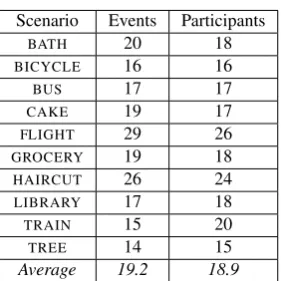
Figure 5: The number of participants and events in the templates.
Figure 5 gives an overview of the number of event and par-ticipant types provided in the templates. TAKING A FLIGHT
andGETTING A HAIRCUTstand out with a large number of both event and participant types, which is due to the inher-ent complexity of the scenarios. In contrast,PLANTING A
TREEand GOING ON A TRAINcontain the fewest labels.
There are 19 event and participant types on average.
avg min max
event annotations in a story 15.9 1 52
event types in a story 10.1 1 23
participant annotations in a story 52.3 16 164 participant types in a story 10.9 2 25
coref chains 7.3 0 23
tokens per chain 6 2 52
Figure 6: Annotation statistics over all scenarios.
Figure 6 presents overview statistics about the usage of event labels, participant labels and coreference chain anno-tations. As can be seen, there are usually many more men-tions of participants than events. For coreference chains, there are some chains that are really long (which also re-sults in a large scenario-wise standard deviation). These chains usually describe the protagonist.
[image:6.595.316.528.581.664.2]scenario stands out in terms of participant mentions, event mentions and average number of coreference chains. Figure 7 shows for every participant label in theBAKING A CAKEscenario the number of stories which they occurred in. This indicates how relevant a participant is for the script. As can be seen, a small number of participants are highly prominent:COOK,INGREDIENTSandCAKEare mentioned in every story. The fact that the protagonist appears most often consistently holds for all other scenarios, where the acting person appears in every story, and is mentioned most frequently. 0 25 50 75 100 cook in g re d ie n ts
cake oven ca
[image:7.595.53.289.220.370.2]k e _ ti n u te n s il dough ti m e beneficiary k itc h e n /lo c a ti o n b a k in g _ in s tr u c ti o n s te m p e ra tu re s to re d e c o ra ti o n o th e r recipe_source ti m e r cabinet 16 27 29 33 44 48 51 52 54 62 65 75 82 83 85 97 97 97
Figure 7: The number of stories in theBAKING A CAKEscenario that contain a certain participant label.
Figure 8 shows the distribution of participant/event type la-bels over all appearances over all scenarios on average. The groups stand for the most frequently appearing label, the top 2 to 5 labels in terms of frequency and the top 6 to 10. SCREV OTHERand SCRPART OTHERare shown sepa-rately. As can be seen, the most frequently used participant label (the protagonist) makes up about 40% of overall par-ticipant instances. The four labels that follow the protag-onist in terms of frequency together appear in 37% of the cases. More than 2 out of 3 participants in total belong to one of only 5 labels.
In contrast, the distribution for events is more balanced. 13% of all event instances have the most prominent event type.
SCREV OTHER and SCRPART OTHER both appear as la-bels in at most 5% of all event and participant instantia-tions: The specific event and participant type labels in our templates cover by far most of the instances.
In Figure 9, we grouped participants similarly into the first, the top 2-5 and top 6-10 most frequently appearing partic-ipant types. The figure shows for each of these groups the average frequency per story, and in the rightmost column the overall average. The results correspond to the findings from the last paragraph.
4.3.
Comparison to the DeScript Corpus
As mentioned previously, the InScript corpus is part of a larger research project, in which also a corpus of a different kind, the DeScript corpus, was created. DeScript covers 40 scenarios, and also contains the 10 scenarios from In-Script. This corpus contains texts that describe scripts on
3 % 8.9 % 13.1 % 36.4 % 39.0 % 5 % 20.5 % 26.6 % 34.3 % 13.3 %
[image:7.595.315.538.247.363.2]top 1 top 2-5 top 6-10 rest ScrPart/Ev_other
Figure 8: Distribution of participants (left) and events (right) for the 1, the top 2-5, top 6-10 most frequently appearing events/participants, SCREV/SCRPART OTHERand the rest.
top 1 top 2-5 top 6-10 all 0 5 10 15 20 25 21.93 5.61 2.55 3.72
Figure 9: Average number of participant mentions for a story, for the first, the top 2-5, top 6-10 most frequently appearing events/participants, and the overall average.
an abstract, generic level, while InScript contains instantia-tions of scripts in narrative texts. Script events in DeScript are described in a very simple, telegram-style language (see Figure 2). Since one of the long-term goals of the project is to align the InScript texts with the script structure given from DeScript, it is interesting to compare both resources. The InScript corpus exhibits much more lexical variation than DeScript. Many approaches use the type-token ratio to measure this variance. However, this measure is known to be sensitive to text length (see e.g. Tweedie and Baayen (1998)), which would result in very small values for In-Script and relatively large ones for DeIn-Script, given the large average difference of text lengths between the corpora. In-stead, we decided to use the Measure of Textual Lexical Diversity (MTLD)(McCarthy and Jarvis, 2010; McCarthy, 2005), which is familiar in corpus linguistics. This metric measures the average number of tokens in a text that are needed to retain a type-token ratio above a certain thresh-old. If theMTLDfor a text is high, many tokens are needed to lower the type-token ratio under the threshold, so the text is lexically diverse. In contrast, a lowMTLDindicates that only a few words are needed to make the type-token ratio drop, so the lexical diversity is smaller. We use the thresh-old of 0.71, which is proposed by the authors as a well-proven value.
bath bicycle bus cake flight grocery haircut library train tree 20 25 30 35 40 45 50 55 DeScript InScript
Figure 10: MTLD values for DeScript and InScript, per scenario.
most diverse (as was also indicated above by the mean word type overlap). However, the difference in the variation of lexical variance of scenarios is larger for DeScript than for InScript. Thus, the properties of a scenario apparently in-fluence the lexical variance of the event descriptions more than the variance of the narrative texts.
We used entropy (Shannon, 1948) over lemmas to measure the variance of lexical realizations for events. We excluded events for which there were less than 10 occurrences in De-Script or InDe-Script. Since there is only an event annotation for 50 ESDs per scenario in DeScript, we randomly sam-pled 50 texts from InScript for computing the entropy to make the numbers more comparable.
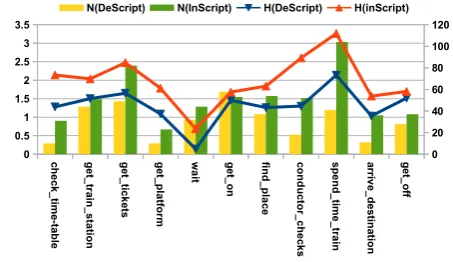
[image:8.595.57.284.385.516.2]ch e ck _t im e-ta b le g e t_ tr ain _s ta tio n g et _t ic k et s g et _p la tfo rm w a it g et _o n fin d _ p la c e co n d u ct o r_ c h e ck s sp e n d _ tim e _t ra in ar ri v e_ d e st in at io n g et _ o ff 0 0.5 1 1.5 2 2.5 3 3.5 0 20 40 60 80 100 120 N(DeScript) N(InScript) H(DeScript) H(inScript)
Figure 11: Entropy over verb lemmas for events (left y-axis,
H(x)) in theGOING ON A TRAIN SCENARIO. Bars in the back-ground indicate the absolute number of occurrence of instances (right y-axis,N(x)).
Figure 11 shows as an example the entropy values (abbre-viated asH) for the event types in theGOING ON A TRAIN
scenario. As can be seen in the graph, the entropy for In-Script is in general higher than for DeIn-Script. In the stories, a wider variety of verbs is used to describe events. There are also large differences between events: WhileWAIThas a really low entropy,SPEND TIME TRAINhas an extremely high entropy value. This event type covers many different activities such as reading, sleeping etc.
5.
Conclusion
In this paper we described the InScript corpus of 1,000 nar-rative texts annotated with script structure and coreference information. We described the annotation process, vari-ous difficulties encountered during annotation and differ-ent remedies that were taken to overcome these. One of the future research goals of our project is also concerned
with finding automatic methods for text-to-script mapping, i.e. for the alignment of text segments with script states. We consider InScript and DeScript together as a resource for studying this alignment. The corpus shows rich lexical variation and will serve as a unique resource for the study of the role of script knowledge in natural language processing.
Acknowledgements
This research was funded by the German Research Founda-tion (DFG) as part of SFB 1102 ’InformaFounda-tion Density and Linguistic Encoding’.
6.
References
Barr, A. and Feigenbaum, E. A. (1981). The Handbook of Artificial Intelligence. Addison-Wesley.
Chambers, N. and Jurafsky, D. (2008). Unsupervised learning of narrative event chains. Proceedings of ACL-08.
Chambers, N. and Jurafsky, D. (2009). Unsupervised learning of narrative schemas and their participants. Pro-ceedings of the 47th Annual Meeting of the ACL and the 4th IJCNLP of the AFNLP.
Cullingford, R. E. (1978). Script application: Computer understanding of newspaper stories. Technical report, DTIC Document.
Fleiss, J. L. (1971). Measuring nominal scale agreement among many raters. Psychological bulletin, 76(5):378. Landis, J. R. and Koch, G. G. (1977). The Measurement of
Observer Agreement for Categorical Data. Biometrics, 33(1):pp. 159–174.
McCarthy, P. M. and Jarvis, S. (2010). Mtld, vocd-d, and hd-d: A validation study of sophisticated approaches to lexical diversity assessment. Behavior Research Meth-ods.
McCarthy, P. M. (2005). An Assessment of the Range and Usefulness of Lexical Diversity Measures and the Poten-tial of the Measure of Textual, Lexical Diversity (MTLD). Ph.D. thesis, The University of Memphis.
Miikkulainen, R. (1995). Script-based inference and mem-ory retrieval in subsymbolic stmem-ory processing. Applied Intelligence, 5(2):137–163.
Modi, A. and Titov, I. (2014). Inducing neural models of script knowledge. InCoNLL, volume 14, pages 49–57. Mueller, E. T. (2004). Understanding script-based stories
using commonsense reasoning. Cognitive Systems Re-search, 5(4):307–340.
Raisig, S., Welke, T., Hagendorf, H., and Van Der Meer, E. (2009). Insights into knowledge representation: The influence of amodal and perceptual variables on event knowledge retrieval from memory. Cognitive Science, 33(7):1252–1266.
Regneri, M., Koller, A., and Pinkal, M. (2010). Learn-ing script knowledge with web experiments. In Proceed-ings of the 48th Annual Meeting of the Association for Computational Linguistics, ACL ’10, pages 979–988, Stroudsburg, PA, USA. Association for Computational Linguistics.
Rudinger, R., Demberg, V., Modi, A., Van Durme, B., and Pinkal, M. (2015). Learning to predict script events from domain-specific text. Lexical and Computational Semantics (* SEM 2015), page 205.
Shannon, C. E. (1948). A Mathematical Theory of Communication. The Bell System Technical Journal, 27(3):379–423.
Singh, P., Lin, T., Mueller, E. T., Lim, G., Perkins, T., and Zhu, W. L. (2002). Open mind common sense: Knowl-edge acquisition from the general public. InOn the move to meaningful internet systems 2002: CoopIS, DOA, and ODBASE, pages 1223–1237. Springer.
Tweedie, F. J. and Baayen, R. H. (1998). How Variable May a Constant Be? Measures of Lexical Richness in Perspective. Computers and the Humanities, 32(5):323– 352.
Wanzare, L. D. A., Zarcone, A., Thater, S., and Pinkal, M. (2016). A crowdsourced database of event se-quence descriptions for the acquisition of high-quality script knowledge. Proceedings of the Tenth Interna-tional Conference on Language Resources and Evalua-tion (LREC’16).