Aligning Script Events with Narrative Texts
Simon Ostermann† Michael Roth†‡ Stefan Thater† Manfred Pinkal† †Saarland University ‡University of Illinois at Urbana-Champaign
{simono|mroth|stth|pinkal}@coli.uni-saarland.de
Abstract
Script knowledge plays a central role in text understanding and is relevant for a va-riety of downstream tasks. In this paper, we consider two recent datasets which provide a rich and general representation of script events in terms of paraphrase sets. We in-troduce the task of mapping event mentions in narrative texts to such script event types, and present a model for this task that ex-ploits rich linguistic representations as well as information on temporal ordering. The results of our experiments demonstrate that this complex task is indeed feasible.
1 Introduction
Event structure is a prominent topic in NLP. While semantic role labelers (Gildea and Jurafsky,2002;
Palmer et al.,2010) are well-established tools for the analysis of the internal structure of event de-scriptions, modeling relations between events has gained increasing attention in recent years. Re-search on event coreference (Bejan and Harabagiu,
2010;Lee et al., 2012), temporal event ordering in newswire texts (Ling and Weld,2010), as well as shared tasks on cross-document event ordering (Minard et al.,2015, inter alia) have in common that they model cross-document relations.
The focus of this paper is on the task of analyzing text-internal event structure. We share the view of a long tradition in NLP (see e.g.Schank and Abelson
(1975); Chambers and Jurafsky (2009); Regneri
et al.(2010)) thatscript knowledgeis of central im-portance to this task, i.e. common-sense knowledge about events and their typical order in everyday activities (also referred to asscenarios,Barr and
Feigenbaum(1981)). Script knowledge guides
ex-pectation by predicting which type of event or dis-course referent might be addressed next in a story
(Modi et al.,2017), allows to infer missing events from events explicitly mentioned (Chambers and Jurafsky,2009;Jans et al.,2012;Rudinger et al.,
2015), and to determine text-internal temporal or-der (Modi and Titov,2014;Frermann et al.,2014). We address the task of automatically mapping narrative texts to scripts, which will leverage ex-plicit script knowledge for the afore-mentioned as-pects of text understanding, as well as for down-stream tasks such as textual entailment, question answering or paraphrase detection. We build on the work ofRegneri et al.(2010) andWanzare et al.
(2016), who collect explicit script knowledge via crowdsourcing, by asking people to describe ev-eryday activities. These crowdsourced descriptions form a basis for high-quality automatic extraction of script structure without any human intervention (Regneri et al.,2010;Wanzare et al.,2017). The events of the resulting structure are defined as sets of alternative realizations, which cover lexical vari-ation and provide paraphrase informvari-ation. To the best of our knowledge, these advantages have not been explicitly used elsewhere.
Aligning script structures with texts is a complex task. In a first attempt, we assume that three steps are necessary to solve it, although in the long run, an integrated approach will be preferable: First, the script which is addressed by the event mention must be identified. Second, it has to be decided whether a verb denotes a script event at all. Finally, event verbs need to be assigned a script-specific event type label. This work focuses on the last two steps: We use a corpus of narrative stories each of which is centered around a specific script scenario, and distinguish verbs related to the central script from all other verb occurrences with a simple decision tree classifier. We then train a sequence labeling model only on crowdsourced script data and assign event type labels to all script-related event verbs.
Yesterday was my sister's birthday. I decided to bake a cake. I looked up the recipe. In my kitchen, I mixed the ingredients.
CHOOSE_ RECIPE
- find recipe - look for recipe
TAKE_INGR.
- take ing. from cupboard - get eggs
BUY_INGR.
- buy flour - go to store
MIX_INGR.
- mix thoroughly - use mixer
BAKE
[image:2.595.72.288.80.180.2]- put cake in oven - bake batter
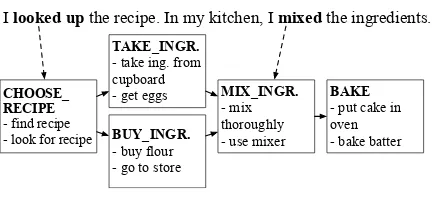
Figure 1: An example of text-to-script mapping with an excerpt of theBAKING A CAKEscript and a story snippet.
baselines, in spite of the availability of only small amounts of training data. In particular, we also demonstrate the relevance of event ordering infor-mation provided by script knowledge.
Our code and all data and parameters that are used are publicly available underhttps:// github.com/SimonOst.
2 Task and Data
As a basis for the task of text-to-script mapping, we make use of two recently published datasets.
DeScript(Wanzare et al.,2016) is a collection of crowdsourced linguistic descriptions of event pat-terns for everyday activities, so called event se-quence descriptions (ESDs). ESDs consist of short telegram-style descriptions of single events (event descriptions, ED). The textual order of EDs corre-sponds to the temporal order of respective events, i.e. temporal information is explicitly encoded. De-Scriptcontains 50 ESDs for each of 40 different scenarios. Alongside the ESDs, it also provides gold event paraphrase sets, i.e. clusters of all event descriptions denoting the same event type, labeled with the respective type.
While DeScript is a source of structured script knowledge, theInScriptcorpus (Modi et al.,2016) provides us with the appropriate kind of narrative texts. InScriptis a collection of 910 stories cen-tered around some specific scenario, for 10 of the 40 scenarios in DeScript, e.g. BAKING A CAKE,
RIDING A BUS, TAKING A SHOWER. All verbs occurring in the texts are annotated with an event type if they are relevant to the script instantiated by the story; asnon-script eventotherwise.
In the upper part of Fig.1, you see the initial fragment of a story about baking a cake; together with a script excerpt in the lower part, depicted by labeled event paraphrase sets. I looked up the
recipe andI mixed the ingredients mention rele-vant script events, and therefore should be labeled with the indicated event types (CHOOSE RECIPE,
MIX INGREDIENTS). Fig.1also illustrates the po-tential of text-to-script mapping: script knowledge enables to predict that a baking event might be ad-dressed next in the story. The verbwasdoes not denote an event at all, anddecideis not part of the
BAKING A CAKEscript, so they are assigned the la-belnon-script event. Actually,InScriptcomes with two additional categories of verbs (script-related
andscript-evoking), which we subsume under non-script event.
The central task addressed in our paper, the au-tomatic labeling of all script-relevant verbs in the
InScripttext with a script-specific event type, uses onlyDeScriptdata for training; event-type labels ofInScriptare used for evaluation purposes only.
3 Model
Section3.1defines the central part of our system, a sequence model for classifying script-relevant verbs into scenario-specific event types. For full automation of the text-to-script mapping, we de-scribe in Section3.2a model for identifying script-relevant verbs.
3.1 Event Type Classification
For identifying the correct event type given a script-relevant verb, we leverage two types of information: We require a representation for the meaning and content of the event mention, which takes into ac-count not only the verb, but also the persons and objects involved in an event, i.e. thescript partic-ipants. In addition, we take event ordering infor-mation into account, which helps to disambiguate event mentions based on their local context. To model both event types and sequences thereof, we implement a linear-chain conditional random field (CRF,Lafferty et al.(2001)). Our implementation is based on the CRF++ toolkit1and employs two types of features:
Sequential Feature. Our CRF model utilizes event ordering information in the form of binary indicator features that encode the co-occurrence of two event type labels in sequence.
Meaning Representation Features. Two fea-ture types encode the meaning of a textual event mention. One is a shallow form of representa-tion derived from precomputed word embeddings
(word2vec, Mikolov et al.(2013)). This feature type captures distributional information of the verb and its direct nominal dependents2, which we as-sume to denote script participants, and is computed by averaging over the respective word vector rep-resentations.3We use pretrained 300-dimensional embeddings that are trained on the Google News corpus.4As a more explicit but sparse form of con-tent representation, we use as the other type of feature the lemma of the verb, its indirect object and its direct object.
3.2 Identifying Script-Relevant Verbs
We use a decision tree classifier for identifying script-relevant verbs (J48from the Weka toolkit,
Frank et al.(2016)) that takes into account four classes: the threenon-script eventclasses from In-Scriptand one class for all event-verbs. At test time, the threenon-script eventclasses are merged into one class. Due to the lack ofnon-script event
instances inDeScript, we train and test our model on all verbs occurring inInScript. We use the fol-lowing feature types:
Syntactic Features. We employ syntactic fea-tures for identifying verbs that only rarely denote script events, independent of the scenario: a feature for auxiliaries; for verbs that govern an adverbial phrase (mostly if-clauses); a feature indicating the number of direct and indirect objects; and a lex-ical feature that checks if the verb belongs to a predefined list of non-action verbs.
Script Features. For finding verbs that match the current script scenario, we employ two features: a binary feature indicating whether the verb is used in the ESDs for the given scenario; and a scenario-specific tf–idf score that is computed by treating all ESDs from a scenario as one document, summed over the verb and its dependents. In Section4.2, we evaluate models with and without script features, to test the impact of scenario-specific information. Frame Feature. We further employ frame-semantic information because we expect script events to typically evoke certain frames.We use a state-of-the-art semantic role labeler (Roth,2016;
Roth and Lapata,2016) based onFrameNet(
Rup-2
For EDs, we use all mentioned head nouns.
3To emphasize the importance of the verb, we double its
weight when averaging. 4
Because our CRF model only supports nominal fea-tures, we discretize embeddings fromcode.google.com/ archive/p/word2vec/by binning the component val-ues into three intervals[−∞,−],[−, ],[,∞]. The hyper-parameteris determined on a held-out development set.
P R F1
Lemma 0.365 0.949 0.526
Our model 0.628 0.817 0.709
[image:3.595.306.526.63.129.2]Our model (scen. indep.) 0.513 0.877 0.645
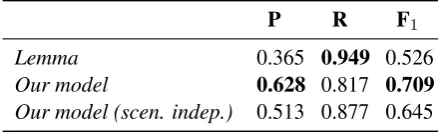
Table 1: Identification of script-relevant verbs within a scenario and independent of the scenario.
penhofer et al.,2006) to predict frames for all verbs, encoding the frame as a feature. We address spar-sity of too specific frames by mapping all frames to higher-level super frames using the framenet querying package5.
4 Evaluation
4.1 Experimental Setup
We evaluate our model for text-to-script mapping based on the resources introduced in Section2. We process theInScriptandDeScriptdata sets using the Stanford Parser (Klein and Manning,2003)6. We further resolve pronouns inInScriptusing an-notated coreference chains from the gold standard. We individually test the two components, i.e. the identification of script-relevant verbs and event classification. Experiments on the first sub-task are described in Section4.2. Sections4.3and4.4
present results on the latter task and a combination of both tasks, respectively.
4.2 Identifying Script-Relevant Verbs
In this evaluation, we test the ability of our model to identify verbs in narrative texts that instanti-ate script events. Our experiments make use of a 10-fold cross-validation setting within all texts of one scenario. To test the model in a scenario-independent setting, we perform additional experi-ments based on a cross-validation with the 10 sce-narios as one fold each and exclude the script fea-tures. That is, we repeatedly train our model on 9 scenarios and evaluate on the remaining scenario, without using any information about the test sce-nario.
Models. We compare the model described in Section3.2to a baseline (Lemma) that always as-signs theeventclass if the verb lemma is mentioned inDeScript. We report precision, recall and F1
-score on event verbs, averaged over all scenarios.
5
github.com/icsi-berkeley/framenet 6To improve performance on the simplistic sentences from
Results.Table1gives an overview of the results based on 10-fold cross-validation. Our scenario-specific model is capable of identifying more than 81% of script-relevant verbs at a precision of about 63%. This is a notable improvement over the base-line, which identifies 94.9% of the event verbs, but at a precision of only 36.5%.
The table also gives numbers for the scenario-independent setting: Precision drops to around 51% if only training data from other scenarios is avail-able. One of the main difficulties here lies in clas-sifying differentnon-script eventverb classes in a way that generalizes across scenarios.Modi et al.
(2016) also found that distinguishing specific types of non-script events from script events can be diffi-cult even for humans.
4.3 Event Type Classification
In this section, we describe experiments on the text-to-script mapping task based on the subset of event instances fromInScriptthat are annotated as script-related. As training data, we use theESDs
and the event type annotations from theDeScript
gold standard7. The evaluation task is to classify individual event mentions inInScriptbased on their verbal realization in the narrative text. We evaluate against the gold-standard annotations fromInScript. Since event type annotations are used for evaluation purposes only, this task comes close to a realistic setup, in which script knowledge is available for specific scenarios but no training data in the form of event-type annotated narrative texts exists.
Models.We evaluate our CRF model described in Section3.1against two baselines that are based on textual similarity. Both baselines compare the event verb and its dependents inInScriptto all EDs inDeScriptand assign the event type with the high-est similarity.Lemmais a simple measure based on word overlap,word2vecuses the same embedding representation as the CRF model (before discretiza-tion) but simply assigns the best matching event type label based on cosine similarity. We report pre-cision, recall and F1-scores, macro-averaged over
all script-event types and scenarios.
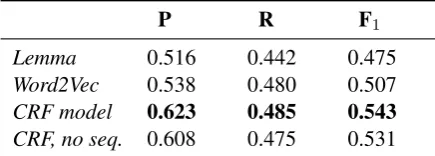
Results.Results for all models are presented in Table2.8 Our CRF model achieves a F1-score of
0.543, a considerably higher performance in com-parison to the baselines. As can be seen from
ex-7
InDeScript, there are some rare cases ofEDsthat do not describe a script event, but that are labeled asnon-script event. We exclude these from the training data.
8Updated in 04/19 due to a bug in the evaluation.
P R F1
Lemma 0.516 0.442 0.475
Word2Vec 0.538 0.480 0.507
CRF model 0.623 0.485 0.543
[image:4.595.307.525.63.141.2]CRF, no seq. 0.608 0.475 0.531
Table 2: Event Type Classification performance, with and without sequential features.
P R F1
Ident. model+Lemma 0.388 0.475 0.426
Ident. model+Word2vec 0.393 0.511 0.442
Ident. model+CRF model 0.458 0.505 0.478
Table 3: Full text-to-script mapping results.
cluding the sequential feature, ordering information improves the result. The rather small difference is due to the fact that ordering information can also be misleading (cf. Section5). We found, however, that including the sequential feature accounts for an improvement of up to 4% in F1score, depending
on the scenario.
4.4 Full Text-to-Script Mapping Task
We now address the full text-to-script mapping task, a combination of the identification of relevant verbs and event type classification. This setup allows us to assess whether the general task of a fully automatic mapping of verbs in narrative texts to script events is feasible.
Models. We compare the same models as in Section4.3, but use them on top of our model for identifying script-relevant verbs (cf. Section4.2) instead of using the gold standard for identification. Results. On the full text-to-script mapping task, our combined identification and CRF model achieves a precision and recall of0.458and0.505, resp. (cf. Table3).8 This reflects an absolute im-provement over the baselines of0.036and0.052
in terms of F1-score. The results reflect the general
difficulty of this task but are promising overall. As reported byModi et al.(2016), even human anno-tators only achieve an agreement of 0.64 in terms of Fleiss’ Kappa (1971).
5 Discussion
Lexical Coverage. We found that although De-Scriptis a small resource, training a model purely onESDsworks reasonably well. Coverage prob-lems can be seen in cases of events for which only fewEDsexist. An example is theCHOOSE TREE
event (the event of picking a tree at the shop) in the
PLANTING A TREEscenario. There are only 3EDs
describing the event, each of which uses the event verb “choose”. In contrast, we find that “choose” is used in less than 10% of the event mentions in
InScript. Because of this mismatch, which can be attributed to the small training data size, more fre-quently used verbs for this event inInScript, such as “pick” and “decide”, are labeled incorrectly.
We observe that our meaning representation might be insufficient for finding synonyms for about 30% of observed verb tokens. This specif-ically includes scenario-specific and uncommon verbs, such as “squirt” in the context of theBAK
-ING A CAKEscenario (squirt the frosting onto the cake). Problems may also arise from the fact that about 23% of the verb types occur in multiple para-phrase clusters of a scenario.
Misleading Ordering Information. We found that ordering information is in general beneficial for text-to-script alignment. We however also iden-tified cases for which it can be misleading, by com-paring the output of our full model to the model that does not use sequential features. As another result of the small size ofDeScript, there are plau-sible event sequences that appear only rarely or never in the training data. This error source is involved in 60–70% of the observed misclassifi-cations due to misleading ordering information. An example is theWASHevent in theGETTING A HAIRCUTscenario: It never appears directly after theMOVE IN SALONevent (i.e. walking from the counter to the chair) inDeScript, but its a plausible sequence that is misclassified by our model.
In almost 15% of the observed errors, an event type is mentioned more than once, leading to mis-classifications whenever ordering information is used. One reason for this might be that events in
InScriptare described in a more exhaustive or fine-grained way. For example, theWASHevent in the
TAKING A BATHscenario is often broken up into
three mentions: wetting the hair, applying sham-poo, and washing it again. However, because there is only one event type for the three mentions, this sequence is never observed inDeScript.
Events with an interchangeable natural order
lead to errors in a number of cases: In theBAKING A CAKEscenario, a few misclassifications happen because the order in which e.g. ingredients are pre-pared, the pan is greased and the oven is preheated is very flexible, but the model overfits to what it observed from the training.
As last, there are also a few cases in which an event is mentioned, even before it actually takes place. In the case of theborrowing a bookscenario, there are cases inInScriptthat mention in the first sentence that the purpose of the visit is to return a book. InDeScriptin contrast, theRETURNevent always takes place in the very end.
Near Misses.For many verbs, it is also difficult for humans to come up with one correct event la-bel. By investigating confusion matrices for single scenarios, we found that for at least 3–5% of script event verbs in the test set, our model predicted an “incorrect” label for such verbs, but that label might still be plausible. In theBAKING A CAKE
scenario, for example, there is little to no differ-ence between mentions of making the dough and preparing ingredients. As a consequence, these two events are often confused: Approximately 50% of the instances labeled asPREPARE INGREDIENTS
are actually instances ofMAKE DOUGH.
6 Summary
In this paper, we addressed the task of automati-cally mapping event denoting expressions in nar-rative texts to script events, based on an explicit script representation that is learned from crowd-sourced data rather than from text collections. Our models outperform two similarity-based baselines by leveraging rich event representations and or-dering information. We showed that models of script knowledge can be successfully trained on crowdsourced data, even if the number of training examples is small. This work thus builds a basis for utilizing the advantages of crowdsourced script representations for downstream tasks and future work, e.g. paraphrase identification in discourse context or event prediction on narrative texts.
Acknowledgments
References
Avron Barr and Edward A. Feigenbaum. 1981. The Handbook of Artificial Intelligence. Addison-Wesley.
Cosmin Adrian Bejan and Sanda Harabagiu. 2010. Un-supervised event coreference resolution with rich lin-guistic features. InProceedings of the 48th Annual Meeting of the Association for Computational Lin-guistics. Association for Computational Linguistics, pages 1412–1422.
Nathanael Chambers and Dan Jurafsky. 2009. Unsu-pervised learning of narrative schemas and their par-ticipants. Proceedings of the 47th Annual Meeting of the ACL and the 4th IJCNLP of the AFNLP.
Joseph L Fleiss. 1971. Measuring nominal scale agree-ment among many raters. Psychological bulletin 76(5):378.
Eibe Frank, Mark A. Hall, and Ian H. Witten. 2016. The weka workbench. online appendix for ”data mining: Practical machine learning tools and tech-niques” .
Lea Frermann, Ivan Titov, and Manfred Pinkal. 2014. A hierarchical bayesian model for unsupervised in-duction of script knowledge. In EACL. volume 14, pages 49–57.
Daniel Gildea and Daniel Jurafsky. 2002. Automatic la-beling of semantic roles. Computational linguistics 28(3):245–288.
Bram Jans, Steven Bethard, Ivan Vuli´c, and
Marie Francine Moens. 2012. Skip n-grams
and ranking functions for predicting script events. In Proceedings of the 13th Conference of the European Chapter of the Association for Computa-tional Linguistics. Association for ComputaComputa-tional Linguistics, pages 336–344.
Dan Klein and Christopher D. Manning. 2003. Fast ex-act inference with a fex-actored model for natural lan-guage parsing. In In Advances in Neural Informa-tion Processing Systems 15 (NIPS. MIT Press, pages 3–10.
John D. Lafferty, Andrew McCallum, and Fernando C. N. Pereira. 2001. Conditional random fields: Probabilistic models for segmenting and labeling se-quence data. InProceedings of the Eighteenth Inter-national Conference on Machine Learning. ICML ’01, pages 282–289.
Heeyoung Lee, Marta Recasens, Angel Chang, Mihai Surdeanu, and Dan Jurafsky. 2012. Joint entity and event coreference resolution across documents. In Proceedings of the 2012 Joint Conference on Empir-ical Methods in Natural Language Processing and Computational Natural Language Learning. Associ-ation for ComputAssoci-ational Linguistics, pages 489–500.
Xiao Ling and Daniel S Weld. 2010. Temporal infor-mation extraction. InAAAI. volume 10, pages 1385– 1390.
Tomas Mikolov, Kai Chen, Greg Corrado, and Jeffrey Dean. 2013. Efficient estimation of word represen-tations in vector space.CoRR.
Anne-Lyse Minard, Manuela Speranza, Eneko
Agirre, Itziar Aldabe, Marieke van Erp, Bernardo Magnini, German Rigau, Ruben Urizar, and Fon-dazione Bruno Kessler. 2015. Semeval-2015 task 4: Timeline: Cross-document event ordering. In Proceedings of the 9th International Workshop on Semantic Evaluation (SemEval 2015). pages 778–786.
Ashutosh Modi, Tatjana Anikina, Simon Ostermann, and Manfred Pinkal. 2016. Inscript: Narrative texts annotated with script information. Proceedings of the 10th International Conference on Language Re-sources and Evaluation (LREC 16).
Ashutosh Modi and Ivan Titov. 2014. Inducing neu-ral models of script knowledge. In Proceedings of the Conference on Computational Natural Lan-guage Learning (CoNLL). Baltimore, MD, USA.
Ashutosh Modi, Ivan Titov, Vera Demberg, Asad Say-eed, and Manfred Pinkal. 2017. Modelling seman-tic expectation: Using script knowledge for referent prediction. Transactions of the Association for Com-putational Linguistics5:31–44.
Martha Palmer, Daniel Gildea, and Nianwen Xue. 2010. Semantic role labeling. Synthesis Lectures on Hu-man Language Technologies3(1):1–103.
Michaela Regneri. 2013. Event Structures in Knowl-edge, Pictures and Text. Ph.D. thesis, Universit¨at des Saarlandes.
Michaela Regneri, Alexander Koller, and Manfred Pinkal. 2010. Learning script knowledge with web experiments. In Proceedings of the 48th Annual Meeting of the Association for Computational Lin-guistics. Association for Computational Linguistics, Stroudsburg, PA, USA, ACL ’10, pages 979–988.
Michael Roth. 2016. Improving frame semantic pars-ing via dependency path embeddpars-ings. InBook of Ab-stracts of the 9th International Conference on Con-struction Grammar. Juiz de Fora, Brazil, pages 165– 167.
Michael Roth and Mirella Lapata. 2016. Neural seman-tic role labeling with dependency path embeddings. InProceedings of the 54th Annual Meeting of the As-sociation for Computational Linguistics (Volume 1: Long Papers). Berlin, Germany, pages 1192–1202.
Josef Ruppenhofer, Michael Ellsworth, Miriam RL Petruck, Christopher R Johnson, and Jan Scheffczyk. 2006. Framenet ii: Extended theory and practice.
Roger C Schank and Robert P Abelson. 1975. Scripts, plans, and knowledge. Yale University New Haven, CT.
Lilian D. A. Wanzare, Alessandra Zarcone, Stefan Thater, and Manfred Pinkal. 2016. A crowdsourced database of event sequence descriptions for the ac-quisition of high-quality script knowledge. Proceed-ings of the Tenth International Conference on Lan-guage Resources and Evaluation (LREC’16).