Markov Logic Networks for Text Mining:
A Qualitative and Empirical Comparison with Integer Linear Programming
Luis Gerardo Mojica and Vincent Ng
Human Language Technology Research InstituteUniversity of Texas at Dallas Richardson, TX 75083-0688, USA
{mojica,vince}@hlt.utdallas.edu
Abstract
Joint inference approaches such as Integer Linear Programming (ILP) and Markov Logic Networks (MLNs) have recently been successfully applied to many natural language processing (NLP) tasks, often outperforming their pipeline counterparts. However, MLNs are arguably much less popular among NLP researchers than ILP. While NLP researchers who desire to employ these joint inference frameworks do not necessarily have to understand their theoretical underpinnings, it is imperative that they understand which of them should be applied under what circumstances. With the goal of helping NLP researchers better understand the relative strengths and weaknesses of MLNs and ILP; we will compare them along different dimensions of interest, such as expressiveness, ease of use, scalability, and performance. To our knowledge, this is the first systematic comparison of ILP and MLNs on an NLP task.
Keywords:Markov Logic, Integer Linear Programming, Joint Inference
1.
Introduction
In the early days of the statistical natural language process-ing (NLP) era, many language processprocess-ing tasks were tack-led using the so-caltack-ledpipelinearchitecture: the given task is broken into a series of sub-tasks such that the output of one sub-task is an input to the next sub-task in the sequence. This pipeline architecture is appealing for various reasons, including modularity, modeling convenience, and manage-able computational complexity. However, it suffers from theerror propagationproblem: errors made in one sub-task are propagated to the next sub-task in the sequence. Realizing this weakness, researchers have turned to joint inferenceapproaches such as Integer Linear Programming (ILP) (Roth and Yih, 2004) and Markov Logic Networks (MLNs) (Domingos and Lowd, 2009), which often outper-form their pipeline counterparts. These joint inference ap-proaches enable manual specification of constraints. These constraints effectively allow incorporation of background knowledge into NLP systems, addressing the aforemen-tioned error propagation problem by allowing the down-stream components to influence the updown-stream components in a pipelined system architecture. To date, MLNs have been underused in NLP applications, and are arguably much less popular among NLP researchers than ILP. While NLP researchers who desire to employ these joint inference frameworks do not necessarily have to understand their the-oretical underpinnings, it is imperative that they understand which of them should be applied under what circumstances. In light of this discussion, our goal in this paper is to help NLP researchers better understand the relative strengths and weaknesses of MLNs and ILP by comparing them along different dimensions of interest, such as expressive-ness(what can and cannot be expressed using a specifica-tion language?),ease of use(how easy is it to encode con-straints?), scalability (how efficient is the inference pro-cedure, especially when applied to large problems?), and
performance(how well do these inference algorithms
per-form?).
To facilitate the comparison, we will discuss how ILP and MLNs can be applied to the task of fine-grained opinion extraction. While many tasks could have been chosen, we chose this task not only for its importance but also for the fact that its sophistication allows us to demonstrate the dif-ferences between the two inference frameworks. In fact, while ILP has been applied to this task (Yang and Cardie, 2013) (henceforth Y&C), MLNs have not, so it would be informative for us to consider how MLNs can be applied to it. To our knowledge, this is the first systematic comparison of ILP and MLNs on an NLP task. It is worth mentioning that while our discussion is centered on this task, many of our conclusions and recommendations are generally appli-cable to other NLP tasks.
The rest of this paper is organized as follows. Section 2 provides some background information, including the task of fine-grained opinion extraction, the corpus, and the two inference algorithms. Section 3 describes the constraints that we enforce on the outputs of a fine-grained opinion extraction system and how ILP and MLNs encode such constraints. In Sections 4 and 5, we discuss the relative strengths and weaknesses of MLNs and ILP. Finally, we report our empirical results in Section 6, and discuss our conclusions in Section 7.
2.
Preliminaries
2.1.
Fine-Grained Opinion Extraction
2.1.1. Task Definition
Fine-grained opinion extraction is an opinion mining task that involves (1) identifying text spans corresponding to
This fine-grained opinion extraction task is typically de-composed into two subtasks. The first subtask, entity ex-traction, involves identifying three types of opinionated entities, including opinions (“O”) and two types of argu-ments, Sources (“S”, entities generating opinions) and Tar-gets (“T”, entities of which a opinion is about). The second subtask,relation extraction, involves extractingIs from re-lations (i.e., linking a source to its opinion) andIs about re-lations (i.e., linking a target to its opinion). To better under-stand the task, consider the following example taken from the MPQA1corpus.
1. [Ashcroft]S0 toldO0 us [he]S0 was determinedO1 [to
take every conceivable action]T1
Ashcroftis the source of the two opinions,toldandwas de-termined, andto take every conceivable actionis the target of the second opinion. In other words, there are twoIs from
relations: one betweenAshcroftandtoldand the other be-tween Ashcroftandwas determined, and there is oneIs aboutrelation betweenwas determinedandto take every conceivable action. Note that the opinionO0has no target
associated with it. When an opinion has no target argu-ments or source arguargu-ments, we refer to it as target-implicit or source-implicit, respectively. In this case,O0is
target-implicit.
2.1.2. Corpus
For training and evaluation, we use the MPQA 2.0 cor-pus (Wiebe et al., 2005; Wilson, 2008). After discarding those ill-formatted documents (lack of punctuation, para-graphs, etc.), we obtain 433 documents with 8,377 sen-tences. These documents contains4,717opinions,4,680 targets and5,505sources. The number ofIs fromrelations is13,046, and9,763of theIs abouttype. Unlike Y&C, we donotremove sentences containing no opinionated entities.
2.1.3. Why Joint Inference?
A straightforward method to address the fine-grained opin-ion extractopin-ion task is to adopt apipelineapproach, where we (1) use an entity extraction model to extract the opin-ions, sources, and targets; (2) use argument-implicit clas-sifiers to identify those extracted opinions that are source-implicit as well as those that are target-source-implicit; and (3) use opinion-argument classifiers to extract Is from rela-tions between sources and opinions that are not source-implicit, as well asIs aboutrelations between targets and opinions that are not target-implicit.2 However, this so-called pipeline approach suffers from error propagation, where errors made in the entity extraction model will be propagated to the implicit opinion identification compo-nent, which in turn will be propagated to the relation ex-traction component. For example, in the example sentence
1http://mpqa.cs.pitt.edu/corpora/mpqa_
corpus/
2Our implementation of the entity extraction model, the
argument-implicit classifiers and the opinion-argument classifiers follow that of Yang and Cardie (2013). Owing to space limita-tions, we omit the details of the training procedure as well as the features used to train each model, and refer the reader to Y&C’s paper for details.
above, if the entity extraction model failed to retrieve the span [Ashcroft], or if the source-implicit classifier misclas-sifies opinionsO0andO1(as source-implicit), it would not
be possible for the opinion-argument classifier to extract the
Is fromrelations between this span andO0andO1.
One way to address the aforementioned error propagation problem is to performjoint inferenceover the outputs of the entity extraction model, the argument-implicit classifiers, and the opinion-argument classifiers. Unlike in the pipeline approach, where entity extraction influences implicit opin-ion identificatopin-ion, which in turn influences relatopin-ion extrac-tion (but not vice versa), in a joint inference approach, all three tasks can influence each other.
Specifically, recall that one problem with the pipeline ap-proach is that if the entity extraction model fails to extract an entity, the opinion-argument classifiers cannot extract the relations for the opinion in consideration. To be ro-bust to the errors made by the entity extraction model, in-stead of making use of its1-bestoutput, we make use of its
n-bestoutput and the confidence assigned by the model to eachcandidateentity it extracted. Similarity, to be robust to the errors made by the argument-implicit classifiers, instead of making use of its binary decisions, we make use of the confidences associated with its decisions. Given this setup, if the opinion-argument classifier is highly confident that anIs aboutrelation exists between twocandidateentities, then these two entities will likely be extracted as an opin-ion and a target even if the entity extractopin-ion component fails to extract them or the target-implicit classifier erroneously determines that the opinion candidate is target-implicit. In other words, the final entity extraction decisions and rela-tion extracrela-tion decisions will be madejointlyby the entity extraction model, the argument-implicit classifiers, and the opinion-argument classifiers by considering the confidence values they individually assign to the extraction decisions.
2.2.
Joint Inference Frameworks
In this subsection, we provide a brief overview of two joint inference frameworks, ILP and MLNs.
2.2.1. Integer Linear Programming
At a high level, many NLP tasks are structured prediction problems which can be naturally expressed as constrained optimization problems, where the goal is to optimize an ob-jective function subject to a set of linear (equality and in-equality) constraints. In principle, a variety of methods can be used to solve these problems. ILP methods are arguably the most popular choice among NLP researchers. Formally, an ILP problem is defined as follows:
Maximize: f(x1, x2, ..., xn)
Subject to: gj(x1, x2, ..., xn)≥bj (j= 1,2, ..., m)
where xi are the variables that take finite integer
val-ues, f(x1, x2, ..., xn) is the objective function, and gj
(x1, x2, ..., xn),1≤j≤m, are the constraints (each
con-straint is linear inx1, x2, ..., xn). Several highly optimized
open source and commercial software for solving ILP prob-lems, such aslpsolve(Berkelaar et al., 2004) and Gurobi3,
are readily available, and therefore the application designer can focus on modeling issues rather than solving optimiza-tion problems
2.2.2. Markov Logic Networks
Markov logic (Richardson and Domingos, 2006; Domin-gos and Lowd, 2009), a popular statistical relational learn-ing (SRL) approach (Taskar and Getoor, 2007), combines graphical models with first-order logic. At a high level, a MLN is a set of weighted first-order logic formulas(fi, wi),
wherewiis the weight associated with formulafi. Given a
set of constants that model objects in the domain, it de-fines a Markov network (Koller and Friedman, 2009) in which we have (1) one node peratom(i.e., grounded pred-icate) and (2) a propositionalfeaturecorresponding to each grounding of each first-order formula (i.e., a clique formed from the atoms in the formula). The weight of the feature is the weight of the corresponding first-order formula. Formally, the probability of a worldωwhich represents an assignment of values to all atoms in the Markov network is given by:
Pr(ω) = 1 Zexp
X
i
wiN(fi, ω)
!
whereN(fi, ω)is the number of groundings of fi which
evaluate to True in ω and Z is a normalization constant called the partition function.
The key inference tasks over MLNs are computing the par-tition function (Z) and the most-probable explanation given evidence (the MAP task). Most queries can be reduced to these inference tasks. Formally, the partition function and the MAP tasks are given by:
Z =X
ω
exp X
i
wiN(fi, ω)
!
(1)
arg max
ω P(ω) = arg maxω
X
i
wiN(fi, ω) (2)
Unlike ILP, which optimizes an objective function provided by the user, MLNs typically optimize the conditional like-lihood of the data. Software packages such as Alchemy (Kok et al., 2008), Alchemy 2.0 (Venugopal and Gogate, 2012), Markov the beast (Riedel, 2009) and Tuffy (Niu et al., 2011) for inference and learning with MLNs are widely available.
3.
Joint Inference for Fine-Grained Opinion
Extraction
3.1.
Consistency Constraints
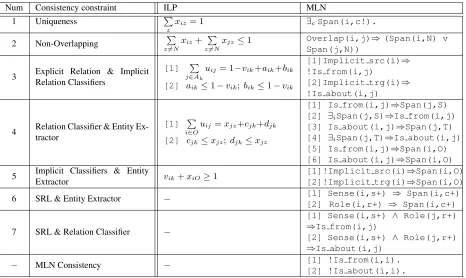
As mentioned before, joint inference enables the entity ex-traction model, the argument-implicit classifiers, and the opinion-argument classifiers to influence each other by em-ploying constraints to enforceglobal consistencyover their outputs. In this subsection, we enumerate seven constraints. Note that Constraints(1)and(2)areintra-taskconstraints, which enforce consistency over the outputs of the entity ex-traction model, whereas the other constraints areinter-task
constraints, which enforce consistency over the outputs of models for different tasks.
The first five constraints were originally proposed by Y&C. Constraint (1) states that an opinion/source/target candi-date(obtained from the 30-best output of the CRF-based entity extraction model) can only be assigned exactly one of four types: opinion, target, source, or none (if it does not belong to any of the other three types). Constraint (2) indicates that among every pair of overlapping en-tity candidates, at most one should be extracted as a non-none type entity. Constraint(3)enforces the consistency between opinion-argument classifiers and the argument-implicit classifiers. Specifically, an opinion candidate can be related to source and target arguments if it is not an argument-implicit opinion. Constraint(4)enforces the con-sistency between the opinion-argument classifiers and the entity extractor. Specifically, the relations between opin-ion and arguments should be consistent with their entity types (i.e., aIs fromrelation must involve an opinion and a source, and a Is aboutrelation must involve an opinion and a target). In the same way, a span related with a tar-get or source argument must be an opinion. Constraint(5) enforces the consistency between the opinion-implicit clas-sifiers and the entity extractor. Specifically, an opinion can-didate that is not argument-implicit must be an opinion. Hypothesizing that some verb senses and argument roles defined in VerbNet (Schuler, 2005) are useful for identi-fying text spans corresponding to opinions and their argu-ments as well as their relationships4, we introduce three constraints that exploit the PropBank-style semantic role labels provided by Mate Tools (Bj¨orkelund et al., 2009). Specifically, Constraint(6)states that (1) a span candidate associated with a particular verb sense should be assigned a non-nonelabel, and (2) a span candidate associated with a verb argument should be assigned a non-nonelabel. Con-straint(7)indicates that two entities that are assigned a verb sense and an argument role respectively might be in a Is fromorIs aboutrelation. Note that while the first five con-straints arehardconstraints, Constraints(6)and(7)aresoft
constraints.
3.2.
ILP Formulation
In this subsection, we show how to formulate fine-grained opinion extraction in the ILP framework. Recall that ILP requires that we define a constrained optimization problem. Below we first define the objective function and then de-scribe how we encode the aforementioned constraints. We create one ILP program for each test sentence. Specifi-cally, for each test sentence, letObe the set of opinion can-didates (provided by the 30-best CRF output),Akbe the set
of argument candidates (also provided by the 30-best CRF output), where kdenotes the relation type (Is aboutorIs from), andSbe the union ofOandAk.
Next, we introduce a set of binary indicator variables whose values are to be determined by ILP during the joint
infer-4
Num Consistency constraint ILP MLN
1 Uniqueness P
z
xiz= 1 ∃cSpan(i,c!).
2 Non-Overlapping
P z6=N
xiz+ P z6=N
xjz≤1 Overlap(i,j)⇒(Span(i,N) v
Span(j,N))
3 Explicit Relation & Implicit Relation Classifiers
[1] P
j∈Ak
uij= 1−vik+aik+bik
[2] aik≤1−vik;bik≤1−vik
[1]Implicit src(i)⇒ !Is from(i,j)
[2]Implicit trg(i)⇒ !Is about(i,j)
4 Relation Classifier & Entity Ex-tractor
[1] P
i∈O
uij=xjz+cjk+djk
[2] cjk≤xjz; djk≤xjz
[1] Is from(i,j)⇒Span(j,S) [2] ∃iSpan(j,S)⇒Is from(i,j)
[3] Is about(i,j)⇒Span(j,T) [4] ∃iSpan(j,T)⇒Is about(i,j)
[5] Is from(i,j)⇒Span(i,O) [6] Is about(i,j)⇒Span(i,O)
5 Implicit Classifiers & Entity
Extractor vik+xiO≥1
[1]!Implicit src(i)⇒Span(i,O) [2]!Implicit trg(i)⇒Span(i,O)
6 SRL & Entity Extractor − [1] Sense(i,s+) ⇒ Span(i,c+) [2] Role(i,r+) ⇒ Span(i,c+)
7 SRL & Relation Classifier −
[1] Sense(i,s+) ∧ Role(j,r+) ⇒Is from(i,j)
[2] Sense(i,s+) ∧ Role(j,r+) ⇒Is about(i,j)
− MLN Consistency − [1] !Is from(i,i).
[2] !Is about(i,i).
Table 1: Consistency constraints for fine-grained opinion extraction encoded as linear constraints for ILP and first-order logic formulas for MLNs.
ence process. Specifically, xiz has the value 1 if ILP
be-lieves that spanishould have entity labelz, wherez =∈ {opinion, target, source, none};uij has the value 1 if and
only if ILP believes that opinion candidateiinOhas a rela-tion with argument candidatejinAkandvik has the value
1 if ILP believes that this opinion candidate is related to a
nullargument in the relation typek.
Finally, we combine these binary variables (xiz,uij , and
vik) with the confidence values returned by the entity
ex-traction model (fiz), the opinion-argument classifiers (rij),
and the argument-implicit classifiers (ri∅) into the
follow-ing objective function:
arg max
x,u,v
λX
i∈S
X
z
fizxiz (3)
+(1−λ)X
k
X
i∈O
X
j∈Ak
rijuij+ri∅vik
As we can see, the function is a linear combination of the confidence values from the three predictors (fiz,rij,ri∅),
andλis a parameter used to balance the contribution of the entity extraction model and the relation extraction classi-fiers.
The objective function will be optimized subject to the seven consistency constraints defined in the previous sec-tion. The column under “ILP” in Table 1 shows how these constraints can be encoded in ILP. The encoding of the first five constraints is due to Y&C.
Two points deserve mention. First, merely enforcing the consistency between the argument-implicit classifiers and the opinion-argument classifiers in Constraint(3)does not
require the use of the variablesaikandbik. These two
vari-ables are used to enforce an additional constraint: an opin-ion can be related to at most three arguments. The same is true for Constraint(4): the variablescjkanddjkare used to
enforce the additional constraint that a source or target can be related to at most three opinions. Second, we do not en-code Constraints(6)and(7)as ILP constraints. The reason is that these two constraints are intended as soft constraints: although it is possible to soften hard constraints in ILP, it is by no means easy to directly encode soft constraints in ILP, as we will see in the next section.
3.3.
MLN Formulation
Unlike ILP, which operates at the propositional level by defining propositional variables, MLNs employ first-order logic, which definespredicatesthat operate on sets of ob-jects. MLNs employ two types of predicates.
Query predicates are those whose assignments are not given during inference and thus need to be predicted. For the fine-grained opinion extraction task, we define five query predicates. Span(i,l) is true when the la-bel assigned to text span i is l. Is about(i,j)
asserts that opinion i is related to source j. Sim-ilarly, Is from(i,j) asserts that opinion i is re-lated to target j. Finally, Implicit src(i) and
Implicit trg(i) assert that opinion i is source-implicit and target-source-implicit, respectively.
Evidence predicates are those whose values are known during inference. We define three evidence predicates.
Overlap(i,j) indicates that spans i and j overlap.
The column under “MLN” in Table 1 shows how the seven consistency constraints can be encoded in an MLN. For instance, the formula ∃c Span(i,c!), which
im-plements Constraint (1), encodes the hard constraint that each spanican have exactly one label. (The!symbol as-serts that the labels assigned to a span are mutually exclu-sive.) The formulasSense(i,s+) ⇒ Span(i,c+)
andRole(i,r+) ⇒ Span(i,c+), which implement Constraint (6), encode the soft constraint that a candi-date entity having sense s or role rshould be labeled as a span with entity type c. The (+) operator asserts that there exists an instantiated formula for every combina-tion of values in the variable domain. For instance, given
Sense(i,s+) ⇒ Span(i,c+), one formula will be instantiated for each combination of sensesand entity la-belcof candidate spani.
In addition to the seven constraints, we need the two for-mulas shown in the last row of Table 1. They ensure that spans are not related to themselves. Note that this constraint needs to be explicitly specified for the MLN but not for ILP. The reason is that MLN operates at the predicate level, meaning that it will instantiate all predicates within its argu-ments domain. On the other hand, in ILP, we have control over which variables are created because ILP operates at the propositional level.
As mentioned before, MLN formulas encode either hard or soft constraints. Hard constraints are encoded as for-mulas with infinite weights (those ending with a period), whereas soft constraints are encoded as formulas with fi-nite weights (i.e., when a soft formula logically evaluates to True, the knowledge encoded in it is proportional to the their weight). Note that while Constraints(2)−(5)are orig-inally intended as hard constraints, they are implemented as soft constraints in our MLN. The reason is that doing so may make the MLN more robust to the noise inherent in the entity extractor and the relation classifiers’ classifications. A few other points deserve mention. First, while ILP incor-porates the confidence values associated with the various classifiers’ outputs into the objective function, these outputs are incorporated into an MLN assoft evidence, which can be thought of as ourpriorbelief that a given atom (i.e., a grounded query predicate) is true. Specifically, we include as priors the atoms Span(s,l 6= N) with weight we
whenp(s=l|x)≥γ, wherep(s=l|x)is the probability
that the CRF thinks spanshas entity typelgiven evidence
x. We include another atom Span(s,N) with weight wn. In addition, we include atom Is from(i,j) with
weightwrwhen p(src(i, j)|x) ≥ ξ, wherep(src(i, j)|x)
is the probability that the relation extractor thinks opin-ioniand sourcej. In a similar fashion, we include atom
Is about(i,j)with weightwr. Also, we included
pri-ors Implicit src(i) and Implicit trg(i) with weights equal to the positive probability values given by the corresponding implicit prediction classifier. In con-trast, we include atomsSense(i,s),Role(i,s)and
Overlap(i,j)as evidences to the MLN since directly observe them.
Second, unlike ILP, which implements the additional con-straint that limits the number of arguments an opinion can take in Constraint(3), MLNs cannot do so: since Markov
Logic is a function-less language, MLNs in general cannot encode cardinality constraints.
Finally, as mentioned before, MLNs do not require the specification of an objective function. Instead, they in-fer the most likely combination of variables (MAP tuple) from the induced Markov Network obtained by ground-ing the MLN, typically by maximizground-ing the conditional log-likelihood of the data.
4.
MLNs: Strengths
In this section, we will discuss the strengths of MLNs. The ability to employ soft constraints. Soft constraints are useful because (1) they allow us to model phenomena that are true with a certain probability, and (2) they provide tunable “knobs” or additional parameters that are used to increase the system’s performance. A soft constraint can be created easily in a MLN by assigning a weight (i.e., a real value) to the desired constraint, where the magni-tude of the weight indicates the importance that the con-straint is satisfied. If it is difficult to assign weights manu-ally, weight learning algorithms for MLNs can be used in-stead (e.g., Richardson and Domingos (2006), Huynh and Mooney (2011)). The ability to learn from data is one of the advantages of MLNs over ILP: unlike MLNs, ILP is a pure inference framework that does not have the ability to learn.
While it is easy to encode soft constraints in MLNs, the same is not true for ILP. One can, however, “soften” a hard constraint in ILP by incorporating it into the objective func-tion and associating it with a coefficient. Consider, for in-stance, Equation (3), where the two terms in the objective function weighted using the parameterλ. Note that this pa-rameter has a softening effect: a smallerλimplies that the first term will have less of an impact on the objective func-tion. Hence, any hard constraint can be softened in a similar manner by associating it with a ”weight” parameter when incorporated into the objective function, where the magni-tude of the weight indicates the importance of satisfying the constraint. If it is difficult to manually specify the param-eters, one can use a held-out development set to tune these weights.
Compact representation. While ILP operates at the propositional level, MLNs operate at the predicate level. This enables MLNs to inherit a key advantage of first-order logic over propositional logic: MLNs can encode a problem more compactly than ILP. This is appealing from a user’s perspective: a user can focus on encoding the constraints on the outputs, and leave the grounding of these predicates and formulas entirely to the MLN inference engine. In particu-lar, when applying an MLN to different probleminstances, the first-order formulas remain unchanged: all we need to change are the evidence predicates (i.e., the observations).5 In contrast, an ILP program cannot encode a problem in-stance compactly. The reason, as mentioned above, is that ILP operates at the propositional level: one variable has to
5A problem instance corresponds to a joint inference problem.
be created for each decision that is to be made by the ILP inference engine, and constraints have to be defined over these variables. Given that both the objective function and the linear constraints are dependent on the variables, a dif-ferent objective function and a difdif-ferent set of linear con-straints have to be created for each problem instance. Ease of specification. It is typically much easier to for-mulate constraints in MLNs than in ILP. One reason is that it is easier for humans to reason with constraints ex-pressed as logical formulas than constraints exex-pressed as linear equalities/inequalities. As an example, consider Con-straint(5), which states that an opinion candidate that is not argument-implicit must an opinion. As can be seen from Table 1, this constraint can be easily encoded as two first-order formulas, which state that an opinion candidate that is not source-implicit or target-implicit must be an opinion. On the other hand, it is comparatively more difficult for a human toencodeandunderstandthe corresponding ILP constraint: ifvik = 0(opinion candidateiis not implicit),
then in order for this inequality to be true, xiO has to be
equal to 1 (i.e.,ihas to be an opinion).
If the above example is not compelling enough, consider encoding the transitivity constraint. If relationR is tran-sitive, we can encode transitivity in MLN using the for-mulaR(i, j)∧R(j, k)⇒R(i, k). In ILP, one can enforce transitivity over three variables using the linear inequality (1?xi,j) + (1?xj,k)≥(1?xi,k). Again, it is comparatively
much harder to encode and understand this constraint in ILP than in MLN. In fact, the encoding process will only become harder as a constraint involves more variables. In other words, ILP puts a much larger burden on the user than MLNs in terms of problem encoding, especially when the problem involves encoding complex output constraints. A related point deserves mention: not all constraints that are intuitively true for a problem will indeed improve per-formance when they are enforced. For instance, while all the constraints in Table 1 are intuitively useful to have, not all of them will be as useful as we think: their use-fulness depends on the correctness of the underlying mod-els (i.e., the entity extractor and the relation classifiers). If these models are ”reasonably accurate”, enforcing the con-straints could improve performance. Otherwise, enforcing the constraints could have an adverse effect on overall per-formance. One way to determine the usefulness of con-straints is to experiment with them on a held-out develop-ment set. MLNs, however, provide an alternative solution. By encoding constraints as soft formulas, the user does not need to worry about whether employing a constraint will hurt performance: if the soft constraint is determined to be not useful, it will be assigned a low weight by the MLN.
5.
MLNs: Weaknesses
In this section, we will discuss the weaknesses of MLNs. Exponential time and space complexity. Since ground-ing a MLN is exponential in the size of the domain and inference is shown to be NP-hard (Richardson and Domin-gos, 2006), handling large problems has traditionally been one of its major challenges. Fortunately, recent advances in liftedinference algorithms have been developed to re-duce the domain size of the variables in MLNs (Gogate
and Domingos, 2010), and scalable approaches to weight learning have been developed that leverage fast, approxi-mate counting techniques (Gogate et al., 2010). Despite these advances, scalability is still a major issue surround-ing inference and parameter estimation in MLNs. As of today, ILP can solve larger problems than MLNs. This in part explains the broader use of ILP in the NLP community than MLNs for joint inference.
Failure to exploit prior information in learning. As mentioned before, the confidence values assigned by the different models (e.g., the entity extractor and the relation classifiers in the fine-grained extraction task) can be incor-porated as prior information for an MLN. However, exist-ing weight learnexist-ing algorithms cannot take advantage of such prior information during the training process (Venu-gopal et al., 2014). In particular, prior information can only be applied during test time. Moreover, since the weights were learned without taking into account the prior informa-tion, they could be suboptimal when combined with prior information to make decisions during the inference process. Typically, the priors arescaledbefore they are used in com-bination with the learned weights during test time (Venu-gopal et al., 2014).
In ILP, prior information is used within the objective func-tion. Since there is no learning in ILP, the issue of combin-ing priors with weight learncombin-ing is not applicable to ILP. No support for functions and preprocessing overhead. Markov Logic is a functionless language. Common opera-tors such as equality checking and comparison are not read-ily available. To perform these operations, new predicates have to be defined, which may result in an expensive pre-processing step before inference and weight training. In our running example, if we were to assert that two entity can-didates refer to distinct entities in Formula4.1, we cannot simply include the expressioni6=jin it. Instead, we need to include a predicateNeq(i,j), converting the formula to: Is from(i,j) ∧ Neq(i,j) ⇒ Span(j,S).6. This is problematic for two reasons. First, the number of additional atoms that need to be added to the network can be large depending on the domain size of the predicate’s arguments. This could significantly increase the network space requirements as well as the time for inference and parameter learning. Second, the preprocessing step can be computationally expensive because the number of ground-ings is exponential in the size of the predicate’s domain. ILP constraints, in contrast, are expressed as mathematical equations, so ILP natively support functions and therefore does not incur this preprocessing overhead. Note, however, that some MLNs implementations (e.g., Rockit (Noessner et al., 2013) and Markov the Beast (Riedel, 2008)) create an ILP program as an inference subroutine that allows the use of a predefined set of functions.
Failure to encode cardinality constraints. Another con-sequence of defining Markov Logic as a functionless lan-guage is that MLNs cannot encode cardinality constraints. So, the additional cardinality constraint encoded as part of
6
Overlap Exact
Opinion Target Source Opinion Target Source Experiment P R F1 P R F1 P R F1 P R F1 P R F1 P R F1 ILP 50.5 72.2 59.4 44.9 36.2 40.1 67.3 37.4 48.1 39.2 56.1 46.2 15.1 12.2 13.5 57.7 32.0 41.2 MLN 75.6 45.5 56.8 55.0 34.7 42.6 77.1 49.6 60.4 59.2 35.6 44.5 25.3 16.0 19.6 67.7 43.6 53.0 MLNSRL 66.4 47.0 55.0 51.2 25.6 34.2 64.5 59.6 62.0 52.1 36.9 43.2 15.9 8.0 10.6 55.4 51.3 53.3
Table 2: Entity extraction results with respect to theOverlapandExactmetrics.
the implementation of Constraints(3)and(4)for ILP (e.g., an opinion can be related to at most three sources/targets) cannot not be enforced in an MLN. Note that some of the aforementioned MLN implementations such asMarkov the Beast andRockit are able to address this weakness. The reason is that they implement MLNs by casting the opti-mization problem of counting the number of satisfied con-straints as an ILP problem. In other words, once a MLN is mapped to ILP, one can include cardinality constraints as in any other ILP formulations.
6.
Evaluation
6.1.
Experimental Setup
Corpus. As mentioned in Section 2.1.2, for evaluation we use the 433 documents in the MPQA 2.0 corpus that remain after discarding those that are ill-formed. Unlike Y&C, we do not remove from these documents the sen-tences that contain no opinionated entities in our evaluation. Hence, our evaluation setting is arguably more challenging than that of Y&C. 20% of the corpus is reserved solely for parameter tuning (i.e., the regularization parameters in the entity extractor and the relation extraction classifiers,λ(for ILP),γ,ξ,weandwr(for the MLN)). Evaluation results
are obtained via five-fold cross-validation experiments on the remaining documents.
Software packages. We employ Gurobi for ILP-based joint inference and Tuffy for MLN-based joint inference. Evaluation metrics. We use the same evaluation criteria as Y&C: precision, recall and F1 score for both overlap
andexact matching mechanisms7. In addition, we report the time taken by the ILP/MLN package to produce the test results in each experiment.
Systems. We compare the performance of three systems that exploit joint inference for fine-grained opinion extrac-tion. The first system (ILP) performs ILP-based joint in-ference via encoding the first five constraints in Table 1. The second system (MLN) is the same as the first one ex-cept that we replace ILP with MLN as the underlying joint inference framework. The third system (MLNSRL) is the same as the second one except that it additionally exploits Constraints(6)and(7)for joint inference.
6.2.
Results and Discussion
Entity extraction results. Entity extraction results ob-tained for the three aforementioned systems using the over-lap and exact metrics are shown in Table 2. Comparing rows 1 and 2, we can see that with respect to both metrics,
7An overlap match occurs when a predicted entity span’s
in-dices overlap with those of a gold entity.
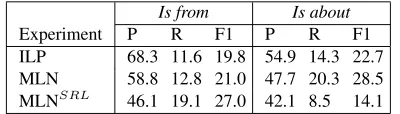
Is from Is about Experiment P R F1 P R F1 ILP 68.3 11.6 19.8 54.9 14.3 22.7 MLN 58.8 12.8 21.0 47.7 20.3 28.5 MLNSRL 46.1 19.1 27.0 42.1 8.5 14.1
Table 3: Relation extraction results with respect to the
overlapmetric.
ILP outperforms MLN on Opinion extraction but underper-forms it on Source and Target extraction. The addition of the constraints on semantic roles to the MLN does not al-ways improve its performance: comparing rows 2 and 3, we can see that with respect to both metrics, MLNSRL
un-derperforms MLN on both Opinion and Target extraction and outperforms it slightly on Source extraction. Hence, as far as entity extraction is concerned, neither inference frameworks are superior to the other, and moreover, a richer MLN model does not always yield better performance. It is worth noting that the ILP results are lower than those re-ported in Y&C’s paper. These results suggest that retaining sentences without opinionated entities yields a harder task.
Relation extraction results. Relation extraction results obtained using the overlap metric are shown in Table 3. The system configurations underlying the three rows in this ta-ble are the same as those in Tata-ble 2. As we can see, MLN outperforms both ILP and MLNSRL with respect to both relations. It seems to have benefitted more from joint in-ference than ILP. In particular, its better performance on extracting both types of relations is partly responsible for its superior performance on Source and Target extraction. While MLNSRL has similarly benefitted from joint
infer-ence (its relatively strong performance on extractingIs from
relations has contributed in part to its strong performance on Source extraction), it has also suffered from joint infer-ence. Specifically, its poor performance on extracting Is about relations has contributed in part to its poor perfor-mance on Target extraction. These results suggest that joint inference can sometimes improve performance and some-times hurt performance. We speculate that semantic role information has been used correctly by MLNSRLto model one but not both relation types, and that the weight learn-ing process is not robust enough to weaken the influence of ”incorrect” formulas. Additional experiments are needed to determine the reason.
suggest that the lack of cardinality constraints has had an adverse impact on MLN’s performance.
Running time. ILP, MLN, and MLNSRL took
approx-imately 550 seconds, 7200 seconds, and 21600 seconds to produce test outputs, respectively. Note that the times shown here include not only inference time but also the time needed to read the input files, for instance. Hence, it is not entirely correct to conclude that MLN is 40 times slower than ILP. Nevertheless, this large time difference cannot be solely accounted for by differences in input read-ing time. We attribute the additional time used by the MLN to thegroundingprocess. With the addition of predicates and formulas related to semantic roles, more predicates and formulas need to be grounded, hence the substantial in-crease in MLNSRL’s runtime.
7.
Conclusions
We conducted a qualitative comparison of two joint infer-ence frameworks, ILP and MLNs, as well as an empiri-cal comparison on the fine-grained opinion extraction task. Empirically speaking, neither of them consistently pro-duces superior results to the other, but our very rough ap-proximation of running time provided suggestive evidence that ILP-based inference was more efficient than MLN-based inference. Qualitatively speaking, MLNs are supe-rior to ILP in terms of their ease of specification as well as their ability to employ soft constraints and encode problem constraints in a compact manner. Their biggest drawback, however, is their inability to scale to large problems. Nev-ertheless, fast and scalable inference for MLNs is an active area of research that continuously produces advances to-wards more efficient algorithms.
In future work, we plan to conduct an extensive empirical comparison of these two frameworks on a range of NLP tasks that can potentially benefit from joint inference.
8.
Acknowledgments
We thank the three anonymous reviewers for their insightful comments on an earlier draft of this paper. This work was supported in part by NSF Grant IIS-1546538.
9.
Bibliographical References
Berkelaar, M., Eikland, K., Notebaert, P., et al. (2004). lp-solve: Open source (mixed-integer) linear programming system. Eindhoven University of Technology.
Bj¨orkelund, A., Hafdell, L., and Nugues, P. (2009). Mul-tilingual semantic role labeling. In Proceedings of the Thirteenth Conference on Computational Natural Lan-guage Learning: Shared Task, pages 43–48.
Domingos, P. and Lowd, D. (2009). Markov logic: An in-terface layer for artificial intelligence.Synthesis Lectures on Artificial Intelligence and Machine Learning, 3(1):1– 155.
Gogate, V. and Domingos, P. (2010). Exploiting logical structure in lifted probabilistic inference. InAAAI 2010 Workshop on Statistical and Relational Artificial Intelli-gence.
Gogate, V., Webb, W., and Domingos, P. (2010). Learning efficient markov networks. InAdvances in Neural Infor-mation Processing Systems, pages 748–756.
Huynh, T. N. and Mooney, R. J. (2011). Online max-margin weight learning for Markov Logic Networks. In
Proceedings of the Eleventh SIAM International Confer-ence on Data Mining, pages 642–651.
Kok, S., Singla, P., Richardson, M., Domingos, P., Sum-ner, M., Poon, H., Lowd, D., and Wang, J. (2008). The Alchemy system for statistical relational AI: User man-ual. Department of Computer Science and Engineering, University of Washington, page 41.
Koller, D. and Friedman, N. (2009). Probabilistic graphi-cal models: principles and techniques. MIT press. Niu, F., R´e, C., Doan, A., and Shavlik, J. (2011). Tuffy:
Scaling up statistical inference in Markov Logic Net-works using an RDBMS. Proceedings of the VLDB En-dowment, 4(6):373–384.
Noessner, J., Niepert, M., and Stuckenschmidt, H. (2013). Rockit: Exploiting parallelism and symmetry for MAP inference in statistical relational models. arXiv preprint arXiv:1304.4379.
Richardson, M. and Domingos, P. (2006). Markov Logic Networks.Machine learning, 62(1-2):107–136.
Riedel, S. (2008). Improving the accuracy and efficiency of MAP inference for Markov Logic. InProceedings of the 24th Annual Conference on Uncertainty in Artificial Intelligence, pages 468–475.
Riedel, S. (2009). Cutting plane MAP inference for Markov Logic. InSRL 2009.
Roth, D. and Yih, W.-T. (2004). A linear programming for-mulation for global inference in natural language tasks. InProceedings of the Eighth Conference on Computa-tional Natural Langguage Learning, pages 1–8.
Saur´ı, R. (2008). A factuality profiler for eventualities in text. Ph.D. thesis, Brandeis University.
Schuler, K. K. (2005). VerbNet: A broad-coverage, com-prehensive verb lexicon. Ph.D. thesis, University of Pennsylvania.
Taskar, B. and Getoor, L. (2007). Introduction to statistical relational learning. The MIT Press.
Venugopal, D. and Gogate, V. (2012). On lifting the gibbs sampling algorithm. InAdvances in Neural Information Processing Systems, pages 1655–1663.
Venugopal, D., Chen, C., Gogate, V., and Ng, V. (2014). Relieving the computational bottleneck: Joint inference for event extraction with high-dimensional features. In
Proceedings of the 2014 Conference on Empirical Meth-ods in Natural Language Processing, pages 831–843. Wiebe, J., Wilson, T., and Cardie, C. (2005). Annotating
expressions of opinions and emotions in language. Lan-guage Resources and Evaluation, 39(2-3):165–210. Wilson, T. A. (2008). Fine-grained subjectivity and
senti-ment analysis: Recognizing the intensity, polarity, and attitudes of private states. Ph.D. thesis, University of Pittsburgh.