Matthew Richardson ([email protected]) and Pedro Domingos ([email protected])
Department of Computer Science and Engineering, University of Washington, Seattle, WA 98195-250, U.S.A.
Abstract. We propose a simple approach to combining first-order logic and probabilistic graphical models in a single representation. A Markov logic network (MLN) is a first-order knowledge base with a weight attached to each formula (or clause). Together with a set of constants representing objects in the domain, it specifies a ground Markov network containing one feature for each possible grounding of a first-order formula in the KB, with the corre-sponding weight. Inference in MLNs is performed by MCMC over the minimal subset of the ground network required for answering the query. Weights are efficiently learned from relational databases by iteratively optimizing a pseudo-likelihood measure. Optionally, addi-tional clauses are learned using inductive logic programming techniques. Experiments with a real-world database and knowledge base in a university domain illustrate the promise of this approach.
Keywords:Statistical relational learning, Markov networks, Markov random fields, log-linear models, graphical models, first-order logic, satisfiability, inductive logic programming, know-ledge-based model construction, Markov chain Monte Carlo, pseudo-likelihood, link predic-tion
1. Introduction
Combining probability and first-order logic in a single representation has long been a goal of AI. Probabilistic graphical models enable us to efficiently handle uncertainty. First-order logic enables us to compactly represent a wide variety of knowledge. Many (if not most) applications require both. Interest in this problem has grown in recent years due to its relevance to statistical relational learning (Getoor & Jensen, 2000; Getoor & Jensen, 2003; Diet-terich et al., 2003), also known as multi-relational data mining (Dˇzeroski & De Raedt, 2003; Dˇzeroski et al., 2002; Dˇzeroski et al., 2003; Dˇzeroski & Blockeel, 2004). Current proposals typically focus on combining probability with restricted subsets of first-order logic, like Horn clauses (e.g., Wellman et al. (1992); Poole (1993); Muggleton (1996); Ngo and Haddawy (1997); Sato and Kameya (1997); Cussens (1999); Kersting and De Raedt (2001); Santos Costa et al. (2003)), frame-based systems (e.g., Friedman et al. (1999); Pasula and Russell (2001); Cumby and Roth (2003)), or database query lan-guages (e.g., Taskar et al. (2002); Popescul and Ungar (2003)). They are often quite complex. In this paper, we introduce Markov logic networks (MLNs), a representation that is quite simple, yet combines probability and first-order logic with no restrictions other than finiteness of the domain. We develop
efficient algorithms for inference and learning in MLNs, and evaluate them in a real-world domain.
A Markov logic network is a first-order knowledge base with a weight attached to each formula, and can be viewed as a template for constructing Markov networks. From the point of view of probability, MLNs provide a compact language to specify very large Markov networks, and the ability to flexibly and modularly incorporate a wide range of domain knowledge into them. From the point of view of first-order logic, MLNs add the ability to soundly handle uncertainty, tolerate imperfect and contradictory knowl-edge, and reduce brittleness. Many important tasks in statistical relational learning, like collective classification, link prediction, link-based clustering, social network modeling, and object identification, are naturally formulated as instances of MLN learning and inference.
Experiments with a real-world database and knowledge base illustrate the benefits of using MLNs over purely logical and purely probabilistic ap-proaches. We begin the paper by briefly reviewing the fundamentals of Markov networks (Section 2) and first-order logic (Section 3). The core of the paper introduces Markov logic networks and algorithms for inference and learning in them (Sections 4–6). We then report our experimental results (Section 7). Finally, we show how a variety of statistical relational learning tasks can be cast as MLNs (Section 8), discuss how MLNs relate to previous approaches (Section 9) and list directions for future work (Section 10).
2. Markov Networks
A Markov network (also known as Markov random field) is a model for the joint distribution of a set of variables X = (X1, X2, . . . , Xn) ∈ X (Pearl, 1988). It is composed of an undirected graphGand a set of potential
functions φk. The graph has a node for each variable, and the model has a potential function for each clique in the graph. A potential function is a non-negative real-valued function of the state of the corresponding clique. The joint distribution represented by a Markov network is given by
P(X=x) = 1
Z
Y
k
φk(x{k}) (1) where x{k} is the state of the kth clique (i.e., the state of the variables that appear in that clique). Z, known as thepartition function, is given by Z = P
x∈X
Q
kφk(x{k}). Markov networks are often conveniently represented as log-linear models, with each clique potential replaced by an exponentiated weighted sum of features of the state, leading to
P(X=x) = 1 Z exp X j wjfj(x) (2)
A feature may be any real-valued function of the state. This paper will focus on binary features, fj(x) ∈ {0,1}. In the most direct translation from the potential-function form (Equation 1), there is one feature corresponding to each possible state x{k} of each clique, with its weight beinglogφk(x{k}). This representation is exponential in the size of the cliques. However, we are free to specify a much smaller number of features (e.g., logical functions of the state of the clique), allowing for a more compact representation than the potential-function form, particularly when large cliques are present. MLNs will take advantage of this.
Inference in Markov networks is #P-complete (Roth, 1996). The most widely used method for approximate inference in Markov networks is Markov chain Monte Carlo (MCMC) (Gilks et al., 1996), and in particular Gibbs sampling, which proceeds by sampling each variable in turn given its Markov blanket. (The Markov blanket of a node is the minimal set of nodes that renders it independent of the remaining network; in a Markov network, this is simply the node’s neighbors in the graph.) Marginal probabilities are com-puted by counting over these samples; conditional probabilities are comcom-puted by running the Gibbs sampler with the conditioning variables clamped to their given values. Another popular method for inference in Markov networks is belief propagation (Yedidia et al., 2001).
Maximum-likelihood or MAP estimates of Markov network weights can-not be computed in closed form, but, because the log-likelihood is a concave function of the weights, they can be found efficiently using standard gradient-based or quasi-Newton optimization methods (Nocedal & Wright, 1999). Another alternative is iterative scaling (Della Pietra et al., 1997). Features can also be learned from data, for example by greedily constructing conjunctions of atomic features (Della Pietra et al., 1997).
3. First-Order Logic
Afirst-order knowledge base (KB) is a set of sentences or formulas in first-order logic (Genesereth & Nilsson, 1987). Formulas are constructed using four types of symbols: constants, variables, functions, and predicates. Con-stant symbols represent objects in the domain of interest (e.g., people:Anna, Bob, Chris, etc.). Variable symbols range over the objects in the domain. Function symbols (e.g., MotherOf) represent mappings from tuples of ob-jects to obob-jects. Predicate symbols represent relations among obob-jects in the domain (e.g., Friends) or attributes of objects (e.g., Smokes). An
inter-pretation specifies which objects, functions and relations in the domain are represented by which symbols. Variables and constants may be typed, in which case variables range only over objects of the corresponding type, and constants can only represent objects of the corresponding type. For exam-ple, the variable xmight range over people (e.g., Anna, Bob, etc.), and the constantCmight represent a city (e.g., Seattle).
Atermis any expression representing an object in the domain. It can be a constant, a variable, or a function applied to a tuple of terms. For example, Anna,x, andGreatestCommonDivisor(x,y)are terms. Anatomic formula or atomis a predicate symbol applied to a tuple of terms (e.g.,Friends(x,
MotherOf(Anna))). Formulas are recursively constructed from atomic
for-mulas using logical connectives and quantifiers. If F1 and F2 are formulas, the following are also formulas:¬F1 (negation), which is true iffF1is false;
F1 ∧F2 (conjunction), which is true iff both F1 and F2 are true; F1 ∨F2 (disjunction), which is true iffF1orF2is true;F1 ⇒F2(implication), which is true iffF1 is false orF2 is true;F1 ⇔ F2(equivalence), which is true iff
F1andF2have the same truth value;∀xF1(universal quantification), which is true iffF1 is true for every objectxin the domain; and∃xF1 (existential quantification), which is true iff F1 is true for at least one object xin the domain. Parentheses may be used to enforce precedence. A positive literal is an atomic formula; a negative literal is a negated atomic formula. The formulas in a KB are implicitly conjoined, and thus a KB can be viewed as a single large formula. Aground termis a term containing no variables. A ground atomorground predicateis an atomic formula all of whose arguments are ground terms. Apossible worldorHerbrand interpretationassigns a truth value to each possible ground atom.
A formula issatisfiableiff there exists at least one world in which it is true. The basic inference problem in first-order logic is to determine whether a knowledge baseKBentailsa formulaF, i.e., ifF is true in all worlds where KB is true (denoted by KB |= F). This is often done by refutation: KB
entailsF iffKB∪¬F is unsatisfiable. (Thus, if a KB contains a contradiction,
all formulas trivially follow from it, which makes painstaking knowledge engineering a necessity.) For automated inference, it is often convenient to convert formulas to a more regular form, typicallyclausal form(also known as conjunctive normal form (CNF)). A KB in clausal form is a conjunction of clauses, a clause being a disjunction of literals. Every KB in first-order logic can be converted to clausal form using a mechanical sequence of steps.1 Clausal form is used in resolution, a sound and refutation-complete inference procedure for first-order logic (Robinson, 1965).
1 This conversion includes the removal of existential quantifiers by Skolemization, which is not sound in general. However, in finite domains an existentially quantified formula can simply be replaced by a disjunction of its groundings.
Inference in first-order logic is only semidecidable. Because of this, knowl-edge bases are often constructed using a restricted subset of first-order logic with more desirable properties. The most widely-used restriction is to Horn clauses, which are clauses containing at most one positive literal. The Prolog programming language is based on Horn clause logic (Lloyd, 1987). Prolog programs can be learned from databases by searching for Horn clauses that (approximately) hold in the data; this is studied in the field of inductive logic programming (ILP) (Lavraˇc & Dˇzeroski, 1994).
Table I shows a simple KB and its conversion to clausal form. Notice that, while these formulas may be typically true in the real world, they are not always true. In most domains it is very difficult to come up with non-trivial formulas that are always true, and such formulas capture only a fraction of the relevant knowledge. Thus, despite its expressiveness, pure first-order logic has limited applicability to practical AI problems. Many ad hoc extensions to address this have been proposed. In the more limited case of propositional logic, the problem is well solved by probabilistic graphical models. The next section describes a way to generalize these models to the first-order case.
4. Markov Logic Networks
A first-order KB can be seen as a set of hard constraints on the set of possible worlds: if a world violates even one formula, it has zero probability. The basic idea in MLNs is to soften these constraints: when a world violates one formula in the KB it is less probable, but not impossible. The fewer formulas a world violates, the more probable it is. Each formula has an associated weight that reflects how strong a constraint it is: the higher the weight, the greater the difference in log probability between a world that satisfies the formula and one that does not, other things being equal.
DEFINITION 4.1. A Markov logic networkLis a set of pairs(Fi, wi), where
Fi is a formula in first-order logic andwi is a real number. Together with a
finite set of constants C = {c1, c2, . . . , c|C|}, it defines a Markov network
ML,C (Equations 1 and 2) as follows:
1. ML,C contains one binary node for each possible grounding of each
predicate appearing inL. The value of the node is 1 if the ground atom
is true, and 0 otherwise.
2. ML,C contains one feature for each possible grounding of each formula
FiinL. The value of this feature is 1 if the ground formula is true, and 0
Richardson
and
Domingos
Table I. Example of a first-order knowledge base and MLN.Fr()is short forFriends(),Sm()forSmokes(), andCa()
forCancer().
English First-Order Logic Clausal Form Weight Friends of friends are friends. ∀x∀y∀z Fr(x,y)∧Fr(y,z)⇒Fr(x,z) ¬Fr(x,y)∨ ¬Fr(y,z)∨Fr(x,z) 0.7
Friendless people smoke. ∀x(¬(∃y Fr(x,y))⇒Sm(x)) Fr(x,g(x))∨Sm(x) 2.3
Smoking causes cancer. ∀x Sm(x)⇒Ca(x) ¬Sm(x)∨Ca(x) 1.5
If two people are friends, either ∀x∀y Fr(x,y)⇒(Sm(x)⇔Sm(y)) ¬Fr(x,y)∨Sm(x)∨ ¬Sm(y), 1.1
both smoke or neither does. ¬Fr(x,y)∨ ¬Sm(x)∨Sm(y) 1.1
mln.tex;
26/01/2006;
19:24;
The syntax of the formulas in an MLN is the standard syntax of first-order logic (Genesereth & Nilsson, 1987). Free (unquantified) variables are treated as universally quantified at the outermost level of the formula.
An MLN can be viewed as atemplatefor constructing Markov networks. Given different sets of constants, it will produce different networks, and these may be of widely varying size, but all will have certain regularities in struc-ture and parameters, given by the MLN (e.g., all groundings of the same formula will have the same weight). We call each of these networks aground Markov network to distinguish it from the first-order MLN. From Defini-tion 4.1 and EquaDefini-tions 1 and 2, the probability distribuDefini-tion over possible worldsxspecified by the ground Markov networkML,C is given by
P(X=x) = 1 Zexp X i wini(x) ! = 1 Z Y i φi(x{i})ni(x) (3) where ni(x) is the number of true groundings of Fi in x, x{i} is the state (truth values) of the atoms appearing inFi, andφi(x{i}) = ewi. Notice that, although we defined MLNs as log-linear models, they could equally well be defined as products of potential functions, as the second equality above shows. This will be the most convenient approach in domains with a mixture of hard and soft constraints (i.e., where some formulas hold with certainty, leading to zero probabilities for some worlds).
The graphical structure ofML,C follows from Definition 4.1: there is an edge between two nodes ofML,C iff the corresponding ground atoms appear together in at least one grounding of one formula in L. Thus, the atoms
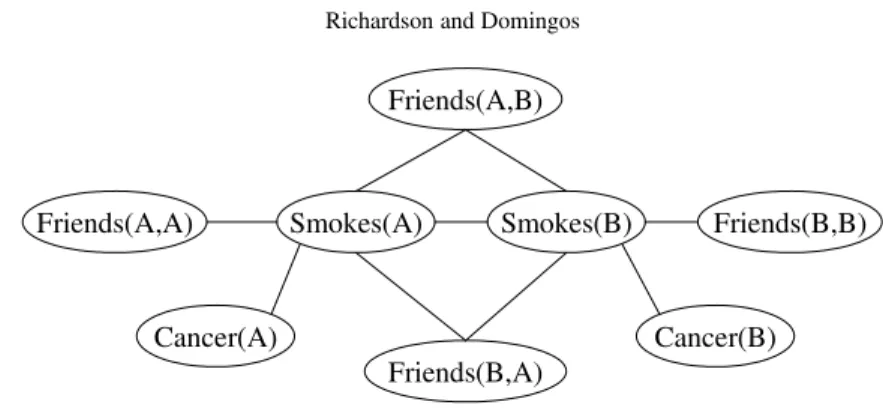
in each ground formula form a (not necessarily maximal) clique in ML,C. Figure 1 shows the graph of the ground Markov network defined by the last two formulas in Table I and the constants Anna andBob. Each node in this graph is a ground atom (e.g., Friends(Anna,Bob)). The graph contains an
arc between each pair of atoms that appear together in some grounding of one of the formulas.ML,Ccan now be used to infer the probability that Anna and Bob are friends given their smoking habits, the probability that Bob has cancer given his friendship with Anna and whether she has cancer, etc.
Each state ofML,C represents a possible world. A possible world is a set of objects, a set of functions (mappings from tuples of objects to objects), and a set of relations that hold between those objects; together with an inter-pretation, they determine the truth value of each ground atom. The following assumptions ensure that the set of possible worlds for(L, C)is finite, and that
ML,C represents a unique, well-defined probability distribution over those worlds, irrespective of the interpretation and domain. These assumptions are quite reasonable in most practical applications, and greatly simplify the use of MLNs. For the remaining cases, we discuss below the extent to which each one can be relaxed.
Cancer(A) Smokes(A) Friends(A,A) Friends(B,A) Smokes(B) Friends(A,B) Cancer(B) Friends(B,B)
Figure 1. Ground Markov network obtained by applying the last two formulas in Table I to the constantsAnna(A)andBob(B).
ASSUMPTION 1. Unique names.Different constants refer to different ob-jects (Genesereth & Nilsson, 1987).
ASSUMPTION 2. Domain closure. The only objects in the domain are those representable using the constant and function symbols in(L, C)
(Gene-sereth & Nilsson, 1987).
ASSUMPTION 3. Known functions.For each function appearing inL, the
value of that function applied to every possible tuple of arguments is known, and is an element ofC.
This last assumption allows us to replace functions by their values when grounding formulas. Thus the only ground atoms that need to be considered are those having constants as arguments. The infinite number of terms con-structible from all functions and constants in(L, C)(the “Herbrand universe”
of (L, C)) can be ignored, because each of those terms corresponds to a
known constant in C, and atoms involving them are already represented as
the atoms involving the corresponding constants. The possible groundings of a predicate in Definition 4.1 are thus obtained simply by replacing each variable in the predicate with each constant inC, and replacing each function
term in the predicate by the corresponding constant. Table II shows how the groundings of a formula are obtained given Assumptions 1–3. If a for-mula contains more than one clause, its weight is divided equally among the clauses, and a clause’s weight is assigned to each of its groundings.
Assumption 1 (unique names) can be removed by introducing the equality predicate (Equals(x,y), orx=yfor short) and adding the necessary axioms to the MLN: equality is reflexive, symmetric and transitive; for each unary predicate P,∀x∀y x=y ⇒ (P(x) ⇔ P(y)); and similarly for higher-order
predicates and functions (Genesereth & Nilsson, 1987). The resulting MLN will have a node for each pair of constants, whose value is 1 if the constants represent the same object and 0 otherwise; these nodes will be connected to
Table II. Construction of all groundings of a first-order formula under Assumptions 1–3.
functionGround(F,C)
inputs:F, a formula in first-order logic C, a set of constants
output:GF, a set of ground formulas
calls:CN F(F, C), which convertsFto conjunctive normal form, replacing
existentially quantified formulas by disjunctions of their groundings overC F←CN F(F, C)
GF =∅
for eachclauseFj ∈F Gj ={Fj}
for eachvariablexinFj for eachclauseFk(x)∈Gj
Gj ←(Gj\Fk(x))∪ {Fk(c1), Fk(c2), . . . , Fk(c|C|)}, whereFk(ci)isFk(x)withxreplaced byci∈C GF ←GF∪Gj
for eachground clauseFj ∈GF repeat
for eachfunctionf(a1, a2, . . .)all of whose arguments are constants
Fj ←Fjwithf(a1, a2, . . .)replaced byc, wherec=f(a1, a2, . . .)
untilFj contains no functions returnGF
each other and to the rest of the network by arcs representing the axioms above. Notice that this allows us to make probabilistic inferences about the equality of two constants. We have successfully used this as the basis of an approach to object identification (see Subsection 8.5).
If the number u of unknown objects is known, Assumption 2 (domain
closure) can be removed simply by introducinguarbitrary new constants. If uis unknown but finite, Assumption 2 can be removed by introducing a
distri-bution overu, grounding the MLN with each number of unknown objects, and
computing the probability of a formulaF asP(F) =Pumax
u=0 P(u)P(F|ML,Cu ), where Mu
L,C is the ground MLN with u unknown objects. An infinite u requires extending MLNs to the case|C|=∞.
LetHL,C be the set of all ground terms constructible from the function symbols in L and the constants in L and C (the “Herbrand universe” of
(L, C)). Assumption 3 (known functions) can be removed by treating each
element ofHL,C as an additional constant and applying the same procedure used to remove the unique names assumption. For example, with a function G(x)and constantsAandB, the MLN will now contain nodes forG(A) =A, G(A) =B, etc. This leads to an infinite number of new constants, requiring the corresponding extension of MLNs. However, if we restrict the level of nesting to some maximum, the resulting MLN is still finite.
To summarize, Assumptions 1–3 can be removed as long the domain is finite. We believe it is possible to extend MLNs to infinite domains (see Jaeger (1998)), but this is an issue of chiefly theoretical interest, and we leave it for future work. In the remainder of this paper we proceed under Assumptions 1– 3, except where noted.
A first-order KB can be transformed into an MLN simply by assigning a weight to each formula. For example, the clauses and weights in the last two columns of Table I constitute an MLN. According to this MLN, other things being equal, a world where n friendless people are non-smokers is e(2.3)n times less probable than a world where all friendless people smoke. Notice that all the formulas in Table I are false in the real world as universally quan-tified logical statements, but capture useful information on friendships and smoking habits, when viewed as features of a Markov network. For example, it is well known that teenage friends tend to have similar smoking habits (Lloyd-Richardson et al., 2002). In fact, an MLN like the one in Table I succinctly represents a type of model that is a staple of social network analysis (Wasserman & Faust, 1994).
It is easy to see that MLNs subsume essentially all propositional proba-bilistic models, as detailed below.
PROPOSITION 4.2. Every probability distribution over discrete or finite-precision numeric variables can be represented as a Markov logic network.
Proof.Consider first the case of Boolean variables(X1, X2, . . . , Xn). Define a predicate of zero arity Rh for each variable Xh, and include in the MLN
L a formula for each possible state of(X1, X2, . . . , Xn). This formula is a conjunction of nliterals, with the hth literal beingRh()ifXh is true in the state, and¬Rh()otherwise. The formula’s weight islogP(X1, X2, . . . , Xn). (If some states have zero probability, use instead the product form (see Equa-tion 3), withφi()equal to the probability of theith state.) Since all predicates inLhave zero arity,Ldefines the same Markov networkML,C irrespective of C, with one node for each variableXh. For any state, the corresponding formula is true and all others are false, and thus Equation 3 represents the original distribution (notice that Z = 1). The generalization to arbitrary
discrete variables is straightforward, by defining a zero-arity predicate for each value of each variable. Similarly for finite-precision numeric variables, by noting that they can be represented as Boolean vectors. 2
Of course, compact factored models like Markov networks and Bayesian networks can still be represented compactly by MLNs, by defining formulas
for the corresponding factors (arbitrary features in Markov networks, and states of a node and its parents in Bayesian networks).2
First-order logic (with Assumptions 1–3 above) is the special case of MLNs obtained when all weights are equal and tend to infinity, as described below.
PROPOSITION 4.3. LetKBbe a satisfiable knowledge base,Lbe the MLN
obtained by assigning weight w to every formula in KB, C be the set of
constants appearing inKB,Pw(x)be the probability assigned to a (set of)
possible world(s)xbyML,C,XKBbe the set of worlds that satisfyKB, and
F be an arbitrary formula in first-order logic. Then:
1. ∀x∈ XKB limw→∞Pw(x) =|XKB|−1 ∀x6∈ XKB limw→∞Pw(x) = 0
2. For allF,KB|=F iff limw→∞Pw(F) = 1.
Proof. Letk be the number of ground formulas inML,C. By Equation 3, if
x ∈ XKB thenPw(x) =ekw/Z, and ifx6∈ XKB thenPw(x)≤e(k−1)w/Z. Thus allx∈ XKB are equiprobable andlimw→∞P(X \ XKB)/P(XKB)≤
limw→∞(|X \XKB|/|XKB|)e−w = 0, proving Part 1. By definition of entail-ment,KB|=F iff every world that satisfiesKBalso satisfiesF. Therefore,
letting XF be the set of worlds that satisfyF, ifKB |=F thenXKB ⊆ XF and Pw(F) = Px∈XF Pw(x) ≥ Pw(XKB). Since, from Part 1, limw→∞
Pw(XKB) = 1, this implies that ifKB|=F thenlimw→∞Pw(F) = 1. The inverse direction of Part 2 is proved by noting that if limw→∞Pw(F) = 1 then every world with non-zero probability in the limit must satisfy F, and
this includes every world inXKB. 2
In other words, in the limit of all equal infinite weights, the MLN rep-resents a uniform distribution over the worlds that satisfy the KB, and all entailment queries can be answered by computing the probability of the query formula and checking whether it is 1. Even when weights are finite, first-order logic is “embedded” in MLNs in the following sense. Assume without loss of generality that all weights are non-negative. (A formula with a negative weightwcan be replaced by its negation with weight−w.) If the knowledge
base composed of the formulas in an MLN L (negated, if their weight is
negative) is satisfiable, then, for any C, the satisfying assignments are the
modes of the distribution represented byML,C. This is because the modes are the worldsxwith maximumP
iwini(x)(see Equation 3), and this expression is maximized when all groundings of all formulas are true (i.e., the KB is 2 While some conditional independence structures can be compactly represented with di-rected graphs but not with undidi-rected ones, they still lead to compact models in the form of Equation 3 (i.e., as products of potential functions).
satisfied). Unlike an ordinary first-order KB, however, an MLN can produce useful results even when it contains contradictions. An MLN can also be obtained by merging several KBs, even if they are partly incompatible. This is potentially useful in areas like the Semantic Web (Berners-Lee et al., 2001) and mass collaboration (Richardson & Domingos, 2003).
It is interesting to see a simple example of how MLNs generalize first-order logic. Consider an MLN containing the single formula ∀x R(x) ⇒ S(x) with weight w, and C = {A}. This leads to four possible worlds: {¬R(A),¬S(A)},{¬R(A),S(A)},{R(A),¬S(A)}, and{R(A),S(A)}. From Equa-tion 3 we obtain that P({R(A),¬S(A)}) = 1/(3ew + 1)and the probability of each of the other three worlds is ew/(3ew + 1). (The denominator is the partition functionZ; see Section 2.) Thus, ifw >0, the effect of the MLN is
to make the world that is inconsistent with ∀x R(x) ⇒ S(x)less likely than
the other three. From the probabilities above we obtain thatP(S(A)|R(A)) = 1/(1 +e−w). When w → ∞, P(S(A)|R(A)) → 1, recovering the logical entailment.
In practice, we have found it useful to add each predicate to the MLN as a unit clause. In other words, for each predicate R(x1, x2, . . .)appearing in the MLN, we add the formula ∀x1, x2, . . . R(x1, x2, . . .)with some weight
wR. The weight of a unit clause can (roughly speaking) capture the marginal distribution of the corresponding predicate, leaving the weights of the non-unit clauses free to model only dependencies between predicates.
When manually constructing an MLN or interpreting a learned one, it is useful to have an intuitive understanding of the weights. The weight of a formula F is simply the log odds between a world where F is true and
a world where F is false, other things being equal. However, if F shares
variables with other formulas, as will typically be the case, it may not be possible to keep those formulas’s truth values unchanged while reversing
F’s. In this case there is no longer a one-to-one correspondence between
weights and probabilities of formulas.3Nevertheless, the probabilities of all formulas collectively determine all weights, if we view them as constraints on a maximum entropy distribution, or treat them as empirical probabilities and learn the maximum likelihood weights (the two are equivalent) (Della Pietra et al., 1997). Thus a good way to set the weights of an MLN is to write down the probability with which each formula should hold, treat these as empirical frequencies, and learn the weights from them using the algorithm in Section 6. Conversely, the weights in a learned MLN can be viewed as collectively encoding the empirical formula probabilities.
3 This is an unavoidable side-effect of the power and flexibility of Markov networks. In Bayesian networks, parameters are probabilities, but at the cost of greatly restricting the ways in which the distribution may be factored. In particular, potential functions must be conditional probabilities, and the directed graph must have no cycles. The latter condition is particularly troublesome to enforce in relational extensions (Taskar et al., 2002).
The size of ground Markov networks can be vastly reduced by having typed constants and variables, and only grounding variables to constants of the same type. However, even in this case the size of the network may be extremely large. Fortunately, many inferences do not require grounding the entire network, as we see in the next section.
5. Inference
MLNs can answer arbitrary queries of the form “What is the probability that formulaF1holds given that formulaF2does?” IfF1andF2are two formulas in first-order logic, Cis a finite set of constants including any constants that
appear inF1 orF2, andLis an MLN, then
P(F1|F2, L, C) = P(F1|F2, ML,C) = P(F1∧F2|ML,C) P(F2|ML,C) = P x∈XF1∩XF2 P(X=x|ML,C) P x∈XF2P(X=x|ML,C) (4) whereXFi is the set of worlds whereFi holds, andP(x|ML,C) is given by Equation 3. Ordinary conditional queries in graphical models are the spe-cial case of Equation 4 where all predicates in F1, F2 and Lare zero-arity and the formulas are conjunctions. The question of whether a knowledge base KBentails a formulaF in first-order logic is the question of whether P(F|LKB, CKB,F) = 1, where LKB is the MLN obtained by assigning infinite weight to all the formulas inKB, andCKB,F is the set of all constants appearing inKBorF. The question is answered by computingP(F|LKB,
CKB,F)by Equation 4, withF2 =True.
Computing Equation 4 directly will be intractable in all but the smallest domains. Since MLN inference subsumes probabilistic inference, which is #P-complete, and logical inference, which is NP-complete even in finite do-mains, no better results can be expected. However, many of the large number of techniques for efficient inference in either case are applicable to MLNs. Because MLNs allow fine-grained encoding of knowledge, including context-specific independences, inference in them may in some cases be more effi-cient than inference in an ordinary graphical model for the same domain. On the logic side, the probabilistic semantics of MLNs facilitates approximate inference, with the corresponding potential gains in efficiency.
In principle,P(F1|F2, L, C)can be approximated using an MCMC algo-rithm that rejects all moves to states where F2does not hold, and counts the number of samples in whichF1 holds. However, even this is likely to be too
Table III. Network construction for inference in MLNs.
functionConstructNetwork(F1, F2, L, C)
inputs:F1, a set of ground atoms with unknown truth values (the “query”) F2, a set of ground atoms with known truth values (the “evidence”) L, a Markov logic network
C, a set of constants
output:M, a ground Markov network
calls:M B(q), the Markov blanket ofqinML,C G←F1 whileF16=∅ for allq∈F1 ifq6∈F2 F1←F1∪(M B(q)\G) G←G∪M B(q) F1←F1\ {q}
returnM, the ground Markov network composed of all nodes inG, all arcs between them
inML,C, and the features and weights on the corresponding cliques
slow for arbitrary formulas. Instead, we provide an inference algorithm for the case whereF1 andF2are conjunctions of ground literals. While less general than Equation 4, this is the most frequent type of query in practice, and the algorithm we provide answers it far more efficiently than a direct applica-tion of Equaapplica-tion 4. Investigating lifted inference (where queries containing variables are answered without grounding them) is an important direction for future work (see Jaeger (2000) and Poole (2003) for initial results). The algorithm proceeds in two phases, analogous to knowledge-based model con-struction (Wellman et al., 1992). The first phase returns the minimal subset
M of the ground Markov network required to computeP(F1|F2, L, C). The algorithm for this is shown in Table III. The size of the network returned may be further reduced, and the algorithm sped up, by noticing that any ground formula which is made true by the evidence can be ignored, and the corresponding arcs removed from the network. In the worst case, the network containsO(|C|a)nodes, whereais the largest predicate arity in the domain, but in practice it may be much smaller.
The second phase performs inference on this network, with the nodes in
F2 set to their values in F2. Our implementation uses Gibbs sampling, but any inference method may be employed. The basic Gibbs step consists of sampling one ground atom given its Markov blanket. The Markov blanket of a ground atom is the set of ground atoms that appear in some grounding of a formula with it. The probability of a ground atomXlwhen its Markov blanketBlis in stateblis
P(Xl=xl|Bl=bl) (5) = exp( P fi∈Flwifi(Xl=xl, Bl=bl)) exp(P fi∈Flwifi(Xl= 0, Bl=bl)) + exp( P fi∈Flwifi(Xl= 1, Bl=bl)) where Fl is the set of ground formulas that Xl appears in, and fi(Xl =
xl, Bl = bl) is the value (0 or 1) of the feature corresponding to the ith ground formula when Xl = xl and Bl = bl. For sets of atoms of which exactly one is true in any given world (e.g., the possible values of an attribute), blocking can be used (i.e., one atom is set to true and the others to false in one step, by sampling conditioned on their collective Markov blanket). The estimated probability of a conjunction of ground literals is simply the fraction of samples in which the ground literals are true, after the Markov chain has converged. Because the distribution is likely to have many modes, we run the Markov chain multiple times. When the MLN is in clausal form, we minimize burn-in time by starting each run from a mode found using MaxWalkSat, a local search algorithm for the weighted satisfiability problem (i.e., finding a truth assignment that maximizes the sum of weights of satisfied clauses) (Kautz et al., 1997). When there are hard constraints (clauses with infinite weight), MaxWalkSat finds regions that satisfy them, and the Gibbs sampler then samples from these regions to obtain probability estimates.
6. Learning
We learn MLN weights from one or more relational databases. (For brevity, the treatment below is for one database, but the generalization to many is triv-ial.) We make a closed world assumption (Genesereth & Nilsson, 1987): if a ground atom is not in the database, it is assumed to be false. If there aren
pos-sible ground atoms, a database is effectively a vectorx= (x1, . . . , xl, . . . , xn) wherexlis the truth value of thelth ground atom (xl= 1if the atom appears in the database, andxl = 0otherwise). Given a database, MLN weights can in principle be learned using standard methods, as follows. If theith formula
hasni(x)true groundings in the datax, then by Equation 3 the derivative of the log-likelihood with respect to its weight is
∂ ∂wi logPw(X=x) =ni(x)− X x0 Pw(X=x0)ni(x0) (6) where the sum is over all possible databasesx0, andP
w(X=x0)isP(X=x0) computed using the current weight vector w = (w1, . . . , wi, . . .). In other words, theith component of the gradient is simply the difference between the
according to the current model. Unfortunately, counting the number of true groundings of a formula in a database is intractable, even when the formula is a single clause, as stated in the following proposition (due to Dan Suciu). PROPOSITION 6.1. Counting the number of true groundings of a first-order clause in a database is #P-complete in the length of the clause.
Proof. Counting satisfying assignments of propositional monotone 2-CNF is #P-complete (Roth, 1996). This problem can be reduced to counting the number of true groundings of a first-order clause in a database as follows. Consider a database composed of the ground atoms R(0,1), R(1,0) and
R(1,1). Given a monotone 2-CNF formula, construct a formula Φthat is a
conjunction of predicates of the formR(xi, xj), one for each disjunctxi∨xj appearing in the CNF formula. (For example,(x1∨x2)∧(x3∨x4)would yield
R(x1, x2)∧R(x3, x4).) There is a one-to-one correspondence between the satisfying assignments of the 2-CNF and the true groundings ofΦ. The latter
are the false groundings of the clause formed by disjoining the negations of all the R(xi, xj), and thus can be counted by counting the number of true groundings of this clause and subtracting it from the total number of groundings. 2
In large domains, the number of true groundings of a formula may be counted approximately, by uniformly sampling groundings of the formula and checking whether they are true in the data. In smaller domains, and in our experiments below, we use an efficient recursive algorithm to find the exact count.
A second problem with Equation 6 is that computing the expected number of true groundings is also intractable, requiring inference over the model. Fur-ther, efficient optimization methods also require computing the log-likelihood itself (Equation 3), and thus the partition function Z. This can be done
ap-proximately using a Monte Carlo maximum likelihood estimator (MC-MLE) (Geyer & Thompson, 1992). However, in our experiments the Gibbs sampling used to compute the MC-MLEs and gradients did not converge in reasonable time, and using the samples from the unconverged chains yielded poor results. A more efficient alternative, widely used in areas like spatial statistics, social network modeling and language processing, is to optimize instead the pseudo-likelihood (Besag, 1975) Pw∗(X=x) = n Y l=1 Pw(Xl=xl|M Bx(Xl)) (7) where M Bx(Xl) is the state of the Markov blanket of Xl in the data. The gradient of the pseudo-log-likelihood is
∂ ∂wi logPw∗(X=x) = n X l=1 [ni(x)−Pw(Xl= 0|M Bx(Xl))ni(x[Xl=0]) −Pw(Xl= 1|M Bx(Xl))ni(x[Xl=1])] (8) whereni(x[Xl=0]) is the number of true groundings of theith formula when we force Xl = 0 and leave the remaining data unchanged, and similarly for ni(x[Xl=1]). Computing this expression (or Equation 7) does not require inference over the model. We optimize the pseudo-log-likelihood using the limited-memory BFGS algorithm (Liu & Nocedal, 1989). The computation can be made more efficient in several ways:
− The sum in Equation 8 can be greatly sped up by ignoring predicates that do not appear in theith formula.
− The counts ni(x), ni(x[Xl=0]) and ni(x[Xl=1]) do not change with the weights, and need only be computed once (as opposed to in every itera-tion of BFGS).
− Ground formulas whose truth value is unaffected by changing the truth value of any single literal may be ignored, since thenni(x) =ni(x[Xl=0])
=ni(x[Xl=1]). In particular, this holds for any clause which contains at least two true literals. This can often be the great majority of ground clauses.
To combat overfitting, we penalize the pseudo-likelihood with a Gaussian prior on each weight.
Inductive logic programming (ILP) techniques can be used to learn addi-tional clauses, refine the ones already in the MLN, or learn an MLN from scratch. We use the CLAUDIEN system for this purpose (De Raedt & De-haspe, 1997). Unlike most other ILP systems, which learn only Horn clauses, CLAUDIEN is able to learn arbitrary first-order clauses, making it well suited to MLNs. Also, by constructing a particular language bias, we are able to di-rect CLAUDIEN to search for refinements of the MLN structure. In the future we plan to more fully integrate structure learning into MLNs, by generalizing techniques like Della Pietra et al.’s (1997) to the first-order realm, as done by MACCENT for classification problems (Dehaspe, 1997).
7. Experiments
We tested MLNs using a database describing the Department of Computer Science and Engineering at the University of Washington (UW-CSE). The
domain consists of 12 predicates and 2707 constants divided into 10 types. Types include: publication (342 constants), person (442), course (176), project (153), academic quarter (20), etc. Predicates include: Professor(person), Student(person), Area(x,area) (with x ranging over publications, per-sons, courses and projects),AuthorOf(publication,person),AdvisedBy (person,person), YearsInProgram(person,years), CourseLevel (course,level), TaughtBy(course,person,quarter), TeachingAssi -stant(course,person,quarter), etc. Additionally, there are 10 equality
predicates:SamePerson(person,person),SameCourse(course,course), etc. which always have known, fixed values that are true iff the two arguments are the same constant.
Using typed variables, the total number of possible ground atoms (n in
Section 6) was 4,106,841. The database contained a total of 3380 tuples (i.e., there were 3380 true ground atoms). We obtained this database by scrap-ing pages in the department’s Web site (www.cs.washscrap-ington.edu). Publica-tions and AuthorOf relations were obtained by extracting from the Bib-Serv database (www.bibserv.org) all records with author fields containing the names of at least two department members (in the form “last name, first name” or “last name, first initial”).
We obtained a knowledge base by asking four volunteers to each provide a set of formulas in first-order logic describing the domain. (The volunteers were not shown the database of tuples, but were members of the department who thus had a general understanding about it.) Merging these yielded a KB of 96 formulas. The complete KB, volunteer instructions, database, and algo-rithm parameter settings are online at http://www.cs.washington.edu/ai/mln. Formulas in the KB include statements like: students are not professors; each student has at most one advisor; if a student is an author of a paper, so is her advisor; advanced students only TA courses taught by their advisors; at most one author of a given publication is a professor; students in Phase I of the Ph.D. program have no advisor; etc. Notice that these statements are not always true, but are typically true.
For training and testing purposes, we divided the database into five sub-databases, one for each area: AI, graphics, programming languages, systems, and theory. Professors and courses were manually assigned to areas, and other constants were iteratively assigned to the most frequent area among other constants they appeared in some tuple with. Each tuple was then assigned to the area of the constants in it. Tuples involving constants of more than one area were discarded, to avoid train-test contamination. The sub-databases contained, on average, 521 true ground atoms out of a possible 58457.
We performed leave-one-out testing by area, testing on each area in turn using the model trained from the remaining four. The test task was to predict theAdvisedBy(x,y)predicate given (a) all others (All Info) and (b) all
measured the average conditional log-likelihood of all possible groundings of AdvisedBy(x,y)over all areas, drew precision/recall curves, and computed
the area under the curve. This task is an instance of link prediction, a problem that has been the object of much interest in statistical relational learning (see Section 8). All KBs were converted to clausal form. Timing results are on a 2.8Ghz Pentium 4 machine.
7.1. SYSTEMS
In order to evaluate MLNs, which use logic and probability for inference, we wished to compare with methods that use only logic or only probability. We were also interested in automatic induction of clauses using ILP techniques. This subsection gives details of the comparison systems used.
7.1.1. Logic
One important question we aimed to answer with the experiments is whether adding probability to a logical knowledge base improves its ability to model the domain. Doing this requires observing the results of answering queries using only logical inference, but this is complicated by the fact that computing log-likelihood and the area under the precision/recall curve requires real-valued probabilities, or at least some measure of “confidence” in the truth of each ground atom being tested. We thus used the following approach. For a given knowledge baseKBand set of evidence atomsE, letXKB∪E be the set of worlds that satisfyKB∪E. The probability of a query atomqis then
defined asP(q) = |XKB∪E∪q|
|XKB∪E| , the fraction ofXKB∪E in whichqis true. A more serious problem arises if the KB is inconsistent (which was indeed the case with the KB we collected from volunteers). In this case the de-nominator ofP(q)is zero. (Also, recall that an inconsistent knowledge base
trivially entails any arbitrary formula). To address this, we redefineXKB∪Eto be the set of worlds which satisfies the maximum possible number of ground clauses. We use Gibbs sampling to sample from this set, with each chain initialized to a mode using WalkSat. At each Gibbs step, the step is taken with probability: 1 if the new state satisfies more clauses than the current one (since that means the current state should have 0 probability), 0.5 if the new state satisfies the same number of clauses (since the new and old state then have equal probability), and 0 if the new state satisfies fewer clauses. We then use only the states with maximum number of satisfied clauses to compute probabilities. Notice that this is equivalent to using an MLN built from the KB and with all equal infinite weights.
7.1.2. Probability
The other question we wanted to answer with these experiments is whether existing (propositional) probabilistic models are already powerful enough to be used in relational domains without the need for the additional represen-tational power provided by MLNs. In order to use such models, the domain must first be propositionalized by defining features that capture useful in-formation about it. Creating good attributes for propositional learners in this highly relational domain is a difficult problem. Nevertheless, as a tradeoff be-tween incorporating as much potentially relevant information as possible and avoiding extremely long feature vectors, we defined two sets of propositional attributes: order-1 and order-2. The former involves characteristics of indi-vidual constants in the query predicate, and the latter involves characteristics of relations between the constants in the query predicate.
For the order-1 attributes, we defined one variable for each (a, b) pair,
whereais an argument of the query predicate andbis an argument of some
predicate with the same value asa. The variable is the fraction of true
ground-ings of this predicate in the data. Some examples of first-order attributes for AdvisedBy(Matt,Pedro) are: whether Pedro is a student, the fraction of
publications that are published by Pedro, the fraction of courses for which Matt was a teaching assistant, etc.
The order-2 attributes were defined as follows: for a given (ground) query predicate Q(q1,q2, . . . ,qk), consider all sets of k predicates and all
assign-ments of constants q1, q2, . . . , qk as arguments to thek predicates, with ex-actly one constant per predicate (in any order). For instance, ifQisAdvised -By(Matt,Pedro)then one such possible set would be{TeachingAssistant ( ,Matt, ),TaughtBy( ,Pedro, )}. This forms2kattributes of the example, each corresponding to a particular truth assignment to thek predicates. The
value of an attribute is the number of times, in the training data, the set of predicates have that particular truth assignment, when their unassigned ar-guments are all filled with the same constants. For example, consider filling the above empty arguments with “CSE546” and “Autumn0304”. The resulting set, {TeachingAssistant(CSE546,Matt,Autumn0304),TaughtBy (CSE546,Pedro,Autumn0304)} has some truth assignment in the training data (e.g., {True,True}, {True,False}, . . .). One attribute is the number of
such sets of constants that create the truth assignment {True,True}, another for{True,False}and so on. Some examples of second-order attributes gener-ated for the queryAdvisedBy(Matt,Pedro)are: how oftenMattis a teach-ing assistant for a course that Pedrotaught (as well as how often he is not), how many publicationsPedroandMatthave coauthored, etc.
The resulting 28 order-1 attributes and 120 order-2 attributes (for the All Info case) were discretized into five equal-frequency bins (based on the train-ing set). We used two propositional learners: Naive Bayes (Domtrain-ingos & Paz-zani, 1997) and Bayesian networks (Heckerman et al., 1995) with structure
and parameters learned using the VFBN2 algorithm (Hulten & Domingos, 2002) with a maximum of four parents per node. The order-2 attributes helped the naive Bayes classifier but hurt the performance of the Bayesian network classifier, so below we report results using the order-1 and order-2 attributes for naive Bayes, and only the order-1 attributes for Bayesian networks. 7.1.3. Inductive logic programming
Our original knowledge base was acquired from volunteers, but we were also interested in whether it could have been developed automatically using induc-tive logic programming methods. As mentioned earlier, we used CLAUDIEN to induce a knowledge base from data. CLAUDIEN was run with: local scope; minimum accuracy of 0.1; minimum coverage of on; maximum complexity of 10; and breadth-first search. CLAUDIEN’s search space is defined by its language bias. We constructed a language bias which allowed: a maximum of three variables in a clause; unlimited predicates in a clause; up to two non-negated appearances of a predicate in a clause, and two negated ones; and use of knowledge of predicate argument types. To minimize search, the equality predicates (e.g., SamePerson) were not used in CLAUDIEN, and this improved its results.
Besides inducing clauses from the training data, we were also interested in using data to automatically refine the knowledge base provided by our volunteers. CLAUDIEN does not support this feature directly, but it can be emulated by an appropriately constructed language bias. We did this by, for each clause in the KB, allowing CLAUDIEN to (1) remove any number of the literals, (2) add up tovnew variables, and (3) add up tolnew literals. We
ran CLAUDIEN for 24 hours on a Sun-Blade 1000 for each (v, l)in the set {(1,2),(2,3),(3,4)}. All three gave nearly identical results; we report the results withv= 3andl= 4.
7.1.4. MLNs
Our results compare the above systems to Markov logic networks. The MLNs were trained using a Gaussian weight prior with zero mean and unit variance, and with the weights initialized at the mode of the prior (zero). For optimiza-tion, we used the Fortran implementation of L-BFGS from Zhu et al. (1997) and Byrd et al. (1995), leaving all parameters at their default values, and with a convergence criterion (ftol) of10−5. Inference was performed using Gibbs sampling as described in Section 5, with ten parallel Markov chains, each initialized to a mode of the distribution using MaxWalkSat. The number of Gibbs steps was determined using the criterion of DeGroot and Schervish (2002, pp. 707 and 740-741). Sampling continued until we reached a confi-dence of 95% that the probability estimate was within 1% of the true value in at least 95% of the nodes (ignoring nodes which are always true or false). A minimum of 1000 and maximum of 500,000 samples was used, with one
sample per complete Gibbs pass through the variables. Typically, inference converged within 5000 to 100,000 passes. The results were insensitive to variation in the convergence thresholds.
7.2. RESULTS
7.2.1. Training with MC-MLE
Our initial system used MC-MLE to train MLNs, with ten Gibbs chains, and each ground atom being initialized to true with the corresponding first-order predicate’s probability of being true in the data. Gibbs steps may be taken quite quickly by noting that few counts of satisfied clauses will change on any given step. On the UW-CSE domain, our implementation took 4-5 ms per step. We used the maximum across all predicates of the Gelman criterion R
(Gilks et al., 1996) to determine when the chains had reached their stationary distribution. In order to speed convergence, our Gibbs sampler preferentially samples atoms that were true in either the data or the initial state of the chain. The intuition behind this is that most atoms are always false, and sampling repeatedly from them is inefficient. This improved convergence by approxi-mately an order of magnitude over uniform selection of atoms. Despite these optimizations, the Gibbs sampler took a prohibitively long time to reach a reasonable convergence threshold (e.g., R = 1.01). After running for 24
hours (approximately 2 million Gibbs steps per chain), the average Rvalue
across training sets was 3.04, with no one training set having reached an
R value less than 2 (other than briefly dipping to 1.5 in the early stages of
the process). Considering this must be done iteratively as L-BFGS searches for the minimum, we estimate it would take anywhere from 20 to 400 days to complete the training, even with a weak convergence threshold such as
R = 2.0. Experiments confirmed the poor quality of the models that resulted
if we ignored the convergence threshold and limited the training process to less than ten hours. With a better choice of initial state, approximate count-ing, and improved MCMC techniques such as the Swendsen-Wang algorithm (Edwards & Sokal, 1988), MC-MLE may become practical, but it is not a viable option for training in the current version. (Notice that during learning MCMC is performed over the full ground network, which is too large to apply MaxWalkSat to.)
7.2.2. Training with pseudo-likelihood
In contrast to MC-MLE, pseudo-likelihood training was quite fast. As dis-cussed in Section 6, each iteration of training may be done quite quickly once the initial clause and ground atom satisfiability counts are complete. On average (over the five test sets), finding these counts took 2.5 minutes. From there, training took, on average, 255 iterations of L-BFGS, for a total of 16 minutes.
7.2.3. Inference
Inference was also quite quick. Inferring the probability of allAdvisedBy(x,y)
atoms in the All Info case took 3.3 minutes in the AI test set (4624 atoms), 24.4 in graphics (3721), 1.8 in programming languages (784), 10.4 in systems (5476), and 1.6 in theory (2704). The number of Gibbs passes ranged from 4270 to 500,000, and averaged 124,000. This amounts to 18 ms per Gibbs pass and approximately 200,000–500,000 Gibbs steps per second. The aver-age time to perform inference in the Partial Info case was 14.8 minutes (vs. 8.3 in the All Info case).
7.2.4. Comparison of systems
We compared twelve systems: the original KB (KB); CLAUDIEN (CL); CLAU-DIEN with the original KB as language bias (CLB); the union of the original KB and CLAUDIEN’s output in both cases (KB+CL and KB+CLB); an MLN with each of the above KBs (MLN(KB), MLN(CL), MLN(KB+CL), and MLN(KB+CLB)); naive Bayes (NB); and a Bayesian network learner (BN). Add-one smoothing of probabilities was used in all cases.
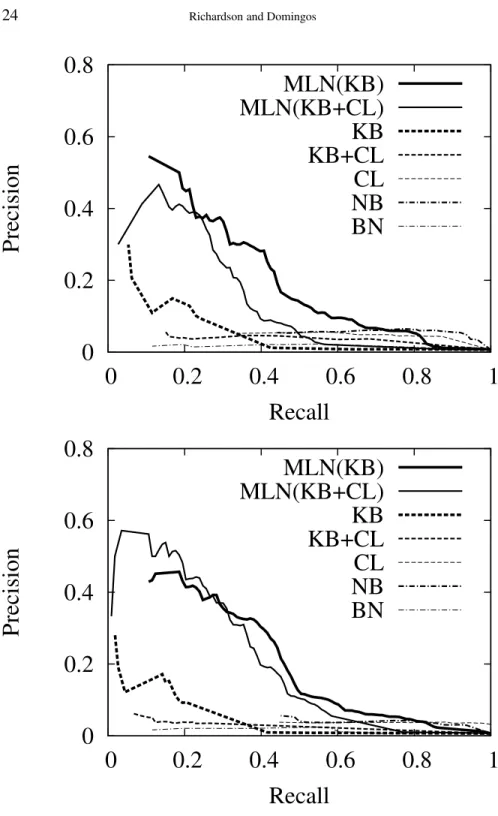
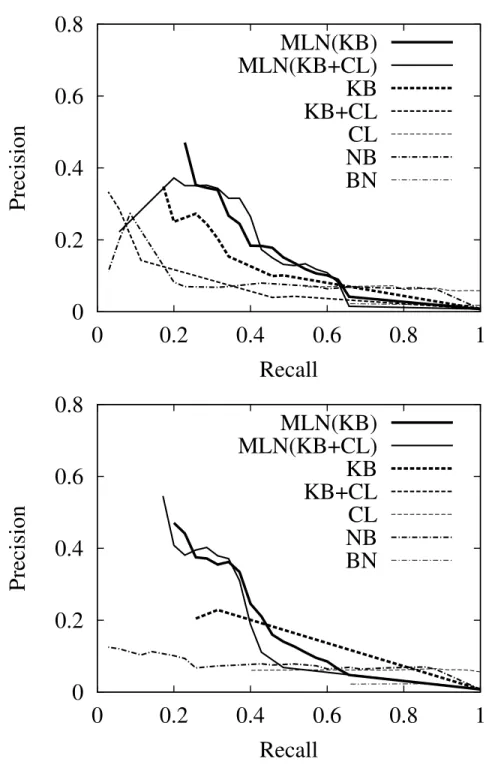
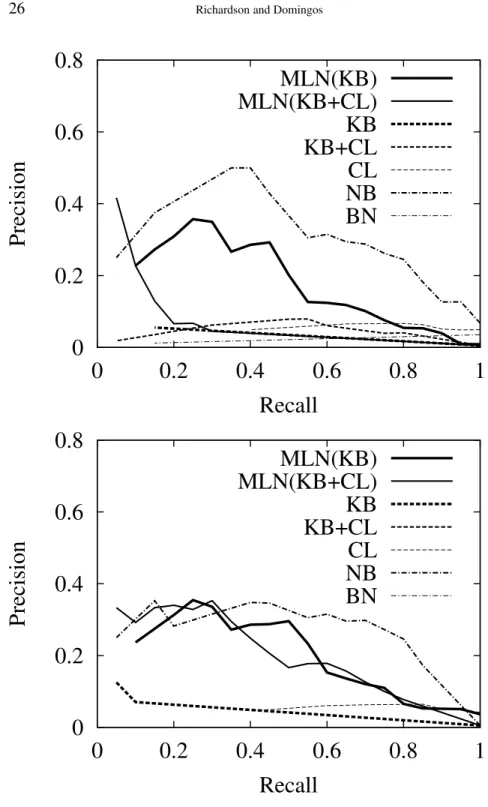
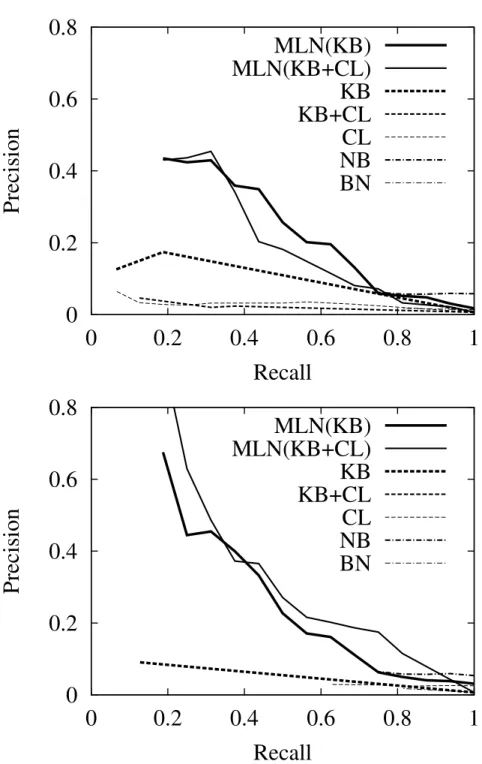
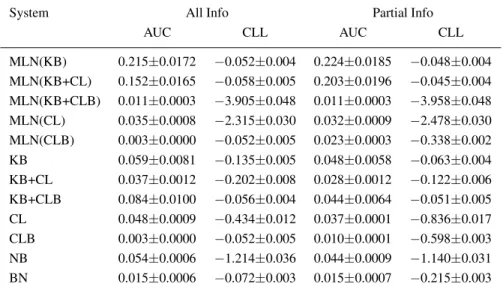
Table IV summarizes the results. Figure 2 shows precision/recall curves for all areas (i.e., averaged over allAdvisedBy(x,y)atoms), and Figures 3 to
7 show precision/recall curves for the five individual areas. MLNs are clearly more accurate than the alternatives, showing the promise of this approach. The purely logical and purely probabilistic methods often suffer when inter-mediate predicates have to be inferred, while MLNs are largely unaffected. Naive Bayes performs well in AUC in some test sets, but very poorly in oth-ers; its CLLs are uniformly poor. CLAUDIEN performs poorly on its own, and produces no improvement when added to the KB in the MLN. Using CLAUDIEN to refine the KB typically performs worse in AUC but better in CLL than using CLAUDIEN from scratch; overall, the best-performing logical method is KB+CLB, but its results fall well short of the best MLNs’. The general drop-off in precision around 50% recall is attributable to the fact that the database is very incomplete, and only allows identifying a minority of the AdvisedByrelations. Inspection reveals that the occasional smaller drop-offs in precision at very low recalls are due to students who graduated or changed advisors after co-authoring many publications with them.
8. Statistical Relational Learning Tasks
Many SRL tasks can be concisely formulated in the language of MLNs, al-lowing the algorithms introduced in this paper to be directly applied to them. In this section we exemplify this with five key tasks: collective classification, link prediction, link-based clustering, social network modeling, and object identification.
0
0.2
0.4
0.6
0.8
0
0.2
0.4
0.6
0.8
1
Precision
Recall
MLN(KB)
MLN(KB+CL)
KB
KB+CL
CL
NB
BN
0
0.2
0.4
0.6
0.8
0
0.2
0.4
0.6
0.8
1
Precision
Recall
MLN(KB)
MLN(KB+CL)
KB
KB+CL
CL
NB
BN
Figure 2. Precision and recall for all areas: All Info (upper graph) and Partial Info (lower graph).
0
0.2
0.4
0.6
0.8
0
0.2
0.4
0.6
0.8
1
Precision
Recall
MLN(KB)
MLN(KB+CL)
KB
KB+CL
CL
NB
BN
0
0.2
0.4
0.6
0.8
0
0.2
0.4
0.6
0.8
1
Precision
Recall
MLN(KB)
MLN(KB+CL)
KB
KB+CL
CL
NB
BN
Figure 3. Precision and recall for the AI area: All Info (upper graph) and Partial Info (lower graph).
0
0.2
0.4
0.6
0.8
0
0.2
0.4
0.6
0.8
1
Precision
Recall
MLN(KB)
MLN(KB+CL)
KB
KB+CL
CL
NB
BN
0
0.2
0.4
0.6
0.8
0
0.2
0.4
0.6
0.8
1
Precision
Recall
MLN(KB)
MLN(KB+CL)
KB
KB+CL
CL
NB
BN
Figure 4. Precision and recall for the graphics area: All Info (upper graph) and Partial Info (lower graph).
0
0.2
0.4
0.6
0.8
0
0.2
0.4
0.6
0.8
1
Precision
Recall
MLN(KB)
MLN(KB+CL)
KB
KB+CL
CL
NB
BN
0
0.2
0.4
0.6
0.8
0
0.2
0.4
0.6
0.8
1
Precision
Recall
MLN(KB)
MLN(KB+CL)
KB
KB+CL
CL
NB
BN
Figure 5. Precision and recall for the programming languages area: All Info (upper graph) and Partial Info (lower graph).
0
0.2
0.4
0.6
0.8
0
0.2
0.4
0.6
0.8
1
Precision
Recall
MLN(KB)
MLN(KB+CL)
KB
KB+CL
CL
NB
BN
0
0.2
0.4
0.6
0.8
0
0.2
0.4
0.6
0.8
1
Precision
Recall
MLN(KB)
MLN(KB+CL)
KB
KB+CL
CL
NB
BN
Figure 6. Precision and recall for the systems area: All Info (upper graph) and Partial Info (lower graph). The curves for naive Bayes are indistinguishable from the X axis.
0
0.2
0.4
0.6
0.8
0
0.2
0.4
0.6
0.8
1
Precision
Recall
MLN(KB)
MLN(KB+CL)
KB
KB+CL
CL
NB
BN
0
0.2
0.4
0.6
0.8
0
0.2
0.4
0.6
0.8
1
Precision
Recall
MLN(KB)
MLN(KB+CL)
KB
KB+CL
CL
NB
BN
Figure 7. Precision and recall for the theory area: All Info (upper graph) and Partial Info (lower graph).
Table IV. Experimental results for predictingAdvisedBy(x,y)when all other predicates are
known (All Info) and whenStudent(x)andProfessor(x)are unknown (Partial Info). CLL
is the average conditional log-likelihood, and AUC is the area under the precision-recall curve. The results are averages over all atoms in the five test sets and their standard deviations. (See http://www.cs.washington.edu/ai/mln for details on how the standard deviations of the AUCs were computed.)
System All Info Partial Info
AUC CLL AUC CLL MLN(KB) 0.215±0.0172 −0.052±0.004 0.224±0.0185 −0.048±0.004 MLN(KB+CL) 0.152±0.0165 −0.058±0.005 0.203±0.0196 −0.045±0.004 MLN(KB+CLB) 0.011±0.0003 −3.905±0.048 0.011±0.0003 −3.958±0.048 MLN(CL) 0.035±0.0008 −2.315±0.030 0.032±0.0009 −2.478±0.030 MLN(CLB) 0.003±0.0000 −0.052±0.005 0.023±0.0003 −0.338±0.002 KB 0.059±0.0081 −0.135±0.005 0.048±0.0058 −0.063±0.004 KB+CL 0.037±0.0012 −0.202±0.008 0.028±0.0012 −0.122±0.006 KB+CLB 0.084±0.0100 −0.056±0.004 0.044±0.0064 −0.051±0.005 CL 0.048±0.0009 −0.434±0.012 0.037±0.0001 −0.836±0.017 CLB 0.003±0.0000 −0.052±0.005 0.010±0.0001 −0.598±0.003 NB 0.054±0.0006 −1.214±0.036 0.044±0.0009 −1.140±0.031 BN 0.015±0.0006 −0.072±0.003 0.015±0.0007 −0.215±0.003 8.1. COLLECTIVE CLASSIFICATION
The goal of ordinary classification is to predict the class of an object given its attributes. Collective classification also takes into account the classes of related objects (e.g., Chakrabarti et al. (1998); Taskar et al. (2002); Neville and Jensen (2003)). Attributes can be represented in MLNs as predicates of the formA(x,v), whereAis an attribute,xis an object, andvis the value of Ainx. The class is a designated attributeC, representable byC(x,v), where visx’s class. Classification is now simply the problem of inferring the truth value ofC(x,v)for allxandvof interest given all knownA(x,v). Ordinary classification is the special case whereC(xi,v)andC(xj,v)are independent
for all xi and xj given the known A(x,v). In collective classification, the
Markov blanket ofC(xi,v)includes otherC(xj,v), even after conditioning on
the known A(x,v). Relations between objects are represented by predicates
of the form R(xi,xj). A number of interesting generalizations are readily
apparent, for exampleC(xi,v)andC(xj,v)may be indirectly dependent via
8.2. LINKPREDICTION
The goal of link prediction is to determine whether a relation exists between two objects of interest (e.g., whether Anna is Bob’s Ph.D. advisor) from the properties of those objects and possibly other known relations (e.g., Popescul and Ungar (2003)). The formulation of this problem in MLNs is identical to that of collective classification, with the only difference that the goal is now to infer the value ofR(xi,xj)for all object pairs of interest, instead ofC(x,v).
The task used in our experiments was an example of link prediction. 8.3. LINK-BASED CLUSTERING
The goal of clustering is to group together objects with similar attributes. In model-based clustering, we assume a generative modelP(X) = P
CP(C)
P(X|C), whereX is an object,C ranges over clusters, andP(C|X)isX’s
degree of membership in clusterC. In link-based clustering, objects are
clus-tered according to their links (e.g., objects that are more closely related are more likely to belong to the same cluster), and possibly according to their attributes as well (e.g., Flake et al. (2000)). This problem can be formulated in MLNs by postulating an unobserved predicateC(x,v)with the meaning “x belongs to cluster v,” and having formulas in the MLN involving this predi-cate and the observed ones (e.g.,R(xi,xj)for links andA(x,v)for attributes).
Link-based clustering can now be performed by learning the parameters of the MLN, and cluster memberships are given by the probabilities of the C(x,v) atoms conditioned on the observed ones.
8.4. SOCIALNETWORKMODELING
Social networks are graphs where nodes represent social actors (e.g., people) and arcs represent relations between them (e.g., friendship). Social network analysis (Wasserman & Faust, 1994) is concerned with building models re-lating actors’ properties and their links. For example, the probability of two actors forming a link may depend on the similarity of their attributes, and conversely two linked actors may be more likely to have certain properties. These models are typically Markov networks, and can be concisely repre-sented by formulas like∀x∀y∀v R(x,y)⇒(A(x,v)⇔A(y,v)), wherexand yare actors,R(x,y)is a relation between them,A(x,v)represents an attribute
of x, and the weight of the formula captures the strength of the correlation between the relation and the attribute similarity. For example, a model stating that friends tend to have similar smoking habits can be represented by the formula ∀x∀y Friends(x,y) ⇒ (Smokes(x) ⇔ Smokes(y)) (Table I). As
well as encompassing existing social network models, MLNs allow richer ones to be easily stated (e.g., by writing formulas involving multiple types
of relations and multiple attributes, as well as more complex dependencies between them).
8.5. OBJECT IDENTIFICATION
Object identification (also known as record linkage, de-duplication, and oth-ers) is the problem of determining which records in a database refer to the same real-world entity (e.g., which entries in a bibliographic database rep-resent the same publication) (Winkler, 1999). This problem is of crucial im-portance to many companies, government agencies, and large-scale scien-tific projects. One way to represent it in MLNs is by removing the unique names assumption as described in Section 4, i.e., by defining a predicate Equals(x,y)(orx=yfor short) with the meaning “xrepresents the same real-world entity as y.” This predicate is applied both to records and their fields (e.g., “ICML”=“Intl. Conf. on Mach. Learn.”). The dependencies
be-tween record matches and field matches can then be represented by formulas like ∀x∀y x=y⇔ fi(x) =fi(y), wherexandyare records andfi(x)is
a function returning the value of the ith field of record x. We have success-fully applied this approach to de-duplicating the Cora database of computer science papers (Parag & Domingos, 2004). Because it allows information to propagate from one match decision (i.e., one grounding ofx=y) to another via fields that appear in both pairs of records, it effectively performs collec-tive object identification, and in our experiments outperformed the traditional method of making each match decision independently of all others. For ex-ample, matching two references may allow us to determine that “ICML” and “MLC” represent the same conference, which in turn may help us to match another pair of references where one contains “ICML” and the other “MLC.” MLNs also allow additional information to be incorporated into a de-duplication system easily, modularly and uniformly. For example, transitive closure is incorporated by adding the formula ∀x∀y∀z x=y∧y=z ⇒ x=z, with a weight that can be learned from data.
9. Related Work
There is a very large literature relating logic and probability; here we will focus only on the approaches most relevant to statistical relational learning, and discuss how they relate to MLNs.
9.1. EARLYWORK
Attempts to combine logic and probability in AI date back to at least Nilsson (1986). Bacchus (1990), Halpern (1990) and coworkers (e.g., Bacchus et al. (1996)) studied the problem in detail from a theoretical standpoint. They
made a distinction between statistical statements (e.g., “65% of the students in our department are undergraduate”) and statements about possible worlds (e.g., “The probability that Anna is an undergraduate is 65%”), and provided methods for computing the latter from the former. In their approach, a KB did not specify a complete and unique distribution over possible worlds, requiring additional assumptions to obtain one. Bacchus et al. considered a number of alternatives, all of them quite restrictive (e.g., all worlds compatible with the KB should be equally likely). In contrast, by viewing KBs as Markov network templates, MLNs can represent arbitrary distributions over possible worlds.
Paskin (2002) extended the work of Bacchus et al. by associating a prob-ability with each first-order formula, and taking the maximum entropy dis-tribution compatible with those probabilities. This representation was still quite brittle, with a world that violates a single grounding of a universally quantified formula being considered as unlikely as a world that violates all of them. In contrast, in MLNs a rule like∀x Smokes(x) ⇒ Cancer(x)causes
the probability of a world to decrease gradually as the number of cancer-free smokers in it increases.
9.2. KNOWLEDGE-BASED MODELCONSTRUCTION
Knowledge-based model construction (KBMC) is a combination of logic pro-gramming and Bayesian networks (Wellman et al., 1992; Ngo & Haddawy, 1997; Kersting & De Raedt, 2001). As in MLNs, nodes in KBMC represent ground atoms. Given a Horn KB, KBMC answers a query by finding all possible backward-chaining proofs of the query and evidence atoms from each other, constructing a Bayesian network over all atoms in the proofs, and performing inference over this network. The parents of an atom in the network are deterministic AND nodes representing the bodies of the clauses that have that node as head. The conditional probability of the node given these is specified by a combination function (e.g., noisy OR, logistic regres-sion, arbitrary CPT). MLNs have several advantages compared to KBMC: they allow arbitrary formulas (not just Horn clauses) and inference in any direction, they sidestep the thorny problem of avoiding cycles in the Bayesian networks constructed by KBMC, and they do not require the introduction of ad hoccombination functions for clauses with the same consequent.
A KBMC model can be translated into an MLN by writing down a set of formulas for each first-order predicatePk(...)in the domain. Each formula is
a conjunction containing Pk(...) and one literal per parent of Pk(...) (i.e.,
per first-order predicate appearing in a Horn clause having Pk(...) as the
consequent). A subset of these literals are negated; there is one formula for each possible combination of positive and negative literals. The weight of the formula isw = log[p/(1−p)], wherepis the conditional probability of