ClearTK 2.0: Design Patterns for Machine Learning in UIMA
Steven Bethard
1, Philip Ogren
2, Lee Becker
21University of Alabama at Birmingham, Birmingham, AL, USA 2University of Colorado at Boulder, Boulder, CO, USA
[email protected],[email protected],[email protected]
Abstract
ClearTK adds machine learning functionality to the UIMA framework, providing wrappers to popular machine learning libraries, a rich feature extraction library that works across different classifiers, and utilities for applying and evaluating machine learning models. Since its inception in 2008, ClearTK has evolved in response to feedback from developers and the community. This evolution has followed a number of important design principles including: conceptually simple annotator interfaces, readable pipeline descriptions, minimal collection readers, type system agnostic code, modules organized for ease of import, and assisting user comprehension of the complex UIMA framework.
Keywords:NLP frameworks, machine learning, UIMA
1.
Introduction
The Unstructured Information Management Architecture (UIMA) framework for developing natural language pro-cessing pipelines has grown in popularity since it was open-sourced by IBM in 2005. More recently, UIMA has gained recognition as the underlying architecture of the IBM Wat-son system that defeated human champions in the game show Jeopardy! (Ferrucci et al., 2010). However, the frame-work only establishes an architecture for connecting NLP components and does not directly support constructing ma-chine learning classifiers based on sets of features.
The ClearTK framework1was introduced to address this gap
(Ogren et al., 2008; Ogren et al., 2009) by providing:
• A common interface and wrappers for popular machine learning libraries such as SVMlight, LIBSVM, LIB-LINEAR, OpenNLP MaxEnt, and Mallet.
• A rich feature extraction library that can be used with any of the machine learning classifiers. Under the cov-ers, ClearTK understands each of the native machine learning libraries and translates features into a format appropriate to whatever model is being used.
• Infrastructure for using and evaluating machine learn-ing classifiers within the UIMA framework.
Since its inception in 2008, ClearTK has been adopted by multiple developers worldwide in both academia and indus-try (including University of Colorado, Technische Univer-sit¨at Darmstadt, Apache cTAKES, Thomson Reuters, and 3M) and has been employed on diverse domains including clinical text, social media and student writing. ClearTK has been downloaded over 1700 times in just the past year, the project site receives over 100 new visits a month, and 78 developers have starred the project in Google Code. This growing user and developer base has provided a wealth of feedback that has led to a large number of changes. In this paper, we reflect on key lessons learned over the last 5 years, and how they generally inform the design of natural language processing frameworks.
1
http://www.cleartk.org/
2.
Annotators should be conceptually simple
A core aspect of UIMA is the Annotator, which provides aprocessmethod that inspects the document (aJCasin UIMA), performs analyses, and stores resulting annotations. This is a familiar construct, even to novice UIMA users, as there are analogs in other frameworks, e.g. Stanford CoreNLP’sCoreMap2 and GATE’s Document (Cunning-ham et al., 2011). Our experience suggests that annotators’ process methods should orchestrate the core analysis code in ways that are as straightforward and intuitive as possi-ble. ClearTK in previous iterations has suffered from over-abstraction of analysis code away from the process method – resulting in difficult to understand code.
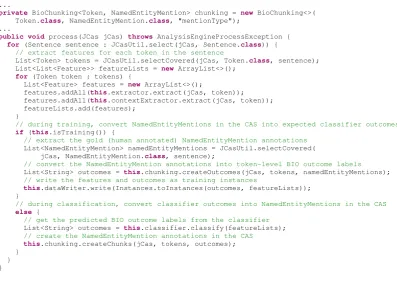
In the first versions of ClearTK, developers were required to write two separate annotators: one for writing training data and another for classification. In practice, the bulk of the code in both annotators shared the same feature ex-traction steps. Consequently, this overlapping functionality was structured to remove this redundancy. The first version of this abstraction used a call-back approach where users only had to implement the feature extraction code. However, users found the call-back style unintuitive as it diverged heavily from the UIMAprocess conventions. Thus we redesigned this abstraction intoClassifierAnnotator, which allows users to write their feature extraction code in the standardprocessmethod, but requires them to handle two cases: training mode and classification mode. An ex-ample of such an annotator is shown in Figure 1. Though the change toClassifierAnnotatorrequires additional coordination within a single annotator, it is conceptually simpler to learn.
We learned a similar lesson in designing an API for Begin-Inside-Outside (BIO) style chunking classifica-tion. The original approach consisted of a subtype of ClassifierAnnotator that abstracted away aspects of chunking, such as feature extraction and converting la-bels from token-based chunk-based and back, into separate classes that were dynamically loaded at instantiation time. In ClearTK 1.2 we replaced this architecture with a set of simple utility objects for converting between chunk labels
2
public class NamedEntityChunker extends CleartkSequenceAnnotator<String> { ...
private BioChunking<Token, NamedEntityMention> chunking = new BioChunking<>( Token.class, NamedEntityMention.class, "mentionType");
...
public void process(JCas jCas) throws AnalysisEngineProcessException {
for (Sentence sentence : JCasUtil.select(jCas, Sentence.class)) { // extract features for each token in the sentence
List<Token> tokens = JCasUtil.selectCovered(jCas, Token.class, sentence); List<List<Feature>> featureLists = new ArrayList<>();
for (Token token : tokens) {
List<Feature> features = new ArrayList<>();
features.addAll(this.extractor.extract(jCas, token)); features.addAll(this.contextExtractor.extract(jCas, token)); featureLists.add(features);
}
// during training, convert NamedEntityMentions in the CAS into expected classifier outcomes if (this.isTraining()) {
// extract the gold (human annotated) NamedEntityMention annotations List<NamedEntityMention> namedEntityMentions = JCasUtil.selectCovered(
jCas, NamedEntityMention.class, sentence);
// convert the NamedEntityMention annotations into token-level BIO outcome labels List<String> outcomes = this.chunking.createOutcomes(jCas, tokens, namedEntityMentions); // write the features and outcomes as training instances
this.dataWriter.write(Instances.toInstances(outcomes, featureLists));
}
// during classification, convert classifier outcomes into NamedEntityMentions in the CAS else {
// get the predicted BIO outcome labels from the classifier List<String> outcomes = this.classifier.classify(featureLists); // create the NamedEntityMention annotations in the CAS
this.chunking.createChunks(jCas, tokens, outcomes); }
} } }
Figure 1: Theprocessmethod of aCleartkAnnotatorfor BIO-chunking
and tokens labels, allowing for direct use of chunking within a standardprocessmethod (as shown in Figure 1) without need for specialized implementations of interfaces.
3.
Pipelines should look like pipelines
Once a user has developed a number of annotators, they typically string them together in apipeline, indicating the se-quence in which these annotators analyze a text. In ClearTK, users develop a variety of pipelines for different tasks such as training classifiers, making predictions with trained clas-sifiers, testing classifier predictions against a gold standard, etc. Our experience suggests that pipeline-based code should be structured to make it easy to quickly understand what annotators are running in what order.
Consider the case of model training and evaluation. ClearTK’s first abstraction separated evaluation into various classes and methods:
• The reader that loaded the training and testing data
• The preprocessing portion of a pipeline
• The classifier training portion of a pipeline
• The classifier prediction portion of a pipeline
• The evaluation portion of a pipeline
These items are easily separable and splitting them reduced code duplication. (For example, the preprocessing portion of the pipeline would be identical for training and testing). However, because each of these items was implemented in a different class or method, it was often difficult for a reader to understand the big picture of what exactly was running in
each pipeline. In ClearTK 1.2, we simplified this abstraction, resulting in a single evaluation class with just three methods that must be defined:
1. Read a subset of data with aCollectionReader
2. Train a model given aCollectionReader
3. Test a model given aCollectionReader
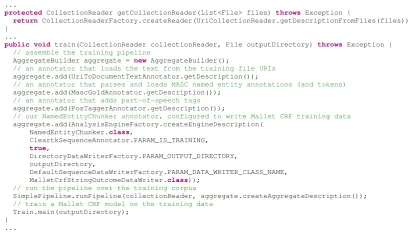
A partial example of such an evaluation class is shown in Figure 2. In exchange for some duplication (e.g. if training and testing used the same preprocessing) developers are rewarded with more interpretable, self-contained pictures of the training and testing pipelines.
Feature transformation (e.g. normalizing feature values to z-scores or scaling term counts by inverse document fre-quency) is another example of structuring concerns around pipelines. In early versions of ClearTK, these kinds of transformations required running a specialized pipeline sep-arately before the real pipeline to collect the sufficient statis-tics. This was confusing to users because (1) two pipelines were required for what was conceptually a single pipeline and (2) feature transformations conceptually happen after training data is written, not before. ClearTK 1.2 introduced TrainableFeatureExtractors where a user instead:
• Runs the original pipeline for writing training data. The TrainableFeatureExtractor will flag fea-tures that need additional post-processing.
public class EvaluateNamedEntityChunker extends
Evaluation_ImplBase<File, AnnotationStatistics<String>> {
...
protected CollectionReader getCollectionReader(List<File> files) throws Exception {
return CollectionReaderFactory.createReader(UriCollectionReader.getDescriptionFromFiles(files)); }
...
public void train(CollectionReader collectionReader, File outputDirectory) throwsException { // assemble the training pipeline
AggregateBuilder aggregate = new AggregateBuilder();
// an annotator that loads the text from the training file URIs aggregate.add(UriToDocumentTextAnnotator.getDescription());
// an annotator that parses and loads MASC named entity annotations (and tokens) aggregate.add(MascGoldAnnotator.getDescription());
// an annotator that adds part-of-speech tags aggregate.add(PosTaggerAnnotator.getDescription());
// our NamedEntityChunker annotator, configured to write Mallet CRF training data aggregate.add(AnalysisEngineFactory.createEngineDescription(
NamedEntityChunker.class,
CleartkSequenceAnnotator.PARAM_IS_TRAINING,
true,
DirectoryDataWriterFactory.PARAM_OUTPUT_DIRECTORY, outputDirectory,
DefaultSequenceDataWriterFactory.PARAM_DATA_WRITER_CLASS_NAME, MalletCrfStringOutcomeDataWriter.class));
// run the pipeline over the training corpus
SimplePipeline.runPipeline(collectionReader, aggregate.createAggregateDescription()); // train a Mallet CRF model on the training data
Train.main(outputDirectory); }
... }
Figure 2: ThegetCollectionReaderandtrainmethods of a ClearTK evaluation class
• Invokes the TrainableFeaturesExtractor’s train method on the serialized features to store sufficient statistics.
• Uses the original data writer on the transformed fea-tures to write out training data for a classifier.
We found that this approach aligned better with the concep-tual expectations of our users.
4.
Collection readers should be minimal
In UIMA, a CollectionReader is the connection be-tween the source (file, URL, etc.) and the UIMA docu-ment (JCas) object. Early versions of ClearTK used the CollectionReadermechanism to both read in the text and import various annotation formats (TreeBank, Prop-Bank, etc.).
However, as ClearTK developed support for importing more annotation formats, it became clear that this ap-proach was problematic. UIMA allows only a single CollectionReaderat the beginning of each pipeline, so you cannot, for example, have both aCollectionReader for TreeBank and one for TimeML in the same pipeline, even if both layers of annotation exist for your document. The solution to this problem is to view these TreeBank and TimeML readers not asCollectionReaders, but as regular UIMA annotators whoseprocess(JCas)method utilizes external resources (e.g. a.mrgor a.tmlfile) to produce annotations to be added to theJCas.
ClearTK now recommends only oneCollectionReader, URICollectionReader, which does nothing more than create aJCas containing the source’s Uniform Resource Identifier (URI). Reading the text or annotations over the text is the responsibility of subsequent annotators. This
approach to developing readers has several advantages, in-cluding more parallizable pipelines (which UIMA-AS can take advantage of) and added accessibility by leveraging users’ existing familiarity with UIMA annotators. Figure 2 shows an example usage ofURICollectionReader.
5.
Code should be type system agnostic
6.
Modules should match natural subsets
ClearTK provides many different types of utilities (machine learning wrappers, readers for various corpora, UIMA wrap-pers for non-UIMA components like MaltParser or Stanford CoreNLP, etc.) and so it has been necessary to split ClearTK up into a small number of modules to allow users to depend on only those parts of ClearTK that they need. In early ver-sions of ClearTK, we structured these based on the types of annotations being processed, e.g. code for reading PennTree-bank trees was put into the same module as our wrapper for OpenNLP’s parser. The idea was that if you were working on, say, parsing, you would want access to all the different parsing algorithms. However, we found that this approach did not scale. For example, very few users would want to in-clude all of OpenNLP, MaltParser, BerkeleyParser, Stanford CoreNLP, etc. just to read trees from a PennTreebank file. ClearTK 1.2 restructured the modules to match the natural subsets of ClearTK functionality:
• Type system agnostic machine learning libraries and feature extractors
• ClearTK’s version of a UIMA type system for NLP
• Feature extractors based on the ClearTK type system (e.g. paths through constituency trees)
• Readers for various corpora, based on the ClearTK type system
• Wrappers for non-UIMA components, based on the ClearTK type system
We have found that this structure better matches the concep-tual dependencies of ClearTK, and better enables ClearTK users to use only the parts they want.
7.
Users need help past the UIMA overhead
After the many improvements to ClearTK interfaces and usability over the years, we have now reached a point where much of the overhead of learning ClearTK is actually the overhead of learning UIMA. To understand the UIMA frame-work, you need to understand not just how to write an an-notator with aprocess(JCas)method – which is what is really at the heart of the framework – but also how to:
• Declare a type system that describes the annotations you want your annotator to create
• Configure your build system to generate Java classes from the type system
• Create code to read your training data intoJCasobjects
• Declare (using XML files or Java annotations) any pa-rameters needed to initialize your annotator
• Create anAnalysisEngineobject from your annota-tor and the initialization parameters
• etc.
These tasks are fairly easy for a UIMA expert, but are of-ten challenging and overwhelming for a new UIMA user. Thus, to get new potential users of ClearTK up to speed, we have found it helpful to have a UIMA expert put the above items together. Then, the new users can focus on the core problems that ClearTK is designed for: extracting features and using the classifier in theprocess(JCas)method of the annotator. We applied exactly this approach with new users of ClearTK, and successfully developed both a student response analysis system for SemEval-2013 (Okoye et al., 2013), and a relation extraction system for Apache cTAKES (Dligach et al., 2013).
8.
Discussion
The development of the ClearTK framework has revealed a number of key design patterns for NLP frameworks that can help new users to more quickly understand and adopt a framework. At their core, these patterns suggest aiming for intuitive interfaces that leverage existing user knowledge, and trying to minimize the number of conceptual dependen-cies between the various parts of the framework.
While the design patterns discussed here are driven by the specific needs of the ClearTK framework as it integrates machine learning into UIMA, we believe that these patterns could be generally useful across NLP frameworks such as Stanford CoreNLP, GATE and NLTK (Bird et al., 2009). For example, while Stanford CoreNLP does well from the perspective of having a simple annotator interface and en-couraging readable pipelines, it does not support type sys-tem agnostic code – all code using Stanford CoreNLP must translate to and from a fixed set of annotation types. Or, for example, while NLTK does well at arranging its modules to allow users to import only the parts of NLTK that they need, a lot of functionality is packaged into the corpus read-ers rather than providing generic corpus parsing annotators that can be easily combined. These are not serious flaws that would prevent the use of any of these frameworks, but are potential avenues for improvement as the frameworks themselves evolve.
9.
Acknowledgements
This research was supported in part by the Strategic Health IT Advanced Research Projects (SHARP) Program (90TR002) from the Office of the National Coordinator for Health Information Technology, and by Grant Number R01LM010090 from the National Library Of Medicine. The content is solely the responsibility of the authors and does not necessarily represent the official views of the Office of the National Coordinator for Health Information Tech-nology, the National Library Of Medicine or the National Institutes of Health.
10.
References
Bird, S., Klein, E., and Loper, E. (2009).Natural Language Processing with Python. O’Reilly Media.
Cunningham, H., Maynard, D., Bontcheva, K., Tablan, V., Aswani, N., Roberts, I., Gorrell, G., Funk, A., Roberts, A., Damljanovic, D., Heitz, T., Greenwood, M. A., Sag-gion, H., Petrak, J., Li, Y., and Peters, W. (2011). Text Processing with GATE (Version 6).
Dligach, D., Bethard, S., Becker, L., Miller, T., and Savova, G. K. (2013). Discovering body site and severity modi-fiers in clinical texts. Journal of the American Medical Informatics Association, pages amiajnl–2013.
Ferrucci, D., Brown, E., Chu-Carroll, J., Fan, J., Gondek, D., Kalyanpur, A. A., Lally, A., Murdock, J. W., Ny-berg, E., Prager, J., Schlaefer, N., and Welty, C. (2010). Building watson: An overview of the DeepQA project.
AI Magazine, 31(3):59–79, July.
Ogren, P. V., Wetzler, P. G., and Bethard, S. (2008). ClearTK: A UIMA toolkit for statistical natural language processing. InTowards Enhanced Interoperability for Large HLT Systems: UIMA for NLP workshop at Lan-guage Resources and Evaluation Conference (LREC), 5. Ogren, P. V., Wetzler, P. G., and Bethard, S. J. (2009). ClearTK: a framework for statistical natural language pro-cessing. InUnstructured Information Management Archi-tecture Workshop at the Conference of the German Society for Computational Linguistics and Language Technology, 9.