R E S E A R C H
Open Access
Molecular characterization and infectivity of a
Tomato leaf curl New Delhi virus
variant
associated with newly emerging yellow mosaic
disease of eggplant in India
Dharmendra Pratap
1, Ashwin R Kashikar
2and Sunil K Mukherjee
1*Abstract
Background:Begomoviruses have emerged as serious problem for vegetable and fiber crops in the recent past, frequently in tropical and subtropical region of the world. The association of begomovirus with eggplant yellow mosaic disease is hitherto unknown apart from one report from Thailand. A survey in Nagpur, Central India, in 2009-2010 showed severe incidence of eggplant yellow mosaic disease. Here, we have identified and characterized a begomovirus responsible for the newly emerging yellow mosaic disease of eggplant in India.
Results:The complete DNA-A and DNA-B genomic components of the causative virus were cloned and
sequenced. Nucleotide sequence analysis of DNA-A showed that it shared highest 97.6% identity withTomato leaf curl New Delhi virus-India[India:Udaipur:Okra:2007] and lowest 87.9% identity with Tomato leaf curl New Delhi virus -India[India:NewDelhi:Papaya:2005], while DNA-B showed highest 94.1% identity with ToLCNDV-IN[IN:UD:Ok:07] and lowest 76.2% identity with ToLCNDV-India[India:Lucknow]. Thus, it appears that this begomovirus is a variant of ubiquitous ToLCNDV and hence, we suggest the name ToLCNDV-India[India:Nagpur:Eggplant:2009] for this variant. The pathogenicity of ToLCNDV-IN[IN:Nag:Egg:09] isolate was confirmed by agroinfiltraion and dimeric clones of DNA-A and DNA-B induced characteristic yellow mosaic symptoms in eggplants and leaf curling in tomato plants. Conclusion:This is the first report of a ToLCNDV variant moving to a new agriculturally important host, eggplant and causing yellow mosaic disease. This is also a first experimental demonstration of Koch’s postulate for a begomovirus associated with eggplant yellow mosaic disease.
Keywords:Eggplant yellow mosaic disease, Begomovirus,Tomato leaf curl New Delhi virus, Betasatellite DNA, Agroinfiltration
Background
Geminiviruses (familyGeminiviridae) possess monopar-tite or biparmonopar-tite circular, single-stranded DNA genomes encapsidated in geminate (18-22 nm diameters) parti-cles. They infect a wide range of monocotyledonous and dicotyledonous plants but each member of the
Gemini-viridae family has its own limited host range. They are
classified into four genera: Mastrevirus, Curtovirus,
Topocuvirus and Begomovirus, on the basis of their
genome organization, host range and insect vector [1,2]. A large number of important diseases are caused by begomoviruses, which comprises of more than 180 spe-cies [1]. Begomoviruses are transmitted by whitefly
Bemisia tabaci(Gennadius) predominantly in the
tropi-cal and subtropitropi-cal regions of the world and cause severe disease in dicot plants including tomato, pepper, cassava, beans, cotton and cucurbits [3-5].
The majority of the begomoviruses are bipartite and the genomic components are referred as DNA-A and DNA-B [1,6]. DNA-A encodes the replication-associated protein (Rep) which is essential for viral replication; the replication enhancer protein (REn); the transactivator
* Correspondence: [email protected] 1
Plant Molecular Biology, International Centre for Genetic Engineering and Biotechnology, Aruna Asaf Ali Marg, New Delhi 110067, India
Full list of author information is available at the end of the article
protein (TrAP) that controls late gene expression and involved in RNAi suppression; and the coat protein (CP) for encapsidation and insect transmission. The DNA-B encodes the nuclear shuttle protein (NSP) and the movement protein (MP), both of which are vital in sys-temic spread and symptom expression. The two geno-mic components share a common region (CR) that contains motifs required for the control of gene expres-sion and initiation of replication. CR has conserved reit-erated motifs and a putative stem-loop structure containing the highly conserved nonanucleotide TAA-TATT↓AC, which is nicked by the Rep protein to initi-ate the rolling circle replication [7,8]. However, a few Old World begomoviruses such as Tomato leaf curl
virus (ToLCV) and Tomato yellow leaf curl virus
(TYLCV) are monopartite and have single genomic component, homologous to DNA-A of the bipartite begomoviruses. These monopartite viruses require only DNA-A to cause systemic infection [9-11].
In the recent past, novel satellite molecules called betasatellites (formerly known as DNA-b), were found to be associated with some monopartite begomoviruses such asCotton leaf curl Multan virus(CLCuMV), which is responsible in the latest disease epidemic of cotton in Pakistan [12]. Betasatellites (~1.4 kb) have sequences unrelated to those of their helper begomoviruses but intriguingly, they depend on helper virus for replication, transmission and spread [13,14]. Betasatellites encode a single genebC1, which is known to be a gene silencing suppressor [15]. Betasatellite is also known to play an important role in determining the host range of its asso-ciated begomovirus [14,16,17]. Some of the betasatellite molecules have relaxed trans-replication characteristics [18] and it has also been established that association of betasatellite increases disease severity and reduces the period between inoculation and appearance of symp-toms [19]. It has also been shown that betasatellite can replace the movement function of DNA-B in case of bipartite begomoviruses [20].
Eggplant (Solanum melongena L.) commonly known as brinjal in India, is an economically important vegeta-ble crop. The production of eggplant is severely affected by a number of plant viruses, particularly the RNA viruses [21]. Begomovirus association with eggplant is so far unknown except for one report from Thailand [1,22]. The natural occurrence of eggplant yellow mosaic dis-ease (EYMD) was observed in a survey conducted in and around Nagpur region of Central India during 2009-2010 and the disease incidence was found to be around 60-65%. The disease prevails across the year and there is no significant seasonal variation about the sever-ity of disease incidence. Infected plants showed severe yellow mosaic and mottling of leaves at later stage of infection. As the presence of whiteflies in the infected
fields was noticed, we wanted to explore the possible association of begomoviruses with the EYMD in central India. We employed rolling circle amplification (RCA) technique to identify the infecting begomovirus. Our results revealed the clear association of a ToLCNDV isolate with EYMD in India.
Furthermore, we constructed dimeric agroinfectious clones from isolated genomic components and observed successful infectivity of these agro-clones in eggplants as well as in tomato plants. We have also recorded the per-iod of disease appearance, symptom severity and accu-mulation of virus in the agroinfiltrated plants. We were also interested to investigate the degree of disease sever-ity when the non-cognate betasatellite is infiltrated along with both the genomic components of the virus and for the purpose, the dimeric clone of non cognate betasatellite (CLCuMV) was used. To the best of our knowledge, this is the first record of a ToLCNDV var-iant moving to a new host, eggplant and causing EYMD in India and we have artificially simulated the new emerging disease thereby satisfying Koch’s postulates.
Methods
Genomic DNA isolation
Different leaf samples of eggplant showing yellow mosaic symptoms were collected from various locations of Nagpur in Central India. From the fields surveyed, infected leaf samples from many different plants were collected and used for genomic DNA isolation. Total genomic DNA was isolated from infected samples by Cetyltrimethylammonium bromide (CTAB) method [23].
Full length genomic amplification
Full length viral genomes (DNA-A and DNA-B) were amplified from the DNA isolated above using RCA [24] based TempliPhi™ DNA amplification kit (GE Health-care). RCA reaction was performed as per manufac-turer’s instruction. The concatemers produced in the reaction were monomerized by restriction digestion with suitable restriction enzymes.
Cloning and sequencing
Aliquots of 1 μl of the above RCA products were digested independently with various restriction enzymes:
India. We also investigated for any possible presence DNA-b satellite molecule in infected samples by RCA and also by Polymerase chain reaction (PCR) using the universal betasatellite primers, namely, Beta 01 and Beta 02 [25].
Sequence analysis
Sequences of all the monomeric clones were assembled and analyzed using the software BIOEDIT version 7.0 programs [26]. Database searches with begomovirus sequences were carried out by NCBI-BLAST program (http://blast.ncbi.nlm.nih.gov). Nucleotide (nt) and amino acid (aa) sequence alignments were performed using CLUSTALW program using Mac Vector software (v11.1.2; MacVector Inc., USA). The phylogenetic tree was constructed using nucleotide sequences of complete DNA-A and DNA-B of ToLCNDV isolates and other selected begomovirus species reported from India and worldwide. Few other selected begomoviruses causing yellow mosaic disease in different plants were also taken into consideration so as to reveal the relationship of the virus isolate under study with its homologues. The phy-logenetic tree was constructed with distance/neighbor-joining method with 1000 bootstrap replications and viewed with the help of MacVector suite program 10.5 (Mac Vector Inc, USA).
Construction of agroinfectious clones and their infectivity
To check the infectivity of the above virus isolate, we used the high fidelity PCR based strategy for making dimeric clones of both DNA-A and DNA-B. For the purpose, we designed two different sets of abutting pri-mers specific for amplifications of complete DNA-A and DNA-B genomic components of the virus isolate. For DNA-A, forward primer
5’-GAGCTCGTGCAGTTGTCCCCAT-3’and reverse primer
5’-AAGCTTCATAGGGGCTGTCGAAGTTGA-3’ were synthesized commercially (IDT, USA). The nucleo-tides underlined represent the respective restriction sites. We incorporated one natural restriction site (SacI) of the virus in the forward primer and one introduced restriction site (HindIII) in the reverse primer for the ease of cloning. The PCR conditions were as follows: initial denaturation at 94°C, 30 cycles at 94°C for 1 min, annealing for 1 min at 58°C, and extension for 3 min at 72°C, followed by a final extension of 10 min at 72°C. The PCR product was subsequently cloned in pGEM-T Easy vector (Promega) and the clones were confirmed by colony PCR, restriction digestion and sequencing. The 2.7 kb band, released by digestion withHindIII and
SacI from the recombinant pGEM-T Easy clone of DNA-A, was subsequently cloned at the same restriction sites of a binary vector pGreen 0029. This clone was
named pG-A’. At the next step, the pGreen-1.0A plas-mid DNA was digested with SacI and the 2.7 viral kb DNA was recloned at the SacI site of pG-A’. In this way, a complete head to tail DNA-A dimer was cloned in pGreen0029 (hereafter called as pGreen-2.0A). Insert integrity and orientation of the dimeric clones of DNA-A were confirmed by restriction digestion with DraI, a unique cutter in the viral DNA sequence. Two bands corresponding to 7.3 and 2.7 kb dropped out following digestion withDraI.
For construction of DNA-B dimeric clone, a similar strategy was adopted. The abutting primers were designed in a similar manner: forward primer 5’ -TCTA-GAACTCATTTGGTGTC-3’and reverse primer 5’-CT GCAGGAG AGAAACTGCAACTTCT-3’. The nucleo-tides underlined represent the respective restriction sites. We incorporated one natural restriction site (XbaI) in the forward primer and one introduced restriction site (PstI) in the reverse primer. The PCR conditions were same as described above for DNA-A. The PCR products obtained were subsequently cloned in pGEM-T Easy vector (Promega) and the clones were confirmed by restriction digestion and sequencing. The 2.7 kb DNA released by digestion with XbaI and PstI from pGEM-T Easy clone of DNA-B was subsequently cloned at the same restriction sites of binary vector pGreen0029. The recombinant clone was named pG-B’. The 2.7 kb viral DNA of pGreen-1.0B plasmid was sub-sequently mobilized at the XbaI site of pG-B’and the final dimeric clone was named pGreen-2.0B. Insert integrity and orientation of clones were confirmed by digestion with the internal cutterScaI.
pGreen-2.0A and pGreen-2.0B plasmid DNAs were mobilized into competent Agrobacterium tumefaciens
strain EHA105 with the helper plasmid pSoupby elec-troporation method using a Gene Pulser Apparatus[27].
Agrobacteriumcolonies were confirmed by colony PCR.
The primers were designed from the flanking sequences of the inserts in the pGreen vector. Empty binary vector pGreen0029 inAgrobacteriumwas used as negative con-trol for mock inoculation on concon-trol plants. To study the effects by betasatellite in disease severity, we also used dimeric agroinfectious clone of non-cognate CLCuMB betasatellite originated from northwestern India-CLCuMB[IN:ND1:03] [28].
A. tumefaciens cultures were incubated with shaking
Eggplant (Solanum melongena cv.Pusa Purple Long) and tomato (Solanum lycopersicum cv. Pusa Ruby) plants were grown in vermiculite inside a temperature controlled glasshouse maintained at 25 ± 2°C and a 16/8 h light/dark cycle. 5-6 leaf stage eggplant and tomato plants were used for agroinfiltration. All the agroinfec-tious constructs, pGreen-2.0A, pGreen-2.0B and pBin-2.0bwere used for infiltration in tomato and eggplants either individually or in various combinations with equi-molar concentrations as described earlier [29]. Five plants each of eggplant and tomato plants were used for various combinations of agro-constructs and agroinfil-trated plants were grown in an insect-free glasshouse and the plants were maintained at 16/8 h light/dark per-iods for 30 weeks to observe the symptoms periodically.
Analysis of viral DNA in inoculated plants
Total genomic DNA isolated from agroinfiltrated plants was used as a template for RCA. The templified pro-ducts were digested with DNA-A specific single cutter restriction enzyme and the digested products were ana-lyzed on agarose gel. Semiquantitative-PCR was also performed using ToLCNDV eggplant isolate DNA-A specific abutting primers to examine the relative viral accumulation efficiency of the virus in infiltrated test plants. The band intensities were quantified using Image J software. The quantified intensity values were normal-ized with respect to the respective actin controls which was taken as negative control. The value obtained for A +B was arbitrarily assigned as 100%. The sequence of actin primers and PCR conditions were similar as described earlier [30].
Results
Field detection of the viral disease and cloning of viral DNA
Eggplants showing severe yellow mosaic symptoms were observed in fields during a survey carried out in 2009-2010 in central India (Figure 1A, B). To characterize the presence of begomovirus in the infected plants, total DNA was isolated from the leaf samples of infected plants as well as from healthy eggplants (as negative control). RCA was performed with the isolated DNA and the RCA pro-ducts were digested with different restriction enzymes. The results presented in Figure 1C clearly demonstrate the presence of ~2.7 kb product in case of infected sam-ples when digested withHindIII,EcoRI,BamH1,SacI and
EcoRV, while no such band appeared on digestion with
NcoI. The appearance of 2.7 kb amplified DNA suggested the presence of a begomovirus in the infected leaves. In healthy leaf samples no band corresponding to 2.7 kb was observed, as expected. The 2.7 kb fragments obtained from digestion with above restriction enzymes were directly cloned in pGreen0029 at their respective sites and sequenced. The DNA was extracted separately from the leaves of 15 different infected plants of same neighbor-hood and subjected to similar treatments of RCA followed by restriction digestion. In every case, similar results were obtained and the amplified and digested DNAs were cloned and sequenced. About twenty clones from the leaf DNA of each infected plant were sequenced.
Viral DNA sequence analysis
The end sequences (about 700 bases in total), obtained from each of the positive samples, showed the presence
2.7 kb (C)
(A) (B)
Figure 1(A) Naturally infected eggplants with yellow mosaic symptoms and mottling of leaves. (B) A magnified image of a part of the
of a bipartite (DNA-A and DNA-B) begomovirus. All DNA-A clones were found to be more than 99% identi-cal amongst themselves and all the DNA-B clones were also about 97% identical amongst themselves. Hence, for subsequent studies, only a few clones of each type, i.e., having either DNA-A or DNA-B, were chosen for further characterization of the virus. To sequence the remaining portion of DNA-A and DNA-B, primer walk-ing was carried out by designwalk-ing additional internal pri-mers. Three clones of each of DNA-A and DNA-B were sequenced completely and one such clone of each DNA-A and DNA-B was used for characterization of the full genome. The restriction enzymes SacI and
EcoRV for DNA-A and HindIII and XbaI for DNA-B were found to be unique cutters. The complete DNA-A and DNA-B sequences are available in GenBank with the accession numbers HQ264185 and HQ264186 respectively. The DNA-A and DNA-B components are comprised of 2741 nt and 2698 nt respectively and their genome organizations are identical to those of the pre-viously characterized bipartite begomoviruses. DNA-A contains six open reading frames (ORFs) of which two ORFs AV1 and AV2 are in the virion sense and the
other four ORFs, i.e., AC1, AC2, AC3 and AC4, are in complementary sense. These ORFs are interspersed by 276 nt long intergenic region (IR) located between the ORFs AC1 and AV2. The DNA-B component contains two ORFs designated as BVI on the sense strand and BC1 on the complementary strand. The DNA-A and DNA-B genomes did not exhibit any sequence similar-ity, except for approximately 160 nt common region (CR) which showed ~96.8% sequence identity with each other. In the CR, a 34 bp potential stem-loop forming region (5’-GCGGCCATTCGTATAATATTACCGAATG GCCGCG-3’) was identified which includes the con-served nonanucleotide sequence TAATATTAC present within the replication origin of almost all geminiviruses.
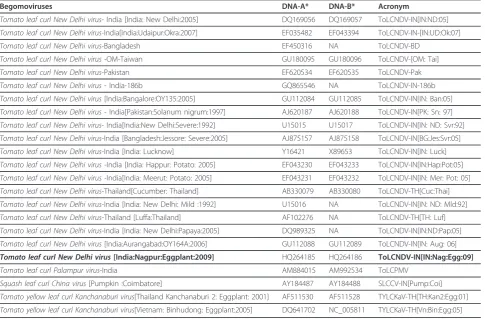
The nucleotide sequence comparison of complete DNA-A of the virus isolate with the selected strains of TOLCNDV, TYLCV and other begomoviruses reported from India and worldwide (Table 1) showed highest identity (97.6%) with ToLCNDV-IN[IN: UD: Ok: 07] and lowest (87.9%) with ToLCNDV-IN[IN:ND:Pap:05] (Table 2). We thus suggest the name of the variant as ToLCNDV-India[India:Nagpur:Eggplant:2009] in accor-dance with the latest International Committee on
Table 1 Name, acronym and GenBank accession numbers of the selected begomovirus genome sequences used for study
Begomoviruses DNA-A* DNA-B* Acronym
Tomato leaf curl New Delhi virus- India [India: New Delhi:2005] DQ169056 DQ169057 ToLCNDV-IN[IN:ND:05]
Tomato leaf curl New Delhi virus-India[India:Udaipur:Okra:2007] EF035482 EF043394 ToLCNDV-IN-[IN:UD:Ok:07]
Tomato leaf curl New Delhi virus-Bangladesh EF450316 NA ToLCNDV-BD
Tomato leaf curl New Delhi virus -OM-Taiwan GU180095 GU180096 ToLCNDV-[OM: Tai]
Tomato leaf curl New Delhi virus-Pakistan EF620534 EF620535 ToLCNDV-Pak
Tomato leaf curl New Delhi virus- India-186b GQ865546 NA ToLCNDV-IN-186b
Tomato leaf curl New Delhi virus[India:Bangalore:OY135:2005] GU112084 GU112085 ToLCNDV-IN[IN: Ban:05]
Tomato leaf curl New Delhi virus- India[Pakistan:Solanum nigrum:1997] AJ620187 AJ620188 ToLCNDV-IN[PK: Sn: 97]
Tomato leaf curl New Delhi virus- India[India:New Delhi:Severe:1992] U15015 U15017 ToLCNDV-IN[IN: ND: Svr:92]
Tomato leaf curl New Delhi virus-India [Bangladesh:Jessore: Severe:2005] AJ875157 AJ875158 ToLCNDV-IN[BG:Jes:Svr:05]
Tomato leaf curl New Delhi virus-India [India: Lucknow] Y16421 X89653 ToLCNDV-IN[IN: Luck]
Tomato leaf curl New Delhi virus-India [India: Happur: Potato: 2005] EF043230 EF043233 ToLCNDV-IN[IN:Hap:Pot:05]
Tomato leaf curl New Delhi virus-India[India: Meerut: Potato: 2005] EF043231 EF043232 ToLCNDV-IN[IN: Mer: Pot: 05]
Tomato leaf curl New Delhi virus-Thailand[Cucumber: Thailand] AB330079 AB330080 ToLCNDV-TH[Cuc:Thai]
Tomato leaf curl New Delhi virus-India [India: New Delhi: Mild :1992] U15016 NA ToLCNDV-IN[IN: ND: Mld:92]
Tomato leaf curl New Delhi virus-Thailand [Luffa:Thailand] AF102276 NA ToLCNDV-TH[TH: Luf]
Tomato leaf curl New Delhi virus-India [India: New Delhi:Papaya:2005] DQ989325 NA ToLCNDV-IN[IN:ND:Pap:05]
Tomato leaf curl New Delhi virus[India:Aurangabad:OY164A:2006] GU112088 GU112089 ToLCNDV-IN[IN: Aug: 06]
Tomato leaf curl New Delhi virus[India:Nagpur:Eggplant:2009] HQ264185 HQ264186 ToLCNDV-IN[IN:Nag:Egg:09]
Tomato leaf curl Palampur virus-India AM884015 AM992534 ToLCPMV
Squash leaf curl China virus[Pumpkin :Coimbatore] AY184487 AY184488 SLCCV-IN[Pump:Coi]
Tomato yellow leaf curl Kanchanaburi virus[Thailand Kanchanaburi 2: Eggplant: 2001] AF511530 AF511528 TYLCKaV-TH[TH:Kan2:Egg:01]
Tomato yellow leaf curl Kanchanaburi virus[Vietnam: Binhudong: Eggplant:2005] DQ641702 NC_005811 TYLCKaV-TH[Vn:Bin:Egg:05]
Taxonomy of Viruses (ICTV) guidelines for species demarcation in the genus [1].
The nucleotide sequence analysis of DNA-B of the ToLCNDV isolate under study with selected DNA-B sequences of begomovirus in NCBI database showed that it has highest sequence identity (94.1%) with ToLCNDV-IN[IN:UD:Ok:07] and lowest with ToLCNDV-IN[IN: Luck] (Table 2).
The phylogenetic tree analysis on the basis of nucleo-tide sequence of DNA-A genome of the ToLCNDV-IN [IN:Nag:Egg:09] with the DNA-A sequences of other selected begomoviruses revealed that the ToLCNDV-IN [IN:Nag:Egg:09] isolate has close relationship with the strains of ToLCNDV. In contrast, DNA-A nucleotide sequences of begomovirus species associated with EYMD in Thailand, showed divergent relationship with ToLCNDV-IN[IN: Nag: Egg: 09] isolate (Figure 2). Phy-logenetic analysis of the DNA-B genome also showed that ToLCNDV-IN[IN:Nag:Egg:09] isolate has close rela-tionship with ToLCNDV strains (Figure 3).
Infectivity of the cloned genomic components
To assess the infectivity of the present ToLCNDV iso-late, agroinfectious constructs of both the genomes were
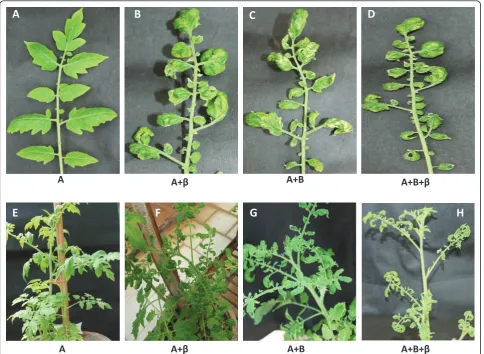
introduced into the leaves of tomato as well as eggplant using the agro-infiltration technique. Agroinfiltration of various constructs were carried out either individually or in various combinations and the consequent disease expressions are summarized in Table 3. When both the genomic components (DNA-A and DNA-B) were co-infiltrated, typical yellow mosaic symptoms at 60 days post inoculation (dpi) was observed in eggplants (5/5) (Figure 4, panels C and G) and the same constructs evoked typical downward leaf curling in tomato plants (5/5) at 45 dpi (Figure 5, panels C and G). The symp-toms persisted even at 150 and 180 dpi in eggplants and tomato plants respectively.
To investigate the possible role of non-cognate DNA-b satellite in the disease severity, we co-infiltrated the dimeric clone of betasatellite, CLCuMB[IN:ND1:03] along with both the genome-components of ToLCNDV-IN[IN:Nag:Egg:09] on the test plants (eggplant and tomato). The eggplants exhibited severe yellow mosaic symptoms at 45 dpi (Figure 4, panels D and H) while severe downward leaf curling was observed in tomato at 30 dpi (Figure 5, panels D and H).
The DNA-A genomic component failed to develop disease either in eggplant or tomato when infiltrated alone (Figure 4, panels A and E; Figure 5, panels A and E). In addition, we were also interested to examine that the DNA-B component of the ToLCNDV-IN[IN:Nag: Egg:09] isolate could be replaced by non-cognate CLCuMV DNA-bfor systemic disease development. As anticipated, co-infiltration of DNA-A and DNA-b resulted in successful systemic disease development. The symptoms were mild mosaic in eggplant (2/5) (Figure 4, panels B and F) and leaf curling in tomato plants (3/5) (Figure 5, panels B and F). Thus, non cognate CLCuMV DNA-b substituted DNA-B of ToLCNDV-IN[IN:Nag: Egg:09] for systemic viral movement in both eggplant and tomato plants, albeit in a reduced manner. How-ever, the disease expression period was prolonged com-pared to when the B-component was administered with DNA-A. The symptom development periods were 90 and 80 dpi for eggplant and tomato respectively.
However, the severity of the symptoms was most pro-nounced when all of the three components, i.e., DNA-A/DNA-B/DNA-b, were co-transferred in plants. Figure 4 shows the severity of yellow mosaic disease in egg-plants and the leaves curled with progression of the dis-ease (panels D and H). The disdis-ease expression time also reduced to 45 days. Similar was the case with tomato and the curled leaves showed mosaic symptoms even-tually due to virus infection (Figure 5, panels D and H). The disease also expressed early, i.e., at about 30 dpi in tomato plants.
As expected, neither empty pGreen vector (negative control) nor DNA-B and DNA-bconstruct caused any
Table 2 Percent identities (nucleotide#) of ToLCNDV-IN [IN:Nag:Egg:09] with DNA-A and DNA-B of selected begomoviruses reported worldwide
Virus-Acronym DNA-A DNA-B
ToLCNDV-IN[IN:UD:Ok:07] 97.6 94.1
ToLCNDV-IN-186b 97.0 NA
ToLCNDV-IN[IN: Ban:05] 96.3 86.4
ToLCNDV-IN[IN: Aug: 06] 95.6 88.3
ToLCNDV-IN[IN:ND:05] 94.5 86.4
ToLCNDV-IN[PK: Sn: 97] 94.5 82.0
ToLCNDV-IN[IN: ND: Svr:92] 94.3 86.4
ToLCNDV-IN[BG:Jes:Svr:05] 94.3 86.4
ToLCNDV-IN[IN: Luck] 94.0 76.2
ToLCNDV-IN[IN: Mer: Pot: 05] 93.7 86.3
ToLCNDV-Pak 93.2 90.9
ToLCNDV-TH[Cuc:Thai] 92.7 81.4
ToLCNDV-IN[IN: ND: Mld:92] 92.7 NA
ToLCNDV-[OM: Tai] 92.1 80.6
ToLCNDV-IN[IN:Hap:Pot:05] 91.4 86.7
ToLCNDV-TH[TH: Luf] 91.1 NA
ToLCNDV-BD 88.8 NA
symptoms in test plants even at 180 dpi and no notice-able phenotypic change in eggplant and tomato plants were observed. In contrast, plants infiltrated with the agroinfectious constructs were always stunted in growth.
The level of viral DNA accumulation in the diseased plants
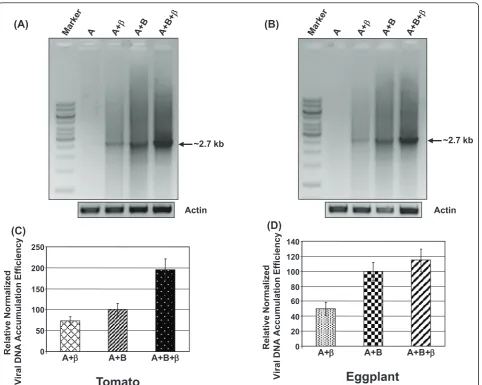
In order to know the level of viral DNA accumulation, total DNA from systemic and symptomatic leaves of agroinfiltrated eggplant and tomato plants was extracted and subjected to semi-qPCR and RCA. RCA products of high molecular weight were digested with EcoRV, unique site in the DNA-A of ToLCNDV-IN[IN:Nag: Egg:09]. The 2.7 kb band was observed only in plants agro infiltrated with either both the genomic compo-nents or DNA-A with non cognate DNA-b. However, no such band was observed in plants infiltrated with only DNA-A (data not shown).
The semi-qPCR was carried out to know the level of viral DNA accumulation in plants infiltrated with various constructs. The results revealed that the viral DNA accu-mulation in tomato plants was highest when the plants
were infiltrated with all the three components, namely DNA-A, DNA-B and non cognate DNA-b. The accumu-lation of viral DNA was lowest when the DNA-A and DNA-bwas used for co-infiltration (Figure 6A, C). Simi-lar results were also obtained with eggplants (Figure 6B, D). However, the effects of non cognatebDNA was less pronounced in eggplants compared tomato.
The measured intensities of the 2.7 kb bands were normalized with respect to the corresponding actin con-trols. The average normalized intensity values (based on three independent studies) are presented as bar graphs in Figure 6C, D. Our data reflect that the accumulation of viral DNA increased to ~95% on introduction of non cognate DNA b in tomato while there was a modest increase of ~14% in eggplant. The accumulation of viral DNA was further reduced up to ~27% when DNA-B was substituted by non cognate DNA-bin tomato plants whereas the same was ~50% in eggplant (Figure 6C, D).
Discussion
Eggplant is one of the preferred hosts for rearing of white-flies and was known to be immune for begomovirus [31]
AB330079 ToLCNDV-TH[Cuc:Thai]
GU180095 ToLCNDV-Tai[OM:Tai]
AF102276 ToLCNDV- TH[TH: Luf]
DQ989325 ToLCNDV-IN[IN:ND:Pap:05]
U15016 ToLCNDV-IN[IN: ND: Mld:92]
EF620534 ToLCNDV-Pak
EF043230 ToLCNDV-IN[IN:Hap:Pot:05]
EF043231 ToLCNDV-IN[IN: Mer: Pot: 05]
AJ620187 ToLCNDV-IN[PK: Sn: 97]
DQ169056 ToLCNDV-IN[IN:ND:05]
U15015 ToLCNDV-IN[IN: ND: Svr:92]
AJ875157 ToLCNDV-IN[BG:Jes:Svr:05]
Y16421 ToLCNDV-IN[IN: Luck]
GU112088 ToLCNDV-IN[IN: Aug: 06] HQ264185 ToLCNDV-IN[IN:Nag:Egg:09]
GQ865546 ToLCNDV-IN-186b
EF035482 ToLCNDV-IN[IN:UD:Ok:07]
GU112084 ToLCNDV-IN[IN: Ban:05]
EF450316 ToLCNDV-BD
AY184487 SLCCV-IN[Pump:Coi]
AM884015 ToLCPMV
AF511530 TYLCKaV-TH[TH:Kan2:Egg:01]
DQ641702 TYLCKaV-TH[Vn:Bin:Egg:05] 100
94 100
100
98 51
98 100
100
100
68 100
68
100 61
62
Figure 2Phylogenetic tree of complete DNA-A of ToLCNDV-IN[IN: Nag: Egg: 09]. The phylogenetic tree was constructed with distance/
EF043232 ToLCNDV-IN[IN:Mer:Pot:05]
EF043233 ToLCNDV-IN[IN:Hap:Pot:05]
GU112085 ToLCNDV-IN[IN: Ban:05]
DQ169057 ToLCNDV-IN[IN:ND:05]
U15017 ToLCNDV-IN[IN:ND:Svr:92]
GU112089 ToLCNDV-IN[IN:Aug:06]
AJ875158 ToLCNDV-IN[BG:Jes:Svr:05]
X89653 ToLCNDV-IN[IN:Luck]
EF620535 ToLCNDV-Pak
EF043394 ToLCNDV-IN[IN:UD:Ok:07]
HQ264186 ToLCNDV-IN[IN:Nag:Egg:09]
AJ620188 ToLCNDV-IN[PK:Sn:97]
AB330080 ToLCNDV-TH[Cuc:Thai]
GU180096 ToLCNDV-Tai[OM:Tai]
AM992534-ToLCPMV
AY184488 SLCCV-IN[Pump:Coi]
AF511528 TYLCKaV-TH[TH:Kan2:Egg:01]
NC 005811 TYLCKaV-TH[Vn:Bin:Egg:05] 100
100 91
100 100
100
99 100 100 100
100 57
98 61
56
0.1
Figure 3Phylogenetic tree of complete DNA-B of ToLCNDV-IN[IN:Nag:Egg:09]. The phylogenetic tree was constructed with distance/
neighbour-joining method with 1000 bootstrap replications and viewed with the help of MacVector suite program 10.5 (Mac Vector Inc, USA).
Table 3 Infectivity and symptom induced by ToLCNDV-IN[IN:Nag:Egg:09] with or without non-cognate betasatellite CLCuMB-[IN:ND1:03] and the number of symptomatic plants as confirmed by RCA
Host/Inoculated dimeric agro-constructs
Symptomatic plants/Inoculated plants Types of symptoms (90dpi)
Eggplant
DNA-2A 0/5 No Symptoms
DNA-2A+DNA-2B 5/5 Yellow mosaic
DNA-2A+ DNA-2b 3/5 Mild yellow mosaic
DNA-2A+ DNA-2B + 2b 5/5 Severe yellow mosaic
DNA-2B 0/5 No Symptoms
DNA-2b 0/5 No Symptoms
DNA-2B+ CLCuMV-DNA-2b 0/5 No Symptoms
Tomato
DNA-2A 0/5 No Symptoms
DNA-2A+ DNA-2B 5/5 Leaf curling
DNA-2A+ DNA-2b 4/5 Mild leaf curling
DNA-2A+ DNA-2B + DNA-2b 5/5 Severe leaf curling with occasionally yellow mosaic
DNA-2B 0/5 No Symptoms
DNA2b 0/5 No Symptoms
till the recent past. However, begomovirus causing EYMD in Thailand have been identified [1,22] although, the etiol-ogy of the disease was not satisfied by Koch’s postulates. Prominent yellow mosaic symptoms were observed on eggplants in fields during 2009-2010 in Nagpur, India. Virus like symptoms and infestation of whiteflies prompted us to investigate the possible association of begomovirus with the newly emerging disease of eggplant. Our results confirmed the association of a begomovirus with EYMD. Based on high nucleotide sequence identity (97.6% for DNA-A and 94.1% for DNA-B) with the strains of ToLCNDV, phylogenetic analysis and the demarcation criteria in species demarcation[1], the begomovirus iso-lated from diseased eggplant is considered as a variant of ToLCNDV and we suggest the name as ToLCNDV-IN [IN:Nag:Egg:09].
ToLCNDV is an economically important pathogen and found to be associated with various crop plants in India, Pakistan, Thailand and Bangladesh [1]. ToLCNDV has been reported for the first time in India from tomato and it required both DNA-A and
DNA-B for symptom development [2]. Later on, it has been reported from various crops and weeds such as, chili [32], cucurbits [33], potato [34], papaya[35], bit-tergourd [36], cotton (GenBank Accession number, EF063145) and Solanum nigrum (GenBank Acc. No. AJ620187). As already known, virus isolated from a plant may or may not be the cause of disease unless it satisfies the Koch’s postulates and despite a large host range and geographical distribution of ToLCNDV, very few cloned isolates have been shown to be infectious to either experimental plants or the hosts from which they were isolated.
Therefore, to satisfy the Koch’s postulates, the infec-tivity of ToLCNDV-IN[IN:Nag:Egg:09] was established by infiltrating the agroinfectious clones in eggplant. The agroinfiltration in eggplants resulted in the disease symptoms that are similar to those occurred in the virus infected eggplant in fields. Hence, we fulfilled the Koch’s postulates and showed for the first time that ToLCNDV-IN[IN:Nag:Egg:09] is responsible for the newly emerging EYMD in central India.
B
A+
ɴ
A
D
A+B+
ɴ
C
A+B
A
F
A+
ɴ
E
H
A+B+
ɴ
A+B
G
A
Figure 4The disease was induced by ToLCNDV-IN[IN:Nag:Egg:09] in eggplants that were inoculated with different constructs as
Interestingly, ToLCNDV-IN[IN:Nag:Egg:09] gave the typical leaf curling symptoms, not the yellow mosaic in tomato plants. Thus, these results also indicated that the nature of symptoms and disease is largely a host-driven process in this case. The successful virus infection is dependent on productive interactions between viral and host factors at each stage of the infection process and host-adaptation have a different basis in different plants [37,38].
On agroinfiltration with empty vector (taken as nega-tive control) or only DNA-A of ToLCNDV-IN[IN:Nag: Egg:09], no symptoms were recorded even by 180 dpi. This showed that DNA-A alone of ToLCNDV-IN[IN: Nag:Egg:09] was neither able to sustain nor produce sys-temic infection in the host plants. This phenomenon is perhaps true for most of the geminiviruses with the bipartite genomes [2,15].
The association of a DNA-b molecule with the field infection of ToLCNDV-IN[IN:Nag: Egg:09] could not be detected by either PCR or RCR method. Never-theless, we still suspect that in succeeding time,
betasatellite associated monopartite begomovirus may be identified with EYMD in southern India. Conse-quently, we used the non-cognate CLCuMB[IN: ND1:03] molecule to examine its role in degree of virus infection. When CLCuMB[IN: ND1:03] was co-infiltrated with DNA-A of ToLCNDV-IN[IN:Nag: Egg:09], produced mild leaf curling in tomato plants. This result suggested that CLCuMV DNA-b can suc-cessfully substitute the DNA-B for systemic movement of ToLCNDV-IN[IN:Nag:Egg:09] and symptom devel-opment. These results are in conformity with the ear-lier findings that DNA-b can substitute DNA-B for systemic movement [20]. However, the symptoms took longer time to develop and they were mild comparative to that when both the genomic components (DNA-A and DNA-B) were present. It indicated that DNA-b can substitute DNA-B up to certain extent but not completely. These results are also in accordance with the previous findings that, DNA-B plays the major role in symptom production and viral pathogenicity in bipartite begomovirus [39].
A
E
A+B
G
A+B+ɴ
H
A+ɴ
F
A
A
A+B
C
D
A+B+ɴ
A+ɴ
B
The DNA-b satellite molecules are also known for intensification of disease symptoms in a host dependent manner [27,40]. Co-infiltration of DNA-A and DNA-B of ToLCNDV-IN [IN:Nag:Egg:09] with DNA-b of CLCuMV resulted in enhanced severity of disease in both eggplant and tomato. The appearance of disease symptoms also took lesser time compared to that required by both DNA-A and DNA-B. Thus, our results promoted the role of DNA-bin increasing the disease severity[41].
The symptomatic variation with agroinfiltrated test plants which were infiltrated with various combina-tions of constructs were corroborated with molecular findings as the relative virus accumulation of virus increased to about ~95% and ~14% in tomato and
eggplant respectively when DNA-b was infiltrated along with both DNA-A and DNA-B. The value reduced to ~27% and ~50% respectively in tomato and eggplant when DNA-B was replaced with DNA-b, where the value obtained for A+B was arbitrarily assigned as 100%. Furthermore, these results support the notion that DNA-b increases the disease severity by increasing the accumulation of the helper virus. The variation observed in tomato and eggplant may be due to the fact that DNA-b increased the symptoms severity in a host dependent manner [14,42].
Thus, we have identified and characterized the virus associated with EYMD as a variant of ubiquitous TOLCNDV, but presence of new begomoviruses species with the eggplant cultivation in India cannot be negated
Tomato
050 100 150 200 250
A+B
A+E A+B+E
R
el
at
ive
N
orma
lize
d
Viral DNA
Accumula
tion Efficiency
~2.7 kb
Actin
(A)
(C)
Eggplant
020 40 60 80 100 120 140
A+B
A+E A+B+E
Relativ
e Normalized
Viral DNA
Accumulation Efficiency
~2.7 kb
Actin
(B)
(D)
Figure 6The plants (Tomato and Eggplant) were agro-infiltrated with various constructs as shown on the top of the figures, and the
as different species of monopartite and bipartite bego-moviruses exist across India and among them many monopartite begomoviruses with betasatellite molecules are already known to be prevalent in southern India [43]. The diversity of begomovirus may lead to adapta-tion of eggplants as a new host and as a result the egg-plants in other part of India might be under severe threat. Therefore, some practical intervention measures, such as enforcement of quarantine regulations in the trade of live plant materials and development of resis-tant plants are urgently needed to curb the viral threat.
Conclusion
Taken together, on the basis of molecular characteriza-tion and infectivity test, we can conclude that ToLCNDV-IN[IN:Nag:Egg:09] is a newly emerging var-iant of ToLCNDV moving to a new economically important host, eggplant and subsequently posing severe constraint on eggplant production in India. This is also a first experimental demonstration of Koch’s postulate for a begomovirus associated with eggplant yellow mosaic disease.
Acknowledgements
We are grateful to Dr. Nirupam Roy Choudhury, ICGEB, New Delhi for helpful discussion and critical reading of the manuscript. We also thank Dr. V. G. Malathi, IARI, New Delhi for CLCuMV betasatellite dimeric clone and Dr. M. K. Reddy, ICGEB, New Delhi for pGreen 0029 and pSoup vector.
Author details
1
Plant Molecular Biology, International Centre for Genetic Engineering and Biotechnology, Aruna Asaf Ali Marg, New Delhi 110067, India.2Ankur Seeds Private Limited, Nagpur 440018, India.
Authors’contributions
DP carried out the entire experiments. ARK carried out the survey and collected the infected samples. SKM conceived of the study, DP and SKM participated in designing the experiments. DP and SKM prepared the manuscript. All authors read and approved the final manuscript.
Competing interests
The authors declare that they have no competing interests.
Received: 3 May 2011 Accepted: 16 June 2011 Published: 16 June 2011
References
1. Fauquet CM, Briddon RW, Brown JK, Moriones E, Stanley J, Zerbini M, Zhou X:Geminivirus strain demarcation and nomenclature.Archives of Virology2008,153:783-821.
2. Padidam M, Beachy RN, Fauquet CM:Tomato leaf curl geminivirus from India has a bipartite genome and coat protein is not essential for infectivity.J Gen Virol1995,76(Pt 1):25-35.
3. Brown JK:Current status of Bemisia tabaci as a plant pest and virus vector in agro-ecosystems worldwide.FAO Plant Protection Bulletin (FAO); Bulletin Phytosanitaire de la FAO (FAO); Boletin Fitosanitario de la FAO (FAO) 1994.
4. Czosnek H, Laterrot H:A worldwide survey of tomato yellow leaf curl viruses.Archives of Virology1997,142:1391-1406.
5. Moffat AS:Geminiviruses emerge as serious crop threat.Science1999, 286:1835-1835.
6. Stanley J:Infectivity of the cloned geminivirus genome requires sequences from both DNAs.1983.
7. Hanley-Bowdoin L, Settlage SB, Orozco BM, Nagar S, Robertson D: Geminiviruses: models for plant DNA replication, transcription, and cell cycle regulation.Critical Reviews in Plant Sciences1999,18:71-106. 8. Pant V, Gupta D, Choudhury NR, Malathi VG, Varma A, Mukherjee SK:
Molecular characterization of the Rep protein of the blackgram isolate of Indian mungbean yellow mosaic virus.J Gen Virol2001,82:2559-2567. 9. Dry IB, Rigden JE, Krake LR, Mullineaux PM, Rezaian MA:Nucleotide
sequence and genome organization of tomato leaf curl geminivirus. Journal of General Virology1993,74:147-147.
10. Kheyr-Pour A, Bendahmane M, Matzeit V, Accotto GP, Crespi S,
Gronenborn B:Tomato yellow leaf curl virus from sardinia is a whitefly-transmitted monoparatite geminivirus.Nucleic Acids Research1991, 19:6763-6763.
11. Navot N, Pichersky E, Zeidan M, Zamir D, Czosnek H:Tomato yellow leaf curl virus: a whitefly-transmitted geminivirus with a single genomic component.Virology1991,185:151-161.
12. Briddon RW, Markham PG:Cotton leaf curl virus disease.Virus Research 2000,71:151-159.
13. Briddon RW, Mansoor S, Bedford ID, Pinner MS, Saunders K, Stanley J, Zafar Y, Malik KA, Markham PG:Identification of DNA components required for induction of cotton leaf curl disease.Virology2001,285:234-243. 14. Saunders K, Bedford ID, Briddon RW, Markham PG, Wong SM, Stanley J:A
unique virus complex causes Ageratum yellow vein disease.Proc Natl Acad Sci USA2000,97:6890-6895.
15. Cui X, Li G, Wang D, Hu D, Zhou X:A Begomovirus DNAbeta-encoded protein binds DNA, functions as a suppressor of RNA silencing, and targets the cell nucleus.J Virol2005,79:10764-10775.
16. Jose J, Usha R:Bhendi yellow vein mosaic disease in India is caused by association of a DNA [beta] satellite with a Begomovirus.Virology2003, 305:310-317.
17. Saunders K, Salim N, Mali VR, Malathi VG, Briddon R, Markham PG, Stanley J: Characterisation of Sri Lankan cassava mosaic virus and Indian cassava mosaic virus: evidence for acquisition of a DNA B component by a monopartite begomovirus.Virology2002,293:63-74.
18. Saunders K, Briddon RW, Stanley J:Replication promiscuity of DNA-beta satellites associated with monopartite begomoviruses; deletion mutagenesis of the Ageratum yellow vein virus DNA-beta satellite localizes sequences involved in replication.J Gen Virol2008,89:3165-3172. 19. Briddon RW, Bull SE, Amin I, Idris AM, Mansoor S, Bedford ID, Dhawan P,
Rishi N, Siwatch SS, Abdel-Salam AM, others:Diversity of DNA [beta], a satellite molecule associated with some monopartite begomoviruses. Virology2003,312:106-121.
20. Saeed M, Zafar Y, Randles JW, Rezaian MA:A monopartite begomovirus-associated DNA beta satellite substitutes for the DNA B of a bipartite begomovirus to permit systemic infection.J Gen Virol2007,88:2881-2889. 21. Pratap D, Kumar S, Raj SK, Sharma AK:Agrobacterium-mediated
transformation of eggplant (Solanum melongena L.) using cotyledon explants and coat protein gene of Cucumber mosaic virus.Indian Journal of Biotechnology2011,10:19-24.
22. Green SK, Tsai WS, Shih SL, Rezaian MA, Duangsong U:Molecular characterization of a new Begomovirus associated with tomato yellow leaf curl and eggplant yellow mosaic diseases in Thailand.Plant Disease 2003,87:446-446.
23. Srivastava KM, Hallan V, Raizada RK, Chandra G, Singh BP, Sane PV: Molecular cloning of Indian tomato leaf curl virus genome following a simple method of concentrating the supercoiled replicative form of viral DNA.J Virol Methods1995,51:297-304.
24. Haible D, Kober S, Jeske H:Rolling circle amplification revolutionizes diagnosis and genomics of geminiviruses.Journal of virological methods 2006,135:9-16.
25. Briddon RW, Bull SE, Mansoor S, Amin I, Markham PG:Universal primers for the PCR-mediated amplification of DNA beta: a molecule associated with some monopartite begomoviruses.Mol Biotechnol2002,20:315-318. 26. Hall TA:BioEdit: a user-friendly biological sequence alignment editor and
analysis program for Windows 95/98/NT.1999, 95-98.
27. Zhou X, Xie Y, Tao X, Zhang Z, Li Z, Fauquet CM:Characterization of DNAbeta associated with begomoviruses in China and evidence for co-evolution with their cognate viral DNA-A.J Gen Virol2003,84:237-247. 28. Sivalingam PN, Malathi VG, Varma A:Molecular diversity of the DNA-beta
29. Lee MW, Yang Y:Transient expression assay by agroinfiltration of leaves. Methods In molecular biology-Clifton Then Totowa-2006,323:225-225. 30. Pandey P, Choudhury NR, Mukherjee SK:A geminiviral amplicon (VA)
derived from Tomato leaf curl virus (ToLCV) can replicate in a wide variety of plant species and also acts as a VIGS vector.Virol J2009,6:152. 31. Czosnek H, Kheyr-Pour A, Gronenborn B, Remetz E, Zeidan M, Altman A,
Rabinowitch HD, Vidavsky S, Kedar N, Gafni Y, others:Replication of tomato yellow leaf curl virus (TYLCV) DNA in agroinoculated leaf discs from selected tomato genotypes.Plant molecular biology1993, 22:995-1005.
32. Hussain M, Mansoor S, Iram S, Zafar Y, Briddon RW:First report of Tomato leaf curl New Delhi virus affecting chilli pepper in Pakistan.Plant pathology2004,53:794-794.
33. Ito T, Sharma P, Kittipakorn K, Ikegami M:Complete nucleotide sequence of a new isolate of tomato leaf curl New Delhi virus infecting cucumber, bottle gourd and muskmelon in Thailand.Archives of Virology2008, 153:611-613.
34. Usharani KS, Surendranath B, Paul-Khurana SM, Garg ID, Malathi VG:Potato leaf curl-a new disease of potato in northern India caused by a strain of Tomato leaf curl New Delhi virus.Plant pathology2004,53:235-235. 35. Raj SK, Snehi SK, Khan MS, Singh R, Khan AA:Molecular evidence for
association of Tomato leaf curl New Delhi virus with leaf curl disease of papaya (Carica papaya L.) in India.Australas Plant Dis Notes2008, 3:152-155.
36. Tahir M, Haider MS:First report of Tomato leaf curl New Delhi virus infecting bitter gourd in Pakistan.Plant pathology2005,54:807-807. 37. Gillette WK, Meade TJ, Jeffrey JL, Petty ITD:Genetic determinants of
host-specificity in bipartite geminivirus DNA A components.Virology1998, 251:361-369.
38. Petty IT, Miller CG, Meade-Hash TJ, Schaffer RL:Complementable and noncomplementable host adaptation defects in bipartite geminiviruses. Virology1995,212:263-267.
39. Ingham DJ, Pascal E, Lazarowitz SG:Both bipartite geminivirus movement proteins define viral host range, but only BL1 determines viral pathogenicity.Virology1995,207:191-204.
40. Li Z, Xie Y, Zhou X:Tobacco curly shoot virus DNAβis not necessary for infection but intensifies symptoms in a host-dependent manner. Phytopathology2005,95:902-908.
41. Nawaz-ul-Rehman MS, Mansoor S, Briddon RW, Fauquet CM:Maintenance of an old world betasatellite by a new world helper begomovirus and possible rapid adaptation of the betasatellite.J Virol2009,83:9347-9355. 42. Saunders K, Bedford ID, Stanley J:Pathogenicity of a natural recombinant
associated with ageratum yellow vein disease: implications for geminivirus evolution and disease aetiology.Virology2001,282:38-47. 43. Chowda Reddy RV, Colvin J, Muniyappa V, Seal S:Diversity and
distribution of begomoviruses infecting tomato in India.Archives of virology2005,150:845-867.
doi:10.1186/1743-422X-8-305
Cite this article as:Pratapet al.:Molecular characterization and infectivity of aTomato leaf curl New Delhi virusvariant associated with newly emerging yellow mosaic disease of eggplant in India.Virology Journal20118:305.
Submit your next manuscript to BioMed Central and take full advantage of:
• Convenient online submission
• Thorough peer review
• No space constraints or color figure charges
• Immediate publication on acceptance
• Inclusion in PubMed, CAS, Scopus and Google Scholar
• Research which is freely available for redistribution
![Figure 1 (A) Naturally infected eggplants with yellow mosaic symptoms and mottling of leavesdiseased leaf [encircled in red (A)]](https://thumb-us.123doks.com/thumbv2/123dok_us/846323.1100917/4.595.58.537.488.682/figure-naturally-infected-eggplants-symptoms-mottling-leavesdiseased-encircled.webp)
![Table 2 Percent identities (nucleotide#[IN:Nag:Egg:09] with DNA-A and DNA-B of selected) of ToLCNDV-INbegomoviruses reported worldwide](https://thumb-us.123doks.com/thumbv2/123dok_us/846323.1100917/6.595.58.289.121.401/percent-identities-nucleotide-selected-tolcndv-inbegomoviruses-reported-worldwide.webp)
![Figure 2 Phylogenetic tree of complete DNA-A of ToLCNDV-IN[IN: Nag: Egg: 09]. The phylogenetic tree was constructed with distance/neighbour-joining method with 1000 bootstrap replications and viewed with the help of MacVector suite program 10.5 (Mac Vector Inc, USA).](https://thumb-us.123doks.com/thumbv2/123dok_us/846323.1100917/7.595.58.535.89.422/phylogenetic-complete-phylogenetic-constructed-neighbour-bootstrap-replications-macvector.webp)
![Figure 3 Phylogenetic tree of complete DNA-B of ToLCNDV-IN[IN:Nag:Egg:09]. The phylogenetic tree was constructed with distance/neighbour-joining method with 1000 bootstrap replications and viewed with the help of MacVector suite program 10.5 (Mac Vector Inc, USA).](https://thumb-us.123doks.com/thumbv2/123dok_us/846323.1100917/8.595.62.538.514.731/phylogenetic-complete-phylogenetic-constructed-neighbour-bootstrap-replications-macvector.webp)
![Figure 4 The disease was induced by ToLCNDV-IN[IN:Nag:Egg:09] in eggplants that were inoculated with different constructs aslabeled](https://thumb-us.123doks.com/thumbv2/123dok_us/846323.1100917/9.595.57.540.88.428/figure-disease-tolcndv-eggplants-inoculated-different-constructs-aslabeled.webp)