2018 International Conference on Computer, Communications and Mechatronics Engineering (CCME 2018) ISBN: 978-1-60595-611-4
Application Research Based on GA-FWA in Prediction of Sintering
Burning Through Point
Dan-dan WANG
1, Kai YANG
1,*, Zhi-jun HE
2, Ya-qiang YUAN
2and Ji ZHANG
1 1School of Software, University of Science and Technology Liaoning, Liaoning 114051, China2School of materials and metallurgy, University of Science and Technology Liaoning,
Liaoning 114051, China
*Corresponding author
Keywords: Sintering Burning Though Point, Support Vector Machine, Intelligent Optimization Algorithm, Simulation Experiment.
Abstract. The sintering burn through point (BTP) is the most important parameter in the sintering process, which is usually used to evaluate the quality of sintered products. However, due to the sintering process is a complex physical and chemical reaction process, the specific sintering end point cannot be detected. In this paper, the fireworks algorithm based on genetic algorithm (GA-FWA) is applied to optimize the parameters in support vector machines(SVM). A new intelligent optimization algorithm is proposed to optimize the sintering terminal prediction model of support vector machines. The model uses MATLAB software to test the actual production data of a steel factory. Through a large number of experiments, the average relative error of the experimental results is 0.0778%, and the average absolute error is 0.0843. The accuracy of the experimental results is obviously higher than the other methods of predicting the sintering BTP. It can accurately predict the position of the sintering end point, greatly improve the quality and production of the sinter in the steel plant, and also prolong the service life of the sintering equipment and reduce the production cost.
Introduction
With the continuous progress of our society, heavy industry is also developing rapidly. As the raw material of iron and steel, the use of iron ore increases greatly, which leads to the decrease of rich iron ore in our country. In order not to affect the production of iron and steel industry, sinter has emerged as the times require and become the main raw material of the blast furnace production process in China. The control of BTP is the key link to judge whether the physical and chemical changes are completed in the sintering process, which is closely related to the output, quality and production cost of sinter produced in the sintering process [1]. If the judged BTP is smaller than the actual value, the phenomenon of under-burning will occur, resulting in partial fuel can not be fully burned, increase the return rate, reduce the output. If the judged BTP is larger than the actual value, the sinter will be overburned, which not only wastes a lot of time, but also leads to the production of sinter easy to break and caking rate is low [2].
Control of BTP
The position of BTP is an important parameter to judge whether the sintering process is completed or not. If the control of BTP is inaccurate, not only the raw material and fuel will be wasted greatly, but also the sintering returning rate will be increased, a lot of waste products will be produced, and the sintering equipment may be damaged finally, so it is necessary to improve the accuracy of the BTP. At present, most iron and steel enterprises adopt waste gas temperature determination method to realize soft sensing of sintering blast furnace. The real-time measurement of exhaust gas temperature of the bellows is realized by installing thermocouples under the last few bellows. The position where the temperature of the exhaust gas from the bellows reaches the maximum value is set as the position of BTP. According to the literature [6,7], the exhaust gas temperature curves of the last few bellows of the sintering machine can be approximately regarded as a one-dimensional quadratic function curve, thus the relationship function model between the exhaust gas temperature of the sintering bellows and the sintering endpoint can be established. By acquiring the exhaust gas temperature values of the last few bellows and their corresponding bellows positions, the three-point method is used to establish the function relationship, and then the function extremum is solved to obtain the final BTP.
The temperature change of exhaust gas in each bellows during sintering process has a certain regularity, which can reflect indirectly the process parameters such as material layer thickness, sintering machine speed, large flue negative pressure and so on. The change of these parameters has a certain causal relationship with the BTP, such as ignition temperature, sintering machine speed, raw material ratio and so on, which will affect the prediction of BTP [8]. But in the actual sintering process, we cannot take all the parameters into account. If too many factors are selected, it will greatly increase the amount of computation, resulting in low efficiency of the program; However, if the selected factors are too few, the sintering condition cannot be accurately reflected, which makes the control of BTP inaccurate, affects the quality of sinter and increases the sintering cost. So choosing the appropriate parameters of BTP can not only improve the efficiency of the program, but also improve the accuracy of prediction of sintering blast furnace, and finally produce the best quality sinter with the lowest cost. In this paper, principal component analysis (PCA) is used to analyze the actual production data of a steel mill [9]. According to the actual production experience of the steel mill, seven main influencing factors, such as ignition temperature, large flue negative pressure, main exhaust air volume, sintering machine speed, raw material thickness, raw material granularity and secondary water content, are selected.
Because of the limitation of the adjustment method of neural network weight coefficients, it is easy to fall into the local optimal and cannot get the global optimal solution, it needs a large number of experimental sample data and the convergence rate is difficult to determine the conditions and other problems, so this paper uses the SVM prediction method. SVM is a new machine learning algorithm proposed by Vapnik et al. [10-13]. SVM can support small samples and avoid the local optimal problem which cannot be solved by neural network while ensuring the global optimization of the algorithm. In this paper, seven main influence parameters are used as input parameters and BTP as output parameters. GA-FWA is used to optimize the penalty parameters, kernel function and insensitive loss coefficients in SVM. The experimental results show that the SVM model trained by optimizing the parameters of the algorithm has higher prediction accuracy and faster running speed.
Realization of GA-FWA
iteration of the fireworks, unselected fireworks or sparks are automatically discarded. Continue the explosion operation on the newly selected fireworks or sparks, and select several of the fireworks or sparks with better fitness values, and repeat the operation until a global optimal value is found or the iteration is complete. The explosion radius of fireworks decreases linearly with the number of iterations, that is to say, the initial fireworks explosion will be searched globally. With the number of iterations increasing, the explosion range of fireworks will continue to shrink, and then search for the global optimal value. In order to improve the searching precision and avoid falling into local optimal value, we introduce the crossover mutation strategy of genetic algorithm to improve the local searching ability of the algorithm. The specific implementation steps of the fireworks algorithm based on genetic algorithm are as follows:
Step1: Initialize n populations and determine the number of fireworks.
Step2: Calculate the number of sparks per firework explosion according to formula (1).
N i i i x f Y x f Y 1 max max i m S (1)In the formula (1), Si is the number of sparks generated by the i-th fireworks; m is a constant to
limit the total number of sparks produced; Ymax represents the fitness of the largest and the worst
individuals in the current population; f (Xi) is the fitness of individual Xi; ε represents a minimal
constant to avoid zero in the fraction.
Calculate the radius of each firework explosion according to formula (2).
initial end
end k r r r T t T r (2)In the formula (2), T is the maximum number of iterations; t is the current number of iterations;
rinitial is the maximum radius of the initial fireworks explosion, rinitial = α * (Xmax-Xmin), Xmax is the
position of the farthest sparks produced by a fireworks explosion; Xmin is the position of the nearest
sparks produced by a fireworks explosion; the range of α is [0.05,0.3]; rend is the maximum radius
of the last fireworks explosion; The experimental results show that the accuracy of the algorithm is
better when rend is 10-6. The explosion radius r of fireworks decreases with the number of iterations;
and k is the parameter that controls the decreasing trend of r. Through a large number of repeated
experiments, when the value of k is 7, the experimental results are the best [20, 21].
Step 3: Perform a Gaussian mutation. Multiply the fireworks position of the current population by the normal distribution function to change the fireworks position of the current population. The dimension of Gaussian catastrophe is realized by random function. At the same time, the fireworks mutated outside the specified range are mapped. Depending on the modular operation of the search range and summation with the minimum value of the search range, the fireworks mutated out of the search range are pulled back into the search range. Then the Euclidean distance formula is used to calculate the distance between each firework and spark. A roulette wheel gambling method is used
to select the n most distant ones from the fireworks and sparks for the next operation.
Step4: For the newly selected n populations, rely on the dec2bin function in MATLAB for binary encoding operations. Then the population crossover operation is realized: first, a random number
rand in the range of 0 to 1 is generated and compared with the crossover probability of 0.7. If the
generated random number is less than 0.7, a crossover operation is performed to crossover the k-th
dimension of the i-th population and the j-th population. Population i and population j are randomly
selected by the program, one as a father and one as a mother. According to the size of the population, the binary code length of the population is set to 20, and the father fireworks and the mother
fireworks are crossed at the crossing point c (c < 20). That is to say, the first c binary codes of the
father generation are combined with the 20-c binary codes after the mother generation to form a
new value to replace the value of the current parent generation. The actual crossover position c of
the population is also randomly generated. If rand is greater than the crossover probability, the loop
Step 5: Perform mutation of the population. A number rand is generated randomly, and then the
relationship between rand and mutation probability 0.1 is judged. If rand is less than the mutation
probability, a mutation operation is performed on the k-th binary code of the j-th dimension of the
current i-th population, changing 0 to 1 or 1 to 0. The binary code mutation position k is randomly
selected by the system from (1,20). After completing the cross mutation operation, the n populations
are decoded and transformed into decimal data by bin2dec function in MATLAB.
Step 6: Judging whether the current population satisfies the termination condition. If so, terminating the operation, executing the next operation. And if not, repeating the steps 2-6 until the termination condition is satisfied;
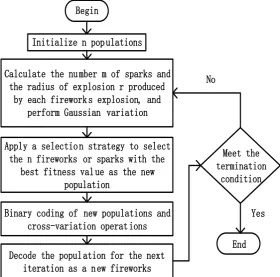
Step 7: The algorithm ends and the optimal value is output. The flow chart of the GA-FWA is shown in Figure 1.
Begin
Initialize n pop ulations
Calculate the nu mber m of sparks and the radius of ex plosion r produced
by each firework s explosion, and perform Gaussian variation
Apply a selectio n strategy to select the n fireworks or sparks with the
best fitness val ue as the new population
Binary coding of new populations and cross-variation operat ions
Decode the popul ation for the next iteration as a n ew fireworks
Meet the termination
condition
[image:4.595.157.438.225.502.2]End Yes No
Figure 1. GA-FWA flow chart.
GA-FWA Optimization of SVM to Predict the BTP
Model Training
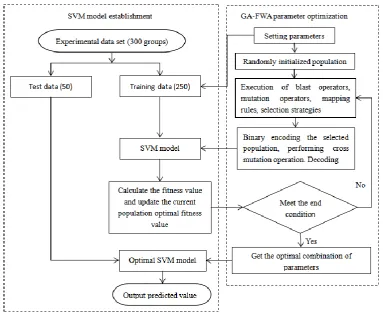
get the optimal SVM prediction model, input the test data set to the trained model to predict the BTP, get the prediction results, the algorithm ends.
Figure2. FWA optimization SVM parameter flow chart.
The experimental data set of this paper is extracted from the actual production data of sintering machine in a steel plant for a period of time, and some incomplete and obviously wrong data are eliminated. Finally, 300 groups of data are selected as experimental data, of which 250 groups are training model data and 50 groups are forecasting model data.
Experimental Results
In this paper, GA-FWA is used to optimize the parameters of SVM, and the root mean square error of sample parameters is used as the target parameter. The initial number of fireworks is 5, the maximum number of iteration is 500, the range of fireworks explosion is [-100,100], the intensity of fireworks explosion is 50, the cross probability is 0.7, and the mutation probability is 0.1. The cross mutation operation is binary encoded, the length is set to 20, the range of penalty parameter of support vector machine is [0.1,100], the range of kernel function is [0.1,100], and the range of insensitive loss coefficient is [0.01,10].
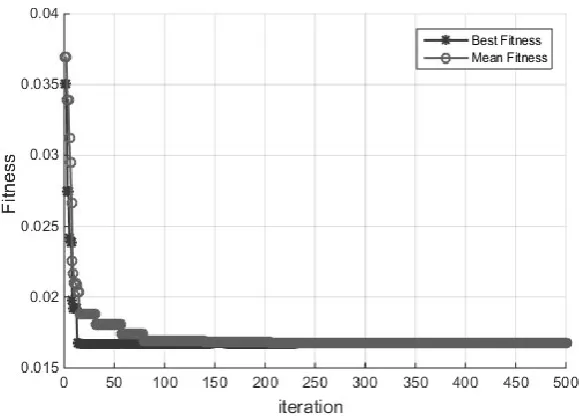
Through the MATLAB simulation experiment to model the experimental data, we can get the evolutionary curve of the fireworks algorithm training model, thus we can see the process of the fitness value of the training model evolving. The training fitting curves and prediction fitting curves of the model can also be obtained, so that the fitting degree of the data of the model during training can be seen, and the training effect and prediction effect of the model can be checked, as shown in Figure 3-5. In order to ensure the accuracy and reliability of the algorithm, the optimal fitness value
is 0.0169, the penalty parameter C=0. 922, the kernel function g=0. 922, and the insensitive loss
[image:5.595.107.491.102.416.2]Figure 3. Evolutionary curve.
[image:6.595.92.488.80.545.2]Figure 4. Training fitting curve.
Figure 5. GA-FWA-SVM predictive fit curve.
Comparison of Experimental Results
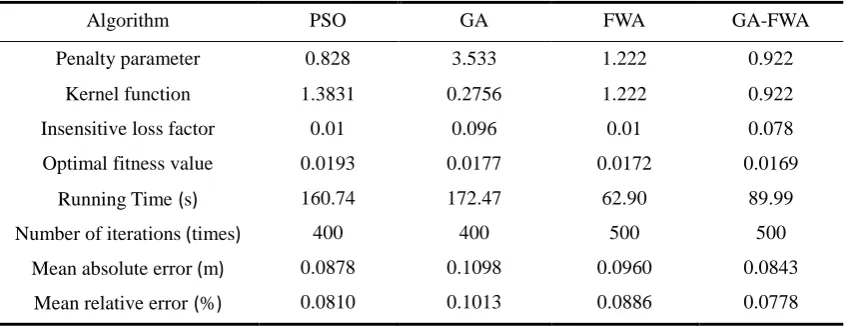
Table 1. Comparison of the prediction results of the algorithm.
Algorithm PSO GA FWA GA-FWA
Penalty parameter 0.828 3.533 1.222 0.922
Kernel function 1.3831 0.2756 1.222 0.922
Insensitive loss factor 0.01 0.096 0.01 0.078
Optimal fitness value 0.0193 0.0177 0.0172 0.0169
Running Time(s) 160.74 172.47 62.90 89.99
Number of iterations (times) 400 400 500 500
Mean absolute error (m) 0.0878 0.1098 0.0960 0.0843
Mean relative error(%) 0.0810 0.1013 0.0886 0.0778
As can be seen from Table 1, the GA-FWA algorithm finds a low optimal fitness value, and the mean absolute error and mean relative error are also significantly lower than other algorithms. In the case of the largest number of iterations, the running time is relatively small. The position of the BTP predicted by the GA-FWA and the position of the actual BTP are within the range of ±0.2m, and the accuracy rate is over 95%, which can more accurately predict the position of the BTP.
In this paper, the same set of training data and test data are used to compare the four algorithms, and the intelligent optimization algorithm is used to optimize the support vector machine to model training and prediction of the data. Finally, from the experimental results Figure and the comparison Table of prediction results, it can be seen that the GA-FWA has shorter running time and higher searching precision when the number of iteration is relatively high, which is more accurate than other optimization SVM model in predicting the BTP, and is more suitable for practical production.
Conclusions
1. Principal component analysis was used to reduce the factors affecting the end point of sintering. By analyzing the data and references, seven main factors affecting the position of sintering blast-through point are finally determined. The short-term prediction of sintering endpoint is realized by calculating sintering endpoint with waste gas temperature determination method.
2. Taking the fireworks algorithm as the core, the crossover mutation operation of genetic algorithm is added to the fireworks algorithm. A new intelligent optimization algorithm GA-FWA is proposed. The algorithm first performs a global search through the fireworks algorithm, then the algorithm searches the whole population by adding the crossover mutation operation of genetic algorithm. In this way, the combination of the two algorithms can further increase the diversity of the population and avoid the premature occurrence to find the global optimal value to a large extent.
3. Establishing simulation structure of BTP prediction model by MATLAB software. GA-FWA is used to optimize the parameters of SVM, so as to obtain the optimal combination of parameters of SVM. Then the optimal prediction model of BTP is obtained by training the optimized SVM with the actual production data.
4. The optimized model is used to predict the actual production data. A large number of experiments show that the model has high precision, the average relative error is 0.0778%, the average absolute error is 0.0843 m, and the training time is 89.99 s. The experimental results show that the model trained by the intelligent optimization method can meet the actual production needs.
Acknowledgment
References
[1] Shi W, Sun YT, Qin B, et al. Prediction of Sintering End Point Based on Particle Swarm Optimization and Radial Basis Function Neural Network [J]. Casting technology, 2016, 37(11): 2479-2483.
[2] Gan H. Application of Prediction of BTP[J]. Journal of Anhui University of Technology, 2010, 27(3): 299-304.
[3] Cai Q. Research and Application of End Point Control Method in Iron Ore Sintering Process [D].Liaoning: Northeast University, 2013:1-57.
[4] Liu ZH, Zheng JH. Optimal control of the sintering burn through point [J]. Automation and Instrumentation, 2014(4):29-32.
[5] Chen H. Optimization of sintering process based on Neural Network[D].Heilongjiang: Harbin Institute of Technology, 2017: 1-4.
[6] Xiang QL, Wu M, Xiang J, et al, Research and Application of Prediction and Intelligent Control Strategy of Sintering Blast Point in Sintering Process [J]. Information and Control, 2006, 35(5):662-666.
[7] Zhang HN. Handbook of sintering design [M]. Beijing: Metallurgical Industry Press, 1990.
[8] Wang HW, He LX. Prediction of burn through point based on wavelet analysis time series algorithm[J]. Computer measurement and control, 2013, 21(1): 27-29.
[9]Su BX, Zhang JL. Performance evaluation of sintered iron ore fines based on principal component analysis [J]. Sintered pellet, 2014, 39(6): 1-6.
[10] Vapnik V N. The Nature of Satistical Learning Theory[M]. New York: New York Springer Verlag, 1995.
[11]Vapnik V N. An overview of statistical learning theory[J]. IEEE Transactions on Neural Networks, 1999, 10(5): 988-999.
[12] Wang JG, Zhang WX. Support vector machine modeling and its intelligent optimization[M]. Beijing: Tsinghua University press, 2015.
[13] Deng NY, Tian YJ. Support vector machines—theory, algorithm and extension[M]. Beijing: Science Press, 2016.
[14] Wang Q, Ma GF, Man MI. Research on Neural Network Control based on Genetic Algorithm[J]. Journal of System Simulation. 2006, 18(4): 1070-1069.
[15] Zhou M, Sun SD. Principles and Application of Genetic Algorithms [M]. Beijing: National Defense Industry Press, 1999.
[16] Li MQ, Kou JS, Lin D, et al. Basic theory and application of genetic algorithm [M]. Beijing: Science Press, 2002.
[17] Zheng Z, Tan Y. Group explosion strategy for searching multiple targets using swarm robotic. IEEE Congress on Evolutionary Computation, 2013:821-828.
[18] Tan Y. Introduction to Fireworks Algorithm [M]. Beijing: Science Press, 2015.
[19] Cao J, Jia H, Li T. Optimization algorithm for fireworks explosion [J]. Computer Engineering and Science, 2011, 33 (1): 138-142.
[20] Li XY, Cui Y. Fireworks clustering algorithm based on binary coding [J]. Applied Science and Technology, 2016, 43 (1): 36-39.