Temporal changes in seismic velocity of the crust around Iwate volcano, Japan,
as inferred from analyses of repeated active seismic experiment data
from 1998 to 2003
Takeshi Nishimura1, Satoru Tanaka1, Teruo Yamawaki1, Hidekazu Yamamoto2, Takashi Sano2, Minemori Sato1, Hisashi Nakahara1, Naoki Uchida1, Shuichiro Hori1, and Haruo Sato1
1Graduate School of Science, Tohoku University, Sendai 980-8578, Japan 2Faculty of Engineering, Iwate University, Morioka 020-8551, Japan
(Received December 3, 2004; Revised April 25, 2005; Accepted May 2, 2005)
We have examined temporal changes in seismic velocity of the crust through repeated active seismic experi-ments at Iwate volcano, Japan, where a significant volcanic activity and an M6.1 earthquake were observed in 1998. We apply a cross spectrum moving window technique to seismic data recorded at eight stations for the six explosions detonated from1998 to 2003. The seismic velocity at the frequency range of 3–9 Hz decreased by about 1% during the three months including the occurrence of M6.1 earthquake. The seismic velocity gradually increased, and about one third of the decrease was recovered by 2002. Then, the seismic velocity decreased again in 2003. Spatio-temporal changes in the volumetric strains predicted from the M6.1 fault mechanism and the volcanic pressure sources are well correlated with the seismic velocity changes observed in 1998. However, the predicted stress fields are not completely matched with the observed velocity changes from 1998 to 2003. This inconsistency may be due to unknown regional tectonic stress field and/or localized stress fields induced by volcanic pressure sources. It should be noted that the observed velocity changes indicate frequency dependent characteristics although the mechanism is not yet understood.
Key words:Temporal changes, seismic velocity, Iwate vocano, active seismic experiment.
1.
Introduction
Temporal changes of the crustal structure have been a major topic of the solid earth, and many seismologists have attempted to detect a small change of the structure asso-ciated with seismic and volcanic activities. For example, Poupinet et al. (1984) showed that the seismic velocity around the hypocentral area of the Coyote Lake earthquake (M5.9) decreased down to 1% by applying a cross spectrum method to multiplet seismic events. He and his colleagues further examined temporal changes of shallow structure at Merapi volcano and reported a 1% increase of seismic ve-locity several months before the 1992 eruption (Poupinetet al., 1996; Ratdomopurdo and Poupinet, 1995). Furumoto et al.(2001) examined the first arrival time data of repeated active seismic experiments at Izu Oshima, Japan, which have been planned by Geological Survey of Japan for mon-itoring the structure around the focal zone of a future Tokai earthquake. By correcting tidal effects in the arrival times, they succeeded in estimating the rate of velocity change to be 0.1% per year, which originates from stress accumu-lation due to the subducting Philippine plate. Baish and Bokelmann (2001) showed a recovery of the heterogeneity in the crust near the M.6.9 Loma Prieta earthquake by an-alyzing waveform similarities of multiplet earthquakes. S -wave splitting -waves and coda-Qanalyses have succeeded
Copy right cThe Society of Geomagnetism and Earth, Planetary and Space Sci-ences (SGEPSS); The Seismological Society of Japan; The Volcanological Society of Japan; The Geodetic Society of Japan; The Japanese Society for Planetary Sci-ences; TERRAPUB.
in detecting a small change of the structure around active seismic areas (e.g., Hiramatsu et al., 2000; Saiga et al., 2003; Tadokoro and Ando, 2002). Repeated seismic reflec-tion measurements in the Kakkonda geothermal area also found structure changes around micro-seismic zones (Mat-sushimaet al., 2004). These previous studies indicate that temporal changes of the crustal structure are related with seismic/volcanic activities and plate motions.
Iwate volcano, which is a strato volcano located in the middle of north eastern Japan, have been active since the end of 1997. Significant volcanic earthquakes and crustal deformation have been detected by dense seismic and geodetic observations around the volcano (Tanaka et al., 2002b; Miura et al., 2000). Although the volcano did not erupt, on September 3, 1998, a large earthquake with a magnitude of 6.1 hit Shizukuishi-town that is located south west of the summit of the volcano (Nakaharaet al., 2002). Nishimuraet al.(2000b) and Uchidaet al.(2002) analyzed the seismic waves excited by two active experiments that were carried out one month before and two months after the M6.1 earthquake, and showed velocity decrease of about 1% in the upper crust. Nakamuraet al.(2002) also indicated 1% velocity decrease in the seismic velocity from analy-ses of directP-waves observed at permanent stations of To-hoku University, and Matsumoto, S.et al.(2001) reported a change of heterogeneous structure around the hypocenter of the M6.1 earthquake on the basis of coherence analyses of seismic array data.
To examine whether the crustal structure around the M6.1
492 T. NISHIMURAet al.: TEMPORAL CHANGES IN SEISMIC VELOCITY AROUND IWATE VOLCANO
Fig. 1. (a) Seismic and volcanic activities around Iwate volcano. Epicen-ters of volcano tectonic earthquakes and low-frequency earthquakes are indicated by gray circles and dark grey stars, respectively. Source region of very long period seismic events (Nishimuraet al., 2000a) are indi-cated by an open ellipse, and locations of spherical volumetric sources and dikes inferred from geodetic measurements (Miuraet al., 2000; To-hoku Univ., 2003) are denoted by a large open circle and thick lines, respectively. M6.1 fault zone estimated from co-seismic displacement (Miuraet al., 2000) is also projected on the horizontal plane (broken line). (b) Temporal changes of cumulative number of earthquakes (thin line), cumulative volumes of spherical volumetric sources (thick line) and dike (broken line).
earthquake and Iwate volcano recovers the seismic velocity decrease or not, we further conducted same active exper-iments from 2000 to 2003. In the present study, we ana-lyze seismic data of active seismic experiments for six years from 1998 to 2003, during which the M6.1 earthquake took place and Iwate volcano experienced significant activities. First, we briefly summarize the volcanic and seismic activ-ities around Iwate volcano as well as outlines of the active experiments. We apply the moving window cross spectrum technique presented by Poupinetet al. (1984) to the seis-mograms of repeated seismic active experiments in order to evaluate small changes in seismic velocity of the crust. In addition, we examine the wave properties by using sem-blance analyses to seismic array data. Finally, we compare the estimated velocity changes with the deformation field that is precisely determined from geodetic data observed around the volcano for understanding the origins of the ve-locity changes.
2.
Activity of Iwate Volcano and M6.1 Earthquake
Figure 1 summarizes spatial distribution of volcanic and seismic activities of Iwate volcano. In September 1995,
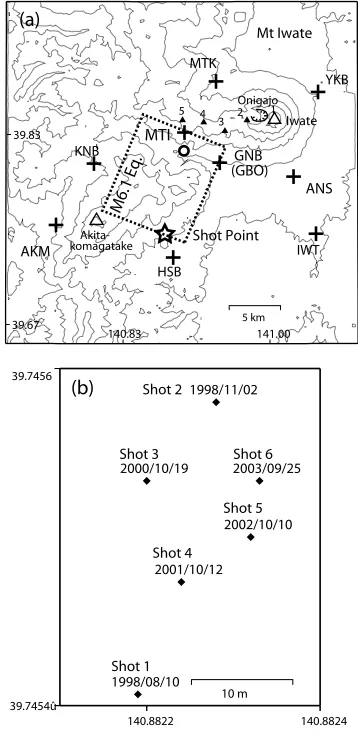
Fig. 2. (a) Location map of seismic stations (large plus symbols), ex-plosion-point (star), the epicenter of the M6.1 earthquake (solid circle). Horizontal projection of the M6.1 fault plane is indicated by a rectan-gular of broken line. Peaks 1 to 5 of Iwate volcano (solid triangles) are aligned in the east-west direction. Peak 1 is the summit (2036 m), Yakushidake. Peaks 2, 3, 4, and 5 are Kurokura, Ubakura, Ohmatukura and Mitsuishi, respectively. (b) Close-up of locations of six explosion points.
notable volcanic tremor was first observed. At the end of 1997, small changes were detected in records of bore-hole tilt and strain meters at YKB, ANS and GNB stations that are deployed on the flank of the volcano. Earthquake swarms occurred in March 1998, and then volcanic earth-quakes, low-frequency earthearth-quakes, very long period seis-mic events and tremor gradually became active at a shal-low part of the volcano (Nishimuraet al., 2000a; Tanakaet al., 2002b). And also, deep low-frequency earthquakes be-came active around the Moho discontinuity (Nakamichiet al., 2003). Borehole tilt and strain meters and the global po-sitioning system (GPS) networks deployed around the vol-cano detected ground deformations, from which spherical volumetric sources and east-west oriented dikes were in-ferred (Miuraet al., 2000; Tohoku Univ., 2003). These seis-mic and ground deformation activities were most prominent from April to June in 1998.
Table 1. Information of the six artificial explosions.
Shot Number Date Time Depth (m) Dynamite charge (kg)
1 Aug. 10, 1998 00 h 52 m 08 s 30 100
2 Nov. 2, 1998 00 h 02 m 03 s 30 100
3 Oct. 19, 2000 01 h 22 m 00 s 50 200
4 Oct. 12, 2001 01 h 12 m 00 s 30 100
5 Oct. 10, 2002 01 h 07 m 00 s 30 100
6 Sep. 25, 2003 01 h 12 m 02 s 30 100
sources detected by the geodetic measurements (Tanakaet al., 2002b; Uminoet al., 1998). The earthquake is a reverse fault dipping to the west (a dip of 41 degree and a strike of 216 degree; Earthquake Information Center, Univ. of Tokyo, 1998), and a part of the fault reached the ground surface at the northeastern part of the focal area (Koshiya and Ohtani, 1999). The total moment release is estimated to be 3.9×10¹⁷Nm by a waveform inversion of strong motion
data, and large slips are observed at the shallow parts of the reverse fault (Nakaharaet al., 2002). Analyses of the GPS network data indicate that the reverse fault averagely slipped 0.37 m on the fault plane of 6 km×10 km with a strike of 203 degree, a dip of 35 degree and a rake of 117 degree (Miuraet al., 2000).
Since the occurrence of the M6.1 earthquake, the vol-canic activity gradually declined and did not show remark-able increases in ground deformation and seismic activities. In March 1999, however, some noticeable surface activities were observed: enlargement of the area adhered by sulfur at the bottom of the Onigajo caldera, new appearance of dead plants at the western edge of the caldera, and formations of new fumeroles along the peaks of Kurokura and Ubakura (peaks 2 and 3 in Fig. 2). These anomalies on the ground surface appeared at once over 5.5 km long of the east-west direction on Iwate volcano (including Onigajo caldera and peaks 2 to 5 in Fig. 2), and have been observed at least until 2002 (Doi, 2002). In the latter part of 2000, the volcano began to deflate, and about 20% of the inflation caused in 1998–2000 had been recovered by the middle of 2002 (Ge-ographical Survey Institute, 2003; Tohoku Univ., 2003).
3.
Active Seismic Experiments and Data
Figure 2 shows a location map of artificial explosion sites (shot points), seismic stations, the fault area of the M6.1 earthquake, and peaks of Iwate volcano. The shot points are located near the south edge of the M6.1 fault. The six shot points are close to each other in an area of 30 m×10 m (Fig. 2(b)). The first and second artificial explosions were detonated on August 10 and November 2, 1998, respec-tively, which were about one month before and two months after the M6.1 earthquake, by the Research Group for In-land Earthquakes and the Research Group for Exploration Seismology, Japan. About two years later, the third explo-sion was conducted on October 19, 2000, as a part of the volcano seismic exploration program under the auspices of the National Project of Prediction for Volcanic Eruptions in Japan (Tanakaet al., 2002a). From 2001 to 2003, we car-ried out explosions three times every year with a support of a scientific grant of MEXT, Japan. To generate near
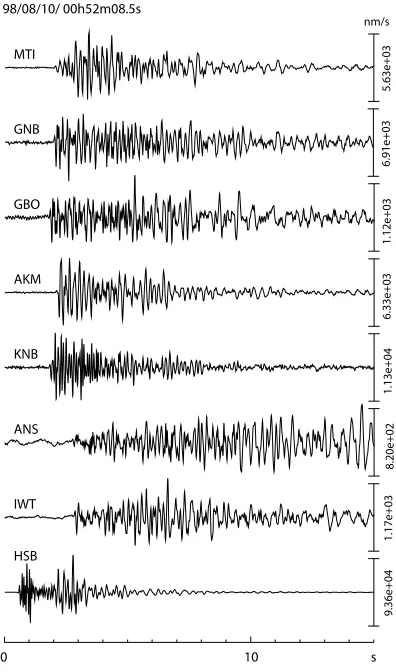
identi-Fig. 3. Vertical velocity seismograms recorded at eight stations for shot 1. The records of broadband seismometer (GNB, MTI) are bandpass filtered from 1 to 16 Hz. The starting time of the seismograms is labeled on the top of the figure.
cal seismic waves, we carefully unified the explosion style except the location of shot points. We used a chemical ex-plosion of 100 kg dynamite embedded at a depth of 30 m for each experiment. However, only for the 3rd experiment in 2000, a source of 200 kg dynamite at a depth of 50 m was used to generate larger seismic waves because the main purpose of the 3rd experiment was the investigation of 3-D seismic structure of Iwate volcano (Tanakaet al., 2002a). Table 1 summarizes information on these six shots.
494 T. NISHIMURAet al.: TEMPORAL CHANGES IN SEISMIC VELOCITY AROUND IWATE VOLCANO
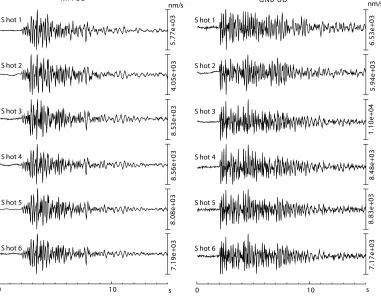
Fig. 4(a). Vertical velocity seismograms at MTI and GNB stations for the six shots.
stations are temporally deployed on the mountain flank to record volcanic earthquakes associated with the activity of Iwate volcano (Nishimuraet al., 2000a; Tanaka et al., 2002b). Two broadband seismometers of STS-2 (Strecke-sen) were installed at MTI and GNB stations, and their sig-nals were digitized at each site with a sampling rate of 0.02 s and an A/D resolution of 24 bit by a portable data logger of LS8000WD (Hakusan Co.). The internal clock (precision is higher than 10−6) was corrected by a GPS clock system
every two hours so that error of the recording time was less than 8 ms. Since the 3rd experiment, signals of the broad-band seismometer at GNB station are continuously digi-tized with a sampling rate of 0.01 s and an A/D resolution of 22 bit by OT4100 (Oki Electronics) and are transmitted to a data acquisition system at RCPEV through a telephone line. Since sampling rates of the signals at GNB station are not the same, we re-sampled the records at a rate of 0.02 s after filtering the seismograms from 1 to 16 Hz for the 3rd to 6th experiments. GNB station is also equipped with a bore-hole three-component short-period (1 s) seismometer at a depth of 300 m. Same borehole seismometers are used at ANS and HSB stations. Three-component short-period (1 s) seismometers are installed at a base on horizontal vault at IWT and AKM stations, and are embedded in soil at KNB station. These signals from short-period seismometers at GNB, ANS, IWT, AKM, HSB and KNB stations are digi-tized with a sampling rate of 0.01 s and an A/D resolution of 12–22 bit, and then the data are transmitted to RCPEV in real time. The code GBO denotes the records of borehole short period seismometer at GNB to discriminate it from the broadband seismograms. We call the six explosions shot 1,
shot 2 and so on.
Figure 3 shows an example of the seismograms of ver-tical component observed at the eight stations for shot 1. The signals of broadband seismometers are bandpass fil-tered from 1 to 16 Hz to eliminate long-period noises. We use three component data at the eight stations for the fol-lowing analysis, but do not use shot 5 data of KNB station and shot 6 data of HSB station, which were not working during the experiments.
4.
Cross Spectrum Analyses
If the seismic velocity of the crustal structure temporally changes for the observation periods, the seismic waves ex-cited by shot 1 are expected to be different in travel time from those by the following five shots. The travel times of first arrivals of each shot may provide us an accurate esti-mate of the seismic velocity, but the time accuracy of MTI station is not enough to resolve a small change (ca. 1%) of the seismic velocity. Therefore, to extract a small differ-ence in travel times of the waveforms for two shots, we ap-ply the cross spectrum moving window technique proposed by Poupinetet al.(1984), by which time difference can be precisely estimated even if absolute recording times are not so accurate. We do not examine the first arrivals of directS wave, becauseSwave is ambiguous.
4.1 Phase change
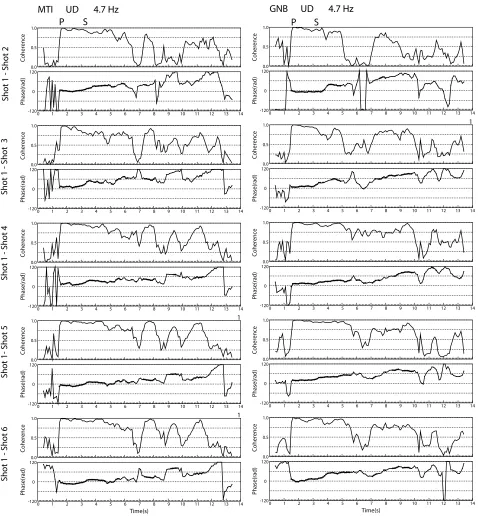
Fig. 4(b). Time sequence of coherence and phase difference of MTI and GNB stations at the frequency of 4.7 Hz. Positive values in phase difference, φ, indicate phase delays in waveform of shot 2–6 to shot 1. The data having coherence larger than 0.75 are marked by small solid circles. Arrival times ofPandS-waves are denoted by symbols ofPandS, respectively, on the top trace for each station. Arrival times ofS-waves are calculated by assumingV p/V s=1.73.
Hz, 5.5 Hz, 6.2 Hz, 7.0 Hz, 7.8 Hz, 8.5 Hz and 9.2 Hz). The waveforms sometimes show low signal to noise ratios below 3 Hz at several stations, so we do not use the fre-quency components lower than 3 Hz. Figure 4(a) shows vertical components of the seismograms recorded at MTI and GNB stations for shots 1–6. The time axes for the six seismograms are adjusted by eye-picked arrival times of ini-tial phase. Time series of coherence and phase difference at 4.7 Hz for the shot 1 data to the other shots are plotted in Fig. 4(b). For both of the stations, the coherences for each pair of the shots show large values of more than 0.75 for
496 T. NISHIMURAet al.: TEMPORAL CHANGES IN SEISMIC VELOCITY AROUND IWATE VOLCANO
Fig. 5. Frequency dependence of the time derivative of phase difference,dφ/dt. Solid circles, squares, and plus symbols representdφ/dtestimated from the data of UD, NS, and EW components, respectively. Fine line is the best fit line for the velocity change at 3–6 Hz that is shown at the bottom right at each panel (see text).
also recognized for horizontal components at these stations (not shown in figure). This result implies that the seismic velocity of the structure at this frequency range decreased for the period between August 1998 (shot 1) and Novem-ber 1998 (shot 2), during which the M6.1 earthquake took
place. The phase differences for the pairs of shots 1–3, 1–4, 1–5 and 1–6 also gradually increase with lapse time.
Fig. 6. Temporal variations of the phase change at 4.7 Hz for the six years from 1998 to 2003. Open circles, squares and plus symbols represent the phase changes of UD, NS EW components, respectively, for the pairs of shot 1 to the other shots. Horizontal lines represent the phase changes estimated for the pairs of consecutive shots. Vertical lines indicate one standard deviation. Time window of 10 s is used for fitting a straight line to the phase changes with lapse time.
(see at about 4 s in Fig. 4(b)) although the phase difference is constant from P-wave toS-wave arrivals. Such changes in phase difference may be related with a localized change of the structure and/or difference of phase types such as P-, S- and surface waves (Poupinetet al., 1996). How-ever, these rapid changes are not systematically found for all pairs of shot 1 to the other shots. Hence, in the present study, we evaluate an average feature of the structure from the waveforms for 10 s from theP-wave arrivals, and mea-sure the time derivative of the phase differences, dφ/dt, by fitting a straight line (hereafter we call dφ/dt phase change). In Fig. 5, the phase changes dφ/dt are plotted for the five pairs of shot 1 to the other shots. For each pair and each station, the phase changes of the three components are shown from 3.1 Hz to 9.2 Hz. The phase changes for the pair of shot 1–2 are generally larger than those for the other pairs (shot 1–3, shot 1–4, shot 1–5, and shot 1–6). Most of the stations show that, at the frequencies less than about 6 Hz, the phase changes almost linearly increases with fre-quency. On the other hand, at the frequencies larger than 6 Hz, the phase changes become constant or even decrease with increasing frequency. Although the mechanism caus-ing such frequency dependence is not known, it is notewor-thy to mention that the phase change (i.e., fractional change of the seismic velocity) of the crust is dependent on the
fre-Fig. 7. Temporal variations of the phase change at 8.6 Hz. The others are the same as Fig. 6.
498 T. NISHIMURAet al.: TEMPORAL CHANGES IN SEISMIC VELOCITY AROUND IWATE VOLCANO
Fig. 9. Temporal variations of the coherence at 3.1, 5.5 and 7.8 Hz. The coherences are calculated for a time window of 10 s from the beginning of
P-wave. Open, square and plus symbols represent the coherences of UD, NS, and EW components, respectively, for the data pairs of shot 1 to the other shots. Horizontal lines represent the coherences for the pairs of consecutive shots.
quency of seismic waves.
Figure 6 shows temporal variations of the phase changes at 4.7 Hz from 1998 to 2003. At MTI, GNB and GBO sta-tions, which are closely located at the northern parts of the M6.1 fault and the spherical volumetric sources (Miuraet al., 2000; Tohoku Univ., 2003), large changes over 10 deg/s (a positive value means an increase ofdφ/dt, i.e., velocity decrease) are found for the pair of shot 1–2. For the pairs of shot 1–3, shot 1–4 and shot 1–5, the phase changes for
each component gradually decrease with small fluctuations. However, for the pair of shot 1–6, the phase changes in-crease again. Most of the other stations show similar trends, but amplitudes of the phase changes are relatively small.
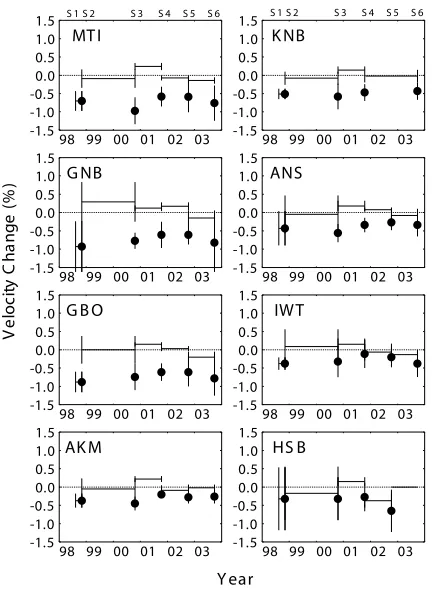
The right and left ends of each horizontal bar indicate the times of the consecutive two shots, and the length of the vertical lines at the ends represent one standard deviation. For shot 2–3, the phase changes are distributed around zero at most of the stations (MTI, KNB, ABO, AKM, HSB), and all data for shot 3–4 show negative phase changes. The phase changes are distributed around zero for shot 4–5 and increase again for shot 5–6. These trends are consistent with the overall features of the results obtained for the pairs of shot 1 to the others: increases of phase changes for shot 1– 2 are gradually recovered by the time of shot 5, and then, small increases are observed again for shot 5–6.
Figure 7 represents temporal variations of the phase change at 8.6 Hz. The characteristics are similar to those at 4.7 Hz, although amplitudes of the changes are smaller compared with the results at 4.7 Hz. It is also recognized that no significant increase is observed at GBO for shot 1– 2 while GNB, which is located at the surface above GBO, indicates a positive phase change. This may imply that shal-low surface structure at this station has different frequency dependence from the structure below.
We calculate the phase changes by using a short time window of 5 s to examine the difference of the wave type (body and surface waves) and the effect of the target region where the wave propagate through. The results show similar characteristics found in the results obtained from analyses using a 10 s time window (not shown in figure). Although a large difference is recognized in the result of GBO for shot 1–2 (the estimated phase change shows a negative value), accuracy of the estimation is not sufficient to discuss the difference in detail.
4.2 Velocity change
Although it is better to examine the temporal variation of the phase change at all of the frequency range, evalu-ation of all of the observed phase changes at once is not easy. In the present study, therefore, we estimate seismic velocity changes of the crust at a low frequency range (3– 6 Hz) from the linear frequency dependence found in the phase changes. The velocity changes are calculated from the relation ofV/V =(2πf)dφ/dt, where f is the fre-quency of the waves and V the averaged velocity in the medium where scattered seismic waves propagate, respec-tively (Poupinetet al., 1984; Nishimuraet al., 2000b). The best fit lines are indicated by a fine line in Fig. 5, and the estimated velocity changes,V/V, are shown at the bot-tom right of each panel. Temporal variations of the velocity changes from 1998 to 2003 are shown in Fig. 8. At MTI, GNB, GBO and KNB stations, a large amount of velocity reduction (over−0.5%) is found for the pair of shot 1–2. The velocity changes at GNB and GBO are estimated to be −0.93% and−0.88%, respectively. The velocity changes at these stations gradually increase for shot 1–3, and reach about−0.6% for shot 1–5. However, a slight decrease of 0.1–0.2% in the velocity change is observed again for shot-1–6. Most of the other stations show the trends similar to GNB and GBO stations, although the velocity changes es-timated at MTI and AKM stations decreased for shot 1–3 (The changes for shot 1–3 are about 0.1–0.2% smaller than those for shot 1–2).
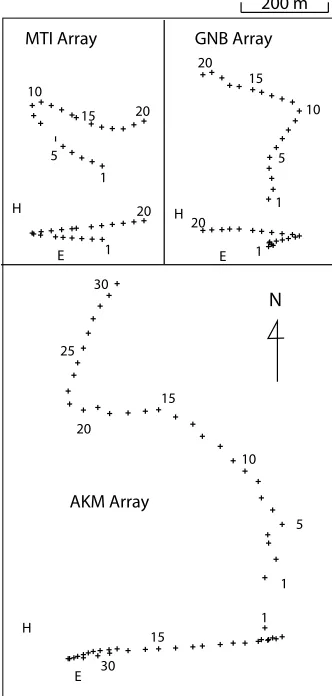
Fig. 10. Configuration of seismic arrays (plus marks) at MTI, GNB, and AKM stations. Map view and vertical cross section in the E-W direction are shown in the upper and lower parts, respectively. Scales and direction of all panels are same.
4.3 Coherence
Figure 9 represents temporal variations of the coherence for the eight stations at 3.1 Hz, 5.5 Hz and 7.6 Hz. The coherences are estimated from the waveform for a 10 s time window beginning from P-wave arrivals. The coher-ences for the pairs of consecutive shots are large compared with those for the pair of shot 1 to the other. This result could be plausible enough if the crustal structure gradually changes with time. It is also found that the coherences grad-ually increase from shot 1–2 to the other pairs with time. These characteristics are qualitatively consistent with the coherence recovery that is reported for waveform analyses of multiplet earthquakes related to the M6.9 Loma Prieta Earthquake (Baish and Bokelmann, 2001). However, in our experiments, all of the stations show similar temporal ten-dency in the coherence, and the shot points are located on the M6.1 fault. So, we cannot distinguish which the main origin of the temporal variations in coherence is, the crustal structure or the seismic source.
5.
Semblance Analysis of Seismic Arrays
500 T. NISHIMURAet al.: TEMPORAL CHANGES IN SEISMIC VELOCITY AROUND IWATE VOLCANO
Fig. 11. Time sequences of the semblance, incident azimuth and slowness of the seismic waves observed at the MTI, GNB, and AKM arrays. Sizes of open circles are proportional to the semblance coefficients. Gray circles in semblance for AKM arrays are the results estimated from 20 seismic stations (no. 10–30 in Fig. 10).
stations. Each of the MTI and GNB arrays consisted of 20 vertical components of short-period (0.5 s) seismometers and recorded the signals from the shots 4 and 5. The AKM
Fig. 12. Spatio-temporal changes of volumetric strains around the M6.1 fault (rectangular of broken lines) and Iwate volcano for the period of shots 1–2, 2–3, 3–4, 4–5, and 5–6. Results at 2.0 km depth are plotted. Red and blue colors represent dilatation and compression, respectively. Contour interval is 0.2 micro strain. Shot point and seismic stations are represented by a star and plus symbols, respectively.
frequency of 250 Hz and an A/D resolution of 16–24 bits by portable data recorders (LS8000SH of Hakusan Co. for GNB and MTI; LS7000 of Hakusan Co. for AKM). The clock of each data logger was corrected by GPS signals just before each explosion, so that the sampling difference between stations were negligibly small (<1 ms).
We apply a semblance method (Neidell and Taner, 1971) to these seismic array data to clarify the wave property. For each array data set, semblance, slowness, and incident az-imuth as a function of time are calculated at the frequency of 3–6 Hz by shifting a time window every 0.1 s from the be-ginning. Length of the time window is set at 1 s. Height cor-rection of each seismometer is made by assuming a surface structure with a velocity of 2.0 km/s. Figure 11 shows time functions of the maximum semblance coefficients obtained for each time window. Results of the MTI and GNB arrays are shown for the data of shot 5. Slowness and azimuth of the wave whose semblance coefficient is more than 90% of the maximum semblance coefficient for each time window are plotted. For the GNB array, large semblance coefficients are observed for theP-wave that is followed by coda waves having semblance coefficients larger than 0.4. The incident azimuth of the P-wave is consistent with the back azimuth (216 deg), and the slowness of P-wave is estimated to be 0.2–0.4 s/km. The incident azimuth does not change for about 3 s beginning from the P-wave arrival. After theS -wave arrival, the incident azimuth seems to slightly shift to the south-west (azimuth is about 240 deg), and the
502 T. NISHIMURAet al.: TEMPORAL CHANGES IN SEISMIC VELOCITY AROUND IWATE VOLCANO decrease the effect of spatial intervals of the seismometers,
show similar features in the MTI and AKM arrays. These observations imply that the low semblance coefficients ob-served at the AKM and MTI arrays are not caused from seismic array configurations.
The observed incident azimuth of the P-wave at the AKM array is almost consistent with the geometrical back azimuth, but that of the MTI array shifts about 45 degree west of the back azimuth. This inconsistency found at the MTI array seems to originate from height difference of the station locations, and may be improved if we use appropri-ate seismic velocity beneath the arrays. But the difference does not affect the following discussion.
We calculate semblance coefficients for the shot 4 data of the GNB and MTI arrays, and the results are quite similar to those mentioned above.
6.
Discussion
6.1 Comparison of seismic velocity changes with spatio-temporal changes in volumetric strains around the M6.1 fault and Iwate volcano
By using the M6.1 fault model of Miura et al. (2000) and the spatio-temporal distributions of the volcanic pres-sure sources from 1998 to 2002 by Tohoku Univ. (2003), we calculate volumetric strains around the M6.1 fault and Iwate volcano. We further estimate volumetric strains in 2003 by analyzing the geodetic data with same method. Fig-ure 12 shows spatial distributions of the volumetric strain at a depth of 2 km for the period from 1998 to 2003. Red and blue colors denote dilatation and compression, respec-tively. For the period from August 1998 to November 1998 (shot 1–2), the M6.1 earthquake took place to release the stress, and the volcanic pressure sources inflated the west-ern part of Iwate volcano. As a result, dilatation in the crustal structure is observed mainly at the eastern and west-ern regions of the fault while compression is caused at the south of the fault and the north of the volcano. It is found that the stations indicating large amplitude of velocity de-creases (GNB, GBO, MTI) are near to strongly dilated re-gions. For the period from November 1998 to 2000 (shot 2–3), only the spherical volumetric source was active. Ac-cordingly, the dilated regions are concentrated at the west-ern part of the volcano where MTI and GNB stations are located at. For the periods from 2000 to 2002 (shots 3–5), the spatial distributions of the volumetric strains are almost same except that the polarity is reversed from dilatation to compression; the stations close to the western part of the volcano (MTI and GNB) are located on the compression re-gions while the other stations are on slightly dilated rere-gions. In these periods (shot 2–5), slight increases of the velocity changes are observed at most of the stations. From 2002 to 2003, small decreases are detected again at most of the sta-tions. These decreases may be attributed to a small seismic swarm accompanying a small crustal deformation occurred at the northern flank of Akita-Komagatake volcano during June 2003 (Uekiet al., 2004). However, the activity was too small to change the tendency of the spatial distribution of the volumetric strains beginning from 2000.
The velocity changes observed for shot 1–2 are well matched with the spatial patterns of the volumetric strain.
However, the velocity changes observed for the following period are not completely matched with the predicted volu-metric strains. This is probably because the strain changes observed after shot 2 are quite small in amplitude for most of the stations except MTI and GNB stations. As for GNB station, the coda waves always come from the structure be-neath the M6.1 fault which show a weak compression at shallow parts. Hence, the detected velocity changes come to be not so affected by the deformation field close to the spherical volumetric sources. And also, the calculated de-formation field may not include the regional stress, which is caused by, for example, the Pacific plate motion that com-presses the Tohoku District in E-W direction (Miuraet al., 2002) because the geodetic measurements (Miura et al., 2000; Tohoku Univ., 2003) were concentrated around Iwate volcano.
6.2 Sensitivity of velocity change to stress loading
So far, we have qualitatively compared the velocity changes with the strain field around the M6.1 fault and Iwate volcano. Although it is not easy to exactly know where the coda waves observed at each station propagate in the crust, we suppose in the present study that the coda waves mainly consist of the waves propagating in a re-gion surrounded by a scattering shell (e.g., Sato and Fehler, 1998). Location of the scattering shell (x,y,z) can be de-termined from the location of station and shot point, lapse time, and an effective seismic velocity, which satisfy the following equation:
(x−xs)2+(y−ys)2+(z−zs)2
+(x−xe)2+(y−ye)2+(z−ze)2=VeT (1)
wherexs,ys,zsare the location of station,xe,ye,zeare the location of shot point, is the effective seismic velocity and T is the lapse time. Large effective velocity implies that coda waves propagate in a large volume and arrive at the station from various directions. On the other hand, small effective velocity suggests that coda waves mainly come from a direction of the source, as is observed at the GNB array, so that the scattering shell becomes small. This may be interpreted as that the former case is a representation that single scattering is dominant and/or the coda waves mainly consist of body waves, whereas the latter case corresponds to that multiply scattered waves and/or surface waves are dominant in the coda waves.
Table 2. Theoretical volumetric strains in the crust due to tidal loading at the time of the six artificial explosions. Volumetric strains are calculated by using GOTIC2 program (Matsumoto, K.et al., 2001).
Shot Volumetric Strain whereis the volumetric strain. For the eight stations, the strain sensitivity is estimated to be −0.0014 to −0.011 / micro strain, most of which are ranging from −0.004 to −0.008/micro strain. Assuming a bulk modulus of 5×10¹⁰ Pa, we estimate the stress sensitivity of the velocity change, 1/V(d V/dσ), to be 0.03 to 0.2 /MPa, whereσis the stress. The effective seismic velocities are estimated to be 1.2 km/s for GNB and GBO stations, while 1.8 km/s and 1.5 km/s for MTI and AKM stations. Since smaller effective seis-mic velocity reflects a small scattering shell, these results are consistent with the results obtained from our semblance analyses.
So far, the seismic velocity changes at the low frequency of 3–6 Hz have been discussed. Since the observed phase changes at the high frequency (6–9 Hz) are equal to or smaller than those at the lower frequency (3–6 Hz), the stress sensitivities at 6–9 Hz come to be smaller than 0.03– 0.2 /MPa.
6.3 Effect of tidal loading
Seismic velocity changes of the crust have been often discussed in terms of temporal changes of the stress field caused by the tidal loadings. Reasenberg and Aki (1974) es-timated the stress sensitivity of velocity change in the rock to be 2.0 /MPa from analyses of the seismic wave (probably Rayleigh wave of about 30 Hz) propagating over a distance of 200 m. Recently, Yamamuraet al.(2003) accurately es-timated the pressure sensitivity of P-wave velocity at about 100 Hz in natural rocks to be 0.5 /MPa from a 1-year con-tinuous measurement of rocks across a distance of 12 m in a vault by using a piezoelectric transducer. Furumotoet al. (2001) also obtained 1 /MPa for the pressure sensitivity of velocity changes in the crust from the arrival time data of initial phase (P-wave) of 10-years artificial explosions at stations in Tokai area, Japan. As summarized in table 1 of Yamamuraet al.(2003), the stress sensitivities of velocity change are ranging from 5×10⁻³ to 2 /MPa. It is noted
that these sensitivities are obtained at different fields, dif-ferent frequency bands and/or difdif-ferent wave types. Table 2 shows volumetric strains at the south of Iwate volcano due to the tidal loading for shots 1–6, which are calculated by
Fig. 13. Comparison of the average volumetric strains with the observed seismic velocity changes. The data are shown by solid circles with error bars (one standard deviation). Unit of horizontal axis is micro strain. Solid lines represent the best fit lines estimated by least squares method. The effective seismic velocity in km/s and the strain sensitivity of velocity change (km/s/micro strain in percentage) are shown on the top right and bottom right in each panel indicate, respectively.
the GOTIC2 program (Matsumoto, K.et al., 2001). Dif-ferences of the volumetric strains between each pair of two shots are ranging from−2.1×10⁻⁸to 2.9×10⁻⁸so that the stress difference are estimated to be from−1.1×10³ Pa to 1.4×10³ Pa on the assumption of a bulk modulus of 5×10¹⁰ Pa. If we assume a pressure sensitivity of 0.2 /MPa, the velocity changes caused by the tidal strains are estimated to be less than±0.02%. Even if we use 1 /MPa, the tidal effects are too small to drastically change the ob-served temporal variations in the velocity change shown in Fig. 8.
6.4 Origins of the velocity changes in crustal structure
504 T. NISHIMURAet al.: TEMPORAL CHANGES IN SEISMIC VELOCITY AROUND IWATE VOLCANO water condition in the crust may be another candidate for
the case of Iwate volcano. For example, as water-saturated rock changes its internal condition from vapor-saturated to liquid-saturated, the compressional velocity increases and shear wave velocity decreases (Ito et al., 1979). At the Geyser geothermal site, temporal changes of V p and V s measured by 4D tomography are explained by water deple-tion process (Gunasekeraet al., 2003). Especially at MTI, GNB, and GBO stations, the observed velocity changes might have been caused by hot-waters induced by the vol-canic pressure sources. However, seismic velocity changes are widely detected at the other stations such as AKM and IWT, which are far from the volcanic pressure sources of Iwate volcano. Therefore, we infer that the main origins of the observed velocity changes are caused from the stress changes, which may be related with crack openings and clo-sure in the crust.
The recovery rate of crustal structure around Iwate vol-cano is smaller than those of the Landers, Loma Prieta, and Hyogo-ken Nanbu earthquakes. While these regions have almost completed the recovery within a few to 5 years, only less than a half of the velocity changes has been recov-ered around the M6.1 fault for the five years (e.g.,−0.9% to−0.6% for GNB station). Such slow recovery may re-flect regional deformation fields at the target fields. For example, geodetic data collected during the past 100 years shows that the Tohoku district, in which Iwate volcano is lo-cated, is under extension (Ishikawa and Hashimoto, 1999). On the other hand, the shear strain rate deduced from the recent GPS measurement indicate that Hyogo-ken Nanbu earthquake is placed on a strong deformation field called as the Niigata-Kobe Tectonic Zone (Sagiyaet al., 2000). Such difference in strain rates suggests that the recovery of the crustal structure is controlled by the stress condi-tion around the target region. However, as pointed out by Ishikawa and Hashimoto (1999), it is necessary to note that the deformation field obtained from the 100 years data is not matched with that by recent GPS measurements at sev-eral areas. Crack orientations may another candidate to con-trol the recovery process, as Tadokoro and Ando (2002) re-cently attributed fault healing process to crack closure due to regional stress at Hyogo-ken Nanbu earthquake. When crack orientation is perpendicular to the maximal strain axis, crack closures are expected to be delayed.
One of the most important results in the present study is the frequency dependence found in the velocity change (fractional change of seismic velocity). Similar frequency dependence on temporal change of seismic wave is re-ported in coda Q analyses. Sato et al. (1988b) reported that log(Q−1
c f)at frequency of 5 Hz took lower value in the three-year period preceding the ML = 5.2 earthquake at Garum, Central Asia, while such changes are not so well recognized at higher frequency ranges. Sato (1988a) sum-marized that temporal changes are often found in the waves at low frequency range (2–6 Hz), and Baish and Bokelmann (2001) mentioned that coherency changes in seismic waves seem to be significant at lower frequency range of less than 8 Hz. These results and our result strongly suggest an ex-istence of frequency dependent characteristics in fractional changes of the seismic wave velocity in the crust.
7.
Summary
We have shown remarkable temporal changes in the seis-mic velocity of the crust around the M6.1 fault and Iwate volcano, by measuring the phase difference in the seismic waves excited by six artificial explosions. The seismic ve-locity of the crust decreased by about 1% in 1998, and the origins are considered to be dilatation in the crust which is caused by the M6.1 earthquake and the volcanic pressure sources of Iwate volcano. About one third of the reduc-tion in seismic velocity is gradually recovered by the mid-dle of 2002, but seismic velocity decrease is observed again in 2003. Volumetric strain fields predicted for these peri-ods are not completely matched with the velocity changes, although regional tectonic stress field may explain the in-consistency. It should be noted that the observed fractional changes in the seismic velocity indicate frequency depen-dent characteristics: the velocity changes are almost con-stant at the low frequency range (3–6 Hz) while the magni-tude of the velocity changes decreases with frequency at the high frequency range (6–9 Hz).
Acknowledgments. The authors are grateful to the Research Group for Inland Earthquakes, the Research Group for Explo-sion Seismology and the Research Group for the Volcano Seismic Exploration, which organized three active seismic experiments in 1998 and 2000. The authors thank Iwate Prefecture and the local authorities around Iwate volcano for helping the survey. Tempo-ral observations of our active seismic experiments are supported by Koichi Nida, Ayako Nakamura, Yosuke Nagahama and many students of the Solid Earth Physics Laboratory of Tohoku Univer-sity. The authors also thank two anonymous referees for their care-ful reviews. Permanent seismic stations around Iwate volcano are maintained by the Research Center for Prediction of Earthquakes and Volcanic Eruptions, Tohoku University. This study was partly supported by a Grant for Scientific Research from MEXT (No. 13440128).
References
Baish, S. and G. H. R. Bokelmann, Seismic waveform attributes before and after the Loma Prieta earthquake: Scattering change near the earthquake and temporal recovery,J. Geophys. Res.,106, 16323–16337, 2001. Doi, N., Change of surface volcanic phenomena at the West Iwate volcano
from march, 1999 to May, 2001, Report of Coordinating Committee for Prediction of Volcanic Eruptions, 79, 44–48, 2002 (in Japanese). Earthquake Information Center, University of Tokyo, EIC Seismological
Note, No. 50, 1998 (in Japanese).
Furumoto, M., Y. Ichimori, N. Hayashi, and Y. Hiramatsu, Seismic wave velocity changes and stress build-up in the crust of the Kanto-Tokai region,Geophys. Res. Lett.,28, 3737–3740, 2001.
Geographical Survey Institute, Crustal deformations of Mt. Iwate and its surrounding area, Report of Coordinating Committee for Prediction of Volcanic Eruptions, 82, 17–20, 2003 (in Japanese).
Gunasekera, R. C., G. R. Foulger, and B. R. Julian, Reservoir de-pletion at the Geysers geothermal area, California, shown by four-dimensional seismic tomography,J. Geophys. Res.,108, doi:10.1029/ 2001JB000638, 2003.
Hiramatsu, Y., N. Hayashi, M. Furumoto, and H. Katao, Temporal chages in codaQ-1 and b value due to the static stress change associated with the 1995 Hyogo-ken Nanbu earthquake,J. Geophys. Res.,105, 6141– 6151, 2000.
Ishikawa, N. and M. Hashimoto, Average horizontal crustal strain rates in Japan during interseismic period deduced from geodetic surveys (Part 2),Bull. Seism. Soc. Jpn,52, 299–315, 1999 (in Japanese with English abstract).
Ito, H., J. D. Vilbiss, and A. Nur, Compressional and shear waves in sat-urated rock during water-steam transition,J. Geophys. Res.,84, 4731– 4735, 1979.
Chikyu,21, 307–311, 1999 (in Japanese).
Li, Y. G., J. E. Vidale, K. Aki, F. Xu, and T. Burdette, Evidence of shal-low fault zone strengthening after the 1992 M7.5 Landers, California, earthquake,Science,279, 217–219, 1998.
Matsumoto, K., T. Sato, T. Takanezawa, and M. Ooe, GOTIC2: A program for computation of oceanic tidal loading effect,J. Geod. Soc. Japan,47, 243–248, 2001.
Matsumoto, S., K. Obara, K. Yoshimoto, T. Saito, A. Ito, and A. Hasegawa, Temporal change in P-wave scatterer distribution associated with the M6.1 earthquake near Iwate volcano, northeastern Japan,Geophys. J. Int.,145, 48–58, 2001.
Matsushima, J., T. Yokota, Y. Okubo, S. Rokugawa, K. Tanaka, T. Tsuchiya, N. Narita, and K. Tani, Repeated seismic reflection measure-ments in the Kakkonda geothermal field,J. Volcanol. Geotherm. Res., 129, 343–356, 2004.
Miura, S., S. Ueki, T. Sato, K. Tachibana, and H. Hamaguchi, Crustal deformation associated with the 1998 seismo-volcanic crisis of Iwate Volcano, Northeastern Japan, as observed by a dense GPS network,
Earth Planets Space,52, 1003–1008, 2000.
Miura, S., T. Sato, K. Tachibana, Y. Satake, and A. Hasegawa, Strain accumulation in and around Ou Backboe Range, northeastern Japan as observed by a dense GPS network,Earth Planets Space,54, 1071–1076, 2002.
Nakahara, H., T. Nishimura, H. Sato, M. Ohtake, S. Kinoshita, and H. Hamaguchi, Broad-band source process of the 1998 Iwate Prefecture, Japan, earthquakes as revealed from inversion analyses of seismic wave-forms and envelopes,Bull. Soc. Seismol. Am.,92, 1708–1720, 2002. Nakamichi, H., H. Hamaguchi, S. Tanaka, S. Ueki, T. Nishimura, and A.
Hasegawa, Source mechanisms of deep and intermediate-depth low-frequency earthquakes beneath Iwate volcano, northeastern Japan, Geo-phys. J. Int.,154, 811–828, 2003.
Nakamura, A., A. Hasegawa, N. Hirata, T. Iwasaki, and H. Hamaguchi, Temporal variations of seismic wave velocity associated with 1998 M6.1 Shizukuishi earthquake,Pure. Appl. Geophys.,159, 1183–1204, 2002.
Neidell, N. S. and M. T. Taner, Semblance and other coherency measures for multi-channel data,Geophysics,36, 482–497, 1971.
Nishimura, T., H. Nakamichi, S. Tanaka, M. Sato, T. Kobayashi, S. Ueki, H. Hamaguchi, M. Ohtake, and H. Sato, Source process of very long pe-riod seismic events associated with the 1998 activity of Iwate Volcano, northeastern Japan,J. Geophys. Res.,105, 19135–19147, 2000a. Nishimura, T., N. Uchida, H. Sato, M. Ohtake, S. Tanaka, and H.
Ham-aguchi, Temporal changes of the crustal structure associated with the M6.1 earthquake on September 3, 1998, and the volcanic activity of Mount Iwate, Japan,Geophys. Res. Lett.,27, 269–272, 2000b. Poupinet, G., W. L. Ellsworth, and J. Frechet, Monitoring velocity
varia-tions in the crust using earthquake doublets: An application to the Calav-eras fault, California,J. Geophys. Res.,89, 5719–5731, 1984. Poupinet, G., G. A. Ratdomopurbo, and O. Coutant, On the use of
earth-quake multiplets to study fractures and the temporal evolution of an active volcano,Annali di Geophysica,36, 253–264, 1996.
Ratdomopurbo, A. and G. Poupinet, Monitoring a temporal change of seismic velocity in a volcano: application to the 1992 eruption of Mt. Merapi (Indonesia),Geophys. Res. Lett.,22, 775–778, 1995.
Reasenberg, P. and K. Aki, A precise, continuous measurement of seismic velocity for monitoring in situ stress,J. Geophys. Res.,79, 399–406, 1974.
Sagiya, T., S. Miyazaki, and T. Tada, Continuous GPS array and present-day crustal deformation of Japan,Pure Appl. Geophys.,157, 2303– 2322, 2000.
Saiga, A., Y. Hiramatsu, T. Ooida, and K. Yamaoka, Spatial variation in the crustal anisotropy and its temporal variation associated with a moderate-sized earthquake in the Tokai region, central Japan,Geophys. J. Int., 154, 695–705, 2003.
Sato, H., Temporal change in scattering and attenuation associated with the earthquake occurrence—A review of recent studies on coda waves,
PAGEOPH,126, 465–497, 1988a.
Sato, H., A. M. Shomahmadov, V. I. Khalturin, and T. G. Rautian, Tem-poral changes in spectral coda attenuation Qc-1 associated with the K=13.3 earthquake of 1983 near Garum, Tadjikistan region in Soviet Central Asia,Bull. Seismo. Soc. Jpn.,41, 39–46, 1988b (in Japanese with English abstract).
Sato, H. and M. Fehler,Seismic Wave Propagation and Scattering in the Heterogeneous Earth, AIP Press/Springer-Verlag, New York, pp. 308, 1998.
Tadokoro, K. and M. Ando, Evidence for rapid fault healing derived from temporal changes in S wave splitting,Geophys. Res. Lett.,29, 10.1029/2001GL013644, 2002.
Tanaka, S., H. Hamaguchi, T. Nishimura, T. Yamawaki, S. Ueki, H. Nakamichi, T et al., Three-dimensional P-wave velocity structure of Iwate volcano, Japan from active seismic survey,Geophys. Res. Lett., 29, 10.1029/2002GL014983, 2002a.
Tanaka, S., H. Hamaguchi, S. Ueki, M. Sato, and H. Nakamichi, Migration of seismic activity during the 1998 volcanic unrest at Iwate volcano, northeastern Japan, with reference to P and S wave velocity anomaly and crustal deformation,J. Volcanol. Geotherm. Res.,113, 399–414, 2002b.
Tohoku Univ., Seismic activity and crustal deformation at Iwate Volcano in the period from June 2001 to September 2002, Report of Coordinating Committee for Prediction of Volcanic Eruptions, 83, 6–13, 2003 (in Japanese).
Uchida, N., T. Nishimura, K. Yoshimoto, H. Nakahara, H. Sato, M. Ohtake, S. Tanaka, and H. Hamaguchi, Temporal change of seismic-wave ve-locity associated with the 1998 northern Iwate prefecture, Japan, earth-quake,Bull. Seism. Soc. Jpn.,55, 193–206, 2002 (in Japanese with En-glish abstract).
Ueki, S., S. Tanaka, and M. Sato, Seismic activity and crustal deforma-tion in and around Akita-komagatake and Iwate volcanoes, possibly triggered by Off-Miyagi EQ, Abstracts 2004 Japan Earth and Planetary Science Joint Meeting, V055-011, 2004.
Umino, N., T. Okada, A. Nakamura, J. Nakajima, T. Sato, S. Hori, T. Kono, K. Nida, S. Ueki, T. Matsuzawa, A. Hasegawa, and H. Ham-aguchi, Aftershock distribution for the M6.1 earthquake of 3 September 1998 in Shizukuishi, Iwate prefecture, northeastern Japan,Active Fault Research,17, 1–8, 1998 (in Japanese with English abstract).
Yamamura, K., O. Sano, H. Utada, Y. Takei, S. Nakao, and Y. Fukao, Long-term observation of in situ seismic velocity and attenuation,J. Geophys. Res.,108, doi:10.1029/2002JB002005, 2003.