R E S E A R C H
Open Access
Security to wireless sensor networks
against malicious attacks using Hamming
residue method
Majid Alotaibi
Abstract
Wireless sensor networks (WSNs) consist of small sensor nodes with limited energy. Such nodes have the ability to monitor the physical conditions and communicate information among the nodes without the requirement of the physical medium. WSNs are autonomous and are distributed in space. Due to the absence of central authority and random deployment of nodes in the network, WSN is prone to security threats. Well-known attacks in WSN are a malicious attack (such as compromised node imitating as one of the network nodes, misleading other nodes). In the art of work, various methods are developed to overcome these attacks either by cryptographic approaches or by time synchronization. But these methods may fail because of WSN autonomous structure. In this paper, an efficient approach called Hamming residue method (HRM) is presented to mitigate the malicious attacks. The
experimental results validate the presented approach.
Keywords: WSN, Malicious attacks, Rival nodes, PDR, NS2, Hamming residue method
1 Introduction
Wireless sensor networks have self-dependent sensor nodes distributed in the space which are easily deploy-able in adverse conditions to monitor the environmental conditions such as noise, temperature, and pressure. These nodes are capable of transferring the data from one node to another without any physical medium. To transfer the data from source to destination, the source node can directly interact with the destination node or may interact with the router nodes which act as an inter-face between source and destination nodes. Such net-work with router nodes is known as multi-hop networks. WSN provides a gateway which acts as an interface between end user to process the data transmit-ted by the sensor nodes. Such type of networks poses some limitations. As the nodes are widely spread, WSNs are exposed to various malicious attacks such as the ma-licious node can easily enter into the network and the rival node masked as one of the network nodes, mis-guiding the other nodes present in the network and net-work congestion. Due to a huge number of nodes
present in WSN, security must be given at different levels, which is complicated.
In the art of work, the research provides different ap-proaches to secure the communication in WSN. Crypt-ography is one of the common solutions for providing security. In this method, the key is distributed among the nodes either in symmetric or in asymmetric fashion. However, the asymmetric distribution of key requires more cost with less speed. In symmetric key distribution, key distribution is complicated as the key should be transmitted before the message. So, to reduce the com-plexity and eliminate the key distribution among the nodes, a simple and effective method is proposed which is called the Hamming residue method (HRM). The pro-posed technique enhances the security of the network against malicious attacks and improves the efficiency of the network. In this approach initially, a codeword is be-ing generated by the use of defined initial security bits (user choice) and security check bits (Hamming bits). After which, quadratic residue technique is being employed to enhance the security at various hops. Using IPV6, the information regarding the HRM is stored in the header and if the code matches with the code gener-ated by the intermediate node, then it can access the
Correspondence:[email protected]
Department of Computer Engineering, College of Computer and Information Systems, Umm Al Qura University, Makkah, Saudi Arabia
data; if not, the node is considered to be an attacker node.
The rest of the paper is organized as follows: Section2
gives the methodology of the presented approach; in Section 3, related work is presented; the proposed ap-proach is discussed in Section 4; Section 5 presents the simulation results; and conclusion is being presented in Section6.
2 Method
In the presented approach, an efficient security method-ology is proposed by the implementation of Hamming residue method. For simplicity, Hamming code as (7, 4) is chosen along with the quadratic residues of 7 to im-provise the security. However, one can choose any
Ham-ming code and residues based on the network
requirements. The entire technique is stored in IPV6 packet header such that all the non-malicious nodes will produce the security code within the specified time to live (TTL). However, it will take more time than TTL for malicious nodes to analyze the security code gener-ation technique. Hence, this method can easily detect the rival node, improving the packet delivery ratio (PDR) and reducing the delay in the network. This method pro-vides the security to WSNs against the malicious attacks without any key distribution mechanism.
3 Related work
WSNs have several security issues; the present literature addresses these issues with different models and tech-niques. Various attacks in the sensor networks, their re-medial measures, and future perspective are discussed in [1,2]. Roberto et al. [3] proposed a beneficial method to mitigate simple attacks in WSN. It mainly concentrates on unattended WSNs (UWSNs) in which the central au-thority is not present for long time periods. Laurent and Virgil [4] presented an approach in which the key is dis-tributed by using random probability.
Delay attacks in WSN can be avoided with the help of two methods given by Song et al. [5], one is generalized extreme Studentized deviate (GESD) algorithm to detect the malicious node and the other is based on preset value to filter out such nodes. The method proposed by Tao et al. [6] mainly focuses on the compromised node and DoS attack by designing multi-path random routing algorithm. The approach presented by Xiaojiang et al. [7] discusses an effective security technique for coopera-tive sensing nodes by time synchronization using the strength of high end sensors. But cooperation between the nodes may be difficult due to lack of centralized au-thority. In [8–10], the authors discuss confidential key sharing methods to establish a session of communication in the network and to avoid problems caused by the compromised node.
Sengar and Bhardwaj [11] discussed applications of WSN and various attacks (such as active and passive at-tacks) incorporated with it. They also discuss the im-portance of trust and fairness of the data transferred from source to destination. The approach proposed by Tang et al. [12] presents a secure routing algorithm with a selection of the shortest path and deterministic strat-egies to normalize the power consumption, and supports different routing methods to secure the data. However, this strategy may fail as the energy of the node is not considered which is the main constraint in WSNs. Rashmi and Archana [13] proposed a model in which dynamic multi-level priority (DMP) for scheduling the packets with bit rate categorization and Rivest cipher 6 (RC6) algorithm is used for providing security to WSN.
The approach presented by Jiye Kim [14] develops a session key concept for cluster networks by using elliptic curve Diffie-Hellman (ECDH) for exchanging the keys, and improves the security in WSNs. A method pre-sented by Pawani et al. [15] discusses a keying technique for the Internet of Things (IoT) applications in WSNs. They developed a PAuthkey to provide secured channels to the end users. However, the distribution of key itself is a complex task as the network is dynamic in nature. In the presented approach, Hamming residue model is used to secure the WSNs from the malicious attacks. The rival nodes causing such attacks can be easily de-tected and are removed from the network. Jalal et al. presented [16] to secure the MANET using block cod-ing; however, the presented approach is very much com-plex and increases delay, which in turn decreases PDR.
4 Proposed approach
“Wm”ismth bit of“W,”m =1, 2, 3...n
If the number of initial security bits isk, then the pos-sible initial security bits matrix block“SB” is represented as
SB¼
S11 S12⋯S1k
S21 S22⋯S2k
………
Sq1 Sq2⋯Sqk 0
B B @
1 C C
A ð2Þ
where Sab represents the element ofath row and bth column, q= 2k= total number of rows, and k= total number of columns in SB.
In this approach, (7, 4) Hamming code is used to gen-erate the security codeword “W.” However, one can se-lect the Hamming code according to the desired initial security bits and security codeword length. Here, initial security bits are 4 and the possible initial security bits matrix block is (i.e., 0–15 represented in binary bits)
SB¼
0 0 0 0 0 0 0 1 0 0 1 0
::……
1 1 11
0 B B B @
1 C C C
A ð3Þ
Here, in the presented approach, the initial security bits at source node are 0 0 0 0 (i.e., hop 0), so at hop 1,
security bits are 0 0 0 1 so on till hop 15 as the proposed approach is designed up to 15 hops only. Thus, simply one can say that the initial security bits are binary equivalent of hop number.
Initial Security bits¼hop number represented in a binary systemð Þ
After obtaining the initial security bits, the security check bits are added to them. These check bits are gen-erated by multiplying and performing modulo 2 addi-tions of the initial security bits with the security matrix as represented in Eq.4
SC¼SSPm ð4Þ
whereSPmis (k×p) security matrix represented as
SPm¼
l11 l12 ⋯l1p
l21 l22⋯l2p
……… Lk1 lk2⋯kkp 0
B B @
1 C C
A ð5Þ
where “lrf” represents the element ofrth row and fth column.
The security matrix is the parity matrix of (7, 4) Ham-ming code which is obtained either from its parity check matrix or from its generator matrix. These two matrices are already defined for the Hamming codes. In the
presented model, the SPm is common to all the source nodes in the network and is defined as
SPm ¼
1 1 0 0 1 1
1 1 1 1 0 1
0 B B @
1 C C A
For example, at source node, the initial security bits are (0 0 0 0); hence, the security check bits are
SCh0¼Sh0SPm¼½0 0 0 0
1 1 0 0 1 1
1 1 1 1 0 1
0 B B @
1 C C A
¼ð0 0 0Þ
where SChrare the check bits atrth hop
Shrare the security bits atrth hop,r= 0, 1, 2, 3…. Hence, the security codeword at the source node is obtained by appending SC 0 to the security bits of the source node and can be represented as
Wh0¼S1 S2 S3 S4 C1 C2 S3¼0 0 0 0 0 0 0
where W ris the security codeword at hop r, r= 0, 1, 2,….
After evaluating the security codeword, the quadratic residue is used to provide additional security as only Hamming codes may not be efficient to provide the de-sired security to WSNs. Quadratic residues are user-defined, secure, easy to implement, and are readily available. In this approach, the residue of 7 is considered, as the length of security codeword obtained is 7 and covers maximum bits in the security codeword to en-hance the security. Residues of 7 are 1, 2, and 4; here, in the presented approach, these bit positions (i.e., 1, 2, and 4) are complemented in the codeword. So, the generated final security codeword can be represented as
Rw0¼1 1 0 1 0 0 0
where“Rw0” is the final security codeword (after com-plementing residue positions in W 0) at the rth hop. Apart from synchronization of the final security code-word, the packet delivery ratio (PDR) (see Eq. 6) of the nodes is continuously being monitored. If PDR value is
acceptable, only then that the data is transferred, and if it is beyond the acceptable limit, data is not passed fur-ther. In similar fashion, this process continues until the destination node.
PDR¼No:of R:P=No:of T:P ð6Þ
where R.P is the received packets and T.P is the trans-mitted packets
4.1 Node matching process
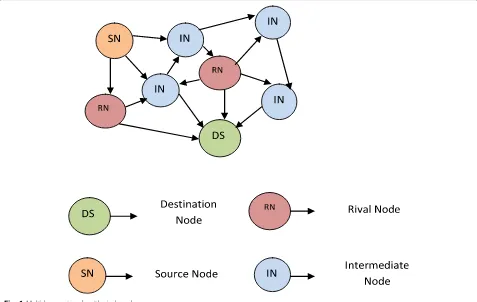
Figure 1 depicts a multi-hop network in which the source node communicates with the destination node through intermediate nodes. The source node sendsRw0 to all its neighboring nodes which are one hop away from the source node. The required operation at various hops is discussed in Sections4.1.1and4.1.2.
4.1.1 At hop 1
The initial security bits are 0 0 0 1; the security check bits are generated by multiplying these bits with
Ch1¼¼Sh1SPm
1 0 1
ð Þ
And the codeword at hop 1 can be evaluated as below
Wh1¼0 0 0 1 1 0 1
Complementing the residue (of 7) positions (i.e., first, second, and fourth positions) in Wℎ1, the final security codeword at hop 1 is represented as
Rw1¼1 1 0 0 1 0 1
If the neighboring node sendsRw1 as an acknowledge-ment to the source node and its PDR value is acceptable,
then the source node will transfer the original data to that neighboring node. The acknowledgement should not exceed the provided time to live (TTL). Now, this neighboring node becomes the source node for other nodes in the network and transmitsRw1 to its neighbor-ing nodes.
4.1.2 At hop 2
The security bits are 0 0 1 0, and the check bits are
Ch2¼Sh2SPm ¼ð1 1 1Þ
Wh2¼0 0 1 0 1 1 1
Complementing the residue positions inWℎ2, the final security codeword at hop 2 can be calculated as
Rw2¼1 1 1 1 1 1 1
If the source node is acknowledged with Rw2, then it will pass the data to the node from which it has received the acknowledgement. If not, the node is considered to be a rival node and the data is not transmitted to that
Table 1Parameters for simulation
Parameters Values
Node count 2 to 150
Simulation period 70 s
Layer Logical link
Antenna used Omni directional
Type of queue Drop tail
MAC 802.11
Data VBR
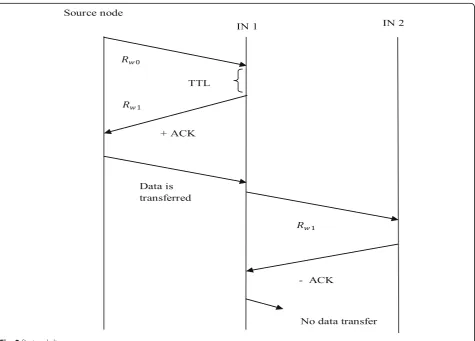
node. This process is continued till the information or data is received by the destination node. This process can be easily understood by using protocol diagram (see Fig. 2). As the security codeword is changed at every hop and becomes very difficult to the rival nodes to mis-lead the active node in the network, so the presented ap-proach not only improves the authentication of the active node but also gives more confidentiality to end nodes by designing multiple codewords in the network. From Fig.2, it is observed that the data is transferred to intermediate node 1 (IN1) from the source node as it gives the positive acknowledgment (+ACK), i.e., 1, to the source node. Once the data is received by IN1, it acts as the source node for its neighboring nodes and transmits 1 to them. The data is not transferred to intermediate node 2 (IN 2) as it gives negative acknow-ledgement (−ACK) to IN1, hence considered to be a rival node.
5 Simulation results
The presented approach is validated by simulating the results using Network Simulator 2 (NS2) [17] and com-paring this approach with the approach that already ex-ists. Table 1 represents different parameters which are considered for simulation. The node count is taken be-tween the range of 2 and 150; however, by the use of Hamming code (7, 4), the maximum number of nodes possible is 15.
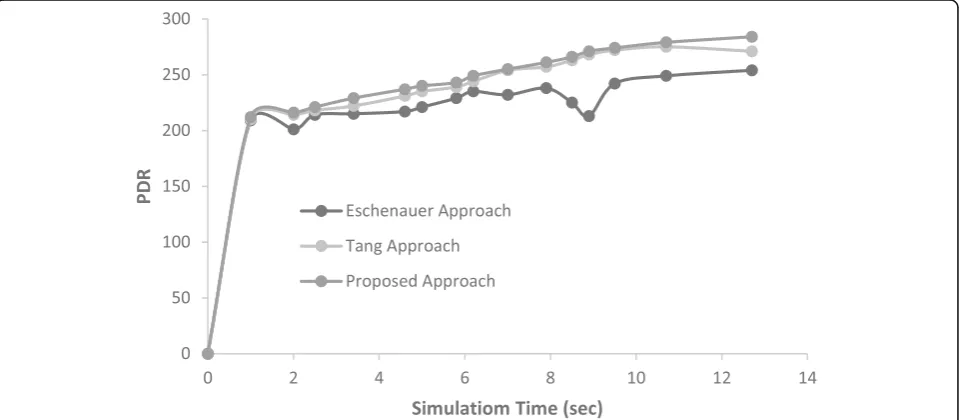
Figure 3 gives the variation of packet delivery ratio (PDR) with respect to the simulation time. The pre-sented approach shows the better result when compared with Eschenauer’s approach [4] which is a moderate re-cent research work and Tang’s approach [12] which is the very recent research work. Initially, the PDR of the
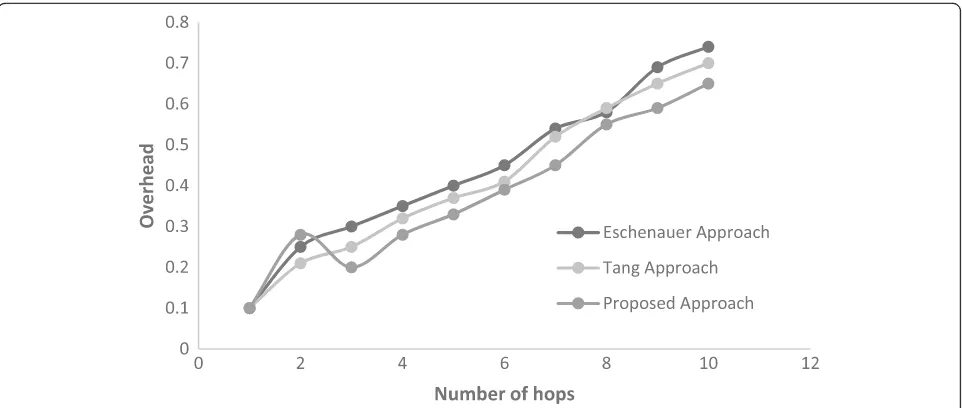
presented approach is approximately equal to that of Tangs’s approach but as the simulation time is increased the PDR increases. Figure 4 gives the relation between overhead and the number of hops; it is observed that overhead of the proposed approach is less when com-pared with the other two approaches, though the graphs vary slightly when compared to the other two methods but have a significant effect on the data transfer. The ac-ceptable limits for video and audio packets are 150 ms and 400 ms respectively [18]. The proposed approach is valid up to 15 hops as the example of (7, 4) Hamming code is presented. However, the number of hops can be increased by increasing their initial security bits length and security codeword length as per the Hamming code.
6 Conclusion
The security of wireless sensor networks is improved by the Hamming residue technique. The presented ap-proach is simple and very much effective if more num-ber of rival nodes exists at different hops in the network. As at each node, a new security codeword is generated, which makes the proposed method more efficient, en-hances the confidentiality among the nodes, and can easily detect the rival node in the network. The pre-sented approach also reduces the mathematical com-plexity which in turn increases the PDR by minimizing the delay.
Abbreviations
−ACK:Negative acknowledgement; +ACK: Positive acknowledgement; DMP: Dynamic multi-level priority; ECDH: Elliptic curve Diffie-Hellman; GESD: Generalized extreme Studentized deviate; HRM: Hamming residue method; IN1: Intermediate node 1; IoT: Internet of Things; MAC: Medium access control; NS2: Network Simulator 2; PDR: Packet delivery ratio; RC6: Rivest cipher 6; TTL: Time to live; UWSNs: Unattended wireless sensor networks; WSNs: Wireless sensor networks
Acknowledgements
Not applicable
Funding
Not applicable
Availability of data and materials
Open access
Author’s contributions
An efficiently secure technique is proposed to secure the wireless sensor networks from the malicious attacks by using the Hamming residue method. The author read and approved the final manuscript.
Author’s information
Majid Alotaibi received Ph.D., from The University of Queensland, Brisbane, Australia, in 2011. Currently, he is an assistant professor with the Department of Computer Engineering, Umm Al Qura University, Makkah, Kingdom of Saudi Arabia. His current research interests include mobile computing, mobile and sensor networks, wireless technologies, ad hoc networks, computer networks (wired/wireless), RFID, antennas and propagation, radar, and nano electronics.
Competing interests
The author declares that there are no competing interests.
Publisher’s Note
Springer Nature remains neutral with regard to jurisdictional claims in published maps and institutional affiliations.
Received: 26 April 2018 Accepted: 21 December 2018
References
1. C. Karlof D. Wagner Secure Routing in Sensor Networks: Attacks and Countermeasures Proc. 1st IEEE Int’l. Wksp. Sensor Network Protocols and Apps.2003
2. Y. Zhou, Y. Fang, Y. Zhang, Securing wireless sensor networks: a survey. IEEE Commun. Surv. Tutorials.10(3) 6–28 (2008)
3. R. Di Pietro, L.V. Mancini, C. Soriente, A. Spognardi, G. Tsudik, Data security in unattended wireless sensor networks. IEEE Trans. Comput. 58(11), 1500– 1511 (2009)
4. L. Eschenauer, V.D. Gligor,A Key Management Scheme for Distributed Sensor Networks, Proc. 9th ACM Conf. Comp. and Commun (2002), pp. 41–47 5. H. Song S. Zhu G. Cao Attack-Resilient Time Synchronization for
Wireless Sensor Networks Proc. 2nd IEEE Int’l. Conf. Mobile Ad Hoc and Sensor Sys. 2005
6. T. Shu, M. Krunz, S. Liu, Secure data collection in wireless sensor networks using randomized dispersive routes. IEEE Trans. Mob. Comput. 9(7), 941–954 (2010)
7. X. Du, Secure and efficient time synchronization in heterogeneous sensor networks. IEEE Trans. Vehic. Tech. 57(4), 2387–2394 (2008)
8. W. Zhang, S. Zhu, G. Cao, Pre-distribution and local collaboration-based group rekeying for wireless sensor networks. Ad Hoc Netw.7(6), 1229–1242 (2009) 9. S. Guo, Z. Qian, A compromise-resilient pair-wise rekeying protocol in
hierarchical wireless sensor networks. Comput. Syst. Sci. Eng. 25(6), 397–405 (2010)
10. Y. Zhang, C. Wu, J. Cao, X. Li, A secret sharing-based key management in a hierarchical wireless sensor network. Int. J. Distrib. Sens. Netw. 2013(Article ID 406061), 7 (2013)
11. P. Sengar, N. Bhardwaj, A survey on security and various attacks in wireless sensor network. Int. J. Comput. Sci. Eng. 5, 4 (2017)
12. D. Tang, T. Li, J. Ren, J. Wu, Cost-Aware SEcure Routing (CASER) protocol design for wireless sensor networks. IEEE Trans. Parallel. Distributed Syst. 26(4), 960–973 (2015)
13. R. Mahidhar, A. Raut, A survey on scheduling schemes with security in wireless sensor networks. Int. Conf. Inf. Secur. Privacy 78, 756–762 (2016) 14. J. Kim, J. Moon, J. Jung, D. Won, Security analysis and improvements of session
key establishment for clustered sensor networks. Hindawi Publishing Corp J Sens 2016, Article ID 4393721, 17https://doi.org/10.1155/2016/4393721. Accessed 10 Apr 2016
15. P. Porambage, C. Schmitt, P. Kumar, A. Gurtov, M. Ylianttila, PAuthkey: a pervasive authentication protocol and key establishment scheme for wireless sensor networks in distributed IoT applications. Int. J. Distrib. Sens. Netw. 2014, Article ID 357430, 14 (2014).https://sourceforge.net/projects/nsnam/ 16. Syed Jalal Ahmad and P. Radha Krishna, Security on MANETs using Block
Coding. International Conference on Advances in Computing, Communications and Informatics (ICACCI), pp 2054–2060, 2015. 17. NS2 Download link:https://sourceforge.net/projects/nsnam/ 18. S.J. Ahmad, V.S.K. Reddy, A. Damodaram, P. Radha Krishna, A dynamic