Transceiver Design Concept for Cellular and Multispot
Diffusing Regimes of Transmission
S. Jivkova
Central Laboratory of Optical Storage and Processing of Information, Bulgarian Academy of Sciences, 1113 Sofia, Bulgaria Email:[email protected]
M. Kavehrad
Center for Information and Communications Technology Research (CICTR), Department of Electrical Engineering, The Pennsylvania State University, University Park, PA 16802, USA
Email:[email protected]
Received 25 March 2004; Revised 23 August 2004
A number of attempts have been made in an effort to combine the advantages of line-of-sight and diffuse configurations for indoor optical wireless communications via sophisticated combinations of elements that are characteristic for these architectures. A different approach has been followed in the present investigation, namely, developing a transceiver capable of operating in both configurations. It is proposed that the transceiver design be based on the utilization of two-dimensional arrays of infrared light-emitting devices and photodetectors. Basic design parameters of transceiver optics are derived from considerations about link blockage and system compliance with the unique features of line-of-sight and diffuse methods of transmission.
Keywords and phrases:optical communications, wireless communications, local area networks.
1. INTRODUCTION
It has been more than two decades now since Gfeller and Bapst [1] suggested that diffusely scattered infrared light could be utilized as a medium for wireless communications indoors. Various system configurations for optical wire-less local area networks have been investigated since then. They differ in the degree of directionality of the transmit-ter and receiver and the orientation of the units. The lat-ter factor underlies the development of two major classes of link topology: line-of-sight (LOS) links, in which an LOS path between receiver and transmitter exists, and non-LOS or diffuse links, which rely on diffuse signal reflec-tions off the room surfaces. In this paper, the term “dif-fuse” is used for a link architecture that prohibits the exis-tence of an LOS between receiver and transmitter regardless of the transmitter radiation pattern. This is in distinction from other investigations that apply this term to links that employ a transmitter with a Lambertian radiation pattern, even when an unobstructed LOS signal path exists (see, e.g., [2]).
This is an open-access article distributed under the Creative Commons Attribution License, which permits unrestricted use, distribution, and reproduction in any medium, provided the original work is properly cited.
Line-of-sight architectures
LOS links exhibit low power requirements when transmitted optical power is concentrated in a narrow beam thus creating a high power flux density at the receiver. Furthermore, such links do not suffer from multipath signal distortion. If addi-tionally a narrow field-of-view (FOV) receiver is used, an effi -cient optical noise rejection and a high optical signal gain are achievable [3]. Generally speaking, narrow LOS links (NLOS, narrow transmit beam and small receiver FOV) are appli-cable to point-to-point communications only. NLOS links cannot support mobile users because alignment of receiver and transmitter becomes necessary. However, elements that are meant for point-to-point links are being incorporated into different link configurations in search for better power efficiency and higher data rates. For example, the so-called tracked system [4] utilizes a narrow beam transmitter and a small FOV receiver with the addition of steering and tracking capabilities.
more launch power is needed to ensure the required power flux density at the receiver. In cellular configuration, optical signal is delivered to all the terminals within the light cone. Communication between portables is accomplished through a base station, that is, in a star network topology.
An important development in LOS-LANs may be de-scribed as a merger of cellular and NLOS tracked systems. The essence is in the utilization of two-dimensional arrays of emitters and detectors. Base station is placed above the coverage area. The sources in the transmitter array emit nor-mally to the plane of the array. Then, an optical system per-forms spatial-angular mapping, that is, a light beam is de-flected into a particular angle depending on the spatial posi-tion of the source in the array. As a result, the communica-tion cell is split into microcells, each illuminated by a single light source of the array. At the receiving end, the opposite transform, angular-spatial mapping is performed, so that the optical signal is collected and focused onto a particular de-tector in the dede-tector array, depending on the angle of ar-rival. The benefits of introducing detector and emitter arrays are as follows. Tracking and pointing functions are electron-ically realized using a spatial-angular-spatial mapping per-formed by the transceiver optics [2,6]. Power savings can be realized by switching offthe sources that do not illuminate a user terminal. Transmitter can be designed so that sources in the emitter array transmit different data streams, thus signif-icantly increasing the overall capacity of the communication system. The pixels in the detector array exhibit low capaci-tance and small FOV because of their small size. The small detector capacitance allows for an increase in the transmis-sion bandwidth and the small FOV reduces the ambient light reception.
Diffuse architectures
In classical diffuse links [7], base station is located at a desk-top level and transmitter emits upwards. Usually, transmitter radiation pattern is Lambertian, therefore the entire room ceiling and large portions of the walls are illuminated. Since infrared is diffusely scattered by most room surfaces, signals reach receiver after multiple reflections offthe room walls and furniture. The immense number of signal paths leads to signal distortion and, as a consequence, may cause inter-symbol interference. Another issue of concern is power effi -ciency. As a rule, diffuse configurations are characterized by high signal path loss. Therefore, a receiver having a large ef-fective collection area and a wide FOV must be used. Never-theless, diffuse links cannot compete with LOS links in terms of power efficiency. The high optical signal path loss and the multipath distortion limit the achievable transmission speed to a few tens of Mbps. On the other hand, while LOS links can easily be blocked, diffuse links have the advantage of be-ing very robust to shadowbe-ing and blockage. Diffuse system is very well suited for point-to-multipoint connectivity and with it star, as well as mesh networks can be established.
Yun and Kavehrad [8] proposed a diffuse-type configu-ration that utilizes a multiple narrow-beam transmitter and a multibranch angle-diversity receiver, thus a multi-input
multi-output (MIMO) system. This architecture is referred to as multispot diffusing (MSD). Transmitter projects the light power in form of multiple narrow beams of equal in-tensity, over a regular grid of small areas (spots) on a dif-fusely reflecting surface such as a ceiling. This way, the sig-nal power is uniformly distributed within the office and the link quality does not depend on the receiver-transmitter dis-tance. Each diffusing spot, in this arrangement, may be con-sidered a secondary light source having a Lambertian radia-tion pattern. Receiver consists of several narrow FOV receiv-ing elements aimed at different directions. A good portion of optical signal power is received by each receiver branch via a finite number of distinct signal paths; a number equal to the number of spots seen by the branch. When properly designed, MSD links are virtually free from multipath signal distortion. It has been shown that the communication chan-nel exhibits a vast bandwidth (greater than 2 GHz on a 3 dB basis [9]) and can be considered virtually ideal at data rates of hundreds of Mbps. The narrow FOV of the receiver ele-ments provides means to decrease the level of ambient light reception utilizing narrow spectral bandwidth optical filters and by spatial separation of desired signal from strong ambi-ent light sources. Receiver consists of more than one elemambi-ent in order to cover several diffusing spots, thus ensuring un-interrupted communication in case some of the transmitter beams are blocked. Additionally, a multiple-element receiver provides diversity, thus it allows combining the output sig-nals from different receiver elements using effective combin-ing techniques.
Like in LOS links, the latest development in quasidiffuse links is the use of emitter [10] and detector arrays [8,10,11]. Utilization of a compact two-dimensional array of semicon-ductor light sources allows for a reconfigurable transmitter output. Each light source in the array is responsible for cre-ating a single diffusing spot on the room ceiling, that is, the number of sources equals the number of diffusing spots needed to cover the communication cell. If there is no need for optical signal within certain parts of the communication cell, the corresponding light sources are switched off. Thus, the system provides only the active users with signal and saves some power by not distributing optical signal where it is not needed. With such a transmitter design, independent communication channels (different information streams are launched through different diffusing spots) are feasible, thus providing a means for spatial diversity. Receiver design is also very similar to the one that has been proposed for LOS sys-tems. Such a receiver possesses inherent angle diversity and the small FOV associated with a single detector pixel ensures an optimal ratio between signal and optical noise level at a re-ceiving element. In contrast to LOS configuration, a user ter-minal communicates with base station through several com-munication channels whose number equals the number of diffusing spots within the overall receiver FOV.
topologies offers, and vise versa. On the other hand, both LOS and diffuse configurations have evolved through the years and recent developments show that the researches have arrived at surprisingly similar transceiver optical designs. Therefore, a good direction for the future research efforts would be designing a transceiver that is capable of operat-ing in both regimes, that is, in both LOS and non-LOS ge-ometries. This is especially important for the portable units, which should be able to communicate with both types of base stations and with other portables. The aim of this paper is to make the first step towards the optical design of such a uni-versal transceiver.
2. TRANSCEIVER PARAMETERS
AND LINK BLOCKAGE
In both cellular and MSD architectures, a large coverage area is desired. This imposes severe requirements on the transmit-ter and receiver optics. Wide receiver FOV and large emis-sion angle are not routinely achieved. On the other hand, it is unnecessary to increase the coverage area beyond cer-tain size because of the increased probability of link age. Even when care has been taken of the permanent block-ing objects like furniture and partitions, the link still can be blocked by the people on the move. In the present investi-gation, the blockage of cellular and MSD links by people is carefully studied in order to ease the requirements on the transceiver optical system design.
Any optical wireless link is a subject to shadowing, and even blockage, caused by moving or stationary objects. Blockage and shadowing might be an important degrading factor for the system performance. When a link is blocked, the information transfer ceases. Therefore, special care must be taken to prevent link blockage and ensure uninterrupted communications.
Shadowing effects depend on the particular interior of an office. It is extremely difficult to generalize an investigation of these effects. Because the shadowing or blockage by furni-ture is easier to predict and avoid, we are mainly concerned with the blockage caused by people. The blocker is assumed to be a tall person who is modeled as having a lateral dimen-sion of 50 cm and a height of 100 cm above communication cell floor. Cell floor is at a desktop level and the cell height is defined as the distance along a vertical line from the room ceiling to the desktop level. All portable units are assumed at the cell floor level. Base station in an LOS configuration is placed on the room ceiling while in MSD configuration it is on a desk. In the following analysis, it is assumed that a person cannot be closer than 50 cm to a portable unit (or a base station in the case of MSD). This restriction is justified by the fact that the portable terminals are usually placed on a desk, so that the area in close proximity to the portable unit is readily occupied by the desk.
Transmitter radiation angle
Consider first the LOS configuration depicted in Figure 1. Maximum semiangle,Φ, at which a base station can transmit
ΦLOS
Figure 1: Cellular architecture: BS (base station), PU (portable unit),ΦLOS (maximum transmit semiangle),H (communication cell height),R(communication cell radius),h(blocker height),r0 (minimum possible blocker-portable unit distance).
rFOV
Figure 2: MSD architecture: Rx (receiver), Tx (transmitter), DS (diffusing spot),ΦMSD (maximum transmit semiangle), FOV (re-ceiver acceptance half angle),rFOV(radius of the circular area in the ceiling that is seen by the receiver),H(communication cell height),
R(communication cell radius),h(blocker height),r0 (minimum possible blocker-portable unit distance).
with full connection availability, is determined by
ΦLOS=arctan
wherer0is the minimum possible blocker-portable unit dis-tance, and his the blocker height (above the communica-tion cell floor). Withr0 =50 cm andh=100 cm, the maxi-mum transmitter emission semiangle is 27◦. At larger angles, a moving person may block the LOS between a terminal and a base station.
2R
2R
Figure3: A large rectangular area covered by sets of square or hexagonal communication cells of equal largest horizontal size. In the case of square cells, 24 base stations are needed as contrasted to only 20 base stations in the case of hexagonal cells.
shown that with this restriction standing or moving people cannot block the link although some shadowing is possible. That is, a person near the base station might block some but not all transmitter beams that produce diffusing spots within receiver FOV. Furthermore, the power penalty due to shad-owing has been computed and it does not exceed 0.1 dB in 99% of the cases.
Receiver acceptance angle
In order to operate at different angles of acceptance in cellu-lar and MSD configurations, receiver optical system will nec-essarily be quite complex. Therefore, it is desirable that the receiver has a fixed value of its FOV instead of a variable one. FromFigure 1, it is evident that in LOS configuration the receiver acceptance angle must be wide enough to encompass the base station at any receiver position within the commu-nication cell. Then, the receiver FOV (half acceptance angle) must comply with the inequality FOV ≥ ΦLOS =27◦. Set-ting a safety margin of 10% leads to a value of about 30◦: FOV=1.1ΦLOS=29.7◦.
In [10], it has been shown that receiver FOV in MSD con-figuration must be at least 25◦. In other words, any value that is larger than 25◦is acceptable.
Thus, a receiver FOV value of 30◦ would satisfy the re-quirements of both communication architectures.
3. TRANSMITTER RADIATION PATTERN
The communication systems under consideration are bound to operate in offices and other closed areas that have, in general, a rectangular form. The easiest and the most nat-ural way to provide the service to all users in a rectangu-lar room is to split the room in a set of square commu-nication cells. However, when the largest horizontal size of the communication cell is restricted (e.g., by considerations regarding link blockage) a square cell covers a smaller area than the corresponding circular communication cell. On the other side, circular cells must partially overlap in order to avoid gaps. A honeycomb-like structure of communication cells provides the most efficient coverage. In order to serve a given area, one would need a larger number of base stations forming square communication cells as compared to the ones that produce hexagonal cells. This is illustrated inFigure 3.
rFOV
a
Figure4: Triangular lattice of diffusing spots to define a hexagonal
communication cell. The lattice spacing,a, must be smaller than the radius,rFOV, of the circular area seen by the receiver.
Both square and hexagonal cells correspond to the same maximum transmission angle, that is, their maximal lateral dimensions, denoted by 2R, are equal. The corresponding ar-eas of a single communication cell areAsquare=(2R)2/2 and Ahexagon = 3
√
3(2R)2/8, and their ratio isA
hexagon/Asquare = 1.3. In Figure 3, a large rectangular area is covered by 24 square cells, that is, 24 base stations are needed to serve the whole area. In the case of hexagonal communication cells, the number of base stations is reduced to 20. In view of this, the following analysis is concerned with transmitter radia-tion pattern that produces a hexagonal communicaradia-tion cell.
Transmitter pattern in multispot diffusing configuration
RMSD
RMSD
a
a
(a)
Source array
Collimating and deflecting optics
(b)
Figure5: (a) A hexagonal communication cell made of a triangular lattice of diffusing spots. The spots can be viewed as arranged in rings
around the central diffusing spot. The side of the hexagonal communication cell,RMSD, is an integer number times the lattice spacing,a. (b) Schematic of the proposed transmitter optics. The role of the optical system is to collimate and redirect the source beams in appropriate directions to create a light spots lattice.
than the spots lattice spacing,a:
rFOV=Htan FOV> a, (2)
whereH is the communication cell height, that is, the dis-tance from the room ceiling to the desktop level.
The lattice spacing can be expressed in terms of the hor-izontal communication cell size: a = RMSD/n. Here,RMSD is the hexagonal cell side and nis the number of rings of spots around the central diffusing spot (seeFigure 5a). Since
RMSD=HtanΦMSD,
a= H
n tanΦMSD. (3)
Then, using the inequality (2), a condition about the in-tegernis obtained:
Htan FOV> HntanΦMSD,
n >tanΦMSD
tan FOV = tan 45◦
tan 30◦ =1.7 (i.e.,n≥2). (4)
The total number of diffusing spots or, correspondingly, the total number of light sources in the emitter array is
N = 1 +nk=16k. The outputs of these light sources must be collimated and deflected to appropriate angles to create a triangular mesh of diffusing spots on the room ceiling, as shown inFigure 5.
Transmitter pattern in cellular configuration
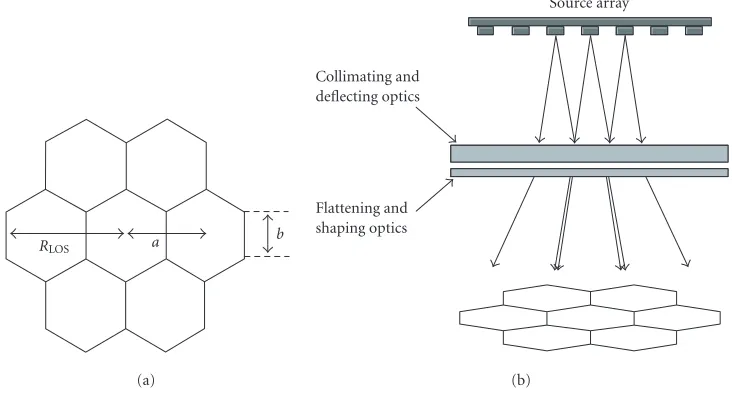
In cellular configuration, the communication cell is split into a number of hexagonal microcells, as shown in Figure 6a. The resultant shape of the cell is close to a hexagon and mul-tiple cells can adjoin without gaps.
The beam from each individual light source in the emit-ter array must be flattened, shaped, and deflected to
illunate uniformly the desired hexagonal area of a particular mi-crocell. Apparently, transmitter optical system will necessar-ily differ somewhat from the one that is utilized in an MSD system. To facilitate the design of a transmitter optics that will serve both cellular and diffuse systems, the same beam deflection angles as in MSD configuration are retained. Then, as shown in Figure 6b, flattening and shaping of the light beams can be done using an additional diffractive optical el-ement (see, for e.g., [12]) that will be exerted or activated when the system is to operate in LOS regime.
Further, in order to satisfy the requirement for the maxi-mal radiation semiangle of 27◦, not allNsources in the emit-ter array should be active in the LOS regime. We denote the number of sources that are used in LOS regime of opera-tion byM, and the number of rings of hexagonal microcells around the central one bym. Again, these two quantities are interdependent throughM=1 +mk=16k. FromFigure 6a, it can be seen that the lateral size of the communication cell can be expressed in terms of the diffusing spots lattice spacing in MSD regime:
RLOS=
m+1
2
a, (5)
whereais given by (3). On the other side,
RLOS=HtanΦLOS. (6)
Then, using (3) through (6), the possible values form are obtained:
m=ntanΦLOS
tanΦMSD −0.5≈0.5n−0.5=0.5(n−1),
n=2, 3, 4,. . . . (7)
Note thatmmust be an integer. Equation (7) gives values for
RLOS a b
Figure6: (a) A communication cell made of hexagonal microcells. The distance between the centers of two neighboring microcells,a, equals the distance between two neighboring diffusing spots in the case of MSD configuration. 2RLOS is the maximal lateral size of the communication cell;bis the side of the hexagonal microcell. (b) Schematic of the proposed transmitter optics. The role of the optical system is to flatten, shape, and redirect the source beams so that adjoining hexagonal areas are uniformly illuminated.
Thus, the smallest number of sources in the emitter array that will serve successfully both cellular and diffuse systems is ob-tained forn=3: are active in diffuse regime of operation is 37, while only 7 of them are needed in cellular regime. The optimum number of sources in the emitter array is not necessarily the small-est one. This should be a subject to further invsmall-estigation al-though throughout the rest of this paperN=37 is assumed.
4. LARGE OFFICE SPACE COVERAGE
When the office space that is to be covered is larger than the communication cell size, more than one base stations must be used to provide the service to all users, as shown in
Figure 3. Since the communication cell size in MSD is larger as compared to cellular configuration, a larger number of base stations are needed for LOS communications. The dif-ference in the base stations density may roughly be estimated by comparing the communication cells areasALOSandAMSD:
ALOS=7Aµcell, (9)
whereAµcellis the area of a single microcell in LOS regime;
AMSD≈37Aµcell≈5ALOS. (10)
Evidently, a much smaller number of base stations work-ing in diffuse regime, as compared to their number in LOS regime, are required for the coverage of a given office space.
Expressed in terms of the communication cell height, the microcell area is taken into account. Thus, the density of base stations is in-versely proportional to the second power of the office height:
1
In other words, the higher the office, the smaller the number of base stations required.
In the case of hexagonal communication cells, the base stations are placed in the knots of a triangular mesh. The base stations grid spacing depends on the room height and, certainly, is different in LOS and diffuse architectures. In
Figure 7, it is denoted bySLOSandSMSDfor the cases of cellu-lar and MSD configurations, respectively.SLOSandSMSDcan easily be calculated if the office height is known:
BS2
SLOS
BS1
BS3
(a)
BS2 SMSD
BS1
BS3
(b)
Figure7: Illumination of three adjoining communication cells is shown for the case of (a) a cellular configuration and (b) an MSD configu-ration. The positions of the base stations, BSs, are projected on the illumination plane (desktop level in (a) and ceiling in (b)). The distances between the neighboring base stations are denoted bySLOSandSMSD, respectively.
5. SIGNAL PATH LOSS
Optical wireless communications are characterized by a high signal path loss. Therefore, receiver must necessarily exhibit a large receiving area. On the other hand, if a large area pho-todetector were used, the high capacitance associated with it would greatly reduce the receiver bandwidth.
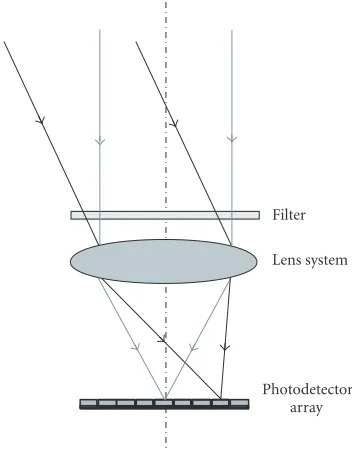
Instead of a single large-area detector, a two-dimensional array of photodetectors is utilized, as has been proposed for the first time in [8]. A common optics serves all pix-els in the detector array (see Figure 8). This way, the ef-fective receiving area, which is the effective entrance aper-ture of the lens system, is large and collects a good por-tion of the optical signal. At the same time, the photode-tector pixel, that actually receives the signal and converts it into an electrical one, has a small area, therefore a small ca-pacitance. As a consequence, receiver can support high bit rates while receiving signals within a wide FOV. For exam-ple, in our recent three-lens optical design of an imaging receiver, presented in [10], we have achieved a full accep-tance angle of 50◦, an entrance aperture diameter of 30 mm, and an image spot size between 1.7 mm and 2.48 mm, pending on the angle of signal arrival. The segmented de-tector consists of 37 hexagonal pixels, each having a 2.8 mm side. Thus, a total image area of 750 mm2 is covered while the active receiving element has a fairly small area of about 20 mm2.
Another advantage of utilizing a detector array is the ca-pability of such a receiver to distinguish between signals ar-riving from different directions, that is, different diffusing spots in the case of MSD or different base stations in the case of a cellular architecture. This is because receiver optical sys-tem actually performs angular-spatial mapping, as shown in
Figure 8. A very small solid acceptance angle corresponds to each pixel in the detector array, so that optical signal power
Filter Lens system
Photodetector array
Figure8: Receiver optical front end performs angular-spatial map-ping. The lens system focuses light impinging at different angles onto different pixels in the detector array.
is focused onto a particular detector depending on the signal angle of incidence.
Optical signal path loss is quite different for LOS and dif-fuse architectures; it is higher in the case of diffuse config-uration. In the following, it is shown that this difference is entirely within the capabilities of the commonly used photo-diodes at the receiver to accommodate.
Table1: Representative link budget.
Cellular topography MSD topography
Wavelength >1400 nm >1400 nm
Eye-safe transmit power per emitting element +10 dBm +10 dBm
Optical path loss at cell edge −48 dB −66 dB
Receiver optics loss (filter and Fresnel losses) −2 dB −2 dB
Optical concentrator gain (3 cm entrance aperture diameter, 3 mm image spot diameter) +20 dB +20 dB
Received optical power −20 dBm −38 dBm
Receiver sensitivity at 155 Mbps (according to [2]) −28.5 dBm (PIN), −43.5 dBm (avalanche)
−28.5 dBm (PIN), −43.5 dBm (avalanche)
Irradiance at a 10 mm2receiving pixel −10 dBm/cm2 −28 dBm/cm2
Required irradiance at 100 Mbps (according to [3]) −30 dBm −30 dBm
array, is where P0 is the launch optical power, ρ is the ceiling re-flectance,θis the angle between a vertical line and the line-of-sight between the receiver and the diffusing spot, r = H/cosθis the distance between the receiver and the diffusing spot, andArecis the receiver effective area. Received power is minimal when the diffusing spot appears at the edge of the receiver FOV, that is, whenθ=FOV:
Pmin MSD=
P0ρcos4FOV
πH2 Arec. (15) Received optical power in cellular configuration depends on the size of the microcells:
PLOS=AP0 µcellArec
cosθ, (16)
where P0 is the launch optical power by the source in the emitter array that illuminates the particular microcell andθ is the angle of signal arrival. The received power is maximal at normal incidence, that is, forθ=0.
Then, the maximum received optical power in a cellular configuration is
The ratio between the two extreme values, the maximum received optical power in cellular regime and the minimum received power in MSD regime, expressed in dB, is
D=10 log10 P what larger due to the dependence of the optical concentra-tor gain on the signal direction of arrival.
Note that in both configurations received optical power is inversely proportional to the squared communication cell height, so thatDdoes not depend on the office size.
An exemplary link budget is given inTable 1. It assumes a wavelength longer than 1400 nm, at which 10 mW optical power can safely be launched [13]. At shorter wavelengths, holograms can be employed in order to make the transmitter eye-safe (see, e.g., [14,15]).
6. CONCLUDING REMARKS
The basic idea that underlies the present investigation is to bring together the two most promising configurations for optical wireless networks indoors, namely, cellular line-of-sight and MSD configurations. This is attempted through developing a system that would be capable of operating in both configurations rather than a sophisticated combination of the architectures themselves. The latter has been tried be-fore with limited success. Therebe-fore, the idea is to redirect the research efforts and to develop a transceiver capable of operating in both cellular and MSD regimes. As a first step towards achieving this goal, it is proposed that transceiver design is based on utilization of two-dimensional arrays of infrared light emitting devices and photodetectors. Basic de-sign parameters of transceiver optics are derived from con-siderations on link blockage and system compliance with the unique features of LOS and diffuse regimes of transmission. Currently, a detailed design of transceiver optical system is under way. For this purpose, conventional optics, diffractive, and holographic solutions are considered. Certainly, a com-promise between transceiver complexity, cost, microcell size (in LOS regime), number of independent channels (estab-lished between two communicating devices in MSD regime), receiving pixel size, and so forth, has to be sought.
REFERENCES
[1] F. R. Gfeller and U. H. Bapst, “Wireless in-house data com-munication via diffuse infrared radiation,”Proc. IEEE, vol. 67, no. 11, pp. 1474–1486, 1979.
[3] A. M. Street, P. N. Stavrinou, D. C. O’Brien, and D. J. Ed-wards, “Indoor optical wireless systems—a review,” Optical and Quantum Electronics, vol. 29, pp. 349–378, 1997. [4] D. R. Wisely, “A 1 Gbit/s optical wireless tracked architecture
for ATM delivery,” inProc. IEE Colloquium Optical Free Space Communication Links, pp. 14/1–14/7, London, UK, February 1996.
[5] M. J. McCullagh and D. R. Wisely, “155 Mbit/s optical wireless link using a bootstrapped silicon APD receiver,” Electronic Letters, vol. 30, no. 5, pp. 430–432, 1994.
[6] D. C. O’Brien, G. E. Faulkner, K. Jim, et al., “High-speed inte-grated transceivers for optical wireless,”IEEE Commun. Mag., vol. 41, no. 3, pp. 58–62, 2003.
[7] J. R. Barry, Wireless Infrared Communications, Kluwer Aca-demic, Boston, Mass, USA, 1994.
[8] G. Yun and M. Kavehrad, “Spot-diffusing and fly-eye receivers for indoor infrared wireless communications,” inProc. IEEE International Conference on Selected Topics in Wireless Com-munications, pp. 262–265, Vancouver, BC, Canada, June 1992. [9] S. Jivkova and M. Kavehrad, “Receiver designs and channel characterization for multi-spot high-bit-rate wireless infrared communications,” IEEE Trans. Commun., vol. 49, no. 12, pp. 2145–2153, 2001.
[10] S. Jivkova, B. A. Hristov, and M. Kavehrad, “Power-efficient multispot-diffuse multiple-input-multiple-output approach to broad-band optical wireless communications,”IEEE Trans. Veh. Technol., vol. 53, no. 3, pp. 882–889, 2004.
[11] P. Djahani and J. M. Kahn, “Analysis of infrared wireless links employing multibeam transmitters and imaging diversity re-ceivers,”IEEE Trans. Commun., vol. 48, no. 12, pp. 2077–2088, 2000.
[12] J. J. Yang and M. R. Wang, “Analysis and optimization on single-zone binary flat-top beam shaper,”Optical Engineering, vol. 42, no. 11, pp. 3106–3113, 2003.
[13] IEC, “Safety of laser products—part 1: Equipment, classifica-tion, requirements and user’s guide,” International Standard IEC 825-1, 1993.
[14] M. R. Pakravan, E. Simova, and M. Kavehrad, “Holographic diffusers for indoor infrared communication systems,” in
Proc. IEEE Global Telecommunications Conference (GLOBE-COM ’96), vol. 3, pp. 1608–1612, London, UK, November 1996.
[15] P. L. Eardley, D. R. Wisely, D. Wood, and P. McKee, “Holo-grams for optical wireless LANs,” IEE Proc. Optoelectronics, vol. 143, no. 6, pp. 365–369, 1996.
S. Jivkova received the M.S. degree in physics in 1985 from the University of Sofia, Bulgaria, and the Ph.D. degree from the Bulgarian Academy of Sciences in 1992. She is currently a Research Associate with the Central Laboratory of Optical Storage and Processing of Information, the Bul-garian Academy of Sciences, and a Post-doctoral Fellow with the Center for In-formation and Communications
Technol-ogy Research (CICTR), the Pennsylvania State University. Her fields of research include optical wireless communications, dig-ital and optical holography, photorefractive materials, photonic band-gap structures, and so forth. She has published a large num-ber of papers in the most prestigious international journals in optics.
M. Kavehrad received the Ph.D. degree from Polytechnic University, Brooklyn, New York, November 1977, in electrical en-gineering. Between 1978 and 1989, he worked on telecommunications problems for Fairchild Industries, GTE (Satellite and Labs), and AT&T Bell Laboratories. In 1989, he joined the Electrical Engineering Depart-ment, University of Ottawa, as a Full Pro-fessor. Since January 1997, he has been with