R E S E A R C H
Open Access
Personalized project recommendations:
using reinforcement learning
Faxin Qi
1, Xiangrong Tong
1*, Lei Yu
1,2and Yingjie Wang
1Abstract
With the development of the Internet and the progress of human-centered computing (HCC), the mode of man-machine collaborative work has become more and more popular. Valuable information in the Internet, such as user behavior and social labels, is often provided by users. A recommendation based on trust is an important human-computer interaction recommendation application in a social network. However, previous studies generally assume that the trust value between users is static, unable to respond to the dynamic changes of user trust and preferences in a timely manner. In fact, after receiving the recommendation, there is a difference between actual evaluation and expected evaluation which is correlated with trust value. Based on the dynamics of trust and the changing process of trust between users, this paper proposes a trust boost method through reinforcement learning. Recursive least squares (RLS) algorithm is used to learn the dynamic impact of evaluation difference on user’s trust. In addition, a reinforcement learning method Deep Q-Learning (DQN) is studied to simulate the process of learning user’s preferences and boosting trust value. Experiments indicate that our method applied to recommendation systems could respond to the changes quickly on user’s preferences. Compared with other methods, our method has better accuracy on recommendation.
Keywords:HCC, Reinforcement learning, Trust, RLS, DQN
1 Introduction
With the development of HCC, recommendation has become common in social networks. Information available in recommendation system is also increasing. User information can be processed and utilized in
ap-propriate ways to enhance user’s experience. HCC
considers the state of user interaction and how it can be used for practical applications. Among the various information available in HCC, trust is widely used as a user-based subjective information [1]. As a subjective consciousness, trust is the basis of a transaction or ex-change relationship. The Internet era has made the interaction between people more frequent. People al-ways establish contacts with friends in social networks which has become research hotspots to make recom-mendations based on people’s trust relationship [2]. It is not uncommon for people to make recommenda-tions to each other in daily life, such as recommending movies and clothing brands to each other. In this
recommendation process, in addition to the recom-mended items (movies, brand, etc.), an important fac-tor that determines whether people will accept the recommendation from their friends is the trust rela-tionship between people. In fact, people are more likely to accept the suggestions and recommendations from their good friends because they trust them more than others. As a result, recommendation based on trust is an important human-computer interaction recommendation application in social networks [3,4].
In social networks, the trust value between users has been regarded as a basis by many researchers. They predict user’s preferences and ratings referring to user’s past interaction records, then recommend related items to users. In recent years, scholars have proposed many methods to calculate trust and recommend items in social networks, which are based on different research bases and purposes. In general, most methods focus on the propagation of trust and trust recommendation systems. They treat trust values as static and immutable parameters, which makes it impossible for the recommendation system to make better user-centered personalized recommendation.
© The Author(s). 2019Open AccessThis article is distributed under the terms of the Creative Commons Attribution 4.0 International License (http://creativecommons.org/licenses/by/4.0/), which permits unrestricted use, distribution, and reproduction in any medium, provided you give appropriate credit to the original author(s) and the source, provide a link to the Creative Commons license, and indicate if changes were made.
* Correspondence:[email protected]
1School of Computer and Control Engineering, Yantai University, Yantai
264005, China
According to the dynamic trust, most of the existing researches are focusing on the changes and states of trust related factors. These researches failed to fully con-sider the process of trust dynamic changes and the fac-tors affecting the dynamic change of trust. In fact, the change of trust will affect the recommendation results. Dynamic change process will be reflected in recommen-dation system in real time, also will affect the coefficient of recommendation system. Recommendation results are affected in the same time, so dynamic trust values could lead to completely different recommendations. There-fore, it is necessary to consider dynamic trust to improve the performance of recommendation system. The im-proved recommendation system could get more accurate results. The real-time performance of recommendation systems will be improved.
For some purposes, when A wants to improve B’s trust value, A will communicate with B frequently, which usu-ally start with B’s interests and hobbies. If B likes watching movies, A will often recommend B the movies she may like. When B makes a positive evaluation of A’s recom-mendation, it indicates that A’s recommendation is con-sistent with B’s preferences in films. B will have more confidence in A’s level of appreciation in film, and B’s trust in A will increase. On the contrary, it indicates that B doubts A’s level of appreciation, and B’s trust in A will be decreased. With the increase of the number of interac-tions that A recommends movies to B, A will know better about B’s preferences in movies; thus, A can recommend B’s favorite movies accurately. At the same time, B will trust A very much. Essentially, this is a process oflearning their preferences and caters to their likes.
Our method simulates the above process: in order to
boost a user’s trust, the recommender chooses an item
to recommend to the user. After accepting the recom-mendation, the user will make an actual evaluation of the item. When the user accepts the item, they will have an expectation. There’s a certain difference between the user’s actual evaluation and the expectation, which de-termines user’s satisfaction degree on the item. If the ac-tual evaluation is higher than the expectation, the user will give positive feedback to the recommender. Con-versely, if the expectation is higher, the user will give negative feedback. Positive feedback indicates the user’s recognition of the recommender, and the user’s trust in the recommender will increase. Negative feedback
indicates that the user doubts recommender’s level of
recommendation, which leads to the decline of the user’s
trust in recommender. This paper uses the
reinforcement learning method DQN to boost the trust of the users and applies it to recommendation systems to improve the efficiency and accuracy of recommenda-tion results. The DQN method is stable, and it can process large amount of data, so our method could be
extended to recommendation systems. The contribu-tions of this paper are shown as follows:
1. The proposed method in this paper combines the reinforcement learning method DQN to learn the
change process of trust to boost the users’trust,
named DQN trust boost (DQN-TB). This method
is based on the difference between user’s experience
evaluation and expected evaluation, which could obtain more complete information by learning the user preferences, thus to improve the level of individuation and the accuracy of
recommendations.
2. The proposed method takes synthetically the user’s
preferences, direct trust, and indirect trust into consideration, and then selectively screens these factors to deliver more practical results.
This paper is organized as follows. Section 2 re-views the related researches. Section 3 gives defini-tions related to our research. Section 4 introduces the method of trust transfer and suggestion processing. Section 5 displays the design of our method, includ-ing the process of trust boostinclud-ing by DQN and related parameters. Section 6 elaborates the parameters used and comparison experiments conducted, then analyzes and discusses the experimental results. Conclusion is summarized in section 7.
2 Related work
On the researches of trust, some scholars have made some achievements. Most of these are about the propa-gation of trust and trust network formation. Xu et al. [5] researched trust through applying reward and penalty to inspire the behaviors of users, which achieved a good
performance. Jiang et al. [6] proposed an extraction
the change of trust value in the process of trust transfer and proposed the heuristic algorithm named DLATrust. The DLATrust based on learning automata, used the improved collaborative filtering and aggregation policy to infer the value of trust. On this basis, Mina et al. [9] proposed a dynamic algorithm named DyTrust, which used distributed learning automaton for random trust propagation. Both DLATrust and DyTrust were aiming to learn to discover reliable paths between users in social networks. You et al. [10] proposed a distributed dynamic management model based on the trust reliability. This method used reliability to evaluate trust to reduce the impact of unreliable data and modify reliability after interaction.
Moreover, many scholars have achieved excellent re-search results about prediction and recommendation. Qi et al. [11] introduced an instance of Locality-Sensitive Hashing (LSH) into service recommendation and further put forward a novel privacy-preserving and scalable mo-bile service recommendation approach based on two-stage LSH. In addition, Qi et al. [12, 13], Liu et al. [14] and Gong et al. [15] proposed a variety of
recommenda-tion and prediction methods. Furthermore, many
scholars have conducted corresponding researches on the related properties of adaptive reputation and trust [16–18]. On the aspect of trust, the dynamic problem of trust has not been considered. The research on dynamic trust is relatively blank. This section will briefly intro-duce the previous work and DQN method.
2.1 DyTrust
DyTrust algorithm is one of the methods of dynamic trust calculation by using learning algorithm. DyTrust uses distributed learning automaton to obtain the dy-namic change of trust in the process of trust propaga-tion, and updates the reliable trust path dynamically according to the change of trust.
As a dynamic trust propagation algorithm, DyTrust algo-rithm can generate more accurately a trust path. However, DyTrust algorithm only uses the dynamic characteristics of trust, without studying the dynamic process of trust. The dynamic change process of trust will be studied and elabo-rated in this paper.
2.2 Q-Learning and Deep Q-Learning
Deep Q-Learning [19] is the development of the
Q-Learning algorithm [20]; it is also an emerging algorithm that combines deep learning with reinforcement learning to realize learning.
Q-Learning algorithm uses a single neural network to estimate the value function and calculate the practical accumulated experience. Compared with it, DQN uses two equally structured neural networks to evaluate the value function estimates (eval_net) and reality (target_
net). The eval_net estimates the value of each action (Q _eval), then selects a final action based on the policy. The environment will return reward value based on the action, and target_net used the reward value for realistic estimation (Q_target).
The weights of target_net are updated more slowly than the weights of eval_net; in other words, target_net tends to be updated every rounds. This method could ensure that DQN avoids the influence of time continuity and gets better results.
At the meanwhile, DQN uses experience playback to train eval_net. After obtaining training parameters of neural network for DQN, the theory of Behrman equa-tion is used to calculate loss funcequa-tion and update weight parameters of eval_net:
Loss Function¼Q target−Q eval
The target_net calculation is derived from the Markov decision.
The trust boost algorithm in this paper is combined with DQN for calculation. In fact, Q-Learning algorithm can also achieve similar results for the trust boost process of a single user. But the disadvantages of Q-learning algorithm cannot be ignored. When Q-Learning is used in reality, there are too many state variables and features need to be manually designed. In addition, the quality of results is closely related to the quality of fea-ture design, which makes Q-Learning algorithm unable to be used in recommendation systems to recommend items for a large number of users. At the same time, Q-Learning algorithm needs to use a matrix to store values. When there are too many users, the data volume will be too large, which will lead to a sharp increase in storage space demand. The huge number of user groups in rec-ommendation systems and the complex categories of recommendation items are disasters for the data storage of Q-Learning algorithm.
Therefore, considering the problems of the method proposed in this paper and the advantages of DQN com-pared with Q-Learning algorithm, this paper uses DQN to design the recommendation model in social networks.
3 Method introductions
3.1 Problem description and basic definitions
This section introduces the basic problem description, user information set, recommender information set, and DQN information set in detail.
3.1.1 Problem description
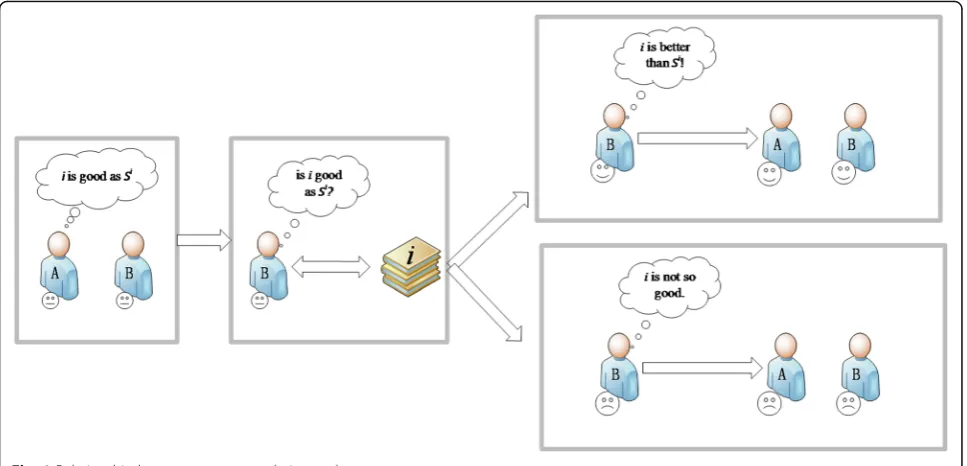
As shown in Fig.1, in order to boost user B’s trust, user
A recommends item i relevant to the content that B is
trust in A will increase. Otherwise, B’s trust in A will decrease.
3.1.2 Basic definitions
Define user setU= {u1,u2,…,uk}, item set I¼ fi1;i2;…;ikg
.
Definition 1.User Set:
T;S;sp
h i ð1Þ
Our method establishes user information set for each user in social network shown by Eq.(1), whereT
repre-sents user trust matrix, S represents user evaluation
matrix, including user’s past evaluation and the user’s
expected evaluation for recommendation items, and sp
represents user’s actual evaluation for recommendation items.
Definition 2.Recommender Information Set:
T;S;I
h i ð2Þ
After recommending items to other users, the user will transform into recommender. There will be an tion set of the recommender to represent his
informa-tion. T and S are trust matrix and evaluation matrix of
the recommender.Iis the set of items.
During the recommendation process, recommender selects items from item sets for recommendation. Users’ degree of satisfaction will dynamically affect the trust be-tween users.
Definition 3.DQN-TB Information Set〈n,a,π,r〉
Recommender’s status n: A user broadcast in moment
τ, recommender chooses action based on a selection
strategy. nτ is recommender’s status corresponds to the
action. After recommender’s action choice,
recom-mender’s status updates as nτ+ 1, and the recommender
will wait for the user’s next broadcast.
Recommender’s action a: Recommender selects the final recommended item to user from item set. The rec-ommended item is recommender’s actiona.
Action Selection Strategy π: The selection strategy de-termines the recommended item which is finally selected by the recommender. The selection policy in this paper is same as that used in DQN, namelyε-greedy policy.
Action Reward r: The user will have their satisfaction
of the item i provided by the recommender. The
influ-ence range of satisfaction on trust is denoted as reward r, and r will affect the recommender’s choice at next moment.
In this paper, we use the difference between users’ ex-pected evaluation and actual evaluation to represent user satisfaction. Recursive least squares method (RLS) is used to calculate the dynamic mapping relationship between the evaluation difference and the change of trust. In the process, the dynamic change of trust is regarded as the re-ward given to the recommender in the process of DQN-TB, and the change of trust will affect the recommender’s selection behavior of the recommended items.
3.2 Trust calculation and suggestion processing
In this section, formulas of trust and suggestion will be displayed.
3.2.1 Trust calculation and data structure
Trust between users can be obtained through direct trust and indirect trust. Users with interactive experience are direct users. When users have no interactive experi-ence, if a trust path can be found between the two users, they are indirect user of each other [21,22].
The direct trust of user j to user b is defined as
follows:
T jð;bÞ←tj;b; tj;b∈½0;1 ð3Þ
The indirect trust of user j to user d is defined as
follows:
TRðj;dÞ←trj;d; trj;d∈½0;1 ð4Þ
Assume that the path of trust path between users can be obtained by up to six intermediate users. The indirect trust valuetrbetween userjanddis obtained by the fol-lowing formula:
where Xdj is the collection of all users between userj andd.
3.2.2 User evaluation suggestion processing
According to the evaluation suggestionsibmade by direct userb, the expected evaluation of itemimade by userj is calculated as follows:
sij;b¼tj;b∙sib; s i
j;b∈Si ð6Þ
According to the evaluation suggestionsi
d made by
in-direct userd, the expected evaluation of item imade by userjis calculated as follows:
rsij;d¼trj;d∙sdi; rsij;d∈Si ð7Þ
Where Si is the storage matrix of expected evaluation of item iobtained by userjthrough different users. The range of user evaluation points is [0, 10].
In reality, userjcan receive suggestions from different users around. It is necessary to process all the
recom-mendation evaluation information received by user j to
get the final evaluation expectation of userj. Using for-mula (8) to process the scoring information in Si, the final expected evaluation si
j of user j to item i can be
After receiving multiple recommendations, user j will
accept the item with the highest expected evaluation.
3.3 The method: DQN trust boost process
Some scholars have applied DQN to recommendation systems, which keeps recommendation systems dynamic
for a long time. Zheng et al. [23] proposed a deep
reinforcement learning framework for news recommen-dation. This method calculates dynamic reward value according to user characteristics and behavioral feed-back, so that the recommendation system can capture the change of user preferences. This method can get long-term rewards and keep users interested in the rec-ommendation system.
This chapter describes the trust boost via Deep Q-Learning process in detail, explains the method and the process of the DQN-TB, and gives the corresponding
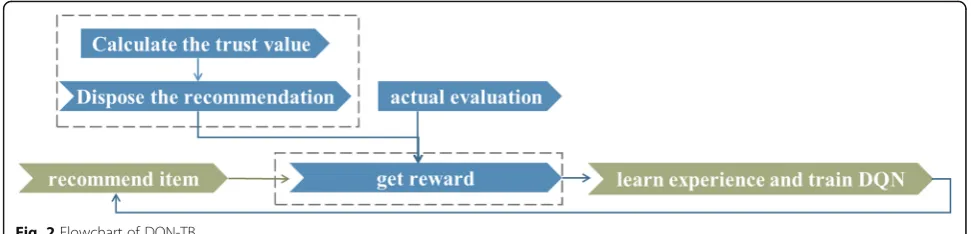
pseudo code. Figure 2 shows the flow chart framework
of DQN-TB process.
It should be noted that a one-to-one relationship can exist in DQN-TB process, that is, only useru1expects to
increase the trust value ofu2in him. There can also be a
many-to-one relationship, that is, useru1,u2…all expect
to improve the trust value of useru3in them.
3.3.1 Model framework
As shown in Fig. 3, each item in item set represents
different actions. In DQN-TB method, a user is regarded as the environment. At each state, DQN network is trained by the data in memory pool, and then an item is selected from the item set and rec-ommended it to the user as the final action. Then, reward returned by the user is obtained. It will be stored in the memory pool with state and action for the next network training update [24].
This process uses the eval_network to expect returns.
According to the process flow in Fig. 2 and the frame
diagram in Fig. 3, the network update model is as
follows:
1. Recommend projects
A user broadcasts at moment τ. According to the
user’s broadcast of requirements, a recommender selects an item i from the corresponding item set. aτ is corre-sponding to the itemi, recommender status notes fornτ.
2. Trust update
After the user received and accepted the recom-mendation, the difference between expected evalu-ation and actual evaluevalu-ation will affect the user’s trust in the recommender. Treating the user as the
envir-onment of DQN-TB process, changing range Δt of
user’s trust will be used as the reward value of
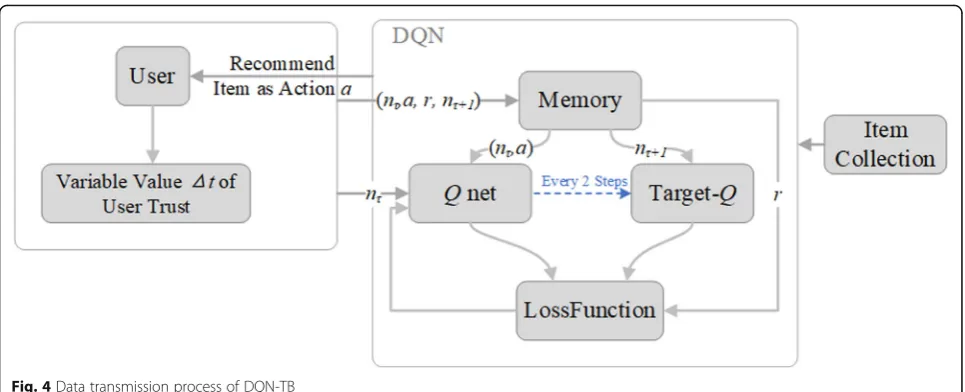
Δt, action aτ, recommender’s status nτ, and the future state nτ+ 1 are stored in the memory pool, as input of
network.
3. Train network
The DQN-TB process uses data in memory pool and the eval_network for action anticipation selec-tion. DQN-TB simulates user reality through the target_network, and updates eval_network based on
the difference between eval_network and target_ network.
4. Repeat steps (1)–(3)
Considering the reality, it will not stop unconditionally once the recommendation process is established. If
user’s trust value in recommender is too low,
sugges-tions provided by the recommender will not be adopted by the user. Therefore, if recommender continues to
Fig. 2Flowchart of DQN-TB
receive negative rewards or recommender has too many referrals fail, the cycle will be terminated. In order to provide more opportunities for recommender’s learning, considering the actual situation, it is not practical to rec-ommend when the trust value is too low. Through experimental verification, it was found that recom-mendation could obtain better results when termi-nated condition is set as t< 0.2.
3.3.2 DQN-TB design
Considering dynamic trust and the concrete process of item recommendation, our method uses the eval_net to
estimate recommender’s reward by choosing a certain
item for recommendation (that is, the action aτ). After taking the degree of trust change as reward value, the re-ward of item selection can be modeled as:
Q nτð ;aτ;ωÞ≈Qπðnτ;aτÞ ð9Þ
where ω is the weight parameter of eval_network and
π is the selected strategy. There may be no interactive
experience between recommender and user, so the rec-ommendation strategy shall be stipulated as follows:
1. Initial recommendation: All alternative items are equally likely to be selected. Recommendation items are randomly to be selected.
2. Follow-up recommendation: By using theε-greedy policy, selection probability changes dynamically ac-cording to recommended results and finally
converges.
On the basis of Markov property, the state at the next moment in random state is only related to the current state. Thus, after computing action probability and
making action choice by eval_net, DQN-TB process will get reward Δt and next status nτ+ 1. Meanwhile, actual
return is calculated by target_net:
Q nð ;aÞ ¼Δtτþλ maxaτþ1Q nð τþ1;aτþ1;ωÞ ð10Þ
where λ is the discount coefficient, which is used to
balance the immediate returns and the future returns. Δtτis the reward of actionaτ.ω is the weight parameter of target_net. After target_net calculated actual returns, the target function is calculated by bellman equation:
Lð Þ ¼ω E Δtjþλ
The eval_net parameterωis updated by using
stochas-tic gradient descent on the objective functionL(ω). Eval_ net has the same structure with target_net. The weight parameter of target_net is same as that of eval_net, and is copied from eval_net every two steps.
Figure 4 shows the data transmission process of
DQN-TB.
3.3.3 Reward parameter
Since the evaluation error and trust in the actual trust updating process are based on a single user, there is al-ways a trust value between users who can be
recom-mended, t(0) is the original trust between them in the
reward calculation process, andP(0) =δ−1I.
u1,u2are the user and the presentee, respectively,
tak-ingu2recommends itemitou1in thenth round of
rec-ommendation as an example, RLS method is used to simulate the trust change and update process:
The estimated error e is the gap between the actual evaluation and the expected evaluation:
e¼spi
The cost functionJ(n) is expressed as:
J nð Þ ¼Xλj je2¼λspiu1−tu1;u2∙s
i u2
2
ð13Þ
whereλis the forgetting factor, in this paper, we setλ= 1 for stability.
In order to minimize the cost function, it can be ob-tained by differentiating the weight vectort:
∂J nð Þ
If the trust relationship between u1 and u2 is direct
trust, the trust update between them is expressed as:
tu1;u2←tu1;u2þk nð Þe
ð
16Þ
Similarly, if the trust relationship betweenu1and u2is
indirect trust, the update between them is expressed as:
tru1;u2←tru1;u2þk nð Þe ð17Þ
After trust update, useru1’s evaluationsiu1of itemiwill
be updated to the actual evaluation spi
u1 in evaluation
matrixS:
siu1←spiu1 ð18Þ
Reward that recommenderu2gets is 0.01g(u2) =Δt.
In DQN-TB, reward value will be entered into the net-work as a parameter for future calculation.
3.3.4 Pseudo code
4 Experiments
4.1 Experimental device
In this section, the simulation experiments are con-ducted to evaluate the performance of the proposed model:
1. The ratio of recommendation trust to direct trust conversion in DQN-TB and the learning rate of trust update when calculating reward parameters will be determined through experiments.
2. The trust boost effect of DQN-TB will also be illustrated.
3. The performance of recommendation systems with DQN-TB is compared with other recommendation systems, including success rate of recommendation and abilities to sense dynamic changes in user preference.
ANR is defined as the number of rounds required by recommendation system to respond changes in user preference, SUMR represents the total number of rec-ommended rounds, and SEN represents the sensitivity of corresponding changes of user preference in recommen-dation system. Then SEN can be calculated by Eq.(19):
SEN¼1− ANR
SUMR ð19Þ
4.2 Basic introduction
User review data and movie project category in douban
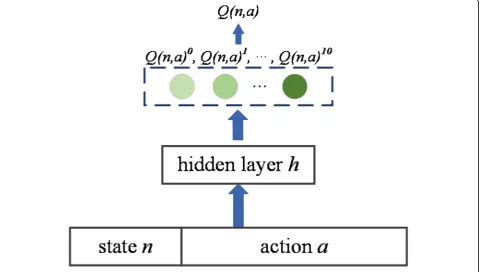
and the scale of movie review data is 510. In the experi-ment, users are randomly selected from all users as target users for making recommendations. The environ-ment of experienviron-ments is based on OpenAI Gym, where the calculation process of reward value is written separ-ately, then transmitted to DQN-TB. As DQN-TB is carried out for individuals, the structure of eval_net in this experiment is shown in Fig.5.
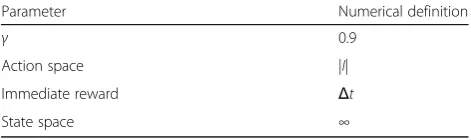
4.3 Markov decision process parameters
Table 1 shows the relevant definitions of Markov
deci-sion process of DQN-TB,
The recommendation process will not stop uncondi-tionally, so the number of user states will increase with recommendation process. Actions in recommendation process are recommended items; optional actions are re-lated to the number of items in item set. Through con-sulting relevant literature and reference materials, the value ofγis set at 0.9.
4.4 Time complexity
In this algorithm, the time complexity of RLS method is
O(n). And every iteration in the process of DQN-TB
should use RLS method to calculate the reward value. DQN-TB uses the stochastic gradient descent to update parameters, so the time complexity of our algorithm is calculated by T(n) = (C+n)∗n∗n∗n≈T(n4) =O(n4). The time complexity is polynomial.
5 Results and analysis
5.1 Conversion of indirect trust and direct trust
During the item recommendation process, when an item is recommended by recommender with indirect trust, there will be a direct trust relationship between the user and the recommender. In real situation, direct trust and indirect trust are not the same. Direct trust tends to have more impact. In order to conform better to real situation, indirect trust value needs to be converted into direct trust value with a certain discount so as to con-duct subsequent calculation. The indirect trust discount factor is represented byμ.
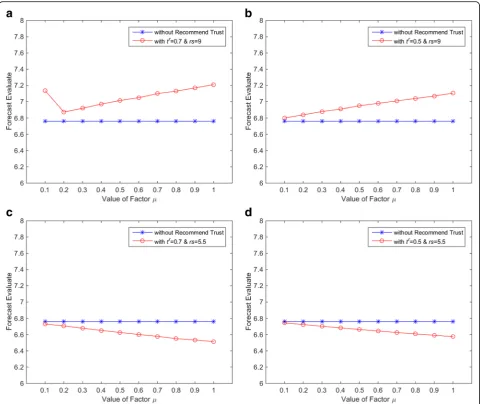
To determine the value ofμ, we use four sets of small data to analyze the result changes caused by different discount factors. The four data sets correspond to high indirect trust and high recommendation evaluation, high indirect trust and low recommendation evaluation, low indirect trust and high recommendation evaluation, and low indirect trust and low recommendation evaluation. All of the other data in the four data sets are the same. The data sets used for analysis are given in Table2. The effect of discount factor μon results of different data is
reflected by the whole evaluation term in Fig. 6. The
comparison evaluation is the expected evaluation calcu-lated by data of Direct trust1-Direct trust 4 only.
According to Fig.6, whenμis low, the overall expected evaluation value is lower than the contrast evaluation. Whenμis higher, the evaluation of indirect user can posi-tively stimulate the total results. The data used in this
comparison experiment cannot represent the whole real-ity, but it still can reflect the influence of discount factor of indirect trust on results. Considering the practical fac-tors, when recommenders make recommendation by direct trust for the first time, it will still have the
corre-sponding impact on users’ evaluation. In order to
minimize the interference of μ, and let the users’ evalu-ation be mainly influenced by trust values, we setμ= 0.8.
5.2 Dynamic change of trust
According to the DQN-TB process, after the presentee learned relevant experience through the recommenda-tion results, the recommendarecommenda-tion choices will be further adjusted to meet the relevant interests and the
prefer-ences of the recommended users. Figure 7 shows the
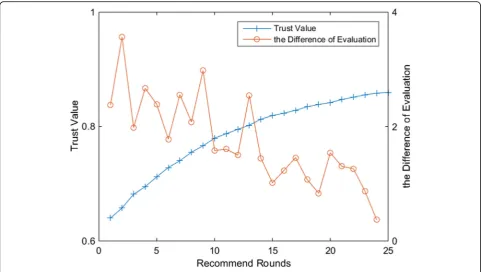
correlation between trust update and evaluation error using RLS method. The horizontal axis represents the recommend rounds. The left axis represents the trust value. The right axis represents the difference of evalu-ation. It can be seen that the error range is narrow and the convergence speed is fast when using RLS method for trust update. With the increase of recommendation times, trust increases steadily and shows down to a steady level. At the same time, the evaluation error con-tinues to decrease. The decrease of error has fluctuation, which is caused by action selection strategy, but the gen-eral trend remains unchanged. This shows that with the increase of the number of recommendations, the
recom-mender can learn more about user’s preference and
make more accurate recommendations.
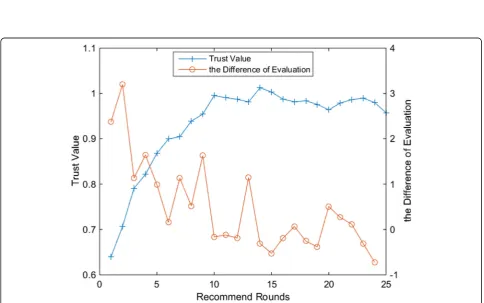
Figures 8, 9, and 10 show the result of trust update and evaluation error by using LMS method. Same as Fig.
7, the horizontal axis represents the recommend rounds, the left axis represents the trust value, and the right axis represents the difference of evaluation. The convergence speed of the LMS method is related to the learning rate η. Figures 8, 9 and 10, respectively, correspond to the change of trust value and error when the learning rate is
0.1/0.2/0.35. It can be seen that when η= 0.1, trust
changes smoothly, and the error fluctuation is not dras-tically very much. The effect is good. When η= 0.2, the change of trust has begun to fluctuate, but it still in the
normal state. When η= 0.35, error changes drastically,
trust fluctuates greatly, even value overflow appears (trust value bigger than 1). Comprehensive considering several factors, RLS method has good effect in some
cases. But the effect has a strong correlation with η,
which brings some limitations in the application of this method. Therefore, our method uses RLS method to cal-culate the trust update.
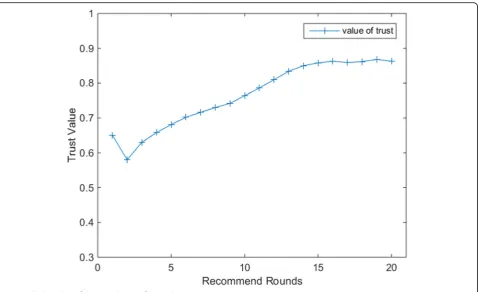
Figure11shows the broking line graph of the average
change of trust with each turn in the DQN-TB process based on recommendation trust. The initial recommen-dation trust value between the presentee and the user is 0.67. User trust decreased in the second round, which was caused by the recommendation trust-direct trust
transformation in 5.2. As shown in Fig. 11, when the
number of rounds is low, the DQN-TB process is in the exploration stage, and the experience in the memory pool is not rich enough, so the trust changes slowly. With the increase of recommendation rounds, the rec-ommender has a deeper understanding of the
recom-mended user’s preferences, and the trust value among
users continues to rise. Moreover, due to the increase of successful experience, the trust value between users in the subsequent recommendation rounds is always stable and the fluctuation range is small.
DQN-TB process can accurately describe the user’s
trust change state and achieve better results. The dy-namic change of user trust can reflect the change of user preference and social relationship in real time, so the dy-namic study of DQN-TB is meaningful, which also brings more flexibility for the application of DQN-TB in recommendation system.
5.3 DQN-TB in recommendation system
The experiment in 5.4 verifies that DQN-TB has an ac-curate description of dynamic change and trust boosting, so this method can also be applied to recommendation system to provide accurate recommendations for users in the system. In this section, we compare DQN-TB with
CSIT proposed by Li et al. [25] and confidence-based
recommendation (CBR) proposed by Faezeh et al. [26]
Table 1Parameters of Markov decision process
Parameter Numerical definition
γ 0.9
Action space |I|
Immediate reward Δt
State space ∞
Table 2Trust value and score value
in success rates of recommendation and their response sensitivity of changes in user preference.
CSIT is a matrix factorization and context-aware rec-ommender method with superior performance. The au-thor provided GMM method to enhance and deal with classification context and continuous context. CBR used trust of user’s opinion and certainty of opinion to de-scribe user’s confidence, introduced user’s confidence into trust model, and provided a series of recommenda-tions to user through implicit trust model. At present, recommendation systems recommend relevant items only by use user’s social relations and other user’s pref-erence in relational network, which cannot reflect the change of user’s trust. Moreover, the change of user’s preference can only be passively obtained from other
users in the relational network, resulting in systems’
untimely and inaccurate on making feedback on changes of users’preferences.
Figure 12 shows the comparison of average success
rate of DQN-TB, CSIT, and CBR corresponding to dif-ferent rounds with in 20 rounds with no dynamic change of user trust, that is, user’s trust is static trust. The DQN-TB method cannot obtain the reward under the situation of static trust, which leads to the inability to learn experience and poor recommendation effect. Both CSIT method and CBR method are calculated based on static trust. Therefore, when user’s trust and other information remain unchanged, their recommen-dation success rate is higher and their performances are better than DQN-TB.
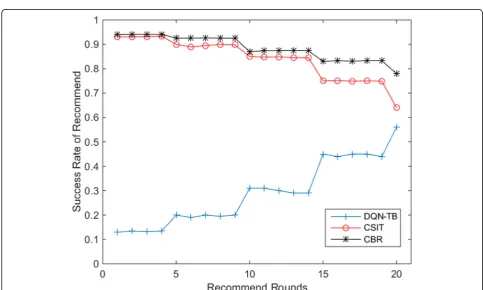
Figure 13 shows the comparison of average success
rates of DQN-TB, CSIT, and CBR corresponding to
Fig. 7Correlation graph of evaluation and trust (with RLS)
Fig. 9Correlation graph of evaluation and trust (with LMS andη= 0.2)
different rounds with in 20 rounds. After the 4th, 9th,
14th, and 19th rounds of recommendation, user’s trust
changes and feedback according to the recommendation results, while other rounds of user’s trust remain
un-changed. When user’s trust changes, the DQN-TB
method obtains experience to train its neural network and has a further understanding of user’s preference, the recommendation results are more inclined to user’s pref-erence, which can improve the success rate. Correspond-ingly, in CSIT method and CBR method, user’s trust has changed dynamically, but the user’s trust and other in-formation have not been changed. The recommend re-sults obtained from the original trust data will be more and more deviated from the user’s preference.
Figure14shows the comparison of average success rate of DQN-TB, CSIT, and CBR corresponding to different rounds within 20 rounds under the dynamic change of user trust and preference. With the increase of recom-mended rounds, DQN-TB has higher accuracy, which is guaranteed by the flexibility of DQN-TB in response to dynamic changes. Meanwhile, due to the influence of CSIT and CBR on the calculation of perception of user preference, the accuracy of the two methods decreased with the dynamic change of conditions. The rate of de-crease of accuracy of ordinary recommender methods var-ies with the change range of user preference, but it is also enough to explain the superiority of DQN-TB.
5.4 Response sensitivity
Implicit trust model and context matrix decomposition
rely too much on user’s neighbors and similar users.
When the preference changes for several times, the ana-lysis of relevant information will lose its accuracy and user’s preference will not be timely feedback. CBR rec-ommends multiple items for users at the same time, so it has certain coverage, and its sensitivity of response is better than CSIT. Table3shows the response sensitivity of each recommendation system after the user prefer-ence changes for 60 times in 450 rounds.
The data in Table 3 verify that DQN-TB has a good
sensitivity to user preferences, which is related to dy-namic rewards and experience learning in DQN-TB. Therefore, the application of DQN-TB to recommenda-tion system can timely perceive the change of user pref-erences and adjust the selection of recommendation items accordingly.
6 Discussion
Based on the experiment, it can be seen that when the user’s trust changes, our method can better capture the user’s trust changes and give personalized recommenda-tions that are more in line with user preferences. Com-paring with other recommendation systems, we can see that our method has strong perception ability in dy-namic trust. This method focuses on the dydy-namic
Fig. 12Change of success rate with no dynamic change
changes of user trust. It should be noted that in the state set of DQN-TB method, the factor affecting the selection of the next action are only the reward value obtained by the last action, and the correlation between states is not considered. In the future, this aspect will be studied and improved. At the same time, the calculation methods of trust and suggestions will be improved to make results of recommender method more accurate and effective.
7 Conclusions
In this paper, we propose a trust boost method based on dynamic trust and combined with reinforcement learning. This method senses the change of user preference through the dynamic change of user trust and learns from mendation experience to provide more accurate recom-mendations, so as to increase and maintain user trust at a high level. Experiment shows that our method is efficient and accurate. Our method can also be applied to recom-mendation system to sensing change of user preference and making accurate recommendation.
Abbreviations
CBR:Confidence-based recommendation; CSIT: A context-aware social rec-ommender system via individual trust among users; DLATrust: A heuristic algorithm based on learning automata; DQN: Deep Q-Learning; DQN-TB: Trust boost via Deep Q-Learning; DyTrust: A dynamic algorithm based on distributed learning automata; HCC: Human-centered computing;
RLS: Recursive least squares
Acknowledgements
The authors would like to thank the anonymous referees for their valuable comments as well as the National Natural Science Foundation of China (61572418), the China Postdoctoral Science Foundation under grant (2019T120732) for providing partial support to this research.
Authors’contributions
FXQ is in charge of the major theoretical analysis, algorithm design, and experimental simulation and wrote the manuscript. The others were in charge of part of the theoretical analysis and given suggestions to the manuscript writing. All authors read and approved the final manuscript.
Funding
The work was supported by the National Natural Science Foundation of China (61572418).
Availability of data and materials
Not available online. Please contact corresponding author for data requests.
Competing interests
The authors declare that they have no competing interests.
Author details
1School of Computer and Control Engineering, Yantai University, Yantai
264005, China.2Department of Computer Science, State University of New
York at Binghamton, Binghamton, NY, USA.
Fig. 14Change of success rate in the recommend system
Table 3Response sensitivity of each recommendation system
Recommendation system ANR SEN
DQN-TB 86 0.809
CSIT 314 0.302
Received: 31 August 2019 Accepted: 8 December 2019
References
1. Y.J. Wang, G.S. Yin, Z.P. Cai, A trust-based probabilistic recommendation model for social networks. J. Netw. Comput. Appl.55, 59–67 (2015) 2. J.L. Xu, S.G. Wang, B.K. Bharat, F. Yang, A blockchain-enabled trustless
crowd-intelligence ecosystem on mobile edge computing. IEEE Trans.15(6), 3538–3547 (2019)
3. B.X. Zhao, Y.J. Wang, Y.S. Li, Y. Gao, X.R. Tong, Task allocation model based on worker friend relationship for mobile crowdsourcing. Sensors19(4), 921 (2019)
4. J. Li, Z. P. Cai, M. Y. Yan, Y. S. Li, Using crowdsourced data in location-based social networks to explore influence maximization. The 35th Annual IEEE International Conference on Computer Communications (INFOCOM 2016), (2016)
5. J.L. Xu, S.G. Wang, N. Zhang, F.C. Yang, X.M. Shen, Reward or penalty: aligning incentives of stakeholders in crowdsourcing. IEEE Trans.18(4), 974– 985 (2019)
6. C. Q. Jiang, S. X. Liu, Z. X. Lin, G. Z. Zhao, R. Duan, K. Liang, Domain-aware trust network extraction for trust propagation in large-scale henterogeneous trust networks. Knowl.-Based Syst.. 111(C), 237-247(2016)
7. S.R. Yan, K.J. Lin, X.L. Zheng, An approach for building efficient and accurate social recommender systems using individual relationship networks. IEEE Trans29(10), 2086–2099 (2017)
8. G. Mina, M.R. Meybodi, Trust propagation algorithm based on learning automata for inferring local trust in online social networks [J]. Knowl.-Based Syst.143, 307–316 (2018)
9. M. Ghavipour, M.R. Meybodi, A dynamic algorithm for stochastic trust propagation in online social networks: learning automata approach. Comput. Commun.123, 11–23 (2018)
10. J. You, J.L. Shangguan, L.H. Zhuang, N. Li, Y.H. Wang, An autonomous dynamic trust management system with uncertainty analysis. Knowl.-Based Syst.161, 101–110 (2018)
11. L.Y. Qi, X.Y. Zhang, W.C. Dou, C.H. Hu, C. Yang, J.J. Chen, A two-stage locality-sensitive hashing based approach for privacy-preserving mobile service recommendation in cross-platform edge environment. Futur. Gener. Comput. Syst.88, 636–643 (2018)
12. L. Y. Qi, Y. Chen, Y. Yuan, S. C. Fu, X. Y. Zhang, X. L. Xu, A QoS-aware virtual machine scheduling method for energy conservation in cloud-based cyber-physical systems. World Wide Web Journal. (2019) DOI:https://doi.org/10. 1007/s11280-019-00684-y
13. L.Y. Qi, X.Y. Zhang, W.C. Dou, Q. Ni, A Distributed locality-sensitive hashing based approach for cloud service recommendation from multi-source data. IEEE Journal on Selected Areas in Communications.35(11), 2616–2624 (2017)
14. H. W. Liu, H. Z. Kou, C. Yan, L. Y. Qi, Link prediction in paper citation network to construct paper correlated graph. EURASIP Journal on Wireless Communications and Networking. (2019)
15. W.W. Gong, L.Y. Qi, Y.W. Xu, Privacy-aware multidimensional mobile service quality prediction and recommendation in distributed fog environment. Wirel. Commun. Mob. Comput.2018, 1–8 (2018)
16. G.F. Liu, Y. Liu, A. Liu, Z.X. Li, K. Zheng, Y. Wang, Context-aware trust network extraction in large-scale trust-oriented social networks. World Wide Web21(3), 713–738 (2018)
17. Z.Q. Liu, J.F. Ma, Z.Y. Jiang, Y.B. Miao, FCT: a fully-distributed context-aware trust model for location based service recommendation. SCIENCE CHINA Inf. Sci.08, 101–116 (2017)
18. E.K. Wang, Y. Li, Y. Ye, S.M. Yiu, L.C.K. Hui, A dynamic trust framework for opportunistic mobile social networks. IEEE Trans15(1), 319–329 (2018) 19. V. Mnih, K. Kavukcuoglu, D. Silver, et al., Human-level control through deep
reinforcement learning. Nature518(7540), 529–533 (2015) 20. J.C.H.W. Christopher,Learning from Delayed Rewards(King’s College,
Cambridge, 1989)
21. Y.J. Wang, Z.P. Cai, Z.H. Zhang, Y.J. Gong, X.R. Tong, An optimization and auction-based incentive mechanism to maximize social welfare for mobile crowdsourcing. IEEE Trans6(3), 414–429 (2019)
22. Y.J. Wang, Z.P. Cai, G.S. Yin, Y. Gao, X.R. Tong, An incentive mechanism with privacy protection in mobile crowdsourcing systems. Comput. Netw.102, 157–171 (2016)
23. G. J. Zheng, F. Z. Zhang, Z. H. Zheng, Y. Xiang, N. J. Yuan, X. Xie, Z. H. Li, DRN: A deep reinforcement learning framework for news recommendation. https://doi.org/10.1145/3178876.3185994.
24. Z. J. Duan, W. Li, Z. P. Cai, Distributed auctions for task assignment and scheduling in mobile crowdsensing systems. The 37th IEEE International Conference on Distributed Computing Systems (ICDCS 2017). (2017) 25. J. Li, C.C. Chen, H.L. Chen, C.F. Tong, Towards context-aware social
recommendation via individual trust. Knowl.-Based Syst.2017(127), 58–66 (2017)
26. F.S. Gohari, F.S. Aliee, H. Haghighi, A new confidence-based recommendation approach: combining trust and certainty. Inf. Sci. 2018(422), 21–50 (2018)
Publisher’s Note