R E S E A R C H
Open Access
Characterization of dynamic wireless
body area network channels during walking
Marshed Mohamed
1*, Wout Joseph
2, Günter Vermeeren
2, Emmeric Tanghe
2and Michael Cheffena
1Abstract
In this work, finite-difference time-domain was used for the investigation of dynamic wireless body area network channel characteristics during walking, thus accounting for dynamic aspects and body postures. This involves the study of on-body, off-body, and body-to-body communication in an empty environment, at the center frequency of 2.45 GHz. The channels were investigated in terms of fade variation and their corresponding amplitude distributions. For on-body channels, the fade variation was found to be periodic, with larger fade variations for the channels involving the nodes at the hand and thigh. For off-body and body-to-body channels, channels with the absence of line of sight experienced constructive and destructive interference as the distance between the end nodes changes, resulting in larger fade variations. For the amplitude distribution of the channels, a multivariate normal distribution was considered. The distribution has the capability of modeling channels jointly which makes it easier for network analysis and was considered because of the significant correlation between the channels. The resulting estimated multivariate distributions fit well with the simulated data, for on-body, off-body, and body-to-body channels.
Keywords: Fading channels, On-body communication, Off-body communication, Body-to-body communication, Wireless body area network
1 Introduction
In recent years, there has been substantial research on wireless body area networks (WBANs) due to their poten-tial applications in areas involving monitoring and trans-mission of human physiological data, such as health mon-itoring and sports activities. The communication could involve the transmission between nodes mounted on the human body realizing an on-body network, between an on-body network and a node away from the human body (external node) acting as an access point realizing an off-body network [1], and between two on-off-body networks realizing a body-to-body network. These kinds of net-works require a low-power communication approach due to their need for long battery life and the close proxim-ity of body surface nodes to human tissue. In addition to this challenge, the networks are subjected to varying signal shadowing caused by relative human body ori-entation between the communicating nodes which vary with the human body movement. These challenges make
*Correspondence:[email protected]
1Norwegian University of Science and Technology, Teknologiveien 22, 2815
Gjøvik, Norway
Full list of author information is available at the end of the article
a study and modeling of WBAN channel characteristics important [2].
Most of the existing studies on on-body, off-body, and body-to-body channels are based on measurements [3–5]. For on-body channels, measurements were conducted in [3] at four locations using seven receivers and a trans-mitter attached on the body. Autocorrelation and cross-correlation functions were reported, and the data col-lected were used to develop models for fading in various on-body links. Similar studies were conducted in [6] in the frequency range of 3–5 GHz and in [7] for ultrawideband 3.1–10.6 GHz. In [8], the effect of antenna polarization with respect to the body surface was examined, while in [9], the comparison for three locations of the hub on the human was conducted.
For off-body channels, path loss was modeled in [4] from the measurement conducted in an anechoic cham-ber, while in [2], the measurements were conducted in an indoor environment. The lognormal distribution proved to be a good fit in describing normalized signal amplitude in both. As in [8], the impact of antenna polarization on off-body channel characteristics was studied in [10], and the importance of body diversity gain for various
body channels was investigated in [11]. Further in [12], measurement conducted using multiple-input-multiple-output antennas showed improvement on the reliability of the off-body channels. A methodology for determin-ing the optimal positions of these antennas independent of the frequency was presented in [13].
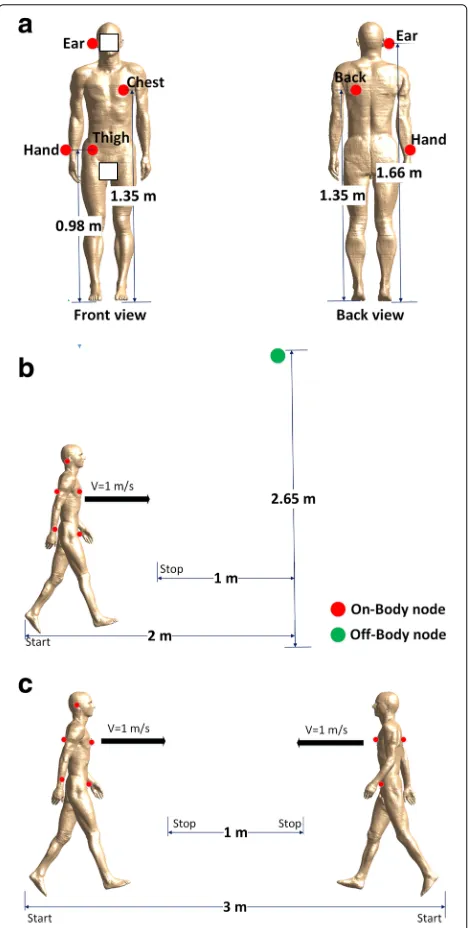
Fig. 1The investigated scenarios.aLocation of on-body nodes on the human model. In scenario 1, a subject walks with on-body nodes attached.bScenario 2 (off-body). A subject walking with on-body nodes attached, towards the off-body node at a velocity of 1 m/s.c Scenario 3 (body-to-body). Two subjects with on-body nodes attached, walking at a velocity of 1 m/s towards each other. The ear and hand nodes are not visible on the subject on the right
For body-to-body channels, a study in [5] investigated the impact of users’ body rotation, tilting, walking in the line of sight (LOS), and non-line-of-sight conditions on the outdoor body-to-body channels. A similar study in
an indoor environment was conducted in [14, 15] and
at the ultrawideband frequency of 2–8 GHz in [16]. The studies highlighted how the movement affected the chan-nel dynamic properties. This was confirmed by the study in [17] which was conducted in both indoor and out-door environments to obtain the mean path loss and the standard deviation for different body motion scenarios and antenna placements. As in [12], a diversity combin-ing scheme was investigated in [18] and has shown some promising results.
Since the aforementioned models are applicable for a particular measurement setup, other researchers have tried to use physical models instead [19,20]. These mod-els are based on calculation of time-varying shadowing effects of human body movement and the addition of mul-tipath component using statistical distribution depending on the location. Another approach is the use of numerical simulations such as finite-difference time-domain (FDTD) [21–24]. In [24], a walking phantom created by animation software is used for simulating the time-varying on-body communication channel in which mean path loss was investigated. A similar study was conducted in [23] to rep-resent in addition the delay properties of the channels, and a study focusing on ultrawideband was conducted in [22]. The studies which apply FDTD have so far been limited to static on-body network channels, using a homogeneous phantom [21,24], with low time resolution [22]. This does not cover the dynamic behavior from the off-body and body-to-body channels, which require a high time resolu-tion, and the use of heterogeneous phantom to be more realistic.
Table 1Simulation parameters for on-body, off-body, and body-to-body scenarios
Parameter Value
Software Sim4Life, Poser
Human model Duke Model (height 1.77 m, weight 70.2 kg) [25]
Walking model Thalmann model [28]
Antenna Dipole
Frequency 2.45 GHz
Antenna separation 5 mm
Sampling rate 50 Hz
On-body node locations Right ear, left chest, right thigh, right hand, left back
Off-body node location 2.65 m high
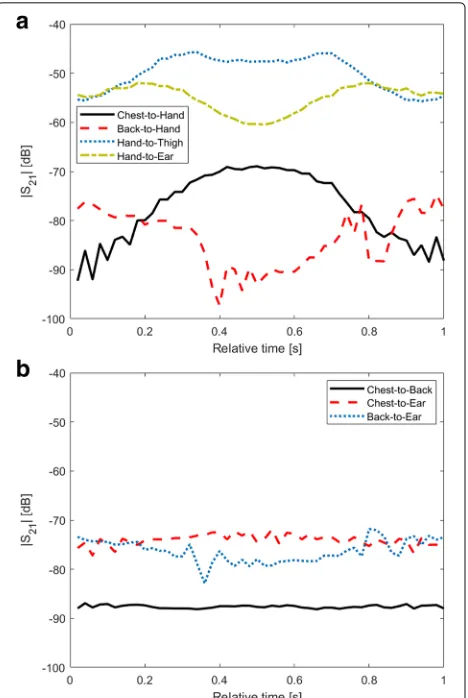
Fig. 2Time series of simulated data for on-body channels.aHand channels.bChannels which do not involve the hand or thigh antenna
The novelties of this study are as follows:
• The on-body, off-body, and body-to-body dynamic channels are investigated together in the same conditions so that a more complete picture of the overall network can be observed and compared. • The study makes use of heterogeneous phantom and
uses time resolution of 50 frames per second to increase the accuracy of the data obtained. • The channel gain is separated into path loss and
antenna gain; this cannot be achieved through measurements since the body is within the near field of the antenna.
• The study investigates the correlation between the channels and the application of multivariate normal distributions in the modeling of WBAN channels. This could enable the modeling of a network of multiple channels jointly, instead of using separate models for separate channels
The rest of this paper is organized as follows: Section2 describes the methodology used in configuration and data analysis, Section3discusses the obtained FDTD simula-tion results, and Secsimula-tion4concludes the paper.
2 Methodology
This section describes the scenarios used to analyze dif-ferent aspects of on-body, off-body, and body-to-body communication channels. The surrounding environment was not included in the simulations, so that the effect of the body on the radio channels can be obtained indepen-dent to the other factors. It also describes the method to analyze the results.
2.1 Scenarios
Employing FDTD, a heterogeneous human model of height 1.77 m and weight 70.2 kg (Duke Model) [25]
Table 2Average channel gain and standard deviation of on-body channels
Number Channel name Propagation TX antenna RX antenna Overall
Mean STD Mean STD Mean STD Mean STD
[dB] [dB] [dB] [dB] [dB] [dB] [dB] [dB]
1 Chest-to-back −29.97 0.31 −28.17 0 −29.49 0 −87.63 0.31
2 Chest-to-hand −37.31 6.62 −23.93 3.38 −13.80 2.61 −75.04 7.11
3 Chest-to-thigh −28.36 2.01 −20.96 0 −19.12 1.62 −68.44 1.88
4 Chest-to-ear −34.70 1.14 −19.61 0 −19.69 0 −74.00 1.14
5 Back-to-hand −42.27 4.24 −25.19 3.05 −14.42 4.40 −81.88 5.89
6 Back-to-thigh −38.67 7.30 −30.51 0 −27.59 1.17 −96.77 6.66
7 Back-to-ear −43.43 2.29 −20.95 0 −11.66 0 −76.03 2.29
8 Hand-to-thigh −20.38 4.01 −15.34 3.57 −13.57 2.24 −49.30 3.54
9 Hand-to-ear −28.77 3.41 −12.04 1.17 −13.89 1.78 −54.69 2.70
was used to represent a male adult human body. A half wavelength antenna (dipole) with a resonance frequency of 2.45 GHz was used as a radiating element for a sin-gle tone signal at the same frequency. This frequency was chosen to fit with the Wi-Fi technology that is often present in the indoor environment. The antenna was posi-tioned 5 mm away parallel to the body to reduce the effect of the body on the radiation pattern of the antenna [26]. This separation is small enough for realistic applications. The antenna type and configuration were the same for all simulation scenarios. We simulated 50 frames of Duke walking 1 m per 1 s (velocity 1 m/s), in order to grasp not only the slow fading caused by shadowing but also the fast fading effects caused by body reflection, diffrac-tion, and scattering involved in these dynamic channels [27]. The orientation of the body parts in these frames was estimated using the Thalmann model [28] and was applied to the phantom using Poser software [29]. For each frame, software capable of conducting FDTD calcu-lations (Sim4Life) was set to calculate for each antenna, radiation pattern, and the gain at their current location. Due to the close proximity of the antenna to the human body, the radiation pattern and hence the gain are not sim-ilar to those of free space. Further, the software was set to calculateS21parameter between all the nodes available on a given scenario [30]. During calculation, a grid of 2 mm was used on the phantom which is equivalent toλ/60 at the 2.45-GHz center frequency. This makes the limita-tions imposed by discretization of the round surface of the phantom negligible. Three scenarios were considered as shown in Fig.1.
• Scenario 1 (on-body), where the subject walks with on-body nodes attached (Fig.1a)
• Scenario 2 (off-body), where the subject walks towards an off-body node (Fig.1b)
• Scenario 3 (body-to-body), where two subjects walk towards each other (Fig.1c)
The same wearable antenna placements (Fig. 1a) were
considered in all three simulated scenarios. Table1 sum-marizes the parameters used in the FDTD simulations of the given scenarios.
For the on-body scenario, on-body nodes were placed at five different locations on the human body (Fig.1a). The node positions were chosen with regard to possible med-ical and non-medmed-ical applications. For example, the node on the ear emulates hearing aid instrument, the node on the thigh represents a possible location for a smartphone, the hand represents a fitness tracker, etc. [31]. In addition to this, the node at the back is added as a possible space diversity node for off-body communication where human body shadowing could be significant [18]. This represents the on-body part of the network.
For the off-body scenario, an off-body node located at a height of 2.65 m was considered in addition to the on-body nodes (Fig.1b). The location of the off-body node at such height represents Wi-Fi routers, commonly placed
on the ceiling in an indoor environment. The simulation starts at a horizontal distance of 2 m between the subject and the off-body node to capture the effect of being in close proximity to such an elevated antenna.
For the body-to-body scenario, two identical subjects (Duke) with identical on-body nodes were used for the simulations (Fig. 1c). The subjects were set to walk towards each other, starting from a distance of 3 to 1 m representing one walking circle for each. The study in this close proximity is important not only for typical body-to-body network applications [15], but also for the study of body network interference [32] and inter-on-body network cooperation [33].
2.2 Data analysis
A total of 30S21parameters were obtained from the sim-ulations, in which 10 were for on-body channels, 5 for off-body, and 15 for body-to-body channels. The param-eters were then used to give insight on channel fading variations with time and distance. The parameters were also used to analyze the correlation of different chan-nels and the use of multivariate normal distribution in describing the channel amplitudes.
2.2.1 Fading variation
The amount of fading a specific WBAN channel experi-ences depends on the location of its two end nodes on the human body, and the fading variation depends on rel-ative movements of the body parts on which these nodes are located. The close proximity of the antennas to the body affects the overall radiation of the signal [26], and the movements of body parts may also lead to a periodic change of the direction of maximum radiation and hence the gain in the direction of communication [34]. In addi-tion, radio wave propagation is significantly attenuated by human body tissue, and hence, penetration through the body is negligible. The movement of body parts may also cause periodic shadowing to the channel. TheS21 param-eter can be expressed in terms of antenna gain, and the propagation losses as
S21[dB]=PL[dB]+GTX[dBi]+GRX[dBi] (1)
wherePLis the propagation loss andGTXandGRXare the transmitting and receiving antenna gains in the direction of communication, taking into consideration the proxim-ity to the human body. With no cables involved in the simulation,S21parameter can be interpreted as the over-all channel gain as it is the ratio between the received signal at the receiver port and the transmitted signal at the transmitter port.
2.2.2 Amplitude distribution
One of the approaches of modeling potential correlated channels is by using multivariate normal distribution given by [35]
where N is the number of channels being modeled
together, μ is 1 × N matrix containing the channels’
means, and is the N ×N covariance matrix.
Multi-variate normal distributions are relatively easy to work with especially in a network with multiple channels. How-ever, this is only applicable when the channels to be considered show a significant correlation which is indi-cated by the large correlation coefficient and can be con-firmed with lowpvalues (<0.05). Pearson’s method was used to find the linear correlation coefficient between the channels, and their correspondingpvalues were cal-culated using Student’s t distribution [36]. Further, the estimated distribution was compared with the simulated data using two-sample Kolmogorov-Smirnov test (KS test) at 0.05 significant level to quantify the goodness of the fit [37].
3 Results and discussions
In this section, the results obtained from the simulations described in Section2are presented. The results for each scenario are presented separately, and when appropriate,
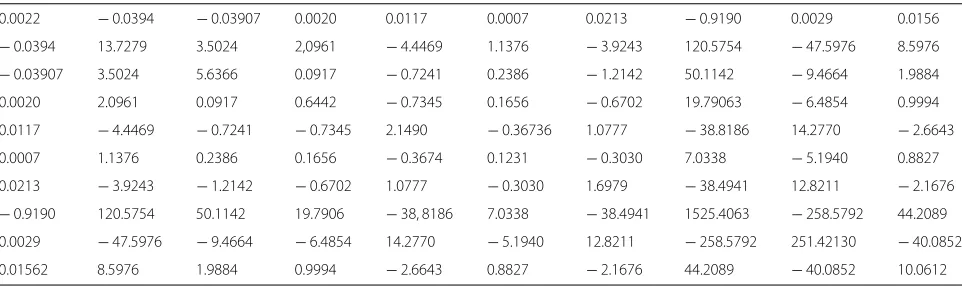
Table 3Covariance matrixfor on-body channels (×10−9)
0.0022 −0.0394 −0.03907 0.0020 0.0117 0.0007 0.0213 −0.9190 0.0029 0.0156
−0.0394 13.7279 3.5024 2,0961 −4.4469 1.1376 −3.9243 120.5754 −47.5976 8.5976
−0.03907 3.5024 5.6366 0.0917 −0.7241 0.2386 −1.2142 50.1142 −9.4664 1.9884 0.0020 2.0961 0.0917 0.6442 −0.7345 0.1656 −0.6702 19.79063 −6.4854 0.9994
0.0117 −4.4469 −0.7241 −0.7345 2.1490 −0.36736 1.0777 −38.8186 14.2770 −2.6643
0.0007 1.1376 0.2386 0.1656 −0.3674 0.1231 −0.3030 7.0338 −5.1940 0.8827
0.0213 −3.9243 −1.2142 −0.6702 1.0777 −0.3030 1.6979 −38.4941 12.8211 −2.1676
−0.9190 120.5754 50.1142 19.7906 −38, 8186 7.0338 −38.4941 1525.4063 −258.5792 44.2089 0.0029 −47.5976 −9.4664 −6.4854 14.2770 −5.1940 12.8211 −258.5792 251.42130 −40.0852
they are compared. The channels are described by their antenna location, for example, a channel between a ceiling node and a hand node is called ceiling-to-hand.
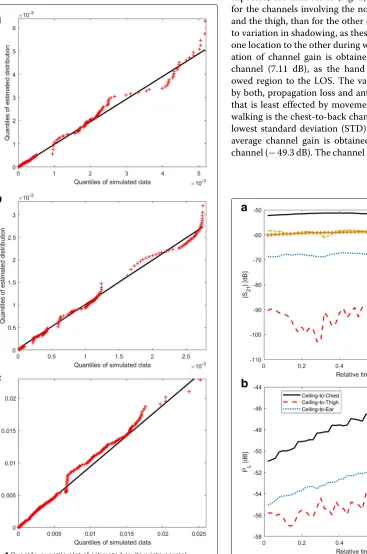
Fig. 4Quantile-quantile plot of estimated multivariate normal distribution and the simulated data.aOn-body channels.bOff-body channels.cBody-to-body channels
3.1 On-body channels 3.1.1 Fade variation
The results of the fade variation for the considered on-body channels are summarized in Fig.2and Table2. As expected, the time series (Fig.2) show a larger variation for the channels involving the nodes located at the hand and the thigh, than for the other channels. This is related to variation in shadowing, as these body parts move from one location to the other during walking. The largest vari-ation of channel gain is obtained on the chest-to-hand channel (7.11 dB), as the hand moves from the shad-owed region to the LOS. The variations are contributed by both, propagation loss and antenna gain. The channel that is least effected by movement of body parts during walking is the chest-to-back channel as confirmed by the lowest standard deviation (STD) of 0.31 dB. The largest average channel gain is obtained for the hand-to-thigh channel (−49.3 dB). The channel has the shortest distance
Table 4Average channel gain and standard deviation of off-body channels
Number Channel name Propagation TX antenna RX antenna Overall
Mean STD Mean STD Mean STD Mean STD
[dB] [dB] [dB] [dB] [dB] [dB] [dB] [dB]
between the end nodes and least body shadowing as con-firmed by the propagation loss (−15.89 dB). The smallest average channel gain is obtained for the back-to-thigh channel (−96.77 dB) contributed by small propagation loss and antenna gain.
3.1.2 Amplitude distribution
To confirm the use of a multivariate normal distribu-tion in the estimadistribu-tion of the amplitude distribudistribu-tion, the channels have to be tested for correlation
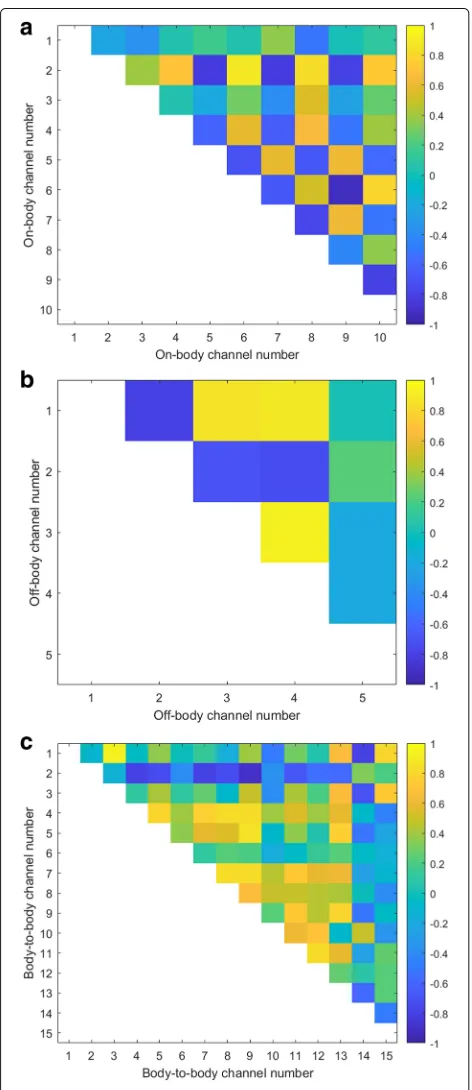
signif-icance. Figure 3a shows the p values of the
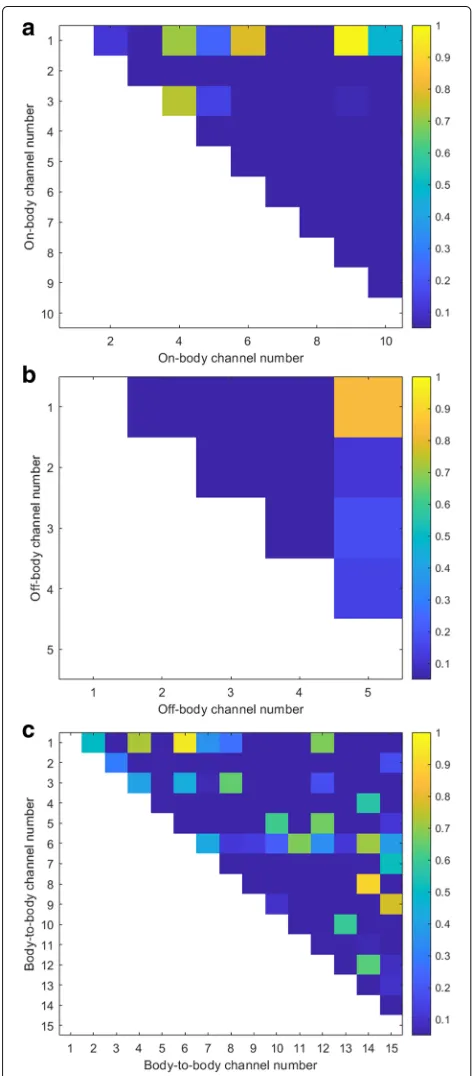
consid-ered on-body channels, with 80% of the channels having p < 0.05, indicating a significant correlation between them. Since the channels show significant correlations, a multivariate normal distribution given by (2) can be used to estimate the amplitude distribution. The esti-mated covariance matrix is given in Table 3. To eval-uate the goodness of the fit, a quantile-quantile plot of the estimated multivariate normal distribution of all 10 on-body channels against the simulation results is shown in Fig.4a. The plot approximately coincides with the identity line, meaning that the estimated distribu-tion is a good fit of the simulated data. The KS test confirms that the two datasets are from the same dis-tribution with asymptoticp = 0.2178 and test statistic ks2stat=0.0468.
3.2 Off-body channels 3.2.1 Fade variation
The results of the fade variation for the considered
off-body channels are summarized in Fig. 5 and Table 4.
The results show overall stable channels with exception from the ceiling-to-back channel (Fig.5a). This is because in the absence of LOS, the resulting power received is a summation of reflected and diffracted fields, resulting in constructive and destructive interference as the sub-jects move from one location to another. We also notice the overall increase in the channel gain with time as back node moves out of the shadow region as the sub-ject gets closer to the off-body node. This is not the
case for the other channels as they are affected by the change in elevation angle and hence the antenna gain in the direction of communication. There is, however, an overall decrease in propagation loss for these chan-nels (ceiling-to-chest, ceiling-to-thigh, ceiling-to-ear) as the subject gets closer to the off-body node as shown in Fig.5b.
3.2.2 Amplitude distribution
Similar to the on-body channels, the off-body channels were tested for correlation significance so that a mul-tivariate normal distribution could be used to estimate the amplitude distribution of the channels. Figure 3b shows thepvalues of the considered off-body channels, with 60% of the channels havingp < 0.05, indicating a significant correlation between them. The resulting esti-mated multivariate distribution’s quantile-quantile plot with estimated covariance matrix given Table 5 shows a good fit with simulated data (Fig. 4b). The KS test confirms that the two datasets are from the same dis-tribution with asymptoticp = 0.5982 and test statistic ks2stat=0.0481.
3.3 Body-to-body channels 3.3.1 Fade variation
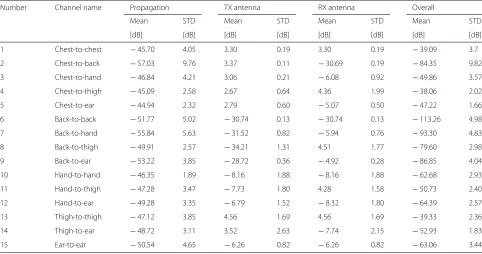
The results of the fade variation for the considered body-to-body channels are summarized in Table6. Sim-ilar to the off-body channels, the body-to-body chan-nels involving the node located at the back have shown the largest fade variations due to the absence of LOS
Table 5Covariance matrixfor off-body channels (×10−9)
113.6780 −5.8442 22.4157 66.2266 0.4873
−5.8442 0.4581 −1.1750 −3.4201 0.2269 22.4157 −1.1750 5.9168 15.9113 −0.7007
66.2266 −3.4201 15.9113 49.2340 −2.1518
Table 6Average channel gain and standard deviation of body-to-body channels
Number Channel name Propagation TX antenna RX antenna Overall
Mean STD Mean STD Mean STD Mean STD
[dB] [dB] [dB] [dB] [dB] [dB] [dB] [dB]
1 Chest-to-chest −45.70 4.05 3.30 0.19 3.30 0.19 −39.09 3.7
2 Chest-to-back −57.03 9.76 3.37 0.11 −30.69 0.19 −84.35 9.82
3 Chest-to-hand −46.84 4.21 3.06 0.21 −6.08 0.92 −49.86 3.57
4 Chest-to-thigh −45.09 2.58 2.67 0.64 4.36 1.99 −38.06 2.02
5 Chest-to-ear −44.94 2.32 2.79 0.60 −5.07 0.50 −47.22 1.66
6 Back-to-back −51.77 5.02 −30.74 0.13 −30.74 0.13 −113.26 4.98
7 Back-to-hand −55.84 5.63 −31.52 0.82 −5.94 0.76 −93.30 4.83
8 Back-to-thigh −49.91 2.57 −34.21 1.31 4.51 1.77 −79.60 2.98
9 Back-to-ear −53.22 3.85 −28.72 0.36 −4.92 0.28 −86.85 4.04
10 Hand-to-hand −46.35 1.89 −8.16 1.88 −8.16 1.88 −62.68 2.93
11 Hand-to-thigh −47.28 3.47 −7.73 1.80 4.28 1.58 −50.73 2.40
12 Hand-to-ear −49.28 3.35 −6.79 1.52 −8.32 1.80 −64.39 2.57
13 Thigh-to-thigh −47.12 3.85 4.56 1.69 4.56 1.69 −39.33 2.36
14 Thigh-to-ear −48.72 3.11 3.52 2.63 −7.74 2.15 −52.93 1.83
15 Ear-to-ear −50.54 4.65 −6.26 0.82 −6.26 0.82 −63.06 3.44
as indicated by their standard deviation. The chan-nels also have the lowest average channel gain for the
same reason. Figure 6 shows the time series of the
channels involving the nodes located at the back. The effect of constructive and destructive interference can be seen clearly especially for the chest-to-back and back-to-back channels. On the other hand, the chan-nels which have constant LOS (to-chest, chest-to-thigh, and thigh-to-thigh) have the largest average channel gain.
Fig. 6Time series of simulated data for body-to-body channels
3.3.2 Amplitude distribution
Thepvalues of the considered body-to-body channels are shown in Fig.3c. The results show that 68% of the chan-nels have p < 0.05, indicating a significant correlation between the channels; hence, multivariate normal distri-bution could be used in the estimation of the amplitude distribution of the channels. The resulting estimated mul-tivariate normal distribution’s quantile-quantile plot with covariance matrix given in Table7is shown in Fig.4c. The plot approximately coincides with the identity line, mean-ing the distribution is a good fit of the simulated data. The KS test confirms that the two datasets are from the same distribution with asymptoticp= 0.9037 and test statistic ks2stat=0.0206
3.4 Comparison of channels
between the reflected and diffracted fields, which vary significantly with distance. For the case of the average channel gain, larger values have been seen in channels with LOS and relatively short distance for on-body (hand-to-thigh), off-body (ceiling-to-chest), and body-to-body (chest-to-thigh).
The channels for all scenarios showed a significant cor-relation withp< 0.05 for 80% of on-body channels, 60% of off-body channels, and 68% of body-to-body channels. This justified the use of multivariate normal distribution in the estimation of the amplitude distribution of the channels. The resulting estimate of amplitude distribution showed a good fit with the simulated data with quantile-quantile plots coinciding with the identity line for all the scenarios.
The antenna placements favorable for off-body and body-to-body communications are those that have the least fading and least fade variations. The chest node appears to be more favorable for the off-body commu-nication due to its low and stable fade values (Fig. 5a). However, this is only applicable in the LOS situation when the subject is facing the off-body node. When the sub-ject orientation changes as in the case of a subsub-ject moving away from the off-body node, the back node could be the better option. The best practice will then be to alternate between the chest and back node depending on the sub-ject orientation. This can be confirmed by the negative linear correlation between the two channels as shown in Fig.7a. A similar approach can be taken to exploit spatial diversity from other channels with negative linear corre-lation in Fig.7. For the on-body communications, we also notice that the channels involving the back node experi-ence the most fading (Table 2). This implies that in a star topology network, the back node is not a feasible option as the center node.
4 Conclusion
In this work, FDTD was used in the investigation of dynamic WBAN channel characteristics during walking. More specifically, the channels considered were 10 on-body, 5 off-on-body, and 15 body-to-body channels. The channels were investigated in terms of fade variation and their corresponding amplitude distributions. For on-body channels, the fade variation was found to be periodic, with a larger fade variation shown by the channels involving the nodes at the hand and thigh. Off-body and body-to-body channels with the absence of LOS experienced construc-tive and destrucconstruc-tive interference as the distance between the end node changed. This resulted in larger fade vari-ation than the channels involving the nodes at the hand and thigh. For the amplitude distribution of the chan-nels, the multivariate normal distribution was considered. The distribution was considered after the channels show significant correlation between each other. The resulting
estimated multivariate distributions fit well the simulated data, for on-body, off-body, and body-to-body channels. This will reduce the complexity of performance analysis of the network.
Abbreviations
FDTD: Finite-difference time-domain; LOS: Line of sight; STD: Standard deviation; WBAN: Wireless body area network
Acknowledgements
The authors would like to thank the Norwegian University of Science and Technology, Norway, and Ghent University/IMEC INTEC-WAVES for supporting this work.
Funding
This work was supported by the Ministy of Education and Research, Norway.
Availability of data and materials
The dataset(s) supporting the conclusions of this article are available in the figshare repositoryhttps://figshare.com/articles/Characterization_of_ Dynamic_Wireless_Body_Area_Network_Channels_During_Walking_zip/ 6226949.
Authors’ contributions
MM and WJ identified the channel to be modeled. MM conducted the simulations with GV, analyzed the data with ET, and wrote the manuscript. WJ supported and supervised the research. WJ, GV, ET, and MC proofread the manuscript. All authors read and approved the final manuscript.
Competing interests
The authors declare that they have no competing interests.
Publisher’s Note
Springer Nature remains neutral with regard to jurisdictional claims in published maps and institutional affiliations.
Author details
1Norwegian University of Science and Technology, Teknologiveien 22, 2815
Gjøvik, Norway.2Ghent University/IMEC INTECWAVES, iGent
-Technologiepark 15, 9052 Gent, Belgium.
Received: 7 May 2018 Accepted: 25 March 2019
References
1. Q. H. Abbasi, M. U. Rehman, K. Qaraqe, A. Alomainy,Advances in Body-Centric Wireless Communication: Applications and State-of-the-Art. (Institution of Engineering and Technology, Stevenage, 2016) 2. D. B. Smith, D. Miniutti, L. W. Hanlen, Characterization of the body-area
propagation channel for monitoring a subject sleeping. IEEE Trans. Antennas Propag.59(11), 4388–4392 (2011)
3. S. L. Cotton, G. A. Conway, W. G. Scanlon, A time-domain approach to the analysis and modeling of on-body propagation characteristics using synchronized measurements at 2.45 GHz. IEEE Trans. Antennas Propag. 57(4), 943–955 (2009)
4. S. Cotton, A. McKernan, A. Ali, W. Scanlon, inProceedings of the 5th European Conference on Antennas and Propagation (EUCAP). An
experimental study on the impact of human body shadowing in off-body communications channels at 2.45 GHz (IEEE, 2011), pp. 3133–3137 5. S. L. Cotton, A. McKernan, W. G. Scanlon, inProceedings of Loughborough
Antennas and Propagation Conference (LAPC). Received signal characteristics of outdoor body-to-body communications channels at 2.45 GHz (IEEE, 2011), pp. 1–4
6. R. D’Errico, L. Ouvry, A statistical model for on-body dynamic channels. Int. J. Wirel. Inf. Netw.17(3-4), 92–104 (2010)
7. D. Goswami, K. Sarma, A. Mahanta, inProceedings of IEEE International Conference on Signal Processing, Informatics, Communication and Energy Systems (SPICES). Experimental determination of path loss and delay dispersion parameters for on-body UWB WBAN channel (IEEE, 2015), pp. 1–4
8. R. Rosini, R. D’Errico, inProceedings of Loughborough Antennas and Propagation Conference (LAPC). Comparing on-body dynamic channels for two antenna designs (IEEE, 2012), pp. 1–4
9. V. Sipal, D. Gaetano, P. McEvoy, M. J. Ammann, Impact of hub location on the performance of wireless body area networks for fitness applications. IEEE Antennas Wirel. Propag. Lett.14, 1522–1525 (2015)
10. R. Rosini, R. D’Errico, inProceedings of 6th European Conference on Antennas and Propagation (EUCAP). Off-body channel modelling at 2.45 GHz for two different antennas (IEEE, 2012), pp. 3378–3382
11. Q. H. Abbasi, M. U. Rehman, H. T. Chattha, K. Qaraqe, A. Alomainy, Y. Hao, C. Parini, Ultra wideband antenna diversity characterisation for off-body communications in an indoor environment. IET Microwaves Antennas Propag.8(14), 1161–1169 (2014)
12. P. Van Torre, L. Vallozzi, C. Hertleer, H. Rogier, M. Moeneclaey, J. Verhaevert, Indoor off-body wireless MIMO communication with dual polarized textile antennas. IEEE Trans. Antennas Propag.59(2), 631–642 (2011) 13. M. Marinova, A. Thielens, E. Tanghe, L. Vallozzi, G. Vermeeren, W. Joseph,
H. Rogier, L. Martens, Diversity performance of off-body MB-OFDM UWB-MIMO. IEEE Trans. Antennas Propag.63(7), 3187–3197 (2015) 14. R. Rosini, R. Verdone, R. D’Errico, Body-to-body indoor channel modeling
at 2.45 GHz. IEEE Trans. Antennas Propag.62(11), 5807–5819 (2014) 15. F. Mani, R. D’Errico, A spatially aware channel model for body-to-body
communications. IEEE Trans. Antennas Propag.64(8), 3611–3618 (2016) 16. T. Kumpuniemi, M. Hämäläinen, K. Y. Yazdandoost, J. Iinatti, inProceedings
of 9th European Conference on Antennas and Propagation (EuCAP). Measurements for body-to-body UWB WBAN radio channels (IEEE, 2015), pp. 1–5
17. S. J. Ambroziak, L. M. Correia, K. Turbic, inProceedings of URSI Asia-Pacific Radio Science Conference (URSI AP-RASC). Radio channel measurements in body-to-body communications in different scenarios (IEEE, 2016), pp. 1376–1379
18. S. L. Cotton, W. G. Scanlon, A. McKernan, inProceedings of 6th European Conference on Antennas and Propagation (EUCAP). Improving signal reliability in outdoor body-to-body communications using front and back positioned antenna diversity (IEEE, 2012), pp. 3393–3396
19. L. Liu, R. D’Errico, L. Ouvry, P. De Doncker, C. Oestges, Dynamic channel modeling at 2.4 GHz for on-body area networks. Adv. Electron. Telecommun.2(4), 18–27 (2011)
20. M. Mohamed, M. Cheffena, A. Moldsvor, F. P. Fontan, Physical-statistical channel model for off-body area network. IEEE Antennas Wirel. Propag. Lett.16, 1516–1519 (2017)
21. T. Aoyagi, M. Kim, J.-i. Takada, K. Hamaguchi, R. Kohno, et al., in Proceedings of the 5th European Conference onAntennas and Propagation (EUCAP). Body motion and channel response of dynamic body area channel (IEEE, 2011), pp. 3138–3142
22. Q. Wang, T. Tayamachi, I. Kimura, J. Wang, An on-body channel model for UWB body area communications for various postures. IEEE Trans. Antennas Propag.57(4), 991–998 (2009)
23. E. Reusens, W. Joseph, B. Latré, B. Braem, G. Vermeeren, E. Tanghe, L. Martens, I. Moerman, C. Blondia, Characterization of on-body communication channel and energy efficient topology design for wireless body area networks. IEEE Trans. Inf. Technol. Biomed.13(6), 933–945 (2009)
24. M. Gallo, P. S. Hall, Y. I. Nechayev, M. Bozzetti, Use of animation software in simulation of on-body communications channels at 2.45 GHz. IEEE Antennas Wirel. Propag. Lett.7, 321–324 (2008)
25. I. Foundation, Duke. https://www.itis.ethz.ch/virtual-population/virtual-population/vip3/duke/. Accessed 7 May 2018
26. L. Roelens, S. Van den Bulcke, W. Joseph, G. Vermeeren, L. Martens, Path loss model for wireless narrowband communication above flat phantom. Electron. Lett.42(1), 10–11 (2006)
27. D. Smith, J. Zhang, L. Hanlen, D. Miniutti, D. Rodda, B. Gilbert, Temporal correlation of dynamic on-body area radio channel. Electron. Lett.45(24), 1212–1213 (2009)
28. P. van Dorp, F. Groen, Human walking estimation with radar. IEE Proceedings-Radar, Sonar Navig.150(5), 356–365 (2003) 29. Modeling Modules Framework: POSER.https://zmt.swiss/sim4life/
framework/poser/. Accessed 7 May 2018
30. ZMT. Z. MedTech, Sim4Life 4.0 User Manual. ZMT Zurich MedTech, Zurich, Switzerland (2018)
31. D. B. Smith, D. Miniutti, T. A. Lamahewa, L. W. Hanlen, Propagation models for body-area networks: a survey and new outlook. IEEE Antennas Propag. Mag.55(5), 97–117 (2013)
33. J. Dong, D. Smith, inProceedings of 23rd International Symposium on Personal Indoor and Mobile Radio Communications (PIMRC). Cooperative body-area-communications: enhancing coexistence without coordination between networks (IEEE, 2012), pp. 2269–2274
34. M. Mackowiak, L. M. Correia, A statistical model for the influence of body dynamics on the gain pattern of wearable antennas in off-body radio channels. Wirel. Pers. Commun.73(3), 381–399 (2013)
35. P. Mukhopadhyay,Multivariate Statistical Analysis. (World Scientific, Singapore, 2009)
36. G. L. Shevlyakov, H. Oja,Robust Correlation: Theory and Applications, vol. 3. (Wiley, Hoboken, 2016)