Brief Report
Report of the 7
thinternational workshop on colposcopy, screening and
prevention of cervical cancer, Douala, Cameroon, March 30 - 31 and
April 1
st2016
Jovanny Tsuala Fouogue
1*, Zacharie Sando
2,
Florent Ymele Fouelifack
3,
Jeanne Hortence Fouedjio
4, Pierre Marie Tebeu
5, Jacques Tsingaing Kamgaing
6,
Pierre Vassilakos
7, Patrick Petignat
81Douala Gynaeco-Obstetric and Pediatric Hospital
,
Douala, Cameroon2Department of Morphological Sciences, Faculty of Medicine and Biomedical Sciences of The University of Yaounde
1, Yaounde, Cameroon
3Yaounde Central Hospital, Yaounde, Cameroon
4Department of Obstetrics and Gynaecology, Faculty of Medicine and Biomedical Sciences of The University of
Yaounde 1, Yaounde, Cameroon
5Yaounde University Teaching Hospital,Yaounde, Cameroon 6Douala General Hospital, Douala, Cameroon
7Geneva Foundationr for Medical Education and Research,1211 Geneva 2 – Switzerland 8Geneva University Hospitals,Rue Gabrielle-Perret-Gentil 4, 1205 Genève, Switzerland
Received: 14 July 2016 Accepted: 09 August 2016
*Correspondence:
Dr.Jovanny Tsuala Fouogue, E-mail: [email protected]
Copyright: © the author(s), publisher and licensee Medip Academy. This is an open-access article distributed under the terms of the Creative Commons Attribution Non-Commercial License, which permits unrestricted non-commercial use, distribution, and reproduction in any medium, provided the original work is properly cited.
ABSTRACT
Background: Authors herein report the proceedings of the 7th international workshop on colposcopy, screening and prevention of cervical cancer held in Douala (Cameroon) on March 30 - 31 and April 1, 2016.
Methods: As with previous conferences of this series, the 2016 edition provided an excellent forum for exchange of information and opinions between the researchers, clinicians, laboratory scientists and regulatory bodies. It also stood as an opportunity for further training of health staff on prevention and screening of cervical cancer.
Results: The workshop covered both accepted and emerging methods of preventing and screening cervical cancer with emphasis on current clinical and public health practice in low and middle-income countries. The topic was covered by complementary sessions: cervical principles, cervical cancer epidemiology and prevention strategy; cervical cancer management and treatment; cervical cancer screening programs in Cameroon; innovations in cervical cancer screening and perspectives in cervical cancer screening. This report also summarizes the presentations done during the workshop. This 7th edition set up the record of attendance with more than 150 participants of several backgrounds (specialist physicians and nurses, laboratory technicians, socio-anthropologists, university lecturers and managers of health systems) from more than 19 local and international institutions.
Conclusions: Master’s classes, free communications and discussions were fruitful and appointment was taken for March 30-31, 2017 in Yaounde (Cameroon).
INTRODUCTION
Cancer of the cervix uteri (CCU) is the third most common cancer among women and the third cause of cancer-related deaths among women worldwide.1 More
than 85% of cases are registered in low and middle income countries (LMICs) countries where CCU is the third cause of cancer-related deaths.2 In Cameroon, the
contribution of CCU to the national burden of cancer is very high since more than four decades.3-6 According to
the International Agency for Research on Cancer (IARC), CCU ranked second in 2012 among Cameroonian women with an Age Standardised Ratio of 1,993 new cases per 100,000 women per year, representing 23.9% of all cases of cancer in women.1 Even in the whole population of
adults (including men), breast cancer had the highest incidence (19.0% of all new cases) followed by CCU (14.5% of all new cases of cancer).1 Though current data
are extrapolated from a regional hospital-based cancer registry covering a part of the country, the incidence of CCU in Cameroon is on the rise.1,6
The main explanation is the same like in other LMICs: lack of an efficient screening programme.7 Indeed,
cytology-based screening programmes and early treatment of pre-cancerous lesions have reduced the incidence of CCU in developed countries.7
Cytology-based (Papanicolaou smear) strategy is beyond the capacities of health services of LMICs because of lack of qualified pathologists and its low sensitivity that impose to repeat it frequently.7 Since 2013, the World Health
Organisation (WHO) recommends screening of cervical cancers with a (naked eye) visual methods: VIA (Visual Inspection of the cervix with Acetic Acid) and HPV (Human Papilloma Virus) testing.8
Background and audience
A project was set up in 2001 (by the Department of Obstetrics and Gynaecology from the University Hospitals of Geneva (HUG) together with three Cameroonian doctors) to fight CCU in Cameroon using cytology-based screening in rural area. That project was revived in 2007 by 3 leadings doctors with the support of their respective institutions: Professor Patrick Petignat (HUG), Professor Pierre-Marie Tebeu (Yaounde University Teaching Hospital (YUTH)) and Professor Anderson Sama Doh (National Cancer Control Committee (NCCC) of the Cameroonian Ministry of Public Health). The second phase of this project focuses on promoting prevention of CCU through screening with visual methods, HPV testing and vaccine. In the frame of this project yearly workshops are organised in Cameroon in prevention and screening of cervical cancer, colposcopy, management of pre-invasive lesions and vaccination against HPV.9 Previous workshops were held
in Yaounde, Edea, Buea, Dschang and Kribi.
This report presents the proceedings of the 7th
international workshop held at the Douala General
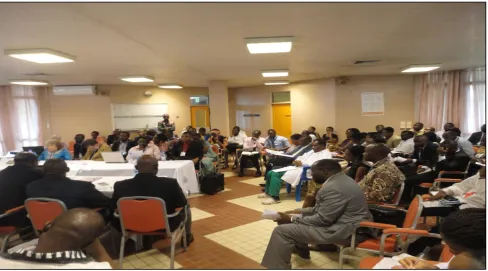
Hospital (DGH) from March 30, 31 to April 1, 2016. This edition has the highest audience with more than 150 participants and 30 speakers from various institutions and countries (Figure 1). From Cameroon we had representatives of the following institutions: DGH, Douala Gynaeco-Obstetric and Pediatric Hospital (DGOPH), Faculty of Medicine and Pharmaceutical Sciences of the University of Douala (FMPS-UD), Laquintinie Hospital,Centre Medical Emergence Divine, Faculty of Medicine and Health Sciences of the University of Buea (FMHS - UB), Cameroon Baptist Convention Health services (CBC-HS), Faculty of Biomedical Sciences of the University of Dschang, Edea Regional Hospital, Biyem-assi district Hospital (BDH), Faculty of Medicine and Biomedical Sciences of the University of Yaounde 1 (FMBS-UY1), Yaoundé Gynaeco-Obstetric and Paediatric Hospital (YGOPH), YUTH, Yaounde General Hospital (YGH), Solidarité Chimiothérapie (SOCHIMIO), NCCC, CentreHospitalier et de Recherche et d’Application en Chirurgie Endoscopique et Reproduction (CHRACERH), Adventist University of Bandjoun (AUB), the University of Dschang (UD) and the Faculty of arts letter and human sciences of the University of Yaoundé.1 The Geneva
University Hospitals (HUG), the Geneva Foundation for Medical Education and Research (GFMER) and the Harvard Medical School (Dana Farber/Harvard Cancer Center; Department of Radiation Oncology) were also represented. This workshop was attended by a wide range of professional categories: undergraduate medical students, students in nursing, a student in sociology, resident doctors, general practitioners, Obstetricians, Gynaecologists, oncologists, radiotherapists, laboratory technicians, nurses and pathologists.
The following paragraphs summarize the main themes that emerged during that 3-day meeting.
March 29, 2016
This day was dedicated to a session of Hands on training to VIA/VILI (Visual Inspection of the Cervix with Lugol’s Iodine) of selected participants. After a briefing on VIA/VILI, 46 participants took part actively in screening of 175 women (25 to 65 years). All the 21 cases of VIA/VILI positive cases were biopsied. A Striking feature of this activity was the discovery of a stage 3 CCU in a 68 year old woman.
March 30, 2016
Session 1: Cervical cancer epidemiology and prevention strategy
Pr Anderson Sama Doh deplored the very small budgetary allocation by the government for the fight against CCU in Cameroon. According to him, this is paradoxical given the high burden of the CCU. This will not allow the NCCC to achieve the goals of his ambitious action plan described by Pr Pierre Marie Tebeu (from the YUTH). The future of screening in LMICs is hrHPV testing as Pr Pierre VASSILAKOS (from the GFMER) demonstrated. Biomarkers (p16INK4A/Ki67, MCM2 and TOP2A, Methylation) of cervical dysplasia are being studied with promising perspectives. There is still a long way before HPV vaccine is fully implemented in LMICs despite funding by the GAVI (Global Alliance for Vaccines and Immunisation). Professor Emile Telesphore Mboudou (from the DGOPH) reviewed the barriers to HPV. As the last speaker of this session Professor Wilfred Ngwa (from the Havard Medical School) depicted the challenges of radiotherapy in Africa (lack of infrastructure and human resource).
Session 2: Cervical principles
Professor Zacharie Sando (FMBS-UY1 and YGOPH) did a practical description of the morphology of the uterine cervix with emphasis on the transformation zone and dysplasia and Dr Claude cyrille Noa Ndoua (FMBS-UY1 and CHRACERH) recalled the principles of antenatal care after management of CIN 2+. Dr Caroline Benski (HUG) presented the colposcopic terminology of the International Federation for Cervical Pathology and Colposcopy and described the tips to identify lesions on VIA/VILI. Closing up of the session, Dr Liliane Temogne (YUTH) described the positive role of carrying out VILI just after VIA at the YUTH.
Session 3: Cervical cancer management and treatment
Professor Patrick Petignat (HUG) explained the principles of screen and treat approach: administering treatment (Cryotherapy end Loop Electrosurgical Excision Procedure (LEEP) to positive women with lesions during the same session (1 or 2 visits) as their screening and diagnosis. Given that the use of VIA/VILI as a triage method for hrHPV positive women may be associated with loss of sensitivity, “ABCD” criteria are proposed as a reliable mean of detecting CIN 2+ lesions in those women. A = Acetowhite lesion; B = Bleeding; C =conformation with VILI; D = Diameter of the lesion (< 5 millimeters). A comprehensive description of LEEP and its possible complications was done by Dr Gregory Ekane Halle (DGH and FMHS - UB). After the masters’ classes, the following free communications were delivered: Cancer du col au cours de la grossesse chez une gestante vivant avec le Virus de IH: à propos d`un cas à l`Hôpital Gynéco-Obstétrique et Pédiatrique de Douala (by Dr Biakolo Essomba (DGOPH)); Knowledge, attitudes and practices regarding cervical cancer amongst
women living in the Dschang health district, west – Cameroon (by Pr Zacharie Sando (FMBS-UY1 and YGOPH)); Misdiagnosis of cervical cancer with fatal outcome: a case report ( by Dr Alphonse Nyong Ngalame (DGOPH)); les perdues de vue du cancer du col de l’utérus, de la suspicion au traitement : étude prospective sur 3 ans à l’Hôpital régional de Limbé, Cameroon (by Dr Robert Tchounzou); Aspects cytopathologiques du frottis cervical chez les femmes de la région de l’extreme-nord Cameroun (by Mr Thomas (AUB)); Colposcopy in the management of premalignant lesions of the cervix at the Yaounde University teaching Hospital (by Dr Rosine Mafoma (FMSB-UY1).
March 31, 2016
Session 4: Cervical cancer screening programs in Cameroon
Professors Thomas and Edith Welty from the CBC-HS presented results of the following study: Prevalence, predictors, and treatment of positive VIA enhanced by Digital Cervicography (DC) and histopathology results in a cervical cancer prevention program in cameroon. The study was carried out on a sample of 44979 women and 9.0% of them were VIA-DC Positive. Factors significantly associated with VIA-DC-positive screen were HIV-infection, young age at sexual debut, higher lifetime number of sexual partners, low level of education and high parity. About 1.5 % of participants were CIN2+ or ICC; and 31.1% of women eligible for cryotherapy underwent treatment on the same day. Still from the CBC-HS, Mr Simon MANGA presented the results of their experience on Screening for cervical cancer among HIV-positive and HIV-negative women in Cameroon using simultaneous co-testing with care HPV DNA testing and digital cervicography. He concluded that screening women aged 30 years exclusively with self-collected careHPV tests and then performing follow-up digital cervicography on HPV positive women may be a more efficacious and cost-effective screening strategy in low-resource settings. Dr Liliane Temogne (YUTH) discussed preliminary results of the first study on the feasibility of the introduction of a point-of-care HPV testing (X-pert® test) for primary screening with
simultaneous genotyping for triaging and management. The conclusion was that X-pert assay can be used to accurately and rapidly test and treat patients affected with CIN2+ lesions at the site of care. Dr Bruno Kenfack (from the FBS-UD) presented the results of primary screening and follow up of hr-HPV positive women at the Dschang health district Hospital. Dr Eveline Foguem Tincho (from the BDH) presented the preliminary results of an ongoing study on efficacy and patient tolerance of cryotherapy for CIN2+ in Dschang (Cameroon).
Session 5: Innovations in cervical cancer screening
Vassilakos (HUG). He demonstrated that self-sampling was an appropriate alternative to physician-collected sapling for cervical cancer screening. The second talk was by Professors Edith and Thomas Welty (CBC-HS); they explained that digital imaging is the future of cervical cancers screening (the so-called ‘digital cervicography’). As the last speaker, Dr Caroline Benski (HUG) described an internet-based Instrument to assess Visual Inspection of the Cervix with Acetic Acid (VIA) and Lugol’s Iodine (VILI) kills among health care providers.
Session 6: Perspectives in cervical cancer screening
Pr Pierre Marie Tebeu (FMBS-UY1 and YUTH) summarized the frame of a project led by ANRS-Cameroon (Agence Nationale de Recherche sur le Virus de l’Immunodéficience Humaine et les hépatites virales) to improve prevention of cancers in HIV patients in sub-saharan Africa with three sites (Burkina Faso, Cameroon and Ivory Coast). The ultimate goal of the project is to identify priority axis of research in prevention and management of cancer in people living with human
[image:4.595.54.543.343.614.2]immunodeficiency virus. In the second part of this session the following free communications were done: Feasibility and costs of using self-collected care HPV testing to screen for cervical cancer in rural villages in Cameroon, followed by VIA and preventive treatment of HPV-positives (by Mr Simon Manga (CBC-HS); Prévalence De L’infection A VIH Chez Les Patientes Présentant Un Cancer Du Col Utérin A l’Hôpital Général De Douala (by Dr Jacques Tsingaing (DGH); Histopathology results in a cervical cancer prevention program in Cameroon (by Professors Thomas and Edith Welty); knowledge attitudes and practices of health staff on cervical cancer in west Cameroon (by Professor Pierre Marie Tebeu (FMBS-UY1 and YUTH); Aspects cytopathologiques du col utérin chez la femme enceinte à Yaoundé (by Professor Blaise Nkegoum (YUTH and UD)); Comparaison entre frottis cervico-vaginal et inspection visuelle du col de l’utérus à l’acide acétique et au lugol dans le dépistage des cancers à Djoungolo (by Dr Etienne Atengeuna (FMSB-UY1 and YGH)); Profil d'un groupe de femmes à Yaoundé n'ayant jamais réalisé le dépistage du cancer du col (by Anny-Nadège Ngassam; CHRACERH).
Figure 1: Participants carefully following a session.
Closing ceremony
As the president of the committee in charge of awards for best scientific presentations, Pr Pierre VASSILAKOS (HUG) disclosed the names of recipients: Dr Jovanny Tsuala Fouogue (DGOPH), Dr Ilick Liliane Ofakem
Figure 2: Family photograph closing the meeting.
CONCLUSION
The goals of this workshop were reached with respect to the number and the qualification of the audience, the number and the content of presentations. Given that the way is still long to achieve acceptable standards in preventing and screening cervical cancer in LMICs, all participants took appointment for the next workshop on March 30 and 31, 2017 in Yaoundé (Cameroon).
ACKNOWLEDGEMENTS
We would like to thank all speakers/moderators and all participants for their time and contribution to the success of this workshop. We express special thanks chief executive officer of the Douala General Hospital and all his staff not only for hosting the meeting but also for their priceless multiform support. Our gratitude also goes to the University Hospitals of Geneva for their continuous support to our fight against cervical cancer in Cameroon in particular and in low- and middle-income countries in general. We also thank the Yaounde University Teaching Hospital for its commitment to fight CCU in Cameroon. Last but not least, we thank the permanent secretary of the Cameroon National Cancer Control committee for active participation.
Funding: No funding sources
Conflict of interest: None declared Ethical approval: Not required
REFERENCES
1. World Health Organization. GLOBOCAN 2012: estimated cancer incidence, mortality and prevalence
worldwide in 2012. Available at:
http://globocan.iarc.fr/Pages/fact_sheets_cancer.aspx Updated 2014. Accessed 25 March 2014.
2. Sankaranarayanan R, Ferlay J. Worldwide burden of gynaecological cancer: the size of the problem. Best Pract Res Clin Obstet Gynaecol. 2006;20(2):207-25. 3. Mbakop A, Yomi J, Yankeum J, Nkegoum B,
Mouelle Sone A. Cancer localisation in men and women aged over 50 in Cameroon. Bull Cancer. 1997;84(12):1119-22.
4. Mbakop A, Essame Oyono JL, Ngbangako MC, Abondo A. Current epidemiology of cancers in Cameroon (Central Africa). Bull Cancer. 1992;79(11):1101-4.
5. Jensen OM, Tuyns AJ, Ravisse P. Cancer in cameroon: a relative frequency study. Rev Epidemiol Sante Publique. 1978;26(2):147-59.
7. Alec M, Vassilakos P. Cervical cancer in developing countries. Cervical cancer information. GFMER
resources. Available at:
http:/www.gfmer.ch/ccdc/cervical-cancer.htm. Accessed on March 25, 2016.
8. WHO guidelines for screening and treatment of precancerous lesions for cervical cancer prevention. World Health Organization 2013.
9. Baumann F. In GFMER Cervical cancer in developing countries: Country activities - Cameroon;
Aldo Campana, editor. Available at:
http:/www.gfmer.ch/ccdc/Cameroon.htm. Accessed on March 25, 2016.
10. Macdonald R. A guide to writing conference reviews. AJP. 2006;4(4).