Volume 8, No. 5, May – June 2017
International Journal of Advanced Research in Computer Science RESEARCH PAPER
Available Online at www.ijarcs.info
Framework for Requirement Management using Requirement Traceability
Sandhya Satyarthi
Department of Information Technology Babasaheb Bhimrao Ambedkar University,
Lucknow - 226025, India
Dhirendra Pandey
Department of Information Technology Babasaheb Bhimrao Ambedkar University,
Lucknow (UP) - 226025, India
Abstract: It has been observed that the requirement engineering is decisive activity in delivering successful software product. For a proper supervision of requirement engineering, a framework is needed to guide the whole procedure related to the requirement management. Requirement may be maintained in a way to better collection, organization, specification, measuring and implementation of the requirements. Therefore, we have developed a framework for requirement management for effective management of requirements from the different sources, such as, customer, market, organization, stakeholders, etc. The framework is ultimately, works as platform on which development activities are running by attainment of abundant results with maximum customer satisfaction. In order to providing good requirement management, Requirement Traceability Matrix is used as apparatus which help in sketching the requirement at every stage. RTM have test cases that are capable of changing, adding and updating the requirement at any level to address good quality software product or project development.
Keywords: Requirements, requirement management, requirement management framework, Requirement management tools, RTM traceability.
I. INTRODUCTION
In software development a requirement plays vigorous role to provide good software product or project. For a effective development of project requirement must investigated correctly. Requirements may be basic attribute or characteristic of product or project being developed. It is the discipline within systems and software engineering that bridges the entire life cycle and thus determines success or failure of a product or project [1]. Requirement engineering is both problem-oriented and solution-oriented discipline. As a problem-oriented discipline, RE interfaces with system engineering in exist in the system in which the software is somehow embedded. It deals with goals to be achieved, the stakeholders who have these goals, and the problems to be solved within given business constraints. On other hand, RE interfaces with product development in that it specifies the desired functions like quality attribute and other properties of software that is to be built. Data collected from the STANDISH Report found approx. 9,236 IT (69%) projects were failed due to top 3 reasons as follows [2, 3, 4]:
• Improper requirement management(Requirement traceability issue),
• Lack of user input, poor end-user training,
• Incomplete requirements or rapidly changes in requirement including poor requirement, over-ambitious requirement, unnecessary requirements, poor contract drafting, poor contact management.
Requirement management is needed to manage all these contributing factors in effective manner. The changes in requirement must be handled adequately and status is updated according to the project phase and tracing to other development artifacts should be established. Tracing of requirement must be important to check the problem and solution of each requirement [7]. In this paper deliberate about the role requirement management in product or project lifecycle and traceability matrix of requirement and how they are used. Requirement traceability is key activity of requirement management in this documentation of derivation path in upward (vertical) and allocation in downward paths
of work product. It provide mapping to requirements in order to achieve their objective in a way to satisfy users. It is equally important to ensure that requirements are being addressed appropriately by its consumers. When the QA team has finished defining test cases, they should map those test cases back to your requirements. This will help to improve coverage of test cases [5, 6].
• Requirement engineering acquire requirements must be of following types:
• Functional Requirement: defines the behavior or functionality of the system, like performance,
• Non-functional Requirement is Quality attributes of the system. This includes McCall’s Quality factor like reliability, usability etc.
• Component Requirement: A system is made up with some different type of components. So, each associated component have its own requirement. • Product Requirement: specify the behavior of the
product. This involves failure rate, security requirement.
• Market Requirement: MRD is developed which ensures costumer’s wants, organization or service needs are described.
Requirements are change heavily during the product life cycle. Hence, management of the requirement is essential. The organization of the paper is as follows. Section 2 presents the requirement management frameworks and details of its phases. In section 3, we have discussed the impact of RE in product life cycle. Section 4 requirement traceability matrix is deliberated and in section 5, we putting light on RTM as tool in requirement management and in last section 6, finding the appropriate conclusions and future scope of our investigation.
II. REQUIREMENT MANAGEMENT FRAMEWORK
managers ,end-users, business analyst, in order gather, specify, prioritize or change requirement [7, 8].
[image:2.595.36.282.144.635.2]We have proposed a framework for requirement management for effective requirement controlling, managing and developing, is shown in the figure-1.
Figure 1. The Framework
The requirement management framework is divided into three phases as follows:
A. Planning
The planning is first phase in framework in which feasibility study is first stair that means valuation of the realism of a proposed project or system with evaluation of cost, tools and efforts. Second step is requirement elicitation or gathering, a procedure for collecting customer requirement
(includes need and wants) and product requirements (includes market, stakeholders, quality) requirements by interviews, brainstorming. The third stage is requirement analysis which is the practice of shaping user expectations for a new or modified product and it is critical to accomplishment or disappointment of a systems or software project. And the last step in this phase is Requirement specifications a document that capture widespread explanation around how the system is expected to perform [9].
B. Execution
After the planning, execution is next phase in which first start with traceability process of mapping requirements from initial to termination with test cases in order to manage the changes, solutions and updating status of particular requirement. RTM se used to trace requirements this includes addition of the requirement or any inevitable changes at any stage. As tracing is done, documentation is proceeding in a way to provide a contract between customer and developers involving functional and non-functional requirements to it. The third step is validation is an action for checking the fulfillment of need of customer and product, they get what they needed or not.
C. Management
Third phase in framework of requirement is management, process of organizing, monitoring and directing the whole development process. In this first stair is implementation which means practice of accomplished a scheme or policy. Implementation is a phase that includes the actual working of plan document in a way to design the required product. The second step is maintenance, a technique to keeping in appropriate condition with including repairing, replacing and managing the changes to components if they need or unable to perform particular task as they have to. And at last, the software development process is considered.
Figure 2. Role of Rquirement Management
Figure 3. The three phases planning, execution and management are provided basic infrastructure for framework in a way to have a better understanding of requirement management. Any changes in requirement may cause enormous influence to the development process it could be positive or negative, which means that requirement management plays significant role throughout the development lifecycle of the product or project. Requirement Feasibility Study
Requirement Elicitation
Customer Requirement
Product Requirement
Demands Needs
Market Requirement
Quality Requirement
Requirement Analysis
Requirement Traceability Change
Update Solution Documentation
Validation
Implementation
Maintenance
Software Development Process
P L A N N I N G
E X E C U T I O N
Inevitable Change
REQUIREMENT SPECIFICATION
PRIORTIZATION
SOFTWARE REQUIREMENT
HARDWARE REQUIREMENT
M A N A G E M E N
T
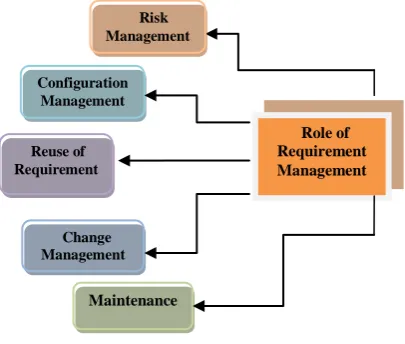
Role of Requirement Management
Configuration Management
Reuse of Requirement
Change Management
Maintenance
Risk Management Hardware
[image:2.595.311.514.495.667.2]management is process in which changes in requirements, maintenance of requirement, status and reuse of requirement should be mentioned. It provides better project supremacy and inferior the risk of project failure, in figure 2, the role of RM is shown.
III. IMPACT OF RE IN PRODUCT LIFE CYCLE
Requirement engineering is a branch of software engineering which can able to analyze, specify, prioritize, document and implement needs of the customers and stakeholders. In addition, it is also clearly stated that the requirement can be changed over the time; therefore, management of changing requirement is very important for clarity, consistency and completeness of the requirements.
RE is beneficial in several etiquettes in the whole product lifecycle this asset following advantages:
• RE have major impact during the conception phase. • Better planning Business cases.
• Determining which requirement should be prioritized from a business perspective.
• Bringing multiple disciplines together for effective collaboration.
• Effectively satisfy customers in a way they get what they need.
Requirements have tendency to change during system development and those changes must be managed. Usually, during RM process involves a large amount of data and unstable requirements. Thus, RM tools have been developed to help in managing those various type tracing tools are also generated [4]. After knowing basic idea about requirements and their management discuss about requirement management tools and the Requirement Trace ability Matrix (RTM).
IV. REQUIREMENT TRACEABILITY MATRIX (RTM)
Requirement Traceability Matrix fixes a assembly between several requirements and their source code, design documents. RTM is used to trace the requirements to tests that are needed to authenticate whether the requirement are fulfilled [5]. RTM is a complex but important tool in requirement management which can help to handle the changes made and updating the status as frequently as possible. RTM is appeared in a stand-alone traceability document or internally represented within a tool for modification. When requirement change in a project, RTM allows to identify all of impacted workflows, test cases, design, software code etc. RTM are generated to access the impact of requirement both in forward and in backward direction. In forward traceability there is mapping of requirement to the test cases and in reverse or backward traceability the test cases are mapped to the requirements. RTM is an structured and detailed approach by which we are trace from where the requirements are generated and where they are implemented.
Requirement Traceability Matrix as a tool in Requirement Management:
A huge amount of software projects have failed or canceled due to cost issues, schedule delays, and due too not fulfilling customer and stakeholders need. A report from the CIO Magazine confesses 71% projects fail do so because of
poor requirement management, poor planning and less skilled staff. Requirement management is single biggest reason than bad technology, missed deadlines etc. RTM can be used to ensure that requirement defined for a system are tested and are being able to link the requirements throughout the validation process. As we know there are many requirement management tools available but in this paper we discussed about RTM tool because it can be able differentiate each requirement and their test cases more efficient way. The system or the product must be tested in some test protocols and testing the all test cases which can find all the requirement from start to the end in a effective manner to yield the good product. RTM can be used to check the current system requirement and the additional requirement which can be used in future. The test plan document before actual execution includes the RTM specifies all requirement and maps corresponding test cases.
The requirement must be mark out to the specific test stage in testing protocol in which they are tested. RTM can be created by adding the source document for adding for both forward and reverse traceability. If requirement traceability matrix created you come to know whether all requirement are covered by test cases or not and it defines test cases for each requirement. This is in the form of table suppose (n) number of requirement and test cases (TC) re associated with each requirement. There is one to one or may be one to may mapping exist.
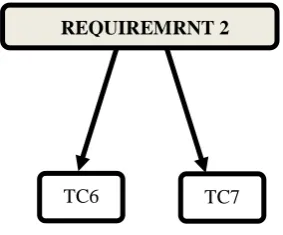
For example, in fig 3 and fig 4, it is shown that how test cases associated with requirement. In requirement 1 five test cases are attached to it and in requirement 2 two test cases are attached which indicates any number of test cases with any requirements.
[image:3.595.317.547.434.550.2]Figure 4. Requirement and Many Test Cases
Figure 5. Requirement and Less Test Cases
In the above figures it is shown that how the test cases are attached to each requirements in the system or service development. RTM is updated as it include any updated
REQUIREMRNT 1
TC1 TC2
TC3
TC4
TC5
REQUIREMRNT 2
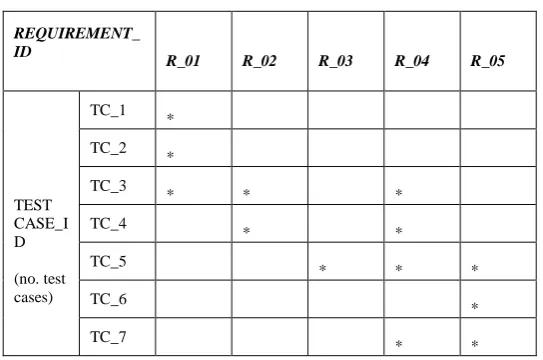
[image:3.595.363.505.596.713.2]document as design specification and test protocol are developed. Each requirement can be traced by using one or more test cases and some similar test cases are common by many requirements. Basically, RTM can be created as a simple table in that project name, Description, Project Status, System and software components etc. Columns are provided to keep the appropriate guidance to testing team to test the each requirement properly [11]. For representation of the requirements with their test cases can be defined. The basic structure of requirement traceability matrix and their mapping is shown in the table given below in table 1.
Table I. Requirement tracebility Matrix for dependency of requirements
[image:4.595.29.301.378.558.2]
Table II. Requirement tracebility Matrix with test cases
REQUIREMENT_ ID
R_01 R_02 R_03 R_04 R_05
TEST CASE_I D
(no. test cases)
TC_1 *
TC_2 *
TC_3
* * *
TC_4
* *
TC_5 * * *
TC_6
*
TC_7
* *
Some of the requirement in the product lifecycle can have orientation to another requirement and if needed, they can use another requirement the requirements are connected and sometimes dependent to one another. “Uses” and “refers” both are the different terms used to specifying the dependency of requirements.
U= means uses; R= refer;
In the above table.2 there is some data of requirements and within this we are going to specify which type of relationship between them is exist, either uses or reference where the “uses” means direct linking between requirements and ”refers” mean that the reference of one requirement to reference to another requirement[10].
RTM is beneficial tool in requirement management in following ways:
• Help in managing compliance at every level.
• Capability to reduce defects and cost of recall. • Effective modification
• Quality improvements and provides higher customer satisfaction
• Confront with higher complexity etc.
• Requirement management has many other tools some of them are listed below:
A. CaliberRM
This is widely used requirement management tool. This is lifecycle oriented, for large systems, have a customizable Graphical User Interface and include centralized repository for requirement artifacts. But basic level cost is high [10, 11].
B. DOORS
It refers to (Dynamic Object Oriented Requirement System) is essentially an object database for requirement management. It Imports the requirements in variety of formats. User can specify whether an attribute is required or excluded, supports XML. A DOOR offers linking between all objects in a project for full traceability and missing link analysis. Cost of development of this tool is high.
C. Rational RequisitePro
One of the most popular tool’s by IBM rational tool. The tool integrates with MS Word for easy requirement analysis and organization. This tool also supports XML, Rational rose, traceability, change management and it is capable to perform comparisons between various projects using exportable XML-based files. Entry-level cost is high [12].
D. eASEE
Used in specification and management of requirements. PLM-driven environment with engineering data backbone for requirement engineering, change management and release management. The basic level cost also high.
E. IRqA(Integral Requisite Analyzer)
This may be one of the used tools in classifications of requirements, their management and in object-oriented analysis. It supports XML, MS office and its entry-level cost is not too much high as compared to above tools.
F. FreeMind
It is an open source requirement engineering tool. This allows a user, stakeholders, or requirements engineer to arrange ideas in a hierarchical manner. This tool is useful in brainstorming, traceability and many other engineering activities.
V. CONCLUSION AND FUTURE SCOPE
Requirement management is critical activity in requirement engineering for development process. By active management we can improve predictability by knowing requirements, provide realistic project planning and resource allocation, reducing the cost-overrun , re-work factors and reducing cycle time by knowing what we have to do and it also improves the better customers , stakeholders satisfaction. The devised framework may accommodating in enhancement of requirements management and collaboration of its each attribute to provide quality product. The management tools we are using to achieve and stipulating requirements have an huge impact in finding correct and clear requirements as they provides numerous advantage like risk management and version control, facilitate Impact Requir
ements
R_01 R_02 R_03 R_04 R_05
R_01 R U
R_02 R
R_03 U R R
R_04 U
analysis, tracking requirement status and reuse of the requirements . The requirement tracing is such an tool which is used mostly to mapping the requirements. As we described it is easy and management of test cases and their associated requirements and checking the current system requirement, and additional requirement which can be used in future.
RTM is a process which is not fully automated it needs person to manage entries, sequence, test cases within a table correctly for this purpose experienced person is required so, improvement in RTM is also needed. Rather than that the RTM is adequate tool for effective development and provide product within time, cost and with compliance of customer needs.
VI. REFERENCES
[1] Phillip A. Laplante, “Requirements Engineering for Software and System”, (pp155-169),2009
[2] Y. Sharma, and A. K. Sharma, “Evaluation of the Software Requirement Tools,” vol. 3, no. 3, pp. 950– 954, 2014.
[3] Sommerville, I.. Software Engineering. Addison Wesley, (2004).
[4] K. Wiegers, “Automating Requirements Management”, Software Development, 7(7), July 1999.
[5]
[6] M. Weber, J. Weisbrod, “Requirements Engineering in
Automotive Development– Experiences and
Challenges”, IEEE Software 20(1), 2003, pp. 16-24.
[7] Bashar Nuseibeh, “Requirement Engineering: A Roadmap”, Japan, 2003.
[8] I. Sommerville, P. Sawyer, Requirement Engineering: A Good Practice Guide, John Wiley & Sons, 1997
[9] Kotonya, I. Sommerville, Requirements Engineering, John Wiley & Sons, New York, 1998.
[10] S. J. Andriole, Managing systems requirements: methods, tools, and cases. McGraw-Hill Companies, 1996.
[11] Di, F., & Zhang, M. (2009). An improving approach for recovering requirements-to-design traceability links. Proceedings of the 2009 International Conference on Computational Intelligence and Software Engineering (pp. 1-6),2009.
[12] D Pandey, U Suman, AK Ramani,