Comparing Rule-based and Data-driven Selection of Facial Displays
Mary Ellen Foster
Informatik VI: Robotics and Embedded Systems Technische Universität München
Boltzmannstraße 3, 85748 Garching, Germany
Abstract
The non-verbal behaviour of an embodied conversational agent is normally based on recorded human behaviour. There are two main ways that the mapping from human be-haviour to agent bebe-haviour has been imple-mented. In some systems, human behaviour is analysed, and then rules for the agent are created based on the results of that analysis; in others, the recorded behaviour is used di-rectly as a resource for decision-making, us-ing data-driven techniques. In this paper, we implement both of these methods for select-ing the conversational facial displays of an animated talking head and compare them in two user evaluations. In the first study, par-ticipants were asked for subjective prefer-ences: they tended to prefer the output of the data-driven strategy, but this trend was not statistically significant. In the second study, the data-driven facial displays affected the ability of users to perceive user-model tai-loring in synthesised speech, while the rule-based displays did not have any effect.
1 Introduction
There is no longer any question that the production of language and its accompanying non-verbal be-haviour are tightly linked (e.g., Bavelas and Chovil, 2000). The communicative functions of body lan-guage listed by Bickmore and Cassell (2005) include conversation initiation and termination, turn-taking and interruption, content elaboration and emphasis,
and feedback and error correction; non-verbal be-haviours that can achieve these functions include gaze modification, facial expressions, hand gestures, and posture shifts, among others.
When choosing non-verbal behaviours to accom-pany the speech of an embodied conversational agent (ECA), it is necessary to translate general find-ings from observing human behaviour into concrete selection strategies. There are two main implemen-tation techniques that have been used for making this decision. In some systems, recorded behaviours are analysed and rules are created by hand based on the analysis; in others, recorded human data is used di-rectly in the decision process. The former technique is similar to the classic role of corpora in natural-language generation described by Reiter and Dale (2000), while the latter is more similar to the more recent data-driven techniques that have been adopted (Belz and Varges, 2005).
Researchers that have used rule-based techniques to create embodied-agent systems include: Poggi and Pelachaud (2000), who concentrated on generat-ing appropriate affective facial displays based on de-scriptions of typical facial expressions of emotion; Cassell et al. (2001a), who selected gestures and facial expressions to accompany text using heuris-tics derived from studies of typical North Ameri-can non-verbal-displays; and Marsi and van Rooden (2007), who generated typical certain and uncertain facial displays for a talking head in an information-retrieval system. Researchers that used data-driven techniques include: Stone et al. (2004), who cap-tured the motions of an actor performing scripted output and then used that data to create performance
specifications on the fly; Cassell et al. (2001b), who selected posture shifts for an embodied agent based on recorded human behaviour; and Kipp (2004), who annotated the gesturing behaviour of skilled public speakers and derived “gesture profiles” to use in the generation process.
Using rules derived from the data can produce dis-plays that are easily identifiable and is straightfor-ward to implement. On the other hand, making di-rect use of the data can produce output that is more similar to actual human behaviour by incorporating naturalistic variation, although it generally requires a more complex selection algorithm. In this paper, we investigate the relative utility of the two imple-mentation strategies for a particular decision: select-ing the conversational facial displays of an animated talking head. We use two methods for comparison: gathering users’ subjective preferences, and measur-ing the impact of both selection strategies on users’ ability to perceive user tailoring in speech.
In Section 2, we first describe how we recorded and annotated a corpus of facial displays in the do-main of the target generation system. Section 3 then presents the two strategies that were implemented to select facial displays based on this corpus: one using a simple rule derived from the most character-istic behaviours in the corpus, and one that made a weighted choice among all of the options found in the corpus for each context. The next sections de-scribe two user studies comparing these strategies: in Section 4, we compare users’ subjective prefer-ences, while in Section 5 we measure the impact of each strategy on user’s ability to select spoken de-scriptions correctly tailored to a given set of user preferences. Finally, in Section 6, we discuss the results of these two studies, draw some conclusions, and outline potential future work.
2 Corpus collection and annotation1
The recording scripts for the corpus were created by the output planner of the COMIC multimodal dialogue system (Foster et al., 2005) and consisted of a total of 444 sentences describing and compar-ing various tile-design options. The surface form of each sentence was created by the OpenCCG surface realiser (White, 2006), using a grammar that
spec-1Foster (2007) gives more details of the face-display corpus.
ified both the words and the intended prosody for the speech synthesiser. We attached all of the rele-vant contextual, syntactic, and prosodic information to each node in the OpenCCG derivation tree, in-cluding the user-model evaluation of the object be-ing described (positive, negative, or neutral), the pre-dicted pitch accent, the clause of the sentence (first, second, or only), and whether the information being presented was new to the discourse.
The sentences in the script were presented one at a time to a speaker who was instructed to read each out loud as expressively as possible into a cam-era directed at his face. The following facial dis-plays were then annotated on the recordings: eye-brow motions (up or down), eye squinting, and rigid head motion on all three axes (nodding, leaning, and turning). Each of these displays was attached to the node or nodes in the OpenCCG derivation tree that exactly covered the span of words temporally associated with the display. Two coders separately processed the sentences in the corpus. Using a ver-sion of theβweighted agreement measure proposed by Artstein and Poesio (2005)—which allows for a range of agreement levels—the agreement on the sentences processed by both coders was 0.561.
When the distribution of facial displays in the corpus was analysed, it was found that the single biggest influence on the speaker’s behaviour was the user-model evaluation of the features being de-scribed. When he described features of the design that had positive user-model evaluations, he was more likely to turn to the right and to raise his eye-brows (Figure 1(a)); on the other hand, on features with negative user-model evaluations, he was more likely to lean to the left, lower his eyebrows, and squint his eyes (Figure 1(b)). The overall most fre-quent display in all contexts was a downward nod on its own. Other factors that had a significant effect on the facial displays included the predicted pitch ac-cent, the clause of the sentence (first or second), and the number of words spanned by a node.
3 Selection strategies
(a) Positive (b) Negative
Figure 1: Characteristic facial displays from the corpus
Although it’s in the family style, the tiles are by Alessi.
Original nd=d nd=d nd=d nd=d nd=d,bw=u
. . . ln=l . . . .
Data-driven nd=d nd=d . . tn=r . .
[image:3.612.74.535.234.300.2]Rule-based ln=l,bw=d,sq tn=r,bw=u
Figure 2: Face-display schedules for a sample sentence
tree for a sentence—that is, a tree in the same for-mat as those that were used for the corpus annota-tion, including all of the contextual features. They then proceed top-down through the derivation tree, considering each node in turn and determining the display combination (if any) to accompany it.
The rule-based strategy specifies motions only on nodes corresponding to mentions of specific proper-ties of a tile design: manufacturer and series names, colours, and decorations. The display combination is determined by the user-model evaluation of the property being described, based on the behaviours of the recorded speaker. For a positive evaluation, this strategy selects a right turn and brow raise; for a negative evaluation, it selects a left turn, brow lower, and eye squint; while for neutral evaluations, it chooses a downward nod.
In contrast, the data-driven strategy considers all nodes in the derivation tree. For each node, it selects from all of the display combinations that occurred on similar nodes in the corpus, weighted by the fre-quency. As a concrete example, in a hypothetical context where the speaker made no motion 80% of the time, nodded 15% of the time, and turned to the right in the other 5%, this strategy would select no motion with probability 0.8, a nod with probability 0.15, and a right turn with probability 0.05.
Figure 2 shows a sample sentence from the cor-pus, the original facial displays, and the displays se-lected by each of the strategies. In the figure,nd=d indicates a downward nod,bw=uandbw=da brow raise and lower, respectively,sqan eye squint,ln=l a left lean, andtn=ra right turn.
4 Subjective preferences
As a first comparison of the two implementation strategies, we gathered users’ subjective preferences between three different types of face-display sched-ules: the displays selected by each of the generation strategies described in the preceding section, as well as the original displays annotated in the corpus.
4.1 Participants
This experiment was run through the Language Ex-periments Portal,2a website dedicated to online psy-cholinguistic experiments. There were a total of 36 participants: 20 females and 16 males. 23 of the par-ticipants were between 20 and 29 years old, 9 were over 30, and 4 were under 20. 21 described them-selves as expert computer users, 14 as intermediate users, and one as a beginner. 18 were native speak-ers of English, while the othspeak-ers had a range of other native languages.
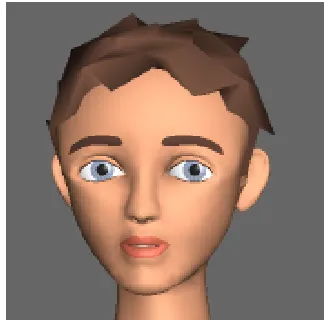
Figure 3: RUTH talking head
4.2 Methodology
Each participant saw videos of two possible synthe-sised face-display schedules accompanying a series of 18 sentences. Both videos had the same syn-thesised speech, but each had a different different facial-display schedule. For each pair, the partici-pant was asked to select which of the two versions they preferred. There were three different schedule types: the original displays annotated in the corpus, along with the output of both of the selection strate-gies. Participants made each pairwise comparison between these types six times, three times in each or-der. All participants saw the same set of sentences, in a random order: the pairwise choices were also allocated to sentences randomly.
4.3 Materials
To create the materials for this experiment, we ran-domly selected 18 sentences from the corpus and generated facial displays for each, using both of the strategies. The data-driven schedules were gener-ated through 10-fold cross-validation as part of a previous study (Foster and Oberlander, 2007): that is, the display counts from 90% of the corpus were used to select the displays to use for the sentences in the held-out 10%. The rule-based schedules were generated by running the rule-based procedure from Section 3 on the same OpenCCG derivation trees. Videos were then created of all of the schedules for all of the sentences, using the Festival speech syn-thesiser (Clark et al., 2004) and the RUTH animated talking head (DeCarlo et al., 2004) (Figure 3).
Original – Rule-based Weighted – Rule-based Original – Weighted 0
10 20 30 40 50 60 70 80 90 100 110 120 130
123
120 123
93 97 92
Comparison
C
ho
ic
e
co
un
[image:4.612.319.536.60.214.2]t
Figure 4: Subjective-preference results
4.4 Results
The overall results of this study are shown in Fig-ure 4. Not all participants responded to all items, so there were a total of 648 responses: 216 compar-ing the original corpus schedules to the rule-based schedules, 217 for the data-driven vs. rule-based comparison, and 215 for the original vs. data-driven comparison. To assess the significance of the pref-erences, we use a binomial test, which provides an exact measure of the statistical significance of de-viations from a theoretically expected classification into two categories. This test indicates that there was a mildly significant preference for the original schedules over the output of each of the strategies (p<0.05 in both cases). While there was also a ten-dency to prefer the output of the data-driven strategy over that of the rule-based strategy, this preference was not significant (p≈0.14). No demographic fac-tor had a significant effect on these results.
4.5 Discussion
(1) Here is a family design. Its tiles are from the Lollipop collection by Agrob Buchtal. Although the tiles have a blue colour scheme, it does also feature green.
(2) Here is a family design. As you can see, the tiles have a blue and green colour scheme. It has floral motifs and artwork on the decorative tiles.
Figure 5: Tile-design description tailored to two user models (conflicting concession highlighted)
same sentences and had an average of 4.83 displays per sentence. In other words, in terms of the range of displays, the schedules generated by the data-driven strategy are fairly similar to those in the cor-pus, while those from the rule-based strategy do not resemble the corpus very much at all.
In another study (Foster and Oberlander, 2007), the weighted data-driven strategy used here was compared to a majority strategy that always chose the highest-probability option in every context. In other words, in the hypothetical context mentioned earlier where the top option occurred 80% of the time, the majority strategy would always choose that option. This strategy scored highly on an automated cross-validation study; however, human judges very strongly preferred the output of the weighted strat-egy described in this paper (p<0.0001). This con-trasts with the weak preference for the weighted strategy over the rule-based strategy in the current experiment. The main difference between the out-put of the majority strategy on the one hand, and that of the two strategies described here on the other, is in the distribution of the face-display combinations: over 90% of the that the majority strategy selected a display, it used a downward nod on its own, while both of the other strategies tended to generate a more even distribution of displays across the sentences. This suggests that the distribution of facial displays is more important than strict corpus similarity for determining subjective preferences.
The participants in this study generally preferred the original corpus displays to the output of either of the generation strategies. This suggests that a more sophisticated data-driven implementation that reproduces the corpus data more faithfully could be successful. For example, the process of select-ing facial displays could be integrated directly into the OpenCCG realiser’sn-gram-guided search for a good realisation (White, 2006), rather than being run on the output of the realiser as was done here.
5 Perception of user tailoring in speech
The results of the preceding experiment indicate that participants mildly preferred the output of the data-driven strategy to that of the rule-based strategy; however, this preference was not statistically signif-icant. In this second experiment, we compare the face-display schedules generated by both strategies in a different way: measuring the impact of each schedule type on users’ ability to detect user-model tailoring in synthesised speech.
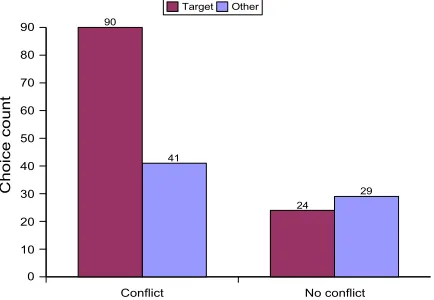
Foster and White (2005) performed an experiment in which participants were shown a series of pairs of COMIC outputs (e.g., Figure 5) and asked to choose which was correctly tailored to a given set of user preferences. The participants in that study were able to select the correctly-tailored output only on trials where one option contained a concession to a neg-ative preference that the other did not. For exam-ple, the description in (1) contains the concession Al-though the tiles have a blue colour scheme, as if the user disliked the colour blue, while (2) has no such concession. Figure 6 shows the results from that study when outputs were presented as speech; the results for text were nearly identical. The first pair of bars represent the choices made on trials where there was a conflicting concession, while the second pair show the choices made on trials with no con-flicting concession. Using a binomial test, the dif-ference for the conflicting-concession trials is sig-nificant at p<0.0001, while there is no significant difference for the other trials (p≈0.4).
Conflict No conflict 0
10 20 30 40 50 60 70 80
90 90
24 41
29 Target Other
C
h
o
ic
e
c
o
u
n
[image:6.612.79.296.65.215.2]t
Figure 6: Results for speech-only presentation
5.1 Participants
Like the previous study, this one was also run over the web. There were 32 participants: 19 females and 13 males. 18 of the participants were between 20 and 29 years old, 10 were over 30, and 4 were un-der 20. 15 described themselves as expert computer users, 15 as intermediate users, and 2 as beginners. 30 of the participants were native English speakers.
5.2 Methodology
Participants in this experiment observed an eight-turn dialogue between the system and a user with specific likes and dislikes. The user preferences were displayed on screen at all times; the user input was presented as written text on the screen, while the system outputs were played as RUTH videos in re-sponse to the user clicking on a button. There were two versions of each system turn, one tailored to the preferences of the given user and one to the prefer-ences of another user; the user task was to select the correctly tailored version. The order of presentation was counterbalanced so that the correctly tailored version was the first option in four of the trials and the second in the other four. Participants were as-signed in rotation to one of four randomly-generated user models. As an additional factor, half of the par-ticipants saw videos with facial displays generated by the data-driven strategy, while the other half saw videos generated by the rule-based strategy.
5.3 Materials
The user models and dialogues were identical to those used by Foster and White (2005). For each sentence in each system turn, we annotated the nodes of the OpenCCG derivation tree with all of the necessary information for generation: the user-model evaluation, the pitch accents, the clause of the sentence, and the surface string. We then used those annotated trees to create face-display sched-ules using both of the selection strategies, using the full corpus as context for the data-driven strategy, and prepared RUTH videos of all of the generated schedules as in the previous study.
5.4 Results
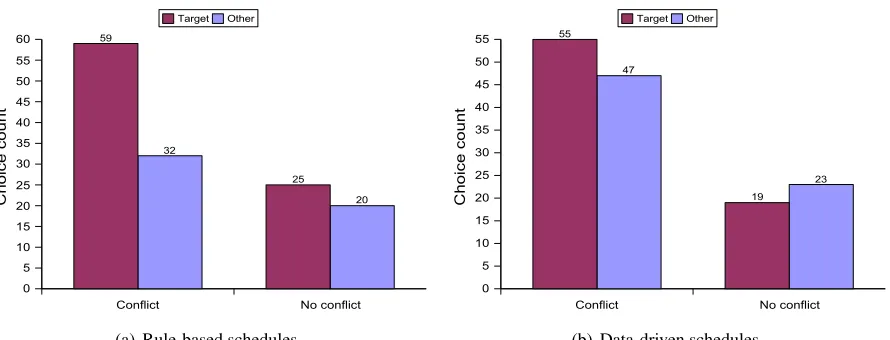
The results of this study are shown in Figure 7: Fig-ure 7(a) shows the results for the participants using the rule-based schedules, while Figure 7(b) shows the results with the data-driven schedules. Just as in the speech-only condition, the participants in this experiment responded essentially at chance on tri-als where there was no conflicting concession to negative preferences. For the trials with a conflict-ing concession, participants usconflict-ing rule-based videos selected the targeted version significantly more of-ten (p<0.01), while the results for participants us-ing the data-driven videos show no significant trend (p ≈0.49). None of the demographic factors af-fected these results.
To assess the significance of the difference be-tween the two selection strategies, we compared the results on the conflicting-concession trials from each of the groups to the corresponding results from the speech-only experiment, using a χ2 test. The results for the judges using the rule-based videos are very similar to those of the judges using only speech (χ2=0.21, p=0.65). However, there is a significant difference between the responses of the speech-only judges and those of the judges using the weighted schedules (χ2=4.72, p<0.05).
5.5 Discussion
Conflict No conflict 0
5 10 15 20 25 30 35 40 45 50 55
60 59
25 32
20 Target Other
C
h
o
ic
e
c
o
u
n
t
(a) Rule-based schedules
Conflict No conflict
0 5 10 15 20 25 30 35 40 45 50
55 55
19 47
23 Target Other
C
h
o
ic
e
c
o
u
n
t
[image:7.612.87.532.64.234.2](b) Data-driven schedules
Figure 7: Results of the perception study
were significantly worse at identifying the correctly-tailored speech than were the participants in the pre-vious study, while the performance of the partic-ipants who saw rule-based videos was essentially identical to that of the speech-only subjects.
The schedules selected by the data-driven strat-egy for this evaluation include a variety of facial dis-plays; sometimes these displays are actually the op-posite of what would be selected by the rule-based strategy. For example, the head moves to the right when describing a negative fact in 23 of the 520 data-driven schedules, and moves to the left when describing a neutral or positive fact in 20 cases. A description includes up to three sentences, and a trial involved comparing two descriptions, so a total of 75 of the trials (52%) for the data-driven participants involved at least one of these these potentially mis-leading head movements. Across all of the trials for the participants using data-driven videos, there were 38 conflicting-concession trials with no such head movement. The performance on these trials was es-sentially the identical to that on the full set of tri-als: the correctly targeted description was chosen 20 times, and the other version 18 times. So the worse performance with the data-driven schedules cannot be attributed solely to the selected facial displays conflicting with the linguistic content.
Another possibility is that the study participants who used the data-driven schedules were distracted by the expressive motions of the talking head and failed to pay attention to the content of the speech.
This appears to have been the case in the COMIC whole-system evaluation (White et al., 2005), for example, where the performance of the male par-ticipants on a recall task was significantly worse when a more expressive talking head was used. On this study, there was no effect of gender (or any of the other demographic factors) on the pattern of re-sponses; however, it could be that a similar effect occurred in this study for all of the participants.
6 Conclusions and future work
The experiments in this paper have compared the two main current implementation techniques for choosing non-verbal behaviour for an embodied conversational agent: using rules derived from the study of human behaviour, and using recorded hu-man behaviour directly in the generation process. The results of the subjective-preference evaluation indicate that participants tended to prefer the out-put generated by the data-driven strategy, although this preference was not significant. In the second study, videos generated by the data-driven strat-egy significantly decreased participants’ ability to detect correctly-tailored spoken output when com-pared to a speech-only presentation; on the other hand, videos generated by the rule-based strategy did not have a significant impact on this task.
that users like subjectively, or to ensure that users fully understand all aspects of the output presented in speech. If the former is more important, than an implementation that uses the data directly appears to be a slightly better option; if the latter is more im-portant, then the rule-based strategy seems superior. On the subjective-preference evaluation, users preferred the original corpus motions over either of the generated versions. As discussed in Section 4.5, this suggests that there is room for a more sophisti-cated data-driven selection strategy that reproduces the corpus data more closely. The output of such a generation strategy might also have a different effect on the perception task.
Both of these studies used the RUTH talking head (Figure 3), which has no body and, while human in appearance, is not particularly realistic. We used this head to investigate the the generation of a limited set of facial displays, based on contextual information including the user-model evaluation, the predicted prosody, the clause of the sentence, and the surface string. More information about the relative utility of different techniques for selecting non-verbal be-haviour for embodied agents can be gathered by ex-perimenting with a wider range of agents and of non-verbal behaviours. Other possible agent types include photorealistic animated agents, agents with fully articulated virtual bodies, and physically em-bodied robot agents. The possibilities for non-verbal behaviours include deictic, iconic, and beat gestures, body posture, gaze behaviour, and facial expressions of various types of affect, while any source of syn-tactic or pragmatic context could be used to help make the selection. Experimenting with other com-binations of agent properties and behaviours can im-prove our knowledge of the relative utility of differ-ent mechanisms for selecting non-verbal behaviour.
References
R. Artstein and M. Poesio. 2005. Kappa3 = alpha (or beta). Technical Report CSM-437, University of Essex Department of Computer Science.
J. B. Bavelas and N. Chovil. 2000. Visible acts of mean-ing: An integrated message model of language in face-to-face dialogue. Journal of Language and Social Psychology, 19(2):163–194. doi:10.1177/0261927X00019002001.
A. Belz and S. Varges, editors. 2005. Corpus Linguistics 2005 Workshop on Using Corpora for Natural Language
Genera-tion.http://www.itri.brighton.ac.uk/ucnlg/ucnlg05/.
T. Bickmore and J. Cassell. 2005. Social dialogue with em-bodied conversational agents. In J. van Kuppevelt, L. Dy-bkjær, and N. Bernsen, editors,Advances in Natural, Multi-modal Dialogue Systems. Kluwer, New York. doi:10.1007/
1-4020-3933-6_2.
J. Cassell, T. Bickmore, H. Vilhjálmsson, and H. Yan. 2001a. More than just a pretty face: Conversational protocols and the affordances of embodiment. Knowledge-Based Systems, 14(1–2):55–64.doi:10.1016/S0950-7051(00)00102-7. J. Cassell, Y. Nakano, T. W. Bickmore, C. L. Sidner, and
C. Rich. 2001b. Non-verbal cues for discourse structure. In
Proceedings of the 39th Annual Meeting of the Association for Computational Linguistics (ACL 2001). ACL Anthology P01-1016.
R. A. J. Clark, K. Richmond, and S. King. 2004. Festival 2 – build your own general purpose unit selection speech synthe-siser. InProceedings of the 5th ISCA Workshop on Speech Synthesis.
D. DeCarlo, M. Stone, C. Revilla, and J. Venditti. 2004. Spec-ifying and animating facial signals for discourse in embod-ied conversational agents. Computer Animation and Virtual Worlds, 15(1):27–38.doi:10.1002/cav.5.
M. E. Foster. 2007. Associating facial displays with syntactic constituents for generation. InProceedings of the ACL 2007 Workshop on Linguistic Annotation (The LAW).
M. E. Foster and J. Oberlander. 2007. Corpus-based generation of conversational facial displays. In submission.
M. E. Foster and M. White. 2005. Assessing the impact of adap-tive generation in the COMIC multimodal dialogue system. InProceedings of the IJCAI 2005 Workshop on Knowledge and Reasoning in Practical Dialogue Systems.
M. E. Foster, M. White, A. Setzer, and R. Catizone. 2005. Mul-timodal generation in the COMIC dialogue system. In Pro-ceedings of the ACL 2005 Demo Session. ACL Anthology W06-1403.
M. Kipp. 2004. Gesture Generation by Imitation - From Hu-man Behavior to Computer Character Animation. Disserta-tion.com.
E. Marsi and F. van Rooden. 2007. Expressing uncertainty with a talking head. InProceedings of the Workshop on Multi-modal Output Generation (MOG 2007).
I. Poggi and C. Pelachaud. 2000. Performative facial expres-sions in animated faces. In J. Cassell, J. Sullivan, S. Prevost, and E. Churchill, editors,Embodied Conversational Agents, pages 154–188. MIT Press.
E. Reiter and R. Dale. 2000. Building Natural Language Gen-eration Systems. Cambridge University Press. doi:10.2277/
052102451X.
M. Stone, D. DeCarlo, I. Oh, C. Rodriguez, A. Lees, A. Stere, and C. Bregler. 2004. Speaking with hands: Creating animated conversational characters from recordings of hu-man perforhu-mance. ACM Transactions on Graphics (TOG), 23(3):506–513.doi:10.1145/1015706.1015753.
M. White. 2006. Efficient realization of coordinate struc-tures in Combinatory Categorial Grammar. Research on Language and Computation, 4(1):39–75. doi:10.1007/
s11168-006-9010-2.