International Journal of Advanced Research in Computer Science
RESEARCH PAPER
Available Online at
www.ijarcs.info
An Improved Energy Efficient AODV Routing Protocol for MANETs
Mr. Ravinder Mohan Jindal
Ph.d Student of Sant Baba Bhag Singh University Adampur (Punjab) India
Mrs. Leekha Jindal
Ph.d Student of Sant Baba Bhag Singh University Adampur(Punjab) India
Mr Lekh Raj
M.Tech Student of CDLU ,Sirsa, (Punjab) India
Mr. Vidhu Vohra
Assistant Professor in PG Department of Computer SC & IT
Hans Raj Mahila Maha Vidyalaya Jalandhar City, (Punjab) India
Abstract—MANETs are a collection of unstructured wirelessmobile nodes which provides independence and scalability for mobile topologies. Energy conservation being cardinal in applications such as Emergency and Military operations requires energy efficient solutions. The proposed work is a newer variation of the AODV routing protocol, which tackles major issues in MANETs like adaptability and energy efficiency. It is achieved by evaluating energy values of the nodes and forwarding packets along least drained nodes path, making the network adaptive in nature. Performance evaluation with respect to network lifetime, throughput, packet delivery ratio, end-to-end delay is done using simulation tools like NS2/QualNet.
Keywords- MANETs, energy efficiency, drain count, NS2, network lifetime
I. INTRODUCTION
In today's fast evolving era, wireless communication is bringing fundamental changes to the field of data networking and telecommunication, and is making integrated networks a reality. One of the popular ad hoc networks is Mobile Ad-hoc Network (MANET) . It is regarded as a system of wireless mobile nodes that can self-organize into arbitrary and temporary network topologies freely and dynamically. Different protocols that are used in MANETs are evaluated based on different parameters such as average end-to-end delay, packet drop rate, average routing load etc. MANET offers an independent, scalable and flexible solution for mobile and dynamic topologies.
One of the greatest challenges in the design of MANETs is the limited availability of the energy resources. Energy-efficient communication is critical for increasing the life of power limited wireless ad hoc networks. Each of the mobile nodes is operated by a limited energy battery and usually it is impossible to recharge or replace the batteries during a mission. Since wireless communications consume significant amount of battery power, this limited battery lifetime imposes a severe constraint on the network performance. Power failure of a mobile node not just affects the node itself but the node’s ability to forward packets on behalf of others and also the overall network lifetime. A mobile node consumes its battery energy not only when it actively sends or receives packets, but also when it stays idle listening to the wireless medium for any possible communication requests from other nodes. Thus, energy-efficient routing protocols minimize both the active communication energy required to transmit and receive data packets and the energy during inactive periods.
The need for judicial usage of energy and intelligent self-organization in MANETs has been the main motivation to
design an energy efficient routing protocol for MANETs by integrating the principles of AODV protocol and drain count (energy metric) in order to obtain increased overall network lifetime to conserve the battery life of mobile nodes.
II. LITERATURE SURVEY AND RELATED WORK
A. Traditional Routing Protocols for MANETs
MANETs mainly use three types of routing protocols. The reactive protocols such as Dynamic Source Routing (DSR), Ad hoc On -demand Distance Vector (AODV) and Temporally Ordered Routing Algorithm (TORA) dynamically determine the routing path as and when there is a demand to transmit some data. The proactive protocols such as Destination Sequenced Distance Vector (DSDV), Optimized Link State Routing (OLSR) and Fisheye State Routing (FSR) dictates that routing tables be maintained at each node. Hybrid routing protocols such as Zone Routing Protocol (ZRP) are also used, which integrates the characteristics of proactive and reactive protocols, but also has demerits i.e. cannot be evaluated for unidirectional links and it can be applied only for very large networks [2].
messages [4].
B. AODV Routing Protocol
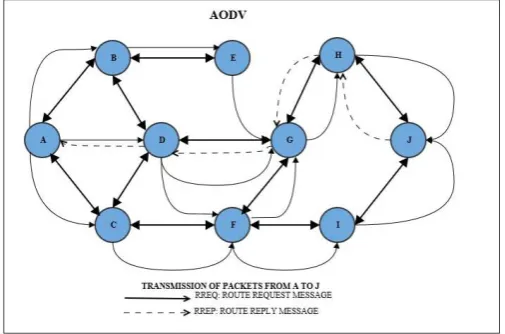
Ad-hoc on demand Distance Vector is a reactive protocol which create routes when demanded by the source host andthe routes are maintained and used when needed. Hello messages are used to detect and monitor links with neighbours. Each active node periodically broadcasts a Hello message that all its neighbours receive. In case a node fails to receive several Hello messages from a neighbour which are broadcasted, a link break is found [2].
Figure 1. Transmission of data between source and destination as per AODV routing algorithm
AODV mainly has three distinct features, firstly every request is assigned a sequence number so that the nodes do not repeat route requests that have already been passed on. Secondly, time to live is present for every route request, which limits the number of times they can be retransmitted. Also, in a situation where a route request fails, we cannot assign another route request unless and until twice as much time has passed since the timeout of the previous request.
AODV has a few advantages over other routing protocols like OLSR, which makes it one of the most preferred
protocols. It doesn’t require a central administrator to manage. The control traffic messages are reduced, but it is at the cost of increased latency in finding new routes. Minimal routing is practiced as the route information exists in the routing table, which shows the active routes in the network. It reacts quickly to topological changes and updates any host affected by the change in Router Error message (RRER).
C. Energy Efficiency in MANETs
In this section, some of the energy efficient schemes developed by researchers in the field have been described. Energy is the most scarce resource and nodes spend energy during transmission and reception of data [5]. Four modes that must be considered for the total energy consumed are:
a) Transmission mode. Transmission energy is the energy spent to transmit a message, and is dependent on the size of the packet.
(1)
(2)
Where is transmission Energy, is Transmission
Power, is time taken to transmit data packet and
is length of data packet in Bits.
b) Reception mode. Energy spent to receive a packet is Reception energy.
(3)
(4)
Where is a Reception Energy, PR is a Reception
Power, is a time taken to receive data packet, and is length of data packet in Bits.
c) Idle mode. In this mode, the node is neither transmitting nor receiving any packet. But energy is spent because the nodes have to listen to the network for any incoming packet. The node then has to move from idle mode to reception mode.
(5)
Where is the power consumed in Idle Mode and is power consumed in Reception Mode.
d) Overhearing mode. Energy spent by the node whenit receives the packet that is destined to it. Unnecessary receiving of such packets consumes energy.
(6)
Where is power consumed in Overhearing Mode and is power consumed in Reception Mode.
In [12] focus is given to emergency search and rescue operations which rely heavily on the availability of the network. The availability is a direct cost of the overall network lifetime, i.e., energy of the nodes. There are many strategies available at different levels of the OSI model to improve the network lifetime. The focus is given to develop a network layer strategy, i.e., one that uses routing protocols. AODV protocol is seen to be the most energy efficient protocol. An existing energy efficient routing protocols based on AODV is proposed, each of which is based on a different energy cost metric. And then the protocol is designed which is a combination of both. Secondly, evaluation of the performance of this protocol against the single energy metric AODV protocol and against traditional AODV is done. Energy can be efficiently conserved by toggling between two parameters such as the transmission energy and remaining energy capacity. The performance metrics used for evaluation are packet delivery ratio, throughput, convergence time, network lifetime and average energy consumed.
this paper the Self-Organizing AODV protocol (which will henceforth be referred to as SO _AODV) has been developed by choosing a leader node with maximum energy and all the packets are forwarded via the leader node to the destination. SO_AODV has been compared with Traditional AODV and basic EESOA using the following metrics: network lifetime, average end to end delay, delivery ratio and convergence time. In the results it is found that SO_AODV has better network lifetime and end to end delay than Traditional AODV and has better convergence time than EESOA.
Energy related metrics used by power aware routing protocols are classified into four categories: transmission power, remaining energy capacity, estimated node lifetime, and combined energy metrics [6]. The Minimum Total Transmission Power Routing (MTPR) attempts to minimize the total transmission power consumption of nodes participating in an acquired route and transmission power is proportional to transmission distance [7]. Considering transmission power as the only cost metric increases the number of hops and end-to-end delay. Adding a power cost metric helps in reducing the hop count. In MBCR (Minimum Battery Cost Routing), the sum of residual energy of all the nodes is calculated and the path with the least cost and maximum energy is chosen, allowing the nodes with less energy to participate in transmission. The improved approach to this is Min-Max Battery Cost Routing (MMBCR) which always chooses the path with maximum residual energy and hence increases the network lifetime [8]. The lifetime of the network is decided based on the energy metric, drain rate, which is defined as the rate at which energy is consumed by the node. Network lifetime can be maximized if the path with least drain rate is chosen and hence it is denoted by,
(7)
Where, ) and represents the previous and
WKH_QHZO\_PRQLWRUHG_GUDLQ_UDWHV__IJ_UHSUHVHQWV_WLPH_LQWHUYDO_
D. Applications of IEE_AODV Protocol
This energy efficient Ad hoc Net protocol finds various applications. A few of them have been listed here.
x Vehicular Ad hoc Networks(VANETs) - A set of
vehicles that depart from a depot has to serve a set of customers before returning to the depot, while utilizing the minimum number of vehicles and the total distance traveled by them. More than one route might be required to serve all orders. This can also be replicated and applied for any type of traffic maintenance, such as finding the least congested path for emergency services like ambulance and fire brigades.[11]
x Aviation sector – inter and intra aircraft communication x Military combat operations - Bugs released for
investigation purposes x Wireless Sensor Networks
x Disaster Recovery - for recovery of communication channels in times of natural disasters such as earthquakes.
III. PROPOSED SOLUTION
The protocol that is proposed in this paper integrates the concept of drain count into AODV in order to make it energy efficient. If the energy of a node is lesser than the set threshold energy, then the drain count value of the path is
incremented by a factor of 1. The path that has the least drain count, i.e. the path which has least number of nodes having energy below the threshold energy, is chosen from among the paths that are traversed by the first few control packets that arrive at the destination node. This ensures that a path with a reasonably short distance is chosen. In the case that two or more paths have the same drain count value, then the path with the least hop count is selected in accordance with AODV. If two or more paths with equal hop count exist, then the path containing nodes with least transmission power is chosen. This also helps in obtaining a longer network lifetime. In case of a link failure in the chosen path, then an alternate path is chosen with low convergence time as the paths that were discovered initially are stored at the destination.
Figure 2. IEE_AODV packet header, modified version of AODV RREQ packet header
The path that is traversed by the control packets is tracked by a record field that is added to the AODV packet header so that the data packets can be sent along the chosen route. The record also helps in updating the routing table along the chosen path. The remaining energy is determined at every node, and is compared to the set threshold value.
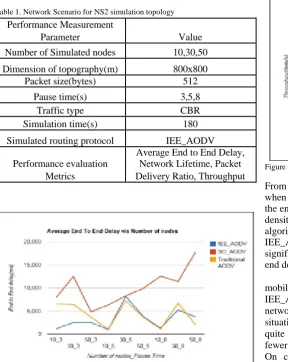
The implementation methodology that is being used to simulate this protocol on MANETs is NS2, and is simulated for networks of different sizes from 10 to 50 nodes, in steps of 20, and pause times of 3s, 5s and 8s.
IV. TESTING AND RESULTS
summarized in Table 1.
Table 1. Network Scenario for NS2 simulation topology
Performance Measurement
Parameter Value
Number of Simulated nodes 10,30,50
Dimension of topography(m) 800x800
Packet size(bytes) 512
Pause time(s) 3,5,8
Traffic type CBR
Simulation time(s) 180
Simulated routing protocol IEE_AODV
Average End to End Delay, Performance evaluation Network Lifetime, Packet
Metrics Delivery Ratio, Throughput
Figure 3. Result for Average End to End delay v/s Number of Nodes and Pause time
Figure 4. Result for Network Lifetime v/s Number of Nodes and Pause time
Figure 5. Result for Throughput v/s Number of Nodes and Pause time
From the graph shown in Figure 3, it can be observed that when the mobility of the nodes is high (pause time 3 seconds) the end to end delay of traditional AODV is quite high. As the density of nodes increases, the end to end delay of all three algorithms increases. However the end to end delays of IEE_AODV is comparable to AODV, and there is no significant difference between the two. The reduction in end to end delay can be attributed to the virtual backbone created.
From the graph shown in Figure 4, for the high mobility case (pause time 3 seconds), it can be seen that IEE_AODV and traditional AODV show consistently better network lifetimes than SO_AODV. For the low density situation (10 nodes), the network lifetime for all 3 protocols is quite high. This can be attributed to the fact that there are far fewer connections and much lesser traffic through each node. On close observation for this case, it can be seen that IEE_AODV still has the best lifetime when compared to traditional AODV and SO_ AODV. In all the cases, the performance of IEE_AODV can be truly appreciated. The protocols show a large increase in network lifetime for different node densities. Thus the selection of the most energy efficient path to perform the bulk of the routing has ensured that nodes with lower energies last longer.
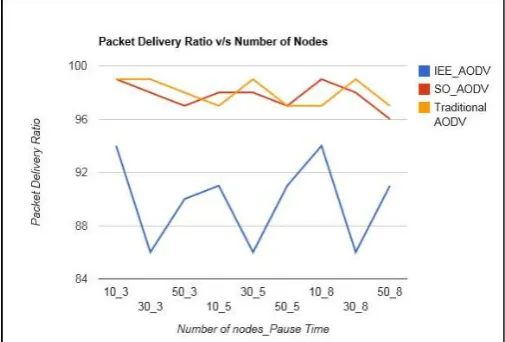
From the graph shown in Figure 5, it can be seen that in the high mobility situation, AODV has consistently better values for packet delivery ratio. This could be attributed to the fact that in IEE _AODV, the most energy efficient path might not be the most reliable and the traffic along this path is high, and may thus drop more packets than AODV does. The packet delivery ratio for all three protocols drops as node density and number of connections increases.
For the cases with lower mobility, a similar situation can be seen. In Figure 6, AODV has the highest packet delivery ratio. Packet delivery ratio again drops as node density increases as the packets traverse many numbers of nodes and chances of packet drop are higher.
Figure 6. Result for Packet Delivery Ratio v/s Number of Nodes and Pause time
V. CONCLUSION AND FUTURE WORK
In this work, it is observed that battery life of the nodes in IEE_AODV protocol has been efficiently utilized by choosing a path with maximum energy. It has also been analytically proved that, the amount of remaining energy helps to probabilistically determine an efficient path. Further to the proposed work, the algorithm has been implemented and is evaluated using performance metrics like throughput, network lifetime, packet delivery ratio and end to end delay. The results are statistically analyzed using network simulation tools such as NS2 by varying the node density from 10 to 50 in steps of 20, and pause time of 3s, 5s and 8s. It is noted that energy of each node is monitored to choose an efficient path with no drained nodes. This has helped to maximize the network lifetime by avoiding frequent link failures due to drained nodes.
This concept of drained nodes can be amalgamated to Bio-inspired computing such as Ant colony optimization. This energy efficient AntHoc algorithm can be implemented on hybrid routing protocol [14] to conserve energy in an efficient manner. The results can be compared with traditional AODV and IEE_AODV protocols to evaluate its performance.
REFERENCES
[1] Michael Meisel, Vasileios Pappas, Lixia Zhang, “A taxonomy of biologically inspired research in computer networking”, 2010 Elsevier.
[2] Nicklas Beijar, “Zone Routing Protocol (ZRP) Networking Laboratory”, Helsinki University of Technology
[3] Sunil Taneja and Ashwani Kush, “A Survey of Routing Protocols in Mobile Ad Hoc Networks”, International Journal of Innovation, Management and Technology, Vol. 1, No. 3, August 2010.
[4] Mehran Abolhasan, Tadeusz Wysocki, Eryk Dutkiewicz, “A review of routing protocols for mobile ad hoc networks”,4 June 2003 Elsevier.
[5] Neeraj Tantubay, Dinesh Ratan Gautam and Mukesh Kumar Dhariwal, “A Review of Power Conservation in Wireless Mobile Adhoc Network (MANET) “, IJCSI International Journal of Computer Science Issues, Vol. 8, Issue 4, No 1, July 2011 ISSN (Online): 1694-0814
[6] Lijuan Cao Teresa Dahlberg Yu Wang, ”Performance
Evaluation of Energy
Ef¿FLHQW_$G_+RF_5RXWLQJ_3URWRFROV”, IEEE
Computer Society 2007
[7] K. Scott and N. Bambos, “Routing and channel assignment for low power transmission in PCS”, Proceedings of IEEE International Conference on Universal Personal Communications (ICUPC ’96), Cambridge, MA, September 29 - October 2, 1996.
[8] S. Singh, M. Woo, and C. S. Raghavendra, ”Power-aware with Routing in Mobile Ad Hoc Networks”, Proceedings of Mobicom 1998,Dallas, TX, 1998
[9] Ehsan Khosrowshahi-Asl, Majid Noorhooseni and Atieh Saberi Pirouz, “Journal of Information Science and Engineering”, 27, 1581-1596 (2011).
[10]Dongkyun Kim, J.J. Garcia-Luna-Aceves and Katia Obraczka,Juan-Carlos Cano and Pietro Manzoni-“Routing Mechanisms for Mobile Ad Hoc Networks based on the Energy Drain Rate”, 2003.
[11]Jan Suwart, “Project Thesis- Wireless Ad Hoc Networks: Limitations, Applications and Challenges”, April 2008.
[12] Annapurna P. Patil, Bathey Sharanya, M. P. Dinesh Kumar, and Malavika J., "Design and Implementation of Combined Energy Metric AODV (CEM_AODV) Routing Protocol for MANETs," International Journal of Computer and Electrical Engineering vol. 5, No. 1, pp. 9-13, Feb 2013.
[13]Annapurna P Patil, K Rajanikanth, Sabarish, Surabi, Madhan, Madhuri, “Enabling Self Organizing Behavior in MANETs: An Experimental Study”, 48th Annual Convention, CSI, Vishakhapatnam, Springer AISC Series, 13-15 Dec 2013. [14]Annapurna P Patil, K Rajanikanth, Apoorva Yadhava, Rakshith