Volume 6, No. 6, July - August 2015
International Journal of Advanced Research in Computer Science
RESEARCH PAPER
Available Online at www.ijarcs.info
© 2010-14, IJARCS All Rights Reserved 133
A New Scheduling Method for Workflows on Cloud Computing
Seyed Ebrahim Dashti
Department Of Computer, science and research Branch, Islamic Azad University, Tehran, Iran
Amir masoud Rahmani
Department Of Computer, science and research Branch, Islamic Azad University, Tehran, Iran
Abstract: Cloud computing has recently become avery popular topic. Nowadays, with the increasing demand for process automation in the cloud, the investigation on cloud workflow scheduling strategies is becoming a significant issue. Majority of existing workflow scheduling algorithms consider only compute resources that usually cannot be provisioned on demand size of workflows or not released to the environment until the workflow execution completes. That is why the performance of these algorithms is being decreased and time and cost of them is being increased. In this paper, we present a new workflow scheduling method based on Ant Colony Optimization algorithm in order to reduce this scheduling overhead with considering the above problems in our dynamic environment. Furthermore, we do consider these problems and various type VMs during the execution dynamically based on Amazon EC2. Also in comparison with state of the art in large-scale scheduling method, our datasets are based on real workflow applications with maximum 100 nodes. The results show that performance of our algorithm is significantly better than Greedy Randomized Adaptive Search Procedure (GRASP) and scalable for increasing nodes of workflow.
Keyword: workflow scheduling, cloud computing,VM allocation,Dynamic VM,user constraint, ACO (Ant Colony Optimization).
1.INTRODUCTION
Cloud computing is emerging as the latest distributed
computing paradigm and attracts increasing interests of
researchers in the area of Distributed and Parallel Computing,
Service Oriented Computing, and Software Engineering.
Though there is yet no consensus on what Cloud is, some of
its distinctive aspects as proposed by Ian Foster in [1] can be
borrowed for an insight: “Cloud computing is a large-scale
distributed computing paradigm that is driven by economies
of scale, in which a pool of abstracted, virtualized,
dynamically-scalable, managed computing power, storage,
platforms, and services are delivered on demand to external
customers over the Internet.” Compared with the definitions
of conventional computing paradigms such as cluster, grid,
and peer-to-peer (p2p), “economies” is a noticeable keyword
in cloud computing which has been neglected by others.
Utility and cloud computing have emerged as new service
provisioning models and are capable of supporting diverse
computing services such as servers, storage, network and
applications for e-Business and e-Science over a global
network. In cloud these services introduced as Infrastructure
as a service (IaaS), platform as a service (PaaS) and software
as a service (SaaS) [2]. In cloud environments, users consume
the services when they need to, and pay only for what they
use. With economy incentive, these technologies encourage
organizations to offer their specialized applications and other
computing utilities as services so that other
individuals/organizations can access these resources remotely.
Therefore, it facilitates individuals/ organizations to develop
their own core activities without maintaining and developing
fundamental infrastructure.
Nowadays, with the increasing demand for process
automation, especially for large-scale collaborative, e-science
applications, and distributed e-business [2, 3], the
investigation on cloud workflow scheduling strategies is
becoming a significant issue. In the following paragraph, we
define the workflow and the importance of workflow in cloud
environment.
Workflows can be modeled as Directed Acyclic Graphs
(DAGs). In this model, each node in the DAG represents an
executable task. Each directed edge represents a precedence
constraint between two tasks (data or control dependence). A
DAG represents a model that help build a schedule of the
tasks onto resources in a way that precedence constraints are
respected and the schedule is optimized. The majority of
proposed workflows [4, 5] aim at minimizing execution time
of the schedule; However, other important parameters such as
cloud. In this paper, we do solve the workflow scheduling
problems in cloud.
There are several reasons that we encourage to investigate the
workflow in cloud as follow a: Initially, workflows were
being implemented in grids. Due to the above mentioned
causes and reduced performance faced in grids, now there is a
need to implement workflows in cloud. The primary benefit of
moving to clouds is application scalability. Unlike Grids,
scalability of cloud resources allows real-time provisioning of
resources to meet application requirements. This enables
workflow management systems to readily meet Quality of
Service (QoS) requirements of applications, as opposed to the
traditional approach that required advance reservation of
resources in global multi-user Grid environments. Cloud
services like compute, storage and bandwidth resources are
available at substantially lower costs. Workflow applications
often require very complex execution environments. These
environments are difficult to create on grid resources. In
addition, each grid site has a different configuration, which
results in extra effort each time an application needs to be
ported to a new site. Virtual machines allow the application
developer to create a fully customized, portable execution
environment configured specifically for their application [6].
Main contributions of this paper are as follows.
1.
Present architecture for workflow scheduling.2.
Present a new workflow scheduler as a subdomain ofworkflow manager which would be defined as a new service
in PaaS level.
3.
Define a new problem in cloud workflow by scheduling itin various type of VM.
4.
Define a new aspect in scheduling cloud workflowproblem by assign task to various type of VM.
5.
Adapt ant colony optimization method to solve workflowscheduling in cloud computing in order to improve makespan
in budget constraint from user perspective.
6.
New formulate the ACO pheromone and heuristic byembedding cost, time and budget constraint to solve our
problem.
7.
Design refined algorithm to reduce bought VM cost in fullhour billing model.
8.
An extensive simulation-based evaluation and performanceanalysis of the proposed algorithm.
The rest of the paper is organized as follow. In Section 2 we
discuss the related work. We present our proposed
architecture and Framework in Sections 3, at last of this
section, we define some of cloud characteristics assumed in
our environment. In section 4, description of our problem is
continued with design heuristic by formulate pheromone in
ACO to solve workflow scheduling. In section 5 we design a
refined sub algorithm to improve ACO results. In section 6,
we evaluate our approach and analysis of experimental result.
We discuss conclude the paper in secion7.
2.LITERATUREREVIEW
Many heuristics have been investigated by several projects for
scheduling workflows on Grids. The heuristics can be
classified as either task level or workflow level. Task level
heuristics make scheduling decisions based only on the
information about a task or a set of independent tasks, while
workflow level heuristics take into account the information of
the entire workflow. Min-Min, Max-Min and Sufferage [7]
are three major task level heuristics employed for scheduling
workflows on Grids which are being used by Mandal et al [8]
to schedule EMAN bio-imaging applications. Blythe et al. [9]
proposes a workflow level scheduling algorithm based on
Greedy Randomized Adaptive Search Procedure (GRASP)
[10] which is also compared with Min-Min in
compute-intensive and data-intensive scenarios. Another two
workflow level heuristics have been employed by the
ASKALON project [11, 12]. One is based on Genetic
Algorithms and the other is a
Heterogeneous-Earliest-Finish-Time (HEFT) algorithm.
Sakellariou and Zhao [13] developed a low-cost rescheduling
policy in order to reduce the overhead produced by
rescheduling by conducting rescheduling only when the delay
of a task execution impacts on the entire workflow execution.
However, these works only attempt to minimize workflow
execution time and do not consider users’ budget
constraints in Grid. Several works have been proposed to
address scheduling problems based on users’ budget
© 2010-14, IJARCS All Rights Reserved 135 parameter-sweep applications to meet users’ budget. A
market-based workflow management system [15] locates an
optimal bid based on the budget of the current task in the
workflow. Tsiakkouri et al [16] developed scheduling
approaches, LOSS and GAIN, to adjust a schedule which is
generated by a time optimized heuristic and a cost optimized
heuristic to meet users’ budget constraints respectively. A
time optimized heuristic attempts to minimize execution time
while a cost optimization attempts to minimize execution cost.
More recently, [17] schedule bag of tasks to VMs in cloud
using integer programing method (without any order). Some
researchers assign workflow tasks to services in user’s
QoS(Quality of Service), it means they investigate in higher
layers of cloud (SaaS and PaaS)[18,19]. In contrast of [17],
we have been ordering of tasks in workflow and in
comparison with [18, 19] we consider VMs and type of them
in cloud and discuss it in lower layers (PaaS and IaaS).
A number of Grid workflow management systems [20, 21, 22]
with scheduling algorithms have been developed. They
facilitate the execution of workflow applications and
minimize their execution time on Grids. However, to impose a
workflow paradigm on cloud, execution cost must also be
considered when scheduling tasks on resources. The price of
VMs is mainly determined by its QoS level such as the
processing speed.
Users may not always need to complete workflows earlier
than they require. They sometimes may prefer to use cheaper
VM that is sufficient to meet their requirements. [23]. There
are few work examining issues related to budget constraints in
a Grid context. The most relevant work is available in [23,
24], where it is demonstrated, through simulation. Although,
the constraint budget and deadline parameters were
considered in the grid environment [25] but not in cloud,
which minimizes workflow execution cost within a certain
deadline and other QoS. In [23] a genetic algorithm based
scheduling heuristic is developed to minimize execution time
while meeting user’s budget constraint,[25] develop an ACO
algorithm in Grid for different QoS. Several researchers use
ACO algorithm in cloud to minimize the makespan by
balancing the entire system load. Two different load balancing
scheduling algorithms based on ant colony are proposed in
[26] and [27]. Another ant colony based algorithm aims to
minimize job completion time based on pheromone is
proposed in [28]. Some researchers consider the cost
parameter in grid/cloud for service or VM. To the best of our
knowledge, all of those methods get and free VM statically
that once VM provision, power on, until end of scheduling.
But in cloud computing, dynamic scalability becomes more
attractive and practical because of the unlimited resource pool.
Some articles are based on the best effort method and
optimize workflow execution time and scalability in multiple
and single workflow [29, 30] without considering cost
parameter that plays important role in cloud. Some researchers
consider specific workflow in cloud such as
transaction-intensive. In [31], the objective of optimization is
to maximize the throughput. [32] Solve the workflow
optimization in cost constraint parameter and [33] improves it
using comprise cost and time constraint. Large-scale
distributed systems are considered by Look-Ahead Genetic
Algorithm (LAGA) in [34]which optimize both makespan and
reliability of a workflow application, some other improve
performance and reliably of their workflow middleware in
distributed environments, such as grids and clouds [35].
In [36], authors discuss load-balancing technologies for SaaS
infrastructure to execute workflow processes, they propose a
proactive load balancing algorithm, by which requests from
different tenants are scheduled concurrently by a single
service instance over shared hosting resources and the
predicted cost of executing the process instances. Some other
solve the problem by using virtual clusters as cloud in IaaS
level, they propose the SHEFT algorithm to schedule a
workflow elastically on a Cloud computing environment [29].
In another paper researchers present a new workflow
scheduling method based on iterative ordinal optimization
(IOO) and they try to reduce makespan and improve
throughput [37]. In [30], researchers also propose virtual
cluster and try to find a solution that meets all users preferred
QoS constraints while improve CPU utilization. Schedule
workflow in two levels of service-level and task-level from
presented scheduling heuristic methods based on Particle
Swarm Optimization (PSO) to minimize data transmission
cost of data intensive workflows on Cloud.
In this paper, we consider workflow applications that are
modeled as DAGs. Moreover, the above mentioned articles
focusing on either service flow scheduling with various QoS
requirements [18], or makespan optimization or throughput.
We also consider that a budget constraint and scalability of
VMs need to be satisfied. Each job, when running on a
machine, consumes some money. Thus, the overall aim is to
find the schedule that gives the shortest makespan for a given
DAG and a given set of resources without exceeding the
budget available. To achieve these aims, we develop an Ant
colony Optimization algorithm for scheduling workflow.
3.THEPROPOSEDARCHITECTURE
Many computation-intensive applications in science and
business can be described as workflows. According to [38],
we can imagine the general cloud architecture as four basic
layers from top to bottom: application layer (user
applications), platform layer (middleware cloud services to
facilitate the development/deployment of user
applications),unified resource layer(abstracted/encapsulated
resources by virtualisation), and fabric layer (physical
hardware resources).Here, we present the lifecycle of a
workflow application to illustrate the system architecture in
Figure 1. Note that here we focus on the system architecture.
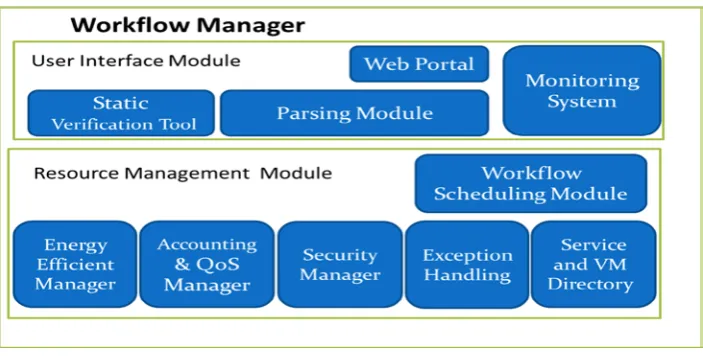
Figure 1: Cloud workflow system architecture
We design a framework for workflow management scheduling
as it’s components can be seen in Figure 2. We define each
component briefly in the following:
Figure 2: Framework of workflow management in our cloud
© 2010-14, IJARCS All Rights Reserved 137 communicate with customer and other users. The user can
define a new workflow with her parameters and QoS or use
original template workflow and manipulate them for her
specific usage or parameters.
Parsing Module: this module transforms graphical workflows
that enter by the user to XML standard form that
understandable for workflow manager; Moreover, it adds
metadata like size of data transfer between nodes. Clustering
can add to this module to merge small tasks to enhance
performance.
Static Verification Tool: this module tests connectivity
between nodes in workflow and verify data user in enter
parameters in order to be in a valid range. Also this module
tests XML format of workflow that the user enter.
Monitoring System: this module communicates with all other
components and collects information. Customer and designer
are able to monitor related module in an online fashion.
Resource Management module contains six components as
follows:
Service and VM Directory: this module index all existing
services and VMs type and price. It also index services and
VM images.
Exception Handling: this component manages fault tolerance,
for example if fault occurs in VM during run time execution;
this component reschedules the task in order to prevent any
delay for other nodes of the workflow.
Security Manager: this component maintains privacy of other
components and VMs and prevents malicious access.
Accounting and QoS Manager: this component monitors task
execution QoS and amount of credit that spend. If any
inconvenience occurs in QoS, it reports to Exception Handling
to manage them. This module also calculate amount of credit
in user‘s account according to QoS.
Workflow Scheduling Module: this component schedules a
task to a suitable VM that satisfy the user QoS and other
constraints like order in workflow.
Energy Efficient Manager: this component manages energy
efficiency of datacenter and manages load of host and merge
under load host and switch off the free host.
A user may first submit a workflow application that specifies
task definitions, the execution order of tasks (process
structures), and QoS constraints through a web portal [19].
Once workflow specifications are created, workflow manager
can verify structure errors and QoS constraints statically. Our
workflow scheduler specifies the number and type of VM in
user constraint that schedule tasks in order to be mapped to
VM in unify Resource Layer so that a concrete workflow is
generated.
3.1.CLOUD ARCHITECTURE CHARACTERISTICS
As a computing platform, clouds own distinct characteristics
compared to utility computing and grid computing. We have
identified the following characteristics which get from popular
cloud computing like amazon EC2 that can largely affect the
way people use cloud platforms, especially in cloud scaling
activities.
Unlimited resources limited budget: Clouds offer users
unlimited computing power and storage capacity. Unlimited
resource enables applications to scale to extremely large size.
On the other hand, these unlimited resources are not free.
Every cycle used and byte transferred are going to appear on
the bill. Budget cap is a necessary constraint for users to
consider where they deploy applications in clouds. Therefore,
a cloud auto-scaling mechanism should explicitly consider
user budget constraints when acquiring resources.
Full hour billing model: The pay-as-you-go billing model is
attractive, because it saves money when users shut down
machines. However, VM instances are always billed by hours.
Fraction consumption of an instance-hour is counted as a full
hour. In other words, 10 minutes and 60 minutes usage are
both billed as 1 hour usage and if an instance is started and
shut down twice in an hour, users will be charged for two
instance hours. The shutting down time can greatly affect
cloud cost. Therefore, a reasonable policy is that whenever an
instance is started, it is better to be shut down when
approaching full hour operation.
4.PROBLEMDESCRIPTION
We model a workflow application as a Directed Acyclic
Graph (DAG). Let Γ be the finite set of tasks Ti 1≤i≤n. Let Λ
be the set of directed arcs of the form (Ti,Tj) where Ti is
task of Ti. We assume that a child task cannot be executed
until all of its parent tasks are completed. Let B be the cost
constraint (budget) specified by the users for workflow
execution. Then, the workflow application can be described as
a Directed Acyclic Graph (DAG) G=(Γ,Λ, B).
Suppose that we have unlimited Virtual Machines (VMs) with
four variant types like speed and RAM. Virtual machines have
varied processing capability delivered at different prices. We
estimate the max number of type groups that ants can be
selected by Equation 1. In this formula one VM add to number
of groups in order to execute a critical path. Total number of
VM instances that is able to select can be calculated according
to the Equation 2.
Equation 1: Number of group= {Number_of_total_task_in
workflow – length of longest critical path +1}
Equation 2: Total VM Instance=Number of group* Number
of VMs Type
Suppose only one VM can be assigned for the execution of a
task; each task must be allocated to one available time. The
cost of virtual machine type is shown in Figure 3 that each
type has specific speed and RAM (Random Access Memory).
We got costs and types from Amazon VM in Asia, where the
VM is charged at least for one hour. The scheduling problem
is to map every Ti into a suitable virtual machine to minimize the execution time of the workflow and complete it within the
budget B.
Figure 3: cost of amazon VM [41]
4.2.ACO METHOD FOR SCHEDULING ALGORITHM
The general idea of Ant Colony Optimization (ACO) is to
simulate the foraging behavior of ant colonies. When a group
of ants set out from their nest to search for food source, they
use a special kind of chemical to communicate with each other.
The chemical is referred to as the pheromone. Once ants
discover a path to food source, they deposit pheromone on the
path. By sensing pheromone on the ground, ants can follow
the path to food source discovered by other ants. As this
process continues, most of the ants tend to choose the shortest
path to food as there have been a huge amount of pheromones
accumulated on this path. This collective pheromone
depositing and pheromone following behavior of ants
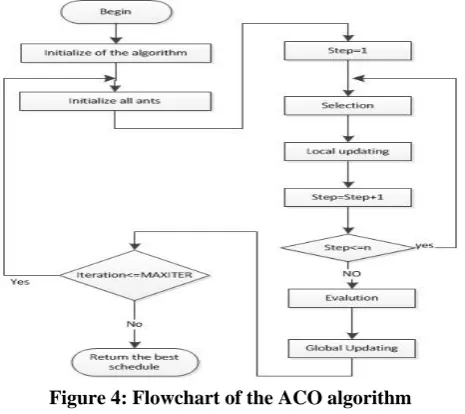
becomes the inspiring source of ACO. The flowchart of the
high level algorithm is given by Figure 4. These procedures
are described in detail below.
The ant colony optimization has been implemented on several
engineering domain [42]. Our problem is similar to travelling
salesman problem, ACO usually is use to produce
near-optimal solutions for it [42]. ACO also, has an advantage
over simulated annealing and genetic algorithm approaches of
similar problems when the graph may change dynamically. In
this paper, we apply ACO algorithms to tackle the workflow
scheduling problem in cloud computing. ACO has several
advantages; one of them is avoiding the convergence to a
locally optimal solution (because of Pheromone evaporation).
Despite the distributed computation avoids premature
convergence, positive feedback leads to rapid discovery of
good solutions. It is possible to prove that it is convergent i.e.,
it is able to find the global optimum in finite time [43]. Also,
the ACO algorithm is scalable for number of nodes and its
performance and results are acceptable. In other words, by
increasing the workflow nodes, overall performance remains
in an acceptable level. Informally, the algorithm can be
viewed as the interplay of the following procedures:
1) Initialization of the algorithm: All pheromone values and
parameters are initialized.
2) Initialization of ants: Assume that a group of M ants are
used in the algorithm. At the beginning of the iteration, all
© 2010-14, IJARCS All Rights Reserved 139 Figure 4: Flowchart of the ACO algorithm
3) Solution construction: M ants set out to build M solutions
to the problem. The construction procedure includes n
steps where n is the number of Tasks in the workflow. In
each step, each ant picks up the next tasks using
pheromone and heuristic information and maps it to the
most suitable Virtual Machine. The algorithm also
estimates the earliest start time and the earliest end time
of tasks and the free duration of last one hour of the VM
in terms of the information of partial solution built by
each ant. This information is helpful to guide the search
behavior of ants. Each ant chooses duration via greedy
method with regard the constraint Budget heuristic. Based
on the heuristic, each ant builds its tackling sequence of
tasks
4) Local updating: Soon after an ant selects the possible Ti
and maps it to VM, the corresponding pheromone value is
updated by a local pheromone updating rule.
5) Global updating: After all ants have completed their
constructions, global pheromone updating is applied to
the best-so-far solution. The cost and makespan of all
solutions are evaluated. The pheromone values related to
the best-so-far solution is significantly increased.
Moreover, some parameters of the algorithm are
adaptively adjusted in this procedure.
6) Terminal test: If the test is passed, the algorithm is end.
Otherwise, go to step (2) to begin a new iteration.
4.3.CONVERT WORKFLOW SCHEDULING TO ACO
PROBLEM
The workflow should be converted to the ACO problem. The
problem which is modelled with the ACO must be a graph.
The workflow as defined at the beginning of this section is
essentially an acyclic graph, the tasks represent the nodes of
graph, and the edges between them represent the dependencies
between workflow nodes. Ants are only allowed to flow this
directions, in other words cost of other direction is infinity, in
term of ACO, we define wall in forbidden directions. Ants
travel workflow graph to optimize order of traversal for assign
optimal nodes to the VMs, the traverse stops when the ants are
a stopping criterion specified or the number of repetitions
completed. Figure 5 illustrates selection and assignment of
nodes (tasks) to the VM by an ant.
Figure 5: A sample Ant build process scheduling
Ant select the next node and VM by quantities obtained from
the probability by Roulette wheel function that is calculated
from the consistency of nodes and the costs ,i.e. execution and
communication costs, and the running cost of VM purchased
in the previous period in order to utilize the unused period of
it. Also the historical of ant pheromone affects the quantity of
probability that illustrated in the next section.
4.4.DEFINITION OF PHEROMONE AND HEURISTIC Pheromone and heuristic information are the most important
factors of an ACO algorithm. In general, pheromone is used to
record the historical searching experiences and bias the ants’
searching behaviour in future. On the other hand, heuristic
information is some problem based values to guide the search
direction of ants. As the scheduling problem is mainly to map
all tasks to VMs, we denote the pheromone value of mapping
VMj to task Ti as fitness(i,j) and then calculate the cost of
them.
In Equation 3, we estimate distance of current slot selection in
equation in numerator and denominator of fraction to
normalize the fitness. We calculate the cost of Ti in Equation
4,free time in this equation encourage ant to select VMj that
product minimum slot time that is not used for Ti ,or Ti can fill
previous free slot time in VMj.
Equation
3:
Equation 4:
Suggest Budget (SB): the SB heuristic biases the artificial ants
to select the VMs within the budget cost. To achieve this
objective, for each task Ti, we assign a suggested budget SBi
based on the user-defined budget of the application [25].
By mapping all tasks to the VMs with the lowest cost, we can
obtain the minimum cost of the whole workflow application
(denoted as min_Cost). That is,
Equation 5:
The suggested budget SBi for Ti is evaluated by enlarging the
value of min costi on a scale of Budget:
Equation 6:
Suppose an ant’s heuristic type is the SB heuristic, and then
the heuristic value of mapping VMj to Ti is set to Equation 3.
According to Equation 3, a VM instance, the cost of which is
closer to SBi, will be associated with a higher heuristic value
and fitness(i,j) ∈ (0, 1].
Global Pheromone Updating: Global updating takes place
after all ants have built their solutions. The algorithm first
compares all solutions in that iteration. The quality of a
solution schedule I can be evaluated by the following
equations Equation 7. In the case of makespan optimization in
constraint budget, the score of schedule I is given by:
Equation 7:
The length of the schedule I in terms of (5) is composed of
two parts: penalties of QoS constraints and quality of the
user-preferred QoS parameter. If I satisfies all QoS constraints,
its length for QoS constraints will be set to zero, and the
length for the user-preferred QoS parameter will be set
according to the makespan of I. Better makespan will
contribute to a lower length of tour. On the other hand, if I
fails to satisfy all QoS constraints, its score for QoS
constraints will be set according to the degree of satisfaction,
and the length for the user-preferred QoS parameter will be set
to a maximum value. The smaller the length is, the better the
schedule will be.
5.REFINESCHEDULINGBYMERGEHOMOGENISE
VM
Scheduling multitask workflows is NP-hard problem, therefor
one approach to solve them in an acceptable time is
meta-heuristic methods such as ACO algorithm. Because of
exploring more search space, Equation 1 (number of VMs
selected by ACO=Number of group*4(Figure 3)) is designed
very optimistically. But in practice, we experimentally
understood in scheduling result some homogenise VMs could
merge due to reduced cost in pre-specified makespan. Figure 6
and Figure 7 illustrate the one instance scheduling that our
algorithm generated for e-protein workflow in budget
5$ before and after refine the scheduling. We illustrate the
pseudo code of the refined algorithm in Algorithm 1.
Algorithm 1:Refine algorithm
For i=1 to Total VM Instance step Number of VMs Type
For j=i to i-1+ Number of VMs Type
If VM is not empty
If Tasks duration in homogenous VM not conflict
© 2010-14, IJARCS All Rights Reserved 141 Figure 6: ACO scheduling before merge tasks
Figure 7: ACO scheduling after merge tasks
6.EXPERIMENTALRESULT
We simulate our experiments at high level in Matlab and at
low level in cloudsim environment; there are mainly five
parameters in the algorithm: ant number, α, β, ρ, and
maximum iteration. α and β consequently determine the
impact of before and current best value in ant new selection
path. ρ is the global refresh effect in founded tour. The maximum iteration is a variable that is specified based on our
experience which is responsible to prevent the algorithm not
to be in an infinity loop because of unexpected user’s entry. If
the ant fails to satisfy the user’s constraints in the maximum
iteration, the algorithm exit and print the best result that found
in the maximum iteration. The best empirical values of those
parameters for our problem consequently are 50, 7, 1, 0.65,
and 50.
We test the ACS algorithm in four workflow applications. The
basic information of these workflow applications is shown in
Table 1. The first two workflows, including the neuroscience
application [functional MRI (fMRI)] with 15 tasks, and the
e-protein workflow with 15 tasks [23], are derived from real
life applications.
Table 1: Test Instances
Instance Name Number of
Tasks
Network
fMRI 15 Figure 8
e-Protein 15 Figure 9
J50_0 50 J50_0 (PSPLIB)
J100_0 100 J100_0 (PSPLIB)
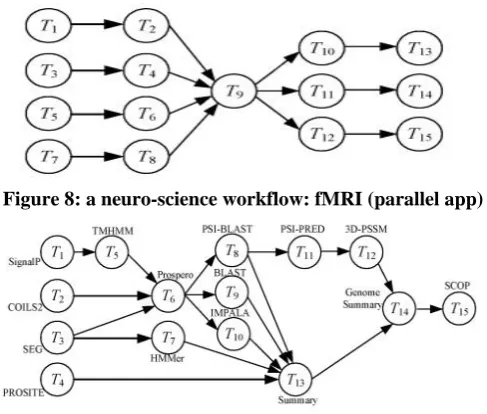
The DAGs of these applications are shown in Figure 8 and
Figure 9. The other two workflows are generated based on the
networks in the project scheduling problem library (PSPLIB)
[24], which is a library for project scheduling problems. These
networks include j50_0 with 50 tasks, and j100_0 with 100.
We estimate maximum number of type groups (VM instances)
that ants can be select according to Equation 1.Total number
of VM instances that ant can be selected calculate from
Equation 2. The QoS parameters (execution time and cost) of
all VMs instances are given from amazon, but they follow the
rule that for the same task, a VM instance with shorter
execution time may cost more money and vice versa. The
range of task’s length in workflow is between one million to
ten million instructions.
Figure 8: a neuro-science workflow: fMRI (parallel app)
Figure 9: e-protein workflow (Hybrid structure)
As has been mentioned before, few methods solve workflow
scheduling problem with different user-defined QoS
constraints in grid, but we consider this problem in cloud by
dynamic get and free of a VM and try to reduce makespan in
user’s budget.
We compare our ACO approach with Greedy Randomized
greedy algorithm [27] and other researchers usually compare
their proposed evolutionary algorithms with this method.
Algorithm 2 shows pseudo code of this algorithm. The greedy
approach assigns a VM to each task in the workflow based on
the free slot time of VM randomly
Algorithm2:GRASP (Greedy Randomized Adaptive Search
Procedure)algorithm
1:While stopping criterion not satisfied do
2: schedule ← createSchedule(work flow)
3: if schedule is better than bestSchedule then
4: bestSchedule ← schedule
5: end if
6: end while
7: PROCEDURE:createSchedule(workflow)
8: solution ← constructSolution(workflow)
9:nSolution ← localSearch(solution)
10:if nSolution is better than solution then
11: return nSolution
12:end if
13: return solution
14: END createSchedue
15:PROCEDURE: constructSolution(workflow)
16:while schedule is not completed do
17: T← get all unmapped ready tasks
18: make a RCL for each tɛT
19: subSolution ← select a resource randomly for each t ɛT
from its RCL
20: solution ← solution subSolution
21: update information for further RCL making
22: end while
23:return solution
24:END constructSolution
25:PROCEDURE:localSearch(solution)
26:nSolution ←find an optimal local solution
27:return nSolution
28: END localSearch
We simulate two common workflow structures in scientific
workflow applications and two other workflows from PSPLIB
data set for our experiments: parallel and hybrid and random
(many nodes). A parallel application (see Figure 8) requires
multiple pipelines to be executed in parallel. A pipeline
executes a number of tasks in a single sequential order. For
example, in Figure 8, there are 4 pipelines (1-2, 3-4, 5-6 and
7-8) before task 9. A hybrid structure application (see Figure
9) is a complex combination of parallel and sequential
execution. In our experiments, we used a neuro-science
workflow for our parallel application and a protein annotation
workflow developed by London e-Science Centre for our
hybrid workflow structure application [23]. Moreover, in
order to check the scalability of our approach, our simulation
is applied for two workflow instances with 50 and 100 nodes
from PSPLIB dataset.
Figure 10 to Figure 17 compare the execution costs and time
(makespan) of using the ACO and GRASP for scheduling
parallel, hybrid structure applications, 50 and 100 tasks
workflow from PSPLIB dataset with suitable budget. It can be
seen that the GRASP takes much higher execution cost. That
is because the decision making of the GRASP is based only
on the information of the current task. It may produce the best
schedule for the current task but it could consequently reduce
the entire workflow performance. However, as the user’s
budget increases, the results of the two approaches are closer.
Moreover as shown in the result of 50 and 100 nodes of the
workflow, we understand when the number of task increase
performance of GRASP decreases but performance of ACO
does not changes significantly.
In our optimization problem time and cost are opposite and
when cost is increased the time decreases, as shown in Figure
10 to Figure 17 the ACO result is near to budget constraint in
compare of GRASP, due to remaining the best path of the ant
in each iteration and use it in other iteration, while in GRASP
each iteration is searched randomly without considering the
best path obtained in pervious iterations, in other word, its
search is limited to compare with total result. For example,
Figure 12 and Figure 13 show our algorithm for fMRI
(parallel workflow) in execution cost and time is significantly
better than GRASP. Our method in all sample constraints
© 2010-14, IJARCS All Rights Reserved 143 and GRASP has similar cost. However as shown in Figure 16
our method in budget 7 is outperformed in term of time.
As the results show; in some budget the exact budget
constraint may not be satisfied and it may be little lower or
higher than budget, these variances is because of VM hourly
cost and the length of tasks do not fitted exactly in duration
hourly although our algorithm produce nearest cost to budget .
On average, the ACO algorithm is better in cost or both in
makespan and cost, while there are differences in various
benchmark workflow. For example, the greatest performance
in compare of GRASP is in parallel and large scale workflow.
Thus, we can see there are comparisons to be made in cost and
makespan in results of algorithms by changes in number of
nods and structure of workflow.
Figure 10: Comparison of execution cost in various budget
in two approaches for e-protein workflow
Figure 11: Comparison of makespan in different budget in
two algorithms for e-protein workflow
Figure 12: Comparison of execution cost in various budget
in two approaches for fMRI workflow
Figure 13: Comparison of makespan in different budget in
two algorithms for fMRI workflow
Figure 14: Comparison of execution cost in various budget
in two approaches for 50 tasks workflow
Figure 15: Comparison of makespan in different budget in
two algorithms for 50 tasks workflow
Figure 16: Comparison of execution cost in various budget
Figure 17: Comparison of makespan in different budget in
two algorithms for 100 tasks workflow
7.CONCLUSION
This paper investigates about workflow scheduling in cloud in
the levels of PaaS and IaaS based on the ACO optimization
algorithm. Money is an important parameter in cloud that is
ignored in many researches because of workflow scheduling
methods, often centralize in grid. In this study, we propose the
ACO approach to acquire the best scheduling in user’s
constraint budget. Also, instead of provisioning all VMs in the
beginning of the scheduling like previous researches, we
consider VM dynamically and according to the Amazon cloud
the least get duration is on hour. We evaluate our method in
real and PSPLIB workflow benchmark, the result shows our
approach has significantly better performance in comparison
to similar works.
REFERENCES
[1]Foster I, Yong Z, Raicu I, Lu S (2008) “Cloud computing and grid computing 360-degree compared” .In: Proc 2008 grid computing environments workshop, pp 1–10
[2]Verma,A. ,and Kaushal,S. (2011) “Cloud Computing Security Issues and Challenges: A Survey”. In proceeding of springer International Conference on Advances in Computing and Communication, Kochi,India, 445-454.
[3]Deelman E, Gannon D, Shields M, Taylor I (2008) “Workflows and e-science: an overview of workflow system features and capabilities”. Future Gener Comput Syst Volume 25, Issue 6,528–540
[4]Xiaofeng Wang , Chee Shin Yeo, Rajkumar Buyya, Jinshu Su ,(2011)”Optimizing Makespan and Reliability for Workflow Applications with Reputation and Look-ahead Genetic Algorithm“. International Journal of Future Generation Computer Systems Volume 27, Issue 8, Pages 1124–1134.
[5]Cui Lin, Shiyong Lu,(2011),” Scheduling Scientific Workflows Elastically for Cloud Computing” in IEEE 4th International Conference on Cloud Computing. [6]Anju Bala, Inderveer Chana,(2011),” A Survey of
Various Workflow Scheduling Algorithms in Cloud Environment “, 2nd National Conference on Information and Communication Technology (NCICT) , International Journal of Computer Applications (IJCA).
[7]Yu J, Buyya R, (2008) “Workflow scheduling algorithms for grid computing”. In: Xhafa F,Abraham A (eds) Metaheuristics for scheduling in distributed computing environments. ISBN:978-3-540-69260-7. Springer, Berlin.
[8]A. Mandal et al.,(2005) “Scheduling Strategies for Mapping Application Workflows onto the Grid”,IEEE
International Symposium on High Performance Distributed Computing (HPDC 2005).
[9]J. Blythe et al.,(2005) “Task Scheduling Strategies for Workflow-based Applications in Grids”, In IEEE International Symposium on Cluster Computing and Grid (CCGrid).
[10]Resende, M. and Ribeiro, C.,(2002) “Greedy Randomized Adaptive Search Procedures, State-of-the-art Handbook in Metaheuristics”,Glover and Kochenberger, eds., Kluwer Academic Publishers.
[11]R. Prodan and T. Fahringer,(2005) “Dynamic Scheduling of Scientific Workflow Applications on the Grid using a Modular Optimisation Tool: A Case Study”, In 20 th Symposium of Applied Computing (SAC 2005), Santa Fe, New Mexico, USA, ACM Press.
[12]M. Wieczorek, R. Prodan and T. Fahringer,(2005),“Scheduling of Scientific Workflows in the ASKALON Grid Environment”, Special Issues on scientific workflows, ACM SIDMOD Record, 34(3):56-62, ACM Press.
[13]R. Sakellariou and H. Zhao.(2004), "A Low-Cost Rescheduling Policy for Efficient Mapping of Workflows on Grid Systems''. Scientific Programming, Volume 12, Issue 4, pages 253-262.
[14]R. Buyya, J. Giddy, and D. Abramson,(2000) “ An Evaluation of Economy-based Resource Trading and Scheduling on Computational Power Grids for Parameter Sweep Applications”, In 2nd Workshop on Active Middleware Services (AMS 2000), Kluwer Academic Press, Pittsburgh, USA.
[15]A.Geppert, M.Kradolfer, and D.Tombros.(1998) “Market-based Workflow Management”, International Journal of Cooperative Information Systems, World Scientific Publishing Co., NJ, USA.
[16]E.Tsiakkouri et al.,(2005) “Scheduling Workflows with Budget Constraints”, In the CoreGRID Workshop on Integrated research in Grid Computing,S. Gorlatch and M.Danelutto (Eds.), Technical Report TR-05-22, University of Pisa, Dipartimento Di Informatica, Pisa, Italy, pages 347-357 .
[17]Ming Mao,Jie Li,Marty Humphrey ,(2010) “Cloud Auto-scaling with Deadline and Budget” , 11th IEEE/ACM International Conference on Grid Computing (GRID), Pages: 41 - 48.
[18]H. liu, D. Xu, H. Miao,(2011) “Ant Colony Optimization Based Service flow Scheduling with Various QoS Requirements in Cloud Computing”, First ACIS International Symposium on Software and Network Engineering, Pages: 53-58.
[19]A. Verma, S. Kaushal,(2012) “Deadline and Budget Distribution based Cost- Time Optimization Workflow Scheduling Algorithm for Cloud”. International Journal of Computer Applications (IJCA).
[20]T. Fahringer et al,(2005), “ASKALON: a tool set for cluster and Grid computing”, Concurrency and Computation: Practice and Experience, Volume 17,Pages:143-169, Wiley InterScience.
[21]B.Ludäscher et al.,(2005) “Scientific Workflow
Management and the KEPLER System”,
© 2010-14, IJARCS All Rights Reserved 145 [22]J. Yu and R. Buyya,(2005) “A Taxonomy
of Workflow Management Systems for Grid Computing”, Journal of Grid Computing, Springer, Volume 3, Issue 3,4, Pages: 171-200, Spring Science+Business Media B.V., New York, USA.
[23]Jia Yu and Rajkumar Buyya ,(2006) “A Budget Constrained Scheduling of Workflow Applications on Utility Grids using Genetic Algorithms”, Journal of Scientific Programming - Scientific Workflows archive,Volume 14 Issue 3,4, Pages: 217-230.
[24]R. Kolisch and A. Sprecher,(1997) “PSPLIB—A project scheduling problem library: OR Software—ORSEP operations research software exchange program,” Eur. J. Oper. Res., Volume 96, Issue 1, Pages: 205–216. [25]Wei-Neng Chen, Jun Zhang,(2009) "An Ant Colony
Optimization Approach to a Grid Workflow Scheduling Problem With Various QoS Requirements",IEEE TRANSACTIONS ON SYSTEMS, MAN, AND CYBERNETICS-PART C: APPLICATIONS AND REVIEWS, Volume 39, Issue 1 Pages:29-43.
[26]Xin Lu, Zilong Gu,(2011) “A load-adapative cloud resource scheduling model based on ant colony algorithm”, IEEE.
[27]Kun Li, Gaochao Xu, Guangyu Zhao, Yushuang Dong, Wang, D.,(2011) “Cloud Task Scheduling Based on Load Balancing Ant Colony Optimization”, IEEE.
[28]Xiangqian Song, Lin Gao, Jieping Wang,(2011) “Job scheduling based on ant colony optimization in cloud computing”, IEEE.
[29]Cui Lin, Shiyong Lu,(2011) ” Scheduling Scientific Workflows Elastically for Cloud Computing”, In IEEE 4th International Conference on Cloud Computing.
[30]P.Varalakshmi, Aravindh Ramaswamy, Aswath Balasubramanian, and Palaniappan Vijaykumar, (2011) ”An Optimal Workflow Based Scheduling and Resource Allocation in Cloud”, Department of Information Technology, Anna University Chennai, India, Pages: 411–420.
[31]Ke Liu, Jinjun Chen, Yun Yang and Hai Jin,(2008) “A throughput maximization strategy for scheduling transaction-intensive workflows on SwinDeW-G”, Concurrency and Computation:Practice and Experience, Wiley, Volume 20, Issue15, Pages:1807-1820.
[32]Y. Yang, K. Liu, J. Chen, X. Liu, D. Yuan and H. Jin,(2008) “An Algorithm in SwinDeW-C for Scheduling Transaction-Intensive Cost-Constrained Cloud Workflows”, Proc. of 4th IEEE International Conference on e-Science, Indianapolis, USA,Pages:374-375.
[33]K. Liu, Y. Yang, J. Chen, X. Liu, D. Yuan and H. Jin,(2010) “A Compromised-Time-Cost Scheduling
Algorithm in SwinDeW-C for Instance-intensive Cost-ConstrainedWorkflows on Cloud Computing Platform”, International Journal of High Performance Computing Applications, Volume 24, Issue 4, Pages:445-456.
[34]Xiaofeng Wang , Chee Shin Yeo, Rajkumar Buyya, Jinshu Su ,(2011) ”Optimizing Makespan and Reliability for Workflow Applications with Reputation and Look-ahead Genetic Algorithm“,International Journal of Future Generation Computer Systems Volume 27, Issue 8,Pages 1124–1134.
[35]Ewa Deelman,(2010) ”Grids and Clouds: Making Workflow Applications Work in Heterogeneous Distributed Environments”,International Journal of High Performance Computing Applications ,International Journal of High August , Volume 24, Issue3, Pages:284-298.
[36]Liyong Zhang , Yan Wen , Yanbo Han,(2010) “ A Proactive Approach to Load Balancing of Workflow Execution in a SaaS Environment”,Fifth IEEE International Symposium on Service Oriented System Engineering.
[37]Fan Zhang, Junwei Cao, Kai Hwang, and Cheng Wu,(2011) “Ordinal Optimized Scheduling of Scientific Workflows in Elastic Compute Clouds”, submitted to IEEE Transactions on Computers.
[38]Zhangjun Wu, Xiao Liu, Zhiwei Ni, Dong Yuan and Yun Yang,(2011) ”A market-oriented hierarchical scheduling strategy in cloud workflow systems”,
Springer, The Journal of Supercomputing ,Science+Business Media.
[39]S. Pandey, Wu. Linlin, Guru,Buyya,(2010) ”A Particle Swarm Optimization-based Heuristic for Scheduling Workflow Applications in Cloud Computing Environments”, 24th IEEE International Conference on Advanced Information Networking and Applications (AINA),Pages: 400 – 407.
[40]Z.Wu, Z.Ni, L. Gu,(2010) “A Revised Discrete Particle Swarm Optimization for Cloud Workflow Scheduling”. Computational Intelligence and Security (CIS), Pages: 184-188.
[41]Amazon,Amazon EC2 Pricing, Available from: http://aws.amazon.com/ec2/pricing/,2012.
[42]B. Chandra Mohan , R.B.,(2012) “A survey: Ant Colony Optimization based recent research and implementation on several engineering domain. Expert Systems with Applications”, Elsevier. Volume 39, Issues 4, Pages: 4618–4627.
![Figure 3: cost of amazon VM [41]](https://thumb-us.123doks.com/thumbv2/123dok_us/693904.1076989/6.595.37.292.556.661/figure-cost-of-amazon-vm.webp)