Volume 3, No. 7, Nov-Dec 2012
International Journal of Advanced Research in Computer Science
RESEARCH PAPER
Available Online at www.ijarcs.info
ISSN No. 0976-5697
Performance Issues in Wimax Networks Including Qos
Beesetti Kiran Kumar*
Wellfare institute of science, technology & management Dept of CSE Vishakhapatnam, A.P
D.D.Siva Prasad
Wellfare institute of science, technology & management Dept of CSE Vishakhapatnam, A.P
K.Venkata Kiran
Wellfare institute of science, technology & management Dept of CSE Vishakhapatnam, A.P
Chokkakula Devi
Wellfare institute of science, technology & management Dept of CSE Vishakhapatnam, A.P
M.Malyadri Babu
Wellfare institute of science, technology & management Dept of CSE Vishakhapatnam, A.P
malyadr
Abstract: Recently IEEE 802.16 WiMAX has attracted a lot of attention in wireless networking research and applications. An attempt had been made to compare Drop Tail, RED, Proportional fairness and DRR protocol model of WiMAX Point to Multi-Point mode with the focus on entry process and scheduling. Drop Tail queue similar to a First in First out (FIFO) queue drops tailing-after packets when the queue is full. RED starts dropping packets early indicating the link is congested and that it should slow down. Proportional Fairness scheduling is based on priorities assigned to the packets. In DRR, we use round-robin servicing with a quantum of service assigned to each queue. It was found that the loss rate was stable for all the four models. In addition to this the throughput and average received bytes increased with change in time for all the models.
Keywords: IDS, IPS, DIDS, NIDS, OSI.
I. INTRODUCTION
The IEEE 802.16 defines the wireless metropolitan area network (MAN) [1] technology which is branded as WiMAX. The 802.16 includes two sets of standards, 2004 (802.16d) for fixed WiMAX and 802.16-2005(802.16e) for mobile WiMAX. The WiMAX wireless broadband access standard provides the missing link for the "last mile" connection in metropolitan area networks where DSL, Cable and other broadband access methods are not available or too expensive. WiMAX also offers an alternative to satellite Internet services for rural areas and allows mobility of the customer equipment. But a mobile ad hoc network (MANET) [2] enables wireless communication between participating mobile nodes without the assistance of any base station. Two nodes that are out of one another’s transmission range need the support of intermediate nodes, which relay messages to set up communication between each other. This standard defines two basic operational modes:
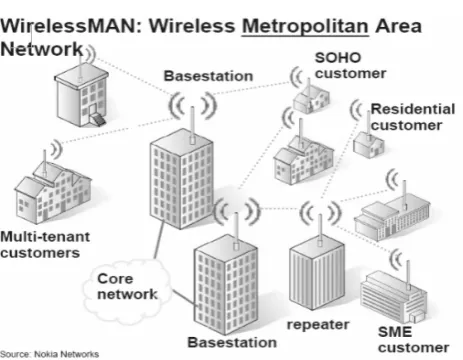
[image:1.595.317.549.440.620.2]Point-to-Multipoint (PMP) mode and Mesh mode. In PMP mode IEEE 802.16 architecture consists of one Base Station (BS) and many Subscriber Stations (SSs). Clients are connected to SS for data transfer or any SS can itself be a client. The only allowed communication is between SS and BS. All SSs have to be synchronized with BS. SSs are allowed to send data only at scheduled time which is decided by the BS and communicated to all SS in the beginning of each frame in Uplink Map (UL-MAP).In Mesh mode SSs can communicate with each other without the need of BS. Figure 1 shows a typical 802.16 network.
Figure 1. 802.16 Network Architecture.
802.16 defines the following four types of service flow with distinct QoS requirement [6] [7] [8]:
a. Unsolicited Grant Services (UGS): designed to
support Constant Bit Rate (CBR) services such as voice applications.
b. Real-Time Polling Services (rtPS): designed to
support real-time services that generate variable size data packets on a periodic basis, such as MPEG video.
c. Non-Real-Time Polling Services (nrt PS): designed to
support non-real-time and delay tolerant services that require variable size data grant burst types on a regular basis such as FTP.
d. Best Effort (BE): designed to support data streams that
do not require any guarantee in QoS such as HTTP. Most important part of this architecture is Scheduling Algorithm and in this paper we wish to describe various approaches to provide scheduling in WiMAX and have a comparative study about the various scheduling algorithm [9] [10] [11]. The reminder of this paper is organized as follows: Section 2 presents our classification of the uplink scheduling algorithm in IEEE 802.16. Section 3 shows a comparison between these algorithms, in term of advantages and inconvenient. Finally, Section 4 concludes this paper and presents our future works.
II. THE SCHEDULING ARCHITECTURES
As mentioned before, the scheduling architecture can be classified into two categories: traditional methods, based on classical scheduling algorithms (FIFO, Round Robin, Proportional Fairness etc) and new methods that are developed for the new standard based on new techniques for the scheduling. This classification is illustrated in Figure 2.
A. Traditional Methods:
Most of the mechanisms proposed for the scheduling in IEEE 802.16 are based on algorithms and methods used in other type of networks (i.e. wired network). There are mechanisms that use these algorithms with a simple way and other mechanisms that modify the structure of these algorithms in order to have a more complex architecture that can respond to the standard needs in term of QoS.
a. Simple mechanisms:
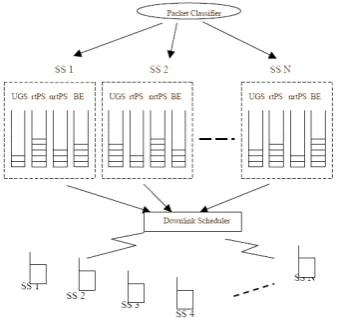
[image:2.595.319.551.54.192.2]Examples of simple methods: FIFO, Fair Queuing, Round Robin. In Figure 3 we illustrate a scheduling architecture based on a simple mechanism.
Figure 3. IEEE 802.16 scheduling based on Fair Queuing
b. Hierarchical Mechanisms:
[image:2.595.356.526.318.478.2]This type of mechanisms is the most proposed for the IEEE 802.16 scheduling [12] [13]. In fact, these mechanisms respond the most to the class structure of the standard and can serve to maintain fairness between the classes and to differentiate between them. However the problem with this kind of mechanisms is their complexity in the implementation. The idea behind this algorithm is to divide the traffic into categories as shown in Figure (4).
Figure 4. Enhanced Packet Scheduling Algorithms
a) Drop Tail: Drop Tail queue which like First in Firstout
(FIFO) queue. When the queue is full, tailing-after packets are dropped. Drop Tail [14] queuing usually considered default behavior because it is easy to implement and can be regarded as a simplest reference for queue management algorithms.
b) Fair Queuing: Fair queuing (FQ) was proposed by
John Nagle in 1987 [15]. In FQ, the buffer space is divided into many queues to hold the packets destined for or from users. In order to decide which packet should be forwarded first, FQ estimates a "virtual" finishing time. Finally, FQ compares the virtual finishing time and selects the minimum one. The packet with the minimum "virtual" finishing time is forwarded.
c) Weighted Fair Queuing: Weighted Fair Queuing
d) Deficit Round Robin: Deficit round robin (DRR) also called deficit weighted round robin (DWRR). DRR was proposed by M. Shreedhar and G.Varghese in 1995 .In DRR, we use round-robin servicing with a quantum of service assigned to each queue, the only difference from traditional round robin is that if a queue was not able to send a packet in the previous round, the remainder from the previous quantum is added to the quantum for next round.
e) Random Early Detection: Random Early Detection
(RED) [16] [17] is produced by Internet Research Task Force (IRTF). Once a link is filling up when TCP/IP session starts, RED starts dropping packets with probability which indicate to TCP/IP that the link is congested and it should slow down. Once the link is completely saturated, it behaves like a normal traffic police.
f) RED with In/Out: RED with in/out (RIO) is proposed
by Clark and Fang [18]. It is as an extension of RED [19]. It uses the same mechanism as in RED but has two sets of parameters, i.e., “In” and “Out” packets, which corresponds to two delivery classes If the packet arrival rate exceeds a predetermined target rate, arriving packets will be marked with “Out”. Otherwise, they will be marked with “In”. RIO wants to achieve both high throughput and low delay performance in over provisioned network.
g) Proportional Fairness (PF): PF was proposed by
Qualcomm Company, which was realized in the IS-856 standard for the downlink traffic scheduling (also known as High Data Rate (HDR)) [20] [21] .The essential goals of this packet scheduling scheme are to enhance the system throughput as well as provide fairness among the queues under consideration. Proportional Fairness scheduling is based on one priority function:
Where
-is the current data rate
-denotes an exponentially smoothing average of the service rate received by SS i up to slot t.
Although PF is simple and efficient, it cannot guarantee any QoS requirement such as delay and delay jitter due to its original design for saturated queues with non real-time data service.
h) Integrated Cross-layer Scheduling: The scheduling
algorithm at the MAC layer is modeled as an optimization problem with respect to some physical layer constraints and application QoS constraints [24]. At every timeslot, the scheduling algorithm has to
produce rate allocation r= (r1, r2… rk) and power P=
(p1, p2… pk) for all the k users, which is based on the
observation of the current channel state information
information (QSI) from the application layer. Rate allocation and power allocation are selected so that they optimize some system objectives.
III. SIMULATION SETUPS
We perform our scheduling algorithm in the NS-2 simulator that offers a significantly and better way to simulate realistic network topologies, traffic characteristics, and behavior of the transport protocols, such as TCP, TCP/Reno, UDP agent...etc. We perform WiMAX module by National Institute of Standards and Technology (NIST) based on the IEEE 802.16 standard with the for the ns-2 version 2.28.
Available features:
a. Wireless MAN-OFDM physical layer with configurable modulation.
b. Time Division duplexing (TDD). c. Point-to-multipoint (PMP) mode.
d. Management messages to execute network entry. e. Default scheduler providing round robin uplink
allocation to registered Mobile Stations (MSs). f. IEEE 802.16e extensions to support scanning and
handovers.
The relationship between the WiMAX module and legacy ns-2 modules is based on the original network component stack of the ns-2. Then, we set up NS2 wireless application program interface (API). The API configures for a mobile-node with all the given values of routing protocol, network stack, channel, propagation model.
The following parameters are used in the configuration: a. Bottleneck-link bandwidth – 100 Mbps b. Bottleneck-link delay – 1 ms.
c. Flow service type – CBR, Message. d. Routing protocol – DSDV.
e. Packet size – 500 bytes.
f. Queue management Drop Tail, PF, WFQ, DRR, RED, RIO queue management.
g. Other parameters using in queue scheduling schemes are set to the default values defined in ns-WiMAX Test.tcl.
IV. SIMULATION RESULT
Figure 5. Comparison of Uplink and Down-link Performance
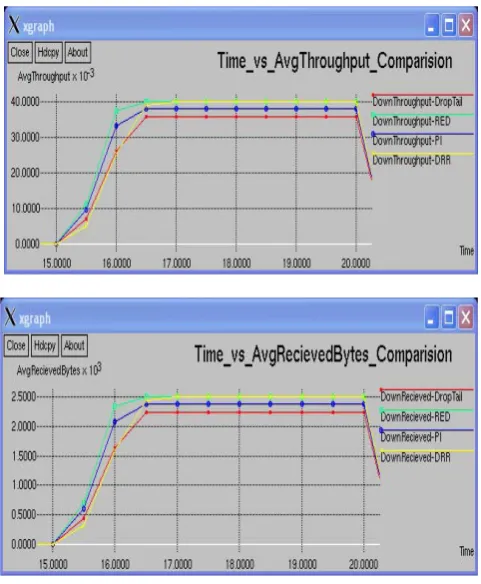
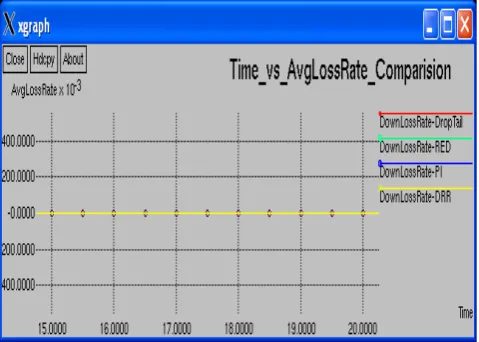
[image:4.595.317.558.425.717.2]In figure 6, this graph shows the performance of four protocols Drop Tail, RED, PI & DRR in uplink scheduling in simulation all the four models perform almost equal and DRR provide better result. Here the throughput and average received bytes increases with no loss rate as the time increases for the DRR.
Figure 6. Comparison of four protocols DropTail, RED, PI & DRR in uplink performance
Figure 7. Comparison of four protocols DropTail, RED, PI & DRR in Downlink performance
V. CONCLUSION
In this paper, we present the evaluation of several packet scheduling schemes for IEEE 802.16 standard are presented in NS2. We focus our study in performance on scheduling schemes for IEEE 802.16 Broadband Wireless Access Networks. The main proposed of this architecture is to provide better packet scheduling to various applications. The WiMAX PMP networks have been discussed in detail with respect to entry process and scheduling. The state-of-the-art research in the area has been extensively reviewed and several open issues have been pointed out. In particular, we proposed an effective QoS differentiation scheme for IEEE 802.16 PMP.In future work; we can improve our module to support all service flow. The IEEE 802.16 standard lacks in packet classification at MAC level. Finally, we will add other factors in the module to reflect the performance of scheduling algorithm accurately. Recently, a variety of new techniques have been developed for implementation of the physical and network layers of the WMNs. For instance, multi-radio multichannel WMNs are suggested to significantly improve the network throughput.
VI. ACKNOWLEDGEMENT
Thanks to the principal and to the management of Wellfare institute of science, Technology & management for helping us to publish this paper by providing us valuable resources.
VII. REFERENCES
[1]. C. Eklund et al., “IEEE Standard 802.16: A Technical Overview of the Wireless MAN™ Air Interface for Broadband Wireless Access,” IEEE Commun. Mag.,Jun.2002, pp. 98–107.
[2]. IEEE 802.16 Standard {Local and Metropolitan Area Networks} Part 16. Broadband Wireless Access Systems.
[3]. Roger B. Marks, “The IEEE 802.16 Wireless MAN Standard for Broadband Wireless Metropolitan Area Networks” IEEE Computer Society Distinguished Visitors Program, Jul. 2004.
[4]. K.Wongthavarawat, and A. Ganz, “Packet Scheduling for QoS Support in IEEE 802.16 Broadband Wireless Access
Systems”, International Journal of Communication Systems, Vol. 16, 2003.
[5]. Supriya Maheshwari. “An Efficient QoS Scheduling Architecture for IEEE 802.16 Wireless MANs. “, Indian Institute of Technology, 2005.
[6]. Guosong Chu, Deng Wang, and Shunliang Mei. “A QoS architecture for the MAC Protocol of IEEE 802.16 BWA System” IEEE International Conference on Communications Circuits and System and West Sino Expositions, vol.1,pp.435–439, China, 2002.
[7]. Jianfeng Chen, Wenhua Jiao, and Qian Guo,“Providing integrated QoS control for IEEE 802.16 broadband wireless access systems,” in 2005 IEEE 62nd Vehicular Technology Conference. Vol.2, pp.1254-1258,2005.
[8]. D. Tarchi, R. Fantacci, and M. Bardazzi,” Quality of Service Management in IEEE 802.16 Wireless Metropolitan Area Networks,“ in 2006 IEEE International Conference on Communications. Vol.4, pp.1789 – 1794, Jun. 2006.
[9]. Jianfeng Chen, Wenhua Jiao, and Hongxi Wang. ”A service flow management strategy for IEEE 802.16 broadband wireless access systems in TDD mode,” 2005 IEEE International Conference on Communications (ICC 2005).Vol.5, pp.3422 - 3426, May 2005.
[10]. H.S. Alavi, M. Mojdeh, and N. Yazdani, “ A Quality of Service Architecture for IEEE 802.16 Standards, ” in 2005Asia-Pacific Conference onCommunications,pp.249– 253,03-05Oct.2005.
[11]. C. Cicconetti, L. Lenzini, E. Mingozzi, C.Eklund, ”Quality of service support in IEEE 802.16 networks”,IEEE Network Volume 20, Issue 2, Mar.-Apr.2006 Page(s):50 – 55.
[12]. C. Cicconetti, A. Erta, L. Lenzini, E. Mingozzi, ” in “Performance Evaluation of the IEEE 802.16 MAC for QoS Support, ” in IEEE Transactions on Mobile Computing,Vol.6, Issue 1, pp.26 – 38, Jan. 2007.
[13]. Dong-Hoon Cho, Jung-Hoon Song, Min-Su Kim and Ki-Jun Han, “Performance analysis of the IEEE 802.16 wireless metropolitan area network” First International Conference on Distributed Frameworks for Multimedia Applications, DFMA '05, 6-9 Feb. 2005 Page(s):130 – 136.
[14]. DropTailQueuehttp://isi.edu/nsnam/ns/docstable/node62.ht ml visited on Sep.2008 [15] John Nagle, “On packet switches with infinite storage,”IEEE Trans. Commun., vol. COM-35, no.4, Apr. 1987.
[15]. John Nagle, “On packet switches with infinite storage,” IEEE Trans. Commun., vol. COM-35, no. 4,Apr. 1987.
[16]. Sally Floyd and Van Jacobson, “Random Early Detection Gateways for Congestion avoidance”, IEEE/ACM Transactions on Networking, Aug. 1993.
[17]. S. FLOYD, “Random early detection (RED): algorithm, modeling and parameters configuration”, Nov.1997.
[18]. D.D. Clark and W. Fang, Aug. 1998, “Explicit Allocation of Best-Effort Packet Delivery Service,”IEEE/ACM Transactions on Networking, vol. 6(4), pp. 362–373.
[20]. A. Jalali, R. Padovani, and R. Pankaj, “Data throughput of CDMA-HDR a high efficiency-high data rate personal communication wireless system,” Proc. IEEEE VTC pp. 1854-1858, 2000, Tokyo, Japan.
[21]. Bender,P., Black,P.,Grob,M., Padovani, R. Sindhushayana, Viterbi,A. (2000).“CDMA/HDR: A bandwidth-efficient high-speed wireless data service for nomadic users,” IEEE Communication Magazine 38(7),pp. 70-77, 2000.
Short Bio Data for the Author
Mr. Venkat.Kiran completed his M.Tech for Andhra University. He is currently working as an Asst.Professor in WISTM Engg College, Pinagadi, Visakhapatnam, and AndhraPradesh.He has a teaching experience of 7 years. His area of interest is Cryptography and Network Security, DWDM.
Mr.B.KiranKumar completed his M.Tech for Gitam University. He is currently working as an Asst.Professor in WISTM Engg College, Pinagadi, Visakhapatnam, and AndhraPradesh.He has a teaching experience of 3 years. His area of interest is Cryptography and Network Security.
Mr.D.D.SivaPrasad completed his M.Tech for Andhra University. He is currently working as an Asst.Professor in WISTM Engg College, Pinagadi, Visakhapatnam; in AndhraPradesh.He has a teaching experience of 7 years. His area of interest is Cryptography and Network Security & DWDM.
Mr. M.Malyadri Babu completed his M.Tech for Gitam University and MCA from Osmania University. He is currently working as Software Engineer in Benfranklin, Hyderabad.