Indistinguishability Obfuscation: from Approximate to Exact
∗Nir Bitansky† Vinod Vaikuntanathan‡
Abstract
We show general transformations from subexponentially-secure approximate indistinguisha-bility obfuscation (IO) where the obfuscated circuit agrees with the original circuit on a 1/2 +
fraction of inputs on a certain samplable distribution, into exact indistinguishability obfuscation where the obfuscated circuit and the original circuit agree on all inputs. As a step towards our results, which is of independent interest, we also obtain an approximate-to-exact transformation for functional encryption. At the core of our techniques is a method for “fooling” the obfuscator into giving us the correct answer, while preserving the indistinguishability-based security. This is achieved based on various types of secure computation protocols that can be obtained from different standard assumptions.
Put together with the recent results of Canetti, Kalai and Paneth (TCC 2015), Pass and Shelat (TCC 2016), and Mahmoody, Mohammed and Nemathaji (TCC 2016), we show how to convert indistinguishability obfuscation schemes in various ideal models into exact obfuscation schemes in the plain model.
Keywords: Functional Encryption, Program Obfuscation, Secure Function Evaluation.
∗
This work was done in part while the authors were visiting the Simons Institute for the Theory of Computing, supported by the Simons Foundation and by the DIMACS/Simons Collaboration in Cryptography through NSF grant CNS-1523467.
†
MIT.E-mail: [email protected]. Research supported in part by NSF Grants 1350619 and CNS-1414119. This material is based upon work supported by the DARPA and ARO under Contract No. W911NF-15-C-0236. Any opinions, findings and conclusions or recommendations expressed in this material are those of the author(s) and do not necessarily reflect the views of the DARPA and ARO.
‡
Contents
1 Introduction 1
1.1 Our Results . . . 2
1.2 Overview of Our Techniques . . . 3
2 Preliminaries 5 2.1 Non-Interactive Secure Function Evaluation . . . 5
2.1.1 Instantiations . . . 7
2.2 Symmetric Encryption . . . 9
2.3 Puncturable Pseudorandom Functions . . . 9
3 Correcting Errors in Indistinguishability Obfuscation 10 3.1 Approximate and Exact IO . . . 10
3.2 The Transformation . . . 11
3.3 Instantiating the Scheme. . . 15
4 Correcting Errors in Functional Encryption 15 4.1 Approximate and Exact FE . . . 15
4.2 The Transformation . . . 17
4.3 Instantiating the Scheme. . . 22
5 An Alternative Transformation for IO based on FE 22 5.1 Approximate FE from Approximate IO . . . 23
1
Introduction
Program obfuscation, the science of making programs “unintelligible” while preserving functionality, has been a holy grail in cryptography for over a decade. While the most natural and intuitively appealing notion of obfuscation, namelyvirtual-black-box(VBB) obfuscation [BGI+12], was shown to have strong limitations [BGI+12, GK05, BCC+14], the recent work of Garg, Gentry, Halevi, Raykova, Sahai and Waters [GGH+13b,SW14] opened new doors by demonstrating that the weaker notion ofindistinguishability obfuscation(IO) is both very useful and potentially achievable. Since then, a veritable flood of applications has made indistinguishability obfuscation virtually “crypto-complete”.
On the flip side, the tremendous power of IO also begets its reliance on strong and untested computational assumptions. Indeed, it has been a major cryptographic quest to come up with a construction of IO based on well-studied computational assumptions. Garg et al. [GGH+13b] gave the firstcandidateconstruction of IO, however the construction came as-is, without a security proof. We have recently seen several works [PST14, GLSW14, AJ15, BV15a] that shed light on how a security proof for IO will look like. Pass, Seth and Telang show security of an IO construction based on a “semantic security” assumption on multi-linear maps [GGH12]; Gentry, Lewko, Sahai and Waters [GLSW14] (following [GLW14]) show security based on the “multilinear subgroup elimination assumption” on multi-linear maps; Ananth and Jain [AJ15] and Bitansky and Vaikuntanathan [BV15a] show how to construct IO from any functional encryption scheme.
Unfortunately, the first two of these works are based on the mathematical abstraction of multi-linear maps which has had a troubled history so far (with several constructions [GGH13a,CLT13,
BWZ14, GGHZ14, GGH15, CLT15] and matching attacks [GGH13a, LS14, CHL+15, CGH+15,
HJ15]), and the last two rely on functional encryption with succinct encryption for which the only known constructions, yet again, use multi-linear maps.
Yet another line of work focuses on proving the security of obfuscators in so-called idealized models. In a typical idealized model, both the construction and the adversary have access to an oracle that implements a certain functionality; in the random oracle model [BR93], this is a random function; in the generic group model [Sho97], this is the functionality of a group; and the most recent entrant to this club, namely the ideal multilinear map model, is an abstraction of the functionality of multilinear maps. Several works [BR14b,BR14a,BGK+14,AB15,Zim15] along this route prove security of (different) constructions of obfuscation (even in the sense of virtual black-box security) in various ideal multi-linear map models.
An even more recent line of work, initiated by Canetti, Kalai, and Paneth [CKP15], inves-tigates how to transform constructions of obfuscation in idealized models into ones in the plain model, where there are no oracles. Indeed, this may lead to an aesthetically appealing avenue to constructing obfuscation schemes:
1. Construct an obfuscation scheme in an appropriate idealized model.
2. “De-idealize” it: translate the ideal model obfuscation scheme into a scheme in the real world.
In more detail, the work of [CKP15] show that any obfuscator in the random oracle model can be converted to an obfuscator in the plain model with the same security properties. Pass and Shelat [Pas16] and subsequently, Mahmoody, Mohammed and Nematihaji [MMN16] extend this to the generic group and ring models respectively, as well as ideal multilinear maps model with bounded multi-linearity.
However, the resulting obfuscators suffer from a major drawback: they only have approximate correctness. That is, the plain model obfuscator may err on a polynomially large fraction of inputs (or more generally with some polynomial probability when inputs are taken from a given samplable distribution). Roughly speaking, these results proceed by isolating a list of “heavy oracle queries”, that is, queries that arise in the evaluation of the obfuscated circuit on a large fraction of inputs. Once the (polynomially large set of) heavy queries are identified, the result of the oracle queries on this set is published as part of the obfuscated circuit. This approach will inherently miss the queries made by a rare set of inputs, resulting in an incorrect evaluation.
While these transformations already have interesting consequences (regarding the impossibility of VBB in these idealised models), the lack of correctness presents a serious obstacle towards fulfilling the above two-step plan. Indeed, it is far from clear that applications of IO will work when we only haveapproximate IOat our disposal. Certainly, one could go through the applications of IO one-by-one, and attempt to re-derive them from approximate IO, but in the absence of automated theorem provers1, this seems neither particularly efficient nor aesthetically pleasing. This motivates us to ask:
Can approximate indistinguishability obfuscation be made exact?
In other words, we are asking for “one transformation to rule them all”, a generic way to compile an approximate obfuscation scheme into a perfectly correct obfuscation scheme, automatically enabling to recover all the applications of IO even given only approximately correct obfuscation.
In this work, we provide exactly such a transformation, under standard additional assumptions. Let us now describe our results in detail.
1.1 Our Results
We say that an obfuscator apO is (X, α)-correct for a given input sampler X and α∈[0,1] (which may depend on the security parameter), if it is correct with probability at leastαover inputs sam-pled byX. Security is defined as in the standard setting of (exact) indistinguishability obfuscation. We shall refer to such an obfuscator as anapproximate indistinguishability obfuscator.
Our main result is that approximate IO with subexponential security for a certain class of samplers can be converted under standard assumptions intoalmost exact IOwhere for any circuit, with overwhelming probability over the coins of the obfuscator algorithm the resulting obfuscation is correct on allinputs. We present two routes towards this result based on different assumptions and with different parameters.
Theorem 1.1 (informal). Assuming DDH, there exists an input samplerX1 and a transformation that for any α ≥ 12 +λ−O(1), converts any (X
1, α)-correct sub-exponentially secure IO scheme for
Theorem 1.2 (informal). Assuming sub-exponentially-secure puncturable PRFs in NC1, there exists an input samplerX2, polynomialpoly2(·), and a transformation that for anyα≥1− 1
poly2(λ), converts any (X2, α)-correct sub-exponentially-secure IO scheme for P/poly into an almost exact IO scheme for P/poly.
Since the works of [CKP15, Pas16, MMN16] apply to any efficient sampler X and any α that is polynomially bounded away from 1, we obtain the following main corollary
Corollary 1.3 (Main Theorems + [CKP15, Pas16, MMN16]). Assume that there is an indistin-guishability obfuscator in either the random oracle model, the ideal generic group/ring model, or ideal multilinear maps model with bounded multi-linearity. Then, there is an (almost) exact obfuscator in the plain model.
We note that our theorems result in IO that may still output an erroneous obfuscator, but only with some negligible probability over the coins of the obfuscator alone. This is analogous to the setting of correcting decryption errors in plain public key encryption [DNR04], and as far as we know is sufficient in all applications. In subsequent work [BV15b], we show that under a worst-case complexity assumption typically used in the setting of derandomization, we could transform any such obfuscator to one that is perfectly correct.
We also show how to transform approximate functional encryption into exact functional encryp-tion, where approximate FE is defined analogously to approximate IO with respect to a distribution on the message space and decryption errors. Besides being of independent interest, this transfor-mation will also serve as a building block to obtain the second theorem above.
Theorem 1.4 (Informal). Assuming weak PRFs in NC1, there exists a message sampler X, con-stant η, and a transformation that for any α ≥1−η, converts any (X, α)-correct FE scheme for P/poly into an almost exact scheme FE scheme forP/poly.
We now proceed to provide an overview of our techniques.
1.2 Overview of Our Techniques
The starting point of our constructions comes from the notion of random self-reducibility [AFK89]. That is, imagine that you have an error-prone algorithm A that computes a (Boolean) functionF correctly on a 1/2 +ε fraction of inputs. Suppose that there is an efficient randomizer r(·) that maps an input x into a random input r = r(x) such that given F(r), one can efficiently recover F(x). Then, we can turn A into a BPP algorithm for computing F; namely, A0(x) = A(r(x)). The new algorithm computesF correctly for anyinput with high probability over its own random coins. The probability of error can then be made arbitrarily small using standard amplification (i.e., taking majority of≈ε−2 invocations).
In our setting,Fis an arbitrary function, which is likelynotrandom self-reducible. Nevertheless, we show how to make theessenceof this idea work, using various notions of (two-party and multi-party) non-interactive secure function evaluation (SFE) [Yao86,BGW88, Gen09]. Indeed, certain forms of non-interactive SFE (or homomorphic encryption) have been used in several instances in the literature to obtain (sometimes computational) random self-reducibility [AIK06,CKV10,BP12,
with care to ensure that homomorphic evaluation does not harm the security of the obfuscator. We next go into more details on how we carry out this agenda.
Our First Construction. Our first construction uses a two-party non-interactive secure function evaluation protocol with security against malicious senders. For simplicity, let us describe this approach in the language of fully homomorphic encryption (FHE). Let (Enc,Dec,Eval) be a (secret-key) FHE scheme (not necessarily compact). (We assume that the randomness of the key generation algorithm acts as the secret key, and avoid explicitly dealing with key generation.)
To exactly obfuscate a circuitC, we use the approximate obfuscatorapOto obfuscate the circuit
EvalC that, given as input an encryption of some x, homomorphically computes an encryption of C(x). Assume that apO(EvalC) is correct on a 1/2 +ε fraction of encryptions of 0n. The key observation is that semantic security of the encryption scheme means thatapO(EvalC) is also correct on a 1/2+ε−λ−ω(1)fraction of encryptions of anyx; that is, it outputsEval
C(Enc(x)) =Enc(C(x)). This gives the required randomizer and can be amplified to give us correctness for every input x.
The problem with this idea is the security of the final obfuscator. Indeed, EvalC(Enc(x)) may reveal information about the circuit C beyond the outputC(x). The problem goes even further: since the evaluator in this setting is untrusted, she can try to run the obfuscated circuits with malformed encryptions, potentially making the problem much worse. The solution is to rely on a maliciously function-hiding homomorphic encryption scheme. Such an object can be constructed using Yao’s garbled circuits combined with an oblivious transfer (OT) protocol secure against malicious receivers (such as the Naor-Pinkas protocol based on the DDH assumption [NP01]). The evaluation procedure, however, is randomized, but can be derandomized with a pseudo-random function.
While the above works perfectly assuming ideal VBB obfuscation, this is not necessarily the case for IO. Nevertheless, we observe that we can useapOto obfuscate this (de)randomized circuit using the machinery of probabilistic IO [CLTV15]. This allows us to show that indistinguishability obfuscation is maintained, but requires going through an exponential number of hybrids, in turn requiring sub-exponential security fromapO(and some of the other involved primitives).
Our Second Construction. Our second construction goes through the notion of functional encryption (FE). In a (public-key) FE scheme, the owner of a functional secret key FSKF can “decrypt” a ciphertext FE.Enc(MPK, m) to learnF(m), but should learn nothing else about m. In an approximately correct FE scheme, the decryption algorithm could err on encryptions of certain messagesm, but should be correct with probability 1−εon messagesmdrawn from a (sampleable) distributionX.
In our case, due to the BGW-based SFE, this size grows exponentially in the depth. Fortunately though, in [BV15a], it is shown that this still suffices to obtain IO, assuming also puncturable PRFs inNC1.
Overall, this leads to a construction of (almost exact) IO from subexponentially-secure approx-imate IO and subexponentially-secure puncturable PRFs in NC1 (which in turn can be obtained from standard assumptions such as LWE [BLMR13]).
2
Preliminaries
The cryptographic definitions in the paper follow the convention of modeling security against non-uniform adversaries. An efficient adversary A is modeled as a sequence of circuitsA ={Aλ}λ∈
N, such that each circuit Aλ is of polynomial size λO(1) with λO(1) input and output bits. We often omit the subscript λwhen it is clear from the context.
When we refer to a randomized algorithm A, we typically do not explicitly denote its random coins, and use the notation s← A or s← A(x) if A has an extra input x. When we want to be explicit regarding the coins, we shall denotes← A(r), ors← A(x;r), respectively.
Whenever we refer to a circuit class C = {Cλ}, we mean that each set Cλ consists of Boolean circuits of size at most poly(λ) for some polynomial poly(·), defined on the domain{0,1}n(λ). When
referring to inputsx∈ {0,1}n(λ), we often omit λfrom the notation.
2.1 Non-Interactive Secure Function Evaluation
We consider two-message secure function evaluation (SFE) protocols. Typically, such a protocol consists of two parties (A, B) and has the following syntax. PartyA is given input x, encrypts x and sends the encrypted input to B. B given as additional input a function f, homomorphically evaluates f on the encrypted x, and returns the result to A, who can then decrypt the result f(x). The protocol is required to ensure input-privacy for Aand function privacy for B (on top of correctness).
Definition 2.1 (Secure Function Evaluation). A scheme SFE = (Enc,Eval,Dec), where Enc,Eval
are probabilistic and Dec is deterministic, is a two-message secure function evaluation protocol for circuit class C={Cλ}, where Cλ is defined over {0,1}n(λ), if the following requirements hold:
• Correctness: for any λ∈N, C∈ Cλ and inputx∈ {0,1}n in the domain ofC it holds that:
Pr
Dec(R,CTc) =C(x)
(CT,R)←Enc(x)
c
CT←Eval(CT, C)
≥1−ν(λ) ,
for some negligible ν(·), where the probability is over the coin tosses of Enc and Eval.
• Input Hiding: for any polysize distinguisher D there exists a negligible function µ(·), such that for all λ∈N, and equal size inputs x0, x1∈ {0,1}n:
|Pr[D(CT0) = 1]−Pr[D(CT1) = 1]| ≤µ(λ) ,
• Malicious Function Hiding: there exists a (possibly inefficient) functionExt, such that for any polysize distinguisher D there exists a negligible function µ(·), such that for all λ ∈ N, maliciously chosen CT∗, and equal size circuits C0, C1 ∈ Cλ that agree on x=Ext(CT∗):
Pr[D(CTc0) = 1]−Pr[D(CTc1) = 1]
≤µ(λ) ,
where CTcb←Eval(CT∗, Cb).
We say that the scheme is δ-function-hiding, for some concrete negligible functionδ(·), if for all poly-size distinguishers, the above indistinguishability gapµ(λ) is smaller than δ(λ)Ω(1).
Remark 2.2 (strong function privacy). For our most basic transformation from approximate IO to exact IO, we will require 2−σ(λ)·λ−ω(1)-function-hiding, where σ(λ) is the size of encryptions in the scheme. Below, we discuss an instantiation, based on the DDH assumption, that has perfect function-hiding, and thus satisfies this requirement.
Distributed Secure Function Evaluation. We will also consider a notion of two-message distributed function evaluation (DSFE). Such a protocol consists ofk+ 2 parties (A, B1, . . . , Bk, C) and has the following syntax. PartyA, given input x, shares xinto kshares and sends the shares to B1, . . . , Bk. The parties B1, . . . , Bk given as additional input a function f, homomorphically and non-interactively evaluatef on each share, and send the evaluated shares to C, who can then decrypt and obtain the resultf(x).
The protocol is required to ensure that each individual share sent by A in the second message hides all information regarding the input x. We also require that C gains no information on the input, except for the output of the function (formally, we will require an indistinguishability-based guarantee analogous to that of functional encryption.) Furthermore, we will require that correctness holds even if someτ fraction of the partiesB1, . . . , Bk are faulty.
Definition 2.3 (Distributed Secure Function Evaluation). A scheme DSFE = (Enc,Eval,Dec), where Enc is probabilistic and Eval,Dec are deterministic, is a (k, τ)-secure distributed function evaluation protocol for circuit class C = {Cλ}, where Cλ is defined over {0,1}n for n = n(λ), k=k(λ), and τ =τ(λ), if the following requirements hold:
• Correctness in the presence of faults: for any λ∈N, C ∈ Cλ and input x ∈ {0,1}n in the domain of C and any set S ∈[k] of size smaller than τ k, and functions{Erri:i∈S} it holds that:
Pr
Dec(R,CTc1, . . . ,CTck) =C(x)
(CT1, . . . ,CTk,R)←Enc(x) ∀i∈[k]\S :CTci =Eval(CTi, C)
∀i∈S:CTci ←Erri(CTi)
≥1−ν(λ) ,
for some negligible ν(·), where the probability is over the coin-tosses of Enc.
• Input Hiding: for any polysize distinguisher D there exists a negligible function µ(·), such that for all λ∈N, and equal size inputs x0, x1∈ {0,1}n and any i∈[k]:
|Pr[D(CT0,i) = 1]−Pr[D(CT1,i) = 1]| ≤µ(λ) ,
• Residual Input Hiding: for any polysize distinguisher D there exists a negligible function µ(·), such that for all λ∈N, inputs x0, x1 ∈ {0,1}n, and circuit C ∈ Cλ such that C(x0) =
C(x1):
Pr[D(R0,CTc0,1, . . . ,CTc0,k) = 1]−Pr[D(R1,CTc1,1, . . . ,CTc1,k) = 1]
≤µ(λ) ,
where for (b, i)∈ {0,1} ×[k], CTcb,i =Eval(CTb,i, C), and(CTb,1, . . . ,CTb,k,Rb)←Enc(xb).
Remark 2.4 (difference from SFE). There are two main differences from SFE. The first is in security, in the above we do not require any type of function-hiding, but require residual input-hiding. The second is the functionality: we allow distributed evaluation (with some resilience to faults). The second difference is not essential, and is considered in order to reduce the underlying computational assumptions. In particular, a (non-distributed) SFE with residual input-hiding implies DSFE with k= 1, τ = 0.
Remark 2.5 (deterministic Eval). Jumping ahead, we remark that we will use distributed SFE in a setting where the encryptor is always honest. Since we are not requiring any privacy against the encryptor, we may assume w.l.o.g that Eval is deterministic. Indeed, we can always sample any required randomness as part of the encryption process and embed it in the sharesCT1, . . . ,CTk.
2.1.1 Instantiations
We now mention known instantiations of SFE and DSFE schemes, which we can rely on.
SFE. As mentioned above, for our application, we will require rather strong function-hiding. To instantiate the scheme we may rely on the SFE protocol obtained by using the oblivious transfer protocol of Naor and Pinkas [NP01] that is based on DDH and is secure against unbounded receivers in conjunction with an information-theoretic variant of Yao’s garbled circuit [Yao86] forNC1[IK02]. The resulting SFE scheme is for classes of circuits in NC1, which will suffice for our purposes. Alternatively, we can use a strong enough computational variant of Yao based on sub-exponential one-way functions, resulting in a construction for all polynomial-size circuits.
More generally, the Naor-Pinkas OT can be replaced with any OT that has statistical function-hiding. In the CRS model, such two-message protocols exist from other standard assumptions as well [PVW08]. While our main transformation is described using SFE in the plain model, it can be naturally extended to the CRS setting (see Remark3.4).
DSFE. An information-theoretically secure DSFE scheme for circuit classes in NC1 can be ob-tained based on a non-interactive variant of the BGW protocol [BGW88] similar to that used in [GVW12]. For the sake of completeness, we now outline this variant.In the resulting DSFE scheme, the complexity of encryption does not grow with the size of the circuits evaluated, but does grow exponentially with their maximal depth. As will be discussed later on, this will still be good enough in our context, to bootstrap functional encryption to indistinguishability obfuscation, as shown in [BV15a].
At a high-level, sharing the inputs in the scheme corresponds to encoding them using the Shamir secret-sharing scheme (that is, as random Reed-Solomon polynomials), evaluation corresponds to homomorphic evaluation over the polynomials, and residual input hiding is guaranteed by adding a random zero polynomial to the evaluated shares.
Concretely, the scheme is defined as follows. Fix a field F, such that |F| ≥ 3D+ 1, and let k= 3D+ 1. Letα1, . . . , αk bek distinct elements in the field.
• Enc(x1, . . . , xn):
1. sample nrandom degree-one polynomialsp1(·), . . . , pn(·), where pi(0) =xi, 2. sample a random degreeD polynomialz(·) such that z(0) = 0.
3. setCTj =p1(αj), . . . , pn(αj), z(αj). 4. output CT1, . . . ,CTk.
• Eval(CTj, C):
1. parse CTj =π1, . . . , πn, γ,
2. consider the univariate polynomial E(·) = C(p1(·), . . . , pn(·)) (that has degree at most D), and compute homomorphically η = C(π1, . . . , πn). (The result is meant to be
E(αj).)
3. output CTcj =η+γ.
• Dec(CTc1, . . . ,CTck):
1. parse (CTc1, . . . ,CTck) as a Reed-Solomon codeword inFk, and decode a polynomialEe(·),
2. output Ee(0).
We claim that the above scheme is (k,13)-secure. The analysis follows the standard BGW analysis (detailed in [AL11]). Very roughly, to show correctness, note that by the homomorphic properties of the Reed-Solomon code the correct polynomialE is such thatE(0) =C(x1, . . . , xn),
and this also holds for E(·) +z(·). Furthermore, decoding such that ˜E =E+z is guaranteed as long as there are at mostD faults. Input-hiding follows from the fact that each individual CTj is distributed uniformly at random onF. Residual input-hiding follows by the fact that after adding z, the new polynomial E+z is a random polynomial with free coefficient C(x1, . . . , xn), and thus can be completely simulated from this value. For more details, see [BGW88,AL11].
One point to notice is that the above is not entirely accurate if the output of the circuit C is a large ` = `(λ). Indeed, na¨ıvely to guarantee residual input-privacy, we will need to generate ` separate polynomials z1, . . . , z`, meaning the encryption size will grow linearly with `. This can be avoided by shifting the randomness to the evaluation procedure (which will slightly complicate our transformation). Alternatively, this can be avoided assuming the existence of a pseudo-random generator, by adding to the ciphertexts a seed, and having Eval use it to generate the multiple polynomialsz1, . . . , z`.
2.2 Symmetric Encryption
A symmetric encryption schemeSymconsists of a tuple of two PPT algorithms (Sym.Enc,Sym.Dec). The encryption algorithm takes as input a symmetric key SK ∈ {0,1}λ, where λ is the security parameter, and a message m ∈ {0,1}∗ of polynomial size in the security parameter, and outputs a ciphertext SCT. The decryption algorithm takes as input (SK,SCT), and outputs the decrypted message m. For this work, we only require one-time security.
Definition 2.7(One-Time Symmetric Encryption). A pair of PPT algorithms(Sym.Enc,Sym.Dec) is a one-time symmetric encryption scheme for message space {0,1}∗ if it satisfies:
1. Correctness: For every security parameter λand message m∈ {0,1}∗,
Pr
Sym.Dec(SK,SCT) =m
SK← {0,1}λ
SCT←Sym.Enc(SK, m)
= 1 .
2. Indistinguishability: for any polysize distinguisherDthere exists a negligible functionµ(·), such that for all λ∈N, and any equal size messages m0, m1,
|Pr[D(Sym.Enc(SK, m0)) = 1]−Pr[D(Sym.Enc(SK, m1)) = 1]| ≤µ(λ) ,
where SK← {0,1}λ.
We further say that Sym is δ-secure, for some concrete negligible function δ(·), if for all polysize distinguishers the above indistinguishability gap µ(λ) is smaller than δ(λ)Ω(1).
A symmetric encryption scheme meeting this definition can be constructed from any pseudo-random generator, and thus any one-way function [HILL99].
2.3 Puncturable Pseudorandom Functions
We consider a simple case of puncturable pseudo-random functions (PRFs) where any PRF may be punctured at a single point. The definition is formulated as in [SW14], and is satisfied by the Goldreich-Goldwasser-Micali PRF construction [GGM86,BW13,KPTZ13,BGI14].
Definition 2.8 (Puncturable PRFs). Let n, k be polynomially bounded length functions. An effi-ciently computable family of functions
PRF =nPRFK:{0,1}∗→ {0,1}λ
K∈ {0,1}
k(λ), λ∈
N
o
,
associated with an efficient (probabilistic) key samplerGenPRF, is a puncturablePRF if there exists a poly-time puncturing algorithm Punc that takes as input a key K, and a point x∗, and outputs a punctured key K{x∗}, so that the following conditions are satisfied:
1. Functionality is preserved under puncturing: For every x∗ ∈ {0,1}∗,
Pr
K←GenPRF(1λ)
∀x6=x∗ :PRFK(x) =PRFK{x∗}(x)
K{x∗}=Punc(K, x∗)
2. Indistinguishability at punctured points: for any polysize distinguisher D there exists a negligible function µ(·), such that for all λ∈N, and any x∗∈ {0,1}∗,
|Pr[D(x∗,K{x∗},PRFK(x∗)) = 1]−Pr[D(x∗,K{x∗}, u) = 1]| ≤µ(λ) ,
where K←GenPRF(1λ),K{x∗}=Punc(K, x∗), and u← {0,1}λ.
We further say that PRF is δ-secure, for some concrete negligible function δ(·), if for all polysize distinguishers the above indistinguishability gap µ(λ) is smaller than δ(λ)Ω(1).
Remark 2.9 (uniform output). For some of our constructions, it will be convenient to assume that the PRF family is one-universal; that is, for any fixed x, PRFK(x) is distributed uniformly at
random (whenK is sampled at random). It is not hard to see that such a puncturable PRF can be easily obtained from any puncturable PRF by adding a random stringU to the key and XORing U to every output.
3
Correcting Errors in Indistinguishability Obfuscation
In this section, we define approximate IO and show how to transform any approximate IO to (almost) perfectly correct IO, based on SFE.
3.1 Approximate and Exact IO
We start by defining indistinguishability obfuscation (IO) with almost perfect correctness. The definition is formulated as in [BGI+12].
Definition 3.1 (Indistinguishability obfuscation). A PPT algorithm O is said to be an indistin-guishability obfuscator for a class of circuits C={Cλ}, if it satisfies:
1. Almost Perfect Correctness: for any security parameter λ andC ∈ Cλ,
Pr O
h
∀x:O(C,1λ)(x) =C(x)i≥1−2−λ .
2. Indistinguishability: for any polysize distinguisherDthere exists a negligible functionµ(·), such that for any two circuitsC0, C1 ∈ C that compute the same function and are of the same
size:
Pr[D(O(C0,1
λ)) = 1]−Pr[D(O(C
1,1λ)) = 1]
≤µ(λ) ,
where the probability is over the coins of D and O.
We further say thatO isδ-secure, for some concrete negligible functionδ(·), if for all polysize distinguishers the above indistinguishability gapµ(λ) is smaller than δ(λ)Ω(1).
Definition 3.2((α,X)-correct IO). Forα(λ)∈[0,1]and an ensemble of input samplersX ={Xλ}, we say that O is (α,X)-correct if instead of (almost) perfect correctness, it satisfies the following relaxed requirement:
1. Approximate Correctness: for any security parameter λ, C∈ Cλ,
PrhO(C,1λ)(x) =C(x)
x← Xλ i
≥α(λ) ,
where the probability is also over the coins ofO.
3.2 The Transformation
We now describe a transformation from approximately correct IO to (almost) perfectly correct IO and analyze it. The transformation is based on SFE satisfying a strong function-hiding guarantee. We discuss an instantiation based on standard computational assumptions in Section 3.3.
In Section 5, we discuss an alternative transformation through functional encryption based on weaker computational assumptions.
A Worst-Case Approximate Obfuscator. The main step of the transformation is to obtain random self-reducibility; that is,to convert an approximate obfuscatorapO, which works reasonably well on average for random inputs taken from an appropriate distribution, into a worst-case ap-proximate obfuscatorwcOthat, for any (worst-case) input, works well on average over the random coins of the obfuscator alone. Then, in the second step, we invoke standard “BPP amplification”.
Ingredients. In the following, let λ denote a security parameter, let ε < 1 be some constant, η(λ) =λ−Ω(1) and letC={Cλ}denote a circuit class. We rely on the following primitives:
• A secure function evaluation scheme SFE for C that is 2−ω(σ(λ)+logλ)-function-hiding, where σ(λ) is the length of fresh ciphertexts generated by the encryption algorithmEnc for security parameterλ(and inputs of size n=n(λ) in the domain of Cλ).
• A 2−˜λε-secure puncturable pseudo-random function familyPRF, where the security param-eter is ˜λ=ω(σ(λ) + logλ)1/ε.
• A (12 +η(λ),X)-correct, 2−˜λε-secure indistinguishability obfuscator apO for C, where the security parameter is ˜λ=ω(σ(λ) + logλ)1/ε. The sampler class X depends on SFE and the class C depends on SFE, PRF, and C. Both X and C are specified below as part of the description of the constructed (exact) obfuscatorO.
The Worst-Case Obfuscator wcO:
Given a circuitC:{0,1}n→ {0,1} and security parameterλ, the obfuscatorwcO(C,1λ)
1. computes a new security parameter ˜λ = ω(σ(λ) + logλ)1/ε, where σ(λ) is the length of ciphertexts as defined above,
2. samples a puncturable PRF seedK←GenPRF(1λ˜),
3. computes the augmentedC-evaluation circuitCK defined in Figure1,
4. outputs an approximate obfuscationCe ←apO(CK,1
˜
CK
Hardwired: the circuitC and the seedK. Input: a ciphertext CT.
1. derive randomness r←PRFK(CT),
2. compute CTc ←Eval(CT, C;r),
3. outputCTc.
Padding: the circuit is padded to be of size`(|C|,K), for some polynomial`specified in the analysis.
Figure 1: The augmentedC-evaluation circuit.
We next describe the how the obfuscationCeis evaluated on any inputxvia a randomized procedure.
Randomized Evaluation:
Given an obfuscationCe, an inputx∈ {0,1}n, and security parameterλ:
1. compute (CT,R)←Enc(x),
2. computeCTc =Ce(CT),
3. output y=Dec(R,CTc).
The ensemble of samplersX consists of samplersX0 that sample encryptions fromEnc(0n) whereas the class C consists of circuitsCK as defined in Figure1.
Proposition 3.1. wcO satisfies:
1. Worst-Case Approximate Correctness: for any λ,C ∈ Cλ, x∈ {0,1}n,
PrhO(C,1λ)(x) =C(x)i≥ 1
2 +η(λ)−λ −ω(1) ,
where the probability is over the coins of apO.
2. Indistinguishability: as in Definition 3.1.
The intuition behind the proof is outlined in the introduction. We now turn to the actual proof.
Proof. We first prove that the new obfuscator is worst-case approximately correct, and then prove that it is secure.
Correctness. For any λ, n= n(λ), input x ∈ {0,1}n, let us denote Xx := Enc(x) a sampler for encryptions ofx. Then, by the input-hiding guarantee of SFE, and the approximate correctness of
as on encryptions of 0n. That is, there exists a negligibleµ(λ) such that
Pr
h e
C(CT) =CK(CT)
CT← X
xi≥
PrhCe(CT) =CK(CT)
CT← X
0i−µ(λ)≥
1
2+η(λ)−µ(λ) ,
where in both of the above K←GenPRF(1λ˜),Ce←apO(CK,1
˜
λ).
It now follows that decryption is correct with probability noticeably larger than half. Concretely,
Pr
Dec(R,CTc) =C(x)
CT,R←Enc(x)
c
CT=Ce(CT)
≥
Pr
Dec(R,CTc) =C(x)
CT,R←Enc(x)
c
CT=CK(CT)
·Pr
h e
C(CT) =CK(CT)
CT← X
xi=
Pr
Dec(R,CTc) =C(x)
CT,R←Enc(x) r=PRFK(CT)
c
CT=Eval(CT, C;r)
·Pr h
e
C(CT) =CK(CT)
CT← X
xi≥
(1−ν(λ))·
1
2 +η(λ)−µ(λ)
,
where in all of the aboveK←GenPRF(1λ˜),Ce←apO(CK,1
˜
λ), andν(·) is some negligible function
(corresponding to the negligible decryption error ofSFE). In the last step, we relied on the fact that for any fixed CT, PRFK(CT) is distributed uniformly at random (Remark 2.9), and the (almost)
perfect correctness ofSFE.
This completes the proof of correctness.
Security Analysis. Consistently with the notation above, for K ← GenPRF(1˜λ), and a circuit C∈ Cλ, we denote byCe←apO(CK,1
˜
λ) the corresponding approximate obfuscation of the
(deran-domized) evaluation circuit. We show that for any polysize distinguisher there exists a neglgible µ(·), such that for anyC0, C1 ∈ Cλ that compute the same function it holds that
Pr[D(Ce0) = 1]−Pr[D(Ce1) = 1]
≤µ(λ) .
Roguhly, the above follows from the fact that the output of the two underlying obfuscated cir-cuits on any point CT ∈ {0,1}σ(λ) is indistinguishable even given C
0, C1. Indeed, because the
circuits C0, C1 compute the same function, by the function-hiding of SFE, for any ciphertext
CT∈ {0,1}σ(λ), the evaluated ciphersEval(CT, C
0) andEval(CT, C1) are indistinguishable. Canetti,
Lin, Tessaro, and Vaikuntanathan [CLTV15] show that (sub-exponential) IO in conjunction with (sub-exponential) puncuturable PRFs are sufficient in this setting, which they formalize by proba-bilistic IO notion. For the sake of completeness, we next sketch the argument.
We consider a sequence of 2σ+ 1 hybrids{HCT}CT∈{0,...,2σ}, where we naturally identify integers
in [2σ] with strings in{0,1}σ. InH
CT, we obfuscate a circuit CCT(CT0) that computes C0,K for all
We first note that C0 computes the same function as C0,K and that C2σ computes the same
function asC1,K, and thus by the IO security,
Pr
h
D(Ce0) = 1 i
−Pr [D(H0) = 1]
≤2
−˜λε
,
Pr [D(H2σ) = 1]−Pr h
D(Ce1) = 1 i
≤2
−λ˜ε
.
We show that for any CT∈[2σ],
|Pr [D(HCT−1) = 1]−Pr [D(HCT) = 1]| ≤O(2− ˜
λε
) .
This follows a standard puncturing argument with respect to the point CT, consisting of:
• puncturing PRFK at CT, and hardwiring C0,K(CT) = Eval(CT, C0;PRFK(CT)), which relies
on IO security,
• replacingPRFK(CT) with true randomness, which relies on pseudorandomness at punctured
points,
• replacingEval(CT, C0) withEval(CT, C1), which relies on function hiding.
• reversing the above steps.
Each of the steps induces a loss of 2−λ˜ε = 2−ω(σ(λ)+logλ) in the indistinguishability gap.
This completes the security analysis.
The (Almost) Exact Obfuscator O: to obtain an (almost) exact obfuscatorO from the worst-case approximate obfuscator we apply standard “BPP amplification”. Such a transformation is given in [KMN+14, Appendix B]. For the sake of completeness, we sketch it here.
Obfuscation: Given a circuit C : {0,1}n → {0,1} and security parameter λ, the obfuscator O(C,1λ) outputs N = ωη(2n(+λλ)) obfuscations Ce1, . . . ,CeN, where Cei ← wcO(C,1λ), and N random
stringsr1, . . . , rN, where ri ← {0,1}λ.
Evaluation: Given an obfuscation
n
e
Ci, ri
i∈[N] o
, inputx∈ {0,1}n, and security parameterλ:
1. Fori∈[N], invoke the randomized evaluation procedure forCei, for inputx, using randomness
ri, store the result yi.
2. Outputy=majority(y1, . . . , yN).
Remark 3.3 (deterministic evaluator). Publishing the random stringsri is done to match the usual obfuscation syntax where the evaluation is deterministic. We may also let the evaluator sample this randomness.
Proof sketch. We show correctness and security.
Correctness. By a Chernoff bound, for large enough λ, and any x∈ {0,1}n, the probability that the majority valuey among all decrypted y1, . . . , yN is incorrect is bounded by
Pr [y6=C(x)]≤2−Ω(N·η2(λ))≤2−n+λ .
The required correctness follows by a union bound over all inputs in {0,1}n.
Security. The obfuscation consists of N independent copies of worst-case obfuscations Cei ← wcO(C), wherewcOsatisfies indistinguishability. Security thus follows by a standard hybrid argu-ment.
Remark 3.4 (SFE in the CRS model). The above construction can be naturally extended to rely also on non-interactive SFE schemes in the CRS model (rather than the plain model). Indeed, the CRS can be generated by the (honest) obfuscator.
3.3 Instantiating the Scheme
As discussed in Section2.1.1, we can instantiate the SFE based on the (polynomial) DDH assump-tion and sub-exponential one-way funcassump-tions. Sub-exponential one-way funcassump-tions are also needed here in order to obtain sub-exponentially-secure puncturable PRFs.
We can thus state the following theorem
Theorem 3.5. Assuming sub-exponentially secure approximate IO forP/poly, (polynomial) DDH, and sub-exponentially-secure one-way functions, there exists (almost) perfectly correct IO forP/poly.
Alternative instantiations of the above under more computational assumptions [PVW08] can be obtained when extending the scheme to SFE in the CRS model.
4
Correcting Errors in Functional Encryption
In this section, we define approximate FE and show how to transform any approximate FE to (almost) perfectly correct FE, based on DSFE. For the sake of concreteness, we focus on the public-key setting. We also focus on selective-security, which can be generically boosted to adaptive security [ABSV14].
4.1 Approximate and Exact FE
We recall the definition of public-key functional encryption (FE) with selective indistinguishability-based security [BSW12,O’N10], and extend the definition to the case of approximate correctness.
A public-key functional encryption (FE) scheme FE, for a function class F = {Fλ} (represented by boolean circuits) and message spaceM={0,1}n(λ):λ∈
N , consists of four PPT algorithms (FE.Setup,FE.Gen,FE.Enc,FE.Dec) with the following syntax:
• FE.Gen(MSK, f): Takes as input a secret keyMSK, a functionf ∈ Fλand outputs a functional keyFSKf.
• FE.Enc(MPK, M): Takes as input a public key MPK, a message M ∈ {0,1}n(λ) and outputs
an encryption of M.
• FE.Dec(FSKf,FCT): Takes as input a functional keyFSKf, a ciphertextFCTand outputsMc.
We next recall the required security properties as well the common (almost) perfect correctness requirement.
Definition 4.1 (Selectively-secure public-key FE). A tuple of PPT algorithms FE = (FE.Setup, FE.Gen, FE.Enc, FE.Dec) is a selectively-secure public-key functional encryption scheme, for func-tion class F ={Fλ}, and message space M=
{0,1}n(λ):λ∈
N , if it satisfies:
1. Almost Perfect Correctness: for every λ ∈ N, message M ∈ {0,1}n(λ), and function
f ∈ Fλ,
Pr
f(M)←FE.Dec(FSKf,FCT)
(MPK,MSK)←FE.Setup(1λ)
FSKf ←FE.Gen(MSK, f)
FCT←FE.Enc(MPK, M)
≥1−2−λ.
2. Selective-security: for any polysize adversaryA, there exists a negligible functionµ(λ)such that for any λ∈N, it holds that
AdvFEA =
Pr[Expt
FE
A(1λ,0) = 1]−Pr[ExptFEA (1λ,1) = 1]
≤µ(λ),
where for eachb∈ {0,1} andλ∈Nthe experimentExptFEA(1λ, b), modeled as a game between the challenger and the adversaryA, is defined as follows:
(a) The adversary submits the challenge message-pairM0, M1 ∈ {0,1}n(λ)to the challenger.
(b) The challenger executesFE.Setup(1λ)to obtain(MPK,MSK). It then executesFE.Enc(MPK, Mb) to obtainFCT. The challenger sends (MPK,FCT) to the adversary.
(c) The adversary submits function queries to the challenger. For any submitted func-tion query f ∈ Fλ, if f(M0) = f(M1), the challenger generates and sends FSKf ←
FE.Gen(MSK, f). In any other case, the challenger aborts.
(d) The output of the experiment is the output of A.
We further say thatFEisδ-secure, for some concrete negligible functionδ(·), if for all polysize adversaries the above indistinguishability gap µ(λ) is smaller than δ(λ)Ω(1).
We now define an approximate notion of correctness that allows decryption to error with some probability over encryption of messages taken from some given distribution.
Definition 4.2((α,X)-correct FE). Forα(λ)∈[0,1]and an ensemble of samplersX ={Xλ}with support M =
{0,1}n(λ):λ∈
1. Approximate Correctness: for every λ∈N, and function f ∈ Fλ,
Pr
f(M)←apFE.Dec(apFSKf,FCT)
(apMPK,apMSK)←apFE.Setup(1λ)
apFSKf ←apFE.Gen(apMSK, f) M ← Xλ
apFCT←apFE.Enc(apMPK, M)
≥α(λ).
4.2 The Transformation
We now describe the transformation from approximately correct FE to (almost) perfectly correct FE and analyze it. The transformation is based on DSFE. We discuss instantiations in Section4.3.
A Worst-Case Approximate FE.As in the case of obfuscation, the main step of the FE trans-formation is to obtain random self-reducibility; that is,to convert an approximate FE schemeapFE, which works reasonably well on average for random messages taken from some appropriate distri-bution, into a worst-case approximate scheme wcFEthat, for any (worst-case) message, works well on average over the random coins of the obfuscator alone. Then, in the second step, we invoke standard “BPP amplification”.
Ingredients. In the following, let λ denote a security parameter, and let F = {Fλ} denote a function class. Consider functions k(λ) ∈ N, and ρ(λ), η(λ) ∈ [0,1] such that η = 12 −√ρ ∈ [λO1(1),
1 2 −
1
λO(1)]. We rely on the following primitives:
• A (k,√ρ)-secure distributed function evaluation scheme DSFE for C. We shall further as-sume that when encrypting an input, the shares CT1, . . . ,CTk all have the same marginal distribution (i.e.,CTi ≡CTj).2
• A (1−ρ,X)-correct (single-key, selectively-secure) functional encryption scheme apFE = (apFE.Setup, apFE.Gen,apFE.Enc, apFE.Dec) for C. The sampler class X depends on DSFE
and the class F depends onDSFE, andF. BothX and F are specified below as part of the description of the constructed (almost exact) scheme FE.
• A one-time symmetric key encryption scheme Sym= (Sym.Enc,Sym.Dec).
The Worst-Case Scheme wcFE: The scheme wcFE, for function class F ={Fλ} and message space M = {0,1}n(λ):λ∈
N , consists of the algorithms (wcFE.Setup, wcFE.Gen, wcFE.Enc,
wcFE.Dec) defined as follows:
• wcFE.Setup(1λ): generate (apMPK,apMSK) ← apFE.Setup(1λ). The public key MPK and secret keyMSKare accordingly set to be theapMPK and apMSK.
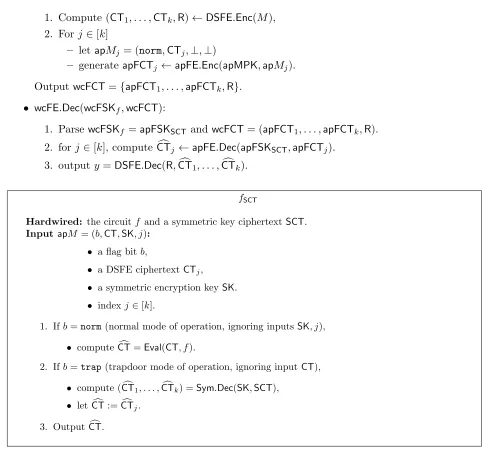
• wcFE.Gen(wcMSK, f): sample SCT ← Sym.Enc(SK,0`×k), where ` = `(λ) is a polynomial specified in the security analysis, and SK ← {0,1}λ. Consider the augmented f-evaluation function fSCT as defined in Figure 2. Generate apFSKSCT ← apFE.Gen(apMSK, fSCT). The
functional keywcFSKf will consists of the functional keyapFSKSCT.
• wcFE.Enc(wcMPK, M):
2
1. Compute (CT1, . . . ,CTk,R)←DSFE.Enc(M),
2. Forj∈[k]
– letapMj = (norm,CTj,⊥,⊥)
– generateapFCTj ←apFE.Enc(apMPK,apMj).
OutputwcFCT={apFCT1, . . . ,apFCTk,R}.
• wcFE.Dec(wcFSKf,wcFCT):
1. ParsewcFSKf =apFSKSCT and wcFCT= (apFCT1, . . . ,apFCTk,R).
2. forj∈[k], compute CTcj ←apFE.Dec(apFSKSCT,apFCTj).
3. output y=DSFE.Dec(R,CTc1, . . . ,CTck).
fSCT
Hardwired: the circuitf and a symmetric key ciphertextSCT. Input apM = (b,CT,SK, j):
• a flag bitb,
• a DSFE ciphertextCTj,
• a symmetric encryption keySK.
• indexj ∈[k].
1. Ifb=norm (normal mode of operation, ignoring inputsSK, j),
• computeCTc =Eval(CT, f).
2. Ifb=trap (trapdoor mode of operation, ignoring inputCT),
• compute (CTc1, . . . ,CTck) =Sym.Dec(SK,SCT),
• letCTc :=CTcj.
3. OutputCTc.
Figure 2: The augmented f-evaluation circuit.
The ensemble of samplers X consists of samplers X0 that sample FE plaintexts of the form
apM = (norm,CT,⊥,⊥) whereCTis the first ofkciphertext components sampled fromDSFE.Enc(0n), i.e. it is a share of a zero-encryption in the underlying DSFE scheme. The classFconsists of circuits fSCT as in Figure 2.
Proposition 4.1. wcFE satisfies:
1. Worst-Case Approximate Correctness: for everyλ∈N, function f ∈ Fλ, and message M ∈ {0,1}n,
Pr
f(M)←wcFE.Dec(wcFSKf,wcFCT)
(wcMPK,wcMSK)←wcFE.Setup(1λ)
wcFSKf ←wcFE.Gen(wcMSK, f)
wcFCT←wcFE.Enc(wcMPK, M)
≥
1
2. Selective security: as in Definition 4.1.
We now turn to the proof.
Proof. We first prove that the new obfuscator has worst-case approximate correctness, and then prove that it is selectively secure.
Correctness. For any λ, n = n(λ), message M ∈ {0,1}n, let us denote XM a sampler for FE plaintexts of the formapM = (norm,CT,⊥,⊥) that is defined just likeX0 except thatCTis a share of an encryption ofM sampled fromDSFE.Enc(M) in the underlying DSFE scheme, rather than a share of an encryption of 0n.
Then, by the input-hiding guarantee ofSFE, and the approximate correctness ofapFE, we claim that, for any functionf ∈ F and corresponding fSCT, decryption inapFE is correct on encryptions
of an arbitrary M ∈ {0,1}n as on encryptions of 0n. That is, there exists a negligible µ(λ) such that
Pr
apFE.Dec(apFSKfSCT,apFCT) =fSCT(apM)
apM ← XM
≥
PrapFE.Dec(apFSKfSCT,apFCT) =fSCT(apM)
apM ← X0
−µ≥
1−ρ−µ ,
where (apMPK,apMSK) ← apFE.Setup(1λ), apFSKfSCT ← apFE.Gen(apMSK, fSCT), apFCT ←
apFE.Enc(apMPK,apM), as defined above in the construction of the exact scheme, and apM = (norm,CT,⊥,⊥).
We now consider alternative samplers
n
XM j
j∈[k] o
that sampleapMj just as in the canonical
XM, except that CTis sampled as the the jth share of a DSFE encryption ofM (rather than the first). Note that by our assumption that the sharesCT1, . . . ,CTk←DSFE.Enc(M) have the same marginal distribution, the samplers XM,XM
1 , . . . ,XkM all sample from the same distribution. In particular, they satisfy the above statement regarding the probability of correct decryption, satisfied by XM.
We shall denote byXM
j |CTj the corresponding sampler conditioned onCT=CTj for some fixed
CTj. We now consider the joint sampler (apM1, . . . ,apMk)← X[Mk] where first shares (CT1, . . . ,CTk) are sampled from DSFE.Enc(M), and then each apMj is sampled from Xj|CTj. Note that this sampler corresponds to the way that encryption is done in our actual scheme wcFEdefined above. Noting that the marginal distribution of each apMj sampled accordingly toX[Mk] is the same as XM
j , it follows that the expected number of successful decryptions for a sample from X[Mk] can be
lower bounded as follows
E
h
|{j|apFE.Dec(apFSKfSCT,apFCTj) =fSCT(apMj)}|
(apM1, . . . ,apMk)← X
M
[k]
i
=
k·PrapFE.Dec(apFSKfSCT,apFCTj) =fSCT(apMj)
apMj ← XM
≥
k·(1−ρ−µ) ,
where (apMPK,apMSK) ← apFE.Setup(1λ), apFSK
fSCT ← apFE.Gen(apMSK, fSCT), apFCTj ←
apFE.Enc(apMPK,apMj).
It follows by averaging that with probability at least 1−√ρ− √2µ
Going to our actual encryption schemewcFE, we now claim that decryption is correct with proba-bility noticeably larger than half. Concretely,
Pr
DSFE.Dec(R,CTc1, . . . ,CTck) =f(M)
CT1, . . . ,CTk,R←DSFE.Enc(M)
c
CTj =apFE.Dec(apFSKfSCT,apFCTj)
≥
Pr
"
DSFE.Dec(R,CTc1, . . . ,CTck) =f(M)
CT1, . . . ,CTk,R←DSFE.Enc(M)
n
c
CTj =fSCT(apMj)
o ≥
√ ρ·k
#
·
Pr [|{apFE.Dec(apFSKfSCT,apFCTj) =fSCT(apMj)}| ≥
√
ρ·k|CT1, . . . ,CTk,R←DSFE.Enc(M)] =
Pr
"
DSFE.Dec(R,CTc1, . . . ,CTck) =f(M)
CT1, . . . ,CTk,R←DSFE.Enc(M)
n
c
CTj =DSFE.Eval(CTj, f)
o ≥
√ ρ·k
#
·
Prh|{apFE.Dec(apFSKfSCT,apFCTj) =fSCT(apMj)}| ≥
√ ρ·k
CT1, . . . ,CTk ← X
M
[k]
i
≥
(1−ν)·
1−√ρ−√2µ ρ
≥ 1
2 +η−λ −ω(1) ,
where in all of the above (apMPK,apMSK)←apFE.Setup(1λ),apFSKfSCT ←apFE.Gen(apMSK, fSCT),
apMj = (norm,CTj,⊥,⊥),apFCTj ←apFE.Enc(apMPK,apMj), andν(·) is some negligible function (corresponding to the negligible decryption error of DSFE).
This completes the proof of correctness.
Security Analysis. We prove the selective security of wcFE in a sequence of hybrids, showing that any adversary Acannot tell the case that the challenge is an encryption ofM0 from the case
that the challenge is an encryption ofM1, for the corresponding (M0, M1) of his choice.
H1: this corresponds to the usual security game where the challenge is an encryption of M0.
H2: here, when generating a key FSKf for a function f, and accordingly generating an (approxi-mate) keyapFSKfSCT for the function fSCT, the symmetric ciphertext SCTis not an encryption of
0`×k as in the previous hybrid, but rather an encryption of the DSFE evaluation corresponding to the challenge ciphertext. Concretely, consider the generation of the challenge ciphertextFCT∗:
• FE.Enc(MPK, M0):
1. Compute (CT∗1, . . . ,CT∗k,R∗)←DSFE.Enc(M0),
2. Forj∈[k]
– letapMj∗ = (norm,CT∗j,⊥,⊥)
– generateapFCT∗j ←apFE.Enc(apMPK,apMj∗).
OutputFCT∗= (apFCT∗1, . . . ,apFCT∗k,R∗).
Then SCTwill now encryptCTc
∗
f,1, . . . ,CTc
∗
f,k, where CTc
∗
f,j =DSFE.Eval(CT∗j, f).
Indistinguishability from the previous hybrid follows by the semantic-security of symmetric encryp-tion. (At this point, a corresponding symmetric secret key SK is not present – in all encryptions the symmetric-key slot is set to⊥.)
Indistinguishability from the previous hybrid follows from the security of the underlying scheme
apFE. Indeed, at this point, for every function f for which a keyapFSKfSCT was generated,
fSCT(trap,⊥,⊥,SK, j) =fSCT(norm,CTj,⊥,⊥) =CTc
∗ f,j .
H4: here, we change how the evaluations CTc
∗
f,j are generated. Recall that in the previous
hybrid CTc
∗
f,j = DSFE.Eval(CT∗j, f), where CTj∗ was generated as part of (CT∗1, . . . ,CT∗k,R∗) ←
DSFE.Enc(M0). Now, instead of encrypting M0 in the latter we encrypt M1.
Indistinguishability now follows from the residual input privacy of the underlying DSFE, since f(M0) = f(M1). (Recall, that this is guaranteed also in the presence of R∗, provided that
CT∗1, . . . ,CT∗k are absent from the adversary’s view, which is indeed the case in this hybrid.)
H5-H8: symmetrically follow the above hybrids in reverse order, until the usual security game whereM1 is encrypted in the challenge.
This completes the security analysis.
Remark 4.3 (removing the assumption on equally-distributed shares). In the above construction we have assumed that the DSFE sharesCT1, . . . ,CTk have the same marginal distribution (for which we have also exhibited an instantiation in Section 2.1.1). To remove this assumption, we could have an instance of an approximate FE scheme apFEi for each iwith respect to the corresponding distribution onCTi(whereas in the construction above we relied on one instance of an approximate FE defined with respect to the marginal distribution which was the same for all shares).
The (Almost) Exact Scheme FE: to obtain an (almost) exact scheme from the worst-case approximate scheme we again apply standard “BPP amplification”. Namely, we considerN parallel copies of the scheme for a large enoughN.
Formally, the schemeFE, for function classF ={Fλ}and message spaceM=
{0,1}n(λ):λ∈
N , consists of the algorithms (FE.Setup,FE.Gen,FE.Enc,FE.Dec) defined as follows:
• FE.Setup(1λ): let N = ω(nη+2λ). For i∈ [N], generate (wcMPKi,wcMSKi)← wcFE.Setup(1λ). The public key MPK and secret key MSK are accordingly set to be all of the public keys {wcMPKi}i∈[N] and secret keys{wcMSKi}i∈[N].
• FE.Gen(MSK, f): For i ∈ [N], generate wcFSKf,i ← wcFE.Gen(wcMSKi, f). The functional keyFSKf will consists of the functional keys {wcFSKf,i}i∈[N].
• FE.Enc(MPK, M): For i∈ [N], compute wcFCTi ← wcFE.Enc(wcMPKi, M). The ciphertext
FCT consists of the ciphertexts (wcFCT1, . . . ,wcFCTN).
• FE.Dec(FSKf,FCT):
1. ParseFSKf ={wcFSKf,i}i∈[N] and FCT={wcFCTi}i∈[N].
2. Fori∈[N], compute yi =wcFE.Dec(wcFSKf,i,wcFCTi).
3. Outputy=majority(y1, . . . , yN).
Proof sketch. We show correctness and security.
Correctness. By a Chernoff bound, for large enoughλ, and messageM ∈ {0,1}n, the probability that the majority value y among all decryptedy1, . . . , yN is incorrect is bounded by
Pr [y6=f(M)]≤2−Ω(N·η2(λ))≤2−n+λ .
The required correctness follows by a union bound over all messages in {0,1}n.
Security. The scheme consists ofN independent copies of the worst-case scheme that is selectively secure. Security thus follows by a standard hybrid argument.
4.3 Instantiating the Scheme
As discussed in Section2.1.1, we can instantiate the DSFE based an information-theoretic variant of BGW for NC1, resulting in an FE scheme for NC1. The scheme can then be generically bootstrapped to P/polyassuming weak PRFs in NC1 [ABSV14].
Theorem 4.4. Assuming approximate FE for P/poly and weak PRFs in NC1, there exists (al-most) perfectly correct FE for P/poly.
5
An Alternative Transformation for IO based on FE
Recall that the transformation from (subexponential) approximate IO to (almost) exact IO de-scribed in Section 3.2 required SFE with function hiding against malicious receivers, and was instantiated based on (polynomial) DDH and subexponential one-way functions. In this section, we show an alternative transformation based on any subexponential puncturable PRF in NC1. The transformation is based on a combination of the FE transformation from Section4and known results from the literature.
The high-level idea consists of three basic steps:
1. Start with a secure) approximate IO and implement directly (subexponentially-secure) approximate FE with compact ciphertexts by following a construction from the exact IO setting [GGH+13b].
2. Apply the transformation from approximate FE to obtain exact FE with compact ciphertexts, based on weaker assumptions.
3. Apply a transformation from exact FE to (exact) IO [AJ15,BV15a].
Fulfilling this high-level plan requires some care though. The transformation of Garg et al. [GGH+13b] from IO to FE naturally extends to the the approximate setting, but relies on additional
when instantiated with the BGW-based DSFE, satisfies the required compactness, when assuming additionally (sub-exponentially-secure) puncturable PRFs inNC1.
Overall, we prove
Theorem 5.1. Assuming approximate IO for P/poly and puncturable PRFs in NC1, both with sub-exponential security there exists (almost) perfectly correct IO P/poly.
We next provide further details.
5.1 Approximate FE from Approximate IO
The starting point for this step is the Garg et al. [GGH+13b]. To obtain FE from IO and PKE, and NIZKs, the transformation works as follows. Each encryption has the form (e0, e1, π), where
e0, e1 encrypt a message M under two independent copies of a plain (exact) public-key encryption
scheme, andπ is a proof that (e0, e1) are indeed well-formed using an (exact) NIZK with statistical
simulation-soundness.
A functional key for a function f is an obfuscation of a circuit CSK0,CRS that given (e0, e1, π):
• verifies the correctness ofπ with respect to the hardwired common reference stringCRS,
• if the proof is accepting, decrypts e0 using the hardwired secret keySK0 to obtain M,
• and outputs f(M).
It follows readily that if we replace exact IO in this transformation with approximate IO (say while still using exact PKE and NIZKs) the resulting FE scheme would be approximately-correct. Concretely to getα-correct FE for a message samplerX, we start with IO that isα-correct for an input sampler X0 that samples FE encryptions (e0, e1, π) of random messages M taken from X.
In fact, even if we start with α-correct versions of PKE and NIZKs we would get Ω(α)-correct FE, however, the security of the FE scheme might no longer hold; indeed, the exact correctness of the PKE and NIZK play an important role in the security proof in [GGH+13b]. To fill this gap we will show how to obtain exact NIZK and PKE directly from approximate IO. More accurately, we would obtain almost exactly correct versions where the NIZK and PKE are exactly correct with overwhelming probability over the choice of their public parameters (i.e., the common reference string and public-keys), which is sufficient for the security proof in [GGH+13b].
(Almost) Exact PKE.To obtain (almost) exact PKE, we start with the PKE of Sahai and Waters [SW14] based on exact IO and one-way functions. Here the public key consists of an obfuscationCeof
a circuitCKthat given a PRG seedsoutputsPRFK(PRG(s)) for an appropriately stretching
pseudo-random generator and a puncturable PRF. An encryption of M consists of PRG(s), M ⊕Ce(s).
Replacing exact IO with α-correct IO in their transformation results in approximate PKE in two senses: (a) the scheme is correct with probability α over an encryption of any message M; (b) it is weakly semantically secure, the probability of guessing a random encrypted message M can be bounded by β = 2−|M|+λ−ω(1)+ (1−α). Schemes such as the latter can be corrected using techniques from the literature [DNR04, Theorem 4] so long that β < O(α4), which holds for constantα that is sufficiently close to 1.
how to shift the error probability to the choice of the public-key alone; namely, get a scheme where with overwhelming probability over the choice of keys there are no decryption errors at all. This is done as follows, assume the decryption error is bounded by 2−λ, and encryption uses r(λ) =λO(1) bits of randomness. We will now publish together with the public key a random stringR← {0,1}r. Encryption will now be done with randomnessR0=R⊕PRG(s), wherePRG:{0,1}λ/2 → {0,1}ris a pseudo-random generator ands← {0,1}λ/2 is a random seed. Due to the sparseness of the PRG
with probability 2−Ω(λ) over the choice of the keys the are no decryption errors. Semantic-security is maintained due to the security of the PRG.
(Almost) Exact NIZK. Statistical simulation-sound NIZKs can be constructed from any NIZK proof and non-interactive commitment schemes in the common reference string model [GGH+13b]. The same also holds for the case that the NIZK is almost exact (where the resulting SSS NIZK will also be almost exact). The required commitments can be constructed from one-way functions [Nao91]. We now describe how to obtain the required NIZKs from approximate IO.
Concretely, we examine the NIZK construction of Bitansky and Paneth [BP15] based on exact IO and one-way functions. In their construction, IO is used to implementinvariant signatures[GO92], which are in turn used to implement thehidden-bit model[FLS99]. Concretely, a verification keyVK
in their scheme consists of an obfuscated circuitCCRS,Kthat given a messageM ∈ {0,1}n, computes
(b, r) ←PRFK(M) using a puncturable PRF, and outputs a Naor commitment C=COMCRS(b, r),
with respect to common reference stringCRS.
Replacing exact IO withα-correct IO preserves two of the guarantees of the invariant signatures: 1) it is invariant in the sense that for every verification keyVKand messageM,C=VK(M) can be opened to a unique bit b, due to the binding of the commitment; 2) it satisfies pseudorandomness of the unique property b, since the obfuscator is as secure as in the exact case. However, now completeness only holds with probability α over random messages M. The implementation of the hidden bit model indeed invokes the invariant signatures for random messages. This leads to a corresponding NIZK with completeness error (1−α)·poly(λ), for some poly that depends on the NIZK construction (and soundness error 2−λ). Assuming α >1−λ·poly(1 λ), we can then take say λ2 independent copies, requiring that the prover succeeds only on a single instance, resulting in a NIZK with completeness error 2−λ and soundness errorλ2·2−λ.
In the resulting scheme, the completeness error is over the choice of the common-reference string and the randomness used by the prover. As before we can use the technique from [DNR04], to shift the error probability to the choice of the CRS alone by sparsifying the coins used by the prover using a PRG. This transformation still maintains computational zero-knowledge due to the pseudo-randomness of the PRG, and has the same unconditional soundness.
A caveat of the latter transformation is that it can only correct a polynomial fraction 1−α= λ−Θ(1) of errors (and not say a constant, as in the previous construction). We stress that in the
de-idealized constructions of obfuscation [CKP15,Pas16,MMN16] the error rate can be made an arbitrary small polynomial. Thus the implication to constructions of IO with an ideal assisting oracle still holds.
5.2 FE to IO
phase generating the keys. The resulting IO will be almost perfectly correct.
To almost exact FE given in Section 4 can be turned to one that satisfies the above property using again the randomness sparsification technique of [DNR04] described above.
Succinctness. In the previous subsection, we described how to obtain an approximate FE scheme where the complexity of encryption is independent of the circuit and output size of the corresponding functions, as inherited from the exact scheme of [GGH+13b]. To fulfill our approach we need to make sure that applying our transformation to exact FE still preserves certain succinctness properties required by the transformations in [AJ15, BV15a]. Concretely, we note that our approximate to exact FE transformation inherits its succinctness from the underlying DSFE scheme. As discussed in4.3, using the BGW-based DSFE, incurs a 2O(d) overhead in the complexity of encryption, where dis the maximal depth of any circuit in the class, but is otherwise as efficient. Fortunately, Bitansky and Vaikuntanathan [BV15a] show that this is still sufficient for a variant of their transformation from FE to IO, under the additional assumption of sub-exponentially-secure puncturable PRFs in NC1.
Acknowledgements
We thank Ilan Komargodsky for pointing out [KMN+14, Appendix B], and the anonymous TCC
reviewers for their comments.
References
[AB15] Benny Applebaum and Zvika Brakerski. Obfuscating circuits via composite-order graded encoding. In Dodis and Nielsen [DN15], pages 528–556.
[ABSV14] Prabhanjan Ananth, Zvika Brakerski, Gil Segev, and Vinod Vaikuntanathan. The tro-jan method in functional encryption: From selective to adaptive security, generically. IACR Cryptology ePrint Archive, 2014:917, 2014.
[AFK89] Mart´ın Abadi, Joan Feigenbaum, and Joe Kilian. On hiding information from an oracle. J. Comput. Syst. Sci., 39(1):21–50, 1989.
[AIK06] Benny Applebaum, Yuval Ishai, and Eyal Kushilevitz. Computationally private ran-domizing polynomials and their applications. Computational Complexity, 15(2):115– 162, 2006.
[AJ15] Prabhanjan Ananth and Abhishek Jain. Indistinguishability obfuscation from compact functional encryption. InCrypto, 2015.
[AL11] Gilad Asharov and Yehuda Lindell. A full proof of the BGW protocol for perfectly-secure multiparty computation. IACR Cryptology ePrint Archive, 2011:136, 2011.